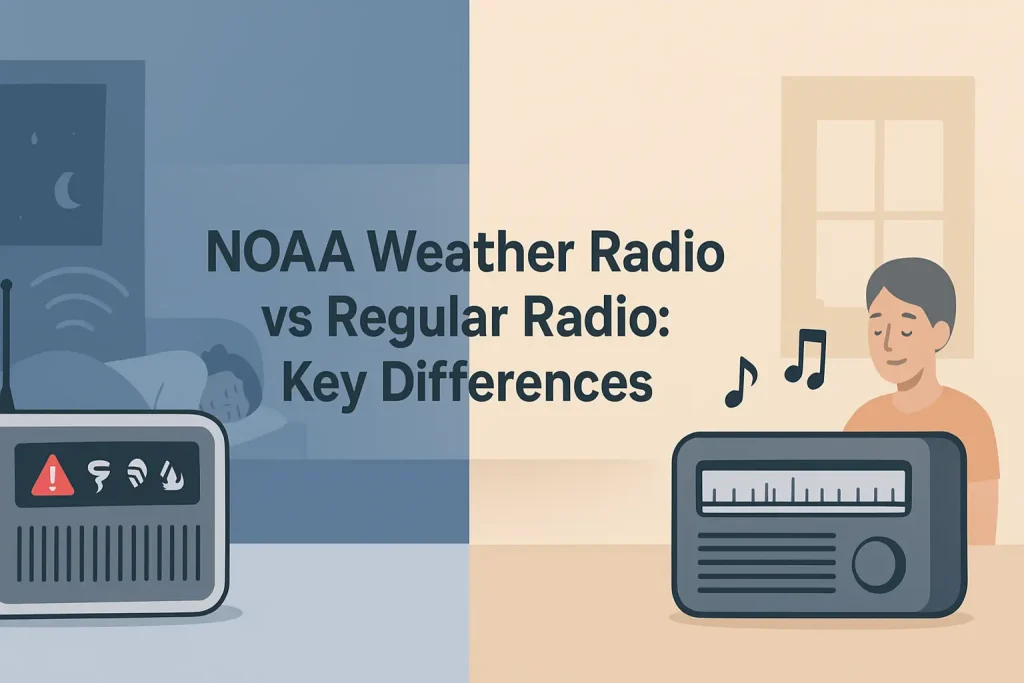
Florida sits in one of the most weather-vulnerable corridors in the United States. The state averages more than 100 tornadoes per year, leads the nation in lightning strikes, and faces direct hurricane threats from June through November. A NOAA weather alert radio tuned to the right local transmitter is the fastest way to receive life-safety warnings before cell towers and power lines go down.
This guide covers every active NOAA Weather Radio All Hazards (NWR) transmitter serving Miami, Tampa, and Orlando, including frequencies, call signs, coverage areas, and S.A.M.E. codes for county-level alert filtering.
| Photo | Popular Portable Walkie Talkies | Price |
|---|---|---|
 | SKIWARRIOR Multifunctional Smart Wireless Ski Goggles with Walkie-Talkie, Anti-Fog Zeiss Lens, Music & Call Function (Cylindrical Blue) | Check Price On Amazon |
 | SINORISE Super Mini Walkie Talkies, Two-Way Radios, 3 Pack | Up to 12 Hours Battery Life, for Baseball Coaches, Restaurants, Retail Stores, Hospitals, Outdoor Sports & Travel | Check Price On Amazon |
 | KOSPET Tank M4C Smart Watch Rugged, Dual-Band GPS, 5ATM & IP69K Waterproof | 1.96" AMOLED Display, 170+ Sport Modes, Built-in LED Flashlight/Walkie-Talkie, Heart Rate/Sleep Monitor for Android & iPhone | Check Price On Amazon |
 | Retevis RT15 Walkie Talkies 3 Pack, Birthday Gift, Outdoor Adventure Kit | Durable, Lightweight, VOX, Key Lock, Mini Walkie Talkies for Adults, School Family Outdoor Travel Camping Hiking | Check Price On Amazon |
 | Rechargeable Walkie Talkies Toys for Kids: DIY Astronaut Walkie Talkies for Boys Christmas Birthday Gifts for 3 4 5 6 7 8 9 10 Boy Walkie Talkie Outdoor Hiking Toy 2 Way Radio Camping Outdoor Game | Check Price On Amazon |
What Is the NOAA Weather Radio Network and How Does It Work in Florida?
NOAA Weather Radio All Hazards broadcasts continuous weather information and emergency alerts on seven dedicated VHF frequencies between 162.400 MHz and 162.550 MHz. The network is operated by the National Oceanic and Atmospheric Administration (NOAA) and covers approximately 95% of the U.S. population within reception range of a transmitter.
Florida’s geography creates specific challenges for NWR coverage. The state is flat, which aids signal propagation, but its peninsula shape means some coastal and rural areas require multiple overlapping transmitters to maintain reliable reception.
Each NWR transmitter broadcasts on one of seven designated frequencies. According to NOAA NWR documentation, those seven frequencies are 162.400 MHz (WX1), 162.425 MHz (WX2), 162.450 MHz (WX3), 162.475 MHz (WX4), 162.500 MHz (WX5), 162.525 MHz (WX6), and 162.550 MHz (WX7).
A weather radio without S.A.M.E. (Specific Area Message Encoding) technology receives every alert broadcast by the transmitter, which may cover dozens of counties. A S.A.M.E.-capable weather radio filters alerts using a 6-digit FIPS (Federal Information Processing Standard) code so only alerts for your specific county trigger the alarm.
Every Florida resident using a weather radio should program the S.A.M.E. code for their home county, not just tune to a frequency. Receiving an alert for a county 80 miles away at 3 a.m. is noise; receiving the alert for your county is life-safety information.
Florida NOAA Weather Radio Stations Serving Miami and South Florida
The Miami metropolitan area is covered primarily by NWR transmitter KHB35, which broadcasts on 162.550 MHz (WX7) from a site in Miami-Dade County. This transmitter serves Miami-Dade, Broward, and Monroe counties, including the Florida Keys, and is operated by the NWS Miami Weather Forecast Office.
South Florida’s unique geography, a narrow peninsula flanked by ocean on three sides, means signals from KHB35 propagate well over open water but can be partially attenuated in areas with dense high-rise construction in downtown Miami and Brickell.
KHB35 Miami Transmitter Details
KHB35 is the primary NWR station for the Greater Miami area. It broadcasts 24 hours a day and carries all National Weather Service Miami alerts including tropical cyclone warnings, tornado warnings, marine weather statements, and hazardous materials alerts.
Key Specifications:
- Call sign: KHB35
- Frequency: 162.550 MHz (WX7)
- Location: Miami-Dade County, Florida
- Primary counties covered: Miami-Dade, Broward, Monroe
- NWS office: National Weather Service Miami (NWS MFL)
- S.A.M.E. code, Miami-Dade County: 012086
- S.A.M.E. code, Broward County: 012011
- S.A.M.E. code, Monroe County: 012087
If you live in Broward County, program S.A.M.E. code 012011 into your weather radio so you receive only Broward alerts, not the full broadcast footprint that includes the Keys. This is especially important during hurricane season when alerts for different counties within the same broadcast area can differ significantly in urgency.
WXJ24 Fort Lauderdale Area Supplemental Coverage
WXJ24 provides supplemental NWR coverage for portions of Broward and Palm Beach counties on 162.425 MHz (WX2). It complements KHB35’s signal in areas where KHB35 reception is marginal, particularly in western Broward County near the Everglades agricultural areas.
Key Specifications:
- Call sign: WXJ24
- Frequency: 162.425 MHz (WX2)
- Primary counties covered: Broward (western portions), Palm Beach (southern portions)
- S.A.M.E. code, Palm Beach County: 012099
Residents in western Broward or southern Palm Beach County should program both 162.550 MHz and 162.425 MHz into a dual-channel Midland WR400 weather radio to ensure reception if one transmitter experiences a technical outage.
KIG64 Key West Coverage for Monroe County
KIG64 covers the Florida Keys from a transmitter located in Monroe County and broadcasts on 162.400 MHz (WX1). The Keys present a challenging coverage environment because of the linear geography of the island chain extending over 100 miles from the mainland.
Key Specifications:
- Call sign: KIG64
- Frequency: 162.400 MHz (WX1)
- Primary area: Monroe County (Florida Keys)
- S.A.M.E. code, Monroe County: 012087
Boaters and residents in the Lower Keys should verify reception from KIG64 in addition to KHB35, as marine alerts for the Straits of Florida and Florida Bay are critical safety information for anyone on the water.
Use the table below to identify the correct transmitter, frequency, and S.A.M.E. code for your South Florida county.
Frequency Reference
South Florida NOAA Weather Radio Stations by County
Primary transmitter, frequency, and S.A.M.E. FIPS code for each county. Source: NOAA NWR transmitter database, NWS Miami.
| County | Primary Station | Frequency | WX Channel | S.A.M.E. Code |
|---|---|---|---|---|
| Miami-Dade | KHB35 | 162.550 MHz | WX7 | 012086 |
| Broward | KHB35 | 162.550 MHz | WX7 | 012011 |
| Palm Beach | WXJ24 | 162.425 MHz | WX2 | 012099 |
| Monroe (Keys) | KIG64 | 162.400 MHz | WX1 | 012087 |
| Collier | WNG663 | 162.475 MHz | WX4 | 012021 |
| Hendry | WNG663 | 162.475 MHz | WX4 | 012051 |
S.A.M.E. codes are 6-digit FIPS county codes. Enter your county’s code into your weather radio’s S.A.M.E. programming to receive only local alerts. Source: NOAA NWR, FIPS County Code database.
Every South Florida resident should identify the primary NWR transmitter for their county and verify clear reception before hurricane season begins in June.
Florida NOAA Weather Radio Stations Serving Tampa Bay and West Central Florida
The Tampa Bay area is served by NWR transmitter KHB36, broadcasting on 162.400 MHz (WX1) from a site in Hillsborough County. KHB36 is operated by the National Weather Service Tampa Bay Area Weather Forecast Office (NWS TBW) and covers the core Tampa Bay metro area including Hillsborough, Pinellas, and Pasco counties.
Tampa Bay’s geography, with a large enclosed bay and low-lying coastal terrain, means this region faces significant storm surge risk during tropical systems. The NWS Tampa Bay office is one of the most active NWR broadcast offices in Florida during hurricane season.
KHB36 Tampa Transmitter Details
KHB36 is the primary NWR station for Tampa, St. Petersburg, and Clearwater. It operates continuously and carries tornado warnings, severe thunderstorm warnings, coastal flood advisories, storm surge warnings, and marine weather broadcasts for Tampa Bay and the Gulf of Mexico approaches.
Key Specifications:
- Call sign: KHB36
- Frequency: 162.400 MHz (WX1)
- Location: Hillsborough County, Florida
- Primary counties covered: Hillsborough, Pinellas, Pasco, Hernando (partial)
- NWS office: National Weather Service Tampa Bay Area (NWS TBW)
- S.A.M.E. code, Hillsborough County: 012057
- S.A.M.E. code, Pinellas County: 012103
- S.A.M.E. code, Pasco County: 012101
Pinellas County residents in St. Petersburg and Clearwater should program S.A.M.E. code 012103 specifically. Hillsborough and Pinellas often receive different alert levels during the same storm event because their coastal exposures differ significantly.
WXL58 Sarasota and Manatee County Coverage
WXL58 covers Sarasota and Manatee counties on 162.475 MHz (WX4). It is operated by NWS Tampa Bay and provides dedicated coverage for the barrier islands and coastal communities along this stretch of the Gulf Coast, including Siesta Key, Anna Maria Island, and Longboat Key.
Key Specifications:
- Call sign: WXL58
- Frequency: 162.475 MHz (WX4)
- Primary counties covered: Sarasota, Manatee
- S.A.M.E. code, Sarasota County: 012115
- S.A.M.E. code, Manatee County: 012081
The barrier island communities along Sarasota and Manatee counties are among the highest storm surge risk zones in all of Florida. A Uniden BC365CRS weather radio with battery backup is essential for residents in these areas, where power outages typically precede the most dangerous surge conditions by several hours.
KZZ80 Citrus, Levy, and Marion County Coverage
KZZ80 extends NWR coverage into the Nature Coast region of Florida, broadcasting on 162.500 MHz (WX5) from a transmitter serving Citrus, Levy, and portions of Marion County. This transmitter is critical for residents in lower-density rural areas where cellular infrastructure is sparse.
Key Specifications:
- Call sign: KZZ80
- Frequency: 162.500 MHz (WX5)
- Primary counties covered: Citrus, Levy, Marion (western portions)
- S.A.M.E. code, Citrus County: 012017
- S.A.M.E. code, Levy County: 012075
Use the table below to find the correct frequency and S.A.M.E. code for your Tampa Bay area county.
Frequency Reference
Tampa Bay Area NOAA Weather Radio Stations by County
Primary transmitter, frequency, and S.A.M.E. FIPS code for West Central Florida counties. Source: NOAA NWR, NWS Tampa Bay.
| County | Primary Station | Frequency | WX Channel | S.A.M.E. Code |
|---|---|---|---|---|
| Hillsborough | KHB36 | 162.400 MHz | WX1 | 012057 |
| Pinellas | KHB36 | 162.400 MHz | WX1 | 012103 |
| Pasco | KHB36 | 162.400 MHz | WX1 | 012101 |
| Manatee | WXL58 | 162.475 MHz | WX4 | 012081 |
| Sarasota | WXL58 | 162.475 MHz | WX4 | 012115 |
| Citrus | KZZ80 | 162.500 MHz | WX5 | 012017 |
Program your county S.A.M.E. code into your weather radio to receive county-specific alerts only. Source: NOAA NWR transmitter database, NWS Tampa Bay Area office.
Every Tampa Bay area household should have at least one battery-backup or hand-crank weather radio pre-programmed to their county’s S.A.M.E. code before the June 1 start of Atlantic hurricane season.
Florida NOAA Weather Radio Stations Serving Orlando and Central Florida
The Orlando metro area is served by NWR transmitter KHB34, which broadcasts on 162.400 MHz (WX1) from a transmitter site in Orange County. KHB34 is operated by the National Weather Service Melbourne Weather Forecast Office (NWS MLB), which covers the entire Central Florida region including the Interstate 4 corridor.
Central Florida is statistically one of the most active severe weather regions in the continental United States. The region averages more tornadoes per square mile than any other part of Florida, and the sea-breeze collision zone that forms daily over the peninsula produces intense afternoon thunderstorms from May through September.
KHB34 Orlando Transmitter Details
KHB34 broadcasts continuously and carries all NWS Melbourne alerts for Orange, Osceola, Lake, Seminole, and portions of Volusia County. The transmitter is a high-power site that provides strong signal coverage across the greater Central Florida metro area.
Key Specifications:
- Call sign: KHB34
- Frequency: 162.400 MHz (WX1)
- Location: Orange County, Florida
- Primary counties covered: Orange, Osceola, Lake, Seminole, Volusia (western)
- NWS office: National Weather Service Melbourne (NWS MLB)
- S.A.M.E. code, Orange County: 012095
- S.A.M.E. code, Seminole County: 012117
- S.A.M.E. code, Osceola County: 012097
- S.A.M.E. code, Lake County: 012069
Orange County and Seminole County residents in the Orlando metro area often experience different tornado warning polygons for the same storm. Programming both S.A.M.E. codes (012095 and 012117) into your radio ensures you receive alerts from either county boundary.
WXM81 Daytona Beach and Volusia County Coverage
WXM81 provides primary NWR coverage for Volusia County including Daytona Beach, broadcasting on 162.550 MHz (WX7). It is operated by NWS Melbourne and covers both the Atlantic coastal zone and the inland communities of central Volusia County.
Key Specifications:
- Call sign: WXM81
- Frequency: 162.550 MHz (WX7)
- Primary counties covered: Volusia, Flagler (partial)
- S.A.M.E. code, Volusia County: 012127
- S.A.M.E. code, Flagler County: 012035
Daytona Beach and the Volusia County beach corridor face both coastal flooding threats and inland tornado risk. A Sangean CL-100 weather radio with S.A.M.E. programming handles both alert types on the same receiver and is well-suited for the coastal Florida environment.
KZZ77 Ocala and North Central Florida Coverage
KZZ77 serves Marion County and surrounding north-central Florida counties on 162.525 MHz (WX6). It is operated by NWS Jacksonville and covers the Ocala area, including Ocala National Forest, where cellular coverage gaps make NWR reception especially important for outdoor recreationists.
Key Specifications:
- Call sign: KZZ77
- Frequency: 162.525 MHz (WX6)
- Primary counties covered: Marion, Alachua (southern portions), Sumter
- S.A.M.E. code, Marion County: 012083
- S.A.M.E. code, Sumter County: 012119
Use the table below to match your Central Florida county to its primary NWR transmitter, frequency, and S.A.M.E. code.
Frequency Reference
Central Florida NOAA Weather Radio Stations by County
Primary transmitter, frequency, and S.A.M.E. FIPS code for Central Florida counties. Source: NOAA NWR, NWS Melbourne and Jacksonville offices.
| County | Primary Station | Frequency | WX Channel | S.A.M.E. Code |
|---|---|---|---|---|
| Orange | KHB34 | 162.400 MHz | WX1 | 012095 |
| Seminole | KHB34 | 162.400 MHz | WX1 | 012117 |
| Osceola | KHB34 | 162.400 MHz | WX1 | 012097 |
| Lake | KHB34 | 162.400 MHz | WX1 | 012069 |
| Volusia | WXM81 | 162.550 MHz | WX7 | 012127 |
| Marion | KZZ77 | 162.525 MHz | WX6 | 012083 |
Multiple S.A.M.E. codes can be programmed into most weather radios simultaneously. If you live near a county border, program both adjacent counties. Source: NOAA NWR, FIPS County Code database.
Central Florida residents near county borders, particularly those near the Orange-Seminole line or the Lake-Osceola line, should program S.A.M.E. codes for both adjacent counties to avoid missing warnings that originate just across the boundary.
How to Program Your Florida Weather Radio for County-Specific S.A.M.E. Alerts
A S.A.M.E.-capable weather radio receives a digital header embedded in each NOAA broadcast that identifies which counties the alert applies to. When your radio’s programmed FIPS code matches the incoming alert header, the radio activates its alarm. Without this programming, the radio alarms for every county in the transmitter’s coverage footprint, which for large Florida transmitters can mean 5 to 10 counties.
This happens because NOAA encodes each alert with a 6-digit FIPS code string in the digital header preceding the audio broadcast. The S.A.M.E. decoder chip in your radio reads the header before the audio begins and compares it to your stored codes.
Step-by-Step Guide
How to Program S.A.M.E. County Codes into a Florida Weather Radio
5 steps, approximately 3 minutes. Applies to Midland, Uniden, and Sangean S.A.M.E. weather radios.
Locate your county FIPS S.A.M.E. code from the tables in this article
Each Florida county has a unique 6-digit FIPS code. Orange County is 012095, Hillsborough is 012057, and Miami-Dade is 012086. Write down the code for your county before touching your radio.
Tune to your local NWR frequency and confirm clear reception
Cycle through WX1 (162.400 MHz) through WX7 (162.550 MHz) until you hear a clear NOAA broadcast with no static. A clean signal before programming ensures your radio will receive encoded alert headers without decoding errors.
Enter the S.A.M.E. programming mode on your radio
On most Midland and Uniden weather radios, press and hold the “SAME” or “Program” button for 3 seconds until the display shows “FIPS” or a blinking code entry field. On Sangean models, navigate to the S.A.M.E. setup menu using the directional buttons.
Enter your 6-digit county FIPS code using the keypad
Enter each digit individually and confirm the display shows the correct 6-digit code before pressing Enter or Save. For Orange County (Orlando), enter 0-1-2-0-9-5. If you live near a county boundary, most S.A.M.E. radios accept 5 to 25 stored FIPS codes simultaneously.
Test your programming with a Public Test broadcast
NWS offices in Florida conduct weekly Wednesday test broadcasts. The test message is encoded with county S.A.M.E. headers. If your radio activates during the test, S.A.M.E. programming is working correctly. If it does not activate, recheck your entered FIPS code against the tables in this article.
If your radio does not alarm during the weekly NWS test broadcast, the most common cause is a transposed digit in the FIPS code, not a hardware failure. Recheck the code entry before replacing the radio.
Which Weather Radio Works Best for Florida Conditions?
The best weather radio for Florida is one with S.A.M.E. alert filtering, AC power with battery backup, and a loud alert tone audible over a window air conditioner or rain on a metal roof. A radio that only works when plugged in is a liability during the power outages that accompany the exact storms it is supposed to warn you about.
Florida’s humidity and proximity to saltwater also make enclosure quality a relevant factor. A radio stored in a garage or boat will degrade faster than one kept indoors in climate-controlled air.
Midland WR400 for Florida Home Use
The Midland WR400 is a desktop weather radio that supports up to 25 S.A.M.E. alert types and accepts up to 50 stored FIPS location codes, making it one of the most flexible options for Florida households near county boundaries or seasonal residents who split time between multiple Florida locations.
Key Specifications:
- S.A.M.E. alert types: 25 programmable
- FIPS code storage: Up to 50 county codes
- Power: AC adapter (included) with 6x AA battery backup
- Display: Backlit LCD with clock and alert log
- Alert memory: Stores last alert received for review after alarming
- Frequency coverage: 162.400 to 162.550 MHz (all 7 WX channels)
Uniden BC365CRS for Combination Scanning and Weather
The Uniden BC365CRS combines 500-channel scanning capability with a dedicated NOAA weather alert receiver, making it a practical choice for Florida residents who also want to monitor local public safety frequencies during hurricane evacuations or tornado emergencies.
Key Specifications:
- Scanner channels: 500 programmable
- Weather channels: All 7 NOAA WX channels with S.A.M.E.
- Alert type: Audible alarm with LCD alert display
- Power: AC power with 4x AA battery backup
- Scan rate: 100 channels per second
Midland ER310 for Portable and Evacuation Use
The Midland ER310 is a portable hand-crank and solar-charged emergency weather radio ideal for Florida hurricane evacuations, camping, or use in areas where power may be out for extended periods. It receives all 7 NWR channels with S.A.M.E. filtering and includes a 2000 mAh internal battery that charges via USB, solar panel, or hand crank.
Key Specifications:
- Internal battery: 2000 mAh lithium-polymer, rechargeable
- Charging options: USB-C, solar panel, hand crank
- Weather channels: All 7 NOAA WX channels with S.A.M.E.
- Additional bands: AM/FM radio
- Emergency features: LED flashlight, SOS beacon, phone charging via USB output
- Weight: Approximately 1.1 lbs
Use the table below to compare the top weather radio options for Florida home, portable, and combination-scanner use cases.
Product Comparison
Top Weather Radios for Florida – Specs Compared by Use Case
Key specifications compared across top picks for Florida conditions. Source: manufacturer data sheets, NOAA NWR compatibility documentation.
| Model | S.A.M.E. | Battery Backup | Portable | Scanner | Price Range |
|---|---|---|---|---|---|
| Midland WR400 | 25 types / 50 codes | 6x AA | No | No | $40-55 |
| Uniden BC365CRS | Yes / all 7 WX | 4x AA | No | 500 ch | $55-70 |
| Midland ER310 | Yes / all 7 WX | 2000 mAh Li | Yes | No | $45-65 |
| Sangean CL-100 | Yes / all 7 WX | 4x AA | No | No | $50-70 |
| Midland WR120 | Yes / basic | 3x AA | No | No | $25-35 |
| Kaito KA500 | Yes / all 7 WX | 1800 mAh Li | Yes | No | $50-65 |
Prices verified at time of publication. Battery backup capacity affects how long the radio operates during power outages. Portable models with hand crank or solar charging are recommended for hurricane evacuation kits. Source: manufacturer data sheets.
For Florida households, the right choice is a desktop S.A.M.E. radio with battery backup for the home and a portable hand-crank model in the emergency kit, not one radio trying to serve both roles.
Here is the seasonal timing widget, which maps Florida’s peak weather alert periods month by month so you can schedule testing, battery checks, and radio programming before each active season.
Seasonal Guide
Florida NOAA Weather Radio – Month-by-Month Preparedness Guide
When to test, charge, and reprogram your weather radio based on Florida’s seasonal hazard calendar. Source: NWS climate data, NOAA NWR All Hazards documentation.
Lower activity / Maintenance and review
Why Does Reception Quality Vary Across Florida, and How Can You Improve It?
NOAA NWR transmitters broadcast at 300 watts ERP (effective radiated power) on the VHF high band. VHF signals at 162 MHz propagate as line-of-sight waves, meaning physical obstructions between the transmitter antenna and your radio’s antenna directly reduce signal strength.
This happens because 162 MHz VHF signals do not diffract around large solid structures the way lower-frequency HF signals do. The signal travels in a straight line from transmitter to receiver, and any obstruction in that path causes attenuation, which is a reduction in signal amplitude.
In Central Florida and South Florida, the flat terrain means few geographic obstructions. However, residential construction materials, particularly concrete block walls and metal roofs common in Florida construction, can reduce indoor NWR signal strength by 10 to 20 dB, which is the equivalent of reducing the transmitter’s effective power by a factor of 10 to 100 indoors compared to outdoor reception.
If your weather radio struggles to maintain a clear signal indoors, the fastest fix is repositioning the radio closer to an exterior wall, near a window, or in an elevated location such as a second-story room facing the transmitter direction. A radio in the center of a concrete block home will always perform worse than the same radio on a windowsill.
For persistent reception problems, an external antenna connected via BNC or SMA adapter can dramatically improve performance. A simple outdoor VHF antenna mounted on the roof adds several dB of gain over the stock telescoping whip included with most desktop weather radios, extending reliable reception range from approximately 25 miles for an indoor radio to 40-60 miles for a properly installed outdoor antenna system.
If reception fails completely, the most common cause is not transmitter outage but a disconnected or collapsed telescoping antenna on the radio itself. Extend the antenna fully and orient it vertically before concluding the transmitter is down.
Florida NWS Weather Forecast Offices and Which Transmitters They Operate
Three National Weather Service Weather Forecast Offices (WFOs) share responsibility for NWR transmitters across Florida. Understanding which office covers your area helps when reporting reception problems or verifying that a specific transmitter is operational after a storm.
NWS WFOs do not just operate transmitters. They encode the S.A.M.E. headers, write the alert messages, and determine which county FIPS codes are included in each broadcast. A single storm can trigger separate alerts from two different WFOs if it crosses their county jurisdiction boundaries.
Use the table below to match your Florida region to the responsible NWS office and understand which transmitters they control.
Quick Reference
Florida NWS Forecast Offices and Their NWR Transmitter Responsibilities
Each office encodes and broadcasts NWR alerts for its county coverage area. Source: NOAA National Weather Service office directory.
| NWS Office | Code | Counties Covered | Primary Transmitters |
|---|---|---|---|
| NWS Miami | MFL | Miami-Dade, Broward, Monroe, Palm Beach, Collier, Hendry, Glades | KHB35, WXJ24, KIG64 |
| NWS Tampa Bay | TBW | Hillsborough, Pinellas, Pasco, Hernando, Citrus, Levy, Manatee, Sarasota, Charlotte, Lee | KHB36, WXL58, KZZ80 |
| NWS Melbourne | MLB | Orange, Osceola, Seminole, Lake, Volusia, Brevard, Indian River, St. Lucie, Okeechobee, Highlands | KHB34, WXM81 |
| NWS Jacksonville | JAX | Marion, Alachua, Clay, Duval, St. Johns, Flagler, Putnam, Nassau, Baker, Columbia, Suwannee and surrounding North FL counties | KZZ77 and North FL stations |
NWS office boundaries determine which office encodes your county’s S.A.M.E. alerts. If you live in a county served by two adjacent offices (e.g., near the TBW/MLB boundary), alerts may originate from either office depending on storm track. Source: NOAA NWS office directory, Weather.gov.
If you are unsure which NWS office serves your Florida county, the NOAA Weather.gov website maintains an interactive county lookup tool where you can enter any Florida zip code to identify your responsible WFO and the active NWR transmitters for your area.
What Alert Types Does Florida NOAA Weather Radio Broadcast?
NOAA Weather Radio All Hazards broadcasts more than just storm warnings. According to NOAA NWR documentation, the system transmits 73 different event types, covering natural hazards, technological hazards, national security alerts, and law enforcement bulletins. Florida NWR transmitters broadcast the full range of event types defined by the Emergency Alert System (EAS) and IPAWS (Integrated Public Alert and Warning System).
In Florida, the most operationally significant NWR alert types fall into five categories based on frequency of issuance and life-safety impact.
- Tropical cyclone alerts: Tropical Storm Watch, Tropical Storm Warning, Hurricane Watch, Hurricane Warning, Extreme Wind Warning, Storm Surge Watch, Storm Surge Warning. These are the most critical alerts for Florida coastal counties and are issued by the NWS National Hurricane Center in Miami.
- Severe convective weather alerts: Tornado Watch, Tornado Warning, Severe Thunderstorm Watch, Severe Thunderstorm Warning. Florida averages more than 100 tornadoes per year, and Central Florida’s I-4 corridor sees some of the highest tornado frequency of any metropolitan area in the nation.
- Flood alerts: Flash Flood Watch, Flash Flood Warning, Flood Watch, Flood Warning, Coastal Flood Advisory, Coastal Flood Watch, Coastal Flood Warning. Florida’s low topography and high annual rainfall (averaging 54 inches statewide) make flood alerts among the most frequently issued NWR event types.
- Marine weather alerts: Marine Weather Statement, Special Marine Warning, Gale Warning, Storm Warning, Hurricane Force Wind Warning. These are particularly critical for Floridians along the Gulf Coast, Atlantic Coast, and Florida Bay.
- Non-weather emergency alerts: Hazardous Materials Warning, Civil Emergency Message, AMBER Alert, Law Enforcement Warning, 911 Telephone Outage Emergency. Florida NWR transmitters carry all EAS-required non-weather IPAWS alerts in addition to NWS weather products.
A S.A.M.E. weather radio programmed with your county FIPS code will activate for all of these event types when they include your county in the alert header. You can further narrow which event types trigger your alarm by using the alert type programming feature on advanced radios like the Midland WR400, which allows you to select exactly which of the 25 alert types activate the audible alarm versus displaying silently on screen.
The most common programming mistake Florida residents make is activating the alarm for every single event type including marine statements and outlooks that are not life-threatening. This causes the radio to alarm so frequently that residents learn to ignore it, defeating the purpose entirely.
Common Florida Weather Radio Problems and How to Fix Them
The two most common weather radio failures in Florida are not hardware defects. They are programming errors: wrong frequency for the local transmitter and incorrect or absent S.A.M.E. codes. A radio that never alarms and one that alarms constantly are both useless, and both problems have the same root cause.
Below are the most frequent issues Florida weather radio users report and the specific fix for each.
Radio Alarms for Counties Far from My Location
This is the clearest sign that S.A.M.E. programming is absent or incorrect. Without a programmed FIPS code, the radio alarms for every county in the transmitter’s broadcast footprint, which for KHB35 in Miami includes Miami-Dade, Broward, and Monroe counties simultaneously.
The fix is to enter your specific county FIPS code using the tables in this article. For Miami-Dade, enter 012086. For Broward, enter 012011. For Monroe, enter 012087. The radio will then alarm only when that specific county code appears in the incoming alert header.
Radio Shows Static or No Signal on the Programmed Frequency
The first thing to check is the antenna. The telescoping whip on most desktop weather radios must be fully extended and positioned vertically for optimal VHF reception. A collapsed or missing antenna reduces effective gain by approximately 20 dB, which is enough to drop a clear signal to complete noise in typical Florida residential buildings.
If the antenna is extended and the signal remains poor, try cycling through all seven NWR frequencies (WX1 through WX7) to find the strongest signal from a nearby transmitter. In border areas between NWS coverage zones, a different transmitter on a different frequency may provide better reception than the one typically listed for your county.
Radio Does Not Alarm During Weekly NWS Test Broadcasts
NWS Florida offices transmit a Required Monthly Test (RMT) on the first Wednesday of each month and a Required Weekly Test (RWT) every Wednesday. If your radio does not activate during these tests, the most common cause is a single transposed digit in the stored FIPS code.
Compare your stored code digit by digit against the tables in this article. A code of 012068 instead of 012086 for Miami-Dade will never match an incoming alert, because the FIPS code verification is an exact string match, not an approximate one.
Radio Battery Drains Rapidly in Standby Mode
Most S.A.M.E. weather radios consume between 50 and 200 mA of standby current when operating on battery backup without AC power. At this draw rate, a set of 4 AA alkaline batteries (approximately 2800 mAh total) lasts between 14 and 56 hours depending on the radio model and ambient temperature.
Florida summer heat above 90 degrees Fahrenheit accelerates alkaline battery self-discharge. If your radio is in a vehicle or garage during summer months, replace the backup batteries with lithium AA cells, which maintain capacity more effectively above 85 degrees Fahrenheit and provide approximately 30% longer standby life than alkaline batteries in high-temperature environments. A set of lithium AA batteries is the correct choice for Florida weather radio battery backup applications.
Radio Receives Signal but Alert Alarm Volume Is Too Low to Wake Me
Most desktop weather radios have an alert alarm volume that is independent of the listening volume control. Check the alarm volume setting in the radio’s menu system, which is separate from the speaker volume knob. On Midland radios, the alarm volume is set under the “Alert” or “Alarm” menu option. On Uniden radios, it is typically labeled “Alert Volume” in the setup menu.
If the maximum alarm volume on your radio is still insufficient for your bedroom, consider placing the radio on a hard surface rather than a carpeted shelf, which amplifies the alarm tone through surface vibration. Alternatively, a bed-shaker accessory designed for weather radios provides a physical vibration alert for deep sleepers and those with hearing impairments.
A weather radio that cannot wake you is functionally equivalent to having no weather radio at all, so alarm volume is worth resolving before the next hurricane season.
Frequently Asked Questions About Florida NOAA Weather Radio Stations
What frequency should I program my weather radio to in Miami?
Miami-Dade County residents should tune to 162.550 MHz (WX7), which is the broadcast frequency of NWR transmitter KHB35. This is the primary NOAA Weather Radio station for Miami, Broward, and Monroe counties, operated by the National Weather Service Miami office. Program S.A.M.E. code 012086 for Miami-Dade County so your radio alarms only for local alerts.
What frequency does NOAA weather radio broadcast on in Tampa?
The Tampa Bay area is served by NWR transmitter KHB36 on 162.400 MHz (WX1). This transmitter covers Hillsborough, Pinellas, and Pasco counties and is operated by NWS Tampa Bay (NWS TBW). The S.A.M.E. code for Hillsborough County is 012057, Pinellas County is 012103, and Pasco County is 012101.
What NWR station and frequency covers Orlando?
Orlando and Orange County are served by NWR transmitter KHB34 on 162.400 MHz (WX1), operated by the National Weather Service Melbourne office (NWS MLB). The S.A.M.E. code for Orange County is 012095. Seminole County, which includes Altamonte Springs and Winter Springs, uses the same transmitter with S.A.M.E. code 012117.
Can I receive NOAA weather radio on a regular AM/FM radio?
No. NOAA Weather Radio broadcasts exclusively on seven VHF frequencies between 162.400 and 162.550 MHz. These frequencies are outside the standard AM broadcast band (535-1705 kHz) and FM broadcast band (87.8-108 MHz). You need a dedicated weather radio receiver or a scanner radio that covers the 162 MHz VHF range, such as the Uniden BC125AT handheld scanner.
What is a S.A.M.E. code and how is it different from just tuning to the weather radio frequency?
S.A.M.E. (Specific Area Message Encoding) is a digital coding system embedded in every NWR alert broadcast that identifies which specific counties the alert applies to. Tuning to the correct frequency receives the broadcast for all counties in that transmitter’s coverage area, which may be 5 to 10 counties. Programming your county’s 6-digit FIPS S.A.M.E. code tells the radio to activate its alarm only when an alert includes your specific county code in the broadcast header.
For a deeper explanation of how the S.A.M.E. system works and how to program it on specific radio models, the guide on how SAME technology filters county-level weather alerts covers the full encoding and decoding process.
What is the S.A.M.E. code for Broward County, Florida?
The S.A.M.E. FIPS code for Broward County, Florida is 012011. Enter this code into your weather radio’s S.A.M.E. programming to receive alerts specifically for Broward County from NWR transmitter KHB35 on 162.550 MHz. Broward County residents near the Palm Beach County line may also benefit from programming Palm Beach County code 012099 as a secondary FIPS entry.
Why does my weather radio alarm for alerts in other counties I do not live in?
A weather radio that has not been programmed with a S.A.M.E. FIPS code will alarm for every alert broadcast by the transmitter, regardless of which county it applies to. NWR transmitters in Florida cover multiple counties, so an unprogrammed radio near Miami will alarm for Miami-Dade, Broward, and Monroe county alerts simultaneously. Enter your specific 6-digit county FIPS code using the programming steps in this article to fix this immediately.
Do I need a separate weather radio for Miami versus one for Tampa or Orlando?
No. A single S.A.M.E.-capable weather radio can store multiple FIPS codes and scan all seven NWR frequencies. If you travel between Miami, Tampa, and Orlando, you can program all three county FIPS codes (012086 for Miami-Dade, 012057 for Hillsborough, 012095 for Orange) into one radio simultaneously. The radio will alarm for alerts in any of the three counties when tuned to the correct local frequency.
What is the difference between a Tornado Watch and a Tornado Warning on NOAA weather radio?
A Tornado Watch means atmospheric conditions are favorable for tornado development and you should monitor NWR broadcasts closely. A Tornado Warning means a tornado has been confirmed by radar or a trained spotter and is actively occurring or imminent in the warned counties. Tornado Warnings require immediate protective action, not continued monitoring. A S.A.M.E. radio programmed with your county code will alarm for both, but Tornado Warnings carry a different EAS event code (TOR) than Tornado Watches (TOA).
How far away can a NOAA weather radio transmitter reach in Florida?
NOAA NWR transmitters in Florida operate at 300 watts ERP on VHF frequencies between 162.400 and 162.550 MHz. Under typical Florida atmospheric conditions with a properly positioned antenna, most NWR transmitters provide reliable reception within 25 to 40 miles of the transmitter site. Florida’s flat terrain aids propagation compared to mountainous states. An outdoor roof-mounted VHF antenna can extend reliable reception to 40 to 60 miles from the transmitter.
Which NWS office is responsible for weather radio alerts in Orlando?
Orlando and the Central Florida I-4 corridor are the responsibility of the National Weather Service Melbourne Weather Forecast Office, designated NWS MLB. This office encodes and issues all NWR alerts for Orange, Osceola, Seminole, Lake, Volusia, Brevard, and several surrounding Central Florida counties. Their transmitters include KHB34 (Orlando) and WXM81 (Daytona Beach area).
Can a handheld walkie-talkie or GMRS radio receive NOAA weather radio broadcasts?
Standard FRS and GMRS handheld radios operate on frequencies between 462 and 467 MHz and cannot receive NOAA Weather Radio broadcasts at 162 MHz. However, some combination handheld radios include a dedicated weather band receiver. The Midland GXT1000 GMRS radio includes a weather channel receive-only feature that covers all seven NWR frequencies, though it does not include S.A.M.E. decoding capability. For full S.A.M.E. alert filtering, a dedicated weather radio is necessary.
Is there a way to listen to Florida NOAA weather radio online without a physical radio?
Yes. NOAA NWR broadcasts from Florida transmitters including KHB35 (Miami), KHB36 (Tampa), and KHB34 (Orlando) are available as live audio streams through online radio aggregators and the Broadcastify platform. For a full list of Florida NWR live stream sources by transmitter, the resource covering live NOAA weather radio streams organized by state provides direct links to Florida transmitter audio feeds.
What should I do if my Florida NOAA weather radio stops receiving a signal after a hurricane?
NWR transmitters are hardened emergency infrastructure, but they can lose power or sustain antenna damage during a direct hurricane strike. If your radio loses the local NWR signal after a storm, first confirm your antenna is extended and your radio is functional by scanning all seven WX channels. If no signal is found on any channel, try tuning to a transmitter from an adjacent coverage area, since nearby transmitters on different frequencies may still be operational and broadcasting alerts relevant to your county.
How do the seven NOAA weather radio frequencies differ from each other?
The seven NOAA NWR frequencies (162.400 through 162.550 MHz in 25 kHz steps) are not differentiated by alert type or priority. Each frequency is simply assigned to a specific transmitter or set of transmitters in a geographic region to prevent interference between adjacent coverage areas. In Florida, different transmitters use different frequencies so that Miami, Tampa, and Orlando signals do not overlap and cause co-channel interference. For a complete breakdown of all seven frequencies and their nationwide transmitter assignments, the article on all seven NOAA weather radio broadcast frequencies and their coverage assignments provides the full national frequency allocation table.
What to Know About NOAA Weather Radio Before Hurricane Season in Florida
A weather radio purchased but never programmed with a S.A.M.E. code is only marginally better than no weather radio at all. The goal is a radio that alarms specifically for your county, runs on battery backup when grid power fails, and has an alarm volume loud enough to wake you at night.
Florida residents should verify three things before June 1 each year: the correct NWR frequency for their county transmitter, their county FIPS S.A.M.E. code entered correctly into the radio, and fresh batteries installed in the backup slot. The NWS Wednesday test broadcast confirms all three in one step. If the radio alarms on Wednesday, it is ready.
For those new to weather radio technology, the guide explaining how the NOAA Weather Radio All Hazards network functions covers the full broadcast system from transmitter to alert activation in straightforward terms. For residents checking how Florida’s transmitters compare to other states, the complete resource on NOAA weather radio station listings organized by every state provides call signs, frequencies, and coverage maps for the entire national NWR network.
A properly programmed S.A.M.E. weather radio with battery backup is the most reliable early-warning tool available to Florida residents because it works when cell towers are overloaded, internet service is down, and power is out. Those are exactly the conditions a hurricane produces in the hours before and after landfall.
| Photo | TOP RATED WALKIE TALKIES | Price |
|---|---|---|
 | Retevis RT628 Kids Walkie Talkies, Toys Gifts for 4-12 Year Old Girl Boy | Kids Camping Essentials Outdoor Toys, Birthday Gift, 22CH, VOX, Keypad Lock, Durable, Easy to Use Walkie Talkies for Kids | Check Price On Amazon |
 | Cobra ACXT545 Weather-Resistant Walkie Talkies, Rechargeable, 22 Channels | Long Range 28-Mile Two-Way Radio Set (2-Pack) | Check Price On Amazon |
 | Retevis RT388 Kids Walkie Talkies, Outdoor Toys for Kids Camping Essentials | 4-12 Year Old Boy Birthday Gift, 22 CH VOX Flashlight Clear Sound, Kids Walkie Talkies 2 Pack for Camping Hiking Adventure | Check Price On Amazon |
 | Cobra RX680 Walkie Talkies (2-Pack), IP54 Water Resistant Design | Rugged & Splashproof Two Way Radios Long Range, 60 Pre-Programmed Channels, Weather Alerts | Check Price On Amazon |
 | Retevis RT22 Walkie Talkies Long Range Rechargeable with Earpiece (2 Pack) | Slim & Lightweight 2 Way Radio For Camping & Hiking, Pocket-Friendly Antenna, Ready to Use, 10-Hour Battery, USB-C Charging | Check Price On Amazon |
 | Midland GXT1000VP4 GMRS Two-Way Radios with Headsets, Black, 2 Pack | 50 Channels, 142 Privacy Codes, Up to 36 Mile Long Range, JIS4 Water Resistant, NOAA Weather Alert, Rechargeable NiMH | Check Price On Amazon |
 | Retevis RT628 Walkie Talkies for Kids,Toys Gifts for 6-12 Years Old Boys Girls,Long Range 2 Way Radio 22CH VOX,Birthday Gift,Family Walkie Talkie for Camping Hiking Indoor Outdoor | Check Price On Amazon |