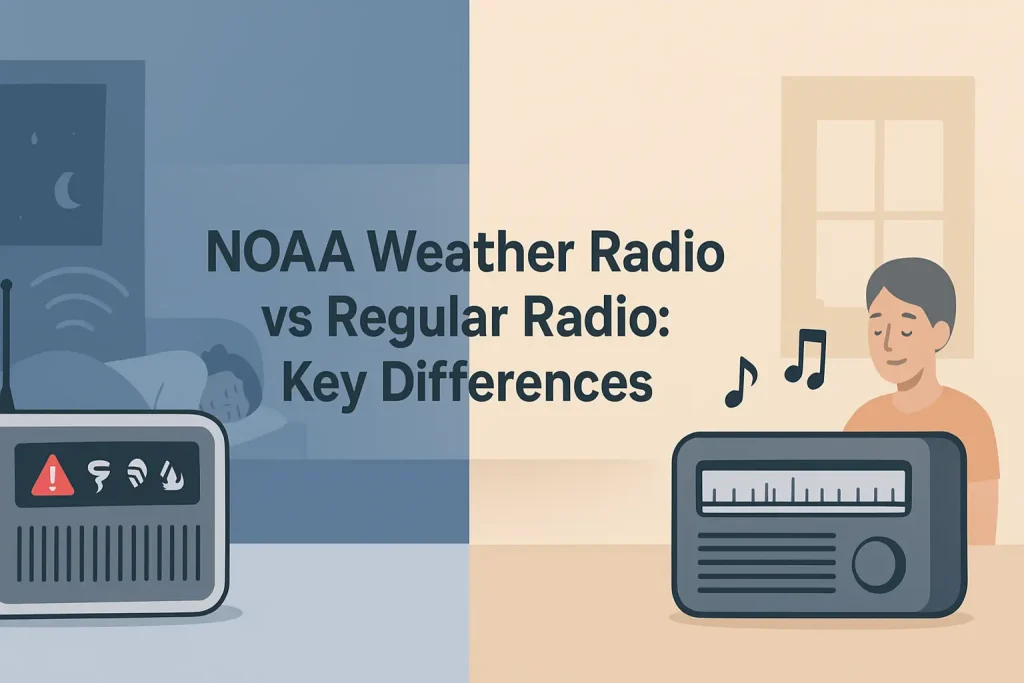
A GMRS radio with NOAA weather alert capability does two jobs at once: it lets you communicate with your group on 462-467 MHz and wakes you up when the National Weather Service issues a warning for your area. The catch is that not every GMRS radio includes a working NOAA receiver, and the ones that do vary significantly in how well that receiver actually performs.
This article covers how the NOAA alert system works inside a GMRS radio, which frequencies it monitors, what S.A.M.E. filtering does, and what to look for when choosing a GMRS radio that genuinely delivers reliable weather alerts.
| Photo | Popular Portable Walkie Talkies | Price |
|---|---|---|
 | SKIWARRIOR Multifunctional Smart Wireless Ski Goggles with Walkie-Talkie, Anti-Fog Zeiss Lens, Music & Call Function (Cylindrical Blue) | Check Price On Amazon |
 | SINORISE Super Mini Walkie Talkies, Two-Way Radios, 3 Pack | Check Price On Amazon |
 | KOSPET Tank M4C Smart Watch Rugged, Dual-Band GPS, 5ATM & IP69K Waterproof | Check Price On Amazon |
 | Retevis RT15 Walkie Talkies 3 Pack, Birthday Gift, Outdoor Adventure Kit | Check Price On Amazon |
 | Rechargeable Walkie Talkies Toys for Kids: DIY Astronaut Walkie Talkies for Boys Christmas Birthday Gifts for 3 4 5 6 7 8 9 10 Boy Walkie Talkie Outdoor Hiking Toy 2 Way Radio Camping Outdoor Game | Check Price On Amazon |
What Is NOAA Weather Radio and How Does It Broadcast Alerts?
NOAA Weather Radio All Hazards (NWR) broadcasts continuous weather information on seven dedicated VHF frequencies between 162.400 MHz and 162.550 MHz, covering approximately 95% of the US population within 40 miles of a transmitter. These are not the same frequencies your GMRS radio uses for voice communication.
According to NOAA’s National Weather Service documentation, the seven broadcast frequencies are 162.400 MHz, 162.425 MHz, 162.450 MHz, 162.475 MHz, 162.500 MHz, 162.525 MHz, and 162.550 MHz. Each transmitter serves a specific geographic region, and your radio needs to be tuned to the transmitter closest to your location for reliable reception.
The NWR system operates under the Emergency Alert System (EAS), which is managed jointly by NOAA, FEMA, and the FCC. When the National Weather Service issues a warning, a digital alert signal is encoded and broadcast on the NWR frequency covering the affected area. A GMRS radio with a built-in weather receiver decodes that signal and activates its alert alarm.
The broadcast is continuous, 24 hours a day, seven days a week. It includes current conditions, forecasts, and emergency alerts for all hazards, not just severe weather. AMBER Alerts, civil emergencies, and hazardous materials incidents can all trigger an NWR broadcast.
The NWR transmitter network consists of more than 1,000 transmitters across all 50 states, US territories, and adjacent areas of Canada and Mexico. Most transmitters operate at 300 watts, with a typical coverage radius of 40 miles over flat terrain. Terrain obstructions reduce that coverage significantly, which is why some rural or mountainous areas require a closer transmitter or a more sensitive receiver to get reliable alerts.
Understanding what the NWR system actually broadcasts is the foundation for understanding why some GMRS radios with weather receivers are genuinely useful and others are not.
How Does a GMRS Radio Receive NOAA Weather Alerts?
A GMRS radio receives NOAA weather alerts through a secondary VHF receiver built into the radio, separate from its primary UHF GMRS transceiver. The GMRS radio itself operates on 462-467 MHz (UHF), while NOAA broadcasts on 162.400-162.550 MHz (VHF high band). These are two completely different frequency ranges, and the radio needs two separate receiver circuits to handle both.
This happens because VHF signals in the 162 MHz range and UHF signals in the 462 MHz range propagate differently and require different antenna and circuit tuning. A single antenna optimized for 462 MHz performs poorly at 162 MHz, which is why budget GMRS radios with weather capability sometimes have weak NOAA reception despite strong GMRS performance.
The weather receiver in a GMRS radio works in one of two modes. In the first mode, the radio actively monitors the selected NOAA channel in the background while remaining active on its GMRS channels. In the second mode, the radio enters a low-power standby state and wakes only when it detects the 1050 Hz alert tone that precedes every NWR emergency broadcast.
This only occurs correctly when the radio is programmed to the right NOAA channel for your region. If you leave the radio on a channel covering a different geographic area, you will miss local alerts and receive alerts for counties hundreds of miles away.
If the radio is set to scan all seven NOAA channels rather than locking to one, it will catch alerts from multiple transmitters. However, scanning introduces a short delay because the radio must cycle through each channel before it lands on the active alert. For time-critical warnings like tornado alerts, a dedicated single-channel lock is more reliable than a seven-channel scan.
The Midland GXT1000VP4 GMRS radio includes a dedicated weather alert mode that locks to your local NWR frequency and sounds an audible alarm with the alert type displayed on screen.
Key Specifications:
- GMRS frequency range: 462.5625-467.7125 MHz (30 channels)
- NOAA weather channels: 7 (162.400-162.550 MHz)
- Max power output: 5W (GMRS, FCC Part 95E)
- Battery: 1000 mAh rechargeable NiMH
- Weather alert mode: audible alarm with channel scan or channel lock
The key performance factor is whether the NOAA receiver in your GMRS radio includes S.A.M.E. decoding, which is covered in the next section.
What Is S.A.M.E. and Why Does It Matter for GMRS Weather Alerts?
S.A.M.E. stands for Specific Area Message Encoding. It is a digital protocol that encodes each NWR alert with a six-digit FIPS (Federal Information Processing Standard) code identifying the specific county or geographic area the alert applies to. A GMRS radio with S.A.M.E. decoding will only trigger its alarm when the alert matches the county codes you have programmed into the radio.
Without S.A.M.E. filtering, your GMRS radio sounds an alarm for every alert broadcast on your local NWR frequency, regardless of where the hazard is located. A single NWR transmitter may cover parts of 10 to 20 counties. Without S.A.M.E., you get alerted for all of them.
According to NOAA’s NWR technical documentation, the S.A.M.E. header is broadcast as a data burst before every alert. It contains the alert type code, the affected FIPS location codes, the valid time period, and the issuing office. A radio with a S.A.M.E. decoder reads this header before activating the alarm.
The practical difference is significant. A family in suburban Chicago programming their GMRS radio with their county’s FIPS code will only be awakened for alerts affecting their immediate area, not for every severe thunderstorm watch issued across northern Illinois and southern Wisconsin covered by the same transmitter.
S.A.M.E. codes are six digits. The first digit is always 0 for a county subdivision. The next two digits are the state FIPS code. The last three digits are the county FIPS code. For example, the code for Cook County, Illinois is 017031.
The Motorola T800 GMRS radio supports NOAA weather alerts but does not include S.A.M.E. decoding, which means it alarms for all alerts on the monitored frequency.
Key Specifications:
- GMRS channels: 22 (FRS/GMRS shared + GMRS-only)
- NOAA weather channels: 7
- S.A.M.E. decoding: No
- Max power output: 5W (GMRS)
- Battery life: approximately 9 hours at 5/5/90 duty cycle
If you plan to use weather alerts overnight or in a sleep environment, a GMRS radio without S.A.M.E. will produce false alarms for distant events. S.A.M.E. filtering is the single most important weather alert feature to check before buying a dual-purpose GMRS radio.
Which GMRS Radios Include NOAA Weather Alerts and S.A.M.E. Decoding?
Most mid-range and premium GMRS handhelds include a NOAA weather receiver. Far fewer include S.A.M.E. decoding. The distinction is meaningful: a NOAA receiver without S.A.M.E. is a general weather monitor, while a receiver with S.A.M.E. is a targeted emergency alert system for your specific location.
Use the table below to compare GMRS radios by NOAA weather alert capability, S.A.M.E. support, and power output.
| Model | NOAA Channels | S.A.M.E. Decoding | Max Power (W) | GMRS Channels | IP Rating | Price (approx.) |
|---|---|---|---|---|---|---|
| Midland GXT1000VP4 | 7 | No | 5W | 50 | Water resistant | ~$60 pair |
| Midland T71VP3 | 7 | No | 2W | 22 | Water resistant | ~$45 pair |
| Motorola T800 | 7 | No | 5W | 22 | IPX4 | ~$110 pair |
| Uniden SX507-2CKHS | 7 | No | 5W | 50 | Water resistant | ~$65 pair |
| Midland X-Talker T300VP3 | 7 | No | 0.5W (FRS) | 22 | None | ~$30 pair |
| Cobra ACXT1035R FLT | 7 | No | 5W | 22 | Floats/water resistant | ~$90 pair |
Power output per FCC Part 95E. GMRS channels include shared FRS/GMRS and GMRS-only channels. Prices verified at time of publication and are approximate street prices for a two-radio pack.
Note that S.A.M.E. decoding is largely absent from GMRS handhelds as a category. Dedicated weather radios like the Midland WR400 desktop weather radio include S.A.M.E. decoding as a core feature, while GMRS radios treat NOAA reception as a secondary add-on. If S.A.M.E. filtering is a priority, the most reliable approach is pairing a GMRS handheld with a separate dedicated weather radio rather than relying on a combined unit.
The best GMRS radio for weather alerts is the one with the most sensitive VHF receiver, not necessarily the most powerful GMRS transmitter. These are independent specifications, and manufacturers rarely advertise receiver sensitivity for the weather band.
How to Set Up NOAA Weather Alerts on a GMRS Radio: Step by Step
Setting up NOAA weather alerts on a GMRS radio requires selecting the correct NWR frequency for your location and, if your radio supports it, programming S.A.M.E. codes for your county. The process takes under five minutes on most models once you know your local NWR frequency.
Here is a step-by-step guide based on the process for most Midland and Motorola GMRS handhelds:
Step-by-Step Guide
How to Enable NOAA Weather Alerts on a GMRS Radio
6 steps · Estimated time: 5 minutes · Applies to most Midland and Motorola GMRS handhelds
Find your local NWR transmitter frequency
Visit the NOAA NWR station listing at weather.gov/nwr and search by state or county. Note the broadcast frequency (one of the seven between 162.400 and 162.550 MHz) for the transmitter closest to your location.
Access the weather channel menu on your radio
On most Midland GMRS radios, press and hold the Weather button until the WX channel number appears on the display. On Motorola models, press the Menu button and scroll to the Weather Channel option using the up/down keys.
Select the channel number corresponding to your local frequency
WX1 = 162.550 MHz, WX2 = 162.400 MHz, WX3 = 162.475 MHz, WX4 = 162.425 MHz, WX5 = 162.450 MHz, WX6 = 162.500 MHz, WX7 = 162.525 MHz. Match the frequency you found in Step 1 to the correct WX channel number and select it.
Enable Weather Alert mode (not just Weather Monitor mode)
Weather Monitor plays the live NWR broadcast audio continuously. Weather Alert mode puts the radio in standby and triggers an audible alarm only when the 1050 Hz alert tone is detected. For overnight or hands-free use, select Weather Alert mode, not Weather Monitor mode.
Test reception before relying on the setup
Switch to Weather Monitor mode and confirm you can hear a clear NWR broadcast on your selected channel. If reception is weak or staticky, try the adjacent WX channel in case a neighboring transmitter on a different frequency covers your area better.
Confirm battery level before leaving in alert mode overnight
Weather Alert mode draws minimal current in standby, but some GMRS radios will trigger false low-battery alarms that override the weather alert function. Start with a fully charged battery or use a radio connected to AC power when monitoring overnight.
The most common setup error is leaving the radio in Weather Monitor mode instead of Weather Alert mode, which drains the battery and produces continuous audio instead of a standby alarm. Correct setup means the radio is silent until an actual alert is broadcast.
What Alert Types Does NOAA Broadcast on Weather Radio Frequencies?
The NOAA Weather Radio All Hazards network broadcasts more than 70 distinct alert types, not just severe weather warnings. A GMRS radio set to Weather Alert mode will trigger for any alert broadcast on the monitored NWR frequency, including alerts that have nothing to do with weather.
According to FEMA’s Integrated Public Alert and Warning System (IPAWS) documentation, the NWR network carries alerts in the following major categories:
- Tornado Warning: Tornado observed or indicated by radar. Highest priority alert. Typically valid for 30-60 minutes.
- Severe Thunderstorm Warning: Thunderstorm producing winds over 58 mph or hail 1 inch or larger in diameter is occurring or imminent.
- Flash Flood Warning: Flash flooding is occurring or imminent in the specified area. One of the most underestimated hazards in the NWR alert system.
- Hurricane Warning: Sustained winds of 74 mph or higher expected within 36 hours associated with a hurricane.
- Winter Storm Warning: Hazardous winter conditions expected, including heavy snow, ice, or blizzard conditions.
- Hazardous Materials Warning: Hazardous chemical release posing a public risk. Issued by local emergency management, not NWS.
- Civil Emergency Message: Broadcast for non-weather emergencies such as evacuations, infrastructure failures, or armed threat situations.
- AMBER Alert: Child abduction emergency issued by law enforcement. Broadcast on NWR in many regions.
- Evacuation Immediate: Issued when an area must be evacuated due to an imminent threat. Can be weather or non-weather.
- National Information Center: Presidential-level alert for national emergencies. Highest-level EAS alert category.
Your GMRS radio in Weather Alert mode does not distinguish between these alert types unless it has S.A.M.E. decoding. Without S.A.M.E., it alarms for all of them, across all counties covered by the transmitter. With S.A.M.E., it alarms only for the event types and locations you have programmed.
Some dedicated weather radios let you filter by event type in addition to location, so you can program the radio to only alarm for Tornado Warnings and Flash Flood Warnings and ignore less urgent broadcasts. This level of filtering is not available in any current GMRS handheld. A dedicated weather radio like the Uniden BC365CRS weather alert radio provides both S.A.M.E. location filtering and alert type filtering, which a GMRS radio cannot match.
For the broadest alert coverage with the most precise filtering, the reliable setup is a dedicated weather radio for alerts and a GMRS radio for two-way communication, not a single combined device.
What Is the Difference Between Weather Alert Mode and Weather Monitor Mode on a GMRS Radio?
Weather Monitor mode and Weather Alert mode are two distinct operating states on a GMRS radio’s weather receiver, and using the wrong one will either drain your battery or cause you to miss an alert. Weather Monitor mode outputs the live NWR audio broadcast continuously through the speaker, exactly like a conventional weather radio in receive mode. Weather Alert mode puts the weather receiver in a low-power standby state and activates only when the radio detects the 1050 Hz Emergency Alert Tone that precedes every NWR emergency broadcast.
This happens because the 1050 Hz tone is a standardized attention signal encoded into every NWR emergency transmission, as defined in NOAA’s NWR technical specifications. The weather receiver circuit in a GMRS radio is tuned to detect this specific tone and trigger the radio’s alarm function when it is present.
Weather Monitor mode uses approximately the same current as normal receive operation, typically 150-300 mA depending on the radio. Weather Alert mode in standby uses significantly less current, often under 50 mA, because the main audio circuitry is powered down and only the tone detection circuit remains active.
This only occurs correctly when the radio is tuned to a frequency that actually carries NWR broadcasts. If the radio is tuned to a NOAA channel that is not in use by a transmitter in your area, it will sit in standby indefinitely without ever triggering an alert, even if a warning is issued for your county.
If the radio is left in Weather Monitor mode overnight, the battery will typically be depleted within 6-12 hours depending on the radio’s receive current draw. Fix this by switching to Weather Alert mode before extended monitoring periods.
The practical rule: use Weather Monitor mode when you want to actively listen to the NWR broadcast (checking current conditions before a camping trip, for example). Use Weather Alert mode when you want passive background monitoring with an audible alarm for emergencies.
Can a GMRS Radio Replace a Dedicated NOAA Weather Radio?
A GMRS radio cannot fully replace a dedicated NOAA weather radio for home emergency preparedness. The NOAA receiver in a GMRS handheld is designed as a secondary feature with a simpler VHF receiver circuit. A dedicated weather radio like the Midland WR400 NOAA weather radio or the Uniden Bearcat weather alert radio with S.A.M.E. includes a more sensitive VHF receiver, S.A.M.E. county filtering, alert type selection, AC power with battery backup, and a larger speaker optimized for alarm volume.
Use the table below to compare GMRS radios with a weather receiver against dedicated weather radios across the features that matter most for emergency alerts.
| Feature | GMRS Radio with Weather | Dedicated Weather Radio |
|---|---|---|
| NOAA channels | 7 (162.400-162.550 MHz) | 7 (162.400-162.550 MHz) |
| S.A.M.E. county filtering | Rarely included | Standard feature |
| Alert type filtering | Not available | Available on many models |
| AC power with battery backup | Battery only | AC + battery backup standard |
| Alarm volume | Radio speaker (small) | Dedicated alarm speaker |
| VHF receiver sensitivity | Secondary circuit | Primary circuit, more sensitive |
| Two-way GMRS communication | Yes (up to 5W, 462-467 MHz) | No |
| Portable / field use | Yes | Desktop models only |
| Price range | $40-120 per pair | $30-80 per unit |
Dedicated weather radio specifications based on Midland WR400 and Uniden BC365CRS. GMRS radio specifications based on Midland GXT1000VP4 and Motorola T800. Source: manufacturer data sheets, NOAA NWR technical documentation.
The correct answer to whether a GMRS radio can replace a dedicated weather radio depends entirely on your use case. For field use during camping, hiking, or outdoor events where you already carry GMRS radios, the built-in weather receiver provides useful situational awareness. For home emergency preparedness where you need reliable overnight alerting with county-specific filtering, a dedicated weather radio with S.A.M.E. and AC backup is the more reliable solution.
If you want to understand the full range of dedicated weather radio options available before making this decision, the guide covering how to choose the right weather radio for your home and emergency kit covers S.A.M.E. filtering, battery backup types, and receiver sensitivity in detail.
How Does GMRS Licensing Affect Weather Alert Use?
Using the NOAA weather receiver on a GMRS radio does not require an FCC GMRS license. Receiving is always legal under FCC rules. The license requirement under FCC Part 95E applies only to transmitting on GMRS frequencies, which are 462.5625 MHz through 467.7125 MHz.
According to FCC Part 95E, Section 95.391, any person may operate a GMRS radio to receive transmissions, including NOAA weather broadcasts on 162.400-162.550 MHz. A GMRS license is required only to transmit on GMRS channels. The license costs $35 for a 10-year term and covers the licensee’s entire immediate family under a single authorization.
This distinction matters practically. A family that purchases a pair of GMRS radios for the weather alert feature alone is not required to obtain a license if they never transmit on GMRS channels. However, the moment anyone presses the push-to-talk button and transmits on a GMRS frequency without a license, they are operating in violation of FCC Part 95E.
The FCC enforces GMRS licensing through its enforcement bureau. Violations can result in fines starting at $10,000 per incident for willful violations. The $35 license fee is a small cost compared to the risk of operating without authorization.
One practical complication arises when GMRS radios are also capable of transmitting on FRS channels (channels 1-22 in the 462-467 MHz range shared between FRS and GMRS). Transmitting on shared FRS/GMRS channels at 2 watts or less does not require a license under FCC Part 95E, Section 95.361. Transmitting on GMRS-only channels (channels 15-22 above 2W, and repeater input/output frequencies) requires a license regardless of power level.
If you are using your GMRS radio primarily for weather monitoring and occasional short-range family communication on shared FRS/GMRS channels at 2 watts or less, you are operating within the unlicensed FRS rules. If you want to use full 5-watt GMRS power or access GMRS repeaters, get the license before transmitting.
The bottom line: the weather alert feature works without a license. The GMRS transmitter requires one.
What Affects NOAA Weather Alert Reception Quality on a GMRS Radio?
NOAA weather alert reception quality on a GMRS radio depends on four factors: distance from the NWR transmitter, terrain obstructions between the radio and the transmitter, the sensitivity of the radio’s VHF receiver circuit, and the antenna design. These factors operate independently, and a weakness in any one of them can produce unreliable alerts even if the other three are favorable.
NWR transmitters operate at up to 300 watts on VHF frequencies. VHF signals in the 162 MHz range propagate as line-of-sight waves with limited ability to diffract around terrain. This means a mountain range, large hill, or dense urban canyon between your location and the transmitter will attenuate the signal in the same way it would attenuate a GMRS transmission.
The receiver sensitivity of a GMRS radio’s weather band circuit is typically not published in product specifications. Dedicated weather radios specify receiver sensitivity in microvolts, which allows direct comparison. GMRS radio manufacturers rarely disclose this figure. The practical way to assess reception quality is to test the radio at your specific location using Weather Monitor mode and evaluate audio clarity.
Antenna design is the second hardware factor. Most GMRS handhelds use a single antenna optimized for the 462-467 MHz UHF band. The same antenna performs less efficiently at 162 MHz because the wavelength is significantly longer. At 162 MHz, a quarter-wave monopole antenna would need to be approximately 18 inches long, compared to approximately 6 inches for 462 MHz. The rubber duck antenna on a GMRS handheld is a compromise that works across both ranges but is not optimized for either.
Holding the radio near a window or elevating it to a higher floor of a building typically improves NWR reception because it reduces structural attenuation and increases effective line-of-sight distance to the transmitter. This applies equally to GMRS radios and dedicated weather radios.
If your location has marginal NWR coverage, a dedicated desktop weather radio with an external antenna connection may receive signals that a GMRS handheld cannot. The Midland WR120 desktop NOAA weather radio includes an external antenna jack that allows connection of a longer VHF antenna to improve reception in fringe coverage areas.
Reliable weather alert reception on a GMRS radio requires confirming clear audio on your local NWR channel before depending on the radio for emergency alerts, not just assuming the feature works because it is listed in the specifications.
Using a GMRS Radio with NOAA Weather Alerts in the Field
A GMRS radio with weather alert capability is most useful in field scenarios where you are already carrying the radio for group communication and need incidental weather monitoring without carrying a second device. Camping, hiking, outdoor events, and backcountry travel are the primary use cases where the combined function delivers genuine value.
In a field scenario, the typical workflow is to leave one radio in Weather Alert mode at a base camp or staging area while other radios in the group are used for active communication. The alert radio monitors the NWR channel passively and sounds an alarm if a warning is issued, giving the group advance notice to take shelter or change plans.
The limitation in this setup is battery life. A GMRS radio used for active group communication on a full day of hiking will typically consume most of its battery on GMRS transmit and receive operations. Leaving it in Weather Alert standby overnight requires enough remaining battery to sustain the alert detection circuit until morning.
The Midland GXT1000VP4 GMRS radio pair includes a 1000 mAh NiMH battery pack. At 5/5/90 duty cycle (5% transmit, 5% receive, 90% standby), rated battery life is approximately 10 hours. In Weather Alert standby mode only, current draw is lower, extending standby time significantly.
For multi-day trips, carrying spare AA lithium batteries as a backup power source is the most practical approach for GMRS radios that support alkaline or lithium AA operation as an alternative to the rechargeable pack. Lithium primary cells perform better than alkaline in cold temperatures, which is relevant for mountain camping or winter use.
NWR reception range in the field is not the same as at home. NWR transmitters typically cover 40 miles over flat terrain, but terrain obstructions in mountainous or heavily forested areas can reduce effective range to 10-15 miles. Before departing for a backcountry location, check the NOAA NWR coverage map at weather.gov/nwr to confirm your destination is within coverage range of a transmitter.
If your field location is outside NWR coverage range entirely, the weather alert feature on your GMRS radio will not function. In that situation, a Garmin inReach satellite messenger or similar satellite-connected device provides weather alert capability independent of NWR coverage.
For most camping and hiking situations within 40 miles of a populated area, the GMRS weather alert function works reliably and provides a useful safety layer without adding a second device to your kit.
Common Problems with NOAA Weather Alerts on GMRS Radios and How to Fix Them
The most common failure with NOAA weather alerts on GMRS radios is the alert never triggering despite severe weather in the area. This is almost always caused by one of four problems: wrong NWR channel selected, radio in Monitor mode instead of Alert mode, weak NWR signal at the radio’s location, or low battery preventing the alert circuit from functioning.
Problem: Wrong NWR Channel Selected
Most GMRS radios default to WX1 (162.550 MHz) when you first access the weather function. WX1 is the most widely used NWR frequency, but it may not be the transmitter closest to your location. If you are not within range of a WX1 transmitter, the radio will sit in standby without receiving any signal and will never trigger an alert.
Fix this by checking the NOAA NWR station list at weather.gov/nwr for the transmitter serving your county, then manually selecting the correct WX channel number on your radio as described in the setup steps above.
Problem: Radio Left in Weather Monitor Mode Instead of Alert Mode
Weather Monitor mode is the default on many GMRS radios because it is the first option listed in the weather menu. It plays continuous NWR audio rather than triggering a standby alarm. Leaving a radio in Monitor mode will deplete the battery within hours and provides no alert function when you are not actively listening.
Fix this by navigating past the Monitor option to the Alert option in your radio’s weather menu. Confirm the radio goes silent (no continuous audio output) after you select Alert mode, which indicates it is in standby rather than active receive.
Problem: Weak or Inaudible NWR Signal
If the radio plays weak, staticky audio in Weather Monitor mode, the NWR signal at your location is marginal. This can cause the alert detection circuit to miss the 1050 Hz alert tone, resulting in missed alerts even when a warning is issued.
Fix this by trying adjacent WX channel numbers to find a stronger transmitter. Moving the radio to a window, elevated position, or outdoor location may also improve signal. If no NWR channel provides clear audio reception, the GMRS radio’s weather alert function is not reliable at that location, and a dedicated weather radio with an external antenna connection should be used instead.
Problem: Alert Triggered for Distant Counties (No S.A.M.E.)
If your GMRS radio does not include S.A.M.E. decoding, it will alarm for every alert broadcast on the NWR frequency, including alerts for counties far outside your area. This produces frequent false alarms and can cause users to disable the weather alert function entirely, eliminating the safety benefit.
The fix is to supplement your GMRS radio’s weather monitoring with a dedicated weather radio that includes S.A.M.E. filtering. Program the dedicated weather radio with your county’s FIPS code for county-specific alerts, and use the GMRS radio’s weather function as a general backup only.
Problem: No Alert During Overnight Monitoring Due to Low Battery
Some GMRS radios disable the weather alert circuit when the battery voltage drops below a threshold, typically around 20-30% remaining charge, to prevent incomplete or distorted alarm operation. If the radio’s battery is low when you activate overnight Weather Alert mode, the alert may not trigger even if a warning is issued.
Fix this by always starting overnight monitoring with a fully charged battery. For AC-powered permanent installations, a GMRS radio with an external power input or a charging cradle that maintains charge while in standby mode eliminates this problem entirely.
Diagnosing and fixing these four problems covers the vast majority of weather alert failures reported with GMRS handhelds, and all of them are solvable without any hardware replacement.
GMRS vs FRS vs Dedicated Weather Radio: Which Combination Is Right for You?
The right combination of two-way radio and weather alert capability depends on your primary use case and whether you need licensed GMRS power and repeater access or unlicensed FRS operation with simpler functionality. Use the table below to understand which combination of features applies to each scenario.
| Scenario | Best Radio Setup | Weather Alert Method | License Required | Approx. Cost |
|---|---|---|---|---|
| Home emergency preparedness only | Dedicated weather radio | S.A.M.E. + AC backup | No | $30-80 |
| Family camping, under 2 miles range | FRS radio with weather | NOAA alert mode (no S.A.M.E.) | No | $30-60/pair |
| Hiking or trail use, 2-5 miles range | GMRS handheld 5W | NOAA alert mode on one radio | Yes ($35 GMRS) | $60-120/pair + $35 |
| Home prep + field use combined | GMRS radios + dedicated WX radio | Dedicated S.A.M.E. + GMRS backup | Yes ($35 GMRS) | $100-180 total |
| Extended range with repeater access | GMRS handheld + mobile | NOAA on handheld + dedicated WX | Yes ($35 GMRS) | $150-400 total |
| Marine or boating use | Marine VHF + weather radio | NWR on marine VHF WX channels | MMSI registration | $100-300 |
GMRS license fee per current FCC Part 95E schedule: $35 for 10-year family license. FRS unlicensed use per FCC Part 95E, Section 95.361. Marine VHF weather channel access is a receive-only function; transmitting on marine VHF requires compliance with FCC Part 80.
For most readers who already own or plan to buy GMRS radios, the most practical setup is a 5-watt GMRS handheld with weather alert mode for field use and a dedicated S.A.M.E. weather radio at home for overnight alerting. The two devices cost less than $200 combined and cover both use cases more reliably than a single combined device could.
If you are evaluating the full range of dedicated weather radio options alongside your GMRS purchase, the reviews of the top-rated NOAA weather radios for home and emergency use compare S.A.M.E. decoding capability, battery backup options, and receiver sensitivity across the most popular desktop and portable models.
For those interested in how marine VHF radios handle NOAA weather channels differently from GMRS handhelds, how marine VHF weather channels work and which frequencies to monitor covers the WX channel designations, DSC integration, and Coast Guard weather broadcast protocols that differ from the NWR system used in GMRS radios.
Frequently Asked Questions About GMRS Radio with NOAA Weather Alerts
Do I need a GMRS license to use the NOAA weather alert feature on my radio?
You do not need a GMRS license to use the weather alert receiving function on a GMRS radio. Receiving transmissions on any frequency is always legal under FCC rules. The GMRS license requirement under FCC Part 95E applies only when you transmit on GMRS frequencies in the 462-467 MHz range.
If you use the radio exclusively to monitor NOAA weather broadcasts on 162.400-162.550 MHz and never press the push-to-talk button to transmit on a GMRS channel, no license is required. The $35 FCC GMRS license becomes mandatory the moment you begin transmitting on any GMRS-designated frequency.
What is the difference between the seven NOAA weather channels on my GMRS radio?
The seven NOAA weather channels (WX1 through WX7) correspond to seven specific VHF broadcast frequencies: WX1 = 162.550 MHz, WX2 = 162.400 MHz, WX3 = 162.475 MHz, WX4 = 162.425 MHz, WX5 = 162.450 MHz, WX6 = 162.500 MHz, and WX7 = 162.525 MHz. Each frequency is used by specific NWR transmitters at specific geographic locations across the country.
Selecting the correct channel is not about the channel number itself but about which NWR transmitter is closest to your location. Two transmitters in different regions of the country can both broadcast on WX1 (162.550 MHz). The NOAA NWR station finder at weather.gov/nwr lists the correct frequency for your county. You should lock to that one channel rather than scanning all seven, because scanning introduces a delay that may cause you to miss the beginning of a critical alert.
Why does my GMRS radio alarm for weather alerts from counties far away from me?
Your GMRS radio is alarming for distant counties because it does not include S.A.M.E. (Specific Area Message Encoding) decoding. Without S.A.M.E., the radio triggers its alarm for every alert broadcast on the monitored NWR frequency, regardless of which county the alert covers. A single NWR transmitter typically covers 10-20 counties, so a radio without S.A.M.E. will alert you for all of them.
S.A.M.E. decoding is rarely included in GMRS handheld radios. If filtered county-specific alerts are important to you, the most reliable solution is to pair your GMRS radio with a dedicated weather radio that includes S.A.M.E. programming. You can program the dedicated weather radio with your county’s six-digit FIPS code so it only alarms for warnings affecting your specific area.
Can I use my GMRS radio to monitor NOAA weather while also communicating on GMRS channels?
Whether you can simultaneously monitor NOAA and remain active on GMRS channels depends on your specific radio model. Some GMRS radios implement a dual-watch or priority scan function that alternates between the active GMRS channel and the selected NWR channel at regular intervals. Others require you to choose one mode or the other, with the weather function temporarily suspending GMRS operation.
On radios without true simultaneous dual-watch, the practical workaround in a group setting is to designate one radio in the group for weather monitoring in Weather Alert mode and keep the remaining radios active on GMRS channels for communication. This provides both functions without compromising either.
What is the maximum range for receiving NOAA weather alerts on a GMRS handheld radio?
NWR transmitters operate at up to 300 watts on VHF frequencies in the 162 MHz range, with a typical coverage radius of 40 miles over flat terrain. A GMRS handheld radio’s built-in weather receiver can generally receive NWR signals within that 40-mile radius, provided there are no significant terrain obstructions between the radio and the transmitter.
In mountainous terrain or heavily forested areas, effective reception range may be reduced to 10-20 miles. Holding the radio near a window or elevating it above terrain features typically improves reception. If you are in an area with marginal NWR coverage, a dedicated weather radio with an external antenna connection provides better receiver sensitivity than a GMRS handheld’s secondary VHF circuit.
Why does my GMRS radio not receive any NOAA weather signal even though I am in a populated area?
The most common reason is that the radio is tuned to the wrong NWR channel. Most GMRS radios default to WX1 (162.550 MHz), which may not be the frequency used by the transmitter closest to your location. The second common reason is that the radio is in a location with significant signal attenuation, such as a basement, concrete building interior, or location surrounded by terrain features that block line-of-sight to the transmitter.
Fix this by looking up your local NWR transmitter frequency at weather.gov/nwr, switching the radio to that channel, and testing in Weather Monitor mode with the radio positioned near a window or in an elevated outdoor location. If signal quality is still poor after trying all seven WX channels, your location may be on the edge of NWR transmitter coverage and a dedicated weather radio with a higher-gain antenna will perform better than the GMRS handheld.
Can a GMRS radio receive NOAA alerts and also work as a ham radio for weather frequencies?
A standard GMRS radio operates only on GMRS/FRS frequencies (462-467 MHz) and the seven NOAA weather receive frequencies (162.400-162.550 MHz). It cannot transmit or receive on amateur radio weather net frequencies, which typically operate on VHF 2-meter band (144-148 MHz) or UHF 70-centimeter band (420-450 MHz). These are different frequency ranges requiring a separate amateur radio transceiver and an FCC amateur radio license.
Some dual-band amateur radios like the Baofeng UV-5R can be programmed to receive the NOAA weather frequencies as a secondary function alongside amateur radio operation, but they are not type-accepted for GMRS use. For more information on how ham radio operators use dedicated weather net frequencies alongside NOAA monitoring, the overview of ham radio frequencies used for weather spotting and storm net operations explains the Skywarn net structure and which VHF/UHF frequencies are active in most regions.
How do I find my county’s S.A.M.E. FIPS code for programming a weather radio?
Your county’s S.A.M.E. FIPS code is a six-digit number formatted as a leading zero followed by the two-digit state FIPS code and the three-digit county FIPS code. You can find the complete list of S.A.M.E. FIPS codes for all US counties on the NOAA NWR website at weather.gov/nwr under the S.A.M.E. programming section. The list is searchable by state and county name.
For example, Harris County, Texas has the S.A.M.E. code 048201. When programming a dedicated weather radio, entering this code tells the S.A.M.E. decoder to only activate the alarm when an alert is issued that includes this code in its header. You can program multiple codes if you want alerts for adjacent counties in addition to your home county.
Is the weather alert feature on a GMRS radio reliable enough for tornado warnings?
The NOAA weather alert feature on a GMRS radio is reliable enough for tornado warnings under two conditions: the radio has clear reception on the correct NWR channel, and the radio is in Weather Alert mode with a charged battery before the storm event. The NWR system itself is extremely reliable, with lead times for tornado warnings typically ranging from 8-13 minutes according to NOAA performance data. The GMRS radio’s alert function will trigger within seconds of the 1050 Hz alert tone reaching the receiver.
The main limitation for tornado warning reliability is the absence of S.A.M.E. decoding in most GMRS handhelds. Without S.A.M.E., the radio alarms for all tornado warnings across the NWR transmitter’s coverage area, not just warnings for your county. For overnight emergency use in tornado-prone regions, a dedicated weather radio with S.A.M.E. filtering and AC power backup is more reliable than a GMRS handheld.
Can I use the NOAA weather channel on my GMRS radio on a boat?
You can use the NOAA weather receive function on a GMRS handheld on a boat, but a marine VHF radio is the correct and legally required communication device for maritime use. Marine VHF radios also receive NOAA weather channels (labeled WX1-WX9 on marine radios), and they include Digital Selective Calling (DSC) capability for distress signaling on Channel 16 (156.800 MHz), which a GMRS radio cannot provide.
A GMRS handheld does not replace a marine VHF radio for boating purposes under FCC Part 80 rules. It can supplement a marine VHF radio for on-board group communication, but the marine VHF radio should remain the primary communications device for any vessel operating on navigable waters. The article on how marine VHF weather channels differ from NOAA broadcast channels covers the specific WX channel frequencies monitored by marine radios and the DSC emergency protocol that GMRS radios cannot replicate.
Why does my GMRS radio sound a weather alert alarm even when the weather is fine?
A weather alarm when conditions appear normal is almost always caused by one of two things: the radio is receiving an alert for a distant county (meaning the alert is real but not relevant to your location), or the radio is receiving interference on the NWR channel that is being interpreted as an alert tone. Both produce alarm triggers that appear false from your local perspective.
The most common cause is the first: a warning is legitimately issued somewhere within the NWR transmitter’s 40-mile coverage radius, and your radio, lacking S.A.M.E. filtering, alarms for it. The fix is S.A.M.E. decoding on a dedicated weather radio. If the alarm appears to trigger randomly and not in patterns consistent with actual weather events, test the radio in Weather Monitor mode and listen for clear NWR audio. Persistent static or interference may be causing spurious alarm triggers, in which case switching to an adjacent NWR frequency that provides a cleaner signal will eliminate the false alarms.
What NOAA weather radio frequencies does my GMRS radio actually monitor?
A GMRS radio with weather capability monitors all seven NOAA Weather Radio All Hazards broadcast frequencies: 162.400 MHz, 162.425 MHz, 162.450 MHz, 162.475 MHz, 162.500 MHz, 162.525 MHz, and 162.550 MHz. These are the only frequencies used by the NWR network in the United States, as allocated by the FCC for government weather broadcasts. You can read more about all seven of these frequencies and which transmitters use them by visiting the full overview of NOAA weather radio broadcast frequencies and which channel to use in your region.
The radio can monitor these frequencies in one of three ways: locked to a single selected channel, scanning all seven channels sequentially, or in standby alert mode on a single channel. Single-channel lock is the recommended configuration for reliable alert detection because it eliminates the scan delay and maximizes the chance of detecting the complete alert tone sequence.
Do all GMRS radios come with NOAA weather alert capability?
Not all GMRS radios include NOAA weather alert capability. Entry-level and basic GMRS handhelds from budget manufacturers often include only GMRS/FRS channels with no weather receiver. Mid-range models from Midland, Motorola, and Cobra typically include the NOAA weather receive function as a standard feature. Premium models rarely add S.A.M.E. decoding, which remains primarily a feature of dedicated weather radios.
Before purchasing a GMRS radio expecting weather alert capability, confirm the product specifications explicitly state NOAA weather alert or NWR alert function. “Weather resistant” in a product name refers to an IP or splash-resistance rating for the radio’s housing, not a weather broadcast receiving function. These two things are entirely different and the terminology is frequently confused in product listings.
For a comprehensive overview of what NOAA Weather Radio All Hazards is, how the NWR transmitter network operates, and what types of radios receive it beyond just GMRS handhelds, the full primer on what NOAA weather radio is and how the alert system works covers the EAS structure, IPAWS integration, and the difference between weather monitoring and weather alerting in detail.
Conclusion
A GMRS radio with NOAA weather alert capability monitors all seven NWR frequencies between 162.400 and 162.550 MHz and triggers an alarm when the 1050 Hz alert tone is broadcast, giving you advance warning of severe weather without carrying a second device.
The key limitations are the near-universal absence of S.A.M.E. county filtering in GMRS handhelds and the secondary quality of the VHF receiver circuit compared to a dedicated weather radio. For field use and camping within 40 miles of an NWR transmitter, the GMRS weather alert function works reliably. For home overnight alerting with county-specific filtering, pair your GMRS radio with a dedicated weather radio like the Midland WR400 with S.A.M.E. decoding.
Start by confirming your local NWR channel frequency at weather.gov/nwr, setting your radio to Weather Alert mode rather than Weather Monitor mode, and testing reception with a fully charged battery before you need the alert in a real emergency.
| Photo | TOP RATED WALKIE TALKIES | Price |
|---|---|---|
 | Retevis RT628 Kids Walkie Talkies, Toys Gifts for 4-12 Year Old Girl Boy | Check Price On Amazon |
 | Cobra ACXT545 Weather-Resistant Walkie Talkies, Rechargeable, 22 Channels | Check Price On Amazon |
 | Retevis RT388 Kids Walkie Talkies, Outdoor Toys for Kids Camping Essentials | Check Price On Amazon |
 | Cobra RX680 Walkie Talkies (2-Pack), IP54 Water Resistant Design | Check Price On Amazon |
 | Retevis RT22 Walkie Talkies Long Range Rechargeable with Earpiece (2 Pack) | Check Price On Amazon |
 | Midland GXT1000VP4 GMRS Two-Way Radios with Headsets, Black, 2 Pack | Check Price On Amazon |
 | Retevis RT628 Walkie Talkies for Kids,Toys Gifts for 6-12 Years Old Boys Girls,Long Range 2 Way Radio 22CH VOX,Birthday Gift,Family Walkie Talkie for Camping Hiking Indoor Outdoor | Check Price On Amazon |