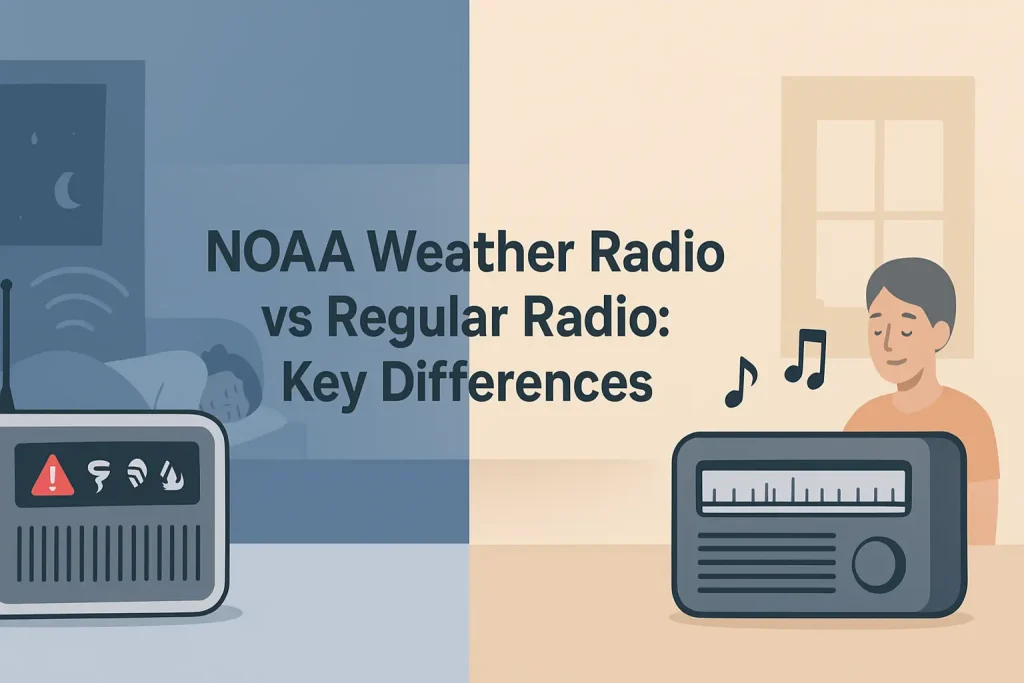
Your smartphone can receive Wireless Emergency Alerts (WEA) for tornado warnings, flash floods, and AMBER Alerts. But that does not mean it can reliably replace a dedicated NOAA Weather Radio. A weather radio operates on seven dedicated VHF frequencies between 162.400 and 162.550 MHz, independent of cellular networks. When the storm knocks out power and cell towers, a battery-powered weather radio still delivers the alert.
Smartphones rely on a functioning cellular or Wi-Fi connection. In a widespread emergency, networks become congested or fail. The Federal Emergency Management Agency (FEMA) recommends every household have a battery-powered NOAA Weather Radio as a primary alert source. This article compares the two devices and helps you decide whether you need a separate weather radio.
| Photo | Popular Portable Walkie Talkies | Price |
|---|---|---|
 | SKIWARRIOR Multifunctional Smart Wireless Ski Goggles with Walkie-Talkie, Anti-Fog Zeiss Lens, Music & Call Function (Cylindrical Blue) | Check Price On Amazon |
 | SINORISE Super Mini Walkie Talkies, Two-Way Radios, 3 Pack | Check Price On Amazon |
 | KOSPET Tank M4C Smart Watch Rugged, Dual-Band GPS, 5ATM & IP69K Waterproof | Check Price On Amazon |
 | Retevis RT15 Walkie Talkies 3 Pack, Birthday Gift, Outdoor Adventure Kit | Check Price On Amazon |
 | Rechargeable Walkie Talkies Toys for Kids: DIY Astronaut Walkie Talkies for Boys Christmas Birthday Gifts for 3 4 5 6 7 8 9 10 Boy Walkie Talkie Outdoor Hiking Toy 2 Way Radio Camping Outdoor Game | Check Price On Amazon |
By the Numbers
NOAA Weather Radio Key Coverage and Alert Statistics
Sources: NOAA NWR, FCC Part 11, FEMA IPAWS
What Your Smartphone Can Do for Emergency Alerts
Smartphones receive Wireless Emergency Alerts (WEA) sent by authorized government agencies. These include tornado warnings, flash flood warnings, and AMBER Alerts. WEA messages are short 90-character texts that appear on your lock screen and sound a distinctive alert tone. They do not require any app installation and work on all modern phones.
However, WEA delivery depends on your phone being connected to a cell tower that is operational. In severe weather, cell towers can be damaged by high winds, flooding, or power loss. The alert may not reach your phone if the local tower is down. Additionally, WEA messages are not targeted to a specific county; they go out to all phones in the affected geographic area, which can cover multiple counties.
What a Dedicated Weather Radio Offers That Your Phone Cannot
A NOAA Weather Radio receives broadcasts 24 hours a day on seven VHF frequencies. It does not depend on cellular networks or internet connectivity. The radio’s 1050 Hz attention tone triggers a loud alert even when the radio is in standby mode. This tone is recognized by the radio’s internal decoder and will sound for any National Weather Service warning.
Weather radios with S.A.M.E. (Specific Area Message Encoding) technology can filter alerts to only your programmed county or counties. Your smartphone’s WEA system cannot do this; it alerts for the entire alert polygon, which often includes multiple counties. A S.A.M.E.-equipped weather radio prevents unnecessary middle-of-the-night wakeups for storms that are not a threat to your location.
Additionally, a weather radio can operate on battery power for days. Most models accept standard AA batteries or have rechargeable battery packs. If you lose power for extended periods, a Midland ER310 emergency weather radio with hand crank and solar charging keeps you informed without any external power source.
Weather Radio vs. Smartphone: Side-by-Side Comparison
Use the table below to decide whether a dedicated weather radio or your smartphone is the more reliable alerting tool for your situation.
Product Comparison
Weather Radio vs Smartphone Alerts – Side by Side
Key specs compared. Sources: NOAA NWR, FCC, FEMA.
| Specification | Dedicated Weather Radio | Smartphone with WEA |
|---|---|---|
| Alert trigger | 1050 Hz tone + NWR broadcast | WEA cell broadcast |
| Frequency band | 162.400-162.550 MHz VHF | Cellular (4G/5G) 700-2500 MHz |
| S.A.M.E. filtering | Yes (programmable county codes) | No (area-wide polygon) |
| Power source | AC + battery backup (AA or rechargeable) | Phone battery only |
| Reliability during outage | Works when cell towers down | Fails if tower down or network congested |
| Price | $25-80 for a basic S.A.M.E. radio | $0-$1200 (phone already owned) |
| Our verdict | Best for targeted, always-on alerts | Best for mobile alerts on the go |
Power limits per FCC Part 95E. License fee current as of publication.
Understanding S.A.M.E. Technology and Why It Matters
S.A.M.E. (Specific Area Message Encoding) uses 6-digit FIPS codes to identify individual counties. When you program your county’s code into a weather radio, you will only receive alerts for that county. This is a critical feature for people living in areas where severe weather is frequent but often misses their specific location.
Without S.A.M.E., a weather radio will sound for every alert issued anywhere within the transmitter’s coverage area, which can span dozens of counties. The result is that you may be awakened repeatedly for storms that are 50 miles away and not a threat. The S.A.M.E. technology in weather radios eliminates this problem entirely.
Programming your county’s FIPS code takes only a few minutes on most weather radios. Once set, the radio ignores all alerts except those with your code. This is why emergency managers and the National Weather Service strongly recommend a S.A.M.E.-capable radio over a basic weather radio that cannot filter by location.
When Is a Weather Radio Necessary?
A dedicated weather radio is necessary if you live in an area prone to severe weather such as tornadoes, hurricanes, or flash floods. It is also essential if you are in a rural area where cell service is spotty or during situations where you are without power for extended periods. A battery-powered weather radio will keep working when your phone’s battery is dead.
If you live in an urban area with reliable cell coverage and are rarely without power, your smartphone may suffice for daytime alerts. However, at night when you are sleeping, your phone may be in Do Not Disturb mode or on silent. A weather radio sitting on your nightstand with its alert tone at full volume will wake you when a tornado warning is issued for your county.
How to Set Up a Weather Radio for Your County
Setting up a NOAA weather radio involves locating the correct FIPS code for your county and programming it into the radio. Visit the NOAA NWR county listing website or use the radio’s built-in search function to find your 6-digit code. For a Midland WR400, you press Menu, select S.A.M.E. Set, and enter the code.
After programming, set the radio to the strongest local NOAA frequency. You can find your nearest transmitter by checking the NOAA coverage map or using the radio’s auto-scan feature. Keep the radio plugged into AC power with fresh backup batteries installed. Test the alert reception by pressing the radio’s test button during a clear weather day.
Can I use my phone as a weather radio?
You cannot turn a standard smartphone into a true NOAA Weather Radio receiver. Phones lack the VHF receiver hardware needed to pick up the 162.400-162.550 MHz broadcasts. Apps that claim to stream NOAA Weather Radio content rely on an internet connection and do not receive the S.A.M.E. alert tones that trigger a dedicated radio’s alarm.
Some apps can play NOAA weather broadcasts, but they do not activate the 1050 Hz attention tone automatically when a warning is issued. They also stop working if cellular data or Wi-Fi is unavailable. A dedicated weather radio remains the only device that reliably captures the alert tone and wakes you from sleep during an emergency.
Do weather radios work when the power is out?
Yes, most weather radios operate on battery power for days during a power outage. They typically use four to six AA batteries or a rechargeable battery pack, providing 24-72 hours of continuous monitoring. Models like the Midland ER310 add a hand crank and solar panel to recharge the internal battery indefinitely without grid power.
AC-powered models without battery backup stop working during an outage. Always choose a model with battery backup capability. Keep fresh alkaline batteries installed and test them every three months to ensure you are ready for a multi-day power loss.
What is the difference between a weather radio and a regular AM/FM radio?
A regular AM/FM radio receives commercial broadcast stations and does not cover the seven NOAA VHF weather frequencies. It cannot decode S.A.M.E. alerts or automatically sound an alarm for severe weather. A weather radio is a dedicated receiver tuned exclusively to the 162.400-162.550 MHz band with a tone alert decoder.
Some combination radios include a weather band, but they often lack the automatic alert feature. A true weather radio sits silently in standby until a 1050 Hz tone triggers its alarm. It then broadcasts the voice warning. An AM/FM radio playing music will not switch itself to a weather broadcast unless you manually tune it.
Will a weather radio wake me up for a tornado warning?
Yes, a properly programmed NOAA Weather Radio will sound a loud 1050 Hz tone followed by the tornado warning voice message. The tone is designed to be unmistakable and to cut through sleep. Radios with S.A.M.E. filtering will only trigger for your specific county, so you are not awakened for distant warnings.
Place the weather radio in your bedroom or wherever you sleep. Set the alert volume high enough to wake you. Some models include a bright strobe light for hearing-impaired users. The alarm is far more effective than a smartphone’s WEA tone, which can be easily silenced or missed when the phone is in do-not-disturb mode.
Is a weather radio required by law?
No federal law requires private citizens to own a weather radio. FEMA and the National Weather Service strongly recommend one as part of an emergency preparedness kit. Some local ordinances in tornado-prone areas may require schools, nursing homes, and public buildings to have NOAA Weather Radios on site.
For individuals, it is a voluntary preparedness step. However, if you live in a mobile home or in an area without reliable outdoor warning sirens, a weather radio becomes a practical necessity. It is the most reliable way to receive immediate severe weather warnings indoors, especially during overnight hours.
How much does a good weather radio cost?
A good S.A.M.E.-capable weather radio costs between $25 and $80. The Midland WR120 is around $30 and includes 25 programmable S.A.M.E. codes and a battery backup compartment. Higher-end models like the Uniden BC365CRS add a scanner and FM radio for about $70.
There is no monthly fee for receiving NOAA Weather Radio broadcasts. The only recurring cost is replacing batteries periodically. For people who want a portable, hand-crank model, the RunningSnail solar hand crank weather radio costs under $30 and works without any grid power or batteries.
Can I listen to weather radio on a walkie-talkie?
Most FRS and GMRS walkie-talkies cannot receive NOAA Weather Radio frequencies because they are designed for the 462-467 MHz UHF band. The NOAA frequencies are in the VHF band at 162.400-162.550 MHz, which requires a different receiver front-end. Some dual-band ham radios and certain GMRS models include a weather band receive-only feature.
If your walkie-talkie has a weather band mode, you can listen to broadcasts but you will not get automatic S.A.M.E. alert activation. It is a passive listening tool, not an alarm. For full alert capability, a dedicated weather radio is necessary.
What happens if I don’t program S.A.M.E. codes?
Without S.A.M.E. codes programmed, your weather radio will sound for every alert issued within its reception range. This can mean dozens of alerts per month, many for counties 50 miles away. The constant false alarms lead to alert fatigue, and you may start ignoring the radio or turning it off.
S.A.M.E. programming eliminates this by filtering alerts to only your chosen counties. It takes about five minutes to set up using the NOAA FIPS code list. Once programmed, you will only be woken for threats directly affecting your location, making the radio a trusted rather than an annoying device.
Are there weather radios that also work as a power bank?
Some emergency weather radios include a USB power bank function, allowing you to charge a smartphone while the radio monitors for alerts. The Midland ER310 and the RunningSnail solar crank radio both have a built-in rechargeable battery and a USB output port. This is useful during extended power outages when you need both alerts and a way to keep your phone alive.
These combination radios typically use a rechargeable lithium-ion battery that can be topped up via solar, hand crank, or USB. They still function as weather radios even while charging a phone. A dedicated weather radio with a power bank feature can serve as a hub for your off-grid communication and charging needs.
Do weather radios receive alerts from FEMA?
Yes, FEMA and the National Weather Service are part of the same NOAA Weather Radio All Hazards network. The radio receives all EAS alerts, including civil emergencies, hazardous materials warnings, and AMBER Alerts. FEMA activates the system through the Integrated Public Alert and Warning System (IPAWS), which sends the same signals to both weather radios and cell phones.
However, the weather radio receives these alerts over VHF, not over the internet. This makes it more resilient than a cell phone during a network outage. Your weather radio will still sound for a FEMA civil emergency message when your phone has no signal.
Can a weather radio be used internationally?
NOAA Weather Radio is a United States system. The frequencies 162.400-162.550 MHz are reserved for US government use and are not replicated in most other countries. Canada has a similar system called Weatheradio Canada using the same frequencies. Some weather radios can be set to receive Canadian alerts with appropriate S.A.M.E. codes for Canadian regions.
In other countries, you would need a radio that supports the local emergency broadcast frequency or a shortwave radio with a weather alert feature. International travelers should not rely on a US NOAA weather radio for local alerts unless they confirm the local system uses compatible frequencies.
How often are NOAA weather radio alerts updated?
NOAA Weather Radio broadcasts are updated continuously. Weather statements and forecasts repeat every few minutes. Severe weather warnings are issued as soon as they are available and are transmitted immediately, interrupting the regular broadcast cycle with the 1050 Hz tone.
The radio stays in standby listening for the tone. When a warning is issued, the radio breaks squelch, sounds the alarm, and plays the warning message. After the warning expires, the radio returns to standby. You do not need to check for updates manually; the radio handles everything automatically.
What is the range of a NOAA weather radio transmitter?
NOAA weather radio transmitters typically cover a radius of 40 miles under good conditions. However, terrain, buildings, and the height of the transmitter antenna affect actual range. In flat open areas, you may receive a signal up to 60 miles away. In mountainous regions, range can drop to 10 miles or less.
If you are on the edge of coverage, an external antenna can improve reception. A simple VHF outdoor antenna connected to your weather radio can extend the reliable alert range by 10-20 miles. The weather radio external antenna guide explains how to choose and install the right antenna for your location.
Can I use a weather radio without a license?
Yes, receiving NOAA Weather Radio broadcasts requires no license. The weather radio is a receive-only device and does not transmit. All NOAA weather radio frequencies are public broadcast channels free for anyone to monitor. There is no FCC license requirement to own or operate a weather radio.
If you use a two-way radio that can transmit on GMRS or ham frequencies, you may need a license for transmitting, but the weather band receive function is always license-free. You can buy and use any NOAA weather radio immediately without any registration or fees.
Do I need to replace my weather radio batteries often?
Alkaline batteries in a weather radio’s backup compartment should be replaced every six to twelve months, even if they have not been used. Batteries slowly self-discharge and can fail when you need them most. Check the expiration date on the battery package and use fresh batteries.
If your radio uses rechargeable batteries, keep them topped off. A radio with a built-in lithium-ion battery should be charged fully once a month to maintain battery health. During an extended power outage, a hand-crank or solar radio will not need replacement batteries at all.
For most people living in severe weather-prone regions, a dedicated weather radio is the only device that guarantees an immediate, location-specific alert when a tornado or flash flood threatens. Your smartphone is a useful backup for when you are away from home, but it cannot match a weather radio’s reliability during a power outage or at night while you sleep. Choose a S.A.M.E.-capable model with battery backup, program your county’s code, and you have a warning system that works independently of the cellular grid.
| Photo | TOP RATED WALKIE TALKIES | Price |
|---|---|---|
 | Retevis RT628 Kids Walkie Talkies, Toys Gifts for 4-12 Year Old Girl Boy | Check Price On Amazon |
 | Cobra ACXT545 Weather-Resistant Walkie Talkies, Rechargeable, 22 Channels | Check Price On Amazon |
 | Retevis RT388 Kids Walkie Talkies, Outdoor Toys for Kids Camping Essentials | Check Price On Amazon |
 | Cobra RX680 Walkie Talkies (2-Pack), IP54 Water Resistant Design | Check Price On Amazon |
 | Retevis RT22 Walkie Talkies Long Range Rechargeable with Earpiece (2 Pack) | Check Price On Amazon |
 | Midland GXT1000VP4 GMRS Two-Way Radios with Headsets, Black, 2 Pack | Check Price On Amazon |
 | Retevis RT628 Walkie Talkies for Kids,Toys Gifts for 6-12 Years Old Boys Girls,Long Range 2 Way Radio 22CH VOX,Birthday Gift,Family Walkie Talkie for Camping Hiking Indoor Outdoor | Check Price On Amazon |