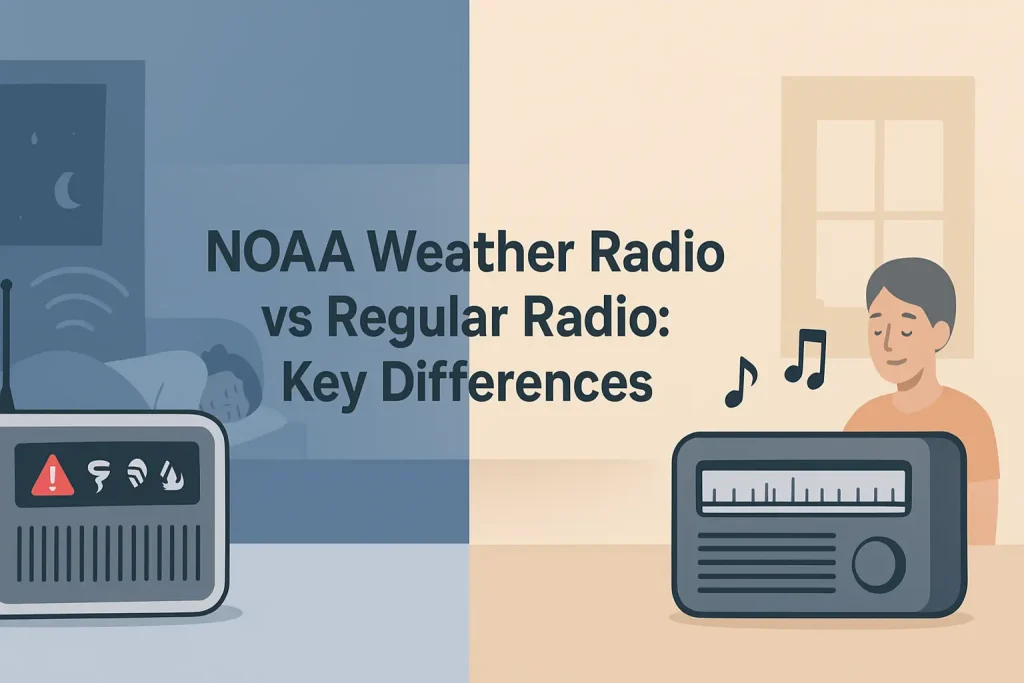
When your NOAA weather radio goes silent at 2 a.m. during a tornado warning, the problem might not be your radio. The transmitter serving your county could be offline. NOAA operates over 1,000 National Weather Radio transmitters across the 162.400 to 162.550 MHz band, and any one of them can go down due to equipment failure, storm damage, or scheduled maintenance. Knowing how to check NOAA Weather Radio outage status determines whether you reach for fresh batteries or switch to a backup alert source.
This guide covers the seven NOAA broadcast frequencies, the step-by-step process to verify transmitter status online and by phone, common outage causes, backup alert options, and troubleshooting steps to distinguish a broken radio from a dead transmitter.
| Photo | Popular Portable Walkie Talkies | Price |
|---|---|---|
 | SKIWARRIOR Multifunctional Smart Wireless Ski Goggles with Walkie-Talkie, Anti-Fog Zeiss Lens, Music & Call Function (Cylindrical Blue) | Check Price On Amazon |
 | SINORISE Super Mini Walkie Talkies, Two-Way Radios, 3 Pack | Check Price On Amazon |
 | KOSPET Tank M4C Smart Watch Rugged, Dual-Band GPS, 5ATM & IP69K Waterproof | Check Price On Amazon |
 | Retevis RT15 Walkie Talkies 3 Pack, Birthday Gift, Outdoor Adventure Kit | Check Price On Amazon |
 | Rechargeable Walkie Talkies Toys for Kids: DIY Astronaut Walkie Talkies for Boys Christmas Birthday Gifts for 3 4 5 6 7 8 9 10 Boy Walkie Talkie Outdoor Hiking Toy 2 Way Radio Camping Outdoor Game | Check Price On Amazon |
By the Numbers
NOAA Weather Radio Network – Key Numbers
Sources: NOAA NWS National Weather Radio documentation, FCC frequency allocation data.
What Is a NOAA Weather Radio Outage and Why Does It Matter?
A NOAA Weather Radio outage occurs when a transmitter in the NWR network stops broadcasting on its assigned frequency between 162.400 and 162.550 MHz. When the transmitter goes silent, every weather radio tuned to that frequency within its 40-mile coverage radius receives no signal and no alerts. This happens because NWR stations broadcast continuously, and a break in that broadcast signals either a hardware fault, a power failure at the transmitter site, or a deliberate shutdown for maintenance.
According to NOAA NWS documentation, each transmitter in the NWR All Hazards network typically operates at 100 to 1,000 watts, covering a radius of approximately 25 to 40 miles depending on terrain. When a single transmitter goes offline, the NOAA Weather Radio network does not automatically reroute alerts through an adjacent station. Your radio simply receives static on that frequency. Residents who depend on a single weather radio as their overnight alert system are left without warning until the transmitter is restored or they switch to a backup alert method. Any gap in NWR coverage during a severe weather event poses a direct safety risk.
How Outages Affect the S.A.M.E. Alert Chain
S.A.M.E. (Specific Area Message Encoding) technology uses 6-digit FIPS codes embedded in the broadcast to trigger alerts on your radio only for your programmed county. When the transmitter goes silent, the S.A.M.E. decoder in your Midland WR400 weather radio or similar S.A.M.E.-equipped model has no signal to decode. The alert chain breaks at the transmitter, before your radio even receives the data. This matters because S.A.M.E. filtering only works when a broadcast is present to carry the encoded alert headers.
Your radio cannot alert on a frequency that carries no signal. The S.A.M.E. chip processes whatever data the transmitter sends. No transmitter output means no alert headers, no voice announcement, and no tone. This is fundamentally different from a weak signal, where alerts still decode correctly at reduced audio quality.
How Do You Check NOAA Weather Radio Outage Status Online?
NoAA does not maintain a single real-time outage dashboard with a map showing which transmitters are currently offline. Instead, you must use a combination of NWS coverage maps, local forecast office pages, and direct phone contact to determine whether your local transmitter is down. NOAA provides transmitter location and coverage maps through its NWR website, but active outage details appear only on the local NWS forecast office pages that manage each transmitter.
The process requires checking multiple sources because NOAA’s NWR infrastructure is managed regionally by individual NWS forecast offices, not through a centralized real-time monitoring system. According to the NWS, each forecast office is responsible for maintaining the transmitters in its coverage area. This distributed structure means outage notifications appear at the regional level, not on one national page. The step-by-step process below walks you through every available check method.
Here is the complete process to verify your local NOAA Weather Radio transmitter status:
Step-by-Step Guide
How to Check Your Local NOAA Weather Radio Transmitter Status
5 steps · Estimated time: 10 minutes
Open the NOAA NWR coverage map page
Go to weather.gov/nwr and click the coverage maps link. Select your state to see transmitter locations and their approximate 40-mile broadcast radius.
Identify your nearest transmitter call sign and frequency
Find the transmitter call sign (such as KEC57 or WNG557), its broadcast frequency between 162.400 and 162.550 MHz, and the NWS forecast office responsible for that transmitter.
Visit your local NWS forecast office page for outage notices
Go to weather.gov and enter your zip code. Your local NWS office page posts active outage notices, scheduled maintenance windows, and estimated restoration times for transmitters in its area.
Tune your weather radio to verify signal presence or absence
Turn on your weather radio and cycle through all 7 NOAA frequencies. Static on every channel confirms a local outage or a radio hardware problem. A signal on an adjacent frequency means a nearby transmitter is still active.
Contact your local NWS office directly for confirmed status
Call your NWS forecast office during business hours. Staff can confirm whether a specific transmitter is offline, whether repairs are underway, and the expected restoration date. Phone numbers are listed on each forecast office page at weather.gov.
Checking your transmitter status requires visiting multiple sources because NOAA does not centralize outage reporting into one live dashboard. Use the coverage map, your local NWS office page, and a direct phone call to build a complete picture of whether your local NWR transmitter is operational.
What Does the NOAA NWR Status Information Tell You?
NoAA NWR status information, when available from your local NWS forecast office page, tells you three things: whether a specific transmitter is currently offline, the reason for the outage, and the estimated time to restoration. Scheduled maintenance outages are usually posted in advance with a specific time window. Unscheduled outages from equipment failure or storm damage typically show an estimated repair date once technicians have evaluated the problem.
A planned outage might read: “Transmitter WNG557 on 162.475 MHz will be offline for maintenance from 8 a.m. to 2 p.m. on Tuesday.” An unplanned outage notice might read: “Transmitter KEC57 is offline due to equipment failure. Repair technicians have been dispatched. Estimated restoration is Thursday afternoon.” The detail level varies by NWS office. Some offices post outage updates to social media on X (formerly Twitter) before updating their website. This distributed reporting approach is why no single national outage map exists.
Where to Find Transmitter Coverage Maps
The NWR coverage maps at weather.gov/nwr show each transmitter location, call sign, broadcast frequency, and estimated coverage radius by state. These maps are the primary reference for identifying which transmitter serves your location and which NOAA weather radio frequency your radio should be set to. Coverage maps display concentric circles around each transmitter, indicating approximate signal range under typical terrain conditions. Actual range varies based on terrain, antenna height, and local interference. A transmitter rated at 1,000 watts ERP (effective radiated power) on flat terrain may cover 40 miles, but mountainous terrain can reduce that to 15 miles or less in shadow zones behind ridges.
How NWS Forecast Offices Report Outages
Each NWS forecast office manages the transmitters in its area of responsibility. When a transmitter goes offline, the office posts a notice on its local web page and may announce it through local media or social media channels. Some offices provide an email notification list for NWR outage announcements. You can find your local office by entering your zip code at weather.gov, then navigating to the office’s “NWR” or “Programs” section. The reporting cadence and detail level differ between offices. Some update the same day a transmitter fails, while others may take longer depending on staffing and workload.
Checking your local NWS forecast office page directly is the most reliable method for finding current outage information for your area. No single national resource replaces this regional reporting structure.
What Causes NOAA Weather Radio Transmitters to Go Offline?
NoAA Weather Radio transmitters go offline for four primary reasons: equipment failure at the transmitter site, power loss to the transmitter facility, physical damage to the antenna or tower from severe weather, and scheduled maintenance windows. Equipment aging is the most common cause, because many NWR transmitters were installed decades ago and rely on components with finite lifespans. According to NWS transmitter maintenance records, vacuum tubes, power amplifiers, and exciter modules are the most frequently replaced components.
Transmitter sites are often located on remote hilltops or tall towers to maximize the 40-mile coverage radius on VHF frequencies near 162 MHz. These remote locations make physical access difficult during winter weather or flooding, which delays repairs. The NWS contracts with regional technicians, and response times range from same-day for sites near major cities to several days for remote mountain locations. Fault detection and diagnosis happen remotely, but repair requires a technician on site with replacement parts.
Equipment Failure and Aging Infrastructure
The NWR transmitter network includes many units installed in the 1990s and early 2000s. Transmitter power amplifiers, exciters, and filtering components degrade over time and eventually fail without warning. When a 1,000-watt transmitter’s final amplifier fails, the station goes silent immediately. There is no gradual degradation warning broadcast to listeners. The NWS maintains spare parts at regional depots, but shipping and installation can take days depending on location. A replacement antenna or amplifier module must be rated for the specific transmitter’s operating frequency and power level.
Storm Damage to Antenna Systems and Tower Infrastructure
Lightning strikes, ice loading, and high winds can damage the antenna, transmission line, or tower structure at a transmitter site. Lightning can destroy the power amplifier and exciter even if the tower survives. Ice accumulation on VHF antennas near 162 MHz can detune the antenna, reducing effective radiated power before a complete failure occurs. According to NWS engineering guidance, transmitter sites in the Great Plains and Midwest experience the highest rate of storm-related outages due to severe thunderstorm frequency and lightning exposure.
Power Loss and Backup System Limitations
Many NWR transmitter sites rely on commercial utility power with battery or generator backup. Backup systems typically provide 4 to 24 hours of runtime, depending on the battery bank size and whether a generator is installed. Extended power outages caused by hurricanes, ice storms, or grid failures can exhaust backup power before utility service is restored. When both commercial and backup power fail, the transmitter goes silent until power returns. Transmitters without generator backup are the most vulnerable during multi-day power outages.
Scheduled Maintenance Outages
The NWS schedules routine maintenance for transmitter inspections, tower work, and equipment upgrades. These planned outages are typically announced in advance on the local NWS forecast office page and through the NWR broadcast itself when possible. Maintenance windows range from 2 to 8 hours and are usually scheduled during favorable weather. Your weather radio receives no alerts during a scheduled maintenance outage. The NWS recommends checking its forecast office page before severe weather events if your radio has been silent for an unusual period. Keeping fresh rechargeable AA batteries in your emergency kit ensures your portable weather radio functions independently of grid power.
Understanding these four outage causes helps you assess how long a transmitter might remain offline and what backup alert sources to activate while waiting for restoration. Equipment aging and weather damage are the most common causes, and both can require days for repair at remote transmitter sites.
How Can You Verify Your Weather Radio Is Working When No Alert Is Broadcasting?
Verify your weather radio by tuning it through all seven NOAA frequencies to check for any active broadcast, checking the display for signal strength indicators, and confirming that fresh batteries are installed. A working radio receives a continuous voice broadcast of the local weather forecast on at least one of the seven channels when a nearby transmitter is operational. If you hear static on all seven channels, the problem could be your radio, your antenna, or the transmitter.
The NWR system broadcasts automated weather cycle messages continuously on the active channel assigned to your local transmitter. This broadcast includes the current forecast, hazardous weather outlook, and any active watches, warnings, or advisories for the coverage area. If your radio produces clear voice audio from this cycle, both the transmitter and your radio are working. According to NOAA NWS technical specifications, the broadcast cycle repeats every 3 to 5 minutes during routine weather and more frequently during active severe weather events with live voice cut-ins.
The All-Channel Scan Test
Turn on your weather radio and set it to scan through the 7 NOAA frequencies: 162.400 MHz (WX1), 162.425 MHz (WX2), 162.450 MHz (WX3), 162.475 MHz (WX4), 162.500 MHz (WX5), 162.525 MHz (WX6), and 162.550 MHz (WX7). Your radio will lock onto the strongest local signal. If it finds a clear voice broadcast on any channel, your radio hardware works and at least one nearby transmitter is active. If every channel produces only static, extend the external antenna or move the radio near a window facing the nearest transmitter. If static persists after repositioning, either your local transmitter is offline or your radio has a hardware fault.
Using the Weekly NOAA NWR Test Tone
Most NWS forecast offices transmit a Required Weekly Test (RWT) alert tone every Wednesday between 11 a.m. and noon local time, weather permitting. If your S.A.M.E.-equipped radio is programmed correctly, it receives this test tone and displays a “RWT” message. If the test tone fails to trigger your radio on Wednesday, either your radio is not programmed to the correct FIPS code for your county, your local transmitter was offline, or your radio has a hardware problem. Check the S.A.M.E. technology guide to confirm you have programmed the correct 6-digit FIPS code for your county. If the test tone triggers successfully, your radio and the transmitter are both operational.
Testing your weather radio with the weekly RWT broadcast and an all-channel scan gives you a reliable confirmation that your alert system is working. If both tests pass, your radio will alert correctly during an actual emergency event.
The following reference table defines key terms used throughout this guide for checking outage status and verifying your weather radio:
NWR: NOAA Weather Radio All Hazards, the national network of VHF transmitters broadcasting weather and emergency alerts on 7 frequencies between 162.400 and 162.550 MHz.
Transmitter: The VHF transmitter site that broadcasts the NWR signal on a specific frequency, identified by a call sign such as KEC57, with a typical coverage radius of 40 miles.
S.A.M.E.: Specific Area Message Encoding, a digital protocol that embeds 6-digit FIPS county codes in the NWR broadcast so your radio alerts only for your programmed county.
FIPS Code: A 6-digit Federal Information Processing Standards code that identifies a specific US county. The first digit identifies the region, the next two digits identify the state, and the last three digits identify the county.
ERP: Effective Radiated Power, measured in watts, representing the power output of the transmitter factoring in antenna gain. Most NWR transmitters operate at 100 to 1,000 watts ERP.
RWT: Required Weekly Test, a scheduled weekly alert tone transmitted by NWS offices every Wednesday to verify that S.A.M.E. decoding and alert hardware are functioning in your radio.
NWS Forecast Office: The local National Weather Service field office responsible for programming and maintaining NWR transmitters in its coverage area and posting outage notifications.
WX Channel: One of the 7 radio channels (WX1 through WX7) assigned to NOAA Weather Radio frequencies from 162.400 to 162.550 MHz, spaced at 25 kHz intervals.
EAS: Emergency Alert System, the national public warning system that NWR participates in as a primary dissemination method for presidential alerts and local emergency warnings.
What Should You Do When Your Local NOAA Transmitter Goes Down?
When your local NOAA Weather Radio transmitter goes offline, activate at least two backup alert sources immediately: a smartphone with Wireless Emergency Alerts enabled and a battery-powered AM/FM radio tuned to a local news station. Do not rely on a single alert method when your primary NWR receiver is silent. The weather radio vs smartphone comparison shows that both have different failure modes. Smartphones depend on cellular towers and can lose signal during the same storms that damage NWR transmitters, while weather radios depend entirely on a single VHF transmitter. Redundancy across different broadcast technologies is your safest approach during an outage.
According to FEMA’s Integrated Public Alert and Warning System (IPAWS) documentation, Wireless Emergency Alerts are delivered through cell broadcast technology, which is distinct from the cellular data network. Cell broadcast can reach phones even when the data network is congested. However, cell broadcast range is limited by tower proximity and does not function in areas without cellular coverage. A combination of NWR, WEA, and local AM/FM broadcast covers the three primary alert distribution channels used in the US emergency communication infrastructure.
How to Set Up Smartphone Backup Alerts
Verify that Wireless Emergency Alerts are enabled on your smartphone. On Android, go to Settings, then Safety and Emergency, then Wireless Emergency Alerts, then ensure the toggle is on. On iOS, go to Settings, then Notifications, then scroll to the bottom to Government Alerts and ensure both Emergency Alerts and Public Safety Alerts are enabled. These alerts use cell broadcast technology and do not require a data connection or an app. They arrive automatically if you are within range of a cellular tower broadcasting the alert. WEA supports Presidential Alerts (mandatory and cannot be disabled), Imminent Threat Alerts (tornado, flash flood, hurricane warnings), and AMBER Alerts.
Using a Battery-Powered AM/FM Radio as a Tertiary Alert Source
A battery-powered AM/FM radio provides a third alert channel because local broadcast stations often relay NWS warnings within their news programming. Many all-hazard weather radios include AM/FM reception as a secondary band. The Midland ER310 emergency weather radio includes AM/FM reception along with the 7 NOAA channels, a hand-crank dynamo, and a solar panel, providing multiple power and reception options during extended outages.
Key Specifications:
- Frequency: 162.400 to 162.550 MHz (7 NOAA channels) plus AM (530 to 1710 kHz) and FM (87.5 to 108 MHz)
- Power sources: Rechargeable 2600 mAh Li-ion battery, hand-crank dynamo, solar panel, USB input
- Alert types: S.A.M.E. with programmable FIPS codes
- Battery life: Up to 32 hours on a full charge in low-power mode
Contacting Your Local NWS Office for Restoration Estimates
Call your local NWS forecast office to report that your transmitter appears offline and to ask for a repair estimate. NWS offices rely partly on public reports to identify transmitter failures, because remote monitoring at some sites is limited. When you call, provide the transmitter call sign if you know it, your city and county, and the frequency your radio normally receives. The NWS office can confirm whether the outage is known, whether technicians have been dispatched, and the estimated repair timeline. Find your local office phone number at weather.gov by entering your zip code and navigating to the “About Us” or “Contact Us” section.
Activate at least two backup alert sources using different broadcast technologies when your local NWR transmitter goes down, and call your local NWS office to report the outage and request a repair estimate.
Which Backup Communication Options Work When NOAA Weather Radio Is Offline?
When NOAA Weather Radio is offline, your three most reliable backup alert sources are Wireless Emergency Alerts on your smartphone, local AM/FM broadcast radio, and NOAA web-based forecasts accessed through any internet connection. Each uses a different transmission infrastructure, so a single event like a tornado is unlikely to disable all three simultaneously. Checking NOAA stations by state can also reveal whether an adjacent transmitter on a different frequency covers your area with a usable signal.
According to the NWS, adjacent NWR transmitters sometimes overlap coverage areas by 10 to 20 miles. If your primary transmitter is offline, a neighboring transmitter may still reach you on a different frequency in the 162.400 to 162.550 MHz range. The NWR coverage maps show overlap zones where two or more transmitters provide coverage. Residents in these overlap areas can program a second frequency into their weather radio as a backup channel. Radios like the Midland WR400 support up to 25 programmable S.A.M.E. locations, allowing you to monitor alerts from adjacent counties served by different transmitters.
Key Specifications:
- Frequency: 162.400 to 162.550 MHz (7 NOAA channels)
- S.A.M.E. alert capacity: 25 programmable location codes
- Alert memory: Stores up to 50 alert events
- Power: AC adapter with 6 AA battery backup
- Programming: Manual keypad entry for FIPS codes
Monitoring Adjacent NWR Transmitters
Consult the NWR coverage map to identify any neighboring transmitter whose 40-mile radius overlaps your location. Program that transmitter’s frequency into your weather radio as a secondary channel. Some S.A.M.E. radios, including the Sangean CL-100, support multiple FIPS codes so you can receive alerts for your county even when broadcast from a different transmitter. If your county falls within the overlap zone, alerts for your FIPS code are carried by both transmitters. This redundancy means you receive the same severe weather warning from the adjacent site when your primary transmitter is down.
Using Scanner Radios to Receive NOAA Broadcasts
A programmable scanner radio can receive NOAA Weather Radio broadcasts on the 162 MHz band. Scanners like the Uniden BC125AT tune to the 7 NOAA frequencies and receive the same voice broadcast and alert tones as a dedicated weather radio. However, most basic scanners do not include S.A.M.E. decoding, so they cannot filter alerts by county code. The scanner treats the NOAA broadcast as a standard VHF voice channel. You hear all alerts broadcast by that transmitter, not just those for your county. This is useful as a backup reception method but lacks the county-level filtering of a dedicated S.A.M.E. receiver.
Key Specifications:
- Frequency range: 25 to 512 MHz (includes NOAA 162.400 to 162.550 MHz band)
- Channels: 500 programmable
- Scan speed: 100 channels per second
- S.A.M.E. decoding: Not included (receives all alerts on the frequency without county filtering)
- Power: AC adapter or 2 AA batteries
GMRS and FRS Radios with NOAA Weather Channels
Many GMRS and FRS two-way radios include one or more NOAA Weather Radio receive channels. The Motorola T800 GMRS radio and similar handheld models feature a NOAA weather channel scan mode. These radios receive the voice broadcast and alert tones on the 162 MHz band. Like scanners, most FRS/GMRS radios lack S.A.M.E. decoding and alert you for any tone received on the channel. Some GMRS models include a weather alert mode that monitors the NOAA channel in the background while you communicate on GMRS frequencies (462 to 467 MHz). This dual-monitor capability makes a GMRS radio a practical backup when your dedicated weather radio receiver is not receiving a signal.
Key Specifications:
- GMRS power: Up to 2W handheld (FRS shared channels 1 to 7) and up to 5W on GMRS-only channels 15 to 22
- NOAA channels: WX1 through WX7 received
- Weather alert mode: Background monitoring with alert tone notification
- S.A.M.E. decoding: Not included
- GMRS license: FCC Part 95E license required ($35 for 10 years, no exam)
Backup alert options include adjacent NWR transmitters, programmable scanner radios, GMRS radios with NOAA channels, smartphone WEA, and AM/FM broadcast radio. The most effective strategy layers at least two technologies that depend on different transmission infrastructure.
How to Troubleshoot Your Weather Radio When You Suspect an Outage?
When your weather radio goes silent, the cause is either a transmitter outage, a radio hardware problem, or a programming error. Start with the all-channel scan test described earlier to determine whether any NOAA broadcast reaches your receiver. The result of this test determines your next step. If the scan finds a signal, the transmitter near you is active and your radio works. If every channel is static, narrow down the problem between your radio and the transmitter.
This troubleshooting process is critical because the fix depends entirely on which component has failed. A dead transmitter requires you to switch to backup alert methods. A broken radio requires repair or replacement. An incorrect FIPS code or frequency setting requires reprogramming. Misdiagnosing a radio problem as a transmitter outage leaves you without alerts indefinitely while you wait for a repair that never happens.
Use the table below to match your symptom to the correct diagnosis and fix:
Use the table below to identify whether your weather radio problem is caused by a transmitter outage, a hardware fault, or a programming error.
| Symptom | Likely Cause | Diagnostic Test | Fix |
|---|---|---|---|
| Static on all 7 NOAA channels | Transmitter offline or radio hardware failure | Try a second weather radio or a scanner on 162.475 MHz | If second radio also receives static, report outage to NWS. If second radio works, replace your primary radio. |
| RWT test tone does not trigger alert on Wednesday | Wrong FIPS code or S.A.M.E. disabled | Check FIPS code matches your county on weather.gov | Reprogram correct 6-digit FIPS code. Confirm S.A.M.E. alert mode is enabled on your radio. |
| Voice broadcast present but no alert tones trigger the alarm | Alert mode set to “voice only” or S.A.M.E. mismatch | Check radio alert mode setting (voice, alert, or siren) | Change alert mode from “voice” to “alert” or “siren.” Verify FIPS code programming. |
| Radio displays “no signal” but batteries are fresh | Weak signal location or antenna issue | Move radio near a window or attach external antenna | Reposition radio. Add external antenna with BNC or SMA connector. Check antenna connection. |
| Radio worked yesterday but shows static today with no weather changes | Transmitter suddenly went offline | Check NWS forecast office page and call NWS office | Activate backup alert sources. Report outage if NWS is not aware. Monitor NWS page for restoration info. |
| Radio picks up a distant station but not your local one | Local transmitter offline; distant transmitter still broadcast | Compare frequency of received station to coverage map | Program the distant station as backup and add its FIPS code. Report local transmitter outage to NWS. |
Distinguishing Radio Hardware Failure from Transmitter Outage
The simplest diagnostic is to test with a second receiver. If you have a scanner, a GMRS radio with NOAA channels, or a Midland HH50 pocket weather radio, tune it to your local NOAA frequency. If the second radio receives a broadcast, your primary radio has a hardware problem. If both radios receive only static, the transmitter is likely offline. You can also check the NWS forecast office page before replacing any equipment. Replacing a working radio because the transmitter is down is a common and expensive mistake.
Common Programming Errors That Mimic an Outage
A S.A.M.E. radio programmed with the wrong FIPS code will not trigger alerts even when the transmitter is broadcasting correctly. The voice broadcast plays, but the alert tone does not activate the alarm function because the S.A.M.E. decoder does not find a matching FIPS code in the alert header. Check your FIPS code by entering your county at weather.gov/nwr. The St. Louis weather radio guide provides an example of locating the correct FIPS code for a specific metro area. Another common error is setting the radio to “voice” mode instead of “alert” mode, which plays the broadcast without triggering the alarm siren when an alert tone is received. Verify both the FIPS code and the alert mode setting in your radio’s menu.
Troubleshooting your weather radio systematically separates transmitter outages, programming errors, and hardware faults. Each cause requires a different fix, and misdiagnosis wastes time and money during an active weather threat.
Are There Portable Weather Radios That Work During Power Outages?
Portable weather radios with hand-crank dynamos or solar panels received NOAA Weather Radio broadcasts independently of grid power. These radios are critical during extended power outages when both your AC-powered desktop weather radio and your local NWR transmitter’s backup batteries may fail. The Eton FRX3+ hand-crank weather radio and similar models generate power through a hand-crank dynamo, maintaining access to the 162 MHz broadcast even when the grid, your AA batteries, and your USB power bank are all depleted.
According to NOAA NWR receiver specifications, a portable weather radio needs at least 0.5 microvolts of signal at the antenna input to decode the broadcast reliably. Hand-crank radios use the same receiver circuitry as battery-powered models and meet this sensitivity threshold. The critical difference is the power source. A hand-crank dynamo generates approximately 3 to 5 watts of mechanical power, which charges an internal NiMH battery at roughly 1 minute of cranking for every 10 minutes of listening time. Solar panels on emergency radios generate 30 to 100 mA in direct sunlight, enough to maintain the internal battery during daytime operation.
Key Specifications:
- Frequency: 162.400 to 162.550 MHz (7 NOAA channels) plus AM/FM
- Power sources: Hand-crank dynamo, solar panel,USB input, 3 AAA batteries
- Battery: Internal NiMH rechargeable battery
- Alert: S.A.M.E. not included; alert tone detection only
- Crank ratio: Approximately 1 minute of cranking per 10 minutes of radio reception
Comparing Hand-Crank, Solar, and Battery-Powered Emergency Weather Radios
Each power source has different strengths. AA batteries (alkaline or lithium) provide the most consistent runtime, lasting 24 to 72 hours depending on radio model and duty cycle. Hand-crank power provides unlimited generation capacity but requires continuous physical effort. Solar power works during daylight but produces negligible charge on overcast days. The FosPower emergency weather radio combines all three: a 2000 mAh Li-ion battery charged by solar, hand-crank, or USB, providing the most flexible power redundancy for a portable NWR receiver.
Use the table below to choose the right emergency weather radio power source for your expected outage duration and environment.
| Power Source | Max Runtime | Rechargeable | Best For | Limitation |
|---|---|---|---|---|
| AA Alkaline Batteries | 24 to 72 hours | No | Short outages, 1 to 3 days | Single use, must stock spares |
| Internal Li-ion / NiMH | 18 to 36 hours | Yes (USB) | Reusable outages, portable | Limited charge cycles, degrades over time |
| Hand-Crank Dynamo | Unlimited (with effort) | Yes | Extended outages, off-grid | Requires continuous physical effort |
| Solar Panel | Unlimited (daylight) | Yes | Daytime charging, wilderness | Near-zero output on overcast days |
| USB Power Bank | 12 to 48 hours | Yes (USB) | Pre-charged backup, portable | Limited capacity, must be pre-charged before outage |
Choose an emergency weather radio with at least two independent power sources. A hand-crank or solar radio with an AA battery backup ensures you can receive NOAA broadcasts regardless of how long the power grid is down.
Does NOAA Weather Radio Go Offline During Severe Weather?
NoAA Weather Radio transmitters are designed to remain operational during severe weather, but they can and do go offline during the storms they are meant to warn you about. Lightning strikes, tornado damage to the antenna or tower, and flooding at the transmitter site can knock a station off the air at the exact moment you need it most. The NWS equips transmitter sites with surge protection, backup power, and hardened antenna systems, but no physical infrastructure is immune to direct severe weather impact.
This happens because NWR transmitter sites are located on hilltops and towers that maximize VHF broadcast range at 162 MHz but also expose the equipment to the full force of thunderstorms, tornadoes, and hurricanes. According to NWS engineering reports, lightning-induced power surges are the leading cause of sudden transmitter failure during severe weather. Backup generators and battery banks keep the site running if commercial power fails, but a direct lightning strike to the antenna or tower can destroy the transmitter’s final amplifier regardless of backup power capacity. This is why maintaining at least one backup alert method using a different technology is essential in any household emergency plan.
When Transmitter Outages Coincide with Active Warnings
The most dangerous scenario occurs when a transmitter goes offline while a tornado warning or flash flood warning is active for your county. Your weather radio cannot generate an alert from a signal that is not being broadcast. In this situation, your smartphone WEA and local AM/FM broadcast become your primary alert sources. The NWS issues the same warnings through all IPAWS distribution channels simultaneously. When the NWR path fails, the WEA path and the EAS path through broadcast radio and television continue to carry the warning. A USB power bank keeps your smartphone charged during an extended outage, maintaining your WEA alert reception.
What to Do If Your Transmitter Goes Silent During a Watch or Warning
If your weather radio loses signal during an active severe weather watch or warning, act immediately. Switch to your smartphone WEA alerts. Tune a portable AM/FM radio to a local broadcast station. Check weather.gov on any available internet-connected device. If you have a scanner or GMRS radio with NOAA channels, use it to check if an adjacent transmitter is still broadcasting. Do not wait to see if the signal returns. The time between a tornado warning and a tornado strike can be measured in minutes. Every backup alert method you activate during a transmitter outage reduces your exposure to a missed warning.
NOAA Weather Radio transmitters can fail during severe weather due to lightning damage and infrastructure failure. Never depend on a single alert technology during tornado season, and activate backup alert sources the moment your weather radio goes silent during an active watch or warning.
Can You Use a Two-Way Radio to Receive NOAA Weather Alerts?
Many GMRS and FRS two-way radios include NOAA Weather Radio receive channels in the 162.400 to 162.550 MHz band, allowing you to monitor weather broadcasts and alert tones on the same handheld radio you use for group communication. These radios do not decode S.A.M.E. FIPS codes, so they alert for any tone broadcast by the transmitter, not just alerts for your county. The Midland GXT1000VP4 GMRS radio and similar models include a weather alert monitor mode that checks for NOAA alert tones in the background while you communicate on GMRS channels 15 through 22 (462.5500 to 462.7250 MHz).
According to FCC Part 95E, GMRS radios may receive on any frequency but may only transmit on the 462 to 467 MHz GMRS band with a valid license. This means your GMRS radio legally receives the NOAA broadcast on 162.400 to 162.550 MHz but cannot transmit on those frequencies. The NOAA channels are receive-only on GMRS and FRS equipment. Using a programmable dual-band radio to transmit on NOAA frequencies is illegal under FCC rules. NOAA Weather Radio frequencies are reserved for NWS broadcast use only.
Two-way radios with NOAA channels provide a useful backup reception method during NWR transmitter outages when your primary weather radio is not working. However, they lack S.A.M.E. county filtering and cannot transmit on the NOAA band, so they complement rather than replace a dedicated S.A.M.E. weather radio.
How Long Do NOAA Weather Radio Outages Typically Last?
NoAA Weather Radio outages range from 2 hours for scheduled maintenance to several days for major equipment failure at remote transmitter sites. According to NWS maintenance records, the average unplanned outage duration is 24 to 72 hours. Remote mountainous sites without nearby technician depots tend toward the longer end of that range. Urban transmitter sites with easy access and spare parts on hand are typically restored within 12 to 24 hours. A complete transmitter replacement (tower climb, antenna replacement, or major component swap) can take 5 to 14 days at some sites depending on weather conditions and parts availability.
The restoration timeline depends on three factors. First, whether the problem is a component swap (hours to days) or a full transmitter replacement (days to weeks). Second, how far the repair technician must travel to reach the transmitter site. NWS maintenance contracts use regional technicians who may be dispatched from several hours away. Third, whether weather conditions at the site allow safe access. Icing on tower structures, flooding at access roads, and active severe weather can delay tower climbs and physical repairs indefinitely until conditions improve. The NOAA Weather Radio Spanish availability information sometimes includes regional office contact details that can provide updated restoration estimates during extended outages.
Why Some Outages Last Weeks Instead of Days
A transmitter requiring a tower climb for antenna or transmission line replacement faces two major delays: scheduling a certified tower crew and waiting for safe climbing weather. Tower crews are specialized contractors who may not be immediately available in your NWS region. Once scheduled, the crew must wait for wind speeds below 30 mph and no lightning or ice on the tower structure. During winter in northern states, safe climbing weather may not occur for weeks. If the transmitter uses a hard-to-source vacuum tube or custom RF power amplifier module, parts procurement adds additional delay. These extended outages are why maintaining backup alert sources is not optional for anyone who relies on weather radio for overnight alerting.
Plan for weather radio outages lasting at least 24 to 72 hours for most failures and up to 2 weeks for major infrastructure damage at remote sites. Your backup alert plan must cover that entire window without interruption.
Does NOAA Weather Radio Work During a Power Outage?
Your weather radio continues receiving NOAA broadcasts during a power outage only if it has independent battery backup power. The NWR transmitter itself may or may not stay on the air, depending on whether its site has adequate backup power. A desktop weather radio running on AC power goes silent the moment the grid fails unless you installed AA batteries in its backup compartment. A portable emergency radio with a hand-crank, solar panel, or internal rechargeable battery maintains reception regardless of grid status.
According to NOAA NWR site engineering standards, most transmitter sites have battery backup providing 4 to 24 hours of runtime. Sites with generator backup can operate for days as long as fuel is available. However, some smaller transmitter sites operate on battery backup only, and those batteries deplete faster under heavy transmit loads during active weather events. When the transmitter’s backup power is exhausted, your radio receives static regardless of how much battery life your receiver has. This is another reason to layer alert methods: your weather radio battery outlasts the transmitter battery in many outage scenarios, but your radio becomes useless when the transmitter goes dark.
Maintaining Your Weather Radio Battery Backup
Replace the AA backup batteries in your desktop weather radio at least twice per year. Alkaline AA batteries self-discharge at approximately 2 to 3 percent per year at room temperature but degrade faster in hot or humid environments. Lithium AA batteries (such as Energizer Ultimate Lithium) hold charge for up to 20 years in storage and perform better in extreme cold, making them a superior choice for weather radio backup. The lithium AA batteries cost more per unit but provide reliable 10-year shelf life for emergency backup compartments. Test your backup batteries by unplugging your weather radio from AC power once per month and confirming that it continues receiving the NOAA broadcast on battery power alone.
When Both Your Power and the Transmitter Backup Fail
The worst case occurs when both your household power and the NWR transmitter’s backup power fail simultaneously during a major event like a hurricane or ice storm. In this scenario, your weather radio cannot help you regardless of its battery status. Your smartphone with WEA enabled and a battery-powered AM/FM radio become your only remaining alert channels. A hand-crank weather radio can receive any transmitter still on the air, and its dynamo provides unlimited power if you are willing to crank periodically. For maximum resilience, keep a hand-crank or solar weather radio alongside your primary S.A.M.E. desktop radio, and store a programmable scanner radio as a third backup that receives both NOAA and local public safety frequencies.
Your weather radio receives NOAA broadcasts during a power outage only if both your receiver and the transmitter maintain backup power. Replace backup batteries twice per year and layer at least two independent alert methods to cover the gap when either end of the chain fails.
Can a Scanner Radio Receive NOAA Weather Radio Broadcasts?
Any programmable scanner radio covering the VHF 136 to 174 MHz band can receive NOAA Weather Radio broadcasts on the 7 frequencies between 162.400 and 162.550 MHz. Scanners receive the same voice audio and alert tones as dedicated weather radios. The difference is that most scanners do not include S.A.M.E. decoding hardware. A scanner plays the broadcast audio and any 1050 Hz alert tones it receives, but it does not filter by FIPS county code or sleep quietly until a warning triggers it like a S.A.M.E. weather radio does.
Scanner radios are useful as NOAA backup receivers because they monitor multiple frequency bands simultaneously. The Uniden SDS100 digital scanner receives NOAA channels alongside police, fire, EMS, and other public safety frequencies. During a severe weather event, monitoring local public safety channels on a scanner provides situational awareness that a weather radio alone does not offer. You hear dispatch traffic from storm spotters, emergency management, and first responders in real time. This dual monitoring (weather alerts plus public safety traffic) makes a scanner a powerful backup when your dedicated weather radio loses its transmitter signal.
Key Specifications:
- Frequency range: 25 to 1300 MHz (continuous, includes 162.400 to 162.550 MHz NOAA band)
- Digital protocols: P25 Phase 1 and Phase 2, DMR, NXDN, conventional analog
- S.A.M.E. decoding: Included on some premium models (check model specifications)
- Power: Rechargeable Li-ion battery pack or USB external power
- Scan rate: Up to 100 channels per second in conventional mode
A scanner radio receives NOAA broadcasts but typically lacks the S.A.M.E. alert filtering and sleep-until-alerted behavior of a dedicated weather radio. Use a scanner as a backup reception device for situational awareness, not as your primary overnight alert system.
Do You Need a S.A.M.E. Weather Radio to Receive County-Level Alerts?
You need a S.A.M.E.-equipped weather radio to receive county-filtered alerts that wake you only for warnings affecting your specific location. A non-S.A.M.E. weather radio receives the same broadcast and alert tones, but it triggers an alarm for any alert broadcast by the transmitter, including alerts for counties 30 or 40 miles away that pose no threat to your area. S.A.M.E. technology embeds your 6-digit FIPS county code in the alert header, so your radio decodes the code and triggers the alarm only if your programmed county is included in the warning. The difference is not in what the transmitter broadcasts but in what your receiver responds to.
According to the NWS, a single NWR transmitter covering a 40-mile radius may serve 5 to 15 counties. Without S.A.M.E. filtering, your radio alerts for every warning issued for any of those counties. A tornado warning for a county 35 miles away will wake you at 3 a.m. even if the storm is moving away from your location. S.A.M.E. filtering reduces false alarms by programming only the FIPS code for your county and any adjacent counties you want to monitor. Radios like the C Crane CC Solar Observer and the Midland WR400 support 25 or more programmable FIPS codes, letting you set exactly which counties trigger your alarm.
S.A.M.E. filtering is essential for overnight alerting because it prevents alert fatigue from false alarms. Without it, you may disable your radio after too many irrelevant nighttime alerts, leaving you unprotected when a real warning arrives for your county.
Does NOAA Weather Radio Go Offline During Severe Weather?
NOAA Weather Radio transmitters are engineered to withstand severe weather but can and do fail during the storms they broadcast warnings about. Lightning strikes, ice loading on antennas, and tornado or hurricane force winds can damage the transmitter tower, antenna, transmission line, or power supply. Backup generators and surge protection reduce the risk, but no VHF transmitter site is immune to a direct hit from a violent thunderstorm or tornado. According to NWS engineering data, the highest outage rates occur during spring severe weather season (March through June) in the central and southeastern US, where thunderstorm frequency and lightning density are greatest.
This is a physical infrastructure problem. NWR transmitter sites are positioned on high terrain for maximum VHF line-of-sight propagation at 162 MHz, which also exposes them to the full force of severe weather. Surge arrestors protect against most lightning-induced voltage spikes on the power and antenna lines, but a nearby or direct strike can overwhelm even the best protection system. When this happens, the transmitter fails without warning, and your weather radio receives static on the next transmission cycle. Your only protection against this failure mode is backup alert sources using different transmission infrastructure.
Transmitter failures during severe weather are the most dangerous type of NWR outage because they occur at the exact moment alerts matter most. Always maintain at least one backup alert method (smartphone WEA or AM/FM radio) alongside your weather radio during tornado and hurricane season.
What Frequency Should Your Weather Radio Be Set To?
Your weather radio should be set to the specific NOAA frequency assigned to the nearest operational transmitter in your area, not left on a random channel. The 7 NOAA Weather Radio frequencies are 162.400 MHz (WX1), 162.425 MHz (WX2), 162.450 MHz (WX3), 162.475 MHz (WX4), 162.500 MHz (WX5), 162.525 MHz (WX6), and 162.550 MHz (WX7). Each local transmitter uses one assigned frequency to avoid interference with neighboring transmitters. You find your exact frequency by checking the NWR coverage map at weather.gov/nwr and selecting your state.
Most weather radios automatically scan the 7 channels and lock onto the strongest signal. The Midland WR400 and similar auto-scan models cycle through all 7 frequencies when first powered on and select the one with the clearest reception. If you live in an overlap zone where two transmitters reach you, manually select the frequency for the transmitter that covers your county. Programming the wrong frequency means you hear a broadcast intended for a different coverage area, and S.A.M.E. alerts for your FIPS code may not be included in that transmitter’s alert stream.
Why 7 Separate Frequencies Exist Instead of One
NoAA uses 7 separate frequencies spaced 25 kHz apart in the 162 MHz VHF band to allow multiple transmitters to operate near each other without mutual interference. Two transmitters within 100 miles of each other cannot use the same frequency because their signals would interfere at the overlap zone. By assigning different frequencies to adjacent transmitters, NOAA ensures that each station’s broadcast reaches its intended coverage area without degrading neighboring stations. The 25 kHz channel spacing meets ITU (International Telecommunication Union) VHF narrowband allocation standards and allows enough spectral separation for clean reception even at the boundary between two transmitter coverage areas.
Set your weather radio to the specific frequency of your nearest NWR transmitter for reliable reception and correct S.A.M.E. alert filtering. If your radio has auto-scan, verify that it locks onto the transmitter covering your county and not a distant one on a different frequency.
Can You Use a Programmable Radio to Transmit on NOAA Weather Radio Frequencies?
You cannot legally transmit on any NOAA Weather Radio frequency. The 7 NOAA frequencies between 162.400 and 162.550 MHz are allocated exclusively to the National Weather Service under FCC Part 90 rules for federal government use. Transmitting on these frequencies by any unauthorized person is a federal offense carrying penalties of up to $10,000 per violation and potential criminal prosecution. This rule applies regardless of your radio’s technical capability to tune and transmit on those frequencies.
According to FCC Part 90, Section 90.235, the 162.0125 to 173.2 MHz band includes the NWR allocation at 162.400 to 162.550 MHz. This segment is reserved for federal government and eligible public safety use. Consumer radios, including Baofeng UV-5R type handhelds and other programmable dual-band transceivers, can be modified to transmit on NOAA frequencies, but doing so is illegal under FCC rules. Your FCC amateur radio license, GMRS license, or any other Part 95 license does not authorize transmission on the NWR band. If you own a programmable radio that covers the 162 MHz range, use it to receive NOAA broadcasts only. Never transmit on those frequencies.
Legal Receive-Only Use of Programmable Radios
Using a programmable radio like the Yaesu FT-70DR dual-band handheld to receive NOAA broadcasts on 162.400 to 162.550 MHz is legal. The FCC permits receiving on any frequency. The restriction applies to transmitting only. You can program the 7 NOAA frequencies as receive-only channels in your radio’s memory. On the Yaesu FT-70DR, set the transmitting frequency to an unused GMRS or amateur frequency and the receive frequency to the NOAA channel. This prevents accidental transmission on the NWR band while allowing you to monitor weather broadcasts on your handheld transceiver.
Receiving NOAA Weather Radio on a programmable radio is legal. Transmitting on NOAA frequencies is illegal and carries federal penalties. Program your radio’s transmit frequency away from the 162 MHz band to prevent accidental violation.
How Do You Find the Right S.A.M.E. Code for Your County During an Outage Situation?
Find your S.A.M.E. FIPS code by entering your state and county at weather.gov/nwr, then program that 6-digit code into your weather radio so it alerts only for your county. The FIPS code format follows a standard structure: the first digit identifies the region (SSS), the next two digits identify the state, and the last three digits identify the county. For example, FIPS code 029510 identifies St. Louis City, Missouri (0 = region, 29 = Missouri, 510 = St. Louis City independent). Each county in the US has a unique FIPS code, and only that specific code triggers your S.A.M.E. radio for warnings in your county.
If your transmitter is offline and you rely on an adjacent transmitter for backup alerts, you must program the FIPS code for your county into the radio even though the broadcast originates from a different transmitter. S.A.M.E. codes are county-based, not transmitter-based. The adjacent transmitter includes alerts for your county if your county falls within its coverage area. Your radio decodes the FIPS code from the broadcast header and triggers the alarm regardless of which transmitter physically carries the signal. Consult the NOAA stations by state guide to identify which adjacent transmitters carry your county’s alerts.
What Happens If You Program the Wrong FIPS Code?
Programming the wrong FIPS code causes your weather radio to either fail to alert when a warning is issued for your county or to alert for a county where you do not live. If the code belongs to a distant county, your radio ignores valid warnings for your area. If the code belongs to a busy county with frequent alerts, your radio triggers too often for events that do not affect you. Both scenarios undermine the purpose of having a weather radio. Double-check your FIPS code against the official list at weather.gov/nwr, and test it each Wednesday when the NWS transmits the Required Weekly Test on your local transmitter.
Program the correct 6-digit FIPS code for your county and verify it against the official NWS list. Add FIPS codes for one or two adjacent counties if you want expanded coverage, but never rely on a code from a distant county that triggers alerts irrelevant to your location.
Are There Any Third-Party Services That Track NOAA Weather Radio Outages?
No centralized third-party service provides a real-time national map of NOAA Weather Radio transmitter outages. The NWS maintains transmitter status information through its regional forecast offices, and no commercial or community service aggregates this data into a single live dashboard. The RadioReference.com community forums sometimes list reported outages posted by users in affected areas, but these reports are crowdsourced and not comprehensive. The most reliable outage tracking method remains checking your local NWS forecast office page and calling the office directly when you suspect a failure.
This gap in centralized outage reporting exists because NWS operates a distributed network of over 1,000 transmitters managed by over 100 forecast offices. Each office handles its own transmitter maintenance and outage communications. NWS has not built a real-time national monitoring system that displays active outages on a single map. Some private weather services and broadcast engineering firms monitor NWR transmitter signals locally, but their coverage is limited to specific regions and not available publicly. Until NWS creates a centralized status dashboard, the best approach is the multi-step verification process described in the step-by-step guide above.
RadioReference.com Forums as a Community Outage Source
The RadioReference.com forums include a NOAA Weather Radio discussion area where listeners report transmitter outages they discover. These reports are voluntary and not verified by the NWS. A user might post that transmitter KEC57 in Chicago appears offline, and other users in the area can confirm or deny the report. This crowdsourced approach can alert you to an outage faster than the NWS forecast office page in some cases, but you should treat forum posts as preliminary reports and confirm directly with the NWS. RadioReference.com also maintains a frequency database listing every NWR transmitter call sign, frequency, and location by state, which is useful for identifying your local transmitter without navigating the NWR coverage map.
No third-party outage map currently exists for NOAA Weather Radio. Use your local NWS forecast office page, direct phone contact, and community forums like RadioReference.com to piece together transmitter status when you suspect an outage in your area.
How Can You Prepare Before a NOAA Weather Radio Outage Occurs?
Prepare for a NOAA Weather Radio outage by setting up at least two backup alert methods before severe weather season, programming your weather radio with FIPS codes for your county and one adjacent county, and testing your receiver weekly using the NWS Required Weekly Test. According to FEMA’s emergency preparedness guidance, every household should have a minimum of three ways to receive emergency alerts using different technologies. NWR, smartphone WEA, and broadcast AM/FM radio represent three distinct distribution paths that are unlikely to fail simultaneously.
Preparation matters because outages happen without warning and often coincide with the very weather events you need alerts for. The NWS reports that its most frequent transmitter failures occur during spring storm season (March through June) and during hurricane season (June through November) along the Gulf and Atlantic coasts. If you wait until a tornado watch is issued to discover that your weather radio has been silently receiving static for three days, you have already lost your primary alert window. Regular testing, backup power, and redundant alert channels eliminate this gap.
Your NOAA Weather Radio Outage Preparedness Checklist
- Program your weather radio with the correct FIPS code for your county and verify it against weather.gov/nwr
- Add the FIPS code for one adjacent county to receive alerts from a backup transmitter if your primary goes offline
- Replace AA backup batteries in your desktop weather radio every 6 months with lithium AA batteries for longest shelf life
- Enable Wireless Emergency Alerts on your smartphone and confirm they are active by checking settings monthly
- Keep a battery-powered AM/FM radio with fresh batteries as a third alert channel
- Test your weather radio each Wednesday during the NWS Required Weekly Test to confirm both the transmitter and your receiver are working
- Program the 7 NOAA frequencies into your scanner or GMRS radio as backup receive channels
- Store your local NWS forecast office phone number in your contacts for quick outage reporting
- Keep a hand-crank or solar weather radio in your emergency kit for extended power outages
- Verify your weather radio receives a clear voice signal on the correct frequency at least once per month
Outage preparedness means you never discover your weather radio has been dead for days at the moment you need it most. Test weekly, maintain backup power, and layer three alert technologies across independent distribution paths.
Conclusion
NOAA Weather Radio outages happen when transmitters fail on the 162.400 to 162.550 MHz band, and no single national outage map tracks them in real time. Your best response combines checking the NWS forecast office page, testing your radio with an all-channel scan and the Wednesday RWT tone, and maintaining at least two backup alert sources using different broadcast infrastructure. Program the correct 6-digit FIPS code, replace your backup batteries twice per year, and test your setup weekly so you are never caught without warnings when severe weather strikes.
| Photo | TOP RATED WALKIE TALKIES | Price |
|---|---|---|
 | Retevis RT628 Kids Walkie Talkies, Toys Gifts for 4-12 Year Old Girl Boy | Check Price On Amazon |
 | Cobra ACXT545 Weather-Resistant Walkie Talkies, Rechargeable, 22 Channels | Check Price On Amazon |
 | Retevis RT388 Kids Walkie Talkies, Outdoor Toys for Kids Camping Essentials | Check Price On Amazon |
 | Cobra RX680 Walkie Talkies (2-Pack), IP54 Water Resistant Design | Check Price On Amazon |
 | Retevis RT22 Walkie Talkies Long Range Rechargeable with Earpiece (2 Pack) | Check Price On Amazon |
 | Midland GXT1000VP4 GMRS Two-Way Radios with Headsets, Black, 2 Pack | Check Price On Amazon |
 | Retevis RT628 Walkie Talkies for Kids,Toys Gifts for 6-12 Years Old Boys Girls,Long Range 2 Way Radio 22CH VOX,Birthday Gift,Family Walkie Talkie for Camping Hiking Indoor Outdoor | Check Price On Amazon |