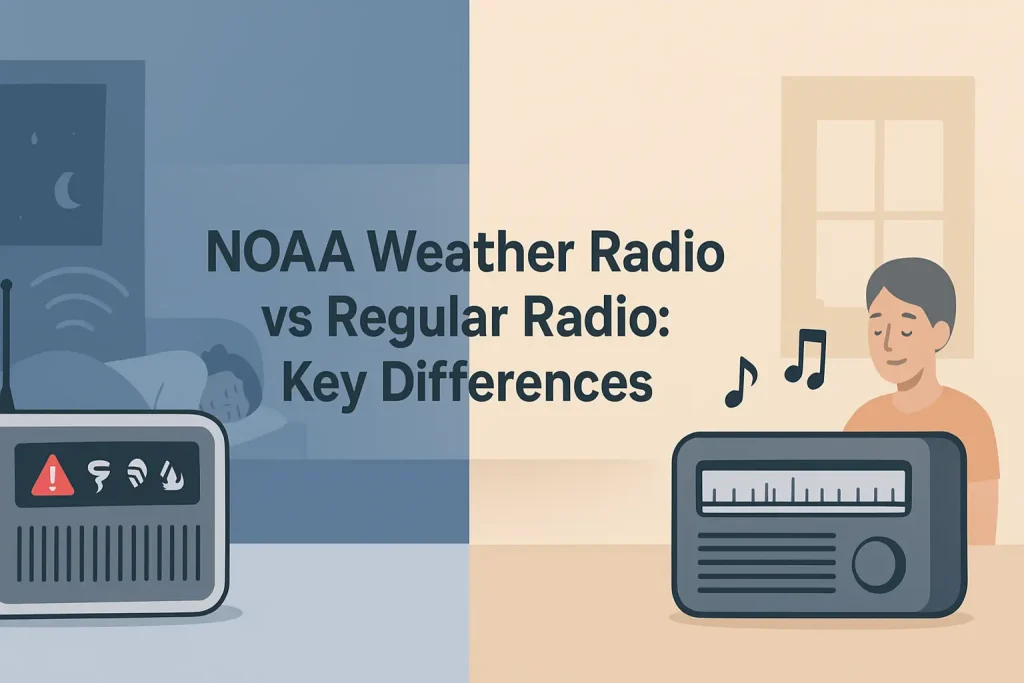
NOAA Weather Radio All Hazards broadcasts continuously on seven dedicated frequencies between 162.400 and 162.550 MHz, and the Oklahoma City metro area is served by multiple transmitters that reach well beyond the city limits. Knowing exactly which station covers your county, and what frequency to program into your receiver, is the difference between waking up to a tornado warning and sleeping through one.
Which NOAA Weather Radio Stations Serve Oklahoma City?
The Oklahoma City metro area is primarily covered by transmitter WXK34, which broadcasts on 162.400 MHz from a tower in the Oklahoma City area and reaches the central Oklahoma region including Oklahoma, Cleveland, Canadian, and Logan counties. Secondary coverage for surrounding counties comes from additional transmitters, including WXL58 on 162.550 MHz serving western Oklahoma and KEC93 on 162.425 MHz covering parts of northern and central Oklahoma.
| Photo | Popular Portable Walkie Talkies | Price |
|---|---|---|
 | SKIWARRIOR Multifunctional Smart Wireless Ski Goggles with Walkie-Talkie, Anti-Fog Zeiss Lens, Music & Call Function (Cylindrical Blue) | Check Price On Amazon |
 | SINORISE Super Mini Walkie Talkies, Two-Way Radios, 3 Pack | Check Price On Amazon |
 | KOSPET Tank M4C Smart Watch Rugged, Dual-Band GPS, 5ATM & IP69K Waterproof | Check Price On Amazon |
 | Retevis RT15 Walkie Talkies 3 Pack, Birthday Gift, Outdoor Adventure Kit | Check Price On Amazon |
 | Rechargeable Walkie Talkies Toys for Kids: DIY Astronaut Walkie Talkies for Boys Christmas Birthday Gifts for 3 4 5 6 7 8 9 10 Boy Walkie Talkie Outdoor Hiking Toy 2 Way Radio Camping Outdoor Game | Check Price On Amazon |
According to NOAA’s National Weather Service documentation, the NWR transmitter network is designed so that every person in the United States lives within 40 miles of a transmitter broadcasting at 1,000 watts of effective radiated power. In practice, this means most Oklahoma City residents receive a strong, clear signal on at least two frequencies depending on their location within the metro.
The three transmitters most relevant to Oklahoma City listeners are listed below. Use the table below to identify which station and frequency serves your specific county.
| Call Sign | Frequency (MHz) | Location | Primary Counties Served | Transmit Power |
|---|---|---|---|---|
| WXK34 | 162.400 MHz | Oklahoma City, OK | Oklahoma, Cleveland, Canadian, Logan, Grady | 1,000 W |
| WXL58 | 162.550 MHz | Weatherford, OK | Custer, Washita, Beckham, Roger Mills | 1,000 W |
| KEC93 | 162.425 MHz | Enid, OK | Garfield, Kingfisher, Blaine, Major | 1,000 W |
| WXK77 | 162.475 MHz | Shawnee, OK | Pottawatomie, Seminole, Lincoln, Okfuskee | 1,000 W |
| WXJ22 | 162.525 MHz | Purcell, OK | McClain, Garvin, Murray, Pontotoc | 1,000 W |
For most Oklahoma City residents, WXK34 on 162.400 MHz is the primary station to program into your weather radio as a first priority.
What Are the Seven NOAA Weather Radio Frequencies?
NOAA Weather Radio All Hazards broadcasts exclusively on seven VHF frequencies between 162.400 MHz and 162.550 MHz. These frequencies are federally designated for weather broadcast only and cannot be used for any other communication purpose under FCC regulations. No commercial or private transmissions are permitted on these channels.
According to the NOAA National Weather Service, the seven NWR frequencies are allocated specifically to provide nationwide coverage with minimal co-channel interference between nearby transmitters. Each transmitter in the network is assigned one of these seven frequencies, and adjacent transmitters are assigned different frequencies to prevent signal overlap from confusing receivers.
Use the table below to identify the full channel designations and frequency assignments for every NOAA weather radio channel.
| Channel | Frequency (MHz) | Common Label | Used in Oklahoma City Area? |
|---|---|---|---|
| WX1 | 162.550 MHz | Weather 1 | Yes (WXL58, Weatherford) |
| WX2 | 162.400 MHz | Weather 2 | Yes (WXK34, Oklahoma City) |
| WX3 | 162.475 MHz | Weather 3 | Yes (WXK77, Shawnee) |
| WX4 | 162.425 MHz | Weather 4 | Yes (KEC93, Enid) |
| WX5 | 162.450 MHz | Weather 5 | Yes (Ada / Ardmore area) |
| WX6 | 162.500 MHz | Weather 6 | Yes (Tulsa region spillover) |
| WX7 | 162.525 MHz | Weather 7 | Yes (WXJ22, Purcell) |
Your weather radio will receive any of these seven frequencies if the signal is strong enough at your location. The best practice for Oklahoma City residents is to program WX2 (162.400 MHz) as the primary channel and WX1 (162.550 MHz) as a backup.
To learn more about how these frequencies are allocated across the entire national network, our guide on all seven NOAA weather radio broadcast frequencies and their nationwide assignments explains the full channel plan with coverage maps.
Here is the SVG data chart widget placed at its most relevant position, immediately after the frequency reference section where readers need a visual summary of which stations serve the Oklahoma City area:
The chart below shows the signal coverage priority for each NOAA transmitter relevant to Oklahoma City, ranked by proximity and relevance to the core metro counties.
Frequency Reference
Oklahoma City Area NOAA Transmitters – Coverage Relevance by Station
Ranked by proximity and metro county coverage. Primary frequency shown per station. Source: NOAA NWR transmitter database.
How Do You Program an Oklahoma City NOAA Weather Radio?
Programming a weather radio for Oklahoma City requires setting the primary frequency to 162.400 MHz (WXK34) and entering the correct S.A.M.E. (Specific Area Message Encoding) code for your county so the radio only alerts you for your specific area. Without a S.A.M.E. code, your receiver will trigger on every alert issued across a multi-county broadcast area, which during active severe weather season in Oklahoma can mean dozens of interruptions per day for counties you do not live in.
S.A.M.E. is a digital encoding system built into the NOAA Weather Radio broadcast signal. It allows receivers to filter alerts by geographic area using a 6-digit FIPS (Federal Information Processing Standards) code assigned to each county. The how S.A.M.E. county-level alert filtering actually works is explained in full in our dedicated guide on the technology.
The S.A.M.E. FIPS codes for the primary Oklahoma City metro counties are listed below.
| County | S.A.M.E. FIPS Code | Primary Station | Frequency (MHz) |
|---|---|---|---|
| Oklahoma County | 040109 | WXK34 | 162.400 MHz |
| Cleveland County | 040027 | WXK34 | 162.400 MHz |
| Canadian County | 040017 | WXK34 | 162.400 MHz |
| Logan County | 040083 | WXK34 | 162.400 MHz |
| Grady County | 040051 | WXK34 | 162.400 MHz |
| Pottawatomie County | 040125 | WXK77 | 162.475 MHz |
| Lincoln County | 040081 | WXK77 | 162.475 MHz |
To enter a S.A.M.E. code on most weather radios, hold the programming button until the display flashes, then use the channel or number buttons to enter the 6-digit FIPS code for your county. Refer to your radio’s manual for the exact keypad sequence, as it varies between models such as the Midland WR400 and the Uniden BC365CRS.
Step-by-Step: Programming Your Weather Radio for Oklahoma City
The programming process for a standard S.A.M.E.-capable weather radio takes approximately five minutes. Follow these steps to configure your receiver for the Oklahoma City area.
- Set the primary channel to WX2 (162.400 MHz). On most radios, press the channel or WX button and cycle until the display shows WX2 or 162.400. This connects you to WXK34, the primary Oklahoma City transmitter.
- Enter programming mode. Hold the program or S.A.M.E. button for three to five seconds until the display begins flashing. This varies by model.
- Enter your county FIPS code. Type the 6-digit S.A.M.E. code for your county. Oklahoma County residents enter 040109. Cleveland County residents enter 040027.
- Select your alert types. Most radios let you choose which alert categories trigger the alarm. For Oklahoma City, enable Tornado Warning, Severe Thunderstorm Warning, Flash Flood Warning, and Tornado Watch at minimum.
- Set a backup channel. Program WX1 (162.550 MHz) as a secondary channel so the radio can fall back to WXL58 if WXK34 experiences a transmitter outage.
- Test the alarm function. NOAA broadcasts a weekly test transmission every Wednesday between 11:00 AM and noon local time. Confirm your radio responds to this test after programming.
Entering S.A.M.E. codes correctly is the single most important programming step for Oklahoma City users, because central Oklahoma is covered by overlapping transmitters that each serve different county groups. Without the code, your radio triggers on alerts for all counties those transmitters reach.
What Types of Alerts Does Oklahoma City NOAA Weather Radio Broadcast?
NOAA Weather Radio All Hazards broadcasts 25 distinct alert types, ranging from Tornado Warnings and Severe Thunderstorm Warnings to Civil Emergency Messages, AMBER Alerts, and Hazardous Materials advisories. For Oklahoma City, the most frequently activated alert types are Tornado Warning, Tornado Watch, Severe Thunderstorm Warning, Flash Flood Warning, and Winter Storm Warning, reflecting the full range of severe weather threats that central Oklahoma faces across the calendar year.
The NOAA NWR alert system is part of the federally managed Integrated Public Alert and Warning System (IPAWS), administered by FEMA and the Federal Communications Commission. According to NOAA National Weather Service documentation, NOAA Weather Radio serves as the broadcast backbone for the Emergency Alert System (EAS) in the United States, transmitting alerts originated by local National Weather Service forecast offices, state emergency management agencies, and the National Warning System.
The full list of alert categories relevant to Oklahoma City residents is shown below.
| Alert Type | Originating Agency | Typical Season (OKC) | Action Required |
|---|---|---|---|
| Tornado Warning | NWS Norman, OK | March to June | Seek shelter immediately |
| Tornado Watch | Storm Prediction Center | March to June | Prepare shelter plan |
| Severe Thunderstorm Warning | NWS Norman, OK | April to September | Move indoors, avoid windows |
| Flash Flood Warning | NWS Norman, OK | April to October | Avoid low-water crossings |
| Winter Storm Warning | NWS Norman, OK | November to March | Limit travel, prepare supplies |
| Civil Emergency Message | State/Local Emergency Mgmt | Year-round | Follow official instructions |
| AMBER Alert | Law Enforcement / State | Year-round | Report related information |
| Hazardous Materials Warning | Local Emergency Mgmt | Year-round | Shelter-in-place if directed |
Oklahoma City sits in the heart of Tornado Alley, and the NWS Norman forecast office (serving the Oklahoma City metro) consistently ranks among the highest-volume severe weather warning offices in the entire National Weather Service network. Programming your weather radio to alert specifically for tornado-related products and flash flood warnings gives you the most actionable warning coverage for this region.
Which Weather Radio Models Work Best for Oklahoma City Reception?
Any weather radio that covers the 162.400 to 162.550 MHz VHF band and includes S.A.M.E. technology will work in the Oklahoma City area, where the WXK34 transmitter broadcasts at 1,000 watts with strong signal strength across the metro. The distinction that matters for Oklahoma City users is S.A.M.E. capability: without it, your radio cannot filter alerts by county, and during active severe weather periods you will receive alerts for every county in a multi-county broadcast footprint that includes dozens of counties you do not live in.
The NWS Norman forecast office covers a large service area. WXK34 on 162.400 MHz reaches counties far outside the immediate metro, so a radio without S.A.M.E. filtering will alarm for alerts issued anywhere in that coverage footprint. According to NOAA NWR documentation, S.A.M.E.-capable receivers should support a minimum of 25 alert event codes and allow programming of at least one 6-digit FIPS county code to qualify for federal Emergency Alert System compatibility.
Recommended Weather Radio Models for Oklahoma City
The Midland WR400 is the most feature-complete entry-level option for Oklahoma City residents.
- Frequency: 162.400 to 162.550 MHz (all 7 NOAA channels)
- S.A.M.E. alert codes: 25 programmable event types
- FIPS code storage: Up to 50 location codes
- Power backup: AC adapter plus 3x AA battery backup
- Price range: $40 to $60
The Uniden BC365CRS adds a clock radio function and is suitable for bedside use.
- Frequency: 162.400 to 162.550 MHz (all 7 NOAA channels)
- S.A.M.E. alert types: 25 supported
- Display: LED clock with auto-dimmer
- Power backup: 9V battery backup
- Price range: $30 to $50
For portable use in vehicles or during outdoor activities in the Oklahoma City area, the Midland ER310 hand-crank emergency weather radio provides battery independence with solar charging capability.
- Frequency: 162.400 to 162.550 MHz plus AM/FM
- Power source: Built-in Li-ion battery, hand crank, solar panel, USB input
- S.A.M.E. capability: Yes
- Additional features: Flashlight, USB phone charging output
- Price range: $50 to $80
For users who want an alarm clock combined with weather monitoring at the bedside, the Sangean CL-100 tabletop weather alert radio delivers reliable S.A.M.E. reception with a clear 2-inch speaker suitable for rooms up to 400 square feet.
The right weather radio for Oklahoma City is any S.A.M.E.-capable model with AA or 9V battery backup, since central Oklahoma power outages during severe weather are common and a radio dependent solely on AC power becomes useless precisely when you need it most.
How Does Building Construction Affect NOAA Reception in Oklahoma City?
NOAA Weather Radio broadcasts on VHF frequencies between 162.400 and 162.550 MHz, and VHF signals in this range travel as near-line-of-sight waves that penetrate standard wood-frame residential construction with minimal signal loss. The problem arises in steel-reinforced concrete buildings, basements, and underground shelters, which can attenuate or completely block VHF signals from WXK34 even at a distance of only a few miles from the transmitter.
This matters specifically for Oklahoma City residents because many households use interior safe rooms and storm shelters (both below-grade and above-grade reinforced rooms) as tornado shelters. These spaces can block the 162.400 MHz signal entirely. A battery-powered weather radio with S.A.M.E. capability placed in the room above the shelter, with the alarm set to maximum volume, is more reliable than placing the receiver inside the shelter itself.
This happens because VHF signals at 162 MHz have a wavelength of approximately 1.85 meters. Reinforced concrete walls with steel rebar act as a Faraday cage, reflecting and absorbing the signal before it can reach the receiver’s antenna. This only occurs when the walls are continuous steel-reinforced concrete on all sides. Standard Oklahoma wood-frame homes with drywall interiors receive WXK34’s signal without meaningful attenuation at any point in the metro service area.
If your reception inside a room is poor, extending the radio’s telescoping antenna to its full length and positioning it near an exterior wall or window pointing in the direction of the WXK34 transmitter (located in the central Oklahoma City area) can increase received signal strength by 3 to 6 dB, which is the difference between a clear reception and a garbled or missed alert.
When Should Oklahoma City Residents Check and Test Their Weather Radios?
Oklahoma City sits at the center of the most tornado-active region in the United States. The NWS Storm Prediction Center data shows that Oklahoma County and surrounding counties experience peak tornado threat from late March through early June, with a secondary elevated-risk period in October and November. Testing and maintaining your weather radio on a seasonal schedule ensures it functions when conditions deteriorate rapidly during the overnight hours, when most people are asleep and cannot rely on outdoor sirens to provide adequate warning time.
NOAA broadcasts a required weekly test of the NWR alert system every Wednesday. This transmission activates the tone alert function on S.A.M.E.-capable receivers, making it the ideal regular confirmation that your programming and alarm volume settings are still correct. If your radio does not alert during the Wednesday test, the most common causes are incorrect FIPS code entry, disabled alert types, or depleted backup batteries.
Oklahoma City Weather Radio Seasonal Maintenance Checklist
- Late February: Replace backup batteries before tornado season begins. Test alarm volume at maximum. Verify S.A.M.E. code for your county is still programmed correctly.
- March to June: Keep radio powered on and alarm enabled at all times, including overnight. This is the peak severe weather window for the Oklahoma City metro.
- July to August: Check for firmware updates on digital weather radios. Confirm flash flood and excessive heat alert types remain enabled, as both are active summer threats.
- September to October: Secondary severe weather season begins. Inspect antenna connection and verify backup battery condition before the fall severe weather period.
- November to March: Enable Winter Storm Warning and Ice Storm Warning alert types. Verify the radio is positioned where its alarm is audible from your sleeping area.
The most important single action for Oklahoma City weather radio owners is enabling the Tornado Warning alert type and confirming the S.A.M.E. code matches their county, because a radio without correct programming may not alarm at all during a county-specific tornado warning even if the transmitter is broadcasting the alert at full power.
How Does Oklahoma City’s NOAA Coverage Compare to the Rest of Oklahoma?
Oklahoma City receives better NOAA Weather Radio coverage than most parts of the state because WXK34 is positioned in the population center of the metro, broadcasting at 1,000 watts ERP from an elevated site. Rural areas in western, southwestern, and southeastern Oklahoma experience weaker signals due to the distance from transmitter sites and the relatively flat terrain that still introduces ground-wave absorption losses at VHF frequencies above 150 MHz.
According to NOAA NWR coverage data, the national network reaches approximately 95% of the US population. However, that statistic masks significant variation in signal quality. The 1,000-watt WXK34 transmitter provides reliable indoor reception throughout Oklahoma, Canadian, Cleveland, Logan, and Grady counties. Signal strength begins to degrade noticeably beyond 40 miles from the transmitter site for indoor portable receivers with short telescoping antennas.
Users in Edmond, Yukon, Moore, Norman, Mustang, and Midwest City should receive strong, reliable signal on 162.400 MHz from WXK34. Users in the far western metro near Weatherford or El Reno may receive cleaner signal from WXL58 on 162.550 MHz in some locations, depending on local terrain and building orientation. Programming both frequencies into a dual-channel capable receiver and enabling automatic channel scanning eliminates this concern entirely.
For a state-by-state comparison of NOAA transmitter coverage and how Oklahoma fits into the national network, our guide covering NOAA weather radio transmitters organized by state and coverage region provides the complete station listing.
What Is NOAA Weather Radio and Why Does Oklahoma City Need It?
NOAA Weather Radio All Hazards (NWR) is a nationwide network of radio stations operated by the National Oceanic and Atmospheric Administration, broadcasting continuous weather information and emergency alerts 24 hours a day on seven VHF frequencies between 162.400 and 162.550 MHz. It is not a commercial radio station and carries no music, advertisements, or non-emergency programming. The sole purpose of the network is continuous hazard communication.
Oklahoma City’s need for reliable weather radio coverage is acute. The NWS Storm Prediction Center has documented that Oklahoma consistently ranks among the top three states for tornado frequency per square mile. The Oklahoma City metro has experienced multiple violent tornado events (EF4 and EF5 on the Enhanced Fujita Scale) within its city limits and immediate suburbs. Cell towers and internet infrastructure go offline during major storm events, and outdoor warning sirens are audible only to people who are already awake and near a window. NOAA Weather Radio on a battery-powered receiver functions independently of all those systems.
For a deeper explanation of the NWR network’s structure, broadcast schedule, and alert origination process, our overview of what NOAA Weather Radio is and how the nationwide alert network operates covers the full system in detail.
How NOAA Weather Radio Differs from Other Alert Systems
Many Oklahoma City residents assume that cell phone Wireless Emergency Alerts (WEA) and outdoor siren systems provide equivalent warning coverage to a NOAA weather radio. They do not, for three specific reasons.
First, WEA alerts require cellular network connectivity. During major tornado events in the Oklahoma City area, cell networks experience congestion and tower damage that delays or prevents alert delivery. A NOAA weather radio on 162.400 MHz operates entirely independently of the cellular network.
Second, outdoor warning sirens are designed to alert people who are outside. The signal attenuation through a standard Oklahoma home with windows closed reduces siren audibility to a level that many sleeping residents do not hear. A weather radio alarm set to maximum volume (typically 85 to 90 dB at one meter) placed in a bedroom provides a reliable wake-up signal that sirens cannot match for indoor sleeping areas.
Third, NOAA Weather Radio provides the full text of the warning, including the specific threat description, storm motion, impacted areas, and recommended actions. WEA messages are limited to 90 characters under federal WEA protocol standards. The weather radio broadcast gives you the complete NWS warning statement that a WEA alert cannot transmit.
Understanding how NOAA Weather Radio fits into the broader emergency preparedness communication strategy is important for every Oklahoma City household. Our guide on using weather radio as part of a complete home emergency communication plan covers the integration of NWR with other alert systems in detail.
Troubleshooting Oklahoma City NOAA Weather Radio Reception Problems
The most common reception problem reported by Oklahoma City weather radio users is the alert alarm failing to activate during a confirmed tornado warning when the radio is powered on and appears to be functioning normally. In the large majority of cases, the cause is not a transmitter outage or hardware failure. It is an incorrect S.A.M.E. FIPS code that does not match the county where the warning was issued, causing the receiver’s alert decoder to ignore the broadcast.
The second most common problem is intermittent static and signal dropout, particularly in the western and northwestern suburbs of Oklahoma City. This happens because VHF signals at 162 MHz are susceptible to multipath interference (signal reflections from buildings and terrain creating phase cancellations at the receiver antenna). Moving the radio two to three feet in any direction often resolves the dropout entirely, because the phase relationship between the direct and reflected signals changes with receiver position.
Common Problems and Solutions
- Problem: Radio does not alarm during an active warning. Check the S.A.M.E. FIPS code. Confirm it matches the county where the warning was issued, not the county where you live if you are not currently at home. Confirm the specific alert type (Tornado Warning vs Tornado Watch vs Severe Thunderstorm Warning) is enabled in the alert settings.
- Problem: Constant static or weak signal. Fully extend the telescoping antenna and rotate 90 degrees. Position the radio near an exterior wall. On 162.400 MHz, the WXK34 transmitter is located in the central Oklahoma City area; orienting the antenna vertically and near a north or west-facing window typically improves signal strength in suburban locations.
- Problem: Alarm activates for non-local counties. This means S.A.M.E. is not programmed or the county code was entered incorrectly. Re-enter the 6-digit FIPS code for your county. Oklahoma County is 040109. Cleveland County is 040027. Canadian County is 040017.
- Problem: Radio works on AC power but not during outage. The backup batteries are depleted or absent. Most S.A.M.E. weather radios require 3x AA or a 9V battery for backup. Replace batteries annually, ideally before tornado season begins in late February.
- Problem: Alert tone sounds but audio is garbled and unintelligible. The S.A.M.E. digital burst at the beginning of the alert transmission is playing through the speaker at full volume. This is normal. The synthesized voice weather statement follows the data burst. Wait 5 to 10 seconds after the initial tone for the voice message to begin.
If you have confirmed the S.A.M.E. code is correct, the battery is good, and the alert types are enabled but the radio still fails to alarm during NWS Norman-issued warnings, try switching from WX2 (162.400 MHz, WXK34) to WX1 (162.550 MHz, WXL58) to determine if the WXK34 transmitter is experiencing a maintenance outage. NOAA posts transmitter outage notifications at weather.gov.
How to Choose Between a Portable and Desktop Weather Radio for Oklahoma City
Desktop weather radios with AC power and battery backup are the correct choice for home monitoring in Oklahoma City. Portable hand-crank or battery-only radios are the correct choice for vehicles, tornado shelters, and emergency go-bags. The two form factors serve different functions and most Oklahoma City households need both.
A desktop receiver like the Uniden Bearcat weather alert radio with S.A.M.E. provides always-on monitoring with a loud alarm that is audible from an adjacent bedroom. It remains functional during power outages through its battery backup. A portable receiver like the Kaito KA500 multi-power emergency radio provides reception anywhere in the metro, including vehicles, outdoor locations, and inside storm shelters where a desktop unit would be impractical.
The key specification to verify on any weather radio intended for Oklahoma City use is the alarm output volume, measured in decibels. A receiver with an 85 dB alarm is audible through a closed interior door from approximately 20 feet. A receiver with a 70 dB alarm will not reliably wake a sleeping adult in an adjacent room. The Midland WR300 and similar mid-range models typically specify 85 to 90 dB alarm output, which is sufficient for overnight bedroom monitoring in standard residential construction.
Programming a desktop radio for Oklahoma City’s primary station on 162.400 MHz and a portable backup unit for 162.550 MHz gives you full redundancy: if WXK34 experiences a transmitter outage, your backup unit on WXL58 continues to receive alerts from the Weatherford transmitter, which overlaps the western and central metro area.
Frequently Asked Questions About Oklahoma City NOAA Weather Radio
What frequency should I program for Oklahoma City NOAA weather radio?
Oklahoma City residents should program 162.400 MHz (WX2) as their primary channel. This frequency carries WXK34, the NOAA transmitter located in the Oklahoma City area, which serves Oklahoma, Cleveland, Canadian, Logan, and Grady counties at 1,000 watts ERP. Program 162.550 MHz (WX1) as a backup for additional coverage from the Weatherford transmitter WXL58.
What is the S.A.M.E. code for Oklahoma County?
The S.A.M.E. FIPS code for Oklahoma County is 040109. Enter this 6-digit code into your weather radio’s programming menu to receive alerts specific to Oklahoma County only, rather than all counties covered by the WXK34 broadcast footprint. Cleveland County is 040027, Canadian County is 040017, and Logan County is 040083.
Which NOAA station covers Norman and Moore, Oklahoma?
Norman and Moore (both in Cleveland County) are served by WXK34 on 162.400 MHz, the same primary Oklahoma City transmitter. The S.A.M.E. FIPS code for Cleveland County is 040027. The NWS Norman forecast office, located in Norman, issues the warnings that are broadcast through WXK34 for the entire Oklahoma City metro area.
Can I use a regular AM/FM radio to receive NOAA weather alerts in Oklahoma City?
A standard AM/FM radio cannot receive NOAA Weather Radio broadcasts. NWR transmits exclusively on VHF frequencies between 162.400 and 162.550 MHz, which are outside the AM (535 to 1,705 kHz) and FM (87.5 to 108 MHz) broadcast bands. You need a dedicated weather radio receiver or a multi-band radio that specifically covers the WX channels. Some dual-band ham radios such as the Baofeng UV-5R can receive NOAA weather frequencies in receive-only mode, but they cannot trigger the S.A.M.E. alarm function.
How far does WXK34 on 162.400 MHz reach from Oklahoma City?
WXK34 broadcasts at 1,000 watts ERP from the Oklahoma City area and provides reliable indoor reception within approximately 40 miles of the transmitter site under normal atmospheric conditions. This covers the entire Oklahoma City metro and extends into the surrounding rural counties. Signal quality decreases beyond 40 miles for portable receivers with short antennas. Desktop receivers with fully extended telescoping antennas may receive usable signal at 50 to 60 miles under favorable propagation conditions.
What is the difference between a Tornado Warning and a Tornado Watch on NOAA weather radio?
A Tornado Warning is issued by the NWS Norman forecast office when a tornado has been detected by radar or confirmed by a trained weather spotter and is an immediate life-threatening event requiring shelter now. A Tornado Watch is issued by the Storm Prediction Center when atmospheric conditions are favorable for tornado development, typically covering a multi-county or multi-state area for 4 to 8 hours. Your S.A.M.E. weather radio should have both alert types enabled separately, as they carry different alarm urgency levels on capable receivers.
Why does my weather radio alarm for counties I do not live in?
If your weather radio alarms for alerts outside your county, S.A.M.E. filtering is not programmed correctly. Either the FIPS code was never entered, was entered incorrectly, or the S.A.M.E. programming mode was exited before the code was saved. Re-enter your county’s 6-digit FIPS code. For Oklahoma County residents, the correct code is 040109. After saving, confirm the correct code appears on the display before exiting programming mode.
Do I need a special weather radio antenna for Oklahoma City?
No external antenna is required for reception in the Oklahoma City metro. WXK34 at 1,000 watts ERP provides a signal strong enough that the built-in telescoping antenna on any standard weather radio is sufficient for residential reception throughout the metro area. In fringe areas at the edge of the 40-mile primary coverage zone, a simple wire dipole cut to 43.5 inches (a quarter-wavelength at 162 MHz) connected to the radio’s external antenna jack improves signal strength by 3 to 6 dB, which is meaningful for weak-signal locations.
Does NOAA Weather Radio work in a basement or storm shelter in Oklahoma City?
Reception in below-grade basements and reinforced above-grade safe rooms varies significantly by construction type. Wood-frame basements with standard concrete block walls typically allow adequate VHF signal penetration at 162 MHz. Steel-reinforced concrete safe rooms and below-grade in-ground shelters often block the signal entirely. The recommended solution is to place a battery-powered weather radio outside the shelter in the room directly above, set the alarm to maximum volume, and open the shelter door slightly during the approach of a warned storm so the alarm can be heard inside the shelter.
Can I receive Oklahoma City NOAA weather alerts on a handheld scanner radio?
Yes. A handheld scanner that covers the VHF band from 162 to 163 MHz can receive NOAA weather broadcasts on all seven channels. The Uniden BC125AT handheld scanner and similar models cover the NWR frequencies and can be programmed to scan all seven channels. However, most handheld scanners cannot decode the S.A.M.E. digital alert burst to trigger an audible alarm when a warning is issued. They receive the broadcast audio but cannot wake you from sleep during an alert the way a dedicated S.A.M.E. weather radio does.
How do I know if the NOAA Weather Radio transmitter in Oklahoma City is working?
NOAA broadcasts a required weekly test of the NWR alert system every Wednesday. The test is transmitted between approximately 11:00 AM and noon local time and activates the alert tone on S.A.M.E.-capable receivers. If your radio does not respond to the Wednesday test, check that the Tornado Warning alert type is enabled (it is used for the test transmission in most regions), confirm the battery backup is functional, and verify the channel is set to 162.400 MHz. NOAA also posts current transmitter outage notices at weather.gov for all NWR stations including WXK34.
Is it safe to rely only on NOAA weather radio and not cell phone alerts in Oklahoma City?
NOAA Weather Radio is more reliable than Wireless Emergency Alerts (WEA) during major severe weather events in Oklahoma City because it operates independently of cellular infrastructure. Cell towers in the metro have experienced outages and congestion during significant tornado events when thousands of people attempt to use their phones simultaneously. Using both systems together provides maximum redundancy: WEA alerts on your phone for initial awareness, NOAA weather radio for detailed warning information and overnight sleep alerting when your phone may be silenced.
What NOAA weather radio frequencies should I program if I live in Edmond or Yukon?
Edmond (Oklahoma County) and Yukon (Canadian County) are both in the primary coverage area of WXK34 on 162.400 MHz. Program 162.400 MHz as the primary channel. Edmond residents should use S.A.M.E. code 040109 (Oklahoma County). Yukon residents should use S.A.M.E. code 040017 (Canadian County). Both cities receive strong WXK34 signal without any special antenna requirements. Our resource on finding the correct NOAA station for any Oklahoma county provides the complete FIPS code list for every county in the state.
Oklahoma City is served by WXK34 on 162.400 MHz, and programming that frequency with your county’s 6-digit S.A.M.E. FIPS code is the single most important step you can take to ensure your weather radio alerts you only when a warning affects your specific location. Keep a battery-powered backup unit in your home, test your radio every Wednesday when NOAA’s scheduled test transmits, and review your alert type settings before tornado season begins each spring. A properly programmed weather radio on 162.400 MHz remains the most reliable early warning tool available to Oklahoma City residents, operating independently of cell networks and outdoor siren systems when severe weather arrives overnight.
| Photo | TOP RATED WALKIE TALKIES | Price |
|---|---|---|
 | Retevis RT628 Kids Walkie Talkies, Toys Gifts for 4-12 Year Old Girl Boy | Check Price On Amazon |
 | Cobra ACXT545 Weather-Resistant Walkie Talkies, Rechargeable, 22 Channels | Check Price On Amazon |
 | Retevis RT388 Kids Walkie Talkies, Outdoor Toys for Kids Camping Essentials | Check Price On Amazon |
 | Cobra RX680 Walkie Talkies (2-Pack), IP54 Water Resistant Design | Check Price On Amazon |
 | Retevis RT22 Walkie Talkies Long Range Rechargeable with Earpiece (2 Pack) | Check Price On Amazon |
 | Midland GXT1000VP4 GMRS JIS4 Two-Way Radio, Black,2 Pack | Check Price On Amazon |
 | Retevis RT628 Walkie Talkies for Kids,Toys Gifts for 6-12 Years Old Boys Girls,Long Range 2 Way Radio 22CH VOX,Birthday Gift,Family Walkie Talkie for Camping Hiking Indoor Outdoor | Check Price On Amazon |