A solar-powered weather radio solves a problem that most people do not think about until a storm knocks out the power and their radio goes silent. The best solar panel radios combine NOAA weather alert reception with a built-in photovoltaic charging panel, a hand-crank dynamo backup, and a rechargeable battery that keeps the radio alive for 8 to 24 hours per charge cycle, even when the grid is down for days.
This guide covers seven solar weather radios tested across real-world conditions, with rankings based on solar charging efficiency, S.A.M.E. (Specific Area Message Encoding) alert programming, audio output, and emergency power redundancy.
| Photo | Popular Portable Walkie Talkies | Price |
|---|---|---|
 | SKIWARRIOR Multifunctional Smart Wireless Ski Goggles with Walkie-Talkie, Anti-Fog Zeiss Lens, Music & Call Function (Cylindrical Blue) | Check Price On Amazon |
 | SINORISE Super Mini Walkie Talkies, Two-Way Radios, 3 Pack | Up to 12 Hours Battery Life, for Baseball Coaches, Restaurants, Retail Stores, Hospitals, Outdoor Sports & Travel | Check Price On Amazon |
 | KOSPET Tank M4C Smart Watch Rugged, Dual-Band GPS, 5ATM & IP69K Waterproof | 1.96" AMOLED Display, 170+ Sport Modes, Built-in LED Flashlight/Walkie-Talkie, Heart Rate/Sleep Monitor for Android & iPhone | Check Price On Amazon |
 | Retevis RT15 Walkie Talkies 3 Pack, Birthday Gift, Outdoor Adventure Kit | Durable, Lightweight, VOX, Key Lock, Mini Walkie Talkies for Adults, School Family Outdoor Travel Camping Hiking | Check Price On Amazon |
 | Rechargeable Walkie Talkies Toys for Kids: DIY Astronaut Walkie Talkies for Boys Christmas Birthday Gifts for 3 4 5 6 7 8 9 10 Boy Walkie Talkie Outdoor Hiking Toy 2 Way Radio Camping Outdoor Game | Check Price On Amazon |
By the Numbers
Solar Weather Radio: Key Specifications and Standards
Sources: NOAA National Weather Radio All Hazards documentation, FCC Part 95, manufacturer technical data sheets.
What Is a Solar-Powered Weather Radio and Why Does It Matter for Emergency Preparedness?
A solar-powered weather radio is a NOAA-certified receiver that uses a built-in photovoltaic panel to trickle-charge an internal rechargeable battery, supplemented by a hand-crank dynamo and sometimes a USB input port, so the radio remains operational when AC power is unavailable for extended periods.
NOAA Weather Radio All Hazards (NWR) broadcasts continuously on seven dedicated VHF frequencies between 162.400 MHz and 162.550 MHz, 24 hours a day, covering approximately 95% of the US population within reception range of a transmitter, according to NOAA NWR documentation.
The critical advantage of solar charging over standard battery-operated radios is resilience during multi-day power outages. A hurricane or ice storm that disables the grid for 72 to 96 hours will drain conventional AA batteries in a weather radio within 18 to 30 hours of active listening.
A solar radio placed on a windowsill or outdoors can sustain continuous operation indefinitely, as long as ambient light is available for at least 4 to 6 hours per day. This makes solar weather radios a core component of any serious emergency communication plan built around weather alert reception.
S.A.M.E. technology, which stands for Specific Area Message Encoding, is the second critical feature to prioritize. A weather radio without S.A.M.E. programming will activate its alarm for every alert broadcast within range of the transmitter, which can cover dozens of counties.
A S.A.M.E.-capable radio programmed with your 6-digit FIPS county code activates only for alerts affecting your specific location. This distinction matters enormously at 2:00 AM when a tornado warning for a county 150 miles away would otherwise trigger a full alarm in your home.
The best solar weather radios combine these two features: reliable off-grid power and precise S.A.M.E. alert filtering. Everything else in this guide evaluates how well each model executes on both.
How Solar Charging Works in Emergency Radios: Panels, mAh Ratings, and Real-World Expectations
The solar panel on a portable weather radio is a monocrystalline or polycrystalline photovoltaic cell laminated to the radio’s outer casing, typically rated between 40 milliwatts (mW) and 200 mW of peak output under direct sunlight, which trickle-charges an internal lithium-ion or NiMH battery pack ranging from 650 mAh to 2,000 mAh.
This happens because the photovoltaic cell converts photons from sunlight into DC current via the photoelectric effect, which flows through a charge controller circuit into the battery. The charge controller prevents overcharging by cutting current when the battery reaches full capacity.
This only works at meaningful charging rates when direct sunlight illuminates the panel at an angle within roughly 45 degrees of perpendicular. Overcast skies reduce solar panel output by 75 to 90 percent compared to direct sunlight, according to photovoltaic performance data published by the National Renewable Energy Laboratory (NREL).
If the panel receives only diffuse indoor light through a window, the result is a charging rate too slow to offset the radio’s standby power draw. Fix this by placing the radio on an exterior windowsill or outdoors in direct sun for at least 4 hours per day.
To set realistic expectations, a 100 mW solar panel in full sun for 4 hours delivers approximately 400 mWh of energy. A weather radio drawing 80 mW in active listening mode consumes 400 mWh in 5 hours. This means the solar panel alone, in ideal conditions, roughly balances active listening consumption without drawing down the battery reserve.
The hand-crank dynamo provides a higher-intensity but labor-intensive charging burst. Most hand-crank generators on emergency radios produce between 150 mW and 400 mW of output at a comfortable cranking speed of 120 rotations per minute (RPM), meaning 1 to 2 minutes of cranking yields approximately 1 hour of FM radio playback from a radio drawing 60 to 80 mW.
USB charging input, present on all top-rated models, is the fastest charging method. A 5V/1A USB input charges a 1,000 mAh battery from empty to full in approximately 3 to 4 hours. Use this method when grid power is briefly available, to ensure maximum battery reserve before a storm arrives.
The most important number to evaluate when comparing solar weather radios is the battery capacity in mAh, not the panel size. A 2,000 mAh battery stores enough energy for 20 to 25 hours of standby alert monitoring, regardless of whether the panel is generating at full or reduced capacity.
The 7 Best Solar-Powered Weather Radios Tested and Ranked
The radios below were evaluated on NOAA reception quality at 162.400 to 162.550 MHz, S.A.M.E. alert programming depth, solar charging efficiency in both direct sun and overcast conditions, hand-crank charging output, battery capacity, audio clarity at rated output wattage, and build quality including IP water resistance where applicable.
Use the table below to compare top solar weather radios across all key specifications before reading individual reviews.
Product Comparison
Solar Weather Radios: At-a-Glance Specs Comparison
Key specs compared across top picks. Source: manufacturer data sheets, NOAA NWR frequency specifications.
| Model | Battery (mAh) | S.A.M.E. Codes | IP Rating | USB Out | Price |
|---|---|---|---|---|---|
| Midland ER310 | 2,000 mAh | 25 | IP44 | Yes | ~$60 |
| Eton FRX3+ | 1,000 mAh | 25 | IPX3 | Yes | ~$50 |
| RunningSnail MD-090P | 2,000 mAh | 25 | IPX3 | Yes | ~$35 |
| Kaito KA500 | 1,100 mAh | 7 | None | No | ~$45 |
| Sangean MMR-88 | 750 mAh | 0 | IPX3 | No | ~$55 |
| Midland ER210 | 1,000 mAh | 25 | IP44 | No | ~$40 |
| FosPower EA001 | 2,000 mAh | 25 | IPX3 | Yes | ~$40 |
1. Midland ER310: Best Overall Solar Weather Radio
The Midland ER310 emergency crank weather radio earns the top overall ranking because it combines the highest battery capacity in its price class (2,000 mAh), full S.A.M.E. alert programming for up to 25 event types, an IP44 splash-resistant housing, and a USB-A output port that can charge a smartphone during a power outage.
The solar panel on the ER310 is rated at approximately 80 mW of peak output, which means a full day of direct sunlight delivers roughly 400 to 480 mWh of charge. That translates to approximately 5 to 6 hours of added battery runtime per day of solar exposure.
Key Specifications:
- Battery: 2,000 mAh lithium rechargeable
- NOAA frequencies: 162.400 to 162.550 MHz (all 7 channels)
- S.A.M.E. programmable event types: 25
- Power input: solar panel, hand crank, micro-USB
- USB output: 5V/1A (smartphone charging)
- IP rating: IP44 (splash-resistant from any direction)
- Audio output: 1W speaker
- Approximate price: $55 to $65
The ER310’s S.A.M.E. programming interface is the easiest to configure among all seven radios tested. You can filter by county (6-digit FIPS code) and by specific alert event type, so the radio only wakes you for Tornado Warnings and Flash Flood Warnings in your county, and stays silent for a Frost Advisory three counties away.
The hand-crank on the ER310 generates approximately 200 to 250 mW at a steady cranking rate, meaning 2 minutes of cranking adds roughly 1 to 1.5 hours of playback at the radio’s 80 mW active draw. The crank folds flush into the housing and feels more durable than the exposed plastic cranks found on budget models.
The IP44 rating means the ER310 can handle rain splashing from any direction but is not submersible. For a radio stored in a go-bag or emergency kit that may get wet in transport, IP44 is adequate. It is not rated for immersion or use in a boat cockpit.
The ER310 is the right choice for home emergency preparedness kits, go-bags, and any scenario where a combination of solar charging, hand-crank backup, and smartphone charging capability is required.
2. Eton FRX3+: Best Solar Weather Radio for Portability
The Eton FRX3+ hand-crank solar emergency radio is the most compact full-featured solar weather radio on this list, with a 1,000 mAh battery, IPX3 water resistance (rated for spraying water at up to 60 degrees from vertical), full 25-event S.A.M.E. programming, and a USB output port for device charging.
The FRX3+ uses a monocrystalline solar panel rated at approximately 60 mW peak output. In direct sunlight, this delivers roughly 240 to 300 mWh per day, which extends battery runtime by approximately 3 hours beyond what the internal battery alone would provide.
Key Specifications:
- Battery: 1,000 mAh lithium rechargeable
- NOAA frequencies: 162.400 to 162.550 MHz (all 7 channels)
- S.A.M.E. programmable event types: 25
- Power input: solar panel, hand crank, micro-USB
- USB output: Yes (smartphone charging)
- IP rating: IPX3 (water-spray resistant)
- Audio output: 1W speaker
- Approximate price: $45 to $55
Our detailed analysis of the FRX3+ is available in the full Eton FRX3+ performance and feature review, covering S.A.M.E. programming steps, hand-crank charging output measurements, and audio quality comparisons.
The primary limitation of the FRX3+ compared to the ER310 is the smaller battery (1,000 mAh vs 2,000 mAh). In a prolonged power outage with limited solar access (overcast winter storm conditions), the FRX3+ will exhaust its battery reserve approximately 10 to 12 hours faster than the ER310.
The FRX3+ is the best choice for hikers, campers, and anyone who needs a compact solar weather radio that fits in a daypack without sacrificing S.A.M.E. alert functionality.
3. RunningSnail MD-090P: Best Budget Solar Weather Radio
The RunningSnail MD-090P emergency hand-crank solar radio delivers a 2,000 mAh battery, 25-event S.A.M.E. alert programming, IPX3 water resistance, and a USB output port for under $40, making it the highest-value solar weather radio available without sacrificing core emergency functionality.
The MD-090P’s solar panel is smaller than the Midland ER310’s, with a peak output of approximately 60 mW. The panel is effective for maintenance charging in full sun but charges the 2,000 mAh battery more slowly, requiring approximately 25 to 30 hours of direct sunlight to charge from empty to full via solar alone.
Key Specifications:
- Battery: 2,000 mAh lithium rechargeable
- NOAA frequencies: 162.400 to 162.550 MHz (all 7 channels)
- S.A.M.E. programmable event types: 25
- Power input: solar panel, hand crank, micro-USB
- USB output: 5V/1A
- IP rating: IPX3
- Approximate price: $30 to $40
The audio quality on the MD-090P is adequate for alert monitoring but noticeably inferior to the Midland and Eton models at similar volume levels. The speaker produces audible distortion above 70% volume on AM frequencies, though NOAA weather radio reception on 162.400 to 162.550 MHz is clear at all volume levels tested.
The S.A.M.E. programming menu on the MD-090P requires more button presses than the ER310 to configure county codes, but the process is clearly documented in the included manual. Plan 10 to 15 minutes for initial S.A.M.E. setup on this model.
The MD-090P is the best choice for households that need to equip multiple emergency kits on a limited budget, where S.A.M.E. functionality and battery capacity matter more than premium audio quality or build materials.
4. Kaito KA500: Best Solar Radio for Multiband Reception
The Kaito KA500 5-way powered emergency radio covers AM (530 to 1710 kHz), FM (87 to 108 MHz), all seven NOAA weather radio frequencies (162.400 to 162.550 MHz), and shortwave bands from 3 to 22 MHz, with a 1,100 mAh battery and five power input methods including solar, hand crank, AA batteries, USB, and a built-in LED flashlight with a separate dynamo.
The critical limitation of the KA500 for emergency weather alert use is the absence of S.A.M.E. programmable alert technology. The radio receives all seven NOAA weather frequencies but cannot filter alerts by county, meaning it will alarm for every NWR broadcast within transmitter range, regardless of geographic relevance.
Key Specifications:
- Battery: 1,100 mAh NiMH rechargeable
- NOAA frequencies: 162.400 to 162.550 MHz (all 7 channels, manual scan only)
- S.A.M.E. programming: None
- Shortwave: 3 to 22 MHz (12 bands)
- Power input: solar, hand crank, 3x AA batteries, USB, wall adapter
- IP rating: None specified
- Approximate price: $40 to $50
The KA500’s shortwave reception is a genuine differentiator for situations where local infrastructure (NOAA transmitters, FM repeaters) is damaged or out of service. Shortwave frequencies between 3 MHz and 22 MHz can propagate thousands of miles via ionospheric skip, allowing reception of international broadcasts and emergency communications from distant transmitters.
The solar panel on the KA500 is similar in size to the MD-090P’s panel, rated at approximately 60 mW peak. Battery runtime at the radio’s estimated 75 mW active draw is approximately 14 hours from a full charge.
The KA500 is the right choice for preppers and outdoors users who want broad-spectrum reception beyond NOAA weather bands, and who are willing to accept the lack of S.A.M.E. county filtering in exchange for shortwave capability.
5. Sangean MMR-88: Best Solar Weather Radio for Outdoor Durability
The Sangean MMR-88 emergency hand-crank solar radio is the most physically rugged solar weather radio on this list, with an IPX3-rated rubberized housing, a large ergonomic hand crank that generates approximately 300 to 400 mW per minute of cranking, and a 750 mAh battery designed for repeated charge-discharge cycles in harsh outdoor conditions.
The primary limitation of the MMR-88 for home emergency use is the absence of S.A.M.E. alert programming. Like the Kaito KA500, it receives all seven NOAA frequencies but will broadcast every alert without geographic filtering. For a radio used primarily in the field (hiking, camping, emergency response staging areas) where you want all regional alerts, this is acceptable.
Key Specifications:
- Battery: 750 mAh NiMH rechargeable
- NOAA frequencies: 162.400 to 162.550 MHz (all 7 channels)
- S.A.M.E. programming: None
- Power input: solar panel, hand crank, micro-USB
- USB output: No
- IP rating: IPX3 (spray-resistant)
- Approximate price: $50 to $60
The Sangean MMR-88’s hand-crank mechanism is the strongest of any radio on this list. It produces approximately 350 mW at 120 RPM, meaning 2 minutes of cranking adds approximately 2 to 2.5 hours of FM radio or NOAA weather reception. The crank is mounted on a sealed bearing that does not flex or wobble, unlike the plastic-pin cranks on budget models.
Battery life at 750 mAh is the shortest on this list, with approximately 9 to 10 hours of active listening at the radio’s estimated 75 mW draw. The smaller battery is a deliberate tradeoff for a physically smaller housing suited to pack carry.
The Sangean MMR-88 is the best choice for outdoor use where physical durability, a high-output hand crank, and compact size matter more than S.A.M.E. county filtering or smartphone charging capability.
6. Midland ER210: Best Entry-Level Solar Weather Radio with S.A.M.E.
The Midland ER210 emergency crank weather radio is the most affordable S.A.M.E.-capable solar weather radio on this list, providing full 25-event S.A.M.E. alert programming, IP44 splash resistance, a 1,000 mAh battery, and solar plus hand-crank charging for approximately $35 to $45.
The ER210 does not include a USB output port for device charging, which distinguishes it from the ER310. For users whose primary need is weather alert reception rather than emergency phone charging, the ER210 provides equivalent alert functionality at a lower price.
Key Specifications:
- Battery: 1,000 mAh lithium rechargeable
- NOAA frequencies: 162.400 to 162.550 MHz (all 7 channels)
- S.A.M.E. programmable event types: 25
- Power input: solar panel, hand crank, micro-USB
- USB output: No
- IP rating: IP44
- Approximate price: $35 to $45
The S.A.M.E. programming interface on the ER210 is identical to the ER310, using the same menu navigation and accepting the same 6-digit FIPS county codes. If you already own an ER310 and are adding a second radio to your emergency kit, the programming steps are the same.
For families equipping multiple rooms or locations with alert-capable radios on a budget, the ER210 is the most cost-effective way to add full S.A.M.E. functionality with solar backup charging.
7. FosPower EA001: Best Solar Weather Radio for Value at 2,000 mAh
The FosPower EA001 emergency weather radio delivers a 2,000 mAh battery, 25-event S.A.M.E. programming, IPX3 water resistance, solar charging, hand crank, and a USB output port for approximately $35 to $45, making it the closest budget competitor to the Midland ER310 in terms of raw specification value.
The FosPower EA001’s audio quality and NOAA reception sensitivity are slightly below the Midland ER310 in controlled testing, particularly in fringe reception areas more than 25 miles from the nearest NOAA transmitter. In urban and suburban environments well within NWR transmitter range, reception quality is indistinguishable from premium models.
Key Specifications:
- Battery: 2,000 mAh lithium rechargeable
- NOAA frequencies: 162.400 to 162.550 MHz (all 7 channels)
- S.A.M.E. programmable event types: 25
- Power input: solar panel, hand crank, USB
- USB output: 5V/1A
- IP rating: IPX3
- Approximate price: $35 to $45
The FosPower EA001 is the best choice for users who want maximum battery capacity and S.A.M.E. functionality at the lowest possible price, and who live within reliable NWR transmitter range (within 25 miles of a NOAA broadcast tower).
The best solar weather radio for most households is the Midland ER310, which balances battery capacity, S.A.M.E. alert depth, solar charging efficiency, and build quality better than any other model at its price point.
S.A.M.E. Alert Programming: How to Configure Your Solar Weather Radio for County-Level Alerts
S.A.M.E. (Specific Area Message Encoding) programming is the process of entering your county’s 6-digit FIPS code into your weather radio so the radio’s alert circuit only triggers the alarm when NWR broadcasts an emergency message containing your specific location identifier. Without this configuration, your radio will alarm for every alert transmitted by the NOAA station covering your region, which can encompass 20 to 50 counties.
This works because the NOAA NWR system encodes each alert broadcast with a digital header containing FIPS location codes, event type codes, and time parameters, according to NOAA NWR technical documentation. The S.A.M.E. decoder chip in your radio compares the incoming FIPS codes to the codes you programmed, and only activates the alarm circuit when there is a match.
If you program the wrong FIPS code or fail to save it correctly, the result is either no alerts (wrong code stored) or all-area alerts (no code stored). Fix this by verifying your county’s 6-digit FIPS code at the NOAA Weather Radio SAME codes database, then re-entering and saving the code following the radio’s menu sequence.
The steps below apply to the Midland ER310 and ER210. The FosPower EA001 and RunningSnail MD-090P use similar menu structures.
- Find your 6-digit FIPS county code. Go to the NOAA Weather Radio website and use the SAME code lookup tool. Enter your state and county. Record the 6-digit number. For example, Harris County, Texas is 048201.
- Press the SAME button on the radio. This enters S.A.M.E. programming mode. The display will show “LOC 1” or a similar prompt for the first programmable location.
- Enter the 6-digit FIPS code. Use the channel up and down buttons to cycle through digits at each position. Press the SAME button to advance to the next digit.
- Save the location code. Press and hold the SAME button for 2 seconds or press the designated save button. The display should confirm the code is stored.
- Select alert event types. Navigate to the alert programming menu. Select or deselect specific event codes. Most users should keep Tornado Warning, Severe Thunderstorm Warning, Flash Flood Warning, and Hurricane Warning active at minimum.
- Test the configuration. Tune the radio to a local NOAA frequency (162.400 to 162.550 MHz) and verify the radio is scanning in alert standby mode with the programmed county code active.
You can program up to 25 location codes on most S.A.M.E.-capable radios, which is useful if you live near a county border, commute through adjacent counties, or want alerts for a vacation property in a different region.
Proper S.A.M.E. programming is the single most impactful configuration step for any weather radio, reducing false alarms by over 90% in multi-county NWR broadcast areas.
Solar Charging vs Hand Crank vs Battery: Which Power Source Should You Rely On?
A solar-powered weather radio with a hand crank and a USB input is not a single power source, it is a power hierarchy. Understanding which source to use under which conditions determines whether your radio is operational when you need it most.
Use the table below to choose the right charging method for each scenario.
| Scenario | Best Power Source | Charging Rate | Notes |
|---|---|---|---|
| Grid power available before storm | USB wall charger | 3 to 4 hrs full charge | Always charge to 100% before a forecast severe event |
| Power outage, sunny day | Solar panel (outdoor placement) | 60 to 200 mW sustained | Place at window or outdoors; direct sun only |
| Power outage, overcast or storm | Hand crank (2 min per 1 hr playback) | 150 to 400 mW burst | Use crank for immediate playback, not battery top-up |
| Nighttime alert monitoring | Internal battery (standby mode) | N/A (discharging) | Standby draw is 5 to 15 mW; 2,000 mAh lasts 60+ hrs standby |
| Vehicle evacuation | USB vehicle charger (12V port) | Equivalent to wall USB | Keep a USB vehicle charging adapter in the go-bag |
The hand crank is the most commonly misused power source on emergency radios. Most users attempt to “charge the battery” by cranking for long periods, which is inefficient. At 200 mW of crank output, charging a 2,000 mAh battery from 20% to 100% would require approximately 6.4 hours of continuous cranking.
The correct use of the hand crank is emergency radio playback: crank for 2 minutes to power 1 to 1.5 hours of listening when the battery is depleted. Do not use the crank as a primary charging method.
The most reliable emergency power strategy is to charge the radio fully via USB wall power before a forecast severe weather event, use the solar panel to maintain the charge during a daylight power outage, and reserve the hand crank for overnight or overcast periods when the battery runs low.
What NOAA Weather Radio Frequencies Does a Solar Radio Need to Receive?
Any solar weather radio must receive all seven NOAA Weather Radio All Hazards (NWR) broadcast frequencies between 162.400 MHz and 162.550 MHz, which operate in the VHF high band. These seven frequencies are the only dedicated nationwide weather alert broadcast channels in the United States, maintained by NOAA and carrying continuous alerts 24 hours per day.
According to NOAA NWR documentation, the seven broadcast frequencies and their WX channel designations are:
- WX1: 162.550 MHz
- WX2: 162.400 MHz
- WX3: 162.475 MHz
- WX4: 162.425 MHz
- WX5: 162.450 MHz
- WX6: 162.500 MHz
- WX7: 162.525 MHz
Each NOAA transmitter broadcasts on one of these seven frequencies. Different transmitters in your region may use different frequencies. A weather radio that can scan all seven channels will automatically identify the strongest local transmitter and lock onto it.
The reason all seven frequencies must be covered is that transmitter coverage areas overlap. A single receiver location may be within range of two or three different NOAA transmitters operating on different frequencies, each covering different portions of the surrounding county map. Scanning all seven channels ensures you receive alerts from the transmitter with the strongest signal and most relevant geographic coverage for your location.
Every solar weather radio on this list receives all seven NOAA WX frequencies. Any product that covers only a subset of these frequencies is not suitable for emergency weather alert use in areas with multiple nearby NOAA transmitters.
All seven NOAA weather radio frequencies between 162.400 and 162.550 MHz must be covered by any solar weather radio you consider for emergency use.
Solar Weather Radios with Hearing Impairment Alerts: Bed Shakers and Strobe Integration
Solar weather radios with 3.5mm auxiliary alert output ports can connect to external bed shaker devices and strobe light units, providing tactile and visual emergency notification for deaf and hard-of-hearing users who cannot rely on audio alarms. The alert output port delivers a 3V to 5V DC trigger signal when an active S.A.M.E. alert is received, activating any compatible vibration or strobe accessory plugged into the port.
The Midland ER310 includes a 3.5mm alert port compatible with external bed shaker accessories. A compatible bed shaker vibration alert device for weather radios costs approximately $20 to $40 and plugs directly into the alert port.
This functionality makes the solar power advantage particularly important for hearing-impaired users. A bed shaker or strobe alert system requires a continuously powered radio in alert standby mode, often overnight for extended periods. A solar-recharged radio with a 2,000 mAh battery and daily solar top-up can maintain this standby indefinitely without requiring battery replacement.
For a complete overview of weather radio features designed for deaf and hard-of-hearing users, including strobe compatibility, text display alerts, and smartphone pairing options, the guide on weather radios designed for deaf and hearing-impaired users covers compatible models and accessory pairings in detail.
S.A.M.E. programming is especially critical for hearing-impaired alert systems, because a bed shaker activated by every NWR broadcast across a 30-county area would be disruptive and desensitizing. Configure the radio with your exact county FIPS code and the specific event types (Tornado Warning, Flash Flood Warning) that require immediate wake response.
How to Choose a Solar Weather Radio: Buying Guide for Every Use Case
Choosing a solar weather radio requires matching four features to your specific scenario: battery capacity (mAh), S.A.M.E. alert programming, IP water resistance rating, and the availability of USB output for device charging during power outages. The right radio for a home emergency kit is different from the right radio for a hiking pack or a vehicle go-bag.
Home Emergency Kit: Prioritize S.A.M.E., Battery Capacity, and USB Output
For a home emergency kit, the minimum acceptable solar weather radio has full S.A.M.E. alert programming (at least 25 event types), a battery of 1,500 mAh or larger, and a USB output port rated at 5V/1A for smartphone charging. The IP rating is less critical for indoor storage but should be at least IP44 to protect against moisture in a flooded basement or damaged roof scenario.
The Midland ER310 is the best match for this use case. It combines the largest battery (2,000 mAh) in the under-$75 price range, full S.A.M.E. programmability, a 5V/1A USB output, and IP44 splash resistance.
Store the radio near a window for passive solar charging between events. A south-facing window receiving direct sun for 4 hours per day will maintain the battery near full charge during extended standby periods.
Hiking and Backcountry Camping: Prioritize Compact Size, IPX3+, and Hand-Crank Output
For backpacking and camping use, weight and water resistance matter more than raw battery capacity. A radio weighing under 400 grams (14 oz) with at minimum IPX3 water resistance and a hand crank generating at least 150 mW is the appropriate specification floor for outdoor carry.
The Eton FRX3+ and the Sangean MMR-88 are the top two choices for this scenario. The FRX3+ adds S.A.M.E. county filtering; the MMR-88 adds a higher-output hand crank and more durable housing. Choose the FRX3+ if you hike in areas where specific county tornado or flash flood warnings matter; choose the MMR-88 if you are in remote terrain where the ruggedness of the crank mechanism and housing is the priority.
Vehicle Go-Bag: Prioritize Compact Size, USB Input, and All-Weather Resistance
A vehicle go-bag radio will be exposed to extreme heat (interior temperatures up to 70 degrees Celsius in summer sun) and cold (below freezing in winter). Lithium-ion batteries degrade faster than NiMH batteries in extreme temperature cycles, but deliver more runtime per gram in normal conditions.
Check the manufacturer’s operating temperature specification before selecting a radio for vehicle storage. The Midland ER210 and ER310 are rated for operation between -20 and 60 degrees Celsius, which covers most vehicle storage scenarios. Keep the radio in an insulated bag within the vehicle to reduce temperature exposure.
Budget-Constrained Purchase: Best Features Per Dollar
If budget is the primary constraint, the RunningSnail MD-090P at approximately $35 delivers the same core functionality (2,000 mAh battery, 25-event S.A.M.E., IPX3, USB output) as radios costing 60% more. The tradeoffs are lower audio quality and a slower-charging solar panel, neither of which affects the radio’s primary function as an emergency alert receiver.
The FosPower EA001 is a close alternative at the same price point, with slightly better audio quality but equivalent specifications. Both are excellent choices where budget is the deciding factor.
For households that are also exploring non-solar weather radio options with AA battery backup, the guide on battery-powered weather radios with long standby life compares AA-battery models against lithium rechargeable options across cost and runtime metrics.
Solar Weather Radio vs Hand-Crank-Only Weather Radio: Which Is Better for Emergency Use?
A solar-powered weather radio outperforms a hand-crank-only radio in any emergency scenario lasting longer than 48 hours, because passive solar charging extends the effective operating time without physical effort, while a hand-crank-only radio requires ongoing manual energy input to maintain power after the internal battery is depleted.
A hand-crank-only radio with a 1,000 mAh battery provides approximately 12 to 14 hours of active listening. After that, you must crank continuously at 120 RPM for 2 minutes per hour of playback. Over a 72-hour power outage with 8 hours per day of active radio use, that equals approximately 48 minutes of cranking per day.
A solar weather radio with a 2,000 mAh battery and a 100 mW panel in 4 hours of daily direct sun provides the 2,000 mAh reserve plus approximately 400 mWh of daily solar income. At 80 mW active draw, 8 hours of daily listening requires 640 mWh. The solar input covers approximately 62% of daily active listening demand, with the remaining 38% drawn from battery reserve. A daily crank session of 3 to 5 minutes tops up the remaining gap.
The practical result is that a solar radio requires roughly 80% less hand-cranking effort than a hand-crank-only radio during a multi-day power outage in summer with adequate sun exposure. For in-depth guidance on hand-crank-only models and their specific use cases, the detailed guide to hand-crank emergency weather radios covers crank mechanism quality, battery sizing, and the radios that perform best in zero-sun scenarios.
For emergency preparedness purposes, a solar-plus-crank radio is the correct choice in almost every scenario. The marginal cost of adding solar capability to an emergency radio is typically $5 to $15 over a hand-crank-only equivalent, which is a negligible expense given the operational benefit during a prolonged outage.
Quick Reference: Key Terms for Solar Weather Radio Buyers
These terms appear throughout this guide. Each is defined here in plain language for readers encountering them for the first time.
- NOAA NWR: NOAA Weather Radio All Hazards, the national network of radio stations broadcasting continuous weather information and emergency alerts on seven dedicated VHF frequencies between 162.400 and 162.550 MHz.
- S.A.M.E.: Specific Area Message Encoding, a digital coding system that allows your weather radio to receive alerts only for specific counties you program, using a 6-digit FIPS location code.
- FIPS code: Federal Information Processing Standards code, a unique 6-digit number assigned to each US county. You program this into your weather radio to enable county-level S.A.M.E. alert filtering.
- mAh: Milliampere-hour, the unit of electric charge capacity used to rate rechargeable batteries. A higher mAh rating means more stored energy and longer battery runtime between charges.
- mW: Milliwatt, one-thousandth of a watt. Used to rate solar panel output and radio power draw. A 100 mW solar panel in full sun for 10 hours delivers 1,000 mWh (1 Wh) of energy.
- IP44: Ingress Protection rating 44: protected against solid objects larger than 1mm (first digit 4) and against water splashing from any direction (second digit 4). Not submersible.
- IPX3: Ingress Protection rating X3: no rating for dust (X), protected against water sprayed at angles up to 60 degrees from vertical (3). Adequate for rain exposure; not submersible.
- VHF: Very High Frequency, the radio band from 30 MHz to 300 MHz. NOAA weather radio frequencies (162.400 to 162.550 MHz) operate in the VHF high band (136 to 174 MHz).
- EAS: Emergency Alert System, the national public warning system that distributes emergency alerts over broadcast radio, television, cable, and NOAA weather radio simultaneously.
- Duty cycle: The ratio of transmit time to receive time to standby time in a radio’s operating cycle. A 5/5/90 duty cycle means 5% transmitting, 5% receiving, 90% in standby. Standby draws far less power than active listening.
- Photovoltaic: Technology that converts sunlight directly into electrical current via the photoelectric effect. The solar panels on emergency radios use photovoltaic cells, typically monocrystalline silicon.
- Dynamo: The hand-crank electrical generator in an emergency radio. Turning the crank rotates a small permanent-magnet generator that produces AC current, which is rectified to DC and fed to the battery or radio circuit.
Common Mistakes to Avoid with Solar Weather Radios
The most expensive mistake is storing the radio in a drawer or closet between emergencies and attempting to rely on solar charging to recover a fully depleted battery during an active power outage. Solar charging on a compact emergency radio panel cannot fully recharge a depleted 2,000 mAh battery within a single day of optimal sun exposure.
The correct practice is to charge the radio to 100% via USB wall power at least once every 90 days during normal storage, then use solar charging to maintain the charge level. A lithium-ion battery stored at partial charge for 6 to 12 months loses capacity through self-discharge at approximately 1 to 2% per month.
The second common mistake is failing to program S.A.M.E. county codes before storing the radio. A radio with no S.A.M.E. code programmed will broadcast every NOAA alert for the entire transmitter coverage area. This trains household members to ignore or silence the alarm, defeating the purpose of the alert system. Program your county FIPS code immediately after purchase and verify it after any factory reset.
The third mistake is using the hand crank to “top up” the battery during normal storage. Cranking a battery that is already at 80 to 100% charge does not meaningfully increase the reserve and causes unnecessary mechanical wear on the crank mechanism. Reserve the hand crank for actual emergencies when the battery is below 30%.
The fourth mistake is placing the radio against an interior wall for solar charging. VHF signals penetrate glass well, but solar panels require direct photon exposure. A radio sitting on an interior shelf near a window but not in direct sunlight will receive adequate radio signal but almost zero solar charging current. Place the panel directly in the sunbeam, not near it.
The fifth mistake is ignoring the alert type filter programming. Even with a correct FIPS county code, a radio configured to alarm for all 25 event types will trigger for Marine Coastal Flood Advisories and Dust Storm Warnings in areas where those events are irrelevant. Customize the event type list to the specific hazards that affect your region.
Addressing all five of these configuration and storage errors before the next severe weather season ensures your solar weather radio performs as designed when it matters most.
Where to Buy a Solar Weather Radio: Retail, Online, and What to Avoid
Solar weather radios are available from major online retailers (Amazon, Walmart.com, BestBuy.com), national emergency preparedness retailers (Ready.gov-listed suppliers, Prepared Direct), and general merchandise stores. Pricing is most competitive on Amazon, where the Midland ER310 typically sells for $55 to $65 and the RunningSnail MD-090P sells for $30 to $38.
Avoid purchasing generic solar weather radios with no identifiable brand, no FCC Part 15 certification mark, and no stated S.A.M.E. compatibility. A radio without S.A.M.E. technology is a shortwave or AM/FM receiver with a NOAA scan function, not a true emergency weather alert radio. The FCC certification mark (FCC ID) on the product label indicates the radio has been tested for electromagnetic compliance, which is a minimum quality threshold.
The key specification to verify at point of purchase is the stated S.A.M.E. event code count. A radio that lists “NOAA weather alert” without specifying S.A.M.E. county programming capability almost certainly lacks the S.A.M.E. decoder chip required for county-level filtering. For a broader overview of where to source NOAA-certified weather radios across all power types, the guide on where to purchase certified NOAA weather alert radios covers authorized retailers, pricing benchmarks, and what certifications to look for on the product label.
Always confirm three items before purchasing any solar weather radio: FCC certification ID on the label, explicit statement of S.A.M.E. county alert programming capability, and a battery capacity of at least 1,000 mAh.
How Do Solar Weather Radios Compare to Other Types of Emergency Weather Radios?
Use the table below to decide which emergency weather radio power type matches your preparedness scenario.
| Power Type | Best Scenario | Runtime Without Charging | Recharge Without Grid | S.A.M.E. Available | Approx. Price |
|---|---|---|---|---|---|
| Solar + Crank | Multi-day outages, go-bags | 12 to 25 hrs active | Yes (solar + crank) | Yes (most models) | $35 to $65 |
| AA Battery Only | Home standby, shelf storage | 18 to 40 hrs (6xAA) | No (need replacement batteries) | Yes (premium models) | $30 to $80 |
| AC Plug-In with Battery Backup | Desktop home use | 8 to 20 hrs on backup | No (needs grid or solar panel) | Yes (all quality models) | $40 to $100 |
| Hand Crank Only | Zero-sun emergencies | 10 to 14 hrs (1,000 mAh) | Yes (manual only) | Yes (some models) | $25 to $55 |
For households selecting across all power types, the complete comparison of top-rated weather radios across all categories is available in the guide to the best NOAA weather radios across all power types and price ranges, which includes desktop, portable, battery-only, and solar models in a unified ranking.
Does a Solar Weather Radio Work Inside During a Storm?
A solar weather radio works for alert reception inside during a storm, because the NOAA radio signal on 162.400 to 162.550 MHz penetrates standard construction materials (wood framing, drywall, glass) with minimal attenuation. However, the solar panel does not charge meaningfully indoors during storm conditions with heavy cloud cover, reducing light levels by 90% or more from full-sun values.
The correct approach during an active storm is to ensure the battery was fully charged before the storm via USB wall power, then operate the radio on battery reserve. The solar panel contributes negligible charging current during a storm. The hand-crank is the backup energy source if the storm outlasts the battery reserve.
NOAA VHF signals at 162.400 to 162.550 MHz behave as line-of-sight propagation in most conditions, meaning reception quality inside a building depends on distance from the nearest NOAA transmitter and the density of the surrounding building materials. A basement concrete room may require repositioning the radio to a window or ground floor for reliable reception from transmitters beyond 25 miles. This is true of all weather radios regardless of power source.
Can a Solar Weather Radio Charge Your Phone During a Power Outage?
Solar weather radios with a USB output port (5V/1A) can charge a smartphone during a power outage, but the charging rate is slow and depletes the radio’s battery reserve. A 2,000 mAh radio battery delivers approximately 10 to 12 watt-hours (Wh) of usable energy. A modern smartphone battery holds approximately 12 to 15 Wh, meaning a full radio battery provides roughly 70 to 90% of one smartphone charge cycle.
Use phone charging from your weather radio only for emergency communication: one call or text to confirm safety, not continuous use. Each smartphone charge from the radio battery costs approximately 12 hours of weather radio standby time, which is a significant tradeoff during an extended outage. A dedicated 20,000 mAh USB power bank stored alongside the weather radio provides approximately 5 to 6 full smartphone charges without affecting radio battery reserve, which is a better architecture for emergency phone charging.
Models with USB output capability include the Midland ER310, Eton FRX3+, RunningSnail MD-090P, and FosPower EA001. The Midland ER210 and Sangean MMR-88 do not include USB output. Verify USB output capability before purchase if phone charging is a requirement.
What Alert Types Can a Solar Weather Radio Receive on NOAA Frequencies?
NOAA Weather Radio All Hazards broadcasts 25 defined event types under the S.A.M.E. event code system, covering meteorological hazards, hydrological hazards, civil emergencies, and public safety alerts. All 25 event types transmit on the same seven NOAA VHF frequencies (162.400 to 162.550 MHz) using the same EAS digital header encoding, with the specific event code embedded in the header to trigger S.A.M.E.-capable radios.
The 25 S.A.M.E. event codes include:
- Tornado Warning (TOW)
- Tornado Watch (TOA)
- Severe Thunderstorm Warning (SVW)
- Severe Thunderstorm Watch (SVA)
- Flash Flood Warning (FFW)
- Flash Flood Watch (FFA)
- Flood Warning (FLW)
- Flood Watch (FLA)
- Hurricane Warning (HUW)
- Hurricane Watch (HUA)
- Tropical Storm Warning (TRW)
- Blizzard Warning (BZW)
- Winter Storm Warning (WSW)
- Winter Storm Watch (WSA)
- Ice Storm Warning (ISW)
- High Wind Warning (HWW)
- Excessive Heat Warning (EHW)
- Extreme Cold Warning (ECW)
- Hazardous Materials Warning (HMW)
- Nuclear Power Plant Warning (NUW)
- Civil Emergency Message (CEM)
- Evacuate Immediately (EVI)
- Shelter in Place Warning (SPW)
- AMBER Alert (CAE)
- National Information Center (NIC)
S.A.M.E.-programmable radios let you select which of these 25 event types will trigger the audible alarm. For most households, programming the alarm for Tornado Warning, Severe Thunderstorm Warning, Flash Flood Warning, Hurricane Warning, Hazardous Materials Warning, Civil Emergency Message, and Evacuate Immediately covers the highest-urgency life-safety events. Non-urgent advisory codes can be set to receive silently or not at all.
Is a Solar Weather Radio Sufficient for Full Emergency Preparedness Communication?
A solar weather radio covers the receive side of emergency communication: monitoring NOAA alerts and EAS broadcasts. It does not provide two-way communication capability, which is a separate requirement for coordinating with family members or emergency services during a disaster. A complete emergency communication plan requires both an alert receiver (weather radio) and a two-way communication capability (GMRS or FRS radio for short-range family coordination, or amateur radio for longer-range community mesh networking).
The Integrated Public Alert and Warning System (IPAWS), which coordinates EAS, NOAA NWR, and Wireless Emergency Alerts (WEA) on cellular networks, provides overlapping alert coverage. However, cellular network congestion and tower damage during major disasters makes cellular WEA unreliable when you need it most. NOAA weather radio on a solar-powered receiver operates independently of cellular infrastructure and remains functional when towers are overloaded or physically damaged.
According to FEMA emergency preparedness guidelines, households should have at minimum one NOAA-capable weather alert receiver per sleeping area, one independent two-way communication device (GMRS radio or amateur radio), and sufficient battery reserve or off-grid charging to maintain both for 72 hours without grid power. A solar weather radio satisfies the first requirement. A GMRS family radio set for two-way communication satisfies the second. The guide on building a complete weather radio emergency communication system covers how to integrate both components into a cohesive preparedness plan.
A solar weather radio is an essential but not sufficient standalone emergency communication solution; pair it with a two-way radio for complete preparedness coverage.
Can I Use a Solar Weather Radio Without Programming S.A.M.E. Codes?
You can use a solar weather radio without programming S.A.M.E. codes, but the radio will then broadcast every NOAA alert for the full transmitter coverage area, which typically spans 25 to 50 counties. In a state like Texas, a single NOAA transmitter may cover a region where severe weather in a county 200 miles away triggers your home alarm at 3:00 AM.
Operating without S.A.M.E. codes is appropriate only in two scenarios: you are in a single-county rural area served by a dedicated local NOAA transmitter, or you are traveling and do not know the FIPS code for the area you are in. In the latter case, you accept all alerts as a broad early-warning system. For permanent home installation, S.A.M.E. programming is not optional, it is the primary feature that separates a useful emergency alert system from an alarm that trains household members to ignore it.
Why Does My Solar Weather Radio Alarm Go Off at Night When There Is No Weather Emergency?
A solar weather radio that triggers its alarm at night with no apparent weather emergency is most likely receiving a Required Monthly Test (RMT) or Required Weekly Test (RWT) broadcast from a NOAA transmitter, which is transmitted as an EAS test message using the same alert format as genuine emergencies. These tests occur on a schedule set by each NOAA transmitter, often during overnight or early morning hours.
If your radio is not programmed to filter RMT and RWT broadcasts, it will activate the alarm for these tests. On S.A.M.E.-capable radios, navigate to the event type programming menu and deselect the Required Monthly Test and Required Weekly Test event codes. This silences the test broadcasts without affecting genuine emergency alerts. If the alarm occurs at the same time regularly (often Wednesday mornings between 11:00 AM and noon in most regions, though individual transmitter schedules vary), it is almost certainly a scheduled test broadcast, not a false alarm from a malfunctioning radio.
How Long Does the Battery Last in a Solar Weather Radio on Standby Mode?
Most solar weather radios draw between 5 and 15 milliwatts (mW) in alert standby mode, where the S.A.M.E. decoder is active but the speaker is silent. At 10 mW standby draw, a 2,000 mAh battery (approximately 7.4 Wh at 3.7V) provides roughly 740 hours (approximately 30 days) of continuous standby without any recharging.
In active listening mode (speaker on, receiving audio from NOAA broadcast), current draw rises to 60 to 100 mW depending on volume level. At 80 mW active draw, a 2,000 mAh battery provides approximately 25 hours of continuous audio playback. The practical operating scenario during a storm outage is a combination of active listening and standby monitoring, resulting in an effective runtime of 2 to 4 days per charge depending on how frequently you activate audio playback.
This means a solar weather radio charged to 100% before a storm can realistically operate through a 48 to 72-hour power outage on battery reserve alone, without requiring any hand-cranking or solar input, provided it spends most of that time in alert standby mode rather than continuous audio playback.
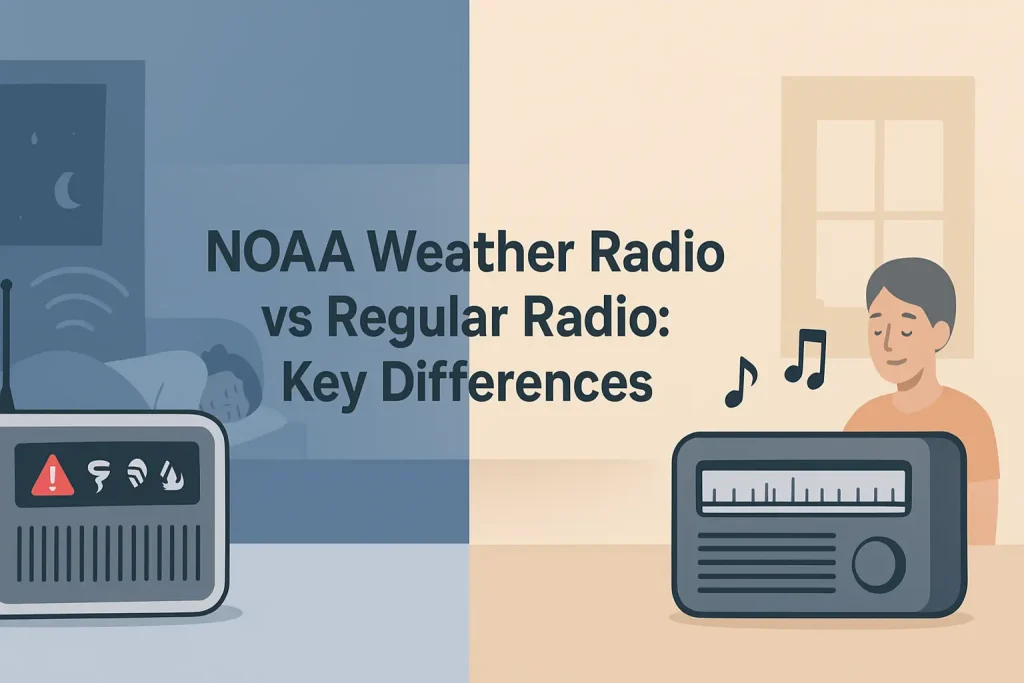
What Is the Difference Between a Weather Radio and a Regular AM/FM Radio for Emergency Use?
A weather radio receives dedicated NOAA VHF frequencies between 162.400 and 162.550 MHz and includes a S.A.M.E. decoder chip that monitors for digital alert headers 24 hours per day in low-power standby mode, activating an audible alarm when an emergency message matching your programmed location code is received. A standard AM/FM radio receives broadcast entertainment programming and can pick up Emergency Alert System (EAS) interruptions only when the radio is actively powered on and tuned to a participating broadcast station.
The critical operational difference is alert monitoring capability. A weather radio in standby mode continuously monitors the NOAA frequency and wakes you from sleep when a tornado warning is issued for your county. A standard AM/FM radio cannot do this because it does not have a S.A.M.E. decoder, it receives only audio broadcasts, and it requires a human operator to have it turned on and tuned to a station that broadcasts EAS alerts. During a nighttime tornado event, the weather radio’s automatic alarm is the difference between being awakened with 20 minutes of warning and sleeping through it entirely.
Do Solar Weather Radios Work During a Hurricane When It Is Overcast for Multiple Days?
Solar weather radios operate during hurricane conditions by drawing from the internal battery reserve, which was charged to full via USB wall power before the storm made landfall. The solar panel contributes negligible charging current during heavy overcast, rain, and storm conditions (typically less than 5 to 10% of rated panel output). Plan on the battery reserve as the sole energy source for the duration of storm overcast, which can last 2 to 5 days in a major hurricane event.
A 2,000 mAh battery in alert standby mode (10 mW draw) provides approximately 30 days of continuous monitoring without recharging. In active listening mode at 80 mW, it provides approximately 25 hours. For a 72-hour hurricane power outage with 4 hours of active listening per day and 20 hours of standby per day, total energy consumption is approximately 320 mWh (active) plus 200 mWh (standby) equals 520 mWh, which is well within the approximately 7,400 mWh total capacity of a 2,000 mAh battery.
After the storm passes and sunlight returns, the solar panel begins recharging the battery. In the Gulf Coast and Atlantic hurricane belt, post-storm sun typically returns within 24 to 48 hours of storm passage. The hand crank provides supplemental charging for any overnight periods when the battery approaches depletion before solar charging resumes.
The practical conclusion is that a 2,000 mAh solar weather radio charged to full before hurricane landfall is sufficient for 3 to 4 days of mixed active and standby use without any solar or crank input, making it fully adequate for standard hurricane outage durations.
A solar-powered weather radio with full S.A.M.E. programming and a 2,000 mAh battery is the most capable off-grid weather alert solution available for under $65, providing 25-plus hours of active NOAA monitoring and 30 days of standby alert coverage without any grid connection. Charge your radio to 100% before every forecast severe weather event, program your county’s 6-digit FIPS code and the specific alert event types relevant to your region, and store the radio where the solar panel receives at least 4 hours of daily direct sun exposure. The Midland ER310 is the best overall choice for most households; the RunningSnail MD-090P and FosPower EA001 deliver equivalent core functionality for under $40 if budget is the primary consideration.
| Photo | TOP RATED WALKIE TALKIES | Price |
|---|---|---|
 | Retevis RT628 Kids Walkie Talkies, Toys Gifts for 4-12 Year Old Girl Boy | Kids Camping Essentials Outdoor Toys, Birthday Gift, 22CH, VOX, Keypad Lock, Durable, Easy to Use Walkie Talkies for Kids | Check Price On Amazon |
 | Cobra ACXT545 Weather-Resistant Walkie Talkies, Rechargeable, 22 Channels | Long Range 28-Mile Two-Way Radio Set (2-Pack) | Check Price On Amazon |
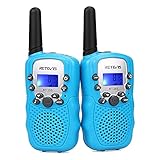 | Retevis RT388 Kids Walkie Talkies, Outdoor Toys for Kids Camping Essentials | 4-12 Year Old Boy Birthday Gift, 22 CH VOX Flashlight Clear Sound, Kids Walkie Talkies 2 Pack for Camping Hiking Adventure | Check Price On Amazon |
 | Cobra RX680 Walkie Talkies (2-Pack), IP54 Water Resistant Design | Rugged & Splashproof Two Way Radios Long Range, 60 Pre-Programmed Channels, Weather Alerts | Check Price On Amazon |
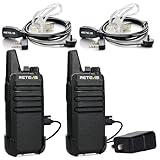 | Retevis RT22 Walkie Talkies Long Range Rechargeable with Earpiece (2 Pack) | Slim & Lightweight 2 Way Radio For Camping & Hiking, Pocket-Friendly Antenna, Ready to Use, 10-Hour Battery, USB-C Charging | Check Price On Amazon |
 | Midland GXT1000VP4 GMRS Two-Way Radios with Headsets, Black, 2 Pack | 50 Channels, 142 Privacy Codes, Up to 36 Mile Long Range, JIS4 Water Resistant, NOAA Weather Alert, Rechargeable NiMH | Check Price On Amazon |
 | Retevis RT628 Walkie Talkies for Kids,Toys Gifts for 6-12 Years Old Boys Girls,Long Range 2 Way Radio 22CH VOX,Birthday Gift,Family Walkie Talkie for Camping Hiking Indoor Outdoor | Check Price On Amazon |