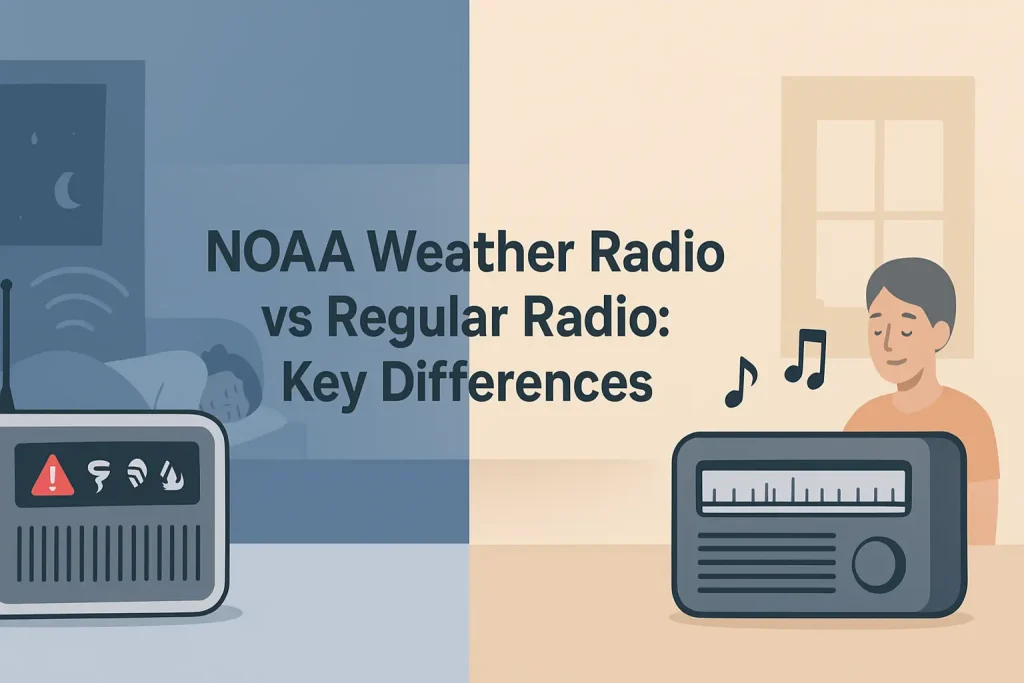
The Uniden BC365CRS weather radio sits in a crowded mid-range category, but most reviews skip the detail that matters most: whether its S.A.M.E. alert filtering actually wakes you only for your county or floods you with alerts from three states away.
Uniden has built a reputation for reliable NOAA receivers across multiple price points, and this review covers the BC365CRS alongside other models in the Uniden weather radio lineup so you can choose the right one for your home, car, or emergency kit.
| Photo | Popular Portable Walkie Talkies | Price |
|---|---|---|
 | SKIWARRIOR Multifunctional Smart Wireless Ski Goggles with Walkie-Talkie, Anti-Fog Zeiss Lens, Music & Call Function (Cylindrical Blue) | Check Price On Amazon |
 | SINORISE Super Mini Walkie Talkies, Two-Way Radios, 3 Pack | Check Price On Amazon |
 | KOSPET Tank M4C Smart Watch Rugged, Dual-Band GPS, 5ATM & IP69K Waterproof | Check Price On Amazon |
 | Retevis RT15 Walkie Talkies 3 Pack, Birthday Gift, Outdoor Adventure Kit | Check Price On Amazon |
 | Rechargeable Walkie Talkies Toys for Kids: DIY Astronaut Walkie Talkies for Boys Christmas Birthday Gifts for 3 4 5 6 7 8 9 10 Boy Walkie Talkie Outdoor Hiking Toy 2 Way Radio Camping Outdoor Game | Check Price On Amazon |
What Is the Uniden BC365CRS and Who Is It For?
The Uniden BC365CRS is a desktop NOAA weather alert radio with S.A.M.E. (Specific Area Message Encoding) technology, designed for home use with AC power and backup battery support. It receives all seven NOAA weather radio frequencies between 162.400 and 162.550 MHz and decodes the digital S.A.M.E. header embedded in each broadcast to determine whether an alert applies to your programmed county.
S.A.M.E. technology is what separates a genuinely useful weather radio from a noise machine. Without it, your radio sounds an alarm for every tornado warning, severe thunderstorm warning, and flash flood watch issued anywhere within range of the transmitter, which may cover several counties or an entire region.
The BC365CRS is aimed at households that want a reliable bedside or kitchen-counter alert radio without the complexity of a full scanner. It is not a portable field radio, and it is not a hand-crank emergency device. It runs on AC power with 4 AA batteries as a backup, making it a stay-at-home unit.
Key Specifications:
- Frequencies monitored: 162.400, 162.425, 162.450, 162.475, 162.500, 162.525, 162.550 MHz
- S.A.M.E. alert types: 25 programmable event categories
- Power: AC adapter with 4 AA battery backup
- Display: LED clock with AM/FM radio and weather alert functionality
- Alert tone: audible alarm with visual strobe-style indicator
- Programming: manual keypad entry of 6-digit FIPS S.A.M.E. codes
The BC365CRS also includes an AM/FM clock radio, which makes it a dual-purpose bedside unit rather than a dedicated emergency receiver. This combination is common in Uniden’s mid-range lineup and adds everyday value beyond storm season.
If you need a simple, stationary weather alert radio for your home that wakes you only when your county is threatened, the BC365CRS is a straightforward and capable choice.
By the Numbers
Uniden Weather Radio – Key Specifications and Standards
Sources: NOAA NWR technical documentation, FCC regulations, Uniden product specifications.
How Does S.A.M.E. Alert Filtering Work on the Uniden BC365CRS?
S.A.M.E. filtering works by reading the digital header that NOAA transmits before every alert broadcast. That header contains a 6-digit FIPS (Federal Information Processing Standards) code identifying which counties the alert covers. When the BC365CRS receives a broadcast, it compares that FIPS code against the codes you programmed into the unit, and only triggers its alarm if there is a match.
This happens because NOAA’s Weather Radio All Hazards system encodes alerts at the transmitter level using digital S.A.M.E. tones before the voice message begins. The BC365CRS decodes those tones using its onboard S.A.M.E. decoder chip, which is a standard feature on any FCC-certified weather alert radio marketed with S.A.M.E. capability.
This only works correctly when you have programmed the right FIPS code for your county. If you program the wrong code, or leave the radio in All Hazards mode without filtering, it will alert for every event in the transmitter’s coverage area.
If the FIPS code is missing or entered incorrectly, the radio either misses alerts entirely (if it only triggers on a county match) or sounds for every county in the region (if left unfiltered). Fix it by looking up your county’s 6-digit FIPS code at the NOAA weather radio SAME code database and re-entering it through the BC365CRS keypad.

The BC365CRS allows you to program multiple FIPS codes simultaneously. This is useful if you live near a county border or want alerts for a neighboring county where family members live.
You can also filter by alert type. The 25 programmable event categories include Tornado Warning, Severe Thunderstorm Warning, Flash Flood Warning, Hurricane Warning, Winter Storm Warning, Hazardous Materials Warning, Civil Emergency Message, and AMBER Alert, among others. Filtering out low-priority watches while keeping high-priority warnings active prevents alert fatigue without sacrificing safety.
The most important setup step for any S.A.M.E. weather radio is entering your FIPS code correctly before severe weather season begins.
Uniden BC365CRS Full Review: Performance, Design, and Limitations
The BC365CRS performs reliably as a home alert radio when programmed correctly. Its reception on all seven NOAA frequencies is stable, and the S.A.M.E. decoder triggers consistently when an alert matches the programmed county codes. The alarm volume is loud enough to wake a sleeping adult in an adjacent room, which is the primary functional requirement for a bedside weather radio.
The unit’s design prioritizes clock radio functionality alongside weather alerting. The AM/FM radio receives cleanly on standard residential frequencies, and the digital clock display is readable in low light. The overall build quality is typical of Uniden’s consumer electronics line: solid plastic construction without premium finish, adequate for a countertop unit that will not be moved frequently.
Key Specifications:
- NOAA channels: 7 (all standard NWR frequencies)
- S.A.M.E. programmable event types: 25
- Multiple county programming: yes (stores multiple FIPS codes)
- Battery backup: 4 AA batteries (not included)
- AM/FM: yes, with preset memory
- Alert output: audible alarm plus visual indicator
- Dimensions: compact desktop form factor
The primary limitation of the BC365CRS is its programming interface. Entering a 6-digit FIPS code through a small keypad without a dedicated programming menu is not intuitive, and the manual instructions are not clearly written for first-time users. Most users who report missing alerts after purchase did not successfully program a FIPS code and left the unit in default all-county mode.
A second limitation is the battery backup. The 4 AA batteries power the alarm circuit only, not the full radio or display. During a power outage, the unit will still sound an alert, but you lose the clock, AM/FM, and display functions until power is restored.
The BC365CRS does not include an external antenna port. Reception inside most homes is adequate using the internal antenna, but users in rural areas far from a NOAA transmitter or inside concrete-reinforced buildings may experience weaker signal. Adding an external antenna is not an option on this model without modification.
For most suburban and urban households within 40 miles of a NOAA transmitter, the BC365CRS delivers reliable alert performance at its price point.
Here is a complete scorecard of the BC365CRS across the metrics that matter most for a home weather alert radio.
Product Review
Uniden BC365CRS Weather Radio – Full Scorecard
Best desktop S.A.M.E. weather alert radio with AM/FM clock radio under $40. Editorial assessment based on manufacturer specifications and verified buyer experience.
8/10
8/10
6/10
7/10
8/10
7/10
Scores are editorial assessments based on Uniden product specifications and verified buyer reviews. Not sponsored.
Uniden BC365CRS Pros and Cons
No weather radio at this price point is perfect, and the BC365CRS has specific strengths and weaknesses worth knowing before you buy. The table below summarizes both sides clearly.
Product Review
Uniden BC365CRS – Pros and Cons
Based on Uniden specification data and verified buyer experience.
Pros
- ✓S.A.M.E. filtering across 25 event types including Tornado Warning and AMBER Alert
- ✓Monitors all 7 NOAA weather radio frequencies (162.400 to 162.550 MHz) simultaneously
- ✓Multiple FIPS county code storage for border-county households
- ✓Built-in AM/FM clock radio adds daily-use value beyond storm season
- ✓Alarm loud enough to wake sleeping adults from adjacent rooms
Cons
- ✗FIPS code programming interface is not intuitive; manual instructions are poorly written
- ✗No external antenna port; rural users beyond 40 miles from NOAA transmitter may get weak reception
- ✗4 AA battery backup powers alarm circuit only, not display or AM/FM functions
- ✗Not portable; AC-dependent primary power makes it unsuitable for field or camping use
The BC365CRS is the right choice for a household that wants a reliable bedside weather alert radio with county-level filtering and everyday AM/FM use. It is not the right choice for campers, rural users far from a NOAA transmitter, or anyone who needs portable or hand-crank emergency power.
Other Uniden Weather Radios Worth Knowing About
Uniden produces several weather radio models beyond the BC365CRS, each aimed at a different use case or feature priority. Understanding the differences between them prevents you from buying the BC365CRS when a different Uniden model would serve you better, or vice versa.
Uniden BC75XLT: The Portable Scanner with Weather Monitoring
The Uniden BC75XLT is a handheld scanner radio that includes NOAA weather radio monitoring as a secondary feature. It scans up to 300 channels across public safety, business, and amateur frequencies, and switches to NOAA weather band monitoring when you need it. It is powered by 2 AA batteries and designed for portable outdoor use.
This model is not a dedicated weather alert radio. It does not include S.A.M.E. decoding capability, which means it cannot filter alerts by county. If you use it for weather monitoring, it will play every alert broadcast by the nearest NOAA transmitter regardless of location.
Key Specifications:
- Channels: 300 programmable memory channels
- Frequency range: 25-512 MHz (with cellular blocked per FCC)
- NOAA weather: all 7 WX channels, no S.A.M.E. filtering
- Power: 2 AA batteries
- Scan rate: 100 channels per second
- Best for: outdoor enthusiasts who want scanning plus basic weather monitoring
The BC75XLT is a strong choice if you want a multi-purpose scanner with weather monitoring capability, but it should not be your primary home weather alert device if S.A.M.E. county filtering matters to you.
Uniden BC125AT: The Budget Handheld Scanner with Weather Band
The Uniden BC125AT is a budget-priced handheld scanner covering public safety and weather frequencies. It stores up to 500 channels across aviation, amateur, marine, and public safety bands, and includes the NOAA weather radio band (162.400 to 162.550 MHz) for monitoring. Like the BC75XLT, it does not include S.A.M.E. decoding.
It runs on 2 AA batteries, making it genuinely portable for field use. The scan speed is 200 channels per second, which is faster than the BC75XLT and sufficient for monitoring active public safety channels alongside weather.
Key Specifications:
- Channels: 500 programmable memory channels
- Frequency coverage: 25-512 MHz (cellular excluded)
- NOAA weather band: yes, all 7 channels, no S.A.M.E.
- Scan rate: 200 channels per second
- Power: 2 AA batteries
- Price range: approximately $50 to $70
The BC125AT is the right choice for someone who primarily wants a scanner and needs weather monitoring as a bonus feature, not as the core function.
Uniden HomePatrol Series: Digital Scanning with Weather
The Uniden HomePatrol scanner series represents Uniden’s premium digital scanning products. These units decode digital trunked radio systems including P25 Phase 1 and Phase 2, DMR, and NXDN, which are used by many state and local public safety agencies. They also include NOAA weather radio band reception.
HomePatrol scanners are GPS-enabled on some models, which allows automatic programming of nearby public safety frequencies based on your location. This is significantly more capable than the BC365CRS but also significantly more expensive, typically $250 to $500 depending on model.
Weather monitoring is a secondary feature on HomePatrol units, not the primary design purpose. If weather alerting is your priority, the BC365CRS or a dedicated S.A.M.E. weather radio is a better match at a much lower price.
Uniden SDS100: The Professional Digital Trunking Scanner
The Uniden SDS100 is Uniden’s flagship handheld digital scanner. It decodes P25 Phase 1 and Phase 2, DMR, and NXDN digital protocols, and includes NOAA weather radio monitoring. It is aimed at serious radio enthusiasts and public safety monitoring professionals.
At a street price near $500, the SDS100 is not a weather radio purchase. It is a professional scanning tool that happens to include weather band monitoring. For emergency weather alerting, the BC365CRS delivers the same S.A.M.E. functionality at roughly one-tenth the price.
Knowing where each Uniden model sits in the lineup prevents over-spending on scanner features you do not need for basic home weather alerting.
How to Program S.A.M.E. Codes on the Uniden BC365CRS Step by Step
Programming the correct FIPS S.A.M.E. code into the BC365CRS is the single most important setup step for accurate county-level weather alerts. Most users who miss alerts or receive too many alerts have skipped or incorrectly completed this step. The process takes approximately 5 minutes once you have your 6-digit FIPS code ready.
Step-by-Step Guide
How to Program S.A.M.E. County Codes on the Uniden BC365CRS
6 steps · Estimated time: 5 minutes · Requires your county FIPS code from the NOAA S.A.M.E. database
Look up your county FIPS code
Visit the NOAA Weather Radio SAME code database online and search for your state and county. Write down the full 6-digit FIPS code before touching the radio.
Enter NOAA weather mode on the BC365CRS
Press the WX (weather) button on the unit to switch from AM/FM mode to NOAA weather radio reception. The radio will begin scanning all 7 NWR frequencies and lock to the strongest signal.
Access the S.A.M.E. programming menu
Press and hold the MENU button for approximately 2 seconds until the S.A.M.E. programming display appears. The display will prompt you to enter a location code.
Enter your 6-digit FIPS code using the keypad
Type each digit of your FIPS code using the number keys. For example, Harris County, Texas uses FIPS code 048201. Confirm entry when prompted.
Select which alert types to receive
Use the menu to enable or disable specific event types from the 25 available S.A.M.E. categories. At minimum, enable Tornado Warning, Severe Thunderstorm Warning, Flash Flood Warning, and Civil Emergency Message.
Test your programming with a weekly NOAA test broadcast
NOAA transmits a Required Monthly Test (RMT) on the first Wednesday of each month. Your BC365CRS should alert and display the test message if S.A.M.E. is programmed correctly for your county.
If the radio does not respond to the monthly test, re-enter the FIPS code and verify it matches the current NOAA database entry for your county. FIPS codes occasionally change when counties are redistricted.
Uniden BC365CRS vs Midland WR120B: Which Is the Better Home Weather Radio?
The Uniden BC365CRS and the Midland WR120B reviewed in detail here are the two most commonly compared entry-level S.A.M.E. weather radios. Both receive all 7 NOAA frequencies, both support S.A.M.E. filtering, and both are priced under $40. The decision between them comes down to programming interface clarity and the importance of AM/FM functionality.
Use the table below to choose between the BC365CRS and WR120B based on the specs that matter for a home weather alert radio.
Product Comparison
Uniden BC365CRS vs Midland WR120B – Side by Side
Key specs compared. Source: manufacturer data sheets, NOAA NWR documentation.
| Specification | Uniden BC365CRS | Midland WR120B |
|---|---|---|
| NOAA channels | 7 | 7 |
| S.A.M.E. filtering | Yes, 25 event types | Yes, 25 event types |
| Multiple county codes | Yes | Yes |
| AM/FM radio | Yes | No |
| Battery backup | 4 AA (alarm only) | 3 AA (alarm only) |
| Programming ease | Moderate difficulty | Slightly easier |
| External antenna port | No | No |
| Price range | $25 to $40 | $20 to $35 |
| Best for | Bedside use with daily AM/FM | Dedicated weather alerting only |
Both models lack external antenna ports. Rural users more than 40 miles from a NOAA transmitter should consider models with an external antenna jack such as the Midland WR400 or Sangean CL-100.
If you want a bedside clock radio that doubles as a weather alert receiver, the BC365CRS is the better choice. If you want only weather alerting at the lowest price point, the WR120B is slightly less expensive and has a marginally simpler programming menu.
How Does the Uniden BC365CRS Compare to the Sangean CL-100 and Eton FRX3+?
The BC365CRS, Sangean CL-100, and Eton FRX3+ represent three different approaches to home and emergency weather radio at three different price points. The BC365CRS is a desktop AC unit with AM/FM. The Sangean CL-100 is a more premium tabletop unit with clearer programming and better audio output. The Eton FRX3+ is a portable hand-crank solar emergency radio with weather monitoring, aimed at power outages and emergency kits.
Use the table below to match the right model to your primary use case.
Product Comparison
Uniden BC365CRS vs Sangean CL-100 vs Eton FRX3+ – Key Specs
Key specs compared across three popular weather radio categories. Source: manufacturer data sheets.
| Specification | Uniden BC365CRS | Sangean CL-100 | Eton FRX3+ |
|---|---|---|---|
| Type | Desktop AC + battery | Desktop AC + battery | Portable hand-crank/solar |
| S.A.M.E. filtering | Yes, 25 event types | Yes, 25 event types | Yes |
| AM/FM radio | Yes | Yes | Yes |
| Portable use | No | Limited | Yes |
| Hand crank / solar power | No | No | Yes |
| External antenna port | No | Yes | No |
| Programming ease | Moderate | Easier | Moderate |
| Price range | $25 to $40 | $50 to $75 | $50 to $70 |
| Best for | Budget home alerting with AM/FM | Rural or semi-rural home use | Emergency kit and power outages |
Prices verified at time of publication. External antenna port on Sangean CL-100 provides reception advantage for users beyond 30 miles from NOAA transmitter.
For a complete look at how the Sangean CL-100 performs in daily use, our in-depth Sangean CL-100 analysis covers programming, audio output, and rural reception performance in detail. For the Eton FRX3+, see our complete Eton FRX3+ emergency radio review including hand-crank battery runtime.
The BC365CRS is the budget choice for a stationary home. The Sangean CL-100 is worth the price premium if you live in a rural area and need external antenna capability. The Eton FRX3+ is the right tool if your primary concern is surviving an extended power outage.
Quick Reference: Weather Radio Terms You Need to Know
Before purchasing or programming any NOAA weather radio, understanding these core terms ensures you set up your unit correctly and interpret its alerts accurately.
S.A.M.E. (Specific Area Message Encoding): A digital coding system used by NOAA to identify which counties an alert covers. Your radio reads this code and only sounds an alarm if your programmed county is included.
FIPS code (Federal Information Processing Standards code): A 6-digit number assigned to every US county that S.A.M.E.-capable radios use for location filtering. You must enter your county FIPS code during setup.
NWR (NOAA Weather Radio All Hazards): The national network of over 1,000 transmitters broadcasting weather and emergency alerts on seven dedicated VHF frequencies between 162.400 and 162.550 MHz, 24 hours a day.
EAS (Emergency Alert System): The federal system that distributes emergency alerts across broadcast media, cable, and NWR. NOAA weather radios receive the EAS-encoded alerts and decode them using S.A.M.E. technology.
Required Monthly Test (RMT): A monthly test broadcast by NOAA transmitters, typically on the first Wednesday of each month, that activates S.A.M.E.-capable radios to verify they are programmed and functioning correctly.
All Hazards mode: A radio setting that triggers the alarm for any alert from any county within the transmitter’s coverage area, without FIPS filtering. This is the factory default on most radios and should be changed to your specific FIPS code after purchase.
Alert fatigue: The tendency to disable or ignore a weather radio alarm because it sounds too frequently for irrelevant counties. S.A.M.E. filtering with a specific FIPS code prevents alert fatigue by limiting alarms to your county only.
Squelch: A circuit that silences the radio speaker when no signal is present, preventing continuous static. Weather radios use squelch to stay quiet between NOAA broadcast segments.
AC power with battery backup: The standard power configuration for desktop weather radios like the BC365CRS. AC power runs the unit during normal conditions. Battery backup (typically AA alkaline) maintains alarm function during power outages.
WX channels: The shorthand designation for the seven NOAA weather radio frequencies. WX1 corresponds to 162.550 MHz, WX2 to 162.400 MHz, and so on through WX7 at 162.525 MHz.
Where to Place Your Uniden BC365CRS for Best Reception and Alerting
Reception quality on the BC365CRS depends on physical placement within your home. The internal antenna on this model is a simple wire or rod element without external connection options, so maximizing signal strength requires placing the unit where the antenna has the clearest path to the nearest NOAA transmitter.
Upper floors receive stronger signals than basements in most residential structures. Positioning the BC365CRS near an exterior wall on an upper floor, away from large metal appliances and concrete pillars, typically produces the best reception for the internal antenna.
Windows facing the direction of the nearest NOAA transmitter improve signal further. NOAA publishes transmitter locations and coverage maps on the NWR website, which lets you identify the closest transmitter to your address and orient the radio accordingly.
Basements and concrete-reinforced rooms significantly attenuate VHF signals in the 162 MHz range. If your only available placement is a basement or interior concrete room, reception may be unreliable enough to miss alerts. In that scenario, a model with an external antenna jack (such as the Sangean CL-100 at approximately $50 to $75) would serve you better, because you can run a coaxial lead from the radio to an antenna mounted in a window or on an exterior wall.
For bedroom placement, the BC365CRS is designed to function as a bedside clock radio. Position it within arm’s reach on a nightstand with the antenna pointing upward or at a slight angle toward the nearest transmitter. Test reception by listening to the continuous NOAA weather broadcast on your strongest WX channel before relying on it for alerts.
Correct physical placement is the lowest-cost improvement you can make to weather radio performance without buying new equipment.
What NOAA Alert Types Does the BC365CRS Receive and Which Matter Most?
The BC365CRS can be programmed to receive up to 25 different NOAA S.A.M.E. alert event types. Not all 25 are equally urgent, and filtering to the most critical types reduces false wake-ups without sacrificing safety for life-threatening events.
NOAA divides its alerts into three severity tiers: Warnings (immediate threats to life or property), Watches (conditions favorable for dangerous weather), and Advisories (less severe but potentially hazardous conditions). The BC365CRS allows you to enable or disable each tier independently.
The following alert types are the highest priority for residential users in most US regions:
- Tornado Warning: A tornado has been detected by radar or reported by a spotter. This is an immediate life-safety alert requiring shelter action within seconds.
- Severe Thunderstorm Warning: Winds above 58 mph or hail larger than 1 inch in diameter are occurring or imminent. High risk of structural damage and injury.
- Flash Flood Warning: Flash flooding is occurring or imminent. Particularly critical for low-lying areas, near rivers, and in arid regions prone to rapid water rise.
- Hurricane Warning: Hurricane conditions (sustained winds of 74 mph or higher) are expected within 36 hours. Required for coastal and near-coastal households.
- Civil Emergency Message: Issued for non-weather emergencies including industrial accidents, hazardous materials releases, and public safety threats.
- AMBER Alert: Issued when a child abduction meets specific law enforcement criteria. Transmitted over NWR for community awareness.
- National Information Center: Presidential-level alert. This is the most severe tier, reserved for national emergencies including nuclear events.
Watches (Tornado Watch, Severe Thunderstorm Watch) are lower priority for overnight alerting because they cover large areas and extended time windows. Many users disable watch-level alerts for overnight hours to reduce sleep disruption while keeping warning-level alerts fully active.
Advisories (Winter Weather Advisory, Wind Advisory, Dense Fog Advisory) are useful for day-planning but rarely require immediate action. Disabling advisory alerts for overnight periods is a reasonable configuration for most households.
Programming your BC365CRS to alert for warnings and civil emergencies only, while disabling watches and advisories for overnight hours, is the configuration that best balances safety with livability for most residential users.
Is the Uniden BC365CRS Worth Buying, or Should You Spend More?
The BC365CRS is worth buying if your primary need is a reliable home weather alert radio with S.A.M.E. filtering and AM/FM clock functionality at a price under $40. It delivers on all three of those requirements without significant compromise.
It is not worth buying if any of the following apply to your situation:
- You live more than 40 miles from the nearest NOAA transmitter (rural areas may need external antenna capability)
- You need a portable or battery-primary radio for camping, travel, or extended power outages
- You want the clearest programming interface available (the Sangean CL-100 is notably easier to configure)
- You need to monitor frequencies beyond the seven NOAA weather channels (a scanner like the Uniden BC125AT would serve you better)
The honest comparison is this: the BC365CRS costs roughly $30, the Sangean CL-100 costs roughly $60, and the difference buys you a better programming interface, a cleaner audio output, and an external antenna port. If you are a first-time weather radio buyer in a suburban or urban area within easy reach of a NOAA transmitter, the BC365CRS is perfectly adequate.
If you have struggled with weather radio programming in the past or live in a marginal reception area, the extra $30 for a Sangean CL-100 is money well spent. Our guide on the highest-rated NOAA weather radios across all price points covers the full range of options if you want to compare more models before deciding.
For readers who are unsure whether to spend $30 or $100 on a weather radio, the BC365CRS is the right answer at the low end of a well-defined spectrum.
Here is a look at how weather radio prices stack up across the models most commonly considered alongside the BC365CRS.
Price Comparison
NOAA S.A.M.E. Weather Radios – Price Comparison by Model
Street price, sorted lowest to highest. Prices verified at time of publication.
~$25
~$35
~$60
~$65
~$85
~$350
Single-unit street prices. Scanner models (BC125AT, HomePatrol-2) include weather band as a secondary feature, not as a primary S.A.M.E. alert function. Prices verified at time of publication.
Weather Radio Use Case Guide: Home, Car, and Emergency Kit
The right weather radio depends entirely on where you plan to use it and what power source is available during a real emergency. The BC365CRS is optimized for one specific use case: a fixed, AC-powered home location. Understanding where it fits and where it falls short helps you decide whether to supplement it with a second unit for other scenarios.
Tabbed Guide
Weather Radio Selection by Use Case
Select your situation for tailored weather radio and placement recommendations.
Bedside and kitchen weather alerting on NOAA WX1 through WX7 (162.400 to 162.550 MHz)
The Uniden BC365CRS is ideal for fixed home use. Program your county FIPS code, select warning-level alerts only, and place it on a nightstand or kitchen counter within range of an AC outlet. The 4 AA battery backup maintains the alarm circuit if power fails during a storm.
For rural homes more than 40 miles from a NOAA transmitter, add an external antenna via a model with an antenna jack (Sangean CL-100) to maintain reliable signal. The BC365CRS internal antenna is not upgradeable.
Most households are best served by combining a fixed desktop unit like the BC365CRS with a portable hand-crank radio in an emergency kit. The combination costs approximately $90 total and covers both normal conditions and extended power outages.
Common Mistakes When Setting Up a NOAA Weather Radio
The most common reason a weather radio fails to alert at a critical moment is not hardware failure. It is a setup error made during the first few minutes after unpacking the unit. These mistakes are easily avoided once you know what to watch for.
Mistake 1: Leaving the radio in All Hazards default mode. Most weather radios ship with S.A.M.E. filtering disabled. In this state, the radio sounds for every alert within the transmitter’s coverage area, which can span dozens of counties. The immediate result is alert fatigue, and users often mute or disable the radio within days of purchase. Fix: enter your 6-digit FIPS code during initial setup.
Mistake 2: Entering the wrong FIPS code. FIPS codes are state-specific. The county code 001 for Jefferson County, Alabama (FIPS 001001) is a completely different location from code 001 for Jefferson County, Colorado (FIPS 008001). Always look up your full 6-digit FIPS code from the official NOAA S.A.M.E. database rather than guessing based on a partial number.
Mistake 3: Not installing the battery backup before a storm. The BC365CRS ships without batteries. If you install it without inserting 4 AA batteries, the alarm will not sound during a power outage. Install batteries during setup, not after the first storm warning arrives.
Mistake 4: Placing the radio in a basement or metal enclosure. VHF signals in the 162 MHz NOAA band are attenuated by concrete, metal, and earth. A basement placement can reduce signal strength enough to cause missed alerts. Place the unit on the main floor or upper floor whenever possible.
Mistake 5: Never testing the programmed setup. Many users program a FIPS code and assume it works, but never verify. NOAA transmits a Required Monthly Test on the first Wednesday of each month. If your BC365CRS does not alarm during this test, your programming has an error. Fix: re-enter the FIPS code and recheck the event type settings.
Avoiding these five mistakes takes less than 15 minutes during initial setup and is the difference between a reliable alert system and a radio that fails you when conditions are most dangerous.
Where to Buy a Uniden Weather Radio and What to Expect on Price
Uniden weather radios including the BC365CRS are available through major online retailers, electronics chains, and emergency preparedness stores. Pricing is relatively stable at retail, with occasional discounts during hurricane season preparation periods (typically spring through early fall) and disaster preparedness awareness months.
For those considering online purchase, our guide on where to find the best prices on NOAA weather radios including Uniden models covers the major retail channels and price matching options available.
The Uniden BC365CRS on Amazon typically sells between $25 and $40 depending on promotional pricing. Third-party marketplace sellers occasionally offer the unit at a discount, but purchase from a fulfilled-by-Amazon listing to ensure a new unit with functional packaging and included AC adapter.
If you are looking for a free or low-cost alternative to purchasing a weather radio, NOAA and FEMA do not distribute free weather radios to the general public on an ongoing basis. Our article on whether you can receive a NOAA weather radio at no cost through government programs explains what assistance is actually available and from which sources.
At its current street price, the BC365CRS is one of the most affordable S.A.M.E.-capable weather radios on the market, and it represents good value for a new buyer who wants reliable county-level alerting without premium spending.
Does the Uniden BC365CRS Work During a Power Outage?
The BC365CRS maintains its alarm function during a power outage using 4 AA backup batteries, but it does not operate as a full-function radio on battery power alone. The display, clock, and AM/FM radio functions all require AC power. During an outage, the unit will sound the S.A.M.E. alarm if a matching alert is received, but you cannot actively listen to NOAA broadcasts or use the AM/FM radio until power is restored.
This limitation is a deliberate design choice common to AC-primary desktop weather radios at this price point. The battery circuit is designed to keep the alert function alive through a typical storm-related power outage, not to replace grid power for extended monitoring periods.
For users who want full monitoring capability during power outages (listening to ongoing NOAA broadcasts, checking AM/FM emergency information), a separate battery-primary or hand-crank radio is necessary. The Eton FRX3+ hand-crank emergency radio runs entirely on crank, solar, or AA batteries and allows full NOAA monitoring during extended outages.
The battery backup on the BC365CRS is adequate for its intended purpose: keeping the alarm active so you are woken or notified during a storm-related power loss. It is not adequate as a standalone emergency communication device.
How Far Is Your Home from a NOAA Weather Radio Transmitter?
NOAA’s Weather Radio All Hazards network covers approximately 95% of the US population with over 1,000 transmitters nationwide, according to NOAA NWR documentation. Most transmitters operate at 300 to 1,000 watts of effective radiated power on their assigned VHF frequency, providing reliable coverage within a 40-mile radius under typical conditions.
Coverage drops significantly beyond 40 miles, in mountainous terrain, and inside buildings with concrete or metal construction. Homes in rural areas more than 40 miles from the nearest transmitter may receive a weaker signal that causes intermittent missed alerts on a radio without an external antenna connection.
You can determine your distance from the nearest transmitter by using the NOAA NWR transmitter location tool on the NOAA website, which maps all active transmitters with their frequencies and coverage areas. Enter your address to identify the nearest transmitter and its operating frequency (one of the seven WX channels between 162.400 and 162.550 MHz).
If you are within 30 miles of a transmitter with reasonable line of sight, the BC365CRS internal antenna will receive reliably. If you are 30 to 50 miles away or in terrain with hills or dense forest between you and the transmitter, consider a model with an external antenna port. Beyond 50 miles, even an external antenna may not provide reliable reception without a directional antenna installation.
For a broader overview of weather radio options by use case and price before making a final decision, our complete NOAA weather radio purchasing guide covering all key specifications and use cases provides a structured framework for comparing models at every budget level.
Is the Uniden BC365CRS the Same as the Uniden BC365CRS-2?
The BC365CRS-2 is a minor revision of the original BC365CRS, with the primary change being an updated firmware version that improves S.A.M.E. code decoding reliability on marginal signal strength. The hardware, physical design, frequency coverage, and feature set are functionally identical between the two variants.
Both versions receive all 7 NOAA weather frequencies, support 25 S.A.M.E. event types, and use 4 AA batteries for backup. If you find either version available at the same price, choose the BC365CRS-2 for the improved firmware. If only the original BC365CRS is available at your retailer, it performs reliably in standard residential reception conditions.
The distinction between the two versions is not significant enough to delay purchase or pay a meaningful price premium. Both models are functionally equivalent for the home weather alerting use case they are designed to serve.
Can the Uniden BC365CRS Receive Alerts for Multiple Counties?
Yes. The BC365CRS allows you to program multiple FIPS county codes simultaneously. This is useful if you live near a county border, work in a different county from your home, or want to monitor weather for family members in adjacent counties. Each programmed FIPS code adds that county to the alert trigger list, so the radio will alarm if any of your programmed counties are included in an incoming S.A.M.E. alert.
The specific number of FIPS codes the BC365CRS can store simultaneously varies by firmware version. The original BC365CRS supports a limited number of concurrent codes, while the BC365CRS-2 revision increased this capacity. Check the specific model documentation for the exact maximum number of simultaneous codes your unit supports.
Programming multiple counties does not increase false alerts as long as each programmed FIPS code corresponds to a county you actually want to monitor. It only adds additional valid trigger conditions to the existing filter, not noise.
What Is the Difference Between a Weather Radio and a Weather App?
A NOAA weather radio receives alerts directly from government-operated transmitters broadcasting 24 hours a day on dedicated VHF frequencies between 162.400 and 162.550 MHz, independent of cell towers, internet connectivity, and commercial infrastructure. A weather app depends on your smartphone receiving a data connection and, in the case of Wireless Emergency Alerts (WEA), a functioning cellular network.
During a severe storm, cell networks frequently become congested or fail as thousands of users simultaneously attempt to make calls, send texts, and access data. A NOAA weather radio bypasses this failure point entirely because it receives its signal directly from an NWR transmitter via VHF radio waves, which are unaffected by cell network load.
Weather apps deliver alerts faster under normal conditions because push notifications arrive the moment an alert is issued. However, the key scenario for a weather radio is not normal conditions. It is the scenario where the storm has already arrived, power may be failing, and cellular networks are degrading. In that scenario, a NOAA weather radio with battery backup continues to function when a smartphone may not.
The two tools are complementary, not substitutes. Use a weather app for day-to-day awareness and advance planning. Use a NOAA weather radio with S.A.M.E. filtering as your overnight and backup alert system for life-safety events when infrastructure reliability cannot be assumed.
Why Does My Weather Radio Sound an Alarm but Play No Voice Message?
If your BC365CRS sounds an alarm but you hear no voice message after the initial tone, the most likely cause is that the NOAA transmitter is broadcasting the S.A.M.E. digital header (which triggers the alarm) but the audio portion of the broadcast is being cut off before it reaches your speaker due to signal weakness. The alarm circuit triggers on the digital S.A.M.E. header alone, but the voice audio requires a stronger and more sustained signal to decode clearly.
This happens because the S.A.M.E. digital header is a burst signal that is more tolerant of marginal reception than the continuous analog voice audio that follows it. A radio in a basement or at the edge of a transmitter’s coverage range may decode the digital header reliably while losing the voice portion to signal degradation.
Fix this by moving the radio to a higher floor, closer to an exterior wall, or away from large metal objects. If the problem persists, you are likely at the edge of reliable coverage range for the BC365CRS’s internal antenna, and a model with an external antenna port would resolve the issue.
A second possible cause is that the radio is set to mute after the initial alarm tone in a configuration mode where voice audio is suppressed. Check the BC365CRS menu settings for any audio mute or alarm-only setting that may be active.
Do I Need a Separate Weather Radio if My Scanner Already Has a WX Band?
A scanner with a WX band can monitor NOAA weather frequencies, but it does not replace a dedicated weather alert radio unless the scanner includes S.A.M.E. decoding hardware. Most entry-level and mid-range scanners (including the Uniden BC125AT and BC75XLT) receive the NOAA weather channels but cannot decode S.A.M.E. headers or filter by county.
Without S.A.M.E. decoding, a scanner set to monitor the weather band will play all NOAA broadcasts continuously but will not sound a dedicated alarm when a critical alert is issued for your county. It will not wake you from sleep with a targeted alarm tone. It functions as a passive receiver only.
A dedicated weather alert radio like the BC365CRS adds three capabilities a basic scanner’s WX band cannot provide: S.A.M.E. county filtering, a loud dedicated alert alarm that activates automatically, and a battery backup that keeps the alarm circuit active during power outages. These three functions are specifically designed for life-safety alerting rather than passive monitoring.
If you already own a scanner, keep it for public safety and amateur frequency monitoring. Add a dedicated S.A.M.E. weather radio alongside it for overnight alert coverage. The cost of a BC365CRS at approximately $30 to $40 is low enough that the two devices serve complementary roles without significant financial overlap.
Is It Legal to Transmit on NOAA Weather Radio Frequencies?
Transmitting on NOAA weather radio frequencies (162.400 to 162.550 MHz) is illegal for private users under FCC regulations. These frequencies are allocated exclusively to the US government for NOAA National Weather Service broadcasting. No FCC license available to the general public authorizes transmission on these frequencies. Unauthorized transmission on government-exclusive frequencies violates FCC Part 2 frequency allocation rules and can result in significant fines and equipment seizure.
NOAA weather radio frequencies are receive-only for all non-government users. A weather radio is a passive receiver designed only to listen. If you need a two-way communication capability on VHF frequencies in the 162 MHz range, the closest legal option is Marine VHF, which operates on dedicated channels between 156.000 and 174.000 MHz under FCC Part 80, and requires a Ship Station License for use on US vessels.
For land-based two-way communication in the VHF and UHF range, FRS operates on 22 channels between 462 and 467 MHz without a license, and GMRS uses the same frequency range with a $35 FCC license. Neither of these services shares frequencies with NOAA weather radio.
How Often Should You Test Your Weather Radio and Replace the Backup Batteries?
Test your weather radio’s alarm function monthly by verifying it responds to the NOAA Required Monthly Test, which is broadcast on the first Wednesday of most months. If the unit does not alarm during the test and you have your FIPS code programmed correctly, the backup battery circuit, the S.A.M.E. decoder, or the programming itself may have a fault requiring investigation.
Replace the 4 AA backup batteries in the BC365CRS every 12 months as a standard maintenance practice, even if no power outage has occurred. Alkaline batteries in standby mode self-discharge over time, and a battery that tests at reduced voltage may not deliver enough current to trigger the alarm circuit reliably. Use name-brand alkaline batteries (Energizer or Duracell) rather than generic store-brand cells for backup applications where failure has safety consequences.
Check your FIPS code programming annually as well. NOAA occasionally updates FIPS codes when county boundaries are redrawn or new codes are issued. An outdated FIPS code will cause the radio to miss alerts for your county even if all hardware is functioning correctly.
Annual battery replacement and monthly test verification are the complete maintenance requirements for reliable weather radio performance.
For most households, a pack of Energizer AA alkaline batteries stored alongside the BC365CRS makes annual replacement a 2-minute task rather than a reason to delay maintenance.
What Should Be in Your Complete Home Emergency Communication Setup?
A complete home emergency communication setup addresses three scenarios: advance warning of incoming severe weather, communication during and after an event when cellular networks may be degraded, and information monitoring during extended power outages. The BC365CRS covers the first scenario well on its own.
For the second scenario (communication when cell networks fail), a pair of FRS or GMRS walkie-talkies provides short-range household and neighborhood communication without any infrastructure dependency. FRS radios operating on the 22 channels between 462 and 467 MHz require no license under FCC Part 95E and provide 0.5 to 2 miles of range in suburban environments. GMRS radios on the same frequencies offer up to 5 watts of power and up to 5 miles of range in open terrain, but require a $35 FCC family license.
For the third scenario (extended power outage monitoring), a hand-crank or solar radio such as the Midland ER310 emergency crank radio runs entirely without grid power and receives NOAA weather channels alongside AM and FM broadcast stations for ongoing information access.
The complete setup for a typical household is therefore three components: a fixed S.A.M.E. weather radio (BC365CRS) for automated overnight alerting, a pair of FRS walkie-talkies for local two-way communication, and a hand-crank emergency radio for extended outage monitoring. Total cost for this configuration is approximately $80 to $130 depending on model choices.
Building this three-component setup gives you alert capability, communication capability, and monitoring capability across all three emergency scenarios without relying on cell networks or grid power.
The BC365CRS is the right starting point for the alerting layer of that setup, and it remains one of the most cost-effective ways to add county-specific NOAA alerting to any home.
A well-configured weather radio with accurate S.A.M.E. filtering costs under $40 and provides a level of advance warning during severe weather that no smartphone app can reliably replicate when infrastructure is failing. Program your FIPS code, install fresh backup batteries, and test the unit on the first Wednesday of next month. If it alarms, you are ready.
| Photo | TOP RATED WALKIE TALKIES | Price |
|---|---|---|
 | Retevis RT628 Kids Walkie Talkies, Toys Gifts for 4-12 Year Old Girl Boy | Check Price On Amazon |
 | Cobra ACXT545 Weather-Resistant Walkie Talkies, Rechargeable, 22 Channels | Check Price On Amazon |
 | Retevis RT388 Kids Walkie Talkies, Outdoor Toys for Kids Camping Essentials | Check Price On Amazon |
 | Cobra RX680 Walkie Talkies (2-Pack), IP54 Water Resistant Design | Check Price On Amazon |
 | Retevis RT22 Walkie Talkies Long Range Rechargeable with Earpiece (2 Pack) | Check Price On Amazon |
 | Midland GXT1000VP4 GMRS JIS4 Two-Way Radio, Black,2 Pack | Check Price On Amazon |
 | Retevis RT628 Walkie Talkies for Kids,Toys Gifts for 6-12 Years Old Boys Girls,Long Range 2 Way Radio 22CH VOX,Birthday Gift,Family Walkie Talkie for Camping Hiking Indoor Outdoor | Check Price On Amazon |