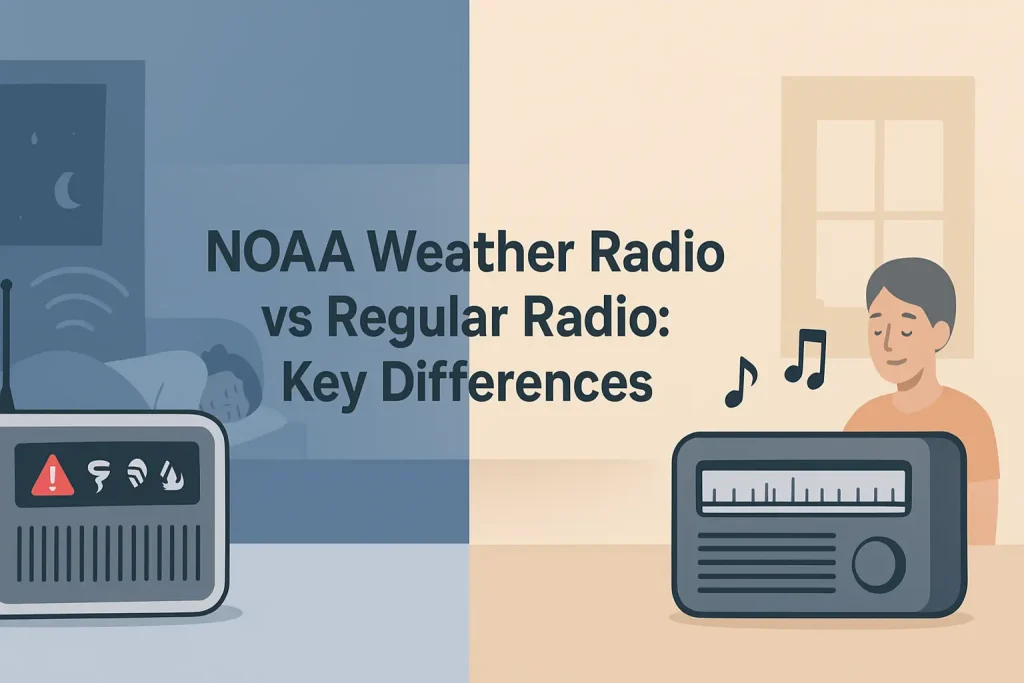
Weather radio and satellite radio both promise to keep you informed during emergencies, but they work in fundamentally different ways. A dedicated NOAA weather radio receiver monitors seven VHF frequencies between 162.400 and 162.550 MHz around the clock and broadcasts government-issued alerts the moment they are issued. Satellite radio services like SiriusXM deliver weather data over a proprietary L-band satellite signal, but that signal depends on a paid subscription and receiver hardware designed primarily for entertainment.
The choice between them comes down to one factor: whether you need a government-operated, always-on alerting system or a subscription-based data service layered on top of something you already use.
What Is a Weather Radio and How Does It Work for Emergencies?
A NOAA weather alert radio is a dedicated receiver that monitors one or more of the seven NOAA Weather Radio All Hazards (NWR) broadcast frequencies: 162.400, 162.425, 162.450, 162.475, 162.500, 162.525, and 162.550 MHz. These are VHF FM frequencies reserved exclusively for government emergency broadcasts by the National Oceanic and Atmospheric Administration. No subscription is required, and no third party controls the signal.
According to NOAA, the NWR transmitter network includes over 1,000 broadcast sites covering approximately 95% of the U.S. population and 95% of the land area within 40 miles of a transmitter. The system operates 24 hours a day, 7 days a week, broadcasting current weather conditions, official watches and warnings, and non-weather hazard alerts including AMBER Alerts, civil emergencies, and hazardous materials incidents.
The most important feature on a modern weather radio is S.A.M.E. technology. S.A.M.E. stands for Specific Area Message Encoding. It allows your radio to filter incoming alerts by a 6-digit FIPS (Federal Information Processing Standards) county code so it only activates the alarm for your specific county, not every county covered by the transmitter.
Without S.A.M.E., a single NOAA transmitter covers multiple counties. A radio without S.A.M.E. will sound an alarm for every warning issued across the entire broadcast area, which can span dozens of counties. A radio with S.A.M.E. programmed to your county code wakes you only when your area is specifically threatened.
Key Specifications for a typical S.A.M.E.-capable weather radio such as the Midland WR400:
- Frequency coverage: 162.400 to 162.550 MHz (all 7 NOAA WX channels)
- S.A.M.E. alert types: 25 programmable alert categories
- S.A.M.E. location codes: Up to 50 programmable county FIPS codes
- Power: AC adapter with 6x AA alkaline battery backup
- Alert memory: Stores recent alerts for playback
The mechanism behind the NWR alert system is straightforward. NOAA meteorologists issue an alert through the NWS (National Weather Service). The alert is encoded with S.A.M.E. header tones and broadcast over the VHF transmitter. Your radio’s S.A.M.E. decoder chip reads the header, checks it against your programmed FIPS code, and either activates the alarm or remains silent.
This system works during power outages as long as your radio has battery backup or a hand-crank generator. A hand-crank solar NOAA weather radio requires no grid power and no subscription at any point during operation.
The failure mode is straightforward: if you are more than 40 miles from the nearest NWR transmitter without line-of-sight terrain, the VHF signal may be too weak to trigger alerts reliably. You can check your nearest transmitter coverage using the NOAA NWR transmitter coverage map to confirm your location falls within broadcast range before purchasing.
A weather radio is the only emergency communication device that requires no cellular service, no internet connection, no subscription, and no prior registration to receive official government hazard alerts for your exact county.
What Is Satellite Radio and How Does It Deliver Emergency Information?
Satellite radio in the U.S. refers primarily to SiriusXM, which broadcasts a proprietary digital signal over the L-band frequency range (approximately 2.3 GHz). The signal is delivered from geostationary and inclined-orbit satellites to a proprietary receiver. It requires an active paid subscription and a SiriusXM-compatible receiver, typically built into a vehicle dashboard or sold as a standalone portable unit.
SiriusXM does carry weather-related channels. The service includes dedicated weather channels with forecasts, hurricane tracking, and storm information. However, this content is curated broadcast programming, not a real-time government alert feed in the same form as NWR.
The critical distinction is activation behavior. A NOAA weather radio with S.A.M.E. sounds an alarm automatically, even when the device is in standby mode, when a warning is issued for your county. SiriusXM weather channels do not send an alarm to your receiver when a tornado warning is issued for your specific location. You must be actively listening to the weather channel to receive the information.
SiriusXM does offer a weather data service called SiriusXM Aviation Weather (used in aviation GPS units) and SiriusXM Marine Weather (for chartplotters), both of which deliver graphical weather data overlays. These are professional tools. They are not emergency alerting systems for the general public.
According to the FCC’s Emergency Alert System rules under 47 CFR Part 11, EAS participation is mandatory for broadcast television and radio stations. SiriusXM, as a satellite radio service, is subject to EAS requirements and does relay national-level Presidential alerts. However, county-level tornado warnings and flash flood warnings delivered automatically to a specific receiver are not how SiriusXM’s consumer service is designed to function.
The mechanism behind satellite radio weather delivery is content aggregation and broadcast, not event-triggered alerting. SiriusXM receives weather data from the NWS and meteorological services, packages it into programming, and streams it continuously over its satellite signal. Your receiver plays what is being broadcast at that moment.
If you are actively listening to a SiriusXM weather channel during a severe storm event, you will receive useful information. If your receiver is off, in standby, or tuned to a music channel, you will not receive a county-specific alarm. That is the fundamental limitation of satellite radio as an emergency alerting tool.
Satellite radio subscription costs range from approximately $9 to $22 per month depending on plan tier, according to SiriusXM’s published pricing. A quality dedicated NOAA weather alert radio costs $30 to $80 as a one-time purchase with no ongoing fees.
Satellite radio is a strong entertainment and general weather information platform, but it is not a replacement for a dedicated NOAA weather radio receiver in an emergency alerting context.
Here is the head-to-head comparison table that summarizes the core operational differences between these two systems side by side.
Product Comparison
Weather Radio vs Satellite Radio – Emergency Use Side by Side
Key capabilities compared for emergency preparedness use. Sources: NOAA NWR documentation, FCC 47 CFR Part 11, SiriusXM published service terms.
| Feature | NOAA Weather Radio | Satellite Radio (SiriusXM) |
|---|---|---|
| Subscription required | No | Yes ($9-$22/month) |
| Automatic county-level alarm | Yes (with S.A.M.E.) | No |
| Signal frequency | 162.400-162.550 MHz (VHF) | ~2.3 GHz (L-band) |
| Works during power outage | Yes (battery/crank backup) | Depends on vehicle/power |
| Government alert source | Direct NWS feed | Curated/broadcast content |
| Standby alert capability | Yes (wakes from standby) | No |
| Requires internet or cellular | No | No (satellite signal) |
| Best use for emergencies | Home/shelter alerting | General weather awareness |
| Our verdict | Primary emergency tool | Supplemental only |
Sources: NOAA NWR All Hazards documentation, FCC 47 CFR Part 11 EAS rules, SiriusXM published channel and subscription data.
Which Alert Types Does Each System Cover?
NOAA Weather Radio All Hazards broadcasts 73 distinct alert types as defined by the NWS. These include weather emergencies such as Tornado Warnings, Severe Thunderstorm Warnings, Flash Flood Warnings, Hurricane Warnings, Winter Storm Warnings, and Extreme Cold Warnings. They also include non-weather hazard alerts: AMBER Alerts, Civil Emergency Messages, Hazardous Materials Warnings, Nuclear Power Plant Warnings, Radiological Hazard Warnings, and 911 Telephone Outage Emergencies.
The S.A.M.E. system encodes each alert with an event code (EEE), a geographic FIPS code (PSSCCC), and an expiration time. Your radio reads the event code and the FIPS code. If both match your programmed settings, the alarm activates. If only the event code matches but the geographic code does not match your county, the radio stays silent.
SiriusXM weather channels cover storm tracking, general forecasts, and hurricane information as continuous programming. The service does not encode alerts with county-level FIPS geographic triggers. It broadcasts weather content as programming rather than as an event-triggered alert system tied to individual receiver units.
For non-weather emergencies (AMBER Alerts, hazardous materials, civil emergencies), NOAA weather radio remains the only dedicated broadcast channel that reaches your county automatically. Satellite radio does not carry these alert categories in an automatic activation format for general consumers.
The practical difference is this: at 3:00 AM during a tornado warning for your county, a NOAA weather radio with S.A.M.E. programmed to your FIPS code will sound its alarm and wake you. A satellite radio receiver will not, unless someone in your household is actively tuned to a SiriusXM weather channel at that exact moment.
For the full list of alert types that trigger NWR broadcasts and how to program your radio to filter them, understanding how the NOAA Weather Radio All Hazards system transmits and categorizes alerts provides the technical foundation.
NOAA weather radio covers more alert categories with automatic, county-specific activation than any other consumer emergency alert device available without a subscription.
How Do Weather Radio and Satellite Radio Compare for Off-Grid and Power Outage Scenarios?
A weather radio with battery backup or hand-crank power operates completely independently of the electrical grid. A Midland ER310 emergency hand-crank weather radio provides power through four AA alkaline batteries, a built-in rechargeable lithium battery pack, a hand-crank dynamo, and a solar panel. It operates on all seven NOAA WX frequencies with full S.A.M.E. functionality regardless of which power source is active.
Key Specifications for the Midland ER310:
- Frequency coverage: 162.400-162.550 MHz (all 7 NOAA WX channels) plus AM/FM
- Power sources: 4x AA batteries, built-in rechargeable pack (USB-C input), hand crank, solar panel
- S.A.M.E.: Yes, programmable by county FIPS code
- Additional features: USB device charging output, SOS beacon flashlight
- IP rating: Splash resistant (not fully waterproof)
Satellite radio in a vehicle operates as long as the vehicle battery has power. A standard car battery holds charge for 2-3 days with intermittent radio use when the engine is not running. If the vehicle battery is drained or damaged (a real scenario in flood, tornado, or ice storm situations), satellite radio access is lost.
Satellite radio portable units such as the SiriusXM SXPL1V1 require USB or AC charging and have limited internal battery life, typically 2-4 hours, before requiring connection to a power source. They do not include hand-crank or solar charging options.
The NWR transmitter network itself is operated with backup power at broadcast sites. According to NOAA documentation, NWR transmitters are designed to continue broadcasting during power grid failures using backup generators and battery systems at the transmitter location. This means the government signal continues even when local power is out.
Satellite radio uplink facilities also operate with backup power, so the satellite signal itself remains available during grid outages. However, the receiver in your home or portable unit still needs a power source you control.
For emergency preparedness scenarios where grid power is unavailable, a hand-crank or solar-capable NOAA weather radio provides the most reliable access to government alerts with zero dependence on subscription services, cellular infrastructure, or rechargeable battery charge levels.
In a multi-day power outage scenario, a hand-crank weather radio is the only option between these two systems that remains fully functional through human-powered operation alone.
What Are the Real Costs of Each System Over Time?
A NOAA weather radio has a one-time purchase cost of $25 to $120 depending on features. A basic S.A.M.E.-capable desktop unit like the Uniden BC365CRS costs approximately $30 to $45. A full-featured emergency radio like the Midland ER310 costs approximately $60 to $80. After purchase, the only ongoing cost is occasional AA battery replacement, typically $3 to $6 per year for a radio in standby mode.
Over five years, a weather radio costs approximately $30 to $110 total including batteries. Over ten years, the cost remains under $150 for most models.
SiriusXM’s base subscription costs approximately $9 to $22 per month depending on the plan tier, according to SiriusXM’s published pricing. The “Select” plan runs approximately $10.99 per month. The “All Access” plan runs approximately $21.99 per month. Promotional rates often apply for the first year, with standard rates resuming after the promotional period.
Over five years at the Select plan rate, SiriusXM costs approximately $659. Over ten years, the cost exceeds $1,300. This assumes no rate increases, which have occurred historically.
SiriusXM also requires a compatible receiver. A SiriusXM portable satellite radio receiver costs $50 to $150 at retail. Most vehicle-installed SiriusXM units are built into the dashboard at no additional hardware cost, but they function only in that vehicle.
The cost comparison is not close for emergency-specific use. A weather radio delivers government-issued, county-specific alerts for a one-time cost of $30 to $80. Satellite radio delivers general weather programming for $9 to $22 per month indefinitely, with no automatic county-level alerting capability included in that subscription.
For users who already subscribe to SiriusXM for music and entertainment, the weather channels represent added value at no additional cost within their existing subscription. However, that added value is general weather information, not an emergency alerting system.
The cost-to-emergency-value ratio strongly favors a dedicated weather radio for anyone whose primary concern is receiving timely warnings during severe weather events.
How Do Weather Radios and Satellite Radio Perform in Rural and Remote Areas?
NOAA’s VHF transmitter network covers approximately 95% of the U.S. land area, but that remaining 5% includes many rural and mountainous regions. VHF signals at 162 MHz travel in essentially straight lines (line-of-sight propagation). A mountain range between you and the nearest NWR transmitter can block the signal entirely. In these areas, the NOAA weather radio signal may be unreliable or absent.
According to NOAA’s transmitter coverage documentation, areas in the Rocky Mountains, remote portions of Alaska, and parts of the rural Great Plains may fall outside reliable NWR coverage. If you live in one of these areas, a weather radio alone may not provide consistent emergency alerts.
Satellite radio’s L-band signal at approximately 2.3 GHz reaches most of the continental U.S. through a combination of three geostationary satellites and ground repeaters in urban areas. However, the signal can be blocked by dense tree canopy, canyon walls, or indoor locations without windows. In a vehicle with a roof-mounted antenna, SiriusXM reception is generally reliable across most of the continental U.S., including many rural areas where terrestrial FM fails.
For remote rural areas outside NWR coverage, the comparison shifts. SiriusXM provides more reliable signal delivery in those specific locations, but still does not provide automatic county-level alarm activation. A satellite messenger device such as the Garmin inReach Mini provides two-way communication and weather forecast delivery via the Iridium satellite network in remote areas beyond any terrestrial coverage, which is a separate product category from either SiriusXM or NWR but relevant to the remote-area comparison.
For users in NWR dead zones, the best emergency communication strategy combines a weather radio for any NWR coverage that does exist with Wireless Emergency Alerts (WEA) delivered to cellular phones as a backup. To understand how these systems compare in terms of alert delivery and geographic targeting, the differences between NOAA weather radio and Wireless Emergency Alerts for emergency notification coverage are covered in detail separately.
In rural areas with good NWR coverage, weather radio is superior for emergency alerting. In remote areas outside NWR coverage, neither weather radio nor satellite radio provides an adequate standalone emergency alert solution.
Can Satellite Radio Replace a Weather Radio in Your Emergency Kit?
Satellite radio cannot replace a weather radio in an emergency kit. The two systems serve different primary functions, and a satellite radio receiver lacks the core capability that defines an emergency alerting device: the ability to automatically activate an alarm while in standby mode when a county-specific warning is issued by the NWS.
FEMA’s emergency preparedness guidelines specifically recommend a battery-powered or hand-crank NOAA weather radio as a core component of a household emergency kit. The guidance cites the ability to receive alerts when power is out and when cellular networks are congested or offline. Satellite radio is not mentioned as an equivalent in FEMA’s official preparedness documentation.
A satellite radio receiver in your emergency kit requires:
- An active paid SiriusXM subscription (which can lapse)
- A charged battery or connection to a power source
- Someone actively listening to the correct weather channel
- A working satellite signal (which can be blocked indoors or in terrain shadows)
A NOAA weather radio in your emergency kit requires:
- A one-time purchase (no subscription)
- A battery backup or hand-crank power source
- S.A.M.E. programming for your county FIPS code (a one-time 5-minute setup)
- No active monitoring required (alarms from standby automatically)
The gap in emergency utility is significant. If you are asleep at 2:00 AM and a tornado warning is issued for your county, a weather radio programmed with your FIPS code will sound an alarm. A satellite radio receiver will not unless it was left on and tuned to a weather channel, which is not practical for overnight standby operation.
Satellite radio is a useful vehicle companion and weather information source during daily commutes and travel. It is not an emergency preparedness device in the same category as a NOAA weather radio receiver.
If you rely on SiriusXM in your vehicle for weather awareness while driving, pair it with a dedicated S.A.M.E. weather alert radio at home to cover the hours when you are not in your vehicle.
What About SiriusXM’s Dedicated Weather Data Services?
SiriusXM operates two professional-grade weather data services that go beyond standard consumer radio channels: SiriusXM Aviation Weather and SiriusXM Marine Weather. These are separate from the consumer entertainment subscription and are targeted at specific professional user segments.
SiriusXM Aviation Weather delivers graphical weather data (NEXRAD radar, METARs, TAFs, PIREPs, TFRs, and SIGMETs) to aviation-certified GPS and EFB (Electronic Flight Bag) devices. Pilots use this service for in-cockpit weather situational awareness. The subscription for aviation weather data runs approximately $29 to $99 per month depending on the tier, according to SiriusXM’s published aviation plans.
Key Specifications for SiriusXM Aviation Weather (Connect tier):
- Data types: NEXRAD radar (national, regional), METARs, TAFs, PIREPs, TFRs, SIGMETs, AIRMETs
- Update rate: NEXRAD updates every 2.5-5 minutes (not real-time)
- Subscription cost: Approximately $29-$99/month depending on plan
- Receiver required: SiriusXM-compatible aviation data receiver (e.g., Garmin GDL 52)
Compatible devices: Garmin avionics, ForeFlight with SiriusXM receiver, Stratus receiver
SiriusXM Marine Weather delivers similar graphical data to marine chartplotters and MFDs (multifunction displays) from brands including Garmin, Raymarine, and Navionics. Marine subscribers receive graphical wind forecasts, wave height data, NEXRAD radar, and storm tracking information overlaid on navigation charts.
These professional services are excellent tools for aviation and marine navigation. They are not emergency alerting systems for the general public, and they do not activate alarms when NWS warnings are issued for specific geographic areas.
| Photo | Popular Portable Walkie Talkies | Price |
|---|---|---|
 | SKIWARRIOR Multifunctional Smart Wireless Ski Goggles with Walkie-Talkie, Anti-Fog Zeiss Lens, Music & Call Function (Cylindrical Blue) | Check Price On Amazon |
 | SINORISE Super Mini Walkie Talkies, Two-Way Radios, 3 Pack | Check Price On Amazon |
 | KOSPET Tank M4C Smart Watch Rugged, Dual-Band GPS, 5ATM & IP69K Waterproof | Check Price On Amazon |
 | Retevis RT15 Walkie Talkies 3 Pack, Birthday Gift, Outdoor Adventure Kit | Check Price On Amazon |
 | Rechargeable Walkie Talkies Toys for Kids: DIY Astronaut Walkie Talkies for Boys Christmas Birthday Gifts for 3 4 5 6 7 8 9 10 Boy Walkie Talkie Outdoor Hiking Toy 2 Way Radio Camping Outdoor Game | Check Price On Amazon |
For a detailed breakdown of what SiriusXM’s weather channels deliver versus what NOAA’s direct broadcasts provide, the comparison of SiriusXM weather channel content and how it differs from NWR broadcasts covers the programming structure and data update rates for each service.
If you are a pilot or boater, SiriusXM Aviation or Marine Weather is a legitimate situational awareness tool for your specific operational environment. For home emergency preparedness, it does not replace a dedicated NOAA weather radio.
How Does Each System Perform During the Most Common Emergency Scenarios?
Performance during specific emergency scenarios reveals where each system succeeds and fails in practical terms. The five most common scenarios where weather radio users depend on their devices are: overnight severe weather threats, power grid failures, rural tornado events, coastal hurricane approaches, and hazardous materials incidents.
Overnight Severe Weather
During overnight severe weather, a S.A.M.E.-equipped NOAA weather radio is the most reliable alerting tool available. It wakes you from sleep with a loud alarm tone specifically for your county without requiring you to be monitoring any channel. The National Weather Service issues tornado warnings with an average lead time of 13 minutes, according to NOAA research. A weather radio in standby delivers that warning within seconds of the NWS broadcast. Satellite radio in standby delivers no alarm.
Power Grid Failures
During extended power outages, a hand-crank or solar NOAA weather radio continues operating through human-powered or solar energy. Satellite radio receivers require grid power or a charged battery to operate. In a multi-day power outage, the battery in a satellite radio portable unit depletes in 2-4 hours. A hand-crank weather radio continues indefinitely through manual cranking.
Rural Tornado Events
In rural areas with NWR coverage, weather radios provide county-specific alerts within seconds of NWS issuance. In rural areas outside NWR coverage (a real gap in mountainous western U.S. terrain), neither system provides automatic alerting. In these locations, Wireless Emergency Alerts delivered to cellular phones may provide the most practical backup, though cellular network reliability during severe weather events is not guaranteed.
Coastal Hurricane Approaches
For hurricane tracking over days of approach, SiriusXM weather channels provide detailed storm track graphics, intensity forecasts, and continuous coverage for subscribers who are actively monitoring. NOAA weather radio provides official NWS hurricane watches, warnings, and special marine statements on a broadcast schedule. For long-duration situational awareness during a multi-day hurricane track, SiriusXM’s visual and audio content is more information-rich. For receiving the official evacuation order alert at 3:00 AM, the weather radio with S.A.M.E. is the reliable tool.
Hazardous Materials Incidents
NOAA weather radio broadcasts Hazardous Materials Warning alerts through the S.A.M.E. system for local industrial incidents, chemical spills, and other civil hazards. These are EAS-encoded alerts initiated by local authorities and relayed through the NWR network. SiriusXM does not carry county-level hazmat alerts in any format that automatically activates a receiver alarm. For non-weather civil emergencies, weather radio is the only broadcast system that delivers them automatically to a home receiver.
Across all five scenarios, weather radio outperforms satellite radio as an emergency alerting tool in four of the five. The one scenario where satellite radio adds meaningful value is multi-day hurricane situational awareness for users who are actively monitoring during waking hours.
How Do You Set Up a Weather Radio for Maximum Emergency Effectiveness?
Setting up a NOAA weather radio correctly takes approximately 5 minutes and requires one piece of information: your county’s 6-digit FIPS S.A.M.E. code. Without the correct FIPS code programmed, your radio will alarm for every county covered by your local NWR transmitter, which may include 20 to 40 counties depending on your region.
To find your FIPS code, visit the NOAA NWR SAME code lookup at weather.gov/nwr/counties or use the NOAA transmitter coverage map. Enter your county and state. The 6-digit FIPS code for your county will be displayed.
Programming steps for most S.A.M.E. weather radios follow this general sequence:
- Power on the radio and confirm it is receiving signal on one of the 7 NWR frequencies (the radio will typically auto-scan and lock onto the strongest local frequency).
- Enter the programming menu by pressing the Menu or Program button (varies by model).
- Select S.A.M.E. programming mode from the menu options.
- Enter your 6-digit FIPS county code using the radio’s keypad or navigation buttons. For example, Harris County, Texas uses FIPS code 048201.
- Select which alert types to enable. For maximum emergency coverage, enable all 25 alert categories or at minimum: Tornado Warning, Severe Thunderstorm Warning, Flash Flood Warning, Hurricane Warning, and Civil Emergency Message.
- Set the alert volume to maximum to ensure it wakes you from sleep. Confirm the alarm volume is not muted.
- Install battery backup. Insert fresh AA alkaline batteries or ensure the built-in rechargeable pack is fully charged. Test the battery backup by unplugging the AC adapter temporarily.
- Test the setup by pressing the Test button if available, or wait for the next scheduled weekly NWR test broadcast (Wednesday mornings in most regions) to confirm alarm activation.
Place the radio in your bedroom or near your sleeping area. The NWR alarm tone is approximately 1050 Hz with an alternating pattern designed to be audible through walls and normal sleep. If your radio is in a basement or interior room with significant sound isolation, consider a weather radio with bed shaker or strobe alert accessory for households with hearing impairments.
For users who want to extend reception beyond a single radio or who are interested in how ham radio operators monitor weather frequencies as a supplement to NWR monitoring, the guide on ham radio frequencies used for weather monitoring and NWS skywarn nets covers the amateur radio complement to NOAA weather radio monitoring.
A correctly programmed S.A.M.E. weather radio with fresh battery backup and maximum alert volume set requires no further attention until the batteries need replacement, typically once every 6-12 months in standby mode.
What About Using GMRS Radios for Weather Alerts?
Some GMRS (General Mobile Radio Service) handhelds include a built-in weather radio receiver as a secondary feature. These radios monitor the 7 NOAA NWR frequencies and can sound an alert when a weather broadcast is received. The GMRS handheld functions as both a two-way communication device and a weather receiver in a single unit.
For example, the Midland GXT1000VP4 GMRS handheld radio includes a weather alert function with a 10-channel NOAA weather receiver. However, the weather alert implementation on combination GMRS/weather radios varies significantly between models.
Key limitations of GMRS radios as weather alert devices:
- Many GMRS/weather combination radios do not include S.A.M.E. decoding. Without S.A.M.E., the radio alarms for every county in the transmitter coverage area, not just yours.
- The radio must be powered on to receive weather alerts. GMRS handhelds are not typically left plugged in and on standby in a bedroom the way a dedicated weather radio is.
- Battery life on GMRS handhelds ranges from 8 to 24 hours depending on model and duty cycle. A dedicated weather radio in standby mode consumes far less power than a GMRS radio left powered on for weather monitoring.
- GMRS operation on 462-467 MHz frequencies requires an FCC license under 47 CFR Part 95E. The license fee is $35 for a 10-year family license. The weather monitoring function does not require a license, but operating the radio as a two-way GMRS device does.
For households that already own GMRS radios for family communication and emergency preparedness, the weather alert feature is a useful supplemental capability. It is not a substitute for a dedicated NOAA weather radio with S.A.M.E. for overnight home alerting. For a full breakdown of how GMRS radios integrate weather alert functionality, the guide on receiving NOAA weather alerts on GMRS radios and which models include S.A.M.E. decoding covers the specific models and their S.A.M.E. capabilities.
A GMRS radio with weather alert is a useful multi-purpose tool. A dedicated weather radio with S.A.M.E. is the correct primary emergency alerting device for home use.
Here is the decision tool to help you identify which system fits your specific situation based on your use case and circumstances.
Decision Tool
Weather Radio vs Satellite Radio: Which Do You Actually Need?
Answer a few questions for a recommendation based on your specific emergency preparedness situation.
Which System Is Better for Emergencies: The Definitive Answer
For automatic, county-specific emergency alerting that functions while you are asleep and during power outages with no subscription required, a dedicated NOAA weather radio with S.A.M.E. technology is definitively the better emergency tool. It is not a close comparison when evaluated against the specific requirements of emergency alerting.
Satellite radio is better than NOAA weather radio in three specific scenarios:
- Long-duration daytime awareness during multi-day hurricane approaches, where the richer graphical and narrative content of SiriusXM weather channels provides more situational detail than NWR audio broadcasts
- Driving situations where a vehicle-integrated SiriusXM receiver provides hands-free weather monitoring without requiring a separate device
- Remote areas where the L-band satellite signal reaches locations beyond the 40-mile effective range of the nearest NWR VHF transmitter (though automatic alerting is still not available)
NOAA weather radio is better than satellite radio in every other emergency scenario:
- Overnight severe weather events (automatic standby alarm for your specific county)
- Power grid failures (battery and hand-crank operation with no subscription)
- Non-weather civil emergencies (AMBER Alerts, hazmat incidents, civil emergency messages)
- Long-term emergency preparedness kit use (no subscription to lapse, no account to manage)
- Cost-effectiveness (one-time $30 to $80 vs $9 to $22 per month ongoing)
The recommended approach for most households is a dedicated S.A.M.E. weather radio as the primary emergency alerting device, and if you already subscribe to SiriusXM for other purposes, use its weather channels as supplemental situational awareness during waking hours. These two systems are not competitors. They serve different functions.
Do not use a satellite radio subscription as a substitute for a weather radio if your goal is reliable emergency alerting. A satellite radio cannot wake you at 3:00 AM when a tornado warning is issued for your county. A properly configured NOAA weather radio can.
Frequently Asked Questions About Weather Radio vs Satellite Radio for Emergencies
Can satellite radio send me an automatic alarm when a tornado warning is issued for my county?
Satellite radio (SiriusXM) does not send automatic county-specific alarms to consumer receivers. The service broadcasts weather programming continuously, but the receiver does not activate an alarm when a National Weather Service tornado warning is issued for a specific FIPS county code. A dedicated NOAA weather radio with S.A.M.E. technology, programmed with your 6-digit county FIPS code, provides that automatic alarm function from standby mode.
This is the single most important functional difference between the two systems for overnight emergency use. SiriusXM is a broadcast service you listen to. A NOAA weather radio is an alerting device that monitors for you.
Does SiriusXM work during a power outage?
SiriusXM works during a power outage only if your receiver has battery power. A vehicle-installed SiriusXM unit works as long as your vehicle battery has charge, typically 2-3 days with intermittent use. A portable SiriusXM receiver has a built-in battery lasting approximately 2-4 hours before requiring recharging. Neither unit includes a hand-crank or solar charging option.
A dedicated NOAA weather radio with hand-crank or solar capability operates indefinitely during a power outage through human-powered or solar energy. For emergency kit purposes, the hand-crank weather radio is significantly more resilient than a satellite radio receiver.
What is a S.A.M.E. code and why does it matter for weather radio alerts?
S.A.M.E. stands for Specific Area Message Encoding. It is a digital header system encoded into NOAA NWR broadcasts that identifies the geographic FIPS county code targeted by each alert. A weather radio with S.A.M.E. decoding reads the county code in the broadcast header and only activates its alarm if the code matches one of the county codes you have programmed into the radio.
Without S.A.M.E., a single NWR transmitter covering 20 counties will trigger your radio’s alarm for every warning issued in any of those 20 counties, including counties far from your location. With S.A.M.E. programmed to your county’s 6-digit FIPS code, you receive only the alerts that directly affect your location. The practical result is fewer false alarms and higher confidence that each alarm requires attention.
Is SiriusXM Aviation Weather the same as consumer SiriusXM weather channels?
SiriusXM Aviation Weather is a separate professional subscription service delivering graphical weather data (NEXRAD radar, METARs, TAFs, SIGMETs, PIREPs) to aviation GPS and EFB devices. It costs approximately $29 to $99 per month and requires a compatible aviation data receiver such as the Garmin GDL 52. It is not included in consumer entertainment subscriptions.
Consumer SiriusXM weather channels deliver curated audio and text weather programming to standard SiriusXM receivers. The two services use the same satellite delivery infrastructure but provide entirely different content types for different audiences. Neither delivers automatic county-level alarm activation to a home receiver.
Can I use a GMRS radio instead of a dedicated weather radio for emergency alerts?
Some GMRS handheld radios include a secondary NOAA weather radio receiver. However, most combination GMRS/weather radios do not include S.A.M.E. decoding, which means they alarm for the entire NWR transmitter coverage area rather than your specific county. Additionally, GMRS radios are not designed to remain in low-power standby mode as household overnight alert devices the way dedicated weather radios are.
Operating a GMRS radio on its two-way frequencies requires an FCC license under 47 CFR Part 95E, which costs $35 for a 10-year family license. The weather monitoring function does not require a license. For a primary home emergency alerting device, a dedicated S.A.M.E. weather radio is the more reliable and cost-effective choice than a GMRS combination radio.
How far does a NOAA weather radio signal reach?
NOAA NWR transmitters operate at power levels between 300 watts and 1,000 watts on VHF frequencies between 162.400 and 162.550 MHz. Under normal line-of-sight conditions with a transmitter at elevation, the effective coverage radius is approximately 40 miles. Terrain obstructions such as mountain ranges can reduce this to 10-20 miles or create dead zones on the far side of ridgelines.
According to NOAA, the network covers approximately 95% of the U.S. population and 95% of land area. The remaining 5% includes mountainous terrain, portions of Alaska, and isolated rural areas. You can verify your location’s coverage using the NOAA NWR transmitter map at weather.gov/nwr/station or check the interactive NWR transmitter coverage lookup tool before purchasing.
Does SiriusXM relay AMBER Alerts and civil emergency messages?
SiriusXM, as a satellite radio service, is subject to FCC Emergency Alert System (EAS) requirements under 47 CFR Part 11 and relays mandatory national-level Presidential EAS alerts. However, county-level AMBER Alerts, Hazardous Materials Warnings, and Civil Emergency Messages are initiated at the local NWS or FEMA level and broadcast through the NWR network with S.A.M.E. geographic coding. These county-level alerts do not automatically activate SiriusXM receivers.
NOAA weather radio is the only consumer broadcast device that automatically activates a receiver alarm for county-level non-weather civil emergencies including AMBER Alerts and hazmat incidents. If receiving these alerts automatically is part of your emergency preparedness plan, a dedicated weather radio is required.
What is the minimum weather radio I should buy for emergency preparedness?
The minimum effective weather radio for emergency preparedness is a S.A.M.E.-capable model with battery backup, covering all 7 NOAA WX frequencies (162.400 to 162.550 MHz). The Midland WR120 and Uniden BC365CRS both meet this minimum at approximately $30 to $45. Both include S.A.M.E. decoding, battery backup, and alert volume sufficient to wake from sleep.
A model without S.A.M.E. decoding is not recommended for primary home use because it will alarm for all counties in the transmitter coverage area. The S.A.M.E. feature is not a premium upgrade. It is a functional requirement for a practical home alerting device.
Why does my weather radio alarm for counties that are not near me?
Your weather radio is alarming for distant counties because the S.A.M.E. county code has not been programmed or is programmed incorrectly. Without a specific FIPS county code entered, most weather radios default to receiving all alerts for the entire NWR transmitter coverage area, which may cover 20 to 40 counties.
To fix this, look up your 6-digit FIPS county code at weather.gov/nwr/counties, enter the programming menu on your radio (typically accessed by the Menu or Program button), navigate to S.A.M.E. settings, and enter your specific county code. The programming process takes approximately 5 minutes. After programming, test by pressing the Test button or waiting for the next scheduled weekly NWR test broadcast.
Can I receive weather alerts on both a NOAA weather radio and my phone simultaneously?
Yes. NOAA weather radio and Wireless Emergency Alerts (WEA) delivered to cellular phones operate independently of each other. WEA alerts are sent by the NWS and FEMA through the Integrated Public Alert and Warning System (IPAWS) to cellular towers, which broadcast them to all compatible phones within the tower coverage area. No app, subscription, or opt-in is required for most WEA alert categories.
Using both systems provides redundancy. A weather radio alarms when the cellular network is congested or your phone is silenced. Your phone alerts you when you are away from home without your weather radio. FEMA recommends having multiple alert methods as part of a comprehensive emergency communication plan. For a detailed comparison of how these two systems differ in geographic targeting and alert latency, the guide on NOAA weather radio versus Wireless Emergency Alerts and which delivers faster county-level warnings covers both systems in detail.
Does weather radio work inside a building or basement?
NOAA NWR broadcasts on VHF frequencies (162 MHz), which penetrate typical residential construction including wood-frame walls, drywall, and standard glass windows without significant signal loss. Reception in basements and interior rooms depends on the distance from the nearest NWR transmitter and the construction materials of the building. Concrete and steel-reinforced structures attenuate VHF signals more than wood-frame construction.
If your weather radio shows poor signal strength in a basement location, position the radio near a window or use an external antenna. Most desktop weather radios include a coaxial antenna connector (typically BNC or F-type) that accepts an external weather radio antenna for improved reception in difficult locations. An external antenna mounted near an exterior window can significantly improve signal reliability in concrete buildings or areas near the edge of NWR transmitter coverage.
Is it legal to use weather radio frequencies for two-way communication?
The seven NOAA NWR frequencies (162.400 to 162.550 MHz) are designated exclusively for government weather broadcasts. Transmitting on these frequencies is illegal under FCC regulations and technically impossible with a standard weather radio receiver, which is a receive-only device with no transmit capability. Two-way communication requires a licensed transmitter operating on separately authorized frequencies.
If you want two-way communication capability combined with weather monitoring, a GMRS handheld radio with a built-in weather receiver provides both functions. GMRS two-way communication operates on 462-467 MHz frequencies under FCC Part 95E and requires a $35 FCC license covering your entire household for 10 years.
How do I know which of the 7 NOAA weather radio frequencies to use in my area?
Your weather radio will automatically scan all 7 NWR frequencies (162.400, 162.425, 162.450, 162.475, 162.500, 162.525, and 162.550 MHz) and lock onto the strongest signal from your location. Most modern weather radios perform this scan automatically on first power-up. You do not need to manually select a frequency in most cases.
If you want to identify which specific NWR transmitter serves your area and its designated frequency, you can look it up by state and county on the NOAA NWR station list at weather.gov/nwr/stations. Each transmitter listing includes the broadcast frequency, call sign, transmitter power, and coverage area. This is useful if you are in an area served by multiple transmitters on different frequencies and want to confirm your radio is locked to the closest and strongest signal.
The Bottom Line on Weather Radio vs Satellite Radio for Emergencies
A dedicated NOAA weather radio with S.A.M.E. technology, programmed with your county’s 6-digit FIPS code, remains the most reliable and cost-effective emergency alerting device available to U.S. households. It costs $30 to $80 once, requires no subscription, operates during power outages with battery or hand-crank backup, and automatically wakes you from sleep for county-specific warnings issued by the National Weather Service on any of the 7 NWR VHF frequencies between 162.400 and 162.550 MHz.
Satellite radio serves a different purpose. It delivers weather information as programming content to subscribers who are actively listening, and it excels as a vehicle-based weather awareness tool during long drives and multi-day storm tracking events. It does not replace the automatic overnight alerting function of a properly configured weather radio.
If you do not own a dedicated weather radio with S.A.M.E., purchasing one is the single highest-value emergency preparedness investment you can make for under $100. Start by confirming your NWR transmitter coverage, then program your county FIPS code within 5 minutes of unboxing your radio.
| Photo | TOP RATED WALKIE TALKIES | Price |
|---|---|---|
 | Retevis RT628 Kids Walkie Talkies, Toys Gifts for 4-12 Year Old Girl Boy | Check Price On Amazon |
 | Cobra ACXT545 Weather-Resistant Walkie Talkies, Rechargeable, 22 Channels | Check Price On Amazon |
 | Retevis RT388 Kids Walkie Talkies, Outdoor Toys for Kids Camping Essentials | Check Price On Amazon |
 | Cobra RX680 Walkie Talkies (2-Pack), IP54 Water Resistant Design | Check Price On Amazon |
 | Retevis RT22 Walkie Talkies Long Range Rechargeable with Earpiece (2 Pack) | Check Price On Amazon |
 | Midland GXT1000VP4 GMRS JIS4 Two-Way Radio, Black,2 Pack | Check Price On Amazon |
 | Retevis RT628 Walkie Talkies for Kids,Toys Gifts for 6-12 Years Old Boys Girls,Long Range 2 Way Radio 22CH VOX,Birthday Gift,Family Walkie Talkie for Camping Hiking Indoor Outdoor | Check Price On Amazon |