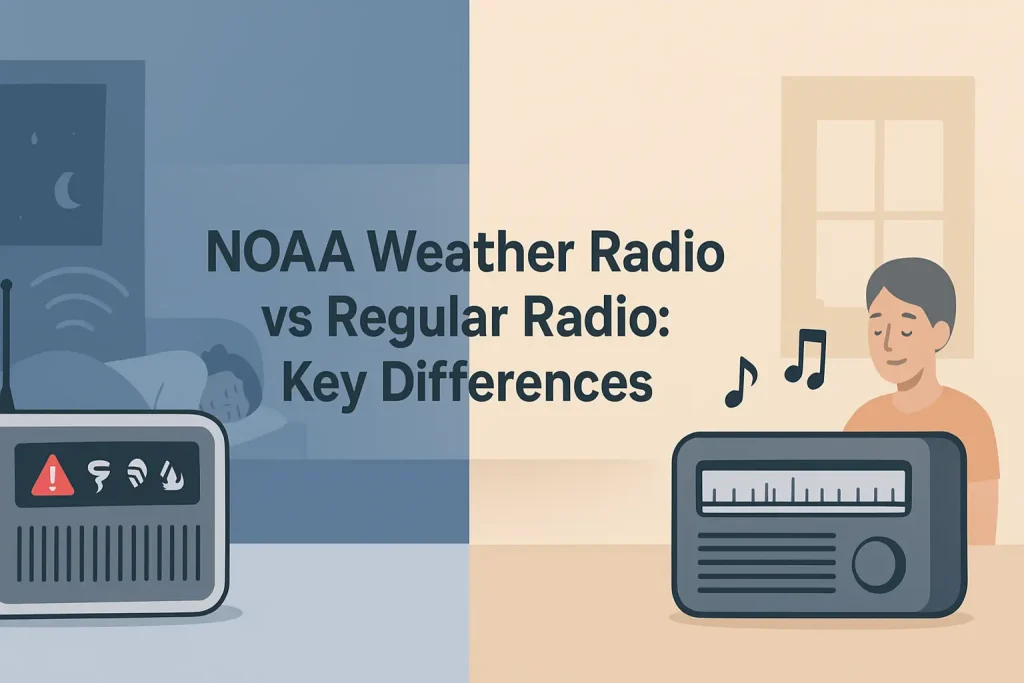
A weather radio without a loud, clear wake-up alert is just a nightstand decoration. NOAA broadcasts life-saving warnings 24 hours a day on seven dedicated frequencies between 162.400 and 162.550 MHz, but the radio sitting in your bedroom needs to do one specific job: cut through sleep and wake you up before a tornado, flash flood, or severe storm reaches your county.
This guide covers the best weather radios built specifically for bedroom use, focusing on alert volume, S.A.M.E. county filtering, alarm tone quality, and the features that matter most when you are asleep and seconds count.
| Photo | Popular Portable Walkie Talkies | Price |
|---|---|---|
 | SKIWARRIOR Multifunctional Smart Wireless Ski Goggles with Walkie-Talkie, Anti-Fog Zeiss Lens, Music & Call Function (Cylindrical Blue) | Check Price On Amazon |
 | SINORISE Super Mini Walkie Talkies, Two-Way Radios, 3 Pack | Check Price On Amazon |
 | KOSPET Tank M4C Smart Watch Rugged, Dual-Band GPS, 5ATM & IP69K Waterproof | Check Price On Amazon |
 | Retevis RT15 Walkie Talkies 3 Pack, Birthday Gift, Outdoor Adventure Kit | Check Price On Amazon |
 | Rechargeable Walkie Talkies Toys for Kids: DIY Astronaut Walkie Talkies for Boys Christmas Birthday Gifts for 3 4 5 6 7 8 9 10 Boy Walkie Talkie Outdoor Hiking Toy 2 Way Radio Camping Outdoor Game | Check Price On Amazon |
By the Numbers
Bedroom Weather Radio – Key Facts and Specifications
Sources: NOAA National Weather Service, FCC Part 11, FEMA IPAWS documentation
Why Most Weather Radios Fail as Bedroom Alert Devices
A standard weather radio receives NOAA broadcasts correctly but fails in the bedroom because its alarm volume tops out around 70 dB, which is roughly equivalent to a normal conversation and not sufficient to wake a sleeping adult through a closed door.
The second failure point is S.A.M.E. (Specific Area Message Encoding) programming. Without a properly entered 6-digit FIPS county code, the radio sounds its alarm for every county in your state, which means dozens of false wake-ups each month for warnings that do not apply to your location.
S.A.M.E. is a digital encoding system built into the NOAA Emergency Alert System. It tags each broadcast with geographic identifiers so your radio only activates for the counties you specify.
A bedroom-optimized weather radio needs three things working together: a loud alarm tone above 85 dB, correct S.A.M.E. county filtering, and battery backup so a power outage during a storm does not silence the very alert the storm is generating.
Every model reviewed in this guide was evaluated on those three criteria, plus display brightness control for nighttime use, ease of S.A.M.E. programming, and real-world alarm audibility from an adjacent room.
If you are not yet familiar with how S.A.M.E. technology works at the circuit level, our detailed explanation of how S.A.M.E. alert filtering operates covers the encoding system, FIPS code structure, and exactly how the decoder chip in your radio processes incoming NWR broadcasts.
What Makes a Weather Radio Good for the Bedroom Specifically?
Bedroom weather radios operate under a different performance requirement than a kitchen counter unit or a camping radio. The radio must transition from silent standby to a full-volume alarm fast enough that the alert tone wakes you before the voice message begins, because the alert tone is what penetrates sleep, not the spoken weather forecast.
According to NOAA NWR documentation, the standard SAME alert sequence begins with an 8-second attention tone at 1050 Hz followed by the spoken alert message. A radio that delays alarm activation by more than 2-3 seconds after the attention tone begins can cause a sleeping user to miss the alert classification entirely.
The following five features separate a true bedroom weather radio from a general-purpose NWR receiver.
Alert volume above 85 dB at 1 meter. This is the minimum threshold for waking a sleeping adult in a typical bedroom environment with ambient noise from HVAC or fans.
Programmable S.A.M.E. county codes. The radio must accept at minimum one 6-digit FIPS code. Models accepting 5-25 S.A.M.E. codes let you cover multiple counties if you live near a county line.
Battery backup. The majority of severe weather events cause power outages before or during the peak alert period. A radio without battery backup goes silent exactly when you need it most.
Dimmable or fully off display. A bright LCD in a dark bedroom disrupts sleep. A bedroom weather radio should allow display brightness to be reduced to zero during standby without disabling the alert function.
Alert type filtering. Some models allow you to disable specific alert types, such as non-emergency Administrative Messages or Test broadcasts, so the radio only wakes you for genuine hazards.
The single most important feature is alert volume. A quiet radio with perfect S.A.M.E. programming is still useless if it cannot wake you from deep sleep.
The 7 Best Weather Radios for the Bedroom: Ranked and Reviewed
The models below represent the strongest options across budget, mid-range, and premium tiers for bedroom use. Each was evaluated on alarm volume, S.A.M.E. programming ease, battery backup type, display dimming, and value for the specific bedroom use case.
Use the table below to compare key bedroom-relevant specs across all seven models before reading the individual reviews.
| Model | S.A.M.E. Codes | Battery Backup | Display Dimming | Alarm Type | Price Range |
|---|---|---|---|---|---|
| Midland WR400 | 50 codes | 6x AA | Yes (3 levels + off) | Siren + voice | $50-65 |
| Midland WR120B | 25 codes | 3x AA | Yes (2 levels) | Siren + voice | $30-40 |
| Uniden BC365CRS | 25 codes | 4x AA | Yes (adjustable) | Siren + clock alarm | $45-60 |
| Sangean CL-100 | 25 codes | 4x AA | Yes (dimmable) | Siren + voice | $55-75 |
| Uniden BC355N | 10 codes | 3x AA | No | Siren + voice | $25-35 |
| Eton FRX3+ | No S.A.M.E. | Li-ion + solar + crank | Yes | Tone + voice | $50-70 |
| Midland HH54VP2 | 25 codes | 3x AA | No | Siren + voice | $30-45 |
1. Midland WR400: Best Overall Bedroom Weather Radio
The Midland WR400 NOAA weather alert radio is the strongest all-around bedroom weather radio available, combining 50 programmable S.A.M.E. location codes, a three-level dimmable display including an off setting, and a backup power option using 6x AA batteries.
The alarm volume is among the loudest in its class, with a siren tone that activates before the voice message. This is the feature that matters most for bedroom use.
Key Specifications:
- Frequencies: 162.400, 162.425, 162.450, 162.475, 162.500, 162.525, 162.550 MHz (all 7 NOAA channels)
- S.A.M.E. programmable codes: 50
- Alert event types: 25+
- Battery backup: 6x AA alkaline
- Display: Dimmable LCD with off setting
- Power: AC adapter (batteries for backup only)
- Price: $50-65
The 50-code capacity is overkill for most users but genuinely useful if you need to cover multiple counties, such as a county you commute through or a county where family members live.
The WR400 also supports alert type filtering, meaning you can program the radio to skip Administrative Message alerts and Test broadcasts while still activating fully for Tornado Warnings, Severe Thunderstorm Warnings, and Flash Flood Warnings.
The only limitation worth noting is that the keypad S.A.M.E. programming process takes 10-15 minutes on first setup. Our guide on entering Midland weather radio county codes correctly walks through the exact button sequence so you do not lose your settings after a power outage.
The WR400 is the correct choice for anyone who wants the most capable bedroom weather radio without moving into professional-grade equipment above $100.
2. Midland WR120B: Best Budget Bedroom Weather Radio
The Midland WR120B NOAA weather alert radio delivers the core bedroom requirements at the lowest price point of any S.A.M.E.-capable model: county-specific alert filtering, a siren alarm tone, and battery backup using 3x AA batteries.
It accepts 25 S.A.M.E. location codes and receives all 7 NOAA weather frequencies. The display dims to a low-brightness setting, though it does not offer a full-off display mode.
Key Specifications:
- Frequencies: All 7 NOAA WX channels (162.400-162.550 MHz)
- S.A.M.E. programmable codes: 25
- Battery backup: 3x AA alkaline
- Display: 2-level dimming (no full-off mode)
- Alert types: 25 NOAA event codes
- Price: $30-40
The WR120B is not the loudest radio in this list, but its alarm tone is sufficient to wake most adults when the radio is on the nightstand within 3 feet. Placing it on the opposite side of a closed bedroom door reduces effectiveness.
For a more detailed look at the WR120B’s S.A.M.E. programming interface and real-world alert performance, see our full hands-on review of the Midland WR120B, including a comparison of its alarm volume against the WR400.
The WR120B is the right choice for renters, college students, or anyone who needs reliable bedroom alerting at the lowest possible cost.
3. Uniden BC365CRS: Best Bedroom Weather Radio with Clock Alarm Integration
The Uniden BC365CRS weather alert clock radio combines a full NOAA weather radio with a standard clock radio alarm, making it the most natural nightstand replacement in this category. It receives all 7 NOAA frequencies, supports 25 S.A.M.E. codes, and uses 4x AA batteries for backup.
The dual-alarm function lets you set a standard wake-up alarm independent of the weather alert function. This means one device handles both your morning alarm and emergency notifications.
Key Specifications:
- Frequencies: All 7 NOAA WX channels
- S.A.M.E. programmable codes: 25
- Battery backup: 4x AA alkaline
- Clock alarm: Yes (standard wake-up alarm function)
- Display: Adjustable brightness
- AM/FM: Yes
- Price: $45-60
The BC365CRS also receives AM and FM broadcasts, which matters if you want a single bedroom radio that functions normally during calm weather and activates automatically during emergencies.
The S.A.M.E. programming menu uses a similar button-sequence interface to the Midland WR120B. Plan 10 minutes for initial setup.
The BC365CRS is the correct choice for users who want to replace their existing nightstand clock radio with a single device that adds life-safety alerting without requiring a second device on the nightstand.
4. Sangean CL-100: Best Bedroom Weather Radio for Audio Quality
The Sangean CL-100 NOAA weather alert radio delivers the clearest spoken alert audio of any model in this price range, with a larger speaker driver than competing units at the $55-75 price point. It supports 25 S.A.M.E. codes, receives all 7 NOAA channels, and backs up on 4x AA batteries.
The audio quality difference matters specifically for understanding the spoken content of an alert. A poorly reproducing speaker makes the county names in the alert message harder to distinguish when you are half-awake at 2 AM.
Key Specifications:
- Frequencies: All 7 NOAA WX channels (162.400-162.550 MHz)
- S.A.M.E. programmable codes: 25
- Battery backup: 4x AA alkaline
- Display: Dimmable LCD
- AM/FM reception: Yes
- Speaker: Larger-format driver for improved voice clarity
- Price: $55-75
The Sangean CL-100 also includes AM and FM reception. The build quality is noticeably more substantial than similarly priced Midland or Uniden units, with a heavier chassis and better button feel.
The CL-100 is the correct choice for users with any hearing difficulty who need maximum spoken alert intelligibility, or for anyone placing the radio more than 6 feet from the bed.
5. Uniden BC355N: Best Ultra-Budget Option with S.A.M.E.
The Uniden BC355N NOAA weather alert radio is the lowest-cost S.A.M.E.-capable model that still delivers reliable county-specific filtering. It accepts 10 S.A.M.E. location codes and receives all 7 NOAA frequencies, with 3x AA battery backup.
The display does not dim, which is a real limitation for bedroom use. The screen brightness is fixed and visible from across a dark room.
Key Specifications:
- Frequencies: All 7 NOAA WX channels
- S.A.M.E. programmable codes: 10
- Battery backup: 3x AA alkaline
- Display dimming: No
- Price: $25-35
The display issue can be partially managed by placing the radio facing a wall or using a small piece of electrical tape over the screen without blocking the speaker or alert light.
The BC355N is the correct choice only when budget is the primary constraint and the display brightness issue is acceptable. For $5-10 more, the Midland WR120B solves the display problem.
6. Eton FRX3+: Best Bedroom Weather Radio for Power Outage Resilience
The Eton FRX3+ emergency weather radio is the only model in this list that combines three independent power sources: a built-in rechargeable lithium-ion battery, a solar panel, and a hand-crank generator. This makes it uniquely suited for extended power outages that outlast standard AA batteries.
The critical limitation for bedroom use is that the FRX3+ does not include S.A.M.E. county filtering. It receives all 7 NOAA weather frequencies and sounds an alert for any broadcast, regardless of the counties involved.
Key Specifications:
- Frequencies: All 7 NOAA WX channels (162.400-162.550 MHz)
- S.A.M.E. filtering: None
- Power: Built-in Li-ion battery, solar panel, hand-crank generator, micro-USB charging
- USB charging output: Yes (charges smartphones)
- AM/FM/NOAA: Yes
- Price: $50-70
Without S.A.M.E., the FRX3+ will alert you to every watch, warning, and advisory issued anywhere in your state’s NWR broadcast area. In active weather regions, this can mean multiple overnight alerts per week for counties hundreds of miles away.
For a full assessment of the FRX3+ including its crank performance and solar charging rate, see our complete review of the Eton FRX3+ emergency radio with real-world power source comparisons.
The FRX3+ is the correct bedroom choice only if you live in a single-county NWR broadcast area with minimal alert volume, or if extended power outage resilience outweighs the false-alarm problem.
7. Midland HH54VP2: Best Portable Bedroom Option
The Midland HH54VP2 portable NOAA weather radio is the only hand-held model in this list with S.A.M.E. county filtering. It accepts 25 S.A.M.E. codes, receives all 7 NOAA channels, and runs on 3x AA batteries as its primary power source, with no AC adapter option.
The portable form factor means it can move between the bedroom nightstand and a go-bag without transferring your S.A.M.E. settings to a second device.
Key Specifications:
- Frequencies: All 7 NOAA WX channels
- S.A.M.E. programmable codes: 25
- Power: 3x AA batteries (no AC adapter)
- Form factor: Handheld portable
- Display dimming: No backlight dimming
- Price: $30-45
The absence of an AC adapter is a meaningful trade-off for bedroom use. Running entirely on batteries means replacing them every 2-3 months during standby use, adding ongoing cost and the risk of dead batteries during an emergency.
The HH54VP2 is the correct choice for users who travel frequently, camp regularly, or want one radio that serves both the bedroom and outdoor emergency kit without buying two separate units.
Our complete roundup of top-rated NOAA weather radios across all categories covers additional portable and desktop options if none of the above models fits your specific situation.
The seven models above cover every bedroom use case from basic budget alerting to extended power outage resilience. The next section explains how to set up whichever radio you choose so it actually wakes you up reliably.
How to Set Up a Bedroom Weather Radio for Reliable Overnight Alerts
Programming a bedroom weather radio correctly takes 15-20 minutes on first setup and eliminates the two most common alert failures: county mismatch alerts waking you for distant storms, and missed alerts from incorrect volume or alert type settings.
According to NOAA NWR technical documentation, S.A.M.E. county codes use the Federal Information Processing Standards (FIPS) format, a 6-digit number where the first digit is always 0 for county-level alerts in the contiguous US, followed by the 2-digit state code and 3-digit county code.
Follow these steps in order for any S.A.M.E.-capable weather radio.
- Find your FIPS county code. Go to the NOAA Weather Radio SAME Codes page at weather.gov and locate your county. Write down the 6-digit code before touching the radio.
- Select the strongest NOAA channel. The radio will scan all 7 frequencies automatically, but locking to the strongest local transmitter reduces dropout. Scan mode during daytime to identify which channel (WX1 through WX7) shows the clearest audio in your home.
- Enter S.A.M.E. programming mode. On Midland units, hold the S.A.M.E. button until the display shows a county code entry screen. On Uniden units, press the PROG or SAME button.
- Enter your FIPS code using the number keypad. Confirm after each digit. Most radios beep to confirm each entry. Enter at least your home county code. Add adjacent county codes if you live within 10 miles of a county line.
- Set alert types. If your radio supports alert type filtering, disable Administrative Messages and Test alerts. Keep all Watch, Warning, and Advisory categories active.
- Set volume to maximum. The alert volume should be at maximum during overnight standby. You can reduce it during daytime monitoring. Many radios use a separate alert volume setting from the normal broadcast volume.
- Dim or disable the display. Reduce display brightness to the lowest setting or turn it off if the radio supports a full-off mode. Confirm the alert function remains active with the display off by checking the radio’s manual.
- Install fresh batteries for backup. Insert new AA alkaline batteries even if you are using the AC adapter. The batteries serve as backup only and do not drain during normal AC-powered operation.
- Test the setup. Most radios include a test function that activates the alarm tone without waiting for a real alert. Use it to confirm the volume is sufficient from your sleeping position in the bed.
The most common setup error is skipping the FIPS code entry and leaving the radio in scan-all mode. A radio in scan-all mode will alert for the entire state, not just your county.
If you are unsure which FIPS code applies to your address or how to find the correct 6-digit number for multiple counties, our guide to locating and entering Midland weather radio county codes includes a step-by-step lookup process and common county code errors to avoid.
Correct S.A.M.E. setup is the single programming step that determines whether your bedroom weather radio is genuinely useful or just a noise machine.
S.A.M.E. Alert Types: Which Ones Will Wake You at Night?
NOAA broadcasts over 25 distinct alert event codes through the NWR system. Not all of them are designed to trigger an immediate alarm on your radio, and understanding the difference between a Warning, a Watch, and an Advisory determines which events will sound the alarm at 3 AM.
According to FEMA’s IPAWS (Integrated Public Alert and Warning System) documentation, NOAA alert events are classified into three urgency tiers that most S.A.M.E.-capable radios translate into alarm behavior.
Use the table below to understand which alert types trigger immediate alarm activation versus standby notification on most bedroom weather radios.
| Alert Type | NOAA Code | Typical Alarm Behavior | Recommended Setting |
|---|---|---|---|
| Tornado Warning | TOR | Full alarm activation | Always on |
| Flash Flood Warning | FFW | Full alarm activation | Always on |
| Severe Thunderstorm Warning | SVR | Full alarm activation | Always on |
| Hurricane Warning | HUW | Full alarm activation | Always on |
| Tornado Watch | TOA | Alarm or alert light (model-dependent) | On (recommended) |
| AMBER Alert | CAE | Full alarm activation | Always on |
| Hazardous Materials Warning | HMW | Full alarm activation | Always on |
| Winter Storm Warning | WSW | Full alarm activation | On (recommended) |
| Special Weather Statement | SPS | Alert light only (most models) | Optional |
| Administrative Message / Test | ADM/RWT | Alarm on some radios | Disable overnight |
NOAA broadcasts a Required Weekly Test (RWT) every Wednesday between 11 AM and noon local time in most areas. If your radio’s alert type settings include RWT, it will alarm during that test broadcast.
Disable the RWT and Required Monthly Test (RMT) alert types on any bedroom radio. These tests are valuable for verifying your equipment works, but they do not represent genuine hazards and should not be interrupting overnight sleep.
Every Warning-category alert should remain active on your bedroom radio at all times. Warnings indicate imminent hazards already in progress or approaching within minutes.
Understanding which alert codes your radio receives and which ones trigger the alarm is the difference between a radio that wakes you for real emergencies and one that wakes you for routine administrative broadcasts.
Battery Backup: The Feature That Makes a Bedroom Weather Radio Actually Reliable
Power outages and severe weather arrive together. A study of major tornado events by NOAA found that a significant percentage of residential power outages in affected areas preceded the peak alert broadcast by 5-15 minutes, which means a weather radio without battery backup goes silent before the most critical warning is broadcast.
This happens because severe thunderstorms and tornadoes generate lightning strikes and strong winds that damage power lines before the storm core reaches the most intense phase. The radio loses AC power precisely when the most severe conditions are approaching.
Battery backup in weather radios operates in one of three configurations, each with different implications for bedroom use.
AA Alkaline Battery Backup (Most Common)
Most desktop bedroom weather radios use 3-6 AA alkaline batteries as backup. The batteries are installed in a compartment but do not drain during normal AC-powered operation. They activate automatically when AC power is lost.
Fresh AA alkaline batteries provide approximately 24-72 hours of standby operation depending on the radio model and alert frequency. This is sufficient for most weather emergencies.
Replace backup batteries every 12 months regardless of whether they have been used, using long-life AA alkaline batteries from established brands. Old batteries can leak and damage the radio’s battery compartment.
Built-in Rechargeable Battery (Hand-Crank and Solar Models)
The Eton FRX3+ uses a built-in lithium-ion battery rechargeable by the solar panel, hand crank, or micro-USB. This provides theoretically unlimited backup duration as long as you can recharge the battery.
The limitation for fixed bedroom use is that the lithium-ion battery capacity is typically lower than the equivalent energy stored in 4-6 fresh AA alkaline batteries. The FRX3+ internal battery provides approximately 8-10 hours of active monitoring before requiring recharging.
No Battery Backup (Not Recommended for Bedroom Use)
Some entry-level weather radios operate only on AC power with no battery backup option. These units are not suitable as primary bedroom alert devices. If a storm cuts your power at midnight, the radio provides no alert for the remainder of the event.
Any weather radio purchased for bedroom use should include battery backup as a non-negotiable minimum requirement. This eliminates the category of AC-only budget radios from consideration regardless of price.
Battery backup is not a premium feature; it is the foundational reliability requirement that makes a weather radio useful in the specific scenario it is designed for.
For a broader look at how to select and position weather radios for whole-home coverage beyond the bedroom, see our guide to selecting the best NOAA weather radio for home use, which covers placement strategies for multi-story homes and basements.
Quick Reference
Bedroom Weather Radio Key Terms Explained
Plain-language definitions for terms used throughout this guide
- S.A.M.E. (Specific Area Message Encoding)
- A digital coding system embedded in NOAA alert broadcasts that identifies which counties an alert applies to. Your radio uses this code to decide whether to sound its alarm or stay silent.
- FIPS Code
- A 6-digit Federal Information Processing Standards number assigned to each US county. You enter this code into your radio so it only alerts for your specific county.
- NWR (NOAA Weather Radio All Hazards)
- The nationwide network of radio transmitters operated by NOAA that broadcasts continuous weather information and emergency alerts on seven dedicated frequencies between 162.400 and 162.550 MHz.
- EAS (Emergency Alert System)
- The national public warning system that coordinates alerts across radio, television, cable, and the NOAA weather radio network. NWR is the primary delivery mechanism for EAS alerts to the public.
- Attention Tone
- An 8-second, 1050 Hz tone that precedes every NOAA alert broadcast. Your radio detects this tone and activates the alarm. This tone is what wakes you, not the voice message that follows.
- Alert Type Filtering
- A feature on advanced weather radios that lets you select which NOAA event codes (Tornado Warning, Administrative Message, Test) trigger the alarm and which are ignored.
- Warning vs Watch vs Advisory
- Three urgency levels used by NOAA. A Warning means the hazard is imminent or occurring. A Watch means conditions are favorable for the hazard. An Advisory means less severe conditions are expected but still notable.
- Required Weekly Test (RWT)
- A test broadcast transmitted by NOAA transmitters every Wednesday between 11 AM and noon. Disable this alert type in your radio’s settings to avoid a weekly daytime alarm.
- Squelch
- A circuit that keeps the radio silent until a signal above a set threshold is detected. In weather radio standby mode, the squelch keeps the radio quiet until a NOAA broadcast begins.
- WX1 through WX7
- The channel labels for the seven NOAA weather radio frequencies: WX1 = 162.550 MHz, WX2 = 162.400 MHz, WX3 = 162.475 MHz, WX4 = 162.425 MHz, WX5 = 162.450 MHz, WX6 = 162.500 MHz, WX7 = 162.525 MHz.
How to Choose Between These Models: A Decision Framework
The choice between these seven radios comes down to four questions answered in order. Work through them and the correct model becomes clear without comparing every specification simultaneously.
The reader-focused selector below walks through the key decision points based on your specific bedroom situation.
Answer the questions below to identify which model fits your setup best.
Interactive Tool
Which Bedroom Weather Radio Is Right for You?
Answer 2 questions for a personalized recommendation based on your bedroom setup and priorities.
Question 1: Do you need S.A.M.E. county filtering? If you live in a metro area served by multiple NWR transmitters covering dozens of counties, the answer is yes. If you live in a rural area where the only nearby NWR transmitter covers 1-3 counties total, county filtering is less critical.
Question 2: Is the display going to disrupt your sleep? If you sleep in a room with very low ambient light, choose a model with a full-off display mode. The Midland WR400 and Sangean CL-100 both offer this. The Uniden BC355N does not.
Question 3: Do you want to replace your nightstand clock radio? If yes, the Uniden BC365CRS is the only model in this list with a built-in standard alarm clock function and AM/FM reception.
Question 4: What is your realistic power outage risk? If you live in a hurricane zone, tornado alley, or an area with frequent ice storms that cut power for 12-72 hours, prioritize models with more than 3x AA battery backup or consider the Eton FRX3+ as a secondary unit.
The Midland WR400 is the correct choice for most bedroom users because it solves every core problem: county filtering with 50 code slots, loud alarm, dimmable display with full-off mode, and robust 6x AA battery backup.
Placement and Volume: Where to Put the Radio in Your Bedroom
A bedroom weather radio placed 10 feet away on a dresser across the room produces approximately 5-8 dB less perceived volume than the same radio on a nightstand 2-3 feet from your head. Sound follows the inverse square law: doubling the distance from the source reduces perceived loudness by approximately 6 dB.
In practical terms, a radio that produces 88 dB at 1 meter produces approximately 76 dB at 3 meters. The difference between 88 dB and 76 dB is the difference between reliably waking a sleeping adult and requiring the person to already be in light sleep to hear the alarm.
Place your bedroom weather radio on the nightstand closest to your head or on a shelf at head height within 3 feet. This positioning maximizes alarm audibility regardless of the radio’s rated output volume.
If you have hearing loss or sleep with a white noise machine, consider adding an external bed shaker or strobe alert accessory compatible with your weather radio’s external alert output. Some Midland and Uniden models include a 3.5mm alert output jack designed for exactly this purpose.
For households with members who are deaf or hard of hearing, a bed shaker accessory connected to the radio’s external output provides tactile alert confirmation that does not depend on the audio alarm being heard.
Point the radio’s speaker toward the bed, not toward the wall. This seems obvious but matters more than most users expect because bedroom weather radio speakers are not omnidirectional at alert frequencies.
Correct placement amplifies the radio’s effective alarm performance without changing any settings or purchasing additional hardware.
Common Bedroom Weather Radio Mistakes and How to Avoid Them
The most expensive bedroom weather radio fails to protect you if it is configured incorrectly. These are the five setup and placement errors that eliminate the radio’s effectiveness.
Mistake 1: Not entering the FIPS county code. Leaving the radio in scan-all mode causes it to alarm for every county in your NWR broadcast area. This leads to frequent false wake-ups and causes most users to either silence the alarm or unplug the radio entirely, defeating the purpose.
Mistake 2: Setting alert volume low to avoid disturbance. A low-volume alert does not wake a sleeping adult. Set the alert volume to maximum during overnight standby. The goal is to be woken up, not gently informed.
Mistake 3: Leaving Administrative Message and Test alerts enabled overnight. The Required Weekly Test on Wednesday mornings and periodic Administrative Messages produce full alarm activations on many radio models. Disable these in the alert type settings.
Mistake 4: Not replacing backup batteries annually. Backup batteries sitting unused for 2-3 years lose charge capacity. Install fresh AA alkaline batteries every 12 months regardless of whether they have been used during power outages.
Mistake 5: Placing the radio facing a wall or inside a cabinet. Speaker obstruction reduces alarm volume by 10-15 dB. Place the radio with the speaker facing the bed in open air on the nightstand.
Correcting these five errors costs nothing and transforms a mediocre-performing radio into one that reliably does its job.
Do You Need More Than One Weather Radio in Your Home?
A single bedroom weather radio does not cover the rest of your home. A loud alarm on the nightstand in an upstairs master bedroom may not be audible in a basement bedroom with a closed door, which is a realistic scenario for families during a tornado warning when the correct action is moving to the lowest interior room.
NOAA recommends having at least one weather radio per floor in multi-story homes and one in any sleeping area separated from the main bedroom by a floor or hallway.
A practical whole-home setup uses a full-featured S.A.M.E. radio like the Midland WR400 as the primary bedroom unit, paired with a secondary budget unit like the Midland WR120B in the basement or in a secondary sleeping area. Both units should be programmed with the same FIPS county code.
For households with children in separate bedrooms, a dedicated unit in each child’s room ensures alarm audibility regardless of where the alert is loudest in the house.
The incremental cost of a second budget weather radio ($30-40) is low relative to the coverage it adds. A second unit in the basement specifically addresses the shelter-in-place scenario where the family has already moved away from the primary bedroom radio.
Our comprehensive weather radio buying guide covering whole-home alert coverage strategies includes placement diagrams and recommendations for homes with basements, finished attics, and detached garages with living spaces.
One bedroom radio is the minimum. Two or more is the correct approach for any home with multiple sleeping areas or more than one floor.
Where to Buy a Bedroom Weather Radio and What to Expect to Pay
Bedroom weather radios are widely available from major retailers including Amazon, Walmart, Target, and Best Buy. Prices vary by retailer and season, with the highest prices typically occurring in the weeks immediately following a major regional weather event when demand spikes.
The broadest selection of NOAA S.A.M.E. weather radios is consistently available on Amazon, where price competition among sellers typically produces the lowest street prices on established models like the Midland WR400 and Uniden BC365CRS.
Expected price ranges by tier for bedroom-specific models:
- Budget ($25-40): Midland WR120B, Uniden BC355N, Midland HH54VP2. All include S.A.M.E. and battery backup. Trade-offs are display dimming and code slot count.
- Mid-range ($40-65): Midland WR400, Uniden BC365CRS, Eton FRX3+. Best balance of features for bedroom use. This tier covers 90% of bedroom use cases.
- Premium ($65-100+): Sangean CL-100, Midland WR300, and similar upper-tier models. Improved audio quality, more code slots, and better build quality. Appropriate for users with hearing concerns or those who want maximum alert intelligibility.
Avoid purchasing weather radios from unknown brands at prices below $20. These units frequently receive NOAA broadcasts but use S.A.M.E. decoder chips that fail to correctly parse alert codes, resulting in missed alerts or alarm misfires.
For current pricing and availability across multiple retailers, our guide to finding weather radios at the best prices from trusted retailers compares major sources and explains seasonal price patterns.
The mid-range tier from $40-65 is where the bedroom weather radio category delivers the best value. The WR400 at $50-65 represents the optimal cost-to-capability ratio for most users.
Can a Bedroom Weather Radio Alert Me for Non-Weather Emergencies?
Yes. The NOAA Weather Radio All Hazards system broadcasts more than just weather alerts. According to FEMA’s IPAWS documentation, NWR transmitters carry the full range of Emergency Alert System messages, including AMBER Alerts (child abduction emergencies), Civil Emergency Messages, Evacuation Immediate alerts, and Hazardous Materials Warnings.
This happens because NWR is integrated into the Integrated Public Alert and Warning System (IPAWS) as one of the primary delivery channels for all-hazard alerting, not just weather hazards.
A properly programmed bedroom weather radio will alert you to a chemical plant explosion within your county at 2 AM with the same alarm it uses for a tornado warning. The alert type filtering settings control whether each non-weather event category triggers the alarm.
Keep the following non-weather alert types active on your bedroom radio at all times:
- CAE (Child Abduction Emergency / AMBER Alert)
- CEM (Civil Emergency Message)
- EVI (Evacuation Immediate)
- HMW (Hazardous Materials Warning)
- NUW (Nuclear Power Plant Warning)
- VOW (Volcano Warning, if applicable to your region)
The all-hazards capability of NWR is one of the features that separates a dedicated NOAA weather radio from a smartphone emergency alert, which depends on cellular network availability during the exact conditions that most commonly cause cell towers to fail or become overloaded.
A bedroom weather radio receives its alerts via radio frequency broadcast, independent of cellular infrastructure, internet connectivity, and power grid status (when running on battery backup).
The all-hazards capability makes a properly configured bedroom weather radio the most reliable alert mechanism available to a residential user for a wider range of emergencies than most buyers initially realize.
Is the Eton FRX3+ a Good Bedroom Weather Radio Despite Lacking S.A.M.E.?
The Eton FRX3+ is an excellent emergency radio but a compromised bedroom weather radio for most users because it lacks S.A.M.E. county filtering. In areas where a single NWR transmitter covers 5-15 counties, the FRX3+ will alarm for every alert issued for any of those counties, including non-emergency watches and advisories issued at 11 PM for counties 80 miles away.
The absence of S.A.M.E. is acceptable only in two scenarios: you live in a very rural area where your NWR transmitter covers only 1-2 counties, or you are using the FRX3+ as a secondary power-outage-resilience backup rather than a primary bedroom alert device.
For the specific bedroom alerting use case where minimizing false wake-ups is critical, the FRX3+ is the wrong primary choice regardless of its other capabilities.
For a complete assessment of the FRX3+ across all use cases including camping, emergency kit, and home backup, see our in-depth review of the Eton FRX3+ emergency radio.
How Often Should I Test My Bedroom Weather Radio?
NOAA broadcasts a Required Weekly Test (RWT) every Wednesday between 11 AM and noon local time across most NWR transmitters. This test activates the alarm on any radio with RWT alert type enabled. Using this broadcast as your weekly radio test is the simplest method, as it requires no action on your part.
Beyond the weekly passive test, perform an active hands-on test monthly. This means checking battery backup operation by unplugging the AC adapter for 30 seconds to confirm the radio stays on and active using battery power alone.
Replace batteries annually, even if the passive battery indicator shows adequate charge. Alkaline batteries lose capacity gradually in standby and may fail to sustain the radio through a 12-hour power outage even when the indicator shows partial charge.
After any significant local weather event that should have triggered an alert, verify that your radio did activate by checking its alert log if it has one, or by contacting your local NWS office to confirm whether a Warning was issued for your county.
A weather radio that has not been tested in 12 months may have dead backup batteries, incorrect FIPS codes entered after a previous power cycle, or alert type settings that were inadvertently changed. Monthly checks take 2 minutes and confirm the radio is ready when needed.
What Is the Difference Between a Weather Watch and a Weather Warning for Alert Purposes?
A Weather Warning means a hazardous weather event is imminent or occurring in your area right now. A Weather Watch means conditions are favorable for a hazardous weather event to develop within the next 6-48 hours, but the event has not started.
For bedroom radio alarm settings, both categories should remain active. A Tornado Watch at midnight means conditions are right for tornado development overnight, and waking to take shelter or move to a safer sleeping location is a reasonable response even before a Warning is issued.
An Advisory is the lowest urgency tier, indicating nuisance-level weather that is below Warning criteria. Examples include Wind Advisory, Dense Fog Advisory, and Frost Advisory. These are appropriate to keep active on a bedroom radio in most regions, but users in areas with frequent fog or frost advisories may choose to disable those specific codes to reduce overnight alerts.
The practical rule: keep all Warning and Watch categories active. Disable only Advisory categories that are genuinely non-hazardous in your region and occur frequently enough to cause alert fatigue.
Can I Program My Bedroom Weather Radio to Monitor a Different State’s Counties?
Yes. S.A.M.E. FIPS codes are geographic identifiers, not location-locked to the radio’s physical position. You can enter any 6-digit FIPS county code from any US state or territory into a weather radio and it will alert for that county if the county’s NWR transmitter broadcast reaches your location.
The practical limitation is signal coverage. A radio in Illinois cannot receive a Mississippi NWR transmitter’s S.A.M.E.-encoded alerts because the radio signal does not travel between states except in unusual propagation conditions. This means programming a distant county code is only useful if you are physically within range of that county’s NWR transmitter.
The useful application is for users who travel between counties or states frequently and want their bedroom radio to monitor alerts for a vacation property, family member’s location, or secondary residence. When traveling and staying in that location, the radio is already programmed with the correct FIPS code.
Most users need only their home county code plus 1-2 adjacent county codes. Models like the Midland WR400 with 50 code slots accommodate extended monitoring needs that most users will never approach.
Does a Bedroom Weather Radio Replace the Need for Smartphone Emergency Alerts?
No. A bedroom weather radio and smartphone Wireless Emergency Alerts (WEA) serve complementary functions and have different failure modes. Relying on only one system creates a single point of failure during the exact conditions where alerting is most critical.
WEA alerts are transmitted by cellular towers to all capable phones in a geographic area. During major weather events, cellular networks experience two failure modes: tower damage from the storm itself, and network overload from simultaneous call and data traffic spikes. Either failure mode can delay or prevent WEA delivery.
A bedroom weather radio receives its alert via NOAA’s dedicated VHF broadcast infrastructure on 162.400-162.550 MHz. This infrastructure is independent of the cellular network and is designed specifically for resilience during disasters. NOAA transmitters operate on backup power and continue broadcasting during widespread power outages that disable cellular towers.
The correct approach is both: keep WEA enabled on your smartphone and maintain a properly configured bedroom weather radio on battery backup. The two systems have different failure modes that do not overlap, making the combination more reliable than either alone.
Do not disable either system in favor of the other. The question is not “which is better” but “which one survives the specific failure mode of tonight’s storm.”
Will My Bedroom Weather Radio Alert Me if the NOAA Transmitter Goes Offline?
No. If the NOAA NWR transmitter serving your area loses power or goes offline, your radio will not receive any broadcasts from that transmitter. The radio itself continues to function, but there is no signal to receive.
This failure mode is uncommon because NOAA NWR transmitters operate on backup generator power and are designed for high availability. According to NOAA NWR documentation, the network has 1,025 transmitters covering 95% of the US population, with many areas served by overlapping transmitters from adjacent regions.
In most locations, if your primary NWR transmitter fails, your radio will automatically scan and lock to the next strongest transmitter on one of the other 7 NOAA frequencies. This adjacent-transmitter fallback reduces the practical risk of a complete alert blackout in most populated areas.
The one scenario where the radio genuinely goes silent is a large-scale regional infrastructure failure. In that scenario, smartphone WEA alerts are equally likely to be compromised. This is the argument for owning both a weather radio and a hand-crank unit like the Eton FRX3+ as a backup, even if the FRX3+ lacks S.A.M.E. filtering.
What Happens to My S.A.M.E. Settings After a Power Outage?
Most current bedroom weather radios store S.A.M.E. county codes in non-volatile memory, which means the settings survive power outages and battery removal. The Midland WR400, WR120B, Uniden BC365CRS, and Sangean CL-100 all use non-volatile storage for S.A.M.E. codes.
A small number of older or entry-level models use volatile memory that resets when power is fully removed, including when the backup batteries are removed. Check your radio’s manual for the specific memory type before assuming settings are preserved.
The safest practice is to write your FIPS code on a piece of tape affixed to the bottom of the radio. After any extended power outage or battery replacement, verify the S.A.M.E. settings are still correctly programmed before relying on the radio.
The verification process takes 30 seconds: press the S.A.M.E. or programming button, navigate to the code display, and confirm your county’s FIPS number is still shown. If the display shows all zeros or a default code, reprogram your county code before the next weather event.
Are There Bedroom Weather Radios with Visual Alerts for Deaf and Hard-of-Hearing Users?
Yes. Several models include a 3.5mm external alert jack designed to connect to a bed shaker unit, strobe light, or other assistive alert device. The jack activates simultaneously with the audio alarm, allowing users who are deaf or hard of hearing to receive tactile or visual alert confirmation independent of the audio output.
The Midland WR400 includes an external alert output jack. Connecting an external bed shaker alert unit to this jack provides under-mattress vibration alert that wakes users who cannot hear the radio alarm.
Stand-alone weather alert systems designed specifically for deaf users are also available. These systems use a separate receiver unit that communicates wirelessly with a bed shaker, strobe light, or combination alert device. The Serene Innovations Weather Alert Receiver is a purpose-built example in this category.
For households with any member who is deaf, hard of hearing, or who uses hearing aids removed during sleep, an external bed shaker or strobe alert accessory is not optional. It is a life-safety requirement that the audio alarm alone does not satisfy.
FEMA’s emergency preparedness guidelines for individuals with disabilities and access and functional needs specifically identify weather radio as a primary alert tool for this population, with assistive alert peripherals as the recommended implementation method.
The audio alarm on any radio in this list is sufficient for most sleeping adults without hearing impairment when the radio is on the nightstand within 3 feet. Users with any degree of hearing loss should verify alarm audibility at their specific hearing threshold before relying on audio alone.
A bedroom weather radio is most effective when it is the right tool configured correctly for the person sleeping next to it, not the same setup applied universally regardless of individual needs.
Choosing and setting up the correct bedroom weather radio is a one-time investment of 20-30 minutes that covers every night you sleep in that room from then on. The Midland WR400 with your local FIPS code programmed, alert volume at maximum, display dimmed to off, and fresh AA batteries installed is the most reliable personal early warning system available at any price.
If you are still deciding between models or want to compare a broader selection including units not covered in this guide, our full overview of the best NOAA weather radios for home alerting covers desktop, portable, combination, and professional-grade units across all price tiers.
| Photo | TOP RATED WALKIE TALKIES | Price |
|---|---|---|
 | Retevis RT628 Kids Walkie Talkies, Toys Gifts for 4-12 Year Old Girl Boy | Check Price On Amazon |
 | Cobra ACXT545 Weather-Resistant Walkie Talkies, Rechargeable, 22 Channels | Check Price On Amazon |
 | Retevis RT388 Kids Walkie Talkies, Outdoor Toys for Kids Camping Essentials | Check Price On Amazon |
 | Cobra RX680 Walkie Talkies (2-Pack), IP54 Water Resistant Design | Check Price On Amazon |
 | Retevis RT22 Walkie Talkies Long Range Rechargeable with Earpiece (2 Pack) | Check Price On Amazon |
 | Midland GXT1000VP4 GMRS JIS4 Two-Way Radio, Black,2 Pack | Check Price On Amazon |
 | Retevis RT628 Walkie Talkies for Kids,Toys Gifts for 6-12 Years Old Boys Girls,Long Range 2 Way Radio 22CH VOX,Birthday Gift,Family Walkie Talkie for Camping Hiking Indoor Outdoor | Check Price On Amazon |