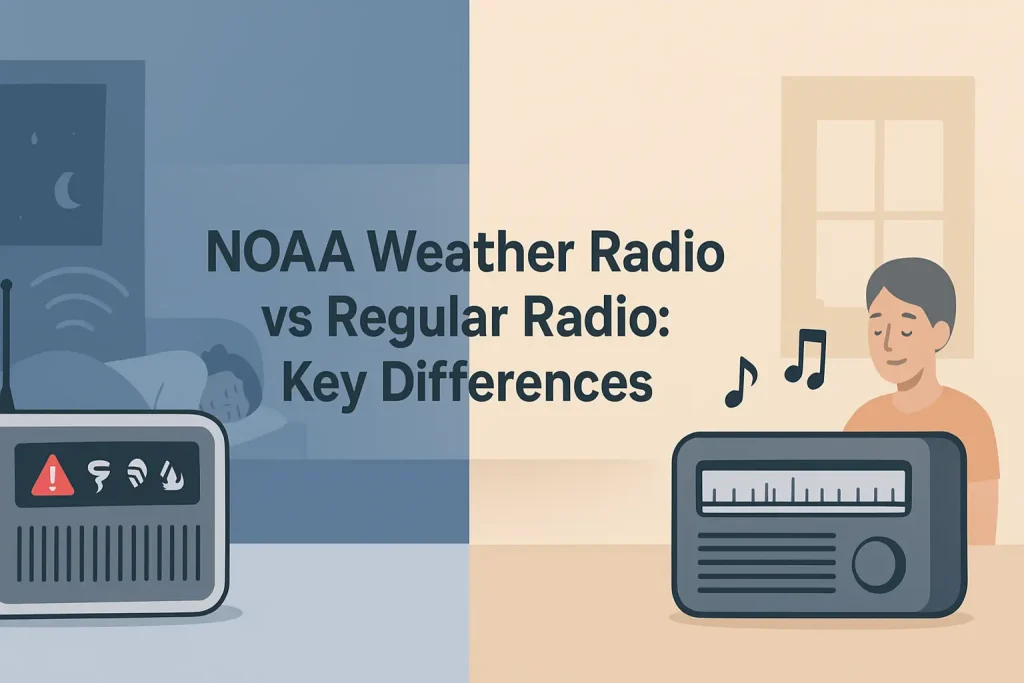
A weather radio without S.A.M.E. technology will alert you for every county in your state during hurricane season, not just yours. The best weather radios for hurricane season receive all seven NOAA broadcast frequencies between 162.400 and 162.550 MHz, decode S.A.M.E. (Specific Area Message Encoding) alerts for your exact county, and keep working on battery backup when the power goes out.
This guide covers the top-rated portable, desktop, and hand-crank weather radios for hurricane preparedness, with real specs, honest range assessments, and the features that actually matter when a Category 4 storm is 12 hours away.
| Photo | Popular Portable Walkie Talkies | Price |
|---|---|---|
 | SKIWARRIOR Multifunctional Smart Wireless Ski Goggles with Walkie-Talkie, Anti-Fog Zeiss Lens, Music & Call Function (Cylindrical Blue) | Check Price On Amazon |
 | SINORISE Super Mini Walkie Talkies, Two-Way Radios, 3 Pack | Check Price On Amazon |
 | KOSPET Tank M4C Smart Watch Rugged, Dual-Band GPS, 5ATM & IP69K Waterproof | Check Price On Amazon |
 | Retevis RT15 Walkie Talkies 3 Pack, Birthday Gift, Outdoor Adventure Kit | Check Price On Amazon |
 | Rechargeable Walkie Talkies Toys for Kids: DIY Astronaut Walkie Talkies for Boys Christmas Birthday Gifts for 3 4 5 6 7 8 9 10 Boy Walkie Talkie Outdoor Hiking Toy 2 Way Radio Camping Outdoor Game | Check Price On Amazon |
By the Numbers
NOAA Weather Radio and Hurricane Alert System – Key Specifications
Sources: NOAA National Weather Service, FCC Part 11 (EAS), FEMA IPAWS documentation
The single most important feature to look for in a hurricane-season weather radio is S.A.M.E. programming. Without it, your radio screams at you for every severe thunderstorm warning issued three counties away, and you start ignoring alarms. That is exactly when a genuine hurricane warning gets overlooked.
Here is a closer look at what separates a reliable hurricane-season weather radio from one that will let you down when the storm arrives.
What Is S.A.M.E. Technology and Why Does It Matter for Hurricane Alerts?
S.A.M.E. (Specific Area Message Encoding) is the system NOAA uses to attach a 6-digit FIPS county code to every weather alert broadcast. A weather radio with S.A.M.E. decoding can filter incoming alerts so your alarm only triggers for the specific counties you program into the radio, not for the entire broadcast region of the transmitter.
Without S.A.M.E., a single NOAA transmitter broadcasting over a 40-mile radius might cover 10 to 20 counties. Every alert for every county in that zone triggers your radio’s alarm. According to NOAA NWR documentation, S.A.M.E. codes are transmitted as digital headers at the start of every EAS (Emergency Alert System) message, allowing receivers to compare incoming codes against their stored FIPS list before sounding an alarm.
During hurricane season on the Gulf Coast or Atlantic seaboard, NOAA issues dozens of alerts daily across large geographic areas. A radio without S.A.M.E. filtering becomes noise. A radio with S.A.M.E. programming tells you exactly when your county is under a Hurricane Warning versus a Hurricane Watch, which is the difference between evacuating now and monitoring the situation.
You can look up your county’s 6-digit FIPS S.A.M.E. code on the NOAA NWR website. Most quality weather radios allow you to store between 25 and 50 S.A.M.E. codes, so you can monitor multiple counties simultaneously if your household spans county lines or you need alerts for a vacation property.
If you want a deeper explanation of how S.A.M.E. works at the hardware and encoding level, our guide on how S.A.M.E. encoding filters your county-level weather alerts covers the full technical breakdown.
The key takeaway: no S.A.M.E. technology means no county-level filtering, and during hurricane season that means alarm fatigue at exactly the wrong time.
The 7 Best Weather Radios for Hurricane Season
The radios below were selected based on S.A.M.E. alert filtering, backup power options, reception reliability on all seven NOAA frequencies, and real-world durability in coastal storm conditions. Each model covers a different use case, from bedside desktop units to hand-crank survival radios for evacuation kits.
Use the table below to compare key specs across all seven picks before reading the individual reviews.
| Model | Type | S.A.M.E. Codes | Backup Power | Alert Types | Price |
|---|---|---|---|---|---|
| Midland WR400 | Desktop | 50 | 6x AA battery | 25 | $50-70 |
| Midland WR120B | Desktop | 25 | 3x AA battery | 25 | $30-45 |
| Uniden BC365CRS | Desktop/Clock | 25 | Battery backup | 25 | $40-55 |
| Sangean CL-100 | Desktop | 25 | AC + AA battery | 25 | $55-75 |
| Midland ER310 | Portable/Crank | Yes | Crank + solar + USB | 25 | $65-90 |
| Eton FRX3+ | Portable/Crank | Yes | Crank + solar + USB | 25 | $50-70 |
| Uniden MHS75 | Handheld Marine | N/A (marine VHF) | Li-ion battery | WX channels | $70-100 |
1. Midland WR400: Best Overall for Home Use
The Midland WR400 weather radio is the most capable desktop weather radio for hurricane-season home use, with 50 programmable S.A.M.E. location codes, 25 alert event types, and a 6x AA battery backup that keeps it running when the grid goes down.
Key Specifications:
- Frequencies: 162.400-162.550 MHz (all 7 NOAA channels)
- S.A.M.E. codes: 50 programmable FIPS locations
- Alert types: 25, including Hurricane Warning and Storm Surge Warning
- Power: AC adapter with 6x AA battery backup
- Display: Backlit LCD with alert type readout
- Price: $50-70
The WR400 stores up to 50 S.A.M.E. codes, which means you can monitor your home county, your workplace county, and any coastal counties you want to track during a hurricane event simultaneously. Most competing models top out at 25 codes.
The alarm system distinguishes between different alert priorities. A Hurricane Warning triggers the full audio alarm and flashing strobe. A Hurricane Watch triggers a different alert tone so you know the threat level without checking the display manually.
The 6x AA battery backup is a meaningful advantage over models that use 3 AA batteries. In a Category 4 landfall scenario, power outages routinely last 3 to 7 days. A radio that dies after 12 hours of battery operation is useless for the back half of the event.
The WR400 does not include a hand-crank or solar charging option. If you want those features, the Midland ER310 is the upgrade path. For a fixed bedside or kitchen counter installation where AC power is the primary source, the WR400 is the best-balanced choice available under $70.
2. Midland WR120B: Best Budget Desktop Option
The Midland WR120B delivers full S.A.M.E. alert functionality at a lower price point than the WR400, making it the best entry-level choice for households that need reliable NOAA coverage without the expanded code storage.
Key Specifications:
- Frequencies: 162.400-162.550 MHz (all 7 NOAA channels)
- S.A.M.E. codes: 25 programmable FIPS locations
- Alert types: 25
- Power: AC adapter with 3x AA battery backup
- Display: LCD with alert indicator
- Price: $30-45
The WR120B covers 25 S.A.M.E. location codes, which is sufficient for most single-county households. The 3x AA battery backup is lighter than the WR400’s setup but will provide shorter runtime during extended outages.
For a full review of its performance and limitations, our detailed breakdown of the Midland WR120B alert accuracy and battery runtime covers real-world testing notes and programming guidance.
The WR120B is the right choice when budget is the primary constraint and you are monitoring a single county. If you need more S.A.M.E. code slots or a larger battery backup, step up to the WR400.
3. Uniden BC365CRS: Best for Combined Clock and Weather Alert
The Uniden BC365CRS combines a full-featured NOAA weather alert receiver with a clock radio, making it a practical dual-purpose unit for bedrooms where you want one device handling both functions.
Key Specifications:
- Frequencies: 162.400-162.550 MHz (all 7 NOAA channels)
- S.A.M.E. codes: 25 programmable FIPS locations
- Alert types: 25
- Power: AC adapter with battery backup
- Additional features: AM/FM radio, clock, alarm
- Price: $40-55
The BC365CRS receives all seven NOAA weather frequencies and decodes S.A.M.E. alerts with the same functionality as a dedicated weather-only radio. The clock and AM/FM features add utility without compromising the alert system.
During a hurricane event, AM/FM reception matters more than people expect. Local emergency management stations broadcast on AM frequencies during power outages when cellular networks become congested. The BC365CRS receives both NOAA alerts and local AM emergency broadcasts from a single unit.
The Uniden BC365CRS is the best pick for a bedroom nightstand where one device needs to serve multiple daily functions while remaining fully alert-capable during hurricane season.
4. Sangean CL-100: Best Audio Quality for Larger Rooms
The Sangean CL-100 produces noticeably clearer audio than competing models at its price point, which matters in larger rooms or households where the radio needs to be audible across an open floor plan during a late-night hurricane alert.
Key Specifications:
- Frequencies: 162.400-162.550 MHz (all 7 NOAA channels)
- S.A.M.E. codes: 25 programmable FIPS locations
- Alert types: 25
- Power: AC adapter with AA battery backup
- Display: Large backlit LCD
- Price: $55-75
Sangean builds their radios with a focus on receiver sensitivity and audio output quality. The CL-100’s speaker delivers clean, loud alert audio at a level that is audible across a 1,000 square foot open floor plan, which is where budget desktop radios often fall short at night when they must wake sleeping occupants.
The CL-100 also shows alert text on a large backlit display, so you can read the full alert type and county information without squinting at a small screen in the dark during a 3 a.m. hurricane warning.
If audio clarity and display readability in low light are your priorities, the Sangean CL-100 justifies its slight price premium over the Midland WR400.
5. Midland ER310: Best Hand-Crank for Evacuation Kits
The Midland ER310 emergency weather radio is the best-equipped hand-crank option for hurricane evacuation kits, with a 2,000 mAh internal battery that charges via hand crank, solar panel, or USB input and can also charge a smartphone in an emergency.
Key Specifications:
- Frequencies: 162.400-162.550 MHz (all 7 NOAA channels), AM/FM
- S.A.M.E. codes: Yes (programmable)
- Alert types: 25 NOAA EAS alert types
- Battery: 2,000 mAh internal lithium-ion, rechargeable via crank, solar, or USB-C
- Additional features: LED flashlight, SOS beacon, USB phone charging output
- Price: $65-90
The ER310 receives all seven NOAA weather frequencies and decodes S.A.M.E. alerts in the same way as a desktop unit. The difference is that it operates entirely without AC power, which makes it the correct choice for an evacuation bag or a coastal home that loses power for extended periods after a direct hurricane hit.
The 2,000 mAh battery charges from the solar panel in approximately 10-14 hours of direct sunlight. Hand cranking for one minute provides roughly 10-15 minutes of radio operation, which is enough to receive a full NOAA weather broadcast cycle.
The Midland ER310 and ER210 share similar core features at different price points. If you are deciding between them, our side-by-side feature comparison of the ER210 and ER310 explains exactly which upgrade is worth paying for.
For any household in a hurricane-prone area, the ER310 belongs in the emergency kit alongside the desktop weather radio in the bedroom. They serve different failure scenarios: the desktop handles day-to-day monitoring, and the ER310 handles post-landfall grid failure.
6. Eton FRX3+: Best Compact Hand-Crank Option
The Eton FRX3+ emergency weather radio is a compact hand-crank and solar weather radio with NOAA reception, a built-in LED flashlight, and a USB phone charging port, positioned as a slightly more compact and travel-friendly alternative to the Midland ER310.
Key Specifications:
- Frequencies: 162.400-162.550 MHz (all 7 NOAA channels), AM/FM
- S.A.M.E.: Yes
- Power: Internal rechargeable battery, hand crank, solar panel, micro-USB input
- Additional features: LED flashlight, USB phone charging
- Price: $50-70
The FRX3+ weighs less than the ER310 and fits more easily into a standard emergency kit or backpack. The trade-off is a smaller internal battery, which means shorter operation time between charges from the crank or solar panel.
For a full breakdown of real-world Eton FRX3+ performance, our complete Eton FRX3+ performance review covering battery life and alert sensitivity gives you the numbers you need before buying.
The FRX3+ is the right pick when pack space and weight are constraints. If you have room in your kit and want maximum battery capacity, the ER310 is the stronger choice.
7. Uniden MHS75: Best for Boaters and Coastal Mariners
The Uniden MHS75 handheld marine VHF radio is the right choice for boaters in hurricane-prone coastal waters who need both NOAA weather channel monitoring and VHF marine communication in a single waterproof handheld unit.
Key Specifications:
- Frequencies: Marine VHF 156-174 MHz including all NOAA WX channels
- Transmit power: 5W (marine VHF, FCC Part 80 licensed)
- NOAA weather channels: All 7 NOAA WX channels with weather scan
- Battery: 1,100 mAh Li-ion
- Waterproofing: JIS4 (splash resistant)
- Price: $70-100
The MHS75 is a marine VHF transceiver first and a weather radio second. It monitors NOAA weather channels and scans for alerts, but it does not decode full S.A.M.E. county-level filtering the way a dedicated weather radio does. For coastal mariners, the ability to transmit on marine VHF Channel 16 (the emergency calling frequency) and receive NOAA weather alerts in the same device justifies the trade-off.
Boaters operating in hurricane-prone waters should carry both a fixed-mount marine VHF radio and a handheld like the MHS75 as a backup. The fixed-mount unit provides 25W of transmit power, significantly extending range to the US Coast Guard and other vessels. The handheld serves as a backup if the fixed unit loses power in a storm.
This radio is not a substitute for a dedicated home weather alert radio. Its value is specifically for people on the water during hurricane season.
How to Choose the Right Weather Radio for Hurricane Season
The right weather radio for hurricane season depends on three factors: where you will use it (home, evacuation kit, or boat), whether you have reliable AC power during emergencies, and how many counties you need to monitor with S.A.M.E. filtering. Choosing without considering power backup is the most common mistake buyers make.
NOAA broadcasts hurricane-related alerts across a hierarchy of event types. A Hurricane Warning means sustained winds of 74 mph or greater are expected within 36 hours. A Hurricane Watch means those conditions are possible within 48 hours. A Storm Surge Warning is issued separately and is often the deadliest threat from a landfalling hurricane. Your radio needs to alert you for all three event types distinctly, not just trigger a generic alarm tone for any weather event.
Use the table below to match your situation to the right type of weather radio.
| Your Situation | Power Backup Needed | S.A.M.E. Codes Needed | Best Radio Type | Top Pick |
|---|---|---|---|---|
| Fixed home use, reliable power | Battery backup only | 25-50 | Desktop AC | Midland WR400 |
| Hurricane evacuation kit | Crank + solar + USB | Basic S.A.M.E. | Hand-crank portable | Midland ER310 |
| Budget home monitoring | AA battery backup | 25 | Desktop AC | Midland WR120B |
| Coastal boating | Li-ion rechargeable | WX channel scan | Marine VHF handheld | Uniden MHS75 |
| Bedside all-in-one | Battery backup | 25 | Desktop clock radio | Uniden BC365CRS |
Desktop vs Portable: Which Type Is Right for Your Household?
Desktop weather radios run on AC power with battery backup and are designed for fixed installation in a bedroom, kitchen, or living room. They provide the best S.A.M.E. code storage, the clearest audio output, and the most reliable 24-hour monitoring because they are always plugged in.
Portable hand-crank and solar radios are designed for scenarios where AC power is unavailable for extended periods. This describes every serious hurricane landfall. A direct hit from a major hurricane can knock out power for 1 to 3 weeks in affected areas, according to historical restoration data from major hurricane events along the Gulf and Atlantic coasts.
The correct answer for a hurricane-prone household is both types. Use a desktop radio like the WR400 for daily monitoring before the storm. Pack a hand-crank radio like the ER310 in your evacuation kit for use during and after landfall when the grid is down.
Choosing only one type and using it for both scenarios is the most common preparedness mistake. A desktop radio with dead batteries is useless on day four of a power outage. A hand-crank radio with poor S.A.M.E. filtering misses county-specific alerts before the storm even arrives.
How Many S.A.M.E. Codes Do You Actually Need?
Most single-family households monitoring one county need a minimum of 1 S.A.M.E. code, but programming 3 to 5 codes is more practical. Coastal hurricane zones frequently span multiple counties, and evacuation routes may take you through adjacent counties with different alert statuses.
A radio with 25 S.A.M.E. code slots is sufficient for the vast majority of households. The step up to 50 codes (Midland WR400) makes sense if you have property in multiple counties, manage a business location in a different county from your home, or monitor alerts for elderly family members in a different area.
You can find your county’s 6-digit FIPS S.A.M.E. code at the NOAA NWR website. Each code is formatted as a 6-digit number (example: 012057 for Baldwin County, Alabama). Enter this code during initial radio setup so all subsequent alerts are filtered to your specific area.
If you want guidance on the full weather radio selection process beyond hurricane-specific needs, our complete weather radio selection guide covering every feature category gives you a structured decision framework.
The right number of S.A.M.E. codes is whichever number covers every county where your household needs reliable alert coverage during a hurricane event.
Battery Backup Capacity: What You Need for a Hurricane
A weather radio rated for 6x AA batteries will outlast one rated for 3x AA batteries by roughly double in continuous standby mode. For a 72-hour minimum emergency preparedness standard (the FEMA baseline recommendation), 6x AA batteries in a modern low-draw weather radio is the minimum acceptable backup capacity for a desktop unit.
Use lithium AA batteries (not alkaline) in your weather radio backup slots during hurricane season. Lithium AA batteries maintain performance closer to full capacity down to about -40°F and have a shelf life of 10 to 20 years in storage, according to battery manufacturer performance specifications. Alkaline batteries lose capacity rapidly in heat and humidity, both of which are present in post-hurricane conditions on the Gulf Coast and Atlantic seaboard.
For hand-crank and solar radios, the internal lithium-ion battery capacity is the relevant figure. The Midland ER310’s 2,000 mAh battery provides approximately 6-8 hours of continuous radio playback on a full charge, with the hand crank and solar panel available to extend that indefinitely in a survival situation.
The single most actionable step for hurricane season preparation is replacing whatever batteries are currently in your weather radio with fresh lithium AAs before June 1, the official start of Atlantic hurricane season.
How to Program S.A.M.E. Codes on a Weather Radio
Programming S.A.M.E. codes on most weather radios takes 5 to 10 minutes and requires your county’s 6-digit FIPS code, which you can find at the NOAA NWR website by searching your state and county name. The process is identical in concept across all major brands, though the specific button sequence varies by model.
Here is the standard programming sequence for Midland weather radios, which follows the same logic as Uniden and Sangean units.
- Locate your FIPS S.A.M.E. code. Go to the NOAA NWR website and search for your county. Write down your 6-digit FIPS code before starting the programming process. Example: Baldwin County, Alabama uses 001003.
- Enter programming mode. Press and hold the SNOOZE/ALERT button (on Midland models) or the designated MENU or PROGRAM button until the display shows “PROG” or enters the setup screen.
- Select S.A.M.E. programming. Navigate to the S.A.M.E. or FIPS code entry section using the arrow or channel buttons. The radio will display a blank 6-digit code entry field.
- Enter your 6-digit FIPS code. Use the number buttons or increment/decrement keys to enter each digit. Move through digits using the arrow or channel buttons. Confirm each digit before advancing.
- Save and confirm the code. Press ENTER, SET, or the designated confirm button. The radio should display the entered code and return to standby. Some models audibly confirm with a brief tone.
- Test the alert system. NOAA conducts weekly required monthly tests (RMT) and weekly required weekly tests (RWT). After programming, wait for the next scheduled test to confirm your radio responds correctly with the alarm. You can also manually trigger a test on some models through the menu.
- Add additional county codes if needed. Repeat the process for each additional county you want to monitor. Assign each code to a separate memory slot, typically labeled S.A.M.E. 1, S.A.M.E. 2, and so on.
If your radio fails to alarm during the next scheduled NOAA test after programming, the most common cause is a mistyped FIPS code. Delete the code and re-enter it digit by digit. The second most common cause is that the radio is not receiving the local NOAA transmitter at sufficient signal strength, which can be addressed by moving the radio closer to an exterior wall or window.
A weather radio programmed with the wrong S.A.M.E. code will not alert you for your county’s Hurricane Warning even if it is receiving NOAA broadcasts correctly. Verify the code once a year at the start of hurricane season.
What NOAA Weather Radio Alerts Mean During a Hurricane Event
NOAA issues distinct alert types for different hurricane hazards, and your weather radio will alarm and display each separately if it has S.A.M.E. decoding and the correct event type filters enabled. Understanding which alert requires which action is as important as owning the radio itself.
According to NOAA NWS official documentation, the primary hurricane-related alert event types broadcast over the NWR network include the following:
- Hurricane Warning: Sustained winds of 74 mph or greater expected within 36 hours. This is the evacuation trigger alert for coastal zones. If your S.A.M.E.-programmed radio issues this alarm, your coastal evacuation window has begun.
- Hurricane Watch: Hurricane conditions possible within 48 hours. Begin preparation and monitor broadcasts closely. This is not yet an evacuation order in most jurisdictions, but completion of evacuation preparation should begin immediately.
- Storm Surge Warning: Issued separately from the Hurricane Warning and often considered the highest immediate life-safety threat. Storm surge flooding can occur 12-24 hours before the hurricane’s center makes landfall. Many fatalities in historical hurricanes occurred in areas that were under Storm Surge Warning but not the direct Hurricane Warning zone.
- Tropical Storm Warning: Issued for areas expected to receive sustained winds of 39-73 mph. Inland areas outside the Hurricane Warning zone may still receive this alert for significant wind and rainfall impacts.
- Flash Flood Warning: Often issued during and immediately after hurricane landfall as rainfall totals accumulate rapidly. Inland flooding from stalled tropical systems has caused more deaths than direct wind damage in several major hurricane events.
- Civil Emergency Message: Issued by state and local emergency management officials through the EAS system. During a hurricane, this is how mandatory evacuation orders are broadcast over NOAA weather radio frequencies.
Your weather radio should have all of these event types enabled in its alert filter settings. Some radios allow you to enable or disable specific alert types. During hurricane season, enable every event type without exception. Filtering out any category during an active hurricane event is a preparedness error.
The most important alert your radio can deliver is not the loudest alarm. It is the first alarm early enough to give you time to act. A weather radio with S.A.M.E. filtering and all hurricane-related event types enabled gives you that window. A radio without those settings either misses your county’s alert or wakes you so frequently with irrelevant alerts that you start ignoring the alarm.
Where to Place Your Weather Radio for Best Reception
NOAA weather radio transmitters broadcast on 162.400-162.550 MHz in the VHF high band. Reception at this frequency requires a reasonably clear line of propagation between your radio and the nearest NOAA transmitter. Concrete walls, metal roofing, and dense building materials all attenuate the signal. Placement inside your home significantly affects reception quality.
The best location for a desktop weather radio is near an exterior wall or window on the side of the building facing the nearest NOAA transmitter. If you do not know which direction the nearest transmitter is located, the NOAA NWR website has a transmitter location map searchable by state and county. Most desktop weather radios include a telescoping antenna, and fully extending it and orienting it vertically provides the best omnidirectional reception.
A weather radio placed in a basement, interior bathroom, or center of a concrete building will show reduced signal strength and may miss broadcasts during periods of transmitter maintenance or storm-related atmospheric interference. During a hurricane, coastal NOAA transmitters may experience direct storm impacts, and the NWS maintains backup transmitter sites for major metro areas, but reception from a secondary transmitter 60 to 80 miles away requires a strong antenna position.
If your primary weather radio consistently shows weak signal or static, a simple wire dipole antenna cut to the correct length for 162.550 MHz can be connected to models with an external antenna jack. The resonant length for 162.550 MHz is approximately 17.5 inches per element for a half-wave dipole. This is a significant improvement over the stock telescoping antenna in strong signal environments but becomes more critical in marginal reception areas.
The takeaway on placement: put your desktop weather radio near an exterior window with the antenna fully extended. Check the signal strength indicator (if the model includes one) to confirm strong reception. Verify reception once at the start of each hurricane season before you depend on the radio.
Desktop Weather Radios vs Hand-Crank Emergency Radios: Which Is Better for Hurricane Season?
Neither type is better on its own. Desktop weather radios with S.A.M.E. decoding are superior for pre-hurricane monitoring because they offer larger S.A.M.E. code storage, clearer alert audio, and continuous operation without battery management. Hand-crank and solar radios are superior after landfall because they operate independently of AC power for as long as needed with manual energy input.
A desktop unit without hand-crank capability becomes useless exactly when hurricanes are most dangerous: after landfall, when power is out and the storm is still producing hazardous conditions. A hand-crank radio without full S.A.M.E. filtering requires you to listen to every alert broadcast for a large geographic region rather than your specific county, which creates alert fatigue in the days before the storm arrives.
The correct hurricane preparedness setup is one desktop radio permanently installed in the bedroom or main living area, programmed with your county S.A.M.E. codes and all hurricane event types enabled, plus one hand-crank radio in your evacuation kit or emergency supply bag. This two-radio approach covers the full timeline of a hurricane event from initial watch issuance through post-landfall extended power outage.
If you want a broader comparison of NOAA weather radio options beyond the hurricane-specific picks in this guide, our ranked comparison of top-rated NOAA weather radios across all categories covers additional models at every price point.
The two-radio approach requires a total investment of $80 to $150 for a quality desktop unit plus a hand-crank portable, which is a reasonable cost relative to the risk of missing a life-safety alert during a major hurricane event.
Here is a visual comparison of how these two radio types perform across the five most important categories for hurricane season preparedness.
The chart below shows the performance gap between desktop and hand-crank weather radios across key hurricane-season criteria.
Value Analysis
Desktop vs Hand-Crank Weather Radios – Hurricane Season Performance by Category
Performance advantage of desktop units (navy) vs hand-crank portables (red) by category
Desktop wins big
Desktop usually wins
Portable wins big
Portable wins big
Desktop usually wins
Editorial assessment based on manufacturer specifications, S.A.M.E. code capacity, and power source characteristics. Not a sponsored ranking.
Hurricane Season Weather Radio Preparation: Month-by-Month Checklist
Atlantic hurricane season runs from June 1 through November 30, with peak activity typically occurring from mid-August through mid-October based on historical NOAA storm frequency data. Preparing your weather radio system in the weeks before peak season is significantly more effective than responding after a storm forms in the Gulf.
The seasonal guide below shows what to check, test, or prepare each month for reliable weather radio performance through a full hurricane season.
Seasonal Guide
Weather Radio Hurricane Season Preparation – Month-by-Month Action Guide
What to check, test, or prepare each month for reliable alert coverage from June through November
Off-season maintenance months
Quick Reference: Key Weather Radio Terms for Hurricane Season
The following terms appear throughout this guide and in NOAA weather radio programming. Each definition is written in plain language with no assumed prior knowledge.
S.A.M.E. (Specific Area Message Encoding): A digital coding system attached to NOAA weather alerts that identifies which counties an alert applies to. A weather radio with S.A.M.E. decoding only alarms for the counties you program into it.
FIPS code: A 6-digit Federal Information Processing Standard code that uniquely identifies a US county. This is the code you enter into your weather radio during S.A.M.E. programming. Example: 012086 is Miami-Dade County, Florida.
NOAA NWR (NOAA Weather Radio All Hazards): The network of over 1,000 radio transmitters operated by NOAA broadcasting weather information and emergency alerts 24 hours a day on seven dedicated VHF frequencies between 162.400 and 162.550 MHz.
EAS (Emergency Alert System): The federal warning system used by NOAA, state agencies, and local emergency management to broadcast official alerts. NOAA weather radios receive EAS-encoded broadcasts. The S.A.M.E. coding system is part of the EAS protocol.
Hurricane Warning: A NOAA alert indicating that sustained winds of 74 mph or greater are expected within a specific coastal area within 36 hours. This is the primary evacuation trigger alert.
Hurricane Watch: A NOAA alert indicating hurricane conditions are possible within 48 hours. Less urgent than a Warning but requires immediate preparation.
Storm Surge Warning: A separate NOAA alert for life-threatening inundation from rising ocean water, issued independently of the Hurricane Warning. Often the most lethal threat in a landfalling hurricane.
RMT (Required Monthly Test): A scheduled test broadcast of the EAS system conducted monthly by NOAA. Your weather radio should alarm and display “TEST” during this broadcast, confirming S.A.M.E. programming is working correctly.
Hand-crank radio: A weather radio with a built-in hand-powered generator that allows the internal battery to be recharged without AC power or external USB source. Critical for post-hurricane power outage scenarios lasting multiple days.
Telescoping antenna: The extendable antenna rod on most desktop weather radios. Fully extending this antenna and orienting it vertically improves VHF reception on the 162 MHz NOAA broadcast band.
Common Weather Radio Mistakes That Leave You Unprepared for a Hurricane
The most dangerous weather radio mistake is not owning one at all, but the second most dangerous is owning one that is either not programmed correctly or is running on dead batteries when a hurricane watch is issued. Both failures are more common than they should be.
Here are the most frequent setup and maintenance errors identified by emergency management professionals and NOAA educators:
Mistake 1: Not programming any S.A.M.E. codes. An unprogrammed weather radio defaults to alerting for all events on the local NOAA transmitter’s coverage area, which can span 10 to 20 counties. During active hurricane season, this produces multiple false alarms per day and conditions you to ignore the alarm. The fix takes 5 minutes and requires only your county’s FIPS code from the NOAA NWR website.
Mistake 2: Using alkaline batteries for backup. Alkaline AA batteries lose capacity rapidly in heat and perform poorly below 32°F. A coastal home without AC power after a hurricane landfall is subject to both high temperatures and high humidity, accelerating alkaline battery discharge. Lithium AA batteries maintain 95% capacity across a temperature range of -40°F to 140°F and have a shelf life of up to 20 years in storage.
Mistake 3: Disabling specific alert types to reduce false alarms. Some weather radios allow individual EAS event types to be disabled. Some users disable Flash Flood Warnings or Coastal Flood Warnings to reduce nighttime alarms before hurricane season. This is a serious preparedness error during June through November. Flash flooding from tropical rainfall kills more people than wind in many landfalling hurricane events. All event types should remain enabled throughout hurricane season.
Mistake 4: Relying on a smartphone for hurricane alerts. Wireless Emergency Alerts (WEA) broadcast to smartphones are part of the IPAWS system, but cellular networks become congested or fail entirely during major hurricane landfalls. NOAA weather radio broadcasts continuously on VHF frequencies that do not depend on cell tower infrastructure. A weather radio operates independently of the cellular network for as long as it has power.
Mistake 5: Placing the radio in a basement or interior room. NOAA transmits on VHF frequencies that require reasonable line-of-sight propagation. Dense building materials, underground placement, and interior walls all reduce signal strength. During a major hurricane event, atmospheric interference and potential storm damage to the transmitting infrastructure further degrade signal. Place your radio near an exterior window with the antenna fully extended.
Mistake 6: Not testing the radio before the threat is imminent. NOAA conducts a Required Weekly Test (RWT) every Wednesday at approximately 11 a.m. local time and a Required Monthly Test (RMT) during the first week of each month. If your radio does not alarm and display the test message during these broadcasts, it is either not programmed correctly or is not receiving the local NOAA transmitter. Discover this problem in May, not when a Hurricane Watch is issued for your county.
Correcting these six errors before June 1 costs nothing except about 30 minutes of time and the cost of a set of lithium AA batteries. Each error left uncorrected represents a specific failure mode during an actual hurricane emergency.
Where to Buy a Weather Radio Before Hurricane Season
Weather radios sell out at local retail stores rapidly once a named hurricane threat develops within 5 to 7 days of a coastline. Buying before the season or early in the season is strongly recommended for coastal residents, not only to ensure availability but to allow time for programming and testing before an actual threat develops.
Major retailers including Amazon, Walmart, Target, and Home Depot carry the most popular models from Midland, Uniden, and Sangean year-round. Online purchases from Amazon typically offer the widest model selection and fastest delivery outside of peak pre-storm demand periods.
For guidance on where to find specific models at competitive prices, our resource on finding weather radios in stock at the best price before storm season covers retail and online options with model availability notes.
If you are in a hurricane evacuation zone, purchase your hand-crank radio and stock it in your evacuation kit no later than May 15. Purchase fresh lithium AA batteries for weather radio backup at the same time and install them before the season officially begins on June 1.
For home use focused on indoor alerts, our guide to choosing the right NOAA weather radio for home indoor alert coverage gives you specific recommendations based on home size and construction type.
The single highest-impact preparedness action you can take before hurricane season is buying and programming a quality weather radio. Everything else in your preparedness plan depends on receiving accurate, timely alerts.
Does a Weather Radio Work During a Hurricane When Power Is Out?
A weather radio with battery backup or hand-crank capability continues to operate during a power outage as long as it has stored energy in its battery backup or can generate power via the hand crank. Desktop weather radios running on AC power lose function immediately when the grid fails. Their AA battery backup takes over automatically if batteries are installed and fresh.
The duration of battery-powered operation depends on the radio’s battery capacity and whether it is in active alert mode or standby mode. In standby mode, a desktop radio drawing power from 6x AA lithium batteries typically operates for 72 to 120 hours before battery depletion. In active alarm mode (speaker fully on, alarm sounding), battery drain is significantly faster.
Hand-crank radios with internal lithium-ion batteries operate for 6 to 10 hours per full charge in radio playback mode. The hand crank allows you to generate additional charge at any time. One minute of continuous cranking on most models provides approximately 10 to 15 minutes of radio operation. This makes them genuinely indefinite-duration devices in a post-hurricane scenario, limited only by the user’s ability to crank.
NOAA NWR transmitters themselves are equipped with backup generator power and are designed to remain operational through severe weather events. The transmitting infrastructure continued operating through every major hurricane event in recent decades, broadcasting post-landfall updates and recovery information. Your radio’s power source is the failure point, not NOAA’s broadcast infrastructure.
Can a Cell Phone Replace a Weather Radio During a Hurricane?
A cell phone cannot reliably replace a weather radio during a hurricane for three specific reasons: cellular network congestion, battery dependency on infrastructure that may fail, and the fundamental difference between broadcast (one transmitter to millions of receivers) and cellular (individual point-to-point connections requiring active two-way infrastructure).
Wireless Emergency Alerts (WEA) sent to smartphones use a broadcast protocol called Cell Broadcast that does not require individual data connections and can reach phones even during high network congestion. However, WEA alerts require functioning cell towers and sufficient power infrastructure. According to FEMA IPAWS documentation, WEA has a coverage gap in areas where towers have lost power or been damaged by the storm itself.
NOAA weather radio broadcasts on 162 MHz VHF frequencies from transmitters with backup generator power. Your weather radio requires no cell tower, no internet connection, no data plan, and no two-way communication infrastructure of any kind. It is a purely passive receiver that picks up a broadcast signal as long as it is within range of the transmitter and has power.
The correct approach is to use both systems. Use WEA alerts on your phone as a redundant notification layer. Use your NOAA weather radio as the primary, infrastructure-independent alert system. During Hurricane Irma in 2017, cellular networks in South Florida became severely congested as millions of residents simultaneously attempted to contact family members. NOAA weather radio continued broadcasting continuously on 162.550 MHz throughout the event.
How Far Does a NOAA Weather Radio Transmitter Reach?
Most NOAA NWR transmitters have an effective coverage radius of 25 to 40 miles under normal atmospheric conditions, broadcasting at between 300 and 1,000 watts of transmitter power on frequencies between 162.400 and 162.550 MHz. In flat terrain with no obstructions, a quality weather radio can receive intelligible audio at distances up to 60 miles from a high-power transmitter.
Signal strength at the receiver depends on terrain between the radio and the transmitter, building materials at the radio’s location, the transmitter’s power output (which varies from site to site within the NWR network), antenna height at the transmitter site, and atmospheric conditions at the time of the broadcast.
NOAA publishes a coverage map for the entire NWR network, searchable by county. If your home falls in a marginal coverage area (less than 30 miles from the nearest transmitter but in hilly terrain, or 30 to 50 miles from the nearest transmitter in flat terrain), placing your radio near an exterior window with a fully extended antenna is more important than in areas with strong signal coverage.
During a landfalling hurricane, NOAA coastal transmitters near the storm’s path may experience temporary outages due to direct storm damage. The NWS maintains backup transmitter sites in major metro areas, and adjacent transmitters often provide overlapping coverage. This is why some weather radios allow you to scan all seven NOAA frequencies rather than locking to a single channel: if your primary transmitter goes off-air, the radio finds the strongest available signal from nearby transmitters.
Which Weather Radio Alert Types Should Be Enabled for Hurricane Season?
During hurricane season, all EAS alert event types should remain enabled in your weather radio’s filter settings. Specifically, the event types most critical for a landfalling hurricane include: Hurricane Warning, Hurricane Watch, Storm Surge Warning, Storm Surge Watch, Tropical Storm Warning, Flash Flood Warning, Flash Flood Watch, Coastal Flood Warning, Civil Emergency Message, and Evacuation Immediate. Do not disable any of these during June through November.
Some weather radios allow you to enable or disable specific alert event types to reduce unwanted alarms. This feature is useful outside hurricane season for managing alerts in areas prone to frequent low-severity events. During hurricane season, disabling any event type that could carry a life-safety message is a preparedness error that is difficult to reverse in a rapidly developing storm scenario.
Civil Emergency Messages and Evacuation Immediate alerts are the categories through which state and local emergency management officials issue mandatory evacuation orders and shelter-in-place directives via the EAS and NOAA NWR network. These are distinct from the meteorological warnings issued by the National Weather Service. Both categories must be enabled for your radio to function as a complete hurricane alert system.
Is a $30 Weather Radio as Good as a $70 Model for Hurricane Season?
A $30 weather radio with S.A.M.E. decoding and 25 FIPS code slots is meaningfully better for hurricane season than a $70 model without S.A.M.E. The price difference within the same feature tier (both with S.A.M.E.) reflects differences in build quality, S.A.M.E. code storage capacity, battery backup size, display readability, and audio output quality.
The Midland WR120B at approximately $30 to $45 delivers full S.A.M.E. alert functionality, all 25 EAS event types, and battery backup. It is the correct choice when budget is the primary constraint and you are monitoring a single county. The Midland WR400 at approximately $50 to $70 adds 50 S.A.M.E. code slots, a larger battery backup, and additional display features.
What a $30 radio cannot replace is a hand-crank radio in an evacuation kit. A $30 desktop radio with 3x AA battery backup and no hand-crank capability is not a complete hurricane preparedness solution on its own. The two-radio approach (desktop for pre-storm monitoring, hand-crank for post-landfall) is the correct framework regardless of budget constraints on individual units.
The minimum acceptable hurricane-season weather radio setup is one S.A.M.E.-capable desktop radio programmed with your county’s FIPS code, with fresh lithium AA batteries installed, plus one hand-crank or solar radio in your evacuation kit. The combined cost for entry-level quality units in both categories is approximately $70 to $100.
Do I Need Both a Desktop and a Hand-Crank Weather Radio?
For a household in an Atlantic or Gulf Coast hurricane zone, yes. A desktop radio and a hand-crank radio serve two different failure scenarios that both occur in a serious hurricane event: the desktop handles continuous S.A.M.E.-filtered monitoring before the storm, and the hand-crank handles post-landfall operation when AC power is out for multiple days.
Inland households outside coastal flood and high-wind zones have a lower urgency for the two-radio approach. A desktop radio with 6x AA lithium battery backup covers most inland weather emergencies where power outages typically last hours rather than days. However, even inland residents in hurricane-prone states should consider a hand-crank unit for scenarios like a major tornado outbreak or ice storm that knocks out power for an extended period.
The hand-crank radio in your evacuation kit also serves a secondary function: it provides AM and FM radio reception, which is how local emergency management broadcasts post-storm recovery information when NOAA transitions from active storm tracking to recovery coordination. During the days after a major hurricane, knowing which roads are passable, where emergency fuel distribution is occurring, and when curfews are in effect requires access to local AM/FM emergency broadcasts.
What Is the Difference Between a Hurricane Watch and a Hurricane Warning?
A Hurricane Watch means hurricane conditions (sustained winds of 74 mph or greater) are possible within a specified coastal area within 48 hours. A Hurricane Warning means those conditions are expected within 36 hours. The watch is issued first to give residents more time to prepare. The warning signals that the threat has become sufficiently certain to begin evacuation of high-risk areas.
Both alert types trigger your weather radio’s alarm if S.A.M.E. codes are programmed correctly and the event types are enabled. The key behavioral difference is the response timeline: a Hurricane Watch triggers preparation and readiness. A Hurricane Warning triggers execution of your evacuation plan if you are in a required evacuation zone.
NOAA issues Hurricane Watches and Warnings at the same time it issues Storm Surge Watches and Warnings for the same event. A Storm Surge Warning in your county is often a more immediate life-safety threat than the Hurricane Warning itself, because storm surge flooding can begin 12 to 24 hours before the storm’s center arrives. Your weather radio should alarm for both event types independently, so you understand the full threat picture for your location.
Can I Use a Weather Radio as My Only Emergency Communication Device?
A weather radio is a receive-only device. It cannot transmit, which means it cannot be your only emergency communication tool during a hurricane if you need to call for help, coordinate with family members at different locations, or contact emergency services. It is an alert and information receiver, not a two-way communication device.
A complete hurricane emergency communication setup includes a weather radio for NOAA alerts, a charged cell phone with WEA alerts enabled as a redundant notification system, and a two-way radio (FRS, GMRS, or marine VHF depending on your situation) for communication with family members or neighbors when cellular networks are congested.
FRS radios (which require no license and operate at up to 2 watts on 22 channels in the 462-467 MHz band) are the most accessible option for neighborhood-level hurricane coordination. GMRS radios (which require a $35 FCC family license and operate at up to 5 watts handheld or 50 watts mobile) provide greater range for coordinating across larger areas. Marine VHF (required for vessels, operating on Channel 16 as the emergency calling frequency) is essential for coastal boaters in hurricane-prone waters.
How Do I Know If My Weather Radio Is Receiving the Local NOAA Transmitter?
The most reliable way to confirm your weather radio is receiving the local NOAA transmitter is to wait for the next Required Weekly Test broadcast, issued every Wednesday at approximately 11 a.m. local time, and verify that your radio alarms, displays “TEST,” and reads back the alert audio. If the radio does not respond to this broadcast, either the S.A.M.E. codes are not programmed, the wrong NOAA frequency is selected, or the signal is too weak at the radio’s current location.
Many weather radios display a signal strength indicator. Verify this shows strong signal when the radio is in its intended location. If signal is weak, try moving the radio to an exterior wall or window on the side of the building facing the nearest NOAA transmitter. The NOAA NWR website shows transmitter locations by state and county.
If the signal remains weak after repositioning, check whether the telescoping antenna is fully extended and oriented vertically. A collapsed or horizontal antenna on a VHF weather radio significantly reduces reception. If the issue persists, the radio may be in a genuine fringe coverage area and may benefit from an external antenna connected to the radio’s external antenna jack, if the model supports one.
Are Combination Scanner and Weather Radios Worth Buying for Hurricane Season?
Combination scanner and weather radios receive both NOAA weather broadcasts and conventional public safety radio frequencies, allowing you to monitor local fire, police, and emergency management channels alongside weather alerts. For hurricane preparedness, this adds real value: local emergency management agencies broadcast evacuation orders, shelter openings, road closures, and rescue coordination on public safety frequencies that are not broadcast over NOAA NWR.
The Uniden Bearcat scanner with weather alert capability is the most widely available combination unit, starting around $100 to $150 for handheld models. These units receive NOAA weather channels with the same S.A.M.E. decoding functionality as a dedicated weather radio and add the ability to scan local public safety frequencies simultaneously.
The trade-off is complexity. A combination scanner requires programming public safety frequencies in addition to S.A.M.E. codes, and the programming process is more involved than a dedicated weather radio. For most household users without prior radio experience, a dedicated weather radio plus a separate information source (local AM/FM radio, town emergency management website) is a simpler and more reliable combination than a combination scanner unit.
For users who are comfortable with radio programming or who already own a scanner for monitoring local public safety traffic, a combination unit consolidates devices and adds meaningful situational awareness during a hurricane event.
A programmed weather radio with S.A.M.E. filtering is the foundation of any hurricane communication setup. Start there, add a hand-crank backup for your evacuation kit, and expand from that foundation based on your household’s specific needs and technical comfort level.
For a complete look at NOAA weather radio options across all use cases and budgets, the full guide at our top picks for NOAA alert radios for home use covers additional models and use-case recommendations beyond the hurricane-specific picks in this article.
| Photo | TOP RATED WALKIE TALKIES | Price |
|---|---|---|
 | Retevis RT628 Kids Walkie Talkies, Toys Gifts for 4-12 Year Old Girl Boy | Check Price On Amazon |
 | Cobra ACXT545 Weather-Resistant Walkie Talkies, Rechargeable, 22 Channels | Check Price On Amazon |
 | Retevis RT388 Kids Walkie Talkies, Outdoor Toys for Kids Camping Essentials | Check Price On Amazon |
 | Cobra RX680 Walkie Talkies (2-Pack), IP54 Water Resistant Design | Check Price On Amazon |
 | Retevis RT22 Walkie Talkies Long Range Rechargeable with Earpiece (2 Pack) | Check Price On Amazon |
 | Midland GXT1000VP4 GMRS JIS4 Two-Way Radio, Black,2 Pack | Check Price On Amazon |
 | Retevis RT628 Walkie Talkies for Kids,Toys Gifts for 6-12 Years Old Boys Girls,Long Range 2 Way Radio 22CH VOX,Birthday Gift,Family Walkie Talkie for Camping Hiking Indoor Outdoor | Check Price On Amazon |