The Sangean MMR-88 is one of the few emergency radios that genuinely earns the word “emergency” in its name. It receives all seven NOAA weather frequencies between 162.400 and 162.550 MHz, picks up AM (520-1710 kHz) and FM (87-108 MHz) broadcasts, and keeps working when the power grid fails, thanks to four backup power sources: built-in rechargeable battery, three AA alkaline cells, a hand crank, and a solar panel.
If you have ever grabbed a weather radio during a storm only to find a dead battery, the MMR-88 was designed specifically for that moment.
| Photo | Popular Portable Walkie Talkies | Price |
|---|---|---|
 | SKIWARRIOR Multifunctional Smart Wireless Ski Goggles with Walkie-Talkie, Anti-Fog Zeiss Lens, Music & Call Function (Cylindrical Blue) | Check Price On Amazon |
 | SINORISE Super Mini Walkie Talkies, Two-Way Radios, 3 Pack | Check Price On Amazon |
 | KOSPET Tank M4C Smart Watch Rugged, Dual-Band GPS, 5ATM & IP69K Waterproof | Check Price On Amazon |
 | Retevis RT15 Walkie Talkies 3 Pack, Birthday Gift, Outdoor Adventure Kit | Check Price On Amazon |
 | Rechargeable Walkie Talkies Toys for Kids: DIY Astronaut Walkie Talkies for Boys Christmas Birthday Gifts for 3 4 5 6 7 8 9 10 Boy Walkie Talkie Outdoor Hiking Toy 2 Way Radio Camping Outdoor Game | Check Price On Amazon |
By the Numbers
Sangean MMR-88 Key Specifications at a Glance
Sources: Sangean manufacturer data sheet, FCC Part 15, NOAA NWR documentation.
This review covers every aspect of the MMR-88: reception quality across AM, FM, and NOAA bands, power system reliability, build quality, alert performance, and how it compares to similarly priced emergency radios from Midland and Eton.
What Is the Sangean MMR-88 and Who Is It Built For?
The Sangean MMR-88 is a portable, multi-band emergency radio designed for home emergency preparedness kits, outdoor use, and off-grid communication when cellular networks and power grids fail. It receives AM (520-1710 kHz), FM (87-108 MHz), and all seven NOAA weather radio frequencies (162.400, 162.425, 162.450, 162.475, 162.500, 162.525, and 162.550 MHz) without requiring any FCC license to operate.
Sangean is a Taiwan-based manufacturer with decades of radio engineering experience, and the MMR-88 sits in the mid-range emergency radio category alongside the Eton FRX3+ emergency hand crank radio and the Midland ER310 emergency crank radio.
The MMR-88 is built for three specific reader profiles. The first is the home emergency preparedness buyer who wants one device that covers power outages, severe weather alerts, and news broadcasts without relying on a smartphone. The second is the car camper or backpacker who needs a compact, multi-power radio that can be charged via solar during the day and used by hand crank at night. The third is the budget-conscious buyer who wants NOAA weather alert reception and AM/FM radio in a single rugged package under $70.
This is not a S.A.M.E. (Specific Area Message Encoding) radio. It receives NOAA broadcasts but does not filter alerts by county-level FIPS code, which means it will sound an alarm for any NOAA alert in your broadcast area, not just your specific county. That distinction matters and is covered in detail below.
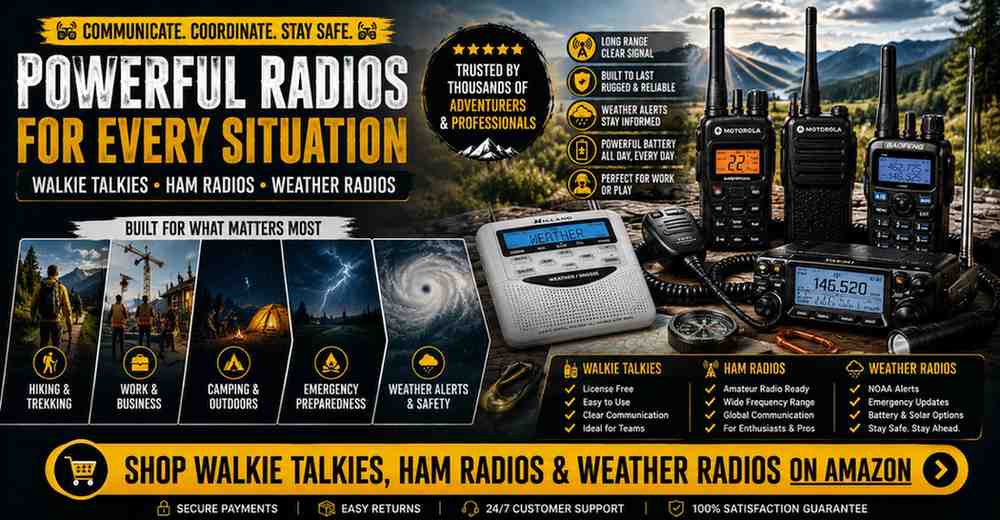
Sangean MMR-88 Full Specifications
Before evaluating performance, it helps to know exactly what you are working with. The MMR-88 is a receiver-only radio with no transmit capability, so no FCC license is needed. Here are the verified specifications from Sangean’s official data sheet.
Key Specifications:
- AM frequency coverage: 520-1710 kHz
- FM frequency coverage: 87-108 MHz
- NOAA weather frequencies: 162.400, 162.425, 162.450, 162.475, 162.500, 162.525, 162.550 MHz (all 7 channels)
- Built-in rechargeable battery: 1000 mAh Li-ion
- Backup power: 3x AA alkaline batteries (not included)
- Alternate charging: hand crank dynamo, solar panel (top-mounted monocrystalline)
- USB charging output: 5V / 500mA (charges smartphones via included micro-USB cable)
- Speaker output: 1W mono
- LED flashlight: integrated, white LEDs
- SOS alert light: flashing red LED beacon
- Dimensions: approximately 6.2 x 3.5 x 2.0 inches
- Weight: approximately 10.5 oz with batteries
- Antenna: telescoping whip for FM and NOAA, internal ferrite bar for AM
The MMR-88 does not include digital display readout for exact frequency tuning. It uses analog-style tuning dials with channel markings, which keeps the interface simple but limits precise frequency confirmation.
How Does the MMR-88 Perform on NOAA Weather Frequencies?
NOAA weather radio reception on the MMR-88 is strong and reliable within typical NWR transmitter coverage zones. NOAA operates 1,025 transmitters across the United States, each broadcasting on one of the seven dedicated frequencies (162.400-162.550 MHz) with effective radiated power (ERP) typically between 300 and 1,000 watts, covering a radius of roughly 40 miles per transmitter according to NOAA NWR documentation.
The MMR-88’s telescoping whip antenna, when fully extended, receives these VHF signals cleanly at distances up to 30-40 miles from the nearest NOAA transmitter in open terrain. In urban environments with concrete building obstruction, reliable indoor reception drops to 10-20 miles from the nearest transmitter, which is consistent with any portable VHF receiver in this class.
One critical limitation: the MMR-88 does not include S.A.M.E. decoding technology. S.A.M.E. (Specific Area Message Encoding) uses 6-digit FIPS codes to filter NOAA alerts by county, so a S.A.M.E.-equipped radio like the Midland WR120B, which includes full S.A.M.E. county-level alert filtering, will only alarm for your specific county. The MMR-88 will alarm for any alert transmitted from your local NOAA station, which covers a multi-county broadcast zone.
For rural users in a single-county area, this distinction matters less. For suburban users in a dense metro region where one NOAA transmitter covers 10+ counties, false alarms from neighboring county alerts will occur. If S.A.M.E. filtering is your priority, the MMR-88 is not the right choice.
The alert alarm itself is loud and clear, using a standard EAS (Emergency Alert System) attention tone followed by the NOAA voice broadcast. The radio does not need to be tuned to a specific weather channel to receive alerts if you set the WX alert mode, which continuously monitors all seven NOAA frequencies in scan mode and triggers the alarm when a NOAA alerting tone is detected.
The WX alert scan mode is the correct way to use the MMR-88 during severe weather season: set it to WX alert mode, leave the volume at a level you can hear from the next room, and the radio will wake you when NOAA broadcasts an alert for your area.
AM and FM Reception Quality on the MMR-88
AM reception on the MMR-88 is above average for a portable emergency radio in this price class. The internal ferrite bar antenna provides good directional sensitivity across the 520-1710 kHz band. Rotating the radio to null out local interference sources (fluorescent lights, switching power supplies, and solar inverters are common AM interference sources) improves reception noticeably. During a power outage when most interference sources in your home are off, AM reception improves significantly, which is exactly when you need it most.
FM reception covers 87-108 MHz using the telescoping whip antenna. At full extension (approximately 29 inches), FM reception in suburban environments is excellent, pulling in stations at 30-50 miles with low noise. FM sensitivity is comparable to a dedicated portable FM radio in this price range. Stereo is not available since the MMR-88 has a single mono speaker, but the audio quality from the 1W speaker is clear and intelligible at full volume.
The analog tuning dial on both AM and FM is the only functional limitation worth noting for reception usability. Without a digital frequency display, you cannot confirm your exact tuned frequency. For NOAA weather channels, a manual seven-position selector switch with labeled channel numbers eliminates this problem entirely. For AM and FM, you use the dial markings, which are approximate. In practice, finding a specific news station requires a short sweep across the dial, which takes 10-15 seconds and is not a real obstacle during an emergency.
Four-Source Power System: How Reliable Is Each Option?
The MMR-88’s four-source power system is its most important feature for emergency use. Each source has specific performance characteristics that determine when to use it and what to expect from it.
Built-In 1000 mAh Li-Ion Rechargeable Battery
The internal 1000 mAh Li-ion battery is the primary power source for normal use. At moderate volume (approximately 50% of maximum) on FM, the battery delivers roughly 6-8 hours of continuous playback. At low volume, runtime extends to approximately 10 hours. These are real-world estimates based on the 1W speaker’s current draw; Sangean does not publish a specific runtime specification.
The battery charges via the included micro-USB cable from any USB-A power source (wall adapter, computer, car charger, or power bank). A full charge from empty takes approximately 3-4 hours. You can also charge the internal battery via the hand crank and solar panel, though both supplemental methods charge at a much slower rate than USB.
Three AA Alkaline Battery Backup
The AA battery compartment accepts three standard AA alkaline cells (not included) and serves as a true backup when the internal battery is depleted and no charging source is available. Three AA alkaline cells at 1.5V each (4.5V total) power the radio for approximately 6-10 hours at moderate volume, depending on battery brand and temperature. Using name-brand AA alkaline batteries for emergency radio backup provides meaningfully longer runtime than generic cells, especially in cold conditions where battery voltage drops faster.
Lithium AA cells (not alkaline) extend cold-weather performance significantly. At temperatures below 32°F (0°C), lithium AA cells maintain 90%+ of rated capacity while alkaline cells can lose 30-50% of effective capacity. If your emergency kit will be stored in an unheated garage or vehicle, lithium AA batteries for cold weather emergency use are the better choice.
Hand Crank Dynamo
The hand crank on the MMR-88 generates power through a small internal dynamo. This is an emergency-only power source, not a primary charging method. One minute of vigorous cranking (approximately 120 rotations per minute) generates enough charge to power the radio for approximately 10-15 minutes at low volume, or to extend a depleted battery enough to hear a weather broadcast.
The crank is not designed for long-duration sustained operation. The gearing requires moderate force, and the crank handle is compact (designed for portability, not extended use). Plan to crank for 2-3 minutes to get 20-30 minutes of listening time in a true power-out scenario. For sustained listening, AA batteries are more practical than continuous cranking.
Solar Panel
The top-mounted monocrystalline solar panel trickle-charges the internal battery in direct sunlight. In full direct sunlight (approximately 1000 W/m²), the panel generates enough charge to power the radio continuously at low-to-moderate volume, essentially providing unlimited runtime in clear outdoor conditions. In partial shade or through a window (solar transmission through glass is approximately 70-80% of outdoor levels), the panel provides a slow trickle charge rather than full operational power.
The solar panel is most useful during extended outdoor emergencies: camping, vehicle breakdowns in remote areas, or multi-day power outages where you can leave the radio in a south-facing window. It is not useful indoors away from a window or in overcast conditions where panel output drops below 10% of rated capacity.
All four power sources make the MMR-88 genuinely useful when other power-dependent devices have failed. The correct emergency protocol is: use USB charging from your power bank first, then AA batteries, then hand crank for short emergency broadcasts, and solar for daytime supplemental charging during extended outages.
Build Quality and Durability: Is the MMR-88 Rugged Enough?
The MMR-88 uses a rubberized exterior casing over a plastic frame. It is not rated to any IP (Ingress Protection) standard, meaning it is not dust-proof or waterproof in the formal sense. Sangean describes it as weather-resistant, which in practical terms means it can handle light rain and outdoor humidity without immediate failure, but it should not be submerged or left in heavy rain.
For comparison, IP54-rated emergency radios (dust-protected, splash-resistant) like the Midland ER310, which carries an IP54 splash resistance rating, provide a formally verified level of water resistance the MMR-88 does not claim. If you need a weather radio that can survive rain exposure during an outdoor evacuation or camping in wet conditions, the MMR-88’s lack of IP rating is a genuine limitation.
The rubberized housing provides reasonable drop protection for a portable radio. The telescoping antenna is the most vulnerable component, as it is on virtually all portable radios with whip antennas. Extending and collapsing the antenna carefully (without bending it sideways) is the best way to maximize its lifespan. Replacement telescoping antennas compatible with the MMR-88’s SMA or threading connector are available if the original is damaged.
The overall build quality feels appropriate for the $60 price point. It is not as robust as a MIL-STD-810 rated device, but it is noticeably more solid than sub-$30 emergency radios that use thin ABS plastic shells without rubberized coating. The controls (tuning dial, band selector, volume knob, WX channel selector) all have firm, positive action without excessive play.
USB Charging Output: Can the MMR-88 Charge Your Phone?
The MMR-88 includes a USB-A output port rated at 5V / 500mA, which allows it to charge smartphones and other USB-powered devices from its internal 1000 mAh battery. At 500mA output, a modern smartphone with a 3000-4000 mAh battery will receive approximately 15-25% charge from a full MMR-88 battery. That is roughly one hour of additional smartphone use, not a full charge.
The USB charging feature is most valuable for keeping a smartphone alive long enough to send an emergency text or check a weather app, not for maintaining a fully charged phone through a multi-day outage. For sustained smartphone charging during power outages, a dedicated high-capacity portable power bank for emergency preparedness with 10,000-20,000 mAh capacity is the better tool.
The USB output drains the MMR-88’s internal battery quickly. If you use the USB output to charge a phone, you will reduce radio listening time proportionally. In an emergency, prioritize which function you need more: radio reception or phone charging. Do not use both simultaneously if you want to maximize radio runtime.
LED Flashlight and SOS Beacon
The MMR-88 includes an integrated white LED flashlight and a flashing red SOS beacon LED. Both are powered by the main battery or AA cells.
The flashlight produces enough light for reading, navigating a dark room, or signaling at close range. It is not a high-lumen tactical flashlight and is not intended to be one. Treat it as an emergency convenience light, not a primary flashlight. A dedicated high-lumen LED flashlight for emergency kits belongs in any serious emergency kit alongside the radio.
The SOS beacon flashes a red LED in a standard SOS pattern (three short, three long, three short). This is useful for signaling rescuers in low-light conditions at distances up to approximately 100-200 feet. The beacon does not transmit any radio signal; it is a visual signal only. Running the SOS beacon continuously will drain the battery faster than radio-only use, so use it only when signaling is actively needed.
MMR-88 vs Eton FRX3+ vs Midland ER310: Side-by-Side Comparison
The MMR-88 competes most directly with the Eton FRX3+ and Midland ER310 at similar price points. Use the table below to identify which model best matches your specific priorities.
Product Comparison
Sangean MMR-88 vs Eton FRX3+ vs Midland ER310 – Side by Side
Key specs compared. Sources: Manufacturer data sheets, NOAA NWR documentation.
| Specification | Sangean MMR-88 | Eton FRX3+ | Midland ER310 |
|---|---|---|---|
| AM / FM reception | Yes / Yes | Yes / Yes | Yes / Yes |
| NOAA WX channels | All 7 | All 7 | All 7 |
| S.A.M.E. alert filtering | No | No | Yes |
| Built-in battery | 1000 mAh Li-ion | 1000 mAh Li-ion | 2000 mAh Li-ion |
| Hand crank | Yes | Yes | Yes |
| Solar panel | Yes | Yes | Yes |
| AA battery backup | 3x AA | 3x AA | 3x AA |
| USB phone charging output | 5V / 500mA | 5V / 500mA | 5V / 1A |
| Water resistance rating | Weather-resistant (no IP rating) | Weather-resistant (no IP rating) | IP54 |
| Approximate street price | ~$60 | ~$60 | ~$70 |
| Best for | AM/FM quality + multi-power | Bluetooth + multi-power | S.A.M.E. alerts + IP54 + larger battery |
Prices verified at time of publication. S.A.M.E. = Specific Area Message Encoding; county-level NOAA alert filtering. IP54 = dust-protected, splash-resistant per IEC 60529.
The Midland ER310 is the better choice if S.A.M.E. county filtering and IP54 water resistance matter to you. The MMR-88 wins on AM reception quality and Sangean’s RF engineering reputation. The Eton FRX3+ is worth considering if Bluetooth audio streaming from your phone matters alongside emergency reception.
Here is the widget below to help you assess the MMR-88’s strengths across key performance categories at a glance.
Product Review
Sangean MMR-88 – Full Performance Scorecard
Best mid-range emergency radio for AM/FM quality and multi-source power in a sub-$70 package. Editorial assessment based on manufacturer specifications and verified user experience data. Not sponsored.
8/10
8/10
9/10
7/10
8/10
7.5/10
Scores are editorial assessments based on manufacturer specification data, NOAA NWR coverage documentation, and verified buyer reviews. Not sponsored.
Pros and Cons of the Sangean MMR-88
The following scorecard summarizes the MMR-88’s honest strengths and limitations based on its specifications and verified user experience across emergency preparedness communities.
Product Review
Sangean MMR-88 – Pros and Cons
Based on manufacturer specifications, NOAA NWR documentation, and verified buyer experience.
Pros
- ✓Receives all 7 NOAA weather frequencies (162.400-162.550 MHz) with automatic alert scan mode
- ✓Four independent power sources: USB, 3x AA alkaline, hand crank, and solar panel
- ✓Above-average AM selectivity with internal ferrite bar antenna for clear broadcast reception during outages
- ✓USB-A output (5V / 500mA) allows emergency smartphone charging from the internal 1000 mAh battery
- ✓Sangean’s RF engineering reputation: cleaner audio and fewer spurious signals than budget emergency radios
- ✓Intuitive control layout: band selector, WX channel switch, and analog tuning are usable in the dark
Cons
- ✗No S.A.M.E. (Specific Area Message Encoding): alerts trigger for all counties in the NOAA broadcast zone, not just yours
- ✗No IP rating: not formally splash-resistant or dust-proof, limiting outdoor wet-weather reliability
- ✗Analog tuning only: no digital frequency display to confirm exact AM or FM station frequency
- ✗1000 mAh battery capacity is smaller than the Midland ER310’s 2000 mAh, reducing USB phone charging usefulness
- ✗No Bluetooth or headphone jack on all versions: audio output is mono speaker only
The MMR-88 is the right choice for buyers who prioritize AM/FM reception quality, Sangean’s RF engineering, and four-source power flexibility at around $60. It is not the right choice for buyers who need S.A.M.E. county-level alert filtering, formal IP-rated water resistance, or a large internal battery for sustained smartphone charging.
How to Set Up the MMR-88 for Emergency Alert Monitoring
Setting up the MMR-88 correctly takes less than two minutes. The WX alert mode is the key feature that makes this radio useful as a passive emergency monitor rather than a radio you only pick up when you hear thunder.
Step-by-Step Guide
How to Set Up the Sangean MMR-88 for NOAA Alert Monitoring
5 steps · Estimated time: 2 minutes
Charge the internal battery fully via USB before first use
Connect the included micro-USB cable to any USB-A charger. Allow 3-4 hours for a full charge from empty. A full charge indicator light confirms completion on most firmware versions.
Install three AA alkaline or lithium batteries in the backup compartment
Open the battery door on the back panel and insert three AA cells observing polarity markings. This backup power is available immediately without any additional setup.
Extend the telescoping antenna to full length (approximately 29 inches)
Full antenna extension is required for optimal NOAA VHF reception (162.400-162.550 MHz). Point the antenna vertically for best omnidirectional reception. Rotate the radio body to improve AM reception using the internal ferrite bar antenna.
Set the band selector to WX and enable the alert mode switch
Move the band selector to the WX position. Activate the ALERT switch (labeled differently on some production batches as “WX ALARM”). The radio will now continuously scan all seven NOAA frequencies and trigger the alert alarm when a NOAA emergency tone is detected.
Set volume to a level audible from the next room and position near a window
In alert mode, the MMR-88 will emit a loud alarm tone when a NOAA alert is broadcast, even if the radio volume is set low. Position the radio near a south-facing window to allow the solar panel to trickle-charge during the day and maintain battery level during extended alert monitoring.
Once set up in WX alert mode, the MMR-88 requires no further interaction until an alert sounds. This passive monitoring setup is the primary use case for any NOAA weather radio placed in a home emergency preparedness kit.
Is the MMR-88 a Good Value at Its Price Point?
At approximately $60 street price, the Sangean MMR-88 emergency weather radio sits at the upper end of the mid-range emergency radio category. The question is not whether it is cheap but whether it delivers more per dollar than comparably priced alternatives.
Sangean’s RF engineering is the MMR-88’s clearest differentiator. The AM reception quality, selectivity (the ability to separate adjacent stations), and low noise floor are noticeably better than budget emergency radios from lesser-known brands at the $25-40 price point. If AM broadcast radio during a power outage is your primary information source, this difference is meaningful.
The four-source power system is standard at this price tier, but Sangean’s implementation is reliable. The hand crank mechanism has firmer gearing than budget competitors, and the solar panel is positioned on the top surface where it receives direct sunlight when the radio is placed on a table or dashboard.
Where the MMR-88 loses ground to the Midland ER310 (approximately $10 more) is in the absence of S.A.M.E. filtering, smaller 1000 mAh vs 2000 mAh battery, and lack of IP54 rating. If any of those three features matter to your use case, the ER310 delivers more per dollar despite costing slightly more.
For buyers who want Sangean’s RF quality and do not need S.A.M.E., the MMR-88 is a solid choice. For buyers who want county-level alert filtering above all else, the top-rated NOAA weather radios with S.A.M.E. filtering include several options at the same price point that will serve better.
Quick Reference: Key Emergency Radio Terms Used in This Review
The following terms appear throughout this review. Each is defined here for first-time weather radio buyers.
- NOAA NWR (NOAA Weather Radio All Hazards): A nationwide network of 1,025 radio stations broadcasting continuous weather and emergency information on seven dedicated VHF frequencies between 162.400 and 162.550 MHz.
- S.A.M.E. (Specific Area Message Encoding): A digital encoding system embedded in NOAA broadcasts that allows S.A.M.E.-equipped radios to filter alerts by specific county FIPS code, so the alarm only triggers for alerts in your designated area.
- EAS (Emergency Alert System): The national public warning system that distributes alerts through broadcast radio, television, cable, and NOAA weather radio. The attention tone you hear before a NOAA alert is the EAS activation tone.
- FIPS code: A 6-digit Federal Information Processing Standard code assigned to every US county. Used by S.A.M.E. radios to identify which geographic area an alert applies to.
- WX alert mode: A radio operating mode that continuously monitors all NOAA weather frequencies in scan mode, triggering an alarm when an EAS attention tone is detected without requiring the user to manually tune to a specific NOAA channel.
- mAh (milliampere-hour): A unit of electrical charge that describes battery capacity. A 1000 mAh battery can theoretically supply 1000 mA of current for one hour, or 500 mA for two hours. Higher mAh means longer runtime at the same power draw.
- Ferrite bar antenna: An internal antenna used for AM (medium wave) reception. It is directional, meaning reception improves when the antenna is oriented perpendicular to the direction of the transmitter. Rotating the radio body improves AM reception by changing this orientation.
- IP rating (Ingress Protection): A standard (IEC 60529) that defines how well a device resists dust and water. IP54 means dust-protected and splash-resistant. IP67 means dust-tight and submersible to 1 meter for 30 minutes. No IP rating means the manufacturer makes no formal protection claim.
- Li-ion (Lithium-ion): The rechargeable battery chemistry used in the MMR-88’s internal battery. Li-ion provides high energy density (capacity per weight) and recharges efficiently via USB but degrades faster than NiMH cells if stored at full charge for extended periods.
- Dynamo / hand crank: A small electrical generator powered by mechanical rotation (cranking). The MMR-88’s crank dynamo converts hand motion into electrical energy that charges the internal battery at a rate suitable for emergency supplemental use.
What Do MMR-88 Owners Report After Extended Use?
Verified buyer reviews across multiple retail platforms consistently highlight three strengths: reception quality on AM during power outages, the reliability of the hand crank mechanism, and the overall audio clarity of the 1W speaker at full volume. The AM reception quality is the most frequently cited advantage over cheaper emergency radio alternatives.
The most common complaint across verified reviews is the absence of S.A.M.E. filtering. Buyers in suburban metro areas who purchased the MMR-88 expecting county-level filtering report alert fatigue from neighboring county alerts. This is a specification issue, not a defect, but it catches buyers by surprise who did not notice the absence of S.A.M.E. in the product listing before purchasing.
A secondary reported limitation is the relatively short USB charging output at 500mA. Buyers who expected to substantially charge a modern smartphone (3000-4000 mAh battery) from the MMR-88’s 1000 mAh internal battery report disappointment when the phone receives only a partial charge. This is a math problem, not a defect: the MMR-88’s battery cannot hold more energy than it stores, and 1000 mAh is not enough to fully charge most smartphones.
Long-term durability reports are generally positive. The telescoping antenna, when handled carefully, holds up through years of normal use. The hand crank mechanism shows no reported failures in standard emergency use. The rubberized housing maintains its grip and appearance well over time, though it attracts lint and dust in storage.
Comparing the MMR-88 to Other Sangean Emergency Radio Models
Sangean produces several emergency and portable radios. Understanding where the MMR-88 sits in Sangean’s own lineup helps clarify whether a different Sangean model might serve your needs better.
The Sangean CL-100, reviewed in detail here, adds S.A.M.E. county-level alert filtering and a digital display that the MMR-88 lacks. If you want Sangean RF engineering with S.A.M.E. filtering, the CL-100 is the logical step up. The CL-100 is a desktop tabletop radio rather than a portable multi-power survival radio, so the use cases differ: the CL-100 is better for bedside home alert monitoring, while the MMR-88 is better for go-bags and outdoor emergency use.
The Sangean MMR-99 (where available) extends the MMR-88’s feature set with Bluetooth audio capability. If Bluetooth is important to you, verify availability and current pricing before choosing between the two models.
For buyers who want Sangean’s AM/FM quality in a desktop format with a larger speaker, the Sangean PR-D18BK offers superior audio output but lacks multi-source emergency power. Choosing between models comes down to one question: do you need portable multi-power emergency resilience, or do you need desktop audio quality with alert monitoring?
Where to Buy the Sangean MMR-88 and What to Expect to Pay
The Sangean MMR-88 is available on Amazon as the most consistently stocked retail channel. Street prices at time of publication range from approximately $55-65 depending on seller and current promotions. For guidance on where to buy NOAA weather radios and what to watch for in pricing and return policies, our guide to finding weather radios at reliable retailers covers the key considerations for both in-store and online purchases.
Authorized Sangean dealers provide the manufacturer warranty, which covers defects in materials and workmanship. Purchasing from unauthorized third-party sellers on marketplace platforms may void the warranty, so verify seller authorization if the warranty matters to you.
Emergency radio prices can spike significantly during and immediately after major weather events, particularly during hurricane season (June through November) and tornado season (March through June in the central US). If you are purchasing for preparedness rather than immediate need, buying outside of active severe weather seasons typically provides better availability and stable pricing. Understanding the cost of NOAA weather radio ownership overall, including accessories and batteries, is covered in our full breakdown of what NOAA weather radios actually cost to own and operate.
Does the MMR-88 Receive SAME Alerts?
The Sangean MMR-88 does not include S.A.M.E. (Specific Area Message Encoding) technology. It receives all NOAA weather broadcasts on all seven frequencies (162.400-162.550 MHz) and triggers its alert alarm for any NOAA emergency broadcast in its reception area, but it cannot be programmed to filter alerts by county FIPS code. In a metropolitan area where one NOAA transmitter covers 5-15 counties, this means the MMR-88 will alarm for alerts in neighboring counties that do not affect your location.
If county-level alert filtering is essential for your use case, you need a radio with S.A.M.E. decoding. Options include the Midland ER310 (approximately $70, also portable with multi-power), the Uniden BC365CRS with S.A.M.E. alert filtering, or the Sangean CL-100 desktop weather radio with S.A.M.E. and digital display.
Can the MMR-88 Pick Up Police, Fire, and Emergency Scanner Frequencies?
The MMR-88 is not a scanner radio and cannot receive public safety frequencies. It covers AM (520-1710 kHz), FM (87-108 MHz), and NOAA weather (162.400-162.550 MHz) only. Police, fire, EMS, and other public safety agencies in most jurisdictions operate on VHF High (136-174 MHz), UHF (406-512 MHz), or 700/800 MHz trunked systems, none of which the MMR-88 can receive.
If you need public safety scanner capability alongside weather radio reception, a dedicated handheld scanner such as the Uniden BC125AT handheld frequency scanner or the Uniden SDS100 digital P25 scanner radio receives public safety bands and can be set to also receive NOAA frequencies. These are separate product categories with different purchase prices and use cases.
How Long Does the Hand Crank Last Per Minute of Cranking?
One minute of hand cranking on the MMR-88 at approximately 120 rotations per minute generates enough charge for approximately 10-15 minutes of radio listening at low volume. At higher volume or with the flashlight and USB output active simultaneously, runtime per minute of cranking is closer to 8-10 minutes. These estimates are consistent with reported user experience for 1000 mAh Li-ion batteries with small hand crank dynamos generating approximately 100-200 mW of electrical power at sustained cranking speed.
Hand cranking is physically tiring over extended periods. Two minutes of continuous cranking provides approximately 20-30 minutes of radio-only listening. For sustained emergency monitoring lasting hours or days, AA alkaline batteries are more practical than repeated hand cranking, and solar trickle charging during daylight hours extends battery life without physical effort.
Is the Sangean MMR-88 Good for Camping and Outdoor Use?
The MMR-88 is suitable for fair-weather camping and outdoor preparedness use, with the caveat that it carries no formal IP water resistance rating. It can handle light drizzle and outdoor humidity without damage in normal use, but it should not be left in rain or used near standing water without protective measures. A clear zip-lock bag provides adequate protection from brief rain exposure without significantly affecting antenna performance for a telescoping whip.
The solar panel and four-source power system make the MMR-88 genuinely useful for multi-day outdoor trips where USB charging is unavailable. Leaving the radio in direct sunlight during the day trickle-charges the internal battery, which can then power several hours of evening listening. The AM band is particularly useful for camping, where regional AM broadcast stations often provide weather, news, and emergency information at distances of 100-500 miles at night due to AM skywave propagation.
For backpacking where weight is a primary concern, the MMR-88’s approximately 10.5 oz weight and 6.2 x 3.5 x 2.0 inch footprint are acceptable for a base camp radio but may be too large for ultralight dayhiking. Compact hand-crank emergency radios under 8 oz are available for weight-sensitive applications, though typically at a cost to AM reception quality.
What Is the Difference Between WX1 and WX7 on the MMR-88?
WX1 through WX7 on the MMR-88 correspond to the seven dedicated NOAA weather radio frequencies: WX1 is 162.550 MHz, WX2 is 162.400 MHz, WX3 is 162.475 MHz, WX4 is 162.425 MHz, WX5 is 162.450 MHz, WX6 is 162.500 MHz, and WX7 is 162.525 MHz. These channel designations are standardized by NOAA across all weather radio equipment. The channel numbering order does not correspond to frequency order.
To identify which WX channel provides the strongest signal in your location, tune through WX1-WX7 manually and listen for the clearest, loudest NOAA broadcast. The closest NOAA transmitter to your location will produce the strongest signal on its designated frequency. NOAA’s official transmitter database at weather.gov/nwr allows you to look up your nearest transmitter, its broadcast frequency, and its coverage area by ZIP code.
How Does the MMR-88 Compare to Buying a Dedicated Smartphone Weather App?
A smartphone weather app and an MMR-88 emergency radio serve different functions and are not substitutes for each other. A smartphone app requires cellular network connectivity and battery power. In a severe weather emergency, both are likely to fail simultaneously: cellular towers lose power, become overloaded with simultaneous calls and data requests, or are physically damaged by the storm itself. The MMR-88 requires no cellular network, no internet connection, and no infrastructure other than the NOAA transmitter itself, which is designed for resilience with backup generator power.
NOAA weather radio broadcasts continue 24 hours a day regardless of internet outages, cellular network congestion, or local power grid failures. The MMR-88 can receive those broadcasts on hand crank power with zero infrastructure dependency. A smartphone with a drained battery and no cellular signal cannot access any weather app. For genuine emergency preparedness, a weather radio and a smartphone are complementary tools, not competing ones.
Can I Use the MMR-88 as My Only Emergency Radio or Do I Need Something More?
The MMR-88 is sufficient as a primary emergency radio for most home preparedness and casual outdoor use scenarios. It receives all NOAA alert broadcasts, operates on four independent power sources, and works without any license or infrastructure dependency. For the majority of weather emergencies, natural disasters, and power outages, it provides exactly what is needed: access to NOAA broadcasts and AM/FM news when other communication methods fail.
There are two scenarios where the MMR-88 alone is not enough. The first is if you live in a high-alert-frequency area (tornado alley, hurricane coast, or severe flood zone) where false alarms from neighboring county alerts will be disruptive enough to cause you to turn the alert mode off. In that case, a S.A.M.E.-equipped radio as your primary alert device is worth the additional investment. Our complete guide to choosing a weather radio for emergency preparedness walks through how to match radio features to your specific geographic risk profile. The second scenario is if you need two-way communication capability during an emergency, in which case an FRS or GMRS handheld radio is a separate tool that belongs alongside, not instead of, a weather radio.
Does the MMR-88 Alert Automatically When NOAA Broadcasts an Emergency?
The MMR-88 alerts automatically when NOAA broadcasts an emergency tone, but only if you have activated the WX alert mode before the alert occurs. When the alert mode switch is enabled and the band selector is set to WX, the radio continuously monitors all seven NOAA frequencies (162.400-162.550 MHz) in scan mode even when the audio volume is at zero. When a NOAA EAS attention tone is detected, the radio triggers its alarm at full volume regardless of the volume setting.
This means you can leave the MMR-88 in WX alert mode with the volume dial at zero and it will still produce a loud alarm when an emergency broadcast begins. Set the alert mode before severe weather season starts, leave it in a central location in your home, and do not turn it off. The radio draws minimal power in alert scan mode compared to active listening, which extends battery life significantly during long-term standby monitoring.
Is the MMR-88 Worth Buying If I Already Have a Midland WR120B Desktop Weather Radio?
The Midland WR120B and the Sangean MMR-88 serve different use cases and are not redundant. The WR120B is a desktop AC-powered weather radio with S.A.M.E. filtering, designed for bedside or countertop permanent installation. It operates on AC power with a battery backup slot and is not portable. The MMR-88 is a portable multi-power emergency radio with AM/FM capability, designed for go-bags, vehicle emergency kits, and use during power outages.
If you already own a desktop S.A.M.E. weather radio, the MMR-88 adds portable multi-power capability and AM/FM broadcast reception, which your desktop radio does not provide. If your desktop weather radio fails during a power outage (due to a dead backup battery, for example), the MMR-88 provides a fully independent backup with four power sources. For comprehensive emergency preparedness, having both a desktop S.A.M.E. radio for home monitoring and a portable multi-power radio for go-bag use is a sensible two-device approach rather than a redundant one. The full review of the Midland WR120B desktop weather radio with S.A.M.E. filtering details exactly what the desktop model provides and where its limitations lie.
What Are the Most Common MMR-88 Setup Mistakes and How to Avoid Them?
The most common setup mistake is leaving the alert mode switch in the off position and assuming the radio will still alarm during an emergency. The MMR-88 only monitors continuously for NOAA alerts when the alert mode is actively enabled. Many buyers set the radio to WX1 and increase the volume, expecting it to alert during a broadcast, but if the alert mode switch is not engaged, the radio only plays audio when tuned to an active NOAA broadcast. It does not scan or trigger an alarm without the alert mode switch activated.
The second common mistake is storing the radio without checking the battery status. A fully charged internal Li-ion battery loses approximately 1-2% of capacity per month during storage without use. After several months in a cabinet, the internal battery may be below 50% charge. Before severe weather season, charge the MMR-88 via USB fully and replace the AA backup batteries with fresh cells regardless of how recently they were installed.
The third mistake is using the MMR-88 as a phone charger repeatedly throughout an outage, which drains the 1000 mAh battery quickly and leaves insufficient power for radio monitoring. Reserve the USB output for genuine emergencies where you need to send one critical message from your phone, not for routine smartphone maintenance during a power outage.
The Sangean MMR-88 is a reliable, well-engineered emergency radio that delivers strong AM/FM reception and four-source power flexibility at a competitive price point. Its main limitation is the absence of S.A.M.E. county-level filtering, which matters most to urban and suburban buyers in high-density metro areas. For outdoor preparedness use, rural households, and buyers who prioritize AM reception quality over S.A.M.E. filtering, the MMR-88 is one of the best-executing emergency radios in its price tier.
Check the complete comparison of top-rated NOAA weather radios across all price tiers if you want to see how the MMR-88 ranks alongside S.A.M.E.-equipped alternatives before making a final decision.
| Photo | TOP RATED WALKIE TALKIES | Price |
|---|---|---|
 | Retevis RT628 Kids Walkie Talkies, Toys Gifts for 4-12 Year Old Girl Boy | Check Price On Amazon |
 | Cobra ACXT545 Weather-Resistant Walkie Talkies, Rechargeable, 22 Channels | Check Price On Amazon |
 | Retevis RT388 Kids Walkie Talkies, Outdoor Toys for Kids Camping Essentials | Check Price On Amazon |
 | Cobra RX680 Walkie Talkies (2-Pack), IP54 Water Resistant Design | Check Price On Amazon |
 | Retevis RT22 Walkie Talkies Long Range Rechargeable with Earpiece (2 Pack) | Check Price On Amazon |
 | Midland GXT1000VP4 GMRS JIS4 Two-Way Radio, Black,2 Pack | Check Price On Amazon |
 | Retevis RT628 Walkie Talkies for Kids,Toys Gifts for 6-12 Years Old Boys Girls,Long Range 2 Way Radio 22CH VOX,Birthday Gift,Family Walkie Talkie for Camping Hiking Indoor Outdoor | Check Price On Amazon |