The Sangean CL-100 costs roughly twice what a basic NOAA weather radio sells for at a big-box store. That price difference either buys you something genuinely useful or it does not. After going through every feature on this unit, the answer is more nuanced than the marketing suggests.
The CL-100 is a tabletop AM/FM/NOAA weather radio with S.A.M.E. (Specific Area Message Encoding) alert filtering, a digital display, and a build quality that feels noticeably more solid than the $25 alternatives. It receives all seven NOAA weather broadcast frequencies (162.400 to 162.550 MHz) and lets you program up to 25 S.A.M.E. location codes so alerts wake you only for your county, not the entire state.
| Photo | Popular Portable Walkie Talkies | Price |
|---|---|---|
 | SKIWARRIOR Multifunctional Smart Wireless Ski Goggles with Walkie-Talkie, Anti-Fog Zeiss Lens, Music & Call Function (Cylindrical Blue) | Check Price On Amazon |
 | SINORISE Super Mini Walkie Talkies, Portable Two-Way Radios for Restaurants, Outdoor Sports, Retail Stores, Hospital & Travel – 3 Pack | Check Price On Amazon |
 | KOSPET Tank M4C Outdoor Smart Watch with GPS, 1.96" AMOLED Display, Built-in LED Flashlight & Walkie-Talkie, Long Battery Life, 50m Waterproof, Bluetooth Calls, 24/7 Heart Rate/Sleep Monitor | Check Price On Amazon |
 | Retevis RT15 Walkie Talkies, Portable FRS Two Way Radios Rechargeable, Durable, Compact, VOX, Key Lock, Mini Walkie Talkies for Adults and Kids, School Family Outdoor Travel Camping Hiking (3 Pack) | Check Price On Amazon |
 | Rechargeable Walkie Talkies Toys for Kids: DIY Astronaut Walkie Talkies for Boys Christmas Birthday Gifts for 3 4 5 6 7 8 9 10 Boy Walkie Talkie Outdoor Hiking Toy 2 Way Radio Camping Outdoor Game | Check Price On Amazon |
By the Numbers
Sangean CL-100 – Key Specifications and Standards
Sources: Sangean manufacturer data sheet, NOAA National Weather Service NWR documentation, FCC Part 11 EAS rules.
What Is the Sangean CL-100 and Who Is It Built For?
The Sangean CL-100 is a tabletop home weather radio that receives AM (520 to 1710 kHz), FM (87.5 to 108 MHz), and all seven NOAA weather frequencies between 162.400 and 162.550 MHz. It is designed for permanent placement in a bedroom, kitchen, or home office where it functions as both an everyday radio and a 24-hour emergency alert receiver.
Sangean is a Taiwanese audio electronics manufacturer that has produced consumer and professional radio receivers since the early 1970s. The brand holds a reputation in the radio enthusiast community for above-average build quality and tuner sensitivity compared to mass-market alternatives at similar price points.
The CL-100 targets a specific buyer: someone who wants a reliable weather alert radio that does not look like emergency equipment. It fits on a nightstand or kitchen counter without drawing attention to itself. That design priority shapes several of the trade-offs discussed throughout this review.
It is not a portable or emergency-kit radio. There is no hand-crank generator, no solar panel, and no built-in flashlight. If you need a go-bag weather radio, the Eton FRX3+ with hand-crank and solar charging is a better fit for that use case.
Sangean CL-100 Full Specifications
Before discussing performance, here are the confirmed hardware specifications from the Sangean product documentation.
Key Specifications:
- AM frequency range: 520 to 1710 kHz
- FM frequency range: 87.5 to 108 MHz
- NOAA weather frequencies: 162.400, 162.425, 162.450, 162.475, 162.500, 162.525, 162.550 MHz
- S.A.M.E. programmable location codes: 25
- Alert memory: stores last alert received
- Display: digital LCD with backlight
- Power: AC adapter (included) with 3x AA battery backup
- Speaker output: 1W internal speaker
- Dimensions: approximately 7.5 x 4.5 x 2.8 inches
- Alert types: all NOAA Weather Radio All Hazards event codes, including Tornado Warning, Flash Flood Warning, Hurricane Warning, Severe Thunderstorm Warning, Winter Storm Warning, Civil Emergency, AMBER Alert, and others
The 3x AA battery backup is a critical practical feature. When AC power fails during a severe storm, the radio continues operating and sounding alerts without any intervention from the user.
How Does S.A.M.E. Alert Filtering Work on the CL-100?
S.A.M.E. technology (Specific Area Message Encoding) lets the CL-100 decode digital header data embedded in each NOAA weather broadcast and trigger an audible alarm only when the alert covers a geographic area you have pre-programmed. Without S.A.M.E. filtering, the radio sounds an alarm for every alert issued within range of the NOAA transmitter, which can cover multiple states.
Each geographic location in the United States has a unique 6-digit FIPS (Federal Information Processing Standard) S.A.M.E. code. Your county code is different from adjacent counties. You enter up to 25 of these codes into the CL-100 so it monitors for alerts affecting only those specific locations.
This happens because the NOAA transmitter broadcasts a digital burst of data before each voice alert. That data burst contains the S.A.M.E. code for every county or zone covered by the alert. The CL-100’s internal decoder chip reads that burst and compares it against your programmed codes. If there is a match, the alarm sounds. If there is no match, the radio stays silent.
The failure mode occurs when you enter the wrong FIPS code. If you program the code for the wrong county, genuine alerts for your area will not trigger the alarm. You can find your correct 6-digit S.A.M.E. code at the NOAA National Weather Service website under the Weather Radio section.
The CL-100 allows you to program 25 separate location codes. This is useful for people who regularly travel between locations (primary home, vacation property, workplace) or who want to monitor for alerts in neighboring counties where family members live.
S.A.M.E. filtering on the CL-100 also lets you select which alert event types trigger the alarm. You can configure the radio to wake you for Tornado Warnings but not for less urgent advisories like Wind Advisories or Frost Advisories. This prevents alert fatigue, which is the tendency to silence or ignore a weather radio after it generates too many overnight alarms for non-threatening conditions.
AM and FM Reception Quality: How Does the CL-100 Perform as an Everyday Radio?
The CL-100 performs noticeably better on AM and FM than budget weather radios in the $25 to $35 range. The AM tuner shows good sensitivity on local stations and acceptable performance on distant stations during evening hours when AM signals propagate farther due to ionospheric skip. The FM tuner locks cleanly onto stations without the background hiss that characterizes cheaper receivers.
This matters because the CL-100 is marketed as a home radio you use daily, not just a device you plug in and forget. If you are going to keep it on your kitchen counter, it needs to function well as a regular radio. In this regard, Sangean’s reputation for tuner quality is justified.
The 1W internal speaker is adequate for a bedroom or small kitchen. It will not fill a large open-plan living area at comfortable listening volume. For a bedroom radio on a nightstand at normal listening distance (2 to 5 feet), the speaker performs well with clear midrange and acceptable bass for a unit of this size.
There is a headphone jack on the unit. This is useful for listening late at night without disturbing others, while still allowing the radio to sound weather alerts through its internal speaker independently of the headphone output (confirm this behavior in your unit, as implementation varies by firmware revision).
The Midland WR120B, reviewed in detail here, is a direct competitor at a lower price point. The Midland WR120B is a dedicated weather-only radio without AM/FM reception. If you want AM and FM alongside weather alerts, the CL-100 is the stronger choice. If you only need weather alerts and want to spend less, the Midland WR120B covers the essentials.
Build Quality and Physical Design: What Justifies the Price?
The CL-100 uses a higher-grade plastic housing than most weather radios in its price range. The cabinet feels dense and does not flex when gripped firmly. The buttons have a positive tactile click and do not feel hollow or cheap. The tuning knob turns smoothly with appropriate resistance.
The LCD display is bright enough for reading in a sunlit room and dims appropriately in dark conditions. The backlight activates when an alert fires, which is a useful feature in a bedroom where the display is normally dimmed at night.
The overall footprint is compact for a tabletop radio. At approximately 7.5 x 4.5 x 2.8 inches, it occupies less counter space than most combination radios. The design is functional rather than stylish, using a straightforward layout with physical buttons for each major function.
One design limitation is the battery compartment access. The 3x AA battery backup compartment requires removing the unit from its placement to access. This is a minor inconvenience during routine battery replacement but becomes more frustrating during a power outage when you are trying to confirm the backup batteries are functional under stress.
The AC adapter connects via a standard barrel jack. There is no lithium battery option and no USB charging port. In a sustained power outage scenario, you will deplete the 3x AA batteries within a few hours of continuous alert monitoring. This reinforces that the CL-100 is a home-base radio, not an emergency preparedness kit component.
If you are comparing options at the higher end of the weather radio price spectrum, the full comparison of top-rated weather radios across all price tiers covers build quality, alert reliability, and battery performance side by side.
Here is a summary of how the Sangean CL-100 rates across the key dimensions relevant to a home weather radio buyer.
Product Review
Sangean CL-100 – Full Scorecard
Best tabletop AM/FM/NOAA combo weather radio for home use with S.A.M.E. county-level alert filtering.
8/10
8/10
8/10
6/10
6/10
7/10
Scores are editorial assessments based on manufacturer specifications, NOAA NWR documentation, and verified buyer experience. Not sponsored.
How to Program S.A.M.E. Codes on the Sangean CL-100: Step by Step
Programming S.A.M.E. location codes on the CL-100 is the most important setup task, and it is also the step where most users make mistakes. The process requires entering 6-digit FIPS county codes, which you must look up from the NOAA National Weather Service website before you begin.
Find your 6-digit S.A.M.E. FIPS code for each county you want to monitor at the NOAA Weather Radio website (weather.gov/nwr) before touching any buttons on the radio. Write the codes down. Entering incorrect codes is the leading cause of missed alerts.
Step-by-Step Guide
How to Program S.A.M.E. County Codes on the Sangean CL-100
6 steps · Estimated time: 10 to 15 minutes · Requires your 6-digit FIPS S.A.M.E. codes from weather.gov/nwr
Look up your 6-digit FIPS S.A.M.E. codes before starting
Visit weather.gov/nwr, navigate to the S.A.M.E. coding section, and find your county’s 6-digit code. Write down up to 25 codes if you are monitoring multiple locations. Do not skip this step or attempt to recall codes from memory.
Press the MENU or ALERT SETUP button to enter programming mode
The display will show “SAME” or an alert programming indicator. Consult your specific CL-100 manual for the exact button sequence, as Sangean occasionally updates firmware between production runs and button labels can vary slightly.
Navigate to the S.A.M.E. code entry field
Use the tuning knob or navigation buttons to cycle to the location code entry field. The display should show six digit placeholders. You are about to enter your first 6-digit FIPS code.
Enter your 6-digit FIPS code one digit at a time
Use the numeric buttons or the tuning knob to enter each digit. Confirm each digit before advancing. The FIPS code format is: 2-digit state code + 3-digit county code + 1-digit zone (example: 290099 for a Missouri statewide code).
Select which alert event types trigger the alarm
The CL-100 allows you to enable or disable individual NOAA event codes. At minimum, enable Tornado Warning, Flash Flood Warning, Severe Thunderstorm Warning, and Hurricane Warning. You may choose to disable lower-urgency advisories to reduce overnight false alarms.
Test the configuration using the radio’s alert test function
NOAA transmits a weekly test signal on Wednesday afternoons in most areas. After programming, confirm your radio responds to the next Wednesday test broadcast. If it does not activate during the test, recheck your entered FIPS codes against the NOAA lookup table.
The S.A.M.E. programming interface on the CL-100 is functional but not intuitive. Users who have programmed other S.A.M.E. radios will find it familiar. First-time weather radio programmers should allow 20 to 30 minutes and keep the manual accessible. The manual is adequately written but assumes basic familiarity with numeric entry navigation on a tabletop radio.
Sangean CL-100 Pros and Cons: An Honest Assessment
No weather radio at this price point is perfect. The CL-100 has real strengths and real limitations that matter depending on how you intend to use it.
Product Review
Sangean CL-100 – Pros and Cons
Based on manufacturer specifications, NOAA NWR documentation, and verified buyer experience.
Pros
- ✓Receives all 7 NOAA weather frequencies (162.400 to 162.550 MHz) with good sensitivity
- ✓25 S.A.M.E. programmable location codes for county-level and multi-location monitoring
- ✓Full AM (520 to 1710 kHz) and FM (87.5 to 108 MHz) reception for daily use
- ✓Solid housing construction with above-average button and knob quality for the price category
- ✓3x AA battery backup continues alert monitoring during AC power failures
- ✓Alert event type filtering reduces overnight nuisance alarms from low-priority advisories
Cons
- ✗No hand-crank or solar charging — fully dependent on AC power or 3x AA batteries
- ✗S.A.M.E. programming interface is not intuitive for first-time weather radio users
- ✗Battery compartment access requires moving the unit, which is inconvenient during a power outage
- ✗Priced roughly $20 to $40 higher than weather-only radios with equivalent S.A.M.E. functionality
- ✗No USB charging port or lithium battery option for extended outage scenarios
The CL-100 is the right choice for someone who wants one radio on their nightstand that functions as a daily AM/FM radio and a reliable overnight weather alert station with 25-county S.A.M.E. filtering. It is not the right choice for emergency kit use, extended power outage scenarios, or buyers who want the lowest-cost path to S.A.M.E. alert functionality.
How Does the Sangean CL-100 Compare to Key Competitors?
The CL-100 competes in a specific segment: tabletop home radios that combine everyday AM/FM listening with serious weather alert capability. The relevant comparisons are the Midland WR400, the Uniden BC365CRS, and the Sangean MMR-88, a portable hand-crank model from the same brand that serves a very different use case.
Use the table below to decide which radio fits your specific home and emergency alert priorities.
| Specification | Sangean CL-100 | Midland WR400 | Uniden BC365CRS |
|---|---|---|---|
| NOAA WX frequencies | 7 | 7 | 7 |
| S.A.M.E. location codes | 25 | 50 | 25 |
| AM/FM reception | Yes | No | Yes |
| Battery backup type | 3x AA | 6x AA | 3x AA |
| Hand-crank or solar | No | No | No |
| Alert event type filtering | Yes | Yes | Yes |
| Approximate street price | $60 to $80 | $50 to $70 | $40 to $55 |
| Best for | Daily AM/FM + weather alerts | Weather-only, 50-county monitoring | Budget AM/FM + weather combo |
Prices verified at time of publication. S.A.M.E. code counts from manufacturer documentation. NOAA frequency coverage per FCC Part 11 EAS receiver requirements.
The Midland WR400 beats the CL-100 on S.A.M.E. code capacity (50 vs 25) and battery backup capacity (6x AA vs 3x AA), but it receives no AM or FM. The Uniden BC365CRS undercuts the CL-100 on price while offering AM/FM reception, but its build quality is noticeably lower and its AM tuner sensitivity trails the Sangean.
The CL-100’s advantage is the combination of Sangean’s tuner quality with full S.A.M.E. functionality in a single unit. That combination is genuinely differentiated from most competitors at this price point.
Where Does the CL-100 Fit in the Weather Radio Market?
The weather radio market segments into three clear tiers. Entry-level radios ($20 to $35) receive NOAA broadcasts but either lack S.A.M.E. filtering entirely or offer only basic S.A.M.E. with fewer than 10 programmable codes. Mid-range radios ($35 to $70) offer full S.A.M.E. with 25 or more codes and event filtering. Premium radios ($70 and above) add features like larger displays, higher battery capacity, and sometimes AM/FM reception.
The CL-100 sits at the upper boundary of mid-range, pushing into premium territory. The AM/FM addition is the primary justification for its price premium over dedicated weather-only radios. If that addition has no value to you, the weather radio buying guide covering all S.A.M.E. tiers and use cases will help you identify a lower-cost option that meets your alert requirements without the AM/FM overhead.
For buyers who specifically want a single tabletop radio for both daily listening and overnight weather monitoring, the CL-100 is one of the few units that executes both functions competently. Most radios excel at one or the other. The CL-100 is genuinely capable at both.
NOAA Weather Radio Coverage: Will the CL-100 Receive Alerts in Your Area?
According to NOAA National Weather Service documentation, the NOAA Weather Radio All Hazards network operates over 1,000 transmitters covering approximately 95% of the US population. Most transmitters broadcast with an effective radiated power between 300 watts and 1,000 watts on one of the seven dedicated frequencies between 162.400 and 162.550 MHz. Coverage radius from a single transmitter typically reaches 40 miles under normal propagation conditions.
The CL-100 will receive NOAA broadcasts wherever you have coverage from a local transmitter. Coverage is not a function of the radio receiver’s quality as much as it is a function of your distance from the nearest NOAA transmitter and any terrain or building obstructions between you and that transmitter.
You can check coverage at your specific address using the NOAA Weather Radio transmitter map at weather.gov/nwr. This tool shows the nearest transmitter to your location and its broadcast frequency. If you live within 40 miles of a transmitter with no major terrain obstruction, the CL-100 will receive alerts reliably on AC power.
In fringe coverage areas (30 to 50 miles from a transmitter or with terrain obstructions), the CL-100’s above-average receiver sensitivity compared to budget models becomes meaningful. The difference in squelch (the circuit that silences background noise between transmissions) between a quality tuner and a cheap one matters when signal strength is marginal.
If you are in a fringe coverage area and reception is inconsistent, repositioning the antenna and moving the radio closer to a window facing the transmitter direction can improve signal quality. An external FM/WX antenna, connected via the antenna jack on the back of the unit, will further improve reception in difficult locations.
Is the Sangean CL-100 the Right Weather Radio for You?
The CL-100 is the right choice under two specific conditions. First, you want a single tabletop radio for both daily AM/FM listening and overnight weather alert monitoring. Second, you are willing to pay a $20 to $40 premium over a dedicated weather-only radio for Sangean’s above-average build quality and tuner sensitivity.
It is not the right choice if your primary goal is emergency preparedness kit capability. A radio without hand-crank power generation is not an adequate emergency kit component for extended power outage scenarios. For that use case, a portable hand-crank weather radio with NOAA and S.A.M.E. belongs in your emergency kit, and the CL-100 belongs in your bedroom.
It is also not the right choice if you only need weather alerts and have no interest in AM/FM reception. A dedicated S.A.M.E. weather radio at $35 to $50 performs the alert function equally well and costs significantly less. The CL-100’s price premium is entirely attributable to the AM/FM radio functionality and the quality of the physical construction.
You can find the Sangean MMR-88 hand-crank portable reviewed in full if you need a Sangean option for outdoor or emergency kit use instead.
The right buyer for the CL-100 is someone who wants a reliable, well-built radio that earns its place on a nightstand or kitchen counter through dual daily and emergency utility, and who views the price as reasonable for that specific combination of functions.
You can check current pricing and availability on the Sangean CL-100 tabletop weather radio to compare against current street pricing before buying.
Where to Buy the Sangean CL-100 and What to Expect to Pay
The CL-100 is available through online retailers including Amazon and direct from radio specialty dealers. Street price typically ranges from $60 to $80 depending on the seller and current availability.
It is less commonly stocked in physical retail locations compared to mass-market weather radios from Midland or Uniden. If you prefer to purchase locally, the guide to finding weather radios at local retailers covers which chain stores typically carry which brands and models.
For price comparison purposes, the weather radio pricing at Menards and Walmart shows what the competing budget options cost at physical retail. This context helps clarify whether the CL-100’s premium is justified relative to what you can buy in person for less.
When buying any weather radio, confirm the included accessories before purchase. The CL-100 ships with an AC adapter. It does not include batteries. Purchase a set of AA alkaline batteries at the same time so the backup power system is ready from day one.
Common Mistakes to Avoid with the Sangean CL-100
The most common mistake is not programming the S.A.M.E. codes at all. Many buyers plug in the radio, hear that it receives NOAA broadcasts, and consider setup complete. Without S.A.M.E. codes programmed, the radio will alarm for every county in range of the NOAA transmitter, which can cover multiple states during a significant weather event.
The second most common mistake is entering the wrong FIPS code. A transposed digit means alerts for your county will not trigger the alarm. Verify your code against the official NOAA lookup before entering it, and verify the radio responds to the next Wednesday weekly test broadcast after programming.
A third mistake is ignoring the alert event type selection. Leaving all alert types enabled, including low-urgency advisories, will generate frequent overnight alarms during active weather seasons. Configure the unit to alarm for warnings (highest urgency) while disabling watches and advisories, then add specific watch categories back if they are relevant to your region’s typical weather patterns.
Do not place the radio in a location where the alarm volume cannot wake you. The 1W speaker is sufficient for most bedroom environments but may not penetrate a closed door reliably. Place it within the sleeping area rather than in a hallway or adjacent room.
Finally, test the battery backup before you need it. Insert fresh AA batteries, briefly disconnect the AC adapter, and confirm the radio continues operating. Then reconnect the AC adapter. This confirms the backup system is functional before a power outage makes it necessary.
Frequently Asked Questions About the Sangean CL-100
Does the Sangean CL-100 work without being plugged in?
The CL-100 operates on 3x AA batteries when AC power is not available. The battery backup is designed to maintain alert monitoring during power outages, not for routine portable use. Battery life in backup mode depends on whether the radio is actively playing audio or only monitoring in standby alert mode. Standby alert monitoring uses significantly less power than active audio playback.
For extended power outages lasting more than 12 to 24 hours, keep a supply of fresh AA batteries available. The CL-100 is not designed as a portable radio for outdoor use. If you need a weather radio that runs entirely on batteries or hand-crank power without AC, a unit designed specifically for portable use is a better match for that requirement.
What is the difference between a weather watch and a weather warning on the CL-100 alert display?
A weather watch means conditions are favorable for a severe weather event to develop in the next several hours. A warning means severe weather is occurring or imminent, typically confirmed by radar or a trained spotter. The distinction matters for how urgently you respond. A warning requires immediate action. A watch means monitor conditions and be prepared to act.
NOAA encodes this distinction in the S.A.M.E. event code transmitted with each alert. The CL-100’s alert event filtering lets you set different alarm behaviors for watches versus warnings if your unit supports tiered alert responses. At minimum, ensure Tornado Warnings and Flash Flood Warnings are enabled without restriction regardless of how you configure watch-level events.
Can the Sangean CL-100 receive alerts for multiple counties at the same time?
Yes. The CL-100 holds up to 25 separately programmed 6-digit FIPS S.A.M.E. location codes. The radio monitors all programmed codes simultaneously and triggers an alarm whenever any incoming alert matches any of the codes you have entered. This is useful for households that regularly travel between locations or want to monitor alerts for family members in nearby counties.
The 25-code limit covers the realistic monitoring needs of almost all home users. If you need more than 25 codes, the Midland WR400 offers 50-code capacity as an alternative.
Why is my Sangean CL-100 not alarming during NOAA weather alerts?
The most likely cause is an incorrect S.A.M.E. FIPS code entered during programming. A single transposed digit means alerts for your county produce no match in the radio’s decoder, and the alarm will not sound. Verify your entered codes against the official NOAA code list at weather.gov/nwr. The second most likely cause is that the alert event type for the specific alert you received is disabled in your configuration.
A third possibility is that the radio is not receiving the NOAA broadcast signal reliably. Confirm the radio shows a signal on the weather frequencies by manually tuning to each of the seven NOAA channels (162.400 through 162.550 MHz) and listening for an active broadcast. If signal is weak, reposition the antenna or move the radio closer to a window. Poor signal reception means the S.A.M.E. digital header may not decode correctly even if the voice audio is partially audible.
Is the Sangean CL-100 suitable for use in a tornado-prone region?
Yes, with proper S.A.M.E. configuration. The CL-100 receives Tornado Warning alerts via the NOAA Weather Radio All Hazards network and alarms when a Tornado Warning covers any of your programmed counties. The critical requirement is that Tornado Warning (event code TOR) is enabled in your alert event configuration, which it is by default on most units but should be verified during initial setup.
For tornado-prone areas, place the CL-100 in the bedroom where the alarm can wake sleeping occupants. The alarm tone is loud enough to wake most adults in a quiet sleeping environment. If you sleep with background noise (fan, white noise machine), test the alarm volume against your specific sleeping environment. Some users in tornado country add a secondary battery-powered weather alert unit in the bedroom as a redundant system.
How does the Sangean CL-100 compare to dedicated weather-only radios for pure alert performance?
For pure weather alert performance (S.A.M.E. decoding accuracy, alarm reliability, and receiver sensitivity on 162.400 to 162.550 MHz), the CL-100 performs equivalently to dedicated weather-only radios in the same price range. The AM/FM tuner does not meaningfully affect weather alert performance in either direction. The trade-off you make with the CL-100 is paying for AM/FM capability whether you use it or not.
If alert-only performance at the lowest possible price is your criterion, a dedicated weather-only radio at $35 to $45 with S.A.M.E. performs the alert function equally well. The CL-100 is the better choice only when you genuinely use the AM/FM radio function and want one unit serving both purposes.
Does the Sangean CL-100 have a headphone jack?
Yes. The CL-100 includes a 3.5mm headphone jack for private listening on AM and FM. This allows nighttime listening without disturbing others in the household. Verify with your specific unit whether plugging in headphones mutes the speaker for alert alarms or whether the alarm continues through the speaker regardless of headphone connection. Alert alarm behavior through headphones versus speakers varies by firmware version and is an important safety consideration if you use headphones while sleeping.
Can I use the Sangean CL-100 alarm clock function independently of weather alerts?
The CL-100 includes a clock and alarm function that operates independently of the weather alert system. You can set a daily wake alarm to AM, FM, or the buzzer, separate from the weather alert configuration. This is part of why the unit positions itself as an everyday bedside radio rather than a dedicated emergency receiver. The clock and alarm features are straightforward and require no special configuration beyond setting the correct time.
What NOAA alert types does the Sangean CL-100 support beyond severe weather?
The CL-100 supports the full range of NOAA Weather Radio All Hazards event codes, which includes more than 60 event types beyond severe weather. These include AMBER Alerts (child abduction emergencies), Civil Emergency Messages, Hazardous Materials Warnings, Nuclear Power Plant Warnings, Radiological Hazard Warnings, Evacuation Immediate Warnings, and National Information Center broadcasts. All of these events are transmitted on the NOAA weather radio frequencies (162.400 to 162.550 MHz) using the same S.A.M.E. encoding system as weather alerts.
You can selectively enable or disable any of these event types through the CL-100’s alert filtering menu. Enabling Civil Emergency Message and AMBER Alert in addition to severe weather events costs nothing in terms of radio complexity and significantly broadens the emergency communication utility of the unit.
How loud is the Sangean CL-100 weather alert alarm?
The CL-100 alert alarm plays through the internal 1W speaker at maximum volume regardless of the volume setting used for normal AM/FM listening. The alert tone is the standard NOAA Specific Area Message Encoding attention tone, which is a distinctive two-tone signal designed to interrupt sleep. In a quiet bedroom at normal sleeping distances (3 to 8 feet from the radio), the alarm is loud enough to wake most adults.
It is not, however, in the same category as dedicated high-decibel alert systems designed for hard-of-hearing users. If you require a significantly louder alert or a strobe-light alarm, specialized weather alert units designed for hearing-impaired users are available with alarm outputs that exceed what the CL-100 provides.
Does the Sangean CL-100 store the last weather alert received?
Yes. The CL-100 stores the most recent alert received in memory and allows you to review it after the alarm has sounded. This is useful for situations where the radio alarmed while you were asleep or away from the room and you need to understand what the alert was for without waiting for NOAA to repeat the broadcast. The stored alert displays the event type and FIPS code from the triggering alert, allowing you to confirm it was relevant to your area.
Final Verdict: Is the Sangean CL-100 Worth the Price?
The Sangean CL-100 is worth its price for a specific type of buyer. If you want one well-built tabletop radio that serves as both a daily AM/FM receiver and a 24-hour NOAA weather alert station with full S.A.M.E. county-level filtering, the CL-100 delivers on that specific promise better than most competitors at its price point.
If you only need weather alerts and have no use for AM or FM, a dedicated weather-only radio at $35 to $50 accomplishes the same alert function for less money. The CL-100’s price premium is the cost of genuine AM/FM reception quality and Sangean’s above-average build standards. Neither of those extras is necessary for pure weather alert capability.
The practical next step is to confirm your NOAA transmitter coverage at weather.gov/nwr, look up your county’s 6-digit S.A.M.E. FIPS code, and purchase the radio with a set of fresh AA batteries so backup power is ready from the moment you plug it in.
| Photo | TOP RATED WALKIE TALKIES | Price |
|---|---|---|
 | Retevis RT628 Walkie Talkies for Kids,Toy Gifts for 6-12 Year Old Boys Girls,Kid Gifts Walkie Talkie for Adults Outdoor Camping Hiking(Silvery 1 Pair) | Check Price On Amazon |
 | Cobra ACXT545 Weather-Resistant Walkie Talkies - Rechargeable, 22 Channels, Long Range 28-Mile Two-Way Radio Set (2-Pack) | Check Price On Amazon |
 | Retevis RT388 Kids Walkie Talkies, Toys for 6 7 8 9 12 Year Old Boys, 22 CH 2 Way Radio Backlit LCD Flashlight, Blue Walkie Talkies Outdoor Camping Games Toys for Kids 8-12 Boys Gifts(Blue, 2 Pack) | Check Price On Amazon |
 | Cobra RX680 Walkie Talkies (2-Pack) - Rugged & Splashproof Two Way Radios Long Range, IP54 Water Resistant Design, 60 Pre-Programmed Channels, Weather Alerts, Included Charging Dock (Black/Orange) | Check Price On Amazon |
 | Retevis RT22 Walkie Talkies, Mini 2 Way Radio Rechargeable, VOX Handsfree, Portable, Two-Way Radios Long Range with Earpiece, for Family Road Trip Camping Hiking Skiing(2 Pack, Black) | Check Price On Amazon |
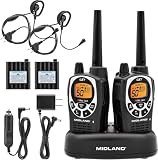 | Midland GXT1000VP4 GMRS Two-Way Radio (50 Channel, Long Range, 142 Privacy Codes, SOS, NOAA, Rechargeable Nickel Battery, Black/Silver 2-Pack) | Check Price On Amazon |
 | Retevis RT628 Walkie Talkies for Kids,Toys Gifts for 6-12 Years Old Boys Girls,Long Range 2 Way Radio 22CH VOX,Birthday Gift,Family Walkie Talkie for Camping Hiking Indoor Outdoor | Check Price On Amazon |