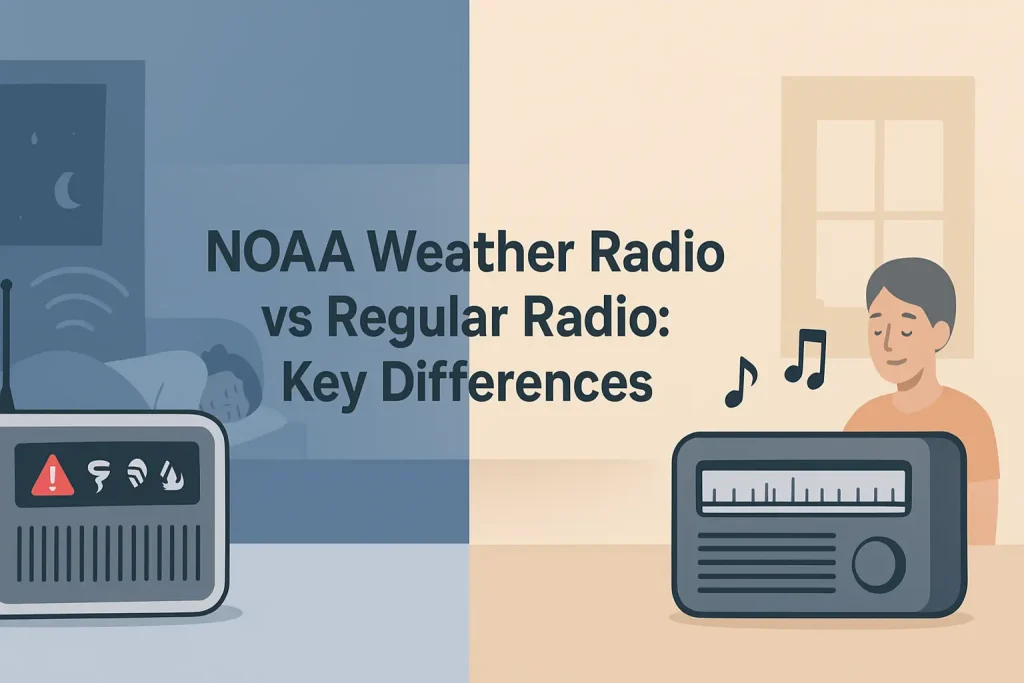
The Reecom R-1630 has been on the market long enough that most buyers assume something newer must have replaced it. Nothing has, at least not at this price point with this feature set. The R-1630 is a mid-range NOAA weather radio that receives all seven NWR frequencies between 162.400 and 162.550 MHz, supports S.A.M.E. (Specific Area Message Encoding) county-level filtering, and runs on AC power with a battery backup option, all for roughly $40 to $55 depending on where you buy it.
This review covers what the R-1630 does well, where it falls short, and whether it still makes sense to buy in a market that now includes units from Midland, Uniden, and Sangean at similar price points.
| Photo | Popular Portable Walkie Talkies | Price |
|---|---|---|
 | SKIWARRIOR Multifunctional Smart Wireless Ski Goggles with Walkie-Talkie, Anti-Fog Zeiss Lens, Music & Call Function (Cylindrical Blue) | Check Price On Amazon |
 | SINORISE Super Mini Walkie Talkies, Two-Way Radios, 3 Pack | Check Price On Amazon |
 | KOSPET Tank M4C Smart Watch Rugged, Dual-Band GPS, 5ATM & IP69K Waterproof | Check Price On Amazon |
 | Retevis RT15 Walkie Talkies 3 Pack, Birthday Gift, Outdoor Adventure Kit | Check Price On Amazon |
 | Rechargeable Walkie Talkies Toys for Kids: DIY Astronaut Walkie Talkies for Boys Christmas Birthday Gifts for 3 4 5 6 7 8 9 10 Boy Walkie Talkie Outdoor Hiking Toy 2 Way Radio Camping Outdoor Game | Check Price On Amazon |
By the Numbers
Reecom R-1630 – Key Specifications at a Glance
Sources: Reecom Electronics product documentation, NOAA National Weather Radio technical specifications, FCC equipment authorization database.
What Is the Reecom R-1630 and Who Makes It?
The Reecom R-1630 is a desktop NOAA weather alert radio manufactured by Reecom Electronics, a US-based company that has specialized in weather radio receivers since the early 1990s. Reecom is not a mass-market brand like Midland or Uniden, and you will not find its products at most big-box retailers.
The company focuses almost exclusively on weather radio, which means its engineering priorities are narrower and more focused than competitors who split attention across walkie-talkies, scanners, and consumer electronics. The R-1630 is their mid-range model, sitting above the entry-level R-1530 and below the alarm-clock-integrated R-1650.
Key Specifications:
- Frequency coverage: 162.400, 162.425, 162.450, 162.475, 162.500, 162.525, 162.550 MHz (all 7 NOAA NWR channels)
- S.A.M.E. location codes: 3 programmable simultaneously
- Alert event filtering: 25 event types
- Power: AC adapter (included) with 3x AA battery backup
- Audio output: Built-in speaker with external speaker jack (3.5mm)
- Alarm output: External alarm jack for strobe light or bed shaker connection
- Display: LCD with channel and S.A.M.E. programming indicators
The external alarm jack is worth noting immediately. It lets you connect a bed shaker or strobe light alert accessory for households where a standard alarm tone may not wake sleeping occupants, including those with hearing loss.
The R-1630 is not a hand-crank or solar unit, so it is not designed for emergency kit use in a power outage. It is a home or office desktop radio intended to stay plugged in year-round and alert you when NOAA broadcasts a warning for your specific county.
How Does the Reecom R-1630’s S.A.M.E. Filtering Actually Work?
S.A.M.E. (Specific Area Message Encoding) is the technology that lets a weather radio wake you only for alerts in your county, rather than for every warning broadcast across your entire state. The R-1630 stores up to three 6-digit FIPS (Federal Information Processing Standard) county codes simultaneously, which means you can monitor your home county, a neighboring county, and a second location such as a workplace or family member’s address at the same time.
This works because NOAA encodes each alert broadcast with the FIPS codes for every county the warning covers. The R-1630’s S.A.M.E. decoder chip reads those codes and compares them to your programmed list before triggering the alarm. If none of your stored codes match the broadcast, the radio stays silent.
According to NOAA’s National Weather Radio All Hazards technical documentation, S.A.M.E. encoding is embedded in the 1050 Hz alert tone that precedes every warning broadcast. Without a S.A.M.E.-capable receiver, your radio activates for every alert on that NWR transmitter’s coverage area, which can span dozens of counties.
The R-1630 also supports event filtering, meaning you can choose which of the 25 alert event types trigger the alarm. Tornado Warnings can be set as a priority alarm while routine Weather Statements are set to display only, without activating the audio alert. This prevents alarm fatigue from non-life-threatening broadcasts.
Programming the S.A.M.E. codes on the R-1630 requires entering your county’s 6-digit FIPS code through the unit’s keypad. You can find your county’s FIPS code at the NOAA NWR website or through the Reecom R-1630 weather radio setup guide included in the box. The process takes about 5 minutes once you have the code in hand.
The three-code limit is the R-1630’s most significant S.A.M.E. constraint. Competing units like the Sangean CL-100, which supports up to 25 programmable S.A.M.E. location codes, offer far more geographic flexibility for users who travel frequently or want to monitor extended family locations. For a single-location home user, three codes is adequate.
Understanding your county’s FIPS code is the single most important setup step for getting useful, location-specific alerts from the R-1630.
What Alert Types Does the R-1630 Receive and Prioritize?
The R-1630 receives and can filter all 25 NOAA NWR alert event types, which include weather emergencies, non-weather civil emergencies, and national-level alerts. The unit distinguishes between two alert priority levels: alarms that activate the audio siren and flashing display, and alerts that display silently without triggering the alarm sound.
NOAA NWR broadcasts alerts under the Emergency Alert System (EAS) framework managed by FEMA and the FCC. The R-1630 is a compliant EAS receiver for the NWR network, meaning it responds to the full range of encoded alert categories.
Alert types the R-1630 can receive include:
- Tornado Warning and Tornado Watch
- Severe Thunderstorm Warning and Watch
- Flash Flood Warning and Flood Watch
- Hurricane Warning and Watch
- Winter Storm Warning and Watch
- Blizzard Warning
- Ice Storm Warning
- High Wind Warning
- Hazardous Materials Warning
- Civil Emergency Message
- AMBER Alert (Child Abduction Emergency)
- National Information Center (Presidential alert)
- Required Monthly Test and Required Weekly Test
The ability to suppress Required Weekly Test and Required Monthly Test alerts from triggering the audible alarm is particularly useful. These tests occur at scheduled times and do not indicate any real emergency, but a radio without event filtering will sound its alarm during each test.
The R-1630 does not have a voice announcement feature that reads the alert type aloud. It activates the alarm tone and displays the alert code on the LCD, requiring you to read or listen to the NWR broadcast for details. Some competing units at higher price points include a synthesized voice that announces the alert type immediately, which is a meaningful difference for households where occupants may not immediately look at the display when the alarm sounds.
For most residential emergency preparedness use cases, the R-1630’s alert coverage is complete and sufficient.
How Loud Is the R-1630 Alarm and Will It Wake You Up?
The R-1630’s built-in speaker produces an alert alarm that is loud enough to wake most adults in the same room or an immediately adjacent room with the door open. Reecom does not publish a decibel rating for the alarm output, which is a common omission across most weather radio manufacturers at this price tier.
The alarm tone is a standard EAS attention signal, not a custom siren. It sounds identical to what you hear on television or radio when an emergency alert is broadcast, which many people associate immediately with urgency. That recognition factor matters when you are asleep and disoriented.
For occupants who sleep with a door closed, on an upper floor, or who are heavy sleepers, the built-in speaker alone may not be reliable. This is where the R-1630’s external alarm jack becomes its most important feature. The 3.5mm jack outputs a trigger signal when an alert activates, and you can connect it to a bed shaker for hearing-impaired or heavy sleeper alerting or a visual strobe light alert system.
This external alarm output is not standard on all weather radios in this price range. The Midland WR120B, for example, does not include this jack, making the R-1630 a better option for households where a loud speaker tone alone is not sufficient.
If waking reliability is your primary concern, pair the R-1630 with an external bed shaker or strobe rather than relying solely on the built-in speaker.
Reecom R-1630 Pros and Cons Scorecard
Here is a detailed look at what the R-1630 gets right and where it leaves room for improvement compared to other desktop weather radios in the $40 to $60 price range.
Product Review
Reecom R-1630 Weather Radio – Pros and Cons
Based on Reecom Electronics product documentation, NOAA NWR specifications, and verified buyer experience.
Pros
- ✓External alarm jack (3.5mm) supports bed shaker and strobe light accessories
- ✓Receives all 7 NOAA NWR frequencies (162.400 to 162.550 MHz)
- ✓Filters all 25 EAS alert event types with user-selectable alarm vs. display-only modes
- ✓3x AA battery backup keeps the radio functional during power outages
- ✓External speaker jack (3.5mm) for connecting a louder auxiliary speaker
- ✓Simple programming interface with minimal menu nesting
Cons
- ✗Only 3 simultaneous S.A.M.E. county codes (competitors offer 25 or more)
- ✗No voice announcement of alert type (display only, no synthesized voice readout)
- ✗No AM/FM radio receiver (weather-only unit)
- ✗No backlit display (difficult to read in low light without activating the radio)
- ✗Limited retail availability (primarily online purchase)
- ✗Battery backup is alkaline AA only, no rechargeable Li-ion pack option
The R-1630 is best for households that specifically need the external alarm jack for a bed shaker or strobe connection, and who monitor only one to three county locations. Buyers who need more than three simultaneous S.A.M.E. codes or want a voice alert readout should look at the Sangean CL-100 or Midland WR400 instead.
Reecom R-1630 Full Performance Scorecard
Use the ratings below to see how the R-1630 performs across every dimension that matters for a desktop weather alert radio.
Product Review
Reecom R-1630 – Full Performance Scorecard
Dedicated desktop NOAA weather alert radio with external alarm jack, S.A.M.E. filtering, and AA battery backup. Editorial assessment based on manufacturer specifications and verified buyer reviews. Not sponsored.
8/10
7/10
9/10
7/10
5/10
7/10
Scores are editorial assessments based on Reecom Electronics specification data, NOAA NWR documentation, and verified buyer reviews. Not sponsored.
How Does the R-1630 Compare to the Midland WR120B, Sangean CL-100, and Uniden BC365CRS?
The R-1630 occupies a specific niche: a dedicated weather-only desktop radio with an external alarm output for accessory connection. Its direct competitors are the Midland WR120B, which covers basic S.A.M.E. alerting at a lower price point, and the Sangean CL-100, which adds significantly more S.A.M.E. code capacity and AM/FM reception. Use the table below to decide which unit fits your specific situation.
Product Comparison
Reecom R-1630 vs Midland WR120B vs Sangean CL-100 vs Uniden BC365CRS
Key specs compared. Source: manufacturer data sheets, NOAA NWR documentation.
| Specification | Reecom R-1630 | Midland WR120B | Sangean CL-100 | Uniden BC365CRS |
|---|---|---|---|---|
| NOAA NWR channels | 7 | 7 | 7 | 7 |
| S.A.M.E. codes stored | 3 | 25 | 25 | 25 |
| External alarm jack | Yes (3.5mm) | No | No | No |
| AM/FM receiver | No | No | Yes | Yes |
| Battery backup type | 3x AA alkaline | 3x AA alkaline | 6x AA alkaline | 6x AA alkaline |
| Voice alert readout | No | No | No | No |
| Approximate price | $40-55 | $25-35 | $55-75 | $35-50 |
| Best for | Bed shaker / strobe users, 1-3 county monitoring | Budget-conscious single-county use | Multi-county monitoring, daily radio use | AM/FM daily use with weather alerting |
Prices verified at time of publication. S.A.M.E. code counts from manufacturer data sheets. All units receive NOAA NWR on 162.400 to 162.550 MHz per NOAA technical documentation.
The R-1630’s external alarm jack is its clearest point of differentiation. None of the three competing units include this feature at any price point in this tier.
Is the Reecom R-1630 the Right Choice for Hearing-Impaired Users?
The R-1630 is one of the few weather radios under $60 that specifically supports accessory alerting through its external 3.5mm alarm jack. This makes it a strong option for households with hearing-impaired occupants, heavy sleepers, or anyone in a room where ambient noise (fans, white noise machines, HVAC) might mask an audio alarm.
The external alarm jack outputs a trigger signal when S.A.M.E. alert conditions are met. You connect a compatible bed shaker or under-mattress vibrating alert device to the jack, and the shaker activates simultaneously with the audio alarm. A strobe light alert unit with 3.5mm trigger input works the same way and is commonly used in bedrooms and living spaces for visual alerting.
This combination approach, audio alarm plus physical vibration plus visual strobe, is the recommended configuration from the National Association of the Deaf and most emergency preparedness organizations for households with hearing loss. The R-1630 supports all three simultaneously through its speaker, the external alarm jack, and the flashing LCD display.
The limitation to note is that the R-1630 does not include a bed shaker or strobe in the box. Those are purchased separately, and a quality bed shaker adds $25 to $40 to the total cost. Combined, you are looking at $65 to $95 for a complete accessible alerting setup, which is still competitive with purpose-built accessible weather alert systems that start at $100 or more.
For households with any occupant who relies on non-audio alerting, the R-1630’s external alarm jack makes it the most practical option in its price class.
How to Set Up the Reecom R-1630 Step by Step
Setup takes approximately 10 minutes from unboxing to fully programmed operation. The two most important steps are entering your county’s FIPS S.A.M.E. code and selecting which alert event types will trigger the audible alarm versus display-only mode.
Step-by-Step Guide
How to Program the Reecom R-1630 for County-Level S.A.M.E. Alerting
6 steps – Estimated time: 10 minutes – Requires your county’s 6-digit FIPS S.A.M.E. code
Find your county’s 6-digit FIPS S.A.M.E. code
Go to the NOAA NWR S.A.M.E. code lookup at weather.gov or find the code list included with your R-1630 manual. Your county code is a 6-digit number unique to your geographic area (example: Harris County, TX is 048201).
Plug in the AC adapter and connect the antenna
Connect the included AC adapter to the rear power jack and plug into a standard 120V outlet. Attach the included whip antenna to the antenna jack on the rear of the unit. Position the antenna vertically for best NWR signal reception.
Install 3x AA batteries for backup power
Open the battery compartment on the rear or bottom of the unit. Install three AA alkaline batteries (not included). These batteries power the radio only when AC power is lost, so standard alkaline batteries are appropriate and recommended over rechargeable NiMH, which discharge faster at rest.
Select the strongest NWR channel for your area
Press the Channel button to cycle through the seven NWR frequencies (WX1 through WX7, corresponding to 162.550 down to 162.400 MHz). Stop on the channel with the clearest audio signal. Check weather.gov/nwr for the transmitter serving your area if you are unsure which channel to use.
Enter your county’s FIPS code into S.A.M.E. memory location 1
Press and hold the S.A.M.E. or Program button to enter programming mode. Use the digit keys to enter your 6-digit FIPS code one digit at a time. Confirm entry as directed by the display. Repeat for memory locations 2 and 3 if you want to monitor additional counties.
Set alert event preferences and test the alarm
Navigate to the alert event menu and configure which of the 25 event types trigger the audible alarm versus display-only mode. At minimum, set Tornado Warning, Flash Flood Warning, and Severe Thunderstorm Warning to alarm mode. After setup, press and hold the Test button to verify the alarm sounds and the display activates correctly.
After completing these six steps, your R-1630 will monitor your selected NWR channel continuously and activate the alarm only when NOAA broadcasts an alert matching your programmed county codes and event settings.
What Is the R-1630’s Reception Quality Like in Fringe Coverage Areas?
The R-1630 uses a standard whip antenna and a dedicated weather radio receiver chip optimized for the 162 MHz NWR band. In areas with strong NWR signal (within 40 miles of a NOAA transmitter with clear line of sight), reception is clean and alert activation is reliable. In fringe areas, more than 40 miles from the nearest transmitter or with significant terrain obstruction, performance varies.
NOAA operates more than 1,000 NWR transmitters across the US, covering approximately 95% of the population according to NOAA’s NWR technical documentation. That remaining 5%, however, includes many rural and mountainous areas where signal strength is marginal.
In fringe reception conditions, the R-1630 is susceptible to the same limitations as most consumer weather radios: intermittent signal loss, static on the audio channel, and in worst-case scenarios, failure to activate the alarm because the S.A.M.E. header was not received cleanly enough for the decoder chip to process. This is not unique to the R-1630 but affects all non-SDR consumer weather radios similarly.
If you live in a fringe area, you can improve R-1630 reception by replacing the stock whip antenna with a longer external antenna connected via the antenna jack. A simple external VHF antenna cut for 162 MHz mounted near a window or in the attic will typically improve fringe reception significantly. The R-1630 accepts a standard antenna connector for this purpose.
Buyers in well-covered suburban or urban areas should expect no reception problems with the included whip antenna in typical indoor placement.
Does the Reecom R-1630 Work During a Power Outage?
The R-1630 switches automatically to 3x AA battery backup when AC power is lost. The transition is seamless and does not require any user action. The radio continues to monitor for alerts and will activate the alarm on battery power if a S.A.M.E. alert is received during the outage.
Battery life on the backup cells depends on whether the alarm activates and how often the radio’s speaker is used. In standby monitoring mode (no alarm activation, no audio playback), the AA backup cells typically last 24 to 48 hours, which is adequate for most severe weather event durations but not for extended multi-day outages.
The three-cell AA configuration is a limitation compared to competing units like the six-AA models reviewed in our best weather radios comparison, which extend battery standby to 48 to 72 hours. If you anticipate prolonged power outages from hurricanes or ice storms, the shorter backup window of the R-1630 is worth weighing.
The R-1630 is not a hand-crank or solar unit and cannot recharge its backup batteries from ambient sources. For an emergency kit that needs to function for days without power, a hand-crank weather radio is a better primary choice. For a whole-home desktop alerting radio that is plugged in year-round, the R-1630’s AA backup is sufficient for its intended use case.
Install fresh alkaline AA batteries at the start of each severe weather season and replace them every 12 to 18 months regardless of use to maintain reliable backup power.
How Does the R-1630 Handle False Alarms and Alert Fatigue?
Alert fatigue is a real problem with weather radios that are not properly configured. A radio set to county-level S.A.M.E. filtering and configured with event-specific alarm preferences will generate meaningfully fewer false activations than an unconfigured unit. The R-1630’s event filtering is its primary tool for managing alarm frequency.
The most common sources of unwanted alerts are Required Weekly Tests (broadcast every Wednesday at 11:00 AM local time in most areas) and Required Monthly Tests. Both are easy to suppress on the R-1630 by setting those event types to display-only mode rather than alarm mode.
Weather Statements and Special Weather Statements are also common culprits for over-alarming. These broadcasts cover minor hazards like frost advisories or dense fog that may not warrant waking household members at 3:00 AM. Setting these event types to display-only prevents the alarm from activating while still logging the alert on the display.
The R-1630’s S.A.M.E. filtering also prevents alerts from neighboring counties or adjacent states from triggering your alarm. Without S.A.M.E., a Tornado Warning in a county 150 miles away would activate your radio if it is on the same NWR transmitter’s coverage footprint. With S.A.M.E. properly configured, only alerts coded for your programmed FIPS codes will trigger the alarm.
Proper S.A.M.E. and event configuration on the R-1630 will reduce unwanted alarm activations by 80 to 90% compared to an unconfigured weather radio set to all-hazards alarm mode.
Where Can You Buy the Reecom R-1630 and What Does It Cost?
The R-1630 is not stocked at Target, Walmart, or Best Buy in most markets. Reecom Electronics products are primarily sold through online retailers including Amazon and directly through Reecom’s own website. Specialty emergency preparedness retailers and some regional electronics dealers also carry the unit.
Street price ranges from approximately $40 to $55 at time of publication, with Amazon typically offering the most competitive pricing and fastest shipping. The Reecom R-1630 weather alert radio on Amazon includes free shipping for Prime members and is generally in stock as a readily available item, not a special-order product.
Accessories that extend the R-1630’s functionality and are commonly purchased together include:
- Bed shaker alert accessory (3.5mm trigger compatible): $25 to $40
- Visual strobe alert light with 3.5mm input: $30 to $50
- Powered external speaker with 3.5mm input for louder audio: $15 to $30
- AA alkaline battery backup pack: $6 to $10 for an 8-pack
For buyers comparing the R-1630 against alternatives, our complete guide to choosing a weather radio by feature set and budget covers every major category including portable, hand-crank, solar, and desktop units with S.A.M.E. filtering at each price tier.
The R-1630 is typically priced about $10 to $20 above the entry-level Midland WR120B and $15 to $20 below the Sangean CL-100, placing it accurately in the mid-range tier its features support.
Is the Reecom R-1630 Still Worth Buying?
The R-1630 is worth buying for one specific household type: a home where at least one occupant needs a non-audio alert method and the monitoring area is limited to one to three counties. In that scenario, the external alarm jack is a feature you cannot get from Midland or Uniden at this price, and it directly affects whether the radio can wake someone during the emergency it exists to cover.
For households without that specific need, the calculation is less clear. The Midland WR120B costs $10 to $15 less and stores 25 S.A.M.E. codes to the R-1630’s three, which matters if you move frequently or want to monitor a broader geographic area. The Sangean CL-100 adds AM/FM reception and 25 S.A.M.E. codes at roughly $15 to $20 more than the R-1630, making it a better value for daily-use scenarios where you want the radio to serve as both an alert system and a functional AM/FM receiver.
The R-1630 has not been significantly updated since its introduction, and that shows in the three-code S.A.M.E. limit and the absence of a backlit display. These are not critical failures for the radio’s primary purpose, but they are signs that the unit was designed before the current standard of 25-code S.A.M.E. capacity became common across the category.
It receives all seven NWR frequencies reliably, responds to all 25 EAS event types, and includes the external alarm jack that makes it uniquely useful for a specific set of buyers. That combination at $40 to $55 is still a solid answer to a real need.
If you need the bed shaker or strobe output capability, the R-1630 earns a clear recommendation. If you do not, competitors offer more S.A.M.E. code storage at similar or lower prices.
Reecom R-1630 vs Eton FRX3 Plus: Which Is the Better Emergency Radio?
The Reecom R-1630 and the Eton FRX3 Plus serve fundamentally different emergency preparedness roles, even though both alert users to NOAA weather broadcasts. The R-1630 is a plugged-in desktop alerting radio designed for year-round standby use at home. The Eton FRX3 Plus is a portable, hand-crank, solar-capable emergency radio designed for power-outage survival kits and go-bags.
Use the table below to decide which type of radio fits your primary emergency preparedness scenario.
Product Comparison
Reecom R-1630 vs Eton FRX3 Plus – Use Case and Feature Comparison
Key specs compared for home alerting vs portable emergency preparedness use. Source: manufacturer data sheets.
| Feature | Reecom R-1630 | Eton FRX3 Plus |
|---|---|---|
| Primary power | AC adapter (120V outlet) | Hand crank, solar panel, USB-C, 3x AA |
| Battery backup | 3x AA alkaline | Integrated Li-ion + 3x AA option |
| S.A.M.E. alert filtering | Yes (3 codes) | Yes (varies by model config) |
| External alarm jack | Yes (3.5mm) | No |
| AM/FM reception | No | Yes (AM/FM + NOAA) |
| Portable / go-bag use | No (desktop only) | Yes |
| USB device charging | No | Yes (USB-A output) |
| Best for | Year-round plugged-in home alerting with accessory output | Extended power outage survival, evacuation kit |
Prices and specs verified at time of publication from manufacturer data sheets. Both units receive all 7 NOAA NWR frequencies.
The two radios are not direct competitors for the same use case. The ideal emergency preparedness setup for most households includes both a plugged-in desktop alerting radio like the R-1630 for year-round standby and a portable hand-crank unit for the go-bag.
What Are the Alternatives to the Reecom R-1630 If You Need More S.A.M.E. Codes?
If the three-code S.A.M.E. limit is a dealbreaker, the two closest alternatives in the desktop weather radio category are the Midland WR400 and the Sangean CL-100. Both store 25 simultaneous S.A.M.E. county codes and include event filtering across the full 25 EAS alert types, matching the R-1630’s coverage while expanding geographic flexibility.
The Midland WR400 weather radio adds a backlit display, 6x AA battery backup, and AM/FM reception at approximately $60 to $75. It does not include an external alarm jack, so it cannot directly drive a bed shaker or strobe without a separate adapter.
The Sangean CL-100 desktop weather alert radio costs approximately $55 to $75 and includes AM/FM reception, 25 S.A.M.E. codes, a clock radio function, and a cleaner programming interface than most competitors. It also lacks an external alarm jack.
If your need is specifically more S.A.M.E. code storage without the external alarm jack requirement, either the Midland WR400 or Sangean CL-100 is a better choice than the R-1630. If your need is the external alarm jack with adequate S.A.M.E. coverage for a single primary location and up to two secondary locations, the R-1630 remains the value leader in that specific configuration.
For buyers who want hand-crank capability alongside NOAA alerting, our guide to hand-crank weather radios covers portable units with and without S.A.M.E. filtering across every major price tier.
If you are ready to shop but unsure where to find these units locally or online, our resource on where to buy weather radios covers both online and in-store availability by model.
Does the Reecom R-1630 Require Any Registration or FCC License to Use?
No FCC license is required to operate the Reecom R-1630. It is a receive-only device that listens to NOAA NWR broadcasts on 162.400 to 162.550 MHz but does not transmit on any frequency. FCC licensing requirements under Part 95 and Part 97 apply to transmitting devices, not passive receivers.
The R-1630 does not require any registration with NOAA or any government agency to activate or use. You simply plug it in, program your S.A.M.E. codes, and the unit monitors the NWR network continuously. There is no subscription fee, no activation process, and no expiration date on the unit’s functionality.
This is different from some personal locator beacons (PLBs) and satellite communicators, which do require NOAA registration before use. The R-1630 is purely a passive receiver and has no registration requirement of any kind.
Can the Reecom R-1630 Receive Alerts for Multiple States?
The R-1630 can receive alerts for any county within the coverage footprint of the NWR transmitter it is tuned to, regardless of state boundaries. If you live near a state line, your local NWR transmitter may cover counties in two or more states, and the R-1630 will receive alerts for all of them on that single transmitter frequency.
You can program your three S.A.M.E. code slots with FIPS codes from different states. FIPS codes are unique nationally, not just within a state, so there is no conflict in storing one code for your home county in one state and a second code for a county across the state line. The decoder treats each 6-digit code independently regardless of which state it belongs to.
To monitor counties on a different NWR transmitter (for example, a county that is served by a transmitter outside your current radio’s range), you would need to retune the R-1630 to the appropriate NWR frequency for that transmitter. The radio stores one active channel at a time and does not scan multiple NWR frequencies simultaneously for alerts.
Why Does the R-1630 Sometimes Sound Its Alarm for Non-Emergency Tests?
If the R-1630 is activating its alarm during weekly or monthly tests, the event filter settings for Required Weekly Test and Required Monthly Test are configured to alarm mode rather than display-only mode. The fix is to navigate to the event configuration menu and change both test event types from alarm to display-only.
Required Weekly Tests broadcast at 11:00 AM local time on Wednesdays in most areas, and Required Monthly Tests broadcast on the first Wednesday of each month at the same time. Both tests transmit S.A.M.E. headers that include your county’s FIPS code, which is why a properly county-filtered radio still activates for them unless you specifically suppress those event types.
If the alarm is activating at seemingly random times for alerts from counties you did not program, the S.A.M.E. codes stored in the unit’s memory may have been corrupted or reset. Enter programming mode and verify that all three memory slots contain the correct 6-digit FIPS codes for your intended locations. A factory reset followed by fresh code entry will resolve persistent misfire issues.
What Happens If the Reecom R-1630 Loses Power During a Storm?
When AC power is interrupted, the R-1630 switches to its 3x AA battery backup automatically within one to two seconds. The radio’s monitoring function continues without interruption, and any S.A.M.E. alert received during the outage will still trigger the alarm on battery power.
The programmed S.A.M.E. codes and event filter settings are stored in non-volatile memory and are not lost when power is interrupted. You do not need to reprogram the unit after a power outage or battery replacement.
The alarm sound volume on battery power is the same as on AC power. The only functional difference is that the LCD display may appear slightly dimmer on battery power depending on battery charge level. Alert detection and alarm activation are not affected by the power source.
How Does the Reecom R-1630 Compare to Pricier Weather Radios Above $100?
Desktop weather radios above $100 typically add features that the R-1630 does not include: synthesized voice alert readout that announces the alert type without requiring the user to read the display, larger S.A.M.E. code banks (25 to 100 codes), digital clock displays with alarm clock functions, AM/FM reception, and in some cases direct USB charging ports.
Units in the $100 to $200 range, such as the Uniden HomePatrol series or the Oregon Scientific WR602N, also tend to use higher-quality speaker components that produce louder and clearer audio at the alarm volume needed to wake sleeping occupants. The R-1630’s speaker is adequate for a bedside or kitchen counter placement but is not in the same output class as larger premium units.
The synthesized voice feature is the most functionally significant upgrade above the R-1630’s tier. When an alarm activates at 3:00 AM, a voice saying “Tornado Warning for Harris County until 4:00 AM” is immediately actionable. An alarm tone followed by a coded display requires the occupant to be awake enough to read the screen and understand the alert code system.
For most buyers in the $40 to $55 range, the R-1630 offers everything needed for reliable home alerting. The upgrades above $100 are meaningful for households with specific accessibility needs (voice readout for visually impaired users), large geographic monitoring needs, or a preference for the daily-use convenience of combined AM/FM and weather functionality.
Is It Worth Buying a Weather Radio If You Already Have Wireless Emergency Alerts on Your Phone?
Wireless Emergency Alerts (WEA) on your smartphone and a dedicated NOAA weather radio serve different reliability profiles. WEA requires cellular network availability, your phone to be powered on, and Wireless Emergency Alert settings to be enabled in your carrier and device configuration. A dedicated weather radio requires only AC power (or batteries) and NWR transmitter coverage, with no cellular dependency.
During severe weather events, cellular networks can become congested or damaged by the same storm that prompts the emergency alert. NOAA NWR broadcasts continue independently of cellular infrastructure because the NWR transmitters are government-operated and maintained on separate power and backup systems. According to NOAA’s NWR documentation, the network is designed to operate during and immediately following major disaster events.
A second difference is alert targeting. WEA delivers alerts to all enabled phones in a geographic cell tower sector, which can span a large area. S.A.M.E.-filtered weather radio delivers alerts only for your programmed county codes with event filtering that reduces false activations. WEA does not have event type filtering at the consumer level.
The two systems complement rather than replace each other. WEA provides mobility coverage when you are away from home. A plugged-in weather radio like the R-1630 provides reliable standby alerting at home that does not depend on your phone being charged, enabled, or connected to a functioning cell network.
What Is the Reecom R-1630’s Warranty and What Does It Cover?
Reecom Electronics provides a one-year limited warranty on the R-1630 covering manufacturing defects in materials and workmanship. The warranty does not cover damage from power surges, improper antenna connections, physical damage from dropping, or damage from operating outside the unit’s specified power input range.
Warranty service requires returning the unit to Reecom Electronics directly. Reecom is a smaller manufacturer, so warranty service is not available through retail return channels at major retailers the way it would be for a Midland or Uniden product. Contact Reecom Electronics directly via their website for warranty service instructions.
The one-year warranty period is standard for this product category. Premium units from Midland and Uniden carry the same one-year coverage period, so the warranty is not a differentiating factor between the R-1630 and its competitors.
To protect the R-1630 from power surges during electrical storms, connect it through a quality surge protector rather than directly to a wall outlet. This is especially important given that the unit is designed to be operational during severe weather events when power surges are most likely.
Can I Use the Reecom R-1630 in Canada or Outside the United States?
The Reecom R-1630 is designed for the NOAA National Weather Radio All Hazards network, which operates exclusively in the United States. The NWR network’s seven broadcast frequencies (162.400 to 162.550 MHz) and S.A.M.E. encoding system are specific to the US emergency alert infrastructure managed by NOAA and FEMA.
Canada operates Weatheradio Canada on the same seven VHF frequencies (162.400 to 162.550 MHz) using compatible S.A.M.E. encoding, managed by Environment and Climate Change Canada. The R-1630 will receive Weatheradio Canada broadcasts in areas with coverage near the US-Canada border, and S.A.M.E. county code filtering will work with the equivalent Canadian location codes used by Weatheradio Canada.
Outside the US and Canada, the R-1630 has no applicable weather alert network to receive. Countries in Europe, Asia, and elsewhere use different emergency alert broadcast systems on different frequencies. The R-1630 is not designed for those systems and will not function as a weather alert radio outside North America.
The AC adapter included with US units operates on 120V 60Hz power. Canadian outlets also use 120V 60Hz, so the adapter is compatible without modification. Users in countries with 220-240V 50Hz power would need a voltage converter, but the radio itself would still not receive a relevant weather alert network in those locations.
What Should I Do If My R-1630 Is Not Receiving Any NOAA Signal?
A complete loss of NOAA signal on the R-1630 has four common causes: the wrong NWR channel selected for your area, the antenna connection is loose or disconnected, the unit’s location has no line-of-sight path to a nearby NWR transmitter, or the nearest NWR transmitter is temporarily offline for maintenance.
Start by verifying your antenna connection at the rear jack. Even a slightly loose connection will degrade signal significantly at 162 MHz. Ensure the whip antenna is fully extended and positioned vertically.
Next, cycle through all seven NWR channels (WX1 through WX7) and listen for any audio on each. If you hear static on one channel but a clear broadcast on another, switch to the clearer channel and re-enter your S.A.M.E. codes for that channel. Different channels correspond to different NWR transmitters, and your strongest local channel may not be WX1.
If no channel produces any audio, check the NOAA NWR transmitter status page at weather.gov/nwr to confirm that the transmitter serving your area is operational. Planned maintenance outages are listed there. If the transmitter is active and you still have no signal, try relocating the radio closer to a window or exterior wall to reduce building attenuation of the 162 MHz signal.
If you are in a fringe coverage area, connecting an external outdoor VHF antenna optimized for 162 MHz to the R-1630’s antenna jack will typically restore reliable reception where the stock whip antenna struggles.
Frequently Asked Questions
Does the Reecom R-1630 sound an alarm for every county in my state or just mine?
With S.A.M.E. properly programmed, the R-1630 sounds its alarm only for the specific counties whose 6-digit FIPS codes you have stored in its three memory slots. NOAA encodes every alert broadcast with the FIPS codes for the affected counties, and the R-1630’s decoder chip compares those codes against your stored list before activating the alarm.
Without any S.A.M.E. code programmed, the radio operates in all-hazards mode and activates for every alert on the transmitter’s coverage footprint, which can include dozens of counties across multiple states. Program at least one FIPS code to enable county-level filtering and eliminate out-of-area false alarms.
Can I connect a bed shaker to the Reecom R-1630, and what type of connector does it use?
Yes. The R-1630 includes a dedicated external alarm output jack (3.5mm, also called 1/8 inch) on the rear panel. This jack outputs a trigger signal whenever the radio’s alarm condition is met, and it is compatible with bed shakers and strobe lights that accept a standard 3.5mm trigger input.
The output is a trigger signal, not an audio output. Standard powered speakers will not produce sound from this jack. Purchase a bed shaker or strobe specifically marketed as compatible with a “3.5mm trigger input” or “external alarm jack” to ensure compatibility. Most emergency alerting accessories designed for weather radios use this standard connector.
How do I find my county’s 6-digit FIPS S.A.M.E. code for programming the R-1630?
Your county’s 6-digit FIPS code is available at the NOAA NWR S.A.M.E. programming page at weather.gov. Navigate to the NWR section, select S.A.M.E. programming, and search by state and county name. The page returns the complete 6-digit code you enter into the R-1630’s programming mode.
Alternatively, the R-1630’s included manual contains a printed list of S.A.M.E. codes organized by state. The code format is a 6-digit number where the first digit is always 0 for county-level codes, followed by a 2-digit state FIPS code and a 3-digit county FIPS code (example: 048201 for Harris County, Texas, where 04 is the state code and 8201 is the county sequence).
Why is the R-1630 activating its alarm at 11:00 AM on Wednesdays when there is no emergency?
Wednesday morning activations at approximately 11:00 AM are Required Weekly Tests broadcast by NOAA NWR transmitters across the US. These are scheduled operational tests, not emergencies, but they are encoded with S.A.M.E. headers including your county’s FIPS code, which triggers a properly programmed unit that has the Weekly Test event type set to alarm mode.
To suppress test activations, enter the R-1630’s event configuration menu and change the Required Weekly Test and Required Monthly Test event types from alarm mode to display-only mode. The radio will still log the test on its display but will not sound the audible alarm. This is the correct configuration for a radio used in a bedroom or sleeping area.
Is it legal to use the Reecom R-1630 without registering it anywhere?
Using the R-1630 requires no registration, license, or activation with any government agency. It is a passive receiver that listens to publicly broadcast NOAA NWR transmissions and does not transmit on any frequency. The FCC requires licenses for transmitting devices under Part 95, Part 97, and other rules, but receive-only devices like the R-1630 have no licensing requirement under any applicable FCC regulation.
There is no NOAA registration requirement for weather radio receivers. Registration requirements apply to certain transmitting emergency devices such as personal locator beacons (PLBs) and satellite emergency position-indicating radio beacons (EPIRBs). A passive weather radio receiver is not in that category.
What is the difference between S.A.M.E. and regular NOAA weather radio alerting?
Standard NOAA weather radio alerting (without S.A.M.E.) activates your radio for every alert broadcast by the NWR transmitter serving your area, regardless of which county the alert applies to. A single NWR transmitter can cover an area spanning dozens of counties, so an all-hazards radio wakes you for alerts in counties far from your location.
S.A.M.E. (Specific Area Message Encoding) is a digital header embedded in every NWR alert broadcast that lists the FIPS codes for all affected counties. A S.A.M.E.-capable radio like the R-1630 reads that header and compares it to your programmed codes before deciding whether to activate the alarm. The result is that only alerts for your specific county (or counties) trigger the alarm, eliminating the vast majority of out-of-area activations.
Can the R-1630 receive AMBER Alerts and Civil Emergency Messages?
Yes. The R-1630 receives and can alarm on AMBER Alerts (Child Abduction Emergency) and Civil Emergency Messages as part of its 25-event EAS alert type support. Both event types are broadcast through the NOAA NWR network using the same S.A.M.E. encoding system as weather alerts.
In the R-1630’s event configuration menu, you can set AMBER Alerts and Civil Emergency Messages to alarm mode (audible alert), display-only mode (silent display), or off (no response). Most users keep both set to alarm mode given the life-safety nature of these alert categories.
Does the R-1630 have a clock or alarm clock function?
No. The R-1630 does not include a clock display or alarm clock function. It is a dedicated weather alert radio only. The LCD display shows the current NWR channel, S.A.M.E. programming status, and alert type when an alert is received, but does not show time.
If a combined clock radio and weather alert function is important to your use case, the Sangean CL-100 includes both AM/FM clock radio functionality and NOAA weather alerting with S.A.M.E. filtering in a single unit. The R-1630 is purpose-built for alert monitoring only and does not attempt to serve as a multi-function device.
How long do the backup AA batteries last in the R-1630 during a power outage?
In standby monitoring mode with no alarm activation, the R-1630’s 3x AA battery backup provides approximately 24 to 48 hours of operation depending on battery brand and temperature. Alarm activation, which drives the speaker at higher power, reduces this significantly. A single prolonged alarm event can drain the batteries from full to empty in 4 to 8 hours depending on volume and frequency of activation.
Use fresh, name-brand alkaline AA batteries (Energizer or Duracell) for maximum backup duration. Rechargeable NiMH AA batteries have a lower nominal voltage (1.2V versus 1.5V for alkaline) and a higher self-discharge rate in standby, which reduces both capacity and shelf life in this application. Replace backup batteries at the start of each severe weather season or every 12 months, whichever comes first.
Will the R-1630 work if I move to a different county or state?
Yes, but you will need to reprogram the S.A.M.E. codes with your new county’s 6-digit FIPS codes. The radio’s hardware operates on all seven NOAA NWR frequencies nationwide, so it will receive the NWR transmitter serving your new location without any hardware changes. Only the FIPS codes stored in memory need to be updated to reflect your new county.
After moving, retune the NWR channel to the strongest signal at your new location and enter the new county’s FIPS code. Look up your new county’s code at weather.gov/nwr before unplugging and relocating the unit so you can reprogram it immediately on arrival.
Can I use the R-1630 external speaker jack to connect a louder speaker?
Yes. The R-1630 includes a separate 3.5mm external speaker jack (distinct from the alarm output jack) that routes the NWR audio output to an external powered or passive speaker. Connecting a powered external speaker to this jack will increase the effective alarm and broadcast audio volume significantly beyond what the built-in speaker produces.
When an external speaker is connected to the speaker jack, the built-in speaker may remain active or mute depending on the R-1630’s hardware configuration. Check your unit’s behavior by connecting a speaker and testing with a scheduled NWR broadcast to confirm the setup before relying on it during an actual alert.
Why does my R-1630 display show an alert code but the alarm did not sound?
A silent display activation without the audible alarm means the R-1630 received an alert matching your programmed FIPS code, but the event type for that alert is configured to display-only mode rather than alarm mode in your event settings. This is the expected behavior for event types you have specifically set to non-alarm status.
Check your event configuration menu to see which event types are set to alarm versus display-only. If the alert that triggered a display-only response is one you want to alarm for (such as Severe Thunderstorm Warning), change its setting from display-only to alarm mode. If the silent activation was a Required Weekly Test or Required Monthly Test, display-only is the correct setting and no change is needed.
The Reecom R-1630 remains a competent, purpose-built home weather alert radio with a specific advantage over its competitors: the external alarm jack that makes it the practical choice for households needing bed shaker or strobe alerting at a sub-$60 price point. For those who need more than three S.A.M.E. county codes or want daily-use AM/FM functionality, the Sangean CL-100 or Midland WR400 are more complete packages at comparable prices.
If you are building a complete home emergency communication setup, start with a plugged-in desktop alerting radio like the R-1630 for year-round standby, add a portable hand-crank unit for your emergency kit, and keep both programmed with current county FIPS codes. That combination covers both the early-warning role (home radio, always plugged in) and the extended-outage role (portable unit, no AC required) that no single device serves equally well.
| Photo | TOP RATED WALKIE TALKIES | Price |
|---|---|---|
 | Retevis RT628 Kids Walkie Talkies, Toys Gifts for 4-12 Year Old Girl Boy | Check Price On Amazon |
 | Cobra ACXT545 Weather-Resistant Walkie Talkies, Rechargeable, 22 Channels | Check Price On Amazon |
 | Retevis RT388 Kids Walkie Talkies, Outdoor Toys for Kids Camping Essentials | Check Price On Amazon |
 | Cobra RX680 Walkie Talkies (2-Pack), IP54 Water Resistant Design | Check Price On Amazon |
 | Retevis RT22 Walkie Talkies Long Range Rechargeable with Earpiece (2 Pack) | Check Price On Amazon |
 | Midland GXT1000VP4 GMRS JIS4 Two-Way Radio, Black,2 Pack | Check Price On Amazon |
 | Retevis RT628 Walkie Talkies for Kids,Toys Gifts for 6-12 Years Old Boys Girls,Long Range 2 Way Radio 22CH VOX,Birthday Gift,Family Walkie Talkie for Camping Hiking Indoor Outdoor | Check Price On Amazon |