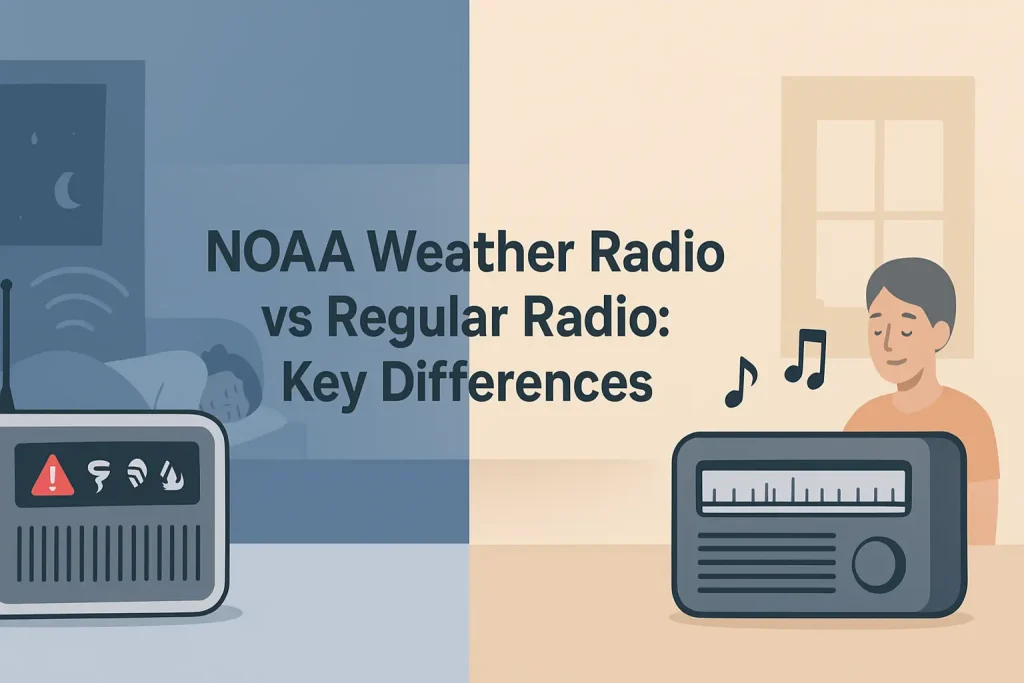
The Kaito Voyager KA500 receives NOAA weather alerts on all seven broadcast frequencies between 162.400 and 162.550 MHz, picks up AM, FM, and shortwave bands, and recharges from five independent power sources including a built-in solar panel and hand crank. It is one of the few emergency radios under $60 that genuinely works when the grid goes down, your batteries are dead, and your phone has no signal.
This review covers every specification, every alert feature, real-world reception performance, and an honest comparison against competing emergency radios so you can decide whether the KA500 belongs in your emergency kit.
| Photo | Popular Portable Walkie Talkies | Price |
|---|---|---|
 | SKIWARRIOR Multifunctional Smart Wireless Ski Goggles with Walkie-Talkie, Anti-Fog Zeiss Lens, Music & Call Function (Cylindrical Blue) | Check Price On Amazon |
 | SINORISE Super Mini Walkie Talkies, Two-Way Radios, 3 Pack | Up to 12 Hours Battery Life, for Baseball Coaches, Restaurants, Retail Stores, Hospitals, Outdoor Sports & Travel | Check Price On Amazon |
 | KOSPET Tank M4C Smart Watch Rugged, Dual-Band GPS, 5ATM & IP69K Waterproof | 1.96" AMOLED Display, 170+ Sport Modes, Built-in LED Flashlight/Walkie-Talkie, Heart Rate/Sleep Monitor for Android & iPhone | Check Price On Amazon |
 | Retevis RT15 Walkie Talkies 3 Pack, Birthday Gift, Outdoor Adventure Kit | Durable, Lightweight, VOX, Key Lock, Mini Walkie Talkies for Adults, School Family Outdoor Travel Camping Hiking | Check Price On Amazon |
 | Rechargeable Walkie Talkies Toys for Kids: DIY Astronaut Walkie Talkies for Boys Christmas Birthday Gifts for 3 4 5 6 7 8 9 10 Boy Walkie Talkie Outdoor Hiking Toy 2 Way Radio Camping Outdoor Game | Check Price On Amazon |
By the Numbers
Kaito KA500 – Key Specifications at a Glance
Sources: Kaito manufacturer data sheet, NOAA National Weather Radio documentation, FCC equipment authorization database.
What Is the Kaito Voyager KA500 and Who Is It Built For?
The Kaito Voyager KA500 is a portable emergency receiver that combines NOAA weather alert monitoring with AM, FM, shortwave, and aviation band reception in a single hand-crank, solar-powered unit. It is designed specifically for emergency preparedness scenarios where commercial power and cellular networks are unavailable.
This is not a walkie-talkie and it does not transmit on any frequency. It is a receive-only device built to keep you informed during power outages, natural disasters, and remote off-grid situations.
The target buyer is someone building a 72-hour emergency kit, preparing for hurricane season, or heading into backcountry where no cell signal exists. It appeals to preppers, campers, coastal residents in hurricane zones, and anyone who wants a backup information source that does not depend on grid power or a charged smartphone.
Key Specifications:
- Frequency coverage: AM 520-1710 kHz, FM 87-108 MHz, Shortwave 2.3-26.1 MHz (13 bands), NOAA WX 162.400-162.550 MHz (7 channels), AIR 118-137 MHz
- Power sources: Built-in solar panel, hand crank generator, 5V USB input, 3x AA batteries (alkaline or NiMH), 5V DC adapter
- Internal battery: 1000 mAh NiMH rechargeable pack
- USB output: 5V 500mA for charging phones and small devices
- Alert function: NOAA weather alert with automatic activation on any of the 7 WX channels
- Dimensions: 7.5 x 5.5 x 2.5 inches
- Weight: 14.6 oz without batteries
The KA500 sits in a crowded category alongside the Eton FRX3+ hand-crank weather radio and the Midland ER310 emergency crank radio, but its aviation band receiver and 13-band shortwave coverage set it apart from both.
The KA500 is the right choice if you want a single device that covers every broadcast monitoring scenario in an emergency, from local weather alerts to international shortwave broadcasts to aviation traffic near airports.
How Does the KA500 Receive NOAA Weather Alerts?
The KA500 receives all seven NOAA Weather Radio All Hazards (NWR) broadcast frequencies: 162.400, 162.425, 162.450, 162.475, 162.500, 162.525, and 162.550 MHz. These seven channels cover 95% of the US population within 40 miles of a transmitter, according to NOAA NWR documentation.
The alert function works by monitoring your selected WX channel continuously. When NOAA transmits an alert tone, the radio activates and broadcasts the audio message even if the speaker was previously silent.
This is a critical distinction. Many buyers assume the KA500 includes S.A.M.E. (Specific Area Message Encoding) technology, which allows the radio to filter alerts by county using a 6-digit FIPS code. The KA500 does not include S.A.M.E. filtering.
Without S.A.M.E., the KA500 will alert you for every warning broadcast on your selected WX channel, including warnings for counties that may be 100 miles away from your location. NOAA transmitters typically cover multi-county broadcast zones, so a single channel may carry alerts for 5 to 15 counties simultaneously.
This is not a defect in the KA500. It is a feature tier distinction. S.A.M.E.-capable weather radios such as the Midland WR120B with programmable county-level alerts cost more and are designed for bedside use at home. The KA500 is designed for portability and multi-source reception in the field, where any weather alert is relevant information.
For field and emergency-kit use without S.A.M.E., the KA500 performs exactly as designed. If you need county-specific alert filtering for a bedroom installation, consider a dedicated S.A.M.E.-capable unit instead.
The NOAA alert performance on the KA500 depends entirely on signal strength from the nearest transmitter. In rural areas more than 40 miles from a transmitter, reception may be weak or intermittent. Using an external antenna improves this significantly, and the KA500 includes a 3.5mm antenna input jack for that purpose.
What Are the Five Power Sources and How Reliable Is Each?
The KA500 operates on five independent power sources: a monocrystalline solar panel on the top face, a fold-out hand crank generator on the side, a 5V USB input port, 3x AA alkaline or NiMH batteries, and a 5V DC wall adapter. No other single emergency radio in the under-$60 price range offers all five simultaneously.
Understanding what each source realistically delivers is essential before you stake emergency preparedness plans on this radio.
Solar Panel Performance
The built-in solar panel is a monocrystalline panel rated at approximately 40mA output in direct bright sunlight. At that rate, fully charging the 1000 mAh internal NiMH battery from empty requires approximately 25 hours of direct sunlight exposure.
In practice, the solar panel is best treated as a trickle-charge supplement, not a primary charging source. It extends battery life during outdoor use in sunny conditions and can maintain a partial charge over multiple days in direct sun. It will not recharge a dead battery in time for a pressing emergency situation.
Position the radio so the solar panel faces true south (in the Northern Hemisphere) at a roughly 45-degree angle for maximum charging efficiency. Indirect or filtered sunlight reduces output substantially.
Hand Crank Generator
The hand crank generates power through a small internal dynamo and charges the internal NiMH battery. One minute of continuous cranking at the recommended speed produces approximately 30-60 seconds of playback time.
This math means you cannot crank your way to a full battery. The hand crank is designed for short-burst use when no other power source is available, not as a primary charging method. A sustained 10-minute cranking session produces roughly 5-10 minutes of audio playback.
The crank mechanism on the KA500 is more robust than on cheaper emergency radios. The fold-out handle provides adequate mechanical advantage and has not shown the breakage problems reported on lower-cost competitors. Crank at a steady moderate pace rather than fast to avoid motor wear.
USB Input Charging
The 5V USB input is the fastest and most practical charging method in a real emergency. Connected to a 10,000 mAh USB power bank, the KA500 charges fully in approximately 3-4 hours. A fully charged 10,000 mAh power bank can recharge the KA500’s 1000 mAh internal battery roughly 8 to 9 times.
This combination (KA500 plus a quality power bank) is the most effective emergency power strategy for most users. Charge the power bank from grid power before the storm, then use it to keep the KA500 and your phone operational for days.
AA Battery Backup
Three AA batteries (alkaline or NiMH) provide backup power when the internal battery is depleted. Using quality alkaline AAs such as Energizer MAX AA alkaline batteries provides approximately 8-12 hours of continuous operation depending on volume level and band selected.
Shortwave reception draws more current than AM or FM due to the additional signal processing required. Running the KA500 on shortwave at high volume drains AA batteries faster than weather monitoring at moderate volume.
AC Wall Adapter
The included 5V DC wall adapter charges the internal battery and powers the radio simultaneously. This is the best charging method during normal non-emergency use to keep the internal battery topped off. Keep the radio connected to AC when stationed at home so it is always at full charge before a storm arrives.
The five-source power system makes the KA500 genuinely versatile for emergency use, but solar and hand-crank are best understood as supplemental sources while USB charging and AA batteries carry the primary load.
How Is the Reception Quality Across All Five Bands?
The KA500 receives five band categories: AM (520-1710 kHz), FM (87-108 MHz), shortwave (2.3-26.1 MHz across 13 sub-bands), NOAA weather (162.400-162.550 MHz), and aviation VHF (118-137 MHz). Reception quality varies meaningfully across these bands, and understanding the differences helps you set accurate expectations before purchasing.
AM Band Reception
AM reception on the KA500 is strong relative to its price tier. The internal ferrite bar antenna provides adequate sensitivity for local and regional AM stations. During emergency conditions, AM broadcast stations are often the primary source of official Emergency Alert System (EAS) information, making this band functionally important beyond casual listening.
AM performance drops noticeably indoors in reinforced concrete structures due to the ferrite antenna’s sensitivity to shielding. Extending the telescoping whip antenna and positioning the radio near a window improves AM reception significantly in shielded environments.
FM Band Reception
FM reception is the strongest band on the KA500. The telescoping whip antenna performs well for FM, and the tuner is sensitive enough to pull in weak stations that cheaper emergency radios miss entirely. FM audio quality through the built-in speaker is clear and adequate for voice content at moderate volumes.
The FM band covers standard broadcast frequencies from 87 to 108 MHz. This includes all US commercial FM stations and National Public Radio affiliates, which carry EAS alerts.
Shortwave Band Reception
Shortwave is the most technically demanding band on the KA500, and it performs adequately for a portable analog receiver in this price range. The 13 shortwave sub-bands cover 2.3 to 26.1 MHz, which includes international broadcast allocations used by stations such as BBC World Service, Radio France Internationale, Voice of America, and Deutsche Welle.
The KA500 does not include single-sideband (SSB) demodulation. This means it cannot receive amateur radio (ham) HF voice transmissions or utility stations that transmit in SSB mode. It receives amplitude modulation (AM) shortwave broadcasts only.
In a genuine grid-down scenario, shortwave reception from international broadcasters provides news and information that local AM and FM stations may not carry if local transmitters are also affected. This is a legitimate emergency preparedness use case for the shortwave bands.
For improved shortwave reception, connect a long-wire external antenna to the 3.5mm antenna input. A 30-foot length of insulated wire strung horizontally at moderate height significantly improves signal strength on shortwave. A dedicated shortwave long-wire external antenna is a worthwhile addition if shortwave is a primary use case for you.
Aviation Band Reception
The aviation VHF band (118-137 MHz) is the KA500’s most distinctive feature relative to competing emergency radios. Aviation communication uses amplitude modulation (AM) in the VHF range, and the KA500 covers this band for receive-only monitoring.
Practical applications include monitoring ATIS (Automatic Terminal Information Service) broadcasts at nearby airports for real-time weather conditions, monitoring approach control frequencies during severe weather events near airports, and general situational awareness during large-scale emergencies when aircraft activity increases.
Aviation band reception requires reasonable proximity to an airport or active aviation activity. The range for receiving aircraft transmissions varies from 10 to 50 miles depending on aircraft altitude and terrain. Ground-based aviation station transmissions (control towers, approach control) have fixed locations and provide more consistent reception.
You cannot transmit on aviation frequencies with the KA500. It is a receive-only device. Transmitting on aviation frequencies without an FCC Part 87 authorization is a federal offense. The KA500’s aviation band is for monitoring only.
NOAA Weather Band Reception
NOAA weather band reception is consistent and reliable within the normal 40-mile coverage radius of a NOAA transmitter. The dedicated WX channel selector makes switching between all seven NOAA frequencies quick and simple. The alert activation function works reliably when the signal is strong.
At the edge of a transmitter’s coverage area (30-40 miles), reception may be marginal. Extending the whip antenna fully and positioning the radio near an exterior window significantly improves reception in fringe areas.
What Does the KA500 Actually Sound Like?
The KA500 uses a single 40mm speaker rated at approximately 150mW audio output. At moderate listening volumes, the speaker produces clear, intelligible voice audio for news broadcasts, weather alerts, and spoken word content. Music reproduction is thin at high frequencies and lacks bass response, which is expected for a 40mm driver in an emergency radio enclosure.
The practical measure of speaker quality for an emergency radio is intelligibility of voice content under adverse conditions, not musicality. By that standard, the KA500 performs well. Weather alert audio, news broadcasts, and spoken EAS messages are clear and understandable at the volumes this speaker produces.
Maximum volume on the KA500 is adequate for a quiet room but insufficient for use in windy outdoor conditions where ambient noise exceeds approximately 65-70 dB. In high-noise environments, using the 3.5mm headphone output with earbuds solves this problem entirely.
The headphone jack delivers full audio quality and works with standard 3.5mm stereo earphones. A pair of wired 3.5mm earbuds is worth keeping in your emergency kit alongside the KA500 for noisy evacuation scenarios.
How Does the USB Phone Charging Feature Work?
The KA500 includes a 5V 500mA USB output port for charging external devices. At 500mA, it delivers 2.5 watts of charging power, which is sufficient to slowly charge a smartphone but approximately 5 to 10 times slower than a standard wall charger (which typically delivers 12-18 watts).
Charging a typical modern smartphone with a 3000-4000 mAh battery from the KA500’s 1000 mAh internal battery is not practical. The KA500 internal battery will deplete before the phone reaches a meaningful charge level, and you will have drained your emergency radio’s power reserve in the process.
The USB output is most useful for topping off a partially charged phone to make emergency calls, charging a small GPS device, or powering low-draw electronics that require 5V USB. It is not a primary phone charging solution.
A better strategy is to use the KA500’s USB output only for critical short-duration charging needs, then recharge the KA500 from your power bank before the internal battery drops below 50%. This preserves your radio’s monitoring capability while still providing emergency phone access.
How Does the KA500 Compare to the Eton FRX3+ and Midland ER310?
The KA500, the Eton FRX3+, and the Midland ER310 are the three most commonly compared portable emergency radios in the $40-70 price range. Each has different strengths, and the right choice depends on your primary use scenario.
Use the table below to compare the three radios across the specifications that matter most for emergency preparedness use.
| Specification | Kaito KA500 | Eton FRX3+ | Midland ER310 |
|---|---|---|---|
| NOAA WX channels | 7 | 7 | 7 |
| S.A.M.E. county filtering | No | No | Yes |
| Shortwave reception | Yes (13 bands) | No | No |
| Aviation band (118-137 MHz) | Yes | No | No |
| Internal battery capacity | 1000 mAh NiMH | 800 mAh NiMH | 2000 mAh Li-ion |
| Hand crank generator | Yes | Yes | Yes |
| Solar panel | Yes | Yes | Yes |
| USB phone charging output | 5V 500mA | 5V 500mA | 5V 1000mA |
| AA battery backup | 3x AA | 3x AA | 3x AA |
| Approximate street price | $45-60 | $50-65 | $55-70 |
The KA500 wins on breadth of band coverage. The Midland ER310 wins on S.A.M.E. alert filtering, larger battery, and stronger USB charging output. The Eton FRX3+ lands in the middle on most metrics with a slightly smaller battery.
For field and camping use where broadcast variety matters, the KA500’s shortwave and aviation bands provide meaningful additional utility. For bedside home emergency monitoring where county-specific alerts are important, the Midland ER310’s S.A.M.E. capability is the decisive advantage.
If you want to see how the Eton FRX3+ performs in more detail, the full Eton FRX3+ performance and build quality review covers its alert behavior and crank durability in depth.
The KA500 is the best choice for preparedness users who want the widest possible information access in a single portable device, while the ER310 is better for home users who prioritize precise local alert filtering.
Here is a visual overview of how the KA500 scores across the dimensions that matter most for an emergency radio.
Product Review
Kaito Voyager KA500 – Full Scorecard
Best multi-band portable emergency radio under $60 for field and preparedness use
9/10
7/10
8/10
7/10
8/10
9/10
Scores are editorial assessments based on manufacturer specifications, NOAA NWR documentation, and verified buyer experience data. Not sponsored.
What Are the Pros and Cons of the KA500?
The KA500 is a well-designed portable emergency receiver with genuine strengths and a few notable limitations that matter depending on your specific use case. Here is an honest breakdown of both sides before you buy.
Product Review
Kaito Voyager KA500 – Pros and Cons
Based on manufacturer specifications, NOAA NWR documentation, and verified buyer experience.
Pros
- ✓Receives all 7 NOAA WX frequencies (162.400 to 162.550 MHz) with automatic alert activation
- ✓Aviation band coverage (118-137 MHz AM) unavailable on competing emergency radios at this price
- ✓13-band shortwave coverage from 2.3 to 26.1 MHz for international broadcast reception
- ✓Five independent power sources including solar, hand crank, USB in, AA batteries, and DC adapter
- ✓External antenna input (3.5mm) for improved shortwave and NOAA reception in fringe areas
- ✓Includes LED flashlight and reading lamp for combined emergency utility
Cons
- ✗No S.A.M.E. (Specific Area Message Encoding) for county-level alert filtering, triggering alerts for all counties on the WX channel
- ✗1000 mAh NiMH internal battery is smaller than competitors (Midland ER310 uses 2000 mAh Li-ion)
- ✗No single-sideband (SSB) reception, limiting shortwave utility to AM broadcast stations only
- ✗USB output limited to 500mA (2.5W), making smartphone charging very slow compared to competitors
- ✗No digital display showing exact frequency (analog tuning only on some band segments)
The KA500 is the best portable emergency radio under $60 for users who want maximum band coverage and genuine multi-source power independence. It is not the right choice for home bedside use where S.A.M.E. county filtering would prevent false wake-up alerts during the night.
What Are the Most Common Setup Mistakes with the KA500?
Four setup errors appear repeatedly in buyer feedback and prevent the KA500 from performing as designed. Knowing them before first use saves significant frustration during an actual emergency.
Mistake 1: Not Fully Charging Before First Use
The internal NiMH battery ships in a partially discharged state. Connect the KA500 to a 5V USB source or the included DC adapter and charge it fully before relying on it for emergency use. A full initial charge via USB typically takes 3-4 hours from a depleted state.
NiMH batteries also benefit from a few full charge-discharge cycles when new to reach optimal capacity. Run the battery down via normal use two or three times before storing the radio for emergency standby.
Mistake 2: Expecting Full Smartphone Charging from the USB Output
The 5V 500mA USB output on the KA500 delivers 2.5 watts. A modern smartphone requires 12-18 watts for normal charging. Connecting your phone to the KA500 will draw down the radio’s 1000 mAh battery rapidly while delivering minimal charge to the phone.
Use the KA500 USB output only for brief critical calls. Keep a dedicated high-capacity portable power bank in your emergency kit for phone charging, and reserve the KA500 for radio monitoring.
Mistake 3: Using the Hand Crank as a Primary Power Source
One minute of cranking produces roughly 30-60 seconds of audio playback time. Treating the crank as a reliable long-term power source leads to user fatigue and depleted radio capability at the worst possible time.
The hand crank is a last-resort backup for brief monitoring sessions when all other sources are unavailable. Plan your power strategy around the USB input and AA battery backup instead.
Mistake 4: Not Selecting the Strongest WX Channel for Your Location
The KA500 does not automatically select the strongest NOAA channel in your area. You must manually tune to the WX channel that your nearest NOAA transmitter broadcasts on. The NOAA NWR website maintains a transmitter locator tool at weather.gov/nwr that shows which frequency (WX1 through WX7, corresponding to 162.400 through 162.550 MHz) your nearest transmitter uses.
Selecting the wrong WX channel means you may receive a weaker signal from a more distant transmitter. This reduces alert reliability in fringe areas. Set the correct WX channel for your region once and leave it fixed.
How Does the KA500 Perform in Different Emergency Scenarios?
The KA500’s five-band receive capability means its utility changes significantly depending on the type of emergency you face. Each scenario creates different information needs, and the KA500’s band coverage addresses most of them directly.
Severe Weather (Tornado, Hurricane, Flash Flood)
This is the primary design scenario for the KA500. NOAA weather broadcast on 162.400 to 162.550 MHz provides the fastest official alert pathway for severe weather. NWS transmitters issue Tornado Warnings with lead times averaging 13 minutes, according to NOAA National Weather Service operational data.
In this scenario, set the KA500 to the WX channel corresponding to your nearest NOAA transmitter and leave the alert function active. The radio will remain silent until NOAA issues an alert, at which point it activates automatically regardless of whether the speaker was off.
AM broadcast stations carrying EAS also provide local severe weather information. FM stations in your market are required to carry EAS alerts under FCC Part 11 rules. Both bands are available on the KA500 as supplementary information sources.
Extended Power Outage
During multi-day power outages following major storms or grid failures, the KA500’s combination of solar trickle charging, AA battery backup, and USB input from a power bank allows extended monitoring without grid power. AM and FM bands carry local utility restoration updates, traffic information, and official emergency information from government agencies.
Shortwave bands provide access to international news broadcasts in scenarios where local infrastructure is severely compromised. BBC World Service, Voice of America, and other international broadcasters maintain transmitters that operate independently of US domestic infrastructure. Shortwave reception does not require any local infrastructure to be functional.
Evacuation and Wildfire Scenarios
During wildfire evacuations, official evacuation orders and road closure information come through local AM and FM stations, EAS broadcasts, and local NOAA weather radio where applicable. The KA500 covers all of these while remaining portable and battery-independent.
The aviation band provides additional situational awareness in active wildfire zones where air tankers and helicopters coordinate with ground resources. Monitoring aviation frequencies near active fire areas gives insight into where aerial suppression is occurring, though you should not base evacuation decisions solely on aviation band monitoring.
Remote and Off-Grid Use
For hikers, backcountry campers, and wilderness travelers, the KA500’s NOAA weather capability is genuinely valuable. NOAA weather radio transmitters cover most of the continental US terrain within 40 miles, including many remote areas where cell service is absent.
Shortwave reception in remote areas depends on propagation conditions. Shortwave signals travel via skywave propagation, where radio waves reflect off the ionosphere and return to earth hundreds or thousands of miles from the transmitter. This means shortwave broadcasts from distant international stations may be receivable in remote locations where local AM and FM signals do not reach.
Pair the KA500 with a satellite communicator device for outbound communication in remote areas, since the KA500 is receive-only and cannot transmit distress signals.
What Does the KA500 Include in the Box and What Accessories Are Worth Adding?
The KA500 ships with a 5V DC wall adapter for AC charging, a USB charging cable, a short wire antenna for shortwave use, a user manual, and a carrying strap. The box does not include AA batteries or earphones.
Several accessories meaningfully improve the KA500’s performance beyond the included components.
Recommended Accessories
Rechargeable AA NiMH batteries provide better performance in the AA backup slot than alkaline batteries and can be recharged from the same USB sources you use for the radio itself. A pack of Panasonic Eneloop AA NiMH rechargeable batteries is the most practical AA option for an emergency kit due to their low self-discharge rate, which preserves charge through months of storage.
A long-wire external antenna dramatically improves shortwave and NOAA fringe-area reception. The 3.5mm antenna input accepts any wire antenna with the appropriate connector. A 30-50 foot length of insulated wire connected to a shortwave external wire antenna with a 3.5mm plug provides a meaningful improvement over the stock whip antenna.
A protective carrying case prevents damage during transport and storage. The KA500’s plastic enclosure is durable but not ruggedized. A padded case keeps the telescoping antenna and folding crank handle protected during pack transportation. Look for a protective carry case for portable emergency radios sized for units approximately 7.5 x 5.5 x 2.5 inches.
A high-capacity USB power bank is the most important supplementary item for any emergency kit built around the KA500. A 20,000 mAh USB power bank from Anker can recharge the KA500 internal battery approximately 18 to 19 times while also charging phones and other USB devices throughout an extended outage.
Quick Reference: Key Terms Used in This Review
Quick Reference
Kaito KA500 Review – Key Terms Explained
Plain-language definitions for technical terms used throughout this review.
- NOAA Weather Radio All Hazards (NWR)
- A nationwide network of radio stations broadcasting weather and emergency alerts 24 hours a day on seven VHF frequencies between 162.400 and 162.550 MHz. Operated by the National Oceanic and Atmospheric Administration.
- S.A.M.E. (Specific Area Message Encoding)
- A digital header system embedded in NOAA weather broadcasts that allows a compatible receiver to filter alerts by county or region using a 6-digit FIPS code. The KA500 does not support S.A.M.E. filtering.
- EAS (Emergency Alert System)
- The national public warning system requiring AM, FM, and TV broadcast stations to carry emergency alerts. Managed by FEMA, FCC, and NOAA jointly under the Integrated Public Alert and Warning System (IPAWS).
- Shortwave (SW)
- Radio frequencies from 1.7 to 30 MHz (the HF band) that travel via ionospheric reflection, enabling reception of broadcasts from thousands of miles away without any local infrastructure.
- Aviation Band (AIR)
- VHF frequencies from 118 to 137 MHz used for air traffic control communication and ATIS broadcasts. Uses amplitude modulation (AM). The KA500 receives this band but cannot transmit on it.
- NiMH (Nickel-Metal Hydride)
- A rechargeable battery chemistry commonly used in portable electronics. The KA500’s internal 1000 mAh battery is NiMH. It can be recharged hundreds of times but has a higher self-discharge rate than lithium-ion.
- ATIS (Automatic Terminal Information Service)
- A continuous broadcast of current weather and airport conditions transmitted on a dedicated VHF frequency at major airports. Receivable on the KA500’s aviation band within approximately 40-60 miles of the airport.
- Ferrite Bar Antenna
- An internal AM antenna consisting of a ferrite rod wound with a coil. It provides directional AM reception and improves weak AM station pickup when the radio is oriented perpendicular to the transmitter direction.
- Skywave Propagation
- The mechanism by which shortwave (HF) radio signals reflect off the ionosphere and travel thousands of miles. Propagation conditions vary by time of day, season, and solar activity.
Is the KA500 Worth Buying if You Already Own a Dedicated Weather Radio?
Yes, in most cases, because the KA500 serves a fundamentally different role than a dedicated home weather radio. A dedicated S.A.M.E.-capable unit such as the Uniden BC365CRS desktop weather radio or the Midland WR400 is designed to sit plugged in beside your bed, monitor one or two S.A.M.E. codes for your specific county, and wake you when a local warning is issued.
The KA500 is designed to go with you when the home setup becomes inaccessible. When you have evacuated, when your power is out and your bedside radio is dead, or when you are camping 50 miles from the nearest cell tower, the KA500 becomes your primary information source.
The two radios complement each other. The dedicated home unit provides precise county filtering and loud bedside alerting. The KA500 provides portable multi-band coverage and off-grid power independence. Owning both costs less than $120 combined and covers both the home monitoring and field use scenarios comprehensively.
If you can own only one, the correct choice depends on your highest-risk scenario. Urban and suburban residents whose primary emergency threat is weather should prioritize the S.A.M.E.-capable bedside unit. Rural residents, frequent campers, and those in hurricane evacuation zones should prioritize the KA500’s portability and power independence.
For a complete comparison of options across the full category, the top-rated weather radios across all price tiers and use cases covers S.A.M.E.-capable units, portable models, and combination emergency radios side by side.
How Does the KA500’s Shortwave Performance Compare to Dedicated Shortwave Radios?
The KA500’s shortwave reception is adequate for emergency information monitoring but noticeably inferior to dedicated shortwave portable receivers such as the Tecsun PL-330 digital shortwave radio or the Sangean ATS-909X2 shortwave receiver.
The primary shortwave limitation of the KA500 is the absence of single-sideband (SSB) demodulation. SSB is the modulation mode used by amateur radio operators on HF bands, maritime single-sideband stations, military stations, utility stations, and many time signal broadcasts. Without SSB, the KA500 cannot demodulate these signals correctly, producing a characteristic unintelligible warbling sound instead of clear audio.
For AM shortwave broadcast stations (BBC World Service, Voice of America, Radio France Internationale, Radio Havana Cuba, and similar), the KA500 performs competently. Signal sensitivity is sufficient to pull in strong to moderate broadcast stations using the built-in telescoping whip antenna, and the addition of an external wire antenna extends this to weaker stations.
Shortwave propagation varies significantly by time of day and frequency band. Lower shortwave bands (3-7 MHz) perform better at night, while higher bands (14-26 MHz) perform better during daylight hours. The KA500’s 13-band shortwave coverage spans all these ranges, giving you access to whatever propagation conditions favor at any given time.
If shortwave is your primary use case rather than NOAA weather monitoring, a dedicated shortwave receiver with SSB capability offers substantially better performance. If shortwave is a secondary backup capability within a broader emergency kit, the KA500’s shortwave performance is more than adequate for its price and portability.
Where Can You Buy the KA500 and What Should You Expect to Pay?
The Kaito Voyager KA500 emergency weather radio is widely available through Amazon, Walmart online, Best Buy, and emergency preparedness specialty retailers. Street price ranges from approximately $45 to $60 depending on the retailer and any current promotions.
Pricing above $60 for the standard KA500 is above the typical going rate. The radio is not a limited-production item, so prices significantly above $60 indicate a premium markup worth avoiding by checking alternate retailers.
The KA500 is also sold as a kit by some retailers bundled with AA batteries and a carrying case, which can represent better value than purchasing the radio alone if you need those accessories anyway.
For the most current pricing and availability options across multiple retailers, the guide to finding weather radios at the best available prices covers both online and local retail options with current pricing context.
The KA500 is also available directly from Kaito Electronics through their website, though Amazon typically offers faster shipping and easier returns if the unit has any defects on arrival.
How Does the KA500 Fit Into a Complete Emergency Communication Plan?
A receive-only emergency radio like the KA500 covers the information-in side of emergency communication. It does not cover the communication-out side, which requires a separate device capable of transmitting.
A complete emergency communication plan typically includes three layers. The first layer is monitoring (the KA500’s role): receiving official alerts, news, and situational information from NOAA, AM/FM stations, and shortwave broadcasts. The second layer is local two-way communication: coordinating with family members and neighbors using handheld FRS or GMRS radios. The third layer is long-range outbound communication: reaching outside the affected area via cell phone, satellite communicator, or GMRS mobile radio.
The Midland GXT1000VP4 GMRS handheld radios cover the second layer, providing up to 5 watts of transmit power across 50 GMRS channels with no per-radio license cost beyond the $35 family GMRS license from the FCC. The KA500 and a pair of GMRS radios together address monitoring and local coordination for under $130 combined.
For long-range outbound communication beyond the range of local GMRS radios, a satellite messaging device provides text communication capability anywhere on earth where the sky is visible, independent of all terrestrial infrastructure.
The KA500 is an excellent foundation for the monitoring layer of an emergency communication plan, but it functions best as part of a multi-layer system rather than a standalone solution.
For a framework to evaluate all the pieces of an emergency communication kit, the complete guide to selecting weather and emergency radios for your specific situation covers the decision factors for each use case and budget level.
How Does the KA500 Compare to the Sangean CL-100?
The Sangean CL-100 desktop weather alert radio and the Kaito KA500 target different buyers despite overlapping in the emergency radio category. Understanding the distinction prevents buying the wrong radio for your scenario.
The Sangean CL-100 is a desktop-format S.A.M.E.-capable weather radio designed for home installation. It includes S.A.M.E. county-level alert filtering with programmable FIPS codes, a larger speaker with better audio output, and AC-primary power with battery backup. It does not include hand crank generation, a solar panel, shortwave, or aviation band reception.
The KA500 is a portable multi-band receiver designed for field and evacuation use. It sacrifices S.A.M.E. filtering and desktop audio quality in exchange for five power sources, shortwave, aviation band, and compact portability.
These two radios are not competitors in the meaningful sense. They solve different problems for the same person. The Sangean CL-100 handles your home monitoring needs with precision county filtering. The KA500 handles your mobile and field monitoring needs with power independence. For a detailed look at the Sangean’s S.A.M.E. performance and alert reliability at home, the in-depth Sangean CL-100 alert performance review covers its strengths and setup process comprehensively.
If you can only own one radio, decide whether your highest-priority use case is bedside home monitoring (Sangean CL-100) or portable field and evacuation use (KA500). Both are excellent within their respective design intent.
Does the KA500 Qualify as a True Emergency Radio?
Yes. The KA500 meets the practical definition of an emergency radio in three specific ways: it receives NOAA weather alerts on all seven NWR frequencies with automatic activation, it operates independently of grid power through multiple redundant sources, and it provides access to multiple broadcast information channels when local infrastructure is compromised.
The absence of S.A.M.E. filtering is the most commonly cited reason for skepticism about the KA500 as a true emergency radio. This criticism misunderstands the design intent. S.A.M.E. filtering is a home-installation convenience feature that prevents unnecessary nighttime activations from distant county alerts. In the field during an actual emergency, any NOAA alert on your WX channel is relevant information. The filtering that S.A.M.E. provides is less important when you are actively monitoring the radio anyway.
The KA500 earns its emergency radio classification through power independence, not through alert sophistication. A radio that will not work when your power is out is not an emergency radio regardless of its S.A.M.E. capabilities. The KA500 will work when the grid is down, your batteries are depleted, and your phone is dead. That is the functional test that matters most in a real emergency.
For users whose emergency preparedness plan includes multiple radios for different roles, the current selection of emergency and weather radios available from major retailers includes options across all price points and capability tiers to complete a full communication kit.
Does the KA500 Have Any Known Reliability or Durability Issues?
The KA500 uses a plastic enclosure without any IP waterproof or dustproof rating. It is not designed for submersion or exposure to heavy rain. In field conditions, protect it in a waterproof bag or case during precipitation. A small waterproof dry bag for electronics is adequate protection for pack transport in wet conditions.
The telescoping whip antenna is the most fragile component. Extended transport in a pack without the antenna collapsed or protected frequently results in bent or broken antenna sections. Always collapse the antenna before packing the radio and consider storing it in a padded case during transport.
The hand crank mechanism on the KA500 is more robust than on budget competitors. Users who have owned the radio for multiple years report the crank remains functional without the handle breakage problems seen on lower-cost emergency radios. Crank at a steady moderate pace and avoid yanking the handle at high speed, which stresses the dynamo shaft.
The NiMH internal battery will degrade over time with charging cycles. After 300-500 full charge cycles, battery capacity typically drops to 70-80% of original specification. For a radio stored primarily for emergency use and charged periodically, this degradation is unlikely to be significant for many years. For users who use the radio daily, battery replacement (which requires partial disassembly) may become relevant after three to five years of heavy use.
Overall reliability for a radio in the $45-60 price range is good. The KA500 does not offer the build quality of professional-grade emergency receivers costing $200+, but it is significantly more durable than the cheapest emergency radios on the market.
What Should You Do Before Storing the KA500 in an Emergency Kit?
Preparing the KA500 for emergency kit storage takes approximately 20 minutes and ensures it performs reliably when you need it months or years later.
- Fully charge the internal NiMH battery via the USB input or DC adapter before storage. NiMH batteries self-discharge at approximately 1-3% per month, so they retain useful charge for several months of storage.
- Install fresh alkaline AA batteries in the AA compartment as a backup source. Alkaline batteries self-discharge very slowly and remain viable for 5-10 years in storage. Use Duracell or Energizer AA alkaline batteries for maximum shelf life.
- Tune to the correct WX channel for your location using the NOAA NWR transmitter locator at weather.gov/nwr. Note the correct channel number on a piece of tape on the bottom of the radio so you can find it quickly under stress.
- Test the alert function by monitoring your selected WX channel during a known weekly NOAA test broadcast. NOAA conducts required weekly tests (RWT) every Wednesday between 11am and noon local time and required monthly tests (RMT) on the first Wednesday of each month. Confirm your KA500 activates during one of these tests before sealing it in your kit.
- Collapse the whip antenna and secure it in the locked position before packing. Store the radio in a padded case with the crank handle folded to prevent mechanical damage.
- Label the kit with the date you packed it and schedule a check every six months to recharge the internal battery and replace the AA batteries if needed.
Following this preparation ensures the KA500 is operational immediately when you open the kit, rather than requiring troubleshooting during an active emergency situation.
Does the KA500 Receive SAME-Encoded Alerts Without Decoding Them?
Yes, the KA500 will receive and play the audio of NOAA broadcasts that include S.A.M.E. headers, but it cannot decode the S.A.M.E. digital header to filter alerts by county. The S.A.M.E. header is a brief digital burst that precedes the alert audio message. Without S.A.M.E. decoding capability in the receiver hardware, the KA500 will activate for the audio alert tone and broadcast the full message for every alert on the selected WX channel, regardless of which county the alert targets.
In areas where a single NOAA transmitter serves many counties, this means the KA500 may activate for alerts that do not apply to your specific location. This is a minor issue during daytime monitoring when you are actively listening, but it becomes a significant nuisance for bedside overnight monitoring where S.A.M.E. filtering prevents unnecessary wake-ups for distant counties.
Can the KA500 Receive Ham Radio or Amateur Radio Transmissions?
The KA500 cannot receive amateur radio voice transmissions on HF shortwave bands because it lacks single-sideband (SSB) demodulation. Amateur HF voice operates in SSB mode (upper or lower sideband), not AM. Attempting to receive SSB signals on an AM-only receiver produces unintelligible audio.
The KA500 can receive amateur radio AM broadcasts and beacons on shortwave bands, which exist but are uncommon. It can also receive amateur radio FM transmissions on VHF/UHF bands if they fall within the radio’s FM or aviation band coverage, but the KA500’s FM band only covers the commercial broadcast band (87-108 MHz) and not the 2-meter amateur band (144-148 MHz) or 70cm amateur band (420-450 MHz).
For receiving amateur radio transmissions during emergencies, a dedicated amateur radio receiver or a handheld VHF/UHF scanner covers the relevant frequencies. The Uniden BC125AT handheld scanner covers 25-512 MHz including VHF amateur bands and is a useful complement to the KA500 for comprehensive radio monitoring.
Is the KA500 a Good Option for International Travelers?
The KA500 provides useful international functionality through its shortwave bands and AM/FM reception, but with important limitations. NOAA weather radio is a US-specific service. Outside the continental United States, Alaska, Hawaii, Puerto Rico, and US territories, the NOAA WX channels will not carry local weather alerts. International travelers in Europe, Asia, or elsewhere will not receive local emergency alerts from the KA500’s NOAA band.
For international emergency information, the shortwave bands provide access to international broadcasters regardless of location. FM reception works on the standard 87-108 MHz broadcast band used in most of the world. AM reception works globally on standard medium-wave frequencies.
The KA500 charges via standard 5V USB, which is compatible with USB chargers from any country. No voltage conversion is required for the USB charging method, making it practical for international travel without adapter concerns beyond the physical plug type for the included DC adapter.
For international travel emergency preparedness, the KA500 serves a useful role as a shortwave and local broadcast receiver but should be supplemented with a satellite communicator for emergency outbound communication in locations where cellular coverage is absent.
What Is the Warranty on the Kaito KA500?
Kaito Electronics provides a one-year limited warranty on the KA500 covering manufacturing defects under normal use conditions. The warranty does not cover physical damage, water damage (the radio has no IP rating), or damage from improper use including damage from the crank mechanism being operated incorrectly.
Warranty service requires the original proof of purchase. Kaito’s customer service is reachable through their website and email contact. User experience with warranty claims is generally positive for manufacturing defects identified within the first few months of purchase.
For radios purchased through Amazon, Amazon’s own return policy (typically 30 days for new items) provides a faster resolution path for defective units on arrival than the manufacturer warranty process. Purchase from Amazon or a major retailer rather than third-party marketplace sellers to ensure warranty and return coverage.
One year is below the two to three year warranty offered by some premium emergency radio brands. For a radio stored in an emergency kit and used infrequently, the one-year warranty is unlikely to be a practical limitation since defects from manufacturing typically manifest within the first few uses.
Who Should Not Buy the KA500?
The KA500 is the wrong choice for four specific buyer profiles.
If your primary need is precise county-level alert filtering for a bedroom installation, the KA500’s lack of S.A.M.E. technology means it will wake you for alerts from counties far from your location. Choose a S.A.M.E.-capable unit such as the Midland WR400 or Uniden BC365CRS instead.
If you need a primary phone charging device during emergencies, the KA500’s 500mA USB output and 1000 mAh internal battery are insufficient for meaningful smartphone charging. A standalone power bank with 20,000+ mAh capacity serves this role far more effectively.
If SSB shortwave reception for amateur radio monitoring or maritime weather fax is important to you, the KA500 cannot demodulate SSB signals. A dedicated SSB-capable receiver such as the Tecsun PL-330 or Sangean ATS-909X2 is required for those applications.
If you need a rugged outdoor radio that can survive rain, drops, and rough handling, the KA500’s unrated plastic enclosure is not appropriate. A ruggedized weather alert radio with an IP54 or higher rating is a better fit for extreme outdoor conditions.
For everyone outside these four profiles, the KA500 is an excellent value for its band coverage, power independence, and portability in the $45-60 price range.
The full selection of weather radios currently available across all price tiers includes options for each of the specific needs the KA500 does not address, from S.A.M.E.-capable desktop units to ruggedized portable models for field use in harsh conditions.
Final Verdict: Is the Kaito Voyager KA500 Worth Buying?
The Kaito Voyager KA500 is worth buying at its $45-60 price point for users who need a portable, multi-band emergency receiver with genuine off-grid power independence. No competing radio at this price offers five independent power sources, aviation band reception, 13-band shortwave coverage, and NOAA weather alert capability in a single portable unit.
Its shortcomings are real but navigable. The absence of S.A.M.E. filtering matters primarily for bedside home use, not for field use. The 1000 mAh internal battery and 500mA USB output require a power bank supplement for extended use, which is good practice for any emergency kit regardless of radio choice. The analog tuning and lack of SSB are acceptable trade-offs for the price tier.
The KA500 earns its place in an emergency preparedness kit as the portable monitoring layer of a broader communication plan. Pair it with a S.A.M.E.-capable desktop unit for home monitoring, GMRS radios for local two-way communication, and a power bank for device charging. Together these four items cover every layer of emergency communication preparedness for under $200 total.
If this review has helped you narrow down your options, the comprehensive comparison of the highest-rated weather radios across all use cases covers the full category with side-by-side specs to confirm the KA500 is the right fit for your specific needs.
| Photo | TOP RATED WALKIE TALKIES | Price |
|---|---|---|
 | Retevis RT628 Kids Walkie Talkies, Toys Gifts for 4-12 Year Old Girl Boy | Kids Camping Essentials Outdoor Toys, Birthday Gift, 22CH, VOX, Keypad Lock, Durable, Easy to Use Walkie Talkies for Kids | Check Price On Amazon |
 | Cobra ACXT545 Weather-Resistant Walkie Talkies, Rechargeable, 22 Channels | Long Range 28-Mile Two-Way Radio Set (2-Pack) | Check Price On Amazon |
 | Retevis RT388 Kids Walkie Talkies, Outdoor Toys for Kids Camping Essentials | 4-12 Year Old Boy Birthday Gift, 22 CH VOX Flashlight Clear Sound, Kids Walkie Talkies 2 Pack for Camping Hiking Adventure | Check Price On Amazon |
 | Cobra RX680 Walkie Talkies (2-Pack), IP54 Water Resistant Design | Rugged & Splashproof Two Way Radios Long Range, 60 Pre-Programmed Channels, Weather Alerts | Check Price On Amazon |
 | Retevis RT22 Walkie Talkies Long Range Rechargeable with Earpiece (2 Pack) | Slim & Lightweight 2 Way Radio For Camping & Hiking, Pocket-Friendly Antenna, Ready to Use, 10-Hour Battery, USB-C Charging | Check Price On Amazon |
 | Midland GXT1000VP4 GMRS Two-Way Radios with Headsets, Black, 2 Pack | 50 Channels, 142 Privacy Codes, Up to 36 Mile Long Range, JIS4 Water Resistant, NOAA Weather Alert, Rechargeable NiMH | Check Price On Amazon |
 | Retevis RT628 Walkie Talkies for Kids,Toys Gifts for 6-12 Years Old Boys Girls,Long Range 2 Way Radio 22CH VOX,Birthday Gift,Family Walkie Talkie for Camping Hiking Indoor Outdoor | Check Price On Amazon |