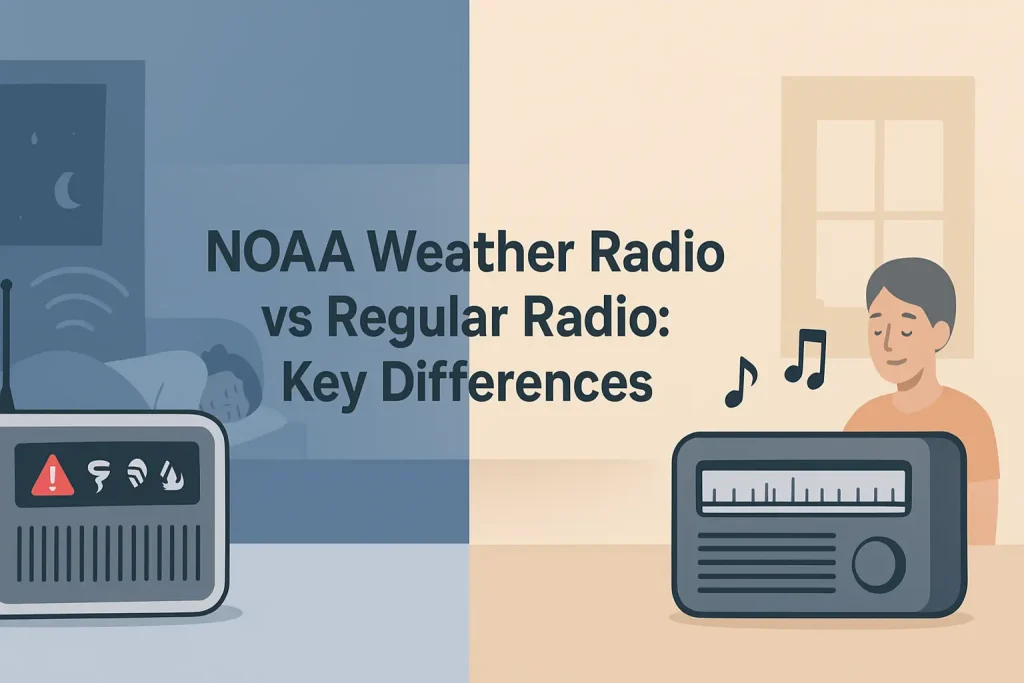
A flash flood can go from a dry creek bed to a 10-foot wall of water in under six minutes. Your smartphone will not save you. Cell towers flood, lose power, and go offline exactly when you need them most. A NOAA weather alert radio broadcasting on 162.400 to 162.550 MHz is the only warning system that works without cell service, internet, or power from the grid.
Flash floods kill more people in the United States each year than tornadoes, hurricanes, or lightning. Most of those deaths happen to people who had no warning or ignored a warning that came too late. This guide explains exactly how a weather radio shortens that gap between danger and action, and what features matter most when seconds count.
| Photo | Popular Portable Walkie Talkies | Price |
|---|---|---|
 | SKIWARRIOR Multifunctional Smart Wireless Ski Goggles with Walkie-Talkie, Anti-Fog Zeiss Lens, Music & Call Function (Cylindrical Blue) | Check Price On Amazon |
 | SINORISE Super Mini Walkie Talkies, Two-Way Radios, 3 Pack | Check Price On Amazon |
 | KOSPET Tank M4C Smart Watch Rugged, Dual-Band GPS, 5ATM & IP69K Waterproof | Check Price On Amazon |
 | Retevis RT15 Walkie Talkies 3 Pack, Birthday Gift, Outdoor Adventure Kit | Check Price On Amazon |
 | Rechargeable Walkie Talkies Toys for Kids: DIY Astronaut Walkie Talkies for Boys Christmas Birthday Gifts for 3 4 5 6 7 8 9 10 Boy Walkie Talkie Outdoor Hiking Toy 2 Way Radio Camping Outdoor Game | Check Price On Amazon |
By the Numbers
Weather Radio and Flash Flood Warning: Key Facts and Specifications
Sources: NOAA National Weather Service, NWR technical documentation, FEMA IPAWS, FCC Part 11.
Why Flash Floods Are the Deadliest Weather Event for People Without a Warning System
Flash floods are responsible for more weather-related deaths in the United States than any other single hazard, according to NOAA National Weather Service historical data. The defining characteristic that makes them so lethal is speed: a drainage basin can fill and overflow within minutes of intense rainfall upstream, even when the sky above you is clear.
Unlike tornadoes, which produce visible rotation and often appear on radar for 20 to 30 minutes before touchdown, flash floods give almost no visual cue at ground level until water is already moving. Radar-based forecasting can detect the rainfall causing the flood, but the warning only protects you if it reaches you fast enough to act.
Cell phone Wireless Emergency Alerts (WEA) are part of the Integrated Public Alert and Warning System (IPAWS), managed by FEMA. They broadcast flash flood warnings to compatible phones in an affected area. However, WEA delivery depends on the cellular network being operational, your phone being powered on, and carrier participation in the alert tier.
During a flash flood event, cell towers in low-lying areas often lose power or become physically damaged within the same timeframe as the flood itself. A NOAA Weather Radio All Hazards (NWR) receiver operates independently of the cellular network entirely. It receives a direct Very High Frequency (VHF) broadcast from a dedicated NOAA transmitter, which runs on hardened backup power systems designed to remain operational during severe weather events.
The National Weather Service issues three distinct alert levels for flash flood situations. A Flash Flood Watch means conditions are favorable for flash flooding to develop. A Flash Flood Warning means flash flooding is imminent or already occurring. A Flash Flood Emergency is a rare, highest-urgency designation used when catastrophic loss of life is considered certain without immediate action.
All three alert types are transmitted via the NWR network using the Specific Area Message Encoding (S.A.M.E.) protocol. S.A.M.E. encodes the alert type, the affected geographic area using a six-digit Federal Information Processing Standard (FIPS) county code, and the valid time window. A properly programmed weather radio decodes this header and activates its alarm only when the alert matches your programmed county or counties.
A weather radio without S.A.M.E. capability will activate for every alert broadcast from that transmitter, which may cover dozens of counties. A weather radio with S.A.M.E. programmed to your specific FIPS code activates only when your area is threatened. This distinction matters at 2:00 a.m. when you need to know whether to wake your family or roll over and go back to sleep.
The single most important thing to understand about flash flood warning time is this: the window between warning issuance and life-threatening conditions can be as short as six minutes. Every minute spent waiting for a cell alert to arrive, or checking social media for confirmation, is a minute you are not moving to higher ground.
How NOAA Weather Radio Broadcasts Flash Flood Alerts: The Technical Path from NWS to Your Alarm
A NOAA Weather Radio All Hazards alert begins at a National Weather Service (NWS) forecast office, where a meteorologist issues a warning product through the Hazard Simplification system. That warning is encoded with S.A.M.E. headers, transmitted via the NOAA NWR network on one of seven VHF frequencies between 162.400 MHz and 162.550 MHz, and received by your weather radio within approximately 90 seconds of issuance.
The seven NOAA NWR broadcast frequencies are 162.400 MHz, 162.425 MHz, 162.450 MHz, 162.475 MHz, 162.500 MHz, 162.525 MHz, and 162.550 MHz. These are designated WX1 through WX7 on most weather radio receivers. Your receiver locks onto the strongest signal from the nearest transmitter automatically when set to scan mode, or you can manually select the correct channel for your area using the NOAA transmitter locator at weather.gov.
This works because the NWR transmitter network uses dedicated VHF high-band frequencies allocated specifically for public safety broadcasting by the FCC. These frequencies are never shared with commercial FM stations, amateur radio, or cellular infrastructure. A weather radio tuned to 162.550 MHz is receiving a signal that no other service can interfere with under normal conditions.
The S.A.M.E. header that precedes every alert contains three pieces of encoded data your radio uses to decide whether to sound the alarm. The first is the event code, which identifies the type of alert (FFW for Flash Flood Warning, FFA for Flash Flood Watch, FFE for Flash Flood Emergency). The second is the FIPS location code, a six-digit number identifying the affected state and county. The third is the valid time, encoded in hours and minutes from the time of broadcast.
When your weather radio receives a broadcast, its S.A.M.E. decoder compares the received FIPS code against the codes you have programmed into memory. If there is a match, the alarm activates regardless of whether your radio is set to mute, regardless of the time of day, and regardless of whether the radio’s main speaker is turned down. The alarm circuit bypasses the volume control by design.
If the FIPS code does not match any of your programmed codes, the radio remains silent. This is the core operational advantage of S.A.M.E. technology for flash flood preparedness: you receive the alert for your county, and only your county, the moment the NWS issues it.
The Midland WR400 weather radio supports up to 50 programmable S.A.M.E. location codes, meaning you can monitor multiple counties simultaneously, which is critical if you live near a county border or travel frequently.
Key Specifications (Midland WR400):
- Frequencies: 162.400 to 162.550 MHz (all 7 NOAA channels)
- S.A.M.E. alert types: 25 event categories including Flash Flood Warning and Flash Flood Emergency
- Programmable FIPS codes: up to 50 location codes
- Power: AC adapter with 6x AA alkaline battery backup
- Alert memory: stores and displays last 14 alerts received
The failure mode to understand here is this: if you never program your FIPS code, your weather radio defaults to alerting on all events for the entire transmitter coverage area. Depending on your transmitter, that can mean alerts for counties 80 to 100 miles away. Program your six-digit FIPS code before the first storm of the season, not during it.
Understanding this technical path from NWS office to your alarm helps you appreciate why weather radio is faster and more reliable than cellular alerts for flash flood events specifically. The next question is which radio features actually matter when the warning arrives at 3:00 a.m. and you have four minutes to decide.
What Flash Flood Watch, Warning, and Emergency Mean on Your Weather Radio
A Flash Flood Watch, a Flash Flood Warning, and a Flash Flood Emergency are three distinct alert products issued by the National Weather Service, each encoded with a different event code in the S.A.M.E. system and each requiring a different response from you. Treating all three as equivalent is one of the most dangerous habits a weather radio user can develop.
A Flash Flood Watch (S.A.M.E. event code: FFA) means conditions are favorable for flash flooding to develop within the watch area, typically within the next 12 to 48 hours. Heavy rainfall is forecast but has not yet begun producing flooding. The correct response is to review your evacuation route, charge backup devices, and ensure your weather radio batteries are fresh.
A Flash Flood Warning (S.A.M.E. event code: FFW) means flash flooding is imminent or currently occurring in the warned area, based on radar-indicated rainfall rates, stream gauge data, or spotter reports. The valid time window is typically one to six hours. The correct response is immediate movement to higher ground if you are in a flood-prone area, low-water crossing, campsite, or river drainage. Do not wait to see water.
A Flash Flood Emergency (S.A.M.E. event code: FFE) is a rare, rarely-issued designation reserved for catastrophic, life-threatening flash flooding that is already occurring and is producing or expected to produce loss of life. The NWS issues fewer than 100 of these per year nationally. When a Flash Flood Emergency triggers your weather radio alarm, the only appropriate response is immediate evacuation if physically possible.
Most S.A.M.E.-capable weather radios allow you to configure alert priority settings, meaning you can set the radio to alarm for warnings and emergencies only, without sounding for watches. This setting matters significantly for flash flood preparedness because watch alerts may arrive multiple times per day during active weather patterns. Programming your radio to alarm only on FFW and FFE events reduces alarm fatigue while ensuring you are woken for life-threatening conditions.
The Uniden BC365CRS and the Midland WR120 both support per-event-type alert filtering, allowing you to enable or disable the alarm for each of the 25 S.A.M.E. event categories independently.
One critical distinction that most weather radio guides fail to explain: the Flash Flood Emergency alert activates the Emergency Alert System (EAS) tone, which is a two-tone attention signal at approximately 853 Hz and 960 Hz, followed by the digital S.A.M.E. header burst. Your radio must be designed to decode the EAS tone sequence correctly to distinguish an Emergency from a standard Warning. All NWR-certified radios sold after the FCC’s current EAS rules took effect are required to decode this sequence, but older pre-certification units may not differentiate correctly.
Knowing the difference between these three alert levels, and configuring your radio to respond appropriately to each, is the foundational skill for using a weather radio as a genuine life-safety tool rather than just a noise generator on your nightstand.
S.A.M.E. Technology: How County-Level Filtering Saves Lives in Flash Flood Events
S.A.M.E. (Specific Area Message Encoding) is the digital subcarrier technology embedded in every NOAA NWR broadcast that allows your weather radio to filter alerts by geographic area. Without it, a single NWR transmitter covering a 40-mile radius would activate your alarm for every county in that area simultaneously. With it, your radio alarms only when the six-digit FIPS code in the broadcast matches the counties you have programmed.
The FIPS code structure is straightforward. The first two digits identify the state using FIPS state codes (for example, 47 for Tennessee, 06 for California). The next three digits identify the specific county within that state. The sixth digit is a subdivision modifier (0 for the entire county, 1-9 for specific NWS-defined sub-county zones used in some coastal and mountainous regions). For most users in flat or suburban terrain, programming the standard six-digit county FIPS code is sufficient.
This matters enormously for flash flood preparedness because flash flood warnings are among the most geographically specific alerts the NWS issues. A warning may cover only two or three counties in a single drainage basin while adjacent counties remain under no alert. A weather radio without S.A.M.E. programmed correctly will either alarm for all counties (creating fatigue) or miss the specific county warning entirely (creating a false sense of safety).
You can find your county’s FIPS code at the NOAA Weather Radio website (weather.gov/nwr) using the state and county lookup tool. Write the code down and program it into your radio during setup, not during an active weather event. Most weather radios accept between 5 and 50 programmable location codes depending on the model.
The Sangean CL-100 supports up to 25 programmable FIPS codes and includes a backlit display that shows the alert type and affected FIPS area when the alarm activates, allowing you to confirm immediately whether the warning is for your specific county or an adjacent one.
Key Specifications (Sangean CL-100):
- Frequencies: all 7 NOAA WX channels (162.400 to 162.550 MHz)
- S.A.M.E. programmable codes: 25 FIPS locations
- Alert types supported: all 25 NWS event categories
- Display: backlit LCD showing event type and FIPS code on alarm
- Power: AC with 3x AA alkaline battery backup
One detail that almost no consumer weather radio guide explains: you can program multiple FIPS codes for counties upstream from your location. Flash floods travel downstream from their origin point. If you live along a river, the flood that reaches you may have been triggered by rainfall in a county 30 miles upstream. Programming that upstream county’s FIPS code into your weather radio gives you additional warning time beyond the warning issued for your own county.
This upstream monitoring technique is particularly valuable for residents of river valleys, canyon communities, and agricultural areas adjacent to dam infrastructure. The few additional minutes of warning time gained from monitoring an upstream county can represent the difference between an orderly evacuation and a crisis exit.
S.A.M.E. technology is the single feature that separates a genuine emergency notification tool from a weather broadcast receiver. Program it correctly, and your weather radio becomes a county-specific alarm system that activates only when your life is at risk.
The following widget shows you how alert lead time, radio type, and S.A.M.E. programming interact for flash flood preparedness across three common situations.
Emergency Guide
Flash Flood Alert Setup: Which Radio Configuration Fits Your Situation
Answer 2 questions to get a tailored weather radio configuration recommendation for flash flood preparedness.
The 13 Types of Flash Flood and Flood Alerts Your Weather Radio Can Receive
NOAA Weather Radio All Hazards broadcasts alerts for 25 distinct event categories using the S.A.M.E. system. Of those 25, 13 are directly related to flooding, flash flooding, and hydrological hazards. Understanding which codes your radio recognizes, and which ones you should configure to trigger an alarm versus a silent alert, is essential for practical flash flood preparedness.
Use the table below to understand which flood-related S.A.M.E. event codes exist, what each means, and the appropriate alarm configuration for each.
| S.A.M.E. Code | Event Name | Urgency Level | Recommended Alarm Setting |
|---|---|---|---|
| FFE | Flash Flood Emergency | Catastrophic | Always ON |
| FFW | Flash Flood Warning | Imminent / Occurring | Always ON |
| FFA | Flash Flood Watch | Elevated Risk | ON for river valley locations |
| FLW | Flood Warning | Imminent / Occurring | Always ON |
| FLA | Flood Watch | Elevated Risk | Situational |
| FLS | Flood Statement | Informational | Optional |
| CFW | Coastal Flood Warning | Imminent / Occurring | Coastal areas: ON |
| CFA | Coastal Flood Watch | Elevated Risk | Coastal areas: Situational |
| LSW | Lakeshore Flood Warning | Imminent / Occurring | Great Lakes areas: ON |
| LSA | Lakeshore Flood Watch | Elevated Risk | Great Lakes areas: Situational |
| DAW | Dam Watch | High | Downstream areas: Always ON |
| DBA | Dam Break Warning | Catastrophic | Always ON for all locations |
| HYS | Hydrologic Statement | Informational | OFF (informational only) |
Two codes in this table deserve specific attention for residents near dams or controlled water infrastructure. DAW (Dam Watch) is issued when dam failure is possible due to elevated water levels, structural concerns, or upstream conditions. DBA (Dam Break Warning) is issued when a dam has already failed or failure is imminent. If you live downstream from any dam, even a small agricultural dam, enabling both DAW and DBA on your weather radio is not optional.
The NWS has a dam information resource at water.weather.gov that maps downstream inundation zones for federally regulated dams. Cross-reference your address against that map. If you are in an inundation zone, the Dam Watch and Dam Break events may be more immediately life-relevant to you than the Flash Flood Warning codes that most guides emphasize.
Configuring your weather radio correctly for all relevant flood event codes, not just the most commonly discussed FFW, is the difference between a complete early warning system and a partial one.
Battery Backup: Why Grid Power Fails Exactly When You Need Your Weather Radio Most
The timing of power outages during flash flood events is not random. The same conditions that produce flash flooding, including intense localized rainfall, high winds, and storm surge, are exactly the conditions that damage power infrastructure. According to FEMA’s National Preparedness Report, power outages affect more households during flooding events than any other infrastructure failure type. A weather radio that requires AC power is most likely to fail during the first 30 minutes of a major flash flood event, which is precisely when it is most needed.
Weather radios use four distinct backup power technologies, each with different operational characteristics during a flood emergency. Understanding these differences helps you select a radio that will remain functional when grid power fails.
Alkaline AA or AAA battery backup is the most common configuration in desktop weather radios. The Midland WR120B uses 3x AA alkaline batteries as backup. Alkaline batteries do not require charging, do not degrade from sitting unused, and perform reliably across a wide temperature range. The practical backup duration for a desktop weather radio in receive-only mode with the alarm active is typically 40 to 72 hours on fresh alkaline batteries, depending on alarm activity level.
Internal rechargeable lithium-ion or NiMH battery packs are used in portable and combination radios. The Midland ER310 includes an internal 2000 mAh lithium-ion battery pack that provides approximately 12 to 18 hours of receive operation when fully charged. The critical limitation is that this battery must be charged before the storm arrives. A rechargeable radio with a depleted internal battery provides zero backup capability.
Hand-crank generators are included in emergency portable radios as a last-resort power source. The typical power generation rate for a hand crank is 1 to 2 minutes of operation per 1 minute of sustained cranking. This is sufficient to hear a weather alert broadcast but not to run the radio continuously through a multi-hour event. Hand-crank capability should be treated as supplemental, not primary backup power.
Solar charging panels are integrated into multi-power portable radios like the Kaito KA500. Solar charging is useful during daytime power outages in clear or partly cloudy conditions but provides no benefit at night or during the overcast conditions that typically accompany flood-producing storms. Solar capability is valuable for extended power outages in the days following a flood event, not during the event itself.
The recommended configuration for flash flood preparedness is a desktop NWR-certified weather radio with alkaline battery backup as your primary alert device, plus a portable multi-power unit as a secondary device. Keep fresh alkaline batteries installed in the desktop unit year-round. Charge the portable unit fully at the start of each storm season and recharge it after each significant use.
One detail that is rarely mentioned: test your battery backup circuit every six months by unplugging the AC power cord while the radio is running. The radio should continue operating without any interruption. If it goes silent or resets, the battery backup circuit or batteries have failed. Discovering a failed backup circuit during a test is far better than discovering it during the first 20 minutes of a flash flood event.
A weather radio with working battery backup, properly maintained, is a 24-hours-a-day monitoring system that requires no action from you to remain operational. That passivity, the fact that it monitors for you while you sleep, is its most important safety characteristic.
Flash Flood Warning Lead Time: How Weather Radio Compares to Other Alert Systems
The average lead time for a Flash Flood Warning issued by the National Weather Service is approximately 20 to 30 minutes, according to NWS performance statistics. That number sounds reassuring until you understand what it means in practice: some warnings arrive 60 minutes before flooding, and some arrive 3 minutes before. The distribution is not uniform, and the shortest lead times tend to occur in the fastest-developing events, which are also the most deadly.
Use the table below to compare how the five main alert delivery systems perform across the factors that matter most during a flash flood event.
| Alert System | Delivery Speed | Works Without Cell Service | Works Without Grid Power | County-Level Filtering | Wakes You While Sleeping |
|---|---|---|---|---|---|
| NOAA Weather Radio (S.A.M.E.) | ~90 seconds from NWS issuance | Yes | Yes (battery backup) | Yes (programmable) | Yes |
| Wireless Emergency Alert (WEA) | 1 to 5 minutes (carrier dependent) | No | No (phone must be charged) | Yes (cell tower polygon) | Yes (if phone not silenced) |
| Local TV or Cable EAS | 1 to 10 minutes | Yes (over-air broadcast) | No (cable requires power) | County crawl shown | Only if TV is on |
| Outdoor Warning Siren | Varies by municipality | Yes | Usually (backup power) | No (zone-wide only) | Only if audible indoors |
| Social Media / News App | Minutes to hours | No | No | No reliable filtering | Only if notifications enabled |
The single dimension where NOAA weather radio is categorically superior to every other system is independence. It does not require cellular infrastructure, internet connectivity, cable television service, or active attention from you. It monitors continuously and activates on its own.
WEA (Wireless Emergency Alert) from the Federal Emergency Management Agency is an effective system when the cellular network is functioning. However, FEMA’s own IPAWS documentation acknowledges that WEA delivery depends on carrier-level implementation and network availability. During a flash flood event that damages local cell infrastructure, WEA may arrive late or not at all for the most severely affected areas, which are precisely the areas most at risk.
Outdoor warning sirens are designed for outdoor notification, not indoor sleeping households. The NOAA NWS explicitly states that outdoor sirens are not a substitute for a weather radio as an indoor warning system. A siren that is clearly audible at 85 dB outdoors may not be audible at all through closed windows, interior walls, and HVAC background noise at 2:00 a.m.
The practical conclusion from this comparison is that a NOAA weather radio with S.A.M.E. and battery backup is not a redundant system for people who already have cell phones. It is a fundamentally different and more reliable system that fills the specific gaps where cellular infrastructure fails during severe weather events.
For a deeper look at how to select and set up the right weather radio for your household, the guide covering top-rated weather radios compared by features and alert performance provides detailed model-by-model analysis across desktop, portable, and combination units.
How to Program Your Weather Radio for Flash Flood Alerts: Step by Step
Programming a weather radio for flash flood alerts requires three distinct steps: selecting the correct NWR frequency for your location, entering your county’s FIPS code, and configuring which alert types trigger the alarm. This process takes approximately five to ten minutes on most models and needs to be completed only once, unless you move or want to add adjacent counties.
Step-by-Step Guide
How to Program a Weather Radio for Flash Flood Alerts
7 steps – Estimated time: 5 to 10 minutes – Applies to most NWR-certified S.A.M.E. radios
Find your FIPS code before touching the radio
Go to weather.gov/nwr and use the state and county dropdown to find your 6-digit FIPS code. Write it on a piece of paper before you begin programming so you do not have to look it up mid-process.
Power on the radio and allow it to scan for the strongest NWR signal
Most weather radios will auto-scan the seven NOAA frequencies (162.400 to 162.550 MHz) and lock on to the strongest signal automatically when first powered on. If yours does not auto-scan, manually select the WX channel listed for your area at weather.gov/nwr under the transmitter search.
Enter programming mode using the SAME or PROG button
On Midland radios, press and hold the SAME button for 3 seconds until the display shows “FIPS” or a dashed entry field. On Uniden radios, press the MENU button and navigate to the SAME setup option. Consult your manual for the exact entry sequence if the display does not respond.
Enter your 6-digit FIPS county code digit by digit
Use the number keys or up/down buttons to enter each digit of your FIPS code. For example, Shelby County, Tennessee uses FIPS code 047157. Confirm each digit before advancing. Most radios display the entered code on screen as you type.
Configure alert type settings to include FFW, FFE, and FFA
After entering your FIPS code, navigate to the alert type menu. Enable Flash Flood Warning (FFW), Flash Flood Emergency (FFE), and, if you are in a river valley or downstream of a dam, Flash Flood Watch (FFA) and Dam Break Warning (DBA). On radios without individual event selection, enable all alerts and accept the broader notification range.
Save the settings and exit programming mode
Press the SAME, PROG, or ENTER button to save your FIPS code and alert settings. The radio should return to its normal receive display showing your selected WX channel. Confirm the S.A.M.E. indicator light or icon is illuminated, which confirms the decoder is active.
Test the alarm circuit immediately after programming
Press the TEST button on your radio to trigger a simulated alarm. Confirm the alarm sounds at full volume, the display shows alert information, and the alarm continues until manually acknowledged. If using battery backup, unplug the AC adapter and run the test again to confirm the backup circuit activates correctly.
After programming, place the weather radio in a location where the alarm will be audible from your sleeping area. The NWS recommends a maximum distance of 30 feet between the radio and the sleeping occupant for reliable alarm audibility through a closed door. If your bedroom is further than 30 feet from the nearest alarm location, consider a secondary portable unit placed closer to the sleeping area.
If you want a complete walkthrough of weather radio features beyond flash flood alerts, the resource covering how to operate and configure a weather radio from initial setup to advanced alert features covers all programming steps and alert type configurations in detail.
The Best Weather Radios for Flash Flood Alerts: What to Look for and What to Avoid
The most important specification for a flash flood weather radio is not speaker loudness, display size, or design. It is NWR certification combined with S.A.M.E. decoding capability and battery backup. Every other feature is secondary. A radio missing any of these three elements is not adequate for nighttime flash flood alerting regardless of its price.
Use the table below to compare the key flash-flood-relevant specifications across leading weather radio models.
| Model | S.A.M.E. Codes | Battery Backup | NWR Certified | Alert Memory | Price (approx.) |
|---|---|---|---|---|---|
| Midland WR400 | Up to 50 | 6x AA alkaline | Yes | 14 alerts | $50 to $70 |
| Uniden BC365CRS | Up to 25 | 3x AA alkaline | Yes | 10 alerts | $40 to $55 |
| Midland WR120B | Up to 25 | 3x AA alkaline | Yes | None | $25 to $35 |
| Sangean CL-100 | Up to 25 | 3x AA alkaline | Yes | 5 alerts | $45 to $65 |
| Midland ER310 (portable) | Yes (county-level) | 2000 mAh Li-ion + AA | Yes | Limited | $55 to $80 |
| Kaito KA500 (portable) | Yes (county-level) | AA + solar + crank | Yes | None | $45 to $65 |
The Midland WR400 is the most capable desktop option for flash flood preparedness specifically because its 50-code S.A.M.E. memory allows simultaneous monitoring of your home county, upstream counties, and dam-adjacent counties without requiring reprogramming. Its 14-alert memory also lets you review recent alert history after a storm passes to understand what warnings were issued and when.
The Midland WR120B is the correct choice if your budget is under $35. It lacks alert memory and is limited to 25 FIPS codes, but it delivers the core functionality: NWR certification, S.A.M.E. decoding, and AA battery backup. For a single-county household with no complex upstream monitoring need, it is completely adequate.
Radios to avoid for flash flood use include any AM/FM combination radio marketed as a “weather radio” that receives the NOAA WX frequencies but does not include S.A.M.E. decoding. These radios receive the audio broadcast but cannot filter by county and will not activate an alarm automatically. They require you to be listening when the alert is broadcast, which provides no protection while you are asleep.
For a complete review of current weather radio models across all price points and form factors, the comparison covering the highest-rated weather radios tested for alert reliability and S.A.M.E. performance provides detailed specifications and recommendations by use case.
Flash Flood Risk by Region: Where Weather Radio Preparedness Is Most Critical
Flash flood risk is not uniform across the United States. Certain geographic regions, terrain types, and seasonal weather patterns create disproportionately higher flash flood frequency and severity. Understanding your regional risk profile determines how aggressively to configure your weather radio and whether upstream county monitoring is necessary.
The highest flash flood mortality regions in the United States, based on NWS historical fatality data, are the Southern Appalachian Mountains, the Desert Southwest (particularly Arizona, New Mexico, and Nevada), the Texas Hill Country, the Ozarks of Missouri and Arkansas, and urban corridor areas along the mid-Atlantic coast. Each region has distinct triggering mechanisms and different warning lead times.
In the Desert Southwest, flash floods are triggered by monsoon convective storms that develop rapidly and dump 1 to 3 inches of rainfall in 30 to 60 minutes over a small area. Canyon systems funnel that water into violent walls of debris-laden flow. Warning lead times in canyon environments can be as short as 3 to 8 minutes from the time a warning is issued to the time water arrives at a downstream point. This is the scenario where the 90-second delivery speed of a NOAA weather radio alert is genuinely the difference between life and death.
In the Southern Appalachians, flash floods are typically driven by slow-moving or stalled frontal systems that produce multi-hour rainfall events. Warning lead times are longer, often 20 to 45 minutes, but the cumulative water volume is much greater. Residents should monitor both Flash Flood Warnings for their immediate county and Flood Warnings for downstream river systems.
Urban flash flooding occurs in all regions where impervious surface area (pavement, rooftops, parking structures) prevents rainfall absorption. A two-inch rainfall in 30 minutes over a dense urban area can produce roadway flooding within 10 to 15 minutes of rainfall onset. WEA cell alerts are generally more effective in urban areas where cell infrastructure is dense and redundant. However, the grid-independence of NOAA weather radio remains valuable during major urban flooding events that damage cell tower power supplies.
Residents living within the estimated downstream inundation zone of any dam should treat their weather radio as a primary life-safety device regardless of region. The NWS issues Dam Watch and Dam Break alerts through the same S.A.M.E. system, and the lead time for dam failure events can be extremely short. FEMA’s National Dam Safety Program maintains a public dam location database that you can use to determine whether any dam’s inundation zone overlaps with your address.
One often-overlooked regional risk is campground and recreation area flash flooding. River campgrounds, slot canyon hike areas, and low-water crossing zones are among the highest-fatality flash flood locations because they attract visitors who are not familiar with local drainage patterns and who may not receive WEA alerts if their phones are off or in a dead zone. A portable weather radio with S.A.M.E. programmed to the relevant county’s FIPS code is the most reliable alerting tool in these environments.
The core message from regional risk analysis is this: your weather radio configuration should reflect your specific terrain, drainage, and dam proximity, not a generic national recommendation. Program the FIPS codes that matter for your physical location, including upstream counties, and enable the alert types that are most likely to be life-threatening in your specific environment.
Quick Reference: Key Weather Radio Terms for Flash Flood Preparedness
Quick Reference
Weather Radio Terminology for Flash Flood Alert Use
Key terms used throughout this guide, defined in plain language. Terms appear in alphabetical order.
- DAW (Dam Watch)
- A S.A.M.E. alert event code issued when a dam failure is considered possible due to elevated water levels or structural concerns. Residents downstream of any dam should enable this alert type.
- DBA (Dam Break Warning)
- A S.A.M.E. alert event code issued when a dam has already failed or is failing imminently. This is a catastrophic-level alert requiring immediate evacuation for anyone in the downstream inundation zone.
- EAS (Emergency Alert System)
- The federal public warning system that distributes emergency alerts through broadcast television, radio, cable, and NOAA weather radio. The two-tone attention signal preceding a major alert is the EAS activation tone.
- FFE (Flash Flood Emergency)
- The highest-urgency flash flood S.A.M.E. event code, issued for catastrophic, life-threatening flooding that is currently occurring and producing or expected to produce loss of life. Fewer than 100 are issued nationally per year.
- FFW (Flash Flood Warning)
- A S.A.M.E. event code indicating flash flooding is imminent or currently occurring based on radar, stream gauges, or spotter reports. Immediate movement to higher ground is the appropriate response.
- FIPS Code
- Federal Information Processing Standard code: a 6-digit number identifying a specific US state and county. Your county’s FIPS code is what you program into your weather radio’s S.A.M.E. decoder to filter alerts to your geographic area.
- FLA (Flood Watch)
- A S.A.M.E. event code indicating conditions are favorable for river or stream flooding to develop. Unlike a Flash Flood Watch, this applies to slower-onset riverine flooding over hours to days.
- IPAWS (Integrated Public Alert and Warning System)
- FEMA’s system that aggregates NWS alerts and distributes them through multiple channels including NOAA weather radio, Wireless Emergency Alert (WEA) on cell phones, and broadcast EAS. NOAA weather radio is one of the fastest IPAWS delivery channels.
- NWR (NOAA Weather Radio All Hazards)
- The national network of over 1,000 VHF radio transmitters operated by NOAA that broadcasts weather forecasts, watches, warnings, and non-weather emergency alerts 24 hours a day on seven dedicated frequencies between 162.400 and 162.550 MHz.
- S.A.M.E. (Specific Area Message Encoding)
- The digital header protocol embedded in every NWR broadcast that encodes the alert type, affected FIPS county codes, and valid time. A weather radio with S.A.M.E. decoding can filter alerts to activate only for your specific programmed counties.
- WEA (Wireless Emergency Alert)
- Cell-broadcast alert messages sent by FEMA via carrier networks to compatible phones in an affected geographic area. WEA requires functional cell tower infrastructure and a powered, charged phone to deliver the alert.
What to Do When Your Weather Radio Activates a Flash Flood Warning
A weather radio alarm at 2:00 a.m. activates a four-second window during which you need to make one decision: is this a Warning for my area, and do I need to move? Everything else follows from that single decision. Having a practiced response plan before the alarm ever sounds is what separates a controlled evacuation from a chaotic one.
When the alarm activates, silence the alert tone and listen immediately to the broadcast. The audio message following the S.A.M.E. header burst identifies the event type, the affected counties by name, the valid time period, and the specific actions recommended by the NWS. The first 15 to 20 seconds of the audio contain all the information you need to make your decision.
If the alert is a Flash Flood Warning (FFW) for your county and you are in a flood-prone location, low-lying area, near a drainage channel, or in a mobile home or basement unit, begin moving to the highest available floor immediately. Do not wait for visual confirmation of water. Flash floods can arrive as a wall of water with no prior surface-level indication.
If the alert is a Flash Flood Emergency (FFE) for your county, treat it as an immediate evacuation order. This alert level is reserved for catastrophic events where fatalities are considered nearly certain without action. Do not wait, do not gather non-essential belongings, and do not attempt to drive through any water of unknown depth.
Never drive into a flooded roadway regardless of vehicle size. According to NOAA NWS data, approximately 50% of all flash flood fatalities occur in vehicles. Moving water 12 inches deep generates 500 pounds of lateral force on a standard vehicle. Two feet of water is sufficient to float and carry most passenger vehicles downstream.
If you live downstream of a dam, a Flash Flood Watch or Dam Watch alert is your signal to review your evacuation route and confirm it does not cross any low-water bridges or roads in a dam inundation zone. Have go-bags accessible and vehicle tanks above half-full before flash flood season begins in your region.
After the event, use your weather radio’s alert memory (on models like the Midland WR400) to review the sequence of alerts received, the times they were issued, and the valid time windows. This post-event review helps you understand the warning timeline and improves your response planning for future events.
The action plan structure described above works only if your weather radio is positioned to wake you reliably. Place it within 30 feet of your sleeping area, confirm the alarm volume is at maximum, and verify the battery backup is functional. A weather radio that does not wake you provides no protection regardless of how accurately it receives the alert.
Weather Radio for Flash Floods at Campsites, Trails, and Backcountry Locations
Flash flood risk at outdoor recreation sites is structurally different from residential risk in one critical way: your cell phone is far more likely to be in a dead zone, powered off, or without a local carrier signal. A portable NOAA weather radio is the only reliable alerting tool for backcountry and remote recreation environments.
Canyon hiking, slot canyon exploration, and river corridor camping are the highest-risk outdoor activities for flash flooding because the terrain itself concentrates and accelerates water. A storm 20 miles upstream, completely invisible from your location, can send a debris-laden wall of water through a dry canyon in minutes. The NWS issues Flash Flood Warnings for these events, but that warning only protects you if it reaches you before the water does.
The Midland ER310 is the most practical portable option for backcountry flash flood monitoring. It weighs 11.4 ounces, receives all seven NOAA WX channels with S.A.M.E. filtering, and operates on its internal 2000 mAh lithium-ion battery for approximately 12 hours in receive mode. An AA battery tray provides backup when the internal pack is depleted.
Key Specifications (Midland ER310):
- Weight: 11.4 ounces
- Frequencies: all 7 NOAA channels (162.400 to 162.550 MHz)
- Battery: 2000 mAh Li-ion internal + AA alkaline backup tray
- S.A.M.E.: county-level FIPS filtering supported
- Additional features: USB phone charging output, SOS flashlight, hand crank emergency charging
Before any backcountry trip, look up the FIPS code for the county containing your destination using weather.gov/nwr. Re-program the radio to that county’s code before departure. This takes approximately two minutes and ensures your radio alarms for the correct geographic area, not your home county hundreds of miles away.
For slot canyon and narrow canyon hiking specifically, the NWS recommends checking not only your destination county but also all counties upstream in the same watershed. The official NWS guidance for visitors to areas like Antelope Canyon, Zion Narrows, and similar slot canyons explicitly states that a Flash Flood Watch or Warning for any upstream county is sufficient reason to exit the canyon immediately.
Keep your portable weather radio powered on and positioned in your tent vestibule or pack top pocket when sleeping at a riverside or canyon campsite during forecast precipitation periods. The alarm circuit bypasses the volume control and will activate at full alarm volume regardless of your radio’s speaker setting, provided the S.A.M.E. decoder is active.
For backcountry preparedness beyond weather radio, the guide covering building a complete emergency communication kit for outdoor and off-grid situations covers the full range of devices, protocols, and power strategies for extended remote use.
Why Weather Radio Is Faster Than Your Phone for Flash Flood Warnings
The speed difference between NOAA weather radio and Wireless Emergency Alert (WEA) delivery for flash flood warnings comes from fundamentally different transmission architectures. Weather radio is a one-way, continuously broadcasting VHF signal that your receiver decodes passively in real time. WEA is a cell broadcast message that must traverse FEMA’s IPAWS aggregation system, then carrier-level distribution networks, then individual cell tower transmission queues before reaching your phone.
The NOAA NWR network transmits the S.A.M.E.-encoded alert directly from the originating NWS forecast office with no intermediate aggregation step. The total path is: NWS meteorologist issues warning product, warning is encoded and sent to local NWR transmitter, transmitter broadcasts on 162.400 to 162.550 MHz, your receiver decodes the S.A.M.E. header, alarm activates. This path typically completes in approximately 90 seconds from the moment the NWS issues the warning product.
WEA delivery adds multiple steps to this path. The NWS warning product must first be ingested by IPAWS, then classified and formatted for WEA broadcast, then distributed to individual carriers, then queued and transmitted from cell towers in the affected area, then received and displayed by individual handsets. Under normal conditions, this process takes 1 to 5 minutes. Under congested network conditions, which are common during major weather events when millions of people are simultaneously calling and texting, WEA delivery can be delayed significantly.
The FCC has documented WEA delivery delays in post-event analyses of major flash flood events. The 2018 Ellicott City, Maryland flash flood, which produced a catastrophic second major flood event within 24 months at the same location, highlighted concerns about alert delivery latency during rapidly developing events with lead times under 10 minutes.
One additional factor that weather radio addresses and WEA does not: WEA requires your phone to be powered on, charged, and connected to a carrier signal. A person sleeping with their phone in Do Not Disturb mode, or with a depleted battery, or in a basement apartment with poor carrier coverage, receives no WEA alert. A weather radio with active S.A.M.E. monitoring and battery backup provides an alert regardless of phone status, network congestion, or grid power availability.
This is not an argument against using WEA. Both systems together provide more protection than either system alone. The point is that a weather radio is not redundant coverage of something your phone already does. It is coverage for the specific failure modes where your phone does not work, which are disproportionately likely to occur during the events where the alert matters most.
To understand what NOAA Weather Radio is, how it functions as a broadcast system, and why it was designed the way it was, the foundational resource explaining the NOAA Weather Radio All Hazards network and how it differs from commercial broadcast radio provides the complete technical and operational context.
Common Weather Radio Mistakes That Reduce Flash Flood Warning Effectiveness
The most dangerous weather radio setup is one that appears to be working but will not alert you when a flash flood warning is issued for your county. Most of these failures are invisible during normal operation. They only become apparent when the alarm fails to sound during an actual event, at which point the consequences are potentially fatal.
The single most common programming error is leaving the radio in its factory default state without programming a FIPS code. A factory-default weather radio with no FIPS code programmed will either alert on every event for the entire transmitter coverage area (which causes alarm fatigue and leads users to silence the radio) or will not alert at all if the radio is set to S.A.M.E. mode but has no codes entered. Check that your radio displays a county name or FIPS code on screen in S.A.M.E. monitoring mode.
The second most common failure is exhausted or failed battery backup. A weather radio that shows “battery low” on its display and was never replaced will provide no backup protection when grid power fails during a storm. Replace alkaline batteries at the start of each spring storm season regardless of whether they have been used. Alkaline batteries self-discharge over 12 to 24 months even without any load.
A third critical failure mode is incorrect NWR channel selection. If your radio is locked on the wrong WX frequency, it may receive a weak, intermittent signal from a distant transmitter rather than the strong signal from your nearest transmitter. Use the NOAA NWR transmitter locator at weather.gov/nwr to confirm which frequency (WX1 through WX7, corresponding to 162.400 through 162.550 MHz) is the correct channel for your location.
A fourth mistake is disabling the alarm tone to reduce nighttime disturbances. Some users reduce the radio’s alarm volume after being woken by distant-county alerts. If you have programmed your FIPS code correctly, the frequency of nighttime alarms should be manageable. If alarms are still too frequent, narrow your alert type selections to Warning and Emergency only, rather than reducing volume or disabling the alarm circuit entirely.
A fifth error applies specifically to portable radios used in backcountry settings: failing to reprogram the FIPS code when traveling to a new area. A portable radio programmed to your home county’s FIPS code will not activate for a Flash Flood Warning issued for a canyon county 300 miles away. Always reprogram for your destination county before departure.
The underlying principle behind all these mistakes is the same: a weather radio that is not tested and verified after programming provides a false sense of security. Run a complete test after every programming change, after every battery replacement, and at the start of each storm season. A radio that passes a test is a radio you can trust at 3:00 a.m.
Does a Weather Radio Work Without Power During a Flash Flood?
Yes, a weather radio with alkaline battery backup or an internal rechargeable battery operates without grid power for the duration of the backup battery’s charge. A desktop unit like the Midland WR400 running on 6x AA alkaline batteries in receive-only mode with S.A.M.E. monitoring active will operate for 40 to 72 hours depending on alarm frequency and display brightness settings. This is sufficient backup duration for the vast majority of flash flood events and their immediate aftermath.
The key condition is that the backup batteries must be functional before the power outage occurs. A weather radio that has never had its battery backup tested may have corroded terminals, exhausted alkaline cells, or a failed backup circuit that prevents the switchover from AC to battery. Test the backup circuit at least twice per year by unplugging the AC adapter while the radio is operating and confirming it continues without interruption.
Portable multi-power radios like the Kaito KA500 add solar and hand-crank charging as tertiary power sources. These are genuinely useful for extended post-flood power outages that last two to five days, but they should not be relied upon as primary backup during the event itself. Charge the internal battery to full before storm season and keep AA alkaline cells installed as the immediate backup layer.
Can I Use My Phone Instead of a Weather Radio for Flash Flood Alerts?
A phone with Wireless Emergency Alerts enabled receives Flash Flood Warnings pushed by FEMA’s IPAWS system to all compatible devices in the warned area. This system works effectively when the cellular network is functional, your phone is charged, and you are within coverage of a cell tower that is transmitting WEA broadcasts. The problem is that all three of these conditions are most likely to fail simultaneously during major flash flood events.
A cell phone does not monitor continuously in the same way a weather radio does. WEA is a push notification that arrives only after traveling through multiple network layers, which takes 1 to 5 minutes under normal conditions. A weather radio receives the S.A.M.E.-encoded alert directly from the NOAA NWR transmitter within approximately 90 seconds of NWS issuance, independently of the cellular network.
The correct answer for maximum flash flood protection is to use both systems. Keep WEA enabled on your phone as a secondary alert. Use a dedicated NOAA weather radio with S.A.M.E. as your primary system. The two systems fail under different conditions, so having both means you have coverage when either one fails. Relying exclusively on your phone means accepting all of its single points of failure as your only early warning system.
How Far Away Does a Flash Flood Have to Be for My Weather Radio to Alert Me?
Your weather radio alerts you based on the geographic area designated in the Flash Flood Warning, not based on physical proximity of the flood to your address. A Flash Flood Warning for your county FIPS code will activate your alarm whether the flooding is occurring two miles from your home or twenty miles away within the same county. The NWS issues county-level warnings, not address-level warnings.
This means your weather radio provides no information about how close the flood water is to your specific location. It tells you that flash flooding is occurring or imminent within your warned county. Your own knowledge of local terrain, drainage patterns, and proximity to waterways determines whether the warning requires immediate action from you specifically.
For residents in large counties, this can create ambiguity. A Flash Flood Warning for a county that spans 800 square miles may be specific to one drainage basin on the opposite side of the county. The audio broadcast following the S.A.M.E. header will typically name the specific drainage areas, roads, or communities most at risk, which is why listening to the full broadcast message is important even after you have identified the event type and county from the alarm display.
What Is the Difference Between a Flash Flood Warning and a Flood Warning on My Weather Radio?
A Flash Flood Warning (S.A.M.E. code FFW) indicates rapidly developing, sudden flooding with a lead time typically measured in minutes to a few hours. Flash floods are caused by intense, localized rainfall or dam failure and can develop with little or no visual warning at your location. The NWS issues Flash Flood Warnings when flood onset is expected within six hours of the causative event.
A Flood Warning (S.A.M.E. code FLW) indicates riverine or general flooding of a river, stream, or drainage area that is developing over a longer timeframe, typically hours to days. River flooding follows predictable stages based on upstream rainfall, snowmelt, or dam release data, and the NWS can often forecast river cresting 12 to 48 hours in advance. The response to a Flood Warning is monitoring and preparation, not necessarily immediate evacuation.
The practical difference for weather radio configuration is that Flash Flood Warnings require your alarm to be enabled and set for immediate response, while Flood Warnings may be appropriate to configure as a non-alarm alert that activates your radio’s display and audio broadcast but does not sound the full alarm tone. Most S.A.M.E.-capable radios allow this per-event-type configuration. Set FFW and FFE to full alarm mode and FLW to alert-only mode unless you live on a riverbank or in a low-lying floodplain, in which case FLW should also trigger a full alarm.
Do I Need a Weather Radio If I Live in a High-Rise Building or on an Upper Floor?
Yes, for two reasons that are distinct from the immediate flooding threat. First, flash flood warnings often accompany or immediately precede severe thunderstorm and tornado conditions, meaning a Flash Flood Warning activation on your weather radio is a signal to monitor for additional hazards regardless of your floor level. Second, a high-rise on an upper floor is not immune to evacuation orders when flooding affects access roads, building utility systems, or underground parking structures.
The more relevant concern for upper-floor urban residents is the downstream effects of flash flooding: road closures that trap you at home, utility outages that cut elevator power, and communication infrastructure failures that reduce cell coverage. A weather radio operating on the NOAA VHF network with battery backup provides alert coverage and weather broadcast capability during all of these scenarios, independent of the cellular or internet infrastructure that upper-floor residents typically rely on.
Additionally, urban residents should configure their weather radio for Flash Flood Emergency (FFE) and Dam Break Warning (DBA) alerts regardless of floor level. A dam failure event upstream can inundate urban street-level infrastructure within minutes and create conditions that trap residents in buildings regardless of their elevation above the initial flood level.
Can a Weather Radio Alert Me for Flash Floods When I Am Sleeping With Headphones or a Sound Machine Running?
A weather radio alarm circuit is designed to override the volume control and produce its alert tone at maximum speaker output regardless of the main volume setting. The alarm typically produces 85 to 95 dB at one meter from the speaker on NWR-certified desktop models. This is equivalent to a running lawn mower at close range and is designed to penetrate closed doors and moderate ambient noise.
However, 85 to 95 dB at one meter attenuates with distance. At 10 meters through a closed door, the effective level may drop to 60 to 70 dB, which may not be audible over a white noise machine running at similar levels in the same room. If you sleep with a sound machine, place the weather radio in your bedroom rather than in an adjacent room, or use a weather radio model that includes a strobe light alert (such as the Midland WR300) which activates a visual alarm in addition to the audio tone.
Some weather radio models also include a bed shaker port or a 3.5mm output jack that can connect to a pillow vibrator or external alarm device. These accessories are designed for hearing-impaired users but are equally effective for any user whose sleep environment includes significant ambient noise. The additional physical alert provides redundancy that compensates for the acoustic limitations of a distant or occluded speaker.
Is a Weather Radio Required by Law for Campgrounds or RV Parks?
No federal law requires campgrounds or RV parks to provide weather radios or NOAA weather monitoring equipment. Some state emergency management regulations or campground licensing requirements in high-risk states (including Texas, Missouri, and North Carolina) include provisions about storm warning systems, but these are state-level rules and vary significantly by jurisdiction and facility type. No universal federal requirement exists as of the current regulatory framework under FCC Part 11 and FEMA IPAWS guidelines.
The practical implication is that you cannot rely on a campground to notify you of a flash flood warning. The responsibility for monitoring flash flood alerts at a campsite falls entirely on the individual camper. Bring your own portable weather radio with S.A.M.E. programmed for the destination county. Do not assume that a campground host, ranger station, or outdoor siren system will provide adequate warning for rapidly developing flash flood events in the middle of the night.
For anyone planning extended outdoor trips, the guide covering how to build a complete weather radio preparedness setup for camping and remote locations covers portable radio selection, FIPS code planning for multi-county trips, and power management strategies for extended off-grid use.
How Do I Know Which NOAA Weather Radio Channel to Use for My Area?
NOAA provides a free transmitter lookup tool at weather.gov/nwr where you can enter your state and county to find the nearest NWR transmitter, its broadcast frequency (one of the seven channels between 162.400 and 162.550 MHz), its call sign, and its coverage area. The tool also provides the FIPS code for your county, which you need for S.A.M.E. programming.
The seven NOAA frequencies and their standard WX channel designations are WX1 (162.550 MHz), WX2 (162.400 MHz), WX3 (162.475 MHz), WX4 (162.425 MHz), WX5 (162.450 MHz), WX6 (162.500 MHz), and WX7 (162.525 MHz). Note that WX channel numbering does not follow the frequency order sequentially. Confirm the correct WX channel number for your area using the NOAA transmitter lookup rather than assuming the channel numbers are in frequency order.
Most NWR-certified weather radios include an auto-scan function that scans all seven frequencies and locks on to the strongest received signal automatically when first powered on. This auto-scan result is a reliable indicator of your correct channel in most locations. Confirm the locked channel matches the transmitter lookup result for your area. If they differ, the radio may be locking on to a more powerful but less relevant transmitter from an adjacent region.
What Happens If My Nearest NOAA Transmitter Goes Offline During a Flash Flood Event?
NOAA NWR transmitters are equipped with hardened backup power systems designed to remain operational during severe weather events. Most transmitters run on commercial power with battery and generator backup capable of sustained operation for 24 to 72 hours without grid power. Transmitter failure during a weather event is rare but not impossible, particularly during events that cause widespread infrastructure damage such as major hurricanes or ice storms.
If your primary NWR transmitter goes offline, your weather radio will lose the signal and, depending on the model, display a “no signal” indicator or switch to another channel. Most desktop weather radios do not automatically switch to a backup transmitter. You would need to manually scan to find an adjacent transmitter on a different frequency. Portable radios with active scanning modes may find a backup signal automatically.
The practical mitigation for this scenario is to enable WEA on your cell phone as a backup alert system and to know your secondary NWR transmitter frequency in advance. The NOAA NWR transmitter lookup at weather.gov/nwr shows coverage from multiple transmitters that may overlap your area on different frequencies. Write down the secondary frequency before storm season so you can manually switch your radio if the primary transmitter signal is lost during an event.
To understand the broader landscape of weather hazard alerts beyond flash floods, including how the same weather radio system handles tornado warnings, the comparison between tornado watch and tornado warning alert types and how to interpret each on your weather radio explains the NWS alert tier system across all severe weather categories.
How Often Should I Test My Weather Radio to Make Sure It Will Work During a Flash Flood?
Test your weather radio’s alarm and backup power circuit at minimum twice per year: once at the start of spring storm season and once before winter storm season. In high flash flood risk regions (the Southeast, Southwest, and Great Plains), quarterly testing is more appropriate given the year-round threat profile.
A complete test involves three steps. First, press the TEST button to trigger a simulated alarm and confirm the alert tone sounds at full volume, the display activates, and the event data is shown correctly. Second, unplug the AC adapter while the radio is operating and confirm it continues running on battery backup without interruption or reset. Third, verify that your programmed FIPS code is still stored correctly by navigating to the S.A.M.E. setup menu and reviewing the saved codes.
Replace alkaline backup batteries every 12 months regardless of test results. Alkaline batteries self-discharge over time and may pass a momentary test but fail under sustained load during a multi-hour event. The cost of a set of AA alkaline batteries is trivial compared to the consequence of a failed backup during a 3:00 a.m. Flash Flood Warning. For a complete look at how NOAA weather radio handles hazardous conditions beyond flooding, the resource explaining what a hazmat or chemical emergency alert looks like on a weather radio and how to respond covers the non-weather alert types that use the same S.A.M.E. system.
A weather radio that is tested, programmed, and maintained is a 24-hour monitoring system that requires nothing from you during normal operation. Its value is entirely realized at the single moment when the alarm sounds in the middle of the night and you have six minutes to decide what to do.
Program your FIPS code, enable FFW, FFE, and relevant upstream county codes, test your battery backup today, and put the radio where it will wake you. That is the complete action set. Everything else in flash flood preparedness follows from getting that one device right.
| Photo | TOP RATED WALKIE TALKIES | Price |
|---|---|---|
 | Retevis RT628 Kids Walkie Talkies, Toys Gifts for 4-12 Year Old Girl Boy | Check Price On Amazon |
 | Cobra ACXT545 Weather-Resistant Walkie Talkies, Rechargeable, 22 Channels | Check Price On Amazon |
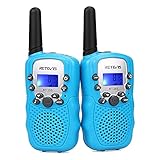 | Retevis RT388 Kids Walkie Talkies, Outdoor Toys for Kids Camping Essentials | Check Price On Amazon |
 | Cobra RX680 Walkie Talkies (2-Pack), IP54 Water Resistant Design | Check Price On Amazon |
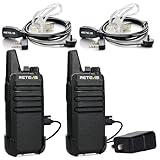 | Retevis RT22 Walkie Talkies Long Range Rechargeable with Earpiece (2 Pack) | Check Price On Amazon |
 | Midland GXT1000VP4 GMRS JIS4 Two-Way Radio, Black,2 Pack | Check Price On Amazon |
 | Retevis RT628 Walkie Talkies for Kids,Toys Gifts for 6-12 Years Old Boys Girls,Long Range 2 Way Radio 22CH VOX,Birthday Gift,Family Walkie Talkie for Camping Hiking Indoor Outdoor | Check Price On Amazon |