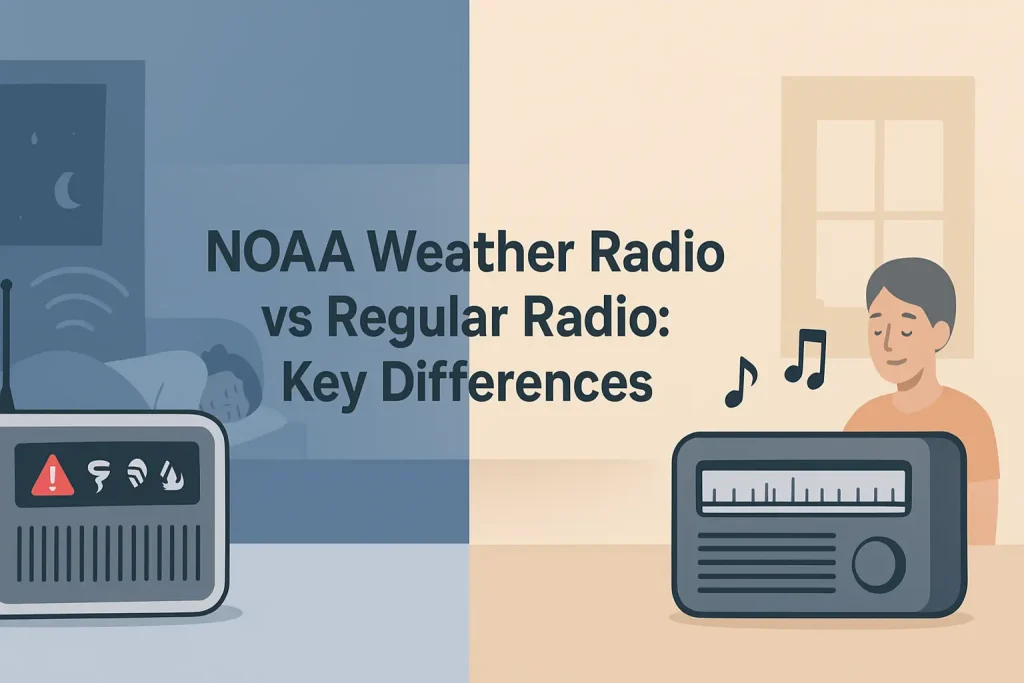
A wildfire can move faster than a car on a residential street. The Dixie Fire in 2021 spread at over 10,000 acres per hour under red flag conditions, and many residents received evacuation orders with less than 15 minutes to act. A NOAA weather radio with S.A.M.E. technology can deliver an evacuation warning directly to your bedside speaker before the first emergency vehicle reaches your street.
Standard smartphone alerts depend on cell towers that go down when wildfires damage infrastructure. A dedicated weather radio receives broadcasts on seven frequencies between 162.400 and 162.550 MHz from NOAA transmitters that operate on backup power, independent of the cellular grid.
| Photo | Popular Portable Walkie Talkies | Price |
|---|---|---|
 | SKIWARRIOR Multifunctional Smart Wireless Ski Goggles with Walkie-Talkie, Anti-Fog Zeiss Lens, Music & Call Function (Cylindrical Blue) | Check Price On Amazon |
 | SINORISE Super Mini Walkie Talkies, Two-Way Radios, 3 Pack | Check Price On Amazon |
 | KOSPET Tank M4C Smart Watch Rugged, Dual-Band GPS, 5ATM & IP69K Waterproof | Check Price On Amazon |
 | Retevis RT15 Walkie Talkies 3 Pack, Birthday Gift, Outdoor Adventure Kit | Check Price On Amazon |
 | Rechargeable Walkie Talkies Toys for Kids: DIY Astronaut Walkie Talkies for Boys Christmas Birthday Gifts for 3 4 5 6 7 8 9 10 Boy Walkie Talkie Outdoor Hiking Toy 2 Way Radio Camping Outdoor Game | Check Price On Amazon |
By the Numbers
Weather Radio for Wildfires – Key Specifications and Standards
Sources: NOAA National Weather Service, FCC Part 95, FEMA IPAWS documentation
What Is a Weather Radio and Why Does It Matter for Wildfire Alerts?
A weather radio is a dedicated radio receiver that monitors NOAA Weather Radio All Hazards (NWR) broadcasts 24 hours a day on seven VHF frequencies between 162.400 and 162.550 MHz. Unlike a smartphone, it does not need cell service, Wi-Fi, or a functioning internet connection to receive alerts.
NOAA NWR is a component of the Emergency Alert System (EAS) and the Integrated Public Alert and Warning System (IPAWS), both managed by FEMA. According to NOAA NWR documentation, the system operates more than 1,000 transmitters nationwide, each broadcasting a continuous loop of hazard information and capable of sending an encoded digital alert that activates compatible receivers.
For wildfire situations specifically, the system issues several distinct alert types. These include Fire Warning, Red Flag Warning, Evacuation Immediate, and Law Enforcement Warning, each encoded with a specific S.A.M.E. (Specific Area Message Encoding) event code.
S.A.M.E. is the technology that makes a weather radio genuinely useful rather than just loud. Without S.A.M.E., your radio sounds an alarm for every alert broadcast by the transmitter, which can cover dozens of counties. With S.A.M.E. programmed to your specific county’s FIPS code, the radio stays silent for alerts in other areas and only activates for your location.
A weather radio without S.A.M.E. in a high-alert state like California will trigger multiple times per night during fire season for areas hundreds of miles away. Program your 6-digit FIPS county code into the radio’s S.A.M.E. memory to receive only the alerts that require you to act.

The radio works while you sleep, while the power is on, and while cellular networks are still functioning. It also works when none of those conditions are true, provided you have battery backup installed.
Understanding what a weather radio is and how S.A.M.E. filtering works is the foundation for using one effectively during wildfire evacuations.
Which NOAA Alert Types Are Issued for Wildfires and Evacuations?
NOAA NWR broadcasts several distinct alert event codes relevant to wildfire and evacuation situations. Each has a different urgency level and a different required action. Knowing which alert type you are hearing tells you exactly how much time you have to act.
According to NOAA NWR S.A.M.E. event code documentation, the codes most directly relevant to wildfire situations are as follows.
- Fire Warning (FRW): Issued when a fire poses an immediate threat to life or property in a specified area. This is the highest-urgency fire alert code broadcast over NWR.
- Red Flag Warning (RFW): Issued by the National Weather Service when weather conditions create extreme fire danger. Issued before a fire starts, it signals that ignition risk is critically high.
- Evacuation Immediate (EVI): Issued when immediate evacuation of a specific geographic area is ordered. This is a civil emergency alert, not a weather alert, but it is broadcast over NWR transmitters under IPAWS integration.
- Law Enforcement Warning (LEW): Issued to warn of a law enforcement action in progress, which in wildfire contexts often accompanies mandatory evacuation enforcement.
- Civil Emergency Message (CEM): A general emergency alert used for life-threatening situations including rapidly advancing fires and road closures due to fire activity.
- Hazardous Materials Warning (HMW): Relevant in wildfire contexts where industrial facilities, propane tanks, or chemical storage sites are in the fire path.
- Air Quality Alert (AQA): Issued when smoke from wildfires creates hazardous air quality conditions. Not an evacuation trigger, but critical for shelter-in-place decisions.
- Special Weather Statement (SPS): Used to convey non-warning fire weather information such as incoming wind events that could accelerate fire spread.
The most critical distinction for wildfire preparedness is between a Red Flag Warning and a Fire Warning. A Red Flag Warning means conditions are dangerous and fires could start or spread rapidly. A Fire Warning means one is already burning and threatening your area.
Your weather radio’s S.A.M.E. decoder can be programmed to respond to specific event codes in addition to specific counties. Some models, including the Midland WR400, allow you to program alert priority levels so the radio sounds a louder alarm for Fire Warnings and Evacuation Immediate alerts than for Air Quality Alerts.
Key Specifications for Midland WR400:
- Frequencies: 162.400 to 162.550 MHz (all 7 NOAA channels)
- S.A.M.E. programmable location codes: up to 50
- Alert event codes monitored: 25+
- Power: AC adapter with 6x AA battery backup
- Alert memory: stores last 14 alerts with date and time stamp
Knowing each alert code and its meaning allows you to set your radio’s alarm response appropriately and avoid treating an Air Quality Alert with the same urgency as an Evacuation Immediate.
How Does S.A.M.E. Technology Filter Wildfire Alerts to Your County?
S.A.M.E. (Specific Area Message Encoding) works by embedding a digital header into each NOAA alert broadcast that contains a 6-digit FIPS (Federal Information Processing Standards) code identifying the specific county or geographic area the alert covers. Your weather radio decodes that header and compares it to the FIPS codes stored in its memory. The alarm sounds only when the codes match.
This happens because NOAA NWR transmitters broadcast alerts for large geographic areas, sometimes covering entire states during wide-scale emergencies. The S.A.M.E. digital header is a sub-audible data burst transmitted at the beginning of each alert, carrying the event code, the affected FIPS codes, and the alert duration. Without a S.A.M.E. decoder in your radio, the receiver has no way to distinguish between a wildfire evacuation in your county and a flood warning 200 miles away.
This only works when you have programmed the correct FIPS code for your county into the radio’s memory. The FIPS code is a 6-digit number, formatted as a 2-digit state code followed by a 3-digit county code, with a leading zero for the county portion (example: 006037 for Los Angeles County, California). You can find your county’s FIPS code on the NOAA NWR website or through the FEMA IPAWS county lookup tool.
If you program the wrong FIPS code, the radio will not alert you for your actual location. This is the single most common setup error with S.A.M.E. weather radios, and it means a correctly functioning radio will appear to be broken during a real emergency.
Some weather radios, including the Uniden BC365CRS and the Sangean CL-100, allow you to store multiple FIPS codes simultaneously. This is useful if you live near a county line, own property in a second county, or want to monitor alerts for a neighboring county where family members live.
To verify your S.A.M.E. programming is working, NOAA conducts weekly required tests and monthly extended tests that broadcast S.A.M.E. coded test messages. These test broadcasts use the event code RWT (Required Weekly Test) and RMT (Required Monthly Test). If your radio alarms during those tests, your FIPS code is programmed correctly.
S.A.M.E. technology is the difference between a weather radio that wakes you up every night during fire season and one that only activates when your county is under a real threat.
What Are the Best Weather Radios for Wildfire and Evacuation Alerts?
The best weather radio for wildfire alerts combines S.A.M.E. county filtering, a battery backup system that functions during power outages, and an alarm loud enough to wake you from sleep. For households in fire-prone areas, the minimum acceptable specification is a radio with S.A.M.E. decoding, at least 4x AA battery backup, and an alarm of at least 85 dB.
Use the table below to compare top-rated weather radios by their wildfire-relevant features.
| Model | S.A.M.E. | Battery Backup | Alert Codes | Alarm (dB) | Price |
|---|---|---|---|---|---|
| Midland WR400 | Yes (50 codes) | 6x AA | 25+ | 90 dB | ~$50 |
| Uniden BC365CRS | Yes (25 codes) | 3x AA | 25+ | 85 dB | ~$45 |
| Sangean CL-100 | Yes (multiple) | 4x AA | 25+ | 90 dB | ~$65 |
| Midland ER310 | Yes | Li-ion + solar + crank | 25+ | 85 dB | ~$70 |
| Kaito KA500 | Yes | Li-ion + solar + crank | 7 WX channels | 80 dB | ~$55 |
| Uniden Homepatrol-2 | Yes (via WX) | Internal Li-ion | 25+ | 85 dB | ~$500 |
For most households in wildfire-prone areas, the Midland WR400 represents the best balance of S.A.M.E. capability, battery backup, and alarm output for the price. If your power grid is unreliable during fire events, the Midland ER310 adds a hand-crank generator and solar panel so the radio can be recharged without grid power or disposable batteries.
For a detailed breakdown of the top-performing models across all use cases, our review of the highest-rated weather radios for home and portable emergency use covers specifications, battery backup types, and programming difficulty for each model.
The right weather radio for wildfire alerts is one you have programmed correctly, placed where the alarm will wake you up, and verified with a weekly test before fire season begins.
How to Program a Weather Radio for Wildfire and Evacuation Alerts
Programming a weather radio for wildfire alerts requires three steps: selecting the correct NOAA broadcast frequency for your area, entering your county’s 6-digit FIPS S.A.M.E. code, and enabling the specific alert event codes relevant to fire and evacuation. Skipping any of these steps means the radio may either fail to alert you or alert you for irrelevant events.
Here is the complete setup process, applicable to most S.A.M.E.-capable weather radios including the Midland WR400, Uniden BC365CRS, and Sangean CL-100.
The following widget walks you through finding the right weather radio setup for your specific wildfire risk situation.
Interactive Tool
Find the Right Weather Radio Setup for Your Wildfire Risk
Answer 2 questions to get a personalized recommendation for your situation.
Follow these steps to complete the full programming sequence on a S.A.M.E. weather radio.
Step-by-Step Guide
How to Program a S.A.M.E. Weather Radio for Wildfire Alerts – Step by Step
7 steps · Estimated time: 10 minutes
Find your county’s 6-digit FIPS S.A.M.E. code
Go to the NOAA NWR S.A.M.E. code lookup at weather.gov or the FEMA IPAWS county lookup tool. Search by state and county name. Write down the 6-digit number (example: 006037 for Los Angeles County, CA).
Identify the strongest NOAA transmitter frequency for your area
The seven NOAA WX frequencies are 162.400, 162.425, 162.450, 162.475, 162.500, 162.525, and 162.550 MHz. Use the NOAA NWR station listing at weather.gov to find the transmitter nearest you and its broadcast frequency. Alternatively, scan all 7 channels on your radio and select the one with the strongest, clearest signal.
Enter the FIPS code into the S.A.M.E. programming menu
Press the S.A.M.E. or PROG button on your radio (varies by model). Navigate to the county code entry field and type in all 6 digits of your FIPS code. On the Midland WR400, press MENU, scroll to S.A.M.E., and enter the code using the number pad.
Enable wildfire-specific event alert codes
In the alert event code menu, enable at minimum: FRW (Fire Warning), RFW (Red Flag Warning), EVI (Evacuation Immediate), CEM (Civil Emergency Message), and LEW (Law Enforcement Warning). Disable low-priority codes like HWO (Hazardous Weather Outlook) if they trigger excessive false alarms in your area.
Set alarm volume to maximum
Navigate to the alarm volume setting and set it to maximum output. For wildfire evacuations, you need the alarm to be audible through a closed bedroom door and above ambient noise from fans or air conditioning units. The Midland WR400 alarm reaches 90 dB at maximum, which is comparable to a lawn mower at 3 feet.
Install battery backup and test it
Insert fresh batteries in the battery compartment. With the radio powered by AC, briefly unplug it to confirm the radio continues operating on battery power without interruption. Replace alkaline batteries once per year minimum, or switch to lithium AA batteries for 2-3 year service life in storage conditions.
Verify programming with the next NOAA weekly test broadcast
NOAA broadcasts a Required Weekly Test (RWT) every Wednesday between 11:00 AM and noon local time. If your radio activates during this test, your FIPS code is correctly programmed. If it does not activate, re-check your FIPS code entry and confirm the radio is set to receive the RWT event code.
Complete all seven steps and verify with the weekly test before fire season begins in your region. A weather radio that has never been tested may have a programming error that prevents it from alerting when a real evacuation order is issued.
How Does a Weather Radio Compare to Wireless Emergency Alerts for Wildfire Evacuations?
Wireless Emergency Alerts (WEA) are the government-issued text messages that push to your smartphone during emergencies. They operate through the cellular broadcast system and are a part of IPAWS alongside NOAA NWR. During wildfire evacuations, both systems may be activated simultaneously, but they have fundamentally different failure modes.
Use the table below to understand which system to rely on under specific wildfire conditions.
| Condition | NOAA Weather Radio | Wireless Emergency Alert (WEA) |
|---|---|---|
| Cell towers down | Continues working | Fails completely |
| Grid power outage | Works on battery backup | Works until phone battery dies |
| Phone is silenced or on Do Not Disturb | Alarms at full volume regardless | May be missed |
| Cell network congestion during evacuation | Not affected by congestion | Delays possible |
| Geographic filtering accuracy | County-level via FIPS S.A.M.E. code | Cell tower polygon (variable accuracy) |
| Nighttime detection while sleeping | Dedicated alarm, always on | Depends on phone being charged and nearby |
| Required equipment cost | $40 to $70 for dedicated radio | No additional cost (phone already owned) |
The critical failure point for WEA during wildfires is cellular infrastructure damage. The 2018 Camp Fire, which destroyed the town of Paradise, California, knocked out multiple cell towers in the affected area before many residents had received any alert. NOAA NWR continued broadcasting on its independent transmitter network throughout the event.
WEA and NOAA NWR are complementary systems, not alternatives. Use both. The weather radio is your backup when cell service fails, and it is the only system that activates a physical alarm in your home without requiring you to be holding a phone.
A dedicated weather radio is not a replacement for your phone’s emergency alerts. It is the system that works when your phone cannot.
What Is the Role of Two-Way Radios During Wildfire Evacuations?
A weather radio receives alerts but cannot transmit. During a wildfire evacuation, you also need the ability to communicate with family members, neighbors, and your evacuation group when cellular networks are overloaded or down. Two-way radios fill this gap by providing point-to-point communication that operates entirely independently of any network infrastructure.
For most households, FRS (Family Radio Service) or GMRS (General Mobile Radio Service) handheld radios are the practical choice for evacuation coordination. FRS radios operate on 22 channels between 462 and 467 MHz, require no license, and are limited to 2 watts on channels 1-14 by FCC Part 95E, Section 95.365. GMRS radios operate on the same frequency band but can transmit at up to 5 watts handheld and 50 watts mobile, and require a $35 FCC family license covering all immediate household members for 10 years.
The practical range difference matters during evacuations. An FRS radio at 2 watts in suburban terrain achieves 0.5 to 1 mile of reliable communication. A GMRS radio at 5 watts in the same environment achieves 1 to 2 miles. If your evacuation plan involves coordinating with people in vehicles on different roads, the extra range of GMRS makes a meaningful difference.
The Midland GXT1000VP4 is a 5-watt GMRS handheld radio rated for rugged outdoor use, with 50 channels, 8 weather alert channels including all 7 NOAA WX frequencies, and a 1,000-hour battery life at 5/5/90 duty cycle.
Key Specifications for Midland GXT1000VP4:
- Radio service: GMRS (FCC Part 95E license required)
- Max power output: 5W
- Channels: 50 GMRS/FRS plus 8 NOAA WX
- Battery: NiMH rechargeable, approximately 10 hours at 5/5/90 duty cycle
- Range (open terrain): up to 36 miles manufacturer claim; realistic suburban range 1-2 miles
- Weather monitoring: receives all 7 NOAA WX frequencies with alert function
For families who want a single device that both receives NOAA weather alerts and provides two-way communication during evacuations, a GMRS radio with built-in weather alert monitoring eliminates the need to carry two separate devices.
The Motorola T800 is another GMRS option with built-in NOAA weather alert scanning and Bluetooth connectivity for hands-free use while driving during an evacuation.
Two-way radios supplement your weather radio by giving you a communication channel when every other network is saturated or down.
How to Build a Wildfire Communication Plan Using Weather Radio and Two-Way Radios Together
A complete wildfire communication plan has three layers: alert reception (your weather radio detects the threat), household coordination (you communicate with people in your home or on your property), and evacuation communication (you maintain contact with your group while moving). Each layer requires a different tool.
Layer 1 uses your programmed S.A.M.E. weather radio, placed where the alarm will wake every sleeping person in the household. The ideal placement is a central hallway or bedroom near the highest-risk sleeping areas. The radio should be plugged into AC power with fresh batteries installed as backup.
Layer 2 uses two-way radios to coordinate between people on the property. If you have a large lot, outbuildings, or family members in a detached structure, FRS radios on Channel 1 (462.5625 MHz) provide reliable short-range coordination during the initial response phase.
Layer 3 uses GMRS radios for evacuation convoy coordination. Program all evacuation party radios to the same GMRS channel before fire season. Channel 20 (462.6750 MHz) is a commonly used simplex GMRS channel for family evacuation communication in California and the western states. Avoid GMRS Channel 23 (467.6750 MHz) and Channel 24 (467.7125 MHz), as these are designated for repeater input only and should not be used for simplex communication.
Your evacuation plan should also designate an out-of-state phone contact who is not in the affected area. This person serves as a message relay point if local networks are overloaded. Give every member of your evacuation group the contact’s number before fire season.
Assign specific radio channels in advance, write them on a laminated card stored in each vehicle’s emergency kit, and conduct a radio check with every member of your group at the start of fire season each year.
A communication plan only works if every person in the group knows their role and has a functioning, charged radio before an evacuation is ordered.
What Wildfire-Specific Radio Equipment Should You Pack in a Go-Bag?
A go-bag (also called a 72-hour kit or bug-out bag) for wildfire evacuations needs radio equipment that operates without any infrastructure, can be used while moving, and has enough battery life to last at least 48 hours. The three critical radio items are a portable weather radio for monitoring NOAA alerts after you leave home, a charged two-way radio for evacuation coordination, and a backup power source for both.
For portable weather monitoring, the Midland ER310 is the most versatile go-bag option. It weighs 1.2 lbs, receives all 7 NOAA WX frequencies with S.A.M.E. decoding, and recharges via solar panel, hand-crank generator, USB, or AA batteries. Its built-in flashlight and SOS strobe add utility beyond radio reception.
For two-way communication, include a pair of rechargeable GMRS handheld radios with a spare battery pack or a vehicle charger adapter. GMRS radios hold a charge for days on standby and can transmit for 8-12 hours at 5/5/90 duty cycle on a single charge. Keep both radios charged at all times, not just when a fire is nearby.
For backup power, a 20,000 mAh USB power bank can recharge most portable weather radios and GMRS radios multiple times. Store it fully charged and replace it if it sits uncharged for more than six months.
Additional go-bag radio accessories worth including are a 12-pack of lithium AA batteries (they perform at full capacity in extreme heat and have a 10-year shelf life), a PTT earpiece for hands-free communication while driving, and a laminated frequency reference card listing your pre-programmed GMRS evacuation channels.
The complete go-bag radio kit weighs under 3 lbs and provides alert monitoring plus two-way coordination for at least 48 hours without any external power source.
How Do Red Flag Warnings Differ from Fire Weather Watches in NOAA Broadcasts?
A Red Flag Warning is issued by the National Weather Service when fire weather conditions are occurring or imminent, typically requiring all three of the following: sustained winds of 25 mph or higher, relative humidity below 15%, and dry fuel moisture content. A Fire Weather Watch is issued 24-72 hours before those conditions are expected, giving emergency managers and the public advance notice to prepare. These are distinct S.A.M.E. event codes: RFW for Red Flag Warning and FWW for Fire Weather Watch.
The critical distinction for weather radio users is that a Red Flag Warning means the conditions that allow a fire to ignite and spread rapidly are present right now. A Fire Weather Watch means those conditions are coming. Both warrant action, but they require different responses.
When your weather radio activates for a Fire Weather Watch (FWW), the appropriate response is preparation: charge all radios, top off vehicle fuel, review your evacuation route, and confirm your go-bag is ready. When it activates for a Red Flag Warning (RFW), the appropriate response is readiness: know where the nearest fire is, stay alert to additional alerts, and be prepared to evacuate on short notice.
Many weather radio users disable the Fire Weather Watch code to reduce alert fatigue during active fire seasons in California, Oregon, and Washington, where Red Flag conditions can occur dozens of times per year. This is a reasonable choice if you live in a lower-risk zone, but households in WUI areas should leave both codes enabled.
According to NOAA National Weather Service fire weather program documentation, Red Flag Warnings are issued based on National Fire Danger Rating System (NFDRS) thresholds, which vary by region. The specific wind speed and humidity thresholds that trigger an RFW in Southern California differ from those in the Pacific Northwest, which is why the same fire weather conditions may generate an RFW in one NWS forecast office jurisdiction but not another.
Understanding the difference between a Fire Weather Watch and a Red Flag Warning lets you calibrate your response and avoid both alert fatigue and dangerous under-reaction.
For a complete breakdown of how NOAA alert language translates into different threat levels and required responses, our explainer on understanding weather statement severity levels and what each one requires you to do covers every alert category in the NOAA system.
How Does Terrain Affect Weather Radio Reception in Wildfire Zones?
NOAA NWR transmitters broadcast on VHF frequencies between 162.400 and 162.550 MHz using vertical polarization with transmit power typically between 300 and 1,000 watts. VHF signals propagate primarily by line-of-sight, meaning ridges, mountains, and dense terrain features between you and the transmitter can block or significantly attenuate the signal.
This matters in wildfire country because the areas at highest fire risk (mountain slopes, canyon communities, chaparral-covered hillsides, and forested ridgelines) are precisely the areas where VHF reception is most variable. A home at the bottom of a canyon with a ridge blocking the nearest NOAA transmitter may receive a weak or intermittent signal on the primary frequency while a stronger signal is available on a secondary transmitter on a different WX channel.
This only occurs when your radio is set to scan all 7 channels instead of being locked to a single frequency. Set your weather radio to automatic channel scanning (labeled “AUTO” or “SCAN” on most models) rather than locking it to a single WX channel. The radio will select the strongest signal automatically.
If you live in a canyon or heavily forested area and receive poor signal on all 7 channels, an external antenna can make a significant difference. Most desktop weather radios accept an external antenna connection via a standard 3.5mm or BNC jack. A simple external wire dipole antenna cut to quarter-wavelength for 162 MHz (approximately 17.5 inches per element) mounted outside the structure can increase signal strength by 3-6 dB, which is the difference between intermittent reception and reliable monitoring.
The dedicated NOAA weather radio external antenna available for most desktop models connects via a standard plug and mounts outside a window or on a roofline for significantly improved reception in obstructed terrain.
For households where even an external antenna cannot achieve reliable reception due to terrain shielding, a combination of WEA (Wireless Emergency Alerts via smartphone) and a portable weather radio positioned at a higher elevation on the property provides dual-path redundancy.
Test your radio’s reception by tuning to each of the 7 NOAA WX channels individually and noting which produces the clearest audio. Use that channel as your primary, and verify that S.A.M.E. alert decoding still functions correctly on it.
Poor weather radio reception in fire-prone terrain is a solvable problem. The solution is almost always a different channel, an external antenna, or a better placement location inside the structure.
What Are the Limitations of Weather Radios During Wildfire Evacuations?
A weather radio receives NOAA NWR broadcasts, which are issued by the National Weather Service and by authorized civil authorities through IPAWS. It does not receive direct communication from local fire departments, emergency management offices, or evacuation route coordinators. The information on NWR is accurate but operates on a broadcast cycle, meaning a rapidly changing fire situation may not be reflected in the NWR broadcast within minutes of a new development.
The NWR broadcast cycle for a given transmitter typically updates hazard information every few minutes, but the specific details of a fast-moving evacuation order (which streets are blocked, which evacuation shelter is open, which roads are already compromised) are often communicated through other channels first. These include local AM radio stations broadcasting emergency management announcements, the Emergency Alert System (EAS) on broadcast television, and direct notifications through local emergency management apps like Zonehaven, Genasys, or county-specific notification systems.
A weather radio with S.A.M.E. technology will alert you that an Evacuation Immediate (EVI) has been issued for your county. It will not tell you which specific neighborhood is affected, which evacuation route to use, or where the fire’s perimeter is. That information comes from the broadcast audio message following the alert tone, which you must listen to in full.
A second limitation is the single-direction nature of NWR. You cannot use a weather radio to request information, confirm receipt of an alert, or communicate your location or status to emergency personnel. For that capability, you need a two-way radio, a cellular connection, or a satellite messenger.
For situations where you are separated from your evacuation group and cellular service is down, a Garmin inReach Mini satellite messenger provides two-way text messaging via the Iridium satellite network, independent of any terrestrial infrastructure. This is the backup communication layer for scenarios where both cellular and local radio infrastructure have failed.
Understanding these limitations means using your weather radio as the alert trigger in your evacuation plan, not as the sole source of situational awareness during an active event.
How Should You Maintain Your Weather Radio Before and During Fire Season?
A weather radio that has not been tested before a fire event is a liability, not an asset. The most common reason a weather radio fails to alert during an actual emergency is not hardware failure. It is a programming error, a dead battery, or a disconnected power supply that was never verified after the last power outage.
Establish a maintenance schedule with three checkpoints per year, timed to the start and peak of fire season in your region.
Pre-season check (March or April for western US fire season): Verify that your FIPS S.A.M.E. code is still correctly programmed (it resets to default on some models after a power loss). Replace alkaline battery backup with fresh cells. Confirm the radio activates during the next Required Weekly Test (RWT) broadcast on Wednesday.
Mid-season check (July or August): Inspect battery terminals for corrosion, especially if the unit is in a garage or storage area exposed to temperature extremes. Confirm the radio is still receiving a clean signal on its programmed channel. Test battery backup by unplugging the unit for 30 seconds and confirming it continues operating.
Post-season check (November): Remove alkaline batteries from the backup compartment if the radio will not be needed through winter. Alkaline batteries left in a device over winter can leak and corrode the contacts. Store lithium AA batteries in the compartment instead if you want year-round backup capability without corrosion risk.
In addition to scheduled maintenance, test the radio immediately after any power outage that lasts more than 30 minutes. Power cycling can clear programmed S.A.M.E. codes on certain radio models, and you may not discover the reset until the next time the radio fails to alert.
Keep a written record of your programmed FIPS code and enabled alert event codes stored with the radio or in your household emergency binder. If a power event resets the radio, you can reprogram it in under 5 minutes with the code in front of you.
A weather radio that is tested, charged, and correctly programmed before fire season is the only kind that actually works when you need it.
For a broader framework covering all aspects of weather radio use in emergency contexts beyond wildfires, our guide to using weather radio as part of a complete emergency preparedness communication system covers battery backup strategies, multi-hazard programming, and household alert protocols.
How Does a Portable Hand-Crank Weather Radio Differ from a Desktop Model for Wildfire Use?
A portable hand-crank weather radio (also called an emergency crank radio) combines a NOAA WX receiver with an internal rechargeable battery, a hand-crank generator, and usually a solar panel and USB charging input. A desktop model connects to AC power with a battery backup compartment for AA or AAA cells. The two types serve different use cases in wildfire scenarios.
A desktop S.A.M.E. weather radio like the Midland WR400 or Sangean CL-100 is optimized for stationary home use. It produces louder alarm output (85-90 dB), stores more FIPS codes (25-50 programmable locations), and interfaces more cleanly with external antennas. It is designed to sit in one place, plug into AC power, and activate when an alert is received. Its weakness in wildfire scenarios is that it requires either AC power or replaceable batteries, and it is not designed to travel with you.
A portable hand-crank radio like the Kaito KA500 or Midland ER310 is optimized for mobility and power independence. Its internal Li-ion or NiMH battery recharges from multiple sources without requiring disposable cells. Its alarm output is typically lower (75-85 dB) and its S.A.M.E. code storage is more limited (often a single FIPS code), but it can operate for days in a field environment without any external power input.
The correct choice for a wildfire-prone household is one of each type. Use the desktop S.A.M.E. radio as your primary nighttime alert device at home. Pack the portable crank radio in your go-bag as a mobile monitoring device for use after evacuation.
Owning only a crank radio and using it as your primary home alert device introduces a risk: if the internal battery is depleted and you have not manually cranked it recently, the radio will not sound an alarm during a nighttime evacuation event. Desktop models with replaceable AA battery backup do not have this failure mode because the batteries are always present and pre-charged.
The right answer for most wildfire households is a desktop S.A.M.E. radio for home monitoring and a portable crank radio in the go-bag, not one device trying to do both jobs.
Can a Ham Radio Operator Receive Wildfire Evacuation Orders Faster Than a NOAA Weather Radio?
A licensed amateur radio (ham radio) operator can access information channels that are not available to NOAA weather radio receivers, including local emergency nets on VHF/UHF frequencies, AUXCOMM (Auxiliary Communications) channels used by served agencies during disasters, and APRS (Automatic Packet Reporting System) data networks that transmit real-time fire perimeter and resource tracking data. In some major wildfire incidents in California, ARES (Amateur Radio Emergency Service) nets were relaying evacuation corridor status 15-30 minutes ahead of formal NWR broadcasts.
This is because NWR broadcasts are issued through official National Weather Service and civil authority channels, which require verification and coordination before transmission. A local ARES net or fire information net on a VHF repeater may relay unofficial but accurate field reports faster than the formal IPAWS pipeline.
However, accessing these channels requires an FCC Technician class amateur radio license (the entry-level ham license), a radio capable of receiving VHF frequencies (144-148 MHz for the 2-meter band) with repeater capability, and knowledge of your local ARES net frequencies and activation protocols. The entry cost and learning curve are significantly higher than purchasing a $50 weather radio.
For most households, a properly programmed NOAA weather radio is faster and more reliable for initial evacuation alerts than monitoring amateur radio nets, because the NOAA system is automated and does not require a net to be actively staffed. Amateur radio supplements the NOAA system for situational awareness after the initial alert, not before it.
A Baofeng UV-5R dual-band radio can receive amateur VHF/UHF frequencies and is programmable to NOAA WX channels for receive-only monitoring, making it a cost-effective dual-purpose device for licensed operators who want both ham net monitoring and weather alert capability in one unit.
Ham radio is a powerful supplemental tool for wildfire information during active incidents. It is not a replacement for a dedicated S.A.M.E. weather radio for initial alert reception.
How Does Wildfire Smoke Affect Radio Signal Propagation?
Dense wildfire smoke does not meaningfully attenuate VHF or UHF radio signals at the frequencies used by NOAA weather radio (162 MHz), GMRS/FRS two-way radios (462-467 MHz), or amateur VHF radio (144-148 MHz). Radio frequency propagation in the VHF and UHF bands is affected primarily by physical obstructions, terrain features, and atmospheric ducting conditions, not by particulate matter in the air. Smoke does not absorb or scatter VHF/UHF radio energy at levels that measurably reduce communication range.
The misconception that smoke interferes with radio signals likely comes from the visual analogy of smoke obscuring line-of-sight visibility. While smoke reduces optical visibility to near zero, it is effectively transparent to radio waves at these frequencies. A VHF signal can propagate reliably through kilometers of dense smoke with no signal degradation.
What does affect radio performance during wildfires is the associated weather phenomena. High winds increase the likelihood of atmospheric ducting, which can cause a NOAA weather radio to receive a signal from a distant transmitter instead of the closest one, potentially delivering alerts for the wrong geographic area. Rapid temperature inversions created by fire-induced convection can temporarily alter VHF propagation in the immediate vicinity of an active fire.
The practical implication is that your NOAA weather radio and GMRS evacuation radios will continue to function normally through heavy smoke. If your radio’s performance degrades during a wildfire event, the cause is almost always antenna positioning, terrain blocking, or battery voltage rather than smoke interference.
Radio communication is one of the few emergency communication modalities that is genuinely smoke-immune. Plan your wildfire communication system around this advantage.
Is a Weather Radio Subscription or Service Fee Required?
NOAA Weather Radio All Hazards (NWR) broadcasts are free, public broadcasts funded by the National Weather Service. There is no subscription, registration, service fee, or account required to receive NOAA NWR alerts on a weather radio. You purchase the radio once, program your FIPS code, and receive all alerts at no ongoing cost for the life of the device.
This distinguishes weather radio from several commercial emergency notification services that charge monthly or annual fees. Some county-level emergency alert systems (such as Zonehaven in California) offer both free basic notification and premium paid tiers. NOAA NWR itself has no commercial tier.
The only costs associated with a weather radio after purchase are replacement batteries (typically $5-15 per year for alkaline AA cells, or $10-20 one-time for a lithium AA supply lasting 2-3 years) and occasional replacement of the device if it fails after years of use.
The FCC GMRS license required for GMRS two-way radios used alongside your weather radio during evacuations costs $35 for a 10-year family license covering all members of your immediate household. That license is issued through the FCC Universal Licensing System (ULS) at fcc.gov/uls. No exam is required.
A complete wildfire communication system (desktop S.A.M.E. weather radio, a pair of GMRS handheld radios, and a portable crank radio for the go-bag) costs approximately $150-200 in hardware, $35 for the GMRS license, and no ongoing fees beyond replacement batteries.
Weather radio monitoring for wildfire alerts carries no subscription cost. It is the lowest total-cost emergency alert system available for a household in a fire-prone area.
Quick Reference
Weather Radio for Wildfires – Key Terms Defined
Plain-language definitions of the technical terms used throughout this guide
A digital encoding system embedded in NOAA weather radio broadcasts that identifies the specific counties an alert applies to, allowing your radio to only alarm for your programmed location.
A 6-digit Federal Information Processing Standards number that uniquely identifies each US county. The first two digits identify the state; the last three identify the county. You program this into your weather radio so S.A.M.E. filtering works correctly.
A nationwide network of over 1,000 radio transmitters operated by the National Oceanic and Atmospheric Administration, broadcasting continuous weather information and emergency alerts on seven VHF frequencies between 162.400 and 162.550 MHz.
The federal public warning system that distributes emergency alerts across broadcast radio, television, cable, and NOAA NWR. Weather radio alerts are issued through EAS using the IPAWS infrastructure.
The FEMA-managed system that consolidates emergency alerts and distributes them simultaneously to NOAA NWR, Wireless Emergency Alerts (WEA), broadcast EAS, and other channels.
A S.A.M.E. event code issued when a fire poses an immediate threat to life or property in a specific area. This is the highest-urgency fire alert broadcast on NOAA NWR.
A National Weather Service alert issued when weather conditions create extreme wildfire ignition and spread risk, typically requiring high winds, low humidity, and dry fuel moisture simultaneously.
A civil authority alert broadcast through NOAA NWR via IPAWS ordering the immediate evacuation of a specified geographic area. This is issued by local or state emergency management, not the National Weather Service.
An FCC-licensed radio service operating on 30 channels between 462 and 467 MHz. Handheld GMRS radios can transmit at up to 5 watts; mobile units at up to 50 watts. A $35 family license (no exam required) covers all immediate household members for 10 years.
A license-exempt radio service on 22 channels between 462 and 467 MHz. FCC Part 95E caps FRS radios at 2 watts on channels 1-14 and 0.5 watts on channels 8-14. No license is required for FRS operation.
Government-issued text-style alerts pushed to smartphones through the cellular broadcast system. WEA alerts require functioning cell towers to reach recipients, unlike NOAA NWR which broadcasts on independent VHF transmitters.
A utility-initiated power shutoff during extreme fire weather conditions to reduce wildfire ignition risk from electrical infrastructure. PSPS events are a primary reason weather radios in California and other western states need robust battery or crank backup power.
Are Weather Radios Required by Law in Wildfire-Prone Areas?
No federal or state law currently mandates that private households own or install a NOAA weather radio, including in designated wildfire hazard areas. However, California, Oregon, Washington, and Colorado have incorporated weather radio awareness into their official emergency preparedness guidance, and several California counties include weather radio ownership in their community wildfire preparedness plans distributed through local emergency management offices.
Some commercial and institutional building codes in high fire risk zones do require approved emergency notification systems, which in some jurisdictions are satisfied by a certified NWR receiver connected to a building alarm panel. These requirements apply to hotels, assisted living facilities, schools, and government buildings, not private residences.
The National Fire Protection Association (NFPA) and FEMA’s Ready.gov preparedness program both list a NOAA weather radio as a core component of a household emergency kit. While this is a recommendation, not a regulation, it reflects the consensus position of federal emergency management agencies.
The absence of a legal mandate should not be interpreted as meaning weather radios are optional for wildfire-prone households. A legal requirement would compel minimum compliance; voluntary ownership of a properly programmed S.A.M.E. radio reflects understanding of the actual risk environment. The households destroyed in the Camp Fire, the Marshall Fire, and the Lahaina fire would not have been made safer by a law mandating weather radios. They would have been made safer by residents who owned, programmed, and listened to them.
Weather radio ownership is not required by law. It is required by the physics of how fast wildfires move and how quickly cellular infrastructure fails under those conditions.
What Is the Difference Between a NOAA Weather Radio Alert and a Local Emergency Notification System Alert for Wildfires?
A NOAA NWR wildfire alert is issued through the National Weather Service or through civil authorities using the federal IPAWS system and is broadcast on the seven dedicated VHF frequencies between 162.400 and 162.550 MHz. A local emergency notification system (ENS) alert, such as those issued through Zonehaven (used in California), Genasys, Everbridge, or county-specific platforms like AlertSCC or AlertLACo, is distributed through databases of registered phone numbers, email addresses, and app notifications maintained by county emergency management offices.
The two systems have different strengths in wildfire scenarios. NOAA NWR alerts operate on independent radio infrastructure and reach anyone with a compatible receiver regardless of whether they have registered, downloaded an app, or maintained a current phone number in the county database. Local ENS alerts can carry more specific information (specific street names, specific evacuation zones, and specific shelter locations) but require the recipient to have pre-registered and maintained an active cellular or internet connection.
NOAA NWR alerts are also faster for broad area notifications and do not depend on a county’s ENS vendor having sufficient server capacity to handle thousands of simultaneous alert deliveries. During the Dixie Fire and the Caldor Fire in 2021, some local ENS systems experienced delivery delays during mass evacuation alert events. NOAA NWR experienced no such delays.
The correct approach is to register with your county’s local ENS system for detailed evacuation zone information and use NOAA NWR as the primary overnight alert system that does not depend on your phone, your registration status, or your cell signal being active.
Find your county’s emergency notification system through your county Office of Emergency Services website, and verify your registration is current every year at the start of fire season.
Can I Use a Weather Radio to Monitor Fire Scanner Frequencies?
A dedicated NOAA weather radio cannot monitor fire scanner frequencies. Weather radios are fixed-frequency receivers designed specifically for the seven NOAA NWR channels between 162.400 and 162.550 MHz. They do not have a general VHF/UHF scanning capability and cannot be tuned to the VHF high-band frequencies (150-174 MHz) or UHF frequencies (450-512 MHz) used by fire department dispatch, command, and tactical channels.
To monitor fire department radio traffic during a wildfire event, you need a scanner radio. A handheld scanner like the Uniden BC125AT or the more capable Uniden SDS100 can receive conventional and digital (P25 Phase 1 and Phase 2) fire and emergency management frequencies. Most California county fire departments have transitioned to P25 digital trunked radio systems, which require a compatible digital scanner like the SDS100 to decode.
The RadioReference.com database lists publicly known fire and emergency management frequencies for every county in the United States. You can look up your county’s fire dispatch frequencies before fire season and pre-program them into a scanner for real-time situational awareness during an active incident.
A scanner radio and a NOAA weather radio serve complementary but distinct functions. The weather radio provides the initial automated alert when a threat is declared. The scanner provides ongoing situational awareness about fire perimeter, road closures, and resource deployment during an active event after the initial alert has been issued.
For a complete wildfire monitoring setup, use a programmed S.A.M.E. weather radio for overnight automated alerting and a pre-programmed scanner for active incident monitoring once an event is in progress.
How Far Does a NOAA Weather Radio Signal Reach in Mountainous Wildfire Terrain?
NOAA NWR transmitters in the continental US typically broadcast at 300 to 1,000 watts on VHF frequencies between 162.400 and 162.550 MHz, with a nominal coverage radius of 25 to 40 miles under flat, open terrain conditions. In mountainous terrain, effective coverage is significantly reduced due to the line-of-sight propagation characteristics of VHF signals. A ridge blocking the direct path between a transmitter and a receiver can reduce that 40-mile coverage radius to under 5 miles.
According to NOAA NWR coverage documentation, the system is designed to cover 95% of the US population within 40 miles of a transmitter. However, population coverage and geographic coverage are different metrics. Sparsely populated mountain communities, rural canyon properties, and backcountry areas may fall into signal shadows even if they are within the nominal 40-mile transmitter radius.
NOAA maintains an online coverage map at weather.gov/nwr that shows predicted coverage for each transmitter. This map is a starting reference, not a guarantee. Actual reception depends on your specific elevation, the terrain between you and the transmitter, your antenna height, and whether any large man-made structures are in the signal path.
For wildfire-risk properties in mountainous areas where the NOAA coverage map shows marginal or no predicted coverage, the practical solutions are: mounting an external antenna as high as safely possible on the structure, scanning all 7 NOAA WX channels to find the strongest available signal from any direction, and using a secondary alert system (WEA or local ENS) as a backup.
Some rural mountain communities in California have addressed this gap by installing NOAA-compatible rebroadcast systems (called “talkers” or fill-in transmitters) that receive the NWR signal at a high elevation point and re-transmit it locally. Check with your county OES or local fire safe council to see if such a system exists for your community.
If you live in a mountain or canyon community in wildfire country and have not tested your weather radio’s reception, testing it now is the single most important maintenance task you can perform before fire season.
For more background on how the NOAA weather radio network is structured, including transmitter locations, broadcast formats, and the difference between the seven WX frequencies, our guide on how the NOAA weather radio system broadcasts alerts and what the seven frequencies are used for covers the complete technical foundation of the NWR network.
Does a Weather Radio Alert for Every Wildfire in My State, or Only Fires Near Me?
Without S.A.M.E. programming, a weather radio alerts for every Fire Warning, Red Flag Warning, and Evacuation Immediate broadcast by the nearest NOAA NWR transmitter. A single transmitter may cover 5-15 counties, meaning your radio could alarm for a fire 200 miles away if its transmitter covers your area. With S.A.M.E. programmed to your specific county’s FIPS code, the radio alarms only for alerts that include your county in the affected area list.
This is the most important operational distinction between a S.A.M.E.-capable weather radio and a basic weather radio. A basic radio without S.A.M.E. will desensitize you to alerts through excessive false alarms. A properly programmed S.A.M.E. radio is quiet when it should be quiet and loud when it matters.
During major fire seasons in California, Oregon, and Washington, a non-S.A.M.E. weather radio in those states can trigger 10-30 times per week from alerts covering other counties. Most users who experience this alarm fatigue either turn the radio’s volume down or unplug it entirely, which defeats its purpose entirely.
Program your FIPS code on the day you purchase the radio, test it on the following Wednesday with the Required Weekly Test, and the alert fatigue problem disappears.
If you want to monitor an adjacent county (for example, because your evacuation route passes through it or because family members live there), add a second FIPS code to your S.A.M.E. memory. The radio will then alert for both counties and stay silent for everything else.
S.A.M.E. filtering is what makes a weather radio livable in a high-alert state. Without it, the radio becomes noise. With it, every alarm means something real is happening in your county.
Our complete guide on programming and operating a weather radio for maximum alert accuracy includes step-by-step instructions for entering FIPS codes on all major weather radio models.
What Happens to NOAA Weather Radio Alerts When Power Goes Out During a Wildfire?
NOAA NWR transmitters are operated by the National Weather Service on commercial power with backup generator systems. The transmitters themselves continue broadcasting during most regional power outages. The vulnerability is not at the transmitter. It is at your receiver.
A desktop weather radio powered only by AC will go silent the moment grid power is lost. If your utility runs a Public Safety Power Shutoff (PSPS) during a Red Flag Warning event (which is the policy of PG&E, SCE, and SDG&E in California), your radio loses power at exactly the moment you need it most.
This is why battery backup is not an optional feature for wildfire preparedness. It is a requirement. Install fresh batteries in your weather radio’s backup compartment and treat them as a safety device, not an afterthought.
The failure sequence during a PSPS event without battery backup: utility cuts power at 9 PM due to Red Flag conditions, your weather radio goes offline, a fire starts at 2 AM and spreads rapidly, an Evacuation Immediate alert is broadcast on NOAA NWR at 3 AM, your radio is unpowered and does not alarm, and you do not wake up until a neighbor knocks on your door.
With battery backup installed: the same PSPS cuts power at 9 PM, your radio switches seamlessly to battery operation, the 3 AM Evacuation Immediate alert triggers the alarm at full volume, and you are up, dressed, and loading your go-bag before 3:15 AM.
For households in PSPS-affected utility territories, the Midland ER310 with solar and crank backup eliminates the battery replacement requirement entirely. Its built-in Li-ion battery recharges from the solar panel during daylight hours and can be manually cranked to full charge in approximately 2-3 hours if needed.
Do not own a weather radio that cannot function without grid power in a wildfire zone. The power goes out in exactly the conditions that generate evacuation orders.
What Is the Difference Between a Tornado Warning and a Wildfire Evacuation Warning on a Weather Radio?
A Tornado Warning and a Wildfire Fire Warning are distinct NOAA S.A.M.E. event codes with different required actions. A Tornado Warning (TOR) requires you to take immediate shelter inside a structure, below ground if possible, away from windows. A Fire Warning (FRW) or Evacuation Immediate (EVI) requires the opposite: you must leave the structure and move away from the threat area. Treating a Fire Warning like a shelter-in-place situation is potentially fatal.
Your weather radio’s alarm tone is the same for both alert types. The difference is communicated in the spoken broadcast message that follows the alarm. When your weather radio activates, you must listen to the full broadcast to identify which alert type has been issued and what action is required.
The spoken message following the alarm tone states the event type, the affected area, the recommended action, and the duration of the alert. For a Fire Warning or Evacuation Immediate, the message will typically include the word “evacuate” or “leave immediately” within the first 10 seconds of the spoken broadcast.
Some newer weather radio models, including the Sangean CL-100, display the alert event code on an LCD screen when an alarm activates. This allows you to see “FRW” or “EVI” on the display before the audio message begins, giving you immediate context for the correct response before you hear the spoken details.
For a detailed breakdown of how Tornado Warnings differ from other severe weather alerts in terms of threat level and required response, our guide comparing tornado watch vs tornado warning broadcasts on weather radio explains the terminology and response protocols for each alert type.
Train every member of your household to listen for the complete spoken message after any weather radio alarm, identify the event type before taking action, and know whether the correct response is shelter-in-place or immediate evacuation.
What Should You Do Immediately When Your Weather Radio Alarms for a Wildfire Alert?
When your weather radio alarm activates, the first action is to listen to the complete spoken broadcast. Do not silence the alarm and go back to sleep. Do not leave the building before hearing the message. The spoken broadcast tells you exactly what the threat is, what area is affected, and what action is required. This information takes less than 60 seconds to receive and determines every subsequent decision you make.
If the alert is a Fire Warning (FRW) or Evacuation Immediate (EVI) for your county, activate your household evacuation plan immediately. The sequence is: wake every person in the household, retrieve your go-bag and vehicle keys, confirm your two-way radios are with you and on your pre-designated evacuation channel, and exit via your primary evacuation route. If the primary route is blocked or potentially blocked by fire activity, use your alternate route.
If the alert is a Red Flag Warning (RFW), do not evacuate immediately. A Red Flag Warning means fire danger conditions are extreme, not that a fire is currently threatening your location. The correct response is to verify your go-bag is ready, confirm your vehicle has adequate fuel, and monitor for follow-up Fire Warning or Evacuation Immediate alerts.
If the alert is a Civil Emergency Message (CEM) or Law Enforcement Warning (LEW), listen carefully. These codes can accompany either evacuation orders or shelter-in-place directives depending on the specific event. The spoken message will specify the required action.
Never assume you have time to gather non-essential items before leaving during a FRW or EVI alert. Wildfires can move faster than vehicles on residential roads under red flag conditions. Your go-bag should already contain everything essential. The time from alert to evacuation should be under 15 minutes for a prepared household.
A complete step-by-step protocol for using your weather radio as part of a household emergency response plan is covered in our guide on activating your household alert protocol when a weather radio alarm sounds at night.
How Many NOAA Weather Radio Channels Should I Program for Wildfire Monitoring?
For wildfire monitoring, program your weather radio to receive the channel with the strongest signal from your nearest NOAA NWR transmitter and set the radio to automatic channel mode so it switches to a stronger signal if your primary transmitter goes offline. You do not need to manually monitor all 7 channels. You need the radio to always be receiving the most reliable available signal for your location.
The seven NOAA WX channels are: WX1 (162.550 MHz), WX2 (162.400 MHz), WX3 (162.475 MHz), WX4 (162.425 MHz), WX5 (162.450 MHz), WX6 (162.500 MHz), and WX7 (162.525 MHz). These frequencies carry identical S.A.M.E. alert broadcasts; the difference is which transmitter is broadcasting on each frequency in your area.
If your weather radio offers a “scan” or “auto” mode, enable it. In this mode, the radio scans all 7 channels, locks onto the strongest received signal, and monitors that channel. When an alert is broadcast, the S.A.M.E. decoder activates the alarm if your programmed FIPS code matches the alert. This automatic mode is more reliable than manually selecting a single channel because it compensates for transmitter outages or interference on any individual frequency.
If you live near a county border, confirm that the transmitter you are receiving covers your county and not primarily the adjacent county. A transmitter 15 miles away in the next county may produce a stronger signal than the transmitter 30 miles away in your county, but the closer transmitter may not carry alerts coded for your FIPS location. Check the NOAA NWR station listing to verify which counties each transmitter covers.
One correctly programmed S.A.M.E. weather radio on automatic channel mode is sufficient for wildfire alert monitoring for most households.
What Are the Most Common Mistakes People Make with Weather Radios During Wildfire Season?
The most destructive mistake is owning a weather radio that has never been tested or verified. A weather radio sitting on a shelf with dead batteries, a cleared FIPS code, and an alert that has never sounded does not provide any protection. The first test of an unprepared radio is often during an actual emergency, at which point it fails silently.
The second most common mistake is failing to install or replace battery backup. Most desktop weather radios ship without batteries in the backup compartment. Users plug the radio in and assume it will work during a power outage. When the grid goes down, the radio goes dark.
The third mistake is disabling too many alert event codes to reduce alarm frequency. In high-alert states during fire season, users frustrated by frequent alarms for distant events turn off Fire Weather Watch (FWW) and Red Flag Warning (RFW) codes, leaving only Tornado Warning active. This eliminates the early warning function entirely for wildfire threats. The correct solution is S.A.M.E. FIPS filtering, not disabling alert codes.
The fourth mistake is placing the radio where the alarm cannot be heard from sleeping areas. A 90 dB alarm measured at the speaker face drops to approximately 70 dB through a closed bedroom door and approximately 60 dB in a room at the far end of a house. If your radio is in the kitchen and your bedroom is on the opposite end of the house, the alarm may not wake a sound sleeper. Place the radio in or near sleeping areas, or use a model with a remote alarm speaker.
The fifth mistake is not updating the FIPS code after moving to a new county or after a county FIPS code boundary change. FIPS codes are stable but not permanent. If you have moved since you last programmed the radio, re-verify your FIPS code at the NOAA NWR website.
Every one of these mistakes is preventable with a 10-minute annual maintenance check at the start of fire season.
How Does a Weather Radio Work with a Home Generator or Backup Power System During a Wildfire Power Outage?
A standard AC-powered weather radio can be plugged into a home generator, an uninterruptible power supply (UPS), or a portable power station in exactly the same way it connects to a wall outlet. Most desktop weather radios operate on 120V AC and draw very little power (typically 5-10 watts), making them compatible with any backup power system that can sustain a standard 3-prong household outlet.
For households with a whole-home standby generator, the weather radio automatically resumes AC operation when the generator starts, typically within 10-30 seconds of a grid power loss. During the generator startup delay, the radio’s battery backup maintains operation.
For portable power stations (such as a Goal Zero Yeti, EcoFlow DELTA, or Jackery Explorer), a 100Wh station can power a weather radio for several weeks of continuous standby operation. A 500Wh station can sustain a weather radio plus a GMRS base station plus phone charging simultaneously for several days.
The portable power station approach is particularly relevant for PSPS events in California, where utilities may cut power for 2-5 days during extended Red Flag Warning periods. A fully charged 500Wh station can sustain essential communication equipment (weather radio, GMRS radio charger, phone charging) throughout a multi-day PSPS shutdown.
For a battery backup, connect the weather radio to a small uninterruptible power supply (UPS) rated for at least 150Wh. A UPS provides instantaneous seamless power transfer with no startup delay, which is preferable to a generator that requires 10-30 seconds to start. A small UPS can sustain a weather radio for 24-48 hours.
Your weather radio’s built-in AA battery backup handles brief outages. Your external power station handles multi-day PSPS events. Both layers together ensure uninterrupted monitoring regardless of what the grid is doing.
What Is the Best Weather Radio Channel for Wildfire Alerts in California?
California has more NOAA NWR transmitters than any other state due to its large area and diverse weather hazard profile. The correct channel for your specific location depends on which transmitter provides the strongest signal at your address. There is no single statewide answer. The channels most commonly used by major California NOAA NWR transmitters are WX1 (162.550 MHz), WX2 (162.400 MHz), and WX3 (162.475 MHz), but the specific frequency varies by NWS forecast office region.
To find the correct channel for your California address, use the NOAA NWR station listing at weather.gov/nwr/sites, filter by state (California), and identify the transmitter closest to your location. The listing shows each transmitter’s broadcast frequency, call sign, and covered counties.
California is divided into multiple National Weather Service forecast offices (Eureka, Sacramento, San Francisco Bay Area, Los Angeles, San Diego, Las Vegas for eastern CA), and each office issues its own alerts for its service area. The transmitter covering your county is affiliated with your regional NWS forecast office.
Southern California fire-weather broadcasts are issued primarily through the NWS Los Angeles and NWS San Diego offices. Northern California fire-weather broadcasts come from NWS Sacramento and NWS Bay Area. These offices have historically issued Red Flag Warnings and Fire Warnings most frequently during October and November Diablo and Santa Ana wind events, and during June through September dry season fire conditions.
Set your radio to automatic channel scan mode and verify reception on the day of purchase. California’s terrain variability means reception testing at your specific address is more reliable than any general frequency recommendation.
For more context on how NOAA weather radio alert categories are structured from least to most severe for fire weather events in the western US, our guide on the difference between a Special Weather Statement and a weather advisory in NOAA broadcasts explains the full alert severity hierarchy used by NWS forecast offices.
Should You Leave Your Weather Radio On All Night During Fire Season?
Yes, without exception. A weather radio only provides protection when it is powered and monitoring. Turning it off at night or during periods when you are sleeping removes the protection during exactly the hours when you are most vulnerable to a rapid-onset wildfire or a nighttime evacuation order.
Modern S.A.M.E. weather radios consume minimal power in standby monitoring mode. A desktop unit on AC power costs approximately $1-3 per year in electricity to operate 24 hours a day. There is no meaningful electrical cost argument for turning it off.
The concern most people raise about leaving the radio on overnight is unwanted alarms from distant events. This is a S.A.M.E. programming problem, not a reason to turn the radio off. A correctly programmed S.A.M.E. radio with your county’s FIPS code is completely silent during unrelated events and activates only for alerts affecting your location. Program it correctly once and it will never wake you unnecessarily.
The fires that kill people in their homes at night are not the ones that develop over several hours with multiple alerts and warnings. They are the ones that run a mile in 10 minutes under a Santa Ana wind event, when the first alert issued is also the last one you have time to act on. For those events, the difference between a radio that is on and a radio that is off is the difference between 12 minutes to evacuate and zero minutes.
Leave your weather radio on, plugged in with battery backup installed, every night from June through November in the western US.
A weather radio programmed to your county’s FIPS code, left running 24 hours a day with battery backup, is the lowest-cost, highest-reliability early warning system available for wildfire evacuations. It does not need a cell signal, an internet connection, a subscription, or any action from you to do its job. Program it once, install the batteries, and let it protect you while you sleep.
Start with a S.A.M.E. weather radio, find your county FIPS code at weather.gov, program it in today, and verify it works during next Wednesday’s required test broadcast.
| Photo | TOP RATED WALKIE TALKIES | Price |
|---|---|---|
 | Retevis RT628 Kids Walkie Talkies, Toys Gifts for 4-12 Year Old Girl Boy | Check Price On Amazon |
 | Cobra ACXT545 Weather-Resistant Walkie Talkies, Rechargeable, 22 Channels | Check Price On Amazon |
 | Retevis RT388 Kids Walkie Talkies, Outdoor Toys for Kids Camping Essentials | Check Price On Amazon |
 | Cobra RX680 Walkie Talkies (2-Pack), IP54 Water Resistant Design | Check Price On Amazon |
 | Retevis RT22 Walkie Talkies Long Range Rechargeable with Earpiece (2 Pack) | Check Price On Amazon |
 | Midland GXT1000VP4 GMRS Two-Way Radios with Headsets, Black, 2 Pack | Check Price On Amazon |
 | Retevis RT628 Walkie Talkies for Kids,Toys Gifts for 6-12 Years Old Boys Girls,Long Range 2 Way Radio 22CH VOX,Birthday Gift,Family Walkie Talkie for Camping Hiking Indoor Outdoor | Check Price On Amazon |