Seven NOAA transmitters cover the Dallas/Fort Worth metro, broadcasting continuous weather alerts on frequencies between 162.400 and 162.550 MHz. Without knowing which station and channel serves your specific county, your weather radio may receive alerts meant for areas 100 miles away, or miss a tornado warning entirely because the signal is too weak to trigger your alarm.
This guide covers every active NOAA Weather Radio station broadcasting to the DFW region, the exact frequencies and channel numbers to program, the S.A.M.E. county codes for Tarrant, Dallas, Collin, Denton, and surrounding counties, and how to confirm your radio is receiving the strongest available signal for your location.
| Photo | Popular Portable Walkie Talkies | Price |
|---|---|---|
 | SKIWARRIOR Multifunctional Smart Wireless Ski Goggles with Walkie-Talkie, Anti-Fog Zeiss Lens, Music & Call Function (Cylindrical Blue) | Check Price On Amazon |
 | SINORISE Super Mini Walkie Talkies, Two-Way Radios, 3 Pack | Check Price On Amazon |
 | KOSPET Tank M4C Smart Watch Rugged, Dual-Band GPS, 5ATM & IP69K Waterproof | Check Price On Amazon |
 | Retevis RT15 Walkie Talkies 3 Pack, Birthday Gift, Outdoor Adventure Kit | Check Price On Amazon |
 | Rechargeable Walkie Talkies Toys for Kids: DIY Astronaut Walkie Talkies for Boys Christmas Birthday Gifts for 3 4 5 6 7 8 9 10 Boy Walkie Talkie Outdoor Hiking Toy 2 Way Radio Camping Outdoor Game | Check Price On Amazon |
What Is NOAA Weather Radio and How Does It Serve Dallas/Fort Worth?
NOAA Weather Radio All Hazards (NWR) is a nationwide network of transmitters broadcasting continuous weather information, emergency alerts, and public safety warnings 24 hours a day on seven dedicated VHF frequencies between 162.400 and 162.550 MHz. According to NOAA’s National Weather Service, the NWR network covers approximately 95% of the U.S. population within reception range of at least one transmitter.
The Dallas/Fort Worth metro sits in one of the most active severe weather corridors in North America. The NWS Fort Worth office, which serves the DFW region, issues more tornado warnings per year than most NWS offices in the country, making a properly programmed weather radio a critical piece of emergency equipment for every household in North Texas.
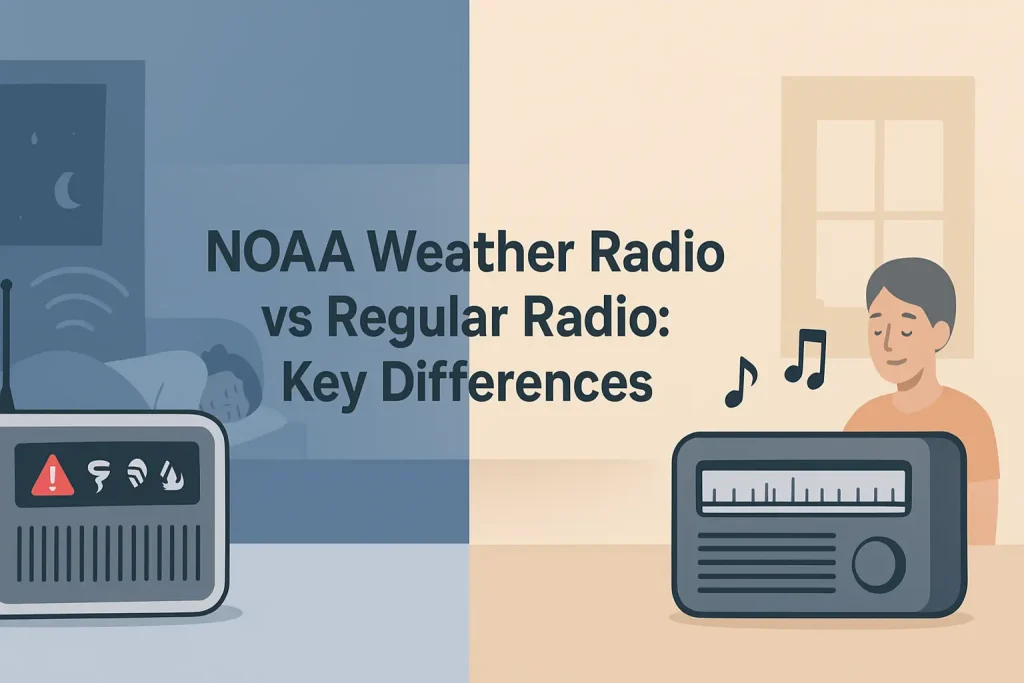
NOAA weather radio differs from standard AM/FM broadcast radio in a fundamental way. It transmits exclusively on seven narrow VHF frequencies designated solely for weather and emergency alerts, with no music, news, or commercial programming sharing those channels.
A NOAA weather alert radio with S.A.M.E. technology goes further than basic broadcast reception. S.A.M.E. (Specific Area Message Encoding) technology allows your radio to wake only for alerts issued for specific counties you program in advance, filtering out the dozens of daily alerts broadcast for counties outside your area.
Without S.A.M.E. filtering, a weather radio in Frisco will sound the alarm for every Flash Flood Warning issued anywhere from Waco to the Red River. With S.A.M.E. programmed correctly, that same radio stays silent until NWS Fort Worth issues a warning for Collin County specifically.
A properly tuned weather radio in DFW is your fastest path to an official warning, because NOAA transmitters broadcast alerts before the first text message reaches your phone.
Dallas/Fort Worth NOAA Weather Radio Stations: Complete Frequency and Location Guide
The Dallas/Fort Worth metro is served by multiple NOAA Weather Radio transmitters, each assigned to a specific VHF frequency (called a “WX channel”) and broadcasting from a tower location chosen to maximize coverage across a specific cluster of counties. The primary transmitter for the DFW core is KEC83, located in Fort Worth, broadcasting on 162.400 MHz (WX Channel 1).
According to NOAA’s NWR station directory, the following transmitters provide primary or secondary coverage to the DFW region and surrounding North Texas counties.
Use the table below to identify the correct station, frequency, and WX channel for your county.
| Station ID | Location | Frequency (MHz) | WX Channel | Primary Coverage Counties | ERP (Watts) |
|---|---|---|---|---|---|
| KEC83 | Fort Worth, TX | 162.400 | WX 1 | Tarrant, Dallas, Parker, Hood | 1,000 |
| WXL58 | Garland, TX | 162.475 | WX 4 | Dallas, Rockwall, Kaufman, Hunt | 300 |
| KEC55 | Denton, TX | 162.425 | WX 2 | Denton, Wise, Cooke, Grayson | 1,000 |
| WXK49 | McKinney, TX | 162.550 | WX 7 | Collin, Grayson, Fannin, Delta | 300 |
| KEC79 | Corsicana, TX | 162.450 | WX 3 | Ellis, Navarro, Henderson, Johnson | 1,000 |
| WXJ48 | Weatherford, TX | 162.500 | WX 5 | Parker, Palo Pinto, Erath, Stephens | 300 |
| KHB36 | Greenville, TX | 162.525 | WX 6 | Hunt, Hopkins, Rains, Van Zandt | 1,000 |
Source: NOAA NWR Station Directory and NWS Fort Worth transmitter data. ERP = Effective Radiated Power. Coverage boundaries overlap in many counties; multiple stations may be receivable at your location.
KEC83 in Fort Worth is the highest-priority station for most DFW residents, broadcasting at 1,000 watts effective radiated power from a centrally located tower that reaches the core urban counties with strong signal.
If you live in the northern suburbs (Plano, Allen, McKinney, Frisco), you may receive both KEC83 on 162.400 MHz and WXK49 on 162.550 MHz with usable signal strength. Program both into your weather radio and set S.A.M.E. codes for your specific county on the stronger of the two signals.
The Seven NOAA Weather Radio Frequencies: What WX Channel Numbers Mean
NOAA Weather Radio broadcasts on exactly seven frequencies, designated WX Channel 1 through WX Channel 7, ranging from 162.400 MHz to 162.550 MHz in 25 kHz increments. These frequencies are in the VHF high band and are reserved exclusively for NOAA weather broadcasts under FCC Part 90 regulations, meaning no other service legally shares these channels.
The “WX channel” numbering system is not a frequency order. WX Channel 1 is 162.400 MHz, WX Channel 2 is 162.425 MHz, and the sequence does not ascend in simple 25 kHz steps across all seven channels. Use the frequency table below to confirm the exact MHz value for each channel number, because programming the wrong frequency will leave your radio receiving silence or interference.
Use the table below to match WX channel numbers to exact NOAA broadcast frequencies.
| WX Channel | Frequency (MHz) | DFW Station Using This Frequency | Notes |
|---|---|---|---|
| WX 1 | 162.400 | KEC83 (Fort Worth) | Primary DFW channel; strongest signal for Tarrant and Dallas counties |
| WX 2 | 162.425 | KEC55 (Denton) | Primary channel for Denton, Wise, Cooke, and Grayson counties |
| WX 3 | 162.450 | KEC79 (Corsicana) | Primary for Ellis, Navarro; secondary for southern Dallas County |
| WX 4 | 162.475 | WXL58 (Garland) | Primary for eastern Dallas, Rockwall, Kaufman, Hunt counties |
| WX 5 | 162.500 | WXJ48 (Weatherford) | Primary for Parker, Palo Pinto; secondary for western Tarrant County |
| WX 6 | 162.525 | KHB36 (Greenville) | Primary for Hunt, Hopkins; secondary for eastern Dallas County |
| WX 7 | 162.550 | WXK49 (McKinney) | Primary for Collin, Grayson, Fannin; strong signal in northern suburbs |
Source: NOAA NWR All Hazards frequency reference and FCC Part 90 frequency allocations. Frequencies are fixed nationwide; the station assigned to each frequency varies by region.
Your Midland WR400 weather radio or any other NWR receiver will scan all seven WX frequencies automatically when you first power it on.
Knowing the exact MHz value for each WX channel matters most when you own a combination scanner radio or a dual-band amateur radio that allows manual frequency entry instead of channel-number selection.
The single most important frequency to know for DFW residents is 162.400 MHz (WX Channel 1, station KEC83 Fort Worth), because it serves the highest-population counties in the metro at 1,000 watts of effective radiated power.
S.A.M.E. County Codes for Dallas/Fort Worth Area Counties
S.A.M.E. (Specific Area Message Encoding) technology allows your weather radio to receive and decode a 6-digit FIPS code embedded in every NOAA alert broadcast, then compare that code against the counties you have programmed into the radio’s memory. If the codes match, your alarm sounds. If they do not match, your radio stays silent.
Without S.A.M.E. programmed correctly, a weather radio in Arlington will sound its alarm for every Flash Flood Warning issued across 30 North Texas counties. According to NOAA’s NWR technical documentation, a single NWS Fort Worth broadcast covers an area roughly the size of New England, meaning a non-S.A.M.E. radio generates an average of 3-8 alarm events per severe weather day, most of them irrelevant to your specific location.
Use the table below to find the correct 6-digit S.A.M.E. FIPS code for your county.
| County | S.A.M.E. FIPS Code | Primary NWR Station | WX Channel | Major Cities Included |
|---|---|---|---|---|
| Tarrant | 048439 | KEC83 (Fort Worth) | WX 1 / 162.400 | Fort Worth, Arlington, Mansfield, Euless, Bedford |
| Dallas | 048113 | KEC83 (Fort Worth) | WX 1 / 162.400 | Dallas, Irving, Grand Prairie, Garland, Mesquite |
| Collin | 048085 | WXK49 (McKinney) | WX 7 / 162.550 | McKinney, Plano, Allen, Frisco, Prosper |
| Denton | 048121 | KEC55 (Denton) | WX 2 / 162.425 | Denton, Lewisville, Flower Mound, Carrollton, The Colony |
| Rockwall | 048397 | WXL58 (Garland) | WX 4 / 162.475 | Rockwall, Rowlett, Heath, Royse City |
| Parker | 048367 | WXJ48 (Weatherford) | WX 5 / 162.500 | Weatherford, Aledo, Willow Park, Azle |
| Ellis | 048139 | KEC79 (Corsicana) | WX 3 / 162.450 | Waxahachie, Ennis, Midlothian, Red Oak |
| Johnson | 048251 | KEC79 (Corsicana) | WX 3 / 162.450 | Burleson, Cleburne, Joshua, Crowley |
| Kaufman | 048257 | WXL58 (Garland) | WX 4 / 162.475 | Kaufman, Forney, Terrell, Seagoville |
| Hunt | 048231 | KHB36 (Greenville) | WX 6 / 162.525 | Greenville, Rockwall (partial), Commerce |
| Wise | 048497 | KEC55 (Denton) | WX 2 / 162.425 | Decatur, Bridgeport, Rhome, Boyd |
| Hood | 048221 | KEC83 (Fort Worth) | WX 1 / 162.400 | Granbury, Acton, Lipan |
Source: NOAA SAME FIPS county code database and NWS Fort Worth county coverage assignments. The 6-digit code format is: 0 (state/county designator) + 2-digit state FIPS (48 for Texas) + 3-digit county FIPS. Verify your code against the official NOAA S.A.M.E. database at weather.gov before programming.
The 6-digit S.A.M.E. code structure follows this formula: the first digit is always 0 for a standard county alert, digits 2-3 are the FIPS state code (48 for Texas), and digits 4-6 are the FIPS county code for your specific county.
If your home sits near a county line (for example, in Carrollton, which spans both Denton and Dallas counties), program both county codes into your weather radio so you receive alerts from whichever NWS office issues warnings for your side of the line.
Entering the correct S.A.M.E. code for your county is the single most important programming step for any DFW weather radio, because it determines which warnings actually wake you up at 3 a.m.
How to Program Your Weather Radio for DFW: Step-by-Step
Programming a NOAA weather radio for Dallas/Fort Worth requires three inputs: the correct WX channel frequency for your county’s primary transmitter, the 6-digit S.A.M.E. FIPS code for your county, and the alert types you want the radio to activate for. Skipping any of these three steps leaves your radio either silent during real emergencies or screaming for storms 200 miles away.
The exact button sequence differs by model, but the programming logic is identical across all S.A.M.E.-capable receivers. The Midland WR120B weather radio and the Uniden BC365CRS are the two most commonly owned weather radios in Texas, and both follow the sequence outlined below.
The steps below apply to most S.A.M.E.-capable NOAA weather radios sold in the U.S. market.
- Step 1: Power on and let the radio complete its initial channel scan. The radio will scan all seven WX frequencies (162.400 through 162.550 MHz) and lock on to the strongest receivable signal. Note which WX channel number the display settles on. For most DFW addresses, this will be WX 1 (162.400 MHz, KEC83 Fort Worth).
- Step 2: Manually confirm your county’s primary WX channel using the table above. If the auto-scan settled on a different channel than your county’s primary station, manually navigate to your county’s correct channel. Weaker signals from the wrong transmitter mean delayed or missed alerts during severe weather.
- Step 3: Enter S.A.M.E. programming mode. On Midland radios, press and hold the “SNOOZE/PROG” button for 3 seconds until “PROG” appears on the display. On Uniden radios, press “MENU” and navigate to “SAME AREA.” Consult your specific model’s manual for the exact key sequence.
- Step 4: Enter your 6-digit county FIPS S.A.M.E. code. Use the keypad or up/down arrows to enter the code. For Tarrant County, enter 048439. For Dallas County, enter 048113. For Collin County, enter 048085. Confirm the entry when prompted.
- Step 5: Add a second county code if you live near a county boundary. Most S.A.M.E. weather radios store between 5 and 25 county codes simultaneously. Residents of Carrollton, Irving, Grand Prairie, or any other city straddling two counties should program both relevant county FIPS codes.
- Step 6: Select alert event types. The NWS broadcasts 25 distinct alert event codes. At minimum, activate Tornado Warning (TOR), Tornado Watch (TOA), Severe Thunderstorm Warning (SVR), Flash Flood Warning (FFW), and Hurricane Warning (HUW). For full DFW severe weather coverage, also activate Tornado Emergency (TOE) and Severe Weather Statement (SVS).
- Step 7: Test the S.A.M.E. programming by triggering a weekly test reception. NOAA broadcasts a Required Weekly Test (RWT) every Wednesday between 11 a.m. and noon local time for most Texas transmitters. Your weather radio should alarm and display your programmed county name during this test. If it does not alarm, your S.A.M.E. code is entered incorrectly or your channel selection is wrong.
- Step 8: Set the alert tone and volume. Most weather radios default to a loud alarm tone sufficient to wake sleeping occupants. The minimum acceptable alarm volume for nighttime use in a bedroom with the door closed is approximately 75 dB at 10 feet. Verify the alarm is audible from your bedroom before relying on it during severe weather season.
For the Sangean CL-100 desktop weather radio, the programming sequence is slightly different: press “SAME PROG,” then use the dial to select your state (Texas), then county, and the radio automatically populates the correct FIPS code from its internal database without requiring manual 6-digit entry.
Completing all eight steps takes less than 10 minutes and means your radio will only wake you for the specific alert types affecting your specific county.
Which DFW Weather Radio Station Covers Your Specific City?
Most DFW cities fall cleanly within the coverage footprint of a single primary NOAA transmitter, but the metro’s geographic spread means residents in cities like Frisco, Carrollton, and Grand Prairie may be equally close to two different transmitters. Reception quality at your specific address depends on distance from the tower, building construction materials, and local terrain.
The transmitter coverage assignments below reflect the NWS Fort Worth primary service area boundaries. Cities in the fringe zone between two transmitters are noted with the recommended primary station first.
Fort Worth, Arlington, Mansfield, Euless, Bedford, Haltom City, Keller, Southlake
These cities are in the primary service area of KEC83 (Fort Worth) on 162.400 MHz (WX Channel 1). Program S.A.M.E. code 048439 for Tarrant County. The KEC83 transmitter broadcasts at 1,000 watts from a central Fort Worth location, delivering the strongest consistent signal in this group.
Dallas, Irving, Mesquite, Garland, Duncanville, DeSoto, Cedar Hill
These cities receive primary coverage from KEC83 (Fort Worth) on 162.400 MHz with S.A.M.E. code 048113 for Dallas County. The WXL58 Garland transmitter on 162.475 MHz (WX Channel 4) provides secondary coverage for eastern Dallas County cities. If you are in Garland or Mesquite and notice WX 1 reception is weak, try WX 4 as an alternative and program the same 048113 Dallas County FIPS code.
Plano, Allen, McKinney, Frisco, Prosper, Celina, Anna
These northern Collin County cities receive primary coverage from WXK49 (McKinney) on 162.550 MHz (WX Channel 7). Program S.A.M.E. code 048085 for Collin County. Frisco sits near the Denton/Collin county line, so residents in northwest Frisco should also program 048121 (Denton County) as a secondary S.A.M.E. code.
Denton, Lewisville, Flower Mound, Carrollton, The Colony, Little Elm
These cities receive primary coverage from KEC55 (Denton) on 162.425 MHz (WX Channel 2) with S.A.M.E. code 048121 for Denton County. Carrollton sits in both Denton and Dallas counties, so Carrollton residents should program both 048121 and 048113 into their weather radio. The KEC55 transmitter broadcasts at 1,000 watts, delivering strong signal across all of Denton County.
Weatherford, Aledo, Azle, Willow Park
Parker County cities receive primary coverage from WXJ48 (Weatherford) on 162.500 MHz (WX Channel 5) with S.A.M.E. code 048367. The WXJ48 transmitter operates at 300 watts, so residents in more remote parts of Parker County may also receive KEC83 from Fort Worth on WX 1. Try both frequencies and program S.A.M.E. codes from the station producing the cleanest, strongest received signal.
Waxahachie, Midlothian, Red Oak, Ennis, Burleson, Cleburne
These southern DFW metro cities fall in the primary coverage of KEC79 (Corsicana) on 162.450 MHz (WX Channel 3). Ellis County residents use S.A.M.E. code 048139. Johnson County residents (Burleson, Cleburne, Joshua) use S.A.M.E. code 048251. Both counties receive NWS Fort Worth warnings through the same transmitter.
For any address in the fringe zone between two transmitters, the simplest test is to place your weather radio near an exterior window overnight and check which WX channel shows the strongest signal bar reading the following morning.
Best Weather Radios for Dallas/Fort Worth Reception
The best weather radio for DFW is one that reliably receives all seven NOAA WX frequencies, stores at least 5 S.A.M.E. county codes simultaneously, and has a battery backup that keeps it operational during power outages caused by the severe thunderstorms that routinely knock out electricity in North Texas. A radio that only runs on AC power is useless the moment a tornado warning arrives alongside a power failure.
The three most important specifications for any DFW weather radio purchase are S.A.M.E. technology, battery backup capacity, and audio output loud enough to wake sleeping occupants.
Midland WR400 (Best Overall for DFW)
The Midland WR400 weather radio is the most widely recommended S.A.M.E. weather radio for North Texas households based on its combination of alert selectivity and reliability during severe weather events.
Key Specifications:
- Frequencies: 162.400, 162.425, 162.450, 162.475, 162.500, 162.525, 162.550 MHz (all 7 WX channels)
- S.A.M.E. alert event codes: 25 programmable event types
- County code memory: 50 simultaneous S.A.M.E. location codes
- Battery backup: 6x AA alkaline (not included)
- Alarm output: loud external alarm horn plus visual strobe
The 50-county-code memory capacity is particularly valuable for DFW households that track severe weather across multiple counties, such as homeowners with vacation properties in Hood or Parker County who want alerts for both their primary residence and their weekend property.
Uniden BC365CRS (Best for Combined Scanning and Weather)
The Uniden BC365CRS combines a 500-channel scanner with full NOAA weather radio reception, making it the best single-device option for DFW residents who want to monitor both public safety radio traffic and weather alerts from one unit.
Key Specifications:
- Scanner channels: 500 conventional channels
- NOAA weather channels: all 7 WX frequencies
- S.A.M.E. capability: yes, county-level filtering
- Power: AC adapter + 4x AA battery backup
- Priority weather alert: interrupts scanning to broadcast active weather alerts
Midland ER310 (Best Portable/Emergency Option)
The Midland ER310 emergency crank weather radio is the recommended portable option for DFW households who want severe weather coverage during extended power outages or for use during tornado shelter-in-place situations where AC power is not available.
Key Specifications:
- NOAA channels: all 7 WX frequencies with S.A.M.E.
- Power sources: hand crank, solar panel, AA batteries, USB charging
- USB output: 1,000 mAh bank for charging phones
- AM/FM: yes, for monitoring commercial emergency broadcasts
- SOS signal: emergency LED flashlight with SOS mode
The correct weather radio choice for most DFW households is the Midland WR400 for primary home use, with a hand-crank portable like the ER310 as a backup for tornado shelters or power outages exceeding 24 hours.
NWS Fort Worth Coverage Area and Alert Authority
The National Weather Service Fort Worth office (NWS FWD) is the single issuing authority for all weather watches, warnings, and advisories broadcast over the NOAA Weather Radio transmitters serving the DFW metro. Every tornado warning, severe thunderstorm warning, and flash flood warning you hear on WX Channel 1 (162.400 MHz) originates from the NWS Fort Worth forecast office located at Meacham International Airport in Fort Worth.
The NWS Fort Worth county warning area (CWA) covers 35 counties in North and Central Texas. The counties span from the Oklahoma border south to the Hill Country fringe, and from the Panhandle edge east to the Louisiana border approaches. This massive coverage area is why S.A.M.E. filtering is not optional in DFW: NWS Fort Worth issues more total warnings in a single active severe weather day than many other offices issue in an entire year.
According to NOAA’s NWS operations documentation, the NWS Fort Worth office ranks among the top 5 most active severe weather forecast offices in the United States by annual warning count. The office issues an average of 150-200 tornado warnings per year, most concentrated between March and June, which is the primary severe weather season for the DFW region.
The NWS Fort Worth office also coordinates with the NWS Dallas/Fort Worth (technically a single combined office operating as “NWS Fort Worth”) to issue alerts for the entire metro as a unified service, meaning the same staff issues warnings for both a tornado near Azle in Tarrant County and a flash flood emergency in downtown Dallas simultaneously.
For complete details on how NOAA weather radio stations are organized by state across Texas, the full NOAA transmitter station directory for all 50 states covers every active NWR station, frequency, and county assignment in a single reference.
Understanding that all DFW weather radio alerts originate from a single NWS office means your weather radio is only as effective as the accuracy of your S.A.M.E. county code entry, because the office is issuing alerts for 35 counties simultaneously through the same broadcast.
DFW Weather Radio Reception Problems and How to Fix Them
A weather radio that cannot receive a clean signal will either miss alerts entirely or generate constant static that causes residents to turn the volume down, defeating the purpose of having the device. Reception problems in DFW fall into three categories: signal strength issues caused by distance or building construction, frequency interference from other transmitters, and S.A.M.E. programming errors that prevent alerts from triggering the alarm.
Problem: Radio Receives Static or Broken Audio on WX Channel 1
Broken audio on 162.400 MHz (KEC83 Fort Worth) in the DFW metro is almost always caused by the radio being placed near concrete walls, inside a basement, or in the center of a large steel-framed building. NOAA broadcasts on VHF frequencies between 162.400 and 162.550 MHz, and VHF signals in this range are blocked effectively by concrete, steel, and dense building materials.
The fix is to relocate the radio within 3-5 feet of an exterior window facing the direction of the transmitter tower. For most DFW addresses tuned to KEC83 (Fort Worth), orienting the antenna toward the west to northwest improves reception significantly. If the built-in antenna on your desktop weather radio is insufficient, an external outdoor weather radio antenna mounted on the exterior of the home with a coaxial run to the radio provides a reliable signal improvement of 10-15 dB, more than enough to overcome typical building penetration loss.
Problem: Radio Alarms for Counties Outside DFW
If your weather radio alarms for severe weather events in counties you did not intend to receive, the cause is one of three issues: S.A.M.E. county codes are not programmed (the radio is in “all alert” mode), the wrong FIPS code was entered, or the alert event filter was not set to county-specific events. A radio in “all alert” mode without S.A.M.E. codes programmed will trigger for every single alert broadcast by NWS Fort Worth across all 35 counties in the coverage area.
The fix is to re-enter your county’s 6-digit FIPS code precisely and verify the entry by triggering a test alert during the weekly NOAA test broadcast on Wednesdays. The radio should display your county name on screen after correct code entry.
Problem: Weather Radio Does Not Alarm During Active Severe Weather
A weather radio that fails to alarm when tornado warnings are being broadcast for your county is the most serious and common DFW problem, and it almost always has one of two causes: the radio is set to receive only a subset of alert types that does not include the active warning type, or the S.A.M.E. code stored in the radio does not match the county code in the broadcast warning.
This happens because NWS Fort Worth embeds the exact 6-digit FIPS code for the warned county in every S.A.M.E. encoded broadcast. If your radio has 048113 (Dallas County) programmed but the tornado warning is for 048439 (Tarrant County), your radio will not alarm even if you are physically present in the warned area at the time.
The fix is to verify both your stored S.A.M.E. county codes and your active alert event list. Ensure TOR (Tornado Warning), SVR (Severe Thunderstorm Warning), and FFW (Flash Flood Warning) are all active in your event filter list. If your radio lacks event-type filtering, it should be replaced with a current S.A.M.E.-capable model.
Problem: Radio Works Fine on AC Power but Fails to Alarm During Power Outages
A weather radio that powers off when the electricity fails will not alert you when a storm knocks out your power simultaneously with issuing a tornado warning, which is exactly when North Texas severe weather tends to strike. The fix requires either a model with built-in rechargeable battery backup or a model designed to run on AA/AAA alkaline batteries when AC power is interrupted.
The Midland WR400 with AA battery backup is the most common solution for this in DFW, because it runs on 6 AA alkaline batteries when AC power fails with no manual switching required. Install fresh AA alkaline batteries in the backup compartment before each spring severe weather season and replace them at the start of each fall season to maintain reliable backup power.
Most DFW weather radio reception problems are solved by two actions: placing the radio near an exterior window and verifying the S.A.M.E. county code matches your specific county.
DFW Severe Weather Seasons and When Your Weather Radio Matters Most
Dallas/Fort Worth sits at the intersection of three major air mass collision zones, dry continental air from the west, warm moist Gulf air from the south, and cold Arctic air from the north, making it one of the most tornado-prone large metros in the United States. According to NOAA’s Storm Prediction Center, the DFW metro has experienced more EF2 or stronger tornadoes within a major metropolitan area than any other U.S. city over the past 50 years of records.
Knowing when severe weather risk is highest helps you make smarter decisions about weather radio maintenance, battery checks, and S.A.M.E. programming verification.
The chart below shows the relative monthly severe weather alert frequency for the NWS Fort Worth service area based on historical NOAA warning data.
Here is a quick reference to DFW’s month-by-month severe weather alert activity so you know when to prioritize testing and maintaining your weather radio.
Seasonal Guide
Dallas/Fort Worth Weather Radio Activity – Month by Month
Severe weather alert frequency and weather radio action items by month for the NWS Fort Worth service area. Source: NOAA Storm Prediction Center historical warning data.
Lower activity / Routine monitoring
The secondary fall severe weather season in October and November is frequently underestimated by DFW residents who replace their batteries in March and forget to check them again before the fall outbreak season.
Replace weather radio batteries twice per year: once in late February before spring tornado season, and once in late September before the fall severe weather season begins.
Weather Radio vs. Phone Alerts for DFW Emergencies
Wireless Emergency Alerts (WEA) delivered to cell phones and NOAA weather radio serve different functions and have different failure modes. Understanding when each system fails in DFW conditions determines how you should configure your emergency communication setup.
WEA (Wireless Emergency Alerts, the system that sends Tornado Warnings to your phone) depends on cell tower infrastructure that can fail or become congested during major severe weather events. According to the FCC’s post-event analysis of major tornado outbreaks, cellular networks in the warned area commonly experience congestion or partial failure within 15-30 minutes of a major tornado warning, precisely when residents most need to receive updates.
NOAA weather radio transmitters operate independently of cellular infrastructure on dedicated VHF frequencies. A transmitter at 1,000 watts of effective radiated power continues broadcasting as long as the transmitter site has generator power, which is maintained at all NWS transmitter sites to FCC requirements.
Use the table below to compare when each alert system is reliable versus when it can fail in DFW severe weather conditions.
| Factor | NOAA Weather Radio (WX Channel) | Wireless Emergency Alert (Phone) |
|---|---|---|
| Infrastructure dependency | VHF transmitter only, no cellular | Cell towers and carrier network required |
| Works during power outage | Yes (battery backup on radio) | Yes (until phone battery dies) |
| Works during network congestion | Yes, always | Delayed or failed |
| Wakes you while sleeping | Yes (loud alarm tone) | Only if phone volume is on |
| County-specific filtering | Yes (S.A.M.E. technology) | Yes (cell tower location-based) |
| Alert speed from NWS issuance | Under 60 seconds | 60-300 seconds (carrier dependent) |
| Works inside concrete tornado shelter | Portable radio required; signal may be weak | Cell signal dependent; often no signal |
| Ongoing audio updates during event | Yes, continuous broadcast | No, one alert message only |
Source: FCC WEA technical standards, NOAA NWR operational documentation, and FCC post-event cellular network performance analyses. Alert delivery times vary by carrier and event conditions.
The critical failure mode for WEA in DFW is network congestion during major tornado outbreaks, when hundreds of thousands of people in the warned area simultaneously attempt to call and text family members, saturating the same cell towers that need to deliver the WEA message.
NOAA weather radio and WEA phone alerts are complementary systems, not substitutes. Use both, with the weather radio serving as the primary overnight and power-outage alert system and WEA providing a secondary confirmation when cell service is available.
To understand how NOAA weather radio fits into a broader home emergency communication plan, the guide on building a complete severe weather communication system for your household covers backup communication options beyond the weather radio itself.
Understanding NOAA Weather Radio Alert Types Broadcast Over DFW
The NWS Fort Worth office broadcasts 25 distinct alert event types over the DFW NOAA weather radio network. Each alert type has a specific S.A.M.E. event code embedded in the broadcast that S.A.M.E.-capable radios use to filter which alerts trigger your alarm. Understanding which event codes matter most for DFW conditions determines which alert types to activate in your radio’s filter settings.
The most critical alert types for DFW residents, in order of life-safety priority, are listed below.
- TOR (Tornado Warning): NWS has detected a tornado by radar or confirmed by spotter. This is the highest-priority alert for DFW. Your radio should always alarm for TOR regardless of any other filter settings. A Tornado Warning gives an average of 13 minutes of lead time before tornado touchdown according to NOAA’s warning performance statistics.
- TOE (Tornado Emergency): A rare, highest-confidence tornado warning indicating an extremely dangerous, confirmed large tornado threatening a populated area. NWS Fort Worth has issued Tornado Emergencies for the DFW area during major outbreak events. Activate this event code if it is separate from TOR in your radio’s menu.
- SVR (Severe Thunderstorm Warning): Hail 1 inch or larger and/or wind gusts 58 mph or stronger have been detected. SVR warnings are issued far more frequently than tornado warnings in DFW, averaging several dozen per season. Hail in excess of 2 inches can cause serious property damage and injury to persons caught outdoors.
- FFW (Flash Flood Warning): Flash flooding is occurring or imminent. North Texas urban flash flooding causes more DFW storm fatalities per year than tornadoes in most years, according to NWS Fort Worth’s annual storm data summary. Always activate FFW for all programmed DFW counties.
- TOA (Tornado Watch): Conditions are favorable for tornado development. A Tornado Watch can cover the entire DFW metro for 4-8 hours at a time. Activating TOA ensures you are awake and monitoring when conditions are most dangerous, giving you time to prepare shelter before a TOR is issued.
- SVA (Severe Thunderstorm Watch): Conditions are favorable for severe thunderstorms. In DFW, a Severe Thunderstorm Watch frequently upgrades to a Tornado Watch within 1-3 hours as storms develop.
- HUW (Hurricane Warning) and HWO (Hurricane Watch): While rare for DFW, major hurricanes making landfall on the Texas coast have impacted the Dallas metro with tropical storm-force winds and flooding. Hurricane Harvey in 2017 produced significant flooding in the DFW metro despite Fort Worth being over 300 miles from the coast. Activate HUW and HWO to receive advance warning of tropical system impacts.
- WSW (Winter Storm Warning) and WCY (Wind Chill Advisory): North Texas ice storms and rare blizzard events have paralyzed DFW infrastructure. The February winter storm event that produced widespread power failure across Texas demonstrated the life-safety importance of winter weather alerts for residents who depend on electric heating.
For a detailed reference on all NOAA weather radio alert types, frequencies, and how to program S.A.M.E. codes for every event category, the complete guide to how S.A.M.E. weather radio technology filters alerts by event type and county covers every NWS event code and the programming steps for popular receiver models.
The minimum set of alert event codes every DFW weather radio owner should have active is: TOR, TOE, SVR, FFW, TOA, SVA, WSW, and HUW.
Frequently Asked Questions About Dallas/Fort Worth Weather Radio Stations and Channels
What WX channel should I program for Fort Worth, Texas?
Fort Worth residents should program WX Channel 1 (162.400 MHz), which is broadcast by station KEC83 located in Fort Worth at 1,000 watts effective radiated power. Enter S.A.M.E. county code 048439 for Tarrant County to receive only alerts affecting Fort Worth and the surrounding Tarrant County area.
KEC83 on 162.400 MHz is the highest-power transmitter in the DFW metro and delivers the strongest, most reliable signal to the core Fort Worth urban area. If your radio scans automatically on first use, it will most likely settle on WX 1 if you are within Tarrant County.
What is the correct NOAA weather radio frequency for Dallas, Texas?
Dallas residents should receive primary NOAA weather radio coverage on 162.400 MHz (WX Channel 1) from station KEC83 in Fort Worth, which serves both Tarrant and Dallas counties. The S.A.M.E. code for Dallas County is 048113. Eastern Dallas County residents in Garland, Mesquite, and Balch Springs may also receive WXL58 on 162.475 MHz (WX Channel 4) with a usable signal.
Program WX 1 (162.400 MHz) as your primary channel with S.A.M.E. code 048113. If you experience weak or broken signal on WX 1 from an eastern Dallas County address, try WX 4 (162.475 MHz) from the Garland transmitter as a secondary option.
What is the S.A.M.E. code for Collin County (Plano, Frisco, Allen, McKinney)?
The 6-digit S.A.M.E. FIPS code for Collin County, Texas is 048085. This code covers all cities within Collin County, including Plano, Frisco, Allen, McKinney, Prosper, Celina, and Anna. The primary NOAA transmitter for Collin County is WXK49 in McKinney, broadcasting on 162.550 MHz (WX Channel 7).
Frisco residents in the northwest portion of the city, near the Denton County line, should also program 048121 (Denton County) as a secondary S.A.M.E. code. This ensures alerts issued for the Denton County portion of Frisco’s surrounding area also trigger your radio’s alarm.
Can I use the same weather radio channel for both Fort Worth and Dallas?
Yes. WX Channel 1 (162.400 MHz, station KEC83) serves both Tarrant County (Fort Worth) and Dallas County (Dallas) as primary coverage. A single weather radio programmed to WX 1 with both 048439 (Tarrant) and 048113 (Dallas) as S.A.M.E. county codes will receive warnings for both counties from the same transmitter signal.
This dual-county programming is especially useful for residents who commute between Fort Worth and Dallas, or for households that want to monitor alerts for family members in adjacent counties. Most S.A.M.E. weather radios store 5-50 county codes simultaneously, so there is no technical barrier to programming multiple DFW county codes.
Why does my weather radio not alarm for tornado warnings in my area?
The most common cause is a S.A.M.E. code mismatch: your radio has either no FIPS code programmed (running in all-alert mode for every county, which ironically can cause false alerts to mask real ones when the alarm fatigue sets in) or an incorrect code that does not match the county code embedded in the NWS Fort Worth tornado warning broadcast. A second common cause is that Tornado Warning (TOR) is not activated in your radio’s event type filter.
The fix is to re-enter your county’s 6-digit FIPS code precisely, confirm TOR is listed as an active alert event in your radio’s settings, and verify your programming by monitoring the Wednesday NOAA weekly test broadcast. Your radio should alarm and display your county name during that test. If it does not, re-enter the county code and repeat.
What is the difference between a Tornado Watch and a Tornado Warning on weather radio?
A Tornado Watch (S.A.M.E. event code TOA) means atmospheric conditions across a broad area are favorable for tornado development within the next 1-8 hours. A Tornado Warning (S.A.M.E. event code TOR) means a tornado has been confirmed by radar rotation signature or by a trained storm spotter on the ground, and it is imminent or ongoing in a specific location within the warned county.
A Tornado Warning requires immediate action: move to your shelter location now. A Tornado Watch means you should monitor your weather radio closely, confirm your shelter plan, and be ready to act immediately if a Tornado Warning is issued for your county. NWS Fort Worth issues an average of 150-200 Tornado Warnings per year, far fewer than the number of Tornado Watches, so your radio alarming for TOR requires immediate response regardless of time of day.
Do I need a special weather radio to receive alerts in the DFW area, or will any radio work?
Any radio capable of receiving VHF frequencies between 162.400 and 162.550 MHz will pick up the NOAA audio broadcast from DFW transmitters. However, a basic radio without S.A.M.E. technology will alarm for every alert broadcast by NWS Fort Worth across all 35 counties in the service area, including warnings for areas far from DFW.
For DFW residents, a S.A.M.E.-capable weather radio priced between $30 and $80 is the minimum practical option. Models like the Midland WR120B at around $30-40 provide full S.A.M.E. county filtering, battery backup capability, and reception of all seven WX frequencies. A radio without S.A.M.E. will generate so many non-relevant alarms during active North Texas severe weather seasons that most owners end up turning the volume down, defeating the entire purpose of owning it.
Which NOAA station serves Denton County and what frequency does it use?
Denton County is primarily served by station KEC55, located in Denton, broadcasting on 162.425 MHz (WX Channel 2) at 1,000 watts effective radiated power. The S.A.M.E. FIPS code for Denton County is 048121. This station provides primary coverage for Denton, Wise, Cooke, and Grayson counties.
Cities in southern Denton County, including Lewisville, Carrollton, and Flower Mound, may also receive KEC83 (Fort Worth) on 162.400 MHz with usable signal strength. Program WX 2 (162.425 MHz) as your primary channel if you are in the Denton city area, and WX 1 as a secondary if you are in the southern portion of the county closer to the Dallas-Fort Worth metro core.
Is it legal to transmit on NOAA weather radio frequencies?
No. The NOAA weather radio frequencies (162.400 through 162.550 MHz) are designated exclusively for NOAA broadcasts under FCC Part 90. Transmitting on any of these seven frequencies without FCC authorization is illegal and can result in enforcement action including fines starting at $10,000 per violation. Standard weather radio receivers are receive-only devices and cannot transmit by design.
If you need two-way communication capability alongside weather radio reception, choose a combination device that includes a weather radio receiver and a separately licensed two-way radio function (such as a GMRS radio with a built-in weather alert receiver). The GMRS radio operates on 462-467 MHz with an FCC license, completely separate from the NOAA weather frequencies.
Can I receive DFW weather radio alerts on a Baofeng or other handheld amateur radio?
Yes. Amateur handheld transceivers like the Baofeng UV-5R or the Yaesu FT-70DR can be programmed to receive the seven NOAA WX frequencies in receive-only mode. Program 162.400 MHz for KEC83 (Fort Worth) and the appropriate DFW transmitter frequency for your county using the frequency entry method in the radio’s programming menu.
However, amateur radios do not include S.A.M.E. decoding circuitry. They will receive the full audio broadcast including the tone alert and spoken message, but they will not automatically alarm or filter by county. For overnight emergency alerting, a dedicated S.A.M.E.-capable weather radio remains the better option. Use an amateur radio’s weather receive capability as a supplemental monitoring tool rather than a primary overnight alert device.
What is the NOAA weather radio frequency for Collin County versus Denton County?
Collin County’s primary NOAA weather radio frequency is 162.550 MHz (WX Channel 7), broadcast by station WXK49 in McKinney with S.A.M.E. code 048085. Denton County’s primary frequency is 162.425 MHz (WX Channel 2), broadcast by station KEC55 in Denton with S.A.M.E. code 048121.
The two frequencies differ because each county is assigned to a different transmitter in the NWS Fort Worth coverage plan. Frisco residents near the Collin/Denton county boundary can often receive both frequencies. Program both county FIPS codes (048085 and 048121) into a multi-code S.A.M.E. weather radio to ensure alerts from either county trigger your alarm.
How often does NOAA test the weather radio system in DFW, and how do I know my radio is working?
NOAA broadcasts two types of scheduled tests over DFW weather radio transmitters: a Required Weekly Test (RWT) broadcast every Wednesday between approximately 11 a.m. and noon local time, and a Required Monthly Test (RMT) broadcast once per month, typically on the first Wednesday. The RWT is a short tone and message transmission. The RMT includes a full attention tone that activates S.A.M.E.-capable radios.
Your S.A.M.E.-capable weather radio will alarm during the RMT if it is correctly programmed with a valid county code for a county within the NWS Fort Worth service area. If your radio does not alarm during the monthly test, your S.A.M.E. code is either not entered, entered incorrectly, or your selected WX channel is not receiving the transmitter signal. Treat a missed RMT alarm as a programming error requiring immediate correction before the next severe weather event.
What weather radio channel should I use if I live near the Tarrant-Johnson county line in Burleson or Crowley?
Residents in Burleson and Crowley, which sit on or near the Tarrant/Johnson county line, should program two S.A.M.E. codes: 048439 for Tarrant County and 048251 for Johnson County. The primary WX channel depends on which county your home address officially falls in, since NWS Fort Worth issues separate warnings for Tarrant and Johnson counties even when the same storm is threatening both areas simultaneously.
Burleson’s city limits extend into both Tarrant and Johnson counties depending on the specific address. Check your county tax records or use the NOAA S.A.M.E. code lookup tool at weather.gov to confirm your official county assignment. For both counties, the relevant transmitters are KEC83 (Fort Worth, WX 1, 162.400 MHz) for Tarrant County portions and KEC79 (Corsicana, WX 3, 162.450 MHz) for Johnson County portions.
Additional North Texas NOAA Weather Radio Resources
Programming a weather radio correctly for DFW is only part of a complete severe weather preparedness plan for North Texas households. The NOAA weather radio network also broadcasts non-weather emergencies including hazardous material spills, civil emergencies, and Amber Alerts, making it a valuable all-hazards alert receiver beyond tornado season.
For residents who want to understand the full technical basis of how NOAA weather radio works before purchasing a receiver, the complete overview of how NOAA weather radio technology broadcasts and receives emergency alerts explains the transmitter network, alert encoding, and receiver hardware in plain language.
If you are comparing weather radio options before purchasing for a DFW address, understanding which of the seven NOAA frequencies your specific county uses is the starting point. The complete national reference for all seven NOAA weather radio broadcast frequencies and their WX channel assignments covers how each frequency is assigned to transmitters across the country and how receivers scan and lock onto them.
For households with properties in other parts of Texas beyond the DFW metro, such as weekend homes in the Hill Country, East Texas lake houses, or Panhandle ranches, the full reference covering every active NOAA weather radio transmitter in Texas by frequency and county coverage lists every Texas NWR station with its frequency, location, and coverage assignment.
A properly programmed DFW weather radio receiving 162.400 MHz from KEC83 Fort Worth with your county’s S.A.M.E. FIPS code entered correctly is the single fastest, most reliable way to receive a tornado warning at 2 a.m. when both cell service and power may already be failing.
Start with your county’s WX channel and FIPS code from the tables above. Install fresh AA batteries in the backup compartment before March and again before October. Confirm your programming works by monitoring the monthly NOAA test broadcast. Those three steps take 15 minutes total and can provide the life-saving lead time that makes a real difference in a DFW tornado emergency.
| Photo | TOP RATED WALKIE TALKIES | Price |
|---|---|---|
 | Retevis RT628 Kids Walkie Talkies, Toys Gifts for 4-12 Year Old Girl Boy | Check Price On Amazon |
 | Cobra ACXT545 Weather-Resistant Walkie Talkies, Rechargeable, 22 Channels | Check Price On Amazon |
 | Retevis RT388 Kids Walkie Talkies, Outdoor Toys for Kids Camping Essentials | Check Price On Amazon |
 | Cobra RX680 Walkie Talkies (2-Pack), IP54 Water Resistant Design | Check Price On Amazon |
 | Retevis RT22 Walkie Talkies Long Range Rechargeable with Earpiece (2 Pack) | Check Price On Amazon |
 | Midland GXT1000VP4 GMRS JIS4 Two-Way Radio, Black,2 Pack | Check Price On Amazon |
 | Retevis RT628 Walkie Talkies for Kids,Toys Gifts for 6-12 Years Old Boys Girls,Long Range 2 Way Radio 22CH VOX,Birthday Gift,Family Walkie Talkie for Camping Hiking Indoor Outdoor | Check Price On Amazon |