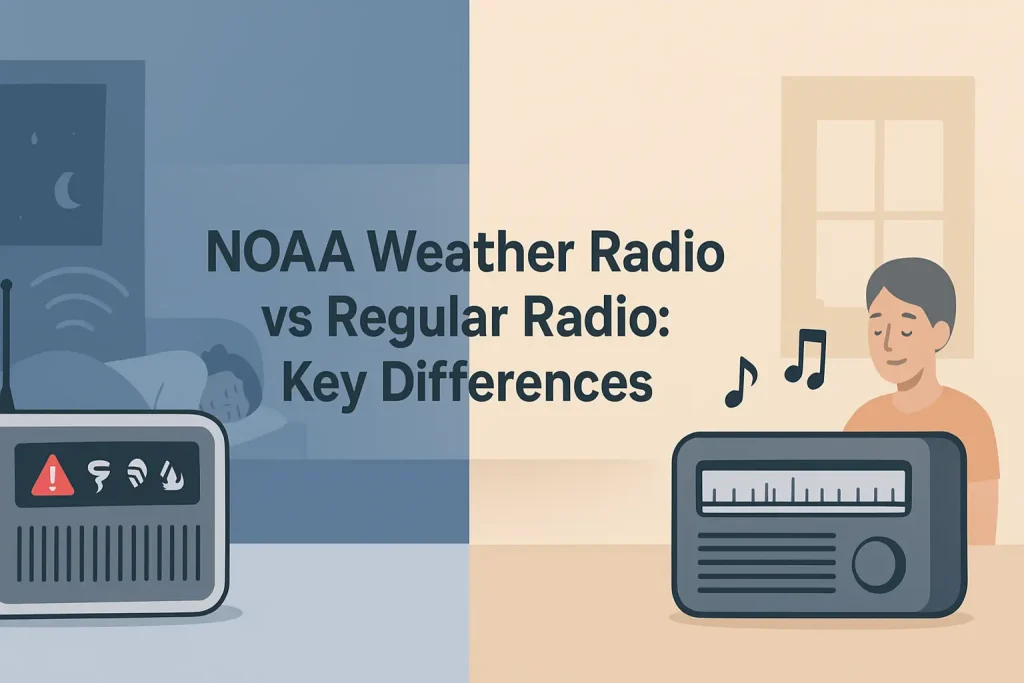
Most people buy a weather radio for tornado warnings and hurricane updates. What many do not realize is that the same device sitting on their nightstand also receives AMBER Alerts, the emergency notifications broadcast when a child is abducted. Weather Radio All Hazards, operated by NOAA, carries far more than storm warnings. It is the backbone of the Emergency Alert System (EAS) in the United States, and child abduction alerts are part of that system.
Understanding how AMBER Alerts reach your NOAA weather radio requires understanding how the Emergency Alert System routes information from law enforcement to broadcast infrastructure, and why weather radio is one of the most reliable delivery channels in that chain.
| Photo | Popular Portable Walkie Talkies | Price |
|---|---|---|
 | SKIWARRIOR Multifunctional Smart Wireless Ski Goggles with Walkie-Talkie, Anti-Fog Zeiss Lens, Music & Call Function (Cylindrical Blue) | Check Price On Amazon |
 | SINORISE Super Mini Walkie Talkies, Two-Way Radios, 3 Pack | Up to 12 Hours Battery Life, for Baseball Coaches, Restaurants, Retail Stores, Hospitals, Outdoor Sports & Travel | Check Price On Amazon |
 | KOSPET Tank M4C Smart Watch Rugged, Dual-Band GPS, 5ATM & IP69K Waterproof | 1.96" AMOLED Display, 170+ Sport Modes, Built-in LED Flashlight/Walkie-Talkie, Heart Rate/Sleep Monitor for Android & iPhone | Check Price On Amazon |
 | Retevis RT15 Walkie Talkies 3 Pack, Birthday Gift, Outdoor Adventure Kit | Durable, Lightweight, VOX, Key Lock, Mini Walkie Talkies for Adults, School Family Outdoor Travel Camping Hiking | Check Price On Amazon |
 | Rechargeable Walkie Talkies Toys for Kids: DIY Astronaut Walkie Talkies for Boys Christmas Birthday Gifts for 3 4 5 6 7 8 9 10 Boy Walkie Talkie Outdoor Hiking Toy 2 Way Radio Camping Outdoor Game | Check Price On Amazon |
By the Numbers
AMBER Alerts and Weather Radio: Key Facts at a Glance
Sources: NOAA NWR documentation, DOJ AMBER Alert program, FCC Emergency Alert System rules
What Is an AMBER Alert and Who Activates It?
An AMBER Alert is an emergency notification issued by law enforcement when a child abduction meets specific criteria defined by the Department of Justice (DOJ). The name is an acronym for America’s Missing: Broadcast Emergency Response, and it was first established in the Dallas-Fort Worth area in 1996 following the abduction and murder of 9-year-old Amber Hagerman.
Before an AMBER Alert is issued, law enforcement must confirm three criteria, according to the DOJ AMBER Alert program guidelines. First, law enforcement must believe an abduction has occurred. Second, they must believe the child is in serious danger of injury or death. Third, they must have enough descriptive information about the child, abductor, or suspect vehicle to broadcast a useful alert.
Each state administers its own AMBER Alert plan through a designated coordinator. The coordinator works with law enforcement agencies and the state emergency management office to verify the criteria and authorize the alert.
Once authorized, the alert enters the Emergency Alert System (EAS) infrastructure, which routes it to broadcast television, radio, cell towers, and dedicated receivers including NOAA weather radios. The child abduction emergency is assigned the EAS event code “CAE,” which is the specific identifier your weather radio uses to determine whether to wake you up for this alert type.
The speed between abduction and alert broadcast is critical. According to the National Center for Missing and Exploited Children (NCMEC), the first three hours after an abduction are the most dangerous for a missing child. The EAS distribution network, including NOAA weather radio, is designed to push alerts across multiple channels simultaneously to maximize public awareness in that window.
The key takeaway is that AMBER Alerts are not issued automatically. They require a human authorization decision by law enforcement before entering any broadcast system.
How Does the Emergency Alert System Deliver AMBER Alerts?
The Emergency Alert System (EAS) is a national public warning network that connects federal, state, and local authorities to broadcast infrastructure across the United States. It is governed by FCC rules under 47 CFR Part 11, which mandates that participating broadcasters, cable operators, and satellite services retransmit EAS alerts. NOAA Weather Radio All Hazards is one of the primary entry points into this system.
The EAS uses a hub-and-spoke distribution model. When a state AMBER Alert coordinator issues an alert, it is encoded in a standardized EAS digital header and sent to Primary Entry Point (PEP) stations. These are the master broadcast stations designated by FEMA to originate and relay national emergency messages. From PEP stations, the alert propagates through the EAS daisy chain to local stations and NOAA weather radio transmitters simultaneously.
The digital EAS header contains several critical pieces of information. It carries the event code (CAE for child abduction), the affected geographic area defined by FIPS codes (the same 6-digit county codes used in S.A.M.E. weather radio programming), the duration of the alert, and the originator identifier showing which agency issued it.
NOAA weather radio transmitters receive this EAS header and rebroadcast it on their assigned frequency between 162.400 and 162.550 MHz. Your weather radio, if programmed with the correct FIPS codes for your county, will decode the header, recognize the CAE event code, and sound its alarm.
A weather radio with S.A.M.E. technology can be set to alert only for specific counties. This means you will not be woken up for an AMBER Alert issued 400 miles away in a different region of your state. You will only hear the alarm if the alert covers the FIPS codes you have programmed into the radio.
The mechanism works because the EAS header is a digital tone sequence (called the Attention Signal) broadcast at 1050 Hz for 8-25 seconds, followed by the digital header data, followed by the audio announcement of the alert. Your radio’s S.A.M.E. decoder reads the FIPS codes in the header before sounding any alarm, filtering out alerts for areas outside your programmed region.
If your weather radio is not programmed with S.A.M.E. codes, it will alarm for every AMBER Alert issued anywhere in your state’s broadcast coverage area, regardless of how far the incident is from your location.
What Is the EAS Event Code for AMBER Alerts on Weather Radio?
The EAS event code for AMBER Alerts is CAE, which stands for Child Abduction Emergency. This is the standardized identifier used in the EAS digital header to classify the alert type. Your weather radio must have CAE enabled in its alert settings to receive and activate an alarm for AMBER Alerts.
The full list of EAS event codes includes dozens of categories, from tornado warnings (TOR) to hazardous materials emergencies (HME) to national information center broadcasts (NIC). Each code tells your radio whether the incoming broadcast matches an alert type you want to receive. According to FCC Part 11 rules governing the Emergency Alert System, all EAS participants must be capable of receiving and retransmitting all national-level alert codes, including CAE.
Most Midland weather alert radios and comparable models come with all EAS event codes enabled by default, including CAE. However, some users disable certain alert types to reduce false alarms, and CAE can be accidentally turned off during that process.
To verify your radio will receive AMBER Alerts, check the alert configuration menu and confirm CAE is active. On most Uniden weather radio models, this setting is found under “Alert Types” or “Event Codes” in the programming menu. The radio’s display should show CAE as “ON” or display a checkmark next to it.
The CAE event code is paired with the FIPS geographic data in the EAS header. A radio with CAE enabled but no S.A.M.E. codes programmed will alert for every CAE broadcast in the state. A radio with CAE enabled and specific county FIPS codes programmed will only alert when the CAE broadcast covers those counties.
The distinction between having CAE enabled and having S.A.M.E. codes properly programmed is the single most important configuration detail for AMBER Alert reception on a weather radio.
How S.A.M.E. Technology Targets AMBER Alerts to Your County
S.A.M.E. stands for Specific Area Message Encoding. It is the technology built into modern weather radios that allows the device to receive alerts only for specific geographic areas, identified by 6-digit FIPS (Federal Information Processing Standard) county codes. Without S.A.M.E., your weather radio alarms for every emergency in the entire state broadcast area, including AMBER Alerts issued hundreds of miles away.
Each county in the United States has a unique FIPS code. The first two digits identify the state. The next three digits identify the county within that state. For example, Harris County in Texas (Houston area) has the FIPS code 048201. Jefferson County in Alabama has 001073. These codes are the same identifiers used in weather alert radio S.A.M.E. programming and EAS header encoding.
When law enforcement issues an AMBER Alert, the EAS header encodes the FIPS codes of the affected counties. If the abduction occurred in Harris County, Texas, the EAS header will contain the FIPS code for Harris County (and potentially neighboring counties if the suspect is believed to have fled). Your weather radio compares the FIPS codes in the incoming EAS header against the codes you have programmed, and only activates the alarm if there is a match.
Most weather radios allow you to program between 5 and 25 FIPS codes. The Midland WR400 weather radio stores up to 50 S.A.M.E. location codes, which allows you to monitor multiple counties simultaneously if you travel frequently or live near a county boundary.
Key Specifications for S.A.M.E. Programming:
- FIPS code format: 6 digits (2-digit state code + 3-digit county code + check digit, or simplified 5-digit county format depending on model)
- NOAA FIPS lookup: available at weather.gov/nwr/counties
- Maximum stored codes: varies by model (5 on basic models, up to 50 on advanced models)
- Programming method: keypad entry on the radio or via CHIRP-compatible software on some models
This happens because the EAS digital header uses FIPS codes as the geographic targeting layer before any audio is broadcast. The condition is that your radio must have at least one FIPS code stored that matches a code in the incoming alert header. If no FIPS match occurs, the radio does not alarm, even if the alert type (CAE) is enabled.
If you have never programmed S.A.M.E. codes into your weather radio, it is operating in “all-hazards” mode, meaning it will alarm for every EAS broadcast in your region, including AMBER Alerts for counties you have no connection to. Fix this by looking up your county’s FIPS code at weather.gov and entering it through the radio’s programming menu.
Programming your S.A.M.E. codes is the single most practical step you can take to ensure your weather radio delivers relevant, county-specific AMBER Alerts rather than every statewide broadcast.
What Does an AMBER Alert Sound Like on a Weather Radio?
An AMBER Alert on a weather radio begins with the EAS Attention Signal, an 8-second burst of two simultaneous tones at 853 Hz and 960 Hz. This is the same jarring two-tone signal that precedes tornado warnings and other emergency broadcasts. After the tone sequence, your radio broadcasts the audio announcement describing the abducted child, suspect, and vehicle information.
The Attention Signal is designed to wake people from sleep and cut through ambient noise. It is loud enough at full volume to be heard in an adjacent room with the door closed. Most weather radios allow you to set separate alarm volumes for different alert types, but the EAS two-tone header plays at the radio’s maximum volume regardless of your alert volume setting on many models.
After the tones, the alert message is read by a computer-synthesized voice (called TTS, or text-to-speech) or, in some cases, by a human NOAA announcer. The message typically includes the child’s name, age, and physical description, the suspect’s description and vehicle information (make, model, color, and license plate number if known), and the geographic area under the alert.
The full broadcast sequence on a Sangean CL-100 weather alert radio or similar model follows this structure:
- EAS header digital tone burst (not audible as a recognizable tone, lasts approximately 1 second)
- 8-second Attention Signal (853 Hz + 960 Hz two-tone alarm)
- Audio announcement of the AMBER Alert content (60-90 seconds typically)
- EAS end-of-message tone (three brief bursts)
Some weather radios also display the alert text on their LCD screen simultaneously with the audio broadcast. The Midland WR120 weather radio scrolls the alert text across its display during the broadcast, which is particularly useful if the radio activates in a noisy environment where the audio is difficult to hear clearly.
AMBER Alerts on weather radio do not include a visual flashing LED in the same way some models do for tornado warnings. If you rely on a weather radio for overnight alerts in a bedroom, choose a model with a built-in flashing strobe or visual alarm in addition to the audible Attention Signal, particularly if any household member has hearing loss.
The AMBER Alert broadcast repeats at regular intervals as long as the alert remains active, typically every 15 minutes on the NOAA weather radio network until law enforcement cancels the alert or the child is found.
Which Weather Radios Receive AMBER Alerts?
Any weather radio that receives NOAA Weather Radio All Hazards broadcasts and supports S.A.M.E. alert filtering is capable of receiving AMBER Alerts. The radio must have the CAE event code enabled in its alert configuration. Basic weather radios without S.A.M.E. technology will still receive AMBER Alerts, but they cannot filter by county and will alarm for all statewide broadcasts.
Use the table below to compare key weather radio models and their AMBER Alert capabilities.
| Model | S.A.M.E. Codes | CAE Support | Alert Types | Display | Price Range |
|---|---|---|---|---|---|
| Midland WR400 | Up to 50 | Yes | 25 EAS types | Backlit LCD | $50-70 |
| Uniden BC365CRS | Up to 25 | Yes | All EAS types | LCD with clock | $40-60 |
| Midland WR120 | Up to 25 | Yes | All EAS types | Basic LCD | $25-40 |
| Sangean CL-100 | Up to 25 | Yes | All EAS types | Large LCD | $60-80 |
| Eton FRX5-BT | Up to 25 | Yes | All EAS types | LCD + hand crank | $70-100 |
| Basic no-SAME models | None | Yes (statewide) | All EAS types | Minimal | $15-25 |
The critical difference between models is not whether they receive AMBER Alerts (all NOAA-capable weather radios do) but whether they can target alerts to your specific county. A model without S.A.M.E. will alarm for every AMBER Alert in your state’s broadcast footprint, which can include a radius of 40 miles or more from the nearest NOAA transmitter.
For most households, a mid-range S.A.M.E. weather radio in the $40-70 price range provides all the functionality needed for targeted AMBER Alert reception. If you are looking at the full range of options, our guide to the top-rated weather radios for home emergency use covers current models with detailed S.A.M.E. programming specs.
The key takeaway: any weather radio with S.A.M.E. support and CAE enabled will deliver county-targeted AMBER Alerts. The radio you already own may be fully capable, provided you have configured it correctly.
How to Configure Your Weather Radio to Receive AMBER Alerts
Configuring a weather radio to receive AMBER Alerts requires two steps: enabling the CAE event code in the alert type settings, and programming the FIPS codes for your county and any neighboring counties you want to monitor. Most weather radios come with all alert types enabled by default, but S.A.M.E. codes must always be entered manually.
Here is the complete setup process for most S.A.M.E. weather radios:
- Look up your FIPS code. Go to weather.gov/nwr/counties and search for your state and county. Write down the 6-digit FIPS code. For example, Maricopa County in Arizona has the FIPS code 004013.
- Enter programming mode on your radio. On most Midland and Uniden models, press and hold the “Program” or “Set” button for 3 seconds until the display begins flashing or shows “PROG.”
- Navigate to S.A.M.E. or county code entry. Use the arrow keys to reach the S.A.M.E. or FIPS code entry screen. On the Midland WR400, this is labeled “S.A.M.E. Location.”
- Enter your FIPS code using the number keypad. Type each digit carefully. Most models require only the last 5 digits (the 3-digit county code preceded by the 2-digit state code), while others require all 6 digits including the leading zero for some counties.
- Confirm and save the first FIPS code. Press “Enter” or the confirmation button. The radio should display the county name or the code you entered and move to the next code slot.
- Add neighboring county FIPS codes if desired. Repeat the entry process for up to the maximum number of codes your model supports. Adding 2-3 neighboring counties is recommended if you live near a county line or travel frequently within a region.
- Verify CAE is enabled. Navigate to the “Alert Types” or “Event Codes” menu. Scroll until you find “CAE” or “Child Abduction” and confirm it shows as active or enabled.
- Test the programming. Tune to your local NOAA frequency (listed at weather.gov/nwr/stations) and confirm the radio locks onto the broadcast and displays your county name or FIPS code.
The full programming process takes approximately 5-10 minutes on first setup. After initial configuration, you do not need to re-enter FIPS codes unless you move or intentionally reset the radio.
If your radio alarms for an AMBER Alert, the best action is to listen to the full broadcast before dismissing it. The audio announcement contains specific suspect and vehicle descriptions that are immediately actionable if you are in your vehicle or near the area under the alert.
Correct S.A.M.E. programming is the only configuration step that separates a useful weather radio from one that either misses relevant alerts or interrupts your sleep with alerts from distant counties every time a severe weather event occurs anywhere in your region.
Why Weather Radio Receives AMBER Alerts When Cell Phones Do Not Always Work
Wireless Emergency Alerts (WEA), the system that sends AMBER Alert text messages to cell phones, requires a functioning cellular network. NOAA weather radio operates on dedicated VHF frequencies between 162.400 and 162.550 MHz using its own transmitter infrastructure, completely independent of cellular towers. A weather radio continues receiving AMBER Alerts even when cell service is congested, damaged, or completely unavailable.
This infrastructure independence is the primary reason emergency management professionals treat weather radio as a primary alerting tool rather than a backup. After a major disaster, cellular networks frequently fail due to tower damage, power loss, or network congestion as millions of people attempt simultaneous calls and texts. The NOAA transmitter network, with over 1,000 stations operating on dedicated frequencies, continues broadcasting without relying on any commercial carrier infrastructure.
Additionally, cell phone WEA systems require your device to be powered on, have a cellular signal, and not be in airplane mode. Weather radios can operate on battery power or hand-crank power, and they do not require any network subscription or signal registration. A hand-crank emergency weather radio will continue broadcasting AMBER Alerts even with no electricity, no cellular service, and no internet connectivity.
There is also a geographic coverage difference. NOAA transmitters serve rural areas where cellular signal is weak or nonexistent. If you live in a rural county more than 20 miles from the nearest cell tower, your cell phone may not reliably receive WEA alerts. The NOAA transmitter covering that same area is designed to reach 95% of the county population within 40 miles of the tower.
The failure mode for cell-based AMBER Alert delivery is well documented. During major hurricanes and earthquakes, WEA message delivery rates drop significantly in the most heavily affected areas, precisely where AMBER Alerts issued in the aftermath of disasters (including child abductions during evacuation chaos) need to reach people most urgently.
Weather radio and cell phone WEA are complementary systems, not substitutes. Having both active simultaneously is the most reliable approach to ensuring you receive AMBER Alerts under any infrastructure conditions.
For a deeper look at how NOAA weather radio fits into the broader emergency communication system, our overview of how NOAA weather radio broadcasts and alert types work covers the full EAS structure and broadcast frequencies in detail.
The Difference Between AMBER Alerts and Other Emergency Alerts on Weather Radio
NOAA Weather Radio broadcasts more than 60 different EAS event code types, ranging from tornado warnings to civil emergencies to presidential alerts. AMBER Alerts (CAE) are classified as “non-weather” emergencies, which means they originate from law enforcement rather than the National Weather Service. This distinction affects how they are routed and how frequently they are broadcast compared to weather-related alerts.
Weather alerts originate directly from National Weather Service forecast offices, which have direct access to NOAA transmitter systems. Non-weather EAS alerts, including AMBER Alerts, are inserted into the NOAA broadcast stream at the state or local EAS level, then relayed to NOAA transmitters through the standard EAS relay chain.
Use the table below to compare how AMBER Alerts differ from the most common weather alert types on the same radio system.
| Alert Type | EAS Code | Originator | Geographic Target | Repeat Interval | Duration |
|---|---|---|---|---|---|
| AMBER Alert | CAE | Law Enforcement | County-level FIPS | Every 15 min | Until cancelled |
| Tornado Warning | TOR | National Weather Service | County or zone | Continuous | 30-60 min typically |
| Flash Flood Warning | FFW | National Weather Service | County or zone | Continuous | 1-6 hours typically |
| Civil Emergency | CEM | Civil authorities | County-level FIPS | Every 15 min | Until cancelled |
| Hazardous Materials | HME | Civil authorities | County-level FIPS | Every 15 min | Until cancelled |
| Emergency Action Notification | EAN | Federal (President) | National | Continuous | Until cancelled |
One important operational difference is that AMBER Alerts are issued for specific geographic areas based on where the abduction occurred and where the suspect is believed to be traveling. A tornado warning covers a meteorological zone based on storm movement. An AMBER Alert covers a law enforcement operational zone based on investigative judgment about the suspect’s likely route.
This means an AMBER Alert’s FIPS code coverage may expand during an active alert as law enforcement updates the broadcast area. Your weather radio will receive the updated alert automatically if the new FIPS codes include your programmed counties.
Understanding the difference between weather-originated and law enforcement-originated EAS alerts helps explain why AMBER Alerts sometimes feel inconsistent in coverage and frequency compared to weather alerts. Weather alerts follow predictable meteorological patterns. AMBER Alerts follow law enforcement operational decisions, which vary significantly from case to case.
AMBER Alert Criteria: When Weather Radio Will and Will Not Broadcast an Alert
Not every missing child case generates an AMBER Alert broadcast on weather radio. The DOJ AMBER Alert program requires law enforcement to confirm that the case meets specific issuance criteria before authorizing an alert that enters the EAS and broadcasts on NOAA weather radio. Cases that do not meet the criteria are handled through other missing persons channels.
The three criteria that must all be met, according to DOJ AMBER Alert program standards, are:
- Confirmed abduction: Law enforcement must believe the child has been abducted and not simply run away. A child voluntarily leaving home does not qualify unless evidence of an abduction is confirmed.
- Serious risk to the child: Law enforcement must believe the child faces serious injury or death. This standard is intended to reserve AMBER Alerts for the most time-critical situations rather than all missing child reports.
- Sufficient descriptive information: There must be enough specific information about the child, abductor, vehicle, or direction of travel to make the public alert actionable. An alert with no suspect or vehicle description provides little useful information to the public.
Some states have adopted additional criteria or modified the federal guidelines. Age limits vary: most states set the threshold at children 17 and under, but some states set it at 18 and under. Some states also issue separate child abduction alert systems with different names (Silver Alert, Blue Alert, Levi’s Call) that may or may not be distributed through the EAS and NOAA weather radio network.
State-level alert programs that use the EAS distribution chain will appear on weather radio with their appropriate EAS event code. Programs that use only cell carrier WEA or highway message signs do not broadcast on weather radio at all.
This is why some high-profile missing child cases do not generate a weather radio alarm. If the case does not meet the federal AMBER Alert criteria, or if the state uses a non-EAS notification channel, your weather radio will remain silent even during an active missing child situation in your county.
The practical implication is that weather radio AMBER Alert reception should be treated as one layer of a multi-channel alerting approach, not as the exclusive source of child abduction notifications. Supplementing your weather radio with a dedicated EAS receiver and maintaining active wireless emergency alerts on your cell phone gives you the most complete coverage across all qualifying cases.
AMBER Alerts on Portable and Battery-Powered Weather Radios
Portable and battery-powered weather radios provide AMBER Alert reception in locations where a plug-in desktop radio cannot reach: tents, vehicles, boats, emergency shelters, and off-grid properties. Any portable NOAA weather radio that receives the 162.400-162.550 MHz frequency range and supports S.A.M.E. decoding will receive AMBER Alerts the same as a desktop model, provided the programmed FIPS codes match the alert’s geographic target.
Battery life is the critical operational variable for portable weather radio use. A portable radio in standby mode (monitoring but not actively broadcasting) consumes very little power. A radio in continuous monitoring mode with the S.A.M.E. decoder active typically lasts 40-80 hours on a set of AA batteries, depending on the model and battery type.
The Midland ER310 emergency weather radio operates on AA batteries, a built-in rechargeable lithium battery, USB charging, or a hand-crank generator, making it one of the most resilient portable options for situations where power availability is uncertain.
Key Specifications for the Midland ER310:
- Frequency coverage: 162.400-162.550 MHz (all 7 NOAA weather channels)
- S.A.M.E. codes: up to 25 programmable FIPS locations
- Power sources: AA alkaline, internal Li-ion rechargeable, USB-C input, hand crank
- Battery life (AA standby): approximately 40-60 hours
- EAS event codes: all types including CAE (AMBER Alert)
For campers and hikers, receiving an AMBER Alert in a remote area raises an important question about what action is possible. If you are in a location without cell service, you cannot immediately call 911 or text a tip line. The practical value of receiving the alert is situational awareness: if you are about to drive out of the backcountry, you can be on alert for a specific vehicle, or you can provide information to law enforcement when you reach cell coverage.
Our guide on using weather radios effectively while camping and hiking covers portable radio selection, battery management, and reception challenges in terrain with limited line-of-sight to NOAA transmitters.
Reception range for portable weather radios in outdoor terrain is typically 20-40 miles from the nearest NOAA transmitter under normal propagation conditions. In mountainous terrain, this range can drop significantly due to terrain obstruction. If you are camping in a deep valley, your portable weather radio may not reliably receive NOAA broadcasts at all, regardless of whether an AMBER Alert has been issued for your county.
Portable weather radios are the most practical solution for AMBER Alert reception in mobile and off-grid situations, but their value depends entirely on whether the NOAA transmitter signal reaches your location.
How IPAWS Connects AMBER Alerts to Weather Radio
The Integrated Public Alert and Warning System (IPAWS) is the federal infrastructure managed by FEMA that aggregates and distributes emergency alerts across multiple delivery channels simultaneously. When an authorized law enforcement agency issues an AMBER Alert through IPAWS, the system simultaneously pushes the alert to EAS broadcasters (including NOAA weather radio), WEA cell carrier networks, and the NOAA weather radio transmitter network within seconds of authorization.
IPAWS was established under Executive Order 13407 and operates under FEMA’s Continuity Communications Division. According to FEMA IPAWS documentation, over 1,500 federal, state, tribal, and local authorities are authorized IPAWS users, including state AMBER Alert coordinators.
The IPAWS-to-weather-radio pathway works as follows. An authorized AMBER Alert coordinator logs into the IPAWS Open Platform for Emergency Networks (IPAWS-OPEN) and submits the alert with the appropriate CAP (Common Alerting Protocol) message. IPAWS-OPEN encodes the alert in EAS format and transmits it to all participating EAS relay stations, including NOAA weather radio transmitters, within approximately 2-3 minutes of submission.
This integration means the same AMBER Alert message that activates cell phone notifications also activates weather radios, highway message signs, television station crawls, and radio station interruptions. The convergence is intentional: the broader the simultaneous reach, the faster the public can identify the suspect or vehicle.
IPAWS uses CAP (Common Alerting Protocol) as its message format. CAP is an XML-based standard that encodes alert information in a machine-readable format compatible with multiple delivery systems. NOAA weather radio encoders translate the CAP message into the legacy EAS digital format for broadcast, ensuring compatibility with weather radios manufactured before CAP was standardized.
Understanding IPAWS explains why AMBER Alerts on weather radio arrive simultaneously with cell phone alerts rather than minutes later. Both delivery channels are triggered by the same IPAWS submission event. The perceived lag some users notice is typically the result of cell carrier processing time, not a delay in the NOAA broadcast.
Weather radio’s independence from the cell carrier processing pipeline means that in periods of high network load, a weather radio will often deliver the AMBER Alert audio announcement before the WEA text message appears on a nearby cell phone.
Common Mistakes That Prevent Weather Radios from Receiving AMBER Alerts
The most common reason a weather radio fails to alarm for an AMBER Alert is incorrect or missing S.A.M.E. code programming. If no FIPS codes are stored, the radio operates in all-alerts mode and should alarm for every CAE broadcast in the region. If FIPS codes are stored but do not match the codes in the AMBER Alert header, the radio will remain silent even if the alert covers a neighboring county just miles away.
Here are the five most frequent configuration errors that prevent proper AMBER Alert reception:
- Wrong FIPS code format. Some radios require a 5-digit FIPS code (state + county only), while others require the full 6-digit FIPS code. Entering five digits into a radio that requires six will store the code incorrectly and no alerts will match. Verify the exact format your model requires in the owner’s manual.
- CAE event code disabled. Users who disable some alert types to reduce nuisance alarms sometimes inadvertently disable CAE. Check the alert type menu and confirm CAE or “Child Abduction Emergency” shows as enabled.
- Wrong NOAA channel selected. NOAA broadcasts on seven frequencies from 162.400 to 162.550 MHz. If your radio is tuned to a channel that does not cover your county, it will not receive the EAS header for your area. Find your local channel at weather.gov/nwr/stations and confirm your radio is receiving that specific frequency with a clear signal.
- Alarm volume set to zero. Some radios allow the alert alarm volume to be set independently of the listening volume. A user who reduced overnight alarm volume to avoid disturbing sleep may have inadvertently set it to zero. Verify the alarm volume is set above zero in the programming menu.
- Factory reset without re-programming. A power interruption or factory reset clears all stored FIPS codes on most weather radio models. After any reset, the radio reverts to no-SAME mode (alerting for all broadcasts) or to a default configuration that may not include your county codes. Re-enter your FIPS codes after any reset.
A quick functional test is possible on most weather radios. Tune to your local NOAA frequency and confirm the radio displays the broadcast signal (signal strength bars or a steady lock indicator). Then navigate to the S.A.M.E. location programming menu and verify your county’s FIPS code appears in the stored code list. Finally, check the event code menu for CAE.
If you discover your radio has no FIPS codes stored and you want to add county-level targeting without accidentally turning off any alert types, enter only your county’s FIPS code first. Confirm CAE still shows as enabled after saving the FIPS code. Some budget radios with limited menu logic occasionally reset event code selections when FIPS codes are modified.
Correcting these configuration errors takes less than 10 minutes and ensures your weather radio functions as a reliable AMBER Alert receiver, not just a weather alert device.
For a complete walkthrough of weather radio setup and programming across different models, our guide on setting up and programming a weather radio for maximum alert coverage covers FIPS entry, event code configuration, and signal verification steps in detail.
AMBER Alerts and Weather Radio During Severe Weather Events
Severe weather events create conditions where AMBER Alerts become more likely and more difficult to receive simultaneously. Disasters including hurricanes, tornadoes, wildfires, and major earthquakes generate significant displacement, chaos, and communication disruption, all of which historically increase risks to children including abduction. At the same time, the same severe weather that increases the risk may be generating competing EAS alerts on your weather radio.
Weather radios handle multiple simultaneous EAS alerts by queuing them. If your radio is currently broadcasting a tornado warning and an AMBER Alert is issued for the same county simultaneously, the radio will complete the tornado warning broadcast and then immediately play the AMBER Alert. The EAS system does not drop lower-priority alerts. All alerts in the queue are delivered sequentially.
The exception is a national Emergency Action Notification (EAN), which overrides all other alerts in progress. An EAN is reserved for the most catastrophic national emergencies and has never been issued in the EAS era. All other alert types, including AMBER Alerts, queue behind currently playing broadcasts rather than interrupting them.
During extended severe weather events, your weather radio may cycle through repeated weather alerts every few minutes while an AMBER Alert continues to rebroadcast on its 15-minute interval. The combined alert load can mean your radio is sounding alarms almost continuously. This is normal EAS behavior, and it is important not to disable alert types during a severe weather event in response to alarm fatigue, as doing so could cause you to miss an AMBER Alert queued behind weather broadcasts.
Battery backup is essential for weather radio AMBER Alert reception during severe weather. A power outage caused by the same storm that prompted an AMBER Alert will silence a wall-powered weather radio. Using a radio with both AC power and AA battery backup ensures continuous reception regardless of power conditions.
If you are building a comprehensive emergency communication setup, our guide on integrating weather radios into your household emergency preparedness plan covers battery backup strategies, antenna placement, and multi-channel alert monitoring.
Severe weather and child abduction alert reception are not competing priorities on a weather radio. They are served by the same device, the same programming, and the same EAS infrastructure, which is precisely why a properly configured weather radio is one of the most efficient emergency alert tools available.
To understand how tornado-specific alerts work alongside other EAS broadcasts on the same device, our detailed guide on the difference between tornado watches and warnings on weather radio explains EAS priority queuing and alert duration in the context of the most frequently issued weather emergencies.
Interactive Quiz
How Well Do You Know AMBER Alerts on Weather Radio?
7 questions · Takes about 2 minutes · Get your result at the end
Quick Reference: Key Terms for AMBER Alerts on Weather Radio
The following terms appear throughout this guide. Each definition is written for readers who are new to weather radio or EAS alert technology.
- AMBER Alert: An emergency broadcast issued by law enforcement when a child abduction meets specific DOJ criteria. The name stands for America’s Missing: Broadcast Emergency Response.
- CAE: The EAS event code for Child Abduction Emergency. This code must be enabled on your weather radio to receive AMBER Alert alarms.
- EAS (Emergency Alert System): The national public warning network governed by FCC rules under 47 CFR Part 11 that routes emergency messages to broadcasters, cable systems, and NOAA weather radio transmitters.
- S.A.M.E. (Specific Area Message Encoding): A technology built into weather radios that uses FIPS county codes to filter alerts to specific geographic areas rather than alarming for entire state broadcast regions.
- FIPS code: A 6-digit Federal Information Processing Standard code assigned to each US county. Used in S.A.M.E. programming to target alerts to specific counties.
- IPAWS (Integrated Public Alert and Warning System): The FEMA-managed federal infrastructure that routes AMBER Alerts simultaneously to EAS broadcasters, NOAA weather radio, and cell carrier WEA systems.
- WEA (Wireless Emergency Alerts): The cell phone-based emergency notification system that delivers AMBER Alert text messages to compatible devices on the cellular network. Separate from and complementary to weather radio.
- EAS digital header: The machine-readable data packet transmitted at the start of every EAS alert broadcast, containing the event code, FIPS geographic codes, originator identifier, and alert duration.
- Attention Signal: The 8-second two-tone burst at 853 Hz and 960 Hz that precedes every EAS alert audio announcement, designed to wake sleeping occupants and attract attention.
- NWR (NOAA Weather Radio All Hazards): The NOAA-operated network of over 1,000 transmitters broadcasting on seven frequencies from 162.400 to 162.550 MHz, delivering EAS alerts including AMBER Alerts 24 hours a day.
- PEP station (Primary Entry Point): A master broadcast station designated by FEMA to originate and relay national emergency messages into the EAS distribution chain.
- CAP (Common Alerting Protocol): The XML-based standard used by IPAWS to encode alert messages in a format compatible with multiple delivery systems including weather radio encoders.
Can AMBER Alerts on Weather Radio Be Received Outdoors and in Vehicles?
AMBER Alerts broadcast on NOAA weather radio frequencies can be received anywhere within range of a NOAA transmitter, including outdoors and in vehicles, using a portable or vehicle-mounted weather radio receiver. Standard NOAA coverage extends approximately 40 miles from each transmitter under normal propagation conditions, covering both outdoor areas and roadways within that radius.
Vehicle reception requires either a portable weather radio placed inside the vehicle or a dedicated vehicle-mounted receiver. Standard car radios do not receive NOAA weather frequencies (162.400-162.550 MHz). You need a device specifically designed for those frequencies.
The Midland ER210 portable weather radio operates on USB power, making it suitable for vehicle use with a standard USB car adapter. It supports S.A.M.E. programming and receives all EAS event codes including CAE.
Some combination scanner radios also monitor NOAA weather frequencies as part of their frequency scanning capability. The Uniden Bearcat BC125AT scanner includes NOAA weather channel monitoring alongside its public safety scanning functions, allowing you to receive AMBER Alert broadcasts while monitoring other emergency frequencies in your area.
Outdoor NOAA reception in mountainous or heavily forested terrain can be inconsistent. Terrain that blocks line-of-sight to the nearest NOAA transmitter will reduce signal strength. In practical terms, a portable weather radio in a vehicle on a highway will typically have excellent reception due to the elevated antenna position relative to surrounding terrain. The same radio in a deep valley or canyon may receive a marginal signal or none at all.
For rural emergency preparedness planning that includes AMBER Alert reception in areas with potential NOAA coverage gaps, our guide on building a reliable home and mobile emergency alert system discusses antenna placement strategies and signal verification methods to maximize reliable coverage.
Vehicle and outdoor AMBER Alert reception on weather radio is fully functional within NOAA transmitter coverage areas, requiring only a portable or vehicle-powered receiver with S.A.M.E. programming and CAE enabled.
What to Do When Your Weather Radio Sounds an AMBER Alert
When your weather radio activates for an AMBER Alert, the most important action in the first 30 seconds is to listen to the complete audio announcement before taking any other step. The announcement contains the specific descriptive information that makes the alert actionable: the child’s physical description, the suspect’s appearance, and most critically, the vehicle description including make, model, color, and license plate number if known.
After listening to the full announcement, take these steps:
- Write down or photograph the vehicle information. The license plate, make, model, and color are the most actionable details. If you are already in your vehicle or about to travel, this information lets you identify the suspect vehicle on the road.
- Note the geographic coverage of the alert. Your weather radio alarmed because the FIPS codes in the alert matched your programmed county. Verify whether the abduction occurred in your county or in an adjacent county you have programmed. This context helps you assess whether you are in the suspect’s likely travel corridor.
- Call 911 if you believe you have spotted the suspect vehicle. Do not attempt to follow or confront the suspect or vehicle. Provide dispatch with your location, a description of the vehicle, the direction it is traveling, and the license plate number if visible.
- Submit a tip through the NCMEC tip line at 1-800-THE-LOST (1-800-843-5678) if you have information that is not an immediate emergency. This is the National Center for Missing and Exploited Children’s 24-hour hotline for non-emergency tip submission.
- Monitor your weather radio for subsequent broadcasts. AMBER Alerts repeat approximately every 15 minutes on the NOAA network. Subsequent broadcasts may contain updated information including new vehicle descriptions, additional suspect descriptions, or geographic area expansions as the investigation develops.
Do not dismiss the alert alarm immediately after the first broadcast ends. The weather radio will reactivate when the next broadcast cycle begins. This repeated activation continues until law enforcement cancels the alert by submitting an AMBER Alert cancellation through the EAS system.
If you are in a public place when your weather radio or cell phone activates for an AMBER Alert, remain alert to vehicle descriptions in your immediate surroundings. The most effective AMBER Alert responses occur when members of the public who are already in the geographic area of the abduction recognize the suspect vehicle in the minutes and hours after the alert is issued.
Responding effectively to an AMBER Alert requires no special training. It requires a properly configured weather radio and the situational awareness to recognize and report what you have seen.
Does Every State Use AMBER Alerts Through Weather Radio?
Every US state has an active AMBER Alert program, and all state programs that use the federal EAS distribution chain will broadcast their alerts on NOAA weather radio within the affected coverage area. However, not all child abduction alerts in every state use the federal EAS and IPAWS infrastructure. Some states use secondary or complementary alert programs that may not route through NOAA weather radio at all.
State-specific programs like California’s Amber Alert System, Texas’ Levi’s Call, Florida’s Missing Child Alert, and others may operate alongside the federal AMBER Alert program. When these state alerts are issued as federal AMBER Alerts through IPAWS, they appear on weather radio with the CAE event code. When they are issued through state-only channels (highway signs, state emergency broadcast systems, or standalone cell carrier messages), they may not reach NOAA weather radio.
The practical implication is that weather radio coverage of child abduction alerts varies slightly by state depending on how each state’s AMBER Alert coordinator chooses to issue alerts and which distribution channels they authorize for each specific case. A case that meets federal AMBER Alert criteria and is issued through IPAWS will always appear on weather radio. A case issued through a state-only supplemental program may not.
According to the DOJ AMBER Alert program, all 50 states, the District of Columbia, Puerto Rico, the US Virgin Islands, and Guam have operational AMBER Alert programs. The majority of AMBER Alerts issued under these programs use the EAS distribution chain and are therefore broadcast on NOAA weather radio within the affected geographic area.
Washington, DC and US territories with NOAA weather radio coverage follow the same EAS distribution process as states. Territories without NOAA transmitter coverage (some Pacific territories) rely entirely on WEA and broadcast EAS for AMBER Alert distribution.
If you want to verify that your state’s AMBER Alerts are consistently routed through NOAA weather radio, contact your state emergency management agency or AMBER Alert coordinator. They can confirm which distribution channels are used for standard AMBER Alert issuance in your state.
How Storm Surge and Coastal Emergency Alerts Compare to AMBER Alert Delivery
Coastal emergency alerts including storm surge warnings, tsunami warnings, and hurricane-related evacuation orders use the same EAS infrastructure as AMBER Alerts. All are broadcast on NOAA weather radio frequencies using the same S.A.M.E. and FIPS targeting system. A properly configured weather radio in a coastal county will receive storm surge warnings, tsunami notifications, and AMBER Alerts through the identical hardware and programming configuration.
Storm surge warnings (EAS event code SSW) and AMBER Alerts (CAE) can be issued simultaneously during hurricane events. During a major hurricane making landfall, it is not unusual for a coastal county to have active storm surge warnings, tropical storm warnings, and an unrelated AMBER Alert all in the EAS queue at the same time.
The EAS queuing behavior described earlier applies here: alerts play sequentially in the order received, with weather-related National Weather Service alerts and law enforcement-originated alerts treated with equal priority in the local EAS relay chain.
For detailed information on how NOAA weather radio handles coastal and storm surge-specific alerts alongside other emergency broadcasts, our guide on storm surge warnings and how weather radio delivers coastal flood alerts covers the EAS code structure and S.A.M.E. targeting for coastal hazard scenarios.
The same S.A.M.E. FIPS programming that delivers county-level AMBER Alerts to your weather radio also delivers county-level storm surge warnings. Configuring your radio correctly for one alert type automatically configures it correctly for all alert types using the same geographic targeting system.
Frequently Asked Questions
Can a weather radio receive AMBER Alerts without S.A.M.E. technology?
A weather radio without S.A.M.E. technology will still receive AMBER Alerts broadcast by NOAA on frequencies between 162.400 and 162.550 MHz, but it cannot filter alerts by county. The radio will alarm for every AMBER Alert issued anywhere within the broadcast range of your nearest NOAA transmitter, which typically covers an area of 40+ miles radius. This means you may receive alerts for counties far from your location.
Basic weather radios in the $15-25 price range often lack S.A.M.E. decoding capability. These radios will still alarm for AMBER Alerts, but users who find frequent distant-county alerts disruptive may choose to disable the device overnight, which removes the AMBER Alert reception benefit entirely.
A weather radio with S.A.M.E. support costs $25-40 at entry level and provides significantly more targeted alerting. The Midland WR120 is an example of a budget S.A.M.E. model in this price range that supports up to 25 county FIPS codes and all EAS event codes including CAE.
What is the difference between an AMBER Alert on weather radio and a Wireless Emergency Alert on a cell phone?
AMBER Alerts on weather radio are delivered over NOAA’s dedicated VHF broadcast network at 162.400-162.550 MHz, operating independently of the cellular network. Wireless Emergency Alerts (WEA) on cell phones are pushed through cell carrier infrastructure and require an active cellular signal and a compatible device. Both are triggered by the same IPAWS submission from the issuing authority, but they travel over entirely separate delivery systems.
The key practical difference is infrastructure independence. Weather radio continues receiving AMBER Alerts during cell network outages, power failures (with battery backup), and in areas without cellular coverage. Cell phone WEA requires carrier signal and device power simultaneously. In the immediate aftermath of a major disaster, weather radio is often more reliable for the first 12-24 hours when cellular networks are most congested or damaged.
Both systems should be active simultaneously. Cell phone WEA reaches you when you are mobile and away from your weather radio. Weather radio reaches you when your phone is off, in airplane mode, or when the cellular network is down.
How do I find the correct FIPS code for my county to program into my weather radio?
The official source for FIPS codes used in S.A.M.E. weather radio programming is the NOAA Weather Radio county codes page at weather.gov/nwr/counties. Select your state from the dropdown menu to see a complete list of all counties with their corresponding FIPS codes. Write down the code for your home county and any neighboring counties where you spend significant time.
The format requirements vary slightly between weather radio models. Most S.A.M.E. weather radios use a 5-digit or 6-digit FIPS format. The 5-digit version omits the leading zero that some federal databases include for states with a single-digit state code (such as Alabama at code 01). If your radio’s owner’s manual specifies 6 digits, include the leading zero. If it specifies 5 digits, omit it.
When programming is complete, navigate back to the stored code list on your radio and verify the county name appears correctly. Many mid-range weather radios display the county name alongside the stored FIPS code as confirmation that the entry was recognized correctly.
Why did my weather radio not alarm for an AMBER Alert I heard about on the news?
The most likely reasons your weather radio did not alarm are: your stored FIPS codes did not match the counties included in the alert’s geographic target, the CAE event code is disabled on your radio, or the specific alert was issued through a state-only distribution channel that does not route through NOAA weather radio. Each of these is a configuration or distribution pathway issue, not a hardware failure.
Start by checking whether the AMBER Alert was officially issued through the federal EAS system or through a state-supplemental program. If it was a federal EAS/IPAWS AMBER Alert, verify your CAE event code is enabled and that your FIPS codes include the counties covered by that specific alert. If your county was in the affected area and your FIPS code is stored, a missing alarm indicates the CAE code is disabled.
If the alert was issued through a state-only child abduction alert program that bypasses the federal EAS, your weather radio will never receive it regardless of configuration. These non-EAS alerts only reach devices through channels specific to that state’s program.
Can I set my weather radio to only alarm for AMBER Alerts and silence all other alert types?
Most S.A.M.E. weather radios allow you to enable or disable individual EAS event codes, which means you can technically disable all other alert types and leave only CAE enabled. However, this configuration is strongly discouraged. Disabling tornado warnings (TOR), flash flood warnings (FFW), and other life-safety alerts to reduce alarm fatigue eliminates the radio’s primary protective function during weather emergencies.
The better approach for reducing unwanted alerts is to program precise S.A.M.E. FIPS codes for only the counties you actually need to monitor. This reduces statewide alert volume to county-specific alerts without disabling any event code types. Most nuisance alarms from weather radios result from missing or over-broad FIPS programming rather than from having too many event codes enabled.
If you are experiencing frequent alerts for your correctly programmed county and want to selectively reduce non-emergency broadcasts, you can disable lower-priority informational codes (such as Administrative Message, ADM, or Test, RWT) without affecting safety-critical codes like TOR, FFW, or CAE.
Do AMBER Alerts on weather radio expire automatically, or do they play indefinitely?
AMBER Alerts broadcast on NOAA weather radio continue repeating on approximately a 15-minute interval until law enforcement issues a cancellation message through the EAS system. When the child is found, the suspect is apprehended, or the alert is determined to be no longer actionable, the issuing authority submits a cancellation through IPAWS, which routes a CAE cancellation header to NOAA transmitters. Your weather radio will receive the cancellation and stop alarming for that specific alert.
The EAS header for every alert includes an expiration duration field. AMBER Alert headers typically include a maximum duration of several hours, after which the broadcast stops automatically even without a cancellation if no renewal is submitted. Long-running AMBER Alerts are renewed by resubmitting the alert through IPAWS before the initial duration expires, which resets the broadcast cycle.
If an AMBER Alert is active overnight, your weather radio will continue sounding the alarm on its 15-minute cycle throughout the night until either a cancellation is received or the alert’s maximum duration expires. This is by design. The alert remains active as long as law enforcement believes the child may still be recovered through public awareness.
Is it legal to disable AMBER Alert reception on a weather radio?
There is no FCC rule or federal law that requires private citizens to keep AMBER Alert reception enabled on their personal weather radios. You are legally permitted to disable the CAE event code on your weather radio. FCC Part 11 rules governing the EAS mandate compliance from broadcasters, cable operators, and satellite services, not from end-user receiving equipment.
Practically speaking, there is no reason to disable CAE on a properly configured S.A.M.E. weather radio. AMBER Alerts are issued infrequently compared to weather alerts. A radio programmed to your specific county with S.A.M.E. codes may receive only a few AMBER Alerts per year. The alerts that do reach a correctly configured radio are, by definition, relevant to the geographic area you are monitoring.
Commercial weather radio receivers used in public facilities such as schools, government buildings, and hospitals may be subject to state or local policies requiring all EAS alert types to remain enabled. These policies are set by the facility operator, not by federal law.
Can a walkie-talkie or two-way radio receive AMBER Alerts?
Standard FRS, GMRS, and amateur handheld radios cannot receive AMBER Alerts because they do not tune to NOAA weather radio frequencies between 162.400 and 162.550 MHz. These radios operate in different frequency bands: FRS and GMRS use 462-467 MHz, and typical amateur VHF handhelds cover 144-148 MHz on the 2-meter band. Neither band overlaps with NOAA weather radio frequencies.
Some multiband radios, including certain Baofeng models and dedicated weather-capable walkie-talkies, include NOAA weather channel reception as an additional receive-only function. The Midland LXT600 walkie-talkie includes NOAA weather channel monitoring alongside its FRS communication functions, and will alarm for weather radio broadcasts including AMBER Alerts when NOAA monitoring is active.
However, a walkie-talkie with NOAA monitoring is a secondary solution at best. The S.A.M.E. decoding capability on combination walkie-talkie/weather radio devices is typically limited compared to dedicated weather radios, and the alert volume and alarm features may be less reliable for overnight monitoring use.
How quickly does an AMBER Alert appear on weather radio after law enforcement issues it?
The pathway from law enforcement authorization to NOAA weather radio broadcast takes approximately 2-5 minutes under normal IPAWS operating conditions. After the issuing authority submits the CAP message through IPAWS-OPEN, FEMA’s system encodes it in EAS format and transmits it to participating relay stations, including NOAA weather radio encoders, within approximately 2-3 minutes. The NOAA transmitter then broadcasts the alert on its next available airtime slot.
In practice, the most time-consuming part of the process is the law enforcement decision and verification step before IPAWS submission, not the technical transmission. Law enforcement agencies must confirm the three DOJ criteria are met and obtain authorization from the designated AMBER Alert coordinator before submitting through IPAWS. This process can take 30 minutes to several hours depending on how quickly information is gathered and verified.
Once the IPAWS submission is made, the technical broadcast delay to weather radio is minimal. Cell phone WEA delivery of the same alert may lag by 1-3 minutes compared to the NOAA broadcast due to carrier processing time, meaning your weather radio may alarm slightly before the WEA text message appears on nearby phones.
What should I do if my weather radio alarms for an AMBER Alert but I cannot understand the audio message?
If the audio announcement from a weather radio AMBER Alert broadcast is unclear due to static, radio interference, or audio quality issues, tune your radio to a different NOAA frequency in the 162.400-162.550 MHz range. Some frequencies provide stronger signal in specific locations depending on transmitter distance and terrain. The NOAA transmitter finder at weather.gov/nwr/stations lists all transmitters by state and county with their assigned frequencies.
On weather radios with a display screen, the alert text scrolls across the screen simultaneously with the audio broadcast. If the audio is unclear, the on-screen text provides the same information. AMBER Alert broadcasts also repeat every 15 minutes, so a second opportunity to hear or read the complete announcement is available within 15 minutes of the initial alarm.
After the immediate broadcast, local TV and radio stations that participate in the EAS system will also be broadcasting the AMBER Alert information. If your weather radio reception is consistently poor, verify you are tuned to the correct NOAA frequency for your county and consider a model with an external antenna jack for improved reception in weak-signal areas. An external antenna for a weather radio can significantly improve signal quality in locations with marginal NOAA coverage.
Do weather radios in schools and public buildings receive AMBER Alerts?
Weather radios installed in schools, government buildings, hospitals, and other public facilities receive AMBER Alerts the same as residential units, provided they are configured with the appropriate S.A.M.E. FIPS codes and have CAE enabled. Many institutional weather radio installations use dedicated receivers with all EAS event codes enabled and local county FIPS codes programmed to ensure comprehensive alert coverage.
Some states have specific guidance or mandates for weather radio installation in schools and public buildings. These institutional policies generally require all life-safety EAS codes to remain active, including CAE. The practical benefit of a weather radio in a school is direct: if an AMBER Alert is issued for an abducted child from that school while classes are in session, the facility’s weather radio will broadcast the alert immediately, enabling staff to respond and initiate lockdown or notification procedures without waiting for a phone call from law enforcement.
Institutional users seeking dedicated EAS receivers for public facility use should look at commercial EAS monitoring equipment from manufacturers like Sage Alerting Systems or Digital Alert Systems, which provide higher reliability and logging capability than consumer weather radios. Consumer-grade weather radios like the Uniden BC365CRS desktop weather radio are suitable for small offices and classrooms with straightforward alerting needs.
A correctly configured weather radio in a school or public building delivers AMBER Alerts and all other EAS broadcasts directly and immediately, making it one of the most cost-effective public alert tools available at any facility scale.
NOAA Weather Radio All Hazards broadcasts AMBER Alerts on dedicated frequencies between 162.400 and 162.550 MHz using the CAE event code within the EAS infrastructure. A weather radio with S.A.M.E. technology, properly programmed with your county’s FIPS code and CAE enabled, is one of the most reliable and infrastructure-independent ways to receive child abduction alerts.
The two actions that have the greatest impact on your AMBER Alert preparedness are confirming CAE is enabled in your radio’s event code menu and verifying your county FIPS code is correctly stored in the S.A.M.E. programming settings. Both checks take under five minutes. For a complete setup walkthrough covering S.A.M.E. programming, signal verification, and battery backup configuration, our full guide on weather radio programming and alert configuration covers every step for the most common models.
| Photo | TOP RATED WALKIE TALKIES | Price |
|---|---|---|
 | Retevis RT628 Kids Walkie Talkies, Toys Gifts for 4-12 Year Old Girl Boy | Kids Camping Essentials Outdoor Toys, Birthday Gift, 22CH, VOX, Keypad Lock, Durable, Easy to Use Walkie Talkies for Kids | Check Price On Amazon |
 | Cobra ACXT545 Weather-Resistant Walkie Talkies, Rechargeable, 22 Channels | Long Range 28-Mile Two-Way Radio Set (2-Pack) | Check Price On Amazon |
 | Retevis RT388 Kids Walkie Talkies, Outdoor Toys for Kids Camping Essentials | 4-12 Year Old Boy Birthday Gift, 22 CH VOX Flashlight Clear Sound, Kids Walkie Talkies 2 Pack for Camping Hiking Adventure | Check Price On Amazon |
 | Cobra RX680 Walkie Talkies (2-Pack), IP54 Water Resistant Design | Rugged & Splashproof Two Way Radios Long Range, 60 Pre-Programmed Channels, Weather Alerts | Check Price On Amazon |
 | Retevis RT22 Walkie Talkies Long Range Rechargeable with Earpiece (2 Pack) | Slim & Lightweight 2 Way Radio For Camping & Hiking, Pocket-Friendly Antenna, Ready to Use, 10-Hour Battery, USB-C Charging | Check Price On Amazon |
 | Midland GXT1000VP4 GMRS Two-Way Radios with Headsets, Black, 2 Pack | 50 Channels, 142 Privacy Codes, Up to 36 Mile Long Range, JIS4 Water Resistant, NOAA Weather Alert, Rechargeable NiMH | Check Price On Amazon |
 | Retevis RT628 Walkie Talkies for Kids,Toys Gifts for 6-12 Years Old Boys Girls,Long Range 2 Way Radio 22CH VOX,Birthday Gift,Family Walkie Talkie for Camping Hiking Indoor Outdoor | Check Price On Amazon |