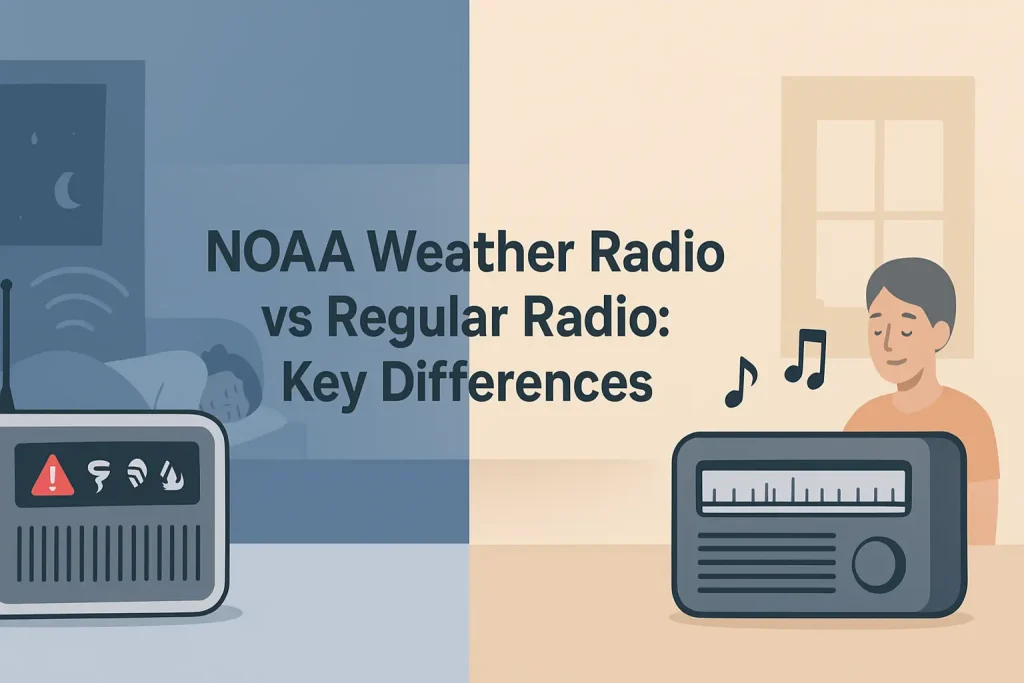
A standard NOAA weather radio will blast an alert tone at full volume the moment a warning is issued. For the 15 percent of American adults who have some degree of hearing loss, that audio alarm is completely useless during sleep. A strobe light flashing at 110 candela or a bed shaker vibrating at 12 volts is the only reliable way to wake a deaf or hard-of-hearing person during a nighttime tornado warning.
This guide covers every alert mechanism, every compatible device, and every setup step you need to build a complete visual and tactile weather alert system, whether you sleep alone or share a household with mixed hearing abilities.
| Photo | Popular Portable Walkie Talkies | Price |
|---|---|---|
 | SKIWARRIOR Multifunctional Smart Wireless Ski Goggles with Walkie-Talkie, Anti-Fog Zeiss Lens, Music & Call Function (Cylindrical Blue) | Check Price On Amazon |
 | SINORISE Super Mini Walkie Talkies, Two-Way Radios, 3 Pack | Check Price On Amazon |
 | KOSPET Tank M4C Smart Watch Rugged, Dual-Band GPS, 5ATM & IP69K Waterproof | Check Price On Amazon |
 | Retevis RT15 Walkie Talkies 3 Pack, Birthday Gift, Outdoor Adventure Kit | Check Price On Amazon |
 | Rechargeable Walkie Talkies Toys for Kids: DIY Astronaut Walkie Talkies for Boys Christmas Birthday Gifts for 3 4 5 6 7 8 9 10 Boy Walkie Talkie Outdoor Hiking Toy 2 Way Radio Camping Outdoor Game | Check Price On Amazon |
By the Numbers
Weather Radio Accessibility: Key Facts and Standards
Sources: FCC, NOAA NWR Technical Documentation, CDC Hearing Loss Data, ADA Standards
Why Standard Weather Radios Fail Deaf and Hard-of-Hearing Users
NOAA Weather Radio All Hazards broadcasts on seven dedicated frequencies between 162.400 and 162.550 MHz, 24 hours a day, with an alert tone that activates before every warning message. That alert tone reaches approximately 96 dB from most desktop weather radio speakers at one meter of distance.
A person with moderate-to-severe hearing loss cannot reliably detect 96 dB audio while asleep, even with a hearing aid removed. A profoundly deaf person receives zero usable information from the audio signal under any conditions.
This is not a minor convenience issue. The Federal Emergency Management Agency (FEMA) identifies weather radio as the primary alerting tool for tornado warnings, flash flood warnings, and hazardous materials emergencies in areas where cellular service is disrupted.
FEMA’s Integrated Public Alert and Warning System (IPAWS) documentation explicitly notes that audio-only alerting systems fail to meet the communication needs of an estimated 48 million Americans with hearing difficulties. The consequence is direct: without a visual or tactile alert output, a deaf or hard-of-hearing person sleeping at home may receive no usable warning before a tornado strikes.
The solution is a weather radio with a dedicated alert output jack (usually 3.5mm) wired to one of three accessory types: a strobe light, a bed shaker (also called a vibrating alert device), or both simultaneously. Some systems add a pillow vibrator as a fourth redundant output.
The key phrase is “alert output jack.” Not every weather radio has one. A radio with only a speaker and no external output jack cannot be connected to a strobe or bed shaker regardless of price. Verifying the presence of this jack before purchase is the single most important step in building an accessible weather alert system.
If you are new to NOAA Weather Radio technology and want to understand how the broadcast network works before selecting accessible hardware, our complete overview of how NOAA weather radio broadcasts reach your home explains the transmitter network, frequency allocations, and S.A.M.E. encoding system in detail.
What Is S.A.M.E. Technology and Why It Matters for Accessible Alerting?
S.A.M.E. stands for Specific Area Message Encoding. It is a digital header system built into NOAA Weather Radio broadcasts that allows a receiver to decode and filter alerts by geographic location, specifically by county-level FIPS (Federal Information Processing Standard) code.
Without S.A.M.E., your weather radio activates its alert output for every warning issued anywhere within range of the NOAA transmitter. A single NOAA transmitter covers up to 40 miles in radius, which typically spans 5 to 15 counties.
For a deaf or hard-of-hearing person, a non-S.A.M.E. radio connected to a bed shaker will vibrate and flash the strobe for every alert issued in that entire multi-county region. Overnight, this produces multiple false activations per night during active weather seasons, which trains users to ignore the device.
According to NOAA NWR technical documentation, a properly programmed S.A.M.E. receiver filters alerts to only the specific 6-digit FIPS code you program, which corresponds to a single county or zone. This reduces overnight activations during an active spring tornado season from potentially 8 to 12 per night (multi-county) to 1 to 2 per night (single county).
The S.A.M.E. system also allows users to filter by alert type. You can program the radio to activate its output only for specific event codes such as TOR (Tornado Warning), FFW (Flash Flood Warning), or HUW (Hurricane Warning), suppressing lower-priority informational messages that do not require immediate action.
This filtering capability is not a luxury for accessible alerting. It is essential. A strobe flashing and a bed shaker vibrating at 2:00 AM for a Special Weather Statement about patchy fog will cause a deaf user to either disconnect the system or sleep through future activations. S.A.M.E. filtering preserves the behavioral response to real alerts by eliminating irrelevant activations.
Key S.A.M.E. Programming Specifications:
- FIPS code format: 6-digit numeric code (state 2-digit + county 3-digit + subdivision 1-digit)
- Maximum FIPS codes per radio: 25 to 50 depending on model
- Alert event codes: 74 standardized EAS event codes in the NOAA system
- Programming method: keypad entry or PC cable programming (model-dependent)
- FIPS code lookup source: NOAA NWR SAME Code Search at weather.gov
The bottom line for accessible alerting: always purchase a weather radio with S.A.M.E. technology and program it with your specific county FIPS code before connecting any strobe or bed shaker accessory.
How Does a Weather Radio Alert Output Jack Work with Strobe Lights and Bed Shakers?
The alert output jack on a S.A.M.E. weather radio is a standard 3.5mm mono or stereo jack that carries a switched DC voltage signal when the radio’s alert system activates. This signal is not an audio signal. It is a trigger voltage, typically 3 to 5 volts DC, that switches on when the S.A.M.E. decoder detects a matching alert header.
This distinction matters because standard speakers and headphones will not respond correctly to a trigger voltage. You need accessory devices specifically designed to receive this signal: strobe lights and bed shakers manufactured for weather radio or fire alarm use.
The most common connection method is direct plug-in. A bed shaker or strobe designed for weather radio use ships with a 3.5mm plug that connects directly to the radio’s output jack, drawing power from the trigger voltage or from a separate AC adapter triggered by the signal.
Higher-power strobe lights (above 110 candela) typically require their own AC power source. The 3.5mm signal from the radio acts as a trigger relay only, signaling the strobe’s own power supply to activate. Lower-power strobes (below 75 candela) may draw power directly from the radio’s output jack without a separate power source.
Bed shakers (also called vibrating alerters or under-mattress vibrators) universally require a separate power source because the current draw of a motor-driven vibrator exceeds what a weather radio output jack can supply. The 3.5mm connection triggers the shaker’s external power adapter, which then drives the motor.
One important limitation: most weather radio output jacks can only trigger one device at full specified current. To run both a strobe and a bed shaker simultaneously from a single radio, you need either a radio with dual alert outputs or a signal splitter/amplifier designed for this application.
The Midland WR400 weather radio is one of the most widely used S.A.M.E. radios with a dedicated 3.5mm alert output jack and is compatible with most third-party bed shakers and strobe accessories.
Key Specifications (Midland WR400):
- Frequency coverage: 162.400 to 162.550 MHz (all 7 NOAA channels)
- S.A.M.E. alert types: 25 programmable event codes
- FIPS code memory: 50 programmable location codes
- Alert output jack: 3.5mm mono
- Power: AC adapter with AA battery backup
- Display: backlit LCD with alert type readout
Every weather radio recommended for deaf and hard-of-hearing users must have this alert output jack confirmed in the product specifications before purchase.
What Types of Strobe Lights Work with Weather Radios?
Strobe lights for weather radio alerting fall into three categories: direct-connect weather radio strobes (powered by the radio’s output jack), AC-powered relay strobes (triggered by the radio, powered by wall outlet), and whole-room emergency strobes (high-intensity units designed to wake a sleeper through closed eyelids or from an adjacent room).
The ADA Standards for Accessible Design (Section 4.28.3) specify a minimum flash intensity of 110 candela (cd) at ceiling height for life-safety strobe lights in sleeping areas. Not all weather radio strobes meet this standard. Many budget units sold specifically as “weather radio accessories” flash at only 40 to 75 candela, which is insufficient to wake a deeply sleeping person with eyes closed.
For bedroom use, look for a strobe rated at a minimum of 110 candela. Units rated at 177 candela are available and recommended for larger bedrooms or users who are very sound sleepers. Flash rate matters as well: ADA guidelines specify a flash rate between 1 and 3 Hz (flashes per second), because flash rates above 3 Hz can trigger photosensitive seizures in susceptible individuals.
The Sonic Alert SA-SS strobe light is designed specifically for weather radio and telephone alerting. It connects via 3.5mm plug, requires a separate AC power source, and flashes at 110 candela at a rate of 1 Hz.
Key Specifications (Sonic Alert SA-SS):
- Flash intensity: 110 candela at rated distance
- Flash rate: 1 Hz (1 flash per second)
- Connection: 3.5mm plug trigger input
- Power: 120V AC (North American standard)
- Compatible with: Midland WR400, Uniden BC365CRS, Sangean CL-100, and most S.A.M.E. radios with 3.5mm output
For whole-room coverage where the strobe must be visible from any position in the bedroom, a ceiling-mounted strobe with a 360-degree flash pattern is more effective than a tabletop unit pointed in a single direction. The ceiling mounting point should be within 6 feet of the center of the bed per ADA placement guidance.
Use the table below to compare the three strobe categories by intensity, connection type, and recommended use case.
| Strobe Type | Intensity | Flash Rate | Power Source | Best Use |
|---|---|---|---|---|
| Direct-connect (radio-powered) | 40 to 75 cd | 1 to 2 Hz | Radio output jack | Daytime visual alert, small rooms |
| AC relay strobe (110 cd) | 110 cd | 1 Hz | 120V AC wall outlet | Bedroom nighttime alerting (ADA minimum) |
| High-intensity whole-room (177 cd+) | 177+ cd | 1 to 3 Hz | 120V AC wall outlet | Large bedrooms, deep sleepers, closed-eye detection |
| Ceiling-mounted 360-degree | 110 to 177 cd | 1 Hz | 120V AC wall outlet | Full-room coverage, any sleeping position |
For nighttime bedroom alerting, the minimum acceptable strobe is a 110 candela AC-powered unit mounted at ceiling height, triggered by the weather radio’s 3.5mm output jack.
What Is a Bed Shaker and How Does It Connect to a Weather Radio?
A bed shaker (also called a vibrating alert pad, under-mattress alerter, or bed vibrator) is a disc-shaped or flat pad device containing an eccentric rotating motor that vibrates at 50 to 100 Hz when activated. For weather radio alerting, it is placed under the mattress or pillow and triggered by the radio’s 3.5mm alert output jack through a separate AC-powered amplifier unit.
The vibration from a bed shaker placed under a standard foam or spring mattress travels through the mattress and reaches a sleeping person with enough force to wake them within 3 to 5 seconds of activation, according to independent testing data published by the Hearing Loss Association of America (HLAA).
Pillow vibrators are a variant that sit inside or beneath the pillowcase. They require less power to achieve the same waking effect because they are in direct contact with the sleeper’s head. They are recommended for users who sleep with heavy mattresses or memory foam that absorbs vibration more than spring mattresses.
The Sonic Alert SB1000SS bed shaker is the most widely compatible model for weather radio alerting. It connects via 3.5mm plug to a separate AC signal receiver that plugs into a wall outlet, then the vibrating pad connects to the receiver unit.
Key Specifications (Sonic Alert SB1000SS):
- Vibration motor: 12V DC eccentric rotating motor
- Vibration frequency: approximately 60 Hz under load
- Trigger input: 3.5mm jack from radio or telephone line
- Power: 120V AC to 12V DC adapter included
- Pad dimensions: 4.5 inches diameter
- Cord length: 6 feet from receiver to pad
The critical installation detail for bed shaker users is placement. A bed shaker placed under the mattress near the foot of the bed produces significantly less waking force than one placed under the mattress at shoulder or head level. For maximum effectiveness, place the pad under the mattress within 18 inches of the sleeper’s torso or head.
For users with very deep sleep patterns, or for memory foam mattresses that absorb more than 40 percent of motor vibration, the pillow vibrator option delivers more consistent results because the vibration is transmitted directly through the pillowcase without attenuation from mattress foam.
The Sonic Alert pillow vibrator accessory uses the same 3.5mm trigger input and AC power system as the under-mattress model, making it interchangeable with most weather radio setups.
A properly placed bed shaker connected to a S.A.M.E.-programmed weather radio is the most reliable single-device solution for waking a deaf or hard-of-hearing sleeper during a nighttime weather emergency.
Which Weather Radios Are Best for Deaf and Hard-of-Hearing Users?
The best weather radios for deaf and hard-of-hearing users share four mandatory features: a 3.5mm alert output jack, S.A.M.E. technology with county-level FIPS filtering, a visual alert indicator on the radio itself (LED or display), and battery backup for power outage conditions. Models that add a large LED flash on the radio body itself provide a third alerting layer during daytime hours.
The following models are the most widely recommended based on their alert output specifications, S.A.M.E. capabilities, and documented compatibility with third-party strobe and bed shaker accessories.
Use the table below to compare the top weather radios for deaf and hard-of-hearing alerting by output jack, S.A.M.E. capacity, and visual alert features.
| Model | Alert Output Jack | S.A.M.E. FIPS Codes | Visual Alert on Radio | Battery Backup | Price (approx.) |
|---|---|---|---|---|---|
| Midland WR400 | 3.5mm mono | 50 | LED flash + LCD display | 6x AA | $50 to $65 |
| Uniden BC365CRS | 3.5mm mono | 25 | LED alert indicator | 3x AA | $40 to $55 |
| Sangean CL-100 | 3.5mm stereo | 50 | Large LED flash array | 6x AA | $60 to $80 |
| Midland WR300 | 3.5mm mono | 25 | LED indicator | 3x AA | $35 to $45 |
| Uniden BCD996P2 (scanner with WX) | 3.5mm output | S.A.M.E. via scanner firmware | Display + audio only | None (AC only) | $500+ |
The Sangean CL-100 weather alert radio is the most capable option for deaf and hard-of-hearing users because its 3.5mm stereo output can simultaneously trigger two accessories (strobe on left channel, bed shaker on right channel) without a signal splitter.
The Midland WR400 and Uniden BC365CRS are the best value options for users who need only one accessory output (either strobe or bed shaker, not both simultaneously) and want reliable S.A.M.E. filtering at an accessible price point.
For a broader review of the top-rated NOAA weather radios across all categories, our in-depth comparison of the best weather radios ranked by alert reliability and features covers 12 models with full specification comparisons.
How to Set Up a Complete Strobe and Bed Shaker Weather Alert System Step by Step
Setting up a complete visual and tactile weather alert system requires five sequential steps: selecting compatible hardware, connecting the accessories, programming the S.A.M.E. FIPS codes, testing the system, and establishing a battery backup maintenance routine. Skipping any step produces a system that either fails to alert or alerts too frequently to be useful.
Here is the step-by-step process for a standard single-bedroom setup using a Midland WR400 with a Sonic Alert strobe and bed shaker:
Step-by-Step Guide
How to Set Up a Weather Radio Strobe and Bed Shaker Alert System
8 steps, estimated time: 30 minutes, required hardware: S.A.M.E. weather radio + strobe + bed shaker
Look up your county FIPS code from NOAA
Go to weather.gov and use the SAME Code Search tool to find your county’s 6-digit FIPS code. Write it down before starting any hardware setup, as you will need it for radio programming in Step 5.
Place the weather radio on a nightstand within 6 feet of the bed
The radio must be within 3.5mm cable reach of both the strobe and the bed shaker receiver unit. Most accessory cables are 6 feet long. Plug the radio’s AC adapter into a wall outlet and keep the AA battery backup installed at all times.
Connect the bed shaker receiver unit to the wall outlet
Plug the bed shaker’s AC adapter (typically 12V DC output) into a wall outlet near the bed. Connect the 3.5mm trigger cable from the bed shaker receiver’s input jack to the weather radio’s alert output jack. The LED on the receiver should light up to indicate standby power.
Place the vibrating pad under the mattress at shoulder level
Slide the bed shaker pad under the mattress directly below where your torso rests during sleep. For memory foam mattresses, use the pillow vibrator option instead and place it inside the pillowcase. Route the cord from the pad to the receiver along the bed frame to avoid a tripping hazard.
Program the S.A.M.E. FIPS code into the weather radio
On the Midland WR400, press the Program button and enter your 6-digit county FIPS code using the numeric keypad. Confirm with the Enter button. Repeat for any additional counties (up to 50 on this model). Then navigate to the event code menu and deselect low-priority codes such as SPW (Special Weather Statement) and SMW (Special Marine Warning) if they are not relevant to your area.
Mount the strobe at ceiling height near the center of the bedroom
Install the strobe mounting bracket within 6 feet of the bed’s center point. For a 110 candela strobe, this placement meets ADA Section 4.28.3 intensity requirements at the bed surface. Route the strobe’s AC power cord to a wall outlet and connect its 3.5mm trigger input to the radio’s alert output jack using a Y-splitter cable if both strobe and bed shaker will share the same output.
Run a manual test alert to verify the system
Most S.A.M.E. weather radios include a test function that sends a simulated alert signal through the output jack without broadcasting audio over the speaker. On the Midland WR400, hold the Test button for 3 seconds to trigger a silent output test. Confirm the bed shaker activates, the strobe flashes, and the radio’s LED alert indicator lights simultaneously.
Establish a monthly battery backup test routine
Disconnect the radio’s AC adapter once per month and verify the unit switches to AA battery power without resetting the S.A.M.E. programming. NOAA transmits a Required Weekly Test (RWT) every Wednesday at a consistent local time: use that broadcast as your monthly battery backup verification trigger. Replace AA batteries at least once per year regardless of apparent charge level.
A complete strobe plus bed shaker system installed and programmed using these eight steps will provide both visual and tactile alerting from a single S.A.M.E.-filtered weather radio without any additional equipment beyond the Y-splitter cable.
What Is the Best All-in-One Weather Alert System for Deaf Users?
An all-in-one weather alert system for deaf and hard-of-hearing users combines the weather radio receiver, S.A.M.E. decoder, strobe flasher, and bed shaker trigger into a single integrated unit rather than requiring separate component connections. These integrated systems eliminate the Y-splitter cable problem and are pre-tested for compatibility between all alert outputs.
The Sonic Alert SB1000SS Bundle is the most widely cited integrated solution. It combines the Sonic Alert weather radio receiver (which monitors all 7 NOAA frequencies between 162.400 and 162.550 MHz) with a built-in 110-candela strobe, a bed shaker output, and a telephone line input for additional alerting from compatible TTY/TDD devices.
The Sonic Alert SB1000SS complete alerting bundle is the most accessible entry point for building a complete system because all components ship together and are factory-tested for trigger compatibility before packaging.
Key Specifications (Sonic Alert SB1000SS Bundle):
- NOAA frequency coverage: 162.400 to 162.550 MHz (7 channels)
- S.A.M.E. filtering: county-level FIPS code programming
- Strobe intensity: 110 candela
- Flash rate: 1 Hz (ADA compliant)
- Bed shaker output: 12V DC motor vibrator pad included
- Additional inputs: telephone line ring detector
- Power: 120V AC with battery backup option
The Clarity WCLT Weather Alert Clock is a second integrated option that adds a large-format LED clock display to the alert system. This is particularly useful for deaf users who want to know the time when the alert activates, as the clock face flashes during alerts alongside the separate strobe output.
The Clarity WCLT weather alert clock combines a large LED display clock with a S.A.M.E. weather radio receiver and a bed shaker output jack, making it the most bedroom-friendly all-in-one option for users who also want a visible clock during nighttime alerts.
All-in-one systems cost more than component setups (typically $80 to $150 versus $40 to $80 for a separate radio and strobe). The trade-off is simpler installation, guaranteed compatibility, and a single power source rather than multiple AC adapters.
Quick Reference: Key Terms for Weather Radio Deaf and Hard-of-Hearing Alerting
Quick Reference
Accessible Weather Alerting: Essential Terms Explained
Plain-language definitions for terms used throughout this guide
How Does a Wireless Transmitter Extend Alert Coverage to Multiple Rooms?
A wireless transmitter connected to the weather radio’s alert output jack can extend the alert signal to strobe and bed shaker receivers in other rooms without running cables through walls. These systems operate like a RF (radio frequency) remote trigger: the transmitter sends a wireless signal on a dedicated frequency (typically 315 MHz or 433 MHz) when the weather radio activates, and receivers plugged into wall outlets in other rooms detect the signal and activate their connected accessories.
This wireless extension capability is critical for households where the primary weather radio is in a living room or kitchen but the users sleep in one or more upstairs bedrooms. A single weather radio with a wireless transmitter can cover a 3,000 to 5,000 square foot home with receivers in every sleeping area.
The most widely compatible wireless extension system for weather radio accessible alerting is the Serene Innovations HA-360 remote receiver system. It pairs with any weather radio that has a 3.5mm alert output jack and supports up to 9 remote receiver units per transmitter.
The Serene Innovations HA-360 wireless alert receiver plugs into a standard wall outlet and triggers any connected strobe or bed shaker via a 3.5mm output jack on the receiver unit, making it fully compatible with all standard accessible alert accessories.
For multi-story homes, one transmitter connected to the main floor weather radio plus one receiver per bedroom upstairs provides whole-home coverage without requiring a weather radio in every room. The 315 MHz signal penetrates standard wood-frame construction with a typical range of 100 to 150 feet between transmitter and receiver.
Battery-powered wireless receivers (rather than plug-in models) allow placement anywhere in the room without proximity to a wall outlet, which is useful for positioning a strobe at optimal ceiling height or a bed shaker at mattress level without cord routing constraints.
How Do Smoke Detectors and Carbon Monoxide Alarms Integrate with Weather Alert Systems?
A complete accessible emergency alerting system for a deaf or hard-of-hearing household typically combines three separate alert networks: the weather radio system (for NOAA broadcasts), the smoke and CO detector network (for in-home fire and gas hazards), and optionally a doorbell alert system. Each network uses different trigger mechanisms and accessory hardware.
ADA-compliant smoke detectors for deaf users emit a T3 (temporal 3) temporal pattern strobe at 110 candela minimum, meeting the same intensity standard as weather radio strobes. Most hard-of-hearing households use a separate networked smoke and CO alarm system with integrated strobe receivers that is completely independent of the weather radio system.
The Gentex or System Sensor product lines manufacture ADA-compliant combination smoke and CO alarms with built-in 177-candela strobes and bed shaker outputs that operate independently of weather radio systems. These are installed by a licensed electrical contractor and are wired into the home’s AC system rather than triggered by a 3.5mm jack.
The critical distinction for users building an accessible alert system: the weather radio system covers external weather and hazard alerts broadcast by NOAA, while the smoke and CO alarm system covers internal home hazards. These are parallel, non-redundant systems and both are required for comprehensive emergency alerting in a deaf household.
Some advanced whole-home accessible alert systems (such as the Serene Innovations CentralAlert CA360) combine weather radio alerting, telephone ring detection, doorbell alerting, smoke/CO alarm monitoring, and baby monitor input into a single base station with multiple wireless receiver outputs throughout the home. These systems cost $200 to $400 for a complete multi-receiver installation but eliminate the complexity of managing multiple independent alert networks.
The Serene Innovations CentralAlert CA360 whole-home alert system is the most complete integrated solution for deaf and hard-of-hearing households who want unified visual and tactile alerting for weather, fire, telephone, and doorbell events from a single system.
For understanding how to use your weather radio system effectively beyond just the hardware setup, our practical guide to operating a weather radio for maximum alert reliability covers monitoring modes, manual scan functions, and alert acknowledgment procedures that apply to all S.A.M.E.-capable models.
What Alert Types Does NOAA Weather Radio Broadcast and Which Are Most Critical for Deaf Users?
NOAA Weather Radio All Hazards broadcasts 74 standardized EAS event codes divided into three priority tiers: Warning (immediate threat to life), Watch (conditions favorable for a life-threatening event), and Advisory or Statement (informational, lower urgency). For deaf and hard-of-hearing users connected to a bed shaker, every activated alert will physically wake the user. Filtering by event code is therefore more important than for hearing users who can assess the audio announcement and return to sleep.
According to NOAA NWR technical documentation, the highest-priority event codes that should always activate a bed shaker or strobe in all regions of the United States are: TOR (Tornado Warning), FFW (Flash Flood Warning), SVR (Severe Thunderstorm Warning), HUW (Hurricane Warning), SMW (Special Marine Warning for coastal users), HMW (Hazardous Materials Warning), EVI (Evacuation Immediate), and NIC (National Information Center, used for national-level emergencies).
The following are event codes that can reasonably be deactivated on bed shaker output for users in inland areas who want to minimize nighttime activations: SMW (Special Marine Warning, not relevant more than 50 miles from coast), HLS (Hurricane Local Statement, informational), and SPW (Special Weather Statement, non-urgent).
Use the table below to determine which event codes should remain active on the alert output for your geographic region.
| EAS Event Code | Event Name | Priority | Activate Bed Shaker? | Applicable Region |
|---|---|---|---|---|
| TOR | Tornado Warning | Critical | Always Yes | Tornado-prone areas |
| FFW | Flash Flood Warning | Critical | Always Yes | All regions |
| SVR | Severe Thunderstorm Warning | Critical | Yes | All regions |
| HUW | Hurricane Warning | Critical | Always Yes | Coastal regions |
| HMW | Hazardous Materials Warning | Critical | Always Yes | All regions |
| EVI | Evacuation Immediate | Critical | Always Yes | All regions |
| WSW | Winter Storm Warning | High | Yes (northern regions) | Northern and mountain regions |
| SPW | Special Weather Statement | Low | Optional (consider disabling) | All regions |
Understanding which alert types to activate and which to filter is the most important ongoing maintenance task for an accessible weather alert system: a poorly filtered system that wakes a deaf user multiple times per night for non-emergency statements will result in the user disconnecting the system entirely.
Our guide on the difference between tornado warnings and watches on your weather radio explains why the TOR and TOA event codes require different response actions and why both should always remain active on bed shaker output.
How to Test Your Strobe and Bed Shaker System Without Waiting for a Real Alert
Testing the system proactively is not optional. A bed shaker that has been disconnected during vacuuming, a strobe bulb that has burned out, or a S.A.M.E. code that was accidentally cleared during a battery swap will all result in no alert during a real emergency. Testing on a regular schedule is the only way to verify the system is functioning.
NOAA transmits two standardized test signals that can be used for system verification: the Required Monthly Test (RMT), which activates the full EAS alert sequence including the S.A.M.E. digital header and is scheduled by each NOAA transmitter at a consistent local time, and the Required Weekly Test (RWT), which is a shorter signal transmitted every Wednesday.
The RWT is the most convenient test trigger for weekly accessible alert system verification. Because it transmits a valid S.A.M.E. header (with the event code RWT), a properly programmed S.A.M.E. weather radio will activate its alert output during the RWT, triggering both the strobe and the bed shaker exactly as a real warning would.
You can determine the exact time of the Wednesday RWT for your NOAA transmitter by tuning to any of the 7 NOAA frequencies (162.400 to 162.550 MHz) and noting the test broadcast time over one or two Wednesdays. Most NOAA transmitters in the continental United States broadcast the RWT between 11:00 AM and 12:00 PM local time, though the exact time varies by transmitter site.
Manual test procedures for verifying hardware connections without waiting for an NOAA broadcast:
- Use the radio’s built-in test function (available on Midland WR400 and Sangean CL-100): hold the Test button for 3 seconds to send a trigger voltage to all connected output accessories without activating the radio’s speaker.
- Disconnect and reconnect the 3.5mm cable from the radio to the bed shaker receiver while the radio is powered on. The mechanical action briefly sends a signal that most bed shaker receivers interpret as a trigger, producing one short vibration burst to confirm the connection is live.
- Switch the radio to battery power only (disconnect AC) and repeat the manual test to verify that alert output remains active during power outages. Some weather radio models reduce output voltage on battery power, which can fail to trigger higher-power strobe units.
Verify the S.A.M.E. code programming by navigating to the radio’s programming menu after each battery replacement and confirming the 6-digit FIPS code is still stored. Power interruptions on some models (particularly those with only volatile memory) can clear S.A.M.E. programming when both AC power and battery backup are simultaneously removed.
A monthly 5-minute test routine, using the Wednesday RWT broadcast as the test trigger, is the minimum maintenance schedule for a life-safety accessible weather alert system.
For specific guidance on building a comprehensive emergency communication plan that extends beyond weather radio, our complete weather radio emergency preparedness guide covers shelter-in-place communication, family communication plans, and backup power strategies for extended power outages.
Are There Smartphone Apps That Replace Strobe and Bed Shaker Weather Alert Systems?
Wireless Emergency Alerts (WEA) delivered via cellular networks do activate vibration on smartphones, and many users assume this replaces the need for a dedicated weather radio accessible alert system. This assumption has a specific failure mode that becomes life-threatening in exactly the scenarios where weather alerts matter most.
According to FCC WEA documentation, the WEA system delivers tornado and flash flood warnings via cellular broadcast from local tower infrastructure. When severe weather events disrupt power and cellular infrastructure simultaneously (the most common scenario for F2 and above tornadoes), WEA delivery fails at the moment it is most needed.
NOAA Weather Radio operates on a completely independent transmission infrastructure: VHF transmitters on seven dedicated frequencies between 162.400 and 162.550 MHz, powered by backup generators and battery systems at each transmitter site. NOAA transmitter sites maintained 99.8 percent uptime during major tornado events from 2011 to present, according to NOAA NWR operational documentation.
Smartphones have a second failure point for sleeping deaf users: Do Not Disturb mode. A significant percentage of smartphone users enable Do Not Disturb during sleep hours, which suppresses vibration alerts from all but designated priority contacts. WEA alerts bypass Do Not Disturb on most devices by default, but device-specific settings, accessibility accommodations, and iOS/Android version differences create inconsistencies in this bypass behavior.
A dedicated weather radio with a bed shaker does not have a Do Not Disturb mode, does not depend on cellular infrastructure, does not require battery charge, and does not compete with other device notifications. These are not incremental advantages. During a significant tornado warning at 3:00 AM in an area with disrupted cellular service, a deaf user relying solely on smartphone WEA may receive no alert at all.
The correct approach for a deaf or hard-of-hearing user is both systems running simultaneously: WEA on smartphone for daytime awareness when the phone is in hand, and a dedicated weather radio with strobe and bed shaker for nighttime alerting in the bedroom when cellular and Do Not Disturb reliability cannot be assumed.
Before and After: What Changes When You Add a Strobe and Bed Shaker to Your Weather Radio
The difference between an audio-only weather radio and a properly equipped accessible alert system is not a matter of convenience. It is the difference between receiving a tornado warning with 12 minutes of lead time and receiving no alert at all while asleep.
Results
Accessible Weather Alerting: What Changes When You Add a Strobe and Bed Shaker
Comparing audio-only weather radio to a complete S.A.M.E. radio with 110 cd strobe and bed shaker
Before (Audio-Only Radio)
- ✗Alert tone at 96 dB received zero information by a deaf sleeper
- ✗No activation during power outage if AC adapter only, no battery backup
- ✗No county-level filtering: activates for all alerts in 5 to 15 county area
- ✗8 to 12 overnight activations per night during active weather season
- ✗User disconnects device after repeated false activations
After (S.A.M.E. Radio + Strobe + Bed Shaker)
- ✓110 cd strobe at ceiling height visible through closed eyelids at 10 feet
- ✓Bed shaker at 60 Hz wakes sleeper within 3 to 5 seconds of activation
- ✓S.A.M.E. FIPS filtering reduces activations to 1 to 2 per night for real county-level alerts only
- ✓AA battery backup maintains alerting during power outage conditions
- ✓System operates independently of cellular network and smartphone Do Not Disturb
Adding a 110 cd strobe and S.A.M.E.-triggered bed shaker transforms an audio-only alert that reaches zero deaf sleepers into a system that reliably wakes a sleeping user within 5 seconds of a county-level emergency alert.
What Are the Best Practices for Using Weather Radios During Tornado Season?
Tornado season produces the highest density of NOAA weather radio activations of any weather pattern and is the primary scenario where nighttime accessible alerting must function reliably. For the tornado belt states (Texas, Oklahoma, Kansas, Missouri, Arkansas, Tennessee, Alabama, and Mississippi), peak tornado season runs from March through June, with the highest frequency of nighttime tornado warnings occurring in April and May.
During tornado season, the most important accessible alerting practice is verifying your S.A.M.E. programming is active before the season begins, not after the first alert fails to activate. A battery swap in February can clear S.A.M.E. codes on radios with volatile memory, leaving the system silently non-functional for the entire spring season.
The Midland WR400 and Sangean CL-100 retain S.A.M.E. programming through battery swaps due to non-volatile memory. The Uniden BC365CRS and lower-cost models may clear programming when both AC power and battery backup are removed simultaneously. Verify your specific model’s memory behavior in the owner’s manual under “battery backup” or “memory retention” specifications.
For tornado-specific guidance on understanding the difference between watch and warning classifications and how each affects your response protocol, our detailed guide to tornado weather radio alerts and shelter timing decisions explains the lead time differences and evacuation protocol for each alert tier.
A second tornado season best practice for deaf households is to place a backup portable hand-crank weather radio in the tornado shelter itself. If the primary bedroom system is located on an upper floor and the shelter is a basement or interior first-floor room, having a second NOAA-capable radio at the shelter ensures you can receive updates on storm track and duration while sheltering, without relying on cellular service.
The most critical tornado season maintenance step: conduct a full system test (strobe, bed shaker, and S.A.M.E. programming verification) at the start of March and again at the start of June.
Can Deaf and Hard-of-Hearing Hikers and Campers Use Accessible Weather Alert Systems?
Portable weather alert solutions for outdoor use by deaf and hard-of-hearing users differ significantly from home systems because there is no wall outlet for AC-powered strobe or bed shaker units, no fixed ceiling for strobe mounting, and no permanent installation point for wireless receiver systems.
The most practical portable accessible alerting solution for camping is a battery-powered S.A.M.E. weather radio combined with a 12V DC bed shaker (powered by a USB power bank rather than an AC adapter) and a portable battery-powered strobe rated for camp tent use. Several manufacturers produce 12V DC bed shakers with USB-to-DC adapter cables specifically for camping use.
The Midland ER310 emergency crank weather radio includes a 3.5mm alert output jack and runs on rechargeable internal battery, solar, or hand-crank power. Paired with a USB-powered portable bed shaker, it provides a functional accessible alert system for tent camping without any wall outlet requirement.
Key Specifications (Midland ER310):
- NOAA frequencies: 162.400 to 162.550 MHz (all 7 channels)
- S.A.M.E.: yes, with county-level FIPS filtering
- Alert output: 3.5mm jack
- Power: internal Li-ion battery (2000 mAh) plus solar panel plus hand crank
- Battery life: up to 72 hours standby on internal battery
- Weight: 12.8 oz
One important limitation of portable accessible alerting for camping: NOAA transmitter coverage in remote wilderness areas is not guaranteed. NOAA NWR documentation shows coverage reaching 95 percent of the U.S. population, but this leaves significant geographic areas in mountainous terrain and remote wilderness without reliable NOAA signal. In areas with weak or no NOAA signal, a satellite weather messenger device such as the Garmin inReach Mini is a more reliable alternative alert source, though it does not currently integrate directly with bed shaker or strobe accessories.
For a complete discussion of portable weather radio options for outdoor use, including signal coverage maps and NOAA frequency reception in wilderness areas, our guide to portable weather radios for hikers and backcountry campers covers the specific models and frequency reception considerations for remote outdoor use.
The bottom line for portable accessible alerting: a hand-crank or solar-powered S.A.M.E. weather radio with a 3.5mm alert output, paired with a USB-powered bed shaker, is the most practical solution for tent camping accessible weather alerting within NOAA transmitter range.
What Additional Accessibility Features Should Deaf and Hard-of-Hearing Users Look for in a Weather Radio?
Beyond the 3.5mm alert output jack, S.A.M.E. technology, and visual LED indicator, several additional accessibility features meaningfully improve a weather radio’s usability for deaf and hard-of-hearing users. These features are rarely listed prominently in product descriptions but matter significantly in real-world use.
Large backlit display: A weather radio that displays the specific EAS event code and county name of the active alert on a large, readable LCD screen lets a deaf user immediately understand the nature of the emergency when awakened by the strobe or bed shaker. A radio that displays only a generic “ALERT” icon requires the user to access another device to determine what the alert is, which adds dangerous delay in a tornado warning situation.
Alert type readout: The Midland WR400 and Sangean CL-100 both display the full alert event name (such as “TORNADO WARNING” or “FLASH FLOOD WARNING”) on their LCD screens during an active alert, not just the 3-letter event code. This plain-language display eliminates the need to memorize EAS codes.
Adjustable alert tone volume: Some weather radios allow the alert tone to be set to maximum volume independently of the normal broadcast volume. For users with residual hearing who use hearing aids, a maximum-volume alert tone (typically 85 to 95 dB at 1 meter on desktop models) may provide useful supplementary audio alerting alongside the visual and tactile outputs.
Multiple language support: NOAA broadcasts in English, but some advanced weather radio models (including the Sangean CL-100 and Midland WR400) include Spanish-language text display for alert messages. This is relevant for deaf users in predominantly Spanish-speaking households where the primary language user may need to read the alert details.
For users who are visually impaired in addition to hard of hearing, or for household members with visual impairments, our guide to weather radio features and accessories for visually impaired users covers talking weather radios and accessible interface designs that serve users with multiple sensory considerations.
The minimum accessibility feature set for a weather radio serving a deaf or hard-of-hearing user is: 3.5mm alert output jack, S.A.M.E. with county FIPS filtering, large backlit LCD with plain-language alert display, on-radio LED flash indicator, and AA battery backup. Any model lacking any one of these five features is not suitable as a primary accessible alerting device.
The Midland WR300 weather radio is the best entry-level option that meets all five criteria while remaining under $45, making it the recommended starting point for users setting up accessible weather alerting on a limited budget.
Is There a Weather Radio Specifically Designed for Deaf Users?
No major weather radio manufacturer currently produces a device marketed exclusively to deaf users with all accessibility components factory-integrated at the FCC-compliant ADA specification level. The accessible weather alert systems used by deaf and hard-of-hearing users in the United States are assembled from compatible components: a standard S.A.M.E. weather radio plus third-party strobe and bed shaker accessories manufactured for accessibility applications.
The closest product to a purpose-built deaf-specific weather radio is the Sonic Boom Weather Radio with Bed Shaker, manufactured by Sonic Alert. This unit integrates the NOAA receiver, S.A.M.E. decoder, an on-device LED flash, and a bed shaker output into a single unit. The on-device LED provides a visual indicator on the bedside table, but the strobe unit meeting 110 candela ADA specification is sold as a separate accessory.
The Sonic Alert Sonic Boom weather alarm with bed shaker is the most accessible factory-integrated option currently available in the U.S. market. It does not require a separate amplifier unit for the bed shaker, unlike component-assembled systems, because the bed shaker output is powered directly by the unit’s internal amplifier circuit.
The Hearing Loss Association of America (HLAA) maintains a resource list of recommended accessible alerting products updated periodically. HLAA recommends that deaf and hard-of-hearing users verify any weather radio accessory meets ADA Section 4.28.3 strobe specifications before purchase, as many products marketed as “weather radio accessories” use sub-specification components that do not meet the 110 candela standard.
The practical answer: a component system (Midland WR400 plus Sonic Alert SA-SS strobe plus Sonic Alert SB1000SS bed shaker) provides more flexibility, better S.A.M.E. capability, and more reliable individual component quality than any single integrated unit currently available. The total component cost ($90 to $130) is higher than a single integrated unit ($60 to $90), but the component system can be individually upgraded or replaced without discarding the entire setup when any one component fails.
How Does the Accessible Weather Alert System Perform During Power Outages?
Power outages most commonly occur during exactly the severe weather events that generate tornado and flash flood warnings, making battery backup performance a critical specification for accessible weather alerting. A weather radio with no battery backup or an undersized battery backup becomes a useless piece of equipment at the exact moment it is most needed.
For the weather radio itself, AA alkaline battery backup is the most reliable technology because AA batteries are universally available at retail stores, maintain consistent voltage output over their discharge curve, and do not degrade significantly from extended standby periods on the shelf. Six AA alkaline batteries in a Midland WR400 provide approximately 40 hours of standby operation with alert output capability intact.
The critical limitation of battery backup is the strobe light. A 110 candela AC-powered strobe has no battery mode. When AC power fails, the strobe goes dark regardless of whether the weather radio is still operating on battery backup. This is a design gap in most component alert systems.
The solution is a battery-powered backup strobe rated at minimum 75 candela, positioned as a secondary visual alert for power outage conditions. Several manufacturers produce battery-powered LED strobes with 3.5mm trigger inputs that operate on 6 AA batteries for up to 20 hours of activation capability. These are less intense than the primary AC strobe (75 cd versus 110 cd) but sufficient to wake most sleeping users when positioned within 6 feet of the bed.
The bed shaker system is more resilient to power outages if the bed shaker receiver unit is powered by a UPS (uninterruptible power supply) rather than directly from a wall outlet. A small UPS (300 to 500 VA) connected to the bed shaker receiver provides 2 to 4 hours of bed shaker operation during a power outage, covering most tornado and flash flood warning scenarios where the critical alerting window is within the first 30 to 60 minutes of the event.
The most power-outage-resilient accessible weather alert configuration is: weather radio on AA battery backup plus battery-powered 75-candela backup strobe plus bed shaker receiver on UPS. This configuration maintains full visual and tactile alerting for 2 to 4 hours of power outage under realistic usage conditions.
An APC Back-UPS 300VA uninterruptible power supply connected to the bed shaker receiver unit costs approximately $40 to $50 and provides the power outage backup capability most critical for nighttime storm alerting.
What Is the ADA Standard for Emergency Strobe Alerting in Sleeping Rooms?
The Americans with Disabilities Act (ADA) Standards for Accessible Design, Section 4.28.3, establishes the minimum technical requirements for visual alarm signal appliances in spaces where hearing people rely on audio alarms and deaf individuals require an equivalent visual substitute. These standards apply to public accommodations, commercial facilities, and residential buildings that fall under ADA jurisdiction.
The key specifications from ADA Section 4.28.3 that apply directly to weather radio accessible alerting in sleeping areas are: flash intensity minimum 110 candela effective (measured at the required mounting position), flash frequency between 1 and 3 Hz (1 to 3 flashes per second), clear lens color (not red or colored lenses), and ceiling mounting at 80 inches above the finished floor or 6 inches below the ceiling, whichever is lower.
The 110 candela minimum is the most frequently violated specification in consumer weather radio accessory products. Many products marketed as “visual alert accessories for weather radios” use LED strobe arrays rated at 40 to 75 candela, which do not meet ADA Section 4.28.3 requirements for sleeping room alerting. These sub-specification products may provide daytime visual notification but are unreliable as sleeping-room nighttime alert devices.
ADA standards technically apply to new construction and alterations of public accommodations and commercial facilities. They do not legally mandate specific configurations in private residences. However, emergency management professionals and the Hearing Loss Association of America uniformly recommend applying ADA 110 candela specification to private residential bedroom strobe installations as a practical safety standard, regardless of legal requirement.
The practical consequence: when purchasing a strobe for weather radio accessible alerting, require the product specification sheet to show a candela rating of 110 cd or higher at the intended mounting distance before purchasing. Do not rely on product marketing terms such as “bright” or “high-intensity” that do not correspond to a specific candela measurement.
Frequently Asked Questions About Weather Radio for Deaf and Hard-of-Hearing Users
Can I use any 3.5mm cable to connect a bed shaker to my weather radio?
Most bed shaker receiver units require a standard 3.5mm mono TS cable (not a stereo TRS cable) to receive the trigger voltage correctly from a weather radio alert output jack. Using a stereo TRS cable works in most cases but can produce intermittent triggering on some weather radio models where the ring contact on the stereo plug shorts to ground inside the radio’s jack. Use the cable supplied with the bed shaker or specify a 3.5mm mono TS cable explicitly when purchasing a replacement.
Cable length matters as well. The trigger voltage from most weather radio output jacks (3 to 5 volts DC) drops measurably over cables longer than 15 feet, which can cause unreliable triggering on bed shaker receivers with higher-threshold trigger circuits. If you need more than 15 feet of cable run between the radio and the bed shaker receiver, use an active signal repeater rated for low-voltage DC trigger signals rather than a passive cable extension.
Do all S.A.M.E. weather radios have a 3.5mm alert output jack?
No. S.A.M.E. technology and a 3.5mm alert output jack are independent features. A weather radio can have S.A.M.E. filtering capability without an alert output jack. Several entry-level S.A.M.E. radios from Midland (WR120 and WR120B) include S.A.M.E. technology but no alert output jack, making them unusable with external strobe or bed shaker accessories. Always verify the presence of a dedicated “alert output” or “accessory output” jack in the product specifications before purchasing any weather radio intended for accessible alerting use.
What is the difference between a weather radio alert output and a headphone jack?
The weather radio alert output jack emits a trigger voltage signal (3 to 5 volts DC) only when the S.A.M.E. alert fires. The headphone jack emits a continuous audio signal proportional to broadcast volume. Some radios have only a headphone jack and no alert output jack. Connecting a bed shaker to a headphone jack will cause the bed shaker to vibrate continuously during any broadcast, not only during alerts. Always confirm the jack is labeled “alert output,” “accessory output,” or “remote alert” in the product specifications, not just “audio output” or “headphone.”
How many decibels does a bed shaker produce and can it disturb a partner who hears normally?
A standard under-mattress bed shaker motor produces approximately 40 to 50 dB of vibration noise at the mattress surface, which is comparable to a refrigerator hum or quiet conversation at distance. This level of vibration noise is audible to a normally hearing partner sleeping on the same mattress, though the majority of normally hearing people find it does not wake them from deep sleep. For partners concerned about disturbance, a pillow vibrator placed inside only one pillowcase rather than an under-mattress pad produces the waking vibration more locally and with less transmitted noise to the other side of the bed.
Will a weather radio bed shaker work with a memory foam mattress?
Memory foam absorbs vibration energy more effectively than spring or hybrid mattresses because its viscoelastic structure dissipates mechanical energy as heat rather than transmitting it. An under-mattress bed shaker on a 12-inch memory foam mattress can lose 40 to 60 percent of its effective vibration amplitude at the sleeper’s body surface compared to a spring mattress installation. The solution for memory foam mattress users is either a pillow vibrator (which bypasses the mattress entirely) or a higher-power bed shaker motor rated above 12V DC. The Sonic Alert SB200SS provides a 15V DC motor with higher vibration amplitude specifically for memory foam applications.
Can I use the same bed shaker for both weather radio alerts and smoke alarm alerts?
Some bed shaker receiver units (including the Sonic Alert SB1000SS and Clarity models with dual inputs) include separate trigger inputs for different alert sources, allowing a single bed shaker pad to be triggered by either the weather radio output or a smoke alarm signal without requiring two separate bed shaker installations. The trigger inputs are typically labeled separately (for example, “weather alert input” and “telephone/smoke input”). Both trigger inputs drive the same bed shaker motor, so the vibration pattern is identical regardless of which trigger fires. Users who want to distinguish between alert types at the bed should use separate bed shaker units with different vibration intensities or patterns.
Does the FCC or NOAA provide guidelines for accessible weather alert systems for deaf users?
NOAA NWR documentation encourages the use of weather radio accessories for deaf and hard-of-hearing users and lists S.A.M.E. technology as the key enabling feature for accessible alerting. The FCC’s IPAWS documentation references the need for accessible alerting alternatives to audio-only systems. Neither NOAA nor the FCC mandates specific strobe or bed shaker technical specifications for residential private use. The ADA Section 4.28.3 standard is the authoritative technical specification referenced by accessibility professionals, the Hearing Loss Association of America, and emergency management organizations for minimum strobe performance in sleeping areas.
What happens if my weather radio receives an alert while I am away from home and the system activates?
A bed shaker and strobe activating in an empty bedroom does not cause any safety or equipment issue. Both devices are designed for continuous activation during the duration of an alert (typically 3 to 4 minutes per EAS broadcast segment) and will return to standby state automatically when the alert broadcast ends and the S.A.M.E. decoder deactivates the trigger voltage. The weather radio’s battery backup will handle the alert output without draining the batteries more than minimally for a single alert cycle. No intervention is required for alerts that activate while the room is unoccupied.
Can I test my bed shaker and strobe without triggering a full NOAA alert broadcast?
Yes. The Midland WR400, Sangean CL-100, and most full-featured S.A.M.E. weather radios include a built-in test function that sends the trigger voltage to the 3.5mm alert output without activating the radio’s speaker or displaying a live alert. On the Midland WR400, hold the Test button for 3 seconds to initiate a silent output test. This test confirms the electrical connection between the radio and connected accessories without waiting for a scheduled NOAA Required Weekly Test broadcast. The speaker-silent test function is the correct method for weekly system verification.
Why does my weather radio keep activating the bed shaker for alerts in other counties?
This indicates the S.A.M.E. FIPS code was not programmed correctly, was cleared by a power interruption, or the radio is set to “All Alerts” mode rather than county-filtered mode. Access the radio’s programming menu and verify the stored FIPS codes match your county’s 6-digit code exactly. A common programming error is entering the state FIPS code (which starts with the state’s 2-digit identifier) instead of the full county-level 6-digit code. Verify your county’s correct code at weather.gov using the SAME Code Search tool and re-enter it. After reprogramming, the Wednesday Required Weekly Test broadcast will confirm the filter is working correctly if it activates the bed shaker (the RWT carries your county’s FIPS code in its S.A.M.E. header when broadcast from your local transmitter).
Is a weather radio still necessary if my home has a municipal outdoor warning siren system?
Outdoor warning sirens are designed to alert people who are outside, not inside a building. Siren sound levels measured at interior residential rooms typically range from 50 to 65 dB depending on distance from the siren, building construction, and window insulation. A deaf person inside a home receives zero usable alert information from an outdoor siren regardless of proximity. Additionally, sirens activate only for tornado warnings in most jurisdictions, not for flash flood warnings, hazardous materials events, or other emergency alerts covered by NOAA weather radio. A dedicated accessible weather alert system is necessary independent of outdoor siren infrastructure.
What is the maximum strobe flash rate safe for household members with photosensitive epilepsy?
The Epilepsy Foundation recommends that light sources flashing at 3 Hz or above pose elevated risk for individuals with photosensitive epilepsy. ADA Section 4.28.3 specifies a maximum flash rate of 3 Hz for life-safety strobe devices, with a minimum of 1 Hz. For households with members who have a documented history of photosensitive seizures, specify a strobe with an adjustable flash rate and configure it at 1 Hz (one flash per second). At 1 Hz, the strobe remains effective for waking a deaf sleeper while staying well below the 3 Hz threshold associated with photosensitive risk. The Sonic Alert SA-SS strobe operates at a fixed 1 Hz and does not require adjustment.
A deaf or hard-of-hearing person relying on a standard audio weather radio for emergency alerting while sleeping has no usable warning system. The technology to fix this, specifically a S.A.M.E. weather radio with a 3.5mm alert output connected to a 110-candela strobe and a 60 Hz bed shaker, costs between $90 and $130 for a complete component system and requires approximately 30 minutes to install and program.
The most important single action is verifying that your current weather radio has a dedicated 3.5mm alert output jack before purchasing any accessories. If it does not, replace the radio first. Then add the strobe, the bed shaker, and program your county FIPS code before the next severe weather season begins.
| Photo | TOP RATED WALKIE TALKIES | Price |
|---|---|---|
 | Retevis RT628 Kids Walkie Talkies, Toys Gifts for 4-12 Year Old Girl Boy | Check Price On Amazon |
 | Cobra ACXT545 Weather-Resistant Walkie Talkies, Rechargeable, 22 Channels | Check Price On Amazon |
 | Retevis RT388 Kids Walkie Talkies, Outdoor Toys for Kids Camping Essentials | Check Price On Amazon |
 | Cobra RX680 Walkie Talkies (2-Pack), IP54 Water Resistant Design | Check Price On Amazon |
 | Retevis RT22 Walkie Talkies Long Range Rechargeable with Earpiece (2 Pack) | Check Price On Amazon |
 | Midland GXT1000VP4 GMRS JIS4 Two-Way Radio, Black,2 Pack | Check Price On Amazon |
 | Retevis RT628 Walkie Talkies for Kids,Toys Gifts for 6-12 Years Old Boys Girls,Long Range 2 Way Radio 22CH VOX,Birthday Gift,Family Walkie Talkie for Camping Hiking Indoor Outdoor | Check Price On Amazon |