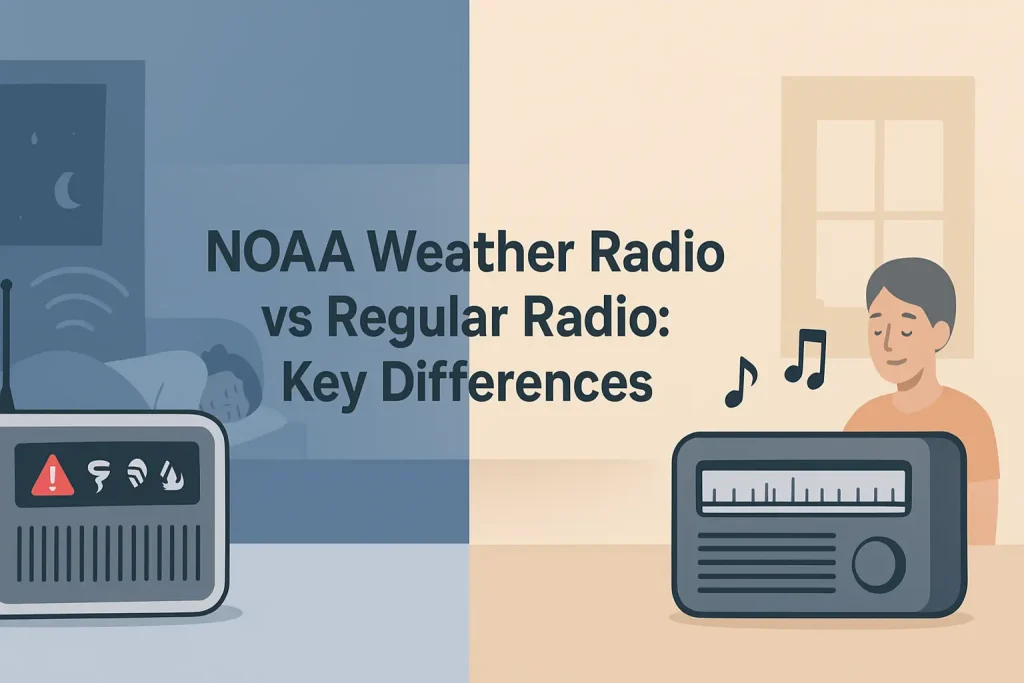
A dedicated marine weather radio does one thing no smartphone app can match: it receives NOAA broadcasts directly on 162.400 to 162.550 MHz, even when cellular networks are down, overloaded, or simply out of range on open water. For boaters, that direct connection to the National Weather Service is not a convenience feature. It is a safety requirement.
This guide covers the best weather radios purpose-built for boating and marine use, with specifications pulled from manufacturer data sheets, NOAA NWR documentation, and FCC Part 80 rules for marine VHF communication.
By the Numbers
Marine Weather Radio: Key Specifications and Standards
Sources: NOAA National Weather Radio All Hazards documentation, FCC Part 80, USCG Boating Safety Division.
Why Do Boaters Need a Dedicated Marine Weather Radio?
A smartphone weather app pulls forecast data from a server on land. A dedicated marine weather radio receives a live, continuous NOAA broadcast directly from the nearest NWR transmitter, with no cell signal required and no 15-minute delay between updates.
NOAA Weather Radio All Hazards broadcasts 24 hours a day on seven frequencies between 162.400 MHz and 162.550 MHz. The signal covers approximately 95% of the U.S. population within 40 miles of a transmitter, according to NOAA NWR technical documentation.
For boaters, the gap between forecast data and live conditions narrows fast. A squall that develops 10 miles offshore may trigger a Special Marine Warning within minutes of formation. That warning reaches a NOAA weather radio instantly, while the same alert may take 10 to 30 minutes to appear on a smartphone app, if cell coverage exists at all.
A dedicated marine weather radio also monitors continuously in the background without draining a phone battery. Most models draw less than 100 milliamps on standby, which means they can run for 20 or more hours on a set of AA batteries while waiting for an alert tone.
The U.S. Coast Guard recommends that all recreational boaters carry a dedicated VHF marine radio or NOAA weather radio as a primary alert source, separate from any cellular device. This recommendation aligns with FCC Part 80 rules governing marine radio equipment.
A dedicated weather radio is not a luxury for offshore sailors. It is the fastest, most reliable path between a National Weather Service warning and your boat.
What Is the Difference Between a Marine VHF Radio and a Dedicated Weather Radio?
A marine VHF radio operates across the full marine VHF band from 156.000 MHz to 174.000 MHz, including Channel 16 (156.800 MHz) for distress calls and Channel 22A for U.S. Coast Guard communications. A dedicated weather radio receives only the seven NOAA WX channels between 162.400 and 162.550 MHz and cannot transmit.
Marine VHF radios with a built-in weather receiver combine both functions. Models such as the Standard Horizon HX890 and the Uniden MHS335BT scan all seven NOAA WX channels alongside marine VHF channels and include S.A.M.E. (Specific Area Message Encoding) alert decoding.
S.A.M.E. technology, which uses a 6-digit FIPS county code to filter alerts by geographic location, means the radio only sounds an alarm for weather events in your programmed area. Without S.A.M.E., a weather radio alerts you to every severe weather event broadcast from the transmitter, which may cover five or more counties you are not sailing near.
Use the comparison below to decide which device type fits your situation.
Product Comparison
Marine VHF Radio vs Dedicated NOAA Weather Radio – Side by Side
Key differences compared. Source: FCC Part 80, NOAA NWR documentation, manufacturer data sheets.
| Feature | Marine VHF Radio | Dedicated Weather Radio |
|---|---|---|
| Transmit capability | Yes (1W and 5W) | No (receive only) |
| NOAA WX channels | All 7 (on most models) | All 7 |
| S.A.M.E. alert decoding | On select models | Standard on most models |
| Channel 16 monitoring | Yes (mandatory distress) | No |
| DSC distress call | Yes (DSC-equipped models) | No |
| Typical price range | $80 to $300+ | $30 to $80 |
| Best for | Offshore, coastal, vessel communication | Inshore, lake, and river boating |
| Our verdict | Required for offshore and ocean sailing | Best backup or primary for inshore use |
FCC Part 80 governs marine VHF radio equipment. FCC-type acceptance required for any transmitting device used on navigable waters. Dedicated weather radios are receive-only and do not require FCC licensing.
If you boat within 20 miles of shore on lakes or rivers, a dedicated weather radio with S.A.M.E. and a waterproof rating of at least IPX4 is sufficient. If you sail offshore or in open coastal waters, a full marine VHF radio with DSC is the minimum safety standard, with a dedicated weather radio as a backup.
What Features Matter Most in a Marine Weather Radio?
The four features that determine whether a marine weather radio is genuinely useful on the water are waterproofing rating, S.A.M.E. technology, alert memory capacity, and battery backup. Everything else is secondary.
Waterproofing is the first filter. A radio rated only IPX0 (no protection) or IPX2 (splash protection from vertical drops) will fail in spray, rain, or a wave. The minimum useful rating for open-water use is IPX4 (splash-proof from any direction). For kayakers, canoeists, or anyone on an open vessel, IPX7 (submersible to 1 meter for 30 minutes) is the correct standard.
S.A.M.E. technology filters incoming alerts by county. Without it, a single NOAA transmitter covers multiple counties and will alarm your radio for every severe weather event across all of them, including counties 200 miles from your position. For more detail on how S.A.M.E. alert codes work and how to program them, the guide on understanding S.A.M.E. codes and county-level alert programming covers the full process.
Alert memory capacity determines how many S.A.M.E. location codes the radio stores. Budget models store 5 to 10 codes. Mid-range models such as the Midland WR400 store 50 codes, which matters when you are traveling between counties or states on a multi-day voyage.
Battery backup ensures the radio continues to work if shore power or your boat’s 12V system fails. Look for models that accept AA or AAA alkaline batteries in addition to an AC adapter or DC power lead. During an active weather event, the last thing you need is a weather radio that dies when the dock power cuts out.
Additional features worth considering include a backlit display for nighttime use, a programmable alarm clock for watch rotation, and an external antenna jack that accepts a standard BNC or SMA connector for improved reception on a vessel with a full-length VHF antenna.
The combination of IPX7 waterproofing, S.A.M.E. decoding, at least 25 programmable alert codes, and a battery backup option covers the essential requirements for any boating application.
What Are the Best Weather Radios for Boating and Marine Use?
The radios listed below are selected for their waterproofing, S.A.M.E. alert capability, battery options, and track record among boaters and emergency management professionals. Prices are current at time of publication.
Midland WR400: Best Overall Marine Weather Radio
The Midland WR400 receives all seven NOAA WX frequencies between 162.400 and 162.550 MHz and programs up to 50 S.A.M.E. location codes. It covers 25 alert types, stores up to 50 county codes, and accepts both AC power and a 6xAA battery backup.
Key Specifications:
- Frequency: 162.400 to 162.550 MHz (all 7 NOAA WX channels)
- S.A.M.E. alert types: 25 programmable categories
- Alert memory: 50 S.A.M.E. location codes
- Power: AC adapter with 6xAA battery backup
- Display: Backlit LCD with clock and alarm
The WR400 is not waterproof in the IPX7 sense, so it belongs in a protected cabin or below deck rather than in an open cockpit. It is an exceptional dock radio, liveaboard radio, or pilothouse radio for vessels with protected electronics spaces.
For a thorough breakdown of how the WR400’s features compare against Midland’s other models, the detailed comparison of the Midland WR120, WR300, and WR400 feature sets explains which model fits which use case.
Uniden BC365CRS: Best for Combined Scanning and Marine Weather
The Uniden BC365CRS pairs a 500-channel scanner with full NOAA weather alert capability and S.A.M.E. decoding. Boaters who want to monitor local marine VHF traffic alongside weather alerts will find this combination useful without carrying two separate devices.
Key Specifications:
- Scanner channels: 500 programmable channels
- NOAA WX reception: All 7 frequencies
- S.A.M.E.: Yes, with county-level alert filtering
- Power: AC adapter with battery backup
- Clock radio: Yes, with programmable alarm
The BC365CRS does not transmit on marine VHF frequencies, so it cannot be used for distress calls. It is a monitoring and alert device only, governed by FCC Part 15 rules for receive-only scanning equipment rather than FCC Part 80 marine radio rules.
Standard Horizon HX890: Best All-in-One Marine VHF with Weather Alerts
The Standard Horizon HX890 combines a Class H DSC marine VHF transceiver with full NOAA WX reception and S.A.M.E. alert decoding. It transmits at 6 watts on marine VHF and receives all seven NOAA weather frequencies.
Key Specifications:
- Frequency range: 156.000 to 174.000 MHz marine VHF, plus 162.400 to 162.550 MHz NOAA WX
- Transmit power: 6W (switchable to 1W)
- DSC: Class H, requires MMSI registration
- Waterproof rating: IPX8 (submersible to 1.5 meters for 30 minutes)
- Floating: Yes, buoyant construction
- Battery: 1800 mAh Li-ion, approximately 8 hours transmit/receive use
The HX890 is IPX8 rated and floats, which makes it the correct choice for any open-water boater who might drop the radio overboard. The DSC function requires an MMSI (Maritime Mobile Service Identity) number, which is a free registration through Sea Tow, BoatUS, or the FCC’s online system. Under FCC Part 80, DSC-equipped radios must be registered before activating the distress function.
Uniden MHS335BT: Best Bluetooth-Enabled Marine Weather and VHF Radio
The Uniden MHS335BT adds Bluetooth connectivity to a full-featured marine VHF radio with NOAA weather monitoring. It transmits at 6 watts on 156.000 to 174.000 MHz and receives all seven NOAA WX channels with S.A.M.E. decoding.
Key Specifications:
- Transmit power: 6W (switchable to 1W)
- Waterproof rating: IPX7
- Bluetooth: Yes, for hands-free calls and audio streaming to compatible headsets
- DSC: Yes, Class D
- NOAA WX: All 7 frequencies with S.A.M.E.
- Battery: 1400 mAh Li-ion
The Bluetooth feature allows a boater to connect a wireless headset and monitor Channel 16 while moving around the deck without holding the radio. This is a practical safety feature for single-handed sailors who cannot keep a radio in hand at all times.
Midland ER310: Best Portable Emergency Weather Radio for Boating
The Midland ER310 is a portable emergency radio that receives all seven NOAA WX frequencies with S.A.M.E. decoding, includes a hand crank generator, a 2000 mAh solar panel, and a USB charging port for mobile devices. It is designed for off-grid use and operates without shore power for extended periods.
Key Specifications:
- NOAA WX: All 7 channels with S.A.M.E.
- Power sources: Hand crank, solar panel (2000 mAh), AA batteries (3x), USB input
- USB output: 1A charging port for devices
- Waterproof rating: IPX4 (splash-proof)
- Flashlight: Yes, with strobe and SOS modes
The ER310 is the right choice for kayakers, canoeists, and boaters on vessels without a 12V electrical system. IPX4 is adequate for splash and rain but not submersion, so stow it in a dry bag when conditions are rough.
Sangean CL-100: Best Desktop Marine Dock Radio
The Sangean CL-100 is a tabletop AM/FM/weather alert radio with S.A.M.E. decoding, designed for dock use, marina offices, and below-deck liveaboard installations. It receives all seven NOAA WX channels and decodes S.A.M.E. alert codes with an audible alarm and backlit display.
Key Specifications:
- NOAA WX: All 7 channels
- S.A.M.E.: Yes, with county-level filtering
- AM/FM: Yes
- Power: AC adapter with battery backup
- Alert types: NOAA hazard categories including marine-specific alerts
The CL-100 is not waterproof and is intended for protected environments only. It excels as a dock-side or pilothouse alert radio that also functions as an everyday AM/FM receiver.
The right radio for your boat depends primarily on whether you need transmit capability and what your waterproofing requirements are. The Standard Horizon HX890 or Uniden MHS335BT covers both weather monitoring and marine VHF communication in a single IPX7 or IPX8 device, which is the most practical solution for open-water boating.
Here is a quick comparison to help you choose the right option for your situation.
Price Comparison
Marine Weather Radios – Price Comparison by Model
Street price, sorted lowest to highest. Prices verified at time of publication.
~$45
~$55
~$65
~$80
~$120
~$170
Marine VHF models (Standard Horizon HX890, Uniden MHS335BT) require MMSI registration for DSC distress function. Registration is free through Sea Tow, BoatUS, or the FCC. No license required to operate a marine VHF radio on U.S. recreational vessels in domestic waters under FCC Part 80.
How Do NOAA Weather Radio Alerts Work on the Water?
NOAA broadcasts a continuous audio weather program on all seven WX channels simultaneously. When the National Weather Service issues a warning, watch, or advisory, it activates a 1050 Hz alert tone followed by the S.A.M.E. digital header, which encodes the event type, the affected FIPS county codes, and the time the alert expires.
A weather radio with S.A.M.E. decoding reads that digital header and compares the encoded FIPS county codes against the codes you have programmed into the radio. If there is a match, the radio sounds an alarm and plays the broadcast audio. If there is no match, the radio stays silent.
This is why programming your S.A.M.E. codes before departure is critical. A radio left on its factory default setting will alarm for every county covered by the nearest NWR transmitter, which can include areas 200 miles away. For detailed guidance on programming S.A.M.E. codes correctly, the resource on how S.A.M.E. weather alert technology filters by county walks through the FIPS code lookup and programming process step by step.
Marine-specific NOAA alerts include Special Marine Warnings (SMW), which are issued for hazardous conditions expected within 24 hours in coastal or inland waters. They also include Marine Weather Statements, Gale Warnings (sustained winds 34 to 47 knots), Storm Warnings (sustained winds 48 to 63 knots), and Hurricane Force Wind Warnings (sustained winds 64 knots or higher).
NOAA also broadcasts Hazardous Seas forecasts that include wave height, swell period, and visibility for offshore zones. These are part of the continuous background program and do not trigger the S.A.M.E. alert tone. You hear them only by actively monitoring the WX channel, not by waiting for an alarm.
Programming your weather radio for the county or marine zone closest to your departure point is the most important setup step before any voyage. Update the codes whenever you move into a new coastal zone.
What Waterproof Rating Does a Marine Weather Radio Need?
A marine weather radio intended for use in an open cockpit, on deck, or in a kayak requires at least an IPX7 rating (submersible to 1 meter for 30 minutes). A radio rated IPX4 (splash-resistant from any direction) is adequate for covered helm stations but will fail if submerged or exposed to heavy spray for extended periods.
The IP rating system is defined by IEC standard 60529. The second digit in an IPX rating specifies water ingress protection on a scale from 0 (no protection) to 9 (high-pressure, high-temperature water jet). For marine environments, the practical minimum levels are:
- IPX4: Resists water splashing from any direction. Suitable for covered helms and below-deck use.
- IPX5: Resists water jets from any direction. Suitable for cockpit use in moderate conditions.
- IPX7: Submersible to 1 meter for 30 minutes. Suitable for open-boat, kayak, and dinghy use.
- IPX8: Submersible beyond 1 meter (manufacturer specifies depth). Used by Standard Horizon HX890 (1.5 meters).
Some marine radios also carry a MIL-STD-810 rating, which is a U.S. military standard covering shock, vibration, humidity, salt fog, and temperature extremes. A radio rated MIL-STD-810G/H has passed drop tests from 1 meter onto hard surfaces and salt spray exposure tests, which are directly relevant to boating conditions.
Do not confuse “water-resistant” in a product description with a specific IPX rating. “Water-resistant” is a marketing term with no standard definition. Only a specific IP designation (IPX4, IPX7, IPX8) tells you exactly what the radio can withstand.
For any boat where the radio may be exposed to spray, rain, or the possibility of going overboard, IPX7 is the correct minimum standard.
How to Set Up a Marine Weather Radio for Offshore Boating
Setting up a marine weather radio correctly before departure takes less than 10 minutes and is the difference between a useful safety device and a box that sits silent until it is too late. The steps below apply to any S.A.M.E.-capable weather radio, including the Midland WR400 and Standard Horizon HX890.
Find your marine zone FIPS code. Go to the NOAA NWR website and enter your departure port’s state and county. Note the 6-digit FIPS code for your county and the marine zone code for your coastal area. If you are traveling between counties or zones, note the codes for all of them.
Enter the FIPS codes into your radio. On the Midland WR400, press the Menu button, navigate to S.A.M.E. Programming, and enter each 6-digit code using the keypad. The WR400 stores up to 50 codes. Most other models store 5 to 25 codes.
Select your strongest NOAA WX channel. Scan through WX1 to WX7 and stop on the channel with the clearest audio and strongest signal. On most radios, a signal strength indicator or squelch-free audio tells you which channel is strongest at your location.
Enable the alert tone function. Set the radio to alert mode (sometimes labeled “ALT” or “ALERT”). In this mode, the radio monitors the channel silently and activates the alarm only when it receives a matching S.A.M.E. header.
Test the alert function. Use the radio’s built-in test function if available. The Midland WR400 includes a manual alert test button. Alternatively, NOAA conducts weekly tests on Wednesdays between 11 a.m. and noon local time (EAS Required Weekly Test), which will trigger any properly programmed radio.
Connect battery backup. Install fresh AA or AAA alkaline batteries in the battery compartment before departure. Do not rely solely on 12V power from the vessel’s electrical system during a storm, when the risk of power loss is highest.
Test external antenna connection if available. If your radio has an external antenna jack (typically BNC or SMA), connect a marine-grade VHF antenna to improve reception range beyond the built-in whip. A fiberglass 3 dB gain antenna at 10 feet of height can extend NOAA reception range from 20 miles to 40 miles offshore.
Running through these steps before each voyage takes under 10 minutes and ensures the radio will wake you up for the right alerts at the right time.
How Does a Marine Weather Radio Differ from a Handheld VHF for Offshore Safety?
A handheld marine VHF radio operating under FCC Part 80 transmits at up to 6 watts on 156.000 to 174.000 MHz and can send a DSC distress call that includes your GPS coordinates to the U.S. Coast Guard and nearby vessels. A dedicated weather radio cannot transmit at all. It is a receive-only device.
For offshore safety, these are not interchangeable functions. A distress situation requires the ability to transmit on Channel 16 (156.800 MHz), which is monitored continuously by the USCG and all properly equipped commercial vessels. A weather radio alone cannot initiate a rescue.
The practical answer for most offshore boaters is to carry both. A handheld marine VHF such as the Standard Horizon HX890 handles both functions in one IPX8-rated floating device. For inshore and lake boating, a dedicated weather radio alongside a cell phone is a reasonable combination.
DSC (Digital Selective Calling) is a digital protocol built into Class D and Class H marine VHF radios that allows a single button press to transmit a mayday signal with vessel ID (MMSI), GPS position, and nature of distress to all DSC-equipped receivers within range. Registration of your MMSI number with the FCC or a recognized boating organization is required before activating the DSC function under FCC Part 80 rules.
A weather-only radio does not replace a marine VHF radio for offshore safety. It supplements it by providing continuous background weather monitoring without tying up the marine VHF channel needed for vessel communication.
Quick Reference: Marine Weather Radio Terms Explained
Quick Reference
Marine Weather Radio Terminology
Key terms used throughout this guide, defined in plain language.
- NOAA WX channels: Seven dedicated broadcast frequencies between 162.400 and 162.550 MHz used exclusively for weather alerts and forecasts by the National Oceanic and Atmospheric Administration.
- S.A.M.E. (Specific Area Message Encoding): A digital system that encodes a 6-digit FIPS county code into every NOAA weather alert, allowing radios to alarm only for events in programmed geographic areas.
- FIPS code: A 6-digit Federal Information Processing Standards code that identifies a specific U.S. county or marine zone, used for programming S.A.M.E. weather radios.
- IPX7: An IEC 60529 waterproofing designation meaning the device is protected against submersion in water to 1 meter for up to 30 minutes.
- DSC (Digital Selective Calling): A one-button digital distress call system built into marine VHF radios that transmits vessel MMSI, GPS position, and distress type to the U.S. Coast Guard and nearby vessels.
- MMSI (Maritime Mobile Service Identity): A 9-digit number assigned to a vessel for DSC radio identification, required to activate the distress function on a DSC-equipped marine VHF radio.
- Channel 16 (156.800 MHz): The mandatory international distress, safety, and calling frequency for marine VHF communication, monitored continuously by the U.S. Coast Guard.
- Special Marine Warning (SMW): A NOAA alert issued for hazardous marine conditions expected within 24 hours in coastal or inland waters, triggering the S.A.M.E. alert tone on programmed radios.
- EAS (Emergency Alert System): The federal public warning system that distributes emergency alerts through broadcast media and NOAA Weather Radio, governed by FCC rules.
- NWR (NOAA Weather Radio All Hazards): The national network of over 1,000 radio stations broadcasting continuous weather information directly from National Weather Service offices.
Which Marine Weather Radio Should You Choose Based on Boat Type?
The right marine weather radio depends on where you boat, how your vessel is equipped, and whether you need transmit capability. The selector below matches boat type to the most appropriate device.
Interactive Tool
Find the Right Marine Weather Radio for Your Boat
Answer 2 questions to get a specific marine weather radio recommendation.
How Should You Mount and Position a Weather Radio on a Boat?
Mounting position determines how reliably a marine weather radio receives the NOAA WX signal. The built-in whip antenna on most handheld weather radios has a gain of approximately 0 dBi and a range of 20 to 40 miles from the nearest NWR transmitter at sea level. Moving the antenna 10 feet higher increases that range noticeably because radio propagation in the VHF band is largely line-of-sight.
For a fixed-mount weather radio in a pilothouse or below deck, connect an external antenna to the radio’s BNC or SMA jack if available. A standard 3 dB gain fiberglass marine VHF antenna mounted at the masthead or on a stern arch provides significantly better NOAA WX reception than the radio’s built-in antenna, particularly at sea where the horizon is the limiting factor.
This works because NOAA WX frequencies (162.400 to 162.550 MHz) fall within the VHF high band, where propagation is essentially line-of-sight. Antenna height above sea level directly controls the radio horizon distance. At 10 feet of antenna height, the radio horizon is approximately 15 nautical miles. At 50 feet, it extends to approximately 30 nautical miles.
If the antenna is too low, you will lose the NWR signal before you see weather conditions deteriorate. Fix it by raising the antenna connection point or connecting to the existing VHF antenna via a splitter designed for the 162 MHz band.
Mount the radio or its speaker within earshot of the helm, not buried in a locker. An alert that no one hears provides zero safety value.
What Are the Best Waterproof Cases and Accessories for a Marine Weather Radio?
A weather radio rated IPX4 can survive a splash, but sustained spray over an hour in a seaway may eventually overwhelm the seals. The practical solution is a waterproof dry bag rated for electronics with an IPX8 or equivalent submersion rating. These bags seal via a roll-top closure and allow the radio speaker to project through the bag material.
For radios with an external speaker port, a waterproof Velcro-closure pouch keeps the unit accessible while adding a layer of splash protection beyond the radio’s own rating. Look for pouches with a clear window that lets you read the radio’s display without opening the bag.
A marine-grade radio mount bracket with a swivel base lets you angle the radio’s display toward the helm operator and secure it against boat motion. Foam-lined mounts with stainless steel hardware resist corrosion better than plastic mounts in salt air environments.
Carry a spare set of Energizer Ultimate Lithium AA batteries aboard. Lithium primary batteries maintain nearly full capacity down to minus 40 degrees Fahrenheit and have a shelf life of up to 20 years, making them the correct choice for emergency battery backup on a boat. Alkaline batteries lose significant capacity in cold temperatures and can leak if stored long-term.
Good accessories extend the useful life of a marine weather radio and ensure it performs when conditions are worst.
How Do Marine Weather Alerts Compare to Cell Phone Emergency Alerts for Boaters?
Cell phones receive Wireless Emergency Alerts (WEA) under the IPAWS (Integrated Public Alert and Warning System) federal infrastructure, which pushes alerts to all cell-capable devices within a geographic cell tower area. NOAA weather radios receive alerts directly from NWR transmitters via dedicated VHF broadcast on 162.400 to 162.550 MHz.
The two systems are not equivalent for boaters. WEA alerts require a cell signal, which disappears 2 to 5 miles offshore for most U.S. coastal carriers and is absent entirely on many large inland lakes. NOAA WX reception extends 20 to 40 miles from the nearest NWR transmitter at sea level, and further with an elevated antenna.
WEA alerts also cover a broader geographic cell sector, not a specific county boundary. A WEA tornado warning may cover an entire county when the tornado is 50 miles from your marina. A properly programmed S.A.M.E. weather radio filters alerts to the specific county or marine zone you have programmed, reducing false alarms significantly.
NOAA Special Marine Warnings (SMW) do not reach WEA at all. They are marine-specific alerts broadcast only through the NOAA NWR network and accessible only by a dedicated weather radio or marine VHF with WX monitoring. A boater relying solely on cell phone alerts will never receive an SMW.
A dedicated marine weather radio is the only device that reliably delivers marine-specific NOAA alerts beyond cell range. A cell phone cannot substitute for it on the water.
What Is the Difference Between a Gale Warning, Storm Warning, and Hurricane Force Wind Warning?
NOAA uses a standardized set of marine wind warning terms. A Gale Warning applies when sustained winds of 34 to 47 knots (39 to 54 mph) are forecast for coastal or offshore waters. A Storm Warning applies for sustained winds of 48 to 63 knots (55 to 72 mph). A Hurricane Force Wind Warning applies when sustained winds of 64 knots (74 mph) or higher are forecast outside a tropical system.
These are distinct from Tropical Storm Warnings and Hurricane Warnings, which apply to named tropical cyclones. The non-tropical wind warnings described above are issued by NWS Marine Forecast Offices for extratropical systems, including nor’easters, Gulf lows, and Pacific storms.
A Special Marine Warning (SMW) is issued for hazardous conditions that develop quickly, generally within 24 hours, and are not captured by the standard forecast cycle. SMWs trigger the S.A.M.E. alert tone on programmed weather radios. Gale Warnings and Storm Warnings may or may not trigger the S.A.M.E. tone depending on the radio’s programmable alert filter settings.
Check your radio’s alert type programming and confirm that Marine Weather Statements and SMWs are enabled in addition to severe weather alerts, which are the default enabled categories on most consumer weather radios.
Knowing the difference between these warning levels and ensuring your radio is programmed to receive all of them is a fundamental part of marine weather radio setup.
Can You Use a Home NOAA Weather Radio on a Boat?
Yes. A home NOAA weather radio such as the Midland WR400 or the Uniden BC365CRS receives the same NOAA WX broadcast frequencies (162.400 to 162.550 MHz) as any marine-specific device. The broadcast signal does not distinguish between a home radio and a marine radio.
The practical limitation is waterproofing. Home weather radios are not rated for marine environments. The Midland WR400, for example, carries no IP water ingress rating. Exposing it to cockpit spray, rain, or humidity in a bilge environment will eventually cause electrical failure.
The correct approach is to use a home weather radio in a protected interior space on the vessel, such as a pilothouse, enclosed helm station, or below-deck cabin. In that environment, a home radio such as the Midland WR400 provides full S.A.M.E. capability, 50-code alert memory, and AC/battery backup at a lower cost than a dedicated marine radio.
For a broader look at how the Midland WR400 performs against other home weather radios, the roundup of top-rated NOAA weather radios for home use includes detailed comparisons across S.A.M.E. code capacity, alert types, and battery backup options.
For open-cockpit or exposed helm use, a home weather radio is not a safe substitute for an IPX7-rated device.
How Often Should You Test a Marine Weather Radio?
NOAA conducts two types of regular broadcast tests that allow you to verify your weather radio is functioning correctly. The Required Weekly Test (RWT) occurs every Wednesday between 11 a.m. and noon local time. It transmits a test S.A.M.E. header followed by a brief audio message. A properly programmed radio will alarm during this test if it is turned on and set to alert mode.
The Required Monthly Test (RMT) occurs on the first Wednesday of each month between 11 a.m. and noon local time. It is a more complete test that includes the full attention tone, a 30-second audio broadcast, and the end-of-message tone.
Beyond passive testing via NOAA broadcasts, physically test the alert function on your radio before every offshore voyage. Most S.A.M.E.-capable radios include a manual test button or menu option. The Midland WR400 has a dedicated ALERT TEST button on the front panel. Use it before each trip to confirm the speaker, alert tone, and display are functioning.
Check and replace the battery backup before any passage longer than a day. Alkaline batteries self-discharge at approximately 1 to 2% per month at room temperature. After six months of storage, they retain 88 to 94% capacity. After two years, capacity may drop below 75%. Replace them annually regardless of apparent condition.
A radio that has not been tested before departure is a radio you cannot trust in an emergency.
Are There Combination Radios That Handle Both Marine VHF and NOAA Weather Alerts?
Yes. Handheld combination marine VHF radios with built-in NOAA weather monitoring are the most practical solution for most boaters. They receive all seven NOAA WX channels, decode S.A.M.E. alerts, and also transmit on the full marine VHF band from 156.000 to 174.000 MHz, including Channel 16 for distress calls.
The Standard Horizon HX890 and the Uniden MHS335BT are the strongest current examples. Both are IPX7 or IPX8 rated, include S.A.M.E. decoding, and transmit at 6 watts on marine VHF. Both include DSC functionality requiring MMSI registration.
For boaters who want a dedicated below-deck alert radio in addition to a handheld VHF, fixed-mount marine VHF radios such as the Standard Horizon GX2400 include weather alert functions and connect to a fixed VHF antenna for maximum reception range. A fixed-mount radio at 25 watts combined with an antenna at 20 feet provides reliable NWR reception well offshore.
Combination radios are also more practical during active navigation because they do not require switching between two devices to move from weather monitoring to vessel communication. The radio scans NOAA WX channels in the background while remaining ready for channel-16 traffic.
If you are purchasing a single radio for a boat, a combination marine VHF with NOAA WX, S.A.M.E., and DSC is the correct choice for anything beyond protected inshore waters.
What Happens to Marine Weather Radio Reception in Remote or Offshore Areas?
NOAA NWR transmitters cover approximately 95% of the U.S. population within 40 miles of a transmitter at ground level, according to NOAA documentation. However, coverage drops sharply beyond 40 miles at sea level, and there are offshore gaps in NWR coverage, particularly beyond 50 to 100 miles offshore in the Gulf of Mexico, Atlantic, and Pacific.
This happens because VHF propagation at 162 MHz is essentially line-of-sight. The curvature of the Earth limits the radio horizon to approximately 30 nautical miles from a 200-foot transmitter tower at sea level. A vessel antenna at 10 feet of height adds approximately 4 nautical miles to the radio horizon on the receiving end, giving a combined horizon of roughly 35 to 40 nautical miles from the transmitter under normal conditions.
In areas beyond reliable NWR coverage, offshore voyagers supplement weather monitoring with:
- SSB (Single Sideband) HF radio reception of NOAA offshore marine forecasts on 4, 6, 8, 12, and 16 MHz bands
- SailMail or Winlink email weather GRIB files via SSB radio or satellite
- Iridium or Inmarsat satellite communication devices such as the Garmin inReach Mini for weather forecasts and two-way messaging
- XM/SiriusXM Marine weather overlay via a compatible chartplotter
For coastal and inshore boating within 40 miles of shore, NOAA NWR coverage is reliable. For offshore passages beyond that range, a dedicated weather radio is a first layer, not the only layer, of weather monitoring.
Does a Marine Weather Radio Need an FCC License?
No. A dedicated weather radio is a receive-only device. It does not transmit. FCC licensing requirements apply only to transmitting equipment. Receive-only devices operating in the 162.400 to 162.550 MHz NOAA WX band are exempt from FCC licensing under the rules governing Part 15 devices.
A handheld marine VHF radio that also transmits is a different category. Under FCC Part 80, recreational vessels operating in U.S. domestic waters are not required to carry a ship station license for a marine VHF radio used voluntarily. However, vessels traveling internationally, commercial vessels, and vessels over 65 feet operating on the high seas are required to hold an FCC ship station license.
The DSC distress function on a marine VHF radio requires an MMSI (Maritime Mobile Service Identity) number. MMSI registration is separate from FCC licensing. Recreational boaters register their MMSI for free through Sea Tow (seatow.com), BoatUS (boatus.com), or directly through the FCC’s online licensing system. Operating DSC without a registered MMSI does not violate FCC rules, but the unregistered distress call contains no vessel identification and reduces USCG response effectiveness significantly.
In short, a dedicated weather radio requires no license. A marine VHF radio used in domestic waters by a recreational boater requires no ship station license but needs an MMSI registration to use DSC properly.
How Do You Choose Between a Portable and a Fixed-Mount Marine Weather Radio?
A portable weather radio runs on batteries and is independent of the vessel’s electrical system. It works on any boat, including a kayak with no onboard power, and serves as an emergency backup if the vessel’s 12V system fails. The trade-off is antenna height: a hand-held radio with a 6-inch whip antenna at helm height has a shorter reception range than a fixed antenna mounted on a mast or arch.
A fixed-mount weather radio or marine VHF radio connects to the vessel’s 12V DC power and a fixed VHF antenna. With an antenna at 20 feet, a fixed-mount radio can receive NOAA WX signals from transmitters 40 to 50 nautical miles away, well beyond the range of a portable device at deck level.
Use this table to decide between the two configurations.
Quick Reference
Portable vs Fixed-Mount Marine Weather Radio
Use the table below to choose between portable and fixed-mount based on your vessel and use case.
| Factor | Portable Radio | Fixed-Mount Radio |
|---|---|---|
| Power source | Batteries (AA/AAA or Li-ion) | 12V DC vessel power |
| Antenna height (typical) | 3 to 6 feet | 10 to 40+ feet |
| Estimated NWR reception range | 20 to 30 nautical miles | 35 to 50+ nautical miles |
| Works without vessel power | Yes | No (unless battery backup added) |
| Works on multiple vessels | Yes | No |
| Best for | Kayaks, small boats, backup use | Sailboats, powerboats, cruising vessels |
| Typical price | $35 to $170 | $100 to $400+ |
Most boaters benefit from both: a fixed-mount marine VHF as the primary communication and weather monitoring device, and a portable IPX7-rated weather radio or handheld VHF as a backup independent of vessel power.
What Are the Most Common Mistakes Boaters Make with Marine Weather Radios?
The most common mistake is leaving S.A.M.E. codes unprogrammed. A weather radio on factory default settings listens for all alerts broadcast by the nearest NWR transmitter, which covers every county in the transmitter’s range. In a large metropolitan coastal area, that may mean alerts for 10 or more counties, most of which are irrelevant to your position. The radio becomes a nuisance device that boaters learn to ignore, which defeats its entire purpose.
The second common mistake is failing to enable marine-specific alert categories in the radio’s programmable alert filter. Most consumer weather radios ship with Tornado Warnings, Severe Thunderstorm Warnings, and a few other land-based hazard categories enabled by default. Marine Weather Statements and Special Marine Warnings are often disabled by default because they are marine-specific. Check your radio’s alert type menu and enable all coastal and marine alert categories before any voyage.
The third mistake is treating a weather radio as an information device rather than a real-time alert device. The radio should remain on and in alert mode during any passage, with the speaker audible from the helm. Checking the weather radio only when conditions look questionable means you are already too late for most fast-developing marine hazards.
The fourth mistake is ignoring battery maintenance. Boaters often install fresh batteries when they buy the radio, then leave them for years. Alkaline batteries in standby mode self-discharge slowly, but salt air, heat, and humidity accelerate deterioration. Replace them annually and inspect the battery compartment for corrosion before every season.
The fifth mistake is relying on a non-waterproof home weather radio in a marine environment without protection. Even IPX4 splash-proof ratings are insufficient for open-cockpit or exposed helm use over a season of real boating. Without proper waterproof protection, corrosion and water damage will eventually cause failure at the worst possible moment.
Avoiding these five mistakes turns a passive piece of safety equipment into an active early warning system that earns its place aboard.
Can a Marine Weather Radio Also Receive AM and FM Broadcasts?
Some marine weather radios include AM and FM band reception in addition to NOAA WX channels. The Sangean CL-100 and Uniden BC365CRS are examples of combination receivers that cover AM (535 to 1705 kHz), FM (87.5 to 108 MHz), and all seven NOAA WX channels in a single device.
Dedicated marine-grade handheld VHF radios such as the Standard Horizon HX890 and Uniden MHS335BT do not include AM/FM. They are purpose-built for marine VHF communication and NOAA WX monitoring, and the additional bands would add size and cost without meaningful benefit for most offshore boaters.
AM/FM reception is a convenience feature for dock use, marina life, and below-deck entertainment. It does not affect the core weather alert function. If you want a single device that covers dock entertainment and weather alerts, a combination AM/FM/weather radio such as the Sangean CL-100 or a hand-crank emergency radio is the appropriate choice.
For open-water use, keep the device selection simple. A dedicated weather radio or marine VHF with NOAA WX monitoring is more durable and purpose-fit than a combination entertainment/alert device in a marine environment.
How Does the Midland WR120B Compare to Marine-Specific Weather Radios?
The Midland WR120B is an entry-level home weather radio that receives all seven NOAA WX channels and includes basic S.A.M.E. alert decoding. It stores up to 25 S.A.M.E. location codes and covers the standard EAS alert categories. It is not waterproof, carries no IP rating, and is powered only by AC with AA battery backup.
As a below-deck or pilothouse radio on a vessel with protected electronics, the WR120B performs its core weather alert function reliably at a lower price point than the WR400. It does not have the WR400’s 50-code storage or full 25 alert category coverage, but for a single-county boating area, the 25-code limit is rarely a constraint.
For a detailed breakdown of the WR120B’s features and limitations, the full technical review of the Midland WR120B including alert sensitivity and S.A.M.E. programming covers its performance against the WR300 and WR400.
The WR120B is not suitable for open cockpit or exposed marine environments. It belongs in the same category as the WR400 for marine use: excellent in protected spaces, unsuitable in spray or rain without additional protection.
What Should Be in a Boat’s Emergency Communication Kit Beyond a Weather Radio?
A complete marine emergency communication kit includes five layers. The first layer is a dedicated marine VHF radio with DSC and registered MMSI, able to transmit a distress call with GPS coordinates on Channel 16 (156.800 MHz). The second layer is a dedicated NOAA weather radio or marine VHF with NOAA WX monitoring for continuous background weather alert reception.
The third layer is a Personal Locator Beacon (PLB) or EPIRB (Emergency Position Indicating Radio Beacon). These are satellite-linked distress devices that transmit on 406 MHz to COSPAS-SARSAT rescue coordination centers, providing GPS position accuracy within 100 meters. They require registration with NOAA’s SARSAT program before activation. An ACR ResQLink PLB is a widely used option on recreational vessels.
The fourth layer is a handheld satellite communicator for two-way messaging and weather forecasts beyond VHF and cell range, such as the Garmin inReach Mini 2. The fifth layer is a waterproof, float-free emergency signaling kit including flares, a signal mirror, and a whistle, required by USCG regulation for vessels in navigable waters.
A weather radio is one component of a layered communication and safety system, not a standalone solution for offshore emergencies.
Where Should You Buy a Marine Weather Radio?
Marine weather radios are available through marine chandleries, outdoor retailers, electronics stores, and online. For most boaters, purchasing through a major online retailer or a marine-specific supplier ensures access to the widest model selection and current pricing. A dedicated marine chandlery also offers staff familiar with FCC Part 80 requirements and MMSI registration for combination VHF/weather radios.
If you are unsure where to start, the guide on where to find and purchase NOAA weather radios from reliable sources covers the main purchasing channels, what to look for in terms of warranty and return policies, and how to avoid counterfeit or uncertified units.
Always verify that a marine VHF radio is FCC-type accepted for Part 80 use before purchasing. The FCC equipment authorization database (apps.fcc.gov/oetcf) allows you to search any radio’s FCC ID and confirm its authorization. Uncertified marine radios are illegal to operate on U.S. navigable waters regardless of where they were purchased.
How Do You Compare Weather Radio Models Before Buying?
The four most important comparison points for a marine weather radio are waterproof rating (IP designation), S.A.M.E. code storage capacity (number of programmable county codes), alert category count (how many NOAA hazard types the radio can be programmed to receive), and battery backup type (AA, AAA, Li-ion, hand crank, solar, or combination).
Secondary comparison points include display backlight (important for nighttime use), external antenna jack availability, alert tone volume in dB, and whether the radio scans all seven NOAA WX channels or only monitors a single pre-selected channel.
For a comprehensive side-by-side comparison across these dimensions for the most popular NOAA weather radio models, the ranked comparison of the highest-rated NOAA weather radios across all categories includes detailed specification tables and use case recommendations. If you are specifically evaluating the Midland lineup, the head-to-head breakdown of the Midland WR120, WR300, and WR400 differences covers every meaningful spec difference between the three models.
Comparing models on these specific dimensions takes five minutes and prevents a purchase that looks correct on the box but fails the first time conditions deteriorate on the water.
Is the Eton FRX3 Plus a Good Marine Weather Radio?
The Eton FRX3 Plus is a hand-crank emergency radio that receives all seven NOAA WX channels with S.A.M.E. alert decoding. It is powered by a built-in 1000 mAh rechargeable battery, a hand crank generator, and a 200 mW monocrystalline solar panel. It also receives AM and FM broadcasts and includes a USB charging port for mobile devices.
Key Specifications:
- NOAA WX: All 7 channels with S.A.M.E.
- Power: Hand crank, solar (200 mW panel), Li-ion 1000 mAh battery, USB-C input
- USB output: 5V for device charging
- Waterproof rating: Splash-resistant (no IP designation listed by manufacturer)
- Flashlight: Yes, LED with red emergency mode
The FRX3 Plus is appropriate for inshore and lake boating where it is stored in a protected location. The absence of a specific IPX waterproof rating means it should not be used in open cockpit conditions without protection. For a detailed performance assessment, the hands-on review of the Eton FRX3 Plus including S.A.M.E. programming and crank charge performance covers its strengths and limitations in practical use.
The FRX3 Plus is a strong choice for kayakers and canoeists who want multi-power-source weather alert capability in a compact, portable package. It is not a substitute for an IPX7-rated marine VHF radio on open-water vessels.
What Marine Weather Radio Is Best for Kayaking and Paddle Sports?
For kayaking and paddle sports, the ideal marine weather radio combines IPX7 or higher waterproof protection, battery-only operation without AC dependence, compact size, and S.A.M.E. alert decoding. The Midland ER310 meets three of those four criteria at IPX4, which is splash-proof but not submersion-proof.
For true submersion protection, the correct approach is to store a weather radio or handheld marine VHF inside a waterproof dry bag rated for submersion. A radio stored in a properly sealed 5L roll-top waterproof dry bag with its speaker oriented toward an audio mesh panel provides full immersion protection regardless of the radio’s own IP rating.
For paddle sports specifically, the Standard Horizon HX890 is technically the best option because it is IPX8 rated, floats, and combines full marine VHF communication with NOAA WX monitoring. Its 1800 mAh battery provides approximately 8 hours of combined transmit/receive use. The trade-off is size and cost compared to a dedicated weather-only radio.
For day paddling on inland lakes within cell coverage, a compact S.A.M.E. weather radio in a waterproof dry bag is adequate. For coastal kayaking or multi-day expeditions, a floating IPX8 marine VHF with NOAA WX is the correct safety standard.
Do You Need a Separate Weather Radio If Your Chartplotter Receives NOAA Alerts?
Most modern marine chartplotters with AIS and VHF radio integration can display NOAA marine forecast text downloaded via internet or Iridium satellite, but they do not receive the live NOAA NWR broadcast on 162.400 to 162.550 MHz in real time unless they include a dedicated WX receiver.
Some chartplotters paired with a compatible VHF radio (such as a Standard Horizon GX2400 fixed-mount radio connected to a Standard Horizon CP390i chartplotter) can scan NOAA WX channels and display alert text on the chartplotter screen. This integration functions as a dedicated weather radio for alert purposes.
A standalone dedicated weather radio is still worth carrying as a backup for two reasons. First, chartplotter systems depend on vessel 12V power. A battery-powered backup weather radio continues to function after a power failure. Second, a small portable weather radio can serve as a personal device for crew members off the helm who need weather alerts while the chartplotter operator is occupied.
If your chartplotter and VHF system fully integrates NOAA WX channel scanning with S.A.M.E. decoding and audible alerts, a dedicated weather radio is redundancy rather than necessity. For most recreational boaters without that integration, a dedicated device is the simpler and more reliable option.
Is a NOAA Weather Radio Mandatory for Recreational Boaters?
No U.S. federal law currently mandates that recreational boaters carry a dedicated NOAA weather radio. The USCG Navigation Rules and the FCC Part 80 regulations do not include a requirement for weather radio equipment on recreational vessels in domestic waters.
However, the U.S. Coast Guard’s Boating Safety Division strongly recommends a weather radio as part of every vessel’s required safety equipment complement. Several state boating safety regulations reference weather monitoring devices in their safety guidelines, though typically without specifying NOAA weather radio as the required technology.
The practical reality is that the absence of a mandatory requirement does not change the risk calculus on the water. Special Marine Warnings and rapidly developing offshore weather events arrive via NOAA NWR faster and more reliably than any other alert channel available to a boater out of cellular range.
For a broader look at how NOAA weather radios are categorized and recommended for different use environments, the complete buying guide for choosing the right weather radio by use case covers the decision framework for home, outdoor, and marine applications.
Required by law or not, a marine weather radio is the minimum responsible standard for any vessel operating on open water.
Can You Use a Marine Weather Radio to Monitor VHF Channel 16?
No. A dedicated weather radio receives only the seven NOAA WX frequencies between 162.400 and 162.550 MHz. Channel 16 operates at 156.800 MHz, which is outside the receive-only WX band. A weather radio cannot monitor Channel 16.
Monitoring Channel 16 requires a marine VHF transceiver or a scanner programmed to 156.800 MHz. Under FCC Part 80, commercial vessels over 300 gross tons and passenger vessels carrying more than six passengers for hire on U.S. navigable waters are required to maintain a continuous watch on Channel 16. Recreational vessels are not subject to this mandatory watch requirement, but USCG guidance strongly recommends it.
Combination marine VHF radios with NOAA WX capability (such as the Standard Horizon HX890 or Uniden MHS335BT) can scan Channel 16 and NOAA WX channels simultaneously using a dual-watch or triple-watch function. In dual-watch mode, the radio monitors Channel 16 continuously and checks your selected NOAA WX channel at regular intervals, alerting you to either a weather broadcast or a Channel 16 transmission.
For any boater who wants to monitor both weather alerts and Channel 16 distress traffic, a combination marine VHF with dual-watch and NOAA WX is the correct single-device solution.
What Should You Do When a NOAA Weather Radio Sounds a Marine Alert?
When the S.A.M.E. alert tone activates, listen to the full broadcast before taking any action. The broadcast identifies the alert type, the affected marine zones or counties, and the time the alert expires. Understanding whether the alert is a Watch (conditions are favorable for a hazard to develop), a Warning (hazardous conditions are occurring or imminent), or an Advisory (less severe conditions that require caution) determines the urgency of your response.
A Gale Watch, for example, means sustained winds of 34 to 47 knots are possible within 48 hours. It is an advance notice to consider your plans, not an immediate emergency. A Gale Warning means those winds are occurring or expected within 36 hours, which is an active operational concern. A Special Marine Warning means hazardous conditions are expected within 24 hours and often develops quickly from a watch or with little preceding warning.
When an SMW or Storm Warning activates, assess your position relative to the nearest safe harbor, your vessel’s condition and stability in forecast sea states, and your crew’s experience level. File a revised float plan with your shore contact if you change your course or timing. Inform other vessels in your vicinity on Channel 16 or Channel 22A if you have marine VHF capability.
Do not dismiss an alert because current conditions look calm. NOAA marine warnings are issued based on forecast model data that may project conditions 12 to 24 hours ahead. A flat sea at the moment of the alert does not mean the warning is premature.
The weather radio gets you the information. Acting on it promptly is the other half of the safety equation.
What Frequency Does NOAA Use for Marine Weather Broadcasts?
NOAA broadcasts marine weather information on all seven NWR frequencies between 162.400 and 162.550 MHz simultaneously from each transmitter site. The seven channels are WX1 (162.550 MHz), WX2 (162.400 MHz), WX3 (162.475 MHz), WX4 (162.425 MHz), WX5 (162.450 MHz), WX6 (162.500 MHz), and WX7 (162.525 MHz).
Each NWR transmitter broadcasts on one or more of these frequencies. The channel with the strongest signal at your location is the best channel to select for reception quality. On most weather radios, scanning all seven WX channels and selecting the one with the clearest audio (no static or squelch dropout) identifies the optimal channel for your area.
Marine zone forecasts, coastal forecasts, offshore forecasts, and High Seas forecasts are included in the continuous NWR broadcast cycle alongside land-based weather information. The broadcast repeats approximately every 4 to 6 minutes, with alert tones interrupting the cycle immediately when a new warning is issued.
These seven frequencies are dedicated exclusively to NOAA broadcasts by FCC frequency allocation. No commercial, amateur, or other licensed service operates on these channels, which ensures they remain clear for weather monitoring at all times.
How Does Marine Weather Radio Reception Compare Between Different Radio Brands?
Receiver sensitivity in the NOAA WX band (162.400 to 162.550 MHz) varies between manufacturers but is rarely the limiting factor for most boaters. The antenna and its height above water are far more significant variables than receiver chipset sensitivity. A high-quality antenna at 15 feet on a modest radio will consistently outperform a premium radio with a built-in whip antenna at deck level.
That said, S.A.M.E. decoding accuracy does differ between brands and model tiers. Budget radios sometimes miss S.A.M.E. headers when signal strength is marginal, resulting in missed alerts at the edge of the transmitter’s coverage area. Premium models and dedicated marine VHF radios from Standard Horizon and Uniden typically have tighter receiver tolerances that perform better in fringe reception areas.
For a boater operating near a major NWR transmitter (within 20 miles), this difference is rarely noticeable. For offshore boating at the edge of NWR coverage, it can mean the difference between receiving an alert and missing one.
The practical guideline is: within 30 miles of shore, any S.A.M.E.-capable weather radio from a major brand (Midland, Uniden, Sangean, Standard Horizon) performs adequately. Beyond 30 miles, invest in a dedicated marine VHF with a high-sensitivity WX receiver and connect it to an elevated fixed antenna.
Can You Program a Marine Weather Radio for Multiple Coastal Zones on a Long Passage?
Yes. S.A.M.E.-capable weather radios that store multiple location codes can be programmed with FIPS codes for every county and marine zone along a planned passage route. The Midland WR400, which stores 50 S.A.M.E. codes, can hold the codes for an entire coastal passage from Maine to Florida without requiring reprogramming at each stop.
Marine zones use a 6-digit FIPS code format identical to county codes. For example, the Boston Harbor Marine Zone uses FIPS code 073001, and the Coastal Waters from Stonington CT to Montauk Point NY uses code 009001. A full list of marine zone FIPS codes is available through the NOAA NWR website under the S.A.M.E. code lookup tool.
Programming all anticipated marine zones before departure is more reliable than trying to update codes at sea on a moving vessel. If your radio stores fewer than 25 codes, prioritize the marine zones for the current leg of your passage and update codes at each overnight stop.
Radios with fewer than 10 programmable S.A.M.E. codes are not practical for multi-day coastal passages. The 25 to 50-code storage capacity of mid-range models like the Midland WR400 is the appropriate specification for any boater covering more than two or three coastal zones.
What Is the Best Weather Radio for a Sailboat Crossing?
For an offshore sailboat crossing, the primary weather radio requirement is a fixed-mount marine VHF radio with NOAA WX monitoring connected to a masthead or spreader antenna, supplemented by an SSB (Single Sideband) HF radio for weather fax and voice forecast reception beyond NWR range.
For coastal and near-offshore passages (within 200 miles of shore), the combination of a Standard Horizon GX2400 fixed-mount VHF with NOAA WX and a Standard Horizon HX890 handheld as a backup covers both weather monitoring and distress communication in all but the most remote offshore scenarios.
For blue-water passages beyond NWR and SSB HF range, satellite weather services (Iridium-based SailMail or OCENS WeatherNet) become the primary weather data source, with the NWR-capable marine VHF serving as a backup within range of shore. An Icom IC-M802 SSB marine radio combined with a weatherfax software package covers the HF weather data requirement for extended offshore passages.
For any sailboat passage that includes coastal segments, a properly configured S.A.M.E. weather radio or marine VHF with NOAA WX remains the fastest and most reliable source for Special Marine Warnings and developing conditions close to shore.
What Is the Best Budget Marine Weather Radio Under $50?
The best weather radio under $50 for marine use is the Midland WR400, which typically sells between $40 and $50 and offers 50 S.A.M.E. location codes, 25 alert categories, a backlit display, and 6xAA battery backup. It receives all seven NOAA WX channels and is the most fully featured dedicated weather radio in its price range.
For boaters who specifically need waterproof protection in this price range, the selection narrows significantly. Most dedicated weather radios under $50 carry no IP waterproof rating. The Midland ER310 at approximately $55 offers IPX4 splash protection with hand crank and solar backup power, which is the closest option to a waterproof weather radio at this price point.
A portable marine VHF radio with NOAA WX capability under $50 does not exist in current production from major manufacturers. The entry point for an IPX7-rated handheld marine VHF with weather monitoring is approximately $80 to $90 (Cobra MR HH350 FLT or Uniden MHS125).
If the budget is strictly under $50 and the radio will be used in a protected location on the vessel, the Midland WR400 is the correct choice. If any exposure to spray or rain is expected, budget an additional $30 to $40 for a model with a specific IPX waterproof rating.
Is the WR120B Sufficient for Marine Use or Should You Upgrade?
The Midland WR120B receives all seven NOAA WX channels and includes S.A.M.E. decoding with up to 25 programmable location codes. It covers the core weather alert function for a boater who keeps the radio in a dry, protected location below deck or in a pilothouse.
It is not sufficient for open cockpit use, and its 25-code storage limit constrains it for multi-day passages across more than three or four coastal zones. The WR400 adds 25 additional S.A.M.E. code slots, more alert categories, and a more readable display at a modest price premium.
For a single-boat, single-home-port boater who keeps the radio mounted in a dry cabin and rarely travels beyond one or two coastal zones, the WR120B is adequate. For any more demanding application, the WR400 is a small investment for meaningfully better coverage and flexibility.
What Is a Special Marine Warning and How Does It Differ from a Coastal Flood Advisory?
A Special Marine Warning (SMW) is issued by the National Weather Service for short-term hazardous marine conditions that are either occurring or expected within 24 hours. Conditions that trigger an SMW include sustained winds of 34 knots or higher, seas of 10 feet or higher, hail of 0.75 inches or larger, waterspouts, or other hazardous conditions not addressed in the standard marine forecast.
A Coastal Flood Advisory is a land-based alert issued for minor coastal flooding conditions that are expected to be a nuisance but not a significant threat to life or property. It does not trigger the same urgency as an SMW and typically applies to low-lying coastal areas rather than open water conditions.
The two alerts are transmitted through different NOAA alert categories in the S.A.M.E. system. SMWs use the code “SMW” in the S.A.M.E. header. Coastal Flood Advisories use “CFA.” On radios with programmable alert type filters, SMWs are the higher-priority category and should always be enabled. Coastal Flood Advisories are lower priority for boaters on the water but may be relevant for marina operators and dock-side facilities during storm surge events.
Check your radio’s alert type programming menu and confirm both SMW and CFA categories are enabled before any coastal boating.
A properly programmed marine weather radio with the right S.A.M.E. codes and alert categories enabled is the most reliable early warning system available to any recreational boater operating within NOAA NWR coverage range. The combination of county-level filtering, real-time broadcast reception independent of cell networks, and continuous background monitoring makes it a piece of safety equipment that pays for itself the first time conditions deteriorate faster than forecast.
For inshore and lake boating, the Midland WR400 in a protected location covers the weather alert requirement completely. For open-water and coastal passages, a combination marine VHF with NOAA WX, S.A.M.E., and DSC (such as the Standard Horizon HX890 or Uniden MHS335BT) is the single device that handles weather monitoring and emergency communication together. Set it up before you leave the dock, program your coastal zone FIPS codes, and leave it in alert mode for the entire passage.