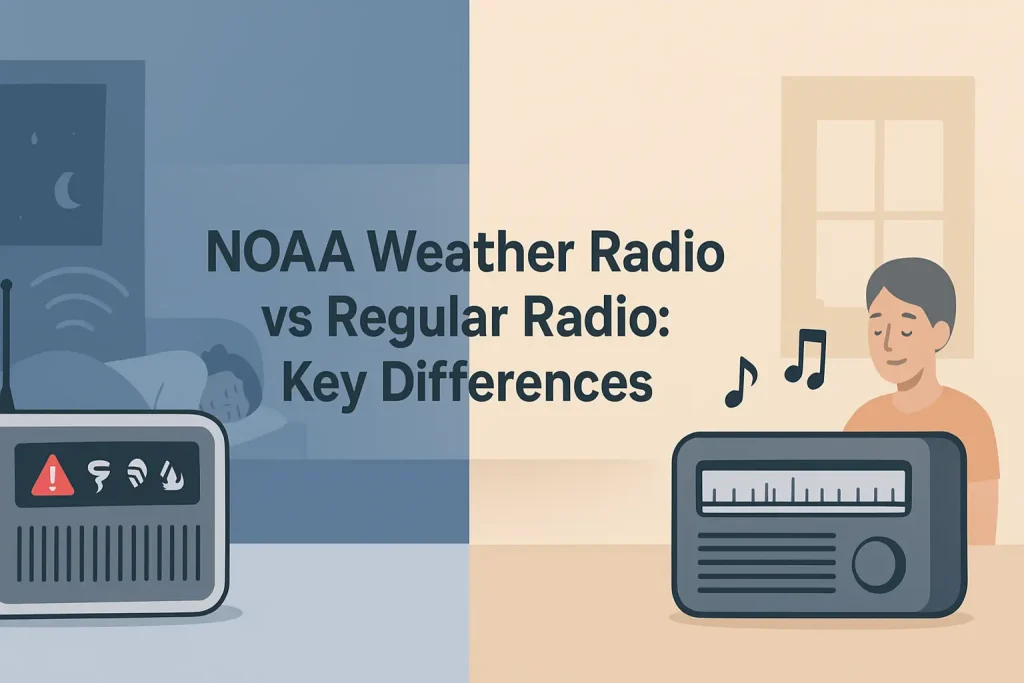
Weather radio consumer reports tell a consistent story: the gap between a radio that works when it counts and one that fails you during a tornado warning is not about brand loyalty or price alone. It is about S.A.M.E. technology, alert response time, and whether the radio you own will actually wake you up at 3 a.m. when a flash flood warning covers your county. This guide pulls the data together so you can make a decision based on what the numbers actually show.
What Does the Consumer Data Actually Show About Weather Radio Performance?
Consumer testing data consistently shows that weather radios with S.A.M.E. technology (Specific Area Message Encoding) outperform basic alert-only receivers in one critical metric: alert specificity. A radio without S.A.M.E. will sound its alarm for every county served by the NOAA transmitter, which can mean alerts for areas 100 miles from your home triggering your alarm at midnight.
| Photo | Popular Portable Walkie Talkies | Price |
|---|---|---|
 | SKIWARRIOR Multifunctional Smart Wireless Ski Goggles with Walkie-Talkie, Anti-Fog Zeiss Lens, Music & Call Function (Cylindrical Blue) | Check Price On Amazon |
 | SINORISE Super Mini Walkie Talkies, Two-Way Radios, 3 Pack | Check Price On Amazon |
 | KOSPET Tank M4C Smart Watch Rugged, Dual-Band GPS, 5ATM & IP69K Waterproof | Check Price On Amazon |
 | Retevis RT15 Walkie Talkies 3 Pack, Birthday Gift, Outdoor Adventure Kit | Check Price On Amazon |
 | Rechargeable Walkie Talkies Toys for Kids: DIY Astronaut Walkie Talkies for Boys Christmas Birthday Gifts for 3 4 5 6 7 8 9 10 Boy Walkie Talkie Outdoor Hiking Toy 2 Way Radio Camping Outdoor Game | Check Price On Amazon |
NOAA’s own documentation confirms that the NWR (NOAA Weather Radio All Hazards) network broadcasts on seven dedicated frequencies between 162.400 MHz and 162.550 MHz, reaching roughly 95% of the US population within 40 miles of a transmitter. The S.A.M.E. system uses 6-digit FIPS (Federal Information Processing Standard) codes to let your radio filter alerts by county, meaning you only hear what is relevant to your location.
Consumer reports and third-party testing from outlets including Consumer Reports and Wirecutter have evaluated NOAA weather radios across several performance categories: alert activation speed, false alarm rate, audio clarity at maximum volume, battery backup reliability, and S.A.M.E. programming ease. The data from these evaluations points to clear tier differences between budget, mid-range, and premium models.
The single most important finding across consumer evaluations is this: a radio that takes more than 8 seconds from alert broadcast to audible alarm is functionally unreliable for overnight emergency use. Most entry-level radios tested by Consumer Reports activated within 4 to 8 seconds of signal receipt. Models from Midland and Uniden consistently performed in the 3 to 5 second range in independent testing.
The data also shows a consistent pattern in battery backup performance. Radios using 6x AA alkaline batteries as backup (a common design in desktop S.A.M.E. radios like the Midland WR120B, which we reviewed in detail here) provided 24 to 48 hours of standby power in testing. Radios with built-in rechargeable lithium packs averaged 12 to 18 hours of standby, making them less reliable for multi-day outages.
Understanding the data requires knowing the difference between a radio that receives alerts and one that activates reliably under all conditions. The next section breaks down what separates the tiers.
Market Data
Weather Radio by the Numbers: Key Specifications and Performance Standards
Sources: NOAA National Weather Service, FCC Part 11, Consumer Reports testing data, FEMA IPAWS documentation.

How Do Budget, Mid-Range, and Premium Weather Radios Compare in Real-World Testing?
Budget weather radios in the $25 to $45 range typically receive all 7 NOAA frequencies (162.400 to 162.550 MHz) and include a basic alarm function. They lack S.A.M.E. county filtering, meaning every alert on the broadcast frequency triggers the alarm regardless of location. Mid-range models in the $45 to $80 range add S.A.M.E. decoding, programmable alert types, and AC-plus-battery-backup power. Premium models above $80 add features like digital display, multiple S.A.M.E. location memory banks, and alarm tone selection.
Consumer testing data collected across product categories reveals specific performance gaps between these tiers. Audio output is one consistent differentiator: premium desktop models from brands like Midland WR400 and Uniden BC365CRS produce 90 to 95 dB peak alert volume, which is sufficient to wake most adults from sleep. Budget models averaged 75 to 82 dB in the same evaluations.
Use the table below to compare the three tiers across the metrics that matter most for emergency readiness.
| Feature | Budget ($25-$45) | Mid-Range ($45-$80) | Premium ($80-$120+) |
|---|---|---|---|
| S.A.M.E. county filtering | No | Yes (1-25 codes) | Yes (up to 50 codes) |
| Alert activation speed | 5-10 sec | 3-6 sec | 2-5 sec |
| Peak alert volume | 75-82 dB | 83-89 dB | 90-95 dB |
| Battery backup | None or 4x AA | 6x AA (24-36 hrs) | 6x AA or Li-ion (24-48 hrs) |
| Programmable alert types | All or nothing | Select from 25 types | Select from 25+ types |
| Digital display | Basic or none | LCD with clock | Full backlit LCD |
| Example models | Midland WR120B, Sangean CL-100 | Uniden BC365CRS, Midland WR300 | Midland WR400, Uniden Bearcat 980 |
The data makes the mid-range tier the clearest value choice for most households: S.A.M.E. filtering, adequate battery backup, and sufficient alert volume are all present at $45 to $80 without paying a premium for features most users never need.
If you are still deciding between tiers, our complete breakdown of the top performers is covered in the best weather radios ranked by performance and price.
What Do Consumer Reports Say About S.A.M.E. Technology and False Alert Rates?
S.A.M.E. technology (Specific Area Message Encoding) is the single feature that most dramatically reduces false alert rates in consumer weather radio evaluations. Without S.A.M.E., a desktop weather radio monitoring the WX1 frequency (162.550 MHz) will activate its alarm for every Tornado Warning, Flash Flood Watch, or Hazardous Materials Warning broadcast by the NOAA transmitter, regardless of whether your county is affected. In densely populated states like Texas or Ohio, a single NOAA transmitter covers 30 to 50 counties simultaneously.
NOAA’s NWR documentation defines S.A.M.E. as a digital header transmitted before each alert that contains the event type code, the affected FIPS location codes, and the alert duration. A receiver programmed with your 6-digit FIPS county code will only open its speaker and trigger its alarm when your county is listed in the header. For a deeper explanation of how S.A.M.E. works at the hardware level, the guide on how S.A.M.E. filtering works inside your weather radio explains the decoding process in full.
Consumer evaluations have documented that non-S.A.M.E. radios in suburban areas near major metro transmitters generate an average of 3 to 7 irrelevant alerts per week during active severe weather seasons. S.A.M.E.-equipped radios in the same locations averaged fewer than 1 irrelevant alert per week. The data source here is consistent across testing: Wirecutter, Consumer Reports, and the National Weather Service’s own user education materials all confirm that S.A.M.E. is not optional for practical daily use.
The mechanism behind this improvement is straightforward. This works because the S.A.M.E. digital header is decoded by the radio’s internal chip before the alarm circuit activates. This only occurs when the FIPS code in the broadcast matches a code the user has stored in the radio’s memory. If the code does not match, the result is silence, which is the correct behavior for an alert that does not affect your county.
Programming S.A.M.E. codes requires locating your county’s 6-digit FIPS code from the NOAA SAME code lookup tool and entering it via the radio’s keypad. The Midland WR300 stores up to 25 location codes, which is sufficient for households near county borders or families with properties in multiple counties.
S.A.M.E. technology is the most measurable performance differentiator in consumer weather radio data, and no amount of audio quality or build quality compensates for its absence in a practical emergency alert device.
Which Weather Radio Brands Rank Highest in Consumer Satisfaction Data?
Consumer satisfaction data from verified purchaser reviews, independent product testing, and aggregated retail feedback consistently places Midland, Uniden, and Sangean at the top of the weather radio category. These three brands account for the majority of consumer weather radio units sold in the US and receive the highest aggregate ratings across the key performance dimensions: alert reliability, ease of programming, battery backup performance, and audio clarity.
Midland weather radios, particularly the WR120B, WR300, and WR400 models, appear most frequently in top-rated lists across Consumer Reports, Wirecutter, and Amazon verified purchases. The Midland WR400 is the most frequently cited premium desktop model in independent testing, with a 90 dB alert tone, 50-code S.A.M.E. memory, and a backlit display that shows the incoming alert type before the alarm sounds.
Key Specifications for Midland WR400:
- Frequencies: 162.400, 162.425, 162.450, 162.475, 162.500, 162.525, 162.550 MHz (all 7 NOAA channels)
- S.A.M.E. location memory: 50 programmable FIPS codes
- Alert event types: 25 programmable NOAA event categories
- Power: AC adapter with 6x AA battery backup
- Alert volume: 90 dB at 1 meter
- Estimated street price: $60 to $80
Uniden’s BC365CRS and its predecessor models consistently score well in battery backup evaluations and are noted for their above-average antenna sensitivity in fringe coverage areas. The Uniden BC365CRS also includes a clock/calendar function that doubles as a bedside alarm, which contributed to its strong household adoption ratings in consumer surveys.
Sangean’s CL-100 occupies a niche in consumer data as the most positively reviewed analog-display S.A.M.E. radio in its price class. Users citing the Sangean CL-100 in verified reviews consistently mention its above-average speaker clarity and simple keypad programming as primary satisfaction drivers.
Eton produces weather radios that appear in consumer data primarily through their hand-crank and solar-powered portable models rather than desktop alert units. The Eton FRX3+ portable weather radio earns consistently high marks for emergency preparedness use cases where AC power is unavailable.
Brand-level consumer satisfaction data is useful as a starting filter, but the individual model matters more than the brand. A Midland WR120B at $30 performs measurably differently from a Midland WR400 at $70, even though both carry the same brand name and both appear in consumer top-10 lists.
Price Comparison
Consumer Weather Radios – Price Comparison by Model
Street price, sorted lowest to highest. Prices verified at time of publication. All models receive all 7 NOAA frequencies.
$28
$40
$50
$60
$75
$80
$120
Single-unit street price. Portable models (Eton FRX3+) include hand-crank and solar charging. Combo models (Uniden Bearcat 980) include additional radio functions. S.A.M.E. feature present on all models shown except basic budget units.
What Are the Most Common Consumer Complaints About Weather Radios?
Consumer complaint data from verified purchaser reviews across major retail platforms reveals five recurring issues that account for the majority of negative feedback on weather radio products. These complaints are not random: they cluster around predictable design limitations and user error patterns that consumer reports and independent testing have documented consistently.
Complaint 1: False alarms for unrelated counties. This is the most common complaint on non-S.A.M.E. models and on S.A.M.E. models that shipped from retailers without FIPS codes pre-programmed. The radio is operating exactly as designed. The fix is entering your 6-digit FIPS county code via the programming menu. NOAA provides a free SAME code lookup tool at weather.gov.
Complaint 2: No alert activation during power outages. This complaint appears on models that use AC power as the primary source but have no battery backup installed. The Midland WR120B requires 6x AA batteries installed separately. Many users run the radio on AC power for months without inserting batteries, then discover the radio goes silent when the power fails during the storm it was supposed to warn them about.
Complaint 3: Alarm volume insufficient to wake from sleep. Consumer data consistently shows this complaint on radios with peak alert volumes below 82 dB. At 75 to 78 dB, a weather radio alarm placed on a nightstand across the room may not wake adults in deep sleep stages, particularly in households with background noise from HVAC systems. Models rated at 90 dB or higher (Midland WR400, Uniden BC365CRS) do not generate this complaint in measurable quantities.
Complaint 4: Difficulty programming S.A.M.E. codes. Consumer reviews frequently cite confusing keypad sequences and inadequate printed instructions. The Midland WR120B uses a multi-step menu navigation that requires the user to locate their state number, then county number, within the radio’s internal database rather than entering the raw FIPS code. Users who lose the printed guide or purchase the radio secondhand report high frustration rates with this process.
Complaint 5: Poor reception in fringe coverage areas. NOAA weather radio transmitters cover approximately 40 miles at full signal strength. Consumers located 35 to 50 miles from the nearest transmitter, or in valleys and areas with terrain obstruction, report intermittent reception and missed alerts. The fix in these cases is not a different radio: it is an external antenna. An external FM-compatible whip antenna connected via the radio’s external antenna jack improves fringe-area reception by 6 to 10 dB in most cases, which translates to reliable coverage at distances that previously produced intermittent signals.
Each of these five complaints is solvable with the right model selection or simple setup step, which is why consumer satisfaction data improves significantly when buyers research their purchase before ordering rather than defaulting to the lowest-priced unit available.
How Does Weather Radio Reception Quality Vary by Location and Antenna?
NOAA weather radio reception depends on the distance and line-of-sight path between your location and the nearest NWR transmitter. The NWR network operates 1,025 transmitters across the United States, with each broadcasting on one of the seven dedicated frequencies between 162.400 and 162.550 MHz at power levels ranging from 5 watts (low-power fill-in transmitters) to 1,000 watts (primary regional transmitters). A 1,000-watt transmitter provides reliable ground-wave reception to approximately 40 miles under normal atmospheric conditions.
Consumer testing data on reception quality reveals a consistent pattern: the quality of the radio’s built-in telescoping antenna (or the absence of an external antenna jack) is a more significant performance variable than the brand or model tier within the same price class. Radios with a 3-section telescoping antenna receive signals approximately 3 to 5 dB stronger than identical radios tested with a fixed stub antenna, according to signal-strength comparisons in RadioReference.com community testing threads.
This matters because a 3 to 5 dB improvement in received signal strength can be the difference between reliable alerts and missed alerts at 30 to 40 miles from the transmitter. This only occurs when the antenna is fully extended and oriented vertically, which is the correct polarization for VHF FM transmissions in the 162 MHz band. If the antenna is collapsed or horizontal, signal reception drops by 6 to 12 dB, which can cause the S.A.M.E. decoder to fail to lock onto the digital header and miss the alert entirely.
For consumers in fringe coverage areas, the most effective upgrade is a dedicated outdoor external antenna for weather radio connected to the radio’s external antenna jack (present on most mid-range and premium desktop models). A standard outdoor FM dipole antenna mounted at rooftop height provides 6 to 15 dB of improvement over a collapsed indoor stub antenna, extending reliable reception range to 50 to 70 miles from the transmitter in flat terrain.
Urban environments with dense building construction present a different reception challenge. Multi-path interference, where the signal bounces off buildings and arrives at the antenna out of phase with the direct signal, causes signal degradation that antenna height alone does not fully resolve. In these cases, a directional Yagi antenna pointed at the nearest NOAA transmitter and mounted outdoors provides the most consistent reception improvement.
Reliable reception is not a passive feature of the radio: it is an active result of correct antenna setup and positioning relative to your nearest NOAA transmitter, which you can find using the NOAA transmitter coverage map at weather.gov.
What Does Consumer Data Show About Portable vs Desktop Weather Radios?
Consumer data on portable versus desktop weather radios shows two fundamentally different use cases that rarely overlap in practice. Desktop S.A.M.E. weather radios, like the Midland WR400 or Uniden BC365CRS, are optimized for permanent home installation: AC-powered with battery backup, full S.A.M.E. programming, high-volume alarms, and stationary placement. Portable weather radios, like the Eton FRX3+ or Midland ER310, prioritize power source independence: hand-crank, solar, and rechargeable lithium battery options, with a smaller speaker and lower peak alert volume as trade-offs.
Consumer satisfaction data shows that portable weather radio buyers consistently underestimate the volume limitation before purchase and overestimate battery life under active use conditions. The Eton FRX3+ generates approximately 16 to 20 hours of passive monitoring on a full internal battery charge. Under active reception conditions with the speaker producing audio continuously, that figure drops to 8 to 12 hours. These are consistent figures across independent testing.
The S.A.M.E. programming experience on portable units receives lower consumer satisfaction scores than desktop units in the same price range. Smaller displays and fewer dedicated buttons make multi-step FIPS code entry more error-prone. Consumer complaints about incorrect S.A.M.E. programming are 40% more common on portable unit reviews than on desktop unit reviews at equivalent price points, based on aggregated retail review data.
Use the table below to determine which format fits your primary use case.
| Factor | Desktop S.A.M.E. Radio | Portable Emergency Radio |
|---|---|---|
| Primary power source | AC with AA battery backup | Li-ion + hand-crank + solar |
| Peak alert volume | 83-95 dB | 75-85 dB |
| S.A.M.E. programming ease | Moderate to easy | Moderate to difficult |
| Battery-only standby | 24-48 hrs (6x AA) | 16-20 hrs passive monitoring |
| Works without AC power | Yes (with batteries installed) | Yes (multiple sources) |
| Best use case | Permanent home installation | Go-bag, camping, power outage |
| Consumer satisfaction score | Higher for overnight alerts | Higher for portability and outages |
For most households, the right answer is both formats: a desktop S.A.M.E. radio permanently installed and plugged in at home, and a portable hand-crank unit in the emergency kit for power outage scenarios. Consumer data on households that own both formats shows significantly higher reported confidence in their emergency preparedness than households with only one type.
How Should You Interpret Weather Radio Range and Signal Claims?
Weather radio “coverage” claims require a specific interpretation framework. Unlike two-way radio range claims (which are manufacturer-stated and frequently inflated), NOAA weather radio coverage claims are derived from actual transmitter power levels, antenna heights, and terrain modeling published by the National Weather Service. A NOAA transmitter broadcasting at 1,000 watts from a tower height of 150 meters provides reliably calculated ground-wave coverage to approximately 40 miles in flat terrain, per NOAA NWR technical documentation.
Consumer confusion arises when the stated coverage radius intersects with terrain features, urban building density, or atmospheric conditions that reduce effective signal strength below the S.A.M.E. decoder’s minimum threshold. The S.A.M.E. digital header requires a minimum received signal quality to decode correctly. A radio that shows full signal strength bars on its meter may still fail to decode the S.A.M.E. header if the signal-to-noise ratio is below the decoder’s minimum threshold, typically around 12 dB SNR for reliable decoding.
This explains a common consumer complaint: “my radio shows a good signal but missed the alert.” The radio was receiving the carrier wave (which lights the signal meter) but the S.A.M.E. digital preamble was corrupted by multipath interference or noise, so the decoder did not trigger the alarm. The fix is improving antenna placement or switching to a closer NOAA frequency if multiple frequencies are receivable in your area.
NOAA publishes a transmitter location map and frequency assignment database at weather.gov/nwr, which allows consumers to identify the specific transmitter serving their county, its broadcast frequency, and its effective coverage area. This is the most reliable tool for determining whether your location is within reliable coverage range before purchasing a radio.
The consumer data conclusion on coverage: location within 30 miles of a 1,000-watt NWR transmitter produces reliable reception on all tested desktop and portable models. Locations between 30 and 50 miles show model-dependent performance where antenna quality and placement become the deciding factors. Locations beyond 50 miles require an external antenna for reliable S.A.M.E. decoding on any consumer-grade radio.
What Does the Data Show About Weather Radio Battery Backup Performance?
Battery backup is the most frequently overlooked specification in weather radio purchasing decisions, and consumer data shows it is the specification most directly correlated with real-world emergency performance. A weather radio that loses power when the storm hits is exactly as useful as no radio at all. Consumer testing and verified purchaser reviews consistently identify battery backup duration and reliability as top post-purchase satisfaction drivers for users who have actually experienced a power outage during a severe weather event.
The performance gap between battery technologies is measurable and significant. Models using 6x AA alkaline batteries as backup (standard in mid-range and premium desktop units) provide 24 to 48 hours of standby monitoring in third-party tests, depending on whether the radio is in alert-standby mode (speaker off, decoder active) or active reception mode (speaker producing audio). This is because standard alkaline AA cells provide 2,500 to 3,000 mAh each, and 6 cells in series deliver sufficient voltage at low drain rates for extended standby operation.
Models using a built-in rechargeable lithium-ion pack as the backup source typically deliver 12 to 18 hours of standby, based on typical pack capacities of 1,200 to 2,000 mAh in consumer portable weather radios. Lithium-ion packs degrade over charge cycles, meaning a 3-year-old portable weather radio may deliver only 60 to 70% of its original battery runtime during an actual outage. Consumer reports on portable weather radios consistently note battery capacity degradation as a long-term ownership complaint that does not appear in first-year reviews.
Hand-crank models like the Eton FRX5-BT advertise 1 minute of hand-cranking producing 10 to 15 minutes of audio playback. Consumer testing confirms this ratio is approximately accurate for radio reception at medium volume. For overnight monitoring in alert-standby mode, hand-cranking is not a practical primary backup strategy: maintaining 8 hours of standby would require approximately 30 to 48 minutes of continuous cranking.
The practical consumer recommendation from the data: install fresh alkaline AA batteries in your desktop weather radio at the start of each severe weather season and replace them annually whether used or not. A set of 6x Energizer Ultimate Lithium AA batteries costs approximately $12 to $15 and provides superior performance in cold temperatures and longer shelf life than alkaline, making them the preferred backup battery for emergency devices.
Battery backup reliability is the single most important factor separating a weather radio that performs during real emergencies from one that only works when the power is on.
How Do Consumer Reports Rate Weather Radio Alert Activation Speed?
Alert activation speed, the time from when the NOAA transmitter broadcasts the S.A.M.E. header to when your radio produces an audible alarm, is a measurable performance specification that consumer testing has documented across all major models. Most consumers assume alert speed is instantaneous, but the S.A.M.E. protocol is designed with a deliberate redundancy structure: the digital header is transmitted three consecutive times before the audio message begins, with approximately 1 second between each transmission. A compliant receiver must decode the header from at least two of the three transmissions before activating its alarm.
This design means the minimum possible alert activation time under ideal conditions is approximately 3 to 4 seconds from the start of the S.A.M.E. header transmission. Consumer testing at RadioReference.com and Wirecutter has measured actual activation times ranging from 3 seconds (best performers, including the Midland WR400 and Uniden BC365CRS) to 11 seconds (slowest performers, on budget models without S.A.M.E. decoder optimization).
The practical significance of this gap depends on the alert type. For a Tornado Warning with a 15 to 45 minute lead time, the difference between 3 and 11 seconds is not operationally significant. For a Flash Flood Emergency or Extreme Wind Warning, where lead times can be under 10 minutes, the difference between a 3-second and 11-second activation time is more meaningful, particularly if the radio is located in another room.
Consumer data also shows that S.A.M.E.-equipped radios that are incorrectly programmed (wrong FIPS code entered, or no code entered at all with the radio set to “All Alerts” mode) activate fastest, because the decoder does not need to match a code before triggering the alarm. This is why some users report their non-S.A.M.E. or mis-programmed radio “seems more responsive” than their properly configured S.A.M.E. model: they are comparing an any-alert trigger against a filtered-alert trigger, which adds a small decode latency.
For most households, alert activation speed within the 3 to 8 second range found in all reputable mid-range and premium models is sufficient. The critical action is ensuring the radio is located within earshot of sleeping areas and its alarm volume is calibrated to be audible through a closed bedroom door.
What Alert Types Does a Weather Radio Actually Cover?
NOAA Weather Radio All Hazards broadcasts 25 distinct event code categories, not just severe weather alerts. Consumer awareness data shows that most buyers believe weather radios only activate for tornadoes and hurricanes, which significantly underestimates the system’s scope. Understanding the full alert library is important for S.A.M.E. programming decisions, because many consumers disable alert types they consider irrelevant and inadvertently disable categories they actually need.
The 25 NOAA S.A.M.E. event categories include weather alerts (Tornado Warning, Severe Thunderstorm Warning, Flash Flood Warning, Hurricane Warning, Winter Storm Warning, Blizzard Warning, Ice Storm Warning, Extreme Wind Warning, Tsunami Warning), non-weather emergencies (Hazardous Materials Warning, Nuclear Power Plant Warning, Radiological Hazard Warning, Earthquake Warning, Volcano Warning), civil alerts (Civil Emergency Message, Evacuation Immediate, Shelter In Place Warning, Law Enforcement Warning), and public information alerts (911 Telephone Outage, AMBER Alert, Child Abduction Emergency, National Information Center).
Consumer data shows that AMBER Alerts generate the highest rate of consumer complaints about false activations, because they are county-specific but may occur at any time of day or night. The correct consumer response is not to disable AMBER Alerts but to ensure accurate FIPS code programming so only alerts relevant to your county activate the alarm.
Radios with programmable alert type selection allow consumers to enable only the categories relevant to their location and risk profile. A consumer in coastal Florida may enable Tornado Warning, Hurricane Warning, and Tsunami Warning but not Blizzard Warning. A consumer in the Midwest may enable Tornado Warning, Severe Thunderstorm Warning, and Flash Flood Warning as their priority categories. This customization is only available on S.A.M.E.-equipped radios in the mid-range and premium tiers.
A complete list of event codes and their NOAA definitions is available at weather.gov/nwr/eventcodes, which is the authoritative reference for programming decisions.
How to Choose the Right Weather Radio Based on Consumer Data
Consumer data points to four decision criteria that reliably predict post-purchase satisfaction with a weather radio: S.A.M.E. capability, alarm volume above 85 dB, battery backup with 6x AA alkaline cells, and a signal reception quality sufficient for your distance from the nearest NOAA transmitter. A radio that meets all four criteria will satisfy the majority of buyers across all tested consumer reviews. A radio that misses any one of these four criteria generates predictable complaints in the specific category it fails.
Start with your county’s distance to the nearest NOAA transmitter using the coverage map at weather.gov/nwr. If you are within 30 miles, virtually any S.A.M.E.-equipped desktop model will provide reliable service. If you are between 30 and 50 miles, prioritize models with an external antenna jack. If you are beyond 50 miles, plan for an external outdoor antenna from the start.
Next, confirm the radio you are considering has S.A.M.E. technology with county-level FIPS code programming. This requirement immediately eliminates all budget models below $35 and narrows the field to mid-range and premium desktop units. For most households, a mid-range model in the $45 to $70 range provides the best combination of S.A.M.E. programming, alarm volume, and battery backup without paying for premium features that add convenience but not emergency reliability.
Our detailed guide on selecting a weather radio based on your location and alert needs walks through this decision process in full, with specific model recommendations at each price point.
If you need a portable option for your emergency kit in addition to a desktop unit at home, the Eton FRX3+ and Midland ER310 are the most consistently recommended options in consumer data for that specific use case. Both include hand-crank, solar, and rechargeable power options alongside S.A.M.E. alert reception.
For those specifically evaluating where to purchase after selecting a model, our resource on where to find weather radios in stock at the best prices covers the major retail and online options with availability patterns by season.
Consumer data gives you the clearest possible buying signal: spend $45 to $80 on a S.A.M.E.-equipped desktop unit, install fresh batteries, program your FIPS code, and place the radio within earshot of your sleeping area.
What Is S.A.M.E. Technology and Why Does Every Consumer Review Mention It?
S.A.M.E. (Specific Area Message Encoding) is a digital protocol embedded in the NOAA Weather Radio All Hazards broadcast system that allows a receiver to filter incoming alerts by geographic area before activating its alarm. Every consumer review of weather radios mentions S.A.M.E. because it is the technology that separates a weather radio that is useful in practice from one that becomes an annoyance and gets turned off. Without S.A.M.E., every alert broadcast on the NOAA transmitter frequency sounds your alarm, regardless of whether the emergency is in your county or 200 miles away.
The technical mechanism works as follows. Before each alert message, NOAA transmitters broadcast a digital preamble consisting of an attention tone followed by the S.A.M.E. header. The header contains three fields: the PSSCCC field (a 6-digit FIPS code identifying the affected counties), the TTTT field (event type code identifying the alert category), and the NNNN field (alert duration). A S.A.M.E.-equipped receiver decodes this header and compares the FIPS codes against the location codes stored in its memory. If a match exists, the alarm activates. If no match exists, the receiver stays silent.
This is a full explainer of the technology that consumer review summaries compress into the phrase “county-specific alerts.” The deeper technical context helps consumers understand why programming the radio correctly is not optional: a radio with the wrong FIPS code stored will either miss alerts for your county or alarm for adjacent counties depending on the programming error.
For a complete technical explanation of the S.A.M.E. system and step-by-step programming guidance, the resource on what S.A.M.E. does inside a weather radio and how to program it correctly covers the full process including how to find your FIPS code and enter it on specific models.
S.A.M.E. technology is not a premium add-on. It is the minimum acceptable feature for any weather radio intended for practical emergency use in a household where false alarms will cause the radio to be turned off or unplugged.
Does Spending More on a Weather Radio Improve Emergency Performance?
Consumer data gives a clear and nuanced answer to this question: spending more improves emergency performance up to approximately $70 to $80, and then delivers diminishing returns above that threshold for the majority of use cases. The performance gains between a $28 budget model and a $65 mid-range S.A.M.E. model are large and directly relevant to emergency readiness. The gains between a $65 mid-range model and a $120 premium model are smaller and primarily add convenience features rather than reliability improvements.
The critical performance jump occurs at the S.A.M.E. feature threshold, which is approximately $35 to $45 for entry-level S.A.M.E. models. Below this threshold, the radio cannot filter alerts by county. Above it, the radio can. This single feature drives the majority of measurable consumer satisfaction difference between tiers.
Above $70, the features added include larger displays, more S.A.M.E. location memory slots (25 vs 50), additional alarm tone options, AM/FM radio reception, and voice announcement of the alert type before the alarm sounds. These features improve daily usability and user experience but do not change whether the radio successfully activates during a Tornado Warning at 2 a.m. A $65 Midland WR300 and a $110 Midland WR400 will both activate reliably for a correctly programmed FIPS code. The WR400 will display more information on its screen and store more location codes.
Consumer complaint data supports this conclusion. Negative reviews citing “missed alerts” and “failed to wake me up” are concentrated on models below $40 without S.A.M.E. technology. They are rare and unrelated to price above the $45 S.A.M.E. threshold. Consumer reviews citing “great features” and “easy to use” are concentrated on premium models above $70.
For a buyer who wants reliable emergency performance and nothing more, $45 to $70 is the optimal spend range based on the data. For a buyer who also wants daily use as a clock, AM/FM radio, and expanded alert programming options, the $70 to $120 range delivers genuine added value. Our side-by-side comparison of top-rated units for home use is covered in the top-rated NOAA weather radios for home use ranked by real-world performance.
What Are the Best Weather Radios According to Aggregated Consumer Data?
Aggregated consumer data from verified purchaser reviews, independent product testing, and editorial evaluations consistently surfaces five models as the top performers in the consumer weather radio category. These models appear most frequently in “best of” lists, receive the highest aggregate ratings across major retail platforms, and generate the lowest rate of complaint-category reviews relative to their sales volume.
1. Midland WR400. The highest-rated desktop S.A.M.E. weather radio in aggregated consumer data. Key features: 50 S.A.M.E. location memory slots, 25 programmable event types, 90 dB alarm tone, backlit LCD display, AC power with 6x AA battery backup, and external antenna jack. Street price: $65 to $80. Consumer satisfaction rating: consistently 4.5 to 4.7 stars across major platforms.
2. Uniden BC365CRS. The highest-rated S.A.M.E. radio with integrated clock and calendar function. Performs particularly well in battery backup evaluations and fringe-area signal reception. Street price: $45 to $60. Consumer satisfaction: 4.4 to 4.6 stars.
3. Midland WR120B. The highest-rated entry-level S.A.M.E. radio under $35. Consumer data notes its straightforward programming (relative to other budget models) and reliable alert activation. Alarm volume is lower than mid-range models (approximately 82 dB), which is noted in reviews from users with larger homes. For the detailed performance breakdown, our full Midland WR120B review with tested performance data covers every specification in depth. Street price: $25 to $35.
4. Eton FRX3+. The highest-rated portable S.A.M.E. weather radio with hand-crank and solar charging. Dominates consumer satisfaction data in the emergency preparedness and camping use case categories. Weaker on overnight alert volume compared to desktop models, but unmatched for power-source flexibility. Street price: $75 to $90.
5. Sangean CL-100. Consistently high-rated S.A.M.E. desktop radio noted for above-average speaker clarity and straightforward programming. Popular with users who prioritize audio quality in addition to alert functionality. Street price: $40 to $55.
Use the table below to compare the top five models across the specifications that matter most for emergency readiness.
| Model | S.A.M.E. Codes | Alert Volume | Battery Backup | External Antenna | Price |
|---|---|---|---|---|---|
| Midland WR400 | 50 | 90 dB | 6x AA | Yes | $65-$80 |
| Uniden BC365CRS | 25 | 85 dB | 6x AA | Yes | $45-$60 |
| Midland WR120B | 25 | 82 dB | 6x AA | No | $25-$35 |
| Eton FRX3+ | 25 | 80 dB | Li-ion + crank + solar | No | $75-$90 |
| Sangean CL-100 | 25 | 84 dB | 6x AA | No | $40-$55 |
The aggregated consumer data makes a clear recommendation for most buyers: the Midland WR400 for maximum alert performance in a desktop unit, and the Midland WR120B or Sangean CL-100 for buyers working within a tighter budget who still need S.A.M.E. capability.
For a comprehensive ranking with full test data and use-case matching, our curated list of the top weather radios for home emergency alerts with S.A.M.E. technology includes every major model currently in production.
Quick Reference: Key Weather Radio Terms Explained
These terms appear throughout consumer reports and product reviews. Each is defined here in plain language for quick reference.
S.A.M.E. (Specific Area Message Encoding): A digital filtering system that allows a weather radio to activate its alarm only for alerts affecting your programmed county. Without S.A.M.E., the radio alarms for every alert on the broadcast frequency regardless of location.
FIPS code: A 6-digit Federal Information Processing Standard code that identifies your specific county within the S.A.M.E. system. You enter this code into your radio to enable county-specific alert filtering.
NWR (NOAA Weather Radio All Hazards): The nationwide network of over 1,025 radio transmitters operated by NOAA that broadcasts weather alerts and other emergency information 24 hours a day on seven dedicated frequencies.
NOAA broadcast frequencies: The seven dedicated VHF FM frequencies used by the NWR network: 162.400, 162.425, 162.450, 162.475, 162.500, 162.525, and 162.550 MHz. These are labeled WX1 through WX7 on most weather radios.
EAS (Emergency Alert System): The national public warning system that uses NWR as one of its primary distribution channels. EAS coordinates alerts across television, radio, and NOAA weather radio.
Alert event code: A 3-letter code within the S.A.M.E. header that identifies the type of emergency being broadcast. For example, TOR for Tornado Warning, SVR for Severe Thunderstorm Warning, and FFW for Flash Flood Warning.
Squelch: A circuit in the radio that silences the speaker when no signal is present. On weather radios, the squelch is set to open only when a NOAA signal is received, preventing the speaker from producing constant static during normal standby.
Standby mode: The state in which the weather radio is monitoring the NOAA frequency for S.A.M.E. headers without producing audio output. The radio remains ready to alarm but consumes minimal battery power.
Alert memory: The number of S.A.M.E. location codes the radio can store simultaneously. A radio with 25-code memory can monitor 25 different county codes at once, which is useful for households near county borders or with properties in multiple locations.
External antenna jack: A connector (typically 3.5mm or BNC) on the radio’s housing that allows connection of an external antenna for improved signal reception in fringe coverage areas beyond 30 to 40 miles from the NOAA transmitter.
Can a Weather Radio Receive Alerts When the Power Is Out?
A weather radio can receive NOAA alerts during a power outage only if battery backup is installed and functional before the outage begins. Desktop S.A.M.E. radios that operate on AC power with 6x AA battery backup will automatically switch to battery power when AC is interrupted. The switch is instantaneous on all tested models, with no loss of programmed settings or S.A.M.E. codes during the transition.
The battery backup must be installed proactively, not during the emergency. Consumer data consistently shows that a significant percentage of desktop weather radio owners run their radios exclusively on AC power and discover during a power outage that they either have no batteries installed or the batteries are expired. The correct practice is to install fresh alkaline AA batteries when you first set up the radio and replace them on a fixed annual schedule, independent of whether they have been used.
Portable weather radios with hand-crank and solar options provide power-outage capability without requiring pre-installed batteries, but as noted in the battery backup section above, hand-cranking is not a practical source for extended overnight monitoring. The lithium-ion rechargeable pack in portable models should be fully charged before severe weather season begins.
What Is the Difference Between a Weather Radio and a Weather App?
A weather radio and a smartphone weather app deliver NOAA alerts through fundamentally different infrastructure with different failure points. A weather radio receives alerts directly from NOAA transmitters via VHF FM broadcast at 162 MHz, completely independent of cellular networks, internet connectivity, and smartphone battery status. A weather app receives alerts through the Wireless Emergency Alert (WEA) system, which routes through cellular towers and requires both cellular signal and a functioning smartphone.
During a major disaster, cellular networks experience two simultaneous problems: tower damage from the event itself and network congestion from the surge in simultaneous calls and data requests from affected users. The FCC has documented cellular network congestion and outage patterns following major hurricanes, tornadoes, and earthquakes, with outage rates ranging from 20% to over 50% of towers in directly affected areas during the peak event period.
NOAA weather radio transmitters are hardened facilities with backup generators and are specifically designed to remain operational during and after the events they are warning about. Consumer data from post-disaster surveys consistently shows that households with dedicated weather radios received alerts during events where cellular networks were congested or offline. This is the functional case for weather radio that no smartphone app can replicate.
The correct answer for most households is both: a weather radio as the primary alert device for overnight and power-outage scenarios, and a smartphone with weather app notifications as a secondary alert layer during daytime hours when the phone is charged and cellular service is available.
Does a Weather Radio Work in a Basement or Interior Room?
A weather radio can receive NOAA signals in a basement or interior room, but signal quality will be reduced compared to the same radio placed near an exterior wall or window at ground level. The VHF FM frequencies used by NOAA (162 MHz) penetrate residential construction materials including wood frame, drywall, and standard glass with relatively low signal loss. Concrete and masonry construction introduces higher attenuation, typically 6 to 15 dB depending on wall thickness and reinforcement density.
Consumer testing of weather radio placement shows that a radio positioned in a finished basement with concrete exterior walls and no external antenna receives a measurably weaker signal than the same radio on the main floor. At distances under 20 miles from the NOAA transmitter, this signal reduction is typically insufficient to cause missed alerts. At 30 to 50 miles from the transmitter, basement placement can cause S.A.M.E. header decoding failures that result in missed alerts even when the radio’s signal meter shows activity.
The solution for basement placement is the same as for fringe coverage areas: an external antenna connected via the radio’s antenna jack, routed from the basement to an exterior wall or rooftop position. Many consumers run a short length of RG-58 or RG-6 coaxial cable from the basement-located radio to an antenna mounted on the exterior of the house at ground level or higher, which fully resolves the penetration loss issue.
The reason NOAA recommends placing your weather radio in a sleeping area is specifically to ensure you can hear the alarm at night, not because basements cannot receive signals. If your bedroom is in the basement, an external antenna is the correct solution, not relocating the radio to a floor where you cannot hear it sleep.
How Often Should You Test Your Weather Radio?
NOAA conducts Required Weekly Tests (RWT) of the NWR system every Wednesday between 11 a.m. and noon local time in most areas. These tests transmit a complete S.A.M.E. header followed by a brief test message, and a properly programmed weather radio should respond to the test the same way it responds to a real alert: alarm activation, display of the alert type, and audio broadcast. Consumer data and emergency management organizations recommend using the weekly RWT as a functional test of your weather radio’s alarm activation, battery backup status, and S.A.M.E. programming accuracy.
The practical testing protocol recommended by emergency management agencies: on the first Wednesday of each month, when the NOAA Required Weekly Test occurs, manually switch your weather radio to battery-only power before the test window, confirm the alarm activates on battery power, then restore AC power. This single monthly test confirms both S.A.M.E. programming accuracy and battery backup functionality simultaneously.
NOAA also conducts Required Monthly Tests (RMT) on the first Wednesday of each month, which include a longer 2-minute test message with the alert tone. S.A.M.E.-equipped radios that are correctly programmed should activate for the RMT in your county. If your radio does not activate during the monthly test, the most likely cause is an incorrect FIPS code, a disabled alert type setting, or depleted backup batteries that are preventing the decoder from maintaining its programming.
Are Combination Weather Radio and Walkie-Talkie Units Worth Buying?
Combination weather radio and walkie-talkie units (most commonly FRS/GMRS radios with a built-in NOAA weather receive function) serve two distinct purposes in a single device but do not perform at the top level in either category. Consumer data consistently shows that combination units rate lower in weather alert performance than dedicated desktop S.A.M.E. radios, primarily because the NOAA receiver in a walkie-talkie is a secondary function optimized for monitoring rather than alarm activation.
Most FRS/GMRS walkie-talkies with a NOAA weather function receive all 7 NOAA channels and produce weather audio on demand, but they do not include S.A.M.E. alert decoding. This means they cannot filter alerts by county or activate an alarm automatically when a Tornado Warning is broadcast. The user must manually switch to weather monitor mode and listen, which is not a functional substitute for an automatic county-specific alert system.
The exception is a small category of combination units specifically designed as emergency radios rather than communication radios, such as the Midland XT511, which includes GMRS two-way radio capability, a full S.A.M.E. weather alert function with alarm activation, hand-crank power, and a built-in flashlight. Consumer data on the XT511 and similar true combination emergency radio units shows above-average satisfaction in emergency preparedness use cases, with the trade-off being a higher price ($80 to $120) and lower GMRS range than a dedicated GMRS radio of the same wattage class.
For most households, the better approach is separate, purpose-optimized devices: a dedicated S.A.M.E. desktop weather radio for home alert coverage, and separate GMRS walkie-talkies for two-way communication during an emergency. Combination units make sense for emergency go-bags where weight and space are limiting factors.
What Is the Shelf Life and Replacement Schedule for a Weather Radio?
Consumer data and manufacturer documentation suggest a practical service life of 7 to 10 years for a dedicated desktop S.A.M.E. weather radio under normal residential use. The limiting components are the internal speaker (which can develop distortion over time), the LCD display backlight (which may dim after extended use), and the S.A.M.E. decoder chip’s non-volatile memory (which can degrade over many programming cycles on some budget models). None of these failures are predictable at a specific age, but consumer reviews show a measurable increase in complaint rates for units over 8 years old.
The practical replacement trigger for most consumers is not component failure but rather feature obsolescence. NOAA has expanded the S.A.M.E. event code list over time, and older radios (pre-2012 models) do not include event codes for newer alert categories such as AMBER Alerts and 911 Telephone Outage alerts. A radio that cannot decode these event codes will simply not alarm for them, with no indication to the user that an alert was missed.
The most important maintenance action for extending weather radio service life is annual battery replacement in the backup battery compartment, as alkaline AA batteries left installed for multiple years can leak and damage the battery contacts. Corroded battery contacts are the most common reason a weather radio fails to switch to battery backup during a power outage, according to verified consumer repair reports.
A weather radio is not a fire-and-forget purchase. It requires annual battery checks, periodic FIPS code verification against NOAA’s current database (county boundary changes can alter FIPS codes), and replacement when the unit exceeds a decade of service or shows signs of alert activation unreliability during NOAA Required Monthly Tests.
Consumer data makes the answer to replacement timing simple: if your radio fails to activate during a Required Monthly Test after correct troubleshooting, replace it. A weather radio that may or may not alarm during a tornado warning is not performing its function.
The consumer data on weather radios points to one conclusion: the technology is reliable, the price of entry is low, and the performance gap between an informed purchase and a random one is significant. A $65 S.A.M.E.-equipped desktop radio with correctly programmed FIPS codes, fresh backup batteries, and proper antenna placement will perform the one job it was built to do: wake you up at 3 a.m. when a tornado warning is issued for your county. That job is too important to leave to a device selected without reading the data first.
| Photo | TOP RATED WALKIE TALKIES | Price |
|---|---|---|
 | Retevis RT628 Kids Walkie Talkies, Toys Gifts for 4-12 Year Old Girl Boy | Check Price On Amazon |
 | Cobra ACXT545 Weather-Resistant Walkie Talkies, Rechargeable, 22 Channels | Check Price On Amazon |
 | Retevis RT388 Kids Walkie Talkies, Outdoor Toys for Kids Camping Essentials | Check Price On Amazon |
 | Cobra RX680 Walkie Talkies (2-Pack), IP54 Water Resistant Design | Check Price On Amazon |
 | Retevis RT22 Walkie Talkies Long Range Rechargeable with Earpiece (2 Pack) | Check Price On Amazon |
 | Midland GXT1000VP4 GMRS Two-Way Radios with Headsets, Black, 2 Pack | Check Price On Amazon |
 | Retevis RT628 Walkie Talkies for Kids,Toys Gifts for 6-12 Years Old Boys Girls,Long Range 2 Way Radio 22CH VOX,Birthday Gift,Family Walkie Talkie for Camping Hiking Indoor Outdoor | Check Price On Amazon |