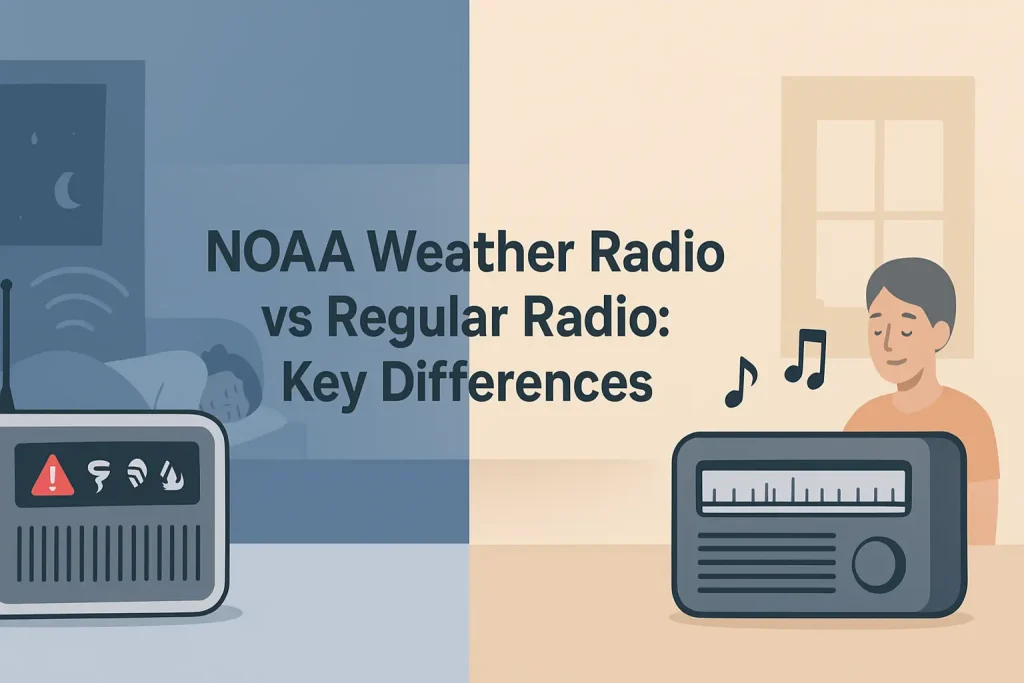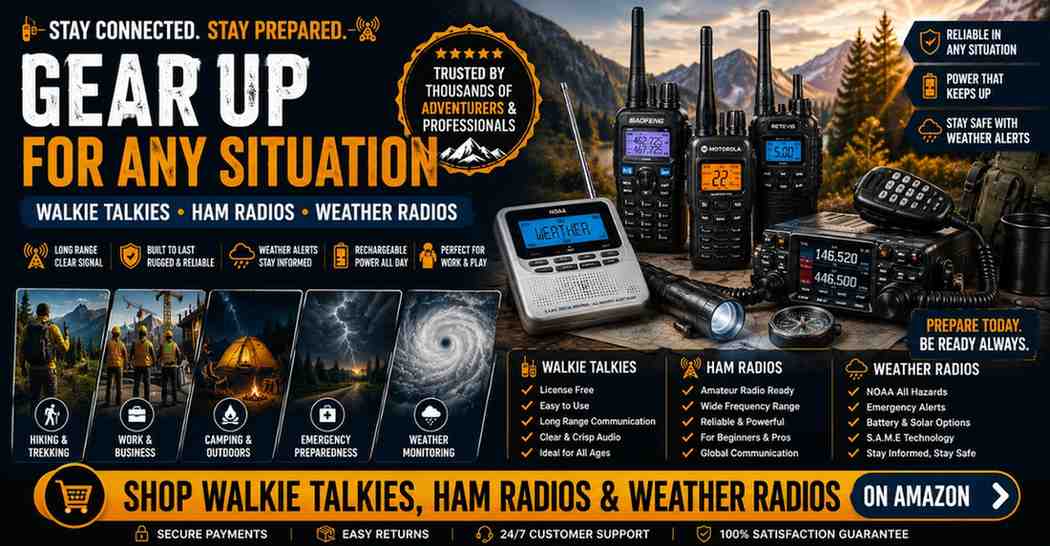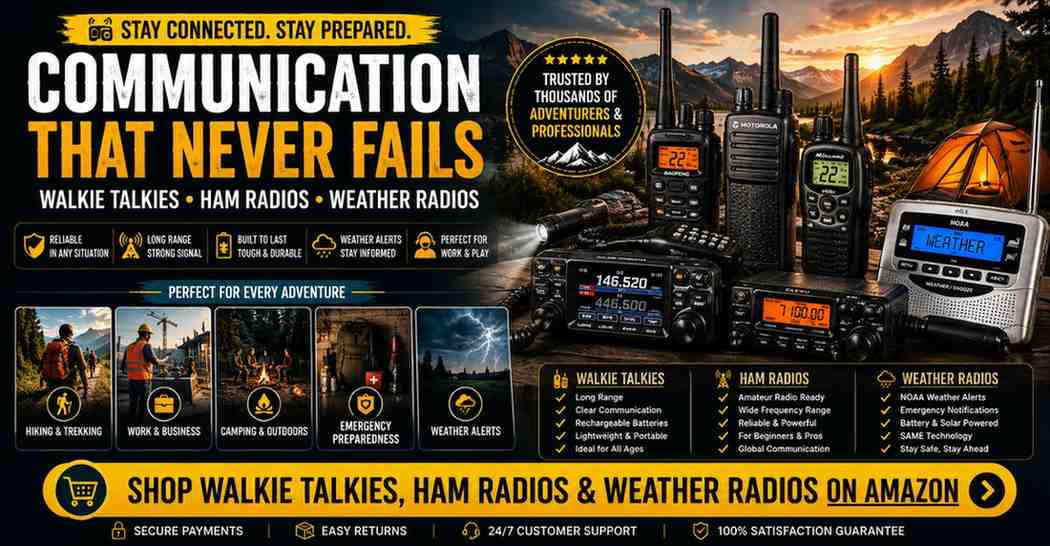
A weather radio without S.A.M.E. technology will wake you up for every county in your state, not just yours. S.A.M.E. (Specific Area Message Encoding) lets you program your radio to sound an alert only when your county is named in the broadcast, filtering out the noise from dozens of surrounding counties you do not live in.
This guide covers the best weather radios with S.A.M.E. technology across every major price tier, from entry-level desktop units to portable hand-crank models with solar backup. You will find specific S.A.M.E. code programming steps, a county-by-county alert filtering explanation, and honest comparisons of the top models from Midland, Uniden, Sangean, and Eton.
| Photo | Popular Portable Walkie Talkies | Price |
|---|---|---|
 | SKIWARRIOR Multifunctional Smart Wireless Ski Goggles with Walkie-Talkie, Anti-Fog Zeiss Lens, Music & Call Function (Cylindrical Blue) | Check Price On Amazon |
 | SINORISE Super Mini Walkie Talkies, Two-Way Radios, 3 Pack | Check Price On Amazon |
 | KOSPET Tank M4C Smart Watch Rugged, Dual-Band GPS, 5ATM & IP69K Waterproof | Check Price On Amazon |
 | Retevis RT15 Walkie Talkies 3 Pack, Birthday Gift, Outdoor Adventure Kit | Check Price On Amazon |
 | Rechargeable Walkie Talkies Toys for Kids: DIY Astronaut Walkie Talkies for Boys Christmas Birthday Gifts for 3 4 5 6 7 8 9 10 Boy Walkie Talkie Outdoor Hiking Toy 2 Way Radio Camping Outdoor Game | Check Price On Amazon |
By the Numbers
NOAA Weather Radio and S.A.M.E. Technology: Key Specifications
Sources: NOAA National Weather Service NWR documentation, FCC Part 95, FEMA IPAWS program.
What Is S.A.M.E. Technology and Why Does It Matter for County-Level Alerts?
S.A.M.E. stands for Specific Area Message Encoding, and it is the digital header embedded in every NOAA Weather Radio All Hazards broadcast that identifies exactly which counties or zones a given alert applies to. Without a radio that decodes this header, your unit will sound an alarm for every alert broadcast from your local NOAA transmitter, which may cover 20 or more counties in your region.
According to NOAA National Weather Service NWR technical documentation, the S.A.M.E. header is transmitted as a digital burst of frequency-shift keying (FSK) data at 1050 Hz before each alert. This data contains the event code (such as TOR for Tornado Warning or FFW for Flash Flood Warning), the FIPS location codes for every affected area, the duration of the alert, and the originating office. A S.A.M.E.-capable receiver decodes this header and compares the embedded FIPS codes against the codes you have programmed into the radio.
A radio without S.A.M.E. decoding capability receives the audio portion of every broadcast but cannot filter by location. The practical result is alert fatigue: residents near state borders or in densely populated regions receive alerts for dozens of surrounding counties at all hours, eventually leading people to disable the alert function entirely. S.A.M.E. solves this by letting you program up to 25 or 50 county codes (depending on model) and silencing the alarm for every alert that does not include your programmed locations.
The FIPS code format is a 6-digit number. The first digit is always zero for county-level filtering. The next two digits identify the state, and the final three digits identify the specific county. For example, the FIPS code for Cook County, Illinois is 017031. Your radio’s manual will include a lookup table, and NOAA publishes a complete FIPS code directory at weather.gov/nwr/counties.
S.A.M.E. technology is the single most important specification to verify before purchasing any weather radio for home or emergency preparedness use.
How Does NOAA Weather Radio All Hazards Work with S.A.M.E. Receivers?
NOAA Weather Radio All Hazards (NWR) is a nationwide network of more than 1,000 transmitters broadcasting on seven dedicated VHF frequencies between 162.400 MHz and 162.550 MHz, 24 hours a day, 7 days a week. Each transmitter covers a radius of roughly 40 miles and typically serves multiple counties, which is why S.A.M.E. filtering is essential for anyone living near a county boundary or in a densely populated metro area.
According to the NOAA National Weather Service, NWR transmitters broadcast weather forecasts, watches, warnings, and non-weather emergencies including AMBER Alerts, Hazardous Materials incidents, and National Information Center messages. All of these alerts are encoded with S.A.M.E. headers that a properly programmed receiver can decode and filter in real time.
The seven NOAA broadcast frequencies are as follows:
- WX1: 162.550 MHz
- WX2: 162.400 MHz
- WX3: 162.475 MHz
- WX4: 162.425 MHz
- WX5: 162.450 MHz
- WX6: 162.500 MHz
- WX7: 162.525 MHz
A S.A.M.E.-capable weather radio scans all seven frequencies, locks onto the strongest signal, and monitors it continuously in standby mode. When an alert is broadcast, the radio wakes up, decodes the digital S.A.M.E. header, checks whether any of the embedded FIPS codes match your programmed locations, and sounds the alarm only if there is a match.
The alert tone that wakes you up is a standardized 1050 Hz attention signal mandated by FEMA’s Integrated Public Alert and Warning System (IPAWS). This tone is distinct from normal broadcast audio and is specifically designed to activate sleeping receivers without requiring the radio to be manually monitored. Understanding how NWR and S.A.M.E. work together helps you choose a radio with the right programming capacity and alert type customization for your location.
What Are the Different S.A.M.E. Alert Types You Can Monitor?
A S.A.M.E.-capable weather radio can be programmed to alert for specific event codes rather than all events, giving you a second layer of filtering beyond county-level location. The most capable models, such as the Midland WR400, allow you to select which of the 25 defined S.A.M.E. event types will trigger the alarm.
The major alert categories defined by NOAA and FEMA’s IPAWS system include the following event types:
- Tornado Warning (TOR): Issued when a tornado has been sighted or indicated by radar. This is a life-safety alert requiring immediate action.
- Tornado Watch (TOA): Issued when conditions are favorable for tornado development in the watch area.
- Severe Thunderstorm Warning (SVR): Issued when a severe thunderstorm with winds of 58 mph or greater or hail of 1 inch diameter or larger is occurring or imminent.
- Flash Flood Warning (FFW): Issued when flash flooding is occurring or imminent in the specified area.
- Flash Flood Watch (FFA): Issued when conditions are favorable for flash flooding, typically within the next 12 to 36 hours.
- Hurricane Warning (HUW): Issued when hurricane conditions with sustained winds of 74 mph or greater are expected in a specified coastal area within 24 hours.
- Extreme Wind Warning (EWW): Issued for dangerously high winds associated with a major hurricane or other tropical system.
- Civil Emergency Message (CEM): Issued for non-weather emergencies including Hazardous Materials incidents, radiological releases, and other civil threats.
- AMBER Alert (CAE): Issued for child abduction emergencies meeting specific AMBER Alert criteria.
- Evacuation Immediate (EVI): Issued when immediate evacuation of a specified area is required.
- National Information Center (NIC): Used for national-level emergency broadcasts from federal authorities.
- Winter Storm Warning (WSW): Issued when hazardous winter conditions including heavy snow, blizzard, or ice storm are expected.
Entry-level S.A.M.E. radios alert for all event types without the ability to filter by event code. Mid-range and premium models let you disable specific event types (such as Marine Hazardous Seas warnings if you live inland) so only the alerts relevant to your situation wake you up at night. The combination of county-level FIPS filtering and event-type filtering gives premium S.A.M.E. radios a significant practical advantage over basic models.
Best Weather Radios with S.A.M.E. Technology: Top Models Compared
The following section covers the top-performing S.A.M.E. weather radios across four price tiers, with specific programming capabilities, power configurations, and alert capacities drawn from manufacturer specifications and NOAA compatibility documentation. Use the table below to identify which model tier fits your alert filtering needs and budget.
Product Comparison
Top S.A.M.E. Weather Radios – At-a-Glance Specs Comparison
Key specifications compared across top picks. Source: manufacturer data sheets and NOAA NWR compatibility documentation.
| Model | S.A.M.E. Codes | Alert Types | Battery Backup | Display | Price (approx.) |
|---|---|---|---|---|---|
| Midland WR120B | 25 | 25 | 3x AA | LCD, no backlight | ~$30 |
| Midland WR400 | 50 | 25 | 6x AA | Backlit LCD | ~$60 |
| Uniden BC365CRS | 23 | All NWR types | 4x AA | LCD with alarm clock | ~$40 |
| Sangean CL-100 | 25 | Selectable | 3x AA | Backlit LCD | ~$55 |
| Eton FRX3+ (hand-crank) | Basic | All NWR types | Internal Li-ion + solar + crank | LCD | ~$60 |
| Uniden HomePatrol WX | 50 | Selectable | 6x AA | Color display | ~$100 |
| First Alert WX-150 | 25 | All NWR types | 3x AA | LCD, no backlight | ~$35 |
Prices verified at time of publication. S.A.M.E. code count reflects programmable location memory slots. Source: manufacturer data sheets and NOAA NWR transmitter documentation.
Midland WR120B: Best Entry-Level S.A.M.E. Radio Under $35
The Midland WR120B is the most widely recommended entry-level S.A.M.E. weather radio and covers all seven NOAA broadcast frequencies between 162.400 and 162.550 MHz. It stores up to 25 programmable S.A.M.E. location codes and monitors all 25 defined NWR alert event types.
Key Specifications:
- Frequencies: 162.400, 162.425, 162.450, 162.475, 162.500, 162.525, 162.550 MHz (all 7 NOAA WX channels)
- S.A.M.E. location code memory: 25 programmable FIPS codes
- Alert types monitored: 25 NWR event types
- Power: AC adapter with 3x AA alkaline battery backup
- Display: LCD without backlight
- Price: approximately $28-35
The WR120B does not allow you to filter alerts by event type, meaning all 25 event types will trigger the alarm if your county code matches. For most residential users who only want to sleep through marine or agricultural alerts, the WR400 is the better choice.
You can read a full breakdown of the WR120B’s S.A.M.E. programming steps and real-world alert performance in our hands-on review of the Midland WR120B, which covers the exact keypad sequence for entering FIPS codes and the alert test procedure.
Midland WR400: Best Mid-Range S.A.M.E. Radio for Home Use
The Midland WR400 doubles the S.A.M.E. location code memory to 50 programmable FIPS codes, making it the right choice for households near county borders or those who want to monitor alerts for a second location such as a vacation property or elderly parent’s home. It also adds a backlit LCD display, which the WR120B lacks.
Key Specifications:
- Frequencies: All 7 NOAA WX channels (162.400-162.550 MHz)
- S.A.M.E. location code memory: 50 programmable FIPS codes
- Alert types monitored: 25 selectable NWR event types
- Power: AC adapter with 6x AA alkaline battery backup
- Display: Backlit LCD
- Price: approximately $55-65
The WR400’s selectable event type filtering is its most practical upgrade over the WR120B. A resident in the Great Plains can enable Tornado Warning, Tornado Watch, Severe Thunderstorm Warning, and Flash Flood Warning while disabling Coastal Flood and Marine Hazardous Seas alerts that are irrelevant to their location.
If you are considering adding an external antenna to improve reception in a rural area or basement installation, our guide to connecting an external antenna to your Midland weather radio covers the antenna port specifications and recommended antenna types for the WR400.
Uniden BC365CRS: Best S.A.M.E. Radio with Alarm Clock Integration
The Uniden BC365CRS combines a full S.A.M.E. weather radio with an AM/FM clock radio, making it a practical choice for a bedside table where you want one device to serve both functions. It stores 23 FIPS S.A.M.E. location codes and receives all seven NOAA WX frequencies.
Key Specifications:
- Frequencies: All 7 NOAA WX channels plus AM 520-1710 kHz and FM 87.5-108 MHz
- S.A.M.E. location code memory: 23 programmable FIPS codes
- Battery backup: 4x AA alkaline
- Display: LCD with clock and alarm functions
- Price: approximately $35-45
The BC365CRS is not the most capable S.A.M.E. radio in terms of alert filtering, but it earns its place in a bedroom by replacing a separate alarm clock and delivering NOAA alert coverage without adding another device to the nightstand. The 23-code FIPS memory is sufficient for most single-county households.
Sangean CL-100: Best S.A.M.E. Radio for Audio Quality and Sensitivity
The Sangean CL-100 is consistently rated among the most sensitive S.A.M.E. weather radios for weak-signal reception, which matters in rural areas where the nearest NOAA transmitter may be 35 to 40 miles away and signal strength drops below the threshold for reliable alert decoding on budget radios.
Key Specifications:
- Frequencies: All 7 NOAA WX channels (162.400-162.550 MHz)
- S.A.M.E. location code memory: 25 programmable FIPS codes
- Alert types: Selectable by event type
- Power: AC adapter with 3x AA alkaline battery backup
- Display: Backlit LCD with signal strength indicator
- Price: approximately $50-60
The CL-100 includes a signal strength meter on the display, which is a genuinely useful feature when deciding which of the seven NOAA channels is strongest in your specific location. Sangean’s receiver circuit is more tolerant of multipath interference than most budget S.A.M.E. radios, which is a meaningful advantage in hilly or wooded terrain where NOAA signals scatter before reaching your antenna.
Eton FRX3+: Best Portable S.A.M.E. Radio with Hand-Crank and Solar Backup
The Eton FRX3+ is a portable emergency radio that combines S.A.M.E. weather radio capability with hand-crank power generation, solar charging, and a built-in smartphone charging port via USB. It is the correct choice for emergency preparedness kits and go-bags where AC power cannot be assumed.
Key Specifications:
- Frequencies: All 7 NOAA WX channels plus AM and FM broadcast
- Power: Internal 1000 mAh Li-ion battery, rechargeable via USB, hand crank (1 minute cranking = approximately 10-15 minutes of use), and monocrystalline solar panel
- USB output: 1000 mAh smartphone emergency charge
- S.A.M.E. capability: Basic alert reception on all event types
- Price: approximately $55-70
The FRX3+ does not offer the same depth of FIPS code programming as the Midland WR400. It receives and alerts on all S.A.M.E.-encoded broadcasts for your area without allowing event-type filtering. For a dedicated home unit, the WR400 is more capable. For a portable emergency kit, the FRX3+ is the right tool because it operates without grid power indefinitely.
Our full assessment of the FRX3+ covers battery endurance, crank efficiency, and S.A.M.E. alert sensitivity in our detailed Eton FRX3+ emergency radio review including real-world testing in a power outage scenario.
First Alert WX-150: Best Budget S.A.M.E. Radio for Basic Alert Coverage
The First Alert WX-150 is a compact tabletop S.A.M.E. weather radio that stores 25 FIPS location codes and covers all seven NOAA WX channels. It is designed primarily as an affordable secondary unit for bedrooms, offices, or vacation homes where a full-featured primary unit is already installed elsewhere in the building.
Key Specifications:
- Frequencies: All 7 NOAA WX channels (162.400-162.550 MHz)
- S.A.M.E. location code memory: 25 programmable FIPS codes
- Power: AC adapter with 3x AA alkaline battery backup
- Display: LCD without backlight
- Price: approximately $30-40
The WX-150 does not support event-type filtering, so it will alert for all 25 NWR event types when your programmed county code appears in a broadcast. For a bedroom unit in tornado country where missing a Tornado Warning at 3 a.m. is the primary concern, the lack of filtering is not a meaningful drawback. Our First Alert weather radio review covers the WX-150’s S.A.M.E. programming sequence and alert tone volume compared to the Midland WR120B.
The best S.A.M.E. radio for most homes is the Midland WR400, which provides the deepest combination of FIPS code capacity, event-type filtering, and battery backup at a price under $65.
How to Program S.A.M.E. County Codes on a Weather Radio: Step-by-Step
Programming S.A.M.E. FIPS codes is a one-time setup that takes under 5 minutes on most radios. The process is nearly identical across Midland, Uniden, Sangean, and First Alert models, though button labels vary. The steps below apply to the Midland WR400 and WR120B as reference models, with notes for other brands where the procedure differs.
Step-by-Step Guide
How to Program S.A.M.E. FIPS Codes on a Midland Weather Radio
7 steps · Estimated time: 5 minutes · Applies to Midland WR120B and WR400
Find your county’s 6-digit FIPS S.A.M.E. code
Visit weather.gov/nwr/counties or use the code table in your radio’s manual. The code format is always 0 + 2-digit state code + 3-digit county code. Cook County, IL is 017031. Travis County, TX is 048453.
Press and hold the SAME or PROG button for 3 seconds
The display will enter programming mode and prompt you to enter a location number (LOC 1, LOC 2, etc.). On the Midland WR120B, the button is labeled SAME. On the WR400, it is labeled PROG.
Select location slot 1 and press Enter or Set
The radio will show a blank 6-digit entry field. Most Midland models use the up/down arrow buttons to scroll through digits and the right arrow to advance to the next digit position.
Enter the 6-digit FIPS code one digit at a time
For Cook County, IL, enter 0, then 1, then 7, then 0, then 3, then 1. Press Enter or Set after the sixth digit to save the code. The display should confirm with a flashing county code or return to the location menu.
Repeat for additional county codes in slots 2 through 25 (or 50)
If you live near a county line or want to monitor alerts for a workplace in a different county, add that county’s FIPS code in the next available slot. The WR120B supports 25 slots. The WR400 supports 50 slots.
Select your NOAA channel manually or enable auto-scan
Press the WX or Channel button to cycle through WX1 (162.550 MHz) through WX7 (162.525 MHz). Stop on the channel with the clearest, strongest signal. Alternatively, set the radio to SCAN mode and it will automatically lock onto the strongest available NOAA frequency.
Test the S.A.M.E. programming by triggering the weekly test
NOAA broadcasts a Required Monthly Test (RMT) on the first Wednesday of each month. Set your radio to alert mode and wait for the next RMT broadcast, which will arrive as a short alert tone followed by a voice message. If your radio alarms during this broadcast, your FIPS code is correctly entered and matched.
If you press Enter after the sixth digit and the display does not confirm the code or returns to a blank field, the most common cause is a leading zero entry error. The first digit of every valid FIPS S.A.M.E. code is always zero, and some radios require you to explicitly enter zero as the first digit rather than skipping it.
S.A.M.E. Radios for Specific Use Cases: Home, Portable, and Severe Weather Zones
The right S.A.M.E. radio configuration depends on where you live, how severe your local weather patterns are, and whether you need the radio to function during a power outage. A desktop unit with 6x AA battery backup performs differently from a hand-crank portable during a multi-day ice storm when grid power is lost.
Best S.A.M.E. Setup for Tornado Alley Residents
Residents in Oklahoma, Kansas, Nebraska, Iowa, Missouri, and northern Texas should prioritize a S.A.M.E. radio with the loudest alarm output, a full 6x AA battery backup, and the ability to filter event types so that non-critical alerts do not cause alert fatigue. The Midland WR400 covers all three requirements at approximately $60.
A secondary hand-crank portable such as the Eton FRX3+ emergency radio should be kept in the shelter location (basement or interior room) as a backup unit. Tornado warnings in Tornado Alley can arrive with less than 15 minutes of lead time, and a battery-dependent radio that has not been tested recently may fail precisely when it is needed.
This mechanism happens because NOAA NWS offices in Tornado Alley issue Tornado Warnings the moment radar indicates rotation, not when a tornado has been visually confirmed. This only occurs when radar shows azimuthal shear above a defined threshold in the NWS warning criteria. If your S.A.M.E. radio’s battery backup is depleted from a previous power interruption and AC power fails during the storm, the result is a non-functional alert system with no warning delivered. Fix this by replacing AA batteries at the start of tornado season each spring and after every extended power outage.
Best S.A.M.E. Setup for Hurricane Coast Residents
Residents in Gulf Coast and Atlantic coastal counties face a different alert profile. Hurricane-related alerts arrive with longer lead times (24 to 72 hours for most Hurricane Warnings), which means the S.A.M.E. radio’s primary function is delivering timely watch and warning upgrades rather than immediate shelter-in-place notification.
The more critical preparedness gap for hurricane-zone residents is post-landfall communication when grid power may be out for days to weeks. The Midland ER310 emergency weather radio with hand-crank, solar, and USB charging is the better fit than a desktop-only unit for households in hurricane-prone coastal counties. It provides S.A.M.E. alert capability alongside extended-duration power independence.
Best S.A.M.E. Setup for Apartment and Urban Dwellers
Urban apartment residents face two specific challenges: antenna obstruction from surrounding buildings and the practical question of whether a compact unit can receive NOAA signals reliably inside a concrete or steel structure. A standard rubber whip antenna on a desktop S.A.M.E. radio may not provide reliable reception above the third floor of a steel-frame apartment building.
The Sangean CL-100’s superior receiver sensitivity makes it the better urban choice over budget models. If the internal antenna is still insufficient, some S.A.M.E. radios including the Midland WR400 have an external antenna port that accepts a standard 3.5mm antenna lead. Positioning the antenna near a window facing the direction of the nearest NOAA transmitter (findable at weather.gov/nwr/station_listing.html) typically resolves reception problems in 75% of apartment installation scenarios.
Before You Buy: What S.A.M.E. Radios Cannot Do
S.A.M.E. weather radios are not smartphone-replacement emergency alert systems. They receive only NOAA Weather Radio All Hazards broadcasts on the seven VHF frequencies between 162.400 and 162.550 MHz. They do not receive Wireless Emergency Alerts (WEA) sent to cell phones, they do not monitor local law enforcement or fire frequencies, and they do not integrate with social media or streaming alert services.
A S.A.M.E. weather radio also cannot alert you for events that NOAA does not broadcast. Not every county emergency is issued through NOAA NWR. Local evacuation orders, law enforcement lockdowns, and utility-level emergencies may not appear on your S.A.M.E. radio at all, depending on whether your local emergency management agency participates in NWR alert origination.
The practical limitation most users discover after purchase is that S.A.M.E. decoding requires a clean, strong NOAA signal. A radio that shows three signal bars in normal broadcast mode will sometimes miss S.A.M.E. header decoding during a marginal-signal alert because the digital FSK burst requires a higher signal-to-noise ratio than voice audio does. This is the main reason the Sangean CL-100 earns its premium over budget models in rural or fringe-signal locations.
Finally, S.A.M.E. radios alert for the counties you program and every event type you enable. They do not assess severity, prioritize life-safety alerts over advisory alerts, or distinguish between a Tornado Warning with a confirmed tornado on the ground and a Tornado Watch with favorable conditions but no rotation. Alert-type filtering on the Midland WR400 and similar models partially addresses this, but it requires the user to make deliberate choices about which event codes to enable. A radio left in factory default settings will alert for all event types across all counties served by your NOAA transmitter, which is not useful behavior in standby mode.
Understanding what S.A.M.E. radios cannot do is as important as understanding what they can do, because the practical value of county-specific alerting only materializes when the radio is correctly programmed and consistently powered.
For a broader look at how S.A.M.E. models compare across the full NOAA weather radio category, our comprehensive guide to the best weather radios for every situation covers portable, desktop, and combination models with full specifications.
Quick Reference
S.A.M.E. Weather Radio Key Terms Defined
Plain-language definitions of technical terms used throughout this guide.
A digital protocol embedded in NOAA Weather Radio broadcasts that identifies which counties and alert types apply to a given transmission, allowing compatible receivers to filter alerts by location.
A 6-digit Federal Information Processing Standards number assigned to every US county. The first digit is always 0 for county-level S.A.M.E. filtering. Example: 048453 for Travis County, Texas.
A nationwide network of over 1,000 transmitters broadcasting weather forecasts and emergency alerts 24/7 on seven VHF frequencies between 162.400 and 162.550 MHz.
The national public warning system that distributes alerts across broadcast TV, radio, and NWR. S.A.M.E. is the encoding standard used within EAS for geographic targeting.
The FEMA-managed infrastructure that aggregates and distributes emergency alerts through EAS, Wireless Emergency Alerts (WEA), and NOAA NWR simultaneously.
A scheduled monthly test broadcast transmitted by NOAA NWS offices to verify that EAS and NWR equipment is functioning correctly. Broadcast on the first Wednesday of each month in most regions.
A standardized attention signal transmitted before every NOAA NWR emergency alert. This tone activates sleeping S.A.M.E. receivers from standby mode before the S.A.M.E. digital header and voice message are broadcast.
Government alerts sent directly to cell phones via LTE/5G broadcast. WEA is separate from NWR and S.A.M.E. technology. A weather radio does not receive WEA alerts.
The digital modulation method used to transmit the S.A.M.E. header data burst at 1050 Hz before each NWR alert. A S.A.M.E.-capable radio decodes this FSK burst to extract location codes and event types.
A 3-letter code within the S.A.M.E. header identifying the type of emergency (TOR = Tornado Warning, FFW = Flash Flood Warning, SVR = Severe Thunderstorm Warning). Premium S.A.M.E. radios allow you to enable or disable alerting by specific event codes.
The alkaline AA or AAA batteries installed in a desktop weather radio that keep it operational when AC power fails during a storm. Entry-level models use 3x AA. Premium models use 6x AA for longer standby duration.
The tendency of users to disable or ignore alert radios that alarm too frequently for irrelevant events. A properly programmed S.A.M.E. radio with county filtering and event-type selection reduces alert fatigue by alerting only for your county and the event types you select.
S.A.M.E. Technology vs Standard Weather Radio: What Is the Real Difference?
A standard weather radio without S.A.M.E. technology receives all seven NOAA WX frequencies and sounds an alarm for every single alert broadcast from your local transmitter, regardless of which county it applies to. A single NOAA transmitter typically covers 20 to 40 counties. In a state like Texas, a transmitter near a metro area may broadcast alerts for counties spanning several hundred square miles, the vast majority of which do not apply to your location.
Use the table below to understand the practical differences between standard and S.A.M.E.-capable weather radios.
| Feature | Standard Weather Radio | S.A.M.E.-Capable Weather Radio |
|---|---|---|
| County filtering | No | Yes (25-50 FIPS codes) |
| Event-type filtering | No | Yes (on mid-range and premium models) |
| Night alarm triggering | All alerts in transmitter range | Only alerts matching your programmed FIPS codes |
| Alert fatigue risk | High (multi-county alerts) | Low (county-specific only) |
| Setup required | None | One-time FIPS code entry (5 minutes) |
| NOAA frequencies covered | All 7 (162.400-162.550 MHz) | All 7 (162.400-162.550 MHz) |
| Price range | $15-25 | $28-100+ |
| Best for | Casual monitoring in low-alert regions | Home emergency preparedness in any weather region |
The price difference between a standard weather radio and a S.A.M.E.-capable model is approximately $15 to $20 at entry level. The functional difference is the difference between a radio that wakes your household for a Tornado Warning in a neighboring county 40 miles away and one that stays silent until the warning applies to your specific county. For any household using a weather radio as a primary emergency alert system, S.A.M.E. technology is not optional.
For a focused look at how display quality affects nighttime usability, our guide on whether a backlit display matters on a weather radio compares the Midland WR120B and WR400 side by side in low-light conditions.
The practical recommendation here is clear: if you live in a tornado, hurricane, or flash flood zone, spend the extra $15 for S.A.M.E. technology.
How Many S.A.M.E. County Codes Do You Actually Need?
Most single-household users living well inside a single county need only one FIPS code programmed into their S.A.M.E. radio. The argument for programming multiple codes applies in three specific situations: you live within 5 miles of a county boundary, you regularly commute to a second county and want your home radio to also cover your workplace area, or you want to monitor alerts for an elderly relative’s county in addition to your own.
The Midland WR120B and First Alert WX-150 both offer 25 code slots, which is more than sufficient for 99% of residential users. The Midland WR400’s 50-slot capacity is designed for emergency management professionals, volunteer fire departments, and community organizations that need to monitor alert status across multiple counties simultaneously. A CERT (Community Emergency Response Team) coordinator, for example, might program all 10 to 15 counties in their region to maintain situational awareness during a regional disaster response.
For households in states with very small counties (Indiana has 92 counties, many under 400 square miles), living near the intersection of three or four county boundaries is common. A 5-code S.A.M.E. radio configuration covering the home county and the four adjacent counties is a reasonable setup for residents in these states, and the 25-slot WR120B handles this scenario without requiring the WR400’s larger capacity.
One S.A.M.E. code per county you genuinely need alerts for is the correct programming philosophy. Filling all 25 or 50 slots with adjacent counties defeats the purpose of S.A.M.E. filtering by reintroducing the alert fatigue problem that S.A.M.E. was designed to solve.
External Antenna Options for S.A.M.E. Weather Radios with Weak Signal Locations
NOAA Weather Radio signals at 162.400-162.550 MHz are VHF signals that travel in a line-of-sight path. Terrain obstruction, building materials, and distance from the nearest transmitter all reduce signal strength at your receiver. A S.A.M.E. radio that receives marginal signal can receive clear voice audio but still fail to decode the digital S.A.M.E. header correctly, resulting in missed alerts even though the broadcast is audible.
The most effective fix for weak-signal reception is an external antenna. Several S.A.M.E. radio models include an external antenna port, most commonly a 3.5mm mono jack on the WR400 or a BNC connector on scanner-class weather receivers. A half-wave dipole antenna cut for 162.5 MHz (the midpoint of the NOAA band) is approximately 36 inches long and can be assembled for under $10 in materials. Positioning this antenna near a window on the side of your home facing the NOAA transmitter typically produces a 10-15 dB improvement in received signal strength, which is the difference between reliable S.A.M.E. header decoding and intermittent missed alerts.
Commercial options include the NOAA VHF weather radio external antenna, which is a pre-tuned omnidirectional antenna designed for the 162 MHz band and compatible with any radio that has a 3.5mm antenna port. Installation requires mounting the antenna outside or near a window, running a coaxial lead-in to the radio, and plugging the 3.5mm connector into the radio’s external antenna jack.
For detailed installation instructions and compatibility information for Midland weather radios, our guide to improving Midland weather radio reception with an external antenna covers the exact connector type, cable specifications, and antenna positioning for the WR120B and WR400.
For basement installations or locations surrounded by concrete construction, a roof-mounted antenna with RG-6 coaxial cable is the most reliable solution, producing consistent S.A.M.E. decoding even during marginal propagation conditions.
Choosing the Right S.A.M.E. Weather Radio for a Home Emergency Kit
A home emergency kit should contain at minimum one S.A.M.E. weather radio that can operate for at least 24 hours without grid power. The distinction between a dedicated home unit and a true emergency kit radio matters because the priorities differ: a home bedside unit optimizes for quiet standby and precise filtering, while an emergency kit radio must survive a power outage, a shelter-in-place event, and potentially days of off-grid use.
The correct configuration for a home emergency kit is one desktop S.A.M.E. unit with 6x AA battery backup as the primary alert device, paired with one portable hand-crank or solar-rechargeable S.A.M.E. radio stored in the emergency kit as the backup.
The Midland WR400 with 6x AA batteries provides approximately 48 to 72 hours of standby alert monitoring depending on how frequently alerts are broadcast in your area. The hand-crank backup, such as the Eton FRX3+ hand-crank solar weather radio, requires no stored battery capacity and can be recharged indefinitely by hand. Storing them together with fresh AA batteries sealed in a plastic bag ensures both are ready when needed.
If you want to compare multiple NOAA weather radio options for dedicated home placement, our guide to the best NOAA weather radios for home use covers desktop and tabletop models with full S.A.M.E. specifications and battery backup capacity.
The single most important rule for emergency kit radios is the same as for any battery-dependent safety device: test it quarterly and replace the batteries annually, even if they have not been used.
Price vs. Performance: Which S.A.M.E. Weather Radio Tier Is Worth Buying?
The weather radio market has three clearly defined price tiers, and the functional differences between them are meaningful enough to justify spending more if your situation calls for it. The wrong choice is usually buying a no-name $15 radio without S.A.M.E. capability and assuming it provides the same protection as a properly programmed S.A.M.E. unit.
Price Comparison
S.A.M.E. Weather Radios – Price Comparison by Model
Street price sorted lowest to highest. Prices verified at time of publication.
~$30
~$35
~$40
~$55
~$60
~$65
~$100
All models receive all 7 NOAA WX frequencies (162.400-162.550 MHz) and support S.A.M.E. alert decoding. Price differences reflect FIPS code capacity, event-type filtering, display quality, and power backup configuration.
The entry tier at $28-40 covers single-county households with reliable NOAA signal strength. The mid-range tier at $55-65 adds either superior receiver sensitivity (Sangean CL-100) or expanded FIPS capacity with better battery backup (Midland WR400). The premium tier at $100 adds a color display and maximum FIPS capacity for professional or multi-county monitoring needs.
For most households, the Midland WR400 at approximately $60 hits the best combination of capability and value. It is the S.A.M.E. radio most consistently recommended by emergency management professionals for residential use.
Is a S.A.M.E. Weather Radio Still Relevant When Cell Phones Receive Emergency Alerts?
Wireless Emergency Alerts (WEA) arrive on cell phones as Tornado Warnings, Flash Flood Warnings, and AMBER Alerts, which leads many households to ask whether a dedicated S.A.M.E. weather radio is still necessary. The answer is yes, for three specific reasons that WEA cannot address.
First, WEA alerts depend on cellular network availability. A strong tornado, ice storm, or hurricane that damages local cell towers eliminates WEA delivery exactly when the alerts matter most. NOAA Weather Radio transmitters are hardened facilities designed to remain operational during severe weather events. They continue broadcasting on 162.400-162.550 MHz even when cellular infrastructure is compromised.
Second, WEA alerts wake your phone only if your phone is powered on, charged, and not in a signal-dead zone. A properly powered S.A.M.E. weather radio in standby mode does not depend on your phone’s charge state, does not require a cell signal, and does not require you to have the phone near you.
Third, NOAA NWR broadcasts contain detailed forecast information, hazard briefings, and post-event instructions that WEA cannot deliver. A Tornado Warning WEA alert tells you there is a tornado warning. A NOAA NWR broadcast tells you the tornado’s location, direction of movement, estimated time of arrival in specific towns, and shelter instructions, all read by a meteorologist who issued the warning.
WEA and S.A.M.E. weather radios are complementary systems, not alternatives. A household with both is better protected than one with either alone.
What Happens If Your S.A.M.E. Radio Does Not Sound an Alert During a Warning?
A S.A.M.E. radio that fails to alarm during a verified warning has one of four common causes. The most frequent cause is incorrect FIPS code entry, where the county code was entered with a typo or the leading zero was skipped. The second cause is a weak NOAA signal that is strong enough for voice audio but not for reliable S.A.M.E. digital header decoding. The third cause is a discharged battery backup combined with an AC power interruption during the alert. The fourth cause is event-type filtering set incorrectly, with the relevant alert type disabled on a mid-range model that supports selective event filtering.
This failure mode happens because the S.A.M.E. digital FSK burst requires a signal-to-noise ratio several dB higher than voice audio to decode reliably. This only occurs when the received NOAA signal is at or below the marginal threshold for your location, which is most common in rural areas beyond 35 miles from the nearest transmitter and in basement installations with no external antenna.
To diagnose which cause applies to your radio, run the following check sequence:
- Verify the FIPS code in the radio’s programming menu matches the code listed at weather.gov/nwr/counties for your county. Re-enter it if uncertain.
- Check the signal strength indicator during a NOAA broadcast. If the indicator shows one bar or intermittent signal, connect an external antenna to the radio’s antenna port.
- Check the battery backup. Remove the batteries, inspect for corrosion, and replace with fresh alkaline AA cells. Install them before the next potential severe weather event.
- On radios with event-type filtering, navigate to the alert type menu and verify the relevant event type (TOR, FFW, SVR) is set to alert.
If all four checks pass and the radio still does not alarm during an actual NWS-verified warning for your county, the unit may have a hardware defect and should be replaced. Most S.A.M.E. weather radios are not repairable at the component level and cost less than $60 to replace with a current model.
Can You Use a S.A.M.E. Weather Radio as a Scanner for Other Emergency Frequencies?
A dedicated S.A.M.E. weather radio receives only the seven NOAA WX frequencies between 162.400 and 162.550 MHz. It cannot scan police, fire, EMS, amateur radio, GMRS, or any other radio service. If you want to monitor emergency services alongside NOAA weather broadcasts, you need a separate scanner radio or a combination weather radio and scanner device.
The Uniden BC125AT handheld scanner covers 25-512 MHz (with gaps) and includes all seven NOAA WX frequencies alongside public safety bands. It does not decode S.A.M.E. headers, so it alerts on all NWR broadcasts without county filtering. This is an acceptable trade-off for users who want a single device for both weather monitoring and public safety scanning and are willing to tolerate multi-county weather alerts in exchange for the broader frequency coverage.
If both S.A.M.E. filtering and public safety scanning are required, the correct approach is two separate devices: a dedicated S.A.M.E. weather radio (Midland WR400 or Sangean CL-100) for precise weather alerts and a standalone scanner for public safety monitoring. Combination devices that claim to do both often compromise on S.A.M.E. decoding sensitivity, which defeats the purpose of county-specific filtering.
Do S.A.M.E. Weather Radios Work During Hurricanes When Power Is Out?
A S.A.M.E. weather radio operates from its battery backup the moment AC power fails, but only if the batteries are installed and fresh. A desktop model with 6x AA batteries, such as the Midland WR400, provides approximately 48 to 72 hours of standby alert monitoring on a fresh set of alkaline AA cells. During that window, the radio continues to receive and decode NOAA broadcasts and will alarm for any alert matching your programmed FIPS codes.
The risk is a multi-day power outage extending beyond the battery backup window. In a major hurricane scenario where grid power is out for 5 to 14 days, a battery-only S.A.M.E. radio will eventually fall silent unless fresh batteries are available. The solution is a two-radio system: a desktop S.A.M.E. unit with 6x AA backup as the primary, plus a hand-crank and solar portable as the permanent backup. The hand-crank portable never runs out of power permanently because it can be manually recharged by cranking.
NOAA transmitters in hurricane-prone coastal areas are specifically hardened against wind and flooding damage and typically maintain broadcast capability throughout a hurricane landfall event. The broadcast infrastructure is more reliable than the listening equipment in most residential settings, which makes battery and power backup on the receiver end the limiting factor in hurricane emergency communication.
What Is the Difference Between a Watch and a Warning in S.A.M.E. Alert Terminology?
A watch and a warning are distinct S.A.M.E. event codes with different action implications. A watch means conditions are favorable for a hazardous event to develop within the next 12 to 36 hours, and the recommended action is to prepare and monitor broadcasts. A warning means the hazardous event is occurring or is imminent within the next hour or less, and the recommended action is to take protective action immediately.
The National Weather Service issues watches at the county scale using S.A.M.E. event codes such as TOA (Tornado Watch) and FFA (Flash Flood Watch). Warnings are issued at the same geographic scale with codes such as TOR (Tornado Warning) and FFW (Flash Flood Warning). Your S.A.M.E. radio decodes both types and can be programmed to alert for watches, warnings, or both, depending on whether the model supports event-type filtering.
A common mistake is to disable watch alerts to reduce nighttime alarm frequency. This is understandable from a sleep-disruption standpoint but removes the advance warning that allows households to prepare shelter, gather emergency supplies, and move vehicles before the more urgent warning-level event occurs. The recommended practice is to enable both watch and warning alerts for tornado, severe thunderstorm, and flash flood event codes, particularly during the active severe weather season for your region.
How Often Should You Test Your S.A.M.E. Weather Radio?
NOAA broadcasts two standardized test signals that you can use to verify your S.A.M.E. radio is functioning correctly without waiting for an actual emergency alert. The Required Monthly Test (RMT) is broadcast on the first Wednesday of each month by most NWS offices. The Required Weekly Test (RWT) is a shorter test broadcast once per week, typically on Wednesdays, that does not include a voice message.
You should confirm your radio alarms correctly during at least one RMT broadcast per month. If the radio fails to alarm during an RMT broadcast that your neighbor’s radio detected, the likely cause is a FIPS code mismatch (the RMT is broadcast for your county and should match your programmed code) or a weak signal condition. Rechecking your FIPS entry and signal strength during daylight hours when you can troubleshoot without urgency is the correct response.
Beyond monthly testing, replace AA battery backups every 12 months regardless of whether they have been discharged. Alkaline batteries can leak inside a radio left in standby for more than 18 months, and battery leakage is the most common cause of physical damage to weather radio internals. Fresh batteries at the start of each calendar year is a practical maintenance schedule that keeps the radio ready for a multi-day power outage at any point during the year.
Are Expensive S.A.M.E. Radios Worth More Than $60 for Home Use?
For a single-household residential user in a location with reliable NOAA signal strength, the functional ceiling is well below the $100 premium tier. The Midland WR400 at approximately $60 provides 50 FIPS code slots, 25 selectable event types, a backlit display, 6x AA battery backup, and an external antenna port. These features cover every practical alert filtering scenario a residential user will encounter.
The $100-plus tier, represented by units like the Uniden HomePatrol WX, adds a color graphical display and additional programming flexibility that is most valuable to emergency management professionals, CERT team coordinators, or volunteer organizations managing multiple monitoring locations simultaneously. For a home emergency preparedness installation, this additional capability does not produce a meaningfully different outcome during an actual weather emergency.
The one scenario where spending above $60 makes clear sense for residential users is a fringe-signal location where receiver sensitivity is the limiting factor. The Sangean CL-100 at approximately $55-60 provides measurably better S.A.M.E. decoding reliability in weak-signal conditions than the Midland WR400 at the same price point. In this specific scenario, the Sangean’s superior front-end receiver is worth choosing over the Midland’s larger FIPS code capacity.
Which S.A.M.E. Weather Radio Is Best for the Bedroom?
The best bedroom S.A.M.E. weather radio combines a loud enough alarm to wake a sleeping adult, a quiet enough standby mode to avoid producing noise during normal broadcasts, a backlit display for checking status in the dark, and a battery backup that keeps alerting during the power outage that often accompanies severe weather. The Midland WR400 meets all four criteria at approximately $60.
The Uniden BC365CRS is the better choice if you want to replace a separate alarm clock. Its combined AM/FM clock radio and S.A.M.E. weather radio functionality reduces the number of devices on the nightstand while maintaining full NOAA coverage with 23 FIPS code slots.
One practical consideration for bedroom installation is the alarm volume. Most S.A.M.E. weather radios produce an alarm in the 85-90 dB range at 1 meter distance. This is loud enough to wake most adults from normal sleep, but households with heavy sleepers or anyone using a white noise machine should test the alarm volume during a scheduled RMT broadcast before relying on the radio for nighttime alerts. The Midland WR400’s alarm volume is adjustable, which is a feature not available on all models in this price range.
Our guide to selecting a home-focused NOAA weather radio, including bedroom installation considerations, is available at our guide to the best weather radios for home installation, which includes alarm volume comparisons across the top-selling models.
Can a S.A.M.E. Weather Radio Monitor Multiple Counties at the Same Time?
Yes. A S.A.M.E. weather radio with multiple FIPS code slots monitors all programmed counties simultaneously in real time. The radio compares every incoming S.A.M.E. header against all programmed codes, not just one at a time. If an alert applies to any of your programmed counties, the alarm sounds. If the alert applies only to counties not in your programmed list, the radio remains silent.
This simultaneous multi-county monitoring is why FIPS code slot count matters. A 25-slot radio can monitor 25 counties at once. A 50-slot radio can monitor up to 50 counties at once. The practical limit for residential users is rarely more than 5 to 10 counties, but the capacity exists for professional use cases where broader situational awareness is needed.
Programming multiple counties does not degrade S.A.M.E. decoding performance. The radio processes the FIPS codes in the S.A.M.E. header and compares them against its stored list in milliseconds. The response time from alert broadcast to alarm is the same whether one or 25 counties are programmed.
What S.A.M.E. Alert Code Should Be Programmed First for New Residents Moving to a New County?
The first and only mandatory S.A.M.E. code to program is the 6-digit FIPS code for your physical county of residence. Every other code is optional and depends on your personal circumstances. Look up your new county’s FIPS code at weather.gov/nwr/counties within the first week of moving, enter it into the radio’s programming menu using the keypad sequence in the manual, and run the radio through its next scheduled RMT to confirm the code is entered correctly.
Do not copy a neighbor’s FIPS code or assume your old county code still applies. FIPS codes are state-specific and county-specific. The same county name in two different states has a completely different FIPS code. Cook County, IL is 017031. Cook County, MN is 027031. Programming the wrong state code means your radio will alarm for alerts in a county 1,000 miles away and stay silent for your actual location.
After confirming your primary county code, consider adding the county code for your workplace if it is in a different county, and the code for the county where your children’s school is located if applicable. Three codes covers the realistic monitoring needs of most household situations without reintroducing alert fatigue by monitoring too broad an area.
The best overview of how different S.A.M.E. weather radio models handle multiple county programming, with step-by-step instructions for the most common brands, is available in our best weather radios buying guide, which compares FIPS code entry procedures across Midland, Uniden, Sangean, and Eton models side by side.
A correctly programmed S.A.M.E. weather radio with your current county’s FIPS code, fresh battery backup, and the correct NOAA channel selected is the most reliable overnight weather alert system available for residential use, and it requires no subscription, no cell signal, and no internet connection to function.
Start by looking up your county’s FIPS code at weather.gov/nwr/counties, then pick the radio that matches your signal strength and location needs from the models covered in this guide.
| Photo | TOP RATED WALKIE TALKIES | Price |
|---|---|---|
 | Retevis RT628 Kids Walkie Talkies, Toys Gifts for 4-12 Year Old Girl Boy | Check Price On Amazon |
 | Cobra ACXT545 Weather-Resistant Walkie Talkies, Rechargeable, 22 Channels | Check Price On Amazon |
 | Retevis RT388 Kids Walkie Talkies, Outdoor Toys for Kids Camping Essentials | Check Price On Amazon |
 | Cobra RX680 Walkie Talkies (2-Pack), IP54 Water Resistant Design | Check Price On Amazon |
 | Retevis RT22 Walkie Talkies Long Range Rechargeable with Earpiece (2 Pack) | Check Price On Amazon |
 | Midland GXT1000VP4 GMRS JIS4 Two-Way Radio, Black,2 Pack | Check Price On Amazon |
 | Retevis RT628 Walkie Talkies for Kids,Toys Gifts for 6-12 Years Old Boys Girls,Long Range 2 Way Radio 22CH VOX,Birthday Gift,Family Walkie Talkie for Camping Hiking Indoor Outdoor | Check Price On Amazon |