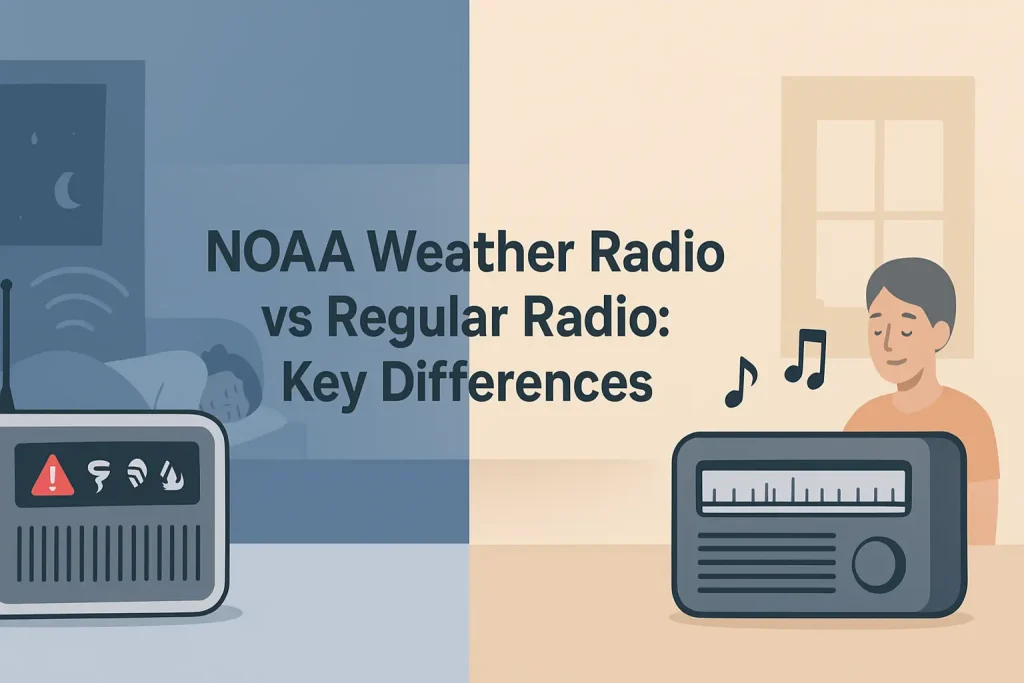
A portable weather radio is one of the most important pieces of gear you can carry on a camping trip or long road journey, yet most people buy the wrong one. NOAA broadcasts weather alerts 24 hours a day on seven dedicated frequencies between 162.400 and 162.550 MHz, but a weather radio without S.A.M.E. (Specific Area Message Encoding) technology will sound an alarm for every county in your state, not just yours. The right portable weather radio gives you targeted, location-specific alerts whether you are deep in a national forest or driving through an unfamiliar region.
This guide covers the best portable weather radios for travel and camping, including hand-crank models, solar-charging units, and compact battery-powered receivers. Each pick is evaluated on S.A.M.E. alert filtering, battery life, durability, and real-world portability.
| Photo | Popular Portable Walkie Talkies | Price |
|---|---|---|
 | SKIWARRIOR Multifunctional Smart Wireless Ski Goggles with Walkie-Talkie, Anti-Fog Zeiss Lens, Music & Call Function (Cylindrical Blue) | Check Price On Amazon |
 | SINORISE Super Mini Walkie Talkies, Two-Way Radios, 3 Pack | Up to 12 Hours Battery Life, for Baseball Coaches, Restaurants, Retail Stores, Hospitals, Outdoor Sports & Travel | Check Price On Amazon |
 | KOSPET Tank M4C Smart Watch Rugged, Dual-Band GPS, 5ATM & IP69K Waterproof | 1.96" AMOLED Display, 170+ Sport Modes, Built-in LED Flashlight/Walkie-Talkie, Heart Rate/Sleep Monitor for Android & iPhone | Check Price On Amazon |
 | Retevis RT15 Walkie Talkies 3 Pack, Birthday Gift, Outdoor Adventure Kit | Durable, Lightweight, VOX, Key Lock, Mini Walkie Talkies for Adults, School Family Outdoor Travel Camping Hiking | Check Price On Amazon |
 | Rechargeable Walkie Talkies Toys for Kids: DIY Astronaut Walkie Talkies for Boys Christmas Birthday Gifts for 3 4 5 6 7 8 9 10 Boy Walkie Talkie Outdoor Hiking Toy 2 Way Radio Camping Outdoor Game | Check Price On Amazon |
By the Numbers
Portable Weather Radio – Key Specifications and Standards
Sources: NOAA National Weather Radio All Hazards documentation, FCC Part 95, manufacturer data sheets.
What Makes a Weather Radio “Portable” for Travel and Camping?
A truly portable weather radio for outdoor use must do three things well: receive NOAA signals reliably away from power outlets, run on multiple power sources including batteries and hand-crank backup, and survive the physical conditions of travel. Weight under 1.5 pounds and a battery runtime of at least 8 hours at low-volume playback are the practical minimums for a camping-worthy receiver.
Standard desktop weather radios like the Midland WR400 are built for AC power at home and are not suitable for backcountry use. Portable models substitute AA or AAA alkaline batteries, rechargeable lithium cells, and in many cases a hand-crank generator for sustained off-grid operation.
S.A.M.E. technology is non-negotiable for travel use. Without S.A.M.E., your radio cannot be programmed with a 6-digit FIPS code to receive alerts only for the county or counties where you are located. A non-S.A.M.E. radio in Wyoming will sound an alert for every severe thunderstorm warning issued anywhere in the NOAA broadcast range, which can cover several states.
Durability matters as much as reception. Look for at minimum an IPX4 splash-resistance rating (protected against water splashed from any direction) for general camping use, and IPX7 or higher (submersible to 1 meter for 30 minutes) for kayaking, rafting, or wet-weather backpacking. A radio that stops working after one rainstorm is worse than no radio at all.
The most versatile portable weather radios also include AM/FM reception, a built-in LED flashlight, and a USB charging port to top off your phone in an emergency. These combined features make the device a genuine emergency preparedness tool rather than a single-purpose receiver.

The key decision comes down to your use case: a compact AA-battery model is best for car camping and road trips, while a multi-power hand-crank solar unit is the right choice for extended backcountry travel where you cannot recharge from a vehicle outlet.
The 7 Best Portable Weather Radios for Travel and Camping
The models below cover every outdoor use case from weekend car camping to multi-week backcountry expeditions. Each radio receives all seven NOAA weather frequencies and supports S.A.M.E. county-level alert filtering. Prices reflect typical street pricing at time of publication.
Use the table below to compare key specifications across all seven picks before reading the full reviews.
| Model | Power Sources | S.A.M.E. | Water Rating | Weight | Price |
|---|---|---|---|---|---|
| Midland ER310 | Crank, Solar, Li-ion, USB | Yes | IPX4 | 14.7 oz | ~$60 |
| Eton FRX3+ | Crank, Solar, Li-ion, USB, AA | Yes | Splash-resistant | 13.4 oz | ~$50 |
| Sangean CL-100 | AA batteries, AC adapter | Yes | None rated | 8.5 oz | ~$55 |
| Midland WR120B | AC adapter, AA backup | Yes | None rated | 12.3 oz | ~$35 |
| Reecom R-1630 | AC adapter, 9V battery | Yes | None rated | 10.2 oz | ~$50 |
| RunningSnail MD-090P | Crank, Solar, Li-ion, USB, AAA | Yes | Splash-resistant | 12.0 oz | ~$30 |
| Kaito KA500 | Crank, Solar, Li-ion, USB, AA | Yes | Splash-resistant | 15.5 oz | ~$45 |
1. Midland ER310: Best Overall Portable Weather Radio for Camping
The Midland ER310 receives all seven NOAA weather frequencies (162.400 to 162.550 MHz) and supports full S.A.M.E. programming for county-level alert filtering. It weighs 14.7 ounces, runs on a built-in rechargeable lithium-ion battery, a hand-crank generator, or a micro-USB input, and includes a solar panel on the top face for slow trickle charging in daylight.
The ER310 carries an IPX4 splash resistance rating, which means it handles rain and water spray from any angle without damage. This is the minimum acceptable rating for outdoor use, and it makes the ER310 suitable for most camping conditions short of submersion.
Key Specifications:
- NOAA frequencies: 162.400, 162.425, 162.450, 162.475, 162.500, 162.525, 162.550 MHz
- S.A.M.E. alert filtering: Yes, county-level FIPS code programming
- Power: Built-in 2000 mAh Li-ion battery, hand-crank, solar panel, micro-USB input
- Battery runtime: Approximately 8 hours at medium volume on a full charge
- Water resistance: IPX4 (splash-proof from any direction)
- USB output: 1000 mA for phone charging
- Weight: 14.7 oz
- Additional features: LED flashlight, SOS beacon, AM/FM reception
The hand-crank on the ER310 generates approximately 1 minute of runtime per 30 seconds of cranking at medium volume. This is not a primary power source but a genuine emergency backup when all other sources are depleted.
The alert tone is loud enough to wake a sleeping camper at 20 feet in a tent. The SOS beacon flashes a Morse code distress signal, which is a useful secondary signaling tool for backcountry emergencies.
The ER310 is the best all-around portable weather radio for camping because it combines reliable S.A.M.E. filtering, multi-source power, and a proven IPX4 build in a package that fits in a side pocket of most backpacks.
2. Eton FRX3+: Best Hand-Crank Solar Weather Radio for Backpacking
The Eton FRX3+ accepts five power inputs: hand-crank, solar panel, built-in rechargeable Li-ion battery, micro-USB, and three AA alkaline batteries as a final backup. This redundancy makes it the most versatile emergency power configuration of any portable weather radio in this price range. It receives all seven NOAA weather frequencies and supports S.A.M.E. county-level filtering.
At 13.4 ounces, the FRX3+ is slightly lighter than the Midland ER310 and packs a similar feature set including AM/FM reception, an LED flashlight, and a 1000 mA USB output for device charging. The AA battery backup is the standout differentiator: if the Li-ion cell fails or runs completely flat, you can insert three standard AA batteries available at any gas station or convenience store and keep receiving alerts.
Key Specifications:
- NOAA frequencies: 162.400 to 162.550 MHz (all 7 channels)
- S.A.M.E. alert filtering: Yes, programmable FIPS code entry
- Power: Li-ion rechargeable, hand-crank, solar panel, micro-USB, 3x AA alkaline
- Water resistance: Splash-resistant housing (no IP rating published)
- USB output: 1000 mA for charging phones and small devices
- Weight: 13.4 oz
- Additional features: Glow-in-the-dark locator, LED flashlight, AM/FM reception
The glow-in-the-dark housing strip helps you locate the radio in a dark tent or shelter after a power outage. This is a small detail that proves genuinely useful when you need the radio quickly at night.
One limitation is the lack of a published IP rating. The FRX3+ is splash-resistant in practice, but Eton does not rate it to a specific ingress protection standard. Keep it inside a dry bag or pack cover during heavy rain.
For a full review of the FRX3+’s S.A.M.E. programming and real-world alert performance, see our detailed breakdown of the Eton FRX3 Plus alert features and outdoor performance.
The Eton FRX3+ is the top pick for backpackers who want the security of AA battery fallback on top of every other charging option available in the field.
3. Sangean CL-100: Best Compact Weather Radio for Road Trips and Car Camping
The Sangean CL-100 is a compact S.A.M.E. weather radio that runs on three AA batteries or an optional AC adapter, weighs 8.5 ounces, and fits in a jacket pocket or glove compartment. It receives all seven NOAA weather frequencies and supports county-level S.A.M.E. alert programming with a maximum of 25 storable alert types. Sangean is a Taiwanese brand with a strong engineering reputation in the radio industry.
The CL-100 does not include a hand-crank or solar panel, which makes it a poor choice for extended backcountry use. Its strength is audio quality and S.A.M.E. programming reliability: Sangean radios are frequently cited by emergency management professionals as among the most accurate S.A.M.E. decoders available at consumer price points.
Key Specifications:
- NOAA frequencies: 162.400 to 162.550 MHz (all 7 channels)
- S.A.M.E. alert filtering: Yes, up to 25 storable event types
- Power: 3x AA alkaline batteries, optional AC adapter
- Battery runtime: Approximately 35 hours at low volume on alkaline AA batteries
- Water resistance: None rated
- Weight: 8.5 oz
- Additional features: AM/FM reception, backlit LCD display, alert memory log
The 35-hour battery runtime on three AA batteries is the longest of any radio in this guide. For car camping or road trips where you keep the radio in your vehicle or RV, this runtime means you rarely need to think about batteries.
The alert memory log stores recent NOAA alerts so you can review what triggered an alarm after the fact. This feature is particularly useful when you need to confirm whether an alert was a tornado warning or a less urgent advisory before deciding whether to take shelter.
The Sangean CL-100 is the best compact weather radio for travelers who prioritize audio clarity, long battery life, and reliable S.A.M.E. decoding over multi-source power redundancy.
4. Midland WR120B: Best Budget Weather Radio with S.A.M.E.
The Midland WR120B is the most affordable S.A.M.E.-equipped weather radio recommended in this guide, typically priced at approximately $35. It receives all seven NOAA weather frequencies, supports county-level FIPS S.A.M.E. programming, and includes a battery backup drawer for three AA batteries that activates automatically when AC power is lost. The WR120B is primarily a desktop unit but is light enough at 12.3 ounces to travel in a duffel bag or camp kit.
The WR120B is not designed for backcountry use. It has no hand-crank, no solar panel, no USB output, and no water resistance rating. Its value for travelers is as a reliable, inexpensive unit to keep in an RV, a travel trailer, a cabin rental, or a motel room where AC power is available.
Key Specifications:
- NOAA frequencies: 162.400 to 162.550 MHz (all 7 channels)
- S.A.M.E. alert filtering: Yes, county-level FIPS code programming
- Alert types: 25 programmable NOAA EAS event types
- Power: AC adapter (primary), 3x AA battery backup (automatic failover)
- Water resistance: None rated
- Weight: 12.3 oz
- Additional features: Visual strobe alert, external alert output jack, adjustable alert volume
The external alert output jack allows you to connect the WR120B to a bed shaker or a larger external alert light. This feature makes it accessible for users who are deaf or hard of hearing, and it is a capability most radios in this price range do not offer.
For troubleshooting S.A.M.E. programming issues specific to the WR120B, including common code entry errors and alert tone failures, see our complete Midland WR120B setup and programming guide.
The Midland WR120B is the right choice when you need a proven S.A.M.E. receiver at the lowest possible cost and will always have access to AC power at your travel destination.
5. Reecom R-1630: Best Weather Radio for S.A.M.E. Programming Precision
The Reecom R-1630 is a dedicated NOAA weather radio receiver built with a focus on S.A.M.E. alert decoding accuracy and programming flexibility. It supports county-level, multi-county, and state-level FIPS code programming, and stores up to 60 S.A.M.E. codes. Reecom is a US-based company that specializes exclusively in weather alert radio hardware, and the R-1630 reflects that focus in its alert system design.
The R-1630 runs on an AC adapter with a 9-volt battery backup. This makes it suitable for RVs, cabins, and base camp setups where AC power is available but you want battery protection against power outages. At 10.2 ounces, it is compact enough to pack in a duffel without adding significant weight.
Key Specifications:
- NOAA frequencies: 162.400 to 162.550 MHz (all 7 channels)
- S.A.M.E. alert filtering: Yes, up to 60 programmable FIPS codes
- Alert selectivity: County, multi-county, and state-level filtering
- Power: AC adapter (primary), 9V battery backup
- Water resistance: None rated
- Weight: 10.2 oz
- Additional features: LCD display with alert type readout, test alert function
The 60-code S.A.M.E. storage capacity is the highest of any radio in this guide. This matters for travelers who move between multiple counties or states frequently: you can pre-program all your planned stopping points before departure and the radio will filter alerts for whichever region you are currently passing through.
For a thorough evaluation of the Reecom’s S.A.M.E. decoding sensitivity and alert accuracy, see our independent assessment of Reecom weather radio alert performance.
The Reecom R-1630 is the best choice for travelers with complex multi-stop itineraries who want the most programmable S.A.M.E. filtering available in a compact, budget-friendly unit.
6. RunningSnail MD-090P: Best Budget Hand-Crank Radio for Camping
The RunningSnail MD-090P is a multi-power emergency weather radio that delivers S.A.M.E. alert filtering, a hand-crank generator, a solar panel, a USB charging output, and a built-in LED flashlight for approximately $30. It receives all seven NOAA weather frequencies and accepts AAA alkaline batteries as a backup power source. The MD-090P is the most affordable hand-crank S.A.M.E. radio currently available from a manufacturer with documented product support.
Build quality is noticeably lower than the Midland ER310 or Eton FRX3+. The housing is lightweight ABS plastic without a published water resistance rating. Keep it inside a waterproof bag during rain exposure.
Key Specifications:
- NOAA frequencies: 162.400 to 162.550 MHz (all 7 channels)
- S.A.M.E. alert filtering: Yes, FIPS code programmable
- Power: Built-in 2000 mAh Li-ion, hand-crank, solar panel, micro-USB, 3x AAA alkaline
- USB output: 1000 mA for phone emergency charging
- Water resistance: None rated officially (splash-resistant in practice)
- Weight: 12.0 oz
- Additional features: LED flashlight with SOS mode, AM/FM, reading lamp
The reading lamp is a small LED panel on the face of the radio that provides enough light to read a map or set up a tent at night without reaching for a separate flashlight. This is an underappreciated convenience feature in a camping context.
The MD-090P’s S.A.M.E. programming interface is less intuitive than the Midland or Eton equivalents. Allow 10 to 15 minutes to complete the initial FIPS code setup using the included printed instructions.
The RunningSnail MD-090P is the right choice when budget is the primary constraint and you understand that build quality and water resistance are traded off for the lower price point.
7. Kaito KA500: Best Multi-Band Emergency Radio for Extended Off-Grid Use
The Kaito KA500 receives NOAA weather frequencies, AM, FM, shortwave (SW), and aviation weather broadcasts on a single unit. It accepts five power inputs: hand-crank, solar panel, built-in Li-ion battery, USB, and AA alkaline batteries. The KA500 weighs 15.5 ounces and is the heaviest radio in this guide, but it provides the broadest frequency coverage of any model reviewed here.
The shortwave reception covers 3 to 22 MHz in several bands, allowing you to receive international emergency broadcasts and amateur radio nets during large-scale disasters when regional NOAA transmitters may be offline. This is a rare capability in a consumer portable radio under $50.
Key Specifications:
- NOAA frequencies: 162.400 to 162.550 MHz (all 7 channels)
- Additional receive bands: AM (520-1710 kHz), FM (87-108 MHz), SW (3-22 MHz in 5 bands), Aviation WX
- S.A.M.E. alert filtering: Yes, FIPS code programmable
- Power: Li-ion rechargeable, hand-crank, solar panel, USB, 3x AA alkaline
- Water resistance: Splash-resistant (no IP rating published)
- Weight: 15.5 oz
- Additional features: LED flashlight, reading lamp, AM/FM/SW/WX reception, phone charging output
The aviation weather band reception picks up ATIS (Automatic Terminal Information Service) broadcasts and aviation weather advisories on 118 to 136 MHz VHF AM. For travelers flying into remote airstrips or camping near small airports, this gives you an additional weather information source beyond NOAA.
The KA500’s shortwave reception is sensitive enough to pick up WWV (the NIST time and frequency standard at 5, 10, 15, and 20 MHz) clearly in most locations, which also provides a reliable time reference when your phone is out of service.
The Kaito KA500 is the best choice for travelers who want maximum frequency coverage in a single device, particularly those venturing to areas where NOAA transmitter coverage may be spotty or who want shortwave emergency broadcast access as a backup.
Here is a quick comparison of the top portable weather radios to help you match the right model to your specific travel style.
Interactive Tool
Find the Right Portable Weather Radio for Your Trip
Answer 2 questions to get a personalized recommendation matched to your travel style and power needs.
How Does S.A.M.E. Technology Work on a Portable Weather Radio?
S.A.M.E. (Specific Area Message Encoding) is a digital header system embedded in NOAA weather radio broadcasts that identifies the geographic area affected by each alert using a 6-digit FIPS (Federal Information Processing Standard) code. When you program your portable weather radio with your county’s FIPS code, the radio’s S.A.M.E. decoder chip compares every incoming broadcast header against your stored codes and only triggers the alarm when there is a match.
According to NOAA’s National Weather Radio All Hazards technical documentation, S.A.M.E. headers are transmitted as a 1200-baud FSK (frequency shift keying) digital burst at the beginning of every alert broadcast on all seven NOAA weather frequencies. The header encodes the event type (tornado warning, flash flood watch, civil emergency), the affected FIPS codes, the valid time period, and the issuing office identifier.
This happens because the NOAA broadcast infrastructure transmits alerts to broad geographic areas covering multiple counties simultaneously. Without S.A.M.E. filtering, your radio cannot distinguish a tornado warning in a county 200 miles away from one directly over your campsite. The FIPS code system solves this by tagging every alert with the specific jurisdictions it applies to.
This only works correctly when you have programmed the right FIPS code for your current location. If you travel to a new county without updating your FIPS code, the radio will miss alerts for your actual location and may trigger for your home county instead. Always reprogram your FIPS code when you arrive at a new campsite or travel destination.
If the S.A.M.E. decoding fails (which can happen when signal strength is marginal), the radio defaults to alerting on all events within the broadcast range. Fix this by repositioning the radio’s antenna vertically and moving closer to a window or open area to improve signal strength on the nearest NOAA transmitter frequency.
You can find your county’s 6-digit FIPS S.A.M.E. code at the NOAA National Weather Radio website (weather.gov/nwr) by entering your county name or zip code. Write the code down before your trip and keep it with the radio.
S.A.M.E. technology transforms a weather radio from a noise machine into a precise location-specific alert system, and programming it correctly before you leave home is the single most important setup step for any portable weather radio.
What NOAA Alert Types Does a Portable Weather Radio Receive?
NOAA’s Emergency Alert System (EAS) broadcasts over 60 distinct event types through the National Weather Radio All Hazards (NWR) network, covering weather emergencies, non-weather civil emergencies, and national-level alerts. Most S.A.M.E.-equipped portable weather radios allow you to select which event types trigger the alarm and which are received silently or ignored entirely.
The most critical weather alert types for campers and travelers include the following events, ranked by severity and alarm priority:
- Tornado Warning: Confirmed tornado on the ground or detected by radar. Immediate threat to life. All S.A.M.E. radios alarm on this event type by default.
- Tornado Watch: Conditions favorable for tornado development. Monitor the situation.
- Severe Thunderstorm Warning: Confirmed winds above 58 mph or hail 1 inch in diameter or larger. Common alert for camping situations.
- Flash Flood Warning: Flash flooding imminent or occurring. Critical for canyon camping, river camping, and low-lying terrain.
- Flash Flood Watch: Flash flooding possible. Important to receive in advance when camped near water.
- Hurricane Warning: Sustained winds of 74 mph or greater expected within 36 hours. Critical for coastal travel.
- Winter Storm Warning: Significant snowfall, ice, or blizzard conditions expected. Essential for mountain camping in cold seasons.
- Hazardous Materials Warning: Chemical spill or hazmat incident requiring evacuation or shelter-in-place. Relevant near industrial areas.
- Civil Emergency Message: Non-weather emergency such as dam failure, nuclear incident, or civil unrest requiring action.
- AMBER Alert: Child abduction emergency. Broadcasts on all NWR frequencies in affected counties.
- National Information Center (NIC) Message: Presidential or national-level emergency alert. Highest priority broadcast on the EAS system.
Radios like the Eton FRX3+ and Sangean CL-100 allow you to enable or disable individual alert types. For camping use, enable all warning-level alerts (tornado warning, flash flood warning, severe thunderstorm warning) and disable lower-priority advisory types that do not require immediate action if you want to reduce false wake-ups at night.
According to NOAA NWR documentation, a Tornado Warning broadcast through S.A.M.E. reaches a properly programmed receiver and triggers the alarm within 5 seconds of the alert header transmission. This near-instant alert capability is why a portable weather radio remains essential even when you carry a smartphone: cellular networks may be congested or offline during a severe weather event, but NOAA broadcasts continue regardless.
Understanding which alert types are most relevant to your specific trip location and season lets you configure your S.A.M.E. radio to wake you for genuine threats while remaining silent for alerts that do not require immediate action.
How to Choose a Portable Weather Radio: The 6 Key Specifications
Choosing a portable weather radio comes down to six specifications that directly affect whether the radio will actually work when you need it in the field. Every model in this guide meets the baseline on all six, but they differ significantly in how well they perform on each dimension.
S.A.M.E. Alert Filtering: Non-Negotiable for Travel Use
S.A.M.E. (Specific Area Message Encoding) filtering is the minimum requirement for any weather radio you plan to use while traveling. Without it, the radio cannot distinguish alerts for your specific location from alerts for counties hundreds of miles away. Every model in this guide includes S.A.M.E. FIPS code programming.
The number of storable FIPS codes varies significantly: the Midland WR120B stores a single code, while the Reecom R-1630 stores 60. If you travel through multiple regions, prioritize a higher code capacity or plan to reprogram the single-code unit at each new destination.
Power Sources: Match Your Power Access to the Right Charging Configuration
Portable weather radios accept between one and five different power inputs. Match the power configuration to your actual access in the field, not your best-case scenario.
For backcountry camping with no vehicle access, a radio with at minimum hand-crank plus Li-ion battery plus AA alkaline fallback is required. For car camping, a USB-rechargeable Li-ion battery is sufficient if you remember to charge it before each night. For motel and cabin travel, an AC adapter with AA battery backup handles 99% of situations.
Battery Runtime: How Long the Radio Actually Runs Without Recharging
Manufacturer battery runtime claims are measured at specific playback volumes that vary between brands. Use these benchmarks as a comparison baseline rather than an absolute guarantee.
The Sangean CL-100 delivers approximately 35 hours on three AA alkaline batteries at low volume. The Midland ER310 provides approximately 8 hours on its built-in Li-ion battery. If the radio only needs to wake you for alerts (low standby power consumption), runtime can be several times longer than active-listening specifications suggest.
Water Resistance: IP Ratings Explained for Outdoor Radio Use
The IP (Ingress Protection) rating system uses two digits: the first covers dust protection (0 to 6), and the second covers water protection (0 to 9). For outdoor radio use, the most important water resistance levels are:
- IPX4: Protected against water splashed from any direction. Handles rain and spray. Minimum for open-air camping use. The Midland ER310 carries this rating.
- IPX5: Protected against low-pressure water jets from any direction. Handles moderate rain and brief submersion splashes.
- IPX7: Submersible to 1 meter for 30 minutes. Handles accidental drops in puddles, streams, or rain-filled gear bags.
- No rating: No tested protection against water. Keep inside a dry bag during any rain exposure.
A waterproof dry bag for electronics is an inexpensive way to protect any unrated weather radio during wet camping conditions. A 2-liter dry bag weighs under 2 ounces and adds full waterproofing to any radio regardless of its IP rating.
Antenna Quality and NOAA Signal Sensitivity
Portable weather radios receive NOAA broadcasts on VHF frequencies between 162.400 and 162.550 MHz. Signal reception in this band depends on antenna length, orientation, and proximity to the nearest NOAA transmitter. NOAA operates over 1,000 transmitters across the United States, with each covering a radius of approximately 25 to 40 miles under normal propagation conditions.
In mountainous or canyon terrain, NOAA signal reception can be blocked by ridgelines between your location and the nearest transmitter. In these situations, repositioning to higher ground or a clearing often restores reception. Radios with a longer, fully extended antenna generally outperform compact fixed-antenna units in marginal signal areas.
Check the NOAA transmitter coverage map at weather.gov/nwr before planning camping trips in remote areas to confirm you will be within range of at least one transmitter at your destination.
Weight and Form Factor: Matching Size to Your Pack
The weight range across the models in this guide runs from 8.5 ounces (Sangean CL-100) to 15.5 ounces (Kaito KA500). For ultralight backpackers where every ounce matters, the Sangean CL-100 is the lightest S.A.M.E. receiver available, though it sacrifices hand-crank and solar power for that weight advantage.
For car camping and RV travel, weight is not a constraint and the richer feature set of the Midland ER310 or Kaito KA500 is worth the additional 6 to 7 ounces. Prioritize the specifications that match your actual use case rather than defaulting to the lightest or cheapest option.
Matching all six specifications to your trip type before purchasing eliminates the most common source of buyer regret with portable weather radios: buying a unit that works at home but fails in the field.
Hand-Crank vs Solar vs Battery: Which Emergency Power Source Is Most Reliable for Camping?
For a camping weather radio, no single emergency power source is sufficient on its own. Hand-crank, solar, and battery charging each have specific failure conditions that the others compensate for. The most reliable field setup combines at minimum two of these three sources in a single unit.
Hand-crank generators produce power only when you turn them. On the Midland ER310 and Eton FRX3+, one minute of sustained cranking at approximately 120 RPM generates roughly 1 to 2 minutes of audio playback at medium volume. This is enough to power through a single NOAA weather alert broadcast but is not practical for extended listening or phone charging. Hand-crank power works because kinetic energy from the crank turns a small AC generator whose output is rectified and stepped down to charge the Li-ion cell.
Solar panels on portable radios are rated for milliwatt-level output, not the watts you see on roof-mounted panels. A panel the size of the one on the Eton FRX3+ produces 0.5 to 1 watt in direct sunlight. This is enough to trickle-charge the Li-ion cell during a full day of sun exposure but will not provide runtime in real time. Solar charging only works in direct, unobstructed sunlight: shade, cloud cover, and a dirty panel face reduce output to near zero.
Alkaline batteries (AA or AAA) are the most reliable emergency power source because they are available everywhere, degrade slowly in storage (10-year shelf life for quality brands), and deliver consistent voltage across their discharge curve. The Eton FRX3+ and Kaito KA500’s AA battery backup is the strongest field reliability feature either radio offers.
If you can only carry one backup, carry a set of Energizer Ultimate Lithium AA batteries. Lithium primary cells (not to be confused with Li-ion rechargeable cells) have a 20-year shelf life and perform in temperatures as low as -40 degrees Fahrenheit, where standard alkaline batteries lose up to 50% of their capacity. For winter camping or cold-weather travel, lithium primaries are the only reliable battery backup option.
The ideal power configuration for a camping weather radio is: Li-ion rechargeable (primary in-use power), AA alkaline or lithium backup (when Li-ion is depleted and no charging is available), and hand-crank (last resort when both are exhausted). Solar is a bonus for slow daytime trickle charging but should not be counted on as a reliable power source in variable weather conditions.
Matching your power configuration to your trip length and charging access is the key decision that separates a weather radio that works all week from one that dies on day two.
How Far Can NOAA Weather Radio Signals Reach in Remote Camping Areas?
NOAA weather radio transmitters operate at 300 watts of effective radiated power on frequencies between 162.400 and 162.550 MHz, producing a coverage radius of approximately 25 to 40 miles under normal line-of-sight propagation conditions. According to NOAA NWR technical documentation, the network covers approximately 95% of the US population, but population coverage and geographic coverage are not the same: large areas of mountainous terrain, deep canyons, and remote wilderness remain outside reliable signal range.
This matters because NOAA signal loss is terrain-driven, not distance-driven in isolation. A campsite 15 miles from a transmitter with a ridge between you and the tower may have no signal at all. A campsite 38 miles away on open plains may receive a clean, strong signal. The VHF frequency band (162 MHz) propagates predominantly by line-of-sight, meaning terrain obstructions between the transmitter and receiver attenuate the signal severely.
Use the following terrain conditions as practical expectations for portable weather radio reception:
- Open plains, flat terrain: Reliable signal up to 40 miles from the nearest transmitter.
- Rolling hills, light tree cover: Reliable signal up to 25 to 30 miles, with occasional dropouts in low-lying areas.
- Mountain terrain, ridgelines: Signal blocked by ridgelines. Move to a high point or ridge for best reception. Effective range may be 10 to 15 miles in mountainous areas.
- Deep canyon, valley floor: Signal may be fully blocked. Climb to the canyon rim for reception. Some canyons have no reliable NOAA coverage.
- Dense forest: Some signal attenuation but generally minor compared to terrain obstruction. VHF signals penetrate foliage reasonably well.
Before any camping trip to remote terrain, check the NOAA NWR transmitter location map at weather.gov/nwr and verify that at least one transmitter covers your planned campsite. If your destination is outside coverage, consider adding a personal locator beacon or satellite communicator to your kit as a supplementary emergency alert source for areas beyond NOAA reach.
If you lose signal during a trip, extending the antenna fully and orienting it vertically toward the direction of the nearest known transmitter usually improves reception. Moving to the highest accessible point in your immediate area is the most effective single action for recovering a marginal NOAA signal.
NOAA signal coverage in remote camping areas is primarily a terrain problem, and checking the coverage map before your trip is the only reliable way to know what to expect at your specific destination.
Price Comparison
Portable Weather Radios for Camping and Travel – Price Comparison by Model
Typical street price, sorted lowest to highest. Prices verified at time of publication.
~$30
~$35
~$45
~$50
~$50
~$55
~$60
Street prices at time of publication. All models include S.A.M.E. county-level alert filtering and receive all seven NOAA weather frequencies between 162.400 and 162.550 MHz.
When Should You Use a Portable Weather Radio vs a Smartphone Weather App While Camping?
A smartphone weather app relies on a cellular data connection to deliver alerts, while a portable NOAA weather radio receives broadcasts directly from a dedicated federal transmitter network that operates independently of cell towers, internet infrastructure, and power grids. The two systems are fundamentally different in their failure modes, and in a severe weather event, those failure modes determine whether you receive warning or not.
Cell networks fail during the same weather events that generate the most critical NOAA alerts. Severe thunderstorms, tornadoes, hurricanes, and flash floods all damage cellular infrastructure and create network congestion as millions of users attempt to send and receive messages simultaneously. According to FEMA’s Integrated Public Alert and Warning System (IPAWS) documentation, NOAA’s NWR network is designed to continue broadcasting through regional power outages and continues operating from backup power even when local cell towers are offline.
In remote camping areas, this distinction is even more pronounced. Many wilderness campsites have no cellular coverage at all, making a smartphone weather app useless for alert delivery. A portable weather radio with a direct line to the NOAA transmitter network remains functional regardless of cellular infrastructure status.
Wireless Emergency Alerts (WEA), the government system that sends Tornado Warnings and Flash Flood Warnings directly to smartphones, only reach devices that are within range of a functioning cell tower. If your campsite has no cell coverage, WEA alerts do not reach you. NOAA weather radio alerts arrive as long as you are within 40 miles of a transmitter.
Use a smartphone app for trip planning, checking radar before you set up camp, and monitoring forecasts during the day when you have cellular coverage. Use a portable weather radio as your overnight alert system and your primary alert source in any location without cell service. The two tools complement each other and should not be treated as interchangeable.
For a detailed comparison of what each technology can and cannot do in emergency situations, our guide on how weather radios differ from two-way communication radios in emergency use explains the distinct roles each device plays in a complete preparedness kit.
A NOAA weather radio is not a replacement for a smartphone during good conditions, but it is the only reliable overnight alert system in any location where cellular coverage is limited or absent.
Common Mistakes Campers Make with Portable Weather Radios
Most weather radio failures in the field are not hardware failures. They are configuration errors, preparation failures, or purchasing decisions made without understanding how the device actually works. The five mistakes below account for the majority of situations where a portable weather radio either misses an alert or wakes the owner for the wrong one.
Mistake 1: Not Programming the S.A.M.E. FIPS Code Before the Trip
A weather radio without a programmed FIPS code will alert on every EAS broadcast within range of the NOAA transmitter, regardless of location. In a densely populated region with multiple county emergency management agencies, this produces alerts every few hours throughout the night for events in counties far from your campsite.
Program the FIPS code for your destination county before leaving home. Look up the code at weather.gov/nwr using your destination’s county name or zip code. Write the code on a piece of tape and stick it to the back of the radio so you can reprogram it at each new campsite location.
Mistake 2: Relying on the Solar Panel as a Primary Power Source
Solar panels on portable weather radios produce 0.5 to 1 watt of power in direct sunlight. This is not enough to run the radio in real time and is only useful for slow trickle-charging the internal battery during extended daylight exposure. Campers who assume the solar panel will “keep the radio charged” often arrive at sunset with a radio that has been running on a nearly depleted battery all day.
Use the solar panel as a supplementary daytime charging source only. Keep the radio switched to standby alert mode (not active audio playback) during the day to minimize battery draw, and rely on the Li-ion cell or AA batteries as your primary power source for overnight alert operation.
Mistake 3: Storing the Radio at the Bottom of a Gear Bag
A weather radio buried under sleeping bags and clothing at the bottom of a pack cannot receive a clear NOAA signal. VHF signals at 162 MHz are partially attenuated by dense material surrounding the antenna, and the alert speaker volume will be significantly reduced.
Keep the weather radio positioned with the antenna extended and vertical, at the top or outside of your gear. In a tent, place it near the tent wall where it has the least material obstruction between the antenna and the sky. A velcro loop or carabiner clip on the tent ceiling is an effective mounting solution.
Mistake 4: Buying a Weather Radio Without S.A.M.E. to Save $10
Non-S.A.M.E. weather radios exist at the $15 to $25 price point and receive all seven NOAA frequencies. They do not support FIPS code programming and will sound an alarm for every EAS alert in the transmitter’s broadcast area. In active weather regions like tornado alley or hurricane coastal zones, this means multiple false wake-up alerts per night during storm season.
The minimum acceptable weather radio for travel use is a S.A.M.E.-equipped model. The price difference between a non-S.A.M.E. radio and an entry-level S.A.M.E. radio like the Midland WR120B is approximately $15 to $20, which is not worth the reduction in functionality.
Mistake 5: Not Testing the Radio at Home Before the Trip
Every S.A.M.E.-equipped weather radio includes a test function that simulates a received alert to confirm the alarm and speaker are functioning correctly. Many users never activate this test and discover for the first time at a campsite that the alarm volume was turned down, the battery was partially discharged, or the FIPS code was entered incorrectly.
Run the self-test function at home on the evening before each trip. Verify the alarm tone sounds at full volume, the display shows the correct programmed FIPS code, and the battery indicator shows a full charge. This 2-minute test prevents the most common field failures.
Avoiding these five mistakes takes less than 30 minutes of preparation and makes the difference between a weather radio that reliably protects you and one that either misses critical alerts or triggers constantly on irrelevant ones.
What Is the Best Portable Weather Radio for Severe Storm Season Travel?
Severe storm season travel, defined broadly as tornado season in the central US (March through June), hurricane season on the Gulf and Atlantic coasts (June through November), and Pacific storm season on the West Coast (November through March), requires a portable weather radio that reliably delivers overnight alerts with zero false negatives on the highest-priority EAS event types. The Midland ER310 is the best overall choice for severe storm season camping due to its IPX4 water resistance, 2000 mAh battery, and audible SOS beacon for dual-purpose emergency use.
For tornado alley camping specifically (Oklahoma, Kansas, Nebraska, South Dakota, and surrounding states), S.A.M.E. programming accuracy is the single most critical factor. Tornado watches and warnings can be issued and expired multiple times in a single evening during active storm season. A radio that misses or delays a Tornado Warning by even 30 seconds in a mobile campsite with no shelter options is a life-safety failure. The Sangean CL-100 is the best S.A.M.E. decoding performer in this guide for users who prioritize alert accuracy over field power redundancy.
For hurricane coastal camping, waterproofing becomes the highest priority. If you are camping within a storm’s potential impact zone, even a watch-level event should prompt you to move to higher ground or evacuate. In pre-storm conditions with heavy rain before the main event, an IPX4-rated radio like the Midland ER310 can handle sustained rain exposure that would disable an unrated unit.
For winter storm and Pacific storm season travel, battery performance in cold temperatures is the key concern. Standard alkaline batteries lose 50% to 80% of their capacity at temperatures below 0 degrees Fahrenheit. For winter camping, use lithium primary AAA or AA batteries in any radio that accepts them, and keep the radio inside your sleeping bag or tent when not in active use to maintain battery temperature.
The alert you most need is always the one you are least expecting. Programming your S.A.M.E. code correctly, keeping the battery topped off, and positioning the radio where it can wake you from a deep sleep are the three actions that determine whether a portable weather radio actually protects you during severe storm season travel.
Quick Reference: Portable Weather Radio Terms Explained
These terms appear throughout this guide and throughout weather radio documentation. Each definition is written for a first-time buyer with no prior radio knowledge.
- NOAA: National Oceanic and Atmospheric Administration. The US federal agency that operates the National Weather Radio All Hazards broadcast network.
- NWR (National Weather Radio All Hazards): The network of over 1,000 NOAA radio transmitters that broadcast weather alerts, emergency notifications, and hazard information 24 hours a day across the United States.
- S.A.M.E. (Specific Area Message Encoding): A digital coding system embedded in NOAA broadcasts that allows your radio to filter alerts by geographic location, so it only alarms for events affecting your specific county.
- FIPS code: A 6-digit Federal Information Processing Standard code assigned to each US county. You program your county’s FIPS code into your radio to enable S.A.M.E. location filtering.
- EAS (Emergency Alert System): The national public warning system that coordinates emergency alerts across broadcast TV, radio, cable, and the NOAA NWR network.
- 162 MHz band: The VHF frequency range (162.400 to 162.550 MHz) on which NOAA weather radio broadcasts are transmitted. All seven NOAA channels fall within this narrow band.
- IPX4: An ingress protection rating meaning the device is protected against water splashed from any direction. The minimum water resistance standard for outdoor radio use.
- IPX7: An ingress protection rating meaning the device can be submerged to 1 meter of water for up to 30 minutes without damage.
- Li-ion (Lithium-ion): A rechargeable battery chemistry used in most portable weather radios. Provides high energy density, charges via USB, and performs well in moderate temperatures but loses capacity in extreme cold.
- Hand-crank generator: A small built-in dynamo that converts the mechanical energy of turning a crank into electrical energy to charge the radio’s battery. Functions as a last-resort power source when all other inputs are depleted.
- Alert tone: The alarm sound a weather radio produces when it receives an EAS alert matching its programmed FIPS code and event type filters. Alert tones are standardized across the EAS system and include distinct sounds for different alert priorities.
- WEA (Wireless Emergency Alerts): Government emergency alerts sent directly to smartphones via cell tower broadcast. Covers many of the same events as NOAA weather radio but requires cellular coverage to function.
Is a Portable Weather Radio Worth It If I Already Have a Smartphone?
A portable weather radio is worth carrying any time you camp or travel in areas with limited or no cellular coverage, which includes most national forests, wilderness areas, and rural campgrounds in the United States. Your smartphone delivers weather alerts only when it has cell service. A NOAA weather radio delivers alerts as long as you are within 40 miles of a transmitter, independently of any cellular infrastructure.
The cost of entry is low. A fully functional S.A.M.E. weather radio like the Midland WR120B costs approximately $35. Considering that a single missed Tornado Warning in a campsite with no shelter options is a life-threatening event, the cost-benefit calculation is straightforward for anyone who camps regularly in severe weather regions.
The practical argument for carrying both is simple: your smartphone is your primary information and communication tool in areas with coverage, and your weather radio is your overnight alert system in areas without it. These are not competing tools but complementary ones that cover different failure modes.
If you camp exclusively at developed campgrounds with reliable cell service and you receive WEA alerts reliably at those locations, the incremental safety benefit of a weather radio is smaller. But that is a narrow use case. Most camping trips involve at least some time in marginal or no-coverage areas, and those are exactly the conditions where a weather radio provides irreplaceable value.
For homeowners who also want a weather radio for stationary use, the requirements differ significantly from portable use. Our guide on the top-rated NOAA weather radios for home and stationary use covers the full range of desktop models with features optimized for household installation.
A portable weather radio costs less than a tank of gas and lasts for years. For anyone who camps in tornado alley, hurricane zones, flash flood terrain, or any remote area, it is worth it.
How to Program S.A.M.E. Codes on a Portable Weather Radio: Step by Step
Programming the S.A.M.E. FIPS code on a portable weather radio takes 5 to 10 minutes and should be done before every trip to a new destination. The exact button sequence varies by model, but the logical steps below apply to every S.A.M.E.-equipped receiver including the Midland ER310, Eton FRX3+, Sangean CL-100, and RunningSnail MD-090P.
- Look up your destination county’s FIPS code. Go to weather.gov/nwr on your smartphone or computer. Enter your destination’s county name and state in the transmitter search. The FIPS code is the 6-digit number listed for your county. Write it down before your trip in case you lose cell service at the campsite.
- Power on the radio and locate the programming or alert mode button. On most models, this is labeled “PROG,” “SET,” or “ALERT.” On the Midland ER310, press and hold the “ALERT” button for 3 seconds. On the Eton FRX3+, press the “PROG” button. Consult your specific model’s manual for the exact entry sequence.
- Navigate to the S.A.M.E. location code entry menu. Use the tuning or menu navigation buttons to find the S.A.M.E. or location code section. The display will show a blank 6-digit entry field or a default code of “000000.”
- Enter your 6-digit FIPS code digit by digit. Use the up/down or channel buttons to scroll through numbers for each digit position. Press the confirm or enter button after each digit. Enter all six digits in sequence.
- Confirm the code is stored. The display should show your entered 6-digit FIPS code. On most models, press “PROG” or “SET” again to save and exit the programming mode.
- Select your alert event types. Some radios allow you to enable or disable specific EAS event types. For camping use, enable all warning-level events (tornado warning, flash flood warning, severe thunderstorm warning, civil emergency) as a minimum. You may choose to disable advisory and watch-level events to reduce nighttime alarm frequency.
- Run the self-test. Press the “TEST” or “ALERT TEST” button to simulate an incoming alert. Confirm the alarm tone sounds at full volume and the display shows the alert type. If the alarm does not sound, check the battery level and the volume setting, and verify the FIPS code was saved correctly.
If you travel to a new county during your trip, repeat steps 1 through 5 with the new county’s FIPS code. On single-code radios like the Midland WR120B, this replaces the previously stored code. On multi-code radios like the Reecom R-1630, you can add the new code to your stored list without removing the previous one.
If your radio is not receiving alerts in an area where severe weather is known to be active, check three things in sequence: confirm the antenna is fully extended and vertical, confirm the FIPS code matches your current county (not your home county), and try scanning to a different NOAA frequency to find a stronger local transmitter signal.
For ongoing programming issues specific to Midland weather radio models, including FIPS code entry errors and alert sensitivity adjustment, our step-by-step Midland weather radio troubleshooting resource covers the most common problems and their fixes.
Correct S.A.M.E. programming is the single most important step in making any portable weather radio work reliably, and the 7-step process above completes it in under 10 minutes for any model in this guide.
Best Portable Weather Radio Picks by Camping Use Case
Different camping styles create different requirements for a portable weather radio. The recommendations below match each use case to the specific radio that best fits its constraints and requirements.
Best for Ultralight Backpacking: Sangean CL-100
At 8.5 ounces, the Sangean CL-100 is the lightest S.A.M.E. weather radio in this guide. It runs 35 hours on three AA batteries, which covers most multi-day backpacking trips without needing a recharge. The trade-off is no hand-crank, no solar panel, and no USB output. Pack a spare set of AA lithium batteries and the CL-100 covers the weight-conscious backpacker’s alert needs reliably.
Best for Car Camping with No Hookups: Midland ER310
The Midland ER310’s IPX4 rating and multi-source power (Li-ion, hand-crank, solar, USB) make it the strongest performer for primitive car camping where you may face rain exposure and have USB charging from a vehicle outlet but no AC power. The SOS beacon is a secondary benefit for solo car campers in remote areas.
Best for RV and Cabin Travel: Midland WR120B or Reecom R-1630
Both radios are AC-primary with battery backup, which is the right power configuration for RVs and cabin stays. The Reecom R-1630’s 60-code S.A.M.E. storage is the better pick for full-season RV travel across multiple states. The Midland WR120B is the better value if you stay in a single region for most of your travel.
Best for Family Camping with Children: Eton FRX3+
The Eton FRX3+’s combination of five power inputs, AA battery fallback, and glow-in-the-dark locator makes it the most parent-friendly pick. Children can use the hand-crank to charge the radio during the day, which teaches emergency preparedness as a practical activity. The large speaker and loud alert tone are audible in a large family tent.
Best for International and Extended Expedition Travel: Kaito KA500
The Kaito KA500’s shortwave and aviation weather band reception extends its utility beyond US NOAA coverage. For travel to Canada, Mexico, or Caribbean destinations where NOAA network coverage is limited, shortwave emergency broadcasts and aviation weather on 118 to 136 MHz VHF provide backup alert sources that no other radio in this guide offers.
Matching your radio to your specific camping style ensures you get the right alert capability without carrying unnecessary features or weight.
How Does a Portable Weather Radio Compare to a Walkie-Talkie for Camping Safety?
A portable weather radio and a walkie-talkie are different tools that serve different safety functions. A weather radio is a receive-only device: it monitors NOAA broadcasts and alerts you to incoming severe weather. A walkie-talkie is a two-way communication device: it lets you speak with other people in your group or call for help. Neither device replaces the other, and both contribute to a complete camping safety kit.
A walkie-talkie operating on FRS (Family Radio Service) frequencies at up to 2 watts provides 0.5 to 2 miles of range in typical camping terrain. This is enough to coordinate between group members spread across a campsite or along a trail. FRS walkie-talkies require no license under FCC Part 95. GMRS walkie-talkies can transmit at up to 5 watts for handheld units and require a $35 FCC family license, providing roughly 3 to 5 miles of range in open terrain.
For group camping safety, a walkie-talkie lets you call a group member who is out of sight and coordinate evacuation when a weather radio alert triggers. For solo camping, a GMRS handheld radio provides two-way communication range to reach a trailhead ranger station or fellow camper, while the weather radio provides the advance warning that makes that communication necessary.
The two tools work together: the weather radio wakes you at 2 AM with a Tornado Warning, and the walkie-talkie lets you immediately alert the rest of your group spread across adjacent campsites. Neither device can perform the other’s function. Our full comparison of top weather radio models across all categories covers additional options if you are building a complete camping communication kit.
For camping safety, carry both: a S.A.M.E. weather radio for overnight alert monitoring and a FRS or GMRS walkie-talkie for group coordination and emergency communication.
Can I Use a Portable Weather Radio Outside the United States?
NOAA weather radio broadcasts on 162.400 to 162.550 MHz are a US-specific service operated by the National Oceanic and Atmospheric Administration. This broadcast network does not extend beyond US territory with any reliability. Camping in Canada, Mexico, the Caribbean, or any other country outside the continental US generally takes you outside NOAA NWR coverage.
Canada operates a similar system called Weatheradio Canada on the same seven frequencies (162.400 to 162.550 MHz) using the same S.A.M.E. encoding system. A S.A.M.E.-equipped US weather radio will work correctly with Canadian Weatheradio broadcasts if you program the appropriate Canadian FIPS-equivalent location code. Coverage is strongest in populated southern Canadian provinces and weakens significantly in remote northern territory.
Mexico does not operate a civilian equivalent to the NOAA weather radio network on these frequencies. For camping in Mexico, Belize, Guatemala, or other Latin American countries, a shortwave-capable radio like the Kaito KA500 provides access to international emergency broadcasts, but no equivalent to NOAA’s 24-hour localized severe weather alert system exists.
For international travel, the US State Department recommends registering with the Smart Traveler Enrollment Program (STEP) at step.state.gov, and FEMA guidance recommends carrying a satellite communicator or personal locator beacon (PLB) for remote international travel where no ground-based emergency alert infrastructure exists.
A portable weather radio is a strong domestic US and southern Canada tool. For travel beyond that coverage area, supplement with a satellite communicator and research the local emergency alert infrastructure before your trip.
Does a Portable Weather Radio Work Inside a Tent or Vehicle?
A portable weather radio inside a tent receives NOAA signals with minimal loss compared to outdoor placement, because nylon, polyester, and other tent fabrics are essentially transparent to VHF radio signals at 162 MHz. Tent poles, especially carbon fiber, cause slightly more signal attenuation than fabric but are rarely an issue in normal camping situations.
A vehicle with a metal roof and body panels is a different situation. Metal acts as a partial Faraday cage for VHF radio signals, attenuating the signal that reaches the radio’s antenna. The degree of attenuation depends on vehicle design, antenna position, and proximity to the nearest transmitter. In most cases, a portable weather radio on the dashboard of a parked vehicle receives a usable NOAA signal because the windshield and windows allow signal to penetrate. Moving the radio to a window sill or positioning the antenna extended vertically toward the windshield improves reception if the signal is marginal.
Inside a hard-sided RV or camper, signal attenuation is similar to a vehicle. Position the radio near a window with the antenna extended toward the nearest NOAA transmitter direction. If the signal is weak inside the RV, an external magnetic-mount antenna connected to the radio’s external antenna jack (if equipped) solves the problem completely by placing the antenna on the vehicle roof outside the metal enclosure.
Concrete, brick, and steel-framed buildings attenuate NOAA signals more severely than vehicles or tents. In a solid-construction cabin or building, position the radio near an exterior window or outside the building for best reception. The rule across all environments: the more metal and dense material between the antenna and sky, the weaker the signal.
In a standard camping tent, a portable weather radio works as effectively as it does in open air. No special positioning is needed beyond keeping the antenna extended vertically.
What Is the Shelf Life of a Portable Weather Radio for Emergency Preparedness?
A properly maintained portable weather radio should remain fully functional for 10 to 15 years. The primary factors that limit lifespan are battery degradation, antenna connector wear, and speaker membrane deterioration from UV exposure and physical damage.
Li-ion rechargeable batteries in portable weather radios typically retain 80% capacity after 300 to 500 full charge cycles and degrade to 60% capacity after 800 cycles. For a radio that is charged once per camping trip (20 to 30 trips per year), this translates to a battery replacement need after 10 to 25 years of active use. Replacement Li-ion packs for popular models like the Midland ER310 are available as aftermarket accessories.
The most common preparedness mistake with stored weather radios is leaving a Li-ion battery in a fully depleted state during long-term storage. Li-ion cells that are stored at or near zero charge sulfate and lose capacity permanently. Store the radio at 40% to 60% charge if it will not be used for more than 60 days. For emergency kit radios stored for years at a time, remove the Li-ion battery entirely and store AA alkaline batteries separately if the radio accepts them as a backup source.
NOAA periodically updates its EAS alert event codes and S.A.M.E. encoding standards. Older radios (generally those manufactured before the most recent EAS updates) may not recognize newer alert event types. Check NOAA’s NWR website for any announced encoding standard changes if your radio is more than 10 years old.
Test every weather radio in your emergency kit at least once every 6 months using the built-in self-test function. Replace any radio that produces a distorted alert tone, displays incorrect FIPS codes, or fails to alarm during a self-test. A weather radio in an emergency kit that has never been tested is not a safety tool.
Are There Portable Weather Radios with Bluetooth or App Connectivity?
Bluetooth and Wi-Fi connectivity are not features found on standard NOAA weather radio receivers, and for good reason. A weather radio’s core function is to receive a dedicated federal broadcast without depending on any internet, cellular, or wireless networking infrastructure. Adding Bluetooth or Wi-Fi connectivity would create new failure modes in exactly the conditions where the radio needs to work most reliably.
Some combination emergency radios include Bluetooth for streaming music from a smartphone during non-emergency use. The Midland ER310 does not include Bluetooth. Some RunningSnail models and similar budget brands include Bluetooth for audio streaming as a secondary feature, not as part of the weather alert system.
If you want smartphone integration with your weather alert system, the best approach is to use a dedicated weather alert app alongside a standalone NOAA weather radio rather than looking for a single device that does both. The FEMA app sends Wireless Emergency Alerts and NOAA storm warnings to your smartphone when you have cellular coverage. The weather radio covers the gaps when cell service is absent.
No Bluetooth or app-connected weather radio currently on the market provides any improvement in alert reliability compared to a standard S.A.M.E. receiver. The connectivity is a lifestyle feature, not a safety enhancement. For a camping weather radio, S.A.M.E. filtering, battery runtime, and water resistance are more valuable than any wireless connectivity option.
How Do I Know If My Campsite Has NOAA Weather Radio Coverage?
NOAA provides an interactive transmitter coverage map at weather.gov/nwr that shows the location, frequency, and approximate coverage radius of every transmitter in the NWR network. Before any camping trip, search for your destination campsite coordinates on this map to confirm at least one transmitter covers your location.
Enter your destination’s city, county, or zip code in the NWR coverage query tool. The results page lists every transmitter within range, the frequency each broadcasts on (one of the seven channels between 162.400 and 162.550 MHz), the transmitter location, and its effective coverage area. Record the frequency of the nearest transmitter before your trip so you can manually tune to that channel if the radio’s automatic scan does not lock on to the right signal.
In areas with marginal coverage (the edge of a transmitter’s 40-mile radius), signal quality may vary throughout the day due to atmospheric conditions. NOAA VHF signals at 162 MHz can be enhanced by temperature inversion layers that occur in the early morning, allowing reception at greater distances than the transmitter’s normal rated range. This sporadic extended range is not reliable enough to plan on but explains why your radio may occasionally receive a distant transmitter clearly under certain weather conditions.
If you plan to camp in a location the NWR coverage map shows as outside transmitter range, note the nearest transmitter in each direction and plan to check signal quality when you arrive. Moving 1 to 2 miles in the direction of the nearest transmitter is sometimes enough to move from no-coverage to marginal coverage. Elevation gain of even 200 to 300 feet above a valley floor can make the difference between a solid signal and no signal at all in mountainous terrain.
Checking coverage before you leave is a 5-minute task that can tell you in advance whether a portable weather radio is the right tool for your specific destination or whether you need to supplement with a satellite communicator for true off-grid emergency alert capability.
What Accessories Should I Pack with My Portable Weather Radio for Camping?
A portable weather radio is more useful in the field with a small selection of supporting accessories. The four accessories below cover the most common field failures and extend the radio’s practical utility beyond its default configuration.
Spare Batteries: AA Lithium Primary Cells
If your radio accepts AA or AAA alkaline batteries as a backup power source (Eton FRX3+, Kaito KA500, Sangean CL-100), carry one spare set of Energizer Ultimate Lithium AA batteries. Lithium primary cells last up to 20 years in storage and retain full performance at temperatures as low as -40 degrees Fahrenheit. A 4-pack of AA lithium cells weighs less than 2 ounces and provides emergency backup power for any radio that accepts AA batteries.
Waterproof Dry Bag: 2-Liter or Smaller
A small waterproof dry bag provides full water protection for any weather radio regardless of its IP rating. Place the radio inside the dry bag when not in active alert-monitoring mode during rainy conditions. This prevents damage to the housing, speaker, and battery compartment and is particularly important for radios without a published IP rating.
USB Power Bank: For Overnight Charging
A 10,000 mAh portable USB power bank can fully recharge the Midland ER310’s 2000 mAh Li-ion battery five times from a single full charge. This extends your weather radio’s effective battery capacity to 10 days of overnight alert monitoring without access to any AC or vehicle charging. A 10,000 mAh power bank also charges smartphones, headlamps, and other USB devices, making it a general-purpose camp power solution.
Written FIPS Code Reference Card
Write your destination county’s 6-digit FIPS S.A.M.E. code on a small piece of weatherproof tape and stick it to the back of the radio before each trip. This costs nothing and prevents the most common programming failure: arriving at a campsite and discovering you cannot look up the FIPS code because you have no cell service and the code is not memorized. For trips covering multiple counties or states, write all relevant FIPS codes on a small laminated card stored in your emergency kit.
These four accessories add under 5 ounces and under $40 to your kit and address the most common reasons a portable weather radio fails to perform in the field.
Frequently Asked Questions
Can I use a portable weather radio while it is charging via USB?
Yes. All of the USB-chargeable portable weather radios in this guide (Midland ER310, Eton FRX3+, RunningSnail MD-090P, Kaito KA500) can operate normally while connected to a USB charging source. The radio continues to monitor NOAA frequencies and will alarm on S.A.M.E.-filtered alerts while the battery charges. Charging does not interrupt the alert monitoring function on any of these models.
Charging via USB from a power bank during overnight use is a practical strategy for camping situations where the battery might otherwise run low before morning. Connect the power bank before sleeping and the radio enters the night with a full battery and continues to charge throughout the night while monitoring for alerts.
What is the difference between a weather watch and a weather warning on a NOAA broadcast?
A weather watch means conditions are favorable for a specific hazard to develop, but it has not yet formed or been confirmed. A weather warning means the hazard is imminent, occurring, or has been detected by radar or a trained spotter. Warnings require immediate protective action. Watches indicate you should prepare and monitor for further updates.
For example, a Tornado Watch means meteorological conditions in your area support tornado development. A Tornado Warning means a tornado has been detected by radar or confirmed by a ground spotter and is threatening a specific location. The distinction matters for S.A.M.E. alert configuration: enabling all watch-level alerts increases the frequency of nighttime alarms significantly during active storm seasons. Many experienced campers enable only warning-level alerts on their weather radio to reduce non-actionable wake-up events.
How do I find my campsite’s FIPS S.A.M.E. code without cell service?
The only reliable method for looking up a FIPS code without cell service is to write it down or print it before leaving home. FIPS codes do not change, so a code you record during trip planning remains valid for all future trips to the same county. A full list of US county FIPS codes is available at weather.gov/nwr and can be saved or printed before any trip.
For systematic trip planning, download the NOAA county FIPS code list for your target states as a PDF before departure. Save it to your smartphone’s local storage where it remains accessible without internet. Alternatively, write the FIPS codes for all planned camping counties on a laminated card in your emergency kit. This is the same low-tech approach recommended by the FEMA emergency preparedness guides for backup documentation.
Why does my weather radio alarm for alerts in counties I did not program?
Most weather radios alarm on all alert types when no S.A.M.E. FIPS code is programmed. If you entered a code but still receive alerts for incorrect locations, the most common cause is that the code was entered incorrectly. A single transposed digit in a 6-digit FIPS code routes your radio to a different county’s alerts.
Enter your radio’s programming mode and display the currently stored FIPS code. Compare it character by character against the code from weather.gov/nwr for your destination county. Re-enter the code if any digit does not match. A secondary cause is signal spillover: if your county borders a county with an active severe weather event, some NOAA transmitters broadcast the alert across the boundary as a precautionary measure. This is normal behavior for events near county lines and is not a programming error.
Can a portable weather radio replace a personal locator beacon for backcountry safety?
No. A portable weather radio and a personal locator beacon (PLB) serve completely different functions. A weather radio receives incoming alerts from NOAA. A PLB transmits a distress signal to satellites that relay your GPS coordinates to search and rescue authorities. One is a receive-only device; the other is a transmit-only emergency signal device. They are not interchangeable.
For backcountry camping in areas without cell service, both devices address different safety needs: the weather radio provides incoming severe weather advance warning, while a PLB or satellite communicator provides outgoing emergency distress signaling when you are injured or lost. A registered personal locator beacon for backcountry use is a separate investment from a portable weather radio and serves a different protective function. FEMA and the ARRL both recommend carrying both types of devices for remote camping safety.
What is the difference between the seven NOAA weather radio frequencies?
The seven NOAA weather radio frequencies (WX1 through WX7) are geographically assigned to different regional transmitters, not to different content types. All seven frequencies broadcast the same types of weather alerts and emergency messages. The difference is which transmitter (and therefore which geographic area) each frequency covers. WX1 is 162.550 MHz, WX2 is 162.400 MHz, WX3 is 162.475 MHz, WX4 is 162.425 MHz, WX5 is 162.450 MHz, WX6 is 162.500 MHz, and WX7 is 162.525 MHz.
In most locations, multiple NOAA transmitters on different frequencies overlap. Your radio’s automatic scan function selects the strongest signal from whichever transmitter is closest. When you manually tune to a specific WX channel, you are selecting a specific transmitter, not a specific type of content. During travel, your radio’s scan function should be enabled so it automatically finds the strongest local transmitter as your location changes.
Can I use a portable weather radio in Canada?
Yes, with one adjustment. Canada’s Weatheradio Canada network broadcasts on the same seven frequencies as NOAA (162.400 to 162.550 MHz) using the same S.A.M.E. encoding standard. A US portable weather radio receives and decodes Weatheradio Canada alerts without any hardware modification. You need to reprogram your radio with the Canadian county or region’s location code (Canada uses a similar FIPS-equivalent system) rather than a US FIPS code.
Weatheradio Canada location codes are available at weather.gc.ca. Coverage is strongest in southern provinces (Ontario, Quebec, British Columbia, Alberta) and becomes less reliable in northern Manitoba, Saskatchewan, and the territories. For camping in remote northern Canada, supplement your weather radio with a satellite communicator for emergency alert coverage in areas beyond Weatheradio Canada’s transmitter range.
Do I need to register my portable weather radio with NOAA or the FCC?
No registration is required to own or operate a receive-only NOAA weather radio. Weather radios only receive broadcasts; they do not transmit any signal. The FCC does not regulate receive-only devices, and NOAA does not require registration of individual receivers. You can purchase, program, and use a portable weather radio without any license, fee, or government registration of any kind.
This is different from two-way radios operating on GMRS frequencies, which require a $35 FCC family license under FCC Part 95. Weather radios are receive-only and are exempt from all FCC licensing requirements. The only action required from you is programming the correct FIPS S.A.M.E. code for your location, which is a user configuration step with no regulatory component.
What causes a portable weather radio to miss an alert?
The most common causes of missed alerts are: an incorrectly programmed FIPS code (the radio’s stored code does not match the county where the alert is issued), insufficient signal strength from the nearest NOAA transmitter (the S.A.M.E. digital header is corrupted and the decoder ignores it), a depleted battery that causes the radio to power off overnight, or alert event type filtering that excludes the specific event type from the alarm function.
Fix the most common cause first: verify the stored FIPS code character by character against weather.gov/nwr. Then check battery level. Then run the self-test to confirm the alarm system is functioning. If the self-test passes but alerts are still being missed, the problem is likely marginal signal strength. Reposition the radio antenna vertically toward the nearest known transmitter, or move to a higher location with less terrain obstruction between the antenna and the transmitter site.
How long does a hand-crank weather radio charge last after one minute of cranking?
One minute of sustained hand-cranking on radios like the Midland ER310 and Eton FRX3+ generates approximately 1 to 2 minutes of audio playback at medium volume. Crank generators on portable radios are small-output dynamos rated at approximately 0.5 to 1 watt of electrical output during active cranking. This is enough to power the radio during an alert broadcast but is not practical for extended listening.
The hand-crank does not charge the battery rapidly enough to be used as a primary charging source. Its correct use is as a last-resort power source when the Li-ion battery is fully depleted and no other charging source (USB, solar, alkaline batteries) is available. Use hand-crank power to receive a single alert broadcast or to check the current NOAA forecast during an emergency, then stop cranking. Sustained cranking for more than 5 minutes produces minimal additional charge and fatigues the crank mechanism over time.
Is a weatherproof rating required for a camping weather radio?
A water resistance rating is not a mandatory specification for a camping weather radio in all conditions, but it becomes important as soon as you plan to use the radio in open-air camping during rain, river camping, kayaking trips, or any wet-weather outdoor activity. The minimum useful rating for exposed camping use is IPX4 (splash-proof from any direction).
For camping inside a tent where the radio is protected from direct precipitation, an unrated radio in a dry bag provides equivalent protection at lower cost. The IPX4 or higher rating matters when the radio will be handled with wet hands, left on a picnic table during light rain, or attached to the outside of a pack in variable weather. If your camping style involves predictable rain exposure, the Midland ER310’s IPX4 rating is worth the additional cost over an unrated model. If you always shelter your gear from precipitation, an unrated radio in a dry bag provides equivalent protection at lower cost.
Choosing the right portable weather radio for your camping style comes down to matching S.A.M.E. filtering, power configuration, and water resistance to your specific trip conditions. The Midland ER310 is the most complete all-around package for most campers, the Eton FRX3+ is the strongest choice for backpackers who need AA battery fallback, and the Sangean CL-100 is the best option when audio quality and compact size matter most.
Program your FIPS code before you leave, run the self-test the night before your trip, and keep a spare set of lithium AA batteries in your kit. Those three steps ensure the radio is ready to do its job when you need it most.
| Photo | TOP RATED WALKIE TALKIES | Price |
|---|---|---|
 | Retevis RT628 Kids Walkie Talkies, Toys Gifts for 4-12 Year Old Girl Boy | Kids Camping Essentials Outdoor Toys, Birthday Gift, 22CH, VOX, Keypad Lock, Durable, Easy to Use Walkie Talkies for Kids | Check Price On Amazon |
 | Cobra ACXT545 Weather-Resistant Walkie Talkies, Rechargeable, 22 Channels | Long Range 28-Mile Two-Way Radio Set (2-Pack) | Check Price On Amazon |
 | Retevis RT388 Kids Walkie Talkies, Outdoor Toys for Kids Camping Essentials | 4-12 Year Old Boy Birthday Gift, 22 CH VOX Flashlight Clear Sound, Kids Walkie Talkies 2 Pack for Camping Hiking Adventure | Check Price On Amazon |
 | Cobra RX680 Walkie Talkies (2-Pack), IP54 Water Resistant Design | Rugged & Splashproof Two Way Radios Long Range, 60 Pre-Programmed Channels, Weather Alerts | Check Price On Amazon |
 | Retevis RT22 Walkie Talkies Long Range Rechargeable with Earpiece (2 Pack) | Slim & Lightweight 2 Way Radio For Camping & Hiking, Pocket-Friendly Antenna, Ready to Use, 10-Hour Battery, USB-C Charging | Check Price On Amazon |
 | Midland GXT1000VP4 GMRS Two-Way Radios with Headsets, Black, 2 Pack | 50 Channels, 142 Privacy Codes, Up to 36 Mile Long Range, JIS4 Water Resistant, NOAA Weather Alert, Rechargeable NiMH | Check Price On Amazon |
 | Retevis RT628 Walkie Talkies for Kids,Toys Gifts for 6-12 Years Old Boys Girls,Long Range 2 Way Radio 22CH VOX,Birthday Gift,Family Walkie Talkie for Camping Hiking Indoor Outdoor | Check Price On Amazon |