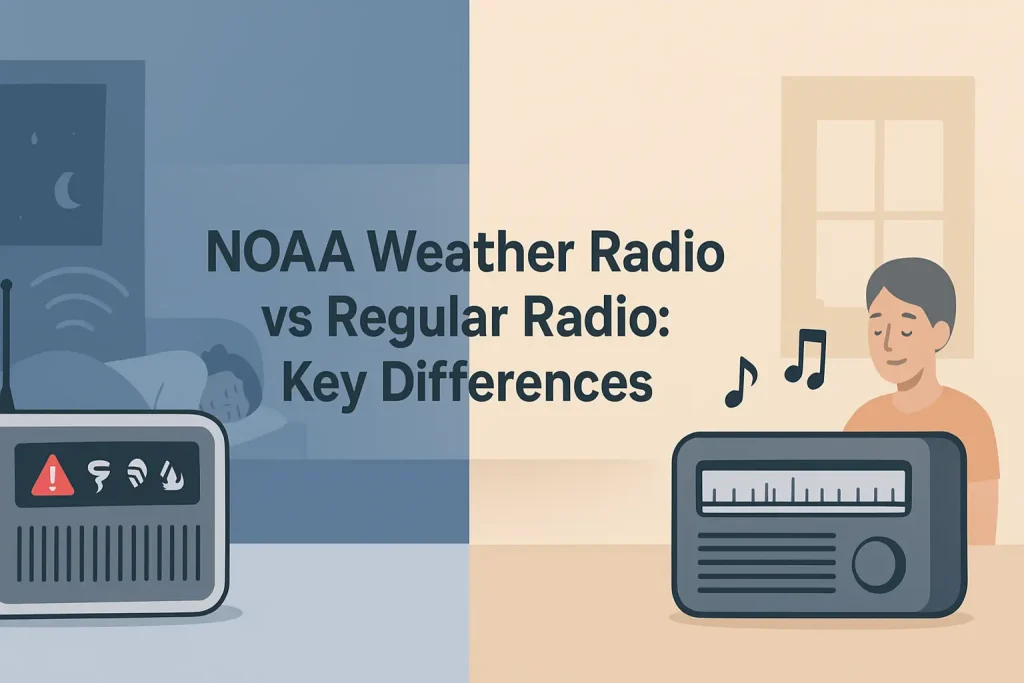
A weather radio sitting dark on your nightstand is not a decoration. It is your early warning system, and at 3 a.m., when a tornado warning fires for your county, you need to read that display without fumbling for a flashlight or squinting at tiny buttons.
The backlit display on a weather radio matters more at night than any other time you will use the device. Here is exactly what you need to know before you buy.
| Photo | Popular Portable Walkie Talkies | Price |
|---|---|---|
 | SKIWARRIOR Multifunctional Smart Wireless Ski Goggles with Walkie-Talkie, Anti-Fog Zeiss Lens, Music & Call Function (Cylindrical Blue) | Check Price On Amazon |
 | SINORISE Super Mini Walkie Talkies, Two-Way Radios, 3 Pack | Check Price On Amazon |
 | KOSPET Tank M4C Rugged Smart Watch with GPS, Built-in LED Flashlight, 5ATM Waterproof, 1.96" AMOLED, 170+ Sport Modes, Long Battery Life, Walkie-Talkie & Bluetooth Calls, Heart Rate/Sleep Monitor | Check Price On Amazon |
 | Retevis RT15 Walkie Talkies 3 Pack, Birthday Gift, Outdoor Adventure Kit | Check Price On Amazon |
 | Rechargeable Walkie Talkies Toys for Kids: DIY Astronaut Walkie Talkies for Boys Christmas Birthday Gifts for 3 4 5 6 7 8 9 10 Boy Walkie Talkie Outdoor Hiking Toy 2 Way Radio Camping Outdoor Game | Check Price On Amazon |
What Does a Backlit Display Actually Do on a Weather Radio?
A backlit display illuminates the LCD screen from behind so you can read alert type, channel, signal strength, and S.A.M.E. (Specific Area Message Encoding) location codes in complete darkness without any external light source.
Most weather radios use one of two backlight technologies: electroluminescent (EL) panels or LED backlights. LED backlights, found on mid-range and premium models like the Midland WR400, are brighter, consume less power, and maintain consistent brightness across the life of the battery.
EL panels, common on budget radios under $30, dim noticeably after 3,000 to 5,000 hours of use and often appear greenish rather than white or blue.
According to NOAA’s National Weather Radio All Hazards technical documentation, a single NWR broadcast station covers a radius of approximately 40 miles, serving listeners 24 hours a day on seven frequencies between 162.400 and 162.550 MHz. That continuous broadcast means your radio may display new alert data at any hour, making nighttime readability a genuine operational requirement, not a convenience feature.
The practical difference between a backlit and non-backlit display shows up most clearly in three specific scenarios: during a power outage when your radio is running on battery backup, during overnight alerts when your eyes are unadjusted to light, and when you need to confirm a S.A.M.E. code or alert category in under five seconds.
The bottom line is straightforward: a backlit display is not cosmetic. It is the difference between reading your radio and guessing at it when an alert sounds in the middle of the night.
Which Weather Radio Display Types Are Available and How Do They Compare at Night?
Weather radio displays fall into four categories: non-backlit LCD, EL-backlit LCD, LED-backlit LCD, and segmented LED digit displays. Each performs differently in low-light conditions, and the gap between the best and worst is larger than most buyers expect.
Non-backlit LCD panels, found on the most basic models below $20, are completely unreadable in the dark. The Midland WR120B, a widely sold budget weather radio, uses a non-backlit display. If an alert fires at night, you can hear the alarm but cannot read the channel, alert type, or S.A.M.E. location without turning on a room light.
You can learn more about the specific display and alert features of that model in this detailed look at what the Midland WR120B offers for basic weather alerting.
EL-backlit LCD displays are readable in the dark but carry two limitations. First, they require you to press a button to activate the backlight on most models, which means a sleeping person must wake fully, locate the button, and press it before the display is readable. Second, EL brightness degrades over time.
LED-backlit LCD displays, standard on models in the $40 to $80 range such as the Uniden BC365CRS and Sangean CL-100, offer the best combination of brightness, battery efficiency, and long-term consistency.
Segmented LED digit displays (separate from LCD panels) appear on a small number of weather radios and clock-style alert radios. These are highly readable because the digits themselves emit light, but they typically show only time and alert status, not full text like alert type or S.A.M.E. code.
Use the table below to compare display types across the factors that matter most for nighttime readability.
| Display Type | Readable in Dark? | Always On? | Brightness Degrades? | Shows Full Alert Text? | Typical Price Range |
|---|---|---|---|---|---|
| Non-backlit LCD | No | N/A | No | Yes | Under $25 |
| EL-backlit LCD | Button press | Some models | Yes, over time | Yes | $25 to $45 |
| LED-backlit LCD | Yes | Most models | Minimal | Yes | $40 to $80 |
| Segmented LED digits | Yes | Always | No | Limited | $35 to $60 |
| Color LCD (premium) | Yes | Yes | Minimal | Yes, with color coding | $80 and above |
| No display (audio only) | N/A | N/A | N/A | No | Under $20 |
Display technology and price ranges based on manufacturer product listings. Prices verified at time of publication.
For most households using a weather radio as a bedroom alert device, the LED-backlit LCD is the correct choice. It offers permanent readability without requiring a button press after an alarm wakes you from sleep.
Does the Backlight Stay On Automatically During an Alert, or Do You Have to Press a Button?
This is the most important display question most buyers never think to ask. A backlit display that requires a manual button press to activate is nearly useless for a sleeping person in a dark room when a tornado warning sounds.
Premium weather radios with alert-triggered backlight activation illuminate the display automatically when an alert is received. The Midland WR400, for example, activates its LED backlight the moment a S.A.M.E. alert signal is detected on any of the seven NOAA weather broadcast frequencies (162.400 to 162.550 MHz).
Budget models with manual-only backlights require you to press a dedicated “Light” or “Display” button to see the screen. In a disoriented, just-woken state during a severe weather event, locating that button adds a frustrating and unnecessary delay.
Some models offer a compromise: a timed backlight that stays on for 15 to 30 seconds after any button press or alert activation, then dims to conserve battery. This approach works reasonably well but means the display goes dark again if you are still reading it when the timer expires.
According to NOAA’s NWR receiver guidelines, a compliant S.A.M.E. weather radio must activate its alert alarm and audio output automatically. Display backlight behavior, however, is not mandated by the NWR Public Alerting Standard, which means manufacturers handle it differently across models.
When evaluating any weather radio for bedroom use, check the product specification sheet specifically for the phrase “alert-activated backlight” or “automatic display illumination on alarm.” If neither phrase appears, assume the backlight is manual only.
Automatic alert-triggered backlights are the standard to demand for nighttime use. Any other behavior is a design compromise that reduces your ability to act quickly during an emergency.
How Much Does a Backlit Display Affect Battery Life on a Weather Radio?
A continuously active LED backlight on a weather radio draws between 15 and 40 milliamps of additional current, depending on the display size and backlight intensity. On a radio running from 3 AA alkaline batteries (approximately 2,500 mAh total capacity), continuous backlight use reduces standby runtime by 20 to 35 percent.
This matters most for two scenarios: radios used as portable units during evacuations and radios used as primary alert devices in areas with frequent power outages where the radio runs on battery for extended periods.
Most LED-backlit weather radios address this with two design choices. First, they dim the backlight to a lower brightness level for continuous standby display rather than running it at full alert brightness. Second, they use the AC power adapter as the primary power source and switch to battery backup only during outages, so battery draw from the backlight is limited to actual outage duration.
The Midland WR300 and similar mid-range models implement this dual-power approach with a battery backup drawer that accepts 3 to 6 AA batteries. The backlight runs at reduced brightness on battery power and full brightness on AC power.
For a weather radio used primarily on AC power with battery backup reserved for emergencies, the battery life impact of a backlit display is minimal during normal operation. The radio runs on AC power 99 percent of the time, and battery capacity is preserved for the moments that actually matter.
If you plan to use a weather radio as a portable or hand-crank unit during extended outdoor use or multi-day emergency situations, look for a model with adjustable backlight brightness levels and a dedicated backlight timeout setting. The Eton FRX3+ hand-crank weather radio offers a 30-second backlight timeout that balances readability with power conservation during battery-only operation.
Managing backlight settings intentionally extends your battery reserve without sacrificing nighttime readability when an alert activates the display automatically.
What Information Can You Actually Read on a Backlit Weather Radio Display at Night?
A backlit weather radio display at night should show you, at minimum: the active NOAA channel (WX1 through WX7), the alert type (Tornado Warning, Severe Thunderstorm Watch, Flash Flood Warning, and so on), and the S.A.M.E. FIPS code identifying which county or area the alert covers.
Whether your specific radio shows all three depends entirely on the display resolution, not just whether it has a backlight. A backlit display with only enough room for time and channel number is not meaningfully better than a non-backlit display for emergency decision-making.
Entry-level displays show two lines of text: typically a channel indicator and a basic alarm icon or alert abbreviation. Mid-range displays, found on radios like the Uniden homepatrol weather radio series, show three to four lines including alert type, event duration, and the originating transmitter location.
Premium displays on radios above $70 show full scrolling text of the NWR broadcast message, programmed S.A.M.E. county name, signal strength indicator, and backup battery status. Scrolling text on a bright backlit display is the most useful format because it mirrors the full audio content of the NOAA broadcast visually.
Understanding what S.A.M.E. technology does and how to read the codes on your display is critical to making sense of what you see during a nighttime alert. Our guide on how S.A.M.E. coding works and why it filters alerts to your specific county explains the FIPS code structure in plain language.
The backlight makes the display visible. The display resolution and text capacity determine whether what you see is actually actionable. Both factors together determine how useful your weather radio is at 3 a.m.
Does a Backlit Display Matter More for Bedroom Radios Than for Kitchen or Living Room Models?
Yes. The ambient light level in a room at the time an alert fires determines how much the backlight matters. A kitchen weather radio near a window in daytime needs no backlight at all. The same radio on your bedroom nightstand at 2 a.m. during a power outage is unreadable without one.
Room placement determines how you should weight the backlight specification when buying. For bedroom nightstand use, an automatic alert-triggered LED backlight is a non-negotiable feature. For kitchen counter use in a normally lit room, it is a minor convenience.
The secondary consideration for bedroom placement is backlight brightness during standby. A weather radio with a bright continuous backlight on your nightstand can disrupt sleep if it shines toward your face all night. Look for models with adjustable brightness levels: a dim standby setting of 1 to 2 cd/m² and a bright alert setting of 80 to 120 cd/m².
Weather radios designed specifically as clock-alarm hybrids solve this problem by default. These models use a dim clock display at all times and activate full brightness only during alerts. Our overview of weather radios that double as alarm clocks with display dimming features covers several models purpose-built for this use case.
For a living room or office placement where the radio is on and visible during waking hours, the backlight matters less for nighttime emergencies but more for casual daytime readability in rooms without strong natural light.
Match the display type and brightness behavior to the specific room and time of day when you expect to use the radio most. Bedroom use demands the highest display standard.
Which Specific Weather Radio Models Have the Best Backlit Displays for Nighttime Use?
The best backlit displays for nighttime use combine automatic alert-activated illumination, adjustable brightness, a large enough display to show full alert text, and a long-term stable LED light source. These four characteristics narrow the field considerably.
The Midland WR400 delivers all four. Its LED-backlit display activates automatically on any incoming S.A.M.E. alert, shows full alert type and county name, and includes a manual brightness control with three levels.
Key Specifications:
- NOAA channels: 7 (162.400 to 162.550 MHz)
- S.A.M.E. programmable codes: 50
- Display: LED-backlit, alert-activated automatic illumination
- Power: AC adapter with 6x AA battery backup
- Alert types supported: 60+
The Uniden BC365CRS adds a clock display with a dim continuous backlight in standby and full brightness on alert activation, making it one of the better bedroom-specific designs available below $50.
Key Specifications:
- NOAA channels: 7
- S.A.M.E. programmable codes: 25
- Display: LED-backlit clock and alert display
- Power: AC adapter with battery backup slot
- Alert types: 23 NOAA event codes
The Sangean CL-100 is frequently cited for its large, high-contrast LCD panel with a strong LED backlight. It shows scrolling alert text and includes S.A.M.E. programming for up to 25 county codes.
Key Specifications:
- NOAA channels: 7
- S.A.M.E. programmable codes: 25
- Display: Large LED-backlit LCD with scrolling text
- Power: AC adapter with 4x AA battery backup
- Additional feature: AM/FM tuner with weather alert override
The Eton FRX3+ is the best option for portable and emergency kit use where wall power is unavailable. Its backlight functions on hand-crank, solar, and AA battery power, and its alert-activated illumination works regardless of the current power source.
Key Specifications:
- NOAA channels: 7
- Power sources: Hand crank, solar panel, 3x AA batteries, micro-USB
- Display: LED-backlit with 30-second timeout on battery power
- Additional feature: 2,000 mAh USB phone charging output
- Alert activation: Automatic on S.A.M.E. alert receipt
For a full comparison of these and other top-rated models with display specifications included, the comprehensive ranking of top weather radios across all price tiers covers display type, S.A.M.E. capacity, and battery backup for each model.
The right model depends on your placement and power situation, but every option above improves meaningfully on a non-backlit alternative for overnight use.
Here is a quick visual breakdown of how these models compare on the display features that matter most at night.
Quick Reference
Backlit Weather Radio Display Features Compared by Model
Key nighttime display specs across popular models. Source: manufacturer product documentation, verified at time of publication.
| Model | Backlight Type | Auto on Alert? | Adjustable Brightness? | Shows Full Alert Text? | Price Range |
|---|---|---|---|---|---|
| Midland WR400 | LED | Yes | Yes (3 levels) | Yes | $55 to $75 |
| Uniden BC365CRS | LED | Yes | Dim standby only | Yes | $35 to $50 |
| Sangean CL-100 | LED | Yes | Limited | Yes, scrolling | $50 to $65 |
| Eton FRX3+ | LED | Yes | Timeout only | Basic | $50 to $65 |
| Midland WR120B | None | No | No | Yes (unlit) | $25 to $35 |
| Sangean WR-12SE | EL | Button press | No | Yes | $30 to $45 |
Specifications sourced from manufacturer product documentation. Prices verified at time of publication. Models subject to product revision.
What Happens When a Non-Backlit Weather Radio Fires an Alert at Night?
When a non-backlit weather radio triggers an alert at night, you hear the alarm tone and the NOAA broadcast audio begins. You cannot read the display to confirm which alert type was issued, which county is affected, or whether the event applies to your location, without turning on a light.
This creates a practical problem in two ways. First, you lose the five to fifteen seconds it takes to find and activate a light source, which matters most for immediate-threat alerts like a tornado warning or flash flood warning. Second, if the radio is in a room you entered to check it, your eyes may not have adjusted to see the small text even with a room light on.
The audio broadcast will tell you the alert type eventually, but a trained NOAA Weather Radio broadcast runs for two to four minutes and buries the critical information (event type, counties affected, expiration time) within a structured message that takes time to reach the specific data you need.
A backlit display showing “TORNADO WARNING – [Your County]” visible in under two seconds communicates the same information faster than two minutes of audio.
The Eton FRX3+ handles this scenario differently from most radios. Even when running on hand-crank power during an extended outage, its automatic backlight activation means the display is immediately readable the moment an alert fires, without any button press or room light. You can review the full feature set in this hands-on look at the Eton FRX3 Plus for emergency preparedness use.
The non-backlit weather radio is a legitimate choice for a kitchen counter, garage, or workshop where lights are typically on during use. For a bedroom nightstand, it is the wrong tool for the job.
Is a Backlit Display More Important Than Other Weather Radio Features?
No. A backlit display is one of several features that collectively determine whether a weather radio actually protects you in an emergency. S.A.M.E. technology, alert tone volume, battery backup, and reliable NOAA signal reception all matter more than display visibility in terms of whether you receive an alert at all.
A weather radio with no S.A.M.E. capability but a bright backlit display will wake you for every alert in your entire state region, not just your county. A radio with a perfectly backlit display but no battery backup will go silent the moment a storm cuts your power. Signal reception matters too: a weak signal on your local NOAA transmitter frequency can cause missed alerts regardless of display quality.
S.A.M.E. technology is the most important feature for reducing false alarms and keeping alerts relevant to your location. If you are not yet familiar with how S.A.M.E. county code programming works, the guide on what S.A.M.E. weather radio technology does and how to program it is the right starting point before evaluating any display features.
Think of display quality as the final layer of a functioning emergency alert system. The radio must receive the signal, decode the S.A.M.E. code correctly, match it to your programmed county, activate the alarm, and stay powered. The backlit display then helps you read the result of all those prior steps instantly in the dark.
Prioritize S.A.M.E. capability and battery backup first. Among radios that have both, choose the one with the best backlit display for your placement.
How to Set Up a Weather Radio for Maximum Nighttime Readability
Configuring a weather radio correctly for nighttime use takes less than ten minutes and significantly improves how useful the radio is when an alert fires at 2 a.m. The setup involves four steps: physical placement, backlight setting, S.A.M.E. code programming, and volume calibration.
- Position the radio at eye level from your bed. Place it on a nightstand or shelf where you can see the display without lifting your head. The display should face toward you directly, not at an angle. Most weather radio LCDs have a viewing angle of 120 to 140 degrees, which means even a slight angle toward the ceiling can reduce contrast significantly.
- Set backlight brightness to its lowest functional level for standby. If your radio offers brightness settings, select the dimmest level that still shows the time and channel clearly from your pillow. This preserves your night vision and avoids disrupting sleep between alerts.
- Program your S.A.M.E. FIPS code for your county. Your 6-digit FIPS code is available from the NOAA Weather Radio website at weather.gov/nwr. Enter it through the radio’s keypad following the manual’s programming sequence. For most mid-range radios, this takes three to five button presses and stores up to 25 county codes.
- Set alert volume to at least 80 percent. The display is only useful if the alarm wakes you. A quiet alert that does not wake you before the tornado is within range is worse than no weather radio at all.
- Test the backlight activation with a manual test alert. Many radios include a test mode that simulates an incoming alert. Trigger it in a darkened room and confirm the display illuminates automatically, shows readable text, and stays lit for at least 15 seconds.
For detailed step-by-step guidance on the full setup process for NOAA weather radios, including S.A.M.E. programming for different models, the guide on how to set up and use a weather radio from first power-on through alert testing covers every step with model-specific instructions.
A correctly configured backlit weather radio on your nightstand is fully operational in under a second when an alert fires, with no fumbling, no light-switching, and no wasted time.
Does Backlight Color Affect Nighttime Readability?
Yes. Backlight color affects both readability and how much your eyes adjust after waking. The three most common backlight colors on weather radios are white, blue, and amber. Each has different performance characteristics in a dark room.
White LED backlights provide the highest contrast against black LCD segments and are easiest to read at all font sizes. They are the standard choice on most mid-range and premium weather radios and perform best for rapid reading of multi-line alert displays.
Blue LED backlights are common on budget models and clock-radio hybrids. Blue light at night suppresses melatonin production more than other wavelengths, which matters for a radio on your nightstand that glows continuously. If sleep quality is a concern, avoid a bright blue continuous backlight.
Amber and orange backlights are rare on weather radios but preferred by some users for nighttime use. Amber wavelengths cause less melatonin suppression and are easier on dark-adapted eyes. Amber is common on marine VHF radios and some handheld aviation transceivers for this reason, but weather radio manufacturers have not widely adopted it.
For a nightstand radio that glows at low brightness continuously, white at its dimmest setting outperforms blue in terms of sleep impact. For a radio that only illuminates during alerts (full brightness, brief duration), color matters less than brightness level and contrast ratio.
The practical recommendation is to choose a white LED-backlit radio with adjustable brightness over a blue-backlit model at the same price, all other features being equal.
Are There Weather Radios with No Display at All and Should You Consider Them?
Yes. Several entry-level weather radios have no display panel at all. These are audio-only devices that receive NOAA broadcasts, decode S.A.M.E. codes, activate an alarm for matching alerts, and broadcast the audio message through a speaker. They provide no visual information at any time.
Audio-only weather radios cost between $15 and $25 and are appropriate in one specific scenario: when the radio is placed in a location where someone is always awake and present during daytime use, and the household uses a separate bedroom-placed backlit radio for nighttime coverage.
They are not appropriate as standalone devices for households that rely on a single radio for all alert coverage, including overnight. Without a display, you cannot confirm which alert type fired, which county is affected, or when the event expires without listening to the full two-to-four-minute NOAA broadcast.
For a household budget that allows only one weather radio, spending the additional $20 to $30 to step up from an audio-only model to an LED-backlit S.A.M.E. radio is worthwhile. The display becomes essential the first time an alert fires at night and you need to decide immediately whether to shelter in place or wake the household.
A single well-chosen backlit S.A.M.E. weather radio in the bedroom outperforms two audio-only radios placed throughout the house for emergency decision-making speed.
Weather Radio Buying Checklist: Display Features to Verify Before You Buy
Use this list to evaluate any weather radio’s display specification before purchase. These are the display-specific questions to answer, separate from S.A.M.E. capability, battery backup, and signal reception, which should also be evaluated as part of a complete buying decision.
- Backlight type: Is it LED (preferred) or EL (acceptable) or none (avoid for nighttime use)?
- Activation method: Does the backlight activate automatically when an alert is received, or does it require a manual button press?
- Brightness levels: Does the radio offer at least two brightness settings (dim standby and bright alert)?
- Display size: Is the display large enough to show at least two lines of text simultaneously (alert type and location)?
- Scrolling text: Does the display scroll the full NOAA alert message text, or show only a code or abbreviation?
- Backlight color: White (best for readability) or blue (acceptable but avoid continuous bright exposure at night)?
- Viewing angle: Can you read the display from your pillow position without repositioning the radio?
- Battery power behavior: Does the backlight function normally on battery backup power, or does it dim or deactivate to conserve battery?
For a complete buying framework covering all weather radio features including S.A.M.E. capacity, power options, signal performance, and price tiers, the full weather radio buying guide covering every key specification by use case provides the complete evaluation framework.
Confirm every item on this display checklist before purchase, and the display will never be the reason your radio fails you in a nighttime emergency.
Frequently Asked Questions About Backlit Weather Radio Displays
Does the Midland WR120B have a backlit display?
The Midland WR120B does not have a backlit display. Its LCD panel is readable in ambient light but completely unreadable in a dark room without an external light source. For nighttime bedside use, the WR120B requires a step-up to a model with LED backlighting, such as the Midland WR400 or WR300.
The WR120B is a capable budget weather radio for daytime use or placement in consistently lit rooms. Its lack of a backlight is its primary limitation for bedroom nightstand deployment, where the radio is most needed during overnight alerts.
Can I add a backlight to a weather radio that does not have one?
No. A backlit display requires an integrated light source built into the display panel during manufacturing. There is no aftermarket modification or accessory that adds backlighting to a weather radio LCD that did not ship with one. The display hardware is fixed at the time of manufacture.
If your current weather radio lacks a backlight and nighttime readability is important to you, the only solution is to replace it with a model that includes an LED backlit display. Mid-range backlit models start around $40 to $50 and represent a meaningful upgrade for overnight alert use.
Is the Eton FRX3 Plus backlit display visible during a power outage on hand-crank power?
Yes. The Eton FRX3+ backlit display functions on all four of its power sources: hand crank, solar panel, AA batteries, and micro-USB. The backlight activates automatically on alert receipt regardless of which power source is active. On battery and crank power, the backlight uses a 30-second timeout to conserve energy rather than staying on continuously.
This makes the FRX3+ the strongest option for emergency kit use where grid power is unavailable. Its backlight performance during extended outages is consistent with its AC-powered performance, which is not true of all multi-power weather radios.
What is the difference between a weather radio display that scrolls text and one that does not?
A scrolling display moves the full NOAA alert text horizontally across the screen, allowing it to show more information than the physical display width would otherwise allow. A non-scrolling display shows only a fixed number of characters simultaneously, which for most small weather radio displays means an abbreviation or code rather than the full alert description.
Scrolling displays are more informative because they can show the complete event name (“Tornado Warning” rather than “TOR WRN”), the affected area name, and the expiration time in sequence. Non-scrolling displays require you to listen to the full audio broadcast to get the same information.
Does the backlight stay on the entire time a weather alert is playing, or does it turn off after a few seconds?
This varies by model. On the Midland WR400 and similar premium models, the backlight stays active throughout the entire alert cycle, turning off only after the alert audio ends and the radio returns to standby mode. On budget LED-backlit models, the backlight may use a fixed timeout (typically 15 to 60 seconds) that shuts it off even while the alert audio continues playing.
Check the product manual for the specific “backlight duration on alert” behavior before purchasing. For a radio used in a bedroom, continuous illumination throughout the alert period is the preferred behavior.
Why does my weather radio display show garbled text during an alert at night?
Garbled display text during a NOAA alert is almost always a weak signal problem, not a display hardware failure. NOAA Weather Radio broadcasts on seven frequencies between 162.400 and 162.550 MHz. If your radio is receiving the signal at the edge of coverage (typically beyond 40 miles from the nearest NWR transmitter), the S.A.M.E. data stream may decode with errors, producing garbled or incomplete alert text on the display.
The fix is to improve signal reception, not to replace the display. Move the radio to a window-facing location, extend its antenna to full length, or switch to a different NOAA channel (WX1 through WX7) to find a stronger local transmitter. Using an external antenna input if your radio supports one can also resolve edge-of-coverage reception issues.
Is a weather radio with an LED display safer for use in a bedroom than one with a bright blue backlight?
A weather radio with a dimmable white LED display is a better choice for a bedroom than one with a fixed bright blue backlight. Blue wavelength light (approximately 450 to 490 nm) is more effective at suppressing melatonin production than white or amber light at the same intensity, which can affect sleep quality if the radio glows on your nightstand throughout the night.
The practical solution is a radio with adjustable brightness set to its dimmest level during standby. Most mid-range LED-backlit weather radios offer at least two brightness levels. At the dimmest setting, the light output is low enough that sleep disruption is minimal regardless of backlight color.
Can I use a weather radio with a non-backlit display if I keep a flashlight next to it at night?
Technically yes, but this approach introduces two failure points. First, a flashlight only helps if you can locate it quickly in the dark and while fully disoriented from sleep. Second, during a power outage (the most common scenario where a weather radio alert matters most), locating a flashlight in a dark room while an alarm is sounding adds critical seconds to your response time.
A weather radio with an automatic LED backlight eliminates both failure points. The display illuminates the moment the alarm fires. No secondary device is needed, and the alert information is immediately visible without any other action required.
Do weather radios display the name of the alert type (like “Tornado Warning”) or just a code?
This depends on the model. Premium weather radios with large LED-backlit displays show the full event name in plain English (“Tornado Warning,” “Severe Thunderstorm Watch,” “Flash Flood Warning”). Budget models with smaller displays show two to four character abbreviations (“TWR” for tornado warning, “SVR” for severe thunderstorm warning) due to limited screen space.
NOAA’s S.A.M.E. encoding system transmits a standardized three-character event code as part of the alert header. The radio’s firmware translates this code into either the full name or the abbreviation depending on display capacity. When comparing models, confirm whether the display shows full event names or only codes.
Is it legal to use a weather radio display as a nightlight in a bedroom?
Yes. Using a weather radio’s continuous standby backlight as ambient nighttime illumination is a personal choice with no FCC or NOAA restrictions. Weather radios are passive receive-only devices with no transmit function, so there are no regulatory constraints on how or where you use them.
The only consideration is battery drain. Running a continuous backlit display from battery backup (rather than AC power) will reduce standby battery life by 20 to 35 percent. If your radio is AC-powered with battery backup reserved for outages, the continuous backlight draws no battery capacity during normal operation.
What is the brightest weather radio display available for a large bedroom or visually impaired user?
The Midland WR400 and Uniden BC365CRS both offer high-brightness LED backlit displays in the midrange price category. For users requiring maximum display visibility, weather radios with dedicated 7-segment LED clock displays (separate from the LCD alert panel) provide the brightest continuous readout because the digits themselves emit light at full intensity.
Some users with visual impairments find that weather radios with voice readout features (which speak the alert type and location aloud when an alert fires) are more effective than relying on any display, regardless of backlight quality. The Midland WR400 includes a voice alert readout in addition to its backlit display, making it one of the more accessible options in its price range.
How do I know if my weather radio’s backlight will activate automatically or needs a button press?
Check the product manual under the display or backlight section. The specific phrase to look for is “alert-activated backlight,” “automatic display illumination,” or “backlight activates on alert.” If those phrases do not appear, assume the backlight is manual only.
You can also test this before purchase by checking a manufacturer video demonstration or reading verified owner reviews that specifically describe nighttime use. Amazon verified purchase reviews frequently describe whether the backlight activates automatically or requires a button press, because this behavior becomes immediately apparent during the first overnight use.
Does the backlit display consume more power than the radio’s other components during an alert?
No. The LED backlight draws 15 to 40 milliamps during active illumination, which is a small fraction of total current consumption during an alert. The radio’s audio amplifier, speaker, and S.A.M.E. decoder collectively draw 100 to 400 milliamps during active audio playback. The backlight is a minor power draw by comparison.
Battery life on alert-active mode is primarily determined by speaker volume and audio amplifier current draw, not display backlight. Setting speaker volume to a moderate level (rather than maximum) has a larger effect on battery life during extended alert cycles than any backlight setting adjustment.
The Bottom Line on Backlit Displays and Weather Radios at Night
A backlit display matters significantly on a weather radio used at night, specifically when the backlight activates automatically on alert receipt, shows the full alert type and county name, and stays illuminated throughout the alert cycle.
For bedroom nightstand use, an LED-backlit weather radio with automatic alert activation, S.A.M.E. county code programming, and battery backup is the correct configuration. The Midland WR400, Uniden BC365CRS, and Sangean CL-100 all meet this standard in the $40 to $75 price range.
Your next step is to confirm your current weather radio’s backlight type and activation behavior. If it lacks a backlight or requires a manual button press in the dark, replacing it with a model that meets the standards described here is a straightforward upgrade that directly improves your household’s emergency response capability.
| Photo | TOP RATED WALKIE TALKIES | Price |
|---|---|---|
 | Retevis RT628 Kids Walkie Talkies, Toys Gifts for 4-12 Year Old Girl Boy | Check Price On Amazon |
 | Cobra ACXT545 Weather-Resistant Walkie Talkies, Rechargeable, 22 Channels | Check Price On Amazon |
 | Retevis RT388 Kids Walkie Talkies, Outdoor Toys for Kids Camping Essentials | Check Price On Amazon |
 | Cobra RX680 Walkie Talkies (2-Pack), IP54 Water Resistant Design | Check Price On Amazon |
 | Retevis RT22 Walkie Talkies Long Range Rechargeable with Earpiece (2 Pack) | Check Price On Amazon |
 | Midland GXT1000VP4 GMRS Two-Way Radio | Check Price On Amazon |
 | Retevis RT628 Walkie Talkies for Kids,Toys Gifts for 6-12 Years Old Boys Girls,Long Range 2 Way Radio 22CH VOX,Birthday Gift,Family Walkie Talkie for Camping Hiking Indoor Outdoor | Check Price On Amazon |