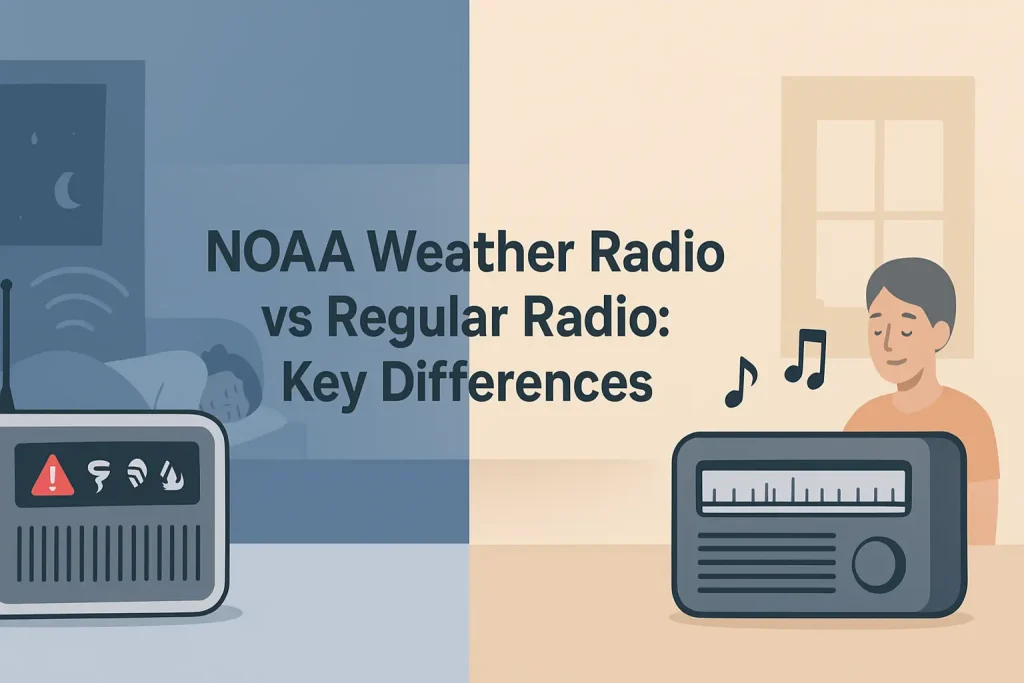
A weather radio set to tone-only alert mode will wake you with a loud alarm but tell you nothing about what is happening outside. A radio set to voice alert plays the full NOAA broadcast, giving you the hazard type, affected counties, and recommended action within seconds. The mode you choose determines whether you reach for your phone to find out what is wrong or already know exactly what to do.
What Is Tone-Only Alert Mode on a Weather Radio?
Tone-only alert mode activates your weather radio’s alarm signal without playing the spoken NOAA broadcast. The radio sounds an alert tone, then goes silent, leaving you to manually tune in for details.
| Photo | Popular Portable Walkie Talkies | Price |
|---|---|---|
 | SKIWARRIOR Multifunctional Smart Wireless Ski Goggles with Walkie-Talkie, Anti-Fog Zeiss Lens, Music & Call Function (Cylindrical Blue) | Check Price On Amazon |
 | SINORISE Super Mini Walkie Talkies, Two-Way Radios, 3 Pack | Check Price On Amazon |
 | KOSPET Tank M4C Smart Watch Rugged, Dual-Band GPS, 5ATM & IP69K Waterproof | Check Price On Amazon |
 | Retevis RT15 Walkie Talkies 3 Pack, Birthday Gift, Outdoor Adventure Kit | Check Price On Amazon |
 | Rechargeable Walkie Talkies Toys for Kids: DIY Astronaut Walkie Talkies for Boys Christmas Birthday Gifts for 3 4 5 6 7 8 9 10 Boy Walkie Talkie Outdoor Hiking Toy 2 Way Radio Camping Outdoor Game | Check Price On Amazon |
According to NOAA’s National Weather Service technical documentation, the EAS (Emergency Alert System) alert sequence begins with an 8-second attention tone, followed by the spoken broadcast. In tone-only mode, the radio stops after the attention signal and does not pass through the voice portion.
This mode was designed for environments where any spoken audio would be disruptive. Hospital waiting rooms, quiet offices, and sleeping areas with multiple occupants are the primary use cases. The radio signals that something requires attention without broadcasting the full message.
The practical limitation is significant. You hear a loud alarm, but you have no information about whether the alert is a Tornado Warning, a Flash Flood Watch, or a Civil Emergency Message. Every alert sounds identical regardless of severity.
Most NOAA weather alert radios with tone-only mode pair this feature with a visual display that shows the alert type on screen. The assumption is that you will look at the display when the alarm sounds. That assumption fails completely in a nighttime emergency when the radio is across the room in the dark.
Tone-only mode is the right choice only when a spoken broadcast is genuinely prohibited and you can guarantee visual access to the display within seconds of the alert sounding.
What Is Voice Alert Mode on a Weather Radio?
Voice alert mode plays the complete NOAA Weather Radio All Hazards spoken broadcast immediately after the attention tone. You hear the alert type, the affected geographic area, the expected timing, and the recommended protective action, all within the first 30 to 60 seconds of the alert activating.
NOAA Weather Radio All Hazards broadcasts on seven dedicated VHF frequencies between 162.400 MHz and 162.550 MHz, covering approximately 95% of the United States population within reception range of a transmitter, according to NOAA NWR technical documentation. The spoken message is generated by a text-to-speech system and updated continuously as the situation evolves.
Voice alert is the default operating mode recommended by FEMA’s emergency preparedness guidelines for home and family use. The reason is direct: during a nighttime severe weather event, a household member awakened from sleep needs immediate spoken context to make a life-safety decision in seconds, not minutes.
The spoken broadcast includes the National Weather Service office issuing the alert, the specific counties or independent cities affected, the event type, the start and end time, and the recommended action such as “take shelter in an interior room on the lowest floor.” No display reading is required.
A Midland WR400 weather radio in voice alert mode will wake a sleeping household and deliver a complete Tornado Warning message within 45 seconds of the NWS issuing the alert, assuming the radio is programmed with the correct S.A.M.E. codes for your county.
Key Specifications for voice alert reception:
- Broadcast frequencies: 162.400, 162.425, 162.450, 162.475, 162.500, 162.525, 162.550 MHz
- Alert types supported: 25 categories including Tornado Warning, Flash Flood Warning, Hurricane Warning, AMBER Alert, and Civil Emergency Message
- Message duration: typically 2 to 4 minutes per broadcast cycle, repeating on a loop until the alert expires
- Transmitter power: 1,000 watts at most NOAA NWR transmitter sites, 300 watts at some secondary sites
Voice alert mode gives you the information necessary to act. Tone-only mode gives you a signal that information exists somewhere else.
Tone-Only vs Voice Alert: How Do the Two Modes Actually Differ?
The core difference between tone-only and voice alert is not volume or sensitivity. Both modes receive the same NOAA broadcast signal and trigger on the same S.A.M.E. alert codes. The difference is what the radio does with the audio after the attention tone ends.
In tone-only mode, the radio’s audio output circuit mutes after the 8-second EAS attention signal. In voice alert mode, the circuit stays open and passes the spoken broadcast through the speaker at full volume until the message ends or you manually silence it.
This happens because of how EAS-compatible weather radio firmware handles the alert sequence. The radio’s S.A.M.E. decoder chip reads the digital header burst that precedes the attention tone. That header identifies the alert type, the affected FIPS location codes, and the valid time period. In tone-only mode, the firmware triggers the alarm and stops audio output after the header is decoded. In voice alert mode, the firmware keeps the speaker active to pass through everything that follows.
This only matters when the alert severity and your location require an immediate decision. A Winter Storm Watch issued for a county 200 miles away at 3:00 AM does not require you to act in the next 60 seconds. A Tornado Warning for your county does. Tone-only mode treats both events identically.
If you program your radio incorrectly and it is in tone-only mode during a severe weather event, the result is an alarm that tells you nothing. You lose the 30 to 60 seconds of spoken information that would have told you to take shelter before you could even locate your phone.
Use the table below to compare the two modes across every dimension that affects real-world emergency response.
| Feature | Tone-Only Mode | Voice Alert Mode |
|---|---|---|
| Alert signal type | Attention tone only (8 sec) | Attention tone + full spoken broadcast |
| Information delivered | Alert exists (visual display only) | Alert type, county, timing, action |
| Response speed | Requires manual tuning or display check | Immediate, no additional action needed |
| Nighttime effectiveness | Low (display unreadable from bed) | High (full information while still in bed) |
| Noise disruption | Minimal (alarm only) | Significant (2 to 4 minutes of spoken audio) |
| Best environment | Quiet professional settings | Homes, vehicles, outdoor use |
| Works without visual display | No | Yes |
| FEMA recommended for home use | No | Yes |
The mode that serves emergency preparedness is voice alert. Tone-only mode serves operational environments where audio disruption creates its own safety or professional problem.
When Should You Use Tone-Only Alert Mode?
Tone-only alert mode is the correct choice in three specific situations: environments where sustained spoken audio creates a safety or professional hazard, locations where a dedicated person can monitor the display immediately after the alarm, and settings where weather radios serve a notification rather than an action-trigger function.
According to FEMA’s Community Emergency Response Team (CERT) radio guidelines, tone-only mode is appropriate for dispatch environments, broadcast control rooms, and medical facilities where any unexpected audio interruption causes operational problems. In these settings, the staff member receiving the tone alert is trained to check the display and escalate the information through their facility’s emergency protocol.
The critical dependency is human presence. Tone-only mode assumes someone will see the alarm, read the display, and take appropriate action within the time the threat requires. In a tornado scenario, that window can be less than 10 minutes from warning issuance to the storm reaching your location.
Tone-only mode also makes sense when you want the radio to serve as a silent monitoring system in a location where you check in periodically. A Uniden BC365CRS weather alert radio placed in a workshop or garage with the display visible from your work area can alert you visually without interrupting audio tools or spoken communication. That works only if you are physically present and regularly glancing at the unit.
Tone-only mode is never the right choice for a bedroom, a sleeping area, a vehicle, or any location where the occupant may be unable to read the display or reach the radio quickly. The 2011 Joplin, Missouri tornado killed 158 people despite advance warning. NOAA’s post-event analysis identified delayed or incomplete alert reception as a contributing factor in many cases. Tone-only mode contributes to that delay by requiring an additional step between alarm and information.
Reserve tone-only mode for professional environments with a trained responder at the radio. Use voice alert mode everywhere else.
When Does Voice Alert Mode Outperform Tone-Only?
Voice alert mode outperforms tone-only in every scenario where a person needs to act immediately without looking at a display. That covers the majority of real-world weather emergency situations: sleeping households, mobile environments, low-visibility conditions, and any setting where the radio may be out of direct line of sight.
The advantage is measurable in seconds. A person awakened by a tone-only alarm must become alert, locate the radio or display, read the alert type and county information, and then decide whether to act. That process takes a minimum of 15 to 30 seconds under ideal conditions. A person awakened by a voice alert begins receiving actionable information (hazard type, location, action required) within 8 seconds of the attention tone, before they are fully awake.
NOAA’s Wireless Emergency Alerts (WEA) system study, published by the National Severe Storms Laboratory, found that households using voice-capable weather radios demonstrated faster evacuation and shelter-in-place compliance than those relying on mobile phone alerts alone. The spoken format reduces cognitive load during high-stress awakening events.
Voice alert mode also handles multi-event situations that tone-only cannot. If NOAA issues a Flash Flood Warning followed within minutes by a Tornado Watch for your county, a tone-only radio sounds the same alarm twice. A voice alert radio broadcasts distinct messages for each event, allowing you to understand that you face two separate hazards with different required responses: move to high ground for flooding, move to an interior room for the tornado threat.
For vehicle use, voice alert is the only functional mode. You cannot safely read a weather radio display while driving. A portable NOAA weather radio with voice alert mounted on your dashboard provides complete alert information through your vehicle’s audio system or its own speaker without requiring you to take your eyes off the road.
Voice alert mode paired with correctly programmed S.A.M.E. (Specific Area Message Encoding) codes is the standard configuration for any weather radio intended for life-safety use in a home, vehicle, or portable emergency kit.
What Is S.A.M.E. Technology and How Does It Interact with Both Alert Modes?
S.A.M.E. (Specific Area Message Encoding) is a digital header system built into NOAA Weather Radio All Hazards broadcasts that allows a weather radio to filter alerts by geographic area and alert type. Without S.A.M.E., your radio activates for every alert broadcast in your entire state. With S.A.M.E. programmed correctly, it activates only for the counties you specify and only for the event types you select.
According to NOAA’s NWR All Hazards Receiver Minimum Requirements (FCC Part 11, Subpart E), all Public Alert-certified weather radios must incorporate a S.A.M.E. decoder. The decoder reads a 3-second digital burst transmitted before every NOAA weather alert. That burst contains the FIPS (Federal Information Processing Standard) geographic code identifying the affected area, the event code identifying the alert type, and the valid time period.
S.A.M.E. interacts with both alert modes in the same way at the detection stage. The radio’s decoder reads the digital header regardless of whether tone-only or voice alert is selected. If the FIPS code matches your programmed location codes, the radio activates. If it does not match, the radio stays silent. The mode selection only affects what happens after the radio activates: tone-only stops at the alarm, voice alert continues to the broadcast.
Programming S.A.M.E. codes requires a 6-digit FIPS county code. You can find your county’s FIPS code through the NOAA NWR SAME code lookup tool at weather.gov/nwr/. Most S.A.M.E.-programmable weather radios accept between 8 and 50 location codes, allowing you to monitor multiple counties if you live near a county line or travel frequently between locations.
A weather radio without S.A.M.E. technology in voice alert mode will activate for every alert across your entire broadcast area. That can mean 20 to 40 false-alarm-style activations per month for alerts in distant counties that do not affect your location. This alert fatigue causes many households to turn their radios off or reduce the alarm volume, defeating the purpose of the device entirely. If you want to learn more about how S.A.M.E. technology works and which alert types it covers, our guide on understanding S.A.M.E. alert codes and county programming covers every FIPS code category and how to select the right event filters for your area.
The correct setup for a home weather radio is voice alert mode combined with S.A.M.E. codes programmed to your county and one or two adjacent counties. This combination maximizes the information you receive while minimizing activations for irrelevant geographic areas.
How to Switch Between Tone-Only and Voice Alert Mode on Common Weather Radio Models
The process for switching between tone-only and voice alert mode varies by manufacturer, but the underlying firmware logic is consistent across all EAS-certified weather radios. You are changing a single alert output setting that controls whether audio continues after the attention tone.
Below are the steps for the most widely used models. Each process takes under 2 minutes. These steps apply to the specific firmware versions current at publication; check your manual if your display shows different menu labels.
How to Switch Alert Modes on the Midland WR120B
The Midland WR120B is one of the most widely owned S.A.M.E. weather radios in North America. It uses a menu-driven interface to toggle between tone-only and voice alert modes.
- Press the MENU button on the front panel. The display shows the programming menu.
- Press the UP or DOWN arrow buttons to scroll to the ALERT setting. The display shows either “TONE” or “VOICE.”
- Press ENTER to select the highlighted option. Press the arrow buttons to toggle between TONE and VOICE.
- Press ENTER again to confirm your selection. The display returns to standby mode showing the active channel.
- Test the setting by pressing the TEST button. In voice alert mode, you will hear a brief spoken test message. In tone-only mode, you will hear the attention tone and then silence.
Key Specifications for the Midland WR120B:
- Frequencies: 162.400 to 162.550 MHz (all 7 NOAA channels)
- S.A.M.E. location codes: up to 25 programmable
- Alert types: 25 EAS event categories
- Power: AC adapter with 3x AA battery backup
- Display: backlit LCD with alert type and county code readout
For a detailed walkthrough of every setting on this model, our complete review and programming guide for the Midland WR120B covers S.A.M.E. code entry, alert type filtering, and alarm volume settings in full.
How to Switch Alert Modes on the Uniden BC365CRS
The Uniden BC365CRS uses a different menu architecture than Midland but arrives at the same setting.
- Press FUNC on the keypad to enter function mode. The display shows a function indicator.
- Press the WX/ALERT button while in function mode. The display shows the alert output options.
- Use the number keys 1 (tone-only) or 2 (voice alert) to select your preferred mode.
- Press FUNC again to exit function mode and confirm the setting. The radio returns to normal standby operation.
- Verify the setting by initiating a manual test broadcast through the NOAA station serving your area.
How to Switch Alert Modes on the Eton FRX3+
The Eton FRX3+ is a hand-crank emergency radio with NOAA weather band reception. Its alert mode configuration is simpler than dedicated S.A.M.E. radios because the FRX3+ uses a physical alarm/voice switch rather than a software menu.
- Locate the ALERT MODE switch on the top or side panel of the unit. It is typically labeled with a bell icon (tone) and a speaker icon (voice).
- Slide or toggle the switch to your preferred position. The position is mechanical, not software-based, so there is no confirmation step.
- Tune to any active NOAA weather channel between 162.400 and 162.550 MHz and monitor for an alert broadcast to verify the setting is working correctly.
For a full breakdown of the FRX3+ hand-crank features, solar charging performance, and how its weather alert system compares to dedicated S.A.M.E. radios, our hands-on evaluation of the Eton FRX3+ emergency radio covers real-world alert sensitivity and battery performance in detail.
Regardless of model, always test your alert mode setting after any change by monitoring a scheduled NOAA weekly test broadcast, which occurs every Wednesday between 11:00 AM and noon local time in most U.S. broadcasting areas.
Does Alert Mode Affect Which Weather Events Trigger Your Radio?
Alert mode does not affect which events trigger your radio. The S.A.M.E. decoder activates your radio based entirely on the FIPS location code and event type code in the digital header, which is decoded before either the tone or the voice broadcast begins. Changing between tone-only and voice alert mode changes the audio output behavior only, not the trigger sensitivity.
This distinction matters because a common troubleshooting mistake is switching to tone-only mode when a radio is triggering too frequently, in the belief that this will reduce alert activations. It will not. If your radio is triggering for counties outside your area, the fix is to reprogram your S.A.M.E. location codes, not to change the alert output mode.
According to NOAA’s NWR receiver technical specifications, the S.A.M.E. decoder operates as a pre-filter on the receive chain. The decoder processes the digital header in real time. If the header codes do not match any of your programmed FIPS codes or your programmed event types, the radio suppresses the alert entirely and neither the tone nor the voice broadcast is heard.
This only fails when your FIPS codes are programmed incorrectly or when NOAA’s transmitter broadcasts an alert with a geographic code error. Both situations produce the same symptom: alerts that should reach you are missed, or alerts for other areas incorrectly trigger your radio. The fix in both cases is S.A.M.E. code verification, not mode switching.
If your radio triggers for a county adjacent to yours during a major event, that is usually intentional. NWS forecast offices sometimes expand the geographic scope of a warning to include neighboring counties when the threat trajectory makes the boundary uncertain. Understanding when and why this happens is part of reading the spoken broadcast correctly, which is one more reason voice alert mode gives you more operational information than tone-only mode does.
Alert mode is purely an output preference, not a sensitivity control.
Which Mode Should You Choose for a Bedroom Weather Radio?
Voice alert mode is the only functionally appropriate choice for a bedroom weather radio. The purpose of a bedroom weather radio is to wake sleeping occupants with enough information to make an immediate life-safety decision. Tone-only mode fails this requirement by design.
FEMA’s “Are You Ready?” emergency preparedness publication explicitly recommends voice-capable weather radios for home use, with special emphasis on bedroom placement for tornado and severe thunderstorm threat areas. The NWS Warning Coordination Meteorology division notes that the average lead time between a Tornado Warning issuance and the tornado reaching a given location is 13 minutes. Households that lose 30 seconds or more to the information gap created by tone-only mode lose a meaningful fraction of that window.
A weather radio alarm clock designed for bedroom use typically includes a backlit display, a battery backup system for power outage scenarios, and a programmable alarm volume that starts at a lower level and escalates, allowing lighter sleepers to receive the alert without the maximum alarm volume waking an entire house. These features are complementary to voice alert mode, not substitutes for it.
The alarm volume setting is a separate control from the alert mode setting. You can set voice alert mode with a moderate initial alarm volume, which reduces the startle response while still delivering the spoken message. Set the volume high enough to wake you reliably in the ambient noise environment of your bedroom, which typically means a minimum of 85 dB speaker output for rooms with any background noise from HVAC systems or fans.
If you use a weather radio that doubles as an alarm clock and want to understand how to balance alarm settings with alert sensitivity, our guide on choosing a weather radio that functions as a reliable alarm clock covers the models that handle both functions without compromising either one.
For bedroom use, set voice alert mode, program S.A.M.E. codes for your county, enable all severe weather alert types, and test the setup every month. No other configuration provides equivalent life-safety performance.
Tone-Only vs Voice Alert in Emergency Kits and Go-Bags
A portable weather radio in an emergency kit or go-bag should always be set to voice alert mode. The emergency kit context by definition involves a disrupted, low-information environment where you may be sheltering in an unfamiliar location, operating with limited visibility, or managing multiple simultaneous tasks. Spoken information is faster to process under those conditions than display reading.
The battery life trade-off between tone-only and voice alert mode is real but smaller than many users assume. A hand-crank NOAA emergency weather radio running on battery power in voice alert mode uses more power during an actual alert activation than the same radio in tone-only mode, because it drives the speaker for the full 2 to 4 minute broadcast duration instead of the 8-second attention tone. However, both modes use nearly identical power in standby. Since most weather radios receive fewer than 5 activations per month in most U.S. regions, the cumulative power difference over a 30-day period is negligible compared to the standby current draw.
The practical exception is extended power-outage scenarios where you are running the radio exclusively on its internal rechargeable battery and cannot recharge it. In a multi-day grid-down situation with high alert frequency (such as during a major hurricane landfall with continuous warnings), you may receive 15 to 25 activations in a 24-hour period. At 3 minutes of audio per activation, that is roughly 75 minutes of active speaker use versus approximately 3 minutes in tone-only mode. For radios with a 1,000 mAh to 1,500 mAh internal battery, this difference can reduce usable battery life by 20 to 30%.
If battery conservation is a genuine concern in an extended emergency scenario, carry a set of AA lithium primary batteries as a backup power source rather than switching to tone-only mode and losing the spoken information advantage. Lithium AA batteries provide 30 to 50% more capacity than alkaline in high-drain applications and perform reliably at temperatures down to minus 40 degrees Celsius, which matters in winter emergency scenarios.
Voice alert mode is the correct default for an emergency kit. Manage battery life through backup power, not by sacrificing information delivery.
Common Mistakes People Make When Configuring Weather Radio Alert Modes
The most costly weather radio configuration mistake is leaving the radio in its factory default mode without verifying what that default is. Some manufacturers ship radios in tone-only mode by default. Others default to voice alert. Neither the box nor the product listing reliably tells you which default the firmware uses. Always press the TEST button after unboxing and listen for whether you hear a spoken message or only the attention tone.
The second most common mistake is disabling alert mode entirely after a series of overnight activations for distant counties. This happens when S.A.M.E. codes are not programmed or are programmed incorrectly. The fix is to program the correct 6-digit FIPS code for your county, not to turn off the alert function. A weather radio with alert mode disabled is a weather radio that cannot wake you during a nighttime tornado warning.
A third mistake is confusing the ALERT/ALARM volume control with the mode setting. Some users turn the alert volume to minimum thinking this activates tone-only behavior. It does not. The radio is still in voice alert mode, but the spoken broadcast is now inaudible from across the room. Set the alert volume high enough to wake you reliably, and manage the mode separately through the menu system.
Many users also fail to test their configuration after a power outage or battery replacement. Some weather radio models reset to factory defaults when power is interrupted. After any power restoration, verify both the alert mode setting and the S.A.M.E. codes are still programmed correctly. The Midland WR120B retains its S.A.M.E. programming through power interruptions using onboard flash memory, but lower-cost models using volatile memory will lose all settings if the backup batteries are also dead.
A final mistake specific to tone-only mode users is failing to position the radio’s display within reading distance of their sleeping or work position. If you choose tone-only mode in a professional setting, the display must be at eye level and within 3 to 4 feet of where you sit, not on a shelf behind you or in an adjacent room. Tone-only mode only functions as intended when a person can read the display within the first 30 seconds of the alarm activating.
How Do Weather Radio Alert Modes Work During Power Outages?
Weather radio alert mode behavior during a power outage depends on the radio’s backup power design. A radio that switches to battery backup seamlessly will maintain its programmed alert mode settings and continue activating on schedule. A radio with no backup power will go silent during the outage, which is precisely when severe weather is most likely to strike.
Most quality weather radios with AC adapter and battery backup switch to battery power automatically within milliseconds of detecting an AC power interruption. The S.A.M.E. decoder, the alert mode setting, and all programmed FIPS codes remain active throughout. The only difference is battery draw rate, which is higher in voice alert mode during activations, as noted in the previous section.
Voice alert mode during a power outage has an additional advantage over tone-only mode: it confirms the radio is receiving a broadcast signal. When power is out and ambient noise from the storm is present, a voice broadcast from the radio provides clear evidence that the radio is functional and receiving NOAA’s signal. A tone-only alarm in the same scenario could theoretically be confused with other alarm devices in a disrupted household environment.
Hand-crank radios like the Eton FRX5-BT emergency radio provide indefinite backup power through manual cranking at approximately 1 minute of playtime per minute of cranking at moderate speaker volume. For voice alert mode use in an extended power outage, this is the most resilient backup power solution because it requires no consumable batteries and no grid power.
The NWS specifically recommends that every household maintain a battery-powered or hand-crank weather radio as a primary alert device for power-outage scenarios. A smartphone app or smart home device cannot substitute for this, because both depend on internet connectivity or cellular networks that frequently become overloaded or disrupted during major severe weather events.
Configure voice alert mode on your primary weather radio, verify the battery backup is functional by testing it monthly, and treat the hand-crank or battery backup version in your emergency kit as a secondary device set to the same mode.
Comparing Alert Modes Across Popular Weather Radio Models
Not every weather radio implements tone-only and voice alert mode with equal flexibility. Some models offer a third mode that activates the alarm tone and then plays a brief spoken summary of the alert type without delivering the full broadcast. Others include an alert priority system that forces voice alert mode for specific high-danger event types (Tornado Warning, Extreme Wind Warning, Tsunami Warning) regardless of your mode selection.
Use the table below to compare alert mode capabilities across the most widely used weather radio models currently available.
| Model | Tone-Only Mode | Voice Alert Mode | S.A.M.E. Codes | Battery Backup | Price Range |
|---|---|---|---|---|---|
| Midland WR120B | Yes | Yes | Up to 25 | 3x AA | $30 to $45 |
| Midland WR400 | Yes | Yes | Up to 50 | 6x AA | $55 to $75 |
| Uniden BC365CRS | Yes | Yes | Up to 23 | 3x AA | $40 to $55 |
| Sangean CL-100 | Yes | Yes | Up to 25 | 3x AA | $50 to $70 |
| Eton FRX3+ | Yes (switch) | Yes (switch) | No | Internal LiPo + hand crank | $55 to $75 |
| Kaito KA500 | Limited | Yes | No | Internal Li-ion + hand crank | $45 to $65 |
| Midland ER310 | No | Yes (voice only) | No | Internal Li-ion + hand crank | $60 to $80 |
The Midland WR400 offers the most complete implementation of both modes, with the largest S.A.M.E. code bank and the highest-capacity battery backup of the dedicated S.A.M.E. radios in this list. For a complete comparison of dedicated S.A.M.E. weather radios and hand-crank emergency radios across all alert categories, our ranked comparison of the best weather radios for home and emergency use evaluates alert sensitivity, S.A.M.E. performance, and voice quality across 12 current models.
How to Test Your Weather Radio Alert Mode Before an Emergency
Every weather radio should be tested in alert mode at least once per month. NOAA transmits a required weekly test broadcast every Wednesday between 11:00 AM and noon in most U.S. coverage areas. A required monthly test broadcast occurs on the first Wednesday of each month and includes the full spoken EAS alert format, which allows you to verify both S.A.M.E. filtering and voice alert playback in a single test event.
To confirm your alert mode is configured correctly, follow these steps during a scheduled NOAA test broadcast:
- At 11:00 AM on any Wednesday, ensure your radio is set to an active NOAA channel (any of the 7 frequencies between 162.400 and 162.550 MHz that your area uses). Your radio’s channel scan function will identify the strongest signal in your area automatically.
- Set your radio to standby mode, not manual listening mode. Alert activation only functions when the radio is in standby and listening for the S.A.M.E. header, not when you are actively tuned to the channel in manual mode.
- Wait for the weekly test broadcast. When the test begins, verify that your radio activates the alarm. In voice alert mode, you should hear the 8-second attention tone followed immediately by a spoken message identifying the broadcast as a Required Weekly Test from your local NWS office.
- In tone-only mode, you should hear only the attention tone and then silence. The display should show the event type code “RWT” (Required Weekly Test) and your area’s FIPS code if S.A.M.E. is active.
- If the radio does not activate, your S.A.M.E. codes may not include the code for the county in which NOAA’s test signal originates. Check your signal reception by manually tuning to the NOAA channel and listening for the broadcast. If you can hear the broadcast manually but the radio does not alert in standby, reprogram your S.A.M.E. codes using the FIPS code lookup at weather.gov/nwr/.
After any firmware update, factory reset, or battery replacement on a model with volatile memory, repeat the full test cycle to confirm all settings are retained. A radio that does not trigger during the weekly test will not trigger during a real event.
If you are new to weather radio setup and want to understand the full programming process from unboxing to first alert test, our step-by-step guide on how to set up and program your weather radio for the first time covers channel selection, S.A.M.E. code entry, alert type filtering, and backup battery installation for the most common models.
Monthly testing is not optional for a device whose only purpose is life-safety alert delivery. Test it, then trust it.
What Are the Advantages of Each Mode for Specific User Groups?
Different user groups have genuinely different requirements for weather radio alert modes, and the correct mode depends on who is receiving the alert, where they are, and what they need to do with the information.
Families with Young Children or Elderly Household Members
Voice alert mode is essential for households with members who may have difficulty reading a small display quickly in a stressful situation. Young children and elderly adults respond more reliably to spoken instructions than to visual information when awakened from sleep. The NOAA broadcast message includes specific action instructions such as “take shelter now” or “move to higher ground,” which are immediately actionable without interpretation.
People with Hearing Impairments
Households with deaf or hard-of-hearing members benefit from weather radios with a bed shaker or strobe light accessory connected through the 3.5mm external alert jack available on most dedicated S.A.M.E. radios. In this configuration, tone-only mode may be preferred because the alert output is delivered through the physical and visual accessory rather than through the speaker. The weather radio bed shaker and strobe alert systems designed for hearing-impaired users typically connect to the radio’s external alarm output, which activates in either mode.
Campers and Outdoor Recreationists
Voice alert mode is critical for outdoor use because the ambient environment of a campground, trail, or open-air site provides no visual display reading opportunity during a nighttime alert. A portable weather radio for camping and outdoor recreation should always be set to voice alert mode so that a single alert activation delivers complete threat information without requiring the user to locate and read the device in the dark.
Commercial and Institutional Settings
Schools, hospitals, office buildings, and retail environments that install weather radios as part of their emergency action plans typically use tone-only mode because the alert is intended to reach a designated safety officer, not to broadcast a spoken message throughout the facility. The safety officer receives the tone, reads the display or contacts the NWS directly, and then activates the facility’s own PA or alert system for occupants. This is the correct workflow for institutional use, and it is the specific scenario that tone-only mode was designed to serve.
Vehicle and Mobile Users
Voice alert mode is the only safe choice for vehicle use. Any weather radio mounted in a vehicle must deliver its alert information through audio because visual attention is required for driving. A compact weather alert radio designed for vehicle mounting in voice alert mode can be connected through the vehicle’s audio input for even clearer alert audio delivery during driving.
Matching the alert mode to the user’s environment and response capability is more important than any single feature on the radio itself.
How to Choose the Right Weather Radio if Alert Mode Is a Priority
If alert mode flexibility is a primary factor in your buying decision, prioritize weather radios that offer both modes with clear switching procedures, retain settings through power interruptions, and support S.A.M.E. geographic filtering. A radio with flexible alert mode options but no S.A.M.E. capability will either alert too frequently (reducing compliance) or require manual mode switching to manage alert volume.
The minimum specification for a primary home weather radio used in a voice alert configuration:
- All 7 NOAA weather channels (162.400 to 162.550 MHz)
- S.A.M.E. decoding with at least 8 programmable FIPS location codes (25 or more is better)
- Selectable alert types covering all 25 EAS event categories
- Battery backup (3x AA minimum, 6x AA preferred for extended outages)
- External alert output jack for accessory connection (bed shaker, strobe, or remote speaker)
- Switchable between tone-only and voice alert mode through menu or physical switch
- Non-volatile memory that retains S.A.M.E. codes and mode settings through power interruption
For budget-conscious buyers, the Midland WR120B at $30 to $45 meets every requirement on this list and is the most widely owned entry-level S.A.M.E. weather radio in the United States. For buyers who want a larger S.A.M.E. code bank and higher alert volume for large homes or properties, the Midland WR400 at $55 to $75 is the step-up choice.
For buyers whose primary concern is emergency kit and power-outage resilience, a hand-crank radio with NOAA voice alert capability such as the Sangean MMR-88 emergency radio provides indefinite power independence at $60 to $80.
Our complete weather radio buying guide covering every feature category walks through S.A.M.E. code capacity, alert type filtering, battery backup specifications, and display readability across all price tiers so you can match the right model to your specific household or emergency kit requirements.
The most important decision is choosing voice alert mode for life-safety use and confirming your model supports it before purchase.
Product Comparison
Tone-Only vs Voice Alert Mode – Side by Side Decision Guide
Key decision factors compared across both alert modes. Source: NOAA NWR technical documentation, FEMA emergency preparedness guidelines.
| Decision Factor | Tone-Only Mode | Voice Alert Mode |
|---|---|---|
| Home bedroom use | Not recommended | Strongly recommended |
| Professional/office environment | Appropriate | May be disruptive |
| Vehicle use | Not safe | Required |
| Camping and outdoor use | Not recommended | Required |
| Hearing-impaired household | With strobe/shaker accessory | With strobe/shaker accessory |
| Emergency kit (go-bag) | Not recommended | Required |
| Battery conservation priority | Marginal advantage | Use lithium backup batteries instead |
| Our verdict | Professional environments with trained responders only | Default choice for all home, vehicle, and outdoor use |
Alert mode does not affect S.A.M.E. filtering or alert sensitivity. Both modes receive identical signals and trigger on identical FIPS codes. Mode selection controls audio output behavior only.
Frequently Asked Questions About Weather Radio Tone-Only and Voice Alert Modes
Can I use tone-only mode and still know what type of weather alert was issued?
You can read the alert type on your radio’s display after the alarm sounds in tone-only mode, but only if the display is visible to you and you can reach it quickly. The EAS digital header decoded by your radio’s S.A.M.E. chip contains the event type code, and most dedicated S.A.M.E. radios display this code (such as “TOR” for Tornado Warning or “FFW” for Flash Flood Warning) on the LCD screen during and after the alarm.
The practical problem is that in a nighttime emergency, reading a display at distance in the dark takes time you may not have. Voice alert mode delivers the same information through the speaker without requiring any physical interaction with the radio.
Does switching to voice alert mode cause the radio to play NOAA weather broadcasts continuously?
Voice alert mode does not cause your radio to broadcast NOAA weather audio continuously. The radio remains in silent standby, monitoring the NOAA frequency for the S.A.M.E. alert header. It activates the speaker only when it detects an alert header that matches your programmed FIPS codes and event types.
The confusion arises because some weather radios have a separate “monitor” or “listen” function that does broadcast the channel continuously. Voice alert mode and monitor mode are two distinct settings controlled separately. If your radio is playing NOAA audio constantly, you are in monitor mode, not voice alert mode. Check your manual for how to return the radio to standby alert mode.
What is the difference between tone-only mode and having the radio turned off?
A radio in tone-only mode is actively monitoring the NOAA frequency and will trigger its alarm when a qualifying S.A.M.E. alert is received. A radio that is turned off does not monitor anything and will not produce any alert. These are completely different states despite both resulting in no continuous audio output.
Turning a weather radio off to avoid nighttime alert activations is one of the most dangerous weather preparedness mistakes. The correct solution for unwanted activations is to program S.A.M.E. codes so the radio only triggers for your county, not to power the unit off.
Will voice alert mode wake me up for every weather advisory, not just warnings?
Voice alert mode activates for every alert type that your radio is programmed to receive, which can include Watches and Advisories in addition to Warnings if you have not filtered your event type settings. Most S.A.M.E.-capable weather radios allow you to select which of the 25 EAS event categories trigger the alarm.
For typical home use, the recommended configuration is to enable alarm activation for Warnings and Watches only (the highest-priority categories) and to disable activation for Advisories and Statements, which are lower-severity informational broadcasts. This reduces overnight activations without disabling alerts for life-threatening events. Your radio’s menu system controls this filtering separately from the alert mode setting.
Can a weather radio with only tone-only mode be used effectively for tornado protection?
A weather radio with only tone-only mode provides a lower level of tornado protection than one with voice alert, because it does not deliver the specific location, timing, and action instructions that determine how quickly a household can reach shelter. It is better than no weather radio, but significantly less effective than voice alert for nighttime events.
If your radio only supports tone-only mode, the mitigation strategy is to position the radio within arm’s reach of where you sleep, ensure the display is large enough to read quickly upon waking, and practice reading and interpreting the displayed event codes before an emergency. Practicing this scenario reduces response time, though it never fully closes the information gap created by the absence of a spoken message.
Is voice alert mode louder than tone-only mode?
The initial alarm volume is typically identical in both modes because the same alarm tone circuitry activates at the start of any alert regardless of mode. The difference is what follows: voice alert mode continues with the NOAA broadcast at your radio’s normal speaker volume, while tone-only mode returns to silence after the alarm.
Some weather radios, including the Midland WR400, allow you to set the alert alarm volume and the voice broadcast volume independently. This is useful when you want the alarm loud enough to wake you but prefer the spoken message at a more moderate volume to avoid startling other household members once you are already awake.
Do all weather radios support both tone-only and voice alert modes?
No. Basic non-S.A.M.E. weather radios, particularly hand-crank emergency radios like the Midland ER310 and most budget combination AM/FM/WX radios, often support only voice alert or only continuous monitoring mode without a tone-only option. Dedicated S.A.M.E. weather radios from Midland, Uniden, and Sangean almost universally support both modes.
Before purchasing, verify the specific model’s alert mode options in the manufacturer’s product specifications, not just the product listing description. The terms “tone alert” and “alarm mode” are used inconsistently across brands, and some listings describe voice alert as the default without mentioning that tone-only is also available.
What happens if my weather radio is in tone-only mode during a Tornado Warning at 2 AM?
Your radio will sound the 8-second attention tone and go silent. The display will show the event type code and FIPS location code. If you do not wake up to the alarm or cannot read the display in the dark, you will receive no information about the threat.
If you do wake up to the alarm and read “TOR” on the display, you know a Tornado Warning has been issued. But you will not know the specific counties affected, the direction of travel, the expected arrival time, or the NWS recommended action, all of which are included in the voice broadcast and directly affect whether you need to take shelter immediately or have several minutes to do so. This is the fundamental limitation of tone-only mode for residential emergency use.
Can I switch between tone-only and voice alert mode remotely or via an app?
No weather radios currently available for consumer purchase support remote alert mode switching through a smartphone app or network connection. Weather radio alert mode is a local firmware setting changed through the radio’s own interface. This is intentional: the device is designed to operate independently of cellular networks and internet connectivity, which can fail during the same severe weather events the radio is designed to warn about.
If you want remote weather alert notification in addition to a local radio, NOAA’s Wireless Emergency Alerts (WEA) system delivers Tornado Warnings and Extreme Wind Warnings directly to cell phones in the affected area. This is a complement to a weather radio, not a replacement for one, because WEA depends on cellular network availability.
Is there a mode that gives a brief spoken summary without playing the full 3-minute broadcast?
Some weather radio models include an “alert summary” mode that speaks only the event type and county information (approximately 15 to 20 seconds) before stopping, rather than playing the full NOAA broadcast. This mode is less common than standard tone-only and voice alert modes, but it is available on select Uniden models and some higher-end Midland units.
This summary mode represents a reasonable middle ground for environments where a full 3-minute broadcast is disruptive but tone-only mode leaves too large an information gap. Check the manufacturer’s firmware documentation for your specific model to determine whether a summary or abbreviated alert mode is available as an option beyond the standard two modes.
Why does my weather radio play the full NOAA broadcast even though I set it to tone-only mode?
If your radio broadcasts the full NOAA audio after what appears to be a tone-only setting, the most likely cause is that the alert output setting was not saved correctly, or the radio reverted to its default voice alert mode after a power interruption. Check the alert mode setting in your menu after confirming the radio has stable power, then run a manual test to verify the setting is active.
A less common cause is that some radios labeled “tone alert” models use that term to describe voice alert with an initial alarm tone, not a separate mode that suppresses the broadcast. If your model’s user manual does not explicitly list two distinct modes with different audio behavior, it may only support voice alert. In that case, there is no functional issue: the radio is working as designed, and voice alert is the appropriate mode for home use anyway.
How do I know if my weather radio’s alert mode setting survived a battery replacement?
The only reliable way to verify your settings after a battery replacement is to run a manual test during the next NOAA weekly test broadcast (every Wednesday between 11:00 AM and noon). In voice alert mode, you will hear the spoken test message. In tone-only mode, you will hear only the attention tone.
If you cannot wait for the weekly test, some weather radios have a manual test button that simulates an alert activation. Press it and listen for the audio output. If you intended voice alert mode and hear only the alarm tone, your settings were lost and need to be reprogrammed. Radios with non-volatile flash memory (including the Midland WR120B and WR400) retain all settings through battery changes and AC power interruptions without needing to be reprogrammed.
Does tone-only mode work with the external alert output jack on a weather radio?
Yes. The external alert output jack (typically a 3.5mm mono jack on the back or side of dedicated S.A.M.E. radios) activates in both tone-only and voice alert modes. In tone-only mode, the jack outputs a voltage signal when the alarm activates, which is sufficient to trigger a bed shaker, strobe light, or relay circuit. In voice alert mode, the same jack outputs the full audio signal including both the alarm tone and the spoken broadcast.
Bed shaker and strobe accessories for hearing-impaired users typically trigger from the voltage activation signal rather than the audio content, so they function equivalently in both modes. Check your accessory’s compatibility documentation to confirm whether it requires audio input or just the activation signal from the external jack.
Conclusion
Voice alert mode delivers a complete Tornado Warning, Flash Flood Warning, or Civil Emergency Message within seconds of the NOAA broadcast activating, with no display reading and no additional steps required. Tone-only mode delivers a signal that something is wrong, leaving the identification, location, and action entirely to you.
For any residential, vehicle, outdoor, or emergency kit application, voice alert mode paired with correctly programmed S.A.M.E. FIPS codes for your county is the only configuration that meets FEMA’s life-safety standard for weather radio alert reception. Tone-only mode serves a specific and narrow professional use case where a trained responder is present and a spoken broadcast would create an operational hazard.
Set your weather radio to voice alert mode, program your county’s 6-digit FIPS code, test it on the first Wednesday of every month, and put fresh batteries in the backup compartment before severe weather season begins in your region.
| Photo | TOP RATED WALKIE TALKIES | Price |
|---|---|---|
 | Retevis RT628 Kids Walkie Talkies, Toys Gifts for 4-12 Year Old Girl Boy | Check Price On Amazon |
 | Cobra ACXT545 Weather-Resistant Walkie Talkies, Rechargeable, 22 Channels | Check Price On Amazon |
 | Retevis RT388 Kids Walkie Talkies, Outdoor Toys for Kids Camping Essentials | Check Price On Amazon |
 | Cobra RX680 Walkie Talkies (2-Pack), IP54 Water Resistant Design | Check Price On Amazon |
 | Retevis RT22 Walkie Talkies Long Range Rechargeable with Earpiece (2 Pack) | Check Price On Amazon |
 | Midland GXT1000VP4 GMRS JIS4 Two-Way Radio, Black,2 Pack | Check Price On Amazon |
 | Retevis RT628 Walkie Talkies for Kids,Toys Gifts for 6-12 Years Old Boys Girls,Long Range 2 Way Radio 22CH VOX,Birthday Gift,Family Walkie Talkie for Camping Hiking Indoor Outdoor | Check Price On Amazon |