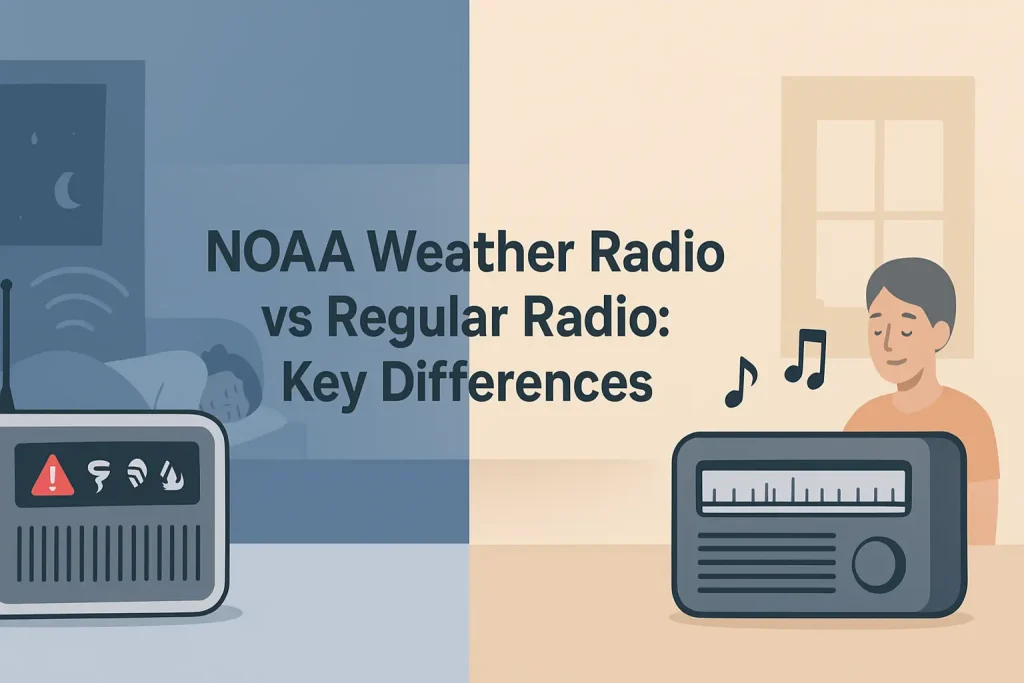
Most weather radios do not come with Bluetooth. The technology is largely absent from the category, and for reasons that matter more than you might expect.
This guide covers what connectivity options actually exist on current weather radio models, why Bluetooth has not taken hold in this product category, and what alternatives exist if you want wireless audio from your NOAA receiver.
| Photo | Popular Portable Walkie Talkies | Price |
|---|---|---|
 | SKIWARRIOR Multifunctional Smart Wireless Ski Goggles with Walkie-Talkie, Anti-Fog Zeiss Lens, Music & Call Function (Cylindrical Blue) | Check Price On Amazon |
 | SINORISE Super Mini Walkie Talkies, Two-Way Radios, 3 Pack | Check Price On Amazon |
 | KOSPET Tank M4C Smart Watch Rugged, Dual-Band GPS, 5ATM & IP69K Waterproof | Check Price On Amazon |
 | Retevis RT15 Walkie Talkies 3 Pack, Birthday Gift, Outdoor Adventure Kit | Check Price On Amazon |
 | Rechargeable Walkie Talkies Toys for Kids: DIY Astronaut Walkie Talkies for Boys Christmas Birthday Gifts for 3 4 5 6 7 8 9 10 Boy Walkie Talkie Outdoor Hiking Toy 2 Way Radio Camping Outdoor Game | Check Price On Amazon |
Why Weather Radios Almost Never Include Bluetooth
Weather radios are purpose-built emergency receivers designed to operate on NOAA’s seven broadcast frequencies between 162.400 and 162.550 MHz, and their design priorities are reliability, battery life, and alert responsiveness, not wireless audio convenience.
Adding Bluetooth to a radio introduces a secondary wireless radio subsystem that consumes power, adds complexity, and creates one more thing that can fail during an emergency. According to NOAA’s National Weather Service technical documentation, a weather radio receiver must be capable of waking from standby and sounding an alert within seconds of receiving an S.A.M.E. (Specific Area Message Encoding) signal. A Bluetooth connection that has timed out, dropped its paired device, or entered a low-power sleep state would interfere with that response.
This is not a cost-cutting decision by manufacturers. It is a design philosophy that prioritizes the core emergency function above convenience features.
Battery life is the second reason. A Midland WR400 weather radio running on AA battery backup can maintain alert monitoring for days in standby mode. Bluetooth radio adds a continuous power draw that would cut that backup window significantly, which is exactly the wrong trade-off for a device you depend on when the power grid goes down.
The core reason Bluetooth is absent from most weather radios is simple: it conflicts with the primary job the device exists to do.
What Connectivity Features Do Exist on Weather Radios
Weather radios do include connectivity features, but they are functional rather than consumer-entertainment focused. The most common connectivity option is a 3.5mm headphone jack, which allows wired audio output to earphones, external speakers, or recording equipment.
According to manufacturer data sheets for models including the Uniden BC365CRS and the Midland WR120B, the standard audio output jack serves two purposes: private listening without disturbing others, and connection to external alert systems in commercial installations like schools or care facilities.
Some models include an alert output jack (separate from audio) that sends a trigger signal to external sirens, strobe lights, or building alert systems when a S.A.M.E. alert is received.
Here are the connectivity features you will actually find across current weather radio models:
- 3.5mm headphone/audio output jack (most common, present on the majority of current models)
- External alert trigger output (found on mid-range and higher models)
- USB charging port (for built-in rechargeable battery, not data)
- Hand-crank generator input (on emergency multi-power models)
- Solar charging panel (on portable emergency models)
- AC power input with battery backup switching
None of these are Bluetooth, and none of them are designed for wireless audio pairing with smartphones or speakers. The wired 3.5mm jack is the universal connectivity standard across the category.
Are There Any Weather Radios with Bluetooth? What the Market Actually Offers
A small number of combination radios include Bluetooth, but these are consumer AM/FM/weather combination units, not dedicated NOAA weather radios. The Bluetooth function on these devices operates the AM/FM music receiver portion, not the NOAA weather alert receiver.
This distinction matters. On a combination radio with Bluetooth, you can stream music from your phone through the radio’s speaker using the AM/FM side of the device. When a weather alert arrives, the radio switches to the NOAA weather channel and sounds the alarm through the speaker, interrupting whatever Bluetooth audio was playing. The S.A.M.E. alert system and the Bluetooth system are parallel functions on different receiver circuits, not integrated features.
Use the table below to understand what Bluetooth actually controls on combination radios versus what it does not touch.
| Feature | Controlled by Bluetooth | NOT Controlled by Bluetooth |
|---|---|---|
| AM/FM music playback | Yes | |
| NOAA weather channel monitoring | Yes | |
| S.A.M.E. alert decoding | Yes | |
| Alert alarm sounding | Yes | |
| Smartphone music streaming | Yes | |
| Speakerphone function | On some models | |
| Battery backup alert monitoring | Yes |
The practical implication is that Bluetooth on a combination weather radio gives you a wireless speaker for music. It does not give you wireless emergency alerts or wireless NOAA audio delivered to your Bluetooth headphones.
If a severe weather alert sounds at 3 AM, the alarm comes from the radio’s physical speaker in the room, regardless of whether your Bluetooth headphones are connected. You need the radio physically present and within earshot, with Bluetooth or without it.
Here is a quick-glance comparison of the connectivity options across weather radio categories to help you decide which type fits your situation.
PRODUCT COMPARISON
Weather Radio Connectivity by Category – What Each Type Actually Offers
Connectivity features compared across dedicated NOAA and combination receiver categories. Source: manufacturer data sheets and product specifications.
| Radio Type | Bluetooth | 3.5mm Jack | Alert Output | S.A.M.E. | Price Range |
|---|---|---|---|---|---|
| Dedicated NOAA weather radio (basic) | No | Yes | No | No | $20-35 |
| Dedicated NOAA weather radio (S.A.M.E.) | No | Yes | On some | Yes | $35-80 |
| Combination AM/FM/weather with Bluetooth | AM/FM only | Yes | Rarely | On some | $40-100 |
| Emergency hand-crank/solar radio | Rarely | Yes | No | On some | $30-80 |
| Weather radio alarm clock | No | Yes | No | Yes | $30-60 |
| Professional/commercial NOAA receiver | No | Yes | Yes | Yes | $80-200+ |
Bluetooth availability refers to the NOAA weather alert receiver circuit only. Combination radios with Bluetooth use it exclusively for AM/FM audio streaming. Prices verified at time of publication.
The clearest takeaway from this comparison is that Bluetooth and S.A.M.E. capability rarely appear together in the same radio, and when Bluetooth is present, it serves a completely different receiver circuit than the weather alert function.
Can You Use a Bluetooth Speaker with a Weather Radio?
You can connect a Bluetooth speaker to a weather radio only if the radio has a 3.5mm audio output jack, and only by using a wired connection from the radio to a Bluetooth transmitter dongle. There is no direct Bluetooth pairing between a standard weather radio and a Bluetooth speaker.
The process works like this: you plug a 3.5mm Bluetooth audio transmitter into the headphone jack on the weather radio. The transmitter pairs with your Bluetooth speaker and relays the audio wirelessly. The weather radio itself does nothing differently. It outputs audio through its jack exactly as it would to wired earphones.
There is a critical limitation to this setup for emergency use. Most Bluetooth transmitters and speakers enter a standby or sleep mode after several minutes of audio silence. A weather radio in normal monitoring mode produces no audio until an alert activates. By the time an emergency alert broadcasts, the Bluetooth transmitter or speaker may have powered down its Bluetooth connection and will miss the first several seconds of the alert or not activate at all.
For overnight or unattended monitoring, a wired connection to a wired external speaker is more reliable than any Bluetooth workaround. The alert audio will activate the speaker immediately with no pairing timeout to manage.
If you specifically need wireless audio from a weather radio, a wired-to-Bluetooth transmitter can work, but it introduces a reliability gap that matters most precisely when you need the alert to come through.
The Midland WR120B: A Typical Example of What You Actually Get
The Midland WR120B reviewed in detail on this site is one of the most widely owned entry-level NOAA weather radios, and its connectivity profile illustrates exactly what the category offers. It has a 3.5mm headphone jack for wired audio output and no Bluetooth of any kind.
Key Specifications:
- Frequencies: 162.400-162.550 MHz (all 7 NOAA weather radio channels)
- S.A.M.E. alert filtering: Yes, with county-level programming
- Audio output: 3.5mm headphone jack
- Alert output: No external trigger jack on this model
- Power: AC adapter with battery backup (3x AA)
- Bluetooth: None
The WR120B receives alerts on all seven NOAA frequencies (162.400, 162.425, 162.450, 162.475, 162.500, 162.525, and 162.550 MHz) and uses S.A.M.E. technology to filter alerts to your specific county using a 6-digit FIPS (Federal Information Processing Standards) code.
This is the design pattern across virtually every dedicated NOAA weather radio at every price point: excellent alert performance, wired audio output, and zero wireless connectivity.
The WR120B is the right choice for reliable county-specific alert monitoring, and its lack of Bluetooth is by design, not omission.
What About the Eton FRX3+? Emergency Radios and Bluetooth
The Eton FRX3+ is a hand-crank solar emergency radio that includes a USB phone charging port, AM/FM receiver, NOAA weather receiver, and a flashlight. It does not include Bluetooth.
The Eton FRX3+ is a multi-power emergency receiver designed for grid-down situations. Its design priority is receiving NOAA broadcasts and charging a smartphone over USB so you can access emergency information through both channels simultaneously.
Key Specifications:
- NOAA frequencies: 162.400-162.550 MHz (7 channels)
- Power: Hand-crank generator, solar panel, USB-C input, 3x AA battery backup
- USB charging output: 5V/500mA (for phone charging)
- Audio output: 3.5mm headphone jack
- Bluetooth: None
- S.A.M.E.: No (receives all NOAA broadcasts without county filtering)
The absence of Bluetooth on the FRX3+ is consistent with its emergency-preparedness design brief. You can read a more complete assessment at the full Eton FRX3+ emergency radio review, which covers its hand-crank charging output, solar performance, and how it compares to dedicated S.A.M.E. weather radios for home alert monitoring.
Emergency radios like the FRX3+ prioritize power independence over connectivity features, which is why Bluetooth is absent even on models that include USB charging ports.
When Does Bluetooth Actually Matter for Weather Radio Use?
Bluetooth matters for weather radio use in exactly one scenario: you want to hear NOAA audio through wireless earbuds or a Bluetooth speaker for convenience during normal listening, not emergency alerting.
If you live in a severe weather region and want a weather radio that wakes you up reliably at 3 AM, Bluetooth adds nothing useful and introduces the timeout reliability risk described above. The alert needs to be audible in the room. Wired or built-in speaker is the correct choice for that scenario.
If you want background NOAA audio while doing other things and prefer wireless headphones, the workaround of a 3.5mm Bluetooth transmitter works for casual listening. It is not appropriate for unattended emergency alerting.
There is a third scenario worth naming: some users in areas with frequent alerts (tornado alley, Gulf Coast during hurricane season) want S.A.M.E. alerts delivered to their phone so they can receive them anywhere in the house or away from the radio. For this, a dedicated NOAA weather radio is not the right tool. A smartphone with the Wireless Emergency Alerts system enabled, or the FEMA app, delivers NOAA alerts over cellular networks to wherever you are. No Bluetooth is involved. The phone’s own speaker sounds the alert.
Bluetooth matters for weather radio convenience listening only. For emergency alerting, it creates more problems than it solves.
How to Get the Most from Weather Radio Audio Without Bluetooth
The 3.5mm audio output jack on most weather radios gives you more practical options than Bluetooth would in most cases. Here is what you can do with it.
Wired earphones for private listening: Any standard 3.5mm wired earphones plug directly into the headphone jack. This lets you monitor NOAA audio in bed without disturbing others. The radio’s alarm speaker remains active for alerts even with earphones plugged in on most models. Check your specific model’s documentation to confirm this behavior before relying on it.
External wired speaker for louder alerts: A small 3.5mm wired desktop speaker plugged into the audio output increases alert volume in a larger room. This is useful for shops, basements, or any space where the radio’s built-in 1-watt speaker is insufficient.
Alert trigger connection to external devices: On models with a separate alert output jack (not the headphone jack), you can connect the radio to an external relay, strobe light, or building alarm system. This is the connection type used in schools, care facilities, and commercial buildings where a single weather radio needs to trigger a broader alert infrastructure.
Recording for monitoring logs: The 3.5mm output can connect to a voice recorder for logging NOAA broadcast audio. This is used by emergency management organizations and broadcast stations to maintain alert response documentation.
For most home users, the built-in speaker is the correct audio output for emergency alerting. The headphone jack adds flexibility for specific situations without requiring any wireless technology.
Choosing a Weather Radio: Does Bluetooth Change the Buying Decision?
For most buyers, the absence of Bluetooth on dedicated weather radios should not affect the buying decision at all. The features that determine whether a weather radio does its job are S.A.M.E. technology, the number of programmable location codes, alert memory, battery backup type, and audible alarm volume. Bluetooth addresses none of these.
The one case where Bluetooth-capable combination radios are worth considering: you want a single device that serves as both a music speaker for everyday use and a NOAA weather receiver for emergency alerting. A combination AM/FM/weather radio with Bluetooth fills both roles in one unit. You give up S.A.M.E. county filtering on some models and alert output capability on nearly all of them, but you gain everyday Bluetooth speaker utility.
Use the table below to match the right radio type to your actual use case.
| Your Primary Need | Recommended Radio Type | Bluetooth Needed? | S.A.M.E. Needed? |
|---|---|---|---|
| Emergency alerting at home | Dedicated S.A.M.E. weather radio | No | Yes |
| Bedside alert with county filtering | Weather radio alarm clock with S.A.M.E. | No | Yes |
| Music speaker plus weather backup | Combination AM/FM/weather with Bluetooth | Optional | Optional |
| Emergency preparedness kit | Hand-crank/solar multi-power radio | No | Optional |
| Commercial or school installation | Professional NOAA receiver with alert output | No | Yes |
| Camping or outdoor use | Portable battery-powered NOAA radio | No | Optional |
For comprehensive guidance on matching specific models to each of these use cases, the complete weather radio buying guide covering S.A.M.E. tiers, battery backup options, and alert output specs walks through every decision factor in detail.
The short answer for most buyers: do not let the presence or absence of Bluetooth drive your weather radio purchase. Let S.A.M.E. capability, battery backup type, and alarm volume drive it instead.
Understanding S.A.M.E. Technology: The Feature That Actually Matters
S.A.M.E. (Specific Area Message Encoding) is the county-level alert filtering system built into better weather radios, and it is the single most important technology difference between a $20 weather radio and a $50 one. Without S.A.M.E., your weather radio will alarm for every severe weather event in your entire state, not just your county.
According to NOAA’s National Weather Service documentation, NOAA Weather Radio All Hazards broadcasts cover 95% of the US population within 40 miles of a transmitter. Each broadcast includes a digital S.A.M.E. header that encodes the specific county FIPS codes affected by the alert. A S.A.M.E.-capable receiver decodes this header and sounds the alarm only if the alert matches your programmed county code.
A weather radio without S.A.M.E. decoding cannot read that header. It treats every NOAA broadcast alert as relevant to you, regardless of geography.
This is why the explanation of how S.A.M.E. weather radio technology works is the most important thing to understand before buying any weather radio. The technology difference between S.A.M.E. and non-S.A.M.E. models has a far greater impact on daily usefulness than any connectivity feature including Bluetooth.
S.A.M.E. is the connectivity technology that actually matters for weather radios: the connection between the NOAA broadcast system and your specific geographic location.
How to Use Your Weather Radio for Maximum Alert Reliability
A weather radio that is not properly set up will either alarm too often (without S.A.M.E. programming) or miss alerts (if the volume is too low or the battery backup is not installed). Proper setup takes less than 10 minutes and is more important than any hardware upgrade.
The setup process for any S.A.M.E.-capable weather radio follows these steps:
- Find your NOAA transmitter frequency: NOAA broadcasts on seven frequencies between 162.400 and 162.550 MHz. Use the NOAA Weather Radio station finder at weather.gov to identify the primary and backup transmitter frequencies for your location. Program both into your radio if it supports multiple channel memory.
- Find your county FIPS code: Your 6-digit FIPS code identifies your county to the S.A.M.E. system. The NOAA station finder provides this code. For example, Cook County, Illinois is 017031.
- Program your S.A.M.E. codes: Enter your county FIPS code (and any adjacent counties you want to monitor) through the radio’s programming menu. Most S.A.M.E. radios accept 1-25 location codes. The Midland WR400 accepts up to 50 programmable codes.
- Set alert types: Most S.A.M.E. radios let you select which alert types sound the alarm. Tornado Warnings, Severe Thunderstorm Warnings, and Flash Flood Warnings are the minimum to enable for most locations. Civil Emergency and AMBER Alerts are recommended for comprehensive coverage.
- Install battery backup: Install fresh alkaline batteries in the backup compartment even if you use AC power as the primary source. The radio must maintain alert monitoring during a power outage, which is precisely when severe weather alerts are most critical.
- Set alarm volume and test: Set the alarm volume to its maximum. Use the radio’s test function (usually labeled “test” or accessible through the menu) to confirm the alert sounds correctly. Many NOAA stations broadcast a weekly test transmission on Wednesdays between 11 AM and noon local time.
A detailed walkthrough of every step is available in the guide on how to set up and use a weather radio for county-specific NOAA alerts, including how to program multiple county codes and how to interpret different S.A.M.E. alert header tones.
Proper S.A.M.E. programming is more valuable than any hardware feature on a weather radio, including Bluetooth.
Weather Radio Alarm Clocks: Bedside Use Without Bluetooth
Weather radio alarm clocks combine a traditional alarm clock with a S.A.M.E.-capable NOAA weather receiver in a single bedside unit. They do not include Bluetooth, but they are the most practical solution for overnight alert monitoring in a bedroom environment.
A weather radio alarm clock with S.A.M.E. wakes you for weather emergencies using the NOAA alert system and also functions as your daily alarm. It removes the question of whether you remembered to turn the weather radio on before bed, because the clock function ensures the device is in active use every night.
The reason Bluetooth is absent from this category is the same as for dedicated weather radios: a Bluetooth speaker connection that has timed out during sleep cannot reliably deliver a 3 AM tornado warning. The built-in speaker mounted on the bedside unit is the correct delivery mechanism for overnight alerts. You can explore current models and their S.A.M.E. capabilities in the guide to weather radio alarm clocks for bedside NOAA monitoring.
Weather radio alarm clocks are the right solution for bedside monitoring. Their lack of Bluetooth is a feature, not a gap.
The Best Weather Radios Available: Connectivity in Context
The best weather radios on the market are selected for S.A.M.E. performance, alert type coverage, battery backup capacity, and alarm reliability, not for wireless connectivity. Understanding this helps explain why the top-rated models consistently lack Bluetooth.
Use the table below to compare the top-performing dedicated weather radios by the specifications that determine alert reliability.
| Model | S.A.M.E. Codes | Alert Types | Battery Backup | Audio Output | Bluetooth |
|---|---|---|---|---|---|
| Midland WR400 | 50 | 25 | 6x AA | 3.5mm + alert | No |
| Uniden BC365CRS | 25 | 23 | 3x AA | 3.5mm | No |
| Midland WR120B | 25 | 25 | 3x AA | 3.5mm | No |
| Sangean CL-100 | 25 | 25 | 6x AA | 3.5mm + alert | No |
| Eton FRX3+ | None | All | 3x AA + crank | 3.5mm | No |
| Midland ER310 | None | All | 3x AA + crank | 3.5mm | No |
S.A.M.E. code counts reflect programmable location codes. Alert type counts reflect individually selectable alert categories. Specifications sourced from manufacturer data sheets. Prices verified at time of publication.
For a full ranked comparison with detailed reviews of each model, the best weather radios ranked by S.A.M.E. performance, battery backup, and alert coverage covers every major model currently available with testing notes on alert response time and audio clarity.
The pattern across all top-rated weather radios is consistent: S.A.M.E. capability and reliable battery backup define quality, while Bluetooth is absent across the entire category.
Frequently Asked Questions About Weather Radio Bluetooth and Connectivity
Do any NOAA weather radios come with built-in Bluetooth?
No dedicated NOAA weather radios currently available include built-in Bluetooth that connects to the weather alert receiver circuit. A small number of combination AM/FM/weather radios include Bluetooth for music streaming through the AM/FM portion of the device, but the NOAA weather alert function on these units does not use Bluetooth and cannot deliver alerts to a paired speaker or headphones.
The NOAA weather alert receiver in every current model outputs audio through the device’s built-in speaker and a 3.5mm headphone jack only. This is consistent across the entire category, from $20 entry-level models to $200 professional installations.
Can I connect a weather radio to a Bluetooth speaker?
You can connect a weather radio to a Bluetooth speaker only by using a wired 3.5mm-to-Bluetooth transmitter dongle plugged into the radio’s headphone jack. The weather radio does not pair directly with any Bluetooth device. For casual listening, this workaround functions adequately.
For emergency alerting, this setup is unreliable. Most Bluetooth transmitters and speakers enter a sleep or standby mode after minutes of silence. A weather radio monitoring in standby produces no audio until an alert activates. By the time an emergency alert sounds, the Bluetooth connection may have timed out and the speaker will not receive the audio in time.
Will a weather radio alert wake me if my Bluetooth headphones are connected?
No. Even if you connect a Bluetooth transmitter to your weather radio’s 3.5mm jack and pair it with Bluetooth headphones, the headphones will not reliably deliver a 3 AM alert. Bluetooth headphones enter low-power or standby mode after a period of audio inactivity. They do not maintain a live audio connection through silence.
The reliable solution for overnight alert delivery is the radio’s built-in speaker placed within audible range of your sleeping location. Alternatively, a S.A.M.E. weather radio alarm clock designed for bedside use delivers alerts directly from its speaker without any wireless connection required.
What is the difference between a weather radio with S.A.M.E. and one without?
A weather radio with S.A.M.E. (Specific Area Message Encoding) alarms only for emergencies affecting your specific county, identified by a 6-digit FIPS code you program into the radio. A weather radio without S.A.M.E. alarms for every NOAA broadcast alert within range of the transmitter, which can cover an entire multi-county broadcast area.
In a state like Oklahoma with frequent tornado activity across multiple counties, a non-S.A.M.E. weather radio may alarm dozens of times per season for counties far from your location. A S.A.M.E.-programmed radio alarms only when your county is specifically named in the alert header, eliminating false wakeups for geographically irrelevant alerts.
Why do weather radios not have Wi-Fi connectivity?
Weather radios do not include Wi-Fi because NOAA broadcasts on dedicated VHF frequencies between 162.400 and 162.550 MHz, and receiving these broadcasts requires a VHF radio receiver, not an internet connection. Wi-Fi would add cost, complexity, and power consumption while adding no capability to the NOAA weather alert reception function.
Internet-connected alert systems exist separately. The FEMA app, the Integrated Public Alert and Warning System (IPAWS), and Wireless Emergency Alerts (WEA) delivered over cellular networks all serve as internet-based alert channels. These complement a weather radio but cannot replace it during power and cellular outages, which are common in severe weather events.
Can my smartphone replace a weather radio?
A smartphone with Wireless Emergency Alerts (WEA) enabled receives NOAA-originated alerts via the cellular network and will sound an alarm for Tornado Warnings, Flash Flood Warnings, and similar events in your area. This works well when cellular networks are functioning and your phone is powered on and not on Do Not Disturb.
A dedicated weather radio receives alerts directly from NOAA’s VHF broadcast network, which operates independently of cellular infrastructure. During a major storm event where cell towers lose power or become congested, NOAA’s broadcast network typically remains operational. FEMA’s emergency preparedness guidelines recommend maintaining a battery-powered or hand-crank weather radio as a backup to cellular-dependent systems.
What does the alert output jack on a weather radio do?
The alert output jack (present on mid-range and higher models like the Midland WR400 and Sangean CL-100) sends a separate trigger signal when a S.A.M.E. alert is received. This signal can activate an external relay, siren, strobe light, or building notification system independently of the radio’s audio output.
The alert output is a DC voltage signal, not an audio signal. It is used in commercial installations such as schools, hospitals, and care facilities where a single weather radio needs to trigger a broader alert infrastructure that spans multiple rooms or buildings. Home users rarely need this feature, but it is the most useful “connectivity” feature on advanced weather radio models for professional deployment.
Do I need a license to operate a weather radio?
No license is required to operate a weather radio receiver. NOAA Weather Radio All Hazards operates as a one-way broadcast service. You are receiving transmissions, not transmitting. FCC licensing requirements apply to two-way radio transmission, not to radio reception.
Weather radios are passive receive-only devices. You can purchase, own, and use any weather radio receiver without any FCC filing, license application, or registration. The only exception would be a device that combines a weather radio receiver with a two-way radio transmitter (such as some GMRS radios with weather monitoring capability), where the transmit function is subject to applicable FCC rules.
Why does my weather radio alarm for counties I am not in?
A weather radio alarming for the wrong counties is almost always a S.A.M.E. programming issue. Either the radio does not have S.A.M.E. capability, or the FIPS codes programmed into it include counties adjacent to yours that you did not intend to monitor.
Check your radio’s S.A.M.E. programming menu and confirm only your target county’s 6-digit FIPS code is entered. If your radio lacks S.A.M.E. capability entirely, it will alarm for all NOAA broadcasts from your local transmitter regardless of which counties are affected. Upgrading to a S.A.M.E.-capable model like the Midland WR120B or Uniden BC365CRS resolves this completely.
Can I use a weather radio outdoors or while camping?
Yes. Portable battery-powered weather radios are suitable for camping and outdoor use. Models like the Midland ER310 and Eton FRX3+ include hand-crank and solar charging in addition to battery backup, making them functional without access to AC power. Most portable weather radios receive NOAA broadcasts from transmitters with 40-mile coverage radius, which covers most camping destinations in the continental US.
The limitation in remote areas is transmitter coverage. NOAA’s National Weather Service transmitter map at weather.gov/nwr shows coverage gaps in some mountainous and rural western regions. For remote camping beyond NOAA transmitter range, a satellite messenger device like the Garmin inReach provides weather alerts over satellite at a subscription cost, serving as an alternative where NOAA VHF signals cannot reach.
What is the difference between a weather radio and an emergency radio?
A dedicated weather radio is designed primarily to receive NOAA Weather Radio All Hazards broadcasts on 162.400-162.550 MHz, with S.A.M.E. county filtering as its defining feature. An emergency radio is a broader category that typically includes AM, FM, shortwave, and NOAA reception in a single portable unit with multiple power sources (battery, crank, solar, USB).
Emergency radios generally lack S.A.M.E. filtering, meaning they receive all NOAA broadcasts without county-level filtering. They compensate with versatility: AM/FM reception for news and information, USB phone charging, and power independence from the grid. For home use where county-specific alerting matters most, a dedicated S.A.M.E. weather radio outperforms a general emergency radio. For a go-bag or camping kit where power independence matters most, a multi-function emergency radio is more practical.
How far does a NOAA weather radio transmitter reach?
NOAA Weather Radio transmitters operate at 300 to 1,000 watts effective radiated power on VHF frequencies between 162.400 and 162.550 MHz. Under normal conditions, a single transmitter covers approximately a 40-mile radius, according to NOAA National Weather Service documentation. The NWR network includes over 1,000 transmitters, providing coverage to approximately 95% of the US population.
Reception range varies significantly with terrain. VHF signals travel in straight lines and are attenuated by hills, mountains, and large buildings. In mountainous regions, a transmitter’s effective coverage may be limited to valleys and lowlands directly below the antenna. A higher-gain external VHF antenna can improve reception in fringe coverage areas by 10-15 dB, which can make the difference between reliable alert reception and missed broadcasts.
The weather radio category is built around reliability for emergency alerting rather than wireless convenience, and understanding that design priority makes every feature decision across the category easier to understand.
If your primary goal is county-specific alert monitoring that works during power outages, a S.A.M.E.-capable dedicated weather radio with battery backup covers everything you need. No Bluetooth required.
| Photo | TOP RATED WALKIE TALKIES | Price |
|---|---|---|
 | Retevis RT628 Kids Walkie Talkies, Toys Gifts for 4-12 Year Old Girl Boy | Check Price On Amazon |
 | Cobra ACXT545 Weather-Resistant Walkie Talkies, Rechargeable, 22 Channels | Check Price On Amazon |
 | Retevis RT388 Kids Walkie Talkies, Outdoor Toys for Kids Camping Essentials | Check Price On Amazon |
 | Cobra RX680 Walkie Talkies (2-Pack), IP54 Water Resistant Design | Check Price On Amazon |
 | Retevis RT22 Walkie Talkies Long Range Rechargeable with Earpiece (2 Pack) | Check Price On Amazon |
 | Midland GXT1000VP4 GMRS JIS4 Two-Way Radio, Black,2 Pack | Check Price On Amazon |
 | Retevis RT628 Walkie Talkies for Kids,Toys Gifts for 6-12 Years Old Boys Girls,Long Range 2 Way Radio 22CH VOX,Birthday Gift,Family Walkie Talkie for Camping Hiking Indoor Outdoor | Check Price On Amazon |