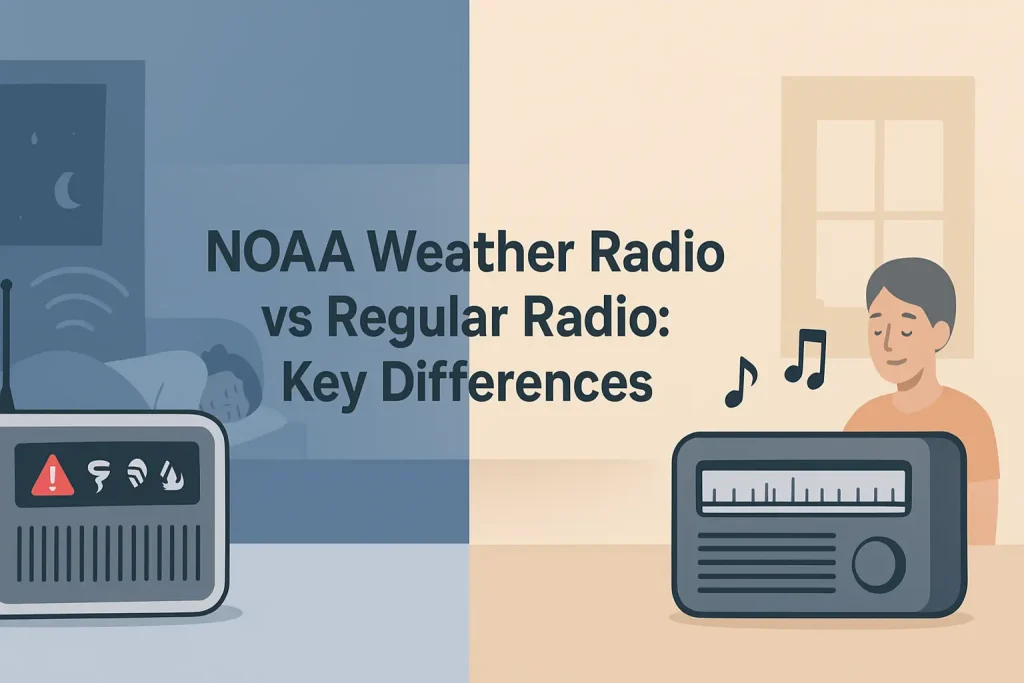
Digital weather radios receive alert data as a coded binary signal that either decodes correctly or does not. Analog weather radios receive a continuous FM broadcast that degrades gradually as signal strength drops. The difference matters most when severe weather hits your area and signal conditions are already compromised.
This article covers how digital and analog reception work at the circuit level, where each format succeeds or fails, and which format gives you the most reliable alert delivery across different environments and use cases.
| Photo | Popular Portable Walkie Talkies | Price |
|---|---|---|
 | SKIWARRIOR Multifunctional Smart Wireless Ski Goggles with Walkie-Talkie, Anti-Fog Zeiss Lens, Music & Call Function (Cylindrical Blue) | Check Price On Amazon |
 | SINORISE Super Mini Walkie Talkies, Two-Way Radios, 3 Pack | Check Price On Amazon |
 | KOSPET Tank M4C Smart Watch Rugged, Dual-Band GPS, 5ATM & IP69K Waterproof | Check Price On Amazon |
 | Retevis RT15 Walkie Talkies 3 Pack, Birthday Gift, Outdoor Adventure Kit | Check Price On Amazon |
 | Rechargeable Walkie Talkies Toys for Kids: DIY Astronaut Walkie Talkies for Boys Christmas Birthday Gifts for 3 4 5 6 7 8 9 10 Boy Walkie Talkie Outdoor Hiking Toy 2 Way Radio Camping Outdoor Game | Check Price On Amazon |
How Digital and Analog Weather Radio Reception Actually Work
Analog weather radio reception works by tuning your radio to one of the seven NOAA broadcast frequencies between 162.400 MHz and 162.550 MHz and converting the FM signal directly into audio. The analog NOAA weather radio you hear through the speaker is a direct demodulation of whatever signal arrives at the antenna, noise included.
Digital reception on a weather radio does not mean the NOAA broadcast itself is digital. NOAA Weather Radio All Hazards (NWR) still transmits on the same seven analog FM frequencies. What “digital” refers to in consumer weather radios is the S.A.M.E. (Specific Area Message Encoding) decoder chip inside the radio, which reads the digital header data embedded at the start of every alert broadcast.
According to NOAA NWR technical documentation, every alert begins with a digital burst of FSK (frequency-shift keying) encoded data that identifies the alert type, the affected geographic area by FIPS county code, and the broadcast duration. A weather radio with S.A.M.E. decoding reads this header and decides whether to trigger your alarm based on whether your programmed county code matches.
A radio without S.A.M.E. decoding hears the same broadcast but ignores the header entirely. It alarms for every alert broadcast within range of the transmitter, regardless of which counties are affected.
This happens because analog-only radios have no instruction set telling them to discriminate between alerts. The S.A.M.E. decoder is the discriminating logic layer. Without it, the radio treats all broadcasts identically.
If your radio lacks S.A.M.E. decoding, the result is alert fatigue. You receive warnings for counties 100 miles away at 3 a.m., which causes users to silence or disable the alert function entirely, which defeats the purpose of owning a weather radio.
What S.A.M.E. Technology Actually Decodes
S.A.M.E. (Specific Area Message Encoding) is a digital protocol standardized by the FCC and NOAA that encodes alert metadata into a short burst of audio-frequency FSK data transmitted before every NWR broadcast. The encoding uses 1,200 baud FSK at audio frequencies, making it transmittable over standard FM broadcast infrastructure without requiring a separate digital transmitter.
According to NOAA NWR documentation, the S.A.M.E. header contains the originator code (National Weather Service, civil authorities, or EAS participants), the event code identifying the specific alert type, the FIPS location codes for affected areas, the broadcast duration, and the issue time stamp.
A S.A.M.E.-capable weather radio stores up to 50 programmable FIPS codes in most mid-range models, allowing you to monitor multiple counties simultaneously. The Midland WR400 accepts up to 50 FIPS codes. The Uniden BC365CRS accepts up to 25.
Key Specifications for S.A.M.E. alert decoding:
- FSK encoding speed: 1,200 baud
- Header transmission: Sent three times at the start of each alert for redundancy
- FIPS code format: 6-digit code (2-digit state + 3-digit county + 1 subdivision digit)
- Alert event codes: 60+ defined event types including Tornado Warning, Flash Flood Warning, Hurricane Warning, AMBER Alert, and Civil Emergency
- Broadcast frequencies: 162.400, 162.425, 162.450, 162.475, 162.500, 162.525, 162.550 MHz
The triple transmission of the S.A.M.E. header is a deliberate reliability mechanism. The radio compares all three transmissions and triggers only if at least two of the three match your programmed county codes, which filters out corrupted single-transmission decodes caused by brief signal interference.
If signal quality is too poor to successfully decode two of the three header transmissions, a properly designed S.A.M.E. radio will not trigger a false alarm. It will miss the alert entirely instead. This is the core reliability trade-off covered in the next section.
The Core Reliability Trade-Off: Digital Discrimination vs. Analog Continuity
Analog weather radios deliver every alert that reaches the antenna with enough signal to demodulate. Digital S.A.M.E. radios deliver only alerts that pass the header decode test. These two behaviors produce opposite failure modes in poor signal conditions.

An analog radio in a fringe signal area will broadcast a noisy, scratchy, but audible alert. A S.A.M.E. radio in the same location may decode nothing, silently missing the alert because the signal was too corrupted to successfully decode two of the three header transmissions.
This is not a flaw in S.A.M.E. technology. It is the intended behavior. The protocol was designed to prevent false alarms from corrupted data. The trade-off is that it requires a cleaner signal floor to function reliably than analog reception does.
According to NOAA NWR coverage data, approximately 95% of the US population lives within 40 miles of a NOAA NWR transmitter. For the 5% in fringe areas, the analog reliability advantage is real and significant.
Use the table below to compare the failure modes of each format across signal conditions.
| Signal Condition | Analog Weather Radio | Digital S.A.M.E. Radio |
|---|---|---|
| Strong signal (within 20 miles of transmitter) | Clear audio, reliable alarm | Clean decode, precise county filtering |
| Moderate signal (20-40 miles from transmitter) | Slight static, alarms for all counties | Usually decodes, county filtering intact |
| Fringe signal (40-60 miles, obstructions) | Noisy but audible alert delivered | May fail to decode, alert missed silently |
| Poor signal (terrain obstruction, basement) | Very noisy, may still alarm | Decode failure likely, alert missed |
| Multi-county broadcast area | Alarms for all counties, including irrelevant ones | Alarms only for programmed FIPS codes |
| Power outage (battery backup only) | Functional if batteries present | Functional if batteries present and FIPS programmed |
| RF interference present | Possible false alarm from noise bursts | Resistant to false alarms, but decode may fail |
The most common location where this trade-off becomes critical is a basement or interior room of a concrete building. Signal attenuation through concrete can reduce a strong outdoor signal to a fringe-level signal indoors, which means a S.A.M.E. radio that works perfectly on your kitchen counter may silently miss alerts in your finished basement.
The fix is positioning the radio near an exterior wall, running an external antenna cable to a window, or choosing a model with an external antenna port such as the Midland WR400 or Uniden BC365CRS.
Digital vs. Analog Performance in Real Environments
The 162 MHz VHF high band used by NOAA NWR broadcasts is a line-of-sight frequency range. Signal propagation follows the radio horizon, which means hills, terrain ridges, dense forests, and buildings between your radio and the NOAA transmitter directly reduce received signal strength.
In flat, open terrain within 30 miles of a transmitter, both analog and digital reception are reliable. The S.A.M.E. radio wins here because it delivers county-specific alerts without false alarms for adjacent counties.
In mountainous or hilly terrain, the nearest NOAA transmitter may be blocked by a ridgeline even if it is only 15 miles away. A second transmitter on a different frequency may be receivable at lower signal strength from the opposite direction. An analog radio may receive one or both with varying quality. A S.A.M.E. radio may successfully decode one and fail on the other, or fail on both if neither provides sufficient signal for FSK header decoding.
In dense urban environments, reflected signals from buildings create multipath interference. Multipath causes phase cancellation at specific locations, which can create a dead spot for S.A.M.E. decoding even when overall signal appears adequate. Moving the radio 12-18 inches can eliminate the multipath null and restore clean decoding.
According to NOAA NWR technical specifications, the NWR transmitter network uses between 300 and 1,000 watts of effective radiated power per transmitter, with a target ground coverage radius of approximately 40 miles per site. Terrain-blocked areas may receive only 0.1-1% of that signal level, which is insufficient for reliable S.A.M.E. header decoding but may still produce audible analog audio.
For rural users more than 40 miles from the nearest NWR transmitter, a weather radio with an external antenna port paired with a directional Yagi antenna pointed at the nearest transmitter is the most reliable solution regardless of whether the radio uses analog-only or S.A.M.E. decoding.
The S.A.M.E. Alert System and What It Covers
S.A.M.E. technology decodes over 60 defined event codes transmitted by National Weather Service offices, state and local emergency management agencies, and the EAS (Emergency Alert System) network. Understanding what S.A.M.E. covers clarifies whether a digital radio genuinely meets your alert needs.
The event categories include weather hazards, non-weather emergencies, and national-level alerts. Weather hazards include Tornado Warning, Tornado Watch, Severe Thunderstorm Warning, Flash Flood Warning, Flash Flood Watch, Hurricane Warning, Hurricane Watch, Winter Storm Warning, Winter Storm Watch, Blizzard Warning, Ice Storm Warning, Freeze Warning, High Wind Warning, and Hazardous Weather Outlook among others.
Non-weather S.A.M.E. events include Civil Emergency Message, Hazardous Materials Warning, Nuclear Power Plant Warning, Radiological Hazard Warning, Evacuation Immediate, Shelter in Place Warning, and Law Enforcement Warning. AMBER Alerts (Child Abduction Emergency) are also transmitted over NWR using S.A.M.E. encoding.
A purely analog weather radio without S.A.M.E. receives all of these alert types. The limitation is that it cannot distinguish between an event affecting your county and one affecting a county 200 miles away. Both trigger the same alarm at the same volume at the same time of night.
For a complete breakdown of S.A.M.E. event codes and how county-level filtering works, the detailed explanation of how S.A.M.E. encodes and filters alerts by FIPS code covers the full protocol including how to read the 6-digit county codes.
Which Weather Radio Models Use Digital S.A.M.E. Decoding
Most weather radios sold today include S.A.M.E. decoding at price points above $30. True analog-only weather radios are increasingly rare in the consumer market but still exist in basic models under $20 and in combination AM/FM/weather radios where the weather band is an add-on feature rather than the primary function.
Use the table below to compare current digital S.A.M.E. weather radio models across the key specifications that affect reliability.
| Model | S.A.M.E. Codes | External Antenna Port | Battery Backup | Alert Memory | Price Range |
|---|---|---|---|---|---|
| Midland WR400 | 50 | Yes | 6x AA | 50 | $50-65 |
| Uniden BC365CRS | 25 | Yes | 3x AA | 25 | $35-50 |
| Midland WR120B | 25 | No | 3x AA | 25 | $25-35 |
| Sangean CL-100 | 25 | No | 3x AA | 25 | $40-55 |
| Eton FRX3+ | 25 | No | Hand crank + solar + AA | 25 | $55-75 |
| Midland WR300 | 25 | Yes | 3x AA | 25 | $35-50 |
| Basic analog-only WX radio | None | Varies | AA batteries | None | $10-25 |
The external antenna port is the most underrated specification on this list. It is the single hardware feature that most directly addresses the signal-floor problem underlying S.A.M.E. decode failures in fringe signal areas.
For a full breakdown of specifications and performance across the most popular current models, the comprehensive comparison of top-rated NOAA weather radio models covers hands-on performance data for each receiver.
Here is a side-by-side comparison of digital S.A.M.E. and analog reception across the specifications that most affect your purchase decision.
Product Comparison
Digital S.A.M.E. vs Analog Weather Radio – Side by Side
Key specifications compared. Source: NOAA NWR technical documentation, FCC Part 11 EAS rules.
| Specification | Digital S.A.M.E. Radio | Analog-Only Radio |
|---|---|---|
| County-level alert filtering | Yes (FIPS code matching) | No (all counties alarmed) |
| Alert types decoded | 60+ event codes | All (undifferentiated) |
| Fringe signal reliability | Lower (decode threshold required) | Higher (any signal produces audio) |
| False alarm resistance | High (triple header verification) | Low (noise bursts can trigger alarm) |
| Silent alert decode failure | Possible (fails without warning) | Not applicable |
| Programmable alert memory | 25-50 FIPS codes | None |
| Price range | $25-75+ | $10-25 |
| Best for | Most home and suburban users | Rural fringe signal areas, basic monitoring |
S.A.M.E. header uses 1,200 baud FSK encoding transmitted three times per alert. Decode requires two of three successful matches. Source: NOAA NWR technical documentation, FCC Part 11.
When Analog Reception Is the More Reliable Choice
Analog weather radio reception is more reliable than S.A.M.E. digital decoding in exactly one scenario: fringe signal areas where received signal strength is insufficient for consistent FSK header decoding but is sufficient to produce intelligible audio.
This scenario occurs most often in rural areas beyond 40 miles from the nearest NWR transmitter, in valleys or behind terrain ridges that block line-of-sight propagation at 162 MHz, in basements or interior rooms of dense construction buildings, and in vehicles where the radio is shielded by the vehicle body and operates on a compromised internal antenna.
A portable hand-crank weather radio with basic analog reception and no S.A.M.E. decoding will deliver audible alerts in these conditions where a S.A.M.E. radio may silently fail to decode.
The practical solution for most users is not choosing between the two formats. It is choosing a S.A.M.E. radio with strong fringe-signal sensitivity, an external antenna port, and a battery backup system so that you can address signal problems mechanically rather than accepting them.
The Eton FRX3+ handles fringe signal conditions better than most S.A.M.E. radios because its hand-crank and solar charging system keeps it powered indefinitely during extended outages, and its analog audio path remains functional even when S.A.M.E. header decoding degrades. For a full review of how it performs in real conditions, the in-depth Eton FRX3+ performance review covers reception sensitivity and alert reliability in detail.
In fringe signal areas, an analog weather radio that alarms for all counties still provides lifesaving alert delivery. A S.A.M.E. radio that silently fails to decode provides nothing.
How to Test Whether Your Digital Radio Is Actually Decoding Alerts
The most dangerous failure mode of a digital S.A.M.E. weather radio is silent decode failure. The radio appears functional, displays signal bars, and plays NOAA audio when you manually tune to the WX channel, but it never triggers an automatic alert because signal quality is too poor to successfully decode the S.A.M.E. header in the alarm-monitoring mode.
NOAA conducts required weekly tests (RWT) every Wednesday between 11 a.m. and noon local time, and required monthly tests (RMT) on the first Wednesday of each month between 11 a.m. and noon. Both transmit a full S.A.M.E. header followed by a test message, which means your radio should trigger its alert alarm during these test broadcasts if S.A.M.E. decoding is functioning correctly.
To verify your radio is decoding correctly, confirm your radio is set to alert monitoring mode (not manual listening mode), confirm your FIPS county code is programmed correctly, and note whether the radio alarms during the weekly Wednesday test.
Key Specifications for NOAA test broadcasts:
- Required Weekly Test (RWT): Every Wednesday, 11 a.m. to noon local time
- Required Monthly Test (RMT): First Wednesday of each month, 11 a.m. to noon local time
- Event code transmitted: RWT or RMT S.A.M.E. event code
- Geographic scope: All FIPS codes in the transmitter’s coverage area
- Source: NOAA NWR Programmer’s Guide, FCC Part 11 EAS rules
If your radio does not alarm during the Wednesday weekly test, do not assume the alert function works. Check your FIPS code programming first. If the code is correct and the radio still does not respond to the Wednesday test, your signal level is insufficient for reliable S.A.M.E. decoding at your location.
The fix is to reposition the radio closer to an exterior wall, add an external antenna, or switch to a model with better receive sensitivity. The Midland WR400 weather radio with external antenna port accepts a standard 75-ohm coaxial antenna connection, which allows you to run a cable to an outdoor or window-mounted antenna for significantly improved fringe-area performance.
Testing your radio against the weekly RWT broadcast is the single most important maintenance action you can take to verify your alert system is actually functional.
Battery Backup and Power Reliability for Both Radio Types
Both analog and digital S.A.M.E. weather radios require power to operate. During the severe weather events and infrastructure emergencies that make weather radios most critical, utility power is frequently the first system to fail.
A weather radio with no battery backup is a weather radio that stops working at exactly the moment you need it most. This applies equally to analog and digital models.
Most S.A.M.E. weather radios in the $30-75 price range include a battery compartment accepting standard AA alkaline batteries as a backup power source. The Midland WR400 requires six AA batteries for backup. The Uniden BC365CRS requires three AA batteries.
For extended power outage scenarios lasting more than 24-48 hours, a hand-crank solar weather radio with S.A.M.E. decoding provides indefinite operation without disposable batteries. The Eton FRX3+ combines a 2,000 mAh internal lithium battery charged by solar panel and hand crank with full S.A.M.E. decoding across all 25 standard alert types.
Key Specifications for emergency power weather radios:
- Standard battery backup: 3-6 AA alkaline batteries, 12-24 hour estimated runtime in alert-monitoring mode
- Hand-crank output: approximately 1 minute of crank = 5-10 minutes of operation
- Solar charging: 8-10 hours of direct sunlight to full charge for 2,000 mAh internal battery
- USB power input: available on most models above $40, allows charging from power bank
- S.A.M.E. power draw: minimal in monitoring mode, radio wakes only when alert header detected
The S.A.M.E. monitoring mode power draw is significantly lower than continuous audio playback mode. Most S.A.M.E. radios in standby/monitoring mode draw less than 20 mA. This means battery backup runtime in alert-monitoring mode is substantially longer than the radio’s rated audio playback time suggests.
For a detailed guide to weather radios that also function as alarm clocks with battery backup, the guide to weather radio alarm clock models with S.A.M.E. and backup power covers models that integrate seamlessly into a bedroom setup.
Choosing the Right Format for Your Specific Situation
For most users in suburban and urban areas within 40 miles of a NOAA NWR transmitter, a digital S.A.M.E. weather radio with at least 25 programmable FIPS codes is the correct choice. The county-specific filtering eliminates false alarms, the triple-header verification prevents false triggers from interference, and signal quality at this distance is sufficient for reliable decode.
For users in rural areas, river valleys, mountain terrain, or any location where your nearest NWR transmitter is more than 40 miles away or blocked by terrain, the priority is maximizing received signal strength first. Choose a S.A.M.E. radio with an external antenna port, pair it with a directional antenna aimed at the nearest transmitter, and verify decoding using the weekly Wednesday RWT broadcast.
For emergency preparedness kits, vehicles, and go-bags where guaranteed operation in unknown locations matters more than county filtering, a combination approach works best. A primary S.A.M.E. radio for home use plus a portable analog-capable weather radio with basic reception as a backup covers both failure modes.
The portable S.A.M.E. weather radio with battery backup category offers models like the Midland WR120B at under $35 that cover both home and emergency kit needs at a price point accessible for having multiple units.
For a comprehensive guide to matching weather radio features to specific use cases and environments, the complete weather radio buying guide covering S.A.M.E., power, and placement walks through every specification that affects real-world reliability.
The right choice is the radio you have tested, verified, and confirmed is actually decoding alerts at your specific location, not the one with the most impressive specification sheet.
Programming Your S.A.M.E. Radio for Maximum Alert Reliability
A S.A.M.E. weather radio set to factory defaults monitors all events for all counties within the transmitter’s range. This is functionally identical to analog-only operation in terms of false alarm rate. The digital advantage only activates after you program your specific FIPS county codes.
FIPS (Federal Information Processing Standards) codes are 6-digit identifiers assigned to every US county and county equivalent. The format is a 2-digit state code followed by a 3-digit county code followed by a single subdivision digit (which is 0 for the entire county). Fayette County, Kentucky, for example, is FIPS code 021067. The leading 0 is significant and must be entered correctly.
The NOAA NWR website maintains a complete searchable database of FIPS codes by state and county. Entering the wrong FIPS code is the most common reason a correctly functioning S.A.M.E. radio fails to alarm during actual alert broadcasts.
Key steps for programming a S.A.M.E. weather radio:
- Look up your county’s 6-digit FIPS code on the NOAA NWR FIPS code database at weather.gov
- Identify adjacent counties you want to monitor (rivers, commute routes, school districts)
- Enter each FIPS code using the radio’s keypad following manufacturer programming instructions
- Verify all entered codes by reviewing the stored code list in the radio menu
- Confirm alert monitoring mode is active (not manual WX channel listening mode)
- Wait for the next Wednesday RWT test broadcast and confirm the radio alarms
Most radios store between 25 and 50 FIPS codes. Programming 3-5 codes covering your home county, work county, and counties along your regular travel routes provides comprehensive coverage without triggering alerts from distant areas.
For complete step-by-step programming instructions with button sequences for the most common models, the step-by-step guide to programming and using a NOAA weather radio covers FIPS code entry and alert mode activation for Midland, Uniden, and Sangean models.
Frequently Asked Questions About Digital vs Analog Weather Radio
Can a digital S.A.M.E. weather radio miss a tornado warning entirely?
Yes. A S.A.M.E. weather radio can silently miss a Tornado Warning if received signal quality is too low to successfully decode two of the three transmitted S.A.M.E. header copies. This failure produces no error message, no alarm, and no indication that an alert was broadcast. The radio appears fully functional while the alert passes undetected.
This is the most critical reliability risk of S.A.M.E. technology in fringe signal areas. The fix is testing your radio against the weekly Wednesday RWT broadcast, confirming it alarms consistently, and adding an external antenna if it does not.
Does a digital weather radio provide better audio quality than an analog one?
No. The NOAA NWR broadcast itself is an analog FM transmission on frequencies between 162.400 and 162.550 MHz. Both digital S.A.M.E. and analog-only radios receive and demodulate the same FM signal. Audio quality is determined by received signal strength and the radio’s FM demodulator quality, not by whether the radio includes S.A.M.E. decoding.
A higher-quality analog FM receiver circuit may actually produce cleaner audio than a budget S.A.M.E. model in moderate signal conditions. The “digital” in S.A.M.E. weather radios refers to the alert header decoding, not the audio path.
What is the difference between S.A.M.E. and EAS on a weather radio?
S.A.M.E. (Specific Area Message Encoding) is the digital protocol used to encode location and event data into the alert header that precedes every NWR broadcast. EAS (Emergency Alert System) is the broader federal alert infrastructure that NWR is one component of. S.A.M.E. is the encoding format. EAS is the system that uses it.
Your weather radio decodes S.A.M.E. headers to filter which EAS alerts trigger your alarm. All consumer weather radios marketed as “digital” or “S.A.M.E.” are EAS receivers by definition, because NWR is an EAS distribution channel. The terms are often used interchangeably in consumer marketing but refer to different layers of the same system.
Why does my S.A.M.E. weather radio alarm for counties I did not program?
There are two common causes. First, many S.A.M.E. radios ship with a default “all alerts” mode active that overrides programmed FIPS filtering until you explicitly switch the radio to “programmed alerts only” mode. Check your radio’s alert mode setting, not just the stored FIPS codes.
Second, some NWR alerts are transmitted with a “nationwide” broadcast code that bypasses county filtering entirely. National-level alerts including Presidential Emergency Alerts and national civil emergencies are designed to reach all receivers regardless of programmed FIPS codes. This is intentional behavior under FCC Part 11 EAS rules, not a programming error.
Can I use a digital weather radio without programming any FIPS codes?
Yes, but doing so makes the S.A.M.E. decoding pointless. A S.A.M.E. radio with no FIPS codes programmed in filtered mode will not alarm for any alerts, because no incoming county code matches the empty stored code list. Most radios default to “all alerts” mode from the factory precisely to prevent this silent failure.
If you want county-specific filtering, you must program at least one valid FIPS code and switch the radio to “programmed alerts only” mode. If you want the radio to alarm for all alerts regardless of county, leave it in “all alerts” mode, which functionally duplicates analog-only behavior.
Do I need to update my FIPS codes if I move to a new county?
Yes. FIPS codes are location-specific identifiers tied to the county where the emergency is occurring, not to the county where your radio is located. If you move and do not update your programmed FIPS codes, your radio will alarm for your old county’s alerts and miss alerts for your new county.
FIPS codes themselves rarely change. County boundary adjustments that change FIPS assignments occur occasionally but are not routine. The main reason to update codes after a move is simply that your old county code no longer represents your location.
Is a hand-crank weather radio digital or analog?
Hand-crank weather radios exist in both analog-only and S.A.M.E. digital formats. The hand-crank power system is independent of whether the radio includes S.A.M.E. decoding. The Eton FRX3+ is a hand-crank solar weather radio with full S.A.M.E. decoding for 25 programmable alert types. Basic hand-crank models under $20 typically include only analog WX channel reception with no S.A.M.E. filtering.
When buying a hand-crank weather radio for emergency preparedness, confirm the product listing specifically states S.A.M.E. technology, programmable FIPS codes, or digital alert filtering. “NOAA weather radio” in a product title does not guarantee S.A.M.E. decoding is present.
Can I legally modify a weather radio to improve its receive sensitivity?
Receiving modifications to improve sensitivity on consumer weather radios are generally permissible under FCC rules because the NWR frequencies are receive-only in this application. You are not transmitting. Replacing the internal antenna with a higher-gain external antenna, adding a preamplifier, or connecting an outdoor directional antenna via the radio’s external antenna port are all legal receiver-side modifications.
What you cannot legally do is transmit on the 162 MHz NWR frequencies without proper FCC authorization. NWR transmitters are operated exclusively by NOAA under FCC authorization. Unauthorized transmission on 162.400-162.550 MHz is an FCC violation subject to enforcement.
What happens to my weather radio alerts during a power outage?
A weather radio continues to function during a power outage if and only if it has battery backup power installed and the batteries are fresh. Most S.A.M.E. radios in the $30-65 range include a battery compartment for 3-6 AA alkaline batteries that activates automatically when AC power is lost.
Radios without battery backup become non-functional the moment AC power fails, which is precisely when severe weather alerts are most critical. Always install fresh batteries in a weather radio’s backup compartment and replace them annually. Fresh AA alkaline batteries stored in the radio provide the most reliable backup because they do not self-discharge over the months between alert events.
Why does my weather radio sometimes broadcast alerts with no audible voice message?
Some NWR alerts are transmitted with a S.A.M.E. header and alarm tone but without a recorded voice message following the tone. This typically occurs with certain test broadcasts, with alerts generated automatically by computerized NWS systems for rapidly developing events, or with relay broadcasts from a transmitter that received the alert header but not the full audio message.
A silent alarm is still a valid alert trigger. If your radio alarms with a tone but no voice, treat it as a genuine alert, consult the radio’s display if it shows the event code, and verify through other sources such as your phone’s wireless emergency alert system or a local TV broadcast.
Do digital S.A.M.E. weather radios work in other countries?
S.A.M.E. technology and the NOAA NWR broadcast network are specific to the United States and its territories. Canada operates the Weatheradio Canada system, which uses a similar FSK alert encoding system but with different FIPS-equivalent location codes (Canadian province and zone identifiers). Some S.A.M.E. radios sold in the US also decode Canadian Weatheradio alerts, but this varies by model.
Outside North America, the 162 MHz NWR frequencies are not used for weather broadcasts. International travelers need country-specific emergency alert receivers or rely on cellular emergency alert systems, which operate independently of weather radio infrastructure.
Can I use one weather radio to cover multiple households or a large property?
A single weather radio covers the physical location where it is placed. It does not broadcast alerts to other locations. For a large rural property where outbuildings are far from the main house, a weather radio with an external alarm output such as the Midland WR400 can connect to an external siren, strobe light, or relay system that covers a larger area.
For genuinely separate households, separate weather radios programmed with the same FIPS codes are the simplest solution. At $25-35 per unit for a Midland WR120B, equipping each building with its own receiver is more practical than attempting to extend a single unit’s alert coverage.
For everything you need to know about selecting and setting up a weather radio from scratch, the complete beginner guide to setting up a NOAA weather radio for the first time covers antenna placement, FIPS programming, and alert mode configuration step by step.
Conclusion
A digital S.A.M.E. weather radio operating on the NOAA NWR network at 162.400-162.550 MHz is more reliable than analog-only reception for the majority of users, because county-specific FIPS filtering eliminates false alarms that cause people to disable the alert function entirely.
Analog reception is more reliable only in fringe signal areas where received signal strength is too low for consistent FSK header decoding. The practical solution for both user types is a S.A.M.E. radio with an external antenna port, fresh battery backup, and a verified decode test against the weekly Wednesday RWT broadcast.
Program your FIPS codes, test on the next Wednesday, and confirm your radio actually alarms before severe weather season arrives.
| Photo | TOP RATED WALKIE TALKIES | Price |
|---|---|---|
 | Retevis RT628 Kids Walkie Talkies, Toys Gifts for 4-12 Year Old Girl Boy | Check Price On Amazon |
 | Cobra ACXT545 Weather-Resistant Walkie Talkies, Rechargeable, 22 Channels | Check Price On Amazon |
 | Retevis RT388 Kids Walkie Talkies, Outdoor Toys for Kids Camping Essentials | Check Price On Amazon |
 | Cobra RX680 Walkie Talkies (2-Pack), IP54 Water Resistant Design | Check Price On Amazon |
 | Retevis RT22 Walkie Talkies Long Range Rechargeable with Earpiece (2 Pack) | Check Price On Amazon |
 | Midland GXT1000VP4 GMRS Two-Way Radios with Headsets, Black, 2 Pack | Check Price On Amazon |
 | Retevis RT628 Walkie Talkies for Kids,Toys Gifts for 6-12 Years Old Boys Girls,Long Range 2 Way Radio 22CH VOX,Birthday Gift,Family Walkie Talkie for Camping Hiking Indoor Outdoor | Check Price On Amazon |