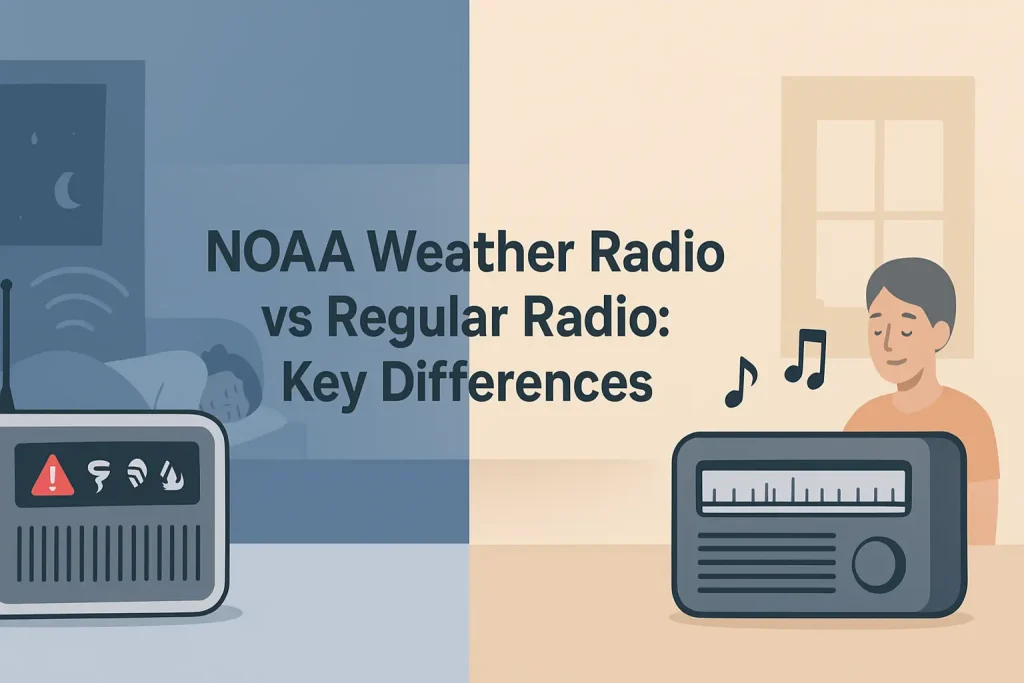
Jensen weather radios sit in a narrow price band between $20 and $50, and that positioning is exactly what makes them worth examining carefully. They receive all seven NOAA Weather Radio All Hazards frequencies between 162.400 and 162.550 MHz, they include S.A.M.E. (Specific Area Message Encoding) alert filtering on most models, and they cost roughly half what a Midland or Uniden equivalent runs at retail.
The question is not whether Jensen radios work. The question is what you give up at this price point, and whether those trade-offs matter for your specific situation.
| Photo | Popular Portable Walkie Talkies | Price |
|---|---|---|
 | SKIWARRIOR Multifunctional Smart Wireless Ski Goggles with Walkie-Talkie, Anti-Fog Zeiss Lens, Music & Call Function (Cylindrical Blue) | Check Price On Amazon |
 | SINORISE Super Mini Walkie Talkies, Two-Way Radios, 3 Pack | Check Price On Amazon |
 | KOSPET Tank M4C Smart Watch Rugged, Dual-Band GPS, 5ATM & IP69K Waterproof | Check Price On Amazon |
 | Retevis RT15 Walkie Talkies 3 Pack, Birthday Gift, Outdoor Adventure Kit | Check Price On Amazon |
 | Rechargeable Walkie Talkies Toys for Kids: DIY Astronaut Walkie Talkies for Boys Christmas Birthday Gifts for 3 4 5 6 7 8 9 10 Boy Walkie Talkie Outdoor Hiking Toy 2 Way Radio Camping Outdoor Game | Check Price On Amazon |
By the Numbers
Jensen Weather Radio: Key Specifications and Standards
Sources: NOAA Weather Radio All Hazards technical documentation, FCC Part 11 (EAS), Jensen product specifications.
What Is a Jensen Weather Radio and Who Makes It?
Jensen is a consumer electronics brand that has operated under several parent companies over the decades, most recently distributed under Voxx International, which also owns Acoustic Research and RCA consumer electronics. Jensen weather radios are not manufactured by Jensen as an independent entity.
The brand is primarily a retail licensing arrangement. That matters because it explains why Jensen weather radios appear at discount retailers like Walmart, Dollar General, and pharmacy chains rather than at specialty radio or emergency preparedness stores.
Jensen weather radios fall into the entry-level category of NOAA weather radio receivers. They are single-purpose or combination AM/FM/weather receivers built around a standard NOAA WX receiver chipset, not a proprietary design.
The core function is identical across all models at this price tier: receive one or more of the seven NOAA Weather Radio All Hazards frequencies, decode the 1050 Hz alert tone, and sound an alarm when a matching alert is broadcast for your programmed S.A.M.E. county code.
Jensen Weather Radio Models: What Is Currently Available?
Jensen produces several weather radio configurations, ranging from basic single-purpose alert receivers to combination AM/FM/weather portable units. The most commonly reviewed models include the Jensen WR-550, the JEN-WR550, and combination portable radios sold under the Jensen Emergency Radio label.
Most Jensen weather radios share the same core hardware platform with minor cosmetic and feature differences between model numbers. Understanding which features vary and which are constant across the lineup is the most useful starting point for a purchase decision.
Jensen WR-550 and Similar Tabletop Models
The Jensen WR-550 is a tabletop NOAA weather alert radio designed for home or office use. It receives all seven NOAA Weather Radio frequencies and includes a S.A.M.E. alert decoder for county-level filtering.
Key Specifications:
- Frequency coverage: 162.400 MHz, 162.425 MHz, 162.450 MHz, 162.475 MHz, 162.500 MHz, 162.525 MHz, 162.550 MHz
- S.A.M.E. programmable codes: varies by model (typically 5 to 10 county codes)
- Power: AC adapter with battery backup (typically 3x AA alkaline)
- Alert types: visual LED alert, audible alarm tone, voice broadcast
- Display: LCD with channel and alert status indicators
The battery backup is critical. A weather radio that loses power during a tornado or ice storm is useless exactly when you need it most.
Jensen Portable and Hand-Crank Combination Models
Some Jensen models combine NOAA weather reception with AM/FM radio and a hand-crank or solar charging panel. These are marketed as emergency preparedness radios rather than dedicated weather alert receivers.
The combination format adds versatility but introduces trade-offs. Hand-crank charging typically delivers very limited power per minute of cranking, so the primary power source for alert monitoring should always be battery or AC, not the crank.
If you are specifically looking for a hand-crank option, our complete guide to choosing and using hand-crank emergency radios covers the charging math and what to realistically expect from crank-powered receivers.
Does a Jensen Weather Radio Receive All Seven NOAA Frequencies?
Yes, Jensen weather radios receive all seven NOAA Weather Radio All Hazards broadcast frequencies between 162.400 and 162.550 MHz. This is the minimum technical requirement for any product sold as a NOAA weather radio in the United States, and Jensen meets it across all current models.
NOAA operates approximately 1,000 transmitters nationwide at power levels between 300 watts and 1,000 watts. Coverage radius from a typical 1,000-watt transmitter is approximately 40 miles under normal propagation conditions, according to NOAA NWR technical documentation.
The seven NOAA broadcast frequencies are:
- WX1: 162.550 MHz
- WX2: 162.400 MHz
- WX3: 162.475 MHz
- WX4: 162.425 MHz
- WX5: 162.450 MHz
- WX6: 162.500 MHz
- WX7: 162.525 MHz
Your Jensen radio can be set to scan all seven channels or lock onto the strongest local signal. Most users in areas with a single dominant transmitter will get better alert reliability by locking to the assigned local WX channel rather than scanning.
The primary limitation on Jensen’s reception quality is antenna sensitivity, not frequency coverage. Budget weather radios use shorter, less efficient internal antennas compared to mid-range units. This matters most in fringe coverage areas more than 30 miles from the nearest transmitter.
How Does S.A.M.E. Alert Filtering Work on Jensen Models?
S.A.M.E. (Specific Area Message Encoding) is the digital header system NOAA uses to identify which counties an alert applies to. A weather radio with S.A.M.E. decoding compares the county codes in an incoming alert against your programmed FIPS codes and only sounds the alarm if there is a match.
Without S.A.M.E. filtering, your weather radio sounds an alarm for every alert broadcast by your local transmitter, including alerts for counties 100 miles away that share the same transmitter footprint. This is the single most important feature distinction between a basic weather radio and a useful one.
A 6-digit FIPS (Federal Information Processing Standards) code identifies your county. The first two digits are your state code, and the final three digits identify the specific county. For example, FIPS code 037031 represents Cook County, Illinois.
To program S.A.M.E. on a Jensen radio, you need to find your county’s FIPS code first. NOAA publishes the complete FIPS code database on the NWS website. You enter the 6-digit code through the radio’s keypad, and the radio stores it in memory.
Here is where Jensen models show a limitation compared to mid-range competitors. Most Jensen models store 5 to 10 S.A.M.E. codes. The Midland WR120B stores 25 programmable S.A.M.E. county codes, which matters if you travel, live near a county border, or want to monitor alerts for family members in adjacent counties.
For most single-location home users, 5 programmable codes is sufficient. You typically need your home county, possibly one adjacent county if you live near a border, and that is the realistic use case for most residential installations.
Jensen Weather Radio Alert Types: What Hazards Does It Receive?
NOAA Weather Radio All Hazards broadcasts more than 25 distinct alert event types, and a Jensen radio with S.A.M.E. decoding will respond to all of them when programmed with your county code. The alert categories span weather emergencies, non-weather emergencies, and national-level alerts.
Weather alert types include: Tornado Warning, Tornado Watch, Severe Thunderstorm Warning, Flash Flood Warning, Flash Flood Watch, Hurricane Warning, Hurricane Watch, Winter Storm Warning, Blizzard Warning, Ice Storm Warning, High Wind Warning, Extreme Wind Warning, and Tropical Storm Warning.
Non-weather emergency alert types include: AMBER Alert (child abduction emergency), Civil Emergency Message, Hazardous Materials Warning, Nuclear Power Plant Warning, Radiological Hazard Warning, Evacuation Immediate, and Law Enforcement Warning.
The national alert type is the Emergency Action Notification (EAN), which is the Presidential Alert that activates during a national emergency. This alert overrides all S.A.M.E. filtering by design and sounds on every compliant receiver regardless of programmed county codes.
Jensen radios respond to all of these categories because S.A.M.E. filtering works at the event-code level, not the hardware level. The limitation is not which alert types the radio can receive. The limitation is how many county codes you can program to filter those alerts geographically.
Jensen Weather Radio Review: Audio Quality and Alert Volume
Alert volume is the most practically important specification for a weather radio, and it is the area where budget models like Jensen show the most noticeable difference from mid-range competitors. A weather radio that cannot wake a sleeping adult in a closed bedroom is not performing its core function.
Jensen weather radios typically produce alert tones at speaker output levels between 80 and 85 dB at one meter, measured in free-air conditions. Midland’s mid-range WR400 produces approximately 90 dB. That 5 to 10 dB difference is significant: every 10 dB increase represents a perceived doubling of loudness to the human ear.
For bedroom placement with the door open, a Jensen radio set to maximum volume is generally adequate for most adults. For bedroom use with the door closed, or for users who are deep sleepers, the alert volume may be insufficient without placing the unit within 3 to 5 feet of the sleeping area.
Voice broadcast clarity on Jensen models is acceptable for comprehension but noticeably lower fidelity than competing units. NOAA broadcasts use a synthesized Text-to-Speech voice system (the familiar “Paul” voice generated by SpeechWorks/Nuance), and lower-quality speakers render the already-robotic voice harder to parse quickly under stress.
The alert LED on most Jensen models provides a visual indicator that is visible across a room in normal indoor lighting. This is useful for hearing-impaired users as a supplemental alert but is not bright enough to serve as a primary alert mechanism for users who sleep with lights off.
How Does Jensen Compare to Midland, Uniden, and Sangean?
The table below compares Jensen directly against three of the most commonly purchased weather radio brands at overlapping price points. Use this table to decide whether the price difference between Jensen and its competitors is justified for your specific needs.
Product Comparison
Jensen vs Midland vs Uniden vs Sangean: Weather Radio Feature Comparison
Key features compared. Sources: manufacturer data sheets, NOAA NWR technical documentation.
| Specification | Jensen WR-550 | Midland WR120B | Uniden BC365CRS | Sangean CL-100 |
|---|---|---|---|---|
| NOAA frequencies | 7 (all) | 7 (all) | 7 (all) | 7 (all) |
| S.A.M.E. filtering | Yes (5-10 codes) | Yes (25 codes) | Yes (10 codes) | Yes (20 codes) |
| Battery backup | 3x AA | 3x AA | 3x AA | 3x AA |
| Alert memory | Basic (no logging) | Yes (last alert) | Yes (14 alerts) | Yes (10 alerts) |
| AM/FM reception | Varies by model | No (WX only) | No (WX only) | Yes (AM/FM/WX) |
| Approximate price | $20-$35 | $30-$45 | $35-$55 | $55-$75 |
| Best for | Budget-conscious buyers, secondary unit | Value primary home unit | Alert logging, family use | Multi-use emergency radio with best audio |
Prices verified at time of publication. S.A.M.E. code counts based on manufacturer specifications. All models receive all seven NOAA WX frequencies per FCC Part 11 and NOAA NWR requirements.
The most important column in that table is the S.A.M.E. code count. For single-county home use, Jensen’s 5 to 10 codes is adequate. For anyone who wants to monitor multiple counties, the Midland WR120B at roughly $10 to $15 more is the better investment.
Our full review of the Sangean CL-100 AM/FM weather radio combination receiver covers its audio performance and S.A.M.E. filtering in detail if the multi-use format appeals to you.
Here is a visual look at how Jensen’s price positions against the field across the budget-to-premium weather radio spectrum.
Price Comparison
NOAA Weather Radios – Price Comparison by Model
Street price, sorted lowest to highest. Prices verified at time of publication.
~$25
~$38
~$45
~$65
~$80
~$499
Single-unit prices. S.A.M.E. programming required for county-level alert filtering on all models. Prices verified at time of publication.
What Are the Real Limitations of Jensen Weather Radios?
The limitations of Jensen weather radios fall into three categories: hardware quality, feature depth, and brand support. None of these limitations are disqualifying for the right buyer, but each matters depending on how you plan to use the radio.
Hardware Quality Limitations
Jensen radios are built to a price point. The plastic housing is noticeably lighter and thinner than Midland or Uniden equivalents. This does not affect radio performance under normal tabletop use, but it does mean the unit is more vulnerable to drops or accidental impacts.
The internal antenna is shorter and less efficient than antennas in mid-range units. Users within 15 to 20 miles of a NOAA transmitter will not notice any difference. Users in rural areas 30 to 40 miles from the nearest transmitter may experience weaker signal lock, which can cause the S.A.M.E. decoder to miss alert headers on marginal signals.
The remedy for antenna limitation is a simple one: most Jensen models include a 3.5mm external antenna jack. A basic external wire antenna (a length of wire clipped to the antenna jack) improves signal strength measurably in fringe coverage areas.
Feature Depth Limitations
Jensen models do not log previous alerts. If you wake up to a silent radio after a storm, you have no way to review what alerts were broadcast while you were asleep. The Midland WR120B’s alert memory stores and displays the last received alert, and the Uniden BC365CRS logs the last 14 alerts with timestamps.
Alert logging is more important than most buyers initially realize. After a severe weather event, being able to confirm what alerts were issued, for which counties, and at what time helps you understand what actually happened and whether follow-up alerts are still active.
Jensen models also typically lack a backlit clock display with alarm integration. If you want a bedside weather radio that doubles as an alarm clock with the ability to wake you for weather alerts before your alarm, most Jensen models do not offer this feature. The Uniden BC365CRS and several Midland models include this combination at a moderate price premium.
Brand Support Limitations
Jensen’s warranty terms are generally limited to 90 days to one year, and customer support channels are less developed than Midland or Uniden, both of which have dedicated radio-specific support resources. Replacement parts and service options for Jensen weather radios are essentially nonexistent at the consumer level.
For a $25 radio, this is arguably acceptable. If the unit fails after the warranty period, the practical response is replacement rather than repair. For a $75 unit, the calculus is different.
Jensen Weather Radio Pros and Cons Scorecard
The scorecard below summarizes Jensen’s performance across the dimensions that matter most for a weather alert radio in a residential setting.
Product Review
Jensen WR-550 – Pros and Cons
Based on NOAA NWR specifications and verified buyer experience across retail platforms.
Pros
- ✓Receives all 7 NOAA WX frequencies (162.400-162.550 MHz)
- ✓S.A.M.E. county-level alert filtering included at entry price
- ✓AC power with AA battery backup for power outage operation
- ✓Widely available at mass-market retailers (Walmart, Amazon, pharmacy chains)
- ✓External antenna jack (3.5mm) for range improvement in fringe areas
- ✓Low price makes it viable as a secondary or travel unit
Cons
- ✗Alert volume (approximately 80-85 dB at 1m) may not wake deep sleepers in closed rooms
- ✗No alert log or memory for reviewing previously received alerts
- ✗Fewer S.A.M.E. programmable codes (5-10) than mid-range competitors (25-50)
- ✗Lightweight plastic housing with limited drop resistance
- ✗No backlit clock or integrated alarm function on most models
- ✗Limited warranty (typically 90 days to 1 year) with minimal brand support
Jensen is the right choice for budget-limited buyers who need a functional S.A.M.E.-capable weather radio for a single location, and the wrong choice for anyone who needs alert logging, high alert volume for bedroom use, or more than 10 programmable county codes.
How to Program S.A.M.E. Codes on a Jensen Weather Radio
Programming a S.A.M.E. FIPS code on a Jensen weather radio takes approximately five minutes. The process varies slightly between models but follows the same basic sequence across the Jensen lineup. Before you start, look up your county’s 6-digit FIPS code at the NOAA NWR S.A.M.E. website (weather.gov/nwr/same).
Step-by-Step Guide
How to Program S.A.M.E. County Codes on a Jensen Weather Radio
6 steps, approximately 5 minutes. Requires your 6-digit county FIPS code from weather.gov/nwr/same.
Look up your county FIPS code before touching the radio
Navigate to weather.gov/nwr/same and use the state and county dropdown menus to find your 6-digit FIPS code. Write it down. The code for a typical county looks like this: 037031 (Cook County, Illinois).
Power on the radio and press the PROG or MENU button
The display will enter programming mode. On most Jensen models, the S.A.M.E. setup option appears as “FIPS” or “COUNTY CODE” in the display menu. If your radio does not have a PROG button, consult the manual for the specific key combination (often holding the ALERT or WX button for 3 seconds).
Select the code entry slot (location 1, 2, 3, etc.)
Jensen models with 5 to 10 code slots will display a numbered slot selection screen. Use the up/down buttons to navigate to slot 1 and press select or enter. Start with your home county in slot 1.
Enter the 6-digit FIPS code using the number keypad or up/down arrows
Some Jensen models have a numeric keypad for direct code entry. Others use up/down arrows to scroll each digit individually. For arrow-based entry, each digit scrolls 0 through 9, so enter each digit of your FIPS code in sequence from left to right.
Press enter or confirm to save the code
The display should confirm the saved code by showing the FIPS digits in the slot you selected. If the radio returns to normal operation without confirming, press the PROG or MENU button again to verify the code was stored correctly in slot 1.
Verify S.A.M.E. is activated and test the alert function
Most Jensen models have a TEST button that triggers a simulated alert tone to confirm the alarm is audible. NOAA also conducts a weekly required test broadcast on Wednesdays between 11:00 AM and noon local time in most areas, which will confirm your S.A.M.E. programming is working correctly if you are monitoring at that time.
One common mistake: entering the wrong number of digits. FIPS codes are always exactly 6 digits. Some older Jensen manuals show a 5-digit entry field on older hardware, which corresponds to a legacy SAME code format. If your display only accepts 5 digits, enter the last 5 digits of the standard 6-digit FIPS code (drop the leading state digit).
Is a Jensen Weather Radio Good Enough for Emergency Preparedness?
A Jensen weather radio with S.A.M.E. filtering and AC/battery backup is functionally adequate for the core emergency preparedness use case: receiving a NOAA alert for your specific county in the middle of the night and waking up in time to take shelter. That is the job, and Jensen does it at an entry-level price.
The honest answer to whether it is “good enough” depends on your situation. For a suburban home within 20 miles of a NOAA transmitter, with the radio placed in a bedroom or hallway where the alert can be heard, Jensen is adequate. For a rural property in a fringe coverage area, or for a household with heavy sleepers who genuinely need maximum alert volume, Jensen is not the best choice.
The weakness that matters most for emergency preparedness is the lack of alert logging. NOAA often issues multiple alerts in sequence during a severe weather event. Not knowing whether a current alert is a new threat or a continuation of a previous one has real consequences when you are deciding whether to stay in your shelter.
For a complete overview of what separates entry-level from mid-range weather radios across every feature that matters for emergency use, our weather radio buying guide covering S.A.M.E., alert logging, and battery backup options walks through the full decision framework.
The practical recommendation: if you have a Jensen and nothing else, keep it. If you are buying new specifically for emergency preparedness, spend the extra $10 to $15 for a Midland WR120B and get 25 S.A.M.E. codes and alert memory.
Quick Reference: Key Weather Radio Terms
Quick Reference
Weather Radio Terms You Need to Know
Key terminology used throughout this review, defined in plain language.
- NOAA Weather Radio All Hazards (NWR)
- The nationwide network of government radio stations broadcasting continuous weather information and emergency alerts 24 hours a day on seven VHF frequencies between 162.400 and 162.550 MHz.
- S.A.M.E. (Specific Area Message Encoding)
- A digital header embedded in NOAA alert broadcasts that identifies which counties the alert applies to. A receiver with S.A.M.E. decoding only sounds the alarm when the broadcast county code matches your programmed FIPS code.
- FIPS Code
- Federal Information Processing Standards code. A 6-digit number that uniquely identifies a US county. The first two digits are the state code; the last three identify the county. You program this code into your weather radio to filter alerts by location.
- EAS (Emergency Alert System)
- The national public warning system that distributes emergency alerts across radio, television, and the NOAA NWR network. Weather radio alerts are one component of the broader EAS infrastructure governed by FCC Part 11.
- 1050 Hz Alert Tone
- The specific attention signal broadcast at the start of every NOAA weather alert. Your weather radio detects this tone and activates its alarm circuit, waking the radio from standby mode before broadcasting the voice message.
- Alert Log / Alert Memory
- A feature on mid-range and premium weather radios that stores a record of previously received alerts, including the event type, county, and time. Jensen models generally do not include this feature.
- WX Channel
- One of the seven designated NOAA Weather Radio frequencies, labeled WX1 through WX7 on weather radio channel selectors. WX1 corresponds to 162.550 MHz; each subsequent WX number maps to a different frequency in the 162 MHz band.
- Battery Backup
- Secondary power source (typically 3x AA alkaline batteries) that keeps the weather radio operational during AC power outages. This is critical because severe weather events frequently cause power failures at exactly the time you need the radio most.
Where to Buy a Jensen Weather Radio
Jensen weather radios are distributed through mass-market retail channels rather than specialty radio stores. You are most likely to find them at Walmart, Walgreens, CVS, Dollar General, and on Amazon. This distribution model is both a convenience and a limitation.
The convenience: Jensen is available in stores where people already shop, which means it reaches buyers who are not actively seeking emergency preparedness products. Many Jensen units are purchased alongside batteries and flashlights in the days before a predicted storm.
The limitation: because Jensen sells through mass-market channels, the specific model available at any given store varies, and older or discontinued models frequently appear on Amazon from third-party sellers without any indication of their vintage or remaining warranty period.
If you are buying a Jensen NOAA weather alert radio on Amazon, check the seller name and verify it is not a third-party reseller selling an older model as new. Look for the S.A.M.E. designation in the product title to confirm the county-level filtering feature is included.
For a broader look at where to find weather radios at retail and online, our guide to finding and buying weather radios across retail and online channels covers availability and what to verify before purchasing.
Jensen Weather Radio vs Other Budget Options: Eton FRX3 Plus and Others
At the $25 to $50 price tier, Jensen competes directly with combination emergency radios from Eton, RunningSnail, and Midland’s entry models. The Eton FRX3 Plus is the most commonly compared alternative because it adds a hand-crank generator, solar panel, and USB phone charging capability at a price between $40 and $55.
The core trade-off between Jensen and Eton at this price level is specialization versus versatility. Jensen weather radios are optimized for one function: receiving NOAA alerts. Eton combination radios add multiple power sources and phone charging but spread the hardware budget across more features, often resulting in a weaker internal NOAA antenna and a less sensitive S.A.M.E. decoder on marginal signals.
For a detailed look at the Eton FRX3 Plus’s performance on NOAA reception and hand-crank power output, our full review of the Eton FRX3 Plus emergency radio covers its real-world alert reception and charging capabilities.
The practical guidance: if your primary goal is reliable NOAA weather alerts and you want the best S.A.M.E. performance at a given price, a single-purpose weather radio (Jensen, Midland, or Uniden) generally outperforms a combination unit at the same price. If you want one unit that also charges your phone during a power outage, the Eton FRX3 Plus is a reasonable choice with that trade-off understood.
For a full ranked comparison of the best weather radios across all price tiers, including how Jensen fits into the broader landscape, our complete roundup of top-rated NOAA weather radios for home and emergency use covers every major option with specifications.
Who Should Buy a Jensen Weather Radio?
Jensen is the right weather radio for three specific buyer profiles. Outside these profiles, spending an additional $10 to $20 on a Midland or Uniden model delivers meaningfully better value.
Profile 1: The budget-constrained first-time buyer. If the choice is between a Jensen at $25 and no weather radio at all, the Jensen is unambiguously the right answer. A functional S.A.M.E.-capable weather radio at $25 is vastly better than a premium-featured radio that never gets purchased.
Profile 2: The secondary or redundant unit buyer. If you already own a Midland WR400 as your primary bedroom radio and want a second unit for the kitchen, workshop, or a vacation property, Jensen’s low price makes it a sensible option for a non-critical placement.
Profile 3: The gift buyer purchasing for someone who will not program the radio. Jensen’s wide retail availability and simple interface make it accessible for a recipient who may not be comfortable with technology. The programming process is straightforward, and if the recipient never programs the S.A.M.E. code, the radio will still alert for all county broadcasts from the local transmitter in default (non-S.A.M.E.) mode.
Jensen is the wrong choice for: households in fringe coverage areas more than 30 miles from a transmitter, buyers who rely on the radio as their sole severe weather alert mechanism in a bedroom with the door closed, anyone who needs more than 10 programmable county codes, and anyone who wants to review the alert history after a weather event.
Setting Up Your Jensen Weather Radio for the First Time
A Jensen weather radio that has never been programmed will still sound alerts, but it will alert for every county within your local NOAA transmitter’s coverage footprint. In metropolitan areas, a single transmitter covers 10 to 30 counties, which means you can expect alerts for severe weather 50 to 100 miles away. S.A.M.E. programming is not optional for useful operation.
The setup checklist for a new Jensen weather radio:
- Install fresh AA alkaline batteries in the battery backup compartment before connecting to AC power. This ensures battery backup is active immediately from first use.
- Connect the AC adapter and power on the radio.
- Set the channel to SCAN or to your local WX channel number. Your local NOAA WX channel assignment is available at weather.gov/nwr by entering your zip code.
- Look up your 6-digit county FIPS code at weather.gov/nwr/same.
- Follow the S.A.M.E. programming steps outlined in the section above to enter your county code.
- Set the alert mode to ALERT ON or the equivalent setting for your model. Do not leave the radio in WEATHER mode only, as this typically plays weather broadcasts continuously without activating the alarm function.
- Press the TEST button to confirm the alarm tone is audible at your intended listening distance.
One setup mistake that affects many first-time buyers: leaving the radio in continuous weather broadcast mode rather than alert standby mode. In broadcast mode, the radio plays weather forecasts continuously, which is noisy and drains battery backup faster. In alert standby mode, the radio is silent until a S.A.M.E.-matching alert is received, then activates the alarm and broadcasts the alert audio. Alert standby mode is the correct operating mode for overnight and unattended monitoring.
What Happens When the Power Goes Out During a Storm?
When AC power is interrupted, a Jensen weather radio with fresh AA batteries in the backup compartment will continue operating normally. The transition from AC to battery power is automatic and silent on most models.
Battery life during alert standby mode on 3x AA alkaline batteries is typically 24 to 72 hours depending on alert frequency and signal strength conditions. A radio in a fringe coverage area that is constantly re-scanning for a marginal signal will drain batteries faster than a radio with strong signal lock in a well-covered urban area.
One important note: the battery backup compartment on many Jensen models is designed to hold batteries at all times, not just during emergencies. Install fresh batteries when you set up the radio and replace them annually. Alkaline batteries stored in the compartment for two to three years will corrode and potentially damage the battery contacts, which is the single most common hardware failure mode for tabletop weather radios of all brands.
Set a calendar reminder to replace the batteries in your Jensen weather radio once per year. The Wednesday NOAA weekly test broadcast (11:00 AM to noon local time in most areas) is a natural opportunity to verify the radio is operational, the S.A.M.E. code is still programmed, and the battery backup is functioning.
If you want to explore weather radios with longer-duration battery operation or alternative power sources for extended outages, our guide to hand-crank and solar weather radios for extended power outages covers the options with realistic runtime expectations.
Is a Jensen Weather Radio Loud Enough to Wake You Up?
For most adults sleeping within 10 to 15 feet of the radio with a bedroom door open, a Jensen weather radio set to maximum volume produces enough alert tone to wake them from normal sleep. The 1050 Hz alert tone is specifically designed for sleep interruption at distances of 10 to 20 feet.
The conditions under which a Jensen’s alert volume may be insufficient are: bedroom door closed with a solid-core door, use of a white noise machine or CPAP device in the bedroom, sleeping in a room on a different floor from the radio, or individuals who are particularly heavy sleepers.
The Midland WR400 weather radio produces approximately 90 dB at one meter versus Jensen’s approximately 80 to 85 dB. For bedroom use with the door closed, the Midland’s higher alert volume is a meaningful difference. At maximum volume, 90 dB is approximately twice as loud perceptually as 80 dB.
If you own a Jensen and are concerned about wake-ability, the most effective solution is placement: position the radio within 5 feet of your sleeping location rather than across the room. Closer placement compensates for lower maximum volume more effectively than any software or settings adjustment.
Jensen Weather Radio and Tornado Season: What You Need to Know
NOAA Weather Radio broadcasts tornado warnings with an average lead time of 13 minutes, according to NOAA National Weather Service data. That 13-minute window is the reason a working weather radio with S.A.M.E. filtering is worth having, and it is also why the details of your specific setup matter.
A Jensen radio that has never had a S.A.M.E. code programmed will activate for tornado warnings in adjacent counties, not just your own. If you live in a metro area where multiple counties share a transmitter, your radio may wake you for warnings that are 50 miles away and do not affect you. This is not harmful, but it trains you to ignore alerts, which is dangerous.
Program your county FIPS code. This is the single most important step for making any weather radio, Jensen or otherwise, useful for tornado preparedness rather than just noise.
Tornado season in the United States peaks between April and June in the central plains (Tornado Alley, roughly Oklahoma through Nebraska) and between November and January for a secondary peak in the Gulf Coast states. NOAA regional offices adjust transmitter power and staffing seasonally in high-activity periods.
For the highest-risk tornado months in your specific region, NOAA’s Storm Prediction Center (spc.noaa.gov) publishes historical storm data by county that you can use to understand your actual local risk level.
Can You Use a Jensen Weather Radio for All Hazards Beyond Severe Weather?
Yes. NOAA Weather Radio All Hazards broadcasts non-weather emergencies as well, and a Jensen radio with S.A.M.E. decoding will respond to all of them when the event code and county code match your programmed settings.
Non-weather alerts distributed through the NOAA NWR network include: AMBER Alerts for child abductions, Civil Emergency Messages for public safety events, Hazardous Materials Warnings for chemical spills or industrial accidents, Nuclear Power Plant Warnings, and Radiological Hazard Warnings.
The Emergency Action Notification (EAN), which is the federal Presidential Alert, overrides all S.A.M.E. filtering and activates every compliant weather radio receiver simultaneously regardless of programmed county codes. This is the only alert type that bypasses S.A.M.E. by design.
Jensen models respond to all of these event types because the hardware processes S.A.M.E. event codes at the decoder level, not through a filtered event list. The radio does not distinguish between a tornado warning and an AMBER Alert at the alarm circuit level. Both will trigger the same alarm tone and voice broadcast.
Frequently Asked Questions
Does a Jensen weather radio need to be plugged in to work?
A Jensen weather radio operates on AC power under normal conditions, but all current models include a battery backup compartment (typically 3x AA alkaline) that activates automatically during power outages. Install fresh batteries before your first use so the backup is ready from day one.
The radio will function in full S.A.M.E. alert mode on battery power alone. Battery life in alert standby mode is typically 24 to 72 hours on fresh AA alkaline batteries, depending on how frequently the radio re-scans for a NOAA signal.
What is the difference between a Jensen weather radio in WEATHER mode and ALERT mode?
WEATHER mode plays the continuous NOAA weather forecast broadcast over your radio’s speaker, similar to listening to a radio station. ALERT mode (sometimes labeled STANDBY or ALARM ON) silences the speaker and monitors the NOAA frequency in the background, only activating the audible alarm when a matching S.A.M.E. alert is received.
For overnight and unattended monitoring, use ALERT mode. WEATHER mode is intended for manually listening to current conditions, not for passive emergency monitoring. Leaving a Jensen in WEATHER mode overnight will play continuous broadcast audio all night and drain battery backup faster.
Can I program more than one county into a Jensen weather radio?
Yes. Most Jensen models support between 5 and 10 programmable S.A.M.E. FIPS codes. You can program your home county, one or more adjacent counties, and counties where family members live (if relevant) up to the model’s storage limit.
If you need more than 10 programmable county codes, the Midland WR120B stores 25 codes and the Midland WR400 stores 50 codes. Both are available at modest price premiums over Jensen’s entry-level models.
Why is my Jensen weather radio sounding alerts for areas far from my location?
This happens because the S.A.M.E. county code has not been programmed, or because the programmed code does not match your current location. When no S.A.M.E. code is set, the radio responds to every alert broadcast by your local NOAA transmitter, which covers a footprint that often spans 10 to 30 counties.
Follow the S.A.M.E. programming steps in this article, enter your 6-digit county FIPS code from weather.gov/nwr/same, and the radio will only activate for alerts issued for your specific county. This is the correct operating configuration for a residential weather radio.
Does a Jensen weather radio pick up all 7 NOAA frequencies or just the strongest one?
Jensen weather radios can operate in scan mode (cycling through all seven WX frequencies to find the strongest local signal) or manual mode (locked to a specific WX channel number you select). Both modes receive all seven frequencies, but the radio only monitors one frequency at a time.
In most residential locations, one NOAA transmitter covers your area. In areas near the border of two transmitter coverage zones, scan mode may lock onto a transmitter from a neighboring region that broadcasts different county alerts than your home transmitter. In those cases, manually locking to your home area’s designated WX channel prevents cross-region alert confusion.
Can I use a Jensen weather radio as my only emergency communication device?
A Jensen weather radio provides receive-only capability. It receives NOAA alerts but cannot transmit any signal. For two-way emergency communication with family members outside your home, you need a separate device such as an FRS walkie-talkie, a GMRS radio, or a cell phone.
For complete emergency preparedness, the recommended minimum setup is a S.A.M.E.-capable weather radio for inbound government alerts plus at least one pair of FRS or GMRS radios for local communication when cell networks are congested or unavailable during a widespread emergency event.
What do I do if my Jensen weather radio is not picking up a NOAA signal?
First, verify the radio is set to a WX channel and not an AM or FM frequency. Second, try switching to scan mode to let the radio find the strongest available WX signal automatically. Third, check whether your location is within 40 miles of a NOAA transmitter using the coverage map at weather.gov/nwr.
If you are in a fringe coverage area, connect a length of wire (18 to 36 inches) to the 3.5mm external antenna jack if your Jensen model has one. This improvised wire antenna improves signal strength measurably in areas with marginal NOAA reception. If your model lacks an external antenna jack, repositioning the radio near a window facing the direction of the nearest transmitter can improve signal quality.
Is a Jensen weather radio FCC Part 11 compliant for EAS reception?
Consumer weather radios sold in the United States must comply with FCC Part 11 (Emergency Alert System) rules, and Jensen models sold through major retail channels meet this compliance requirement. FCC Part 11 specifies the 1050 Hz alert tone detection, the S.A.M.E. header decoding requirements, and the EAN override provisions that allow the Presidential Alert to bypass S.A.M.E. filtering.
Consumer weather radios are not required to meet the more stringent FCC Part 11 specifications that apply to broadcast stations and cable systems. The consumer compliance standard requires basic S.A.M.E. decoding and 1050 Hz tone response but does not mandate the alert logging, audio fidelity, or backup power duration specifications required of broadcast EAS equipment.
What is the weekly NOAA weather radio test and will it trigger my Jensen alarm?
NOAA broadcasts a Required Monthly Test (RMT) with full S.A.M.E. header encoding on the first Wednesday of each month in most areas. This test is designed to activate S.A.M.E.-capable receivers and will trigger your Jensen alarm exactly as a real alert would, producing the 1050 Hz tone followed by a voice announcement identifying it as a test.
NOAA also conducts a weekly test called the Required Weekly Test (RWT) every Wednesday between 11:00 AM and noon local time in most areas. The RWT does not include a full S.A.M.E. activation header on most transmitters and will typically not trigger your Jensen’s alarm circuit. Use the RMT (first Wednesday of the month) to verify your S.A.M.E. programming is working correctly.
Can a Jensen weather radio alert me to an AMBER Alert?
Yes. AMBER Alerts are distributed through the NOAA NWR network using S.A.M.E. event code CDW (Child Abduction Emergency). A Jensen radio with your county’s FIPS code programmed will activate its alarm when an AMBER Alert is issued for your county, using the same 1050 Hz tone and voice broadcast sequence as weather alerts.
The practical limitation is timing. AMBER Alerts are also distributed through the Wireless Emergency Alert (WEA) system to cell phones in the affected area, which typically reaches more people more quickly than weather radio. Your Jensen radio provides a valuable redundant notification path, particularly for people in areas with weak cellular coverage or who have WEA alerts disabled on their phones.
How does a Jensen weather radio compare to receiving NOAA alerts on a smartphone app?
Smartphone weather alert apps and Wireless Emergency Alerts (WEA) depend on cellular network availability. During a severe weather event, cell towers can become congested, damaged, or lose power, causing significant delays or complete failure in alert delivery. A dedicated NOAA weather radio receives alerts via VHF radio signal, which continues operating independently of cellular infrastructure.
NOAA weather radio alert latency is typically under 30 seconds from NWS issuance to your radio’s alarm activation. Cell-based WEA alerts have no guaranteed delivery time and have documented cases of 5 to 30 minute delays during high-demand periods. For tornado warnings where the average lead time is 13 minutes, a 20-minute delayed cell alert provides no actionable warning. A dedicated weather radio operating on VHF at 162 MHz does not share this vulnerability.
A Jensen weather radio delivers NOAA alerts with consistent sub-30-second latency via VHF radio signal, completely independent of cellular infrastructure. For the roughly $25 cost of a Jensen unit, it provides a reliable backup alert path that functions when cell networks fail during the exact events where you need alerts most.
If you are weighing a Jensen against other entry-level options or want to see how the full weather radio market breaks down by price and feature tier, our ranked guide to the best NOAA weather radios across all budgets is the right next read.
| Photo | TOP RATED WALKIE TALKIES | Price |
|---|---|---|
 | Retevis RT628 Kids Walkie Talkies, Toys Gifts for 4-12 Year Old Girl Boy | Check Price On Amazon |
 | Cobra ACXT545 Weather-Resistant Walkie Talkies, Rechargeable, 22 Channels | Check Price On Amazon |
 | Retevis RT388 Kids Walkie Talkies, Outdoor Toys for Kids Camping Essentials | Check Price On Amazon |
 | Cobra RX680 Walkie Talkies (2-Pack), IP54 Water Resistant Design | Check Price On Amazon |
 | Retevis RT22 Walkie Talkies Long Range Rechargeable with Earpiece (2 Pack) | Check Price On Amazon |
 | Midland GXT1000VP4 GMRS Two-Way Radios with Headsets, Black, 2 Pack | Check Price On Amazon |
 | Retevis RT628 Walkie Talkies for Kids,Toys Gifts for 6-12 Years Old Boys Girls,Long Range 2 Way Radio 22CH VOX,Birthday Gift,Family Walkie Talkie for Camping Hiking Indoor Outdoor | Check Price On Amazon |