You can stream NOAA Weather Radio broadcasts directly in your browser without buying any hardware. Every one of the seven NOAA weather radio frequencies (162.400 to 162.550 MHz) is rebroadcast online through official and community-maintained streaming platforms, giving you real-time NWR audio on any device with an internet connection.
This guide covers every working method for browser-based NOAA weather radio streaming, including the best websites, how to find your local transmitter’s stream, what to do when streams go offline, and how online listening compares to a dedicated NOAA weather alert radio for emergency preparedness.
| Photo | Popular Portable Walkie Talkies | Price |
|---|---|---|
 | SKIWARRIOR Multifunctional Smart Wireless Ski Goggles with Walkie-Talkie, Anti-Fog Zeiss Lens, Music & Call Function (Cylindrical Blue) | Check Price On Amazon |
 | SINORISE Super Mini Walkie Talkies, Two-Way Radios, 3 Pack | Check Price On Amazon |
 | KOSPET Tank M4C Smart Watch Rugged, Dual-Band GPS, 5ATM & IP69K Waterproof | Check Price On Amazon |
 | Retevis RT15 Walkie Talkies 3 Pack, Birthday Gift, Outdoor Adventure Kit | Check Price On Amazon |
 | Rechargeable Walkie Talkies Toys for Kids: DIY Astronaut Walkie Talkies for Boys Christmas Birthday Gifts for 3 4 5 6 7 8 9 10 Boy Walkie Talkie Outdoor Hiking Toy 2 Way Radio Camping Outdoor Game | Check Price On Amazon |
By the Numbers
NOAA Weather Radio Online Streaming – Key Facts
Sources: NOAA National Weather Service, FCC Part 2 frequency allocations
What Is NOAA Weather Radio Online Streaming and How Does It Work?
NOAA Weather Radio (NWR) online streaming delivers the same 162 MHz VHF broadcast audio that a physical weather radio receives, but routed through an internet-connected Software Defined Radio (SDR) receiver or official rebroadcast server to your browser.
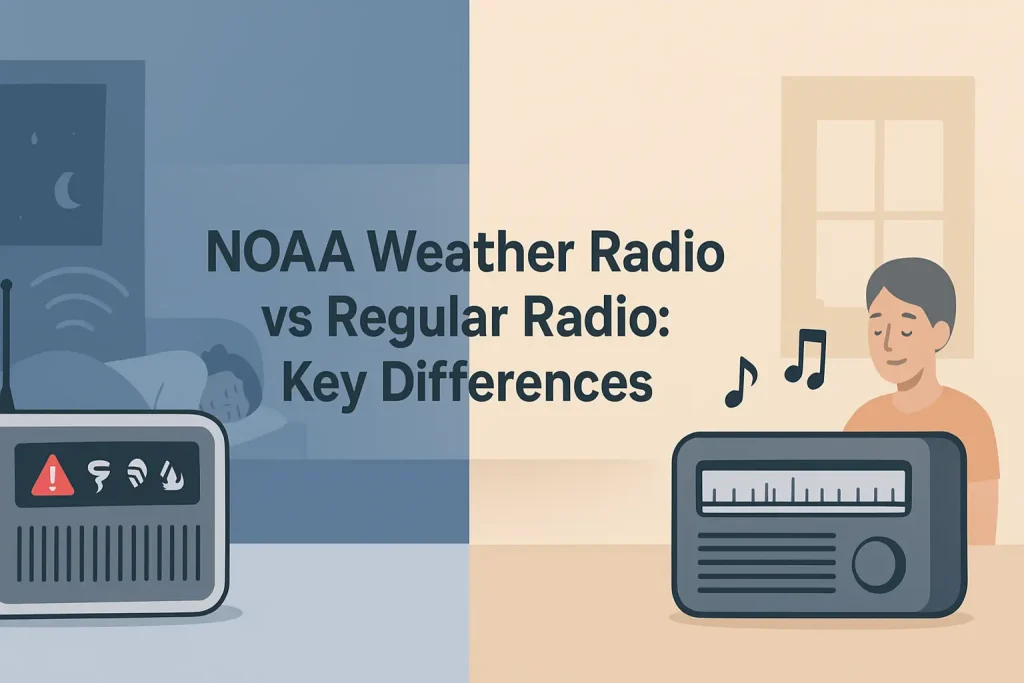
The audio you hear online is identical to what a dedicated NOAA weather alert radio picks up over the air. Tone alerts, S.A.M.E. header data bursts, and the synthesized voice announcements are all present in the stream.
Most online NWR streams originate from one of two source types. The first is a volunteer-operated SDR receiver (a software-defined radio dongle connected to a computer) that rebroadcasts a specific local transmitter’s audio as a public internet stream.
The second source type is RadioReference.com’s Broadcastify platform, which aggregates hundreds of NWR transmitter feeds submitted by volunteers across the country into a single searchable directory.
The critical limitation of browser streaming is that it provides receive-only audio. It does not trigger an alert tone that wakes you up when a Tornado Warning is issued for your county the way a dedicated weather radio with S.A.M.E. technology does.
Online streaming works best as a monitoring tool when you are actively at your computer, not as a nighttime or away-from-home alert system. Knowing this distinction before you start will help you decide whether streaming alone meets your preparedness needs.
Which Websites Stream NOAA Weather Radio Live?
Three platforms provide reliable, free NOAA weather radio browser streaming in the United States: Broadcastify (RadioReference.com), the Weather.gov audio player, and the NOAA Weather Radio Online player maintained by independent operators.
Each platform covers different transmitters and has different reliability characteristics. Using more than one source gives you a backup when a specific feed goes offline.
Broadcastify (RadioReference.com): The Largest NWR Stream Directory
Broadcastify at broadcastify.com hosts over 600 active NOAA weather radio feeds submitted by volunteer SDR operators across every US state. It is the most comprehensive single source for finding your local NWR transmitter online.
To find your local feed, go to broadcastify.com, click “Weather” in the top navigation, then select your state from the dropdown. You will see a list of active feeds organized by city or transmitter callsign (NWR callsigns follow the format KEC, WXK, or KHB followed by three digits).
Each feed page shows the transmitter’s broadcast frequency (for example, 162.475 MHz), the NWS office responsible for the content, and a listener count showing whether the feed is currently active.
Broadcastify streams play directly in your browser using an HTML5 audio player. No plug-ins or downloads are needed. Mobile browsers on Android and iOS also support playback without any additional software.
The main limitation of Broadcastify feeds is uptime dependency on the volunteer operator. If their SDR receiver goes offline, the feed drops. Feeds marked “Active” in the last 24 hours are the most reliable choice.
NOAA Weather.gov Audio Player
The National Weather Service provides a direct audio link to NWR transmitter streams from individual NWS office pages at weather.gov. These links are maintained by each local NWS forecast office and point to the transmitter responsible for that office’s service area.
Navigate to weather.gov, enter your zip code in the location search box, then look for the “NOAA Weather Radio” link in your local NWS office’s page sidebar. Not every office prominently displays this link, so you may need to browse the office’s “About” or “Contact” page.
The Weather.gov streams are often more stable than volunteer Broadcastify feeds because they are managed at the NWS office level rather than by individual hobbyists. They are the recommended first-choice source for official, uninterrupted monitoring.
NWR Online Player (nwronline.info)
The NWR Online player at nwronline.info provides a map-based interface for selecting NOAA weather radio transmitters by geographic location. Click your state on the map, then select the transmitter nearest your location from the list.
This platform is maintained independently and pulls from a mix of SDR feeds and archived official streams. It is particularly useful for users in rural areas where Broadcastify has fewer volunteer-operated feeds.
The site also displays the current NWR transmitter callsign and broadcast frequency for each stream, which is useful if you want to verify you are listening to the correct transmitter for your county.
How to Find the Correct NOAA Weather Radio Stream for Your County
NOAA weather radio transmitters do not follow state boundaries. Each transmitter serves a specific geographic footprint, and a single county may fall within range of two or three different transmitters broadcasting on different frequencies.
Listening to the wrong transmitter means you will hear alerts for counties that are not yours. Finding the correct transmitter for your specific county is the most important step in setting up reliable NWR browser monitoring.
Use the NOAA NWR Station Finder
The official NOAA NWR station finder is at nws.noaa.gov/nwr/coverage/county_coverage.html. Enter your state and county name to see every NWR transmitter that broadcasts S.A.M.E. coded alerts for your county.
The results show the transmitter callsign, broadcast frequency (in MHz), transmitter location city, and the NWS office responsible for the alerts on that transmitter. Write down the callsign and frequency for your primary transmitter.
Once you have the callsign, search for it by name on Broadcastify or nwronline.info to find the corresponding online stream. Most major NWR transmitters (those covering population centers) have at least one active Broadcastify feed.
Cross-Reference with the S.A.M.E. County Code
Every NWR alert broadcast includes a S.A.M.E. (Specific Area Message Encoding) header that identifies which counties the alert applies to using a 6-digit FIPS code. The first two digits identify the state, and the next three digits identify the county.
When you listen to an online NWR stream, you will hear the S.A.M.E. digital burst tone (a rapid data squeal lasting about one second) at the start of every alert. This tone carries the FIPS codes for all affected counties.
A physical S.A.M.E. weather alert radio decodes this tone and only activates its alarm for counties you have pre-programmed. Browser streams pass the full audio through without any filtering, so you will hear alerts for all counties on that transmitter regardless of whether they affect you.
Understanding how S.A.M.E. county filtering works on dedicated receivers helps clarify why a hardware radio offers a significant alerting advantage over unfiltered browser streaming.
Step-by-Step Guide to Streaming NOAA Weather Radio in Your Browser
The following steps work for any modern desktop or mobile browser, including Chrome, Firefox, Edge, and Safari. No software installation is required.
Step-by-Step Guide
How to Find and Stream Your Local NOAA Weather Radio Feed
7 steps – Estimated time: 5 minutes
Go to the NOAA NWR county coverage finder
Open nws.noaa.gov/nwr/coverage/county_coverage.html in your browser. Select your state and county from the dropdown menus to see which NWR transmitters serve your area.
Note your primary transmitter’s callsign and frequency
Write down the callsign (for example, KEC79) and the broadcast frequency (for example, 162.550 MHz) for the transmitter listed first for your county. This is your primary NWR transmitter.
Open Broadcastify and search for your transmitter
Go to broadcastify.com and click “Weather” in the navigation menu. Select your state, then look for your transmitter callsign or city name in the list of active feeds.
Verify the feed frequency matches your transmitter
On the Broadcastify feed page, confirm the listed frequency (in MHz) matches the one from the NOAA county coverage finder. A mismatch means the feed is for a different transmitter and different counties.
Click the Play button in the browser audio player
The Broadcastify HTML5 player loads automatically. Click the play button and allow a 5-10 second buffer before audio begins. You should hear the NOAA synthesized voice reading the current forecast or the repeating station ID announcement.
Bookmark the feed page for fast access during severe weather
Add the feed page to your browser bookmarks and save it to your phone’s home screen. During an active weather event, you want to open the stream in under 10 seconds without searching again.
Save a backup feed from a second transmitter
Return to the NOAA county coverage finder and note the callsign for the secondary transmitter listed for your county. Find and bookmark its Broadcastify feed as well. Use the backup if your primary feed goes offline during an event.
Having both a primary and a backup feed bookmarked is the single most useful preparation step for browser-based NWR monitoring.
What Are the Seven NOAA Weather Radio Frequencies and Which One Should You Stream?
NOAA Weather Radio All Hazards broadcasts on seven VHF frequencies between 162.400 MHz and 162.550 MHz, designated WX1 through WX7. Each transmitter is assigned one of these frequencies, and no two transmitters in the same geographic area use the same frequency to prevent interference.
You do not choose a frequency when streaming online. You choose a transmitter (by callsign or location), and the stream delivers that transmitter’s audio regardless of which of the seven frequencies it broadcasts on.
Understanding the seven frequencies is still useful for two reasons. First, it helps you verify a Broadcastify feed is correct by cross-referencing the listed frequency. Second, it matters if you later decide to add a dedicated portable NOAA weather radio for backup alerting.
Use the table below to identify which WX channel designation corresponds to each broadcast frequency.
| Channel | Frequency (MHz) | Primary Use Region | Most Common Transmitter Areas |
|---|---|---|---|
| WX1 | 162.550 MHz | Most widely used | Major metro areas, first-choice frequency |
| WX2 | 162.400 MHz | Second most common | Secondary fill-in transmitters |
| WX3 | 162.475 MHz | Common in Midwest/South | Tornado alley states, Gulf Coast |
| WX4 | 162.425 MHz | Common in Northeast/Southeast | Atlantic coast, New England states |
| WX5 | 162.450 MHz | Western US common | Mountain states, Pacific Coast |
| WX6 | 162.500 MHz | Fill-in and rural | Rural transmitters, secondary areas |
| WX7 | 162.525 MHz | Least common | Remote areas, Alaska, Hawaii |
For a full technical breakdown of each frequency’s coverage characteristics and how transmitter power output (typically 300 watts to 1,000 watts ERP) affects reception distance, the complete guide to all seven NWR broadcast frequencies covers signal propagation and reception range in detail.
WX1 (162.550 MHz) is the correct starting point for most users in populated areas. If the NOAA county coverage finder lists a different frequency for your county, use that one instead.
Browser Streaming vs a Dedicated Weather Radio: Which Do You Actually Need?
Browser streaming and a dedicated weather radio are not equivalent for emergency preparedness. They serve different functions, and the difference matters most at 2 AM during a tornado watch when your phone is charging across the room.
A dedicated S.A.M.E. weather alert radio monitors NWR 24 hours a day in standby mode, activates an audible alarm only for alerts affecting your pre-programmed counties, and operates on battery backup when power is out. Browser streaming does none of these things.
Use the table below to decide which approach fits your situation.
| Feature | Browser Streaming | Dedicated NWR Radio |
|---|---|---|
| Alert wakes you up | No | Yes (alarm tone) |
| County-specific filtering | No (all counties on transmitter) | Yes (S.A.M.E. programming) |
| Works during power outage | Only with battery backup for router | Yes (battery backup built-in) |
| Works without internet | No | Yes (direct RF reception) |
| Ongoing cost | Free | $30-$80 hardware, then free |
| Setup time | 5 minutes | 15-30 minutes (S.A.M.E. programming) |
| Best for | Active monitoring at a desk | Overnight alerting and power outages |
| Verdict | Good supplemental tool | Required for reliable alerting |
The practical recommendation for most households is to use browser streaming as a supplemental monitoring tool during the day and rely on a dedicated S.A.M.E. radio for overnight and power-outage alerting.
A Midland WR120B weather radio costs under $30 and covers the baseline S.A.M.E. alerting function reliably. Our detailed review of its features and limitations is covered in the Midland WR120B performance and alert speed assessment.
Browser streaming supplements but does not replace a physical receiver for genuine emergency preparedness.
What Content Does a NOAA Weather Radio Stream Broadcast?
A NOAA Weather Radio stream broadcasts a continuous loop of content produced by the local National Weather Service forecast office responsible for that transmitter’s service area. The broadcast runs 24 hours a day, 7 days a week, on all seven NWR frequencies.
During normal (non-alert) conditions, the stream cycles through current conditions, zone forecasts, marine or agricultural forecasts (where applicable), river and flood stage reports, and a station identification announcement every 30 minutes.
When a weather alert is issued, the broadcast interrupts with a 1050 Hz attention tone lasting 8-25 seconds, followed by the S.A.M.E. digital header burst (the data squeal), followed by the alert message read by the NWS synthesized voice system (known as “Paul” or “Donna” depending on the transmitter).
NWR also broadcasts non-weather alerts under the NOAA Weather Radio All Hazards program. These include AMBER Alerts (missing children), Civil Emergency Messages, Hazardous Materials Warnings, 911 Telephone Outage notifications, and National Information Center messages from FEMA.
According to NOAA NWR documentation, there are 25 standard S.A.M.E. event codes covering weather events (from Tornado Warnings to Dense Fog Advisories) and non-weather emergencies. All 25 event types are present in the same audio stream you access online.
To understand the full range of alert types your stream may broadcast and what each one means for your safety response, the complete overview of what NOAA weather radio broadcasts and why it exists explains the NWR network’s structure and alert hierarchy in plain language.
Quick Reference: NOAA Weather Radio Online Streaming Terms
Quick Reference
Key Terms for NOAA Weather Radio Browser Streaming
Plain-language definitions for terms used throughout this guide
- NWR (NOAA Weather Radio All Hazards): The US federal network of over 1,000 VHF radio transmitters broadcasting continuous weather and emergency information on 162.400-162.550 MHz.
- S.A.M.E. (Specific Area Message Encoding): A digital encoding system embedded in NWR broadcasts that identifies which counties an alert applies to using a 6-digit FIPS code.
- SDR (Software Defined Radio): A low-cost USB radio receiver dongle that uses computer software to decode radio signals. Most online NWR streams originate from volunteer SDR setups.
- Broadcastify: The RadioReference.com platform that hosts volunteer-submitted live radio feeds, including over 600 NOAA weather radio transmitter streams.
- NWR Callsign: The unique identifier assigned to each NOAA weather radio transmitter, formatted as three letters followed by two or three digits (for example, KEC79 or WXK26).
- FIPS Code: A 6-digit Federal Information Processing Standards code that identifies a specific US county within the S.A.M.E. system. The first two digits are the state code.
- Attention Tone: A 1050 Hz alert tone that precedes every NWR emergency message. It lasts 8-25 seconds and activates the alarm on S.A.M.E.-equipped radios.
- WX1-WX7: The channel designations for the seven NOAA weather radio frequencies, used on dedicated weather radios to select between transmitters. WX1 corresponds to 162.550 MHz.
- NWS Forecast Office: A regional National Weather Service office responsible for producing weather forecasts and alert messages for a specific geographic area. Each office controls content on its assigned NWR transmitters.
- HTML5 Audio Player: The built-in browser audio player that Broadcastify and other streaming platforms use to deliver NWR audio without requiring plug-ins or software downloads.
Troubleshooting: What to Do When Your NOAA Weather Radio Stream Goes Offline
Online NWR streams go offline more often than a dedicated weather radio loses its signal. The most common causes are the volunteer SDR operator’s hardware going down, the host server experiencing overload during high-traffic weather events, and internet connectivity issues between you and the stream server.
When a Broadcastify feed shows “Offline” or the audio cuts out mid-stream, work through these steps in order.
Check Feed Status on Broadcastify
On the Broadcastify feed page, look at the “Last Active” timestamp below the player. If it shows more than 30 minutes ago during a time when severe weather is active in the area, the feed operator’s hardware is likely down, not a temporary glitch.
Broadcastify shows a real-time listener count next to each feed. A count of zero during active weather almost always means the feed itself is offline rather than a local playback issue on your end.
Switch to Your Backup Transmitter Feed
Open the backup feed you bookmarked during setup. If your primary transmitter’s feed is down, the backup transmitter (which covers the same county on a different frequency) may have an active stream from a different volunteer operator.
The NOAA county coverage finder typically lists two to four transmitters per county, which gives you multiple backup options. Check feeds for the second and third transmitters if the first backup is also offline.
Try the NWR Online Player as an Alternative Source
Open nwronline.info and select your state. Some transmitters have streams hosted on this platform that are independent of the Broadcastify volunteer network. The audio quality may be lower, but the content is identical.
Use the Weather.gov Direct Stream Link
Navigate to your local NWS forecast office page at weather.gov. Many offices provide a direct MP3 or Shoutcast stream link on their page that bypasses Broadcastify entirely. This link connects directly to the NWS office’s own audio server and is often more stable during high-traffic weather events.
Fall Back to a Dedicated Weather Radio
If all online streams are offline or unstable during an active severe weather event, this is precisely the scenario where a dedicated weather radio on battery power proves its value. Internet infrastructure can fail during the same storms that trigger NWR alerts.
A hand-crank emergency weather radio with battery backup operates completely independently of internet connectivity and receives NWR directly on 162 MHz VHF. It is the only reliable option when both power and internet are out simultaneously.
Browser streaming is a useful day-to-day tool, but an active severe weather event is the worst possible moment to discover your stream is down and you have no backup.
Can You Use a Smartphone App to Stream NOAA Weather Radio?
Yes. Several smartphone apps stream NOAA weather radio audio using the same Broadcastify and SDR-based feeds that work in desktop browsers, with the advantage of mobile notifications when specific alert types are broadcast.
The Broadcastify app (available for both Android and iOS) is the mobile counterpart to the desktop website. It provides access to all the same NWR feeds with a mobile-optimized interface and background audio playback that continues when you switch to other apps.
The Weather Underground app and the American Red Cross Emergency app both include NOAA weather radio audio or NWR-sourced alert notifications as features. These apps push alerts to your notification tray based on your location, which partially addresses the “won’t wake you up” limitation of passive browser streaming.
However, smartphone apps share the same fundamental limitation as browser streaming: they depend on your cellular or Wi-Fi data connection. During major weather events, both cellular networks and home internet connections can become congested or fail entirely in the affected area.
For context on how to set up and use a dedicated hardware receiver as a complement to app-based monitoring, the guide on setting up and operating a weather radio correctly covers placement, S.A.M.E. programming, and alert response procedures.
The most reliable preparedness setup combines a dedicated S.A.M.E. weather radio for overnight alerting with a smartphone app or browser stream for active daytime monitoring.
How to Stream NOAA Weather Radio on Specific Devices and Platforms
The streaming method varies slightly depending on your device. The core Broadcastify and NWR Online platforms work on any device with a modern browser, but a few platform-specific considerations affect audio output and reliability.
Windows and Mac Desktop Computers
Desktop browsers (Chrome, Firefox, Edge, Safari) all support the HTML5 audio player used by Broadcastify without any additional configuration. The stream plays through your default audio output device.
For continuous background monitoring on a desktop, open the Broadcastify feed in a dedicated browser tab and use your operating system’s volume mixer to control the NWR stream volume independently of other audio sources. On Windows, right-click the volume icon in the taskbar and select “Open Volume Mixer.”
iPhone and iPad (iOS and iPadOS)
Safari on iOS supports HTML5 audio and plays Broadcastify streams without issues. The audio continues playing in the background when you lock the screen, which is useful for monitoring during active weather events.
Enable the “Auto-Lock” exception by going to Settings, Display and Brightness, Auto-Lock, and setting it to “Never” when you are actively monitoring a stream. Remember to reset this when you are done to preserve battery life.
Android Smartphones and Tablets
Chrome on Android plays Broadcastify streams with background audio support. The stream appears in the Android notification shade as a media control, which allows you to pause or stop it without reopening the browser.
If a Broadcastify stream does not play in Chrome on Android, try the Firefox mobile browser as an alternative. Some Android devices have power management settings that kill background audio after a few minutes. Disable battery optimization for Chrome in your phone’s battery settings to prevent this.
Smart TVs and Streaming Devices
Smart TVs with built-in web browsers (Samsung, LG, Sony) can access Broadcastify, but the HTML5 audio player may not render correctly on all TV browser implementations. A more reliable approach is to cast a browser tab from a Chromebook or Chrome desktop to a Chromecast-enabled TV using Chrome’s cast feature.
Amazon Fire TV Stick users can install the Silk browser and navigate to Broadcastify directly. The audio playback works reliably on current Fire TV Silk browser versions.
What Happens to Online NOAA Streams During Major Weather Events?
Broadcastify feed listener counts spike dramatically during active severe weather events. A normally quiet NWR feed that draws 20 concurrent listeners can jump to several hundred during an active tornado warning in the transmitter’s coverage area.
This traffic spike causes buffering and audio dropouts on heavily loaded feeds. Broadcastify has server infrastructure to handle significant load, but individual volunteer SDR operators may have bandwidth-limited home internet connections that cannot sustain hundreds of simultaneous listeners.
The two mitigation strategies that work reliably are switching to the NWS direct stream link (which is server-side rather than volunteer-hosted) and having the backup transmitter feed bookmarked in advance.
More importantly, internet infrastructure itself can degrade during major weather events. Tornadoes, hurricanes, and major ice storms damage fiber and cable infrastructure. Cellular towers lose power or become overloaded with simultaneous calls and data traffic from people in the affected area.
According to FEMA’s emergency communications planning guidance, internet-dependent communication tools should always be backed up by a method that does not rely on commercial internet or cellular infrastructure. A battery-powered NWR receiver satisfies this requirement for weather alerting.
Maintaining the batteries in a dedicated weather radio is a straightforward but often neglected preparedness task. The guide on weather radio battery maintenance and replacement schedules covers which battery types perform best in long-term standby use and how often to replace them.
Advanced Option: Setting Up Your Own Local NOAA Weather Radio Stream
If no active Broadcastify feed exists for your local NWR transmitter, you can create one using a $25 RTL-SDR USB dongle, a free SDR software package, and a Broadcastify broadcaster account. This is an intermediate-level technical project that takes approximately 2-3 hours for someone comfortable with computer software.
The hardware required is an RTL-SDR V3 receiver dongle (approximately $30), a computer that stays on continuously (a Raspberry Pi works well for this), and an outdoor or indoor antenna tuned to 162 MHz VHF.
An outdoor VHF dipole antenna cut for 162 MHz significantly improves reception quality compared to the small stub antenna that ships with most RTL-SDR kits. A correctly cut dipole at 162 MHz measures approximately 17.4 inches per element (quarter-wave at 162.5 MHz).
The software chain uses SDR# (SDRSharp) or GQRX to receive the NWR signal, VB-Audio Virtual Cable (on Windows) to route the audio internally, and the Broadcastify Desktop Broadcaster client to encode and stream the audio to the Broadcastify server. All of these tools are free.
After setting up your stream, submit it to Broadcastify and to RadioReference.com’s NWR database so other community members in your area can use it. Your stream becomes part of the public infrastructure that makes NWR browser monitoring possible for your entire region.
Seasonal Timing: When NOAA Weather Radio Monitoring Matters Most
NOAA Weather Radio broadcasts continuously throughout the year, but severe weather alert frequency varies significantly by season and region. Knowing peak alert periods helps you decide when to keep a browser stream running actively versus checking it periodically.
Seasonal Guide
NOAA Weather Radio Monitoring – Month-by-Month Priority Guide
When to monitor actively, when to test your hardware, and which alert types peak by season
Lower activity: maintenance and preparation focus
Severe weather seasons vary significantly by region. The monthly guide above reflects national patterns. Residents of the Gulf Coast, Tornado Alley (Texas through Nebraska), and the Atlantic seaboard should treat April through September as continuously high-priority monitoring months.
Is There a Delay Between a Live NOAA Alert and What You Hear on an Online Stream?
Yes. Browser streams have an inherent latency of 15 to 45 seconds compared to the live NWR broadcast. This delay is introduced by the buffering required for internet audio streaming and is present on all Broadcastify and SDR-based feeds regardless of your connection speed.
For most weather monitoring purposes, a 30-second delay is inconsequential. You will still hear the complete alert message, including all S.A.M.E. header information and the full text of the warning, well within the time needed to act on the alert.
The delay becomes significant in only one scenario: a rapidly moving tornado or flash flood event where every minute of warning time affects your safety response. In this scenario, a dedicated weather radio receiving the signal directly at 162 MHz VHF will activate its alarm 30-45 seconds before the online stream delivers the same alert.
This 30-45 second gap is the technical reason emergency management professionals recommend a dedicated weather radio for households in high-risk tornado and flash flood regions, regardless of how good their internet connection is.
Frequently Asked Questions
Can I listen to NOAA weather radio on a regular FM radio receiver?
No. Standard FM broadcast radios cover 87.5 to 108 MHz and cannot receive the NOAA weather radio frequencies at 162.400 to 162.550 MHz. The NWR frequencies are in the VHF band above the FM broadcast band, requiring a dedicated weather radio receiver, an SDR-equipped computer, a scanner radio that covers the VHF high band, or an internet stream to access them.
Some combination AM/FM/weather radios, such as the Sangean CL-100, include a dedicated NWR receiver stage alongside the standard FM tuner. These are not FM radios picking up NOAA; they have a separate circuit for the 162 MHz VHF band.
What is the difference between Broadcastify and the official NOAA weather radio website?
Broadcastify is a third-party platform hosting volunteer-operated SDR streams of local NWR transmitters. The official NOAA website at weather.gov does not host a centralized audio streaming service, but individual NWS forecast offices sometimes link to their own transmitter’s stream from their local office pages. Broadcastify provides far more geographic coverage because it aggregates hundreds of volunteer feeds, while official NWS streams are limited to the transmitters where offices have set up streaming infrastructure.
The audio content is identical since both sources originate from the same NWR transmitter broadcast. The difference is reliability and coverage, not content quality.
Why does the NOAA weather radio stream sound like a robot voice?
NOAA weather radio uses a text-to-speech synthesis system to convert forecast text into audio automatically. The system is designed for reliability and 24-hour continuous operation rather than natural-sounding speech. NWR has used synthesized voices (named “Paul,” “Tom,” “David,” “Donna,” and others) since the early 2000s, replacing the human forecasters who previously recorded broadcasts manually. The synthetic voice allows immediate automated broadcasts of new alerts without requiring a human to be present at every transmitter site.
Can I use a Baofeng radio or other handheld transceiver to receive NOAA weather radio frequencies?
Yes. The Baofeng UV-5R and most dual-band VHF/UHF handheld transceivers can receive (but not transmit on) the NOAA weather radio frequencies at 162.400 to 162.550 MHz in receive-only mode. Program one of the memory channels to 162.550 MHz (WX1) and set the squelch to 0 (open) to monitor without a CTCSS tone requirement. The UV-5R will receive the NWR broadcast but will not trigger an alarm for alerts the way a dedicated S.A.M.E. radio does.
You cannot legally transmit on 162.400 to 162.550 MHz. These frequencies are exclusively assigned to NOAA NWR transmitters under FCC Part 2 frequency allocation rules. Transmitting on these frequencies is a federal violation.
Do NOAA weather radio online streams include the same alert tones as a physical receiver?
Yes. The 1050 Hz attention tone that precedes every alert message is present in the audio stream exactly as it is broadcast on the air. If your computer or phone speakers are on and the stream is playing, you will hear the alert tone when an emergency message is issued.
However, the tone in an online stream will not activate the alarm circuit of a physical weather radio. The tone is simply audio in the stream, not a trigger signal. Only a dedicated S.A.M.E. receiver connected to the 162 MHz signal over the air can decode the S.A.M.E. header and activate its alarm function.
Why does my NOAA weather radio stream keep cutting out or buffering?
Buffering in NWR streams has three common causes: the volunteer SDR operator has a slow upstream internet connection, your own internet connection is congested, or the Broadcastify server is experiencing high load during an active weather event when many people are tuning in simultaneously. Switch to a backup transmitter feed or try the NWS direct stream link from your local forecast office page if Broadcastify is congested. If the problem occurs consistently regardless of weather activity, the volunteer SDR operator’s hardware or internet connection is the likely cause, and the feed may simply be unreliable.
Is it legal to rebroadcast NOAA weather radio audio on a website or app?
NOAA weather radio broadcasts are produced by the US federal government and are in the public domain under 17 U.S.C. Section 105. There is no copyright restriction on the audio content itself. Broadcastify and similar platforms operate legally by rebroadcasting NWR audio as a public service. However, rebroadcasting NWR audio for commercial gain while misrepresenting it as an official NOAA service would raise regulatory and trademark concerns separate from copyright law.
Can I receive NOAA weather radio alerts on my computer without a browser stream running?
Not through a browser stream alone. Browser streams only deliver audio when you actively have the page open and playing. For passive computer-based NWR alerting, you need either a dedicated weather radio connected to a physical NWR receiver (which operates independently), or an SDR dongle connected to your computer running 24-hour monitoring software such as MultiPSK or a dedicated NWR alert decoder application that triggers a desktop notification when it detects the S.A.M.E. header signal.
An RTL-SDR receiver dongle paired with NWR alert decoder software is the closest browser-free alternative to a dedicated weather radio for computer-based passive monitoring.
What is the difference between a Tornado Watch and a Tornado Warning on NOAA weather radio?
A Tornado Watch (S.A.M.E. code TOR, Watch modifier) means conditions are favorable for tornado development in the watch area, typically a multi-county region, over the next several hours. A Tornado Warning (S.A.M.E. code TOR, Warning modifier) means a tornado has been detected by radar or confirmed by a spotter and is an immediate life-threatening event for a specific area. NWR broadcasts both, but the Warning uses the full 1050 Hz attention tone and S.A.M.E. header to trigger alarms on S.A.M.E. radios, while Watch messages may be broadcast as routine informational content depending on the severity of the outbreak.
Does NOAA weather radio broadcast alerts for non-weather emergencies like chemical spills?
Yes. NOAA Weather Radio All Hazards broadcasts 25 standard S.A.M.E. event codes that include non-weather emergencies. Hazardous Materials Warning (HMW), Civil Emergency Message (CEM), 911 Telephone Outage Emergency (TOE), and AMBER Alert (CAE for Child Abduction Emergency) are all part of the standard NWR broadcast protocol. These alerts use the same S.A.M.E. header and attention tone system as weather alerts and will appear in any online NWR stream just as they do on a physical weather radio.
How do I know if the NOAA weather radio stream I am listening to is for my county?
Cross-reference the transmitter callsign and frequency shown on the Broadcastify feed page with the results from the NOAA NWR county coverage finder at nws.noaa.gov/nwr/coverage/county_coverage.html. Enter your state and county into the finder and verify that the callsign listed there matches the callsign of the stream you are listening to. If the callsigns match, the stream broadcasts alerts for your county. If they do not match, you are monitoring alerts for a different geographic area and need to find the correct feed.
The guide to identifying which NWR frequency and transmitter serves your location walks through this process with additional detail on multi-transmitter counties and signal overlap zones.
What should I do if no Broadcastify feed exists for my local NOAA transmitter?
Check nwronline.info as a secondary source, then try searching for your NWS forecast office name directly on Broadcastify. If no feed exists at all, you have three options. First, check your local NWS forecast office page at weather.gov for a direct stream link that bypasses Broadcastify. Second, set up your own SDR-based stream using an RTL-SDR dongle and Broadcastify’s broadcaster program. Third, use a dedicated weather radio as your primary monitoring tool and treat online streaming as unavailable for your area. Rural areas with lower population density are the most likely to have no active Broadcastify feed.
Listening to NOAA weather radio online through a browser is a genuinely useful tool for active weather monitoring when you are at a desk or on your phone. The seven NWR frequencies between 162.400 and 162.550 MHz are accessible for free through Broadcastify, NWR Online, and local NWS office stream links without any hardware purchase.
The step to take right now is to open the NOAA NWR county coverage finder, confirm which transmitter callsign serves your specific county, find its Broadcastify feed, and bookmark it alongside a backup transmitter feed. Pair that with a dedicated S.A.M.E. weather radio for overnight and power-outage alerting, and you have a complete NOAA weather radio monitoring setup that works in every scenario.
| Photo | TOP RATED WALKIE TALKIES | Price |
|---|---|---|
 | Retevis RT628 Kids Walkie Talkies, Toys Gifts for 4-12 Year Old Girl Boy | Check Price On Amazon |
 | Cobra ACXT545 Weather-Resistant Walkie Talkies, Rechargeable, 22 Channels | Check Price On Amazon |
 | Retevis RT388 Kids Walkie Talkies, Outdoor Toys for Kids Camping Essentials | Check Price On Amazon |
 | Cobra RX680 Walkie Talkies (2-Pack), IP54 Water Resistant Design | Check Price On Amazon |
 | Retevis RT22 Walkie Talkies Long Range Rechargeable with Earpiece (2 Pack) | Check Price On Amazon |
 | Midland GXT1000VP4 GMRS Two-Way Radios with Headsets, Black, 2 Pack | Check Price On Amazon |
 | Retevis RT628 Walkie Talkies for Kids,Toys Gifts for 6-12 Years Old Boys Girls,Long Range 2 Way Radio 22CH VOX,Birthday Gift,Family Walkie Talkie for Camping Hiking Indoor Outdoor | Check Price On Amazon |