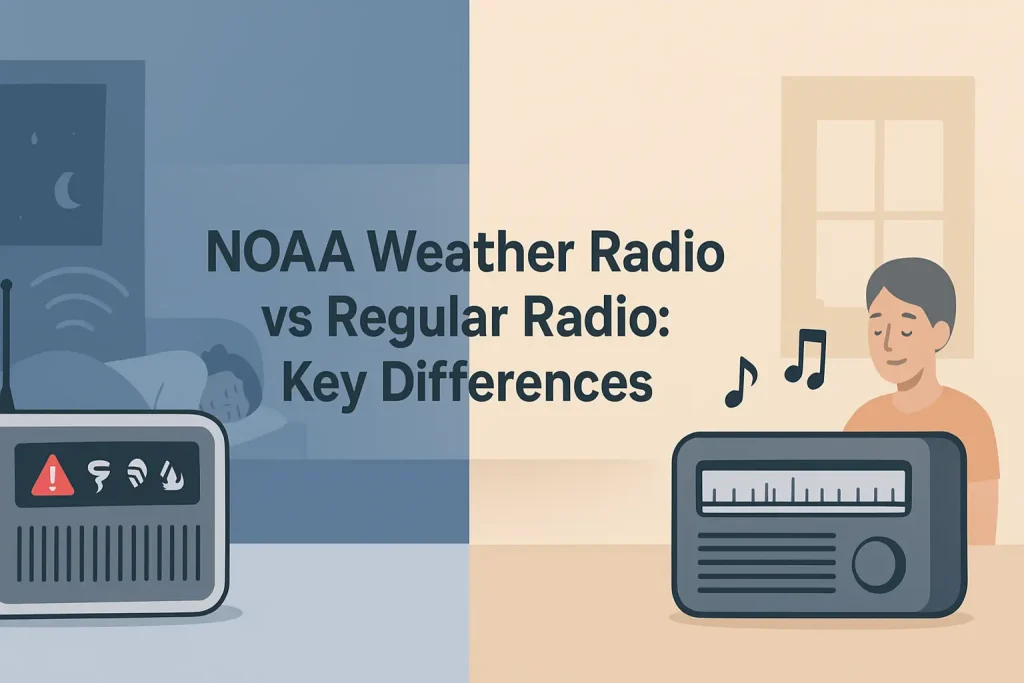
Your weather radio sits on the shelf, plugged in, and you assume it will alert you when a tornado warning drops for your county. But assumption is not the same as verification. NOAA broadcasts on seven dedicated frequencies between 162.400 and 162.550 MHz, and a radio that has never been tested may have a failed speaker, a dead backup battery, or a S.A.M.E. code programmed for the wrong county entirely.
Testing your weather radio takes less than five minutes once per week, and the weekly test broadcast from NOAA makes it automatic. This guide walks you through every test method, every failure sign to watch for, and every fix so your radio is genuinely ready when conditions deteriorate.
| Photo | Popular Portable Walkie Talkies | Price |
|---|---|---|
 | SKIWARRIOR Multifunctional Smart Wireless Ski Goggles with Walkie-Talkie, Anti-Fog Zeiss Lens, Music & Call Function (Cylindrical Blue) | Check Price On Amazon |
 | SINORISE Super Mini Walkie Talkies, Two-Way Radios, 3 Pack | Check Price On Amazon |
 | KOSPET Tank M4C Smart Watch Rugged, Dual-Band GPS, 5ATM & IP69K Waterproof | Check Price On Amazon |
 | Retevis RT15 Walkie Talkies 3 Pack, Birthday Gift, Outdoor Adventure Kit | Check Price On Amazon |
 | Rechargeable Walkie Talkies Toys for Kids: DIY Astronaut Walkie Talkies for Boys Christmas Birthday Gifts for 3 4 5 6 7 8 9 10 Boy Walkie Talkie Outdoor Hiking Toy 2 Way Radio Camping Outdoor Game | Check Price On Amazon |
By the Numbers
NOAA Weather Radio – Key Facts and Testing Standards
Sources: NOAA National Weather Service, FCC Part 11, FEMA IPAWS documentation
What Is the NOAA Weekly Required Test and When Does It Broadcast?
The NOAA Required Weekly Test (RWT) is a standardized test signal broadcast by NOAA Weather Radio All Hazards transmitters once per week to verify that receiving equipment and the broadcast infrastructure are both functioning correctly. Most transmitters in the continental United States broadcast the RWT on Wednesdays between 11 a.m. and noon local time, though the exact day and time varies slightly by transmitter location.
According to NOAA National Weather Service documentation, the RWT does not carry an actual emergency alert tone. It transmits the S.A.M.E. (Specific Area Message Encoding) header and a voice announcement that identifies the test, followed by an end-of-message tone. Your radio must be set to receive test alerts, not just warnings and watches, or the RWT will pass through silently with no alarm activation.
The RWT is distinct from the Required Monthly Test (RMT), which is broadcast at least once per month and includes the full Emergency Alert System attention tone. The RMT more closely simulates an actual alert. Both test types are useful for different verification purposes, and a complete weekly testing routine uses the RWT for quick function checks and the RMT for full alarm chain verification.
If your NOAA weather alert radio with S.A.M.E. filtering does not alarm during the RWT, you have three possible causes: the alert type filter is set to exclude tests, the S.A.M.E. county code is programmed incorrectly for your area, or the radio has a hardware failure. Each of those causes has a different fix, and the sections below walk through all three.
Knowing when your local transmitter broadcasts the RWT is the first step in building a reliable weekly test habit.
How to Set Up Your Weather Radio to Receive the Weekly Test Alert
A weather radio that has never been configured to receive test broadcasts will not alarm during the RWT or RMT, even if everything else is working correctly. The S.A.M.E. alert type filter on most radios defaults to warnings and watches only, which excludes the RWT event code (TOR, FFW, and similar codes for actual events are included, but the RWT uses a separate code that many radios suppress by default).
The following steps apply to most current Midland and Uniden weather radio models with S.A.M.E. programming capability.
Step-by-Step Guide
How to Configure Your Weather Radio to Receive Weekly Test Broadcasts
6 steps · Estimated time: 5 minutes · Applies to most S.A.M.E.-capable weather radios
Enter the programming or setup menu
Press and hold the PROGRAM or MENU button on your radio until the display enters setup mode. On Midland radios, this is typically the SAME button held for 3 seconds.
Navigate to alert type or event filter settings
Scroll through the menu to find “Alert Types,” “Event Codes,” or “SAME Events.” This section controls which event codes trigger your radio’s alarm.
Enable the Required Weekly Test (RWT) event code
Find the entry labeled “RWT” or “Required Weekly Test” and set it to ON or ALARM. Without this step, the radio will receive the broadcast but will not produce any sound or alert.
Enable the Required Monthly Test (RMT) event code as well
While you are in the event filter menu, also enable “RMT” or “Required Monthly Test.” The RMT includes the full attention tone and gives you a more complete alarm chain test each month.
Verify your S.A.M.E. county FIPS code is correct
Confirm the 6-digit FIPS code programmed into your radio matches your actual county. An incorrect FIPS code means your radio will ignore alerts for your real location, including the weekly test broadcast. Look up your county FIPS code at the NOAA Weather Radio county codes page.
Save settings and confirm the radio returns to standby mode
Press PROGRAM or CONFIRM to save. The radio should display the active NOAA frequency (most commonly 162.550 MHz for WX1) and return to its normal standby display with the alert LED active.
Once the RWT event code is enabled and the correct FIPS code is saved, your radio will alarm automatically during the next Wednesday morning broadcast, confirming the full alert chain is functioning without any manual intervention on your part.
How to Manually Test Your Weather Radio Right Now Without Waiting for Wednesday
You do not have to wait for Wednesday’s RWT broadcast to verify your radio is working. Most weather radios include a manual test feature that exercises the speaker, alarm tone, and display independently of any incoming NOAA signal. This manual test confirms local hardware function but does not verify that the radio is receiving the NOAA signal from your area’s transmitter.
For a complete test, you need both: the manual hardware test and a live reception test using the RWT or RMT broadcast. The manual test alone tells you the speaker is not burned out. The reception test tells you the antenna, tuner circuit, and S.A.M.E. decoder are all functioning together.
Here is how to run both tests.
Running the Manual Hardware Test
Hold the TEST or ALERT TEST button on your radio for 3 to 5 seconds. The radio should produce the alarm tone at full volume through the internal speaker and display an alert message on screen. If you hear nothing, the speaker has failed or the volume is set to zero. If you hear a tone but the display shows nothing, the display has failed.
Check the backup battery compartment at the same time. Remove the batteries and inspect for corrosion (white or blue residue on the terminals). Even if the radio runs on AC power, dead or corroded backup batteries mean the radio will go silent when the power goes out, which is exactly when you need it most.
Replacing the batteries in your weather radio backup battery pack every six months, or at minimum annually, keeps the backup power reliable. Many emergency managers recommend replacing them when clocks change for daylight saving time as a memory trigger.
Running a Live Reception Test Using the NOAA Signal
Tune your radio manually to 162.550 MHz (WX1), which is the most widely used NOAA frequency in most US metro areas. You should hear a continuous broadcast within a few seconds. If you hear nothing, try 162.400 MHz (WX2) and 162.425 MHz (WX3), as coverage varies by region.
A strong signal sounds clear with minimal static. Heavy static on all seven channels may indicate the radio’s antenna is damaged, the radio is positioned inside a metal enclosure that blocks the signal, or the radio’s receiver circuit has failed. Moving the radio to a window-facing location often resolves marginal reception before concluding the hardware is at fault.
For a full picture of which NOAA frequencies serve your exact location, the detailed frequency breakdown at this guide covering all seven NOAA broadcast frequencies and their coverage footprints identifies which channel provides the strongest signal for your county.
What Does a Passing Weekly Test Look and Sound Like?
A passing RWT on a properly configured weather radio produces a specific sequence. Knowing exactly what to expect helps you distinguish a genuine pass from a partial function that will fail during a real alert. The sequence begins with the S.A.M.E. digital header burst (a rapid data tone lasting approximately 1 second, repeated three times), followed by the voice announcement identifying the test, and ending with the end-of-message tone.
On the radio’s display, you should see the alert type (RWT or “WEEKLY TEST”), the issuing NOAA office code, and the county FIPS code associated with the broadcast. If your radio displays the event but shows a county code that does not match your area, your S.A.M.E. filter is set to receive all locations rather than being programmed to your specific county.
A complete passing test on a Midland WR120B or similar S.A.M.E.-capable radio looks like this:
- The alarm tone activates and the alert LED flashes
- The display shows the event code (RWT) and the issuing transmitter
- The voice message plays clearly through the speaker at the programmed volume level
- The end-of-message tone sounds and the radio returns to standby automatically
- The backup battery indicator shows adequate charge
If any of those five elements is missing, you have a specific fault to diagnose rather than a simple “it did not work” situation. The section below maps each failure to its most likely cause.
A passing test means the radio received the signal, decoded the S.A.M.E. header correctly, matched your programmed county code, and activated the full alarm chain from antenna to speaker.
What to Do When Your Weather Radio Fails the Weekly Test
A failed weekly test means one of four things: the radio did not receive the signal, the radio received the signal but did not decode it, the radio decoded it but the alert filter suppressed it, or the hardware alarm chain (speaker, display, or LED) is broken. Each failure has a distinct symptom and a distinct fix.
Use the table below to match your specific symptom to the most likely cause and the correct resolution step.
Diagnostic Reference
Weather Radio Weekly Test – Failure Symptoms and Fixes
Match your symptom to the cause and resolution. Source: NOAA NWR technical documentation, manufacturer service guides.
| Symptom | Most Likely Cause | Fix |
|---|---|---|
| No alarm, no display change during RWT window | RWT event code disabled in alert filter | Enable RWT in the event code / alert type menu |
| Display shows RWT received but no alarm sounds | Volume set to zero or speaker failed | Increase volume; run manual TEST button to isolate speaker failure |
| Heavy static on all NOAA channels, no clear voice | Weak signal, damaged antenna, or metal obstruction | Move radio to window, try all 7 channels, check antenna connector |
| Radio alarms for other counties but not yours | Incorrect FIPS code programmed | Re-enter correct 6-digit county FIPS code in S.A.M.E. programming menu |
| Radio alarms but goes silent when power is cut | Dead or corroded backup batteries | Replace backup batteries; clean terminals with dry cloth or pencil eraser |
| Alarm sounds but voice is garbled or cuts out | Marginal signal causing S.A.M.E. decode errors | Switch to the strongest NOAA channel for your area (check NOAA transmitter map) |
| Radio does not power on at all | Failed AC adapter or no backup batteries installed | Test with known-good outlet; install fresh backup batteries |
If none of the fixes in the table resolve the failure after two consecutive weekly tests, the radio’s internal S.A.M.E. decoder chip or receiver circuit has likely failed, and replacing the unit is more reliable than attempting repair.
How to Test Your Weather Radio’s Backup Battery and Power Continuity
A weather radio that loses power during a storm and has no functioning backup battery is useless at the exact moment it is most needed. Power outages and severe weather arrive together, and the backup battery is the only thing standing between you and silence when the grid goes down. Testing the backup battery is a separate check from testing the alert reception, and it must be done independently.
This happens because the backup battery circuit is only activated when AC power is interrupted. A radio can pass the RWT perfectly on AC power and still have a completely dead backup battery that you will never discover until the power fails.
To test the backup battery circuit, unplug the radio from the wall while it is in standby mode. The radio should continue to operate normally on backup power within two seconds of losing AC. If the display goes dark or the radio powers off when you unplug it, the backup batteries are either missing, dead, or corroded.
On a radio running on fresh alkaline AA backup batteries, NOAA recommends replacing them at least once per year. The AA alkaline batteries used in most weather radio backup compartments lose charge slowly even when not in use, and a set installed three years ago may have less than 20% of its original capacity remaining.
For a complete walkthrough of replacement intervals, battery types, and terminal cleaning, the step-by-step process in this guide to replacing and maintaining weather radio backup batteries covers every common model and battery format.
Testing backup power continuity is as important as testing signal reception, and a radio that fails this check needs new batteries before the next severe weather season begins.
How to Verify Your S.A.M.E. Code Is Correct for Your County
S.A.M.E. (Specific Area Message Encoding) is the system NOAA uses to attach a geographic identifier to every weather alert broadcast. Your weather radio’s S.A.M.E. decoder compares the incoming geographic code to the FIPS code you have programmed. If they do not match, the radio stays silent, even during a tornado warning for your neighborhood.
According to NOAA National Weather Service documentation, every county in the US has a unique 6-digit FIPS code. The first two digits identify the state, and the last three identify the county within that state. For example, the FIPS code for Cook County, Illinois is 017031. Entering 017031 tells your radio to alarm only for alerts issued for Cook County.
To verify your current programmed code, enter the S.A.M.E. or programming menu and navigate to the location code section. Compare the number displayed to the correct FIPS code for your county from the NOAA Weather Radio county code database at weather.gov. If they do not match, re-enter the correct code and save.
One important note: you can program most S.A.M.E.-capable radios with multiple county codes simultaneously. If you live near a county line or want alerts for adjacent counties as well, add those FIPS codes as secondary locations. The Midland WR120B accepts up to 25 S.A.M.E. location codes, and most current Uniden and Sangean models accept at least 10.
A full explanation of how S.A.M.E. technology works, including how the digital header encoding identifies both the alert type and the geographic area, is covered in this detailed breakdown of how S.A.M.E. encoding and county-level alert filtering operates.
Confirming your FIPS code is correct takes less than 60 seconds and is the single most important programming check you can do to ensure your radio alerts you for the right location.
How to Build a Weekly Weather Radio Test Checklist You Will Actually Use
A verbal commitment to test your weather radio weekly rarely survives contact with a busy schedule. The only reliable approach is a written checklist tied to a specific recurring day and time, kept next to the radio or on your phone as a repeating calendar reminder. Wednesday morning is the ideal anchor because that is when NOAA broadcasts the RWT in most areas.
The following checklist covers every verification point in under five minutes when performed on schedule.
Quick Reference
Weekly Weather Radio Test Checklist – 5 Minutes Every Wednesday
Print and keep next to the radio. Check each item and note any failures for follow-up.
- Reception check: Confirm the radio is receiving the strongest NOAA channel for your area (typically 162.550 MHz for WX1) with clear audio and no static.
- RWT alarm check: Confirm the RWT event code is enabled in the alert type filter. Verify the radio alarmed during Wednesday’s broadcast window (11 a.m. to noon local time for most areas).
- Volume check: Confirm the volume is set to the highest level so the alarm will wake you from sleep in the same room.
- Display check: Confirm the alert LED is illuminated and the standby display shows the active NOAA frequency.
- Backup battery check: Unplug the AC cord for 5 seconds. Confirm the radio stays on without interruption. Reconnect the AC cord.
- Battery condition check: If the radio has a low-battery indicator, confirm it is not showing. Check the date of the last battery replacement (target: every 12 months).
- S.A.M.E. code check (monthly, not weekly): On the first Wednesday of each month, enter the programming menu and confirm the 6-digit FIPS code matches your county. This setting does not change on its own but should be verified after any factory reset.
- Physical inspection: Confirm the antenna is fully extended and not bent or folded. Check that the radio is positioned away from metal objects, microwaves, or other electronics that can interfere with the 162 MHz signal.
Attach this checklist to a specific recurring Wednesday calendar event on your phone and the five-minute test becomes a habit rather than an afterthought before severe weather season.
How Often Should You Test Your Weather Radio Beyond the Weekly Routine?
The weekly RWT check covers day-to-day function verification. Certain other life events and seasonal transitions require additional spot-checks outside the weekly schedule. Skipping these additional tests means you may discover a failure at the worst possible time rather than weeks before you need the radio.
Test your weather radio immediately after any of the following events:
- Moving to a new address: Your county FIPS code changes when you move. Reprogram the S.A.M.E. code immediately and run a manual test to confirm reception on the strongest local NOAA channel.
- After any power outage: Confirm the radio returned to normal standby after power was restored. Some radios lose programming after extended outages if the backup battery was also depleted.
- After replacing batteries: Run the manual TEST button after installing new backup batteries to confirm the battery compartment contacts are clean and the radio operates on battery power correctly.
- At the start of severe weather season: In tornado-prone areas, test before March. In hurricane-prone areas, test before June 1. In wildfire-prone areas in the western US, test before May.
- After any firmware or factory reset: Some models reset all S.A.M.E. programming to default (all counties, all alert types) after a factory reset. Re-enter your specific FIPS code and confirm the RWT and RMT event codes are enabled.
- After extended storage: If the radio has been unplugged for 30 days or more, test the full alarm chain before relying on it again. Backup batteries may have self-discharged below functional threshold.
The Sangean CL-100 and similar premium S.A.M.E. weather radios retain their programming through short power outages using an internal capacitor, but longer outages require reprogramming verification.
Testing after any disruption to the radio’s power or programming takes the same five minutes as a weekly test and prevents discovering a failure during a real emergency event.
Seasonal Guide
Weather Radio Testing and Maintenance – Month-by-Month Action Guide
What to check, test, or prepare each month for reliable weather alert reception year-round
Moderate activity / Standard weekly test
Quick Reference: Weather Radio Testing Terms Explained
The terms used in weather radio testing documentation and owner manuals are not always intuitive, especially if you are setting up your first S.A.M.E.-capable radio. The following definitions cover the terms used throughout this guide so you can interpret your radio’s menus and displays correctly.
RWT (Required Weekly Test): A standardized NOAA test broadcast transmitted once per week by each NWR transmitter to verify that the broadcast infrastructure and receiving equipment are functioning. It does not include the full EAS attention tone.
RMT (Required Monthly Test): A monthly test broadcast that includes the full Emergency Alert System attention tone. It more closely simulates the audio and digital sequence of a real emergency alert.
S.A.M.E. (Specific Area Message Encoding): The digital encoding system NOAA uses to attach geographic (county-level) and event-type identifiers to every weather alert broadcast. Your radio’s S.A.M.E. decoder filters incoming alerts against your programmed FIPS codes.
FIPS code: A 6-digit Federal Information Processing Standards geographic identifier assigned to each US county. The first two digits identify the state and the last three identify the county. This is the number you program into your weather radio’s S.A.M.E. filter to receive county-specific alerts.
Event code: The 3-letter code embedded in each NOAA S.A.M.E. broadcast that identifies the alert type. Examples include TOR (Tornado Warning), FFW (Flash Flood Warning), HUW (Hurricane Warning), and RWT (Required Weekly Test). Your radio’s alert type filter uses these codes to decide which alerts trigger the alarm.
NWR (NOAA Weather Radio All Hazards): The nationwide network of over 1,000 FM transmitters broadcasting weather and emergency alerts 24 hours per day on seven frequencies between 162.400 and 162.550 MHz.
WX1 through WX7: The channel designations your radio uses to label the seven NOAA broadcast frequencies. WX1 corresponds to 162.550 MHz, WX2 to 162.400 MHz, WX3 to 162.475 MHz, WX4 to 162.425 MHz, WX5 to 162.450 MHz, WX6 to 162.500 MHz, and WX7 to 162.525 MHz.
EAS (Emergency Alert System): The national public warning system that uses a combination of broadcast media, cable television, and NOAA Weather Radio to deliver emergency alerts. The distinctive attention tone you hear before a weather alert is the EAS attention signal.
Squelch: A circuit that mutes the radio’s speaker when no signal is present. On a weather radio, proper squelch prevents constant static when no NOAA broadcast is being received while still allowing alerts to activate the alarm.
Standby mode: The normal operating state of a weather radio when no alert is active. In standby, the radio continuously monitors the programmed NOAA channel(s) and S.A.M.E. codes while remaining silent until a matching alert is received.
Which Weather Radios Are Easiest to Test and Maintain Weekly?
Not all weather radios make the weekly test routine equally easy. Radios with a dedicated TEST button, a visible alert LED, a clear programming menu for event codes, and a backup battery status indicator are far easier to verify weekly than models that bury the test function in a multi-level menu or lack any battery condition display.
Use the table below to compare the testing-relevant features of the most widely used weather radio models at each price tier.
Product Comparison
Weather Radio Models – Testing and Maintenance Feature Comparison
Key features relevant to weekly testing and S.A.M.E. programming. Source: manufacturer data sheets.
| Model | S.A.M.E. Codes | Dedicated Test Button | Battery Indicator | Backup Power | Price |
|---|---|---|---|---|---|
| Midland WR120B | 25 | Yes | Basic LED | 3x AA | $30-40 |
| Midland WR400 | 50 | Yes | Display indicator | 6x AA | $55-70 |
| Uniden BC365CRS | 25 | Yes | LED indicator | 3x AA | $35-50 |
| Sangean CL-100 | 25 | Yes | Display percentage | 4x AA | $55-75 |
| Reecom R-1630 | 25 | Yes | LED status | 3x AA or 9V | $40-55 |
| Midland ER310 (portable) | 25 | Yes | Display percentage | Internal Li-ion + solar + crank | $65-85 |
Prices verified at time of publication. S.A.M.E. code capacity and backup power format from manufacturer data sheets.
If you are evaluating a first weather radio purchase with testing ease in mind, the dedicated TEST button and a visible battery indicator are the two features that matter most for a reliable weekly routine. A detailed review of the entry-level Midland option is available in this hands-on evaluation of the Midland WR120B’s alert performance and S.A.M.E. programming process.
Choosing a radio with accessible test features removes friction from the weekly routine and makes consistent verification sustainable long-term.
Common Mistakes People Make When Testing Their Weather Radio
The most common mistake is confusing AC power function with full operational readiness. A radio that turns on, plays audio from the NOAA channel, and passes the manual TEST button check may still fail during a real alert if the RWT event code is disabled, the FIPS code is wrong, or the backup battery is dead. These three failures are invisible during a casual power-on check.
The second most common mistake is testing only at convenient times and skipping the Wednesday morning RWT window. The RWT broadcast is the only test that verifies the complete signal path from NOAA transmitter to your specific radio’s alarm activation. A manual button test exercises local hardware only.
Other mistakes that routinely cause weather radios to fail real alerts include:
- Setting the alert filter to “Warnings Only” and forgetting to re-enable test broadcasts: This setting is useful for reducing false alarms from watches and advisories, but it also disables the RWT. Keep the RWT event code enabled separately from your warning/watch preferences.
- Placing the radio inside a cabinet or against a metal appliance: Metal surfaces reflect and absorb the 162 MHz signal. A radio inside a closed cabinet may receive only 30-50% of the signal strength available at the same location with an unobstructed path to the nearest window.
- Assuming a factory-new radio is pre-programmed for your county: New radios typically ship with the S.A.M.E. filter set to receive all counties or with no FIPS code programmed at all. Programming your specific county code is always a required first setup step.
- Ignoring the RMT because the RWT passed: The RWT does not include the full EAS attention tone. Only the RMT tests whether your radio produces the full alert sound that wakes sleeping occupants. Listen to at least one RMT per month to confirm the alarm volume is adequate.
For a complete picture of how a properly configured weather radio functions from first setup through ongoing maintenance, the overview in this guide to setting up and operating a NOAA weather radio from initial programming to alert response covers the full configuration process step by step.
Avoiding these mistakes ensures your weekly test is a genuine verification of operational readiness rather than a false confidence check.
Does Your Weather Radio Work If the Power Goes Out During a Storm?
A weather radio without functioning backup batteries goes silent the moment the power grid fails, which is precisely when severe weather is most likely to be actively threatening your area. Power outages and tornado warnings, flash flood events, and severe thunderstorm warnings frequently occur simultaneously. Testing your backup power continuity is not a secondary concern; it is the most safety-critical aspect of weather radio maintenance.
This happens because weather radio models designed for home use run on AC power by default. The backup battery circuit is passive and only activates when the AC supply drops below operating voltage. The radio cannot detect a dead backup battery while AC power is connected, which is why you must unplug the radio briefly to test backup continuity.
If your radio powers off immediately when you unplug the AC cord, the backup batteries are either missing, fully discharged, or suffering from terminal corrosion. Clean corroded contacts with a dry pencil eraser or a small amount of isopropyl alcohol on a cotton swab. Replace the batteries with fresh alkaline AA cells from a brand you trust, such as Energizer or Duracell AA alkaline batteries.
For portable weather radios with internal lithium-ion batteries (such as the Midland ER310 or similar hand-crank emergency radios), the backup test requires confirming the internal battery is charged to at least 50% capacity. These radios display a battery percentage on screen. A unit showing 10% or less should be charged via USB before severe weather season begins.
A weather radio with full backup power continuity operates for 8 to 24 hours on fresh AA alkaline batteries depending on the model, which is typically sufficient to cover the duration of any single severe weather event. The goal is to confirm that backup power is available, not to run the radio on batteries continuously.
How to Test a Hand-Crank or Solar Weather Radio
Hand-crank and solar weather radios add two additional power systems that require their own verification steps. The crank generator, solar panel, and internal rechargeable battery must all be tested independently of the AC adapter test, because each can fail while the others continue to function.
To test the hand-crank function, disconnect the AC adapter and cover the solar panel completely. Then crank at a steady rate of approximately 1 revolution per second for 60 seconds. The radio should power on and maintain operation while you are cranking. If it powers on but goes dark when you stop cranking, the internal rechargeable battery is likely fully discharged or failed. Charge via USB for 4 to 6 hours and retest.
To test the solar panel, take the radio to direct outdoor sunlight (not indoor window light, which is insufficient for most solar panels to charge effectively) and monitor the charging indicator if the radio has one. Most solar panels on emergency radios in the $50 to $90 range generate 50 to 100 milliwatts under direct sunlight, which is enough to maintain the internal battery but not to fully recharge it from empty within a single day.
The Midland ER310 emergency hand-crank weather radio includes a USB-C charging port, solar panel, hand crank, and internal 2,600 mAh lithium-ion battery. All four power inputs should be verified quarterly, not just at the annual battery replacement cycle.
After any power input test on a hand-crank or solar unit, confirm the NOAA channel reception and S.A.M.E. alarm function have not been affected. Some models reset volume or alert filter settings when the internal battery drops below a minimum threshold voltage during deep discharge.
Testing all power inputs on a multi-source emergency radio takes approximately 10 minutes and should be scheduled quarterly rather than only at the start of severe weather season.
What Is the Difference Between the Weekly Test and the Monthly Test?
The Required Weekly Test (RWT) and the Required Monthly Test (RMT) serve different verification purposes and produce different audio and data outputs. Understanding the difference helps you interpret your radio’s response correctly and ensures you are not missing important alarm chain verification by relying only on the weekly test.
The RWT transmits a S.A.M.E. digital header followed by a voice announcement that identifies the broadcast as a test. It does not include the EAS two-tone attention signal (the distinctive 8 to 25 second warbling tone that precedes real emergency alerts). Your radio should activate its alarm LED and play the voice announcement, but will not produce the two-tone attention sound during an RWT.
The RMT transmits the full EAS attention signal followed by the S.A.M.E. header and a longer voice announcement. This is the broadcast that most closely simulates a real emergency alert. Your radio should produce the full alarm tone, activate the LED, display the event code, and play the voice message. If your radio produces a different or weaker sound during the RMT than during a real past alert you have witnessed, the alarm circuit may be operating below full output.
According to FCC Part 11 and NOAA EAS documentation, monthly tests are required for all EAS participants in the National Public Warning System. NOAA Weather Radio transmitters originate both the RWT and the RMT as part of the national test broadcast schedule.
Use the RWT to confirm weekly function. Use the RMT to confirm that the full alarm chain, including the attention tone and alarm volume, is operating correctly at least once per month.
How Do You Know If Your Local NOAA Transmitter Is Offline or Broadcasting Incorrectly?
If your weather radio consistently receives no signal or only static across all seven NOAA channels and you have ruled out antenna and placement issues, the problem may be with the local NOAA transmitter rather than your radio. NOAA transmitters occasionally go offline for maintenance, storm damage, or equipment failure, sometimes for hours or days at a time.
NOAA maintains a transmitter status page at weather.gov where you can check the operational status of the transmitter(s) serving your area. Each transmitter has a unique call sign (formatted as KEC followed by three digits, such as KEC-79) and a listed broadcast frequency and coverage area. If your transmitter is listed as offline or broadcasting with reduced power, switching to an alternate transmitter on a different frequency may restore full signal until the primary is restored.
To identify your area’s transmitters and their frequencies, the complete reference in this frequency reference listing all seven NOAA broadcast channels with their coverage areas and transmitter locations helps you identify which channel carries the strongest signal for your specific county.
A secondary check is to compare reception across multiple radios or to use a scanner with the NOAA weather band to verify whether the signal is absent entirely or only weak on your primary channel. If a second radio in the same room shows the same absence of signal, the transmitter is the likely source of the problem rather than your radio.
Knowing how to distinguish a transmitter outage from a radio failure prevents unnecessary equipment replacement when the actual cause is temporary infrastructure maintenance.
Can a Weather Radio Give a False Alarm During a Weekly Test?
A weather radio configured to receive the RWT event code will alarm every Wednesday morning during the broadcast window. This is not a malfunction; it is the radio functioning exactly as configured. Listeners unfamiliar with the weekly test schedule sometimes mistake the RWT alarm for a real emergency, particularly if the radio is in a bedroom and alarms during sleep hours.
The RWT voice announcement clearly identifies the broadcast as a test within the first 5 seconds. The message typically states: “This is a test of the NOAA Weather Radio All Hazards broadcast system. This is only a test.” If you hear this announcement, no emergency action is required.
Genuine false alarms (alerts that activate your radio for a real event code like TOR or FFW but for a location outside your programmed county) can occur if the S.A.M.E. county filter is not programmed or is set to receive all counties. The fix is to program your specific 6-digit FIPS code into the radio’s S.A.M.E. location filter so that only alerts for your county trigger the alarm.
False activations can also occur if the NOAA transmitter briefly sends an erroneous or corrupted S.A.M.E. header, which is rare but documented. If your radio alarms with an alert type that has no corresponding National Weather Service alert visible on weather.gov for your county, the event was likely a S.A.M.E. decode error rather than a real emergency. Log the event and verify reception quality on your primary NOAA channel.
Should You Test Your Weather Radio Differently in a Basement or Interior Room?
The 162 MHz VHF frequency band used by NOAA Weather Radio propagates well through standard residential construction (wood framing, drywall, glass) but attenuates significantly through reinforced concrete, metal framing, and earth. A weather radio installed in a basement, particularly a below-grade room with concrete walls, may receive a weaker signal than the same radio on an upper floor near a window.
This matters for testing because a radio that passes the weekly test in a marginal location may decode the S.A.M.E. header incorrectly under certain atmospheric conditions, causing missed or delayed alerts. A marginal signal produces garbled audio and occasional S.A.M.E. decode errors even when the radio technically receives the broadcast.
To test signal quality in a basement installation, compare the audio clarity on your primary NOAA channel against the audio quality when the radio is placed at a window on the main floor. If the basement audio is noticeably staticky while the window audio is clear, the signal is being attenuated by the structure.
The solution for basement installations is a remote antenna extension. Several weather radio models, including the Uniden Bearcat weather radio with external antenna jack, accept a coaxial antenna cable that allows you to route the antenna to a window or exterior location while keeping the radio in the basement. A 3 to 5 meter coaxial extension with an SMA or BNC connector typically resolves basement reception issues without requiring a radio relocation.
Testing in your actual intended installation location, not at a window, gives you an accurate picture of the signal quality your radio will have during a real alert event.
How to Test a Weather Radio You Have Not Used in Several Years
A weather radio that has been in storage for one to three years requires a more thorough checkout than a weekly routine test. Battery corrosion, capacitor degradation, and outdated S.A.M.E. programming are all more likely after extended storage, and a quick power-on check will not identify any of them reliably.
Begin by removing all backup batteries before powering on the radio. Inspect the battery compartment for corrosion (white, blue, or green residue). Clean any corrosion with a dry brush or pencil eraser before installing fresh batteries. Corrosion that has reached the circuit board requires professional cleaning or replacement of the unit.
Power the radio on AC and scan all seven NOAA channels manually. Confirm clear audio on at least one channel before proceeding to S.A.M.E. programming verification. After years of storage, the FIPS code may have been cleared or reset to a default state. Re-enter your county FIPS code and confirm the event code filter includes both RWT and RMT along with the critical alert types (TOR, FFW, HUW, and at minimum the severe thunderstorm warning code SVR).
Run the manual TEST button after completing all programming. Then wait for the next RWT broadcast (Wednesday morning) to confirm the full alert chain including S.A.M.E. decoding. If the radio passes both the manual test and the RWT broadcast test, it is operationally ready.
If you are reconsidering whether a stored radio from several years ago is worth reactivating versus replacing, the broader context in this overview of how NOAA Weather Radio All Hazards works and what features matter most in a current-generation receiver helps you assess whether the stored unit’s feature set meets current S.A.M.E. and alert type standards.
A thorough reactivation checkout on a stored radio takes about 20 minutes and should be followed by at least two consecutive successful RWT alarms before you consider the radio fully reliable again.
Do I Need to Test My Weather Radio If I Also Have a Smartphone Alert App?
Wireless Emergency Alerts (WEA) delivered to smartphones via cell towers are a reliable secondary alert system for many weather events, but they do not make weather radio redundant for emergency preparedness purposes. The two systems fail in different ways under exactly the conditions most likely during a severe weather event.
Smartphones depend on cell tower infrastructure and battery power. Cell towers are vulnerable to storm damage and grid failure, and high call and data volume during a regional emergency can cause congestion that delays or prevents WEA delivery. A weather radio with working backup batteries operates independently of cell infrastructure and will alert you even when towers are down or overloaded.
Smartphones also require the owner to be awake or to have their phone volume turned up to receive WEA notifications. A weather radio’s alarm, particularly models with a 90 dB alarm output, is designed to wake sleeping occupants. Many WEA tones on phones set to sleep or do-not-disturb mode will not activate the alert at the required volume level.
The correct approach is to maintain both systems and test both regularly. Weather radio handles the overnight alert scenario, the power outage scenario, and the cell congestion scenario. WEA handles mobile and travel scenarios where a plugged-in weather radio is not accessible.
Testing your weather radio weekly and your WEA settings monthly (by confirming your phone model receives test WEA broadcasts when your carrier transmits them) provides layered redundancy for emergency alerting that neither system provides alone.
What Happens If My Weather Radio Misses a Real Alert After Passing the Weekly Test?
A weather radio that passed the most recent RWT can still miss a real alert if the real alert’s event code or county FIPS code differs from what the radio has been programmed to receive. The weekly test only verifies that the radio can receive and decode the RWT event code for your programmed county. A tornado warning for an adjacent county, or a hazardous materials warning (event code HMW) that is not in your enabled event list, will not trigger the alarm even on a fully functional radio.
This failure mode is a programming issue, not a hardware failure. The fix is to review your enabled event code list and add any alert types that are relevant to your area and risk profile. Residents in chemical plant or industrial facility corridors should enable HMW. Coastal residents should confirm HUW (Hurricane Warning) is active. River valley residents should confirm FFW (Flash Flood Warning) is enabled.
Another cause of missed real alerts on a passing radio is S.A.M.E. county filtering that is too narrow. If you have programmed only your home county, a tornado warning that originates in a neighboring county but is tracking toward yours will not alarm your radio until the NWS issues a separate warning for your specific county, which may be minutes later than the warning covering the adjacent area. Adding one or two adjacent county FIPS codes as secondary locations provides earlier warning for incoming threats.
If your radio missed an alert that was confirmed as broadcast by your local NOAA transmitter, review your event code list and FIPS codes first before concluding the radio has a hardware fault. In most documented cases of missed alerts on functioning radios, the cause is an event code filter or county code mismatch rather than receiver failure.
How Do I Know If My Weather Radio Is Receiving the Right NOAA Frequency for My Area?
NOAA broadcasts on seven frequencies between 162.400 and 162.550 MHz, and most areas are served by multiple transmitters on different frequencies with overlapping coverage zones. Your radio should be tuned to whichever frequency provides the strongest, clearest signal at your specific location, not necessarily the one listed first in the owner manual.
To find your best frequency, manually scan through all seven NOAA channels (WX1 through WX7) and listen to the audio quality on each. The strongest channel for your location will have the clearest voice audio with the least background noise. Note that signal quality can vary by a full channel’s worth of difference across a distance of just a few miles, depending on which transmitter towers are nearest to you.
If your radio’s signal meter or reception indicator shows a weaker signal on WX1 (162.550 MHz) than on WX3 (162.475 MHz), set your radio to scan WX3 as the primary channel. Most S.A.M.E.-capable radios allow you to select which channels to scan rather than monitoring all seven simultaneously.
The NOAA transmitter map at weather.gov shows the location, call sign, frequency, and coverage area of every NWR transmitter in the US. Identifying which transmitters serve your county and which frequency each one uses takes about two minutes and ensures your radio is monitoring the most reliable signal path available for your location.
Is It Possible for a Weather Radio to Appear to Work But Not Alert for Real Emergencies?
Yes, and this is the most dangerous failure mode a weather radio can have, precisely because it is invisible during a casual check. A radio can power on, play audio from the NOAA channel, and even respond to the manual TEST button while having one or more configuration failures that guarantee it will not alarm during a real emergency event.
The three silent failure modes are: alert filter set to exclude the relevant event code (e.g. RWT enabled but TOR disabled), county FIPS code set to a different geographic area (radio alarms for the wrong county), and backup battery failure that causes the radio to go silent during the power outage that accompanies the storm.
None of these failures are detectable by looking at the radio or pressing the power button. They are only detectable through the specific tests described in this guide: enabling and verifying each event code individually, confirming the correct FIPS code in the programming menu, and testing backup power continuity by unplugging the AC adapter.
A weather radio that has never been through these specific checks cannot be considered operationally ready regardless of how new it is or how reliable it looks. The weekly test routine in this guide is specifically designed to surface all three failure modes on a regular basis so that a configuration error or battery failure is discovered weeks before a real event rather than during it.
What alert types should I enable on my weather radio beyond tornado warnings?
Enable at minimum these event codes in addition to Tornado Warning (TOR): Severe Thunderstorm Warning (SVR), Flash Flood Warning (FFW), Hurricane Warning (HUW), Tornado Watch (TOA), and Winter Storm Warning (WSW). The complete NOAA S.A.M.E. event code list includes over 70 event types, but the five listed above cover the highest-fatality weather threats in most US regions.
Additional codes worth enabling based on your region include: Hazardous Materials Warning (HMW) for areas near industrial facilities, Earthquake Warning (EQW) for seismically active regions, Civil Emergency Message (CEM) for areas with proximity to nuclear facilities, and AMBER Alert (CAE) if you want your radio to alert for child abduction emergencies. Review your local hazard profile and enable codes that match the threats most likely in your specific geography.
Can I use my weather radio to monitor NOAA broadcasts during non-emergency periods?
Yes. In its normal standby mode, a weather radio continuously receives the NOAA broadcast and can be switched to “monitor” or “listen” mode on most models, which plays the NOAA audio continuously through the speaker. This mode is useful for following developing weather conditions in real time rather than waiting for a formal alert to trigger the alarm.
The NOAA broadcast includes continuous weather observations, forecasts, marine and coastal conditions, and active watch and warning summaries for the broadcast area. Switching to listen mode during a developing severe weather situation lets you hear the forecaster’s ongoing assessment rather than only the automated alert tones. Most radios switch between alert-only standby and continuous monitor mode with a single button press labeled LISTEN, MONITOR, or WX.
Why does my weather radio alarm for counties far away from mine?
Your weather radio is alarming for distant counties because either no FIPS code has been programmed into the S.A.M.E. filter, or the radio is set to receive all counties rather than only your specified location. In the all-counties or unprogrammed state, every S.A.M.E. alert broadcast by your local NOAA transmitter triggers the alarm regardless of which county the alert covers.
The fix is to enter the S.A.M.E. programming menu, locate the county code or location code section, and enter the 6-digit FIPS code for your county. Delete any entries for counties you do not want to monitor. Save the settings and confirm the radio returns to standby showing your programmed county code. After reprogramming, the radio will alarm only for alerts that include your specific county’s FIPS code in the S.A.M.E. header.
What is the loudest alarm setting on common weather radio models?
Most dedicated NOAA weather radios produce alarm tones between 85 and 95 dB at one meter, which is loud enough to wake most adults from sleep at the same volume level as a smoke detector. The Midland WR400 produces approximately 90 dB at one meter at maximum volume. The Uniden BC365CRS reaches approximately 85 dB. Budget models under $25 typically produce 75 to 80 dB, which may be insufficient to wake sleeping occupants through closed bedroom doors.
Set the volume to the maximum level at all times during storm season. The radio’s continuous audio during non-alert monitoring can always be turned down separately from the alert alarm volume on S.A.M.E.-capable models that store a separate alarm volume setting. Never reduce the alarm volume as a convenience measure for daytime use without resetting it to maximum before nighttime hours.
Do weather radios work during power outages caused by ice storms or prolonged winter weather?
A weather radio with functioning backup batteries operates normally during any power outage regardless of duration, as long as the backup batteries have sufficient remaining charge. For AA alkaline batteries, expect 8 to 20 hours of continuous operation on fresh cells depending on the model and alarm frequency. For radios with internal lithium-ion batteries, runtime at full charge is typically 12 to 24 hours.
The specific vulnerability during prolonged winter power outages is battery drain. If the power outage extends beyond the backup battery capacity, the radio will shut down. For outages expected to last multiple days, a hand-crank emergency radio with solar charging capability, such as the Midland ER310 or a comparable solar and hand-crank emergency weather radio, provides indefinite operation as long as you maintain the charge manually or have access to daylight.
Can two weather radios in the same house both be programmed to the same FIPS code?
Yes, and this is the recommended configuration for homes where occupants sleep in rooms far enough apart that a single radio in one location cannot be heard in the other. Program both radios to the same county FIPS code and enable the same event codes on both units. Both will alarm simultaneously during any alert for your county, maximizing the likelihood that all occupants are alerted regardless of where they are in the house.
Place one radio in or near the main bedroom area and one in a central location such as a kitchen or living room. The two-radio configuration also provides redundancy in case one unit fails during a real event, which is particularly important if either radio has not been tested recently.
Does testing the weather radio weekly shorten its lifespan?
No. The manual TEST button and the RWT alarm activation do not meaningfully affect the lifespan of a weather radio’s speaker, circuit board, or display. Weather radio speakers are rated for tens of thousands of activations, and a 52-alarm-per-year weekly test schedule represents negligible wear relative to the component’s design life.
The only test activity that can affect hardware over very long periods is repeatedly removing and reinstalling backup batteries, which can gradually wear the battery compartment contacts. Inspecting and cleaning battery contacts once per year rather than more frequently minimizes this wear. The radio itself benefits from regular use and testing far more than it is harmed by it, as inactive electronics are more susceptible to corrosion and component degradation than those used regularly.
Weekly testing keeps the speaker, alarm circuit, and S.A.M.E. decoder exercised and confirms their function continuously. A radio tested 52 times per year is more reliably functional than one tested once at purchase and left in standby for years without verification.
Your weather radio is only as useful as your confidence that it will alert you. A five-minute Wednesday morning test routine using the NOAA RWT broadcast is the most reliable method for maintaining that confidence, and the checklist and diagnostic tools in this guide give you everything you need to verify every point in the alert chain from antenna to alarm.
| Photo | TOP RATED WALKIE TALKIES | Price |
|---|---|---|
 | Retevis RT628 Kids Walkie Talkies, Toys Gifts for 4-12 Year Old Girl Boy | Check Price On Amazon |
 | Cobra ACXT545 Weather-Resistant Walkie Talkies, Rechargeable, 22 Channels | Check Price On Amazon |
 | Retevis RT388 Kids Walkie Talkies, Outdoor Toys for Kids Camping Essentials | Check Price On Amazon |
 | Cobra RX680 Walkie Talkies (2-Pack), IP54 Water Resistant Design | Check Price On Amazon |
 | Retevis RT22 Walkie Talkies Long Range Rechargeable with Earpiece (2 Pack) | Check Price On Amazon |
 | Midland GXT1000VP4 GMRS JIS4 Two-Way Radio, Black,2 Pack | Check Price On Amazon |
 | Retevis RT628 Walkie Talkies for Kids,Toys Gifts for 6-12 Years Old Boys Girls,Long Range 2 Way Radio 22CH VOX,Birthday Gift,Family Walkie Talkie for Camping Hiking Indoor Outdoor | Check Price On Amazon |