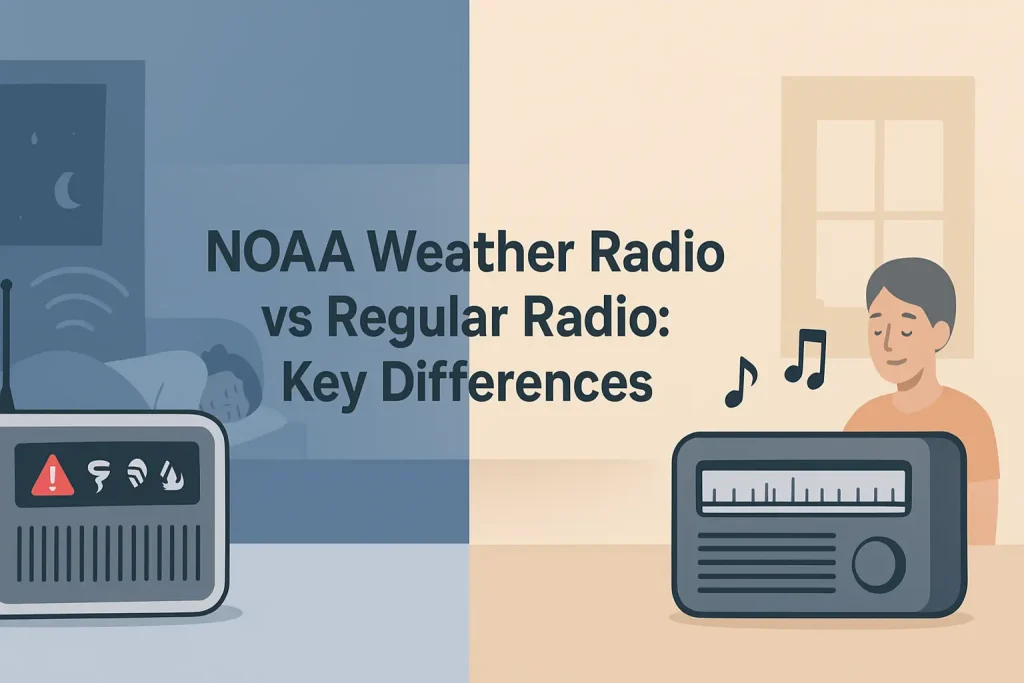
A “Public Alert” certification means a weather radio meets strict federal standards for decoding emergency alerts. NOAA Weather Radio broadcasts on seven frequencies between 162.400 and 162.550 MHz, but without certification, your device might miss critical specific area message encoding (S.A.M.E.) data.
This distinction separates a reliable emergency receiver from a basic weather band scanner. A certified radio acts as a dedicated lifeline during severe weather.
| Photo | Popular Portable Walkie Talkies | Price |
|---|---|---|
 | SKIWARRIOR Multifunctional Smart Wireless Ski Goggles with Walkie-Talkie, Anti-Fog Zeiss Lens, Music & Call Function (Cylindrical Blue) | Check Price On Amazon |
 | SINORISE Super Mini Walkie Talkies, Two-Way Radios, 3 Pack | Check Price On Amazon |
 | KOSPET Tank M4C Smart Watch Rugged, Dual-Band GPS, 5ATM & IP69K Waterproof | Check Price On Amazon |
 | Retevis RT15 Walkie Talkies 3 Pack, Birthday Gift, Outdoor Adventure Kit | Check Price On Amazon |
 | Rechargeable Walkie Talkies Toys for Kids: DIY Astronaut Walkie Talkies for Boys Christmas Birthday Gifts for 3 4 5 6 7 8 9 10 Boy Walkie Talkie Outdoor Hiking Toy 2 Way Radio Camping Outdoor Game | Check Price On Amazon |
Review these key specifications and regulatory standards that define a compliant Public Alert weather radio.
By the Numbers
Weather Radio Alert System – Key Specifications and Standards
Sources: NOAA NWR documentation, Consumer Technology Association CTA-2009-A
What Does Public Alert Certified Mean for a Weather Radio?
Consumer Technology Association standard CTA-2009-A defines the Public Alert certification. A certified radio is a type of emergency receiver that automatically triggers an alarm when it receives specific event codes from the National Weather Service.
This happens because the radio’s internal decoder continuously monitors the local NOAA broadcast for digital header codes. This only occurs when the radio is plugged in and set to alert mode.
If the radio lacks this certified decoder, the result is a missed tornado warning. Fix it by replacing the unit with a certified model like the Midland WR400 weather radio.
Public Alert certification guarantees the device meets minimum audio output and decoding standards. The standard ensures the radio will wake you up at 3 AM for a critical alert.
How Does Public Alert Certification Differ From NWR All Hazards?
NOAA Weather Radio All Hazards (NWR) is the broadcast network itself, operating on the VHF band. Public Alert is the certification standard for the receiving equipment in your home.
A radio consists of a receiver, an antenna, and an alert decoder. The decoder works with the receiver to process the 1050 Hz warning tone and S.A.M.E. digital headers.
A cheap scanner might pick up the audio on 162.550 MHz, but it will not automatically trigger a siren. The Public Alert standard mandates this automatic triggering behavior.
A scanner like the Uniden BC125AT scanner can monitor weather channels, but it is not a certified alert device. You would have to manually listen to hear the warnings.
Which Alerts Will a Public Alert Radio Receive?
A certified radio processes over 80 different Specific Area Message Encoding (S.A.M.E.) event codes. These include weather warnings like Tornado Warning (TOR) and non-weather emergencies like AMBER Alerts.
The Federal Emergency Management Agency (FEMA) pushes these alerts through the Emergency Alert System (EAS). Your radio must be programmed with the correct 6-digit FIPS code to filter these alerts correctly.
According to NOAA NWR documentation, the system broadcasts official watches, warnings, and forecasts 24 hours a day. The Public Alert standard requires the receiver to recognize all of these specific coded events.
If your radio is not certified, it might ignore critical civil emergency messages. You need a certified device to capture the full range of EAS alerts.
How to Verify if Your Weather Radio is Public Alert Certified
Look for the official “Public Alert” logo on the device packaging or the front of the radio unit. The Consumer Technology Association maintains a list of certified devices that meet the CTA-2009-A standard.
If the device only says “NOAA Weather Radio” or “Weather Band,” it likely lacks the automatic alerting features required for certification. You must check the manual or the manufacturer website to confirm.
Do not rely on the presence of a weather antenna or a WX channel button as proof of certification. True certification guarantees specific hardware decoding capabilities.
Once you confirm certification, you must program your local FIPS code. Use this step-by-step guide to program S.A.M.E. codes on a typical Public Alert radio.
Step-by-Step Guide
How to Program S.A.M.E. Codes – Step by Step
4 steps · Estimated time: 3 minutes
Enter Menu Mode
Press the Menu button on the front panel of your weather radio to access the setup options.
Select S.A.M.E. Setup
Use the up and down arrows to scroll until you see the S.A.M.E. Set option, then press Select.
Enter 6-Digit FIPS Code
Input the correct 6-digit FIPS code for your county using the numeric keypad to filter alerts to your area.
Save and Exit
Press the Menu button again to save your entry and return the radio to normal standby alert mode.
Public Alert Certified vs. Standard Weather Radios: Which Should You Choose?
You should choose a Public Alert certified radio for emergency preparedness. Standard weather band receivers are fine for listening to the daily forecast.
Certified radios differ from standard receivers in their ability to automatically decode location-specific alerts. A standard receiver requires human intervention to hear the broadcast.
The Midland WR400 and Sangean CL-100 are prime examples of certified units with reliable alert sirens. Finding the best weather radios requires checking for this exact certification to ensure automatic life-saving alerts.
Top Public Alert Certified Weather Radios for Your Home
Desktop units provide the best combination of loud sirens and battery backup for home use. The Midland WR400 features 25 programmable county codes.
It also includes an 85 dB siren to wake you during nighttime emergencies. Key Specifications: Frequency: 162.400-162.550 MHz. S.A.M.E. memory: 25 locations. Power: AC adapter with 4x AA battery backup. Siren output: 90 dB.
The Sangean CL-100 is another highly rated Public Alert desktop radio. It offers RBDS technology to display alert text on a backlit screen.
Key Specifications: Frequency: 162.400-162.550 MHz. S.A.M.E. memory: 20 locations. Power: AC adapter with 4x AA battery backup. Siren output: 85 dB.
Can a Walkie-Talkie or GMRS Radio Receive Public Alerts?
Some GMRS handheld radios include a NOAA weather radio receive function. Devices like the Midland GXT1000VP4 GMRS can scan the seven weather frequencies.
However, two-way radios are not Public Alert certified. They lack the continuous background decoding required to trigger an automatic siren while you sleep.
Understanding the NOAA Weather Radio network reveals why dedicated receivers are mandatory for true hands-free emergency alerting. A walkie-talkie is only useful if you manually turn the knob to the weather channel.
For dedicated outdoor use, you might consider a certified portable device. Choosing a portable weather radio for camping ensures you receive alerts even when away from a wall outlet.
How to Troubleshoot a Public Alert Radio That Fails to Trigger
Check your S.A.M.E. code entry first. If you enter the wrong 6-digit FIPS code, the radio will not process alerts for your county.
This happens because the digital header mismatch causes the radio’s logic circuit to ignore the incoming warning tone. The condition only occurs when the programmed code differs from the broadcast target area.
If the code is wrong, the result is a missed alert, which you can fix by reprogramming the correct FIPS digits. Look up local S.A.M.E. codes for your county to ensure absolute accuracy.
Test the 1050 Hz tone reception weekly using the built-in test function. Learning proper weather radio operation prevents dead batteries and faulty antennas from masking incoming alerts.
Replace the backup batteries every six months to maintain reliable performance. Use high-quality AA alkaline batteries to prevent leakage and ensure maximum standby time.
Quick Reference: Weather Radio Terminology
Public Alert: A certification standard ensuring a radio meets specific requirements for decoding and responding to emergency alerts.
S.A.M.E.: Specific Area Message Encoding, a digital protocol that allows radios to filter alerts by county or geographic region.
FIPS Code: A 6-digit Federal Information Processing Standards code used to program the geographic filter on a weather radio.
NWR: NOAA Weather Radio, the nationwide network of radio stations broadcasting continuous weather information.
1050 Hz Tone: An attention signal broadcast before severe weather warnings to trigger older non-S.A.M.E. weather radios.
CTA-2009-A: The official Consumer Technology Association standard that defines the technical requirements for Public Alert certified devices.
What does it mean if a radio is Public Alert certified?
A Public Alert certified radio meets the Consumer Technology Association standard CTA-2009-A for automatic emergency alerting. The device is guaranteed to decode S.A.M.E. headers and trigger an alarm for severe weather warnings.
This certification ensures the radio has the necessary hardware to process Specific Area Message Encoding data. It guarantees the device will sound an alarm of at least 85 dB for critical alerts.
Without this certification, a device might only function as a basic weather receiver. Always look for the Public Alert logo when buying an emergency radio.
Do I need a license to operate a Public Alert weather radio?
No, you do not need a license to operate a Public Alert weather radio. These devices are receive-only equipment that monitor the NOAA Weather Radio frequencies between 162.400 and 162.550 MHz.
The FCC does not require licenses for receive-only radio equipment. This differs from GMRS or amateur radio transmitters, which require FCC Part 95 or Part 97 licenses.
You can buy, program, and operate a weather radio immediately without any government paperwork. Simply plug it in, enter your S.A.M.E. code, and set the alert mode.
Will a Public Alert radio work during a power outage?
Yes, a Public Alert radio will work during a power outage if it has functional backup batteries installed. The certification standard requires a battery backup system to maintain alerting capability.
Most desktop units use 4x AA alkaline batteries as a primary backup source. Some advanced models also accept rechargeable lithium-ion battery packs.
If the power goes out and your batteries are dead, the radio will fail to alert you. Test your batteries every six months to ensure they maintain a charge.
What is the difference between S.A.M.E. and Public Alert?
S.A.M.E. is a digital encoding protocol used by the National Weather Service, while Public Alert is a hardware certification standard for receiving devices. A radio needs S.A.M.E. technology to filter alerts by county.
Public Alert certification requires the device to properly decode S.A.M.E. signals, but also mandates specific siren volumes and display requirements. Understanding S.A.M.E. weather radio technology helps clarify how digital codes trigger the hardware alarm.
A radio can have S.A.M.E. technology without being fully Public Alert certified. However, a Public Alert certified radio always includes S.A.M.E. filtering.
Can I use a Baofeng UV-5R as a Public Alert radio?
No, you cannot use a Baofeng UV-5R as a Public Alert radio. While the UV-5R can receive the 162 MHz weather band, it lacks the certified hardware to decode S.A.M.E. headers automatically.
The UV-5R will not sound an alarm when a tornado warning is issued. You would have to manually monitor the channel to hear the broadcast.
Amateur radio handhelds are designed for two-way communication, not dedicated emergency alerting. Keep a dedicated certified weather radio in your home for hands-free alerts.
Why does my weather radio alert for a different county?
Your weather radio is alerting for a different county because you entered the wrong 6-digit FIPS code. The radio only triggers alerts for the specific geographic codes programmed into its memory.
This happens because the digital header mismatch causes the radio to process the wrong geographic filter. Fix the problem by deleting the incorrect code and entering the correct FIPS code for your location.
Checking NOAA weather radio frequencies and broadcast coverage can also help you tune to the strongest local transmitter. This ensures reliable reception of the correct regional alerts.
Does a Public Alert radio receive AMBER alerts?
Yes, a Public Alert radio will receive AMBER alerts if the specific S.A.M.E. event code is active in your area. The CTA-2009-A standard requires certified radios to decode civil emergency messages, including child abduction emergencies.
The National Weather Service broadcasts these non-weather emergencies through the Emergency Alert System. Your radio will trigger its siren when the AMBER code is transmitted.
You can usually disable specific non-weather alerts through the radio menu if you prefer. However, most users leave these alerts active for maximum safety.
What frequencies do Public Alert radios monitor?
Public Alert radios monitor seven specific frequencies in the VHF band: 162.400, 162.425, 162.450, 162.475, 162.500, 162.525, and 162.550 MHz. These channels are dedicated exclusively to NOAA Weather Radio broadcasts.
You must select the frequency that provides the strongest signal in your geographic area. Most modern radios automatically scan for the strongest signal upon setup.
If you live on the edge of a transmitter range, you may need an external antenna. An external weather radio antenna can improve reception in fringe areas.
Is a portable weather radio as reliable as a desktop Public Alert unit?
A portable weather radio is not as reliable as a desktop Public Alert unit for primary home alerting. Desktop units typically have louder sirens, better antennas, and continuous AC power with battery backup.
Portable units are designed for outdoor mobility rather than waking you from a deep sleep. Their smaller speakers cannot match the 90 dB siren output of a certified desktop model.
Use a desktop unit for your home and a portable unit for camping or travel. This combination provides complete alert coverage in all situations.
A Public Alert certified weather radio guarantees you receive critical S.A.M.E. alerts on the 162.400 to 162.550 MHz frequencies. This hardware certification ensures your device decodes emergency headers and sounds an alarm when seconds count. Pair a dedicated desktop unit for home use with a portable model for outdoor activities. Replace the backup batteries every six months to ensure continuous operation during severe weather.
| Photo | TOP RATED WALKIE TALKIES | Price |
|---|---|---|
 | Retevis RT628 Kids Walkie Talkies, Toys Gifts for 4-12 Year Old Girl Boy | Check Price On Amazon |
 | Cobra ACXT545 Weather-Resistant Walkie Talkies, Rechargeable, 22 Channels | Check Price On Amazon |
 | Retevis RT388 Kids Walkie Talkies, Outdoor Toys for Kids Camping Essentials | Check Price On Amazon |
 | Cobra RX680 Walkie Talkies (2-Pack), IP54 Water Resistant Design | Check Price On Amazon |
 | Retevis RT22 Walkie Talkies Long Range Rechargeable with Earpiece (2 Pack) | Check Price On Amazon |
 | Midland GXT1000VP4 GMRS JIS4 Two-Way Radio, Black,2 Pack | Check Price On Amazon |
 | Retevis RT628 Walkie Talkies for Kids,Toys Gifts for 6-12 Years Old Boys Girls,Long Range 2 Way Radio 22CH VOX,Birthday Gift,Family Walkie Talkie for Camping Hiking Indoor Outdoor | Check Price On Amazon |