The FRS and GMRS channel system provides reliable two-way radio communication for outdoor activities, family outings, and emergencies. This comprehensive guide explains all 22 channels, their frequencies, power limits, and license requirements. You’ll learn which channels need licenses, realistic range expectations, and how to choose the right channels for your specific needs.
Understanding these channels helps you communicate more effectively, avoid interference, and stay legal while using your two-way radios. Skip to specific sections using the links below.
| Photo | Popular Portable Walkie Talkies | Price |
|---|---|---|
 | SKIWARRIOR Multifunctional Smart Wireless Ski Goggles with Walkie-Talkie, Anti-Fog Zeiss Lens, Music & Call Function (Cylindrical Blue) | Check Price On Amazon |
 | SINORISE Super Mini Walkie Talkies, Two-Way Radios, 3 Pack | Up to 12 Hours Battery Life, for Baseball Coaches, Restaurants, Retail Stores, Hospitals, Outdoor Sports & Travel | Check Price On Amazon |
 | KOSPET Tank M4C Smart Watch Rugged, Dual-Band GPS, 5ATM & IP69K Waterproof | 1.96" AMOLED Display, 170+ Sport Modes, Built-in LED Flashlight/Walkie-Talkie, Heart Rate/Sleep Monitor for Android & iPhone | Check Price On Amazon |
 | Retevis RT15 Walkie Talkies 3 Pack, Birthday Gift, Outdoor Adventure Kit | Durable, Lightweight, VOX, Key Lock, Mini Walkie Talkies for Adults, School Family Outdoor Travel Camping Hiking | Check Price On Amazon |
 | Rechargeable Walkie Talkies Toys for Kids: DIY Astronaut Walkie Talkies for Boys Christmas Birthday Gifts for 3 4 5 6 7 8 9 10 Boy Walkie Talkie Outdoor Hiking Toy 2 Way Radio Camping Outdoor Game | Check Price On Amazon |
- Complete FRS & GMRS Channel Chart
- What Are FRS and GMRS Radio Services?
- GMRS License Requirements
- Real-World Range Guide
- Channel Selection Guide
FRS & GMRS Channel Chart: Complete Reference Table
This comprehensive FRS and GMRS channel chart provides all the information you need in one place. The table below includes all 22 channels with their frequencies, power limits, and license requirements.
| Channel | Frequency (MHz) | FRS Power Limit | GMRS Power Limit | License Required? | Notes |
|---|---|---|---|---|---|
| 1 | 462.5625 | 2 Watts | 5 Watts | Shared (GMRS needs license) | Popular family channel |
| 2 | 462.5875 | 2 Watts | 5 Watts | Shared (GMRS needs license) | Good clarity in most areas |
| 3 | 462.6125 | 2 Watts | 5 Watts | Shared (GMRS needs license) | Common outdoor recreation channel |
| 4 | 462.6375 | 2 Watts | 5 Watts | Shared (GMRS needs license) | Often used for group coordination |
| 5 | 462.6625 | 2 Watts | 5 Watts | Shared (GMRS needs license) | Popular camping channel |
| 6 | 462.6875 | 2 Watts | 5 Watts | Shared (GMRS needs license) | Good for hiking groups |
| 7 | 462.7125 | 2 Watts | 5 Watts | Shared (GMRS needs license) | Common for family use |
| 8 | 467.5625 | 0.5 Watts | 0.5 Watts | No | FRS low power channel |
| 9 | 467.5875 | 0.5 Watts | 0.5 Watts | No | FRS low power channel |
| 10 | 467.6125 | 0.5 Watts | 0.5 Watts | No | FRS low power channel |
| 11 | 467.6375 | 0.5 Watts | 0.5 Watts | No | FRS low power channel |
| 12 | 467.6625 | 0.5 Watts | 0.5 Watts | No | FRS low power channel |
| 13 | 467.6875 | 0.5 Watts | 0.5 Watts | No | FRS low power channel |
| 14 | 467.7125 | 0.5 Watts | 0.5 Watts | No | FRS low power channel |
| 15 | 462.5500 | 2 Watts | 50 Watts | Yes (GMRS only) | GMRS repeater output |
| 16 | 462.5750 | 2 Watts | 50 Watts | Yes (GMRS only) | GMRS repeater output |
| 17 | 462.6000 | 2 Watts | 50 Watts | Yes (GMRS only) | GMRS repeater output |
| 18 | 462.6250 | 2 Watts | 50 Watts | Yes (GMRS only) | GMRS repeater output |
| 19 | 462.6500 | 2 Watts | 50 Watts | Yes (GMRS only) | GMRS repeater output |
| 20 | 462.6750 | 2 Watts | 50 Watts | Yes (GMRS only) | GMRS repeater output |
| 21 | 462.7000 | 2 Watts | 50 Watts | Yes (GMRS only) | GMRS repeater output |
| 22 | 462.7250 | 2 Watts | 50 Watts | Yes (GMRS only) | GMRS repeater output |
Key Points About This Chart:
- Shared Channels (1-7): Both FRS and GMRS users can use these, but GMRS requires a license
- FRS-Only Channels (8-14): Limited to 0.5 watts, no license required
- GMRS Repeater Channels (15-22): Higher power, license required, can work with repeaters
The 2017 FCC rule changes expanded FRS power limits on channels 1-7 from 0.5 watts to 2 watts, allowing for better range on these shared channels even without a GMRS license.
What Are FRS and GMRS Radio Services?
Before diving deeper into channels and frequencies, it’s important to understand what FRS and GMRS actually are and how they differ.
Family Radio Service (FRS) is a license-free radio service designed for short-range communication between family members and small groups. Created by the FCC in 1996, FRS allows anyone to communicate using specific channels without needing any license or special permission.
General Mobile Radio Service (GMRS) is a licensed radio service that offers more power, greater range, and additional features compared to FRS. GMRS has been around since the 1960s and requires users to obtain a license from the FCC before transmitting.
Key Differences Between FRS and GMRS:
- Licensing: FRS requires no license; GMRS requires an FCC license ($35 for 10 years)
- Power Limits: FRS maxes out at 2 watts; GMRS allows up to 50 watts on certain channels
- Range: FRS typically reaches 0.5-2 miles; GMRS can reach 5+ miles (more with repeaters)
- Repeater Use: FRS cannot use repeaters; GMRS can use repeaters for extended range
- Channels: FRS has access to 22 channels (with power limits); GMRS has access to 30 channels total (22 main plus 8 repeater inputs)
In 2017, the FCC updated regulations, increasing FRS power limits and simplifying the channel structure. This expanded FRS capabilities while maintaining GMRS advantages for those needing more range and features.
GMRS License Requirements: What You Need to Know
While FRS channels can be used without a license, GMRS operation requires an FCC license. Here’s everything you need to know about getting licensed and staying legal.
A GMRS license costs $35 and is valid for 10 years. The good news is that a single license covers your entire immediate family, including your spouse, children, parents, grandparents, and in-laws. This makes it very cost-effective for family activities.
How to Get Your GMRS License
- Visit the FCC Website: Go to the FCC’s Universal Licensing System (ULS) at https://www.fcc.gov/wireless/universal-licensing-system
- Create an FCC Registration Number (FRN): If you don’t already have one, register for an FRN
- Fill out Form 605: Complete the application for the GMRS license
- Pay the Fee: Submit the $35 payment (valid for 10 years)
- Receive Your License: The FCC typically processes applications within 1-2 business days
Unlike ham radio, there’s no test required to get a GMRS license. You simply apply and pay the fee.
Frequently Asked GMRS License Questions
Who needs a license? Anyone operating on GMRS channels with power exceeding FRS limits needs a license. If you’re only using FRS power levels (2 watts or less), you don’t need a license.
Do I need separate licenses for multiple radios? No, one license covers all your GMRS radios.
Can my friends use my GMRS radio? Non-family members can use your GMRS radio under your direct supervision, but technically they should have their own license for independent use.
What are the penalties for unlicensed operation? Operating GMRS without a license can result in warnings, fines starting at $100, and potentially reaching several thousand dollars for repeated violations.
Real-World Range Guide: What to Actually Expect
Forget the marketing claims of “30+ miles” range. Here’s what you can realistically expect from FRS and GMRS radios in different environments.
| Environment | FRS Range (2W) | GMRS Range (5W) | GMRS Range (50W) | With Repeater |
|---|---|---|---|---|
| Dense Urban (city) | 0.5-1 mile | 1-2 miles | 2-3 miles | 5-10 miles |
| Suburban | 1-2 miles | 2-3 miles | 3-5 miles | 10-20 miles |
| Rural/Open Fields | 2-3 miles | 3-5 miles | 5-8 miles | 20-30 miles |
| Elevated/Mountain | 3-5 miles | 5-10 miles | 10-15 miles | 30+ miles |
| Inside Buildings | 1-3 floors | 2-5 floors | 3-7 floors | N/A |
These ranges are based on real-world testing rather than theoretical maximums. Actual performance depends on several key factors:
Factors That Affect Radio Range
- Obstacles: Buildings, hills, dense forests, and even large vehicles block radio signals
- Elevation: Higher positions dramatically improve range (every 100 feet of elevation can add miles of range)
- Antenna Quality: Aftermarket antennas can improve range by 20-50%
- Weather: Humidity, rain, and fog can reduce range by absorbing signals
- Radio Position: Holding the radio near your body reduces range; holding it up improves range
- Battery Level: Low batteries can reduce transmit power and range
In testing with the Midland GXT1000 radios, we found that in an urban environment with many buildings, the actual range was just under 1 mile despite the “36-mile” claim on the packaging. In open fields, the same radios reached about 3 miles.
The most significant range improvements come from increasing elevation and using GMRS repeaters. Standing on a hill or tall building can double or triple your range compared to ground level. For a deeper understanding of what affects signal distance and how to maximize it, check out our complete walkie talkie range guide.
Channel Selection Guide: Which Channels to Use When
Not all channels are created equal. Here’s how to select the optimal channels for different situations and environments.
Recommended Channels for Specific Activities
- Family Camping/Hiking: Channels 1-7 offer good balance of range and clarity. Channel 5 (462.6625 MHz) is particularly popular for outdoor recreation.
- Large Events/Coordination: Channel 4 (462.6375 MHz) is commonly used for group coordination at events. For larger events, consider channels 15-22 with a GMRS license.
- Urban Use: In cities, channels 8-14 often have less interference despite their lower power, making them more useful than higher-powered channels in some cases.
- Emergency Communications: Channels 1, 16, and 20 are commonly monitored by emergency preparedness groups. Channel 20 (462.6750 MHz) is often used as a calling channel.
- Maximum Range Needs: With a GMRS license, channels 15-22 with repeaters offer the greatest possible range.
Channel Selection Strategy
For best results, follow this channel selection approach:
- Start with less crowded channels: Try channels 2, 5, or 7 first, as they tend to have less traffic
- Listen before transmitting: Always check if a channel is in use before you start using it
- Have backup channels: Pre-arrange several alternative channels with your group in case of interference
- Use privacy codes: Add CTCSS/DCS codes to filter unwanted conversations (but remember they don’t make your conversations private)
- Avoid channels 8-14 for distance: These limited-power channels work well for close range but not for distance
When using channels in popular outdoor areas like national parks, you may encounter more congestion. In these situations, adding a privacy code can help filter out other conversations, even though the channel itself is shared.
Understanding Privacy Codes: CTCSS and DCS Explained
Privacy codes don’t actually make your communications private—they help filter out unwanted chatter. Here’s how they really work and how to use them effectively.
Privacy codes use either CTCSS (Continuous Tone-Coded Squelch System) or DCS (Digital Coded Squelch) to filter radio traffic. Think of them as a door that only opens for voices using the same code.
Important Facts About Privacy Codes:
- They don’t encrypt or scramble your voice
- Anyone can hear your conversation by simply turning off privacy codes
- There are typically 38 CTCSS codes and 83 DCS codes available
- They only filter what you hear, not who can hear you
Most brands use compatible privacy codes, but they might label them differently. Midland’s “Privacy Code 1” is the same as Motorola’s “Code 1” – they both use the 67.0 Hz CTCSS tone.
Using privacy codes effectively lets your group focus on just your conversations while sharing busy channels with others. For example, your family could use Channel 5 with Privacy Code 3, while another nearby group uses Channel 5 with Privacy Code 10. For a more detailed explanation of how these codes work and how to use them effectively, see our complete guide to walkie talkie privacy codes.
GMRS Repeater Channels: Extended Range Communication
GMRS repeaters can dramatically extend your communication range. Channels 15-22 can be used with repeaters—here’s how they work and how to use them.
A repeater is a fixed radio station, usually on a high location like a mountain or tall building, that receives signals and retransmits them with more power. This allows your handheld radio to reach much further than it could directly.
GMRS repeaters operate on channel pairs:
- Input: Your radio transmits on channels 15R-22R (467.5500-467.7250 MHz)
- Output: You receive from the repeater on channels 15-22 (462.5500-462.7250 MHz)
Modern GMRS radios automatically handle this channel pairing when you select “repeater mode.” On some radios, you’ll see these marked as “15R” instead of just “15” to indicate repeater input channels.
To find local repeaters, check resources like:
When using repeaters, always identify yourself with your callsign (given when you get your GMRS license) and keep transmissions brief to allow others access. For a complete understanding of how repeaters work and how to effectively incorporate them into your communication system, visit our guide on radio repeaters.
Emergency Channels and Weather Alerts
While there’s no official emergency channel for FRS/GMRS, there are conventional practices and channels commonly monitored during emergencies.
In the GMRS/FRS world, certain channels have become informally recognized for emergency use:
- Channel 1 (462.5625 MHz) is often monitored by outdoor groups and is a good first choice in wilderness emergencies
- Channel 20 (462.6750 MHz) is commonly used as a calling channel by GMRS users and monitored by many emergency preparedness groups
- Channels without privacy codes are more likely to be heard by others in emergency situations
Many GMRS radios also include NOAA Weather Radio capability, which provides access to seven dedicated weather channels broadcasting continuous weather information and emergency alerts. These are separate from the GMRS/FRS channels but accessible on most radios with a “WX” button.
Emergency Communication Tips
- State “EMERGENCY” clearly at the beginning of your transmission
- Give your exact location with as much detail as possible
- Explain the nature of the emergency and what help is needed
- Speak slowly and clearly
- If no response, try different channels, especially Channel 1 and Channel 20
- Conserve battery by transmitting briefly and then listening
For emergency preparedness, establish a channel plan with your family or group in advance, including primary and backup channels.
Programming and Using Your Radio: Practical Tips
Understanding channels is one thing—actually setting up your radio correctly is another. Here’s how to program and use your radio effectively.
Basic Setup Steps for Most Radios
- Install batteries/charge radio – Many GMRS radios use rechargeable battery packs
- Select a channel – Usually with up/down buttons or a dial
- Set privacy codes – Look for “code,” “CTCSS,” or “DCS” in the menu
- Set volume – Start at 50% and adjust as needed
- Test with your group – Conduct radio checks before separating
Brand-Specific Notes
Midland Radios: Press Menu button until the channel number flashes, select channel with up/down, press Menu again to set. For privacy codes, press Menu twice until “Ct” appears, then select code number.
Motorola Radios: Press Menu button, select “CHAN” using + or – buttons, press Menu to confirm. For privacy codes, go to Menu, select “CODE” and choose your code number.
Baofeng GMRS Radios: Enter frequency directly using keypad in VFO mode, or program channels using CHIRP software and a programming cable for easier setup.
Practical Usage Tips
- Battery Conservation: Turn off the radio when not in use; lower power settings for short-range communication
- Proper Transmission Technique: Hold button, wait 1 second, then speak; release button to listen
- Clear Communication: Speak clearly at normal volume, holding the radio 1-2 inches from your mouth
- Range Improvement: Hold radio high and away from your body; move to higher ground when possible
- Scanning: Use the scan function to find active channels, but return to your agreed channel
For better performance, consider these accessories:
- External speaker/mic: Allows convenient use while the radio stays on your belt
- Better antenna: Aftermarket antennas can improve range substantially
- Extra batteries: Always carry spares, especially on longer trips
FRS vs. GMRS vs. Other Radio Services: Comparison Guide
FRS and GMRS aren’t your only options for two-way radio communication. Here’s how they compare to other services like MURS, CB, Ham Radio, and business band.
| Service | Frequency | License Required | Max Power | Typical Range | Best For | Cost to Start |
|---|---|---|---|---|---|---|
| FRS | 462-467 MHz | No | 2 Watts | 0.5-2 miles | Family activities, short-range | $20-50 per radio |
| GMRS | 462-467 MHz | Yes ($35/10yr) | 50 Watts | 1-5+ miles (30+ with repeaters) | Serious outdoor use, emergencies | $40-200 per radio + license |
| CB Radio | 27 MHz | No | 4 Watts | 1-5 miles (15+ in ideal conditions) | Road trips, trucking | $30-150 per radio |
| MURS | 151-154 MHz | No | 2 Watts | 1-3 miles | Business, property security | $60-200 per radio |
| Ham Radio | Multiple bands | Yes (test required) | 1.5-1500 Watts (band dependent) | 1-5000+ miles (worldwide) | Hobby, technical users, DX | $30-1000+ per radio + license |
| Business Band | Various UHF/VHF | Yes | 1-50 Watts | 1-30+ miles | Commercial operations | $100-500 per radio + license |
Which Service Is Right For You?
- Choose FRS if: You need simple, license-free communication for family activities with minimal setup
- Choose GMRS if: You need reliable, medium-range communication for outdoor activities and are willing to get a license
- Choose CB if: You need communication while driving, especially on highways
- Choose Ham Radio if: You’re interested in radio as a hobby and want maximum flexibility and range
- Choose MURS if: You need license-free communication for property security or business use
For most recreational users, GMRS offers the best balance of range, ease of use, and cost. The license is simple to obtain and covers your entire family for 10 years. If you’re interested in understanding the key differences between these services in greater detail, our comparison of FRS, GMRS, and Ham Radio provides an in-depth technical analysis.
International Usage: Using Your Radios Outside the US
Planning to use your radios while traveling? FRS and GMRS regulations vary by country—here’s what you need to know.
Canada: Canada has harmonized with US FRS/GMRS channels, but with different licensing. FRS channels 1-7 and 15-22 can be used without a license, but with power limited to 2 watts. An Innovation, Science and Economic Development Canada license is required for higher power.
Mexico: Mexico allows FRS usage without a license, but GMRS operation requires authorization from the Federal Telecommunications Institute (IFT). Frequencies are compatible with US channels.
Europe: Most European countries use PMR446 (446 MHz), which is incompatible with US FRS/GMRS radios. You’ll need to purchase or rent European-specification radios when traveling there.
Australia: Uses UHF CB on different frequencies (476-477 MHz). US radios won’t work there.
Always check local regulations before traveling with radios. In many countries, using US-specification radios without authorization can result in fines or equipment confiscation. When in doubt, purchase or rent locally approved radios instead of bringing your own.
Frequently Asked Questions About FRS and GMRS
Still have questions about FRS and GMRS channels? Here are answers to the most commonly asked questions.
Can different brands of radios communicate with each other?
Yes, all FRS/GMRS radios from different manufacturers (Motorola, Midland, Cobra, etc.) can communicate with each other as long as they’re on the same channel and using the same privacy code. The FCC standards ensure compatibility between brands.
Are privacy codes the same across all radio brands?
Yes, the actual tones (CTCSS/DCS) are standardized, but brands might number them differently. Code 1 on a Midland radio uses the same 67.0 Hz tone as Code 1 on a Motorola radio, ensuring cross-compatibility.
How can I improve my radio’s range?
Improve range by moving to higher ground, using a better antenna, ensuring full battery charge, holding the radio properly (away from your body), and using GMRS repeaters when available. External antennas can improve range by 20-50%.
Can I use a GMRS radio without a license in an emergency?
Yes, FCC rules allow for the use of any radio service without a license in genuine emergencies when life or property is in danger and no other communication means is available.
What’s the difference between UHF and VHF?
UHF (Ultra High Frequency, including FRS/GMRS) works better around buildings and in forests, while VHF (Very High Frequency) travels farther in open areas. FRS/GMRS radios use UHF frequencies, which work well for most recreational uses.
Can I modify my radio to transmit on restricted frequencies?
No, modifying radios to operate outside their authorized frequencies is illegal and can result in substantial FCC fines, typically starting at $10,000 for willful violations.
Do weather conditions affect radio performance?
Yes, heavy rain, fog, and high humidity can reduce range by absorbing radio signals. Snow generally has minimal impact, while electrical storms can cause interference.
How long do batteries typically last?
Most handheld radios provide 8-12 hours of typical use (5% transmitting, 5% receiving, 90% standby). Transmitting consumes the most power, so limiting unnecessary talk extends battery life.
Can I use my FRS/GMRS radio as a baby monitor?
While technically possible using VOX (voice-activated transmission) mode, it’s not recommended for safety-critical monitoring since channel interference could disrupt the signal. If you’re specifically looking for this application, check out our guide on choosing walkie talkies for baby monitoring that examines the pros and cons in detail.
What happens if someone else is using my channel?
FRS/GMRS channels are shared, and you must wait until the channel is clear before transmitting. Try using privacy codes to filter unwanted conversations or switch to a different channel.
Conclusion: Making the Most of Your Two-Way Radios
With the right knowledge about FRS and GMRS channels, you can maximize the effectiveness of your two-way radio communications. The key points to remember:
- Channels 1-7 (shared) offer good range and can be used with 2 watts power without a license
- Channels 8-14 are limited to 0.5 watts and best for close-range communication
- Channels 15-22 offer the best range but require a GMRS license
- Real-world range is much less than advertised, typically 1-3 miles in most environments
- GMRS licenses cost $35 for 10 years and cover your entire family
- Privacy codes don’t make conversations private—they just filter what you hear
For most recreational users, a quality GMRS radio and license provides the best communication solution, offering substantial range and reliability for outdoor activities, road trips, and emergency preparedness.
Choose channels based on your specific needs, keep extra batteries handy, and practice proper radio etiquette. With these fundamentals in place, your two-way radios will become an invaluable tool for keeping your group connected, coordinated, and safe.
| Photo | TOP RATED WALKIE TALKIES | Price |
|---|---|---|
 | Retevis RT628 Kids Walkie Talkies, Toys Gifts for 4-12 Year Old Girl Boy | Kids Camping Essentials Outdoor Toys, Birthday Gift, 22CH, VOX, Keypad Lock, Durable, Easy to Use Walkie Talkies for Kids | Check Price On Amazon |
 | Cobra ACXT545 Weather-Resistant Walkie Talkies, Rechargeable, 22 Channels | Long Range 28-Mile Two-Way Radio Set (2-Pack) | Check Price On Amazon |
 | Retevis RT388 Kids Walkie Talkies, Outdoor Toys for Kids Camping Essentials | 4-12 Year Old Boy Birthday Gift, 22 CH VOX Flashlight Clear Sound, Kids Walkie Talkies 2 Pack for Camping Hiking Adventure | Check Price On Amazon |
 | Cobra RX680 Walkie Talkies (2-Pack), IP54 Water Resistant Design | Rugged & Splashproof Two Way Radios Long Range, 60 Pre-Programmed Channels, Weather Alerts | Check Price On Amazon |
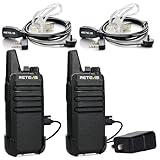 | Retevis RT22 Walkie Talkies Long Range Rechargeable with Earpiece (2 Pack) | Slim & Lightweight 2 Way Radio For Camping & Hiking, Pocket-Friendly Antenna, Ready to Use, 10-Hour Battery, USB-C Charging | Check Price On Amazon |
 | Midland GXT1000VP4 GMRS Two-Way Radios with Headsets, Black, 2 Pack | 50 Channels, 142 Privacy Codes, Up to 36 Mile Long Range, JIS4 Water Resistant, NOAA Weather Alert, Rechargeable NiMH | Check Price On Amazon |
 | Retevis RT628 Walkie Talkies for Kids,Toys Gifts for 6-12 Years Old Boys Girls,Long Range 2 Way Radio 22CH VOX,Birthday Gift,Family Walkie Talkie for Camping Hiking Indoor Outdoor | Check Price On Amazon |