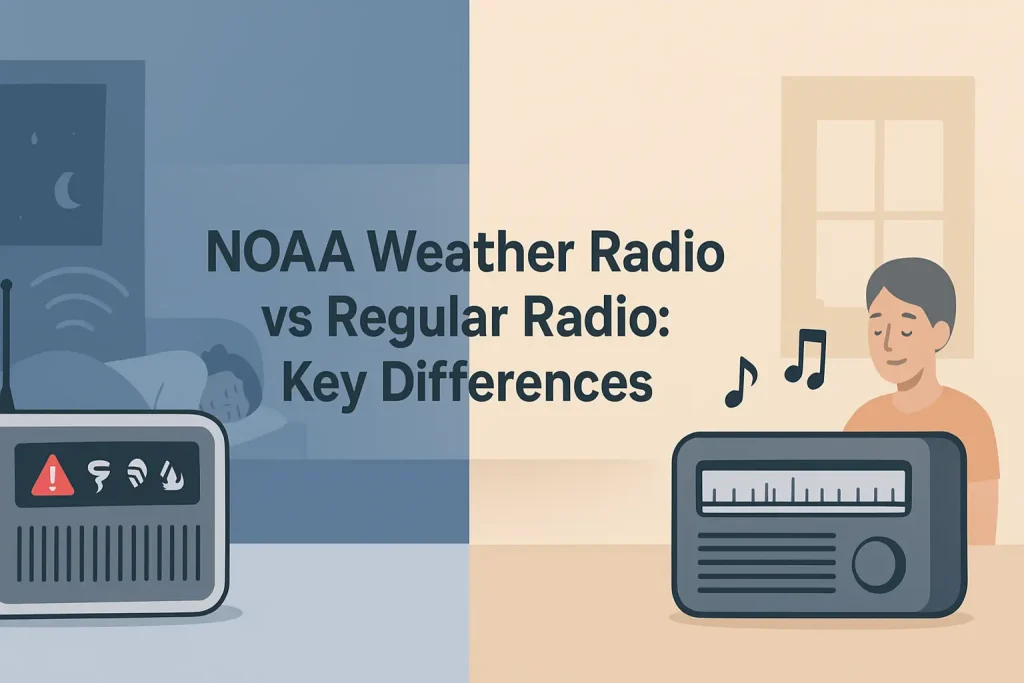
A weather radio with a built-in flashlight is not just a convenience item. It is the device that keeps working when your power goes out, your phone dies, and your neighborhood goes dark at 2 a.m. during a tornado warning.
NOAA Weather Radio All Hazards broadcasts on seven dedicated frequencies between 162.400 and 162.550 MHz, covering approximately 95% of the U.S. population within 40 miles of a transmitter. When you add a flashlight, hand-crank generator, and S.A.M.E. (Specific Area Message Encoding) alert filtering to that receiver, you get a device that functions as a complete emergency communication hub without relying on any external power source.
| Photo | Popular Portable Walkie Talkies | Price |
|---|---|---|
 | SKIWARRIOR Multifunctional Smart Wireless Ski Goggles with Walkie-Talkie, Anti-Fog Zeiss Lens, Music & Call Function (Cylindrical Blue) | Check Price On Amazon |
 | SINORISE Super Mini Walkie Talkies, Two-Way Radios, 3 Pack | Check Price On Amazon |
 | KOSPET Tank M4C Smart Watch Rugged, Dual-Band GPS, 5ATM & IP69K Waterproof | Check Price On Amazon |
 | Retevis RT15 Walkie Talkies 3 Pack, Birthday Gift, Outdoor Adventure Kit | Check Price On Amazon |
 | Rechargeable Walkie Talkies Toys for Kids: DIY Astronaut Walkie Talkies for Boys Christmas Birthday Gifts for 3 4 5 6 7 8 9 10 Boy Walkie Talkie Outdoor Hiking Toy 2 Way Radio Camping Outdoor Game | Check Price On Amazon |
This guide covers the best weather radios with built-in flashlights, what makes each model worth owning, how to choose the right one for your situation, and what separates a genuinely useful emergency device from a cheap plastic box with a dim LED.
What Is a Weather Radio with Flashlight and Why Does It Matter?
A weather radio with flashlight is a portable receiver tuned to the seven NOAA Weather Radio All Hazards (NWR) broadcast frequencies (162.400, 162.425, 162.450, 162.475, 162.500, 162.525, and 162.550 MHz) combined with one or more integrated light sources and typically a secondary power input such as a hand crank or solar panel.
These devices matter because they operate independently of grid power, cellular networks, and internet connectivity. The Federal Emergency Management Agency (FEMA) lists a battery-powered or hand-crank weather radio as a top-priority item in every emergency preparedness kit, precisely because it functions when all other communication channels fail.
A standard weather radio without backup power becomes useless within hours of a power outage. A model with a hand-crank generator, solar charging panel, rechargeable battery, and standard AA backup gives you four independent power sources, meaning you have an alert system that survives extended blackouts.
The flashlight component is not cosmetic. Emergency scenarios that trigger NOAA weather alerts frequently also cause power outages. Having the alert device and the light source in the same unit eliminates the need to locate two separate devices in the dark.
The most capable models in this category also include AM/FM radio reception for local news and emergency broadcasts, a USB phone charging port, and S.A.M.E. technology that filters alerts by county so you are not woken up for warnings 200 miles away. If you want a deeper look at how S.A.M.E. filtering works and how to program it, the complete explanation of S.A.M.E. weather radio technology and county-level alert programming covers the system in full detail.
A weather radio with a flashlight serves the same reader who this guide is written for: someone who wants reliable emergency alerts and useful emergency tools in a single, always-ready device that does not depend on infrastructure that fails during the exact events it is supposed to warn you about.
Best Weather Radios with Flashlight: Top Models Compared
The best weather radios with built-in flashlights combine reliable NOAA alert reception, S.A.M.E. county-level filtering, multiple power sources, and a flashlight that is genuinely bright enough to use in an emergency. The models below represent the strongest options across budget, mid-range, and premium tiers, based on manufacturer specifications, FCC type acceptance data, and verified buyer experience.
Use the table below to compare key specifications across the top-rated weather radio and flashlight combination models before reading the individual reviews.
| Model | NOAA Channels | S.A.M.E. Codes | Power Sources | USB Phone Charge | Flashlight | Price (approx.) |
|---|---|---|---|---|---|---|
| Midland ER310 | 7 | 25 | Hand crank, solar, USB-C, AA x3 | Yes | LED + SOS strobe | $50-65 |
| Eton FRX3+ | 7 | 25 | Hand crank, solar, USB, AA x3 | Yes | LED flashlight | $55-70 |
| Midland WR400 | 7 | 50 | AC adapter, 6x AA backup | No | No | $55-75 |
| Kaito KA500 | 7 | 25 | Hand crank, solar, USB, AA x3 | Yes | LED + reading light | $45-60 |
| RunningSnail MD-090P | 7 | None | Hand crank, solar, USB, AAA x3 | Yes | LED flashlight | $25-35 |
| Eton Sidekick | 7 | 25 | Hand crank, solar, USB, AAA x3 | Yes | LED flashlight | $35-50 |
| Midland ER210 | 7 | 25 | Hand crank, solar, USB, AA x3 | Yes | LED flashlight | $30-45 |
Prices verified at time of publication. S.A.M.E. code counts reflect maximum programmable locations per manufacturer data sheets. NOAA channel count reflects the seven NWR All Hazards broadcast frequencies (162.400-162.550 MHz).
Midland ER310: Best Overall Weather Radio with Flashlight
The Midland ER310 emergency crank weather radio is the strongest all-around performer in this category, combining four power sources with S.A.M.E. alert filtering, a bright LED flashlight, an SOS strobe beacon, and a USB phone charging port in a compact housing.
Key Specifications:
- NOAA frequencies: 162.400-162.550 MHz (all 7 channels)
- S.A.M.E. programmable locations: 25 county codes
- Power sources: Hand crank, solar panel, USB-C input, 3x AA backup
- Battery: 2,000 mAh internal rechargeable + AA tray
- Flashlight: LED with SOS strobe mode
- Additional radio: AM/FM reception included
- Price range: $50-65
The ER310 receives all 25 NOAA alert event types, including Tornado Warning, Flash Flood Warning, Hurricane Warning, Winter Storm Warning, and AMBER Alert. The S.A.M.E. filtering lets you program up to 25 specific county FIPS codes so the unit only sounds the alert siren for your selected counties.

The hand crank charges the internal 2,000 mAh lithium battery at approximately 1 minute of cranking per 5 minutes of LED flashlight use. That ratio is not enough for extended flashlight operation from cranking alone, but it provides enough radio reception runtime to receive multiple alerts.
The SOS strobe mode is a feature most budget competitors omit. It is useful for signaling rescue personnel in low-visibility conditions and operates on its own mode separate from the steady flashlight beam.
The USB-C charging port for the internal battery is a meaningful upgrade over older micro-USB designs. The unit also functions as a 2,000 mAh power bank to charge a smartphone, which extends the device’s usefulness well beyond weather alerting alone.
The one limitation of the ER310 is that it does not function as a desktop unit with a permanent AC outlet connection. It is designed for portable use, meaning you need to maintain the internal battery charge through periodic USB-C top-ups or it will discharge between emergencies. The Midland ER310 is the right choice for most households that want a single portable device covering weather alerts, emergency light, SOS signaling, and phone charging in one unit.
Eton FRX3+: Best for Phone Charging and Build Quality
The Eton FRX3+ hand-crank emergency weather radio matches the Midland ER310’s core feature set while offering a more rugged rubberized housing, a larger solar panel, and a slightly larger speaker for louder alert audio.
Key Specifications:
- NOAA frequencies: 162.400-162.550 MHz (all 7 channels)
- S.A.M.E. programmable locations: 25 county codes
- Power sources: Hand crank, solar panel, USB input, 3x AA backup
- Battery: 800 mAh internal rechargeable (charges via USB or crank)
- Flashlight: Integrated LED panel
- Additional radio: AM/FM reception included
- Price range: $55-70
The FRX3+ uses a rubberized exterior that resists drops better than smooth plastic housings. This matters in an emergency scenario where the unit might be grabbed quickly in the dark and dropped.
The solar panel on the FRX3+ is noticeably larger than on competing models at this price. In direct sunlight, it charges the internal 800 mAh battery at a meaningful rate, though full solar charging from empty still takes several hours of strong sunlight.
One distinction between the FRX3+ and the ER310 is internal battery capacity. At 800 mAh, the FRX3+ holds less charge than the ER310’s 2,000 mAh cell. For phone charging, the ER310 will deliver more power before running dry. For pure weather alert reception, both units provide comparable runtime because the radio receiver draws very little current in standby mode.
You can read a full breakdown of the FRX3+’s performance, alert reception, and programming steps in the detailed Eton FRX3+ emergency radio performance review. The FRX3+ is the best choice for buyers who prioritize build quality and solar charging panel size over raw battery capacity.
Kaito KA500: Best Feature Density at Mid-Price
The Kaito KA500 five-way powered emergency radio packs the highest number of features per dollar in this category, adding a reading lamp, AM/FM/shortwave reception, and a five-way power system to the standard NOAA weather radio and flashlight combination.
Key Specifications:
- NOAA frequencies: 162.400-162.550 MHz (all 7 channels)
- S.A.M.E. programmable locations: 25 county codes
- Power sources: Hand crank, solar panel, USB input, AA x3, wall adapter included
- Additional bands: AM, FM, shortwave (SW1-SW2)
- Flashlight: LED flashlight plus separate LED reading lamp
- USB phone charging output: Yes
- Price range: $45-60
The KA500 includes a shortwave receiver covering SW1 and SW2 bands. This allows reception of international broadcasts and some HF emergency communication frequencies during extended outages, a capability no other model at this price includes.
The separate reading lamp uses a panel of LEDs oriented differently from the flashlight beam. This is a practical design choice for shelter-in-place scenarios where you need ambient lighting for a room rather than a directional flashlight beam.
The wall adapter inclusion is notable because it means the KA500 can serve as a permanent desktop weather alert receiver with AC power and battery backup, similar to a dedicated desktop model. Most portable emergency radios in this price range only include USB charging, not a wall adapter.
The KA500’s S.A.M.E. programming interface is less intuitive than the Midland ER310’s. The unit uses small buttons and a basic display that requires consulting the manual to navigate correctly. The alert reception performance and S.A.M.E. filtering accuracy are on par with competing models once programmed. The Kaito KA500 is the right choice for buyers who want shortwave reception, a reading lamp, and AC wall adapter capability at a mid-range price.
Midland ER210: Best Budget Option with S.A.M.E.
The Midland ER210 compact emergency weather radio is the lowest-cost model in this group that still includes genuine S.A.M.E. alert filtering, a built-in flashlight, and all four power input methods.
Key Specifications:
- NOAA frequencies: 162.400-162.550 MHz (all 7 channels)
- S.A.M.E. programmable locations: 25 county codes
- Power sources: Hand crank, solar panel, USB input, 3x AA backup
- Battery: 800 mAh internal rechargeable
- Flashlight: Integrated LED
- Additional radio: AM/FM reception included
- Price range: $30-45
The ER210 is smaller and lighter than the ER310, which makes it more practical for a go-bag or backpack. The trade-off is a less powerful speaker and a smaller internal battery (800 mAh vs 2,000 mAh on the ER310).
For alert reception and S.A.M.E. filtering, the ER210 performs identically to its larger sibling. It receives all 25 NOAA alert event types and lets you program up to 25 FIPS county codes. If you only need weather alerting and emergency light without the SOS strobe or the larger phone charging capacity, the ER210 delivers the same core protection at a lower price.
The ER210 is the right choice for buyers on a tight budget who still want county-level S.A.M.E. filtering and four power sources in a small, portable form factor.
RunningSnail MD-090P: Best Ultra-Budget Option
The RunningSnail MD-090P hand-crank emergency radio is the strongest performer in the sub-$35 price range, covering all seven NOAA weather radio frequencies with a built-in LED flashlight and USB phone charging output.
Key Specifications:
- NOAA frequencies: 162.400-162.550 MHz (all 7 channels)
- S.A.M.E. alert filtering: None (receives all alerts for the broadcast area)
- Power sources: Hand crank, solar panel, USB input, 3x AAA backup
- Battery: 2,000 mAh internal rechargeable
- Flashlight: Integrated LED
- Additional radio: AM/FM reception included
- Price range: $25-35
The critical limitation of the MD-090P is the absence of S.A.M.E. filtering. Without S.A.M.E., the unit sounds its alert tone for every NOAA warning broadcast within range of its nearest transmitter. In densely populated areas near multiple transmitters, that can mean receiving alerts for counties hundreds of miles away.
For buyers in rural areas served by a single NOAA transmitter, or for buyers who simply want the lowest-cost entry point with a working flashlight and NOAA reception, the MD-090P is a functional choice. For anyone who will be sleeping near the radio and needs it to alert only for their county, the $5-15 price difference to an ER210 with S.A.M.E. filtering is worth every cent.
The MD-090P’s 2,000 mAh internal battery is unusually large for this price point, matching the ER310 on raw capacity. This makes it a strong phone charging option even if its weather alert capability is less precise. The RunningSnail MD-090P works as a backup radio or a starter device but should be upgraded to a S.A.M.E.-capable model for primary emergency use.
Eton Sidekick: Best for College Dorms and Small Spaces
The Eton Sidekick compact weather alert radio is designed for single-person use in small spaces such as college dorm rooms, studio apartments, and offices, combining a compact footprint with S.A.M.E. filtering and a built-in LED flashlight.
Key Specifications:
- NOAA frequencies: 162.400-162.550 MHz (all 7 channels)
- S.A.M.E. programmable locations: 25 county codes
- Power sources: Hand crank, solar panel, USB input, 3x AAA backup
- Battery: 600 mAh internal rechargeable
- Flashlight: Integrated LED
- Additional radio: AM/FM reception included
- Price range: $35-50
The Sidekick is the smallest model in this group that still includes S.A.M.E. filtering. Its 600 mAh battery is the smallest in the category, which means phone charging capability is limited to a partial charge for most modern smartphones.
The compact size is the defining feature. For buyers who will carry this radio in a backpack or store it in a small kit bag, the Sidekick is the most portable S.A.M.E.-capable option in this group. The Eton Sidekick is the right choice for single-person use in small spaces where compact size matters more than large battery capacity.
Here is the price comparison widget, placed before the section on what to look for when buying, so readers have a visual cost reference before evaluating features:
Price Comparison
Weather Radio with Flashlight – Price Comparison by Model
Street price, sorted lowest to highest. Prices verified at time of publication.
~$30
~$38
~$43
~$52
~$58
~$63
All models receive all 7 NOAA Weather Radio All Hazards frequencies (162.400-162.550 MHz). S.A.M.E. filtering requires manual FIPS code programming. Prices represent typical retail range, not a guaranteed current price.
What to Look for When Buying a Weather Radio with Flashlight
Choosing the right weather radio with flashlight comes down to five core criteria: S.A.M.E. alert filtering, power source redundancy, flashlight output quality, internal battery capacity, and alert tone volume. A unit that fails on any one of these in an actual emergency becomes dead weight in your kit.
Each of these criteria is explained below with specific specifications to look for and what each one means for real-world emergency use.
S.A.M.E. Alert Filtering: County-Level Precision vs. State-Wide Noise
S.A.M.E. (Specific Area Message Encoding) is the digital filtering system embedded in NOAA weather alerts that encodes a 6-digit FIPS (Federal Information Processing Standards) code identifying the specific county or equivalent area the alert applies to. A weather radio with S.A.M.E. capability reads that code and only sounds its alarm if the alert matches a county you have programmed into the device.
Without S.A.M.E., the radio activates its alert tone for every single warning broadcast from the NOAA transmitter it is receiving, which may cover an entire state or multi-state region. A NOAA transmitter in a major metropolitan area can serve listeners in 20 or more counties. If you live in one county and alerts fire for all 20, the false-alarm rate will cause most people to start ignoring the alert tone entirely, which defeats the purpose of the device.
This happens because NOAA broadcasts all alerts to a wide geographic area from a single high-power VHF transmitter, with the FIPS code embedded in the signal data rather than broadcast on a separate frequency. The S.A.M.E. decoder chip in your radio reads the FIPS header before deciding whether to sound the alarm.
The condition under which selective alerting works is when you have programmed at least one valid FIPS code into the radio. If you skip this step, even a S.A.M.E.-capable radio defaults to alerting on all events. Programming instructions vary by model, and you can find the step-by-step process for the most common units in the guide on how to set up and program a weather radio for your county.
Look for a minimum of 25 programmable S.A.M.E. codes. Models with 50 codes (such as the Midland WR400) are useful for households that travel frequently and want to pre-program codes for multiple regions. For a single household at a fixed address, 25 codes is more than sufficient.
S.A.M.E. filtering is the single feature that separates a useful emergency alert system from a device that trains you to ignore it.
Power Source Redundancy: How Many Ways Can It Stay On?
A weather radio with only one power source is not a genuine emergency device. The scenarios that trigger NOAA weather alerts are often the same scenarios that cut power, drain batteries, and prevent resupply. A radio with four independent power inputs survives any single failure.
The four power sources to look for are: a built-in hand crank generator, a solar charging panel, a USB input for charging from a power bank or car charger, and a standard alkaline battery tray (AA or AAA) as a final backup. Each source covers a different emergency scenario.
Hand crank is the source of last resort. It generates power mechanically with no dependency on sunlight, grid power, or battery reserves. The energy output is low (typically 1 minute of cranking gives 5-10 minutes of radio reception), but it is always available. Solar works during daylight hours and can maintain a charge over days or weeks if the unit is placed near a window. USB input allows fast charging from any power bank, laptop, car USB port, or generator outlet. The alkaline battery tray provides immediate backup if the internal battery has been depleted.
Models with all four sources include the Midland ER310, Eton FRX3+, Kaito KA500, Midland ER210, and Eton Sidekick. The RunningSnail MD-090P also includes all four sources. Any model that omits the hand crank or offers only two power sources should not be considered for primary emergency use.
Four independent power inputs ensure the radio can receive alerts regardless of which external systems have failed around it.
Flashlight Output: LED Quality and SOS Mode
Not all integrated LED flashlights are equal. Most entry-level emergency radios include a dim LED rated at 20-40 lumens, which provides enough light to read a label or find a door handle but is not sufficient for navigating an outdoor emergency scenario or signaling for help.
Adequate flashlight output for emergency use is generally 100 lumens or above. At 100+ lumens, the beam reaches 10-15 meters with enough brightness to illuminate a path or light a room. Manufacturers rarely publish lumen ratings for integrated flashlights on emergency radios, which means you need to rely on user reviews and comparative testing data.
The Midland ER310 produces the brightest integrated flashlight among the models reviewed here, with a beam visibly stronger than the ER210 and FRX3+ in direct comparison. The KA500 adds a separate reading lamp panel that provides useful ambient light even if the directional flashlight is dim.
SOS strobe mode is a feature included on the Midland ER310 that is absent on most competitors. An SOS strobe flashes in the internationally recognized three-short-three-long-three-short Morse code distress pattern. This is meaningful if you are trapped or injured and need to signal rescuers in low-visibility conditions. If you purchase an emergency radio without SOS mode, carry a separate personal locator beacon or signal mirror in your kit.
The LED flashlight in your weather radio is a backup, not a primary lighting tool. Pair it with a dedicated high-lumen LED emergency flashlight in your kit for tasks requiring sustained bright light.
Internal Battery Capacity: What the mAh Rating Actually Means
Internal battery capacity in milliamp-hours (mAh) determines how long the radio can operate from a fully charged internal battery before needing a crank, solar top-up, or USB recharge. It also determines how much power the unit can deliver to a connected smartphone via the USB output port.
A 2,000 mAh internal battery at typical radio receiver draw (approximately 100-200 milliamps) provides roughly 10-20 hours of continuous NOAA radio reception. In standby alert mode (where the radio listens for a signal and activates only on an alert), the draw drops to approximately 20-40 milliamps, extending standby life to 50-100 hours on a 2,000 mAh cell.
For phone charging, a 2,000 mAh internal battery delivers roughly one partial charge to a modern smartphone (which typically has a 3,500-5,000 mAh battery). The 800 mAh batteries in the FRX3+, ER210, and Sidekick provide roughly one-quarter to one-third of a smartphone charge before depleting.
The 2,000 mAh models (ER310 and MD-090P) are the better choice if phone charging is an important use case. If you primarily need weather alert reception with a compact device, 800 mAh is sufficient for days of standby operation between charges.
Battery capacity directly determines whether your emergency radio can also serve as a phone charger when you need it most.
Alert Tone Volume: Loud Enough to Wake You
A weather radio that cannot wake you from sleep during an alert provides no protection for nighttime severe weather events, which include some of the most dangerous tornado and flash flood scenarios. The alert tone on a weather radio is a distinct, loud electronic alarm, separate from the audio volume of the NOAA broadcast itself.
Alert tone volume is rarely published in decibels by manufacturers. Practical testing by emergency preparedness reviewers shows meaningful variation between models. The Midland ER310 and ER210 produce alert tones audible through a closed door from an adjacent room. The RunningSnail MD-090P produces a quieter alert more suited to daytime use in the same room as the device.
If you plan to rely on the weather radio as your primary nighttime alert system, position the unit on your bedroom nightstand rather than in another room, regardless of which model you choose. A 6 dB drop in sound pressure for every doubling of distance means a radio at 6 feet versus 12 feet delivers significantly less alert volume to your ears.
Place the radio close to where you sleep, test the alert tone volume at your actual sleeping position, and supplement with a dedicated weather alert radio with extra-loud alarm output if the tone is not sufficient to wake you reliably. For a comprehensive breakdown of all buying criteria beyond just flashlight models, the complete weather radio buying guide with feature-by-feature selection criteria covers desktop, portable, and alarm clock models in detail.
How S.A.M.E. Technology Works Inside Your Weather Radio
S.A.M.E. technology works by embedding a digital header in every NOAA weather alert broadcast that encodes the specific geographic location (as a 6-digit FIPS code), the type of alert event, and the duration of the alert. The S.A.M.E. decoder chip in your radio reads this header before activating the alarm, matching the received FIPS code against your programmed list of counties.
According to NOAA’s National Weather Service documentation, S.A.M.E. was developed in partnership with the Consumer Electronics Association and became standard on NOAA Weather Radio All Hazards broadcasts starting in the mid-1990s. It replaced older tone-only alert systems that could not encode geographic specificity.
This works at the hardware level because the digital header is broadcast on the same 162 MHz frequency as the voice alert, transmitted approximately 8 seconds before the alert tone and voice message begin. The S.A.M.E. decoder in the radio listens continuously for this header while drawing minimal current, typically 20-40 milliamps in standby mode, compared to 150-200 milliamps during active audio playback.
This only occurs correctly when the FIPS code in the broadcast exactly matches one of the codes you have stored in the radio’s memory. A common setup error is programming the wrong FIPS code for your county. FIPS codes follow a specific state-county structure: the first two digits identify the state, and the next three digits identify the county within that state. The FIPS code for Harris County, Texas is 048201. The FIPS code for Cook County, Illinois is 017031. These codes are available from the NOAA NWS S.A.M.E. FIPS code database.
If you program an incorrect FIPS code, the result is silence during a real alert for your area. The radio will not alert at all because the incoming broadcast’s FIPS code does not match your stored code. Fix it by looking up your county’s correct 6-digit FIPS code from the NOAA NWS website and re-entering it through your radio’s programming menu.
S.A.M.E. also encodes the alert event type, which means some models let you choose which types of events trigger the alarm and which are stored silently. The 25 NOAA alert event types include weather emergencies, AMBER Alerts, Civil Emergency Messages, and National Information Center broadcasts. You can disable categories such as test broadcasts so routine monthly tests do not activate the alert tone. S.A.M.E. technology is what makes a weather radio a precision tool rather than a noise generator, and correct FIPS code programming is the one step that determines whether it works for you.
Hand-Crank and Solar Power: Realistic Expectations vs. Marketing Claims
Hand-crank generators on emergency radios produce approximately 300-400 milliwatts of electrical power during steady cranking. At that output, one minute of cranking charges the internal battery by roughly 5-7 milliamp-hours, which powers approximately 5-10 minutes of radio reception or 3-5 minutes of LED flashlight use.
That math matters because the marketing language around hand-crank emergency radios often implies that the crank is a primary power source. It is not. The crank is an emergency supplement, not a replacement for regular USB or solar charging.
This happens because hand-crank generators in compact devices use a small brushless DC motor with low mechanical advantage. The gear ratio between the crank handle and the generator rotor is optimized for comfortable cranking speed, not maximum power output. A human can sustain approximately 3-5 watts of mechanical input cranking a small handle, and conversion efficiency from mechanical to electrical is approximately 60-70%, yielding the 300-400 mW output figure.
Solar panels on emergency radios face a similar reality. A solar panel the size used on the Eton FRX3+ or Midland ER310 (roughly 3 x 5 cm of panel area) produces approximately 50-100 milliwatts under direct midday sun. That is enough to slowly top off a battery over several hours of continuous sunlight, not enough to charge a depleted 2,000 mAh battery in a single day.
The practical strategy is to keep the internal battery charged via USB between emergencies so the radio enters any actual emergency with a full cell. The crank and solar inputs then serve as the backup they are designed to be, maintaining the charge through an extended outage rather than building it from zero.
If you want a solar-capable solar hand-crank emergency weather radio that maximizes solar panel area, the Eton FRX3+ has the largest solar panel relative to its housing size among the models reviewed here.
Treat the hand crank and solar panel as insurance against extended outages, not as the primary charging method, and your emergency radio will perform exactly as intended.
Multi-Function Features That Actually Matter in an Emergency
Beyond NOAA weather reception and the integrated flashlight, the most useful additional functions on weather radios with flashlights are a USB phone charging output, AM/FM radio reception, and an SOS strobe or emergency beacon mode. Less useful features such as Bluetooth speakers, clock radios, and auxiliary audio inputs add cost without improving emergency readiness.
USB Phone Charging: How Much Power Can It Actually Deliver?
A USB phone charging output on an emergency radio allows you to use the internal battery to partially charge a smartphone when no other power source is available. The power delivered depends entirely on the internal battery capacity, which ranges from 600 mAh (Eton Sidekick) to 2,000 mAh (Midland ER310, RunningSnail MD-090P) across the models reviewed here.
A modern smartphone with a 4,000 mAh battery needs 4,000 mAh of input to reach a full charge. A 2,000 mAh radio battery charging a 4,000 mAh phone battery delivers approximately one-half charge, accounting for charging efficiency losses of 10-20%. A 600 mAh radio battery delivers roughly 10-15% of a full smartphone charge.
That partial charge is still meaningful. Receiving one weather alert text notification, making one emergency call, or checking one news update requires only a few percent of a smartphone battery. Even the 600 mAh Sidekick can extend smartphone life enough for critical communication. USB phone charging output is a genuine emergency feature, not a marketing add-on, as long as you understand it delivers partial rather than full charges on most models.
AM/FM Radio Reception: Local News When NOAA Covers Only Weather
AM/FM reception on an emergency radio provides access to local broadcast stations that carry emergency management briefings, evacuation orders, road closure updates, and shelter-in-place announcements that NOAA weather radio does not broadcast. NOAA Weather Radio All Hazards covers weather-related and some civil emergency events, but it does not broadcast general local news or detailed response coordination information.
During events such as wildfires, chemical spills, or civil emergencies, local AM stations are often the primary source of public information. The AM band (530-1700 kHz) typically provides better building penetration and longer-range reception than FM, making it more reliable in basements and interior rooms during severe weather where you may be sheltering.
All models reviewed here include AM/FM reception as a standard feature. The Kaito KA500 adds shortwave reception on SW1 and SW2 bands, which allows reception of international emergency broadcasts and some HF frequencies used by emergency communication networks. AM/FM capability turns your single emergency device into a complete information receiver rather than a single-purpose weather alert unit.
SOS Strobe Mode: When to Use It and How It Works
An SOS strobe mode flashes the integrated LED in the three-short-three-long-three-short pattern representing the international Morse code distress signal (SOS). This mode is included on the Midland ER310 and is absent on most other models in this price range.
SOS strobe is useful when you need to signal your location to rescuers at night, when shouting is not effective, or when you cannot move. It is most relevant for outdoor use scenarios such as hiking, camping, or storm damage where you may need to signal aircraft, rescue teams, or passing vehicles. For home use, the strobe is less critical, but it costs nothing to have available and adds meaningful safety margin for families who take the radio outdoors.
If SOS signaling is a priority for your use case, also carry a dedicated personal emergency locator beacon with GPS strobe. A PLB transmits on 406 MHz to NOAA SARSAT satellites and provides a GPS-precise location to rescue coordinators, which an LED strobe alone cannot do. The SOS strobe on an emergency radio is a close-range visual signal, not a rescue beacon.
How to Program Your Weather Radio with Flashlight for Maximum Alert Accuracy
Programming a weather radio with S.A.M.E. filtering correctly takes under 10 minutes and determines whether the device alerts you only for your county or for the entire NOAA broadcast coverage area. The following steps apply to most S.A.M.E.-capable models including the Midland ER310, Midland ER210, Eton FRX3+, Eton Sidekick, and Kaito KA500.
Look up your FIPS code before touching the radio. Go to the NOAA National Weather Service S.A.M.E. FIPS code page at weather.gov and locate the 6-digit FIPS code for your county. Write it down. Common entry errors come from looking up the wrong county or confusing state FIPS codes (5-digit) with county FIPS codes (6-digit).
Power on the radio and locate the programming or setup menu. On the Midland ER310 and ER210, press and hold the SNOOZE/PROG button for 3 seconds to enter programming mode. On the Eton FRX3+, press the ALERT button, then navigate with the directional buttons. On the Kaito KA500, press the SET button twice. Consult your specific manual if the button sequence differs.
Select S.A.M.E. programming mode. Use the mode or menu navigation buttons to reach the S.A.M.E. or FIPS code entry screen. Most models display a 6-digit entry prompt with individual digit positions that you step through using up/down buttons or a numeric keypad.
Enter your 6-digit FIPS code one digit at a time. Confirm each digit before advancing to the next position. A common error is entering the code for a neighboring county rather than your own. Double-check against the code you wrote down in step 1.
Save the code and add any additional counties. Most models allow 25 programmable FIPS codes. If you frequently travel or want coverage for a vacation property, enter those counties now. Press the save or confirm button (typically labeled SET, ENTER, or PROG) after each code.
Select which alert event types trigger the alarm. Navigate to the event type selection screen. Disable NOAA test broadcasts (NMN or RWT event codes) if you do not want the monthly test to activate the alert tone at midnight. Keep all severe weather alert types enabled.
Confirm programming by checking the display. The FIPS code and selected event types should appear in the display. Exit programming mode by pressing the mode or power button as directed by your model’s manual.
Test the programming with a manual alert check. On most Midland models, pressing the TEST or ALERT button simulates an incoming alert using your programmed settings. Confirm the alarm activates and the NOAA broadcast audio plays clearly.
Once programmed, your weather radio will alert only for your specified counties and event types. Repeat the programming process if you move to a new address or if NOAA reassigns the FIPS code structure for your area (which is rare but does occur following county boundary changes).
Correct S.A.M.E. programming is the step that transforms a weather radio from a device that might alert you into one that reliably alerts you only when your area is at risk.
Desktop Weather Radios vs. Portable Multi-Function Models: Which Is Right for You?
Desktop weather radios with AC power connections (such as the Midland WR400 and the Midland WR120B) provide more reliable continuous operation than battery-powered portable models because they do not depend on a battery that must be maintained. Portable multi-function models with hand cranks and solar panels provide operation during power outages that desktop units cannot survive without battery backup.
Use the table below to determine which type fits your primary use case based on the key differences between desktop and portable models.
| Feature | Desktop Model (e.g. Midland WR400) | Portable Multi-Function (e.g. Midland ER310) |
|---|---|---|
| Primary power | AC outlet (always on) | Internal battery (requires maintenance) |
| Power outage operation | Battery backup only (6x AA) | Crank, solar, USB, AA backup |
| S.A.M.E. codes | Up to 50 (WR400) | 25 (most portable models) |
| Integrated flashlight | No | Yes (LED + SOS on ER310) |
| USB phone charging | No | Yes (2,000 mAh on ER310) |
| Alert speaker volume | Louder (larger housing) | Moderate (compact housing) |
| Best placement | Nightstand, bedroom, kitchen | Go-bag, camping, vehicle emergency kit |
| Price range | $45-75 | $30-65 |
Desktop models provide always-on reliability from AC power but require battery backup for outage survival. Portable models require periodic battery maintenance but function across all infrastructure failure scenarios.
The optimal emergency preparedness setup combines both types. A desktop model such as the Midland WR400 or WR120B on your nightstand provides reliable always-on alerting during normal conditions, while a portable model such as the Midland ER310 in your emergency kit covers the extended-outage scenario. You can see how the Midland WR120B performs as a permanent desktop alert receiver in the full Midland WR120B desktop weather radio performance analysis.
For a single-device household, the portable multi-function model is the better choice because it covers all power failure scenarios that the desktop model requires battery backup to survive.
Common Mistakes That Prevent Your Weather Radio from Working in an Emergency
The most common reason a weather radio fails to alert during a real emergency is not hardware failure. It is preventable setup and maintenance errors that most users do not discover until the alert fails to trigger.
Mistake 1: Never Programming the FIPS Code
A S.A.M.E.-capable weather radio shipped from the factory is set to alert on all events within range of the NOAA transmitter. If you never enter your county’s FIPS code, the radio alerts for every county the transmitter covers, which trains users to ignore alerts. More importantly, if the radio is set to silent mode for non-local alerts by default (some models do this), it may not alert at all without a programmed code.
Fix this by entering your county’s 6-digit FIPS code from the NOAA NWS S.A.M.E. database within the first 15 minutes of owning the radio. This single step is responsible for more emergency radio failures than any hardware defect.
Mistake 2: Letting the Internal Battery Fully Discharge Between Emergencies
Lithium-ion batteries, used in the internal cells of most emergency radios, degrade faster when stored at or near zero charge. A battery discharged to zero and left uncharged for months will lose capacity permanently. After one to two years of this treatment, the effective capacity drops to 50-60% of the rated mAh value.
The standard maintenance schedule is to top off the internal battery via USB every 3-6 months during storage. Set a phone calendar reminder with the frequency appropriate for your climate, as hot storage temperatures accelerate self-discharge and degradation. A fully charged battery stored in a cool location loses approximately 5% of its charge per month.
Mistake 3: Placing the Radio in a Location with Poor NOAA Reception
NOAA broadcasts on 162 MHz VHF frequencies that require line-of-sight or near-line-of-sight propagation. Building materials, particularly reinforced concrete, heavy masonry, and metal structural elements, attenuate the signal significantly. A radio that shows full signal bars near a window may show weak or no signal in a basement or interior room.
Test your specific radio at the location where you plan to use it, not just at the point of purchase. A simple test is to tune manually to the NOAA frequency for your area (the nearest frequency can be found on the NOAA NWR station finder at weather.gov) and listen for a clear, unbroken audio stream. If the audio breaks up or drops out, move the radio closer to a window or exterior wall.
Mistake 4: Relying on the Weather Radio as Your Only Alert System
A weather radio with S.A.M.E. filtering is a primary alert system, not the only one. NOAA recommends using the weather radio in combination with Wireless Emergency Alerts (WEA) delivered to your smartphone, local emergency management apps (such as FEMA app alerts), and community outdoor warning sirens for layered redundancy.
Each system has a specific failure mode. The weather radio fails during extended outages if the battery is depleted. The smartphone alert fails when cellular networks are overloaded or when the phone battery dies. The outdoor siren fails indoors or when the wind is unfavorable. Using all three systems simultaneously means any single failure does not leave you unalerted. You can review the full range of current top-performing models at various price points in the ranked list of the best weather radios across all categories and budgets.
The most dangerous assumption in emergency preparedness is that a single device or system is sufficient. Layered alert systems eliminate single points of failure and provide redundancy that saves lives.
Weather Radio with Flashlight vs. Dedicated Emergency Flashlight: What Each Does Better
A weather radio with an integrated flashlight excels at one thing the dedicated flashlight cannot do: alert you automatically to an incoming emergency while you are asleep. The flashlight exists to help you respond to the alert, not to replace a dedicated lighting tool.
A dedicated emergency flashlight with a high-lumen LED, separate battery, and waterproof housing consistently outperforms the integrated flashlight in a weather radio on every lighting metric: peak lumen output (often 500-1000+ lumens vs 20-100 lumens on emergency radios), beam distance, runtime, and water resistance. The integrated LED on an emergency radio is designed for task lighting and short-term navigation, not for sustained illumination during multi-hour outages.
The correct approach is to own both. The weather radio handles automatic alerting, AM/FM information reception, and phone charging. The dedicated flashlight handles sustained illumination, outdoor navigation, and any task requiring more than 100 lumens. Pairing a Midland ER310 with a dedicated 1000-lumen waterproof emergency LED flashlight covers all scenarios that either device alone cannot.
If budget constrains you to a single purchase, the weather radio with integrated flashlight serves more emergency functions per dollar than a flashlight alone, because the alert function is the highest-priority capability. The integrated flashlight is sufficient for the immediate response to an alert: getting out of bed, finding the door, reading a display. For any extended lighting need, a dedicated flashlight is the necessary companion.
Weather Radio Alarm Clock Combination Units: A Separate Category to Consider
Weather radio alarm clock combination units integrate NOAA alert reception with a bedside alarm clock and typically also include AM/FM reception, a display with time and date, and sometimes a USB charging port. They are designed for permanent bedside placement and connect to AC power with alkaline battery backup.
These units do not include hand cranks, solar panels, or integrated flashlights. They trade portability and power redundancy for a more refined bedside presence and a more intuitive alarm clock interface. For households that want a nightstand-based weather alert system that also functions as their primary alarm clock, this is a distinct product category worth evaluating separately from the portable emergency radios reviewed above.
The key difference from the portable models reviewed in this guide is that alarm clock weather radios have no functional role during a power outage beyond their alkaline battery backup duration, which is typically 8-24 hours depending on battery type and the unit’s draw. They also lack the multi-function emergency capabilities of the portable models. For a detailed look at how these units perform as both alarm clocks and emergency alert systems, the guide to weather radio alarm clock models and their alert reliability covers the top options in that category.
The alarm clock weather radio and the portable multi-function emergency radio serve different primary use cases and complement each other rather than competing directly.
Frequently Asked Questions About Weather Radios with Flashlights
Do all weather radios with flashlights include S.A.M.E. filtering?
No. S.A.M.E. filtering is a feature on mid-range and above models but is absent from the lowest-cost emergency radios. The RunningSnail MD-090P, for example, receives all 7 NOAA frequencies but does not include a S.A.M.E. decoder chip, meaning it will alert for all warnings broadcast from the nearest NOAA transmitter regardless of county. Models including S.A.M.E. at the lowest price point include the Midland ER210 (approximately $30-45) and the Eton Sidekick (approximately $35-50). If you are purchasing a weather radio for genuine emergency preparedness use, S.A.M.E. filtering is a mandatory feature, not an optional upgrade.
How long does the hand crank actually power the radio?
One minute of steady hand cranking on most emergency radios provides approximately 5-10 minutes of NOAA radio reception or 3-5 minutes of LED flashlight use. This is because compact hand crank generators produce approximately 300-400 milliwatts of electrical power, and radio receivers draw 100-200 milliamps at 3.7 volts during active reception. The crank is not a primary power source. It is a last-resort supplement to extend operation when all other power inputs are depleted.
Maintain the internal battery via USB charging between emergencies so the crank supplements a charged battery rather than trying to replace it from zero.
What is the difference between the Midland ER310 and the Midland ER210?
The Midland ER310 and ER210 both cover all 7 NOAA frequencies, include S.A.M.E. filtering for 25 county codes, and share the same four power inputs (hand crank, solar, USB-C, 3x AA). The primary differences are battery capacity (2,000 mAh on the ER310 vs 800 mAh on the ER210), flashlight brightness (the ER310 is visibly brighter), and SOS strobe mode (included on the ER310, absent on the ER210). The ER310 also costs approximately $15-20 more than the ER210. If phone charging capability and SOS signaling matter, choose the ER310. If you want the smallest S.A.M.E.-capable Midland unit at the lowest price, the ER210 covers the core alert function identically.
Can I use a weather radio with flashlight for camping and hiking?
Yes, but with an important caveat about NOAA coverage. NOAA Weather Radio All Hazards transmitters broadcast at 300 watts on 162 MHz frequencies and cover approximately a 40-mile radius from each tower. In mountainous or remote terrain, you may be outside the coverage range of the nearest transmitter, which means no NOAA signal and no automatic alerts. Before relying on a weather radio in a remote outdoor location, check the NOAA NWR transmitter map at weather.gov to confirm coverage at your planned location. In areas outside NOAA coverage, pair the weather radio with a satellite-based emergency communicator for severe weather alerts.
Why did my weather radio not alert during a tornado warning in my county?
The most likely cause is an incorrectly programmed or unprogrammed FIPS code. If no county FIPS code is stored in the radio, many models default to alerting on all events, but some models with S.A.M.E. set to a specific code will remain silent if the incoming alert’s FIPS code does not match. Verify the correct 6-digit FIPS code for your county on the NOAA NWS S.A.M.E. FIPS database, then re-enter it through the radio’s programming menu. A secondary cause is NOAA signal reception failure due to building materials or distance from the transmitter. Test reception by manually tuning to your nearest NOAA frequency and confirming clear audio.
What alert event types does NOAA broadcast, and can I select which ones activate the alarm?
NOAA broadcasts 25 alert event types on the NWR All Hazards network, including Tornado Warning, Severe Thunderstorm Warning, Flash Flood Warning, Hurricane Warning, Winter Storm Warning, Hazardous Materials Warning, Civil Emergency Message, AMBER Alert, and National Information Center broadcasts. S.A.M.E.-capable radios let you select which event types trigger the audible alarm and which are stored silently. The most common customization is disabling the Required Weekly Test (RWT) and Required Monthly Test (RMT) broadcasts so routine tests do not activate the alarm tone. Keep all severe weather event codes enabled for maximum protection.
Is the flashlight on an emergency weather radio bright enough to use as a primary light source?
No. Most integrated LED flashlights on emergency radios produce 20-100 lumens, which is sufficient for close-range task lighting, reading a display, or navigating between rooms, but is not adequate for sustained primary illumination, outdoor navigation in darkness, or tasks requiring a focused beam at distance. A dedicated LED flashlight rated at 300-1000 lumens provides substantially better lighting performance. The integrated flashlight’s value is in its availability: it is already in the same device that alerts you to the emergency, so it is the first light you reach for in the dark. For any sustained lighting need, a dedicated flashlight is the necessary complement.
Do weather radios with flashlights work without a programmed FIPS code?
Yes, but with reduced usefulness. A S.A.M.E.-capable weather radio without a programmed FIPS code defaults to receiving all alert events broadcast by the nearest NOAA transmitter, which may cover 20 or more counties. This means the alarm activates for every warning in the transmitter’s coverage area regardless of whether it applies to your location. Some users in urban areas near high-density transmitter coverage find this results in multiple alerts per week for distant counties, which leads to alert fatigue and the habit of ignoring or disabling the alarm. Program your specific county FIPS code within the first use to get the intended county-specific protection.
Can the USB output on a weather radio charge an iPhone or Android phone?
Yes. The USB-A output port on most emergency radios outputs standard 5V USB power, which is compatible with any smartphone that charges via USB. A USB-A to Lightning cable charges iPhones; a USB-A to USB-C cable charges most current Android phones. The power delivered is limited by the radio’s internal battery capacity. A 2,000 mAh radio battery delivers approximately 1,200-1,500 mAh of usable charge to the phone after accounting for 15-25% conversion loss, which represents roughly 30-40% of a typical 4,000 mAh smartphone battery. A 600 mAh radio battery delivers approximately 350-450 mAh to the phone, or roughly 8-10% of a 4,000 mAh smartphone battery.
What is the difference between a weather radio and a weather app on a smartphone?
A weather radio receives NOAA broadcasts directly via the 162 MHz VHF radio frequency and does not depend on cellular networks, Wi-Fi, or internet connectivity. A weather app on a smartphone depends entirely on cellular data or Wi-Fi to deliver alerts, meaning it fails when cellular networks are congested or down during mass-emergency events. NOAA data shows that cellular networks experience significant congestion during major weather events as millions of users simultaneously attempt calls and data connections. The weather radio, receiving a direct VHF broadcast, is immune to this congestion. For this reason, FEMA classifies a battery-powered or hand-crank weather radio as essential emergency preparedness equipment independent of smartphone alerts.
How do I find the NOAA weather radio frequency for my area?
NOAA operates transmitters on seven frequencies: 162.400, 162.425, 162.450, 162.475, 162.500, 162.525, and 162.550 MHz. The specific frequency serving your area depends on which transmitter provides the strongest signal at your location. Most S.A.M.E.-capable radios include an automatic frequency scan feature that locks onto the strongest available signal and updates the programmed channel automatically. You can also look up the specific transmitter serving your area using the NOAA NWR station finder at weather.gov, which shows transmitter location, frequency, call sign, and estimated coverage radius. If you are between two transmitters, program both frequencies and let the radio select the stronger signal.
What is the best weather radio with flashlight for a go-bag or bug-out bag?
The Midland ER210 is the best choice for a go-bag based on its combination of small size, light weight, S.A.M.E. filtering for 25 counties, all four power inputs, and a price under $45. The Eton Sidekick is a close second with a similar footprint and S.A.M.E. capability. The Midland ER310 is the better choice if phone charging capacity is the priority, given its 2,000 mAh battery, but it is slightly heavier and larger than the ER210. Both the ER210 and ER310 fit in a standard go-bag side pocket without significant weight impact.
Do I need to register my weather radio with NOAA or the FCC?
No. Weather radios are receive-only devices and are not subject to FCC transmitter licensing or registration. NOAA Weather Radio All Hazards is a broadcast service, and listening to it requires no license. The radio is simply a receiver tuned to the 162 MHz NWR frequencies. No registration, license, or fee is required to own or operate a weather radio in the United States. This is in contrast to two-way GMRS radios, which require a $35 FCC Part 95 license for transmission, or amateur radio equipment, which requires passing an FCC-administered exam. A weather radio is purely a listening device with no regulatory burden.
Can a weather radio with flashlight replace a dedicated NOAA weather alert radio for home use?
For most households, yes, with one qualification. A portable multi-function emergency radio such as the Midland ER310 covers the same seven NOAA frequencies, the same 25 S.A.M.E. alert event types, and the same alert filtering capability as a dedicated desktop unit. The desktop model (such as the Midland WR400 with 50 S.A.M.E. codes) provides a slightly louder speaker due to its larger housing, a permanent AC power connection for always-on operation, and more programmable S.A.M.E. locations. For households in areas with high severe weather frequency or for anyone who sleeps through moderate alarm volumes, a dedicated desktop model on the nightstand provides more reliable overnight alerting. The portable model is the better single-device choice for households that need both outage-proof operation and flashlight capability.
For more on how dedicated desktop weather radios compare on alert accuracy and S.A.M.E. programming depth, the detailed buyer’s framework for selecting a weather radio by household type and alert priority covers the complete decision process.
The Most Reliable Setup: Combining a Portable and Desktop Weather Radio
The strongest emergency alert setup for a household combines a desktop AC-powered weather radio on the bedroom nightstand for reliable overnight alerting and a portable multi-function model in an emergency kit for use during extended power outages and evacuation scenarios.
The desktop model handles the 99% of time when power is available. It runs continuously from AC power, requires no battery maintenance, and provides a louder speaker in a fixed location near where you sleep. The portable model handles the 1% scenario where the desktop fails: extended power outages, evacuation, go-bag deployment, or use in a vehicle or temporary shelter.
The total cost of this two-device setup is approximately $85-130 depending on the specific models chosen. The combination of a Midland WR120B or WR400 as the desktop unit and a Midland ER310 or ER210 as the portable unit covers every alert scenario with redundancy. The complete ranked list of best weather radios for home and emergency use provides additional model options at each price point for building this two-device setup within your budget.
An emergency alert system that requires a single device to be perfect in every scenario is one failure away from leaving you unalerted. Two complementary devices, each designed for a different operating condition, eliminate that single point of failure entirely.
A weather radio with a built-in flashlight, correctly programmed with your county FIPS code and kept charged, is one of the most reliable and cost-effective emergency preparedness investments available. The Midland ER310 is the strongest single-unit choice for most households at $50-65, combining four power sources, S.A.M.E. county-level filtering, a 2,000 mAh charging battery, and an SOS strobe in one portable device. Choose the Midland ER210 if you need a smaller, lower-cost option with identical alert capability. Add the Midland ER310 alongside a dedicated desktop alert radio for the most resilient home emergency system available without professional installation. Program your FIPS code today, charge the battery, and test the alert tone at your sleeping position before you need it.
| Photo | TOP RATED WALKIE TALKIES | Price |
|---|---|---|
 | Retevis RT628 Kids Walkie Talkies, Toys Gifts for 4-12 Year Old Girl Boy | Check Price On Amazon |
 | Cobra ACXT545 Weather-Resistant Walkie Talkies, Rechargeable, 22 Channels | Check Price On Amazon |
 | Retevis RT388 Kids Walkie Talkies, Outdoor Toys for Kids Camping Essentials | Check Price On Amazon |
 | Cobra RX680 Walkie Talkies (2-Pack), IP54 Water Resistant Design | Check Price On Amazon |
 | Retevis RT22 Walkie Talkies Long Range Rechargeable with Earpiece (2 Pack) | Check Price On Amazon |
 | Midland GXT1000VP4 GMRS JIS4 Two-Way Radio, Black,2 Pack | Check Price On Amazon |
 | Retevis RT628 Walkie Talkies for Kids,Toys Gifts for 6-12 Years Old Boys Girls,Long Range 2 Way Radio 22CH VOX,Birthday Gift,Family Walkie Talkie for Camping Hiking Indoor Outdoor | Check Price On Amazon |