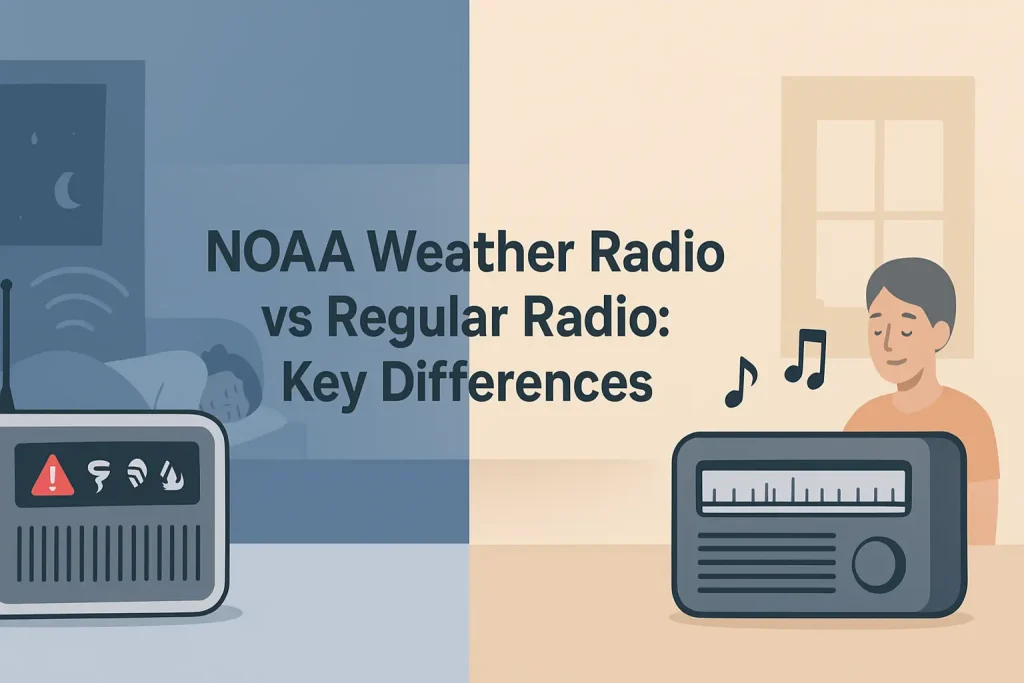
Most drivers keep jumper cables, a spare tire, and maybe a first aid kit in their car. A weather radio rarely makes the list. That is a gap worth closing, because your smartphone loses cell service exactly when severe weather is worst, and a portable NOAA weather radio broadcasts alerts on seven dedicated frequencies between 162.400 and 162.550 MHz regardless of tower congestion or power outages.
This guide covers why a car weather radio matters, what features to look for, which situations make it essential, and which models work best in a vehicle.
| Photo | Popular Portable Walkie Talkies | Price |
|---|---|---|
 | SKIWARRIOR Multifunctional Smart Wireless Ski Goggles with Walkie-Talkie, Anti-Fog Zeiss Lens, Music & Call Function (Cylindrical Blue) | Check Price On Amazon |
 | SINORISE Super Mini Walkie Talkies, Two-Way Radios, 3 Pack | Up to 12 Hours Battery Life, for Baseball Coaches, Restaurants, Retail Stores, Hospitals, Outdoor Sports & Travel | Check Price On Amazon |
 | KOSPET Tank M4C Smart Watch Rugged, Dual-Band GPS, 5ATM & IP69K Waterproof | 1.96" AMOLED Display, 170+ Sport Modes, Built-in LED Flashlight/Walkie-Talkie, Heart Rate/Sleep Monitor for Android & iPhone | Check Price On Amazon |
 | Retevis RT15 Walkie Talkies 3 Pack, Birthday Gift, Outdoor Adventure Kit | Durable, Lightweight, VOX, Key Lock, Mini Walkie Talkies for Adults, School Family Outdoor Travel Camping Hiking | Check Price On Amazon |
 | Rechargeable Walkie Talkies Toys for Kids: DIY Astronaut Walkie Talkies for Boys Christmas Birthday Gifts for 3 4 5 6 7 8 9 10 Boy Walkie Talkie Outdoor Hiking Toy 2 Way Radio Camping Outdoor Game | Check Price On Amazon |
By the Numbers
Weather Radio in Your Car – Key Facts and Coverage Data
Sources: NOAA National Weather Service, FCC Part 95, FEMA IPAWS documentation
Why Your Phone Is Not Enough During Severe Weather on the Road
Cell networks fail under the exact conditions that make weather alerts most urgent. During a tornado warning or severe thunderstorm, towers lose power, become overloaded with calls, or sustain physical damage, and your phone goes silent precisely when you need information most.
NOAA Weather Radio All Hazards (NWR) broadcasts continuously on seven VHF frequencies between 162.400 and 162.550 MHz. These are dedicated government-operated frequencies with no commercial traffic and no internet dependency.
The Wireless Emergency Alert (WEA) system that sends tornado warnings to your phone requires functioning cell towers within range of your location. A battery-powered portable weather radio receives the NOAA signal directly from a government transmitter up to 40 miles away, independent of any cellular infrastructure.
According to NOAA National Weather Service documentation, the NWR network operates more than 1,000 transmitters covering 95% of the US population. That coverage does not depend on your carrier, your data plan, or a functioning cell tower in the storm’s path.
There is a second problem with relying on your phone: WEA alerts are county-wide by default. A tornado warning covering your entire county does not tell you whether the storm is 2 miles west of you or 30 miles east. NOAA broadcasts include specific storm location, direction of travel, and estimated arrival time, which gives you actionable information rather than just an alert tone.
The bottom line is that a dedicated weather radio in your car gives you a backup communication channel that functions independently of every system that typically fails in a severe weather event.
What Is S.A.M.E. Technology and Why Does It Matter in a Car Radio?
S.A.M.E. stands for Specific Area Message Encoding. It is a digital header system embedded in NOAA weather radio broadcasts that lets your radio filter alerts by county-level location using a six-digit FIPS (Federal Information Processing Standard) code, so the alarm only sounds for your specific area instead of every county in the state.
Without S.A.M.E., a weather radio in Oklahoma receives alerts for all 77 counties simultaneously. With S.A.M.E. programmed to your county’s FIPS code, the radio stays silent during alerts for counties you are not in and activates only when the alert applies to your location.
In a car, this matters more than at home. You are moving through different counties, and a radio without S.A.M.E. will alarm constantly as you travel through a region with multiple active alerts. A S.A.M.E.-capable radio lets you program up to three FIPS codes, covering your home county, your destination county, and the counties in between.
The Midland WR400 weather radio supports up to 50 programmable S.A.M.E. location codes and stores 25 alert event types.
Key Specifications (Midland WR400):
- Frequencies: 162.400-162.550 MHz (all 7 NOAA channels)
- S.A.M.E. alert event types: 25
- Programmable S.A.M.E. codes: up to 50
- Power: AC adapter with battery backup
- Alert output: alarm tone plus voice broadcast
For car use specifically, look for a portable S.A.M.E. radio that runs on AA batteries or has a 12V car adapter port. Programming the S.A.M.E. codes for the counties along your regular driving routes takes about five minutes and eliminates false alarms from adjacent areas.
A weather radio without S.A.M.E. is functional but noisy on the road. S.A.M.E. is the feature that makes a car weather radio practical rather than just technically present.
Which Situations Make a Car Weather Radio Most Valuable?
A weather radio in your car delivers the most value in four specific scenarios: long highway drives through tornado-prone regions, rural routes where cell coverage is sparse, areas with recurring flash flood risk, and during hurricane evacuation routes where cell networks are saturated with millions of simultaneous users.
Tornado alley states (Texas, Oklahoma, Kansas, Nebraska, South Dakota) see the highest frequency of tornado warnings per year. Driving through these regions in spring and early summer without a dedicated weather radio means you depend entirely on your phone for warnings that may arrive seconds before conditions become dangerous.
Flash flood risk is underestimated by most drivers. NOAA weather radio broadcasts Flash Flood Warnings as a separate S.A.M.E. event type. These warnings are often not preceded by visible sky changes, and a low-water crossing can become impassable in minutes. A radio receiving a Flash Flood Warning for the specific county you are driving through gives you advance notice that your phone may not deliver if the cell network is already stressed.
Hurricane evacuation routes present a different problem. When millions of people leave a coastal region simultaneously, cell networks in the evacuation corridor become congested to the point of failure. NOAA weather radio operates independently of this congestion and continues broadcasting storm track updates, shelter-in-place orders, and road closure information throughout the event.
Rural driving is the fourth scenario. Many rural areas in the US have gaps in cell coverage that have existed for years with no near-term fix. A portable AA-battery weather radio receives NOAA signals up to 40 miles from any transmitter, covering most rural areas that still have significant dead zones for cellular.
If you drive primarily in dense urban areas with strong cell coverage and mild weather patterns, the benefit is lower. But for anyone who regularly drives rural highways, through severe weather states, or along coastlines, a car weather radio is a genuine safety tool rather than a novelty.
What Features Should You Look for in a Car Weather Radio?
The five features that matter most for a car weather radio are S.A.M.E. county filtering, portable battery power, a 12V vehicle adapter port or compatibility, alarm volume sufficient to hear over road noise, and compact size for storage in a glove compartment or center console.
S.A.M.E. county filtering is covered above. Do not buy a weather radio for car use without it.
Battery power is critical because the radio needs to function during power outages and must operate independently of your car’s electrical system if the vehicle is damaged. Look for radios that accept AA or AAA alkaline batteries as a backup, not only rechargeable internal batteries that cannot be field-replaced.
A 12V car adapter port lets you plug the radio into your vehicle’s accessory outlet for continuous operation during long drives. The Midland ER310 emergency weather radio supports multiple power inputs including a hand crank, solar panel, USB, and AA batteries, which makes it one of the most versatile options for vehicle use.
Key Specifications (Midland ER310):
- Frequencies: 162.400-162.550 MHz (all 7 NOAA channels)
- Power sources: hand crank, solar, USB, AA batteries
- S.A.M.E.: yes, county-level filtering
- Additional features: AM/FM receiver, flashlight, USB phone charging output
- Weight: approximately 11 oz
Alarm volume matters more in a car than at home. Road noise in a moving vehicle typically measures 65-75 dB. A weather radio alarm needs to exceed 80 dB to be reliably audible while driving. Check the specification sheet for the alarm output level before purchasing.
Compact size determines whether the radio actually stays in the car. A unit that fits in a glove compartment is one you will always have. A large desktop unit that requires a dedicated shelf spot will migrate to the garage within a month.
One additional feature worth considering for frequent travelers is an AM/FM receiver combined with the weather radio function. When NOAA broadcasts are between alerts, an AM/FM combo unit remains useful, which gives you a reason to keep it charged and accessible.
The Best Portable Weather Radios for Car Use
The radios below represent the most practical options for keeping in a vehicle, based on S.A.M.E. capability, power flexibility, size, and alarm output. Use the table below to compare the key specs across the top portable weather radio options for car use.
Product Comparison
Portable Weather Radios for Car Use – Side by Side Specs
Key specs compared for vehicle suitability. Source: manufacturer data sheets, NOAA NWR compatibility data.
| Model | S.A.M.E. | Power Options | NOAA Channels | 12V / USB Input | Price (approx.) |
|---|---|---|---|---|---|
| Midland WR400 | Yes (50 codes) | AC + 4x AA backup | 7 | AC only | ~$60 |
| Midland ER310 | Yes | Crank, solar, USB, AA | 7 | USB-C input | ~$60 |
| Uniden BC365CRS | Yes (25 event types) | AC + AA backup | 7 | AC only | ~$40 |
| Sangean CL-100 | Yes | AC + AA backup | 7 | AC only | ~$55 |
| Kaito KA500 | No | Crank, solar, USB, AA | 7 | USB input | ~$40 |
| Midland HH54VP2 | Yes | 3x AA batteries | 7 | Battery only | ~$30 |
Prices verified at time of publication. All models receive all 7 NOAA weather radio frequencies (162.400-162.550 MHz). FCC license not required to receive NOAA weather radio broadcasts.
The Midland HH54VP2 handheld weather radio is the most practical purely portable option because it runs entirely on AA batteries with no AC dependency, fits in a jacket pocket, and includes S.A.M.E. for about $30.
The Midland ER310 is the best choice if you want a single unit that handles car use, camping, and home emergency backup, because its multiple charging inputs mean it stays powered across every scenario.
For the car specifically, the best overall choice is the model that combines S.A.M.E. filtering, AA battery operation, and a USB input for charging from your vehicle’s accessory port. That combination covers both routine driving use and post-emergency scenarios when the car itself may not be operable.
The right weather radio for your car matches the specific driving patterns and weather risks you actually face, not the most feature-laden unit available.
Here is a practical reference guide to help you understand the key terms used when evaluating weather radios for car use.
Quick Reference
Weather Radio Terms for Car Use – Plain Language Definitions
Key terms used when selecting and programming a portable weather radio for vehicle use.
- NOAA Weather Radio All Hazards (NWR)
- A nationwide network of government radio stations broadcasting continuous weather information and emergency alerts on seven VHF frequencies between 162.400 and 162.550 MHz.
- S.A.M.E. (Specific Area Message Encoding)
- A digital filter system that allows your weather radio to alarm only for alerts affecting specific counties you have programmed, identified by a six-digit FIPS code.
- FIPS Code
- A six-digit Federal Information Processing Standard code that uniquely identifies each US county for use in S.A.M.E. programming on weather radios.
- EAS (Emergency Alert System)
- The national public warning system that distributes emergency alerts through broadcast media, cable TV, and NOAA weather radio. Weather radios receive EAS messages directly from government transmitters.
- WEA (Wireless Emergency Alert)
- The cell-phone-based emergency alert system that sends text-style notifications to mobile devices. Unlike NWR, WEA depends on functioning cellular towers and network capacity.
- VHF (Very High Frequency)
- The radio frequency band from 30 to 300 MHz. NOAA weather radio broadcasts in the VHF high band at 162.400-162.550 MHz, which provides reliable line-of-sight propagation with limited building penetration.
- Alert Event Type
- A specific category of emergency broadcast on NOAA weather radio, such as Tornado Warning, Flash Flood Warning, or AMBER Alert. S.A.M.E.-capable radios let you enable or disable specific event types.
- Hand-Crank Radio
- A weather radio with a built-in mechanical generator that produces power when you turn a crank handle, enabling operation when batteries are depleted and no electrical outlet is available.
- Duty Cycle
- The ratio of time a radio spends transmitting, receiving, and in standby. For weather radios in receive-only mode, battery life is measured at 100% receive duty cycle.
- Squelch
- A circuit that mutes the radio speaker when no signal is present, preventing constant static output. Weather radios maintain squelch silence until an alert signal activates the broadcast.
How to Set Up a Weather Radio for Car Use
Setting up a portable weather radio for reliable use in a car takes under 10 minutes. The critical steps are finding your local NOAA frequency, programming the correct S.A.M.E. FIPS codes for your driving area, and choosing the right power source for the vehicle.
Follow these steps to configure your radio before your first drive.
- Find your strongest local NOAA frequency. Scan through all seven NOAA frequencies (162.400, 162.425, 162.450, 162.475, 162.500, 162.525, 162.550 MHz) and select the one with the strongest signal in your area. The NOAA transmitter locator at weather.gov lists the nearest transmitter and its primary broadcast frequency by zip code.
- Look up your county FIPS codes. Go to the NOAA weather radio SAME code finder at weather.gov/nwr/counties. Enter your home county and the one or two counties you drive through most frequently. Write down each six-digit code.
- Program the FIPS codes into your radio. Enter the SAME/FIPS programming mode on your radio (the button is labeled SAME, PROG, or SET depending on the model). Enter each six-digit code in sequence. Most radios accept between 3 and 50 location codes.
- Select your desired alert event types. If your radio supports per-event filtering, enable Tornado Warning, Severe Thunderstorm Warning, Flash Flood Warning, and any other event types relevant to your region. Disable event types that do not apply to your area if you want to reduce non-emergency alerts.
- Set the power source for car operation. If your radio has a USB or 12V input, connect it to your vehicle’s accessory outlet using a 12V USB car charger. Insert backup AA batteries regardless of whether the USB input is in use.
- Test the alarm before driving. Most weather radios have a test function that simulates an alert activation. Run this test with the radio in your intended car storage location to confirm the alarm is audible over ambient vehicle noise.
- Store the radio in an accessible location. The glove compartment, center console, or a mount on the dashboard are the best positions. Avoid the trunk or cargo area where the alarm cannot be heard while driving.
Once programmed, the radio requires no ongoing attention. It monitors the NOAA frequency continuously and activates only when an alert matching your programmed counties and event types is broadcast.
You need to reprogram the FIPS code once if you make a long road trip to a new region. This takes about two minutes and keeps the radio filtering correctly for your current location rather than your home county.
Car Weather Radios vs Phone Alerts vs AM/FM Radio: What Each Does in a Storm
Each alert method has specific strengths and failure points during severe weather. Understanding which system does what determines how you layer them for maximum reliability rather than relying on any single source.
Use the table below to compare how each alert channel performs when severe weather conditions are at their worst.
Product Comparison
Weather Alert Methods – Performance During Severe Weather
Infrastructure dependencies and failure modes compared. Source: FEMA IPAWS documentation, NOAA NWR technical data.
| Alert Method | NOAA Weather Radio | Phone WEA | AM/FM Radio |
|---|---|---|---|
| Works without cell towers | Yes | No | Yes |
| Works during power outage | Yes (battery) | Until phone dies | If station has backup |
| County-level geographic filtering | Yes (S.A.M.E.) | County-wide only | No |
| Storm location and path detail | Yes (voice broadcast) | Alert text only | Depends on station |
| Activates from standby automatically | Yes (alarm tone) | Yes (if charged) | No (must be tuned) |
| Requires ongoing attention | No | No | Yes (active listening) |
| 24/7 continuous broadcast | Yes | Alert-based only | Varies by station |
NOAA NWR transmitters operate on government backup power independent of the commercial grid. WEA delivery time varies by carrier network congestion. AM/FM station backup power capacity varies by station and is not standardized federally.
The practical conclusion from this comparison is that NOAA weather radio and phone WEA are complementary, not redundant. Phone WEA fails precisely when NOAA weather radio is most reliable, which is when cell towers are overloaded or damaged by the storm.
AM/FM radio in the car delivers EAS alerts through local station broadcasts, but requires the station to be on the air, staffed, and actively interrupting programming. Many smaller stations operate with automation that cannot interrupt pre-scheduled content quickly. NOAA broadcasts are automated at the government transmitter and do not depend on a local station decision.
The most resilient approach is to treat all three as layers: phone WEA for routine alerts in areas with strong cellular coverage, NOAA weather radio as the primary reliable source during actual storm events, and AM/FM as a secondary source for extended situation awareness.
Does a Car Weather Radio Work While Driving?
Yes. A portable weather radio set to standby mode monitors the NOAA frequency continuously while drawing minimal current from the battery. When an alert matching your programmed S.A.M.E. codes broadcasts, the radio activates the alarm tone and plays the voice message regardless of vehicle motion or speed.
The practical limitation while driving is signal continuity. NOAA transmitters have an approximate 40-mile coverage radius. If you are driving a long highway route, you may pass through the edge of one transmitter’s coverage area before entering the next. Most portable weather radios scan all seven NOAA frequencies and lock onto the strongest signal automatically, which minimizes coverage gaps on most US highways.
A second consideration is that the NOAA frequency range (162.400-162.550 MHz) is in the VHF high band, which propagates via line-of-sight with limited ability to diffract around terrain. In mountainous areas, signal gaps can be significant. For driving in the Rocky Mountains, Appalachians, or other terrain-heavy regions, you may experience periods where NOAA reception is intermittent.
The external antenna adapter available for some portable weather radios can improve reception while driving by placing an antenna in a higher position than a dashboard-mounted radio allows. This is a minor upgrade but a worthwhile one for long highway driving in variable terrain.
For most driving in the continental US east of the Rockies, a portable weather radio in the car maintains reliable NOAA reception throughout the drive. Coverage gaps are the exception rather than the rule in this region.
Seasonal Timing: When Is a Car Weather Radio Most Critical?
Severe weather risk in the US follows predictable seasonal patterns that determine when a car weather radio transitions from a useful backup to an essential safety tool. The risk window varies significantly by region, but the highest-priority months for most of the continental US cluster in spring and early summer.
Here is a month-by-month reference for weather radio priority while driving across the continental US.
Seasonal Guide
Car Weather Radio Priority by Month – Continental US Driving Guide
Severe weather risk and recommended action by month. Source: NOAA Storm Prediction Center seasonal climatology data.
Lower activity: maintain and test readiness
Regional variation applies. Gulf Coast tornado risk is present year-round. West Coast has different hazard profile (wind events, atmospheric rivers) also broadcast on NOAA frequencies. Source: NOAA Storm Prediction Center tornado climatology.
The March through September window represents the highest-priority period for most continental US drivers, with May and June as the absolute peak for tornado and severe thunderstorm risk.
Replacing the AA batteries in your car weather radio at the start of tornado season (March) and hurricane season (June) ensures the radio is ready without requiring you to track battery age month by month.
Common Mistakes People Make with Car Weather Radios
The most common mistake is buying a weather radio without S.A.M.E. and never programming county FIPS codes. This results in a radio that either alarms constantly for adjacent counties or never alarms at all because it is set to a channel with no local signal.
The second most common mistake is storing the radio in the trunk or cargo area. A weather radio alarm you cannot hear while driving provides no warning. The radio must be within earshot of the driver’s seat to serve its function.
A third mistake is relying exclusively on the internal rechargeable battery without keeping AA batteries loaded as backup. Rechargeable batteries drain over time in storage. A radio that has been sitting in your glove compartment for two months without charging may have a depleted internal battery exactly when you need it most. AA lithium batteries hold charge for up to 10 years in storage and are a reliable backup for any radio that accepts them.
The Energizer Ultimate Lithium AA batteries have a 20-year storage life and function at temperatures down to -40°F, making them the correct choice for any emergency radio kept in a vehicle where temperature extremes are common.
A fourth mistake is not updating S.A.M.E. codes when making a long road trip. Driving through three states with codes programmed for your home county means the radio filters out alerts for the counties you are actually in. Reprogramming takes two minutes and should be done the night before any significant road trip.
The final mistake is treating the weather radio as a static home device and not maintaining it for car use. A radio that lives on a kitchen counter at home is not available when you are four hours into a highway drive through a tornado watch area. The car is the location where a weather radio adds the most value, because it is the situation where you have the fewest alternative information sources and the least ability to take shelter quickly.
Is a Car Weather Radio Worth It If You Already Have a Phone?
A car weather radio is worth keeping in your vehicle if you regularly drive in tornado-prone states, rural areas with sparse cell coverage, or coastal regions during hurricane season. The $30-60 cost is a one-time purchase with no subscription fee and no FCC license required to receive NOAA broadcasts.
If you drive exclusively in urban areas with consistent cell coverage and mild weather conditions, the incremental value is lower, but not zero. Cell networks fail in major weather events regardless of coverage quality under normal conditions. The question is whether you want a backup that functions when your primary system fails.
The honest answer is that for most drivers in the US, a compact portable weather radio with S.A.M.E. is a minor purchase that provides significant value in a small number of high-stakes situations. You will not use it every day. You will be glad it is there on the day you need it.
For a deeper understanding of what the NOAA weather radio network is and how it works, our guide on how the NOAA weather radio broadcasting system operates explains the full transmitter network and alert delivery process in detail.
The practical threshold is simple: if you drive more than two hours at a time through any region on the seasonal guide above marked as high activity, a car weather radio is worth the investment.
Can You Use a GMRS or FRS Radio as a Weather Radio in Your Car?
No. FRS and GMRS radios operate in the 462-467 MHz UHF band and cannot receive the NOAA weather radio frequencies at 162.400-162.550 MHz VHF. They are transmit-and-receive two-way communication radios, not weather broadcast receivers.
Some combination radios do exist that include both two-way FRS/GMRS capability and a NOAA weather radio receiver in a single unit. The Midland GXT1000 GMRS radio includes a weather alert receiver and S.A.M.E. capability alongside its two-way FRS/GMRS function. This combination makes sense for drivers who want both capabilities without carrying two separate devices.
Key Specifications (Midland GXT1000VP4):
- Two-way service: GMRS (requires FCC license) and FRS (no license)
- Two-way power: up to 5W (GMRS channels)
- Weather radio: NOAA 162.400-162.550 MHz (all 7 channels)
- S.A.M.E.: yes
- Channels: 50 total (22 FRS/GMRS plus repeater channels)
- Power: NiMH rechargeable plus AA backup
Using GMRS frequencies for two-way communication requires an FCC license under Part 95 of the FCC rules. The license costs $35 for a 10-year family license with no exam required. Operating a GMRS radio without the license while using the weather radio receive function does not violate FCC rules, because receiving NOAA broadcasts requires no license. Transmitting on GMRS channels without the license does violate Part 95 rules.
For car use, a combination GMRS plus weather radio unit adds practical value if you also use the two-way radio function for family travel or outdoor activities. If you only need NOAA weather alerts, a dedicated weather radio is simpler and less expensive.
If you are considering a combination radio for road trips with family, our overview of using weather radios as part of a complete emergency communication plan covers how to integrate weather alerts with two-way family communication during travel.
What Happens to Your Weather Radio Signal in a Tunnel or Parking Garage?
NOAA weather radio signals at 162.400-162.550 MHz in the VHF high band do not penetrate reinforced concrete tunnels or multi-level parking structures. The signal requires line-of-sight or near-line-of-sight propagation, and thick concrete walls attenuate VHF signals to below receivable levels within a few meters of entry.
This is the same propagation physics that limits your FM radio reception inside a concrete parking structure. VHF signals require an unobstructed path between the transmitting antenna and your radio’s antenna.
This limitation is not unique to weather radios. No VHF broadcast receiver maintains signal in a concrete tunnel. The practical implication for car use is that you cannot expect a weather radio alert inside a tunnel, but alerts outside the tunnel before entry provide sufficient notice for most warning scenarios.
In an underground parking structure, the radio will resume reception when you drive to an open-air level or exit the structure. Modern parking garages with emergency broadcast repeater systems may relay EAS alerts internally, but this is not standardized and should not be relied upon.
The failure mode here is not a device defect. It is the physics of VHF propagation through dense materials. No hardware change or antenna upgrade eliminates this limitation.
How Long Do Batteries Last in a Car Weather Radio?
A portable weather radio in standby receive mode (no alarm active, scanning for NOAA broadcasts) typically runs 20-40 hours on three AA alkaline batteries, depending on the radio model and the volume of the squelch circuit. Continuous receive mode draws significantly less current than transmit mode because weather radios are receive-only devices.
Alkaline AA batteries left in a car glove compartment lose approximately 2-3% of their charge per month in moderate temperatures. At 100°F (common in a parked car in summer), alkaline battery self-discharge accelerates to 5-8% per month and battery capacity can degrade permanently above 130°F.
Lithium AA batteries such as the Energizer Ultimate Lithium maintain 90% of their charge after 10 years of storage and function normally at temperatures from -40°F to 140°F. They are the correct choice for any radio stored in a vehicle.
The Energizer Ultimate Lithium AA eight-pack provides enough batteries to load your weather radio plus keep a spare set in the glove compartment. Replace the batteries annually even if they test as having remaining charge, because the cost of fresh batteries is negligible compared to the risk of a depleted radio during an emergency.
If your weather radio uses an internal rechargeable lithium-ion battery, connect it to your car’s USB outlet during any drive longer than two hours to maintain a full charge. A radio with 20% battery remaining when you start a four-hour drive may not complete the trip with functioning batteries if an extended alert playback activates.
Frequently Asked Questions About Keeping a Weather Radio in Your Car
Do you need a license to use a weather radio in your car?
No license is required to receive NOAA weather radio broadcasts on any of the seven frequencies between 162.400 and 162.550 MHz. Weather radios are receive-only devices, and FCC rules do not require a license to listen to any broadcast frequency. The FCC license requirement applies only to transmitting on licensed frequencies, not receiving them.
This applies to all weather radio models, including combination units that also include FRS or GMRS two-way capability. The weather receive function requires no license. If you transmit on GMRS channels using a combination radio, a $35 FCC Part 95 GMRS license is required for that transmit function only.
Will a weather radio work in a moving car?
Yes. NOAA weather radio signals propagate over distances of up to 40 miles from each transmitter, and a portable radio scanning all seven NOAA frequencies automatically locks onto the strongest available signal. In most of the continental US east of the Rockies, you remain within range of at least one NOAA transmitter throughout a highway drive.
Signal gaps occur in mountainous terrain and some remote rural areas where transmitter spacing exceeds 40 miles. On most US Interstate highways, coverage is continuous. The NOAA transmitter location database at weather.gov lists all transmitters by state and provides coverage maps for your specific route.
What is the difference between a weather watch and a weather warning on NOAA radio?
A weather watch means conditions are favorable for severe weather to develop in the next several hours. A weather warning means severe weather has been detected or is imminent and poses an immediate threat. Watches prompt preparation; warnings require immediate protective action.
S.A.M.E.-capable weather radios can be programmed to alarm for warnings only, watches only, or both. For car use, enabling both watch and warning alerts is recommended because a watch while driving gives you time to identify shelter options before conditions escalate to a warning. Our detailed guide on the difference between tornado watches and tornado warnings on weather radio covers the full NOAA classification system and what each alert type requires you to do.
Can a car weather radio alert you while you are sleeping in the vehicle?
Yes, if the radio is set to standby alert mode with the alarm enabled. A weather radio in standby mode monitors the NOAA frequency continuously and activates the alarm tone when a matching S.A.M.E. alert is broadcast, regardless of whether the main speaker volume is turned up. This makes it effective as an overnight alert device for people camping in their vehicles or staying in remote areas.
Ensure the radio has fresh batteries and is not set to a low alarm volume before using it as an overnight alert device in a car. The alarm tone on most portable weather radios measures 85-90 dB at maximum volume, which is audible inside a sleeping vehicle.
How do you update S.A.M.E. codes when driving to a new region?
Access the S.A.M.E. programming menu on your radio, delete the previous county FIPS codes, and enter the six-digit FIPS codes for the counties you will be driving through. FIPS codes for any US county are available at the NOAA weather radio SAME code finder at weather.gov/nwr/counties by entering the state and county name.
For a planned road trip, look up the FIPS codes for two or three counties along your route the night before departure and write them down. The programming process takes under two minutes on most portable weather radios. You do not need to reprogram every county, only the two or three most relevant to your current route.
What is the range of a NOAA weather radio transmitter?
NOAA weather radio transmitters operate at power levels between 300 watts and 1,000 watts and cover an average radius of approximately 40 miles under normal VHF propagation conditions. Hilly or mountainous terrain reduces effective range, while flat open terrain can extend reception beyond 50 miles.
According to NOAA National Weather Service documentation, the NWR network of more than 1,000 transmitters covers 95% of the US population. Coverage gaps exist primarily in mountainous western states and some remote rural regions in the interior west. NOAA publishes an interactive coverage map at weather.gov/nwr that shows the coverage polygon for each transmitter by frequency.
Why does my car weather radio alarm for areas I am not driving through?
This happens because the radio either has no S.A.M.E. filtering programmed or has county FIPS codes from a previous location still active. Without S.A.M.E. codes programmed, the radio alarms for every alert broadcast on the NOAA frequency regardless of the affected county. Reprogram the S.A.M.E. codes to the counties in your current driving area to restore county-level filtering.
A second cause is receiving a NOAA transmitter that covers multiple counties across a state line. If the transmitter serving your area also broadcasts alerts for adjacent counties that overlap the transmission area, your radio will receive those alerts unless you specifically disable the FIPS codes for those counties. Most radios allow you to program between 3 and 50 codes, so you can be precise about which counties trigger your alarm.
Can you use a weather radio for camping trips in the car?
Yes. A portable weather radio is one of the most recommended pieces of safety equipment for camping trips that involve driving to remote sites. The radio receives NOAA alerts at the campsite, during the drive, and during any hiking or outdoor activity near the vehicle. For camping use specifically, look for a model with hand-crank backup power so you can charge it without any external power source.
Our guide to choosing and using a weather radio for outdoor camping and hiking covers the specific alert types most relevant to wilderness users and how to program a portable radio before leaving cell coverage range.
Does a car weather radio require any ongoing subscription or fee?
No. NOAA weather radio broadcasts are a free government service funded by taxpayers. There is no subscription fee, no monthly charge, and no account required. You purchase the radio once and receive NOAA broadcasts for its entire service life at no additional cost.
This differs from some smartphone weather alert apps that charge subscription fees for premium alert features. NOAA weather radio provides official government-issued alerts in real time with no intermediary, no software update dependency, and no app subscription.
What alert types does NOAA weather radio broadcast beyond tornado warnings?
NOAA weather radio broadcasts more than 25 event types under the S.A.M.E. system. These include Severe Thunderstorm Warning, Flash Flood Warning, Winter Storm Warning, Hurricane Warning, Tsunami Warning, Hazardous Materials Warning, Civil Emergency Message, Law Enforcement Warning, AMBER Alert, and National Information Center messages, among others. The full list of S.A.M.E. event codes is published in NOAA NWR technical documentation.
For drivers, the most relevant alert types beyond tornado warnings are Flash Flood Warning (relevant on roads near rivers and low-water crossings), Severe Thunderstorm Warning (relevant for lightning and hail risk), Winter Storm Warning (relevant for ice and snowfall rate), and Civil Emergency Message (which can include road closures and evacuation orders). Programming your S.A.M.E.-capable radio to activate for all of these event types maximizes its usefulness during any road-based emergency situation. Our complete guide to programming and using a weather radio for all alert types walks through the full S.A.M.E. event code list and which ones to enable for each use case.
Is a hand-crank weather radio a good choice for car use?
A hand-crank weather radio is a good choice for car use if it also supports AA battery operation or USB charging, because the hand crank alone produces limited power (typically enough for 10-15 minutes of listening per minute of cranking). A combination unit with hand crank plus AA batteries plus USB input covers every scenario: normal use on AA batteries, USB charging from the car’s accessory port, and emergency operation via hand crank if all other power sources are depleted.
The hand crank’s primary value in a car context is post-accident or post-storm readiness when the vehicle is not operational. A driver who has been in an accident in a remote area cannot rely on the car’s electrical system. A hand-crank radio provides a power source that requires no infrastructure whatsoever, which makes it the most failure-proof backup available.
How does NOAA weather radio coverage work in remote western states?
NOAA weather radio coverage in the western US is less continuous than in the east because the transmitter network was designed primarily around population centers, and the low population density of many western states means some rural areas fall between transmitter coverage polygons. According to NOAA NWR documentation, coverage in states like Wyoming, Montana, Nevada, and Idaho has measurable gaps in remote areas.
For long highway drives in the intermountain west, check the NOAA transmitter coverage map for your specific route before departure. In areas with known gaps, supplement your weather radio with a satellite messenger device that can receive weather alert notifications independently of cellular and VHF infrastructure. This is the scenario where NOAA weather radio’s limitations are most pronounced and where knowing those gaps in advance is most important.
For drivers who regularly travel through high-risk tornado regions and want to understand how weather radios integrate with a broader tornado preparedness plan, our guide on using a weather radio as part of a tornado safety plan provides the complete protocol from alert receipt to shelter decision.
A weather radio in your car is not a complex piece of equipment. It receives government broadcasts that function independently of cell towers, costs $30-60, requires no license, and needs only five minutes of setup to filter alerts to your specific driving area. The NOAA network operates more than 1,000 transmitters covering 95% of the US population, broadcasting continuously on seven dedicated VHF frequencies at 162.400-162.550 MHz regardless of storm conditions or network congestion.
Buy a S.A.M.E.-capable model, load it with lithium AA batteries, program the FIPS codes for your home county and the counties you drive through most often, and store it where you can hear it from the driver’s seat. Our full comparison of the top-rated models across all price points is available in our guide to the best weather radios currently available to help you find the right unit for your specific driving patterns and budget.
| Photo | TOP RATED WALKIE TALKIES | Price |
|---|---|---|
 | Retevis RT628 Kids Walkie Talkies, Toys Gifts for 4-12 Year Old Girl Boy | Kids Camping Essentials Outdoor Toys, Birthday Gift, 22CH, VOX, Keypad Lock, Durable, Easy to Use Walkie Talkies for Kids | Check Price On Amazon |
 | Cobra ACXT545 Weather-Resistant Walkie Talkies, Rechargeable, 22 Channels | Long Range 28-Mile Two-Way Radio Set (2-Pack) | Check Price On Amazon |
 | Retevis RT388 Kids Walkie Talkies, Outdoor Toys for Kids Camping Essentials | 4-12 Year Old Boy Birthday Gift, 22 CH VOX Flashlight Clear Sound, Kids Walkie Talkies 2 Pack for Camping Hiking Adventure | Check Price On Amazon |
 | Cobra RX680 Walkie Talkies (2-Pack), IP54 Water Resistant Design | Rugged & Splashproof Two Way Radios Long Range, 60 Pre-Programmed Channels, Weather Alerts | Check Price On Amazon |
 | Retevis RT22 Walkie Talkies Long Range Rechargeable with Earpiece (2 Pack) | Slim & Lightweight 2 Way Radio For Camping & Hiking, Pocket-Friendly Antenna, Ready to Use, 10-Hour Battery, USB-C Charging | Check Price On Amazon |
 | Midland GXT1000VP4 GMRS Two-Way Radios with Headsets, Black, 2 Pack | 50 Channels, 142 Privacy Codes, Up to 36 Mile Long Range, JIS4 Water Resistant, NOAA Weather Alert, Rechargeable NiMH | Check Price On Amazon |
 | Retevis RT628 Walkie Talkies for Kids,Toys Gifts for 6-12 Years Old Boys Girls,Long Range 2 Way Radio 22CH VOX,Birthday Gift,Family Walkie Talkie for Camping Hiking Indoor Outdoor | Check Price On Amazon |