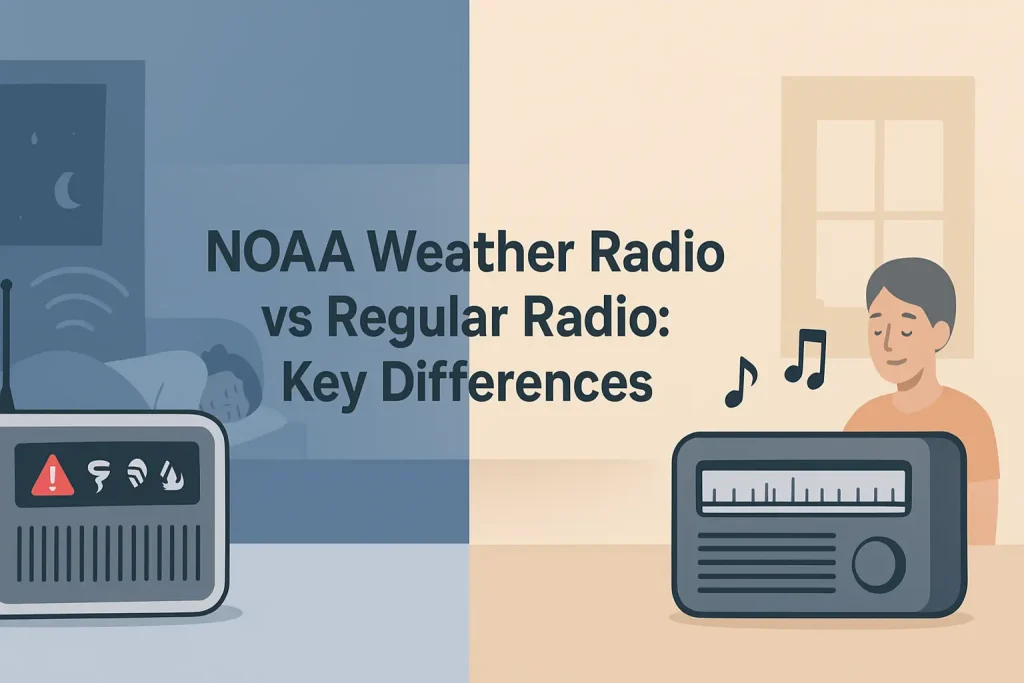
A weather radio without S.A.M.E. technology programmed correctly is like a smoke alarm that goes off for every house on the block, not just yours. NOAA broadcasts alerts for entire states across seven frequencies between 162.400 and 162.550 MHz, and without Specific Area Message Encoding (S.A.M.E.) filtering, your radio will sound an alarm for every county in the broadcast footprint, not just the one where your facility sits.
For businesses, schools, warehouses, hospitals, and any multi-building facility, that difference matters. A false-alarm-fatigued staff stops reacting to alerts, and a radio programmed for the wrong county zone can miss a tornado warning that touches down three miles away.
| Photo | Popular Portable Walkie Talkies | Price |
|---|---|---|
 | SKIWARRIOR Multifunctional Smart Wireless Ski Goggles with Walkie-Talkie, Anti-Fog Zeiss Lens, Music & Call Function (Cylindrical Blue) | Check Price On Amazon |
 | SINORISE Super Mini Walkie Talkies, Two-Way Radios, 3 Pack | Up to 12 Hours Battery Life, for Baseball Coaches, Restaurants, Retail Stores, Hospitals, Outdoor Sports & Travel | Check Price On Amazon |
 | KOSPET Tank M4C Smart Watch Rugged, Dual-Band GPS, 5ATM & IP69K Waterproof | 1.96" AMOLED Display, 170+ Sport Modes, Built-in LED Flashlight/Walkie-Talkie, Heart Rate/Sleep Monitor for Android & iPhone | Check Price On Amazon |
 | Retevis RT15 Walkie Talkies 3 Pack, Birthday Gift, Outdoor Adventure Kit | Durable, Lightweight, VOX, Key Lock, Mini Walkie Talkies for Adults, School Family Outdoor Travel Camping Hiking | Check Price On Amazon |
 | Rechargeable Walkie Talkies Toys for Kids: DIY Astronaut Walkie Talkies for Boys Christmas Birthday Gifts for 3 4 5 6 7 8 9 10 Boy Walkie Talkie Outdoor Hiking Toy 2 Way Radio Camping Outdoor Game | Check Price On Amazon |
By the Numbers
NOAA Weather Radio S.A.M.E. Technology – Key Specifications and Standards
Sources: NOAA National Weather Service NWR documentation, FCC Part 11 EAS rules, FEMA IPAWS technical specifications.
This guide covers every step of setting up S.A.M.E. zone filtering on a commercial weather radio: finding the correct FIPS codes for your county, choosing the right NOAA transmitter channel for your region, selecting alert event types relevant to your facility type, and avoiding the three programming errors that cause missed alerts in real emergencies.
It also covers multi-zone programming for facilities that span county lines, repeater-based alerting for large campuses, and the specific requirements for schools, hospitals, and outdoor facilities under FEMA and state emergency management guidance.
What Is S.A.M.E. Technology and Why Does It Matter for Businesses?
S.A.M.E. (Specific Area Message Encoding) is a digital header system embedded in every NOAA weather radio broadcast that identifies the geographic area, event type, and duration of an alert before the audio message plays. A weather radio with S.A.M.E. decoding reads that header and only activates its alarm if the programmed location code and event type match what NOAA transmitted.
Without S.A.M.E. filtering, a weather radio programmed to receive WX1 (162.550 MHz) in Kansas will alarm for every alert across the entire state broadcast footprint, which can cover 15 to 20 counties. According to NOAA National Weather Service documentation, a single NWR transmitter covers an average radius of 40 miles, which typically spans multiple counties in densely populated regions.
For a business, that means staff can receive 200 to 400 alerts per year for counties nowhere near the facility. Alert fatigue is a documented problem in emergency management: when alarms trigger too frequently for non-threatening events, staff begin ignoring them.
S.A.M.E. filtering solves this by limiting activations to events that actually affect your specific county or zone. The Midland WR400 and Uniden BC365CRS, two of the most widely deployed commercial weather radios, both support up to 50 programmable S.A.M.E. location codes and 25 event type filters.
This matters especially for facilities with overnight staffing, automated alert relay systems, or public address integration, where an unwanted alarm at 3 a.m. has real operational consequences. Correct S.A.M.E. zone setup is the single most important configuration step for any business weather radio installation.
How the S.A.M.E. Code System Works: FIPS Codes Explained
Every S.A.M.E. location code is a 6-digit Federal Information Processing Standards (FIPS) code that identifies a specific US county or county equivalent. The format is: a 1-digit county subdivision prefix (always 0 for the entire county), followed by a 2-digit state code, followed by a 3-digit county code. For example, the S.A.M.E. code for Cook County, Illinois is 017031: 0 (entire county), 17 (Illinois state FIPS code), 031 (Cook County FIPS code).
NOAA encodes this 6-digit FIPS code into the digital S.A.M.E. header of every alert broadcast. Your weather radio compares that code against the codes you programmed and activates only on a match.
The county subdivision prefix (the first digit) is almost always set to 0 for business use. Setting it to 0 means your radio activates for any alert affecting the entire county.
Some NWR transmitters in large states broadcast alerts using subdivision codes (1 through 9) to target portions of large counties. In those cases, programming only the “0” code still captures all subdivision alerts within that county, because NOAA’s header encoding rules treat “0” as a wildcard that matches all subdivisions.
This happens because S.A.M.E. decoders compare only the state and county digits when the prefix is set to 0, according to the NOAA Weather Radio All Hazards technical specifications published by the National Weather Service. Businesses operating in large counties with multiple NWR subdivisions should program the “0” prefix code to avoid missing alerts targeted at specific zones.
The FIPS code system is maintained by the US Census Bureau and updated periodically when county boundaries change. NOAA publishes a current S.A.M.E. FIPS code reference list at weather.gov, which is the only authoritative source for verifying your county’s correct code.
Understanding the FIPS code structure is the foundation of every other S.A.M.E. programming step, and getting this number wrong means your radio either never alarms or alarms for the wrong county.
How to Find the Correct FIPS S.A.M.E. Code for Your Facility
The correct FIPS S.A.M.E. code for your facility’s county is available from two official sources: the NOAA Weather Radio S.A.M.E. code lookup tool at weather.gov/nwr/sameloc, and the US Census Bureau FIPS code reference tables. Both sources are free and do not require an account.
Use the NOAA lookup tool for the fastest result. Enter your state and county name, and the tool returns the exact 6-digit S.A.M.E. code formatted for weather radio programming.
Do not use third-party websites or community forums to find your FIPS code. Outdated codes from non-official sources are a common cause of S.A.M.E. programming failures, particularly in states that have created new counties or changed county designations in recent years.
For businesses operating in more than one county, such as a distribution campus that crosses a county line or a school district with buildings in two counties, look up the FIPS code for each county separately. Most commercial weather radios support programming 2 to 7 location codes simultaneously.
The Midland WR400 desktop weather radio accepts up to 50 S.A.M.E. codes and lets you program multiple counties with separate event type filters for each.
Key Specifications for the Midland WR400:
- Frequencies: 162.400 to 162.550 MHz (all 7 NOAA channels)
- S.A.M.E. programmable codes: up to 50 location codes
- Alert event types: 25 programmable event filters
- Power: AC adapter with 6x AA battery backup
- Display: backlit LCD with county name display
Write down each FIPS code before you sit down at the radio. Most radios require you to enter all digits in one sequence without pausing, and having the codes on paper prevents input errors during programming.
Also record the FIPS codes for the 1 to 2 counties immediately adjacent to your facility’s county that lie in the predominant storm track direction for your region. Severe weather systems typically travel 20 to 40 miles before their warning area catches up with them, and programming adjacent counties gives your facility an earlier warning window than the facility’s home county alone provides.
How to Choose the Right NOAA Channel for Your Location
NOAA broadcasts weather radio programming on seven frequencies: 162.400 MHz (WX2), 162.425 MHz (WX4), 162.450 MHz (WX5), 162.475 MHz (WX3), 162.500 MHz (WX6), 162.525 MHz (WX7), and 162.550 MHz (WX1). Each NOAA transmitter broadcasts on one of these seven frequencies, and your radio must be tuned to the frequency serving your specific region to receive local alerts.
The NOAA NWR transmitter network has over 1,000 transmitters nationwide, each assigned to one of the seven frequencies. Two transmitters in the same area can use different frequencies without interference because they cover different geographic zones.
Find the correct channel for your facility using the NOAA transmitter locator at weather.gov/nwr/station. Enter your state and county, and the tool lists every NWR transmitter serving that area, including the transmitter’s assigned frequency, broadcast power, and coverage map.
In areas served by more than one transmitter, choose the transmitter whose coverage area most closely centers on your facility’s county. A transmitter broadcasting at higher power (typically 1,000 watts for primary transmitters) will provide a more reliable signal inside a building than a lower-power backup transmitter, especially in facilities with metal roofing or concrete walls that attenuate VHF signals.
This happens because VHF signals in the 162 MHz range experience significant attenuation passing through ferrous metal roofing and reinforced concrete. Signal loss of 10 to 20 dB is common inside metal warehouse structures, which can reduce a 1,000-watt transmitter’s effective indoor coverage by 30 to 50%. An external antenna installation resolves this for affected facilities.
If your facility is in a valley, canyon, or area with significant terrain shielding, the closest NWR transmitter may not be the strongest signal at your location. Use a scanning weather radio to check signal strength on all seven NOAA channels and select the one with the clearest, strongest reception at your specific building location before finalizing your channel selection.
The Uniden BC365CRS weather radio scans all seven NOAA channels automatically and locks onto the strongest local signal, which simplifies channel selection for facilities in areas with multiple transmitters.
Set your radio to monitor the selected channel continuously. Do not use the scan function during normal operation, because a scanning radio may be on a different channel at the moment an alert is broadcast and miss the first few seconds of the S.A.M.E. header, causing a missed activation.
Which S.A.M.E. Alert Event Codes Should Businesses Program?
S.A.M.E. weather radios allow you to filter alerts by event type using 3-letter event codes defined by NOAA and the Emergency Alert System (EAS). A weather radio programmed to receive only specific event codes will alarm only for those event types, even if other alerts are broadcast for your county. For most businesses, programming too few event codes is a safety risk, while programming all 25 event codes reintroduces the alert fatigue problem S.A.M.E. filtering was designed to solve.
The core event codes every business facility should program are listed below, organized by priority.
Priority 1 (Life Safety, Always Program):
- TOR: Tornado Warning (NWS has confirmed a tornado on the ground or radar-indicated rotation)
- SVR: Severe Thunderstorm Warning (winds above 58 mph or hail 1 inch or larger)
- FFW: Flash Flood Warning (life-threatening flooding imminent or occurring)
- EWW: Extreme Wind Warning (non-tropical winds 115 mph or greater)
- HUW: Hurricane Warning (sustained winds 74 mph or greater within 36 hours)
- TSW: Tsunami Warning (coastal facilities only)
- CEM: Civil Emergency Message (imminent threat to life or property from any cause)
- EAN: Emergency Action Notification (Presidential-level national emergency alert)
Priority 2 (High Risk, Strongly Recommended):
- TOR Watch (TOA): Conditions are favorable for tornado development in the next 2 to 6 hours
- SVA: Severe Thunderstorm Watch
- FFA: Flash Flood Watch
- HWW: High Wind Warning (sustained winds 40 mph or more, or gusts 58 mph or more)
- WSW: Winter Storm Warning (heavy snow, sleet, or ice accumulation meeting local NWS thresholds)
- BZW: Blizzard Warning (sustained winds 35 mph or greater with significant snow or blowing snow reducing visibility to below 0.25 miles)
Priority 3 (Situational, Program Based on Facility Type):
- HMW: Hazardous Materials Warning (for industrial facilities, chemical plants, or facilities near highways and rail lines carrying hazardous cargo)
- LEW: Law Enforcement Warning (civil unrest or security threats near the facility)
- AMW: AMBER Alert (for schools, childcare facilities, and any facility with child supervision responsibility)
- NUW: Nuclear Power Plant Warning (for facilities within 50 miles of a nuclear plant)
- RHW: Radiological Hazard Warning (for facilities near nuclear research institutions or military installations)
According to FEMA’s Integrated Public Alert and Warning System (IPAWS) guidance, facilities with public occupancy or large employee populations should program at minimum all Priority 1 and Priority 2 codes. Schools in states with tornado risk should also program AMW.
Outdoor businesses (construction sites, outdoor event venues, golf courses, summer camps) should add all wind-related codes including HWW and SCY (Special Marine Warning, if near coastal or large inland water areas) because outdoor workers have zero structural protection during severe weather.
Selecting the correct event codes for your specific facility type is the step most businesses skip, and it is the most common reason weather radios fail to alarm for relevant events.
Step-by-Step S.A.M.E. Zone Programming for Commercial Weather Radios
The following steps apply to the most common commercial weather radio models used in US businesses and facilities, including the Midland WR400, Midland WR300, Uniden BC365CRS, and Sangean CL-100. The button names may differ slightly between models, but the programming sequence is structurally identical across all S.A.M.E.-capable weather radios.
Use this step-by-step guide to configure S.A.M.E. zone filtering on your facility’s weather radio for the first time or to update an existing incorrect programming.
Step-by-Step Guide
How to Program S.A.M.E. Zone Filtering on a Commercial Weather Radio
8 steps · Estimated time: 10 to 15 minutes · Have your FIPS codes and NOAA channel number written down before starting
Power on the radio and locate the SAME or PROG button
On most Midland and Uniden models, the S.A.M.E. programming mode is accessed by pressing and holding the SAME button for 2 to 3 seconds until the display shows “PROG” or “SAME SETUP.” The radio must be in standby mode, not actively receiving a broadcast, before entering programming.
Select the NOAA channel for your region
Navigate to the channel selection menu and enter the channel number (1 through 7) corresponding to the NWR transmitter frequency serving your county. WX1 is 162.550 MHz, WX2 is 162.400 MHz, WX3 is 162.475 MHz, WX4 is 162.425 MHz, WX5 is 162.450 MHz, WX6 is 162.500 MHz, WX7 is 162.525 MHz. Confirm the channel before proceeding to code entry.
Enter your primary county FIPS code
When prompted for the first location code, enter the 6-digit FIPS S.A.M.E. code for your facility’s county using the number keypad. Enter all six digits without pausing. On radios with a scroll-and-select interface (Sangean CL-100), navigate to the correct state using the up/down arrows, then select your county from the list. Confirm the entry by pressing ENTER or SET.
Add adjacent county codes for earlier storm track warnings
After confirming the primary code, the radio prompts for additional location codes. Enter the FIPS codes for 1 to 2 adjacent counties that lie in the predominant storm track direction for your region (typically southwest to northeast in the central US, southeast to northwest along the Gulf Coast). Most commercial radios allow 2 to 7 location codes total.
Select alert event types to monitor
Navigate to the event type selection menu. The radio displays each of the 25 S.A.M.E. event codes (TOR, SVR, FFW, etc.) in sequence. Toggle each code on or off using the select button. Enable all Priority 1 and Priority 2 codes as a minimum. Enable additional Priority 3 codes specific to your facility type as described in the previous section of this guide.
Set alarm tone and volume for the facility environment
Set the alarm volume to the highest setting in facilities with ambient noise above 70 dB (warehouses, manufacturing floors, commercial kitchens). In quieter office environments, a mid-range volume setting is sufficient. For facilities with external PA integration, set the radio’s audio output to line level and connect to the PA system’s auxiliary input port using a 3.5mm to RCA cable.
Confirm battery backup is installed and functional
Insert fresh alkaline AA or AAA batteries (per model specification) in the backup battery compartment. Many severe weather events are accompanied by power outages. A weather radio that loses power during the event it was installed to monitor provides zero protection. Test the battery backup by unplugging the AC adapter and verifying the radio continues to operate normally.
Test S.A.M.E. reception using the NOAA weekly test broadcast
NOAA broadcasts a Required Monthly Test (RMT) on the first Wednesday of each month and a Required Weekly Test (RWT) every Wednesday between 11 a.m. and noon local time. After programming, wait for the next RWT and verify that your radio activates correctly for your programmed county codes. If the radio does not activate during the RWT, recheck your FIPS codes against the NOAA lookup tool and verify the correct channel is selected.
After completing these eight steps, your weather radio will activate only for alerts issued for your programmed counties and selected event types, and will remain silent for all other broadcasts on the NOAA channel.
Multi-Zone S.A.M.E. Programming for Facilities That Span Multiple Counties
A facility that spans a county line, such as a large industrial campus, a university with buildings in two counties, or a regional hospital system with locations in different jurisdictions, requires S.A.M.E. programming that covers all relevant counties simultaneously. Most commercial weather radios support 2 to 7 location codes, which is sufficient for multi-county coverage without requiring separate radios for each zone.
The programming approach depends on whether the facility uses a single centralized radio or a distributed network of radios.
For a single centralized radio serving the entire facility, program the FIPS codes for every county where occupied buildings are located. This ensures the radio activates for any alert affecting any part of the campus.
For distributed systems with one radio per building or zone, program each radio with the FIPS code for the county where that specific building sits, plus the adjacent county codes most relevant to the storm track for that location. This reduces alert fatigue for staff in a specific building while maintaining full coverage for their immediate area.
Large campuses with dedicated emergency management staff may also use a weather radio receiver connected to a campus-wide notification system (fire alarm relay, PA integration, or IP-based mass notification). In these installations, the weather radio itself functions as a sensor feeding the notification system, and S.A.M.E. programming at the radio level determines which alerts the notification system receives. For this use case, program all counties in the campus footprint plus all storm-track-adjacent counties at the radio level, and apply event type filtering at the notification system level for zone-specific alert routing.
The Midland WR300 commercial weather radio supports up to 25 S.A.M.E. location codes, making it appropriate for multi-county campus installations.
Multi-county programming does not require purchasing a separate radio license. NOAA weather radio reception is unlicensed receive-only operation under FCC rules, and no FCC authorization is required for any facility to receive NOAA broadcasts on any of the seven weather radio frequencies. The only regulatory consideration is the type of equipment used, which must be capable of receiving the standard 162.400 to 162.550 MHz band.
Facilities spanning county lines should also verify that their primary NOAA transmitter covers all counties in their footprint. Some rural campuses may sit at the edge of one transmitter’s coverage and within the primary coverage of a different transmitter for the adjacent county. In those cases, programming both transmitter channels on separate radios, one per county zone, provides more reliable reception than trying to serve the entire campus from a single radio tuned to one channel.
S.A.M.E. Programming for Specific Business and Facility Types
Different facility types have different alert priorities, occupancy patterns, and physical layouts that affect both which S.A.M.E. event codes to program and how to configure the alert notification process. The programming choices that protect a warehouse with 50 employees during daytime hours differ from those required for a school with 800 students or a hospital with 24-hour staffing.
Schools and Educational Facilities
Schools represent the highest-stakes weather radio application because occupants are minors who cannot self-direct in an emergency. FEMA’s Best Practices in School Emergency Management recommends that schools program their weather radios to activate for Tornado Warnings (TOR), Tornado Watches (TOA), Severe Thunderstorm Warnings (SVR), Flash Flood Warnings (FFW), and AMBER Alerts (AMW) at minimum, with the radio connected to the school intercom or PA system for immediate campus-wide notification.
Schools in states with documented tornado risk (the tornado alley states of Oklahoma, Kansas, Nebraska, Texas, South Dakota, and North Dakota, plus the Dixie Alley states of Mississippi, Alabama, Tennessee, and Arkansas) should also program the adjacent county codes for all counties within 30 miles in the predominant storm track direction.
Our guide on setting up and maintaining weather radio systems in K-12 schools covers intercom integration, drill protocols, and state-specific compliance requirements in detail.
The Sangean CL-100 weather alert radio is widely used in schools because its large display shows the alert county name in plain text, making it easier for staff to visually confirm that an alert applies to their specific location before initiating an evacuation or shelter-in-place protocol.
Hospitals and Healthcare Facilities
Hospitals must program weather radios for both severe weather events and hazardous materials events, because healthcare facilities receive evacuation orders and shelter-in-place directives from local emergency management for both categories. Priority event codes for hospital weather radio installation include TOR, SVR, FFW, HUW, HMW (Hazardous Materials Warning), CEM (Civil Emergency Message), and NUW (Nuclear Power Plant Warning, for facilities within 50 miles of a nuclear plant).
Hospitals typically cannot evacuate during a warning, which means shelter-in-place protocols must activate quickly. The weather radio should be positioned at the nurse’s station or emergency operations center and connected to the facility’s overhead paging system to ensure all staff receive the alert simultaneously regardless of their location in the building.
Battery backup is especially critical for hospital installations. Severe weather events that trigger weather radio alerts frequently coincide with power outages. Install the radio on a dedicated UPS (uninterruptible power supply) circuit in addition to the standard battery backup tray, to maintain operation during extended power interruptions.
Warehouses, Distribution Centers, and Manufacturing Facilities
Large industrial facilities present a specific challenge: high ambient noise (often 80 to 95 dB on the production floor) means a standard weather radio alarm will not be heard by workers more than 20 to 30 feet away. S.A.M.E. programming for these facilities must be paired with an external alarm relay or strobe light system that activates when the weather radio receives a programmed alert.
Program TOR, SVR, EWW (Extreme Wind Warning), FFW, and HMW at minimum. Industrial facilities near rail lines or highways carrying hazardous cargo should give HMW equal priority to tornado alerts, because a hazardous materials release from a derailment or accident can require immediate shelter-in-place with the same urgency as a tornado warning.
Connect the weather radio’s alert output (available as a 3.5mm or RCA jack on most commercial models) to an external horn or strobe relay unit to ensure floor-level notification. The relay activates whenever the radio receives a programmed S.A.M.E. alert, regardless of ambient noise conditions.
Outdoor Businesses and Event Venues
Golf courses, outdoor amphitheaters, sports complexes, construction sites, and summer camps face the highest lightning and wind risk of any business category because there is no structural protection for occupants. S.A.M.E. programming for outdoor facilities should include SVR, TOR, HWW (High Wind Warning), and for coastal facilities, SCY (Special Marine Warning) and HUW.
Outdoor facilities should consider a portable weather radio at each remote zone of a large property, rather than a single central unit. A construction site spanning 40 acres may have workers in locations where a single indoor-mounted weather radio is inaudible.
A portable hand-crank emergency weather radio like the Midland ER310 is appropriate for remote site supervisors because it operates without AC power, includes a built-in flashlight, and can be carried to any location on a large property.
Hotels and Hospitality Facilities
Hotels face a unique obligation: guests are sleeping on the premises and are unfamiliar with the building layout and evacuation routes. A hotel weather radio should be connected to the property management system or fire alarm relay panel so that a S.A.M.E. alert triggers both the control room alarm and the in-room notification system (typically phone calls or in-room alarm panels).
Program TOR, SVR, FFW, HUW, and CEM at minimum. In coastal markets, add TSW (Tsunami Warning) and HUW. Program the adjacent county codes for counties in the storm approach direction to provide a 10 to 20 minute earlier warning window before a tornado warning is issued specifically for the hotel’s county.
What Is the Difference Between a Watch and a Warning on a Weather Radio?
A weather watch (event codes ending in “A” such as TOA for Tornado Watch) means atmospheric conditions are favorable for the development of the named hazard over the next 2 to 6 hours in a defined watch area. A weather warning (event codes ending in “W” such as TOR for Tornado Warning) means the hazard is imminent, already occurring, or radar-confirmed in a specific area, requiring immediate protective action.
This distinction matters for S.A.M.E. programming because watches and warnings require different organizational responses. A watch should trigger staff briefing and shelter preparation. A warning requires immediate movement to shelter.
For a detailed breakdown of each alert level and the specific NWS criteria that trigger each, our explainer on the difference between tornado watches and warnings on weather radio systems covers both the NWS issuance criteria and the recommended facility response protocols for each level.
For S.A.M.E. programming, program both the watch and warning codes for any hazard that is relevant to your facility. A tornado warning without a watch pre-programmed means staff have no advance alert before the immediate danger alarm activates.
How to Verify Your S.A.M.E. Programming Is Working Correctly
After completing S.A.M.E. programming, you must verify the configuration is functional before relying on it in a real emergency. A misconfigured S.A.M.E. code will either cause the radio to never alarm (wrong FIPS code, wrong channel) or alarm for the wrong county (transposed digits in the FIPS code). Both failures are silent: the radio appears normal in standby mode and gives no indication that its programming is incorrect.
There are three methods to verify correct S.A.M.E. operation.
Method 1: NOAA Required Weekly Test (RWT)
NOAA broadcasts a Required Weekly Test every Wednesday between 11 a.m. and noon local time. The RWT uses the same S.A.M.E. header format as a real alert but uses event code RWT, which is clearly labeled as a test in the audio message. If your radio activates during the RWT, your FIPS codes and channel selection are correct for at least one of your programmed counties.
The RWT is the most reliable verification method because it uses an actual NOAA broadcast signal and real FIPS codes for your area.
Method 2: NOAA Required Monthly Test (RMT)
On the first Wednesday of each month, NOAA broadcasts a more comprehensive Required Monthly Test that activates the full EAS audio sequence. The RMT uses event code RMT and should activate radios programmed for any county within the transmitter’s broadcast area.
Method 3: Manual S.A.M.E. Code Verification
Access the programming menu and review the stored FIPS codes on the radio display. Compare each digit against your written FIPS codes from the NOAA lookup tool. A single transposed digit in a 6-digit FIPS code means the code will never match an alert and the radio will never activate for that county.
Document the verified programming in writing: channel number, FIPS codes, event codes enabled, and the date of verification. Post this documentation inside the radio’s battery compartment door or on a label affixed to the back of the unit. This record is essential for future staff who service the radio or update programming after a county FIPS code change.
The Three Most Common S.A.M.E. Programming Errors in Business Installations
After S.A.M.E. weather radio installations in businesses fail to activate during real alerts, the cause is almost always one of three programming errors. All three errors produce the same symptom: a radio that sits silently in standby while NOAA broadcasts an active warning for the facility’s county.
Error 1: Wrong or Outdated FIPS Code
This is the most common error. FIPS codes are not intuitive (Cook County, Illinois is 017031, not 0-1-7-0-3-1 as a phone number pattern would suggest), and many installers enter codes from memory, from outdated printed reference lists, or from third-party websites that have not been updated since the Census Bureau last revised county boundaries.
The fix is to always look up the code from the official NOAA S.A.M.E. lookup tool at weather.gov/nwr/sameloc immediately before programming. Do not rely on any printed or cached source for FIPS code data.
Error 2: Monitoring the Wrong NOAA Channel
A weather radio tuned to WX3 when your area’s primary NWR transmitter broadcasts on WX1 will receive no alerts. The radio scans the frequency continuously and waits for a S.A.M.E. header on that specific channel. If the NWR transmitter for your county broadcasts on a different channel, the S.A.M.E. header it transmits will never be decoded by your radio.
The fix is to verify the correct channel using the NOAA transmitter locator before programming, and to scan all seven channels on the radio to confirm signal strength before selecting the final channel.
Error 3: All Event Types Disabled or Not Saved
Some weather radio models default to “all off” for event type filtering when S.A.M.E. mode is first enabled. If a user enters valid FIPS codes but does not scroll through the event type menu and enable each desired code, the radio programs successfully for location but activates for no event types.
The fix is to navigate through the entire event type menu after entering location codes, explicitly enabling each code, and then saving the configuration. Verify the event codes by reviewing the programming menu after saving and confirming each desired code shows as enabled.
Avoiding these three errors requires one additional step after programming: waiting for the next NOAA RWT broadcast on Wednesday and confirming that the radio activates. If it does not activate during the RWT, the programming has an error in one of these three categories, and the verification step catches it before a real emergency exposes the failure.
External Antenna Installation for Facilities with Poor NOAA Signal Reception
A weather radio mounted inside a metal building, concrete structure, or basement level may receive a NOAA signal too weak to reliably decode the S.A.M.E. header, even when the NWR transmitter is within 40 miles. The S.A.M.E. decoder requires a clean, strong signal to correctly interpret the digital header. A noisy or weak signal causes decoding errors that prevent the radio from activating, even when a valid S.A.M.E. alert is being broadcast.
The solution is an external antenna connected to the weather radio’s external antenna input jack (standard on most commercial models, typically an F-connector or BNC port). A simple half-wave dipole or discone antenna mounted on the exterior of the building, connected via RG-6 or RG-8X coaxial cable, provides 5 to 10 dB of signal improvement over the radio’s internal whip antenna.
A dedicated NOAA weather radio external antenna designed for the 162 MHz VHF band provides the best performance for facilities with marginal indoor signal reception.
Installation height matters. Every 10 feet of additional antenna height above the surrounding terrain adds approximately 3 to 4 miles of additional line-of-sight range to the NWR transmitter. For a warehouse with a 30-foot roofline, mounting the external antenna at roof level rather than ground level provides a meaningful improvement in signal quality.
This happens because VHF signals in the 162 MHz range propagate by line-of-sight, and the Earth’s curvature and terrain obstructions attenuate the signal over distance. Higher antenna placement increases the geometric line-of-sight distance to the transmitter.
For very large campuses or facilities in deep valleys, a distributed antenna system (DAS) using a signal splitter and multiple indoor antenna heads fed from a single external antenna can extend S.A.M.E. reception to all buildings from a single rooftop antenna installation.
Use RG-6 quad-shield coaxial cable for runs under 50 feet and RG-8X for runs over 50 feet to minimize signal loss in the cable before the signal reaches the radio. Every 10 feet of RG-6 cable introduces approximately 0.5 dB of signal loss at 162 MHz, which is acceptable for short runs but cumulative over long cable runs in large facilities.
Integrating Weather Radio Alerts into Facility-Wide Notification Systems
A weather radio that alarms only in one location in a large facility provides incomplete protection for staff in other zones. Commercial and institutional facilities need alert notification that reaches every occupied area simultaneously, which requires integrating the weather radio’s S.A.M.E. alert output into the facility’s existing notification infrastructure.
The three most common integration methods are PA system connection, fire alarm relay integration, and IP-based mass notification relay.
PA System Integration
Most commercial weather radios provide a 3.5mm or RCA audio output that activates when a S.A.M.E. alert is received. Connect this output to the auxiliary input of the facility’s PA amplifier using an appropriate cable. When the weather radio receives a programmed S.A.M.E. alert, the alarm tone and NOAA voice message play through all PA speakers simultaneously.
This approach requires no additional hardware beyond a cable and works with virtually any commercial PA system. The limitation is that it requires the PA amplifier to be powered on and the weather radio audio to be routed correctly through the PA system’s input switching.
Fire Alarm Relay Integration
Some weather radio models, including the Midland WR400, include a dry contact relay output that activates when a S.A.M.E. alert is received. This relay can be wired to a fire alarm panel’s auxiliary input, triggering the building’s existing fire alarm notification appliances (horns, strobes) for weather alerts.
This integration requires coordination with the fire alarm system installer and may be subject to local fire code approval. The advantage is that it activates the full building notification system without any additional infrastructure.
IP-Based Mass Notification Relay
For facilities using IP-based mass notification platforms (AtHoc, Everbridge, Rave Alert, or similar), an IP-connected weather radio receiver or a dedicated S.A.M.E. decoder appliance can feed alert data to the notification platform, which then distributes the alert via email, SMS, desktop pop-up, and PA simultaneously.
This approach is standard in hospitals, universities, and large corporate campuses where IP mass notification infrastructure is already in place. The weather radio or S.A.M.E. decoder functions as an input sensor to the notification platform, which handles all distribution logic.
If your facility already uses an emergency preparedness communication plan that includes two-way radios for internal coordination during a weather event, our overview of integrating weather radio alerts into a complete emergency communication system covers how NOAA weather radio fits alongside two-way radio coordination, mobile alert systems, and staff notification protocols.
Maintaining and Updating S.A.M.E. Programming Over Time
S.A.M.E. programming is not a one-time setup task. Three categories of changes can make existing programming obsolete: FIPS code updates, NWR transmitter frequency changes, and facility changes such as new buildings in a different county or relocated operations.
FIPS Code Changes
The US Census Bureau updates FIPS codes when counties are created, renamed, merged, or subdivided. While these changes are infrequent, they do occur, and an outdated FIPS code will cause a weather radio to silently fail to activate for alerts in the newly assigned code area.
Check the NOAA S.A.M.E. code lookup at weather.gov/nwr/sameloc annually and compare the current codes against your programmed codes. Update any codes that have changed.
NWR Transmitter Changes
NOAA periodically adds new NWR transmitters, upgrades existing transmitters to higher power, or reassigns transmitter frequencies in areas where propagation interference has been identified. A new higher-power transmitter may provide better building penetration than the transmitter your radio is currently programmed to receive, improving signal quality and S.A.M.E. decoding reliability.
Check the NOAA transmitter locator for your county annually and update your channel selection if a newer or higher-power transmitter has been added that serves your location better than your current selection.
Facility Changes
When a business adds a new building, opens a satellite location, or relocates, the FIPS code and NOAA channel programming must be updated to reflect the new location. This step is frequently overlooked during facility expansion, leaving new locations with the programming from the original site, which may be in a completely different county.
Assign one staff member (facilities manager, safety officer, or emergency coordinator) as the designated weather radio programming owner. This person is responsible for annual programming reviews and updates when facility changes occur.
Establish a written log of the radio’s current programming, including channel number, all FIPS codes, enabled event codes, and the date of last verification. Store this log inside the radio’s battery compartment or attached to the unit. When a new staff member takes over radio maintenance, the log provides a complete programming history without requiring them to reverse-engineer the current configuration from the radio menu.
Portable Weather Radios for Multi-Building Campuses and Remote Staff
A single desktop weather radio cannot adequately serve a campus where staff work in multiple buildings, outdoor areas, or remote zones beyond the audible range of the central alarm. Facilities with this profile need either distributed fixed radios in each building or portable weather radios carried by supervisors in remote zones.
Portable S.A.M.E. weather radios are battery-powered, handheld units that receive NOAA broadcasts and perform the same S.A.M.E. decoding as desktop models. They are appropriate for construction sites, outdoor event staff, remote building supervisors, and any staff member working outside the range of a fixed alarm.
The Midland ER310 emergency hand-crank weather radio is widely used in construction and outdoor facility management because it operates on rechargeable battery, hand crank, or solar panel, eliminating dependence on AC power or disposable batteries in outdoor deployments.
Key Specifications for the Midland ER310:
- Frequencies: 162.400 to 162.550 MHz (all 7 NOAA channels)
- S.A.M.E.: yes, county-level alert filtering
- Power: rechargeable battery, hand crank, solar panel, or USB input
- Battery life: approximately 20 hours on a full charge at low power mode
- Additional features: USB phone charging port, LED flashlight, red emergency beacon
For hikers and outdoor recreational staff, the programming and use of portable weather radios in field conditions is covered in our guide on using S.A.M.E. weather radios in backcountry and camping environments, which includes specific advice on antenna placement and reception in mountainous terrain.
When deploying multiple portable radios across a campus, program each unit with the same FIPS codes and event types as the primary fixed radio. This ensures consistent alerting across all zones and eliminates the risk of one portable radio having outdated or incorrect programming relative to the others.
A Kaito KA500 emergency weather radio provides an affordable portable option for secondary deployments where a full-featured unit is not required, and it supports all seven NOAA weather radio channels with S.A.M.E. alert filtering.
NOAA Weather Radio All Hazards: What Businesses Need to Know About the Broadcast Network
NOAA Weather Radio All Hazards (NWR) is a nationwide network of radio stations operated by the National Weather Service that broadcasts continuous weather information and emergency alerts 24 hours a day, 7 days a week. NWR is not a standard commercial radio broadcast service and does not require an FCC license to receive. It operates exclusively on the seven VHF frequencies between 162.400 and 162.550 MHz, which are reserved by the FCC for weather radio use under FCC Part 90 and Part 11 regulations.
NWR broadcasts are categorized into three levels of urgency:
- Warning: A hazard is occurring, imminent, or has a high probability of occurring. Immediate protective action is required.
- Watch: Conditions are favorable for the development of a named hazard over the next several hours. Begin preparedness actions.
- Advisory: Conditions may cause significant inconvenience and, if caution is not exercised, could lead to situations that may threaten life or property.
NWR also broadcasts non-weather alerts including AMBER Alerts, civil emergency messages, 911 telephone outage notifications, and national security alerts issued under IPAWS. These non-weather alerts are transmitted using the same S.A.M.E. header format as weather alerts and activate S.A.M.E.-programmed radios that have the relevant event codes enabled.
According to NOAA National Weather Service documentation, the NWR network transmits at power levels between 10 watts and 1,000 watts depending on the transmitter site, with most primary transmitters broadcasting at 300 to 1,000 watts. Coverage radius for a 1,000-watt transmitter in flat terrain with no obstruction is approximately 40 miles. Actual indoor coverage in urban environments with high building density may be significantly less.
For a complete technical overview of how the NOAA Weather Radio All Hazards network is structured, how transmitters are organized by state and county, and how the system integrates with the broader Emergency Alert System, our foundational explainer on how the NOAA Weather Radio All Hazards network operates and what it monitors covers the full system architecture in accessible terms.
NWR broadcasts are the only federally operated alerting system that provides continuous, local, county-specific weather information independent of internet connectivity, cellular infrastructure, or commercial power. This makes NWR-capable weather radios the most reliable alerting tool available to businesses during the early stages of a severe weather event, when cell networks are often congested and power may already be failing.
The following table summarizes the key specifications of the NOAA NWR broadcast system relevant to business weather radio installations.
Use the table below to verify that your weather radio hardware and programming are aligned with NOAA NWR system specifications.
| NWR System Parameter | Specification | Business Relevance |
|---|---|---|
| Broadcast frequencies | 162.400, 162.425, 162.450, 162.475, 162.500, 162.525, 162.550 MHz | Radio must be capable of receiving at least one of these 7 frequencies |
| Transmitter power range | 10W to 1,000W depending on site | Higher power = better building penetration; select highest power transmitter for your county |
| Typical coverage radius | 40 miles at 1,000W in flat terrain | Verify transmitter coverage reaches your specific facility location |
| S.A.M.E. header format | 6-digit FIPS location code + 3-letter event code + duration + issue time | All six FIPS digits must match exactly for radio to activate |
| Alert event codes | 25 defined event codes (EAS/NOAA) | Program only codes relevant to your facility type and location |
| Required Weekly Test (RWT) | Every Wednesday, 11 a.m. to noon local | Use RWT to verify radio activates correctly after programming |
| Required Monthly Test (RMT) | First Wednesday of each month | Use RMT for full EAS audio sequence verification |
| FCC license required to receive | No. Receive-only, no license required. | Any business may install and operate a NOAA weather radio without FCC authorization |
Here is a quick reference for the key terms used throughout this guide.
Quick Reference: S.A.M.E. Weather Radio Terms for Business Installers
S.A.M.E. (Specific Area Message Encoding): A digital header system embedded in NOAA weather radio broadcasts that identifies the alert’s geographic area, event type, and duration. Enables county-level alert filtering on compatible radios.
FIPS Code: Federal Information Processing Standards code. A 6-digit number assigned by the US Census Bureau that uniquely identifies each US county. Used as the location identifier in S.A.M.E. programming.
NWR: NOAA Weather Radio All Hazards. The nationwide network of over 1,000 NOAA-operated VHF radio transmitters broadcasting continuous weather and emergency alerts.
EAS: Emergency Alert System. The federal alert relay infrastructure that coordinates weather and emergency alerts across broadcast stations, cable systems, satellite providers, and NWR transmitters.
Event Code: A 3-letter code (such as TOR for Tornado Warning or SVR for Severe Thunderstorm Warning) that identifies the type of alert in the S.A.M.E. header. Radios activate only for enabled event codes.
RWT (Required Weekly Test): A test broadcast transmitted by NOAA every Wednesday between 11 a.m. and noon local time to verify S.A.M.E. system functionality. Uses event code RWT.
RMT (Required Monthly Test): A more comprehensive test broadcast on the first Wednesday of each month that activates the full EAS audio sequence. Uses event code RMT.
IPAWS: Integrated Public Alert and Warning System. The FEMA-managed platform that coordinates alert distribution across all public warning channels including NWR, Wireless Emergency Alerts, and the Emergency Alert System.
County Subdivision Code: The first digit of a 6-digit FIPS S.A.M.E. code. A value of 0 covers the entire county. Values 1 through 9 target specific geographic subdivisions within large counties.
VHF: Very High Frequency. The radio frequency band from 30 MHz to 300 MHz. NOAA weather radio broadcasts on the VHF band at 162.400 to 162.550 MHz.
The following widget helps you match your facility type and alert priorities to the correct S.A.M.E. event code programming strategy. Answer two questions to get a tailored recommendation for your specific installation context.
Interactive Tool
S.A.M.E. Event Code Setup Recommender for Business Facilities
Answer 2 questions to get a tailored S.A.M.E. event code programming recommendation for your facility type and region.
How to Use a Weather Radio During an Active Alert: Facility Response Protocols
A weather radio that activates correctly is only useful if staff know the specific response protocol for each alert type before the alarm sounds. Alert fatigue, confusion about which alert type requires shelter versus evacuation, and delayed response to the first alarm tone are the three most common failure modes in facility weather emergency response, not equipment failure.
The core protocol distinction that every facility staff member must understand is this: tornado warnings require immediate movement to a designated interior shelter room on the lowest floor away from windows. Hazardous materials warnings require immediate shelter-in-place in a sealed interior room with windows and HVAC intakes closed. These two protective actions are opposite in direction, and confusing them during an active alert can increase rather than reduce risk.
Post a laminated one-page protocol card at every weather radio location that lists:
- The radio’s primary NOAA channel and the county it monitors
- Each enabled event code and the required response action for that code
- The location of the designated shelter space for the facility
- The all-clear procedure and who has authority to declare all-clear
Train staff on this protocol during onboarding and run a tabletop drill or actual shelter-in-place exercise at least once per year, timed to a known weather threat season (before tornado season in April, before hurricane season in June, before winter storm season in November).
For facilities that have never developed a formal severe weather response plan, our guide on building a complete facility emergency communication and severe weather response plan covers shelter location selection, staff role assignments, communication protocols during an active alert, and post-event recovery procedures.
The weather radio and its S.A.M.E. programming is the alert trigger. The response protocol is what converts that alert into a safe outcome for your facility’s occupants.
Recommended Commercial Weather Radios for Business and Facility Use
The weather radios most appropriate for business and facility use share four characteristics: reliable S.A.M.E. decoding with at least 25 programmable location codes, battery backup with AC power primary, an external antenna input for facilities with marginal signal reception, and an alert relay output for PA or notification system integration. The models below represent the most widely deployed options in commercial installations across the US.
Use the table below to select the model that matches your facility’s programming capacity needs and integration requirements.
| Model | S.A.M.E. Codes | Event Filters | External Antenna | Alert Relay Output | Battery Backup | Best For |
|---|---|---|---|---|---|---|
| Midland WR400 | 50 | 25 | Yes (F-connector) | Yes (3.5mm) | 6x AA | Multi-county campuses, PA integration |
| Uniden BC365CRS | 23 | 25 | Yes (BNC) | No | 3x AAA | Single-building offices and retail |
| Sangean CL-100 | 25 | 25 | Yes (BNC) | Yes (3.5mm) | 3x AA | Schools, county name display for staff confirmation |
| Midland WR300 | 25 | 25 | Yes (F-connector) | Yes (RCA) | 6x AA | Healthcare facilities, fire alarm integration |
| Midland ER310 | 25 | 25 | No | No | Rechargeable + crank + solar | Outdoor sites, construction, remote zones |
| Uniden Bearcat 280 | 7 | All on/off only | No | No | 3x AA | Small offices in low-risk regions, budget installations |
For a broader comparison of weather radio models across all use cases, including home, portable, and combination AM/FM/weather units, the full comparison of top-rated weather radio models across all categories includes detailed S.A.M.E. programming capacity, signal sensitivity, and battery runtime data for each model tested.
Do All Weather Radios Support S.A.M.E. Filtering?
No. Basic weather radios that lack S.A.M.E. technology receive and alarm for all NOAA broadcasts on the monitored channel without any location or event type filtering. These radios will alarm for every county within the transmitter’s 40-mile broadcast footprint, which in most US regions means 5 to 20 counties. For a business installation, a non-S.A.M.E. radio is inadequate because it will generate excessive false alarms and cannot be configured to prioritize specific alert types for your facility.
S.A.M.E.-capable radios are identified by the presence of a “SAME” label on the packaging or product description. All radios that carry NOAA’s Public Alert certification (indicated by the Public Alert logo) are required to support S.A.M.E. decoding as a condition of certification.
Within the S.A.M.E.-capable category, models differ significantly in how many location codes they can store (ranging from 3 to 50), whether they support event type filtering (some only allow all-on or all-off), and whether they include an external antenna jack or relay output for facility integration. For business installations, choose a model with at least 25 location code slots, full event type filtering, and an external antenna input. This eliminates the bottom tier of S.A.M.E. radios marketed primarily for home use.
Can a Weather Radio Miss an Alert Even When Correctly Programmed?
Yes, under specific conditions a correctly programmed weather radio can miss a S.A.M.E. alert. The three most likely causes are signal-level failure due to building attenuation, decoder error on a weak or noisy signal, and a transmitter outage on the monitored NOAA channel.
Signal attenuation inside metal or reinforced concrete buildings is the most common technical cause of missed activations. If the radio’s internal signal meter shows less than half-scale signal strength on your programmed NOAA channel, the S.A.M.E. decoder is operating at the margin of reliable decoding. Install an external antenna to resolve this.
Transmitter outages on the primary NOAA channel are rare but do occur during severe weather events, which is precisely when alerting is most critical. The NOAA NWR system is designed with redundant transmitters in most coverage areas, but a facility that monitors only one channel has no fallback if that transmitter goes offline. Programming a backup NOAA channel from the second-nearest transmitter for your county provides a redundancy layer for this scenario.
A weather radio can also miss an alert if the battery backup has discharged and the facility experiences a power outage at the same moment an alert is issued. Test the battery backup quarterly by unplugging the AC adapter for 30 minutes while the radio is in standby mode and confirming it continues to operate normally.
What Happens If My Facility Crosses Two Different NOAA Transmitter Coverage Areas?
A facility whose buildings span the coverage boundary of two NOAA transmitters will receive the best signal from different transmitters depending on each building’s location. The correct solution is to program each radio in each building for the transmitter that provides the strongest signal at that specific building’s location, rather than programming all radios for the same transmitter.
To identify which transmitter covers each building, visit the NOAA transmitter locator at weather.gov/nwr/station, select your state, and review the coverage maps for all transmitters listed for your county. Then perform a signal strength check on all seven NOAA channels at each building location using a scanning weather radio to determine which transmitter provides the best indoor reception at each site.
If both buildings are in the same county, program the same FIPS code on both radios but tune each to the optimal NOAA channel for its location. If the buildings are in different counties, program each radio with the FIPS code for the county where that building sits, plus the same adjacent county codes for the storm track approach direction.
Are There FCC Rules That Apply to Business Weather Radio Installations?
Receiving NOAA weather radio broadcasts requires no FCC license. Weather radio reception is a passive, receive-only activity on dedicated government-operated frequencies, and FCC rules explicitly exempt receive-only operations from licensing requirements. Any business, school, hospital, or facility may install and operate as many weather radio receivers as needed without any FCC authorization.
The FCC rules that do apply to business weather radio installations are indirect: the receiving equipment must not generate radio frequency interference to other licensed services (Part 15 of FCC rules governs unintentional radiators including electronic equipment), and any PA system or notification relay connected to the weather radio must comply with applicable state and local fire and building codes for alarm systems.
If your facility also uses two-way radios for internal communication during severe weather events (a recommended practice), those radios are subject to FCC licensing requirements based on the radio service they use. FRS radios require no license. GMRS radios used by a business require an FCC Part 95 GMRS license ($35 for 10 years covering the business entity). Commercial business-band radios operating under Part 90 require a separate FCC Industrial/Business Pool license, which typically costs $70 to $75 and covers a specific frequency or frequency pair assigned to the business.
How Often Should a Business Test and Update Its Weather Radio Programming?
A business weather radio should be tested every Wednesday during the NOAA Required Weekly Test broadcast (11 a.m. to noon local time) and fully reviewed for programming accuracy on an annual basis. The annual review should include verification of the stored FIPS codes against the current NOAA S.A.M.E. lookup, confirmation of the correct NOAA channel, a battery backup test, and a check for any new high-power NWR transmitters that may have been added to the network in your area.
Beyond annual review, reprogram or verify the radio immediately after any of these changes: the facility adds or moves to a new building in a different county, local emergency management changes the primary NWR transmitter for your county, the US Census Bureau updates the FIPS code for your county (announced via the NOAA NWR system documentation), or the radio is replaced, repaired, or has its batteries removed for an extended period (some models lose programming when power is fully disconnected).
Assign the annual review task to a named staff member and document the review date in the radio’s programming log. A weather radio whose programming has not been verified in more than 18 months should be treated as an unknown quantity and reprogrammed from scratch using current data from the NOAA lookup tool before the next severe weather season.
What Is the Best Weather Radio for a Large Multi-Building Campus?
The best weather radio for a large multi-building campus is a combination of one centralized S.A.M.E.-capable desktop unit with relay output capability serving as the primary alert sensor feeding the campus notification system, plus portable S.A.M.E. weather radios carried by supervisors in each building or zone that does not have a fixed unit. The Midland WR400 is the most widely specified model for the centralized role because it supports 50 programmable S.A.M.E. location codes, has both a 3.5mm alert output and a dry contact relay, and accepts an external antenna for improved building penetration.
For campuses where IP-based mass notification is already in place, a dedicated S.A.M.E. decoder appliance connected to the notification platform provides the most scalable solution. These appliances (made by Digital Alert Systems, Gorman-Redlich, and similar professional EAS equipment manufacturers) are designed for institutional deployment and provide more robust S.A.M.E. decoding reliability than consumer-grade weather radios in demanding facility environments.
For campuses that want to understand all available options across weather radio form factors, power sources, and reception technologies before making a procurement decision, the complete operational guide to weather radio setup, programming, and maintenance covers everything from initial channel selection through long-term programming maintenance in a single reference document.
Can I Connect My Weather Radio Directly to a Fire Alarm Panel?
Yes, weather radios with a dry contact relay output can be connected to a fire alarm panel’s auxiliary input to trigger the building notification system when a S.A.M.E. alert is received. The Midland WR300 and WR400 both include a dry contact relay rated for this purpose. Connection requires a qualified fire alarm technician to make the panel wiring connection, because modifying a fire alarm system requires compliance with NFPA 72 (National Fire Alarm and Signaling Code) and local AHJ (Authority Having Jurisdiction) approval.
The practical benefit is that a tornado warning triggers the same horns and strobes as a fire alarm, which is a sound staff already associate with immediate evacuation or shelter action. The limitation is that the fire alarm panel typically does not distinguish between the weather radio relay and a fire alarm activation, so staff must be trained to distinguish the difference by the NOAA voice message that plays through the PA output simultaneously.
Facilities that want to avoid this ambiguity should use a separate PA output from the weather radio rather than fire alarm relay integration, playing the NOAA voice message through dedicated speakers or the overhead PA system independent of the fire alarm circuit. This preserves the semantic distinction between fire alarms and weather alarms for staff response purposes.
How Do I Know If My Building Is in a NOAA Weather Radio Dead Zone?
A NOAA weather radio dead zone is a location where the signal from the nearest NWR transmitter is too weak to reliably decode the S.A.M.E. header, typically due to terrain shielding, distance beyond 40 miles from the transmitter, or severe building attenuation. You can identify a potential dead zone by checking the signal meter on a scanning weather radio tuned to your area’s primary NOAA channel while standing at the radio’s intended installation location inside the building.
A signal meter reading below 50% (on a 5-bar or 10-segment display) at the installation location indicates marginal reception that may cause intermittent S.A.M.E. decoding failures. A signal meter reading below 25% at the installation location means the radio will likely miss alerts during normal atmospheric conditions, not just during extreme propagation scenarios.
The fix for a dead zone inside a building is an external antenna installed on the exterior at the highest accessible mounting point (rooftop preferred) and connected via low-loss coaxial cable to the radio’s external antenna input. If the facility is in a genuine geographic dead zone beyond the coverage radius of all nearby NWR transmitters, contact the NOAA National Weather Service Weather Forecast Office (WFO) for your region. NOAA actively works with local emergency management agencies to identify and fill NWR coverage gaps, and facilities in documented dead zones are given priority consideration for new transmitter siting proposals.
For areas where NOAA weather radio signal is genuinely unreachable, supplemental alerting through Wireless Emergency Alerts (WEA) on cellular phones, county emergency management siren networks, and IP-based notification systems provides redundancy. A weather radio should be the primary alert tool for any fixed facility, but a multi-layer alerting strategy that does not depend on any single system provides the most reliable coverage in marginal signal areas.
If your emergency preparedness strategy includes coverage for tornadoes specifically and you want to understand how NOAA weather radio fits into a comprehensive tornado response plan, our dedicated resource on using weather radio as part of a tornado preparedness and response system covers NWR alert timing, lead time expectations, and facility response protocols for tornado warnings in detail.
Correctly programmed S.A.M.E. filtering on a commercial weather radio transforms a noisy, county-blanketing alarm into a precise, facility-specific alert tool that activates only for the hazards and locations that affect your specific operation. The FIPS code is the foundation: one wrong digit and the radio sits silent during the event it was installed to detect.
Start with the NOAA S.A.M.E. lookup at weather.gov/nwr/sameloc, confirm the correct channel for your county using the NWR transmitter locator, enable the event codes relevant to your facility type, install battery backup, and verify the programming on the next Wednesday morning RWT broadcast. Those five steps, completed correctly once, give your facility a reliable, no-subscription, no-internet-required early warning system for the life of the radio.
| Photo | TOP RATED WALKIE TALKIES | Price |
|---|---|---|
 | Retevis RT628 Kids Walkie Talkies, Toys Gifts for 4-12 Year Old Girl Boy | Kids Camping Essentials Outdoor Toys, Birthday Gift, 22CH, VOX, Keypad Lock, Durable, Easy to Use Walkie Talkies for Kids | Check Price On Amazon |
 | Cobra ACXT545 Weather-Resistant Walkie Talkies, Rechargeable, 22 Channels | Long Range 28-Mile Two-Way Radio Set (2-Pack) | Check Price On Amazon |
 | Retevis RT388 Kids Walkie Talkies, Outdoor Toys for Kids Camping Essentials | 4-12 Year Old Boy Birthday Gift, 22 CH VOX Flashlight Clear Sound, Kids Walkie Talkies 2 Pack for Camping Hiking Adventure | Check Price On Amazon |
 | Cobra RX680 Walkie Talkies (2-Pack), IP54 Water Resistant Design | Rugged & Splashproof Two Way Radios Long Range, 60 Pre-Programmed Channels, Weather Alerts | Check Price On Amazon |
 | Retevis RT22 Walkie Talkies Long Range Rechargeable with Earpiece (2 Pack) | Slim & Lightweight 2 Way Radio For Camping & Hiking, Pocket-Friendly Antenna, Ready to Use, 10-Hour Battery, USB-C Charging | Check Price On Amazon |
 | Midland GXT1000VP4 GMRS Two-Way Radios with Headsets, Black, 2 Pack | 50 Channels, 142 Privacy Codes, Up to 36 Mile Long Range, JIS4 Water Resistant, NOAA Weather Alert, Rechargeable NiMH | Check Price On Amazon |
 | Retevis RT628 Walkie Talkies for Kids,Toys Gifts for 6-12 Years Old Boys Girls,Long Range 2 Way Radio 22CH VOX,Birthday Gift,Family Walkie Talkie for Camping Hiking Indoor Outdoor | Check Price On Amazon |