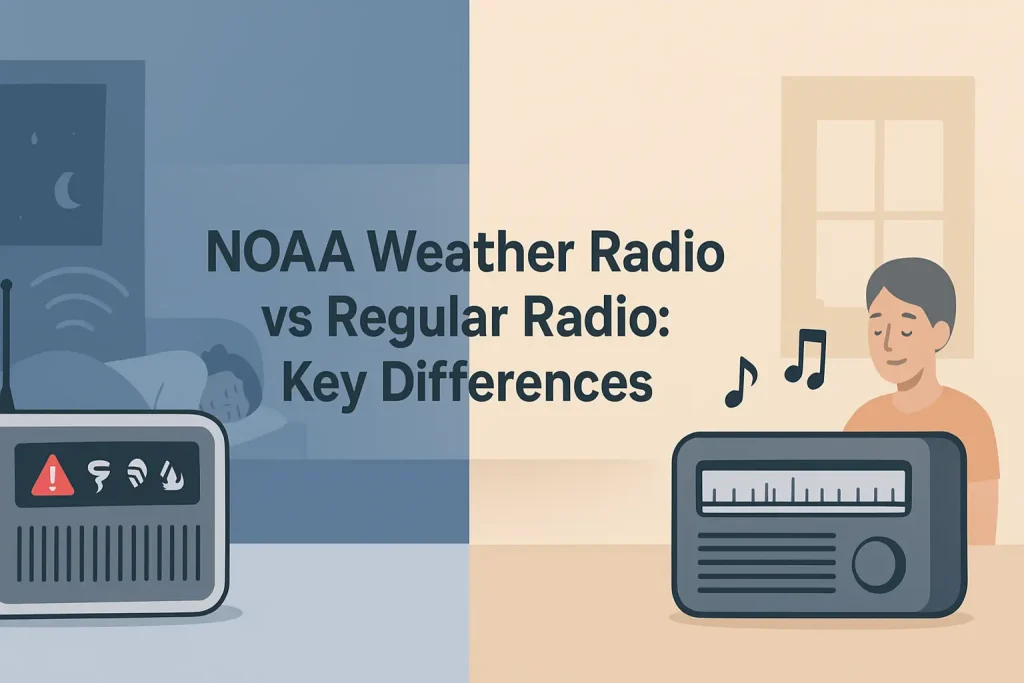
Most people buy a NOAA weather radio expecting tornado warnings and severe thunderstorm alerts. But that same radio sitting on your nightstand is also listening for hazardous material spills, nuclear power plant emergencies, AMBER Alerts, and even 911 system outages.
The NOAA Weather Radio All Hazards network earned its name honestly: it covers far more than weather. Understanding what non-weather emergencies your radio can detect changes how you use it and what you program into its S.A.M.E. memory.
| Photo | Popular Portable Walkie Talkies | Price |
|---|---|---|
 | SKIWARRIOR Multifunctional Smart Wireless Ski Goggles with Walkie-Talkie, Anti-Fog Zeiss Lens, Music & Call Function (Cylindrical Blue) | Check Price On Amazon |
 | SINORISE Super Mini Walkie Talkies, Two-Way Radios, 3 Pack | Check Price On Amazon |
 | KOSPET Tank M4C Smart Watch Rugged, Dual-Band GPS, 5ATM & IP69K Waterproof | Check Price On Amazon |
 | Retevis RT15 Walkie Talkies 3 Pack, Birthday Gift, Outdoor Adventure Kit | Check Price On Amazon |
 | Rechargeable Walkie Talkies Toys for Kids: DIY Astronaut Walkie Talkies for Boys Christmas Birthday Gifts for 3 4 5 6 7 8 9 10 Boy Walkie Talkie Outdoor Hiking Toy 2 Way Radio Camping Outdoor Game | Check Price On Amazon |
EMERGENCY GUIDE
NOAA Weather Radio Non-Weather Alerts – Key Numbers
Sources: NOAA NWR All Hazards documentation, FCC Part 11 EAS rules, FEMA IPAWS program data.
This guide covers every non-weather emergency category your NOAA weather radio can detect, how to program your radio to receive only the alerts you want, and what happens during each alert type.
What Are Non-Weather Emergencies on NOAA Weather Radio?
The NOAA Weather Radio (NWR) network is a nationwide system of over 1,000 VHF transmitters broadcasting on seven frequencies between 162.400 and 162.550 MHz. While the network started as a weather-only service, it expanded after a 1975 White House policy directive designated NWR as the federal government’s primary system for disseminating all types of civil emergency information to the public.
Non-weather emergencies are any alert broadcast over NWR that does not originate from the National Weather Service’s meteorological operations. These alerts come instead from civil authorities: emergency management agencies, law enforcement, the Department of Homeland Security, nuclear power plant operators, and FEMA. According to FCC Part 11, which governs the Emergency Alert System (EAS), NWR serves as the primary distribution pathway for EAS messages across the entire United States.
Your weather radio receives these alerts because every NWR transmitter doubles as an EAS distribution node. When a county emergency manager issues a hazardous materials warning or the state police activate an AMBER Alert, the message routes through the EAS network and transmits over the same NOAA frequencies that carry your routine weather forecasts.
If you rely exclusively on a Midland WR400 weather radio or similar S.A.M.E.-capable receiver for emergency alerts, you are already covered for these non-weather events whether you realized it or not.
The Full List of Non-Weather EAS Event Codes NOAA Weather Radio Broadcasts
NOAA Weather Radio broadcasts more than 14 distinct non-weather Emergency Alert System event codes. Each code triggers a specific alert tone and message format that your weather radio processes according to its S.A.M.E. programming.
Use the tabs below to see exactly which non-weather emergencies fall into each category and what triggers them.
TABBED GUIDE
Non-Weather NWR Alert Categories by Emergency Type
Select a category for specific EAS event codes, real examples, and programming guidance.
Hazardous Materials Warning (HMW) and Nuclear Power Plant Warning (NUW)
HMW alerts activate after chemical spills, gas leaks, railcar derailments carrying hazardous cargo, or industrial accidents releasing toxic substances. The February 2023 East Palestine, Ohio train derailment triggered HMW alerts across multiple counties through the NWR network. NUW alerts cover incidents at any of the 54 commercial nuclear power plants in the United States. Each plant has a 10-mile emergency planning zone. If your S.A.M.E. code falls within that zone, your radio will alert for NUW events automatically. Radiological Hazard Warning (RHW) covers non-power-plant radiation incidents including dirty bomb scenarios and transportation accidents involving medical or industrial radioactive materials.
Each of these event codes maps to a specific S.A.M.E. alert type that you can enable or disable individually on most mid-range and premium weather radios. The Uniden BC365CRS supports all standard EAS event codes, as does the Midland WR400.
How S.A.M.E. Technology Filters Non-Weather Alerts for Your Location
S.A.M.E. (Specific Area Message Encoding) is the technology that prevents your weather radio from alerting for emergencies in counties 200 miles away. Every S.A.M.E.-capable radio stores one or more 6-digit FIPS codes that identify your specific county or counties of interest.
When an EAS alert transmits over NWR, the first burst of data contains the event code (what type of emergency) and the FIPS code (which counties are affected). Your radio compares that FIPS code against its programmed list. If there is no match, your radio stays silent no matter how severe the alert.
This filtering matters even more for non-weather alerts than for weather. A tornado warning typically covers one to three counties. A hazardous materials spill near a major rail line can trigger alerts across 12 counties simultaneously. Without S.A.M.E. filtering, your radio would activate for every one of them. With S.A.M.E. programmed correctly, you hear only the alerts for the counties you specified.
To learn the exact steps for programming S.A.M.E. codes, see our guide on how S.A.M.E. weather radio technology filters emergency alerts by county.
Most weather radios let you also filter by alert type within your S.A.M.E. programming. For example, you can program your radio to receive tornado warnings and hazardous material warnings but disable AMBER Alerts if you prefer not to receive them. This per-event-type control is a standard feature on the Midland WR120 and higher-tier models.
How Non-Weather NWR Alerts Differ from Weather Alerts
Non-weather and weather alerts on NOAA Weather Radio share the same VHF frequency band (162.400 to 162.550 MHz) and the same S.A.M.E. encoding format, but they differ in three important ways: their originating authority, their alert tone pattern, and how frequently they occur.
Weather alerts originate from your local National Weather Service forecast office. Non-weather alerts originate from county emergency management, state police, FEMA, or nuclear facility operators. The 1050 Hz alert tone is identical for both, but the message content format follows different EAS templates depending on the event code.
Use the table below to compare weather and non-weather NWR alerts across key characteristics.
| Characteristic | Weather Alerts | Non-Weather Alerts |
|---|---|---|
| Originating authority | National Weather Service | FEMA, state/local EMA, law enforcement, nuclear operators |
| EAS event codes | TOR, SVR, FFW, HUW, TSW, etc. | CEM, HMW, NUW, CAE, BLU, CDW, RHW, SPW, LEW, TOE, etc. |
| Frequency | Daily during active weather seasons | Rare; most counties see fewer than 5 non-weather NWR activations per year |
| Duration of alert | 15 minutes to 6 hours depending on warning type | Typically 30 minutes to 2 hours; NIC messages may run longer |
| S.A.M.E. filter support | Full; all S.A.M.E. radios support weather event filtering | Varies by model; premium radios support per-event-code filtering |
| Typical affected area | 1 to 5 counties | 1 to 20 counties; some alerts are statewide |
| Best for | Everyone in the alert area | Residents near industrial sites, nuclear plants, major rail corridors, and high-traffic highways |
Non-weather alerts matter most if you live near a nuclear power plant, chemical manufacturing facility, major rail line carrying hazardous cargo, or within a high-traffic AMBER Alert corridor. If you live in a rural area far from these risk factors, weather alerts will dominate your NWR experience.
Real-World Examples of Non-Weather NWR Activations
Non-weather NOAA Weather Radio activations are infrequent but consequential. The East Palestine, Ohio train derailment in early 2023 triggered Hazardous Materials Warnings across multiple Ohio and Pennsylvania counties through the NWR network. Residents with programmed weather radios received the shelter-in-place instructions before cell phone alerts reached them.
During the 2011 Fukushima Daiichi nuclear incident, NWR stations along the US West Coast broadcast informational National Information Center messages about radiation monitoring, even though no US nuclear threat existed. The alerts served as a public reassurance mechanism through an existing trusted alert channel.
AMBER Alerts on NWR have directly contributed to child recoveries. In a 2019 case in Tennessee, a truck driver who did not own a smartphone heard the AMBER Alert on his CB radio scanner (which also monitors NOAA frequencies) and spotted the suspect vehicle at a rest stop 45 minutes later. The redundancy of multiple alert distribution pathways, including NWR, increases the probability that someone will see or hear the alert at the critical moment.
If you want to understand how these alerts fit into a broader emergency preparedness plan, our guide on weather radio emergency preparedness and alert planning covers setting up your receive station for all alert types.
How to Program Your Weather Radio for Non-Weather Alerts
Programming a weather radio for non-weather alerts follows the same S.A.M.E. code entry process as weather alerts, but with one critical difference: you must verify that the specific non-weather event codes you want are enabled in your radio’s alert menu. Many radios ship with some non-weather event types disabled by default.
First, find your county’s 6-digit FIPS code. The NWS maintains a complete database at weather.gov/nwr/counties. Enter this code into your radio’s S.A.M.E. memory following the manufacturer’s instructions. For the Midland WR400, press MENU, select COUNTY CODE, and enter the six digits followed by SAVE. For the Midland WR120, the process is nearly identical.
Next, navigate to your radio’s alert type menu. This is usually labeled ALERT SELECT or EVENT TYPES. Here you will see a list of all 25 standard S.A.M.E. alert types your radio supports. Each will show ON or OFF. Scroll through and enable the non-weather alerts you want (HMW for hazardous materials, NUW for nuclear, CAE for AMBER, and so on).
Finally, verify your programming by listening for the weekly NWR test, which transmits every Wednesday between 11 AM and noon local time on most stations. The test message confirms your radio is receiving and decoding S.A.M.E. data correctly. For detailed steps on the entire setup process, see our guide on how to use a weather radio for emergency alerts.
Most weather radios let you program up to 25 S.A.M.E. location codes. If you live near a county border, program at least two counties (your home county and the neighboring county that includes your workplace or your children’s school). Non-weather emergencies do not respect county lines, and a chemical spill half a mile upwind in the next county affects you exactly as much as one in your own.
Quick Reference: Key NWR Non-Weather Terms
EAS (Emergency Alert System): The federal alert distribution network that routes emergency messages to broadcasters and NWR transmitters.
S.A.M.E. (Specific Area Message Encoding): The digital data protocol that tags each alert with a geographic FIPS code, letting your radio filter alerts by county.
FIPS Code: A 6-digit Federal Information Processing Standards code identifying your state (first 2 digits) and county (last 4 digits).
Event Code: A 3-letter EAS designation identifying the type of emergency (HMW for hazardous materials, CAE for AMBER Alert, etc.).
IPAWS (Integrated Public Alert and Warning System): FEMA’s modern alert origination platform that feeds alerts into the EAS and NWR network.
NWR All Hazards: The official name for NOAA Weather Radio since its 1975 expansion to include non-weather emergency broadcasts.
1050 Hz Alert Tone: The attention signal transmitted before every NWR alert message, recognized by all S.A.M.E. weather radios.
NWR Transmitter: One of over 1,000 VHF broadcast stations operating on 162.400 to 162.550 MHz, each covering approximately 40 miles in radius.
Shelter in Place (SPW): An EAS event code instructing residents to stay indoors and seal windows, doors, and ventilation during airborne hazards.
National Periodic Test (NPT): A scheduled nationwide EAS test verifying the entire alert distribution chain from FEMA to your radio.
Which Non-Weather Alerts Do Most Weather Radios Support?
Most S.A.M.E.-capable weather radios support 25 alert types, including all major non-weather EAS event codes. The Midland WR400, for example, supports all 25, including HMW, NUW, CAE, BLU, and CDW. Budget radios like the Midland WR120 support the same 25 alert types but with fewer programmable S.A.M.E. location slots (typically 10 to 15 instead of 25).
Portable hand-crank weather radios without S.A.M.E. capability receive all alerts transmitted by the nearest NWR station but cannot filter by location or event type. They alert for everything or nothing, depending on whether the alert function is switched on. If you live in a busy alert region, a non-S.A.M.E. radio will wake you for every alert across a wide geographic area.
The Sangean CL-100 supports all 25 S.A.M.E. alert types plus FM/AM broadcast reception, making it useful for receiving local EAS broadcasts that route through commercial radio stations as well.
How Do Non-Weather NWR Alerts Differ from Wireless Emergency Alerts (WEA) on Cell Phones?
Wireless Emergency Alerts on cell phones and NWR non-weather alerts share the same IPAWS origin but reach you through different paths. WEA messages transmit to cell towers and push to compatible phones within the affected area. NWR alerts transmit from fixed VHF towers on 162.400 to 162.550 MHz and reach any S.A.M.E.-programmed weather radio within approximately 40 miles of the transmitter.
The key practical difference is coverage reliability. Cell towers depend on commercial power and backhaul connections that fail during widespread emergencies. NWR transmitters have battery backup and operate independently of the cellular network. During the 2020 Nashville bombing, parts of the cellular network went down while NWR continued broadcasting normally. For more on how the NWR transmission infrastructure works, see our guide on how NOAA Weather Radio transmitters and the NWR broadcast network operate.
Can a Weather Radio Receive Non-Weather Alerts Without S.A.M.E. Programming?
Yes, a weather radio without S.A.M.E. programming receives all non-weather alerts transmitted by the nearest NWR station, along with every weather alert. It cannot filter by location. If the transmitter covers 25 counties, your radio alerts for every county equally.
This creates a practical problem: a non-S.A.M.E. radio near a major metropolitan NWR transmitter may activate dozens of times per year for alerts irrelevant to your location. A S.A.M.E.-programmed radio with only your county codes entered will activate only when your specific counties are included in the alert’s geographic zone.
Why Does My Weather Radio Not Alert for AMBER Alerts Even Though I Programmed S.A.M.E. Codes?
This happens for one of three reasons. First, your radio may have the AMBER Alert event type (CAE) disabled in the alert selection menu, even though your FIPS county codes are correctly programmed. Check your alert type settings and confirm CAE is set to ON.
Second, not all weather radios support the CAE event code. Some budget and older models support only weather-related event types. Check your radio’s manual or specification sheet for the list of supported EAS event codes.
Third, AMBER Alerts are rare. Most counties issue zero to two per year. Your radio may be functioning perfectly but simply has not had an AMBER Alert to receive since you programmed it. Wait for the weekly NWR test to confirm your radio is decoding S.A.M.E. data correctly.
Why Did My Weather Radio Wake Me Up for an Alert in a County 100 Miles Away?
Your radio’s S.A.M.E. memory includes the FIPS code for that distant county. This commonly happens when users program counties for family members or vacation properties and forget those entries are still active. Check your radio’s county code list and remove any entries for counties where you do not need alerts.
It can also happen if the NWR transmitter you are tuned to serves a very large geographic area. Some transmitters cover radiuses exceeding 50 miles in flat terrain, carrying alerts for counties at the outer edge of that range. Changing to a closer transmitter frequency may reduce the number of distant-county alerts you receive.
Is It Legal to Rebroadcast NOAA Weather Radio Non-Weather Alerts?
Rebroadcasting NWR audio is legal for non-commercial purposes under NOAA’s public use policy. However, rebroadcasting non-weather EAS alerts with the actual EAS attention signal (the 1050 Hz tone) over public airwaves is restricted by FCC Part 11 regulations to prevent false activation of EAS equipment. If you stream NWR audio online or retransmit it over a radio repeater, you must filter out or mute the EAS header tones.
For amateur radio operators, retransmitting NWR audio on ham frequencies is generally permitted as long as the transmission serves a public service function and does not include the EAS activation tones. Check with your local ARRL frequency coordinator for region-specific guidance.
Do I Need a License to Monitor Non-Weather Emergency Frequencies on My Radio?
No license is required to receive NOAA Weather Radio broadcasts on any frequency. NWR transmissions are public broadcasts intended for reception by anyone with a compatible receiver. This applies equally to weather and non-weather alert content.
This differs from two-way radio services like GMRS, which requires a $35 FCC license for transmission on the 462 to 467 MHz band. Receiving is always license-free. For more on licensing requirements, see our guide on what NOAA Weather Radio is and its role in emergency communication.
How Do I Know Which S.A.M.E. Code to Use for My County?
The National Weather Service maintains a complete, searchable database of every county FIPS code at weather.gov/nwr/counties. Enter your state and county, and the site returns your 6-digit code. The first digit of the 6-digit code is always 0 for the entire US. The next two digits identify your state, and the final three digits identify your county within that state.
If you live near a county border, the NWS site also lists the FIPS codes for adjacent counties. Program at least your home county plus any neighboring county where you regularly work, commute, or send children to school. Non-weather emergencies like hazardous material spills and AMBER Alerts frequently cross county lines.
Can I Use My GMRS or Ham Radio to Receive NOAA Non-Weather Alerts?
Many GMRS and amateur radios include NOAA weather band receive capability covering 162.400 to 162.550 MHz. Models like the Baofeng UV-5R and most Midland GMRS handhelds can monitor NWR frequencies. However, these radios lack S.A.M.E. decoding hardware, so they receive all alerts without geographic filtering.
This means your GMRS or ham radio will play every alert from the nearest NWR transmitter for the entire coverage area, not just your county. It serves as a backup alert source but should not replace a dedicated S.A.M.E. weather radio for primary emergency notification, especially overnight when you want only location-specific alerts.
How Do I Test If My Weather Radio Receives Non-Weather Alerts Correctly?
The weekly NWR test, transmitted every Wednesday between 11 AM and noon local time, tests the entire S.A.M.E. decoding chain including non-weather alert capability. If your radio activates for the weekly test, your S.A.M.E. programming and alert type settings are working correctly for all enabled event codes.
Some NWR stations also conduct monthly EAS tests that specifically exercise non-weather event code routing. These are less predictable than the weekly test but provide additional confirmation. If you want to verify a specific event code, the only reliable method is to wait for a real activation, as test transmissions rarely use non-weather event codes.
Can I Filter Out Specific Non-Weather Alert Types While Keeping Others?
Yes, most mid-range and premium S.A.M.E. weather radios let you enable or disable each of the 25 alert types individually. The Midland WR400 and Uniden BC365CRS both offer per-event-code toggling through their alert select menus. Scroll through the list and set each event code to ON or OFF according to your preference.
Budget radios may only offer an all-or-nothing approach to non-weather alerts. Check your radio’s manual for the specific alert customization options before purchasing if per-event filtering matters to you.
Do I Need a Special Weather Radio to Receive Non-Weather Emergency Alerts?
Any NOAA Weather Radio that receives the standard seven NWR frequencies (162.400 to 162.550 MHz) receives non-weather emergency alerts automatically. No special hardware is required. The S.A.M.E. technology that filters alerts by county and event type is available on radios at every price point, from the $30 Midland WR120 to premium $100+ desktop models.
What separates radios is not whether they receive non-weather alerts but how they let you manage them. A S.A.M.E.-capable radio lets you filter by location and event type. A non-S.A.M.E. radio alerts for everything in range. For overnight use, S.A.M.E. filtering is the difference between being woken only for emergencies in your county and being woken for every alert across half the state.
Your NOAA weather radio is an all-hazards alert receiver, not just a storm warning device. The same radio that warns you of a tornado also tells you about the chemical spill up the highway, the missing child in your county, and the 911 system outage affecting your ability to call for help. Program your S.A.M.E. codes. Enable the non-weather event types you want. And verify your setup with the weekly Wednesday test. The non-weather alerts are infrequent, but when one activates in your county, you will be glad your radio was listening.
| Photo | TOP RATED WALKIE TALKIES | Price |
|---|---|---|
 | Retevis RT628 Kids Walkie Talkies, Toys Gifts for 4-12 Year Old Girl Boy | Check Price On Amazon |
 | Cobra ACXT545 Weather-Resistant Walkie Talkies, Rechargeable, 22 Channels | Check Price On Amazon |
 | Retevis RT388 Kids Walkie Talkies, Outdoor Toys for Kids Camping Essentials | Check Price On Amazon |
 | Cobra RX680 Walkie Talkies (2-Pack), IP54 Water Resistant Design | Check Price On Amazon |
 | Retevis RT22 Walkie Talkies Long Range Rechargeable with Earpiece (2 Pack) | Check Price On Amazon |
 | Midland GXT1000VP4 GMRS Two-Way Radios with Headsets, Black, 2 Pack | Check Price On Amazon |
 | Retevis RT628 Walkie Talkies for Kids,Toys Gifts for 6-12 Years Old Boys Girls,Long Range 2 Way Radio 22CH VOX,Birthday Gift,Family Walkie Talkie for Camping Hiking Indoor Outdoor | Check Price On Amazon |