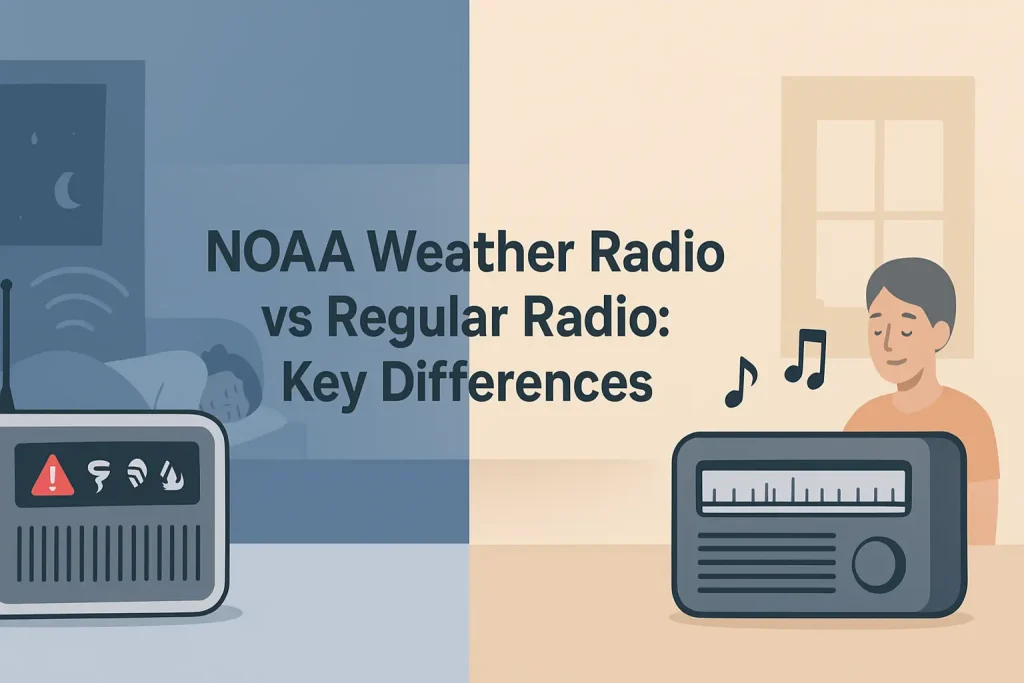
S.A.M.E. (Specific Area Message Encoding) technology filters weather alerts so your radio only sounds for your exact county. Standard weather radios without this feature will wake you up for a tornado warning 50 miles away.
This happens because NOAA broadcasts all alerts over a 40-mile radius transmitter network. The NOAA weather radio network covers 95% of the United States population.
| Photo | Popular Portable Walkie Talkies | Price |
|---|---|---|
 | SKIWARRIOR Multifunctional Smart Wireless Ski Goggles with Walkie-Talkie, Anti-Fog Zeiss Lens, Music & Call Function (Cylindrical Blue) | Check Price On Amazon |
 | SINORISE Super Mini Walkie Talkies, Portable Two-Way Radios for Restaurants, Outdoor Sports, Retail Stores, Hospital & Travel – 3 Pack | Check Price On Amazon |
 | KOSPET Tank M4C Outdoor Smart Watch with GPS, 1.96" AMOLED Display, Built-in LED Flashlight & Walkie-Talkie, Long Battery Life, 50m Waterproof, Bluetooth Calls, 24/7 Heart Rate/Sleep Monitor | Check Price On Amazon |
 | Retevis RT15 Walkie Talkies, Portable FRS Two Way Radios Rechargeable, Durable, Compact, VOX, Key Lock, Mini Walkie Talkies for Adults and Kids, School Family Outdoor Travel Camping Hiking (3 Pack) | Check Price On Amazon |
 | Rechargeable Walkie Talkies Toys for Kids: DIY Astronaut Walkie Talkies for Boys Christmas Birthday Gifts for 3 4 5 6 7 8 9 10 Boy Walkie Talkie Outdoor Hiking Toy 2 Way Radio Camping Outdoor Game | Check Price On Amazon |
A S.A.M.E. weather radio is a type of emergency communication receiver operating in the 162.400 to 162.550 MHz band. It works with your local National Weather Service transmitter to achieve targeted emergency alerts.
By the Numbers
7 NOAA weather radio frequencies between 162.400 and 162.550 MHz
6-digit FIPS codes programmed into S.A.M.E. weather radios for county-level alert filtering
95% of US population covered within 40 miles of a NOAA weather radio transmitter
50 programmable S.A.M.E. location codes supported by premium desktop weather radios
What Is S.A.M.E. Technology on a Weather Radio?
S.A.M.E. (Specific Area Message Encoding) is a digital protocol used by NOAA to encode geographic alert data into weather broadcasts. This digital header tells your radio which county the alert affects before the audio warning plays.
Your radio compares the incoming FIPS code to your programmed list. If the codes match, the alarm sounds for that specific county.
This happens because the National Weather Service structures alerts using federal emergency alerting standards. This only occurs when your radio has a functioning S.A.M.E. decoder chip installed and configured.
If the chip is missing or unprogrammed, the result is alert fatigue from every broadcast. Fix it by entering your specific 6-digit FIPS code into your radio memory bank.
The Midland WR400 weather radio uses this technology to silence irrelevant alerts. Key Specifications: Frequency: 162.400-162.550 MHz (7 NOAA channels). S.A.M.E. alert types: 25. Alert memory: 50 programmable S.A.M.E. codes. Power: AC adapter with 6x AA battery backup.
A S.A.M.E. weather radio consists of a receiver, a digital decoder chip, and an alert memory bank. According to NOAA National Weather Service documentation, S.A.M.E. eliminates false alarms from neighboring counties entirely.
S.A.M.E. technology ensures your emergency radio only alerts you when your actual location is in danger.
How Does S.A.M.E. Technology Filter Emergency Alerts?
S.A.M.E. filters alerts by reading a burst of digital data transmitted before the audible warning tones. This data burst contains the alert type, affected counties, and expiration time.
A S.A.M.E. weather radio consists of a receiver, a digital decoder chip, and an alert memory bank. These components work together to intercept and evaluate every NOAA broadcast.
Use the chart below to understand which alerts take up the most broadcast time. This breakdown shows why filtering them is critical for your safety.
The mechanism works by matching the transmitted FIPS code against your saved county codes. This only occurs when the NOAA transmitter sends a properly formatted S.A.M.E. header.
If the header is corrupted by weak signal strength, the result is a missed alert or a default full-alert broadcast. Fix it by relocating the radio closer to a window or installing an external weather radio antenna.
A weather radio without S.A.M.E. triggers the siren for every single alert the transmitter sends out. Filtering prevents you from unplugging the radio to sleep through the night.
Filtering alerts by county ensures you only wake up for actual threats to your immediate area.
What Are the FIPS Codes Used in S.A.M.E. Programming?
FIPS (Federal Information Processing Standards) codes are 6-digit numbers identifying specific US counties. The first digit identifies the region, the next two identify the state, and the last three identify the county.
You must find your exact FIPS code to program your weather radio correctly. The NWS provides a comprehensive database of these codes for every county in the United States.
For example, a FIPS code of 042101 means region 0, state 42 (Pennsylvania), and county 101. A radio programmed with this code ignores alerts for neighboring counties.
You can find your local code by checking the S.A.M.E. weather radio codes database for your state. Entering the correct 6-digit FIPS code restricts alerts to your specific county.
By the Numbers
S.A.M.E. Weather Radio – Key Specifications and Standards
Sources: NOAA NWR documentation, FCC Part 95, manufacturer data sheets
The Uniden BC365CRS scanner uses FIPS codes to isolate local emergency broadcasts. Key Specifications: Frequency: 162.400-162.550 MHz. Channel capacity: 300 channels. S.A.M.E. programming: manual entry via keypad. Power: AC adapter.
According to FEMA and the Integrated Public Alert and Warning System (IPAWS), FIPS codes guarantee geographic accuracy for emergency alerts. Precise code entry ensures your radio remains silent for irrelevant warnings.
Entering the correct 6-digit FIPS code is the only way to restrict alerts to your specific county.
How to Program S.A.M.E. Codes on a Weather Radio?
Programming S.A.M.E. codes involves accessing the radio menu, selecting your county code, and saving it to memory. You repeat this process for every county you want to monitor.
Most radios allow you to enter multiple codes to monitor adjacent counties. This is useful if you work in one county and live in another.
The mechanism relies on saving the FIPS digits into the non-volatile memory of the S.A.M.E. decoder chip. This only occurs when you follow the exact button sequence specified by the manufacturer.
If you input a digit incorrectly, the result is a completely silent radio during an actual emergency. Fix it by double-checking your code against the official NOAA database before hitting save.
For detailed button sequences, programming S.A.M.E. codes step by step requires following your specific model manual. Using high-quality rechargeable AA batteries ensures your radio survives a power outage while saving codes.
The Midland WR120 weather radio simplifies this process. Key Specifications: Frequency: 162.400-162.550 MHz. S.A.M.E. memory: 25 programmable codes. Display: LCD with backlight. Alert override: programmable mute.
According to the ARRL Handbook, storing local FIPS codes in memory prevents signal lockout errors. Always test your radio after entering codes using the required weekly test function.
Following the exact menu sequence ensures your radio stores your local county codes safely.
What This Means for You
Program your radio with your exact 6-digit FIPS code to prevent dangerous alert fatigue. If you skip this step, your radio will sound for every storm within a 40-mile radius. A S.A.M.E. weather radio with properly entered FIPS codes eliminates this noise entirely. Ignoring the programming step means you will eventually turn the radio off completely and miss a real tornado warning.
Why Does S.A.M.E. Prevent False Alarms and Alert Fatigue?
S.A.M.E. prevents false alarms by mathematically comparing received geographic codes against your approved list. Alert fatigue occurs when a radio sounds for non-threatening storms too many times.
People unplug warning radios that constantly wake them up for distant thunderstorms. S.A.M.E. decoding stops this behavior by acting as a geographic filter for your speaker.
The mechanism works by suppressing the audio amplifier until a valid FIPS code matches the internal database. This only occurs when the radio operates in localized “S.A.M.E. standby” mode rather than “all alerts” mode.
If you leave the radio in “all alerts” mode, the result is continuous interruptions for every regional broadcast. Fix it by switching the menu back to “S.A.M.E. mode” after testing the siren.
According to RadioReference.com community verified data, users who program S.A.M.E. codes keep their radios powered on longer than those who do not. Targeted alerts build trust in the emergency warning system.
Alert fatigue causes people to ignore life-saving warnings, but S.A.M.E. keeps the system trustworthy.
What Types of Alerts Does S.A.M.E. Decode?
S.A.M.E. decodes watches, warnings, and advisories for weather events like tornadoes, floods, and winter storms. It also decodes civil emergency messages and AMBER alerts.
The NWS structures these messages with specific preamble codes to identify the alert severity. Your radio reads these severity codes to determine how loud to sound the siren.
This happens because the S.A.M.E. protocol allocates specific 3-letter character codes to different emergency categories. This only occurs when the NOAA transmitter sends the full S.A.M.E. header burst before the 1050 Hz warning tone.
If the transmitter sends an alert without the header, the result is a missed automated siren in S.A.M.E. mode. Fix it by keeping your radio set to receive both “Alerts” and “Tests” in the menu.
The 162.400 MHz band carries watches, while imminent warnings typically trigger the loud 1050 Hz siren. Reviewing the NOAA weather radio frequencies guide helps clarify channel assignments.
You can mute non-critical advisories while keeping critical tornado warnings at full volume. To ensure you have the right equipment, find the best portable weather radio for your area.
The Midland XT10 weather radio categorizes these alerts by severity. Key Specifications: Frequency: 162.400-162.550 MHz. S.A.M.E. alert types: 80. Alert siren: 90 dB. Battery backup: 4x AA.
Decoding specific alert types lets you silence minor advisories while guaranteeing loud sirens for tornado warnings.
How to Choose the Best S.A.M.E. Weather Radio?
Choosing the best S.A.M.E. weather radio requires evaluating battery backup options, alert memory capacity, and display readability. You need a model that holds at least 20 programmable FIPS codes.
Models with multiple power sources ensure you receive alerts during extended power failures. A detailed guide to the best weather radios compares top models side by side.
The mechanism relies on radio receiver sensitivity combined with a robust S.A.M.E. decoder chip design. This only occurs when the internal memory retains codes during a complete power loss.
If the radio lacks NVRAM (non-volatile random access memory), the result is total loss of your programmed FIPS codes during a battery swap. Fix it by choosing a radio with EEPROM memory storage.
If you live in a hurricane zone, following a weather radio hurricane preparation guide requires weatherproofing considerations. You also need instructions on how to use a weather radio to maximize battery life.
A hand crank weather radio provides power when grid electricity fails completely. Using a desktop battery charger ensures your backup supply remains fully voltage-optimized.
Selecting a radio with EEPROM memory guarantees your S.A.M.E. codes survive a complete power failure.
Can I Program My Weather Radio for Multiple Counties?
You can program a S.A.M.E. weather radio for multiple counties by entering separate 6-digit FIPS codes into the memory bank. Most premium models like the Midland WR400 support up to 50 distinct county codes.
This feature is crucial for people who live near county borders or commute between regions. You simply add the FIPS codes for your home county and your work county.
According to NOAA documentation, traveling weather radio users should program every county along their route to ensure safety. You can clear the memory and reprogram the codes whenever you travel to a new region.
Why Does My Weather Radio Go Off for Storms in Another State?
Your weather radio goes off for storms in another state because it is operating in default “all alerts” mode instead of filtered S.A.M.E. mode. In this default state, the radio sounds the siren for every watch and warning transmitted by the local NOAA tower.
The NOAA transmitter network uses high-power broadcasts that often cover 40 miles or more in radius. Without S.A.M.E. filtering, your radio cannot distinguish between a storm 5 miles away and a storm 45 miles away.
Fix this by entering your specific 6-digit FIPS code into your radio settings menu. This restricts the alerts exclusively to the counties you specify, silencing out-of-state warnings.
What Is the Difference Between S.A.M.E. and EAS?
S.A.M.E. (Specific Area Message Encoding) is the digital protocol used by NOAA weather radios to filter alerts, while EAS (Emergency Alert System) is a broader national public warning network. The EAS encompasses television, radio broadcasts, and cell phones.
S.A.M.E. functions specifically within the 162.400 to 162.550 MHz weather band to decode geographic headers. EAS requires cooperation from commercial broadcasters to interrupt programming with alert tones.
According to FEMA and IPAWS documentation, S.A.M.E. works as a localized subset of the larger EAS infrastructure. Your weather radio only needs S.A.M.E. decoding, not full EAS compliance, to alert you to local tornadoes.
Do I Need a S.A.M.E. Weather Radio if I Have a Smartphone?
You need a S.A.M.E. weather radio even with a smartphone because cellular networks often fail during severe weather and tornado strikes. A weather radio operates independently on VHF broadcast signals and AA battery power.
Smartphones rely on cellular towers that require continuous grid power and internet connectivity to deliver Wireless Emergency Alerts (WEA). A tornado can easily destroy the local cell tower infrastructure before the storm hits your location.
According to NOAA preparedness guidelines, S.A.M.E. weather radios provide a critical redundancy layer for emergency alerts. A weather radio ensures you receive life-saving audio broadcasts even when your smartphone goes silent.
How Do I Find My 6-Digit FIPS Code for S.A.M.E. Programming?
You can find your 6-digit FIPS code for S.A.M.E. programming by using the official NOAA weather radio county code lookup tool online. You simply enter your state and county to retrieve the specific 6-digit identifier.
You can also find these codes in the instruction manual that accompanies your S.A.M.E. weather radio. Some premium models include pre-loaded databases, but most require manual entry via the keypad.
According to the National Weather Service, you can also call your local NWS office to request your county FIPS code. Write this code down and keep it with your emergency supplies for quick reprogramming.
Why Did My S.A.M.E. Weather Radio Miss a Local Tornado Warning?
Your S.A.M.E. weather radio missed a local tornado warning because the broadcast signal was too weak or the decoder chip failed to read the header. A weak signal corrupts the digital data burst before the radio can process it.
This happens because VHF signals in the 162.400 MHz band struggle to penetrate metal roofs and thick concrete walls. If your radio sits in a basement behind foil insulation, the signal drops below the decoding threshold.
Fix this by relocating the radio to a window facing the nearest NOAA transmitter tower. You can also install an external antenna to improve signal reception and prevent missed tornado warnings.
Can I Silence Severe Thunderstorm Warnings Without Muting Tornado Warnings?
You can silence severe thunderstorm warnings without muting tornado warnings by customizing the alert override settings on your S.A.M.E. weather radio. Premium models allow you to select specific alert types to trigger the siren.
You simply access the menu, locate the alert library, and toggle the siren status for watches, warnings, and advisories. You can set tornado warnings to “On” and severe thunderstorm warnings to “Off.”
According to FCC Part 95 rules governing weather radio receivers, customizable alert selection is a standard feature on all S.A.M.E. certified devices. This prevents alert fatigue by ensuring the siren only sounds for imminent threats.
What Does the 1050 Hz Tone Mean on a Weather Radio?
The 1050 Hz tone on a weather radio is the audible attention signal that activates older receivers before a voice broadcast. It is a continuous analog tone that triggers the speaker on radios without S.A.M.E. digital filtering.
NOAA transmitters send this 1050 Hz tone for approximately 8 seconds before the spoken warning message begins. Radios with S.A.M.E. technology can bypass this tone entirely and use the digital FIPS code instead.
According to NOAA NWR technical documentation, the 1050 Hz tone remains part of the broadcast protocol for backward compatibility. However, relying on this tone instead of S.A.M.E. codes prevents you from filtering out non-local alerts.
Do S.A.M.E. Weather Radios Work in Canada?
S.A.M.E. weather radios work in Canada because Environment Canada uses the same S.A.M.E. digital protocol for its Weatheradio Canada network. You can program Canadian 6-digit location codes into your device.
The Weatheradio Canada network broadcasts in both English and French on the same 162.400 to 162.550 MHz frequencies used by NOAA. Your radio hardware requires no modifications to receive these signals across the border.
According to Environment Canada documentation, Canadian S.A.M.E. codes use a slightly different numbering format than US FIPS codes. You must consult the Canadian codes database to program your radio correctly for Canadian counties.
Is It Legal to Modify a Weather Radio to Ignore EAS Alerts?
It is legal to modify a consumer weather radio to ignore certain EAS alerts because personal receiving devices are exempt from FCC compliance mandates. The FCC regulates broadcasters, not the consumer hardware receiving the signals.
You can legally silence tests, AMBER alerts, and civil emergency messages on your weather radio without violating federal law. The S.A.M.E. protocol explicitly allows consumer filtering via the programmable memory bank.
According to FCC Part 15 rules governing consumer receivers, you are under no obligation to listen to emergency broadcasts. However, muting tornado warnings on your device defeats the purpose of owning an emergency radio entirely.
How Often Should I Test My S.A.M.E. Weather Radio?
You should test your S.A.M.E. weather radio weekly by checking for the required weekly test indicator in the display. NOAA transmitters broadcast a systemic test every Wednesday between 10 AM and noon local time.
Your radio might not sound the siren for this test to prevent annoyance, but the LCD should display “REQUIRED WEEKLY TEST.” If the display does not show this test indicator, your radio is not receiving the signal properly.
According to NOAA preparedness guidelines, you should activate the manual siren test button monthly. This verifies that the speaker, battery backup, and decoder chip are functioning correctly for actual emergencies.
Why Does My Weather Radio Lose Its S.A.M.E. Codes When the Power Goes Out?
Your weather radio loses its S.A.M.E. codes when the power goes out because the radio lacks non-volatile memory or the internal backup battery is dead. Older budget models rely solely on volatile RAM to store FIPS codes.
If the device loses AC power and the AA backup batteries drain completely, the RAM clears the saved county codes. Premium models with EEPROM retain data without any power source present.
Fix this by always keeping fresh AA batteries in the backup compartment and replacing them during daylight saving time changes. You should also reprogram your FIPS codes immediately after any extended power outage.
What Happens if I Do Not Program Any S.A.M.E. Codes Into My Radio?
If you do not program any S.A.M.E. codes into your radio, it defaults to “all alerts” mode and sounds the siren for every warning within the 40-mile transmitter range. You will hear continuous alarms for distant storms that do not threaten your location.
This happens because the radio has no geographic data to cross-reference the incoming digital headers against. The decoder simply assumes you want to hear every broadcast propagated by the NOAA tower.
This unfiltered state causes rapid alert fatigue, causing you to unplug the radio and miss real emergencies. Always program at least your local county code to ensure the siren sounds only for immediate threats.
Can I Use a S.A.M.E. Weather Radio on a Boat?
You can use a S.A.M.E. weather radio on a boat, but it is not the best emergency communication choice for marine environments. S.A.M.E. relies on terrestrial county lines, which do not apply to bodies of water.
When boating, you need a fixed-mount marine VHF radio that monitors Channel 16 and Weather channels. Marine VHF radios use Digital Selective Calling (DSC) to transmit GPS coordinates during emergencies.
According to the US Coast Guard Navigation Rules, marine VHF radios provide ship-to-ship and ship-to-shore communication that weather radios cannot. Save the S.A.M.E. weather radio for your cabin or home base.
S.A.M.E. technology filters NOAA weather alerts on the 162.400 MHz band so your radio only sounds for your specific county. Programming your 6-digit FIPS code into a device like the Midland WR400 weather radio prevents dangerous alert fatigue. Always verify your local FIPS code, enable battery backup, and test your system weekly to ensure you never miss a targeted tornado warning.
| Photo | TOP RATED WALKIE TALKIES | Price |
|---|---|---|
 | Retevis RT628 Walkie Talkies for Kids,Toy Gifts for 6-12 Year Old Boys Girls,Kid Gifts Walkie Talkie for Adults Outdoor Camping Hiking(Silvery 1 Pair) | Check Price On Amazon |
 | Cobra ACXT545 Weather-Resistant Walkie Talkies - Rechargeable, 22 Channels, Long Range 28-Mile Two-Way Radio Set (2-Pack) | Check Price On Amazon |
 | Retevis RT388 Kids Walkie Talkies, Toys for 6 7 8 9 12 Year Old Boys, 22 CH 2 Way Radio Backlit LCD Flashlight, Blue Walkie Talkies Outdoor Camping Games Toys for Kids 8-12 Boys Gifts(Blue, 2 Pack) | Check Price On Amazon |
 | Cobra RX680 Walkie Talkies (2-Pack) - Rugged & Splashproof Two Way Radios Long Range, IP54 Water Resistant Design, 60 Pre-Programmed Channels, Weather Alerts, Included Charging Dock (Black/Orange) | Check Price On Amazon |
 | Retevis RT22 Walkie Talkies, Mini 2 Way Radio Rechargeable, VOX Handsfree, Portable, Two-Way Radios Long Range with Earpiece, for Family Road Trip Camping Hiking Skiing(2 Pack, Black) | Check Price On Amazon |
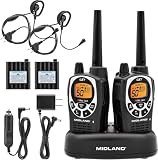 | Midland GXT1000VP4 GMRS Two-Way Radio (50 Channel, Long Range, 142 Privacy Codes, SOS, NOAA, Rechargeable Nickel Battery, Black/Silver 2-Pack) | Check Price On Amazon |
 | Retevis RT628 Walkie Talkies for Kids,Toys Gifts for 6-12 Years Old Boys Girls,Long Range 2 Way Radio 22CH VOX,Birthday Gift,Family Walkie Talkie for Camping Hiking Indoor Outdoor | Check Price On Amazon |