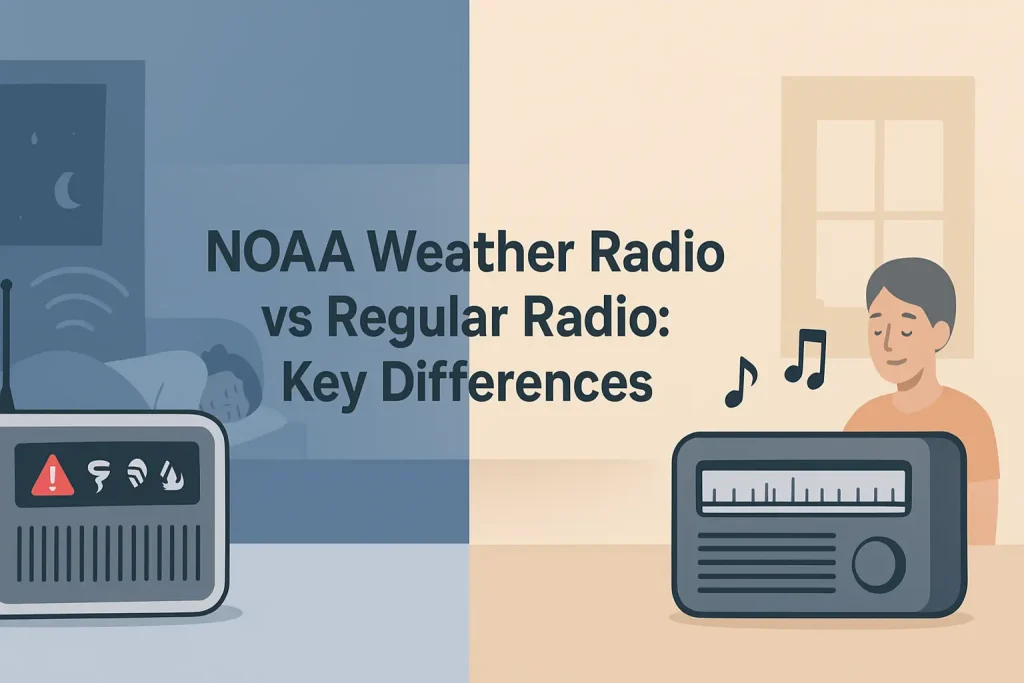
The National Weather Service operates every single NOAA Weather Radio All Hazards transmitter in the United States. There is no private broadcaster, no commercial station, and no contracted third party involved. The NWS builds the transmitters, programs the alerts, and maintains the network 24 hours a day across all seven dedicated frequencies between 162.400 and 162.550 MHz.
This guide explains exactly how the NWS broadcast system works, who controls what, and what that means for the reliability of the alerts your weather radio receives.
| Photo | Popular Portable Walkie Talkies | Price |
|---|---|---|
 | SKIWARRIOR Multifunctional Smart Wireless Ski Goggles with Walkie-Talkie, Anti-Fog Zeiss Lens, Music & Call Function (Cylindrical Blue) | Check Price On Amazon |
 | SINORISE Super Mini Walkie Talkies, Two-Way Radios, 3 Pack | Check Price On Amazon |
 | KOSPET Tank M4C Smart Watch Rugged, Dual-Band GPS, 5ATM & IP69K Waterproof | Check Price On Amazon |
 | Retevis RT15 Walkie Talkies 3 Pack, Birthday Gift, Outdoor Adventure Kit | Check Price On Amazon |
 | Rechargeable Walkie Talkies Toys for Kids: DIY Astronaut Walkie Talkies for Boys Christmas Birthday Gifts for 3 4 5 6 7 8 9 10 Boy Walkie Talkie Outdoor Hiking Toy 2 Way Radio Camping Outdoor Game | Check Price On Amazon |
By the Numbers
NOAA Weather Radio All Hazards – Key Network Statistics
Sources: NOAA National Weather Service, FCC, FEMA IPAWS documentation.
What Is NOAA Weather Radio All Hazards?
NOAA Weather Radio All Hazards (NWR) is a nationwide network of radio stations operated exclusively by the National Oceanic and Atmospheric Administration through its National Weather Service. The network broadcasts continuous weather information, emergency alerts, and hazard warnings 24 hours a day, 7 days a week, on seven VHF frequencies between 162.400 and 162.550 MHz.
The NWR network is a component of the Federal Emergency Management Agency’s Integrated Public Alert and Warning System (IPAWS). It serves as one of the most reliable public warning systems in the United States precisely because it operates independently of commercial infrastructure.
NWR is not a commercial radio service. No advertising, no entertainment programming, and no private operators are involved at any point in the broadcast chain. Every alert originates inside a National Weather Service forecast office and travels directly to the transmitter without passing through any private intermediary.
If you want to understand the full scope of what this system covers and why it matters for households and emergency preparedness, our overview of how the NOAA weather radio network serves American communities covers the fundamentals in detail.
The network broadcasts more than weather. Alert types include tornadoes, flash floods, hurricanes, winter storms, tsunamis, earthquakes, hazardous materials incidents, civil emergencies, AMBER Alerts, and National Information Center messages. NWR is the “all hazards” designation in its full name.
Who Specifically Operates the NOAA Weather Radio Transmitters?
The National Weather Service, a division of NOAA within the Department of Commerce, owns and operates every NOAA Weather Radio transmitter in the United States. Each NWS regional forecast office is responsible for the transmitters within its coverage area. There is no outsourcing, no franchise arrangement, and no independent station owner anywhere in the network.
According to NOAA NWS documentation, the transmitter network is maintained by NWS field offices with support from the NOAA Office of Observations. Individual meteorologists at each forecast office are responsible for generating and verifying the alert content that gets encoded and broadcast.
This is a critical distinction for anyone relying on a NOAA weather alert radio for emergency preparedness. Because the NWS owns the entire broadcast chain, there is no commercial dependency that could take a transmitter offline during an emergency. Power failures, budget cuts at a private contractor, and corporate decisions cannot interrupt the signal.
Each NWS forecast office covers a defined geographic service area. Meteorologists within that office write the alerts, encode them with the appropriate S.A.M.E. (Specific Area Message Encoding) codes for affected counties, and trigger the broadcast. The process from alert creation to transmitter activation takes under 60 seconds in most cases.
The transmitters themselves operate at up to 1,000 watts of effective radiated power. This high-power VHF broadcast reaches approximately 40 miles in most terrain conditions. In flat, open areas, the signal can extend further. In mountainous terrain, the NWS adds additional low-power transmitters to fill coverage gaps.

How Many NWS Transmitters Are in the Network?
The NOAA NWR network operates more than 1,000 transmitters across all 50 states, Puerto Rico, the US Virgin Islands, Guam, and American Samoa. The network covers approximately 95% of the US population. The remaining 5% falls into remote areas where terrain or geography limits VHF signal propagation.
Each transmitter broadcasts on one of the seven designated NWR frequencies. The assignment of a specific frequency to a specific transmitter follows FCC coordination rules to prevent interference between adjacent transmitters. The seven NWR frequencies are:
- 162.400 MHz (WX1)
- 162.425 MHz (WX2)
- 162.450 MHz (WX3)
- 162.475 MHz (WX4)
- 162.500 MHz (WX5)
- 162.525 MHz (WX6)
- 162.550 MHz (WX7)
A single metro area may receive signals from multiple transmitters on different frequencies. Your NOAA weather radio with S.A.M.E. technology can scan all seven channels and lock onto whichever one delivers the strongest signal in your location.
The NWS publishes a complete database of all transmitter locations, frequencies, and call signs. Call signs follow the format KEC or KHB with a three-digit number. For example, KEC83 is the NWS transmitter serving the Louisville, Kentucky area on 162.400 MHz. You can look up your local transmitter on the NOAA NWR transmitter list at weather.gov to find the strongest signal for your county.
For a detailed breakdown of all seven frequencies and guidance on which channel to use in your region, the complete guide to NOAA weather radio broadcast frequencies and transmitter coverage provides county-level detail.
What Is the Role of the National Weather Service Forecast Offices?
There are 122 National Weather Service Weather Forecast Offices (WFOs) across the United States, each covering a defined geographic area. Every alert broadcast on NOAA Weather Radio originates in one of these offices. The WFO serves as the editorial and operational hub for every alert in its region.
When a meteorologist at a WFO determines that a hazardous weather event meets the criteria for a warning, watch, or advisory, they create the alert in the NWS text product system. The system automatically encodes the alert with the appropriate S.A.M.E. county codes, generates the audio broadcast, and triggers the relevant transmitters.
The audio you hear on a NOAA weather radio is a combination of automated text-to-speech synthesis for routine broadcasts and pre-recorded human voice for specific alert types. During major events, NWS meteorologists may read alerts live into the broadcast system directly. The synthesized voice used in most automated broadcasts is named “Paul” and was produced specifically for NWS broadcasts.
WFOs also coordinate with state and local emergency managers. When a civil authority issues a non-weather emergency (such as a hazardous materials spill or an AMBER Alert), the state emergency management agency submits the message through IPAWS, and the NWS broadcast system carries it on NWR. The NWS meteorologist does not write the content of those alerts, but the NWS transmitter network carries them.
Understanding how alerts travel from the forecast office to your receiver helps you understand why signal reliability matters so much when choosing a Midland WR400 weather radio or similar S.A.M.E.-capable receiver. The full technical process is covered in the detailed explanation of how NOAA weather radio transmits and decodes emergency alerts.
Each WFO is responsible for the accuracy and timeliness of the alerts it generates. NWS meteorologists are federal employees operating under established warning criteria defined in the NWS Operations Manual. This is why NWR alerts are considered the most authoritative source for weather warnings in the US.
What Is the Difference Between NWS Broadcast Roles and EAS Broadcaster Roles?
NOAA Weather Radio and the Emergency Alert System (EAS) are two separate systems that work together during major emergencies. The NWS operates NWR directly and generates the primary alert content. Commercial broadcasters (TV stations, AM/FM radio stations, cable systems) participate in EAS by relaying NWS-originated alerts to their audiences, but they do not originate weather warnings themselves.
Use the table below to understand how the broadcast roles differ between the NWS and commercial EAS participants.
| Role | NOAA NWS | Commercial EAS Broadcasters |
|---|---|---|
| Alert origination | Yes, all weather warnings | No, relay only |
| Broadcast frequency | 162.400-162.550 MHz (7 channels) | AM, FM, TV, cable channels |
| 24/7 continuous broadcast | Yes | No |
| S.A.M.E. county-level coding | Yes | No |
| Receiver required | Dedicated weather radio | TV, AM/FM radio, or phone |
| Alert speed (time to broadcast) | Under 60 seconds from issuance | 60-180 seconds after NWS issues |
| Operates during power grid failure | Yes, with backup generators | Not guaranteed |
This distinction explains why a dedicated weather radio with a backup battery provides a faster and more reliable alert than waiting for a TV station to relay the warning. The NWS transmitter activates at the moment the alert is issued. Commercial EAS stations receive the signal and then rebroadcast it, adding processing delay.
Commercial broadcasters are required by FCC rules to participate in EAS and to relay Presidential-level alerts. Weather watches and warnings are voluntary relay events for most commercial stations, which is why your local FM station may not interrupt programming for every tornado warning in your county.
Does the NWS Broadcast Alerts for All 50 States Simultaneously?
No. Each NWS Weather Forecast Office broadcasts alerts only for its own service area. A tornado warning issued by the WFO in Norman, Oklahoma activates transmitters covering central Oklahoma, not transmitters in Texas or Kansas. The geographic targeting of NWR is one of its most important features.
This is where S.A.M.E. technology becomes essential. S.A.M.E. (Specific Area Message Encoding) allows the NWS to embed county-level FIPS codes into each alert broadcast. A Uniden BC365CRS weather radio or any other S.A.M.E.-capable receiver can be programmed to only activate its alarm for specific counties. Without S.A.M.E. programming, the radio will sound an alert for every county within the transmitter’s broadcast radius, which can cover dozens of counties across multiple states.
A transmitter in a border region between two WFO service areas may carry alerts from both offices. The NWS coordinates transmitter assignments so that a single transmitter does not carry conflicting content from two different forecast offices simultaneously. The result is a seamless broadcast experience where the alert you hear is always relevant to your geographic location.
For emergency preparedness scenarios where you need county-specific alerts, understanding how to program S.A.M.E. codes into your receiver is critical. The complete guide to how S.A.M.E. technology filters weather alerts by county explains the FIPS code system and programming process in full.
The geographic precision of NWR broadcasts is the reason emergency management professionals consider it the most targeted public warning system in the United States. Wireless Emergency Alerts (WEA) sent to cell phones use cell tower geometry, which is less precise than FIPS county-level coding.
What Technology Do NWS Transmitters Use to Broadcast?
NWS transmitters broadcast in the VHF (Very High Frequency) band at frequencies between 162.400 and 162.550 MHz using FM modulation. The transmitters operate at power levels between 300 and 1,000 watts of effective radiated power (ERP). This high-power VHF signal propagates primarily by line-of-sight, which is why transmitter antenna height is a major factor in coverage radius.
VHF FM at these power levels is ideal for reliable regional broadcast coverage. The 162 MHz band penetrates moderate foliage and building materials better than UHF frequencies above 400 MHz. At the same time, VHF signals do not bounce off the ionosphere like HF signals, which prevents interference between distant transmitters on the same frequency.
This happens because VHF propagation follows the curvature of the earth only within line-of-sight distance. The effective horizon for a 1,000-watt transmitter on a 1,000-foot tower is approximately 40-60 miles. This condition only occurs when the receiving antenna has a clear line of sight to the transmitter with minimal obstructions. If a mountain range, dense urban high-rise cluster, or significant foliage belt exists between you and the transmitter, your received signal strength drops and your weather radio may lose the broadcast entirely. Fix this by moving the radio to a window facing the nearest NWS transmitter or by adding a VHF external antenna for weather radio mounted at a higher elevation.
Each NWR transmitter also encodes the S.A.M.E. digital header at the beginning of each alert. This is a 1,050 Hz FSK (Frequency Shift Keying) data burst transmitted before the audio portion of the alert. Your receiver’s S.A.M.E. decoder chip reads this data burst, compares it against your programmed FIPS codes, and decides whether to activate the alarm. The alert audio only plays if the county code matches.
NWS transmitters also broadcast a continuous alert tone during active warnings. The standard attention signal is a 1,050 Hz tone broadcast for 8-25 seconds before the verbal alert. This tone triggers the alarm circuit in all weather radios, including non-S.A.M.E. models that cannot filter by county.
Key Specifications for a typical NWS NWR transmitter:
- Broadcast band: VHF FM, 162.400-162.550 MHz
- Power output: 300-1,000 watts ERP
- Typical coverage radius: 40-60 miles in flat terrain
- S.A.M.E. encoding: 1,050 Hz FSK digital header
- Attention signal: 1,050 Hz tone, 8-25 seconds duration
- Backup power: Generator and battery backup systems standard
How Does the NWS Maintain Broadcast Continuity During Severe Weather?
Every NWS transmitter site is equipped with backup power systems, typically diesel generators and battery banks, to maintain broadcast continuity during power grid failures. This is a non-negotiable design requirement of the NWR network because the most critical time for the system to function is precisely when the power grid is most likely to fail.
The NWS also maintains redundant broadcast paths. If a primary transmitter goes offline, adjacent transmitters can often cover the gap with their own broadcasts. In practice, this means that during a major storm event, the NWR signal in most areas remains available even if individual transmitters lose power.
NWS staff at forecast offices also maintain backup broadcast capability. If the primary encoder system at a WFO fails, meteorologists can issue alerts through backup systems that route directly to transmitters. The goal is zero broadcast gap during any hazardous event.
For your household, the practical implication is that a hand-crank emergency weather radio or a model with battery backup will continue receiving NWR broadcasts even when your home loses power. The transmitter stays on. Your receiver needs its own power source to take advantage of that.
The NWS publishes outage notifications when a transmitter goes offline for planned maintenance. You can subscribe to these notifications through the NOAA NWR website to know in advance when your local transmitter will be temporarily replaced by a backup signal.
Broadcast continuity is especially important during wildfire events where power infrastructure may be compromised for extended periods. Understanding how weather radio supports evacuation decisions during wildfires is covered in the guide on using weather radio alerts to support wildfire evacuation planning.
The NWS broadcast system maintains alerting capability through the duration of most weather emergencies, which is why emergency management professionals consistently list NWR as the primary alerting tool for households without cellular service.
What Types of Alerts Does the NWS Broadcast on NOAA Weather Radio?
The NWS broadcasts a defined set of alert types over NWR, all of which are categorized within the NOAA NWR All Hazards alert system. Weather alerts make up the majority of broadcasts, but the system also carries non-weather hazard alerts submitted through IPAWS by authorized emergency management agencies.
Use the table below to understand which alerts originate from the NWS directly and which come from other agencies through the IPAWS relay.
| Alert Type | Originating Authority | S.A.M.E. Code Category | Typical Lead Time |
|---|---|---|---|
| Tornado Warning | NWS Forecast Office | TOR | 0-13 minutes |
| Severe Thunderstorm Warning | NWS Forecast Office | SVR | 5-30 minutes |
| Flash Flood Warning | NWS Forecast Office | FFW | Minutes to hours |
| Hurricane Warning | NWS National Hurricane Center | HUW | 36+ hours |
| Winter Storm Warning | NWS Forecast Office | WSW | 12-48 hours |
| Tsunami Warning | NWS Tsunami Warning Centers | TSW | Minutes to hours |
| Civil Emergency Message | State/Local Emergency Mgmt | CEM | Varies |
| AMBER Alert | Law Enforcement / State | CAE | Immediate |
| Hazardous Materials Warning | Local Emergency Mgmt | HMW | Varies |
| National Information Center | Federal Government | NIC | Varies |
Your weather radio can be programmed to respond to specific alert types and specific counties simultaneously. A Sangean CL-100 weather radio, for example, allows you to select which S.A.M.E. event codes trigger the alarm and which play silently or are ignored entirely. This prevents false wake-ups from routine advisories while ensuring you never miss a tornado warning for your county.
The complete system of alert types and how to program your receiver to respond to the right ones is what distinguishes a functional emergency preparedness tool from a radio that wakes you up for every frost advisory in a five-county area. NWR is only as useful as the S.A.M.E. programming you apply to it.
How Do NWS Forecast Offices Generate and Send Alerts?
When a meteorologist at an NWS WFO determines that warning criteria are met, they compose the alert in the WFO’s warning software system. The software prompts the forecaster to select the affected counties, the event type, the S.A.M.E. code, and the alert duration. Once the forecaster approves the alert, it enters the NWS dissemination system in under 10 seconds.
The dissemination system routes the alert simultaneously to multiple channels: the NWR transmitter network, the NWS website, the NWS API (which feeds third-party weather apps), the Emergency Alert System for relay by commercial broadcasters, and IPAWS for Wireless Emergency Alerts to cell phones. All of these channels activate from a single forecaster action.
The audio portion of the NWR broadcast is generated automatically from the text of the alert. The NWS text-to-speech engine converts the written warning into spoken audio in under 5 seconds. This is why NWR alerts sometimes sound mechanical. The urgency of rapid broadcast outweighs the aesthetic benefit of a human voice reading every alert.
During extremely high-impact events such as a landfalling major hurricane or an outbreak of violent tornadoes, NWS meteorologists may choose to read alerts into the system manually using a microphone. This direct recording bypasses the text-to-speech engine and produces a more natural voice on the broadcast. Listeners familiar with NWR broadcasts can tell the difference immediately.
The NWS also broadcasts routine weather forecasts, hourly observations, marine forecasts, agricultural weather, and aviation weather statements in between alert events. These routine broadcasts keep the NWR frequencies active 24 hours a day and serve as a useful signal strength test. If your weather radio can receive the routine forecast clearly, it will receive emergency alerts with the same signal strength.
Learning how to use your weather radio to take full advantage of both routine broadcasts and emergency alerts is covered in the practical walkthrough of how to set up and operate a weather radio effectively at home.
The NWS forecast office is the first link in the alerting chain. Every second of delay in that first link translates directly into reduced lead time for households in the path of a storm.
Here is a look at the common types of NOAA weather radios that receive these broadcasts, including portable and desktop models recommended for home use.
Quick Reference
NOAA Weather Radio Key Terms Explained
Plain-language definitions for the core terminology used throughout this article. Source: NOAA NWS, FCC.
The nationwide network of NWS-operated radio transmitters broadcasting weather alerts and emergency messages 24/7 on seven VHF frequencies.
The federal agency within NOAA that operates the NWR transmitter network and generates all weather alerts broadcast on it.
One of 122 regional NWS offices that generates weather alerts for a defined geographic service area and triggers the local NWR transmitters.
A digital coding system embedded in NWR broadcasts that tags each alert with 6-digit FIPS county codes, allowing receivers to filter alerts by county.
Federal Information Processing Standards code. The 6-digit number that identifies a specific US county in the S.A.M.E. system. You program your receiver with these codes to receive county-level alerts.
The broader federal system that includes NWR plus commercial TV, radio, and cable broadcasters who relay NWS-originated alerts to their audiences.
FEMA’s infrastructure that connects NWS, EAS broadcasters, and Wireless Emergency Alerts (WEA) into a single national alerting network.
The actual broadcast power output of an NWR transmitter, accounting for antenna gain. NWR transmitters operate at 300-1,000 watts ERP.
The distinctive tone broadcast for 8-25 seconds before each NWR alert. This tone activates the alarm circuit in all weather radios, including non-S.A.M.E. models.
Very High Frequency, Frequency Modulated. The signal type used by NWR transmitters at 162.400-162.550 MHz, providing reliable regional coverage within 40-60 miles of each transmitter.
Now that the core terminology is established, the next section addresses a question that comes up often for households in areas with spotty signal coverage.
Why Can Some Households Not Receive an NWR Signal?
Approximately 5% of the US population lives outside reliable NWR coverage. This is not a gap in the network by design. It is a physical limitation of VHF line-of-sight propagation. Mountainous terrain, deep valleys, and remote geography create signal shadows where no transmitter power level can reach without a relay or repeater site.
This happens because VHF signals travel in straight lines from the transmitter antenna to the receiver. When a mountain ridge or significant terrain feature stands between the transmitter and your location, the signal does not bend around it. The only fix is a transmitter on the same side of the obstruction as you. The NWS addresses this by adding low-power fill-in transmitters in known signal shadow areas, but complete coverage in mountainous terrain requires transmitters at very close spacing, which is expensive to build and maintain.
If your household is in a known coverage gap, a portable solar hand-crank weather radio with AM/FM reception can sometimes pick up a weather alert relay broadcast by a commercial AM station in your area. This is not as fast or reliable as direct NWR reception, but it provides a fallback alerting channel.
Another option for coverage-gap households is the use of a directional outdoor antenna aimed at the nearest NWR transmitter. A Yagi-type VHF antenna pointed at the transmitter can add 6-10 dBi of gain compared to the built-in telescoping antenna on most receivers. This gain translates to the ability to receive signals that would otherwise be too weak for reliable decoding. The NWS publishes transmitter coordinates and you can use free online tools to calculate the bearing from your home to the nearest transmitter.
The NWS also provides a coverage map on its website where you can enter your ZIP code and see which transmitter serves your area and the expected signal quality. If your area shows marginal or no coverage, contacting your local NWS WFO to report the gap can result in the NWS investigating additional transmitter sites.
The practical bottom line for any household: test your weather radio’s reception on a clear day before you need it in an emergency. Tune to each of the seven NWR frequencies and confirm you can receive a clear audio broadcast on at least one channel. If you cannot, solve the antenna problem before the storm season, not during it.
How Does the NWS Coordinate With Other Emergency Agencies During Broadcasts?
The NWS does not operate in isolation during major emergencies. It coordinates with FEMA, state emergency management agencies, the National Hurricane Center (NHC), the Storm Prediction Center (SPC), and local emergency managers. Each of these agencies contributes to the alert ecosystem but interfaces with NWR through defined roles.
The Storm Prediction Center in Norman, Oklahoma issues tornado watches and severe thunderstorm watches for the entire country. These watch products appear on NWR broadcast by the WFO covering the affected area, not by the SPC directly. The SPC creates the watch; the local WFO broadcasts it. When the WFO then issues a tornado warning for a specific county, that warning supersedes the watch and triggers a separate alert broadcast.
The National Hurricane Center in Miami issues hurricane watches and warnings for coastal areas. These products also feed through NOAA’s dissemination system and appear on NWR broadcasts for affected coastal WFOs. The NHC does not operate its own transmitters; its products reach the public through the same WFO broadcast infrastructure used for all NWR alerts.
FEMA’s IPAWS system allows state and local emergency managers to submit non-weather alerts for broadcast on NWR. A state emergency management director can issue a Civil Emergency Message (CEM) for a dam failure, industrial accident, or public health emergency, and it will broadcast on NWR in the affected counties within minutes. This requires prior registration with IPAWS and authentication, so not every local official can send messages without authorization.
For households building a comprehensive emergency communication plan, NWR is one layer of a multi-channel alerting strategy. Our guide to integrating weather radio into a complete household emergency preparedness plan outlines how to layer NWR with cell alerts, two-way radios, and neighborhood communication protocols.
The coordinated alert system is designed so that no single agency failure can silence all alerting channels simultaneously. This redundancy is the principle behind having both NWR and Wireless Emergency Alerts active in your household.
What Is the History of the NWS Broadcasting Role?
The National Weather Service began broadcasting weather information over radio in the early 1960s. The original system used a patchwork of frequencies and formats that varied by region. In 1967, NOAA (then operating as the Environmental Science Services Administration) began standardizing the network and assigning the 162 MHz frequency band specifically to weather radio broadcasts.
The “All Hazards” designation was added in 1997 when the NWR network expanded its alert types beyond weather to include non-weather emergencies through coordination with FEMA and state emergency management agencies. This expansion required the development and implementation of the S.A.M.E. digital encoding standard, which was introduced in the same period.
S.A.M.E. technology deployment across the transmitter network was completed in the late 1990s. Consumer weather radios with S.A.M.E. decoding capability began appearing in retail channels around the same time. The Midland WR120 and similar early S.A.M.E. receivers represented the first generation of consumer radios that could filter alerts by county instead of broadcasting every alert within a transmitter’s coverage area.
The FCC formalized the role of NWR within the EAS in the 1990s, designating NWR transmitters as Primary Entry Points for the Emergency Alert System. This gave NWR transmitters the legal status of being among the first stations to receive Presidential-level alerts for relay to the public, reinforcing the federal government’s commitment to maintaining the network as critical infrastructure.
The network has grown continuously since its standardization. From approximately 400 transmitters in the 1970s to more than 1,000 today, the expansion has tracked population growth and the political priority of reaching rural and underserved communities with timely weather warnings.
Is NOAA Weather Radio Available Outside the United States?
The NOAA Weather Radio All Hazards network as operated by the NWS covers only the United States and its territories. Canada operates a similar system called Weatheradio Canada, operated by Environment and Climate Change Canada (ECCC), using the same seven VHF frequencies between 162.400 and 162.550 MHz. The two systems are compatible, meaning a weather radio designed for NOAA reception in the US will also receive Weatheradio Canada broadcasts when in range of a Canadian transmitter.
Mexico does not operate a comparable national weather radio broadcast system. In border regions, some US NWR transmitters broadcast into northern Mexico, but coverage is inconsistent and not the result of an intentional cross-border design. Residents in northern Mexico near the US border who can receive a US NWR signal may use the same weather radio receivers as US households.
Internationally, the World Meteorological Organization (WMO) promotes weather radio broadcasting standards similar to NWR, but implementation varies significantly by country. The 162 MHz band is not reserved for weather broadcasts internationally as it is within US FCC jurisdiction. Some countries use different frequency bands and incompatible alert encoding systems.
For US travelers in Canada, a standard US weather radio will work for Weatheradio Canada reception on the same channels. For international travel beyond Canada, weather radio receivers are not useful unless the destination country operates a compatible system on 162 MHz.
The geographical limitation of NWR is relevant for marine users operating in coastal and offshore waters. NOAA NWR transmitters cover coastal waters for approximately 40-60 miles offshore, depending on transmitter height. Beyond that range, mariners rely on the US Coast Guard’s NAVTEX system and VHF marine weather forecasts on Marine Channel 22A (157.100 MHz). A dedicated marine VHF radio with weather channel capability covers both the standard NWR channels and marine weather broadcasts.
Can You Transmit on NOAA Weather Radio Frequencies?
No. Transmission on NOAA Weather Radio frequencies (162.400-162.550 MHz) is prohibited for all non-authorized users. These frequencies are FCC-designated for federal government broadcast use exclusively. Transmitting on them without FCC authorization constitutes a federal violation under Part 0 of FCC rules governing frequency allocations for federal government use. Penalties can include equipment seizure and fines starting at $10,000 per violation.
This prohibition applies regardless of power level. Even a low-power handheld radio transmitting a test signal on 162.400 MHz is illegal. The frequencies are receive-only for the general public. No license class, including an amateur Extra class license, grants permission to transmit on 162 MHz for weather broadcasts.
Some amateur radio operators confuse NWR frequencies with the 2-meter amateur band (144-148 MHz), which is adjacent but entirely separate. A Baofeng UV-5R dual-band radio can receive 162 MHz in receive-only mode (it is within the radio’s receive range), but it cannot legally transmit there under any circumstances. The UV-5R’s frequency range for legal transmission starts at 136 MHz and 400 MHz, not 162 MHz for broadcast purposes.
The reason for this exclusivity is signal integrity. A single rogue transmission on an NWR frequency can interfere with the broadcast signal across the entire coverage radius of that transmitter, potentially preventing thousands of households from receiving a life-safety alert. The FCC enforces these restrictions aggressively, and NWS engineers can locate the source of interference rapidly using direction-finding equipment.
The practical takeaway: if your radio can receive NWR broadcasts, treat those frequencies as permanently receive-only and do not program them into any transmittable memory channel.
How Do NWS Alert Broadcasts Interact With S.A.M.E.-Capable Weather Radios?
When an NWS forecast office triggers an alert, the transmitter begins the broadcast with a digital S.A.M.E. header preamble. This header consists of a 1,050 Hz FSK data burst that carries the event type, the affected FIPS county codes, the alert duration, and the originating WFO identifier. Your S.A.M.E.-capable weather radio listens continuously for this header even while in standby mode.
When the receiver detects the S.A.M.E. header, it decodes the county codes and compares them against the FIPS codes you programmed into the receiver. If the codes match, the receiver activates its alarm and plays the alert audio. If the codes do not match, the receiver silences the alert and returns to standby. This process takes approximately 2-3 seconds from the moment the header arrives at your receiver’s antenna.
The S.A.M.E. header is transmitted three times in succession before the alert audio begins. This triple transmission is a redundancy feature that allows the receiver to confirm the header data across three independent readings before deciding whether to activate. A single-read error due to weak signal or interference will not incorrectly trigger or suppress an alarm if the other two readings are correct.
Key Specifications for S.A.M.E.-capable receivers:
- S.A.M.E. alert types supported: Typically 25-60 distinct event codes depending on model
- FIPS codes programmable: 1-25 county codes depending on model
- Header decode time: 2-3 seconds from header receipt to alarm activation
- Standby power consumption: 0.5-2 watts (determines battery backup duration)
- Recommended minimum spec: 25 S.A.M.E. event codes and at least 5 programmable FIPS counties
If you have not yet programmed your receiver with the correct FIPS codes for your county, the radio will alarm for every alert broadcast within the transmitter’s coverage area. In active weather regions, this can mean multiple alarms per night during storm season for counties that are not yours. Programming your specific county code is the single most impactful improvement you can make to a weather radio setup.
The complete guide to programming S.A.M.E. codes and selecting the right FIPS codes for your location walks through the process for the most common receiver models step by step.
What Should You Look for in a Weather Radio to Best Receive NWS Broadcasts?
A weather radio that best receives NWS broadcasts has five non-negotiable capabilities: S.A.M.E. decoding with FIPS county programming, alarm output loud enough to wake a sleeping household (minimum 85 dB at 3 meters), battery backup for use during power outages, reception across all seven NWR frequencies (162.400-162.550 MHz), and a scan function that finds the strongest local transmitter automatically.
The Midland WR400 is a desktop S.A.M.E. receiver widely used in emergency preparedness households. It supports up to 50 programmable S.A.M.E. location codes, covers all 25 standard S.A.M.E. alert event types, and includes both AC power and 6xAA battery backup.
Key Specifications for the Midland WR400:
- Frequency coverage: 162.400-162.550 MHz (all 7 NWR channels)
- S.A.M.E. alert types: 25 programmable event codes
- FIPS codes: Up to 50 programmable location codes
- Alarm output: 90 dB at 3 meters
- Power: AC adapter with 6xAA battery backup
- Display: LCD with time, date, and alert status
The Uniden BC365CRS is a comparable alternative with a built-in clock radio function and S.A.M.E. alert capability. It is often preferred in bedrooms where the combined clock and weather alert function replaces two separate devices.
For households in areas with marginal NWR signal, adding an external VHF antenna for 162 MHz weather radio reception can dramatically improve signal quality. Many desktop weather radio models include an external antenna jack for this purpose.
For outdoor and portable use, a Kaito KA500 emergency weather radio provides solar charging, hand-crank power generation, and NWR reception in a single portable unit. This type of radio is essential for emergency kits and go-bags where household power may not be available.
Battery backup duration is a key differentiator among models. A radio with 6xAA alkaline backup will run for approximately 24-48 hours in standby mode. A model with a built-in lithium rechargeable battery may provide 72+ hours of standby. Always test the backup battery annually and replace AA batteries before storm season even if they have not been used.
How Does NWR Fit Into a Broader Emergency Preparedness Communication Strategy?
NOAA Weather Radio is the fastest and most reliable single-point alerting system for weather emergencies, but it is one layer of a multi-channel emergency communication plan, not the entire plan. A complete emergency communication strategy pairs NWR with secondary alerting channels and two-way communication tools that allow you to communicate with family and neighbors, not just receive alerts.
Wireless Emergency Alerts (WEA) delivered to cell phones are the most widely used complementary alerting channel. They cover the same NWS warning events as NWR broadcasts and reach cell phone users automatically. However, WEA alerts depend on cellular infrastructure, which can become congested or fail during major disasters. NWR operates independently of the cellular network.
Two-way radios provide the communication capability that NWR cannot. After receiving a tornado warning on your weather radio, your next step is often communicating with family members in different parts of the house, a neighbor, or a local shelter. FRS radios and GMRS radios provide short-range two-way communication that functions when phone lines are congested. A set of Midland GXT1000 GMRS radios paired with your weather radio setup creates a receive-and-communicate system suitable for most household emergency scenarios.
For wildfire evacuation scenarios, the combination of NWR alerts and pre-planned two-way radio communication protocols can be critical when cell networks are overloaded. The specific role of weather radio in wildfire preparedness is detailed in our guide on integrating weather radio alerts into wildfire evacuation decision-making.
A complete household emergency communication plan includes: a S.A.M.E.-programmed desktop weather radio in the bedroom (set to alarm mode 24/7), a portable weather radio in the emergency kit, at least one pair of FRS or GMRS radios for family communication, and a pre-established communication plan with out-of-area contacts. Each of these components addresses a different failure mode in the alerting and communication chain.
The broader framework for combining weather radio with other emergency communication tools is covered in detail in the guide to building a complete emergency communication system around weather radio.
NWR is where your emergency communication strategy begins, not where it ends.
Is There an NWS-Operated App or Digital Alternative to NOAA Weather Radio?
The NWS operates the weather.gov website and the official NWS mobile app, which deliver the same alert content as NWR broadcasts through internet-connected devices. The NWS also operates the NWR streaming audio feed, which broadcasts live NWR audio over the internet. These digital channels are useful supplements but are not substitutes for a dedicated weather radio receiver in an emergency preparedness context.
The critical difference is infrastructure dependency. A weather radio receiver requires only the NWR transmitter signal and a power source. It does not require an internet connection, a cellular data subscription, or a functioning smartphone. During major emergencies that damage cellular infrastructure or cause widespread internet outages, the weather radio receiver continues to function as long as the NWR transmitter is on the air.
Smartphone weather apps like Weather Channel, Dark Sky, and NWS mobile all rely on cellular or Wi-Fi connectivity to deliver alerts. During the critical first hours of a major disaster, cellular networks frequently become congested or partially damaged. A weather radio with battery backup operates independently of all of these dependencies.
The NWS also supports the Wireless Emergency Alert system, which delivers alerts to cell phones through broadcast cell tower signals rather than internet connectivity. WEA is more resilient than internet-dependent apps, but it is still dependent on cellular infrastructure. NWR is the only alerting channel that requires nothing from the cellular or internet ecosystem.
For households that want the NWR experience without purchasing a dedicated receiver, some combination radios include NWR reception alongside AM, FM, and shortwave. A combination AM/FM/shortwave/NOAA weather radio provides multiple alerting channels and general-purpose radio reception in a single device. These are commonly recommended for emergency kits where space and weight are constraints.
The NWS has stated publicly that it has no plans to discontinue NWR broadcasts in favor of digital-only alternatives. The physical transmitter network is considered critical federal infrastructure and will continue to be funded and maintained alongside digital alerting channels.
Does the NWS Conduct Regular Tests of the NWR System?
The NWS conducts two types of regular tests of the NOAA Weather Radio system. Weekly Required Monthly Tests (RMT) and periodic Required Weekly Tests (RWT) are broadcast on NWR transmitters to verify the end-to-end functionality of the alerting system, including the S.A.M.E. encoding, transmitter hardware, and receiver alarm activation.
The Required Weekly Test (RWT) broadcasts every Wednesday between 11 AM and noon local time in most areas. It activates S.A.M.E.-capable receivers and verifies that the alarm function is working. The test broadcast uses S.A.M.E. event code RWT and includes a verbal announcement identifying it as a test. Your receiver should alarm briefly and then silence when it detects the RWT code, assuming you have not disabled test alerts in your receiver’s settings.
The Required Monthly Test (RMT) is a more comprehensive test broadcast once per month, typically at the same Wednesday time slot. It uses S.A.M.E. event code RMT and is also relayed by commercial EAS broadcasters as a test of the full EAS chain. Most S.A.M.E.-capable weather radio receivers are factory-set to respond to both RWT and RMT test codes.
If your weather radio does not alarm during the weekly Wednesday test, that is a signal that something in your setup requires attention. Common causes include: depleted backup batteries, incorrect county code programming that prevents the test code from matching, alarm disabled in settings, or a failed receiver alarm circuit. Test your radio’s response to the RWT code every month to confirm it will activate when an actual alert is issued.
Some households disable the RWT and RMT codes in their receiver settings to avoid weekly alarm activations during work hours. This is a legitimate configuration choice, but you should verify that your receiver will still respond to actual warning codes (TOR, FFW, SVR) with the test codes disabled. Consult your receiver’s manual to confirm which codes remain active when test notifications are suppressed.
What Credentials and Meteorological Standards Govern NWS Broadcasts?
NWS Weather Forecast Office meteorologists hold federal civil service positions with academic backgrounds in atmospheric science or meteorology, typically at the bachelor’s degree level or above. NWS hiring standards require formal meteorological education, and operational meteorologists working in warning roles complete additional certification through the NWS Learning Center in warning decision training and mesoscale analysis.
Warning issuance at NWS WFOs follows standardized criteria defined in the NWS Operations Manual and supplementary local procedures. A tornado warning, for example, is issued only when a meteorologist identifies rotation in a thunderstorm on Doppler radar consistent with tornado-producing conditions, or when a trained storm spotter reports a tornado on the ground. The criteria are not subjective.
The NWS is bound by a verification and accountability process for warning accuracy. False alarm rates, probability of detection, and lead times for warnings are tracked centrally by NOAA and published in annual performance reports. These metrics drive continuous improvement in warning criteria and issuance procedures. The NWS probability of detection for tornado warnings exceeds 70%, with a mean lead time of approximately 13 minutes before tornado touchdown, according to published NWS performance data.
False alarm rates are a known issue with NWR alerts. The NWS has invested in improving warning specificity through probabilistic hazard information (PHI) research and threat-based warning methodologies. The goal is to issue fewer warnings that cover unnecessarily large areas, which reduces false alarms for households outside the actual threat zone and increases the credibility of warnings that are issued.
The professional standards and meteorological expertise behind every NWR broadcast are what distinguish it from social media weather alerts, app notifications, and neighbor word-of-mouth. Every alert you hear on a weather radio has been evaluated by a trained federal meteorologist using real-time radar, surface observation, and numerical weather prediction data.
How Is the NOAA Weather Radio Network Funded?
NOAA Weather Radio All Hazards is funded through the federal budget as part of NOAA’s National Weather Service appropriations. The NWS receives its annual operating budget through the Commerce, Justice, Science, and Related Agencies appropriations bill in the US Congress. NWR is not a fee-supported service and does not charge listeners, broadcasters, or receiver manufacturers for the right to receive its signal.
Radio receiver manufacturers do not pay a fee to NOAA or the NWS to include NWR reception capability in their products. The NWR frequencies and S.A.M.E. encoding standards are publicly documented. Any manufacturer can build a compliant receiver without licensing or royalty payments.
The FCC does not charge the NWS for use of the 162 MHz frequencies. These frequencies are allocated to the federal government for weather broadcast use. The FCC coordinates the assignment of specific frequencies to specific transmitters to prevent interference, but there is no spectrum fee.
Budget constraints at the NWS do affect the pace of transmitter upgrades and new site construction. The network has experienced periods of slower expansion when federal budgets were constrained, and some planned new transmitter sites have been delayed for years due to funding limitations. This is worth understanding: the NWR network is excellent but its growth is subject to congressional appropriations, which means coverage gaps in some regions persist longer than a purely technical assessment would suggest they should.
The long-term funding stability of NWR is reinforced by its designation as critical federal infrastructure. It is unlikely to be defunded entirely, but households in known coverage gap areas should not assume a new transmitter is coming soon without checking NWS infrastructure plans for their region.
The NWR network represents one of the most cost-effective public safety investments in the federal budget. Serving 95% of the US population with continuous 24/7 weather alerting capability from a network of approximately 1,000 transmitters represents a per-capita cost that few comparable public safety systems can match.
Is There a Difference Between a NOAA Radio and an NWS Radio?
No. “NOAA radio” and “NWS radio” refer to the same system. NOAA (National Oceanic and Atmospheric Administration) is the parent agency, and the NWS (National Weather Service) is the division that actually operates the transmitter network and generates the broadcast content. Consumer products are labeled “NOAA Weather Radio” because that is the public-facing brand name. The actual operator is the NWS within NOAA.
This distinction matters when you are looking for technical documentation. NOAA maintains the public-facing NWR website and consumer information. The NWS maintains the operational transmitter database, WFO service area maps, and alert issuance procedures. If you need your local transmitter’s call sign and frequency, that information lives in NWS documentation, not NOAA consumer pages.
Product labels that say “NOAA Weather Radio approved” or “NOAA weather alert radio” are marketing descriptions, not a formal certification category. The NWS does not operate a product certification program for consumer weather radios. Any radio that can receive 162.400-162.550 MHz FM and decode S.A.M.E. headers is functionally compatible with the NWR system, regardless of what the packaging says about NOAA approval.
The Public Alert brand was a voluntary industry program in which receiver manufacturers could pay for testing and certification of their products’ S.A.M.E. decoding accuracy. The program was discontinued, but products labeled “Public Alert certified” were verified to meet minimum S.A.M.E. decoding performance standards. This certification is no longer actively awarded, so most current products do not carry it regardless of their actual decoding accuracy.
When shopping for a weather radio, focus on the technical specifications: S.A.M.E. capability, number of programmable FIPS codes, alarm output in dB, backup power type, and all seven NWR frequency coverage. These specifications determine actual performance more reliably than any marketing certification label.
Is There a Difference Between NWS-Issued Watches and Warnings on NWR?
Yes, and the difference is operationally significant. A weather watch means conditions are favorable for the development of a hazardous event in the watch area, typically within the next several hours. A weather warning means a hazardous event is occurring, is imminent, or has a very high probability of occurring in the warning area within the next 30-60 minutes. A weather advisory indicates conditions that are hazardous but not as severe as warning criteria.
On NWR, watches and warnings trigger different S.A.M.E. event codes. A Tornado Watch uses the event code TOA. A Tornado Warning uses the event code TOR. A S.A.M.E.-capable receiver can be programmed to respond differently to each code. Many households program their receivers to alarm for warnings (TOR, SVR, FFW) but play quietly or silently for watches (TOA, SV.A), reducing nighttime disruptions while preserving the most critical alarm functions.
This programming distinction requires understanding your receiver’s event code settings. Some receivers categorize alerts as “Warning,” “Watch,” or “Advisory” at a high level without letting you select individual S.A.M.E. event codes. Better-equipped receivers allow code-by-code selection. The Midland WR300 and higher-tier models provide individual event code programming for this reason.
The practical recommendation: always keep Tornado Warnings (TOR), Flash Flood Warnings (FFW), and Severe Thunderstorm Warnings (SVR) set to full alarm mode. These three event codes represent the highest probability of imminent life-safety impact in most US regions. You can evaluate whether to enable alarm mode for watches based on your region’s typical weather patterns and your personal tolerance for nighttime alerts.
Understanding the watch-versus-warning distinction prevents a dangerous error: assuming a watch is not worth acting on. Watches precede warnings by 30-90 minutes in most tornado events. Using the watch period to shelter, gather family members, and confirm your emergency plan is the correct response to a tornado watch broadcast on NWR.
Are There Limitations to Relying Solely on NOAA Weather Radio for Emergency Alerts?
NOAA Weather Radio is the most reliable standalone alerting system available to US households, but it has four genuine limitations you should plan around. First, NWR coverage is not universal. The 5% of the US population outside reliable coverage cannot depend on NWR alone. Second, NWR requires a powered receiver. A weather radio with no battery backup will not alert you during a power outage, which is precisely when alerts matter most. Third, NWR cannot send two-way messages. It is a broadcast-receive system only. Fourth, NWR coverage indoors depends on building construction. Heavy concrete construction can attenuate the 162 MHz signal significantly, reducing received signal strength in building interiors.
These limitations do not diminish NWR’s value. They define the edges of its capability and point toward complementary tools. For coverage gap areas, a combination of WEA cell alerts and a subscription-based commercial alerting service (such as county emergency management text alerts) fills the gap. For power outages, a battery-backed or hand-crank receiver solves the problem completely.
The two-way communication gap is not a limitation of NWR specifically; it is a characteristic of any broadcast system. Filling this gap requires a separate two-way radio solution. An FRS or GMRS radio paired with your weather radio creates a receive-and-communicate system that addresses both alerting and response communication needs.
Signal penetration in concrete buildings is a real challenge in some urban environments. If you live in a high-rise concrete building, place your weather radio near a window facing the nearest NWR transmitter and use an external antenna if the receiver has an antenna jack. Alternatively, rely on WEA alerts as your primary alerting channel indoors and use NWR as a secondary confirmation source.
No single alerting system is complete. The NWS, FEMA, and emergency management professionals consistently recommend a multi-channel approach for this reason. NWR is the foundation, but it functions best as part of a layered alert strategy, not as the only tool.
Here is a widget that tests your knowledge of how the NWS broadcast system works, covering the key facts from this article.
Interactive Quiz
How Well Do You Know NOAA Weather Radio and NWS Broadcasts?
7 questions – Takes about 2 minutes – Get your result at the end
Can Private Companies or Individuals Apply to Broadcast on NWR Frequencies?
No. The 162.400-162.550 MHz NWR frequencies are allocated exclusively to the federal government for weather broadcast purposes under FCC Part 0 rules governing government frequency use. Private entities, commercial broadcasters, and individuals cannot apply for a license to transmit on these frequencies. The FCC does not accept applications for NWR frequency use from non-government entities.
This is fundamentally different from commercial AM, FM, and television broadcasting, where private companies and individuals can apply for FCC licenses to operate transmitters. NWR operates entirely outside the commercial licensing framework.
State and local governments also cannot operate NWR-band transmitters. Only the NWS, as an authorized federal agency, has the right to transmit on 162.400-162.550 MHz for weather broadcast purposes. State emergency management agencies that want to broadcast on NWR must submit their alerts through IPAWS for relay by NWS-operated transmitters. They do not get their own transmitters on these frequencies.
Some emergency management agencies operate their own VHF or UHF transmitters on other frequencies for public alerting purposes. These are separate systems, not part of NWR, and they operate under different FCC license categories. Receivers for these systems are not standard weather radios and are not the same as NWR-compatible receivers.
The exclusive federal control of NWR frequencies is a deliberate policy choice designed to ensure that life-safety weather broadcasts come only from a single, accountable, scientifically vetted source. Allowing private or local government transmitters on NWR frequencies would introduce the risk of conflicting or inaccurate alerts on the same frequency band, which could be more dangerous than no alert at all.
Does the NWS Broadcast Different Content on Different NWR Channels?
In a single local area, typically only one transmitter frequency is the primary local broadcast channel. That transmitter carries all alerts and routine forecasts for its service area. When you tune your weather radio to the correct WX channel for your location, you hear all content relevant to your area on a single frequency.
Different NWR frequencies in adjacent areas may carry different content from different WFOs. If you live near a state border, the frequency that serves your state may carry different weather forecasts and different alerts than the frequency serving the adjacent state. Your receiver should be set to receive the transmitter closest to your location, not just any NWR frequency that comes in clearly.
During a simultaneous multi-state event such as a large tornado outbreak or a major hurricane, multiple WFOs issue their own alerts for their respective service areas. A receiver near the boundary of two WFO service areas may hear alerts from both offices on different frequencies. The content of these alerts may differ because each WFO covers a different geographic portion of the event.
Routine programming on each NWR channel follows a repeating loop. The loop typically includes: current weather conditions for the service area, forecast for the next 3-5 days, marine forecast (if coastal), agricultural weather, and any active watches, warnings, or advisories. The loop duration is typically 4-10 minutes before it repeats. Emergency alerts interrupt the routine loop immediately.
To find out which frequency and which WFO serves your specific county, use the NOAA NWR transmitter locator at weather.gov. Enter your ZIP code and the tool returns the transmitter call sign, frequency, and the WFO responsible for your area. Program your receiver to that frequency for the most accurate and relevant local content.
How Quickly Does an NWS Alert Appear on NOAA Weather Radio After It Is Issued?
The time from when an NWS meteorologist approves a warning to when it begins transmitting on NWR is typically under 60 seconds. The warning software at each WFO routes the alert to the transmitter encoder automatically upon approval. No human action is required between alert approval and transmitter activation.
This speed advantage over commercial EAS broadcasters is significant. A commercial TV station that receives the NWR alert signal must process it through its EAS equipment and interrupt its programming. This adds 60-120 seconds of delay in most cases. In a tornado scenario with a 13-minute average lead time, this delay represents a meaningful fraction of total warning lead time.
The transmitter itself begins broadcasting the S.A.M.E. header within seconds of receiving the encoded alert from the WFO. Your weather radio receiver detects the header, decodes it, and activates the alarm in 2-3 seconds. The total path from meteorologist approval to alarm sounding in your household is typically 60-90 seconds under normal conditions.
Factors that can slow the path include: WFO encoder system delays during peak alert volume (a large severe weather outbreak may stress the encoding system), transmitter maintenance windows, and equipment failures that require backup systems to activate. These are rare but they do occur. The NWS maintains contingency procedures for each failure mode to minimize broadcast delay.
The 60-second alert-to-broadcast speed of NWR is faster than any other public alerting channel available to households. WEA alerts to cell phones are initiated from the same NWS alert system but travel through a more complex path through IPAWS and cellular carrier infrastructure, adding 60-300 seconds of additional delay depending on carrier processing times.
This speed advantage is the single most important reason to maintain an active, properly programmed weather radio in your bedroom. Every minute of lead time before a tornado or flash flood matters. A weather radio that activates in under 90 seconds of alert issuance is not replaceable by a phone app that may take 3-5 minutes to deliver the same notification.
Are NOAA Weather Radio Frequencies the Same as Ham Radio or FRS Frequencies?
No. The seven NOAA NWR frequencies (162.400-162.550 MHz) are entirely separate from amateur (ham) radio frequencies, FRS frequencies, and GMRS frequencies. They are located in the VHF high band and are not within the transmission range of any legal FRS or GMRS radio. They are adjacent to, but separate from, the 2-meter amateur radio band (144-148 MHz).
Use the table below to understand how NWR frequencies compare to the most common two-way radio services.
| Radio Service | Frequency Range | Transmit Allowed? | License Required? |
|---|---|---|---|
| NOAA NWR | 162.400-162.550 MHz | No (receive only) | Federal only |
| 2-Meter Amateur | 144-148 MHz | Yes | FCC Technician license |
| FRS | 462.5625-467.7125 MHz | Yes | No license required |
| GMRS | 462-467 MHz | Yes | FCC GMRS license ($35) |
| Marine VHF | 156-174 MHz | Yes | Ship station license |
| MURS | 151.820-154.600 MHz | Yes | No license required |
Some multi-purpose radios include NWR reception alongside FRS, GMRS, or marine VHF transmission capability. A Midland T71 FRS radio with weather channel reception allows you to monitor NWR broadcasts and transmit on FRS channels in the same device. This combination is popular for outdoor activities where you want both weather monitoring and two-way communication without carrying separate devices.
These combination radios receive NWR signals but cannot transmit on them. The transmit function is limited to the FRS, GMRS, or marine VHF frequencies the radio is certified for. The NWR frequencies remain receive-only regardless of what other services the radio supports.
What Happens to NWS Broadcasts During the Most Extreme Emergencies?
During extreme national emergencies such as a nuclear event or a Presidential-level Emergency Alert, NWR transmitters become Primary Entry Points (PEPs) in the Emergency Alert System hierarchy. In this role, they receive and relay a national-level alert originating from the President of the United States through the White House Communications Agency. This capability has never been used in a real emergency since the EAS was formalized in the 1990s, but it is a built-in function of the NWR transmitter infrastructure.
During major regional disasters such as a landfalling Category 4 hurricane, NWS meteorologists may work extended shifts around the clock to provide continuous alert updates. WFOs have business continuity plans that relocate staff and operations if the forecast office itself is in the storm’s path. NOAA maintains regional backup facilities for this purpose.
During a power grid failure affecting an NWR transmitter site, the transmitter’s backup generator activates automatically. Generator fuel capacity varies by site, but most NWR transmitters carry enough fuel for 72+ hours of continuous operation. If a transmitter runs out of generator fuel during a prolonged outage, the NWS prioritizes fuel resupply to NWR transmitter sites as part of federal emergency infrastructure maintenance.
The network’s resilience is deliberately designed to outlast the most common emergency scenarios. Power outages, equipment failures, and even physical damage to individual transmitters do not silence the NWR network because adjacent transmitters continue broadcasting. The system is designed for regional redundancy, not single-point resilience.
The most accurate statement about NWR reliability in extreme emergencies: it is more likely to be broadcasting during a major disaster than almost any other public communication system available to households. This reliability is why emergency management professionals across the US list NWR as a non-negotiable component of household emergency preparedness.
Can You Stream NOAA Weather Radio Audio Online?
Yes. The NWS provides live audio streams of NWR broadcasts on the weather.gov website. You can select your state and local transmitter from a map-based interface and listen to the live NWR broadcast for your area through any internet-connected browser or media player. This streaming service is free and does not require any special software.
Third-party websites and apps also aggregate NWR audio streams. The Broadcastify platform streams hundreds of NWR transmitters alongside public safety radio feeds. The WeatherBug app includes NWR audio streaming for some locations. These third-party streams use the NWS public audio feed as their source.
Online streaming of NWR is useful for monitoring weather situations when you are away from your dedicated weather radio. If a severe weather event is affecting your home while you are at work, you can stream your home area’s NWR broadcast to monitor conditions in real time. This is a legitimate use case for the streaming service.
Streaming NWR audio does not activate a physical alarm the way a dedicated receiver does. A weather radio receiver with a loud alarm can wake a sleeping household from across the house at 3 AM. A streaming audio feed playing through a laptop or smartphone requires you to be actively monitoring it. For life-safety alerting purposes, a physical receiver with an alarm remains essential. Online streaming is a supplement, not a substitute.
The NWS audio stream quality varies by transmitter. Some streams are near-broadcast quality. Others have audible compression artifacts or occasional dropouts. The physical broadcast signal received by a dedicated weather radio at close range to the transmitter is always higher quality than any internet-compressed audio stream.
What Do You Do If Your NOAA Weather Radio Gives False Alarms?
False alarms on a weather radio fall into two categories: true false alarms (the NWS issued an alert that did not verify as an actual weather event) and receiver-side false activations (your receiver alarmed for counties or event types you did not intend). The second category is far more common and is almost always a programming error, not an equipment failure.
If your receiver alarms for counties other than yours, the problem is that your FIPS codes are not programmed correctly, or you selected an entire state rather than a specific county. Review your receiver’s S.A.M.E. programming and confirm you have entered the 6-digit FIPS code for your specific county, not a neighboring county or a state-level code.
If your receiver alarms for watch-level events when you only want to be alerted for warnings, the problem is your event code settings. Review which S.A.M.E. event codes you have enabled for full alarm mode and disable alarm activation for codes you want to monitor silently (such as TOA for Tornado Watch or SVA for Severe Thunderstorm Watch).
If your receiver alarms with no apparent NWS alert on weather.gov, it may have detected interference from another source that mimics the S.A.M.E. header frequency. This is rare but does occur near industrial equipment or certain types of electrical interference. Moving the receiver away from sources of electrical noise (computers, televisions, fluorescent lighting) typically resolves the issue.
If your receiver never alarms during the weekly Wednesday RWT test broadcast, the receiver’s alarm function may be disabled in settings, the alarm volume may be set to zero, or the receiver may have a hardware fault. Test each possibility before assuming hardware failure. Replace the backup batteries and confirm the alarm volume is at maximum before concluding that the receiver is defective.
A replacement weather radio with S.A.M.E. capability is an inexpensive investment if your current receiver is behaving erratically after you have ruled out programming errors. A receiver that produces unreliable alarms is worse than no receiver at all, because it conditions you to ignore the alarm when an actual emergency alert occurs.
Why Does the NWS Voice on NOAA Weather Radio Sound Robotic?
The synthesized voice on most NOAA Weather Radio broadcasts is an automated text-to-speech system, not a human broadcaster. The NWS uses a text-to-speech engine called “Paul” (the default NWR voice) that converts the written text of weather products into audio in real time. The system was designed for speed and accuracy, not for natural-sounding delivery.
This happens because NWS meteorologists write weather alerts in a standardized text format that prioritizes information density over conversational readability. The text-to-speech engine reads this format exactly as written, including abbreviations, coded product headers, and structured geographic descriptions that sound unnatural when spoken aloud but are highly information-dense in written form.
The NWS has updated its text-to-speech systems over the years to improve the natural quality of the voice. Current NWR broadcasts use a higher-quality synthetic voice than the early systems, which used a distinctly mechanical monotone. However, the fundamental limitation remains: automated text-to-speech will always sound less natural than a human broadcaster reading the same content.
During extreme events, NWS meteorologists do record or broadcast live voice alerts to supplement or replace the automated system. If you hear a clearly human voice on NWR, it is because a meteorologist at the WFO recorded the alert directly or is reading it live. This is more common during high-impact events like a significant tornado outbreak or a major hurricane landfall.
The robotic voice characteristic is a feature, not a flaw, in the context of emergency alerting. The same text-to-speech system that sounds awkward during routine forecasts can generate a warning broadcast within 10 seconds of alert approval, 24 hours a day, without requiring a human to be standing at a microphone. That speed is more valuable than audio quality in a life-safety context.
Is NOAA Weather Radio the Same as Emergency Alert System (EAS) Tones on TV?
No. They are related systems but are not the same thing. The distinctive three-tone alert sound you hear on television before an EAS message (the three descending tones followed by a data burst) is the EAS attention signal used by commercial broadcasters. The NOAA Weather Radio attention signal is the 1,050 Hz continuous tone broadcast before NWR alerts.
The EAS three-tone sequence heard on TV is officially called the EAS Attention Signal and consists of three specific tones (853 Hz, 960 Hz, and 1,050 Hz) broadcast sequentially for 8-25 seconds. Commercial EAS equipment uses this tone sequence. NOAA Weather Radio uses only the 1,050 Hz tone.
When the NWS issues a tornado warning, it simultaneously triggers NWR transmitters (which broadcast the 1,050 Hz tone and S.A.M.E. data) and sends the alert through IPAWS to commercial EAS equipment at TV and radio stations (which then broadcast the three-tone EAS attention signal before relaying the alert audio). The underlying alert content is identical, but the delivery tone and system are different.
Your weather radio responds to the 1,050 Hz NWR attention signal. It does not respond to the three-tone EAS signal on your television. These are separate systems with separate receiver hardware requirements. A television cannot serve as a weather radio because it lacks the S.A.M.E. decoder and the always-on monitoring capability of a dedicated NWR receiver.
The relationship between NWR and EAS is that NWR is the primary alert origination system for weather emergencies, and EAS is the secondary relay system that broadcasts those same alerts through commercial media channels. Both serve the same life-safety purpose but reach different audiences through different infrastructure.
Can a Walkie-Talkie Pick Up NOAA Weather Radio?
Some walkie-talkies include a receive-only weather channel function that lets them tune to NWR frequencies. Most FRS radios marketed for family use include WX1 through WX7 as receive-only channels in addition to the standard 22 FRS channels. GMRS radios commonly include the same weather receive capability. These radios can monitor NWR broadcasts but cannot alarm automatically the way a dedicated weather radio does.
A walkie-talkie with weather receive capability requires you to be actively listening on the WX channel to hear an alert. It will not wake you at 3 AM when a tornado warning is issued for your county. This is the critical difference between a walkie-talkie’s weather channel and a dedicated weather radio with S.A.M.E. alarm functionality.
The Motorola T800 GMRS radio includes weather channel monitoring alongside its standard GMRS/FRS operation. This is a practical combination for outdoor activities where you want situational awareness of weather without carrying a second device. For home emergency preparedness, a dedicated weather radio with an alarm remains necessary.
Amateur handheld radios with wide-frequency receive capability, such as the Yaesu FT-70DR, can receive NWR frequencies in monitor mode. Some of these radios support a weather alert scan function that monitors NWR frequencies for the attention signal and activates an audible alert. This is closer to dedicated weather radio functionality but still lacks the county-level S.A.M.E. filtering that a purpose-built receiver provides.
For complete NWR alert capability, a dedicated weather radio with S.A.M.E. decoding and a loud alarm is the correct tool. Walkie-talkie weather channels are a useful supplement when you are already awake and monitoring, not a substitute for nighttime alerting capability.
How Does the NWS Decide Which Counties to Include in a Warning Broadcast?
NWS meteorologists define the geographic extent of a warning based on the forecasted path and impact area of the hazardous event. For a tornado warning, the affected counties are determined by the radar-identified storm motion vector and the projected path of the storm cell over the next 30-60 minutes. For a winter storm warning, the affected counties are determined by forecast snowfall totals that meet the warning criteria threshold.
The NWS warning software prompts the forecaster to select affected counties from a list of counties in the WFO’s service area. The forecaster can select individual counties or defined forecast zones. The S.A.M.E. encoder then automatically assigns the corresponding 6-digit FIPS codes for each selected county and embeds them in the alert header.
NWS policies discourage issuing warnings for counties significantly beyond the confirmed threat area. Over-warning (issuing warnings for too many counties) reduces public trust in alerts and contributes to warning fatigue, where residents stop responding to alerts because they have experienced many that were not relevant to their location. Under-warning risks leaving threatened areas without timely notification.
The NWS has moved toward more precise, polygon-based warning areas that do not always follow county boundaries. In this format, the warning area is a geographic polygon drawn around the actual threat area on radar, which may cover only part of a county rather than the entire county. S.A.M.E. coding for polygon warnings is more complex and requires newer receiver hardware to process correctly. Most current S.A.M.E.-capable weather radios handle polygon-based alerts by activating for any county that overlaps with the polygon, which maintains a conservative, safety-first approach.
The precision of county selection directly affects how useful your S.A.M.E.-programmed weather radio is. A well-targeted warning covering only your county produces an alarm that is highly relevant. A warning covering your county plus ten adjacent counties produces the same alarm, but your personal risk level may be much lower than the alarm implies. Understanding this limitation helps you make better decisions when the alarm sounds.
What Happens to NWR Broadcasts in the Hours After a Major Disaster?
In the hours and days after a major disaster, NWR broadcasts shift from active warning mode to post-event information mode. This includes all-clear messages when the immediate threat has passed, damage survey information, updated forecasts for ongoing conditions (such as continued flooding after a hurricane), and civil emergency messages from state and local agencies about shelter locations, evacuation routes, and recovery resources.
After a tornado outbreak, NWS meteorologists conduct damage surveys on the ground to confirm tornado tracks and intensity ratings. The results of these surveys are broadcast on NWR as information statements. This post-event information is useful for households trying to understand whether their specific location was in the confirmed path of a tornado.
During major hurricanes, NWR broadcasts shift to continuous storm-track updates as the storm approaches. The frequency and detail of updates increases as the storm nears landfall. In the 24 hours before landfall, NWR may broadcast updated wind speed and storm surge forecasts hourly. After landfall, broadcasts transition to wind diminishment, flood recovery, and civil emergency information.
NWR also broadcasts public health and safety messages from federal and state agencies in the aftermath of disasters involving hazardous materials, infrastructure damage, or public health concerns. These messages may include boil-water advisories, evacuation orders, shelter-in-place instructions, and road closure information.
Maintaining your weather radio in working order after a disaster is as important as before it. The recovery period can involve ongoing hazards (aftershocks, secondary flooding, hazardous materials) that require continued NWR monitoring. A rechargeable solar emergency weather radio with USB charging capability can maintain power through extended grid outages that follow major disasters when generator fuel becomes scarce.
NWR continues broadcasting through the entire disaster lifecycle, from pre-event watches to post-event recovery. This lifecycle coverage is what makes NWR a complete public information system for emergency events, not just a warning siren.
Does the NWS Have a Quality Control Process for NWR Alert Accuracy?
Yes. The NWS operates a formal verification and performance measurement system for weather warnings. Every tornado warning, severe thunderstorm warning, and flash flood warning is verified after the event to determine whether the warned conditions actually occurred within the warned area. The results feed into the NWS verification database, which is published annually and used to evaluate and improve warning procedures.
Key performance metrics tracked by the NWS include probability of detection (POD), false alarm ratio (FAR), and critical success index (CSI). According to NWS published performance data, the probability of detection for tornado warnings exceeds 70%, meaning the NWS successfully issues a warning before more than 70% of confirmed tornadoes occur in the warned area. The mean lead time for tornado warnings is approximately 13 minutes before tornado touchdown.
False alarm ratio for tornado warnings is approximately 70-75%, meaning roughly three out of four tornado warnings are issued for events that either do not produce a tornado at the surface or produce one outside the warned area. This ratio sounds high but reflects the fundamental challenge of distinguishing rotation that will produce a surface tornado from rotation that will not, with technology that has inherent limitations.
The NWS uses these metrics to continuously improve its warning decision process. Investments in dual-polarization radar technology, improved numerical weather prediction models, and warning decision training have steadily improved POD and lead times over several decades while working to reduce FAR.
Every alert you receive on NWR has been issued by a meteorologist whose warning performance is being tracked against these metrics. The system creates accountability that does not exist in social media weather alerts or informal notification systems.
Is There a Difference Between “NOAA Weather Radio” and “Weather Alert Radio”?
These terms are used interchangeably in consumer marketing, but they describe slightly different things. “NOAA Weather Radio” is the proper name of the NWS broadcast network. “Weather alert radio” is a generic term for a receiver device capable of receiving NWR broadcasts and activating an alarm when an alert is detected.
Not all devices marketed as “weather alert radios” include S.A.M.E. decoding capability. A basic weather alert radio may alarm for any NWR alert broadcast within the transmitter’s coverage area, regardless of which county the alert covers. A S.A.M.E. weather alert radio adds county-level filtering using programmed FIPS codes.
The term “NOAA weather radio” on product packaging typically means the device can receive the seven NWR frequencies. It does not guarantee S.A.M.E. capability, alarm loudness, or backup power. These capabilities must be verified separately in the product specifications.
For practical purchasing guidance, the terms to verify are: S.A.M.E. (confirms county-level alert filtering), alarm dB level (confirms loud enough to wake sleeping household), battery backup type (confirms operation during power outages), and number of programmable FIPS locations (more is better, minimum 5 recommended).
A weather radio that costs $15 without S.A.M.E. capability will alarm for the entire transmitter coverage area. In a region with many counties, this produces frequent irrelevant alarms that reduce the household’s responsiveness to genuine local alerts. Investing in a S.A.M.E.-capable receiver is the single most impactful decision in weather radio selection.
What Do NOAA Weather Radio Call Signs Tell You About the Broadcast?
Each NWR transmitter has a unique FCC-assigned call sign that identifies it in the broadcast system. NWR call signs follow a consistent format: three letters followed by two or three digits, such as KEC83, KHB35, or WWF58. The letter prefix indicates the geographic region of the country the transmitter is located in, and the digits are sequential identifiers within that region.
Call signs beginning with K are used for transmitters west of the Mississippi River and some transmitters in the central states. Call signs beginning with W are used for transmitters east of the Mississippi River. The NWS publishes a complete list of all NWR transmitter call signs with their locations, frequencies, and WFO assignments on the NOAA NWR website.
The call sign is broadcast verbally at the beginning of each routine programming loop on NWR. You will hear something like “This is National Weather Service [city], broadcasting on [frequency]. This is NOAA Weather Radio [call sign] serving [counties].” This identifier helps confirm you are receiving the correct local transmitter and not a transmitter from a distant area with marginal signal.
If your weather radio receives a strong signal from a transmitter in an adjacent state rather than the correct local transmitter, you will hear alerts for that state’s counties instead of yours. Always confirm your receiver is tuned to the call sign that serves your specific county by cross-referencing with the NOAA NWR transmitter list at weather.gov.
Understanding your local transmitter’s call sign also helps you troubleshoot signal strength issues. If you know the transmitter call sign, you can look up its exact geographic coordinates and calculate the bearing from your home using free online tools. This bearing tells you which direction to aim an external directional antenna to maximize received signal strength.
Can Hearing-Impaired Households Receive NOAA Weather Radio Alerts?
Yes. Several technology options make NWR alerts accessible to hearing-impaired households. The most common solution is a weather radio with strobe light output or a bed shaker accessory that physically vibrates to wake a sleeping person when an alert is received. Some dedicated weather radio models include a strobe light output jack that connects to a compatible lamp or strobe unit placed in the bedroom.
Standalone strobe light units designed for hearing-impaired alerting can be connected to any weather radio with an external alarm output jack. When the weather radio’s alarm activates, the strobe light flashes in a pattern that alerts a sleeping person who cannot hear the audio alarm. The combination weather radio and strobe alert system for hearing-impaired households is available from several manufacturers and is a FEMA-recommended accessibility accommodation.
Bed shaker accessories connect to the weather radio’s external alarm output and vibrate a pillow or mattress when an alert is received. These are effective for deep sleepers and hearing-impaired individuals who may not be woken by even a loud audio alarm. Several Midland and Uniden weather radio models include a 3.5mm output jack specifically for bed shaker accessories.
Captioning and text-based NWR alert access is available through the NWS website and third-party weather apps. Hearing-impaired households can configure Wireless Emergency Alert notifications on smartphones, which include text display in addition to vibration. The combination of WEA text alerts on a cell phone with a strobe or bed shaker weather radio provides the most complete coverage for hearing-impaired alerting.
FEMA’s IPAWS program has specifically identified hearing-impaired alerting as a priority accessibility area and has funded research and development of improved alerting technologies for this population. The NWS coordinates with FEMA on ensuring that NWR alert content is available through accessible channels beyond audio broadcast.
Frequently Asked Questions
What organization is legally authorized to operate NOAA Weather Radio transmitters?
The National Weather Service (NWS), a division of NOAA within the US Department of Commerce, is the only organization legally authorized to operate NOAA Weather Radio All Hazards transmitters. All 1,000-plus NWR transmitters in the US are federal government property operated by NWS staff. No private company, state government agency, or local authority can operate a transmitter on the 162.400-162.550 MHz NWR frequencies.
This exclusive federal operation is mandated by FCC frequency allocation rules that reserve the 162 MHz band for federal government weather broadcast use. State emergency management agencies submit alerts through FEMA’s IPAWS for relay on NWS-operated transmitters. They do not own or control any transmitters.
How do I find out which NOAA Weather Radio frequency I should receive in my county?
Go to weather.gov/nwr and use the transmitter lookup tool by entering your ZIP code. The tool returns the call sign, frequency (one of the seven between 162.400 and 162.550 MHz), and the NWS Weather Forecast Office responsible for your area. Program that specific frequency into your weather radio’s priority channel for the clearest and most relevant local signal.
In most areas, you will be able to receive more than one NWR frequency. The recommended channel is the one served by the WFO covering your county. An adjacent frequency from a neighboring WFO will carry different county alert codes and may not include alerts for your county, even if the signal is stronger at your location.
Can I use a standard FM radio to receive NOAA Weather Radio broadcasts?
No. Standard FM broadcast radios cover 87.5-108.0 MHz and cannot tune to the 162.400-162.550 MHz NWR frequencies. These are two different sections of the VHF band with no overlap. A standard FM radio will not receive NWR signals regardless of its sensitivity or antenna quality.
To receive NWR broadcasts, you need a receiver specifically designed to cover the 162 MHz weather radio band. This includes dedicated NOAA weather radios, FRS/GMRS walkie-talkies with weather channel receive capability, some multi-band scanners, and some marine VHF radios. An FM car radio or home stereo FM tuner will not work.
Why did my weather radio alarm for a county that is not mine?
The most common cause is incorrect S.A.M.E. FIPS code programming. If you did not program your specific county’s 6-digit FIPS code into the receiver, it defaults to alarming for all alerts broadcast by the transmitter, which can cover dozens of counties. Log into your receiver’s programming menu and enter the specific FIPS code for your county. The FIPS code lookup is available at weather.gov/nwr.
A secondary cause is that you programmed a state-level FIPS code instead of a county-level code. State-level codes trigger alarms for every alert in the entire state. Always enter the full 6-digit county FIPS code, not the 2-digit state code.
Is there a cost to receive NOAA Weather Radio broadcasts?
There is no subscription fee, license fee, or service charge to receive NOAA Weather Radio broadcasts. The NWR broadcast signal is freely available to anyone with a compatible receiver within the transmitter’s coverage area. The only cost to the listener is the purchase price of a weather radio receiver, which ranges from approximately $20 for a basic model to $60-100 for a full-featured S.A.M.E. desktop receiver.
Receiver manufacturers do not pay a fee to include NWR reception in their products. The NWR frequencies and S.A.M.E. encoding standards are publicly documented by NOAA and the FCC. The NWR system is funded entirely through federal appropriations, making it effectively a free public service to all US residents within coverage range.
What is the difference between a tornado watch and a tornado warning on NOAA Weather Radio?
A Tornado Watch (S.A.M.E. code TOA) means atmospheric conditions are favorable for tornado development in the watch area, typically over the next 2-6 hours. It does not mean a tornado is occurring or confirmed. A Tornado Warning (S.A.M.E. code TOR) means a tornado is occurring, is imminent based on radar rotation, or has been confirmed by a storm spotter on the ground. The warning requires immediate protective action.
On your weather radio, you can program TOR to trigger full alarm mode while setting TOA to alert you more quietly or silently. This distinction prevents the alarm from waking you for every watch while preserving the critical alarm for warnings. The watch period is the time to prepare your shelter; the warning period is the time to be in your shelter.
Why does my weather radio alarm go off during clear weather with no storm nearby?
The most likely cause is S.A.M.E. county code programming that is too broad. Your receiver may be alarming for alerts in counties outside your area because it is programmed with a state-level code, a neighboring county code, or no FIPS code at all. Review and correct your county programming using the FIPS lookup at weather.gov/nwr.
A secondary cause is that you have test alert codes (RWT, RMT) enabled for full alarm mode. The NWS broadcasts Required Weekly Tests (RWT) every Wednesday and Required Monthly Tests (RMT) monthly. If your receiver is set to alarm for these test codes, it will activate during the test even in clear weather. Disable test code alarms in your receiver’s settings if you want to suppress these weekly activations.
Do I need to register my weather radio with NOAA or the NWS to receive alerts?
No registration is required. NOAA Weather Radio is a broadcast service. Any receiver within the transmitter’s coverage area receives the signal automatically. There is no account, subscription, or registration process. You simply purchase a compatible receiver, tune to the correct NWR frequency for your area, and program your county’s FIPS code for S.A.M.E. filtering.
The only registration-adjacent step is programming your receiver with your county’s 6-digit FIPS code. This is done through the receiver’s menu system and requires no communication with NOAA or the NWS. Your receiver does not transmit any information to the NWS; it only receives.
Can commercial businesses use NOAA Weather Radio to alert employees during emergencies?
Yes. Commercial businesses commonly install S.A.M.E.-capable weather radio receivers in workplaces to provide automated alert monitoring. The receiver activates when an NWS alert is issued for the business’s county, triggering an alarm that can be connected to a building’s PA system or emergency notification system. This is a legitimate and common use of NWR technology in commercial settings.
Larger facilities may install multiple receivers to ensure coverage throughout the building. Some professional-grade receivers include relay outputs that integrate directly with building automation systems. The commercial-grade weather alert receiver with relay output is a standard product category for this application. No special license or permission from NOAA is required to use NWR broadcasts for commercial alert purposes.
Why does NOAA Weather Radio use the VHF band instead of AM or FM broadcast frequencies?
The 162 MHz VHF band was selected for NWR because it provides reliable regional coverage from a single high-power transmitter, penetrates moderate obstructions better than higher UHF frequencies, and does not propagate beyond line-of-sight like HF frequencies (which would cause interference between distant transmitters on the same frequency). The AM broadcast band (535-1705 kHz) was not selected because its signals travel hundreds of miles at night through ionospheric skip, making nationwide frequency coordination nearly impossible without severe interference between stations.
The FM broadcast band (87.5-108 MHz) was not selected to avoid interference with commercial broadcasting and to maintain separation between NWR and entertainment radio. The 162 MHz band was essentially unoccupied at the time NWR was standardized, allowing the FCC to assign it exclusively to federal weather broadcast use without displacing other services.
What is the NOAA Weather Radio alert for a dam failure, and how quickly does it broadcast?
A dam failure alert broadcasts on NOAA Weather Radio as a Flash Flood Warning (S.A.M.E. code FFW) or a Dam Break statement, depending on the nature of the failure and the downstream hazard. When an emergency management agency confirms or anticipates a dam failure, the alert is submitted through IPAWS and appears on NWR within 60-90 seconds of issuance. For dam failures with confirmed or imminent downstream flooding, this may be the fastest large-scale public notification channel available.
Dam failure alerts are among the most time-critical NWR alerts because flash flooding from dam failures can travel downstream faster than emergency responders can notify residents through door-to-door evacuation. A S.A.M.E.-programmed weather radio in a downstream community is often the first notification residents receive before any siren or official emergency vehicle reaches their area.
Is NOAA Weather Radio accessible in languages other than English?
NOAA Weather Radio broadcasts primarily in English throughout the continental United States. In Puerto Rico and some other US territories, NWR broadcasts are conducted in Spanish. In Hawaii, some NWR broadcasts include Hawaiian language content. The NWS has limited capability to broadcast in languages other than English on the mainland US NWR network due to the automated text-to-speech architecture of the system.
For non-English-speaking households on the mainland, Wireless Emergency Alerts (WEA) delivered to cell phones can be displayed in the phone’s set language in some cases, and FEMA has expanded WEA Spanish-language capability. State emergency management agencies sometimes supplement NWR broadcasts with Spanish-language public address announcements through commercial Spanish-language radio and television stations participating in EAS.
How does the NWS ensure NWR transmitters are operating correctly at all times?
The NWS monitors NWR transmitter performance through a centralized network monitoring system. This system tracks signal output, audio quality, and broadcast continuity for each transmitter in real time. When a transmitter anomaly is detected, automated alerts notify NWS field engineers responsible for that site. Most transmitter faults are identified and resolved within hours, and the NWS publishes a planned maintenance schedule for transmitters that will be temporarily offline.
The weekly Required Weekly Test (RWT) broadcast also serves as a functional check of the entire broadcast chain from WFO encoder to transmitter to receiver alarm. If a transmitter fails to broadcast the RWT, the monitoring system flags it immediately. Field engineers confirm signal integrity using calibrated monitoring receivers at each transmitter site during regular maintenance visits.
The NWS also relies on reports from the public to identify transmitter problems. If you notice your weather radio cannot receive any NWR signal on any of the seven frequencies, you can report the issue to your local NWS WFO through weather.gov. Field engineers investigate reported coverage gaps as part of the network maintenance process.
The NOAA Weather Radio network exists precisely because the National Weather Service operates every transmitter in a single, accountable, federally maintained system. When your weather radio alarm sounds, it is because a trained NWS meteorologist made a professional judgment that a hazardous event is imminent for your county, and a purpose-built federal broadcast network delivered that judgment to your receiver in under 90 seconds. That speed, reliability, and accountability are the reasons that a dedicated, S.A.M.E.-programmed weather radio with battery backup belongs in every American household.
Program your county’s FIPS code, test your alarm this Wednesday during the NWS weekly test broadcast, and confirm your backup batteries are fresh. Those three actions are the difference between a weather radio that works and one that sits on the shelf until it is needed, and then does not perform.
| Photo | TOP RATED WALKIE TALKIES | Price |
|---|---|---|
 | Retevis RT628 Kids Walkie Talkies, Toys Gifts for 4-12 Year Old Girl Boy | Check Price On Amazon |
 | Cobra ACXT545 Weather-Resistant Walkie Talkies, Rechargeable, 22 Channels | Check Price On Amazon |
 | Retevis RT388 Kids Walkie Talkies, Outdoor Toys for Kids Camping Essentials | Check Price On Amazon |
 | Cobra RX680 Walkie Talkies (2-Pack), IP54 Water Resistant Design | Check Price On Amazon |
 | Retevis RT22 Walkie Talkies Long Range Rechargeable with Earpiece (2 Pack) | Check Price On Amazon |
 | Midland GXT1000VP4 GMRS Two-Way Radios with Headsets, Black, 2 Pack | Check Price On Amazon |
 | Retevis RT628 Walkie Talkies for Kids,Toys Gifts for 6-12 Years Old Boys Girls,Long Range 2 Way Radio 22CH VOX,Birthday Gift,Family Walkie Talkie for Camping Hiking Indoor Outdoor | Check Price On Amazon |