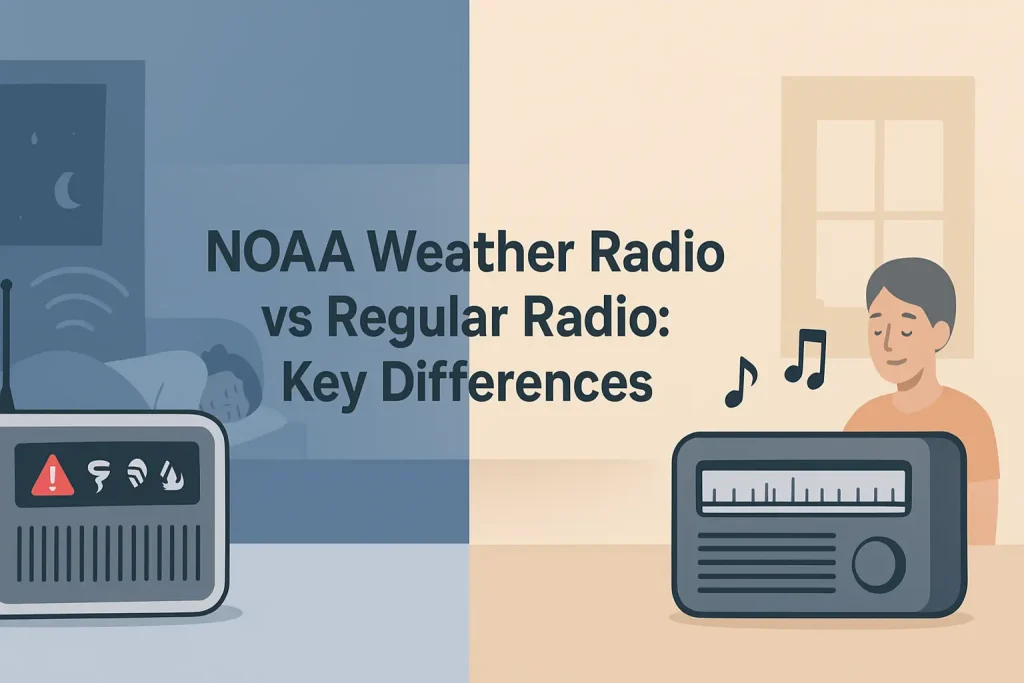
Most households in the United States own a smartphone and assume that is enough for emergency alerts. It is not. Cellular networks fail during the exact storms and disasters that trigger emergency warnings, leaving millions of people without reliable alert delivery at the moment they need it most. A dedicated weather radio receives NOAA broadcasts on seven frequencies between 162.400 and 162.550 MHz, operating completely independently of cell towers, internet service, and commercial power grids.
This post covers how NOAA Weather Radio All Hazards works, why smartphone alerts fall short, what S.A.M.E. technology does, and how to choose a weather radio that will actually wake you up when a tornado is approaching your county at 2 a.m.
| Photo | Popular Portable Walkie Talkies | Price |
|---|---|---|
 | SKIWARRIOR Multifunctional Smart Wireless Ski Goggles with Walkie-Talkie, Anti-Fog Zeiss Lens, Music & Call Function (Cylindrical Blue) | Check Price On Amazon |
 | SINORISE Super Mini Walkie Talkies, Two-Way Radios, 3 Pack | Check Price On Amazon |
 | KOSPET Tank M4C Smart Watch Rugged, Dual-Band GPS, 5ATM & IP69K Waterproof | Check Price On Amazon |
 | Retevis RT15 Walkie Talkies 3 Pack, Birthday Gift, Outdoor Adventure Kit | Check Price On Amazon |
 | Rechargeable Walkie Talkies Toys for Kids: DIY Astronaut Walkie Talkies for Boys Christmas Birthday Gifts for 3 4 5 6 7 8 9 10 Boy Walkie Talkie Outdoor Hiking Toy 2 Way Radio Camping Outdoor Game | Check Price On Amazon |
By the Numbers
NOAA Weather Radio All Hazards – Key Facts and Coverage Statistics
Sources: NOAA National Weather Service, FCC, FEMA IPAWS documentation.
What Is NOAA Weather Radio All Hazards and Why Does It Exist?
NOAA Weather Radio All Hazards (NWR) is a nationwide network of radio stations that broadcast continuous weather information and emergency alerts directly from the National Weather Service, 24 hours a day, on seven dedicated VHF frequencies between 162.400 and 162.550 MHz. It is the only communication system in the United States specifically built to deliver life-safety alerts to the public without relying on commercial infrastructure.
The NWR network exists because commercial radio stations, television broadcasters, and cellular carriers were never designed to prioritize emergency delivery. NOAA built a dedicated system specifically for that single purpose.
The seven NWR broadcast frequencies are 162.400, 162.425, 162.450, 162.475, 162.500, 162.525, and 162.550 MHz. These frequencies sit in the VHF high band (136-174 MHz), which propagates reliably over terrain and penetrates buildings better than UHF frequencies. Each transmitter covers a radius of roughly 40 miles at 300 to 1,000 watts output power, and the network of over 1,000 transmitters overlaps to eliminate coverage gaps across populated areas.
NWR is a core component of the Emergency Alert System (EAS) and the Integrated Public Alert and Warning System (IPAWS), which is the federal infrastructure overseen by FEMA for coordinating alerts across all public media. A dedicated weather radio connects you directly to this infrastructure without a smartphone, internet connection, or cellular subscription.
If you want a deeper look at how the broadcast network is structured, the full explanation of what NOAA weather radio is and how the network operates covers the transmitter layout and signal propagation in detail.
A dedicated weather radio gives you direct access to the federal emergency alert infrastructure that every other system depends on to issue its own secondary alerts.
Why Smartphones Are Not a Reliable Backup for Weather Alerts
Wireless Emergency Alerts (WEA) delivered to smartphones are transmitted over commercial cellular networks. Those networks become overloaded, partially fail, or lose commercial power during the same severe weather events that generate the alerts being sent. A tornado does not wait for your carrier’s tower to come back online.
WEA messages rely on cell towers maintaining power and data capacity under storm conditions. The FCC requires carriers to maintain backup power for towers, but that backup typically runs between 4 and 8 hours under normal load. Heavy call volume during emergencies drains backup power faster.
Smartphones also depend on you having the device charged, powered on, and in an area with signal. A NOAA weather radio requires none of those conditions to be met simultaneously. Entry-level models like the Midland WR120 weather alert radio run on AC power with battery backup and alert automatically even when the display is dark and the volume is low.
There is also an alert latency problem with WEA. The path from a National Weather Service meteorologist issuing a warning to a WEA delivery on your phone involves multiple system handoffs: NWS issues the alert, IPAWS processes it, carriers receive it, towers broadcast it, and your phone displays it. Each handoff adds delay. A dedicated weather radio with S.A.M.E. technology receives the alert tone directly from the NOAA transmitter within seconds of broadcast.
WEA is also geographically imprecise. A tornado warning covering one county may trigger WEA alerts on phones across three counties if the towers serving that area overlap county lines. A weather radio programmed with your specific S.A.M.E. county code only alerts you when the warning covers your county.
Finally, WEA does not work during a power outage if your phone battery is dead and you have no backup charging. A hand-crank weather radio like the Midland ER310 emergency crank weather radio generates its own power without any electrical infrastructure at all.
Smartphones are a supplement to dedicated weather radios, not a replacement for them.
What Is S.A.M.E. Technology and Why Does It Matter for Home Alerts?
S.A.M.E. stands for Specific Area Message Encoding. It is a digital header system that encodes every NOAA weather alert with a six-digit FIPS (Federal Information Processing Standard) code identifying the specific geographic area the alert applies to. A weather radio with S.A.M.E. decoding reads that code and activates the alarm only when the alert matches the location codes you have programmed into the radio.
Without S.A.M.E., a weather radio alarms for every alert broadcast by the nearest NOAA transmitter, which covers a 40-mile radius. That transmitter may serve 10 to 20 counties. You will wake up at 3 a.m. for a flash flood warning in a county 35 miles away with no relevance to your location. This is the single most common reason people turn weather radios off and miss the alerts they should be receiving.
The six-digit FIPS code for S.A.M.E. programming follows this format: PSSCCC, where P is a subdivision indicator (0 for whole county), SS is the two-digit state code, and CCC is the three-digit county code. For example, the S.A.M.E. code for Harris County, Texas (Houston area) is 048201. NOAA publishes the complete FIPS code list for every county in the United States at weather.gov.
Most entry-level S.A.M.E. weather radios allow you to program between 5 and 25 location codes. The Uniden BC365CRS weather alert radio stores up to 25 S.A.M.E. codes, which means you can program your home county, your workplace county, and your children’s school county all at once and receive alerts relevant to any of those locations.
S.A.M.E. also lets you filter by alert type. You can configure many radios to alarm only for specific event codes, such as Tornado Warnings, Flash Flood Warnings, or Civil Emergency Messages, while suppressing lower-priority advisories that do not require immediate action. For a detailed breakdown of how the encoding system works, the complete guide to S.A.M.E. weather radio technology and FIPS code programming walks through every event code type and how to configure them.
A weather radio without S.A.M.E. is functionally useful but practically annoying; a weather radio with S.A.M.E. properly programmed is the only alert system that will wake you up specifically because something dangerous is happening in your county.
Quick Reference
Weather Radio Terms Every Owner Should Know
Plain-language definitions for key terms used throughout this guide.
The Types of Alerts a Weather Radio Delivers That Smartphones Often Miss
NOAA Weather Radio broadcasts more than just tornado and hurricane warnings. The NWR alert system covers over 25 event types spanning weather hazards, non-weather emergencies, and national security events, many of which are poorly or inconsistently delivered through WEA.
Use the table below to compare which alert types are reliably delivered through NOAA Weather Radio versus those that depend on WEA or local broadcaster discretion.
| Alert Type | NOAA Weather Radio | Wireless Emergency Alert (WEA) | Notes |
|---|---|---|---|
| Tornado Warning | Yes | Yes | NWR delivers faster; WEA may be geographically imprecise |
| Flash Flood Warning | Yes | Yes | Both systems deliver; NWR provides full text readout |
| Severe Thunderstorm Warning | Yes | Inconsistent | WEA delivery for thunderstorm warnings varies by carrier |
| Winter Storm Warning | Yes | Rarely | WEA does not deliver most winter storm products |
| Hazardous Materials Warning | Yes | No | NWR only; WEA does not carry hazmat alerts |
| Civil Emergency Message | Yes | Sometimes | Depends on local emergency manager using IPAWS |
| Shelter in Place Warning | Yes | No | NWR broadcasts shelter-in-place orders from local authorities |
| AMBER Alert | Yes | Yes | Both systems broadcast AMBER Alerts |
| National Information Center (Presidential) | Yes | Yes | Highest-priority alert; both systems required to carry it |
The critical gap is in the middle tier of alerts: winter storms, hazardous materials incidents, and shelter-in-place orders. These are exactly the scenarios where a neighborhood may need to act without any WEA delivery occurring at all.
A weather radio is the only device that covers the full range of 25+ NOAA alert types without depending on a cellular carrier choosing to broadcast them.
How Does a Weather Radio Actually Work During a Severe Weather Event?
A weather radio in standby mode monitors a NOAA broadcast frequency (one of the seven between 162.400 and 162.550 MHz) and listens for a 1050 Hz alert activation tone. When that tone is detected, the radio wakes from its standby state, reads the S.A.M.E. digital header to determine whether the alert matches your programmed county codes, and if it matches, activates the alarm at full volume regardless of the volume setting you use for normal listening.
This happens automatically, even when the radio appears to be off. The squelch circuit keeps the speaker silent during normal operation when only the continuous broadcast voice is playing. The alert tone bypasses the squelch and overrides the speaker.
The mechanism works because NOAA embeds a specific 1050 Hz tone at the start of every alert broadcast. That tone is outside the normal voice frequency range of the broadcast, so it cannot accidentally trigger during a routine weather forecast. The S.A.M.E. digital header that immediately follows encodes the event type, affected counties, and alert duration in a standardized machine-readable format that S.A.M.E.-capable radios decode automatically.
This only works correctly when your radio is programmed with at least one valid S.A.M.E. FIPS code. A radio with no FIPS codes programmed defaults to alarming for all alerts broadcast by the transmitter, covering every county in the transmitter’s range. For a deeper understanding of the broadcast mechanism and signal path, the detailed explanation of how NOAA weather radio signals are transmitted and decoded covers the technical path from NWS meteorologist to your alarm.
If the radio is not alarming when it should be, the most common cause is either a wrong FIPS code, a battery failure in the backup system, or the radio tuned to a frequency with no strong local transmitter. The step-by-step troubleshooting process for weather radios that are not alerting correctly covers each failure mode with specific fixes.
Understanding the alert activation chain clarifies why a weather radio works when a smartphone does not: the alert comes directly from the NOAA transmitter through RF signal to your radio, with no intermediate network required.
What Types of Weather Radios Are Available and Which One Does a Home Need?
Weather radios fall into four categories: desktop plug-in models, portable battery-operated models, hand-crank and solar emergency radios, and combination scanner/weather radios. Each category serves different household scenarios, and the right choice depends on where you plan to use it and what power sources you expect to be available during an emergency.
Desktop Plug-In Weather Radios: The Right Choice for Most Homes
Desktop weather radios plug into AC power and typically include a 6-cell alkaline or rechargeable battery backup that activates automatically when power is lost. These are the most reliable option for home use because they maintain constant power connectivity and can sound an alert at full volume even during an outage.
The Midland WR400 desktop weather alert radio is one of the most fully featured options in this category.
Key Specifications (Midland WR400):
- Frequencies: 162.400 to 162.550 MHz (all 7 NOAA channels)
- S.A.M.E. programmable codes: 50
- Alert event types: 25
- Power: AC adapter with 6x AA battery backup
- Display: backlit LCD showing alert type, time, and channel
The Uniden BC365CRS weather radio is a comparable desktop option with a built-in clock radio function and 25 S.A.M.E. code storage slots.
Desktop models are the correct primary weather radio for most households because they stay plugged in, maintain battery backup passively, and do not require any user action to be ready when an alert arrives.
Portable Battery Weather Radios: Useful as a Supplement
Portable weather radios run on AA or AAA batteries and can be moved from room to room or taken on camping and hiking trips. They receive all seven NOAA frequencies and most include S.A.M.E. decoding, but they require you to remember to replace batteries regularly and they do not charge passively.
The Sangean CL-100 tabletop weather alert radio combines portable design with full S.A.M.E. capability and clear audio output in a compact form factor.
Portable models work well as a second radio for a bedroom, or as the primary radio in rental situations where a plug-in unit is not practical.
Hand-Crank and Solar Emergency Radios: The Off-Grid Option
Hand-crank and solar weather radios generate power without any external source. They are built for situations where both AC power and battery supplies have failed, which is exactly the scenario that follows a major hurricane, ice storm, or earthquake.
The Midland ER310 emergency weather radio includes hand-crank charging, a solar panel, a built-in LED flashlight, and a USB output for charging a smartphone. One minute of cranking produces approximately 10 to 15 minutes of radio operation.
Key Specifications (Midland ER310):
- Power sources: hand crank, solar panel, 2000 mAh internal battery, USB input
- Frequencies: all 7 NOAA WX channels
- S.A.M.E.: yes, programmable
- Flashlight: yes, with strobe and SOS modes
- USB output: 1A for device charging
The Kaito KA500 solar and hand-crank emergency radio is another well-regarded option in this category, covering AM, FM, and all NOAA weather frequencies with five power input options.
The ideal home emergency communication setup is a desktop plug-in model as the primary unit and a hand-crank model in your emergency kit as the backup.
Combination Scanner and Weather Radios: For the Monitoring Enthusiast
Some households prefer a combination scanner that covers NOAA weather frequencies as well as local police, fire, and emergency management channels. The Uniden BC125AT handheld scanner covers 29 to 512 MHz including all NOAA WX channels and can monitor local emergency services simultaneously.
A pure weather radio delivers a simpler, more reliable alert experience for most households. A scanner adds value if you want situational awareness of local emergency service activity during a major event.
Public Alert Certified Weather Radios: What the Certification Actually Means
Public Alert Certified is a certification standard developed by the Consumer Electronics Association (now the Consumer Technology Association) in partnership with NOAA. A radio bearing the Public Alert Certified label has been independently tested and confirmed to meet minimum performance requirements for receiving all seven NOAA frequencies, decoding S.A.M.E. headers correctly, and sounding the alert alarm reliably when triggered.
The certification requires a minimum alarm volume of 85 dB at one meter, which is loud enough to wake an adult from sleep in an adjacent room with the door closed. This is the single most important requirement for overnight home use, because a warning that cannot wake you has no value.
Not every weather radio sold in retail stores is Public Alert Certified. Inexpensive radios marketed as “weather radios” may receive NOAA frequencies for passive listening but fail to meet the S.A.M.E. decoding accuracy or alarm volume standards. Checking for the Public Alert logo before purchasing is the fastest way to confirm the radio will function correctly as an alert device, not just a broadcast receiver.
The complete breakdown of what the Public Alert Certified standard requires and which models carry the certification explains the testing criteria and lists certified models by category.
If you are buying a weather radio for home emergency use, Public Alert Certified is not a premium feature; it is the baseline minimum standard the radio must meet to be worth purchasing.
Always verify the Public Alert Certified logo before buying any weather radio intended for home safety use.
The following widget shows you how weather radio alert coverage and technology compare across key household scenarios, helping you identify the right setup for your home.
Seasonal Guide
Weather Radio Home Readiness – Month-by-Month Action Guide
What to check, test, or prepare each month so your weather radio is ready when it matters most. Source: NOAA NWR maintenance guidance and FEMA emergency preparedness recommendations.
Moderate activity / Routine check
Lower activity / Annual maintenance
Why a Dedicated Weather Radio Outperforms Every Alternative Alert System
The case for a dedicated weather radio comes down to one principle: single-purpose devices do their one job better than multi-purpose devices that do many jobs adequately. A weather radio exists solely to receive NOAA broadcasts and alarm you when the right alert arrives. It does not run out of storage, does not get distracted by app notifications, and does not depend on a data plan.
Television crawls and broadcast radio interruptions require the television or radio to be on and tuned to a local station. Most households do not have broadcast television or AM/FM radio running continuously at night. A weather radio monitors continuously in standby without any user attention.
Smart home devices like Amazon Echo and Google Nest can deliver emergency alerts in some configurations, but they depend on Wi-Fi connectivity, server availability, and power. A weather radio with battery backup continues to operate when the router is down, the power is out, and the cell tower is overloaded.
NOAA tests the NWR alert system with weekly required monthly tests (RMT) and weekly required weekly tests (RWT). Your weather radio will alarm on these test signals, which confirms the system is working before a real emergency occurs. No other consumer alert system runs routine public tests you can observe at home.
The Midland WR300 weather radio and the Uniden BC355N weather and alert receiver are both solid mid-range options with full S.A.M.E. capability, alarm override, and battery backup that address every weakness of alternative alert systems.
A dedicated weather radio is the only alert device in your home that is specifically designed and tested to wake you up for life-safety events regardless of infrastructure status.
How to Choose the Right Weather Radio for Your Home
Choosing a home weather radio requires answering four questions: Does it have S.A.M.E. decoding? Is it Public Alert Certified? What is the battery backup capacity? And does it have a loud enough alarm to wake sleeping occupants? Every other feature is secondary to these four.
S.A.M.E. Decoding: Non-Negotiable for Any Home
Any weather radio without S.A.M.E. decoding will alarm for every alert broadcast by the nearest NOAA transmitter, covering all counties within a 40-mile radius. In a multi-county metro area, that means alerts from 10 to 20 counties, most of which have no relevance to your location.
S.A.M.E. decoding lets you program your specific county FIPS code so the radio only alarms for alerts affecting your area. Every weather radio intended for home emergency use must have this feature. Radios without S.A.M.E. are broadcast receivers, not alert systems.
Alarm Volume: The Feature That Determines Whether the Radio Is Useful at Night
Public Alert Certified radios must produce at least 85 dB of alarm output at one meter. Most adults sleeping in a closed bedroom require approximately 75 to 80 dB at the bedside to be awakened reliably. A radio placed in a hallway or living room must exceed 85 dB to reach a sleeping person in an adjacent room.
Check the product specification sheet for the alarm output level in dB. If the specification is not listed, the radio has likely not been tested to the Public Alert standard. The Midland WR50B weather alert radio is a compact budget-friendly option that carries the Public Alert Certified designation and provides adequate alarm volume for single-room placement.
Battery Backup: What You Actually Need
Desktop weather radios include battery backup in one of two configurations: a compartment for 3 to 6 AA alkaline batteries, or a built-in rechargeable NiMH or lithium battery pack. AA alkaline backup is preferable for most households because alkaline batteries remain viable on the shelf for 7 to 10 years and do not degrade from charging cycles.
A 6x AA alkaline backup provides approximately 12 to 24 hours of continuous operation in alarm-monitoring mode. That is sufficient for most storm-related outages. For extended outages lasting multiple days, a hand-crank backup radio is a necessary addition to the household kit.
Number of S.A.M.E. Code Slots: Plan for Multiple Locations
Most entry-level S.A.M.E. radios store between 5 and 10 FIPS codes. Mid-range and premium models store between 25 and 50 codes. If your household includes people who work in a different county from where they live, or if children attend school in an adjacent county, a radio that stores only 5 codes may not cover all relevant locations simultaneously.
The Midland WR400 with 50 S.A.M.E. code slots and the Uniden BC365CRS with 25 slots both provide enough capacity for a family monitoring multiple counties.
For most single-county households, a 5 to 10 code radio is sufficient. Choose based on how many distinct geographic locations your household needs to monitor simultaneously.
Where to Place a Weather Radio in Your Home for Maximum Effectiveness
The single most important placement rule for a home weather radio is this: put it where sleeping occupants can hear the alarm. A weather radio in the kitchen provides no protection to a family asleep in bedrooms at the opposite end of the house if the alarm cannot reach them at 85 dB or above.
The optimal placement for a desktop unit is a central hallway or landing on the same floor as the bedrooms, plugged into a wall outlet with a clear path for sound to reach all bedroom doors. At distances greater than 20 feet from the radio through a closed door, alarm volume drops by 15 to 20 dB. A radio rated at 90 dB output may deliver only 70 to 75 dB at a closed bedroom door 20 feet away, which may not wake all adults reliably.
If your home has multiple floors, each floor occupied at night should have its own weather radio. A single radio on the ground floor will not reliably alarm occupants on the second or third floor with doors closed.
Battery-powered portable radios provide a practical solution for bedside placement in rooms far from the primary desktop unit. The Midland WR10 portable weather alert radio is a compact bedside option at under $30 that receives all NOAA frequencies with S.A.M.E. decoding.
Place your primary weather radio where its alarm can reach sleeping occupants, and add a secondary radio in bedrooms that are more than 20 feet away from the primary unit.
Common Weather Radio Problems and How to Fix Them
The most frequently reported weather radio problem is a radio that keeps beeping or alarming without an obvious emergency. This is almost always caused by the radio receiving a test signal (Required Weekly Test or Required Monthly Test) that the owner did not expect, a low-battery warning tone, or the radio alarming for alerts in adjacent counties because S.A.M.E. codes have not been programmed correctly.
If your weather radio keeps beeping at unexpected intervals, the specific causes and fixes for a weather radio that beeps without an apparent emergency walks through each scenario with the exact steps to resolve it.
The second most common problem is a radio that receives no signal or cannot find an active NOAA channel. NOAA transmitters occasionally go offline for maintenance or due to storm damage. The current NOAA transmitter outage status and coverage map lets you check whether a transmitter near you is experiencing a known outage before assuming your radio has a hardware fault.
For all other radio malfunctions including no alarm on test signals, S.A.M.E. programming errors, and battery backup failures, the complete weather radio troubleshooting guide covering the most common failure modes provides step-by-step diagnostics for each issue.
Most weather radio problems are either programming errors or power supply issues, both of which are correctable in under five minutes without replacing the radio.
The NOAA Weather Radio Frequency Network: Which Channel Should Your Radio Use?
NOAA broadcasts on seven frequencies: WX1 (162.550 MHz), WX2 (162.400 MHz), WX3 (162.475 MHz), WX4 (162.425 MHz), WX5 (162.450 MHz), WX6 (162.500 MHz), and WX7 (162.525 MHz). Each transmitter in the NWR network uses one of these seven frequencies, and different transmitters covering overlapping areas use different frequencies to prevent interference.
Your weather radio should be set to scan all seven channels automatically, or manually set to the strongest channel for your location. The strongest channel is the one served by the nearest NOAA transmitter. Signal strength matters because a weak signal increases the risk of S.A.M.E. header decoding errors, which can cause missed alerts or false alarms.
You can find the correct primary frequency for your location using the NOAA station finder tool at weather.gov, which lists the transmitter serving your county along with its output frequency, wattage (typically 300 to 1,000 watts), and coverage radius. The full breakdown of all seven NOAA weather radio broadcast frequencies and which transmitter serves each region provides a state-by-state frequency reference.
Most modern weather radios scan all seven channels automatically and lock onto the strongest signal. If your radio has a manual channel selector, set it to the frequency of the nearest NOAA transmitter for your county and confirm the signal strength indicator shows a strong reading.
Programming your radio to the correct NOAA frequency for your county is as important as programming the correct S.A.M.E. code; a radio on the wrong frequency may receive alerts for entirely different counties.
Is a Weather Radio Worth It If I Already Have a Smart Speaker or Smart TV?
Smart speakers (Amazon Echo, Google Nest) and smart televisions with emergency broadcast capability are supplemental alert devices, not replacements for a dedicated weather radio. They depend on internet connectivity, Wi-Fi availability, and active power to the home network. All three of those dependencies fail during the same severe weather events that generate emergency alerts.
A dedicated weather radio operating on battery backup continues to function when the router loses power, when the internet service provider’s infrastructure is damaged, and when the cell towers serving your neighborhood are overloaded or offline. Smart speakers do none of these things.
Smart TVs with emergency alert capability require the television to be on or in a low-power standby mode that continuously monitors for alerts. Most smart TVs in standby consume under 1 watt and cannot monitor for EAS signals the way a dedicated weather radio does. The television’s alert function is a convenience feature, not a life-safety system.
The annual cost of owning a weather radio is approximately zero after purchase. Batteries for the backup supply cost under $10 per year if replaced annually. A Public Alert Certified desktop unit costs $30 to $80 at purchase and lasts 10 to 15 years with no subscription, no data plan, and no maintenance beyond battery replacement.
The question is not whether a weather radio is worth it. The question is why any household that owns a smart speaker has not already added a $40 weather radio to the outlet next to it.
Do Children’s Bedrooms Need Their Own Weather Radio?
Children sleep more deeply than adults and are significantly harder to rouse from sleep by sound. Research published in the journal Sleep consistently shows that children between ages 6 and 12 have higher arousal thresholds than adults, meaning they require louder and longer alarm signals to wake from deep sleep stages.
A weather radio in a hallway 15 to 25 feet from a child’s closed bedroom door may not generate sufficient alarm volume at the sleeping child’s location to produce reliable awakening, particularly during deep sleep phases in the first few hours of the night when the most severe thunderstorms often occur.
The practical answer is yes: a separate weather radio in or immediately adjacent to a child’s bedroom provides substantially more reliable alert delivery than relying on a hallway or common-area unit. A battery-powered bedside unit like the Midland WR10 compact weather alert radio costs under $30 and requires only correct S.A.M.E. programming to be fully functional as a bedroom alert device.
If a child’s bedroom is on a separate floor from the primary weather radio, a dedicated bedroom unit is not optional; it is a basic safety measure consistent with the NOAA recommendation that all sleeping areas have reliable alert coverage.
What Is the Difference Between a Weather Warning, a Weather Watch, and a Weather Advisory?
NOAA Weather Radio broadcasts three levels of alert severity: warnings, watches, and advisories. Each triggers a different response from a S.A.M.E.-equipped radio and requires a different response from you.
A Warning means a hazardous weather event is occurring, is imminent, or is likely. It is the highest urgency level and requires immediate protective action. Examples include Tornado Warning, Flash Flood Warning, and Hurricane Warning. S.A.M.E. radios alarm at full volume for warnings.
A Watch means conditions are favorable for a hazardous weather event to develop. It is a preparatory alert. Examples include Tornado Watch and Severe Thunderstorm Watch. You should monitor the situation and prepare to act. S.A.M.E. radios can be configured to alarm for watches or to alert silently depending on the model.
An Advisory means weather conditions are expected that are inconvenient and potentially hazardous. Examples include Winter Weather Advisory, Frost Advisory, and Dense Fog Advisory. These require caution but not immediate protective action. Many households configure their S.A.M.E. radios to suppress advisories and only alarm for warnings and watches.
Configuring your weather radio to alarm for warnings only reduces unnecessary nighttime activations while ensuring you receive alerts for the events that require immediate action.
Can a Weather Radio Also Work as a Two-Way Communication Device During an Emergency?
No. A weather radio is a receive-only device. It picks up NOAA broadcasts on the seven VHF frequencies between 162.400 and 162.550 MHz but cannot transmit on any frequency. It has no microphone, no push-to-talk capability, and no transmitter circuitry. Using it for two-way communication is physically impossible.
For two-way communication during an emergency, a separate device is required. FRS radios (unlicensed, up to 2 watts, 22 channels in the 462-467 MHz range) serve short-range neighborhood communication. GMRS radios (FCC license required at $35 for 10 years, up to 50 watts for mobile units) serve extended range communication and repeater-linked systems. A handheld amateur radio with a Technician class license provides the broadest communication options including access to nationwide repeater networks.
The weather radio and the two-way radio solve different problems. The weather radio monitors NOAA for incoming alerts. The two-way radio lets you communicate with other people in your household or community during an event. A complete home emergency communication kit includes both.
A weather radio is a one-way receiver built for one job; add a separate two-way radio if you need to communicate outward during an emergency.
How Often Does NOAA Test the Weather Radio Alert System and Will It Wake You Up?
NOAA conducts two types of routine tests on the NWR system. The Required Weekly Test (RWT) is a brief 2-minute test broadcast every Wednesday between 11 a.m. and noon local time. The Required Monthly Test (RMT) is a longer test including a full EAS attention signal and test message, conducted on the first Wednesday of each month.
Both test broadcasts include S.A.M.E. headers with a specific test event code. Most modern weather radios are configured by default to suppress alarm activation during routine weekly tests while still activating during monthly tests, which allows homeowners to verify the system is working without a weekly alarm interruption.
You can configure many S.A.M.E. weather radios to alarm or not alarm for each test type independently. If your radio is alarming every Wednesday at noon, check whether your unit has the RWT alarm filter enabled. If your radio never alarms during the monthly test, the alarm configuration may be filtering it out incorrectly, or the radio may not be receiving a strong enough signal to decode the S.A.M.E. header. This distinction matters: the monthly test is your confirmation that the radio will function correctly during a real event.
Using the monthly test to verify your radio’s alert function is a simple 60-second monthly task that confirms your home alert system is operational before the next real emergency arrives.
What Happens to a Weather Radio Signal During a Power Outage?
The NOAA transmitter network is maintained with backup power at each transmitter site. NOAA transmitters are classified as critical federal infrastructure and are equipped with diesel generators and battery backup systems that activate within seconds of commercial power loss. A power outage in your neighborhood does not affect NOAA’s ability to continue broadcasting on 162.400 to 162.550 MHz.
Your weather radio’s reception depends on its own power source, not the NOAA transmitter’s. A desktop weather radio on battery backup continues to receive NOAA broadcasts normally during a local power outage. A radio without functioning battery backup goes offline when power is lost, which is exactly when you need it most.
Test your weather radio’s battery backup quarterly by unplugging it from the wall and confirming it remains powered and monitoring the NOAA frequency. Replace backup batteries annually regardless of apparent capacity, because alkaline batteries that appear viable on a battery tester may fail under the higher current draw of the alarm sounder during an actual alert.
NOAA transmitter coverage during regional outages can be checked using the outage status tool. If a nearby transmitter is offline, your radio may need to be retuned to an adjacent transmitter’s frequency to maintain reception. The real-time NOAA transmitter outage tracker and coverage map shows which transmitters are currently offline and which adjacent frequencies to use as alternatives.
Your weather radio’s battery backup is the single component that determines whether it remains functional during the power outages that most commonly accompany severe weather events.
Are There Weather Radios That Work for Hearing-Impaired Households?
Yes. Several weather radio models include outputs specifically designed for hearing-impaired users. The most common features are a strobe light output (for connection to a compatible visual alert system), a bed shaker output (for connection to a pillow or mattress vibrating alarm), and an audible tone that can be switched to a lower frequency for individuals with high-frequency hearing loss.
The Midland WR400 weather radio with strobe output includes a 3.5mm jack for connecting an external strobe light or bed shaker unit. The strobe and vibrating alarm activate simultaneously with the audible alarm when a matching alert arrives, providing a multi-sensory alert for household members who cannot rely on sound alone.
Key Specifications (Hearing-Impaired Setup with Midland WR400):
- Strobe output: 3.5mm jack, activates on any alarm condition
- Compatible bed shakers: Sonic Boom and similar units with 3.5mm input
- Alarm volume: adjustable from 60 dB to 95 dB
- Visual display: backlit LCD shows alert type and duration
Households with hearing-impaired members should treat the visual and vibrating alert accessories as required components of the weather radio system, not optional additions.
Why Does a Weather Radio Sometimes Alert for Events That Did Not Affect Your Area?
A weather radio alerting for events in the wrong area is almost always a S.A.M.E. programming error. The two most common causes are: the FIPS code was entered incorrectly (transposing two digits is the most frequent mistake), or the radio has no FIPS codes programmed at all and is defaulting to alarming for all counties served by the transmitter.
A second possible cause is receiving a strong signal from a NOAA transmitter in an adjacent region that covers a different set of counties from your local transmitter. This can happen in areas near state borders where two transmitters on the same frequency produce overlapping coverage. The fix is to manually set the radio to the specific frequency of the transmitter serving your county rather than using the auto-scan function.
The third cause is the radio receiving alerts intended for a different geographic subdivision of your county. Some NOAA alerts are issued for specific zones within a county (coastal vs. inland, urban vs. rural) using zone FIPS codes that differ from the county-wide FIPS code. If you are receiving alerts for your county’s coastal zone and you live inland, you may need to use the zone-specific FIPS code for the inland zone rather than the county-wide code.
Correct S.A.M.E. FIPS programming eliminates the vast majority of false or irrelevant alerts without reducing the reliability of genuine emergency alerts for your location.
What Should I Look for in a Weather Radio Bought for a Camper, RV, or Boat?
A weather radio for mobile use in a camper, RV, or boat requires different specifications from a home desktop unit. The three most important features for mobile use are: portability and battery operation, reception sensitivity for locations farther from NOAA transmitters, and durability for outdoor environments.
Reception sensitivity matters more for mobile use because campsites and marinas are often located farther from NOAA transmitters than residential areas. A radio with a higher-gain external antenna jack or a telescoping antenna performs better in marginal-signal locations. Check for models that include an external antenna connection (typically a 3.5mm or BNC antenna jack) to allow connection to a vehicle-mounted antenna for improved reception.
For marine use, NOAA weather broadcasts on VHF are the primary source of weather information, and most marine VHF radios (Standard Horizon, Icom, Uniden) include dedicated WX channel scanning as a standard feature. The Standard Horizon HX890 marine VHF radio includes all seven NOAA WX channels with alert scanning integrated into a marine-rated handheld transceiver.
For camping and RV use, a combination emergency radio like the Kaito KA500 five-way powered emergency radio covers NOAA weather frequencies alongside AM and FM with solar and hand-crank backup power, making it self-sufficient for multi-day outings without AC access.
A mobile weather radio must be able to operate indefinitely without AC power and receive a usable signal from transmitters that may be 50 to 60 miles away from your campsite or marina slip.
Does Every Region of the United States Have Equal Weather Radio Coverage?
No. NOAA Weather Radio coverage is strongest in densely populated areas of the continental United States and weakest in remote rural areas, mountainous terrain, and most of Alaska and Hawaii. NOAA reports that approximately 95% of the US population lives within 40 miles of at least one NWR transmitter, but this statistic covers population density rather than geographic area.
Large portions of rural Montana, Wyoming, Alaska, and the desert Southwest have significant coverage gaps where NOAA transmitters are absent or produce signal too weak for reliable S.A.M.E. decoding. Mountainous terrain blocks VHF signals in the 162 MHz range because VHF propagation is largely line-of-sight. A transmitter on the east side of a mountain range may not reach communities on the west side.
Households in marginal-coverage areas can improve reception by using a weather radio with an external antenna jack and connecting a directional antenna pointed toward the nearest NOAA transmitter. Yagi-style directional antennas pointed at the transmitter can recover usable signals at distances of 60 to 80 miles with clear line of sight, compared to the 40-mile radius for omnidirectional whip antennas.
For locations with confirmed no NOAA coverage, FEMA and IPAWS-integrated commercial alert services (county emergency notification systems, state emergency alert networks) serve as the primary alert delivery mechanism, often supplemented by sirens for immediate outdoor warning.
Check your specific coverage using the NOAA station finder tool at weather.gov before assuming your location has reliable NWR reception.
Does a Weather Radio Pick Up Other Emergency Alerts Beyond Weather?
Yes. NOAA Weather Radio All Hazards broadcasts non-weather emergency alerts including AMBER Alerts (child abduction emergencies), Civil Emergency Messages (law enforcement shelter-in-place orders, hazardous materials incidents), Evacuation Immediate alerts, and National Information Center messages (presidential-level national security alerts). The word “All Hazards” in the network’s name explicitly signals this broader scope.
Local emergency managers can issue Civil Emergency Messages and Evacuation Immediate alerts through the NWR system using the same S.A.M.E. encoding that weather alerts use. This means your weather radio programmed for your county will alert you to hazmat incidents, industrial accidents, dam failures, and terrorism-related shelter-in-place orders affecting your specific county, not just meteorological events.
The practical implication is that a weather radio’s value extends beyond storm season. It is an all-hazards alert device that remains relevant throughout the year regardless of weather conditions.
Programming your weather radio to receive Civil Emergency Messages and AMBER Alerts, in addition to weather events, requires no additional hardware and simply involves confirming that those event types are enabled in your S.A.M.E. event filter settings.
What Are the NOAA Weather Radio Alert Frequencies for Each US State?
NOAA assigns each transmitter one of the seven standard frequencies (162.400 to 162.550 MHz), and neighboring transmitters use different frequencies to prevent co-channel interference. The primary frequency for your county depends on which specific transmitter NOAA has designated as the serving station.
The most reliable way to find your primary NWR frequency is the NOAA station locator at weather.gov/nwr, which returns the transmitter frequency, call sign, power output, and S.A.M.E. county codes for any zip code in the United States. The most common primary frequencies in densely populated areas are 162.550 MHz (WX1) and 162.400 MHz (WX2), which are assigned to the highest-power transmitters covering major metropolitan areas.
Most weather radios with auto-scan capability will identify and lock onto the strongest NWR signal automatically. Manual frequency selection is only necessary in areas with overlapping signals from transmitters on the same frequency, which can cause reception confusion in border areas between adjacent transmitter coverage zones.
For a state-by-state reference of primary NOAA transmitter frequencies, the complete NOAA weather radio frequency list organized by state and county provides the primary and secondary frequencies for each region.
Can I Use a Weather Radio Outdoors or Is It Only for Indoor Use?
Standard desktop weather radios are designed for indoor use and are not rated for outdoor exposure. However, portable and hand-crank weather radios designed for camping and emergency preparedness kits are built to tolerate outdoor use conditions including humidity, rain splash, and temperature extremes.
IP (Ingress Protection) ratings indicate a device’s resistance to water and dust. A weather radio with an IP54 rating (splash-resistant from any direction) is adequate for use under a shelter during rain. A radio rated IP67 (submersible to 1 meter for 30 minutes) can withstand direct rain and brief immersion. Most budget portable weather radios carry no IP rating and should be treated as splash-sensitive.
The Midland WR10 portable weather alert radio is a compact, lightweight option rated for portable use. For fully weatherproofed outdoor operation, the Eton Scorpion II hand-crank weather radio includes a rubberized housing designed to withstand outdoor use conditions.
For outdoor use, verify the IP rating or MIL-STD-810 rating of any weather radio before exposing it to rain or humid field conditions, as an unrated radio can fail in exactly the weather events it is meant to help you respond to.
How Long Do Weather Radio Batteries Last and When Should You Replace Them?
Battery life in weather radio backup systems depends on battery type, battery capacity, and the power draw of the alarm sounder. A desktop weather radio in standby monitoring mode (no alarm sounding) draws approximately 50 to 150 milliamps from the backup batteries. At that rate, a 6x AA alkaline pack (approximately 1,800 mAh total usable capacity) provides 12 to 24 hours of monitoring before the batteries are depleted.
When the alarm sounder activates, current draw increases significantly, sometimes to 300 to 500 milliamps for the sounder plus display backlight. Active alarm operation reduces remaining battery life proportionally.
Alkaline AA batteries should be replaced annually in home weather radios regardless of measured remaining capacity. Alkaline cells can show adequate voltage on a multimeter but fail under the high current demand of the alarm circuit because internal resistance increases with age even when resting voltage remains normal. A battery that reads 1.4 volts at rest may collapse to under 1.0 volts under load, causing the radio to lose power during an alert.
Rechargeable NiMH batteries used in built-in backup packs should be replaced every 3 to 5 years, as NiMH cells lose capacity with charge cycles and age. A 2-year-old rechargeable pack may retain only 60 to 70% of its original capacity even with regular charging.
Replace alkaline backup batteries every 12 months and rechargeable backup packs every 36 months to maintain reliable emergency operation.
What Is the Best Weather Radio for Under $50?
The best weather radio under $50 for home use is the Midland WR120 NOAA weather alert radio, which is Public Alert Certified, supports S.A.M.E. programming for up to 25 county codes, covers all seven NOAA frequencies, and includes battery backup for AC power outages. It alarms at 90 dB and includes a visual alert indicator for low-light conditions.
Key Specifications (Midland WR120):
- Street price: approximately $35 to $45
- S.A.M.E. code slots: 25
- NOAA channels: 7 (162.400 to 162.550 MHz)
- Alarm output: 90 dB
- Battery backup: 3x AA alkaline (not included)
- Public Alert Certified: Yes
The Uniden BC365CRS is a comparable alternative in this price range that adds an AM/FM clock radio function, making it a practical dual-purpose bedside device.
Both models meet the minimum requirements for home emergency use and represent better value per dollar for primary home alert duty than any unit under $25, most of which lack Public Alert Certification or S.A.M.E. decoding accuracy at the required standard.
A dedicated weather radio with S.A.M.E. technology, Public Alert Certification, and a proven alarm at 85 dB or above is the foundation of home emergency communication; add one to your home today and program your county FIPS code before the next severe weather season begins in your region.
| Photo | TOP RATED WALKIE TALKIES | Price |
|---|---|---|
 | Retevis RT628 Kids Walkie Talkies, Toys Gifts for 4-12 Year Old Girl Boy | Check Price On Amazon |
 | Cobra ACXT545 Weather-Resistant Walkie Talkies, Rechargeable, 22 Channels | Check Price On Amazon |
 | Retevis RT388 Kids Walkie Talkies, Outdoor Toys for Kids Camping Essentials | Check Price On Amazon |
 | Cobra RX680 Walkie Talkies (2-Pack), IP54 Water Resistant Design | Check Price On Amazon |
 | Retevis RT22 Walkie Talkies Long Range Rechargeable with Earpiece (2 Pack) | Check Price On Amazon |
 | Midland GXT1000VP4 GMRS JIS4 Two-Way Radio, Black,2 Pack | Check Price On Amazon |
 | Retevis RT628 Walkie Talkies for Kids,Toys Gifts for 6-12 Years Old Boys Girls,Long Range 2 Way Radio 22CH VOX,Birthday Gift,Family Walkie Talkie for Camping Hiking Indoor Outdoor | Check Price On Amazon |