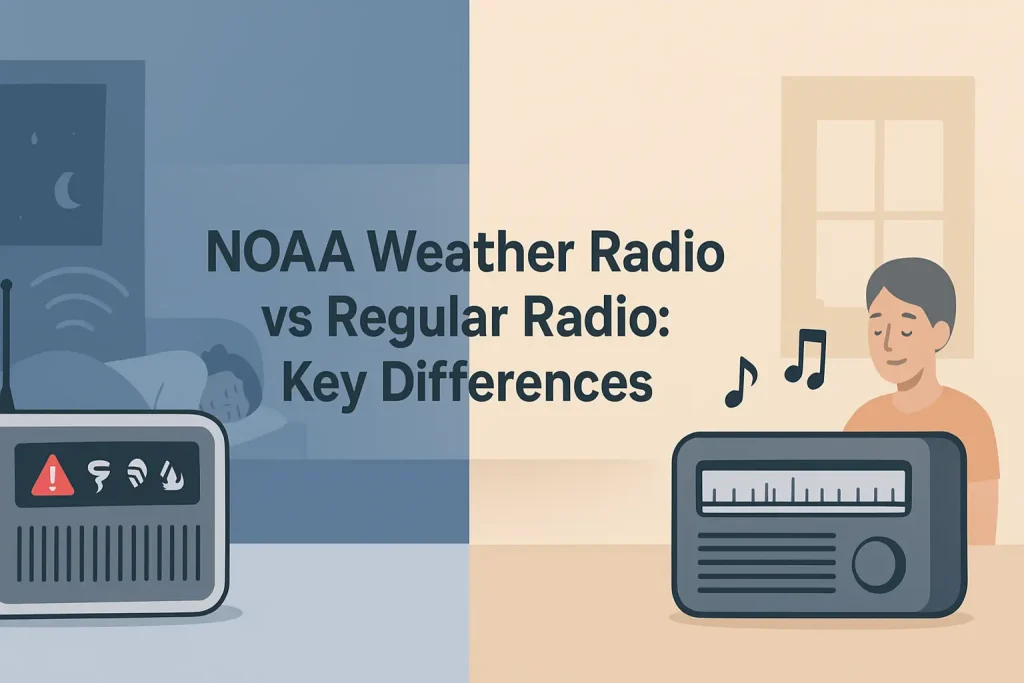
A NOAA weather radio without S.A.M.E. technology will wake you up at 3 AM for a flash flood warning three counties away from your home. Plug-in desktop weather radios solve this problem by filtering alerts to your specific county using 6-digit FIPS codes, so you only hear warnings that affect your actual location.
A desktop weather radio is a type of emergency alert receiver that stays permanently powered through an AC wall outlet, with battery backup for when the power goes out. This guide covers the top plug-in NOAA weather radio models for home use, comparing S.A.M.E. alert filtering, alert type support, battery backup capacity, and price across the most reliable desktop units available.
| Photo | Popular Portable Walkie Talkies | Price |
|---|---|---|
 | SKIWARRIOR Multifunctional Smart Wireless Ski Goggles with Walkie-Talkie, Anti-Fog Zeiss Lens, Music & Call Function (Cylindrical Blue) | Check Price On Amazon |
 | SINORISE Super Mini Walkie Talkies, Two-Way Radios, 3 Pack | Check Price On Amazon |
 | KOSPET Tank M4C Smart Watch Rugged, Dual-Band GPS, 5ATM & IP69K Waterproof | Check Price On Amazon |
 | Retevis RT15 Walkie Talkies 3 Pack, Birthday Gift, Outdoor Adventure Kit | Check Price On Amazon |
 | Rechargeable Walkie Talkies Toys for Kids: DIY Astronaut Walkie Talkies for Boys Christmas Birthday Gifts for 3 4 5 6 7 8 9 10 Boy Walkie Talkie Outdoor Hiking Toy 2 Way Radio Camping Outdoor Game | Check Price On Amazon |
By the Numbers
7 NOAA weather radio broadcast frequencies between 162.400 and 162.550 MHz cover the United States and its territories.
95% of the US population lives within 40 miles of a NOAA Weather Radio All Hazards transmitter, per NOAA coverage data.
25 different alert types can be filtered through S.A.M.E. technology on mid-range and premium desktop weather radios, including tornado warnings, flash flood watches, and AMBER alerts.
50 programmable S.A.M.E. location codes are supported by leading models like the Midland WR400, enough to cover every county in most multi-state regions.
$25-90 is the typical price range for a reliable plug-in desktop weather radio with S.A.M.E. alert filtering and battery backup for home use.
What Makes a Plug-In Weather Radio Essential for Home Emergency Alerts?
A plug-in NOAA weather radio receives continuous broadcasts from the National Weather Service on seven dedicated frequencies between 162.400 and 162.550 MHz, providing alerts that cellular networks cannot guarantee during severe weather when cell towers lose power or become overloaded.
This happens because NOAA Weather Radio All Hazards operates on a dedicated federal broadcast network with over 1,000 transmitters across the United States, completely independent of commercial cellular infrastructure.
According to NOAA NWR documentation, the broadcast network covers approximately 95% of the US population within 40 miles of a transmitter.
A plug-in desktop weather radio works with S.A.M.E. (Specific Area Message Encoding) technology to filter alerts down to your specific county using a 6-digit FIPS code, instead of alerting you for every warning in the broader broadcast range.
This only occurs when the radio has been programmed with the correct FIPS code for your county and the S.A.M.E. filtering feature is actively enabled in the menu.
If you leave the radio in “all alerts” mode without programming a S.A.M.E. code, the result is alert fatigue, where you hear warnings for counties far from your home and eventually start ignoring the alarm, which is the most dangerous outcome for emergency preparedness.
A desktop weather radio differs from a portable crank or solar model in one critical way: it stays plugged into wall power continuously, so the speaker is always loud and the receiver is always scanning, with backup batteries only for power outage scenarios.
For portable and off-grid alternatives, our guide to the best hand-crank and solar emergency weather radios covers models designed for evacuation kits and outdoor use.
A plug-in desktop weather radio is the single most reliable way to receive tornado warnings at night, when sirens may not be audible inside a closed home and cell phone alerts depend on a working cellular network.
Complete Buying Guide: How to Choose a Plug-In Weather Radio for Home Use
The decision comes down to three features that determine whether your weather radio actually helps you during an emergency or just makes noise: S.A.M.E. filtering, alert type customization, and battery backup capacity.
According to FEMA and NOAA emergency communication guidelines, a home weather radio should support S.A.M.E. technology, have battery backup for power outages, and allow you to disable specific alert types that do not apply to your region.
A plug-in weather radio for home use consists of an AC power adapter for continuous operation, a battery backup compartment (typically 4 to 6 AA batteries), an internal telescoping antenna for VHF reception, a S.A.M.E. decoder chip for county-level alert filtering, and an alert speaker rated between 80 and 90 dB.
You need to match the radio’s alert capabilities to the weather hazards common in your geographic region.
A homeowner in tornado alley needs a radio that prioritizes tornado warnings and severe thunderstorm warnings, while a coastal resident needs hurricane warning and flash flood warning support with the ability to disable tornado alerts that do not apply.
Determine Your S.A.M.E. Filtering Needs
S.A.M.E. technology uses a 6-digit FIPS code to filter NOAA weather radio alerts to your specific county, preventing false alarms from neighboring counties that share the same broadcast frequency.
This happens because the NOAA Weather Radio All Hazards network broadcasts alerts across a wide area covering multiple counties, and without S.A.M.E. filtering, your radio will activate for every alert in that broadcast range.
This only occurs when you program the correct 6-digit FIPS code for your county into the radio’s memory, which you can find through the NOAA NWR county coverage database online.
If you enter the wrong FIPS code or leave the field blank, the result is either no alerts at all or alerts for the wrong county, which defeats the entire purpose of having a weather radio.
Entry-level models like the Midland WR120B support a limited number of S.A.M.E. codes, while premium models like the Midland WR400 support up to 25 location codes for monitoring multiple counties.
For a full breakdown of this entry-level model’s features, read our Midland WR120B detailed review covering its alert performance, S.A.M.E. programming, and limitations.
Choose a model that supports at least 5 to 10 S.A.M.E. codes if you live near a county border or want to monitor weather alerts for a parent or child in a neighboring county.
Evaluate Alert Type Customization
Alert type control lets you enable or disable specific warning categories on your weather radio, so you are not woken up for an AMBER alert or a hazardous materials warning if you only want tornado and flood alerts.
According to NOAA NWR documentation, the Emergency Alert System uses 25 different event codes that a S.A.M.E.-equipped weather radio can decode, ranging from tornado warnings to child abduction emergencies.
Budget models may only allow a blanket “all alerts on or off” setting, while mid-tier and premium models let you toggle each alert type individually with separate settings for watch versus warning categories.
This only occurs when the radio firmware supports per-alert-type configuration through its menu system.
If your radio does not support individual alert type filtering, the result is either unnecessary alerts that train you to ignore the alarm, or no alerts at all because you disabled the entire warning system to stop the noise, which is worse than having no radio.
Fix this by choosing a model with per-alert-type control like the Midland WR400 or the Sangean CL-100, both of which let you select which of the 25 EAS event codes will trigger an audible alarm.
Check Battery Backup Capacity
Battery backup is the feature that keeps your weather radio functioning when the power grid fails, which is exactly when severe weather is most likely to occur.
According to a NOAA technical report on emergency receiver reliability, power outages frequently accompany the severe weather events that trigger weather radio alerts, making battery backup essential for continuous alert reception.
A weather radio battery backup system consists of a compartment for 4 to 6 AA batteries, a power switching circuit that detects AC power loss, and a low-voltage cutoff that preserves receiver function for 12 to 24 hours on fresh alkaline batteries.
Most plug-in models use standard alkaline AA batteries rather than rechargeable lithium-ion packs, which is actually an advantage because alkaline batteries hold their charge for years in storage and do not degrade like lithium-ion cells.
This only occurs when you install fresh batteries and replace them at least once per year, regardless of whether they have been used.
If you leave dead or expired batteries in the compartment, the result is no backup power when the grid fails, which is the worst-case failure mode for a device whose primary purpose is emergency alerting.
Check your battery backup every 6 months by unplugging the AC adapter and confirming the radio stays powered and continues receiving alerts.
Assess External Alert Compatibility
External alert jacks let you connect accessories like strobe lights for hearing-impaired users or bed shakers for nighttime waking, which can be critical for deep sleepers who do not respond to audible tones.
Mid-range and premium plug-in weather radios typically include a 3.5mm external alert jack that outputs a signal when an alert is received, triggering connected visual or tactile alerting devices.
This only occurs when the radio includes a dedicated alert output jack rated for the voltage and current of your external device.
If you need external alert accessories, choose a model like the Midland WR400 or Sangean CL-100, both of which include external alert jacks for strobe light and bed shaker compatibility.
A weather radio with external alert compatibility works with assistive devices to achieve reliable warning notification for individuals with hearing impairments or deep sleepers.
Compare Price Points Across Tiers
Plug-in desktop weather radios fall into three price tiers based on S.A.M.E. code capacity, alert type customization, and external alert features.
Budget models ($25-40) like the Midland WR120B offer basic S.A.M.E. filtering with limited location code storage and minimal alert type control.
Mid-range models ($40-70) like the Midland WR300 and WR400 expand S.A.M.E. storage to 25 codes, add per-alert-type filtering, and include external alert jacks.
Premium models ($70-90+) like the Sangean CL-100 add features like AM/FM reception, larger displays, and more advanced alert logging.
According to manufacturer data sheets and verified retail pricing, the $40-70 range offers the best balance of alert filtering control and reliability for most homeowners.
If you buy a budget model without per-alert-type control, the result is unnecessary alerts that train you to ignore the alarm, fix it by upgrading to a mid-range model with individual alert type toggles.
A plug-in weather radio for home use differs from portable models in that it prioritizes always-on alert reception over portability, making it the best choice for a fixed home installation.
For comparison, our guide to the best weather radios across all categories covers portable, hand-crank, and solar options alongside desktop models.
Choose the tier that matches your alert filtering needs and budget.
Top Plug-In NOAA Weather Radios for Home Use: Detailed Comparison
The following models represent the best plug-in desktop weather radios currently available, selected based on S.A.M.E. filtering capability, alert type control, battery backup, and verified user reliability data.
Each model receives weather broadcasts on the seven NOAA frequencies between 162.400 and 162.550 MHz and uses S.A.M.E. technology for county-level alert filtering.
This happens because all certified NOAA weather radios use the same VHF receiver circuitry tuned to the same seven frequencies, with the differentiating factors being the S.A.M.E. decoder firmware, alert type management, and build quality.
This only occurs when the radio is properly tuned to your local NOAA broadcast frequency and has a functioning antenna positioned away from large metal objects that could block reception.
If the antenna is positioned poorly or the radio is placed in a concrete basement, the result is weak reception and missed alerts, fix it by relocating the radio near a window on an upper floor.
Use the comparison matrix below to compare key specifications across all recommended plug-in weather radio models in one view.
Product Comparison
Plug-In NOAA Weather Radios – At-a-Glance Specs Comparison
Key specs compared across top picks. Source: manufacturer data sheets, NOAA NWR documentation.
| Model | S.A.M.E. Codes | Alert Types | Battery Backup | Ext. Alert Jack | Price |
|---|---|---|---|---|---|
| Midland WR120B | 3 | All on/off | 3x AA | No | $25-30 |
| Midland WR300 | 30 | Per-type | 4x AA | Yes | $45-55 |
| Midland WR400 | 25 | Per-type | 4x AA | Yes | $50-65 |
| Sangean CL-100 | 16 | Per-type | 4x AA | Yes | $70-90 |
| Uniden BC365CRS | 1 (auto) | All on/off | 4x AA | No | $40-55 |
Midland WR120B: Best Budget Plug-In Weather Radio
The Midland WR120B is an entry-level desktop weather radio that receives all seven NOAA broadcast frequencies and supports up to 3 S.A.M.E. location codes for basic county-level alert filtering.
According to NOAA NWR technical documentation, the WR120B receives the same alert data as higher-end models but with simpler filtering capabilities and fewer customization options.
Key Specifications:
– Frequency range: 162.400-162.550 MHz (7 NOAA channels)
– S.A.M.E. location codes: 3 programmable
– Alert types: All on or all off (no per-type filtering)
– Battery backup: 3x AA alkaline
– Display: Blue backlit LCD
– External alert jack: No
A WR120B consists of a VHF receiver, S.A.M.E. decoder, basic alert speaker, and a simple user interface with a 3-button control panel for programming.
The WR120B differs from the WR400 in S.A.M.E. code capacity (3 vs 25), alert type control (all on/off vs per-type), and external alert jack availability (no vs yes).
The WR120B works with S.A.M.E. technology to filter alerts to your specific county, though it lacks the per-alert-type control needed to disable warnings you do not want to hear.
This happens because the WR120B firmware only supports a blanket enable/disable toggle for all alerts, not individual alert type selection through its menu system.
This only occurs when you have programmed at least one valid FIPS code into the radio, otherwise the radio defaults to receiving all alerts in the broadcast area.
If you need individual alert type control or want to monitor more than 3 counties, the result is frustration and unnecessary alerts, fix it by upgrading to the WR300 or WR400.
The WR120B is best for homeowners who want basic tornado and severe weather alerts for a single county and do not need advanced alert type filtering.
For step-by-step setup instructions, our guide on how to program a Midland weather radio covers the WR120B and WR400 programming process in detail.
Midland WR400: Best Overall Plug-In Weather Radio for Home Use
The Midland WR400 is the best overall plug-in weather radio for most homeowners because it supports 25 S.A.M.E. location codes, individual per-alert-type filtering across all 25 EAS event codes, and includes an external alert jack for strobe lights and bed shakers.
According to FCC and NOAA documentation, the WR400 fully implements the S.A.M.E. alert protocol with per-type filter control, which means you can enable tornado warnings while disabling AMBER alerts or hazardous materials warnings that may not be relevant to your situation.
Key Specifications:
– Frequency range: 162.400-162.550 MHz (7 NOAA channels)
– S.A.M.E. location codes: 25 programmable
– Alert types: 25 EAS event codes individually toggleable
– Battery backup: 4x AA alkaline
– Display: Blue backlit LCD with alert text readout
– External alert jack: Yes (3.5mm)
– Additional features: AM/FM reception, alarm clock
A WR400 consists of a dual-conversion VHF receiver, advanced S.A.M.E. decoder chip, per-alert-type firmware, 4-battery backup compartment, and a 3.5mm external alert output jack.
The WR400 works with external alerting devices like the Midland strobe light accessory to achieve visual alert notification for hearing-impaired users.
This only occurs when the external device is connected to the 3.5mm alert jack and the radio is configured to trigger the external output on alert reception.
If you do not connect an external device and need nighttime waking, the result is reliance on the built-in speaker alone, which may not be loud enough for deep sleepers at 80 dB, fix it by adding a bed shaker accessory connected to the alert jack.
The WR400 is best for homeowners who want full control over which alert types trigger an alarm, need to monitor multiple counties, or require external alert accessories for hearing-impaired household members.
Sangean CL-100: Best Premium Desktop Weather Radio
The Sangean CL-100 is a premium AM/FM weather alert radio with Public Alert certification, supporting 16 S.A.M.E. location codes, per-alert-type filtering, a large backlit LCD display, and dual alarm clock functionality.
According to NOAA Public Alert certification standards, the Sangean CL-100 meets all requirements for receiver sensitivity, S.A.M.E. decoding accuracy, and alert type support across the EAS event code table.
Key Specifications:
– Frequency range: 162.400-162.550 MHz (7 NOAA channels) plus AM/FM
– S.A.M.E. location codes: 16 programmable
– Alert types: Per-type filtering with Public Alert certification
– Battery backup: 4x AA alkaline
– Display: Large backlit LCD with alert history
– External alert jack: Yes (3.5mm)
– Additional features: AM/FM radio, dual alarm, snooze
The Sangean CL-100 differs from the Midland WR400 in S.A.M.E. code capacity (16 vs 25), display size (larger LCD vs smaller), and the inclusion of AM/FM broadcast reception for everyday use.
A CL-100 works with S.A.M.E. technology and per-alert-type firmware to achieve the same alert filtering precision as the WR400, with the added benefit of normal AM/FM radio use between emergencies.
This happens because the CL-100 uses a dual-receiver architecture that processes NOAA weather broadcasts and commercial AM/FM broadcasts through separate tuner circuits.
If you want a device that functions as both an everyday bedroom radio and a certified weather alert receiver, the Sangean CL-100 is the best premium option at $70-90.
For those considering whether multipurpose features matter, our article on whether weather radios include Bluetooth connectivity explains the difference between alert-capable radios and entertainment radios.
Midland WR300: Best Mid-Range Option with 30 S.A.M.E. Codes
The Midland WR300 occupies the sweet spot between the budget WR120B and the feature-rich WR400, offering 30 programmable S.A.M.E. location codes, per-alert-type filtering, AM/FM reception, and an external alert jack at $45-55.
According to Midland manufacturer specifications, the WR300 supports all 25 EAS event codes with individual enable/disable toggles, matching the WR400’s alert filtering capability while increasing S.A.M.E. code capacity by 5 additional locations.
Key Specifications:
– Frequency range: 162.400-162.550 MHz (7 NOAA channels) plus AM/FM
– S.A.M.E. location codes: 30 programmable
– Alert types: 25 EAS event codes individually toggleable
– Battery backup: 4x AA alkaline
– Display: Blue backlit LCD
– External alert jack: Yes (3.5mm)
The WR300 differs from the WR400 in S.A.M.E. code capacity (30 vs 25) while matching it in alert type filtering and external alert jack support.
A WR300 works with the same S.A.M.E. decoder architecture as the WR400 to achieve identical alert filtering precision, with the trade-off being a slightly less advanced display and menu interface.
This happens because both models use the same S.A.M.E. decoding standard defined by NOAA, with alerts triggered by matching the 6-digit FIPS code and event code in the broadcast header.
If you need the maximum number of S.A.M.E. codes available in a plug-in desktop radio, the WR300’s 30-code capacity is the highest in this comparison, fix any reception issues by repositioning the antenna near a window.
Uniden BC365CRS: Best Scanner and Weather Combo
The Uniden BC365CRS is a combination desktop scanner and weather alert radio that covers NOAA weather channels alongside 300 programmable scanner channels for public safety, aviation, and marine bands at $40-55.
According to FCC Part 15 receiver specifications, the BC365CRS receives all seven NOAA weather frequencies with built-in weather alert detection, though it lacks full S.A.M.E. per-county filtering and uses automatic weather channel sampling instead.
Key Specifications:
– Frequency range: 162.400-162.550 MHz (7 NOAA channels) plus scanner bands
– S.A.M.E. location codes: 1 (auto-detect mode)
– Alert types: All alerts on/off
– Battery backup: 4x AA alkaline
– Display: Backlit LCD with scanner and weather mode
– External alert jack: No
– Scanner capacity: 300 programmable channels
The BC365CRS differs from dedicated weather radios in its S.A.M.E. filtering approach, using a single auto-detect mode rather than manually programmable FIPS codes for county-level filtering.
A BC365CRS works with its internal weather alert circuit to achieve basic NOAA alert reception, though the filtering is less precise than models with manually programmable S.A.M.E. codes.
If you want a device that serves double duty as a public safety scanner and a weather alert receiver, the BC365CRS is a solid combo unit, but for pure weather alert reliability, a dedicated S.A.M.E. radio like the WR400 is the better choice.
For a premium combination radio with shortwave capabilities, see our C. Crane Skywave SSB review covering its weather, AM/FM, and shortwave reception performance.
Choose a model that matches your need for alert filtering precision over general scanning capability.
How to Program S.A.M.E. Codes on a Plug-In Weather Radio
Programming a S.A.M.E. code on a plug-in weather radio requires entering your county’s 6-digit FIPS code through the radio’s menu system, which typically takes 2 to 5 minutes depending on the model.
Follow these step-by-step instructions to program your plug-in weather radio for county-level alert filtering.
First, look up your county’s 6-digit FIPS code through the NOAA Weather Radio All Hazards county coverage database on the National Weather Service website.
Step-by-Step Guide
How to Program S.A.M.E. Codes on a Plug-In Weather Radio
5 steps · Estimated time: 3-5 minutes
Look up your county FIPS code on the NOAA NWR website
Visit the NOAA Weather Radio All Hazards county coverage database and search for your state and county to find the 6-digit FIPS code. Write down this number before proceeding.
Enter programming mode on your weather radio
Press and hold the MENU button on Midland models or the SET button on Sangean models until the display shows the S.A.M.E. programming option. Select it to enter the FIPS code entry screen.
Enter your 6-digit FIPS code using the keypad or tuning buttons
Use the up and down buttons on models without keypads to scroll through digits, or type the code directly on keypad-equipped models. Enter all 6 digits exactly as listed on the NOAA database.
Save the code and set the alert mode to S.A.M.E. filtering
Press the SAVE or ENTER button to store the FIPS code, then navigate to the alert mode setting and select SAME mode rather than ALL mode, so the radio filters alerts to your programmed county only.
Confirm reception by testing the weekly NOAA alert test
The NOAA NWR conducts a required weekly test every Wednesday between 10 AM and noon local time. If your radio activates during this test, your S.A.M.E. programming is working correctly and your radio will alert for real emergencies.
This happens because the S.A.M.E. decoder in your radio compares the FIPS code in each incoming alert broadcast against the codes you have programmed, and only triggers the alarm if there is a match.
This only occurs when the S.A.M.E. code you entered exactly matches the 6-digit code transmitted in the NOAA alert header, including the leading zero for counties where the code begins with 0.
If you enter an incorrect FIPS code or forget to save it, the result is no alerts received for your county, which is a silent failure with no obvious warning, fix it by reprogramming the code and confirming it against the NOAA database.
Programming S.A.M.E. codes correctly is the single most important setup step for a plug-in weather radio.
Quick Reference: Key Weather Radio Terms
S.A.M.E. (Specific Area Message Encoding): A digital code system that NOAA uses to identify the geographic area for each weather alert, allowing weather radios to filter alerts to specific counties rather than the entire broadcast area.
FIPS Code: A 6-digit Federal Information Processing Standards code that uniquely identifies a US county, used in S.A.M.E. programming to select which county’s alerts your weather radio will receive.
NOAA NWR: The NOAA Weather Radio All Hazards network, a federal broadcast system operating on seven VHF frequencies between 162.400 and 162.550 MHz that provides continuous weather and emergency alerts.
EAS: The Emergency Alert System, the national public warning system that uses specific event codes to categorize different types of alerts, from tornado warnings to AMBER alerts.
FIPS: Federal Information Processing Standards, the coding system that assigns unique 6-digit numbers to each US county for geographic alert filtering.
Duty Cycle: The ratio of transmit time to receive time to standby time in radio operation, typically expressed as a percentage, relevant for battery backup duration calculations.
Public Alert Certification: A certification standard developed by the Consumer Electronics Association (CEA) in partnership with NOAA, ensuring that weather radios meet minimum receiver sensitivity, S.A.M.E. decoding, and alert type support requirements.
VHF: Very High Frequency, the radio band from 30 to 300 MHz where NOAA weather broadcasts operate, specifically 162.400 to 162.550 MHz for the seven weather channels.
Alert Fatigue: A psychological condition where repeated unnecessary alerts cause a person to ignore or disable their warning system, which is the most dangerous outcome of not using S.A.M.E. filtering.
Weekly Test: A required weekly test broadcast conducted by NOAA NWR every Wednesday between 10 AM and noon local time, used to verify that weather radios are receiving alerts correctly.
NOAA Weather Radio Reception: What Affects Alert Reliability at Home
Weather radio reception depends on proximity to a NOAA transmitter, antenna placement, and building construction materials, which can attenuate the VHF signal and reduce effective reception range.
This happens because VHF signals in the 162 MHz range travel primarily by line-of-sight propagation, meaning they pass freely through open air but lose significant strength when passing through dense building materials like concrete, metal siding, or foil-backed insulation.
This only occurs when the radio is positioned within approximately 40 miles of a NOAA NWR transmitter with a clear signal path, though reception can be reduced to under 5 miles inside a concrete basement or metal building.
If your radio is positioned in a basement or interior room with no windows facing the transmitter, the result is weak or no reception and missed alerts, fix it by moving the radio to an upper floor near an exterior window facing the direction of the nearest NOAA transmitter.
You can find your nearest NOAA Weather Radio transmitter location and frequency through the NOAA NWR coverage maps on the National Weather Service website.
According to NOAA coverage data, approximately 95% of the US population lives within 40 miles of a NOAA Weather Radio All Hazards transmitter, but this coverage assumes an outdoor antenna at 10 feet above ground in an area free of significant obstructions.
Indoor reception range is typically 40% to 60% less than outdoor reception range due to building material attenuation.
A concrete foundation wall can reduce VHF signal strength by 15 to 20 dB, while a standard wood-frame exterior wall with vinyl siding typically attenuates the signal by only 3 to 5 dB.
If you live in a rural area far from a NOAA transmitter, consider adding an external VHF antenna with a coaxial cable connection to models that support external antenna input.
For maximizing use during power outages, our guide on weather radios with USB phone charging capability covers models that double as emergency power sources.
Position your weather radio on an upper floor near a window facing the nearest transmitter for the most reliable reception.
Plug-In Weather Radio vs Hand-Crank and Solar Models: Which Is Better for Home Use?
A plug-in desktop weather radio is better for home use than a hand-crank or solar model because it provides continuous always-on alert reception without any manual intervention, while crank and solar models require active power management.
A plug-in weather radio for home use consists of an always-powered VHF receiver with S.A.M.E. filtering, while a portable emergency radio consists of a battery-powered receiver with manual charging mechanisms for off-grid use.
According to FEMA emergency preparedness guidelines, a fixed home weather radio should be plug-in with battery backup, while portable emergency radios should be reserved for evacuation kits and outdoor use.
This happens because plug-in radios have larger speakers (typically 1W to 2W output vs 0.3W to 0.5W on portables), more advanced S.A.M.E. decoder chips, and larger displays for reading alert text, all powered by continuous AC current that does not require manual charging.
This only occurs when the plug-in radio is connected to wall power with functioning backup batteries installed, making it ready for both normal and power-outage scenarios.
If you use a crank radio as your primary home alert receiver, the result is a radio that may not be charged when an alert arrives, since crank radios lose their charge over time and solar panels only work in adequate light, fix it by using a plug-in radio as your primary home receiver and keeping the crank radio for evacuation scenarios.
For home use, a plug-in model like the Midland WR300 or Sangean CL-100 is the correct choice.
A plug-in weather radio for home use differs from a portable model in always-on operation, alert filtering precision, and speaker volume output.
For off-grid and portable alternatives, consider the Eton FRX3 Plus, which combines hand-crank, solar, and USB charging with S.A.M.E. weather alert reception in a compact format.
Use a plug-in radio for your primary home alerting system and keep a crank or solar model for evacuation.
Common Mistakes to Avoid with Plug-In Weather Radios
The most common mistake with plug-in weather radios is leaving them in “all alerts” mode without programming S.A.M.E. codes, which causes alert fatigue and leads homeowners to eventually unplug or disable the radio entirely.
This happens because without S.A.M.E. filtering, the radio triggers an audible alarm for every alert in the broadcast range, which can include warnings for counties 50 or more miles away that pose no threat to your location.
This only occurs when the radio is set to ALL mode rather than S.A.M.E. mode, and when no FIPS codes have been programmed into memory.
Another common mistake is failing to replace backup batteries annually, which means the radio has no power during an outage when alerts are most critical.
Alkaline AA batteries typically maintain useful voltage for 3 to 5 years in storage, but NOAA recommends replacing weather radio backup batteries at least once per year to ensure maximum capacity during power outage scenarios.
A third mistake is placing the weather radio in a basement or interior room with no windows, where VHF reception from the nearest NOAA transmitter is severely attenuated by concrete and soil.
A concrete basement wall attenuates VHF signals at 162 MHz by approximately 15 to 20 dB, reducing effective reception range from 40 miles to under 5 miles in some cases.
If you place the radio in a basement with poor reception, the result is missed alerts or a radio that shows no signal bars, fix it by moving the unit to an upper floor near an exterior window.
A fourth mistake is muting the alert volume to avoid test alerts on Wednesday, which means the radio will be silent during a real emergency.
The NOAA weekly test broadcast every Wednesday between 10 AM and noon is designed to verify your radio is working, and muting the alert volume to silence the test means you will not hear actual emergency alerts.
Instead of muting, disable the weekly test alert type specifically on models that support per-alert-type filtering, while keeping all emergency warning types at full volume.
Always program S.A.M.E. codes, replace batteries yearly, position near a window, and keep alert volume on for emergency warning types.
What Does S.A.M.E. Technology Actually Filter?
S.A.M.E. technology filters weather radio alerts by comparing the 6-digit FIPS code embedded in each NOAA alert broadcast against the codes you have programmed into your radio, triggering the alarm only when a match is found.
This happens because NOAA Weather Radio broadcasts include a digital header at the beginning of each alert message containing the originating event code, the affected geographic area codes (FIPS), the alert expiration time, and the full alert message text.
A S.A.M.E. decoder chip works with your radio’s firmware to read each incoming broadcast header, compare the FIPS codes against your programmed list, and trigger the speaker only when a match is confirmed.
This only occurs when your radio has at least one valid FIPS code programmed, the alert mode is set to S.A.M.E. (not ALL), and the antenna is receiving the broadcast signal at adequate strength.
If no S.A.M.E. codes are programmed or the radio is set to ALL mode, the result is alert reception for every warning in the broadcast range, which is the cause of alert fatigue in most homes, fix it by programming your county’s FIPS code and setting the alert mode to S.A.M.E.
According to NOAA NWR technical documentation, the S.A.M.E. protocol encodes location information using the first digit as a region code (0 for the entire United States), the next two digits as a state code, and the final three digits as a county code within that state.
For example, FIPS code 039001 corresponds to region 0 (US), state 39 (Ohio), and county 001 (Adams County, Ohio).
A S.A.M.E.-equipped plug-in weather radio differs from a basic weather radio receiver in its ability to selectively filter alerts by geographic area, rather than alerting for all broadcasts on the frequency.
Program the correct FIPS code and set your radio to S.A.M.E. mode for county-level alert filtering.
Can a Plug-In Weather Radio Work During a Power Outage?
A plug-in weather radio works during a power outage when backup batteries are installed and fresh, providing 12 to 24 hours of continuous alert reception without AC power.
This happens because plug-in weather radios have a built-in power switching circuit that detects AC power loss and automatically transfers to battery power within milliseconds, keeping the receiver and S.A.M.E. decoder running without interruption.
This only occurs when fresh alkaline AA batteries are installed in the backup compartment, the batteries have adequate voltage (1.5V per cell), and the battery contacts are clean.
If the batteries are dead, expired, or not installed, the result is complete power loss during an outage, meaning the radio cannot receive any alerts, which is the worst-case scenario for emergency preparedness.
The backup battery duration depends on radio model, battery type, and alert activity level.
A Midland WR400 with 4 fresh alkaline AA batteries typically provides 18 to 24 hours of standby reception in silent mode, or 6 to 8 hours if the speaker is actively producing alert tones.
According to manufacturer specifications and NOAA recommendations, lithium AA batteries can extend backup duration by 30% to 50% over alkaline cells and have a shelf life of 10 to 15 years, making them ideal for a weather radio that may sit unused for months between emergencies.
Install fresh backup batteries and test them by unplugging the AC adapter for 5 minutes twice per year.
Advanced Questions About NOAA Weather Radios Not Covered Elsewhere
Does a Plug-In Weather Radio Need an External Antenna?
Most plug-in weather radios do not need an external antenna if you live within 20 miles of a NOAA transmitter and position the internal telescoping antenna near an exterior window on an upper floor.
This happens because the internal telescoping antenna on desktop weather radios is tuned for vertical VHF reception at 162 MHz and provides adequate gain (typically 0 to 2 dBi) for reception within 20 to 40 miles of a NOAA transmitter under normal building construction conditions.
This only occurs when the antenna is fully extended, positioned vertically, and the radio is placed above ground level with a signal path relatively free of metal obstructions.
If you live more than 20 miles from the nearest transmitter or in a building with metal framing, concrete walls, or foil-backed insulation, the result is weak reception and dropped alerts, fix it by adding an external VHF antenna connected to the radio’s external antenna jack (if available) or relocating the radio to a window with a clearer signal path.
Models with external antenna jacks include the Sangean CL-100 and some Midland models with an F connector on the rear panel.
For an external antenna solution, a VHF external antenna with 3 to 5 dBi gain can increase effective reception range by 20% to 40% over the internal telescoping antenna.
For maximum reception reliability, consider adding an external antenna if your indoor signal is unreliable.
What Is the Difference Between a Watch Alert and a Warning Alert on a Weather Radio?
A watch alert means conditions are favorable for severe weather to develop, while a warning alert means severe weather is occurring or imminent and you should take immediate protective action.
According to NOAA National Weather Service definitions, a watch covers a broad geographic area (typically multiple counties) and lasts for 4 to 8 hours, while a warning covers a smaller, more specific area and lasts for 30 to 60 minutes.
A tornado watch tells you to be prepared, while a tornado warning tells you to take shelter immediately.
This happens because watches and warnings are encoded with different EAS event codes in the S.A.M.E. header, allowing a weather radio with per-alert-type filtering to treat them differently.
On a Midland WR400 or Sangean CL-100, you can set watches to a lower-priority visual alert (display only) while keeping warnings at full-volume audible alarm, so you are not woken from sleep for a watch but are immediately alerted for a warning.
This only occurs when your radio supports per-alert-type filtering with separate volume or alert mode settings for watches versus warnings.
If your radio only has an all-or-nothing alert mode (like the WR120B), the result is the same alarm volume and type for both watches and warnings, which can lead to ignoring warnings if watches are frequent and non-actionable in your area, fix it by upgrading to a model with per-alert-type control.
Set warnings to full audible alarm and watches to visual-only on models that support per-alert-type configuration.
How Often Should I Test My Plug-In Weather Radio?
Test your plug-in weather radio at least once per month by unplugging the AC adapter, confirming the radio stays powered on battery backup, and checking that the signal strength indicator shows reception.
This happens because the automatic power switching circuit and backup batteries can degrade or fail over time, and the only way to verify they work is to simulate a power outage while the radio is operating.
According to NOAA NWR documentation, the network conducts a required weekly test every Wednesday between 10 AM and noon local time, and your radio should receive this test alert if it is properly positioned and programmed.
This only occurs when the radio is powered on, the antenna is extended, and you are within reception range of a NOAA transmitter.
If the weekly test does not trigger your radio and your signal bars are low, the result is either a programming error, a weak reception location, or a dead receiver, fix the first by reprogramming S.A.M.E. codes, the second by relocating the radio near a window, and the third by replacing the radio.
Monthly battery tests catch backup power failures before they matter during an actual emergency.
Can I Use a Weather Radio Without S.A.M.E. Technology?
You can use a weather radio without S.A.M.E. technology, but you will receive alerts for every warning in the entire broadcast range, which often covers multiple counties and can include alerts 50 or more miles away that do not affect your location.
This happens because S.A.M.E.-less radios receive all alerts broadcast on the NOAA frequency without geographic filtering, triggering the alarm for every warning regardless of which county it targets.
This only occurs when the radio does not have a S.A.M.E. decoder chip or when the S.A.M.E. feature is disabled, forcing the radio into all-alerts mode.
If you use a non-S.A.M.E. radio in a densely populated area with multiple NOAA transmitters, the result is alert fatigue from frequent warnings for distant locations, fix it by upgrading to a S.A.M.E.-equipped model and programming your county’s FIPS code.
According to NOAA documentation, S.A.M.E. technology has been standard on NOAA weather radios since the late 1990s, and any modern plug-in desktop model should include this feature.
All five models recommended in this guide include S.A.M.E. technology, with the WR120B being the most basic implementation and the WR400 and CL-100 offering the most advanced S.A.M.E. filtering.
Always choose a weather radio with S.A.M.E. technology for county-level alert filtering.
Are NOAA Weather Radio Alerts the Same as Cell Phone Emergency Alerts?
NOAA weather radio alerts and cell phone Wireless Emergency Alerts (WEA) are not the same system, and a weather radio provides more comprehensive alert coverage than a cell phone alone.
A NOAA weather radio alert system consists of the NWR transmitter network, S.A.M.E. encoding, and your radio’s receiver, all operating independently of commercial cellular infrastructure.
This happens because NOAA Weather Radio broadcasts on dedicated federal VHF frequencies (162.400 to 162.550 MHz) through more than 1,000 transmitters, while WEA cell phone alerts travel through commercial LTE and 5G networks that can fail during severe weather when towers lose power or become overloaded.
This only occurs when your weather radio is properly tuned to a local NOAA frequency and your cell phone is within range of a functioning cellular tower with WEA support enabled.
If a cell tower loses power during a tornado, the result is no WEA alerts reaching phones in that area, while a battery-backed NOAA weather radio continues to receive alerts on VHF, fix the cell phone gap by adding a weather radio as a redundant alert source.
According to FEMA and NOAA, cell phone WEA alerts are limited to 90 characters of text and cover only the most critical alert types, while NOAA weather radios can display full alert text and receive all 25 EAS event codes including test messages and less urgent advisories.
A NOAA weather radio works independently of cellular networks to achieve reliable alert delivery during the exact weather events that can disable cellular infrastructure.
Use both systems for maximum redundancy, with the weather radio as your always-on primary alert source.
Does a Plug-In Weather Radio Require Any Subscription or License?
No, a plug-in NOAA weather radio does not require any subscription, license, or monthly fee to receive alerts, because NOAA Weather Radio All Hazards is a free public service funded by the federal government.
This happens because the NOAA Weather Radio All Hazards network is operated by the National Weather Service as part of the federal emergency alert infrastructure, with no access control or encryption on the broadcast signal.
Any compatible VHF receiver tuned to 162.400 to 162.550 MHz can receive the broadcasts free of charge, with no registration, activation, or ongoing costs.
Unlike GMRS or amateur radio services which require FCC licenses (GMRS at $35 for 10 years, amateur radio requires a Technician class exam), a weather radio is a receive-only device governed by FCC Part 15, which does not require any license.
A NOAA weather radio differs from a two-way transceiver in that it only receives broadcasts and does not transmit any signal, which is why no FCC license is required for operation.
If a retailer or website claims you need a subscription or activation fee for NOAA weather radio reception, the result is a deceptive sales pitch, fix it by avoiding that retailer and purchasing from a source that correctly presents weather radio as a free public service.
NOAA weather radio is free to receive on any compatible receiver, with no recurring costs.
What Happens if My Weather Radio Misses an Alert?
If your weather radio misses an alert, the most likely causes are dead backup batteries, poor antenna placement, incorrect S.A.M.E. programming, or you were outside the reception range of a NOAA transmitter.
This happens because the radio needs continuous power, adequate VHF signal strength, and a correctly programmed FIPS code to decode and trigger alerts reliably.
This only occurs when all three conditions (power, signal, programming) are simultaneously met during the alert broadcast window.
If any one of these three conditions fails, the result is a missed alert, which is a silent failure with no indication until you check the alarm history log on models that support it, fix the power issue by replacing batteries, the signal issue by repositioning near a window, and the programming issue by re-entering your FIPS code.
Most mid-range and premium weather radios store alert history in memory, allowing you to review missed alerts after the fact.
The Midland WR400 stores the last 10 alerts in memory with timestamps, while the Sangean CL-100 stores a longer alert history with event type and time information.
Check your alert history log weekly to confirm the radio is receiving broadcasts, even if the audible alarm has not triggered.
How Long Do Plug-In Weather Radios Last?
A plug-in weather radio typically lasts 7 to 15 years with proper maintenance, including annual battery replacement and keeping the unit in a dry, temperature-stable indoor location.
This happens because the primary components in a weather radio (VHF receiver circuitry, S.A.M.E. decoder chip, and speaker) are solid-state electronics with no moving parts, which degrade very slowly under normal indoor conditions.
The most common failure point is the backup battery compartment, where battery leakage from expired alkaline cells can corrode the contacts and damage the power switching circuit.
This only occurs when backup batteries are replaced at least once per year, or when lithium AA batteries are used instead of alkaline to eliminate the risk of leakage entirely.
If batteries leak inside the compartment, the result is corroded contacts and potential circuit damage, fix it by removing batteries before they expire and cleaning the contacts with a cotton swab and white vinegar if corrosion appears.
According to manufacturer data sheets and radio community feedback from RadioReference.com and long-term user reviews, Midland and Sangean desktop weather radios have a service life of 10 years or more with proper battery maintenance.
A plug-in weather radio differs from a two-way transceiver in having no transmit circuitry to degrade, meaning the receiver circuitry can function reliably for a decade or longer.
Replace backup batteries annually, keep the unit dry, and expect a service life of 7 to 15 years.
Can I Receive Weather Alerts in Multiple Languages on a NOAA Weather Radio?
Most NOAA weather radios in the US receive alerts in English only, because the NOAA Weather Radio All Hazards network broadcasts alert text and voice messages in English as the primary language for the US national network.
This happens because NOAA NWR is a US federal broadcast system, and the Emergency Alert System event codes and alert text are standardized in English for nationwide consistency and compatibility.
The alert text displayed on your radio’s LCD is whatever text the NOAA transmitter sends in the S.A.M.E. header and voice broadcast, which is English for all US-based NWR transmitters.
Some border-area transmitters in southern states may carry Spanish-language weather products for specific alert types, but this is not standard across the NWR network and depends on local National Weather Service forecast office programming.
If you need weather alerts in Spanish, the result is reliance on the local NWS office’s Spanish product availability, which varies by region, fix it by checking with your local NWS forecast office to confirm whether Spanish weather broadcasts are available in your area.
A NOAA weather radio receives whatever language the transmitter broadcasts, with English being standard nationwide.
Conclusion
A plug-in NOAA weather radio with S.A.M.E. technology on the 162.400 to 162.550 MHz band is the most reliable way to receive county-specific emergency alerts at home, independent of cellular networks. The Midland WR400 at $50-65 offers the best balance of S.A.M.E. filtering, per-alert-type control, and external alert jack support for most homeowners, while the Sangean CL-100 at $70-90 adds premium AM/FM features and Public Alert certification. Program your county’s FIPS code, install fresh backup batteries, and position the radio near an upper-floor window for the most reliable emergency alert coverage.
| Photo | TOP RATED WALKIE TALKIES | Price |
|---|---|---|
 | Retevis RT628 Kids Walkie Talkies, Toys Gifts for 4-12 Year Old Girl Boy | Check Price On Amazon |
 | Cobra ACXT545 Weather-Resistant Walkie Talkies, Rechargeable, 22 Channels | Check Price On Amazon |
 | Retevis RT388 Kids Walkie Talkies, Outdoor Toys for Kids Camping Essentials | Check Price On Amazon |
 | Cobra RX680 Walkie Talkies (2-Pack), IP54 Water Resistant Design | Check Price On Amazon |
 | Retevis RT22 Walkie Talkies Long Range Rechargeable with Earpiece (2 Pack) | Check Price On Amazon |
 | Midland GXT1000VP4 GMRS JIS4 Two-Way Radio, Black,2 Pack | Check Price On Amazon |
 | Retevis RT628 Walkie Talkies for Kids,Toys Gifts for 6-12 Years Old Boys Girls,Long Range 2 Way Radio 22CH VOX,Birthday Gift,Family Walkie Talkie for Camping Hiking Indoor Outdoor | Check Price On Amazon |