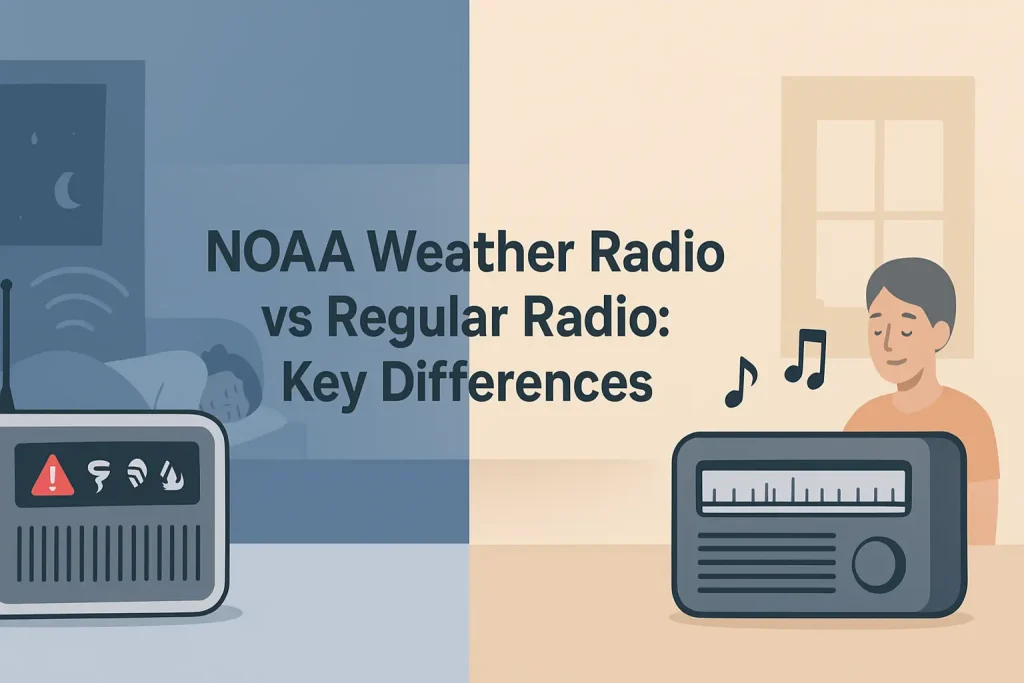
A good weather radio does not need to cost much. The Midland WR120B sells for around $25 and receives all seven NOAA broadcast frequencies between 162.400 and 162.550 MHz. For most households, that is everything a weather radio needs to do.
The challenge is knowing which budget models actually work and which ones look fine on a store shelf but fail when a tornado warning drops at 2 a.m. This guide covers the best weather radios under $30, what specs matter at this price, and exactly what you give up compared to models that cost more.
| Photo | Popular Portable Walkie Talkies | Price |
|---|---|---|
 | SKIWARRIOR Multifunctional Smart Wireless Ski Goggles with Walkie-Talkie, Anti-Fog Zeiss Lens, Music & Call Function (Cylindrical Blue) | Check Price On Amazon |
 | SINORISE Super Mini Walkie Talkies, Two-Way Radios, 3 Pack | Check Price On Amazon |
 | KOSPET Tank M4C Smart Watch Rugged, Dual-Band GPS, 5ATM & IP69K Waterproof | Check Price On Amazon |
 | Retevis RT15 Walkie Talkies 3 Pack, Birthday Gift, Outdoor Adventure Kit | Check Price On Amazon |
 | Rechargeable Walkie Talkies Toys for Kids: DIY Astronaut Walkie Talkies for Boys Christmas Birthday Gifts for 3 4 5 6 7 8 9 10 Boy Walkie Talkie Outdoor Hiking Toy 2 Way Radio Camping Outdoor Game | Check Price On Amazon |
By the Numbers
Budget Weather Radios Under $30 – Key Facts and Standards
Sources: NOAA National Weather Radio All Hazards documentation, FCC Part 95, manufacturer spec sheets.
What Does a Budget Weather Radio Actually Need to Do?
A weather radio under $30 needs to receive all seven NOAA frequencies and sound an alarm when an alert is broadcast for your area. That is the core job.
Everything beyond that is either a convenience feature or a S.A.M.E. (Specific Area Message Encoding) capability. S.A.M.E. is the technology that lets a weather radio filter alerts by county, so you are not woken up at 3 a.m. for a tornado warning in a county 200 miles away.
According to NOAA NWR technical documentation, S.A.M.E. uses a six-digit FIPS code to identify geographic areas. When an alert is broadcast, it includes a list of FIPS codes for the affected counties.
A S.A.M.E.-capable radio checks that list against the codes you have programmed. If your county is not on the list, the alert is suppressed.
Without S.A.M.E., the radio wakes you for every alert in the broadcast range of that NOAA transmitter, which can cover dozens of counties. That is not a deal-breaker if you live in a rural area with one or two counties in range, but it is a significant annoyance in densely populated regions.

At under $30, you can find radios with basic S.A.M.E. programming. The tradeoff is usually alert memory: budget models store 7 to 25 S.A.M.E. location codes, while mid-range models store 50 or more.
The most important spec to verify before buying any budget weather radio is whether it includes S.A.M.E. filtering, not just S.A.M.E. decoding. Some very cheap models decode the S.A.M.E. header but cannot filter by location.
The Best Weather Radios Under $30: Ranked and Reviewed
The radios below all receive 162.400 to 162.550 MHz, include alarm functionality, and are available at or under $30 at time of publication. They are ranked by overall usefulness for a typical household, not by price alone.
Use the table below to compare the top budget picks at a glance before reading the full reviews.
| Model | S.A.M.E. | Alert Types | Battery Backup | Price (approx.) |
|---|---|---|---|---|
| Midland WR120B | Yes | 25 | 3x AA | ~$25 |
| Uniden BC365CRS | Yes | 25 | 3x AA | ~$28 |
| Midland WR100B | Yes (basic) | 25 | 3x AA | ~$22 |
| Sangean CL-100 | Yes | 25 | 6x AA | ~$30 |
| La Crosse Technology WR-10 | Basic only | 7 | 3x AA | ~$18 |
Midland WR120B: The Best Budget Weather Radio Under $30
The Midland WR120B is the benchmark for budget weather radios. It receives all seven NOAA frequencies, supports S.A.M.E. filtering for all 25 NOAA alert event types, and runs on three AA batteries when the power goes out.
Key Specifications:
- NOAA frequencies: 162.400, 162.425, 162.450, 162.475, 162.500, 162.525, 162.550 MHz
- S.A.M.E. alert types: 25 (including Tornado Warning, Flash Flood Warning, AMBER Alert)
- Battery backup: 3x AA alkaline
- Alert memory: 7 S.A.M.E. location codes (county-level FIPS programming)
- Alarm output: audible siren plus visual strobe
- Price: approximately $25
The WR120B programs S.A.M.E. codes through a straightforward keypad interface. You enter your six-digit county FIPS code, and the radio stores it.
You can program up to seven location codes simultaneously, which covers households near county borders or families who want alerts for multiple areas. The limitation at this price is the seven-code maximum: mid-range models like the step-up version with expanded alert memory store up to 25 codes.
The alarm on the WR120B is loud enough to wake most people from a normal sleep. Midland rates it at 90 dB at one meter, which is comparable to a smoke detector.
The strobe light feature matters for households with hearing-impaired members. It fires simultaneously with the siren when an alert activates.
The WR120B does not include an AM/FM radio, a clock, or a display beyond basic indicator lights. If you want those features at this price, the Uniden BC365CRS is the better choice.
For pure weather alerting functionality, the Midland WR120B is the best value under $30 for most households.
Uniden BC365CRS: Best Budget Weather Radio With Clock and Display
The Uniden BC365CRS adds a digital clock and larger LCD display to the standard budget weather radio feature set. It costs approximately $28 and includes full S.A.M.E. filtering for all 25 NOAA alert event types.
Key Specifications:
- NOAA frequencies: all 7 (162.400 to 162.550 MHz)
- S.A.M.E. alert types: 25
- Battery backup: 3x AA alkaline
- Alert memory: 7 S.A.M.E. location codes
- Display: digital clock with date
- Price: approximately $28
The clock display makes the BC365CRS practical as a bedside radio. You get weather alerting and a functional clock in one device that draws minimal power on standby.
S.A.M.E. programming on the BC365CRS requires entering your FIPS code through a numeric keypad, the same process as the Midland WR120B. If you are unsure of your FIPS code, NOAA publishes a complete county-level FIPS database on the National Weather Service website.
The audio quality on the BC365CRS is slightly cleaner than the WR120B, with less hiss on weak NOAA signals. This matters if you are more than 30 miles from a NOAA transmitter.
The Uniden BC365CRS is the better choice if you want a combined bedside clock and weather radio at the lowest possible price.
Midland WR100B: The Lowest-Cost S.A.M.E. Option
The Midland WR100B is the entry point for S.A.M.E.-capable weather radios, available for approximately $22. It covers all seven NOAA frequencies and supports S.A.M.E. filtering, but with a simpler programming interface than the WR120B.
Key Specifications:
- NOAA frequencies: all 7 (162.400 to 162.550 MHz)
- S.A.M.E. alert types: 25
- Battery backup: 3x AA alkaline
- Alert memory: 7 S.A.M.E. location codes
- Price: approximately $22
The WR100B is functionally very close to the WR120B in alert performance. The differences are cosmetic: the WR100B has fewer indicator lights and a less polished case design.
If your only goal is reliable S.A.M.E.-filtered weather alerts at the absolute lowest price, the WR100B delivers. It is not the radio to choose if audio quality or ease of programming matters to you.
Sangean CL-100: Best Battery Backup Capacity Under $30
The Sangean CL-100 sits at the top of the under-$30 price range at approximately $30 and stands out for one specific reason: it runs on six AA batteries instead of three. That doubles the battery backup runtime compared to every other model in this category.
Key Specifications:
- NOAA frequencies: all 7 (162.400 to 162.550 MHz)
- S.A.M.E. alert types: 25
- Battery backup: 6x AA alkaline (approximately 40 hours of standby)
- Alert memory: 7 S.A.M.E. location codes
- Additional reception: AM/FM radio
- Price: approximately $30
The AM/FM capability makes the Sangean CL-100 a full emergency radio, not just a weather alerting device. During extended power outages, you can receive local emergency broadcast information on AM frequencies.
The build quality on the Sangean CL-100 is noticeably better than the Midland and Uniden budget models. The tuning dial is firmer and the speaker produces more volume with less distortion at maximum output.
The Sangean CL-100 is the right choice for households in hurricane zones or areas with extended power outage risk, where battery longevity during multi-day events matters.
La Crosse Technology WR-10: What to Avoid at This Price
The La Crosse Technology WR-10 costs approximately $18 and receives all seven NOAA frequencies. It is included here as a caution, not a recommendation.
The WR-10 does not support county-level S.A.M.E. filtering in the way the Midland and Uniden models do. It receives the S.A.M.E. header tone that triggers the alert but does not decode geographic filtering from the broadcast signal.
In practice, this means the WR-10 will alarm for every NOAA alert broadcast within range of your transmitter, regardless of whether your county is affected. For households near county borders or in states with many counties, this produces frequent false-alarm awakenings.
The $7 price difference between the WR-10 and the Midland WR120B is not worth sacrificing functional S.A.M.E. filtering. Buy the WR120B instead.
The La Crosse WR-10 is acceptable only as a second radio for a secondary location where you want basic NOAA monitoring without alarm functionality, and only if you understand it will alert for all counties in your transmitter’s coverage area.
Here is a side-by-side look at all five picks to help you decide which budget model fits your situation best.
Price Comparison
Budget Weather Radios Under $30 – Price by Model
Street price sorted lowest to highest. Prices verified at time of publication.
~$18
~$22
~$25
~$28
~$30
Single-unit retail price. No license required for weather radio reception. Prices may vary by retailer.
What S.A.M.E. Technology Does and Why It Matters at Any Budget
S.A.M.E. (Specific Area Message Encoding) is the NOAA standard that allows a weather radio to alert only for the geographic areas you have programmed. Without it, your radio alarms for every county the NOAA transmitter covers, which can be dozens of counties in densely populated states.
This matters because NOAA broadcasts alerts on seven fixed frequencies (162.400 to 162.550 MHz) from approximately 1,000 transmitters nationwide. Each transmitter covers a geographic footprint that routinely crosses county and sometimes state lines.
S.A.M.E. works by encoding a list of six-digit FIPS codes into the digital header of each alert broadcast. A FIPS code (Federal Information Processing Standard) identifies a specific county. When your radio receives the alert header, it checks the FIPS list against the codes you have programmed and only triggers the alarm if there is a match.
To program your county’s FIPS code, find your six-digit code at the NOAA NWS S.A.M.E. county code database at weather.gov. Enter that code into your radio’s S.A.M.E. programming menu.
Budget radios under $30 typically store 7 FIPS codes. That is enough for most single-county households plus one or two neighboring counties. If you need to monitor more locations, look at models above $30 that store 25 or 50 codes.
A weather radio without working S.A.M.E. programming is not a failure-proof emergency alerting device. It is an alarm that may or may not wake you for the right reasons. For a deeper look at how S.A.M.E. functions at the system level, our guide on how S.A.M.E. encoding filters alerts by county covers the full technical process.
How to Program S.A.M.E. Codes on a Budget Weather Radio: Step by Step
Programming S.A.M.E. codes on a budget weather radio takes under five minutes. The process is the same on the Midland WR120B, WR100B, and Uniden BC365CRS.
Step-by-Step Guide
How to Program S.A.M.E. County Codes on a Budget Weather Radio
6 steps · Estimated time: 5 minutes · Applies to Midland WR120B, WR100B, and Uniden BC365CRS
Find your county’s six-digit FIPS code
Go to weather.gov and search “S.A.M.E. county codes.” Locate your state and county in the list and write down the six-digit FIPS number (example: Cook County, Illinois is 017031).
Power on the radio and plug it into AC power
Programming mode requires AC power on most budget models. Battery-only mode typically locks the programming menu.
Press and hold the “Program” or “S.A.M.E.” button
On the Midland WR120B, press and hold “Program” until the display shows dashes in the FIPS code entry field. On the Uniden BC365CRS, press “Menu” and navigate to “S.A.M.E. Setup.”
Enter your six-digit FIPS code using the numeric keypad
Type each digit in sequence. Most budget radios confirm each digit with a beep. If you make an error, press “Clear” or hold the programming button to restart entry.
Press “Enter” or “Program” to save the code
The radio will return to monitoring mode. Repeat steps 3 through 5 for any additional counties you want to monitor (up to seven on most budget models).
Test the programming with a manual NOAA weather broadcast test
NOAA broadcasts a required weekly test on Wednesdays between 11 a.m. and noon local time in most areas. The test includes a S.A.M.E. header, so your radio should display or sound briefly if your FIPS code matches the broadcast area.
If your radio alarms for counties you did not program, verify that you entered all six digits correctly including any leading zeros. A county FIPS code beginning with zero (such as 006037 for Los Angeles County, California) must be entered with the leading zero included.
What You Give Up Under $30 Compared to Mid-Range Weather Radios
Budget weather radios under $30 deliver the core function (NOAA reception and S.A.M.E. alerting) reliably. But four capabilities found on $40 to $80 models are missing at this price point, and one of them affects day-to-day usefulness significantly.
The most important missing feature is expanded S.A.M.E. code storage. Budget models store 7 FIPS codes; mid-range models like the Midland WR400 store 50. This matters if you travel frequently, own property in multiple counties, or want to monitor alerts for family members in different areas.
The second gap is alert type selectivity. On a budget radio, you program which counties to monitor. On a mid-range radio, you can also select which alert types trigger the alarm. You might want Tornado Warnings and Flash Flood Warnings to alarm at full volume, but Winter Storm Watches to activate only a visual indicator.
Third, mid-range radios include a backlit display that shows the current alert type and affected counties when an alert triggers. Budget models show minimal information, often just a flashing light.
Fourth, some mid-range models include a headphone output or a direct audio output jack for connecting to an external speaker or alerting system. Budget models lack this.
Use the table below to decide whether the extra $10 to $50 for a mid-range model is justified for your situation.
| Feature | Budget (under $30) | Mid-Range ($40 to $80) |
|---|---|---|
| NOAA frequency coverage | All 7 (162.400 to 162.550 MHz) | All 7 (162.400 to 162.550 MHz) |
| S.A.M.E. county filtering | Yes (7 codes max) | Yes (25 to 50 codes) |
| Alert type selectivity | No (all 25 types alarm) | Yes (select which types alarm) |
| Backlit information display | No | Yes |
| Headphone / audio output | No | Yes (3.5mm jack) |
| Strobe light for hearing impaired | Midland WR120B only | Yes on most models |
For most single-county households with no specific alert-type filtering needs, a budget weather radio under $30 is fully adequate. The core alerting function is identical at both price points.
Battery Backup: Why It Matters More Than Any Other Spec at This Price
A weather radio that loses power during the storm it is supposed to warn you about is useless. Battery backup is the most critical practical specification on any weather radio under $30, and it is the one most buyers overlook.
Most budget weather radios run on three AA alkaline batteries in backup mode. At standby current draw (the radio is on and scanning for alerts but not playing audio), three fresh alkaline AAs provide approximately 24 to 40 hours of operation depending on the model.
This matters because the power outages that weather radios are designed to cover typically last from a few hours to several days. Three AAs at 24 hours of standby will carry most households through a typical severe weather event.
The exception is extended events: hurricanes, ice storms, and major floods can knock out power for five to ten days or more. In those situations, the Sangean CL-100’s six-AA backup gives roughly double the runtime of the three-AA models, which provides meaningful extra margin.
All five radios reviewed here include battery backup. Verify that any budget weather radio you consider includes this feature; some very low-cost models (typically under $15) are AC-only and will go dark exactly when you need them most.
If you want to extend battery life on any of these radios, use high-capacity alkaline AA batteries rather than standard duty cells. Energizer Ultimate Lithium AAs last up to 20% longer in low-drain applications like weather radio standby mode and perform better in cold temperatures during winter storm events.
Reliable battery backup is the single feature that separates a useful emergency device from a piece of electronics that fails when it matters most.
Where to Place Your Weather Radio for the Best NOAA Reception
A weather radio under $30 uses a short internal or fixed external wire antenna to receive the NOAA signal at 162.400 to 162.550 MHz. Reception quality depends heavily on placement, and poor placement is the most common reason budget radios fail to receive a clear signal.
NOAA transmitters broadcast at 300 watts ERP (effective radiated power) on VHF frequencies. The signal travels line-of-sight from the transmitter, which means walls, terrain, and distance all reduce signal strength at the receiver.
Place the radio near a window on the side of your home facing the nearest NOAA transmitter. You can find your nearest transmitter on the NOAA NWR transmitter location map at weather.gov/nwr.
If your home has thick masonry walls or a metal roof, move the radio to an exterior wall or near a window. Steel and concrete significantly attenuate the 162 MHz signal.
Do not place the radio in a basement if you can avoid it. Underground rooms attenuate the NOAA signal substantially. If a basement location is required for other reasons, run a small external wire antenna (even 12 inches of wire attached to the antenna terminal) up to ground level through a window or cable penetration.
The Midland WR120B and WR100B have a fixed wire antenna that cannot be extended. The Uniden BC365CRS and Sangean CL-100 include a small telescoping antenna that can be adjusted for optimal signal orientation.
For the best signal, orient a telescoping antenna vertically. NOAA transmits with vertical polarization, and a vertically oriented receiving antenna maintains the matching polarization angle for maximum signal capture.
Correct placement improves signal-to-noise ratio, reduces hiss during audio playback, and ensures the alert tone decodes accurately. A misplaced radio with a weak signal may fail to trigger the alarm on a marginally strong alert broadcast.
Quick Reference: Weather Radio Terms You Need to Know
These terms appear throughout weather radio documentation and reviews. All are relevant to buying and operating a budget weather radio under $30.
- NOAA NWR: National Oceanic and Atmospheric Administration Weather Radio All Hazards. The US government radio network broadcasting weather and emergency alerts 24 hours a day on seven dedicated VHF frequencies.
- S.A.M.E.: Specific Area Message Encoding. The digital coding system embedded in NOAA alert broadcasts that allows a weather radio to filter alerts by county using six-digit FIPS codes.
- FIPS code: Federal Information Processing Standard code. A six-digit number identifying a specific US county for S.A.M.E. programming purposes.
- EAS: Emergency Alert System. The federal system that coordinates emergency alerts across radio, television, and weather radio networks. NOAA NWR is part of the EAS infrastructure.
- Alert event type: One of 25 categories of NOAA alerts, including Tornado Warning, Flash Flood Warning, Hurricane Warning, AMBER Alert, and Civil Emergency.
- Squelch: A circuit that mutes the radio’s speaker when no signal is present. On a weather radio, squelch prevents static noise from playing continuously on standby.
- Alert tone: The distinctive 1050 Hz tone that NOAA broadcasts before an alert message to trigger weather radio alarms. Also called the attention signal.
- Battery backup: The ability of a weather radio to operate on battery power when AC power is interrupted. Expressed in AA or AAA cell count.
- ERP: Effective Radiated Power. NOAA NWR transmitters broadcast at 300 to 1000 watts ERP depending on transmitter class.
- VHF: Very High Frequency. The 30 to 300 MHz radio spectrum. NOAA weather broadcasts at 162.400 to 162.550 MHz fall within the VHF high band.
Is a $25 Weather Radio Reliable Enough for Emergency Use?
A $25 weather radio with functional S.A.M.E. filtering and battery backup is reliable for emergency alerting. The core hardware (a VHF receiver tuned to 162.400 to 162.550 MHz and a S.A.M.E. decoder chip) is not complex and does not degrade meaningfully at budget price points.
The Midland WR120B has been the best-selling entry-level weather radio for over a decade. It has a documented track record across millions of households in tornado-prone states like Oklahoma, Kansas, and Texas.
The failure modes on budget weather radios are almost never electronic. They are operational: batteries not replaced, S.A.M.E. codes not programmed, or the radio placed in a location with poor reception. A $25 radio that is properly set up outperforms an $80 radio sitting in a drawer with dead batteries.
The one legitimate reliability concern at this price is AC adapter quality. Very low-cost weather radios sometimes include fragile AC adapters that fail or produce electrical noise that interferes with reception. The Midland WR120B and Uniden BC365CRS both use standard 5V DC input, and you can replace a failed adapter with any matching voltage supply.
For households looking for the most capable home weather alerting setup, pairing a budget desktop radio with a second portable unit provides redundancy. Our guide covering the top-rated NOAA weather radios for home use covers models at multiple price points for building a complete alerting setup.
A properly programmed budget weather radio is fully adequate for life-safety emergency alerting for the vast majority of US households.
Hand-Crank and Solar Weather Radios Under $30: Are They Worth It?
Hand-crank and solar emergency radios that include NOAA weather radio reception are available under $30, but they represent a different trade-off than a dedicated desktop weather radio. Understanding this trade-off before buying will prevent disappointment.
A hand-crank emergency radio like the Midland ER310 (typically $40 to $60) or budget alternatives like the Kaito KA500 (approximately $30) include NOAA reception, AM/FM, hand crank, solar panel, and USB charging output in one device.
The NOAA reception on these combination radios works correctly. They receive all seven NOAA frequencies and most include some form of weather alerting.
The critical limitation: most combination emergency radios under $30 do not include full S.A.M.E. county filtering. They receive the NOAA signal and may alert on the EAS tone, but they do not decode and filter by FIPS county code the way a dedicated weather radio does.
This means a hand-crank emergency radio used as your primary weather alert device may wake you for alerts across dozens of counties, or may not reliably trigger automatically while on standby.
The right approach is to use both: a dedicated desktop weather radio (Midland WR120B) as your primary home alert device on AC power, and a hand-crank emergency radio as a portable backup for extended outages or evacuation scenarios. You do not have to choose one or the other.
If budget forces a single purchase under $30, buy the dedicated desktop weather radio with S.A.M.E. for your home. It will reliably wake you in the night when a tornado warning is issued for your county. A combination emergency radio cannot guarantee that.
Which Budget Weather Radio Should You Buy?
The right budget weather radio depends on one primary factor: where the radio will be used and what secondary features matter to you beyond the core alerting function.
If you want the best all-around budget weather radio for a home or bedroom, buy the Midland WR120B. It delivers all 25 NOAA alert types, county-level S.A.M.E. filtering, a 90 dB alarm, and a strobe light for approximately $25.
If you want a clock display combined with weather alerting for a nightstand, buy the Uniden BC365CRS for approximately $28. The digital clock and larger display make it the most convenient all-in-one option at this price.
If you live in a hurricane zone or an area with frequent multi-day power outages, buy the Sangean CL-100 for approximately $30. The six-AA battery backup roughly doubles runtime during extended outages, and the AM/FM capability provides additional emergency information access.
If your budget is the absolute limiting factor, the Midland WR100B at approximately $22 provides functional S.A.M.E. filtering at the lowest price. Do not buy below this price point if you expect the radio to filter alerts by county.
Do not buy the La Crosse WR-10 or similar basic models under $20 as a primary home alert device. The lack of functional county-level S.A.M.E. filtering defeats the primary purpose of a dedicated weather radio.
For a comprehensive look at how these budget options compare to mid-range and premium weather radios, the full-range weather radio comparison covering all price tiers provides a complete overview of what additional features become available as budget increases.
Do You Need a Weather Radio If You Already Have a Smartphone?
Wireless Emergency Alerts (WEA) push Tornado Warnings and other life-safety alerts to smartphones within the affected area automatically. A weather radio and a smartphone serve overlapping but not identical alerting functions, and understanding the difference explains why both have value.
Smartphone WEA alerts rely on cell tower infrastructure. During a major severe weather event, cell towers experience congestion from simultaneous high call and data volume. In some high-impact tornado events, WEA alerts have been delayed by 30 seconds to several minutes relative to the actual NWS warning issuance time.
A weather radio receives the NOAA alert directly at 162.400 to 162.550 MHz within seconds of the warning being issued by the National Weather Service, with no cellular network dependency. The radio does not care how many people are using their phones.
Additionally, a weather radio functions without internet connectivity or cellular service. If a tornado or hurricane damages cell towers in your area, your smartphone loses its alerting capability entirely. A weather radio on battery backup continues operating.
The practical answer: use your smartphone WEA alerts as a secondary confirmation, not a primary warning system. A dedicated weather radio with S.A.M.E. filtering is the more reliable primary alert device for life-safety warnings, particularly during the overnight hours when you may not have your phone nearby or at sufficient volume to wake you.
Both tools together provide redundancy. Neither alone is as reliable as both functioning simultaneously.
Can I Use a Budget Weather Radio for Programming Custom Alert Sounds?
Budget weather radios under $30 do not support custom alert sounds. The alarm on the Midland WR120B, WR100B, and Uniden BC365CRS is a fixed 1050 Hz tone pattern that follows the NOAA alert standard. You cannot change the tone type, pattern, or volume beyond the radio’s built-in volume control.
Mid-range models like the Midland WR400 allow you to select from multiple alarm types, including a voice-only mode that plays the NOAA broadcast without the preceding alarm tone. This is useful for households with young children or pets who are startled by the standard siren.
At the budget price point, the alarm tone is not adjustable. If the standard NOAA alert tone is a concern for your household, consider stepping up to a mid-range model that offers tone customization.
Why Does My Weather Radio Keep Alarming for Alerts Not in My County?
If your weather radio alarms for alerts outside your programmed county, there are three possible causes: incorrect S.A.M.E. FIPS code entry, the radio is set to “All Alerts” mode rather than S.A.M.E. mode, or the radio’s S.A.M.E. decoder chip is experiencing a false decode from a strong adjacent signal.
The most common cause by far is an entry error in the FIPS code. Verify your code against the NOAA NWS S.A.M.E. county code database. Check for leading zeros: many county codes begin with 0 and must be entered as all six digits including the leading zero.
The second most common cause is that the radio defaulted to “All Alerts” mode rather than S.A.M.E. filtered mode after a power outage or battery replacement. Check your radio’s programming menu and confirm it shows your FIPS code, not a blank or “All” setting.
If both are correct and the radio still alarms incorrectly, the issue may be a marginally weak NOAA signal causing the S.A.M.E. decoder to misread the county code header. Improve antenna placement per the guidance in the placement section above, then reprogram the FIPS code.
If you continue to have issues after placement improvements, our troubleshooting guide for resolving common Midland weather radio alert and programming errors covers these failure modes in detail for the WR120B and related models.
What Is the Difference Between a Tornado Watch and a Tornado Warning on a Weather Radio?
A Tornado Watch means conditions are favorable for tornado development. The National Weather Service issues it for a broad area, typically covering multiple counties, when atmospheric conditions could produce tornadoes over the next several hours. Your weather radio may or may not alarm for a Watch, depending on how you have programmed your alert type preferences.
A Tornado Warning means a tornado has been detected by radar or confirmed by a spotter. It is issued for a specific area and indicates an immediate threat. Every properly programmed weather radio should alarm immediately for a Tornado Warning in your county.
On budget weather radios without alert-type selectivity, both Watch and Warning events trigger the alarm. This is by design: the S.A.M.E. system sends both event codes, and a basic budget radio responds to all 25 event types with the same alarm.
If you want to suppress Watch alerts and alarm only on Warning events, you need a mid-range weather radio with alert-type filtering capability. The Midland WR400 and Uniden BC355N both support per-event-type alarm enable/disable at the county level.
Do I Need to Register My Weather Radio With NOAA?
No registration is required to operate a weather radio in the United States. Weather radios are receive-only devices. They do not transmit, so no FCC license or registration is needed for legal operation.
This applies to all budget weather radios, all mid-range models, and all combination emergency radios. You purchase the radio, program your FIPS code, and it is ready to use. There is no annual fee, no license application, and no regulatory agency to notify.
This is distinct from two-way radios like GMRS handhelds, which require a $35 FCC Part 95 license to transmit legally. A weather radio is purely passive and has no transmission capability.
How Far Can a NOAA Signal Reach Reliably?
NOAA Weather Radio transmitters broadcast at 300 to 1000 watts ERP depending on transmitter class, on frequencies between 162.400 and 162.550 MHz in the VHF high band. At these power levels and frequencies, NOAA covers approximately 95% of the US population within 40 miles of a transmitter, according to NOAA NWR documentation.
Reliable indoor reception with a budget weather radio is typically achievable within 25 to 40 miles of the nearest transmitter. Beyond 40 miles, signal quality degrades and S.A.M.E. header decoding may become unreliable, particularly with weak antenna designs on budget models.
If you are outside the reliable coverage radius of your nearest transmitter, a small outdoor VHF antenna connected to the radio’s external antenna terminal (if present) can significantly improve reception. A simple dipole cut for 162 MHz mounted outdoors at 10 to 15 feet elevation will outperform any internal antenna on a budget weather radio at ranges beyond 30 miles.
For areas beyond 50 miles from the nearest NOAA transmitter, the signal becomes unreliable for most budget radios regardless of placement. In those locations, combining a weather radio with smartphone WEA alerts and local emergency management notifications provides the best redundancy.
Should I Buy a Weather Radio Online or In a Store?
Both purchase channels deliver the same product. The practical difference is price, availability, and the ability to verify you are buying an FCC-compliant model.
Online retailers, including Amazon, typically offer the lowest prices on budget weather radios. The Midland WR120B is consistently available online at or below $25. In-store prices at hardware stores and big-box retailers are often $5 to $10 higher for the same model.
When buying online, verify that the listing is for a genuine FCC-part-compliant weather radio, not a generic NOAA-frequency-capable radio without S.A.M.E. decoding. The product listing should specifically state “S.A.M.E. weather radio” or list the number of NOAA alert event types (look for 25, not 7).
Our guide covering where to find reliable weather radios at the best prices covers both online and in-store options with retailer-specific notes on availability and pricing.
If you need a weather radio immediately before an approaching storm, hardware stores and mass-market retailers (Home Depot, Walmart, Target) typically stock the Midland WR120B or an equivalent. Buying the night before a hurricane landfall is not the right time to discover the nearest retailer is out of stock.
What Happens If the NOAA Transmitter Nearest to Me Goes Offline?
NOAA operates a network of approximately 1,000 transmitters across the US. Individual transmitters do go offline for maintenance or weather-related damage. During an outage, your weather radio will lose NOAA signal for that transmitter’s coverage area.
Most areas are within range of two or more NOAA transmitters on overlapping frequencies. If your radio scans all seven NOAA frequencies (which all budget models do), it will receive the signal from the next nearest transmitter automatically if your primary transmitter is offline.
The practical limitation is geographic. In rural areas, the secondary transmitter may be significantly weaker. S.A.M.E. filtering may still work, but audio quality will be lower.
NOAA publishes transmitter status information at weather.gov/nwr. If you experience a sudden loss of signal on all seven NOAA frequencies, check the transmitter status page for your nearest transmitter before assuming the radio has failed.
For households in areas with known transmitter coverage gaps, a backup alert method such as smartphone WEA and local emergency management text notifications provides necessary redundancy alongside the weather radio.
Can a Budget Weather Radio Receive Alerts From Multiple States?
A weather radio receives whichever NOAA transmitter signals it can detect, regardless of state boundaries. NOAA transmitters near state borders often cover counties in multiple states. If you live near a state border, your radio may receive alerts from NOAA transmitters in the adjacent state as well as your home state.
S.A.M.E. FIPS codes are state-specific (the first two digits of the six-digit code identify the state). If you program your radio with your home county code, it will filter correctly for your county and alarm only when that county is included in a broadcast alert, regardless of which state’s transmitter is sending the signal.
You can also program FIPS codes for counties in adjacent states if you want to monitor cross-border weather activity. Budget models with seven FIPS code slots have enough capacity for a home county plus five to six neighboring counties across state lines.
How Often Should I Test My Budget Weather Radio?
NOAA conducts a required weekly test on all NWR transmitters every Wednesday between 11 a.m. and noon local time in most areas. The test includes a full S.A.M.E. header and alert tone. Your weather radio should display or briefly activate when this test broadcasts for your programmed county’s FIPS code.
Verify your radio responds correctly to the Wednesday test at least once per month. If the radio does not activate during the test, troubleshoot in this order: check that batteries are fresh and the radio is switched to standby mode, verify the FIPS code is programmed correctly, and confirm the radio is receiving signal by manually tuning to your strongest NOAA frequency and listening for the continuous weather broadcast.
In addition to weekly electronic tests, NOAA conducts a monthly required test that includes a spoken announcement. This is separate from the weekly tone-only test and provides a full end-to-end test of the alerting chain including voice audio.
Replace batteries in your weather radio at least once per year regardless of whether they appear depleted. Alkaline batteries left in standby devices for extended periods can leak and damage internal components. A battery replacement costs less than one dollar per AA cell and takes 30 seconds.
Does the Midland WR120B Work During a Power Outage?
The Midland WR120B operates on three AA alkaline batteries when AC power is interrupted. It switches to battery backup automatically when AC power drops. You do not need to manually activate battery mode or flip a switch.
At typical standby current draw (waiting for an alert), three fresh AA alkaline batteries power the WR120B for approximately 24 to 36 hours. This covers the majority of severe weather power outage durations in most US regions.
The radio maintains its S.A.M.E. programming in non-volatile memory through power outages. You will not need to reprogram your FIPS codes after the power comes back on.
One important note: the WR120B’s battery compartment holds the batteries but does not charge them. Use standard alkaline AA cells, not rechargeable NiMH cells, in the backup compartment. NiMH cells discharge at a higher self-discharge rate than alkaline cells and may not provide reliable backup power after extended standby storage periods.
For a full technical review of the WR120B including battery performance data and S.A.M.E. programming accuracy, the detailed Midland WR120B performance and feature review covers the complete specification set and real-world test results.
What to Do After Buying a Budget Weather Radio: First Setup Checklist
A budget weather radio sitting in its box does not protect anyone. Complete these steps within 30 minutes of unboxing to ensure the radio is ready before the next severe weather season.
- Insert fresh AA alkaline batteries in the backup compartment before plugging into AC power. This ensures backup power is available immediately.
- Plug the AC adapter into the radio and into a wall outlet. Confirm the power indicator light activates.
- Look up your county’s six-digit FIPS S.A.M.E. code at weather.gov.
- Enter your FIPS code through the radio’s programming menu. Confirm it saves correctly by returning to the programming menu and verifying the code is displayed.
- Tune to your strongest NOAA frequency and listen for the continuous weather broadcast. If the audio is clear, reception is adequate. If there is significant static, move the radio to a better position near a window.
- Confirm the radio is set to S.A.M.E. filtered mode, not “All Alerts” mode.
- Verify the alarm volume is set to maximum for nighttime use.
- Check the radio responds during the next Wednesday weekly NOAA test between 11 a.m. and noon.
This process takes under 10 minutes and ensures your radio will function correctly during the first severe weather event. Most weather radio failures are not hardware failures: they are setup failures that could have been prevented in the first 10 minutes after unboxing.
For households starting their emergency preparedness setup and comparing weather radio options across all categories, the complete weather radio buying guide covering all feature categories and price tiers provides the full decision framework beyond what any single budget tier comparison can cover.
A properly set up $25 weather radio will wake you at 2 a.m. when a tornado warning is issued for your county. Set it up today, before you need it.
| Photo | TOP RATED WALKIE TALKIES | Price |
|---|---|---|
 | Retevis RT628 Kids Walkie Talkies, Toys Gifts for 4-12 Year Old Girl Boy | Check Price On Amazon |
 | Cobra ACXT545 Weather-Resistant Walkie Talkies, Rechargeable, 22 Channels | Check Price On Amazon |
 | Retevis RT388 Kids Walkie Talkies, Outdoor Toys for Kids Camping Essentials | Check Price On Amazon |
 | Cobra RX680 Walkie Talkies (2-Pack), IP54 Water Resistant Design | Check Price On Amazon |
 | Retevis RT22 Walkie Talkies Long Range Rechargeable with Earpiece (2 Pack) | Check Price On Amazon |
 | Midland GXT1000VP4 GMRS JIS4 Two-Way Radio, Black,2 Pack | Check Price On Amazon |
 | Retevis RT628 Walkie Talkies for Kids,Toys Gifts for 6-12 Years Old Boys Girls,Long Range 2 Way Radio 22CH VOX,Birthday Gift,Family Walkie Talkie for Camping Hiking Indoor Outdoor | Check Price On Amazon |