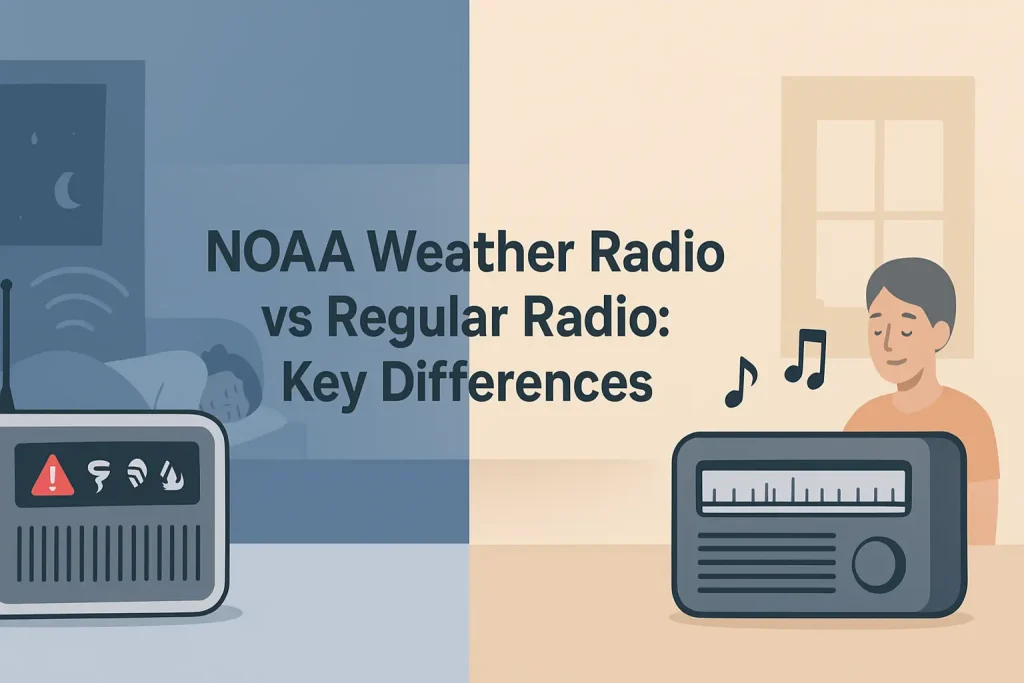
When your local power grid fails and cell towers go dark, a NOAA Weather Radio receiver sits quietly on your shelf broadcasting life-saving alerts around the clock on 162.400 to 162.550 MHz. What most people do not realize is that the alert reaching their radio does not come from a single button someone pushes at the National Weather Service. It travels through a layered technical architecture called the Emergency Alert System (EAS), where NOAA Weather Radio All Hazards (NWR) serves as both the trigger and the backbone of the entire national warning network.
Understanding how that chain works tells you why some radios wake you up instantly while others miss alerts entirely, and why the county-specific filtering built into S.A.M.E. technology is the single most important feature to look for in any weather radio purchase.
| Photo | Popular Portable Walkie Talkies | Price |
|---|---|---|
 | SKIWARRIOR Multifunctional Smart Wireless Ski Goggles with Walkie-Talkie, Anti-Fog Zeiss Lens, Music & Call Function (Cylindrical Blue) | Check Price On Amazon |
 | SINORISE Super Mini Walkie Talkies, Two-Way Radios, 3 Pack | Check Price On Amazon |
 | KOSPET Tank M4C Smart Watch Rugged, Dual-Band GPS, 5ATM & IP69K Waterproof | Check Price On Amazon |
 | Retevis RT15 Walkie Talkies 3 Pack, Birthday Gift, Outdoor Adventure Kit | Check Price On Amazon |
 | Rechargeable Walkie Talkies Toys for Kids: DIY Astronaut Walkie Talkies for Boys Christmas Birthday Gifts for 3 4 5 6 7 8 9 10 Boy Walkie Talkie Outdoor Hiking Toy 2 Way Radio Camping Outdoor Game | Check Price On Amazon |
By the Numbers
NOAA Weather Radio and the Emergency Alert System: Key Specifications
Sources: NOAA National Weather Service NWR documentation, FCC EAS rules (47 CFR Part 11), FEMA IPAWS program data.
What Is the Emergency Alert System and How Does NOAA Weather Radio Fit Into It?
The Emergency Alert System (EAS) is a national public warning infrastructure governed by FCC rules under 47 CFR Part 11, requiring broadcast stations, cable systems, and satellite providers to interrupt programming when authorized government agencies issue alerts. NOAA Weather Radio All Hazards is not just a participant in the EAS. It is the primary entry point through which most weather-related alerts enter the entire system.
According to NOAA National Weather Service documentation, NWR operates more than 1,000 transmitters across all 50 states, U.S. territories, and adjacent coastal waters. Each transmitter broadcasts 24 hours a day on one of seven dedicated VHF-FM frequencies between 162.400 MHz and 162.550 MHz.
The EAS itself is a three-tier network. At the top sits the Federal Emergency Management Agency (FEMA), which controls the Integrated Public Alert and Warning System (IPAWS). Below FEMA sit state emergency management agencies. At the local level sit primary entry points (PEPs), which include NWR transmitters and key broadcast stations.
When a National Weather Service meteorologist issues a Tornado Warning, the alert does not simply appear on your radio. It travels through a structured encoding and relay process that can reach every EAS-equipped device in the affected area within seconds. Your NOAA weather alert radio with S.A.M.E. technology is the last link in that chain inside your home.
NOAA Weather Radio functions as the backbone of the EAS because it is always on, always broadcasting, and covers geography that cellular networks and internet connections cannot guarantee during infrastructure failures. This matters most at exactly the moment when you need it most.
How Does a National Weather Service Alert Get Encoded and Sent?
A National Weather Service forecaster initiates an alert by entering it into the NOAA Weather Wire Service system, which automatically generates a structured digital message called an EAS header. That header is encoded using the Specific Area Message Encoding (S.A.M.E.) protocol and transmitted over the NWR frequency serving the affected area, typically within one to two minutes of the forecaster issuing the product.
The S.A.M.E. header is a digital burst transmitted at 1,200 baud using audio frequency shift keying (AFSK) at 1,562.5 Hz and 2,062.5 Hz tones. This digital burst carries five critical pieces of information that every EAS decoder must read correctly before activating an alert.
Those five fields are the originator code (who sent it), the event code (what type of alert it is), the location codes (which FIPS counties or zones are affected), the valid time period (how long the alert is in effect), and the originator’s identification string (which NWS office issued it). A receiver that cannot decode all five fields correctly will either miss the alert entirely or fail to filter it to the correct county.
The S.A.M.E. header is transmitted three times in succession. This triple transmission is a redundancy measure required by FCC EAS rules to compensate for signal noise or brief interference that might corrupt a single transmission. A properly designed EAS decoder uses a two-of-three voting algorithm, accepting the alert only when at least two of the three header transmissions match.
After the three digital header bursts, NWR transmits the attention signal: a distinctive 8 to 25 second tone consisting of 853 Hz and 960 Hz simultaneously. This is the tone that wakes up analog weather radios without S.A.M.E. decoders. S.A.M.E.-equipped radios use the digital header instead, which allows county-level filtering before the attention signal even plays.
The voice message follows immediately after the attention signal, delivered by the NWS forecaster or by a Text-to-Speech (TTS) synthesis system. After the voice message, the EAS end-of-message (EOM) code is transmitted, again three times, signaling all EAS decoders to return to standby monitoring mode.
The encoding architecture ensures that every part of the alert chain, from the forecaster’s keyboard to your bedroom radio, carries the same structured data, making the system machine-readable at every relay point. The S.A.M.E. protocol is what transforms a weather alert from a broadcast announcement into a targetable, filterable, automated warning system.
What Are the Seven NOAA Weather Radio Frequencies and Why Does Each One Matter?
NOAA Weather Radio All Hazards broadcasts on exactly seven VHF-FM frequencies between 162.400 MHz and 162.550 MHz. These frequencies are dedicated exclusively to NWR under FCC Part 90 and Part 15 regulations, which means no commercial broadcaster, amateur operator, or business radio system is permitted to transmit on them. Your receiver will only ever hear NOAA programming on these channels.
The seven frequencies are WX1 (162.550 MHz), WX2 (162.400 MHz), WX3 (162.475 MHz), WX4 (162.425 MHz), WX5 (162.450 MHz), WX6 (162.500 MHz), and WX7 (162.525 MHz). Each transmitter site uses whichever frequency provides the best coverage for its geographic area without interfering with adjacent transmitters using the same frequency.
Your Midland WR400 weather radio or similar receiver scans all seven frequencies automatically on startup and locks onto the strongest signal in your area. In most U.S. locations, one frequency will dominate based on which transmitter is geographically closest to you.
Key Specifications for NOAA NWR Frequency Allocation:
- Frequency band: 162.400 to 162.550 MHz (VHF-FM, narrowband)
- Channel spacing: 25 kHz between each of the seven channels
- Transmitter power: up to 1,000 watts ERP (effective radiated power)
- Coverage radius: typically 40 miles from each transmitter at 1,000W ERP
- Modulation: FM, narrowband
- Broadcast format: continuous 24-hour audio with S.A.M.E. digital header bursts during alerts
The VHF frequency range between 162 and 163 MHz propagates well over flat terrain and water but attenuates significantly inside reinforced concrete structures and in valleys surrounded by terrain. This is the physics reason why a weather radio placed near a window or on an upper floor of a building receives a stronger, more reliable signal than one placed in a basement or interior room.
This happens because VHF signals at 162 MHz travel primarily by line-of-sight propagation, meaning the signal strength drops sharply when building materials or terrain obstruct the direct path between the transmitter and your receiver’s antenna. It only works reliably when there is a relatively unobstructed path between the NWR transmitter antenna and your receiver. If concrete walls or terrain block that path, the result is a weak, noisy signal that may cause your radio to miss the S.A.M.E. header entirely during an alert. Fix it by relocating the radio to a higher position near an exterior wall or window, or by connecting an external antenna to your receiver’s external antenna jack if it has one.
For more detail on all seven frequencies and which transmitter serves your specific county, the complete breakdown of every NWR broadcast channel and its geographic coverage shows which frequency to set as your primary on any manually tuned receiver.
How Does S.A.M.E. Technology Filter Alerts to Your Specific County?
S.A.M.E. (Specific Area Message Encoding) technology allows a weather radio receiver to decode the digital header of every alert broadcast and compare the embedded FIPS location codes against the codes you have programmed into the radio. The receiver only activates its alarm if the alert’s location codes include at least one code that matches your programmed county or zone. Every other alert plays silently, or not at all.
Without S.A.M.E., a weather radio sounds its alarm for every alert broadcast by the NWR transmitter serving your area, which can cover 20 to 40 counties. A single active severe weather day in a large state can produce dozens of alerts for counties nowhere near you, making the radio more of a noise source than a useful warning tool.
The FIPS location code in every S.A.M.E. header is a six-digit number. The first digit is always zero for statewide alerts or a specific sub-county zone designation. The next two digits are the FIPS state code. The final three digits are the FIPS county code. For example, FIPS code 048113 identifies Dallas County, Texas (state code 048, county code 113).
You can program up to 25 FIPS codes into most S.A.M.E.-capable weather radios. This means you can monitor your home county, your work county, your child’s school county, and any other counties your family regularly travels through, all simultaneously, with a single receiver. The Uniden BC365CRS weather radio supports up to 25 programmable S.A.M.E. location codes.
This happens because the S.A.M.E. decoder chip inside the radio reads the three digital header transmissions, extracts the location code field from each, performs the two-of-three voting comparison, and then checks the extracted code against its internal memory before triggering any alarm or audio output. The filtering decision takes place entirely inside the receiver hardware, in real time, before your alarm sounds.
It only works correctly when you have programmed at least one valid FIPS code into your receiver. A S.A.M.E.-capable radio with no codes programmed will default to alarming on all alerts for the entire transmitter coverage area, behaving identically to a basic non-S.A.M.E. radio. If your radio alarms for distant counties you did not expect, the most common cause is that the FIPS code was entered incorrectly, with a transposed digit, or that the radio was not saved after programming. Fix it by re-entering the correct six-digit FIPS code from the NOAA NWR S.A.M.E. code lookup tool and confirming the save before closing the programming menu.
To look up the exact FIPS S.A.M.E. code for any county in the United States, the searchable S.A.M.E. weather radio codes database lets you find your county code by state and county name without needing to know the FIPS numbering system in advance.
What Happens Inside an EAS Decoder When a NOAA Alert Arrives?
When your weather radio’s EAS decoder detects the beginning of a S.A.M.E. header burst on the monitored NWR frequency, it begins capturing the AFSK digital data stream at 1,200 baud. The decoder records all three header transmissions and then applies the two-of-three voting algorithm to reconstruct the most accurate possible version of each data field before any alert action occurs.
The decoder then parses five fields in sequence: originator code, event code, location codes, purge time, and originator identification. The event code is checked against the radio’s internal event code filter (if you have configured one) to determine whether this alert type is enabled on your receiver. Most radios ship with all event codes enabled, but some models allow you to silence non-life-threatening alerts like Administrative Messages or Test broadcasts.
The location code field can contain up to 31 individual six-digit FIPS codes, separated by plus signs in the raw data stream. The decoder extracts each code and compares it against every code in your programmed memory. If any single code matches, the alarm sequence begins. If none match, the decoder returns to silent monitoring without triggering any output.
The purge time field tells the decoder how long the alert is valid. This is expressed as a four-digit time code in the format HHMM (hours and minutes). A Tornado Warning with a purge time of 0030 will cause the radio to display the alert as active for 30 minutes, after which the receiver automatically clears the alert from its display even if the EOM code was not received due to a signal interruption.
After a successful decode and alarm activation, the decoder opens the radio’s audio output path, allowing the attention signal tone and the voice or TTS message to play through the speaker at full volume. This is the moment your radio wakes you up. The entire decode-to-alarm process, from the first bit of the digital header to the first second of alarm tone, takes less than two seconds on a properly functioning EAS receiver.
The Midland WR120B weather radio and similar consumer EAS receivers complete this entire decoding sequence in under two seconds from the first received header bit.
Step-by-Step Guide
How a NOAA Alert Travels from the NWS Forecaster to Your Weather Radio
7 steps from alert issuance to alarm activation. Source: NOAA NWR technical documentation, FCC 47 CFR Part 11.
NWS Forecaster Issues the Warning Product
The forecaster enters the alert into the NWS warning generation system, which creates a standardized text product with event type, affected area, and valid time. The system automatically generates the EAS/S.A.M.E. header fields from the structured product data.
S.A.M.E. Header is Encoded
The system encodes the originator code (WXR for NWS), event code (e.g. TOR for Tornado Warning), up to 31 six-digit FIPS location codes, the purge time (HHMM format), and the NWS office identifier into the AFSK S.A.M.E. digital burst at 1,200 baud.
NWR Transmitter Broadcasts the Alert Three Times
The NWR transmitter broadcasts the S.A.M.E. digital header three times in succession on the appropriate 162 MHz frequency. The triple transmission is required by FCC EAS rules (47 CFR Part 11) to provide redundancy against signal noise corruption.
Attention Signal Tone Plays
After the three header bursts, the transmitter broadcasts the attention signal: a 8 to 25 second dual-tone alert at 853 Hz and 960 Hz simultaneously. This tone is the wake-up signal for basic analog weather radios and is also heard on broadcast stations that relay NWR alerts.
Your Receiver Decodes the Header and Filters by County
Your weather radio’s EAS decoder captures all three header transmissions, applies two-of-three voting to reconstruct the data, and compares every FIPS location code in the alert against your programmed county codes. If any code matches, the alarm sequence begins. If none match, the radio stays silent.
Alarm Activates and Voice Message Plays
The receiver activates its alarm tone, flashes its alert LED, and opens its audio output to broadcast the NWS voice message or Text-to-Speech synthesized announcement at full speaker volume. The alert type and affected counties are also displayed on the radio’s screen if it has a display.
End-of-Message Code Resets All EAS Receivers
After the voice message, the NWR transmitter broadcasts the EOM (end-of-message) code three times. Every EAS decoder receiving this code returns to standby monitoring mode. The radio logs the alert in memory and returns to its quiet monitoring state until the next alert.
How Does NOAA Weather Radio Relay Alerts to Broadcast Stations and Cable Systems?
NOAA Weather Radio is designated as a Primary Entry Point (PEP) for the Emergency Alert System, which means broadcast television stations, AM and FM radio stations, cable systems, and satellite radio providers are required by FCC EAS rules (47 CFR Part 11) to monitor NWR and relay mandatory alerts within their service areas. When NWR transmits a national-level alert such as an Emergency Action Notification, every EAS-equipped broadcast station in the country must relay it within the legally required time window.
Each broadcast station and cable head-end operates an EAS decoder-encoder unit that monitors NWR continuously. When the NWR transmitter sends a S.A.M.E.-encoded alert, the broadcast station’s decoder captures and verifies the header, then determines whether the alert is mandatory (must be relayed immediately) or voluntary (may be relayed at the station’s discretion).
Mandatory relay events include the Emergency Action Notification (EAN), the national-level alert that can only be initiated by the President of the United States. Voluntary relay events include most weather warnings, watches, and advisories. Individual broadcast stations choose whether to relay voluntary alerts, which is why some TV stations interrupt programming for local tornado warnings while others do not.
When a broadcast station does relay an NWR alert, its EAS encoder rebroadcasts the same S.A.M.E. header, attention signal, and voice message over its own frequency. This creates a cascade effect where a single NWR alert can reach radios, televisions, cable subscribers, and satellite radio listeners simultaneously within seconds. The relay chain from NWR transmitter to a viewer’s television typically takes less than 15 seconds end to end.
Cable systems are required by FCC rules to pass through EAS alerts on all channels simultaneously, which is why a tornado warning can interrupt both a local news broadcast and a national cable channel at the same time. This mandatory interrupt capability is hard-coded into the EAS architecture and cannot be disabled by the cable operator for mandatory alerts.
The NWR-to-broadcast relay system is what gives EAS its national reach. A single NWR transmitter covering 40 miles of radius can trigger alerts on dozens of broadcast stations and cable systems that collectively reach millions of viewers and listeners across a much larger geographic footprint. Your weather radio, however, still delivers the alert faster than any broadcast station relay, because it decodes the NWR signal directly without the relay processing delay.
What Are the EAS Event Codes and Which Ones Trigger Immediate Alarms?
Every EAS alert transmitted by NOAA Weather Radio includes a three-letter event code that identifies the specific type of emergency. FCC rules and NOAA NWR documentation define 73 standardized EAS event codes, of which approximately 25 are weather-related and originate from the National Weather Service. The event code is the primary field your weather radio uses (along with the FIPS location code) to decide whether to sound its alarm.
Most S.A.M.E.-capable weather radios group these event codes into two categories internally: alerting events (which trigger the alarm regardless of time of day) and non-alerting informational broadcasts (which play audio but do not sound the alarm). The specific groupings depend on the radio manufacturer’s firmware, but most consumer receivers treat these event codes as immediate alarm triggers.
Use the table below to identify which EAS event codes trigger immediate alarms on most consumer weather radios and which ones are informational only.
| Event Code | Alert Name | Immediate Alarm | Issued By |
|---|---|---|---|
| TOR | Tornado Warning | Yes | NWS |
| SVR | Severe Thunderstorm Warning | Yes | NWS |
| FFW | Flash Flood Warning | Yes | NWS |
| HUW | Hurricane Warning | Yes | NWS |
| EWW | Extreme Wind Warning | Yes | NWS |
| TSW | Tsunami Warning | Yes | NWS |
| CAE | Child Abduction Emergency (AMBER Alert) | Yes | Local/State |
| CEM | Civil Emergency Message | Yes | Local/State |
| SVA | Severe Thunderstorm Watch | Varies | NWS |
| TOA | Tornado Watch | Varies | NWS |
| RWT | Required Weekly Test | No | NWS |
| RMT | Required Monthly Test | No | NWS |
Many weather radios allow you to configure which event codes trigger an audible alarm and which ones play silently or are suppressed entirely. The Sangean CL-100 weather radio lets you enable or disable individual alert types from a programmable event code menu, so you can silence watch-level alerts while keeping warning-level alerts at full alarm volume.
The distinction between a Warning (imminent threat) and a Watch (conditions favorable for a threat) matters for how you configure your radio’s alarm behavior. A Tornado Warning (TOR) means a tornado has been spotted or indicated on radar and you have minutes to take shelter. A Tornado Watch (TOA) means conditions are favorable for tornado development over a wide area and you should be prepared. Configuring your radio to alarm on warnings but not watches reduces unnecessary nighttime disruptions while still alerting you when immediate action is required.
What Is the Difference Between a Watch, Warning, and Advisory on NOAA Weather Radio?
A Watch means a hazardous weather event is possible within the next several hours, typically 6 to 48 hours, based on atmospheric conditions observed by NWS forecasters. A Warning means a hazardous weather event is imminent or already occurring and poses an immediate threat to life or property. An Advisory means weather conditions are expected to cause significant inconvenience but are not immediately life-threatening.
These three levels correspond to three different urgency tiers in the EAS event code system and directly affect how your weather radio should be configured to respond to each.
A Tornado Watch (TOA) covers a large area, sometimes an entire state or multi-state region, for a period of several hours. It is issued when the atmospheric environment supports tornado development, not because a tornado has been detected. A Tornado Warning (TOR) covers a much smaller area, typically a single county or part of a county, for a period of 30 to 60 minutes, and is issued when a tornado has been detected by Doppler radar or confirmed by a trained storm spotter.
The practical difference for your weather radio configuration is this: if your radio alarms at full volume for both Watches and Warnings, you will be woken up far more frequently for large-area Watch events that may never produce a storm near your location. Most emergency management professionals recommend configuring consumer weather radios to alarm audibly for Warnings and play silently or not at all for Watches, then checking the audio manually if you see the alert indicator on the display.
An Advisory, such as a Winter Weather Advisory or a Dense Fog Advisory, uses the event code format ending in “Y” (e.g. WSY for Winter Storm Advisory). Most consumer weather radios can be programmed to suppress advisory-level alerts entirely, or to display them without sounding an alarm, keeping the radio useful for genuine emergencies without training you to ignore alarms through alert fatigue.
Alert fatigue is the documented behavioral phenomenon where a person begins ignoring alarm signals after experiencing too many false-positive or low-priority activations. Research from NOAA and the social science of warning response consistently shows that weather radio users who receive too many non-threatening alerts are less likely to take action when a life-threatening warning arrives. Configuring your event code filters correctly is not just about convenience: it is about maintaining the behavioral reliability of your response when it genuinely matters.
How Does NOAA Weather Radio Work During Power Outages and Infrastructure Failures?
NOAA Weather Radio transmitters operate on backup power systems capable of maintaining broadcast operations during commercial power failures. Most NWR transmitter sites are equipped with diesel generators and battery backup systems that can sustain continuous broadcast for 72 hours or more without commercial power. This is the reason NWR continues broadcasting weather alerts during the exact severe weather events that knock out local power grids.
Your weather radio receiver is only as reliable as its power source, however. A receiver plugged into a wall outlet with no battery backup will go silent the moment commercial power fails, which is precisely when you most need it operational. Every S.A.M.E.-capable weather radio designed for emergency preparedness includes a battery backup compartment for this reason.
The Midland ER310 emergency weather radio combines AC power operation with a built-in rechargeable lithium battery, AA alkaline battery backup, a hand-crank generator, and a solar panel, providing four independent power sources for continuous operation during extended outages.
Key Specifications for Emergency Power Redundancy:
- Primary power: 120V AC adapter (standard wall outlet)
- Battery backup: 6x AA alkaline batteries (approximately 24 hours of monitoring operation)
- Rechargeable option: built-in 2,000 mAh lithium-ion pack on premium models
- Hand-crank generator: approximately 1 minute of cranking per 10 minutes of operation
- Solar charging: slow trickle charge, not suitable as primary power source
The NWR transmitter network is also designed with geographic redundancy. If your nearest primary transmitter fails or goes off-air due to equipment damage, your receiver will typically pick up a secondary transmitter on the same or a different frequency from a more distant location. The signal will be weaker, but the alerts will still be received if your receiver’s antenna has adequate sensitivity.
This happens because VHF-FM signals at 162 MHz from high-power NWR transmitters (up to 1,000 watts ERP) can propagate beyond their primary 40-mile service area under normal atmospheric conditions. A transmitter 60 to 80 miles away may still provide a receivable signal, especially if your receiver is positioned near a window or connected to an external antenna. If you live in a rural area at the edge of a transmitter’s coverage footprint, a dedicated external VHF antenna for 162 MHz weather radio reception can dramatically improve signal reliability during infrastructure stress events.
How Do Portable and Hand-Crank Weather Radios Receive EAS Alerts?
Portable and hand-crank weather radios receive EAS alerts through exactly the same NWR transmission system as desktop plug-in receivers. The difference is not in the signal reception mechanism but in antenna size, receiver sensitivity, and available power sources. A portable weather radio with a short built-in antenna will have a shorter effective range and weaker signal capture than a desktop receiver with a longer antenna or external antenna connection.
Most portable weather radios designed for emergency preparedness include a telescoping whip antenna that extends to approximately 10 to 14 inches for optimal signal reception on the 162 MHz NWR frequencies. Collapsed, the same antenna may reduce signal strength significantly enough to miss weak transmitter signals or cause S.A.M.E. header decode errors during marginal conditions.
The Kaito KA500 emergency weather radio includes a fully extended telescoping antenna, five power sources (AC, DC, solar, hand-crank, and AA batteries), and S.A.M.E. alert decoding capability for county-level filtering in a portable form factor.
Portable weather radios with S.A.M.E. capability function identically to desktop receivers in terms of alert decoding and filtering. They store FIPS codes in non-volatile memory that is retained even when batteries are removed. They apply the same two-of-three header voting algorithm. They respond to the same event codes with the same alarm behaviors.
The practical limitation of hand-crank models is that the hand-crank generator charges a small internal battery, not the radio’s main operating capacitor or a large energy reserve. Generating enough power to monitor continuously for hours requires either battery backup or AC power. The hand-crank is best understood as a last-resort power source for brief monitoring sessions when all other power options have been exhausted, not as a primary power method for overnight alert monitoring.
For emergency preparedness kits, a combination receiver that supports both S.A.M.E. alert decoding and multiple power sources is the appropriate choice. The radio should be programmed with your home county FIPS code before it goes into the emergency kit, because you may not have the opportunity or lighting to program it correctly during the emergency itself.
Quick Reference: Key EAS and NOAA Weather Radio Terms Explained
Quick Reference
Key terms used throughout this article, defined in plain language.
- EAS (Emergency Alert System)
- The U.S. national public warning system governed by FCC rules (47 CFR Part 11) that requires broadcast stations and cable systems to relay authorized emergency alerts. NOAA Weather Radio is the primary entry point for weather alerts into the EAS.
- NWR (NOAA Weather Radio All Hazards)
- The national network of over 1,000 VHF-FM transmitters operated by NOAA that broadcasts weather forecasts, warnings, and emergency alerts 24 hours a day on seven dedicated frequencies between 162.400 and 162.550 MHz.
- S.A.M.E. (Specific Area Message Encoding)
- The digital encoding protocol used in every NWR alert transmission to specify exactly which geographic areas (counties or zones) are affected. A S.A.M.E.-capable receiver decodes this digital data to filter alerts to only the counties you have programmed.
- FIPS Code
- A six-digit Federal Information Processing Standards code that identifies a specific U.S. county or geographic zone in S.A.M.E. alert headers. You program your county’s FIPS code into your weather radio so it only alarms for your area.
- AFSK (Audio Frequency Shift Keying)
- The digital modulation method used to transmit S.A.M.E. header data on NWR broadcasts. The S.A.M.E. burst uses tones at 1,562.5 Hz and 2,062.5 Hz transmitted at 1,200 baud to carry the structured alert data.
- ERP (Effective Radiated Power)
- The actual radio power output of an NWR transmitter when antenna gain is factored in. NWR transmitters operate at up to 1,000 watts ERP, providing a typical coverage radius of 40 miles over flat terrain.
- PEP (Primary Entry Point)
- An EAS facility designated as a primary source of national emergency alerts. NWR transmitters and selected broadcast stations are PEPs. All other EAS participants must monitor PEPs and relay their alerts as required by FCC rules.
- IPAWS (Integrated Public Alert and Warning System)
- FEMA’s national platform that aggregates alerts from authorized government agencies and distributes them simultaneously through multiple channels including NWR, Wireless Emergency Alerts (WEA) to cell phones, and the EAS broadcast network.
- Attention Signal
- The 8 to 25 second dual-tone alert at 853 Hz and 960 Hz transmitted by NWR immediately after the S.A.M.E. header bursts. This tone activates basic analog weather radios and is the alert tone heard on broadcast stations relaying NWR alerts.
- Two-of-Three Voting
- The redundancy algorithm used by EAS decoders to reconstruct S.A.M.E. header data. The header is transmitted three times, and the decoder accepts the data only when at least two of the three transmissions agree on each field value.
- EOM (End of Message)
- The digital code transmitted three times at the end of every NWR alert broadcast. EAS decoders receiving the EOM code return to standby monitoring mode. The code is four ASCII end-of-transmission characters transmitted at 1,200 baud AFSK.
- TTS (Text-to-Speech)
- The voice synthesis system used at many NWR transmitter sites to automatically convert NWS text warning products into spoken audio without requiring a human voice announcer. TTS voices are recognizable by their slightly robotic cadence during automated alerts.
How Does NOAA Weather Radio Interact with Wireless Emergency Alerts on Cell Phones?
Wireless Emergency Alerts (WEA) are a separate but parallel component of the IPAWS architecture. They are not transmitted through NOAA Weather Radio. Instead, WEA messages are sent from FEMA’s IPAWS platform to cell carriers, which then broadcast them as geographically targeted cell-broadcast messages to all compatible mobile devices within range of specific cell towers in the affected area.
NOAA Weather Radio and WEA are both connected to the same underlying IPAWS alert origination platform at FEMA, but they use entirely different transmission technologies to reach the public. NWR uses VHF-FM radio broadcast at 162 MHz reaching receivers within 40 miles of each transmitter. WEA uses cellular infrastructure, specifically the Cell Broadcast Service (CBS) protocol on 4G LTE and 5G networks, reaching any mobile device on an active cellular network within the geographic target area.
The critical difference in reliability is this: WEA depends on cellular network infrastructure that can be overloaded, damaged, or depowered during major disasters. NWR transmitters operate on backup power independent of the commercial power grid and the commercial cellular network. A WEA alert cannot reach a cell phone in a dead zone, during a network outage, or if the device is in airplane mode. An NWR alert will reach your weather radio regardless of cellular network status as long as the NWR transmitter is operational and your receiver has power.
WEA also delivers significantly less information than a full NWR alert broadcast. A WEA message is limited to 360 characters on LTE networks and 90 characters on older networks. The full NWR alert includes the complete NWS text product read aloud, which can run 60 to 90 seconds and includes specific location descriptions, timing information, and safety instructions that cannot fit in a WEA character limit.
For maximum alert redundancy, emergency preparedness professionals recommend maintaining both: a WEA-capable mobile device with alerts enabled for fast notification when cellular infrastructure is working, and a dedicated NOAA weather radio with S.A.M.E. alert capability as the infrastructure-independent backup that continues working when the cellular network does not.
What Makes a Weather Radio Legally Certified to Receive EAS Alerts?
A weather radio receiver does not need FCC certification to receive NWR broadcasts passively. Any VHF-FM receiver capable of tuning to the 162.400 to 162.550 MHz frequency range can pick up NWR audio. However, a receiver marketed as EAS-capable or S.A.M.E.-capable must correctly decode the S.A.M.E. digital header protocol according to the NOAA specifications documented in NWS Publication EHB 6-622.
The Consumer Electronics Association (now the Consumer Technology Association, CTA) maintains a standard called the NOAA Weather Radio Performance Standards that defines the minimum technical requirements for a receiver to be marketed as a S.A.M.E.-capable weather alert radio. Receivers meeting these standards must decode the S.A.M.E. header correctly across a specified range of signal strengths and must support the two-of-three voting algorithm for header redundancy.
In practice, virtually all weather radios sold in the United States by major manufacturers including Midland weather radios with S.A.M.E., Uniden, Sangean, and Eton meet these performance standards. The presence of S.A.M.E. programming capability on the product label is a reliable indicator that the receiver implements the full EAS decode protocol.
Amateur radio receivers, scanner radios, and general-coverage VHF receivers can receive NWR audio on the 162 MHz frequencies but are not designed to decode and act on S.A.M.E. headers. A Uniden Bearcat scanner radio will let you monitor NWR broadcasts manually, but it will not automatically activate an alarm based on S.A.M.E. event codes or filter alerts by county. For automated overnight alerting, a dedicated weather radio with a certified S.A.M.E. decoder is essential.
If you want to understand the full landscape of weather radio options, including which receiver features matter most for reliable EAS alert reception, the guide to choosing a weather radio based on alert reliability and S.A.M.E. performance covers the key specifications that separate capable receivers from unreliable ones.
How Does NOAA Weather Radio Handle Statewide and National-Level Alerts?
When a statewide or national-level alert is issued, the S.A.M.E. location code field uses a special FIPS prefix of “0” in the third-digit position of the state code to indicate all counties within a state, or a specially designated national code to indicate all counties in the United States. A receiver programmed with any county code within the affected state will alarm on statewide alerts because the statewide FIPS code matches all county-level codes within that state.
The national-level alert is called the Emergency Action Notification (EAN) and uses the event code EAN in the S.A.M.E. header. The EAN is the highest-priority alert in the EAS hierarchy and can only be authorized by the President of the United States through FEMA. When an EAN is transmitted, all EAS participants including NWR transmitters, broadcast stations, and cable systems are required by FCC rules (47 CFR Part 11.41) to immediately relay it without any editorial filtering or delay.
Every S.A.M.E.-capable weather radio will alarm on an EAN regardless of how its FIPS codes are programmed, because the EAN carries a special national FIPS code that matches every county-level code in the receiver’s memory by design. This behavior is built into the S.A.M.E. specification to ensure that a true national emergency alert reaches every receiver without exception.
The EAN has never been used in an actual national emergency in the history of the EAS. Required Monthly Tests (RMT) and Required Weekly Tests (RWT) are used to verify the operational readiness of the EAS relay chain without activating national emergency broadcasts. These test event codes trigger EAS equipment at broadcast stations but are typically suppressed from consumer weather radio alarms through the event code filter configuration.
State-level emergency management agencies can also issue Civil Emergency Messages (CEM) and other state-originated alerts through NWR using IPAWS access credentials granted by FEMA. These state-originated alerts follow the same S.A.M.E. encoding format as NWS weather alerts and will trigger your receiver’s alarm if they include your programmed county code, regardless of whether the alert originated from the National Weather Service or from your state emergency management agency.
For a comprehensive overview of how NOAA Weather Radio fits into the broader emergency communication system, including the history of the NWR network and how it interfaces with FEMA’s IPAWS, the detailed explanation of what NOAA Weather Radio is and how the NWR network operates provides the foundational context that makes the EAS relay chain easier to understand.
The following widget illustrates how NOAA Weather Radio activates the EAS across different alert scenarios, showing the full signal path from NWS forecaster to your receiver for the most common alert types.
Why Does My Weather Radio Sometimes Miss Alerts or Fail to Alarm?
The most common cause of a weather radio failing to alarm during a genuine alert is a S.A.M.E. header decode failure, typically caused by weak signal strength preventing the receiver from successfully capturing two of the three header transmissions required for the two-of-three voting algorithm to produce a valid decode. A radio that hears only one clean header transmission out of three will not alarm, even if the alert is for your exact county.
Weak signal is the single most fixable problem. Move the radio to a higher position near a window or exterior wall. Extend the telescoping antenna to its full length. If the radio has an external antenna jack, connect a dedicated 162 MHz external antenna and route it toward the direction of the nearest NWR transmitter.
The second most common cause is incorrect FIPS code entry. A single transposed digit in your six-digit FIPS code means the receiver’s location code comparison will never match the alert’s location codes, and the alarm will never activate. Verify your FIPS code against the official NOAA S.A.M.E. code lookup, re-enter it carefully, and confirm that the radio has saved the new code before closing the programming menu.
A third cause is event code filter configuration. If your radio’s event code filter has been configured to suppress a specific alert type, that alert type will never trigger an alarm regardless of signal strength or FIPS code accuracy. Review your radio’s event code filter settings and confirm that all life-threatening alert types (TOR, SVR, FFW, HUW, TSW, EWW, CAE, CEM) are set to alarm mode.
A fourth cause specific to S.A.M.E. radios is receiver firmware bugs in certain model lines that cause the S.A.M.E. decoder to lock up or become unresponsive after extended operation without a power cycle. If your radio has not been power cycled in several months, performing a full power-off and restart can restore normal decode function. Some models require a factory reset to restore S.A.M.E. decode reliability after firmware corruption caused by a low-battery discharge event.
Understanding exactly how the S.A.M.E. system works, including the programming process for FIPS codes, is covered in depth in the guide explaining how S.A.M.E. weather radio technology works and why it matters for reliable county-level alert filtering.
How Do I Test That My Weather Radio Is Receiving EAS Alerts Correctly?
NOAA transmits two scheduled test broadcasts that allow you to verify your receiver’s EAS decode function without waiting for an actual emergency. The Required Weekly Test (RWT) uses the event code RWT and is transmitted every Wednesday between 11 a.m. and noon local time from each NWR transmitter. The Required Monthly Test (RMT) uses the event code RMT and includes the full EAS header, attention signal, and a voice announcement, providing a complete functional test of your receiver’s decode chain.
To test your receiver using the RWT, tune it to your local NWR frequency and set the volume to audible output. At the scheduled Wednesday test time, you should hear the attention signal tone followed by a brief announcement identifying the test. If you hear nothing during the test window, your receiver either has a signal reception problem or has the RWT event code suppressed in its event code filter.
To test using the RMT (which occurs once per month on a randomly selected Wednesday between 8:30 a.m. and local sunset), listen for the full EAS sequence: three S.A.M.E. digital header bursts, the attention signal tone, a voice announcement identifying the broadcast as a test, and three EOM code transmissions. This full sequence exercises every component of the EAS decode chain including the S.A.M.E. decoder, event code filter, and audio output path.
You can also use the manual alarm test function built into most weather radios, which simulates an alert activation using the radio’s internal test mode. This tests the alarm sound, LED flash, and display function, but it does not test the S.A.M.E. decoder or the NWR signal reception. Always use the NWR-transmitted RWT or RMT to verify true end-to-end EAS decode capability.
A properly functioning weather radio should respond to the RMT with a full alarm activation if the RMT’s FIPS code matches your programmed county. If your radio suppresses the RMT because you have the RMT event code disabled in your filter settings, this is correct behavior. You can temporarily enable the RMT event code in your filter menu before the scheduled test, then disable it again afterward, to confirm your decode chain is working without disrupting your normal alert filtering configuration.
Can Amateur Radio Operators Monitor and Relay EAS Alerts?
Amateur radio operators licensed under FCC Part 97 are not authorized to transmit EAS-originated alerts on amateur radio frequencies. FCC rules prohibit amateur stations from retransmitting EAS content as if it were an official EAS relay, because amateur radio is a non-commercial service and EAS relay is a regulated function limited to licensed EAS participants such as broadcast stations and cable systems. An amateur operator who retransmits an EAS alert on 2 meters or 70 centimeters could create legal confusion about the authority of the transmission.
However, amateur radio operators play a critical supporting role in emergency communication infrastructure through organizations like ARES (Amateur Radio Emergency Service) and RACES (Radio Amateur Civil Emergency Service). These groups provide communication support to emergency management agencies but do not operate as formal EAS relay points.
An amateur radio operator can legally monitor NWR broadcasts on any of the seven 162 MHz frequencies using a VHF-capable receiver, but standard amateur transceivers like the Yaesu FT-70DR dual-band handheld or Baofeng UV-5R cannot decode and act on S.A.M.E. headers automatically. They can receive the audio, but you would need to listen manually rather than relying on automated alarm activation.
The most valuable role for amateur radio operators in the EAS ecosystem is as trained S.A.M.E.-code-aware communicators who can relay weather alert information via voice on established simplex or repeater frequencies when conventional communication infrastructure is damaged. This is a human relay function, not a technical EAS relay function, and it is completely consistent with FCC Part 97 regulations governing the purpose of amateur radio in emergency communication support.
Is NOAA Weather Radio the Same Thing as an Emergency Alert System Receiver?
NOAA Weather Radio is the most important component of the consumer-facing Emergency Alert System infrastructure, but it is not the same thing as an EAS encoder-decoder unit used by broadcast stations. The distinction matters because the two devices have different regulatory roles, different technical capabilities, and different legal obligations under FCC rules.
A consumer weather radio receiver is a receive-only device. It decodes incoming S.A.M.E. headers and activates alarms based on county code and event code filtering, but it does not transmit, does not relay alerts to other devices, and is not regulated as an EAS participant under 47 CFR Part 11. Consumer weather radios are passive endpoints in the EAS chain, not active relay points.
An EAS encoder-decoder, as used by broadcast stations and cable systems, is an active EAS participant. It monitors designated EAS sources (including NWR), decodes incoming alerts, determines whether mandatory relay is required, re-encodes the S.A.M.E. header with the relay station’s identification information, and rebroadcasts the alert on the station’s frequency. These devices are regulated under 47 CFR Part 11 and must meet FCC certification requirements for EAS encoder-decoder equipment.
Consumer weather radios marketed as “EAS alert radios” are correctly labeled in the sense that they respond to EAS-formatted S.A.M.E. transmissions, but they are not EAS participants in the regulatory sense. They are the intended end-point receivers of the entire EAS relay chain, sitting at the final link between the national emergency warning infrastructure and the person sleeping in a bedroom who needs to wake up when a tornado is three miles away.
What Is the Difference Between NOAA Weather Radio and a Weather App on Your Smartphone?
NOAA Weather Radio broadcasts alerts through a dedicated VHF-FM radio transmission network that operates independently of the commercial internet, cellular data networks, and GPS infrastructure. A weather app on a smartphone depends on an active internet connection and a functioning cellular or Wi-Fi data connection to retrieve alert data. During the specific conditions that produce the most severe weather, including infrastructure-damaging tornadoes, hurricanes, and ice storms, cellular networks frequently become congested, damaged, or depowered precisely when app-based alerts would be most needed.
Weather apps also have a structural latency disadvantage. An app must wait for the NWS alert to be published, the app server to ingest and process it, and the cellular network to deliver the push notification to your device. This process can add 30 seconds to several minutes of delay compared to the direct NWR-to-receiver path. A weather radio receives the same alert, directly from the NWR transmitter, with a processing delay measured in seconds rather than minutes.
The most reliable emergency alert configuration uses both systems simultaneously. Enable Wireless Emergency Alerts (WEA) on your smartphone through your device settings (it is enabled by default on most devices). Keep a dedicated NOAA weather radio with alarm and S.A.M.E. technology powered by AC with battery backup near your sleeping area. The two systems reach you through independent infrastructure paths, and when one fails, the other continues working.
A weather app cannot alarm you if your phone is in Do Not Disturb mode, if your phone has run out of battery, or if the cellular network is down. Your weather radio will alarm at full speaker volume regardless of what your smartphone is doing, because it operates on completely independent hardware and infrastructure. For overnight alerting, the dedicated weather radio is the only system that provides both infrastructure independence and automatic county-level filtering without requiring your phone to be operational.
For step-by-step instructions on programming your weather radio correctly, including setting S.A.M.E. county codes, configuring alert tone levels, and enabling backup power, the complete guide to setting up and programming a weather radio for reliable alert reception walks through every step on the most common receiver models.
Can I Program Multiple County Codes If I Live Near a County Border?
Yes. S.A.M.E.-capable weather radios support between 8 and 25 programmable FIPS location codes depending on the model. If you live within a few miles of a county border, programming both your home county code and your neighboring county code means your radio will alarm for severe weather threats in either county, giving you earlier warning of storms that might cross the county line before reaching your location.
This is especially important in tornado-prone areas where a storm can travel from one county into an adjacent county in two to five minutes. An NWS Tornado Warning for the adjacent county, if you have that county’s FIPS code programmed, gives you that additional warning time before the warning is upgraded or extended to your home county.
The same logic applies to commuting routes, school locations, and frequently visited areas. Program your work county if you often stay late during severe weather season. Program the county where your children’s school is located. Program any county you travel through regularly during outdoor activities. The receiver handles all of these silently and automatically, alarming only when an alert affects at least one of your programmed locations.
To find the correct FIPS S.A.M.E. codes for your home county and any neighboring counties you want to monitor, use the S.A.M.E. code lookup database organized by state and county name to retrieve the exact six-digit codes needed for your receiver’s programming menu without needing to know the FIPS numbering system in advance.
What Types of Non-Weather Emergencies Does NOAA Weather Radio Alert For?
NOAA Weather Radio All Hazards broadcasts non-weather emergency alerts in addition to meteorological warnings. The “All Hazards” designation in its official name reflects its mandate to serve as a general-purpose emergency broadcast platform for any threat to public safety, not just severe weather. Non-weather alerts transmitted through NWR include AMBER Alerts (child abductions), Civil Emergency Messages (man-made or other hazardous situations), Evacuation Immediate notices, Hazardous Materials Warnings, Nuclear Power Plant Warnings, Radiological Hazard Warnings, and Shelter-In-Place Warnings.
These non-weather alerts use the same S.A.M.E. encoding format as weather alerts and are filtered by the same FIPS county code system. A Civil Emergency Message (CEM) for a hazardous materials spill in your county will trigger your weather radio’s alarm if your county’s FIPS code is programmed, exactly the same way a Tornado Warning would.
The originator code in the S.A.M.E. header identifies which agency issued the alert. The originator code WXR indicates the National Weather Service. The originator code EAS indicates an EAS participant (broadcast station or cable system) relaying a state or local government alert. The originator code CIV indicates a civil authority, such as a state or local emergency management agency, issuing a non-weather civil emergency alert directly through IPAWS and NWR.
Not all NWR transmitters are configured to relay all non-weather alert types from all local authorities. A county emergency management agency must have IPAWS access credentials and a relationship with the local NWS Weather Forecast Office that manages the regional NWR transmitters to have its civil emergency alerts broadcast on NWR. Coverage of non-weather civil alerts through NWR varies by region and by the level of IPAWS integration achieved by local emergency management agencies.
For a practical overview of the full range of weather radio features, including which models support the broadest range of alert types and have the most reliable S.A.M.E. decoders for both weather and non-weather emergencies, the comparison of top-rated weather radios with AM/FM and full EAS alert capability covers the feature differences between current models in detail.
Does the Distance from a NOAA Transmitter Affect Alert Reliability?
Yes, significantly. NWR transmitters operate at up to 1,000 watts ERP and provide reliable signal coverage within approximately 40 miles of the transmitter site over flat terrain. Beyond 40 miles, signal strength drops below the threshold needed for reliable S.A.M.E. header decoding, and your receiver may successfully capture one or two of the three required header transmissions but not all three, causing the two-of-three voting algorithm to produce an unreliable result.
This happens because VHF-FM signals at 162 MHz follow line-of-sight propagation physics. Signal strength decreases at a rate proportional to the square of the distance from the transmitter (the inverse square law). A receiver 80 miles from a 1,000-watt ERP transmitter experiences roughly one-quarter of the signal strength of a receiver 40 miles away, not half. The practical effect is that marginal signal strength produces intermittent S.A.M.E. decode errors long before the signal becomes completely inaudible to your ear.
The condition that makes this worse is terrain. Hills, ridges, buildings, and dense vegetation between you and the NWR transmitter can reduce effective signal range from 40 miles to as little as 10 to 15 miles in severe cases. If you live in a valley, mountain hollow, or behind a significant terrain feature, your effective NWR coverage radius may be much shorter than the transmitter’s nominal 40-mile service area.
If you live near the edge of a transmitter’s coverage area, there are three practical solutions. First, try all seven NWR frequencies to determine whether a different transmitter on a different frequency provides better signal in your location. Second, position your receiver near a window or exterior wall facing the direction of the nearest transmitter. Third, connect an external 162 MHz antenna to your receiver’s external antenna input jack if it has one. An external antenna elevated above roofline height can extend reliable reception range by 15 to 25 miles beyond what an internal antenna achieves inside a building.
How Does NOAA Weather Radio Reach Coastal Waters and Marine Environments?
NOAA NWR transmitters are specifically sited to provide coverage of coastal waters, the Great Lakes, and major inland waterways in addition to land-based areas. Marine-focused NWR transmitters are positioned at elevated coastal sites and sometimes on offshore structures to maximize over-water VHF propagation, which is significantly better than over-land propagation due to the absence of terrain obstructions and the reflective properties of salt water.
Over open water, a 1,000-watt ERP NWR transmitter can provide reliable reception at distances of 60 to 100 miles or more under normal propagation conditions. This is the reason mariners on ocean-going vessels can often receive NWR broadcasts well beyond the 40-mile nominal coverage radius cited for land-based reception.
Marine VHF radios capable of receiving the 162 MHz NWR frequencies can monitor NWR weather broadcasts on WX1 through WX7 channels, which are pre-programmed into the channel memory of all Coast Guard-approved marine VHF radios. However, most dedicated marine VHF radios like the Standard Horizon HX890 marine VHF radio are receive-only on NWR frequencies and do not include S.A.M.E. decoder circuitry. They will play NWR audio including the attention signal tone, but they will not automatically alarm based on S.A.M.E. county codes.
Marine-specific weather alert radios, sometimes called offshore weather receivers, combine NWR reception with S.A.M.E. decode capability optimized for marine FIPS zone codes rather than county codes. NOAA publishes separate marine zone identifiers in S.A.M.E. format (beginning with “AM” or “AN” for Atlantic marine zones, “GM” for Gulf of Mexico zones, and “PZ” for Pacific zones) that function identically to land-based FIPS county codes in the S.A.M.E. header format. A properly configured marine weather receiver programmed with the appropriate marine zone code will alarm for coastal marine alerts targeting its specific offshore area.
What Happened to EAS Alerts That Did Not Reach Their Intended Audience?
Post-event analyses of major tornado outbreaks and hurricane landfalls have documented specific cases where EAS alerts reached NWR transmitters and broadcast stations but failed to reach residents who needed them, due to a combination of technical and behavioral failures in the alert chain. NOAA, FEMA, and academic researchers studying warning response have identified several recurring failure modes.
The most documented technical failure is the “dead zone” problem, where a geographic area falls at the coverage edge of multiple NWR transmitters but receives strong enough signal from none of them to enable reliable S.A.M.E. decoding. NOAA has worked to address coverage gaps by adding transmitters and increasing power at existing sites, but gap areas still exist in mountainous regions, river valleys, and remote rural areas.
The most documented behavioral failure is receiver non-use. Post-event surveys conducted after major tornado events have found that a significant percentage of affected residents owned weather radios that were not plugged in, had dead backup batteries, had been turned off due to false alarms, or had FIPS codes that had never been programmed. A weather radio in a drawer with dead batteries is technically EAS-capable but functionally useless. The equipment only protects the people who maintain it in operational condition year-round, not just during severe weather season.
The lesson from the research literature is consistent: a weather radio programmed correctly, powered reliably, and positioned for adequate NWR signal reception provides the fastest, most infrastructure-independent severe weather alert available to a private citizen. Every step of that chain (programming, power, signal) must be functioning simultaneously for the system to deliver on its potential.
If you are selecting a weather radio for the first time or upgrading from a basic model to a S.A.M.E.-capable receiver, the ranked comparison of weather radios by alert reliability, S.A.M.E. decode accuracy, and backup power capability identifies the specific models that perform best across all three operational requirements.
Does NOAA Weather Radio Frequency Vary by Region?
NOAA Weather Radio does not vary by region in terms of its available frequencies. All seven frequencies (162.400 to 162.550 MHz) are available nationwide, and any NOAA weather radio can receive all seven. What varies by region is which specific frequency is most useful in your location, because different NWR transmitters use different frequencies to avoid co-channel interference with adjacent transmitters serving overlapping geographic areas.
In a densely populated region with many NWR transmitters, your receiver may pick up multiple transmitters on different frequencies simultaneously. The transmitter on your locally dominant frequency (the one with the strongest signal at your location) is typically the one assigned to serve your county, and it will carry the S.A.M.E. alerts encoded with your county’s FIPS code. A transmitter on a different frequency from a more distant location may be audible but may not carry alerts encoded for your specific county.
This is why most modern weather radios include an automatic frequency scan feature that identifies the strongest NWR signal in your area on startup and locks to that frequency. The Uniden BC365CRS weather alert radio includes automatic NWR frequency scanning and locks to the strongest local signal automatically, eliminating the need to manually identify which of the seven frequencies is optimal for your location.
In some areas, particularly rural areas far from urban NWR transmitter clusters, your receiver may scan all seven frequencies and find only one with a receivable signal, simplifying the frequency selection decision. In others, particularly along state borders or near major metropolitan areas with multiple transmitters, two or three frequencies may all provide usable signal strength, and manual testing of each can identify which provides the most reliable S.A.M.E. decode performance for your specific location.
For a complete reference on which frequencies serve which regions and how to identify the optimal NWR frequency for your specific address, the detailed guide to NOAA Weather Radio frequencies and how to find the strongest signal in your area includes transmitter location maps and the NOAA tools for identifying coverage in your county.
What Is the Required Weekly Test and Why Does It Sound Different from a Real Alert?
The Required Weekly Test (RWT) is a scheduled EAS test broadcast transmitted by NWR transmitters every Wednesday between 11 a.m. and noon local time. It uses the event code RWT in the S.A.M.E. header and is specifically designed to exercise the EAS relay chain at broadcast stations and cable systems, not to trigger consumer weather radio alarms. Most consumer weather radios ship with the RWT event code set to non-alarming or suppressed by default, which is why you may never notice the weekly test even if your radio is powered on and monitoring.
The Required Monthly Test (RMT) is a more comprehensive EAS test conducted once per month on a randomly selected Wednesday between 8:30 a.m. and local sunset. The RMT includes the full EAS sequence: three S.A.M.E. digital header bursts using the RMT event code, the attention signal tone, a voice announcement identifying the broadcast as a test, and three EOM transmissions. This is the test that exercises every component of the EAS chain including the S.A.M.E. decoder in your consumer weather radio.
The RMT sounds different from a real alert primarily because it uses the word “test” repeatedly in the voice announcement and includes a standard disclaimer that the broadcast is only a test of the Emergency Alert System. A real alert uses warning-specific language identifying the event type, affected locations, and recommended protective actions without any test disclaimer.
If you want to confirm that your weather radio’s S.A.M.E. decoder is functioning correctly, temporarily enable the RMT event code in your receiver’s event code filter menu before the next scheduled monthly test. If your receiver activates its alarm during the RMT broadcast, the S.A.M.E. decode chain is working correctly. After confirming function, you can disable the RMT event code again to restore normal filter operation that suppresses test broadcasts from your alarm output.
Knowing how NOAA Weather Radio interfaces with the Emergency Alert System at every technical level gives you the foundation to configure, maintain, and trust your weather radio as a genuine life-safety tool rather than an appliance that sits on a shelf until it is needed. Program your county codes today, verify your signal strength, and test your receiver against the next monthly RMT broadcast to confirm your end-to-end EAS decode chain is ready when it counts.
| Photo | TOP RATED WALKIE TALKIES | Price |
|---|---|---|
 | Retevis RT628 Kids Walkie Talkies, Toys Gifts for 4-12 Year Old Girl Boy | Check Price On Amazon |
 | Cobra ACXT545 Weather-Resistant Walkie Talkies, Rechargeable, 22 Channels | Check Price On Amazon |
 | Retevis RT388 Kids Walkie Talkies, Outdoor Toys for Kids Camping Essentials | Check Price On Amazon |
 | Cobra RX680 Walkie Talkies (2-Pack), IP54 Water Resistant Design | Check Price On Amazon |
 | Retevis RT22 Walkie Talkies Long Range Rechargeable with Earpiece (2 Pack) | Check Price On Amazon |
 | Midland GXT1000VP4 GMRS JIS4 Two-Way Radio, Black,2 Pack | Check Price On Amazon |
 | Retevis RT628 Walkie Talkies for Kids,Toys Gifts for 6-12 Years Old Boys Girls,Long Range 2 Way Radio 22CH VOX,Birthday Gift,Family Walkie Talkie for Camping Hiking Indoor Outdoor | Check Price On Amazon |