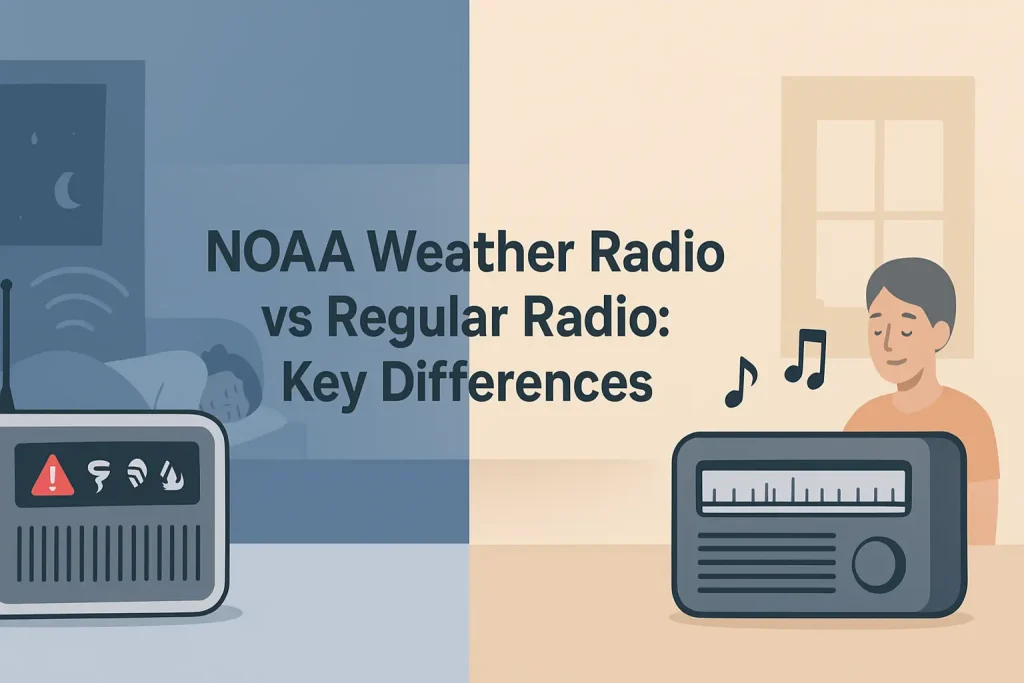
NOAA Weather Radio broadcasts on seven frequencies between 162.400 and 162.550 MHz, but a radio without S.A.M.E. technology will wake you up for every alert in your region. Phone alerts use WEA (Wireless Emergency Alerts) to target your specific location based on cell tower proximity. The difference between S.A.M.E. and WEA comes down to how strictly they filter emergency alerts by geography.
S.A.M.E. (Specific Area Message Encoding) relies on 6-digit FIPS codes that you program manually into your weather radio. WEA relies on your phone’s GPS and local cell towers to push alerts automatically. Both systems exist to prevent alert fatigue, but their reliability varies drastically depending on your location and power situation.
| Photo | Popular Portable Walkie Talkies | Price |
|---|---|---|
 | SKIWARRIOR Multifunctional Smart Wireless Ski Goggles with Walkie-Talkie, Anti-Fog Zeiss Lens, Music & Call Function (Cylindrical Blue) | Check Price On Amazon |
 | SINORISE Super Mini Walkie Talkies, Two-Way Radios, 3 Pack | Check Price On Amazon |
 | KOSPET Tank M4C Smart Watch Rugged, Dual-Band GPS, 5ATM & IP69K Waterproof | Check Price On Amazon |
 | Retevis RT15 Walkie Talkies 3 Pack, Birthday Gift, Outdoor Adventure Kit | Check Price On Amazon |
 | Rechargeable Walkie Talkies Toys for Kids: DIY Astronaut Walkie Talkies for Boys Christmas Birthday Gifts for 3 4 5 6 7 8 9 10 Boy Walkie Talkie Outdoor Hiking Toy 2 Way Radio Camping Outdoor Game | Check Price On Amazon |
By the Numbers
S.A.M.E. vs WEA – Key Specifications and Standards
Sources: NOAA NWR documentation, FEMA IPAWS
What Is S.A.M.E. and How Do County Codes Work?
S.A.M.E. is a digital protocol used by NOAA Weather Radio to encode alert information. It allows your radio to silence alerts for counties you did not program. A S.A.M.E. weather radio is a type of emergency receiver that requires manual programming of 6-digit FIPS codes.
You program these codes into your radio to restrict alerts to your specific county. The radio decodes the incoming signal on the 162.400-162.550 MHz band. If the encoded FIPS code matches your programmed code, the radio un-mutes and sounds the alarm.
This happens because NOAA transmitters cover large geographic areas, often broadcasting alerts for dozens of counties simultaneously. This only works correctly when you input the exact FIPS code for your county. If you enter the wrong code, the result is missed alerts or unwanted alerts, fix it by verifying your code on the NOAA website.
The Midland WR400 weather radio programs up to 50 S.A.M.E. location codes. It alerts you only for the counties you specify, instead of waking you for alerts across the entire state.
Proper county code programming ensures your emergency alert system functions exactly as intended without unnecessary noise.
What Is WEA and How Do Phone Alerts Work?
WEA is a public safety system that allows local authorities to send emergency alerts to mobile devices. It uses cell tower technology to broadcast alerts to any compatible phone in a targeted geographic area. WEA does not require you to register or sign up.
Your phone receives the alert if it is connected to a cell tower within the alert zone. This system works with FEMA’s IPAWS to distribute alerts for severe weather, AMBER alerts, and local emergencies. The alert overrides silent mode and do-not-disturb settings to ensure you see the warning.
Cell tower proximity causes WEA alerts to be highly targeted. This only occurs when your phone has an active cellular connection and the cell tower is functioning. If the cell tower loses power or your phone has no signal, the result is a total failure of WEA alerts, fix it by relying on a battery-powered weather radio.
Phone alerts are convenient but rely on infrastructure that can fail during the exact disasters you need them for.
S.A.M.E. vs WEA: Which Alert System Is More Reliable?
S.A.M.E. weather radios operate independently of cellular networks. They receive VHF signals directly from NOAA transmitters on 162.400-162.550 MHz. A WEA phone alert requires active cellular infrastructure and a charged battery.
Cell networks frequently fail during severe weather events like hurricanes or ice storms. A S.A.M.E. radio running on backup batteries or a hand crank will continue to receive alerts. According to FEMA IPAWS documentation, WEA is an enhancement to, not a replacement for, emergency alert systems.
Use the table below to compare the capabilities of S.A.M.E. weather radios and WEA phone alerts.
| Feature | S.A.M.E. Weather Radio | WEA Phone Alert |
|---|---|---|
| Frequency | 162.400-162.550 MHz (VHF) | Commercial Cellular Bands |
| Power Requirement | AC + Battery/Handcrank | Phone Battery |
| Geographic Filtering | Exact County FIPS Codes | Cell Tower Radius |
| Infrastructure Dependency | None (Direct from NOAA) | Requires Active Cell Towers |
| Setup Requirement | Manual FIPS Programming | Automatic |
For true emergency preparedness, independent VHF reception is vastly superior to commercial cell networks.
How to Program a S.A.M.E. Weather Radio for Your County
You program a weather radio by finding your county FIPS code and entering it into the radio’s memory. The radio then filters all incoming NOAA alerts to match only your specified geographic area. Proper programming prevents alert fatigue during regional severe weather events.
Many users find the programming process frustrating because the interface varies by model. We have provided a step-by-step visual guide below to walk you through the process on a standard desktop radio.
Step-by-Step Guide
How to Program a S.A.M.E. County Code on Your Weather Radio
4 steps – Estimated time: 5 minutes
Find your county FIPS code
Look up your 6-digit FIPS code on the NOAA Weather Radio website. The first digit is usually 0 for the eastern US or 1 for the west, and the next two digits identify your state.
Enter the setup menu
Press the Menu button on your radio. Use the up and down arrows to navigate to the S.A.M.E. programming option on your display screen.
Input the 6-digit code
Select an empty memory slot. Enter your 6-digit FIPS code using the numeric keypad or up and down arrows, then press Select to save it.
Verify the alert tone
Exit the menu and check that your radio shows the correct county name. The radio will now only sound its 1050 Hz alert tone for warnings in your programmed county.
A CHIRP-compatible programming cable is useful for two-way radios, but weather radios require manual keypad entry. Manual entry ensures the FIPS code is locked into the hardware correctly. Take your time entering the digits to avoid missing critical alerts.
Do You Need S.A.M.E. If You Have WEA on Your Phone?
You need a S.A.M.E. weather radio if you live in an area prone to power outages or cellular dead zones. WEA alerts depend entirely on a functional cellular network. S.A.M.E. radios receive signals on the VHF band, which covers 95% of the US population directly from NOAA transmitters.
Having both systems provides redundant layers of emergency communication. If your cell phone dies or the network goes offline, the weather radio still receives critical tornado warnings. Emergency communication advisors always recommend having a device that does not rely on commercial infrastructure.
To understand more about the broadcast network, you can read about how NOAA Weather Radio operates nationwide. This network provides the backbone for all S.A.M.E. alerts. Redundancy is the core principle of reliable emergency preparedness.
Why S.A.M.E. County Codes Filter Alerts Better Than GPS
S.A.M.E. county codes filter alerts based on strict political boundaries. GPS-driven WEA alerts rely on cell tower triangulation, which can be imprecise. A phone might receive an alert meant for a neighboring county if you are near a cell tower boundary.
When you program your FIPS code, the radio ignores everything outside that specific county. This prevents unnecessary wake-ups for storms that are 50 miles away but still within the transmitter’s range. This happens because NOAA uses specific 6-digit codes to designate exact counties, whereas WEA uses a radius approximation from the cell tower.
If a storm is in the next county, S.A.M.E. keeps your radio silent. This precise filtering is the main advantage of S.A.M.E. over broad commercial alert networks.
Troubleshooting S.A.M.E. Programming Issues
If your weather radio is not sounding alerts, check your FIPS code for errors first. A single mistyped digit will cause the radio to ignore alerts for your county. The radio will still display the alert, but it will not trigger the 1050 Hz alarm tone.
Ensure your antenna is fully extended and pointed toward the nearest NOAA transmitter. The transmitter broadcasts on specific frequencies, and you must tune your radio to the correct one. If you cannot hear the weekly test, the result is a silent radio during an actual emergency, fix it by repositioning the radio near a window.
Using the correct frequency is essential for receiving the digital S.A.M.E. data. You can find the right NOAA frequency for your area to ensure a clear signal. Weak signals will not decode the S.A.M.E. tones properly without a strong VHF connection.
Always verify your setup during the routine Wednesday NOAA tests to confirm everything is working. This simple check replaces guesswork with certainty.
Choosing the Right S.A.M.E. Weather Radio
Choose a S.A.M.E. weather radio with battery backup and multiple programmable memory slots. Look for models that support all 25 NOAA alert types and have an external antenna jack. The radio must operate on VHF frequencies between 162.400 and 162.550 MHz.
Desktop models are best for home use, while portable models are better for outdoor activities. The Midland WR400 provides reliable alerts at home. For outdoor use, a hand-crank emergency radio ensures you never lose power.
For home use, a weather radio suited for your bedroom should have adjustable alert volume. This prevents sudden deafening alarms at night while keeping you safe.
If you want to compare models, our list of the top-rated weather radios includes options for every budget. We also have a guide on what a S.A.M.E. weather radio is if you need more background information. A good radio is a one-time investment in safety.
How to Use Your Weather Radio During an Emergency
During an emergency, your weather radio acts as your primary source of official information. Keep it tuned to your local NOAA frequency and ensure the alert mode is active. Do not turn off the alert function if severe weather is in the forecast.
Keep spare batteries in your emergency kit. A radio with a dead battery is just as useless as a phone with no signal. You can learn how to use your weather radio effectively to maximize its lifespan and reliability.
When an alert triggers, listen for the specific event code announced by the radio. The National Weather Service uses specific codes like TOR for Tornado Warning or FFW for Flash Flood Warning. Knowing these codes helps you react faster than waiting for a voice summary.
To find the exact codes for your location, you can access our S.A.M.E. weather radio codes database. This database contains every FIPS code needed for US counties. Fast identification of alert codes saves valuable minutes during evacuations.
Can I use my phone instead of a weather radio for alerts?
You can use your phone for alerts, but it is not a reliable primary system during severe weather. Phone alerts require active cell towers and a charged battery. A VHF weather radio operating on 162.400 MHz will work even when cellular networks are down.
Phones are excellent for everyday convenience but fail when infrastructure is damaged. Always pair your phone with a dedicated hardware receiver for true preparedness.
What does a 6-digit S.A.M.E. code represent?
A 6-digit S.A.M.E. code represents a specific geographic area, usually a county. The first digit indicates the region, the next two digits identify the state, and the final three digits identify the county. You must enter this code into your radio to filter alerts.
Entering the full sequence ensures the microprocessor inside the radio decodes the correct regional warnings. Without this strict numerical matching, the radio would sound for every transmitter broadcast.
Are WEA alerts faster than weather radio alerts?
WEA alerts are not faster than weather radio alerts. The NOAA Weather Radio broadcast is the original source of the warning. WEA alerts are generated after the warning is issued and routed through commercial cell towers, adding a delay.
The digital S.A.M.E. tone triggers the moment NOAA sends the signal to the transmitter. Phone alerts can lag by 30 seconds to several minutes depending on network congestion.
Do I need a license to own a weather radio?
You do not need a license to own or operate a weather radio. Weather radios are receive-only devices that monitor the 162.400-162.550 MHz band. You only need a license if you plan to transmit on two-way radio frequencies like GMRS.
A Baofeng UV-5R can receive weather alerts, but transmitting requires a ham or GMRS license. Dedicated weather radios are completely unlicensed and free to operate.
Why does my weather radio go off for alerts in neighboring counties?
Your weather radio likely has neighboring county FIPS codes programmed into its memory, or you entered your own FIPS code incorrectly. Check your programmed codes and delete any you do not need. S.A.M.E. filtering is strict, so wrong codes will trigger unwanted alerts.
Review your memory slots and ensure only your primary and immediate adjacent counties are listed. Clearing the extra slots will restore quiet operation.
Will my weather radio work if the power goes out?
Your weather radio will work if the power goes out, provided it has backup batteries installed. Desktop models require AA batteries for backup power during outages. Portable models run entirely on batteries or hand-crank power.
Keep a fresh set of alkaline batteries in your emergency kit at all times. Lithium AA batteries offer the longest shelf life and perform best in cold weather.
Can I program my weather radio to ignore certain alerts?
Many S.A.M.E. weather radios allow you to program specific alert types to display-only mode. This means the radio shows the alert on the screen but does not sound the loud 1050 Hz tone. You can usually disable non-life-threatening alerts like winter weather advisories while keeping tornado warnings active.
Refer to your specific model’s manual to learn how to disable specific SAME event codes. This customization prevents alert fatigue from minor weather events.
What is the weekly weather radio test?
The weekly weather radio test is a mandatory check performed by the National Weather Service to ensure your radio is functioning. It usually occurs on Wednesdays between 11 AM and noon. If your radio does not alert during the weekly test, your antenna placement or programming is likely faulty.
Listen for the Required Weekly Test (RWT) code on your display. If you miss the test for two consecutive weeks, check your batteries and antenna orientation immediately.
Does WEA work on older flip phones?
WEA does not work on older flip phones that lack the required chipset and software. WEA requires a smartphone capable of receiving cellular broadcast messages. Older phones will not receive the presidential or imminent threat alerts pushed by FEMA.
Anyone using a basic flip phone or a device without modern LTE capabilities must rely on a dedicated VHF weather radio for emergency notifications. Do not assume an older phone will protect you.
S.A.M.E. and WEA serve the same purpose, but S.A.M.E. weather radios provide independent reliability that phone alerts cannot match. Programming your 6-digit FIPS code ensures you only receive alerts for your specific county on the 162.400 MHz band. Keep fresh batteries in your radio and verify your programming during the weekly NOAA test.
| Photo | TOP RATED WALKIE TALKIES | Price |
|---|---|---|
 | Retevis RT628 Kids Walkie Talkies, Toys Gifts for 4-12 Year Old Girl Boy | Check Price On Amazon |
 | Cobra ACXT545 Weather-Resistant Walkie Talkies, Rechargeable, 22 Channels | Check Price On Amazon |
 | Retevis RT388 Kids Walkie Talkies, Outdoor Toys for Kids Camping Essentials | Check Price On Amazon |
 | Cobra RX680 Walkie Talkies (2-Pack), IP54 Water Resistant Design | Check Price On Amazon |
 | Retevis RT22 Walkie Talkies Long Range Rechargeable with Earpiece (2 Pack) | Check Price On Amazon |
 | Midland GXT1000VP4 GMRS Two-Way Radios with Headsets, Black, 2 Pack | Check Price On Amazon |
 | Retevis RT628 Walkie Talkies for Kids,Toys Gifts for 6-12 Years Old Boys Girls,Long Range 2 Way Radio 22CH VOX,Birthday Gift,Family Walkie Talkie for Camping Hiking Indoor Outdoor | Check Price On Amazon |