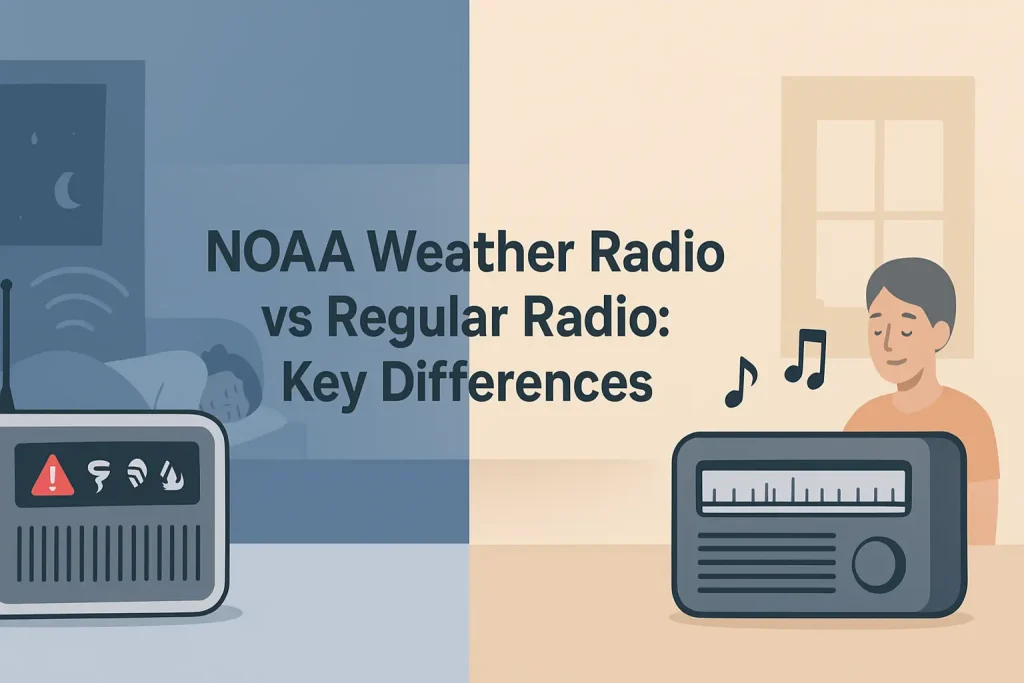
Your Midland weather radio is only as good as the signal it can receive. A stock internal antenna works fine when you live within a few miles of a NOAA transmitter, but add some distance, a concrete wall, or a basement location, and that signal drops fast. An external antenna can recover much of that lost reception, sometimes turning a barely audible alert into a clear, reliable alarm.
NOAA broadcasts weather alerts 24 hours a day on seven dedicated VHF frequencies. Those frequencies sit between 162.400 MHz and 162.550 MHz, a band where signal behaves like light: it travels in straight lines, bends poorly around terrain, and gets absorbed quickly by building materials.
The closer your antenna is to line-of-sight with the nearest NOAA transmitter, the stronger your received signal will be. That is the physics your external antenna upgrade is working with.
Which Midland Weather Radios Support an External Antenna?
Most Midland desktop weather radios include a BNC (Bayonet Neill-Concelman) antenna port on the rear panel. This includes the Midland WR400, the Midland WR120B, and the Midland WR300. The BNC port accepts a standard BNC-terminated antenna cable directly, with no adapter needed for most aftermarket VHF antennas.
Portable and hand-crank Midland models, such as the Midland ER310, typically use a fixed internal antenna with no external port. If you rely on a portable model, your upgrade options are limited to antenna positioning, not replacement.
Check your specific model’s rear panel before purchasing any external antenna hardware. A BNC port looks like a small bayonet-style locking connector, roughly 0.75 inches in diameter, with a center pin. If your model has this port, you can connect any BNC-terminated 162 MHz VHF antenna directly.
The section below focuses on desktop models with BNC ports, since those are the units that benefit most from an external antenna upgrade.
Key Specifications: Midland WR400 and WR120B Antenna Ports
Use the table below to confirm your Midland model’s antenna connector type before purchasing hardware.
| Model | External Antenna Port | Connector Type | S.A.M.E. | Form Factor |
|---|---|---|---|---|
| Midland WR400 | Yes | BNC female | Yes (50 codes) | Desktop |
| Midland WR120B | Yes | BNC female | Yes (25 codes) | Desktop |
| Midland WR300 | Yes | BNC female | Yes (25 codes) | Desktop |
| Midland ER310 | No | Internal only | No | Portable |
| Midland HH54VP2 | No | Internal only | No | Portable |
If your model has a BNC port, your antenna upgrade path is straightforward and inexpensive. Most quality external VHF antennas for 162 MHz cost between $15 and $60.
By the Numbers
Midland Weather Radio External Antenna – Key Specifications and Standards
Sources: NOAA National Weather Service NWR documentation, FCC Part 15, Midland Radio technical specifications
Why Does an External Antenna Improve Reception on 162 MHz?
A stronger antenna improves your weather radio reception because 162 MHz VHF signals travel in near-perfect straight lines. Any obstruction between your radio and the NOAA transmitter (a hill, a building, a dense tree line, or even your own roof) absorbs or deflects signal energy before it reaches your receiver. A higher, better-positioned external antenna reduces the number of obstructions in the signal path.
This happens because VHF frequencies above 30 MHz do not bend around the Earth’s curvature the way lower HF frequencies do. The NOAA transmitter at 162.550 MHz behaves like a flashlight, not a floodlight. What is directly in front of it gets illuminated. What is behind a wall or below a ridge does not.
The condition for improved reception is simple: the external antenna must have a clearer line of sight to the nearest NOAA transmitter than your radio’s internal antenna does. In a single-story home, the difference between a radio on your kitchen counter and an antenna mounted on your roofline can equal 20 to 30 feet of additional height, which translates directly to a longer horizon and fewer signal-blocking obstructions.

If the condition is not met (your external antenna is still indoors at the same height as your radio), the improvement will be minimal. The gain comes from height and positioning, not just from plugging in an external cable.
According to NOAA’s National Weather Radio All Hazards technical documentation, NOAA transmitters operate at power levels between 300 watts and 1,000 watts effective radiated power (ERP), with coverage designed for outdoor reception at the edge of the 40-mile service radius. Indoor reception at the same distance is always weaker because building materials attenuate the signal. An outdoor-mounted external antenna effectively puts your receiver at the point where NOAA’s coverage was designed to reach.
The practical result: better signal strength means fewer missed alerts, less static during severe weather events (when signals can be disrupted by atmospheric conditions), and reliable S.A.M.E. code decoding even at greater distances from the transmitter.
What Types of External Antennas Work with Midland Weather Radios?
Four main antenna types work at 162 MHz for NOAA weather radio reception. Each has a different gain level, installation complexity, and ideal use case. The right choice depends on how far you are from the nearest NOAA transmitter and where you can physically mount the antenna.
Simple Whip Antennas (2-3 dBi Gain)
A simple quarter-wave or half-wave whip antenna cut for 162 MHz is the most common external antenna upgrade for desktop weather radios. These antennas are omni-directional, meaning they receive equally well from all horizontal directions. That matters for weather radios because you do not always know which direction your nearest NOAA transmitter is located.
The BNC-terminated VHF whip antennas designed for marine radios work extremely well with Midland weather radios because marine VHF operates in the 156-162 MHz range, overlapping directly with NOAA weather radio frequencies. A marine VHF whip antenna designed for 162 MHz provides 3 dBi of gain and attaches directly to the BNC port on the WR400 or WR120B.
For indoor mounting on a window sill or bookshelf, a simple whip is sufficient. For outdoor mounting, you will need a mounting bracket and a short coaxial cable run to connect the antenna to your radio.
Magnetic Mount Antennas (2-3 dBi Gain, Easy Outdoor Placement)
Magnetic mount VHF antennas provide a fast, no-drill option for metal surfaces such as a metal roof, a filing cabinet near a window, or a vehicle rooftop. The magnetic base creates a ground plane that improves performance, and the built-in coaxial cable runs through a window or door gap to reach your radio’s BNC port.
Most magnetic mount antennas for VHF come with 12 to 17 feet of coaxial cable, which is enough to reach an outdoor surface from most interior radio locations. The tradeoff is that coaxial cable introduces a small amount of signal loss (typically 0.5 to 1 dB per 10 feet of RG-58 cable), so keep the cable run as short as practical.
If you cannot mount an antenna permanently outdoors, a magnetic mount on a metal window frame or the metal casing of an appliance near a window gives you most of the outdoor benefit without drilling a single hole.
Discone Antennas (0 dBi Gain, Extremely Wideband)
A discone antenna is a wideband omni-directional antenna that covers a frequency range typically from 25 MHz to 1,300 MHz. It does not have the gain of a tuned whip or Yagi, but it covers 162 MHz well and can also serve a scanner radio or GMRS radio on the same installation. If you already have a scanner or plan to add one, a single outdoor discone handles multiple radios simultaneously.
Discone antennas require outdoor mounting and a coaxial feedline run. They are physically larger than whip antennas (typically 24 to 36 inches in diameter), which makes them visible from the street but very effective in marginal reception areas.
Yagi Directional Antennas (6-9 dBi Gain, Maximum Range)
A Yagi directional antenna tuned for 162 MHz provides 6 to 9 dBi of gain in a single, aimed direction. This is the maximum gain option for weather radio reception and is appropriate when you are 40 to 60 miles from the nearest NOAA transmitter, or when terrain or building construction is blocking the signal severely.
The downside is that a Yagi must be pointed directly at the NOAA transmitter. You lose the omni-directional coverage of a whip or discone. For a weather radio that only needs to receive alerts from a single known transmitter direction, this is an acceptable trade. But if you are near the border of two transmitter coverage areas and want to receive both, a Yagi will only serve one.
Yagi antennas require outdoor mounting, careful aiming using a compass bearing to the nearest NOAA transmitter (available from the NOAA transmitter location map at weather.gov), and a coaxial feedline. They are overkill for most residential users but genuinely useful for rural locations beyond 40 miles from a transmitter.
The right antenna type for most Midland weather radio users is a BNC-terminated VHF whip or magnetic mount antenna, installed as high as practical, with the shortest possible coaxial cable run to the radio.
How to Connect an External Antenna to a Midland Weather Radio
Connecting an external antenna to a Midland WR400 or WR120B takes about 15 minutes for an indoor whip installation and about 60 to 90 minutes for a rooftop or attic mount with a cable run. The process below covers both scenarios step by step.
The following step-by-step guide shows exactly how to install an external antenna on your Midland weather radio, from choosing the right cable to verifying improved signal strength after connection.
Step-by-Step Guide
How to Connect an External Antenna to a Midland Weather Radio
6 steps · Estimated time: 15 to 90 minutes depending on installation type
Locate the BNC antenna port on your Midland radio
Check the rear panel of your Midland WR400, WR120B, or WR300 for the BNC female connector. It is a circular bayonet-style port approximately 0.75 inches in diameter with a center pin and two locking tabs around the rim.
Choose your antenna and coaxial cable
Select a BNC-terminated VHF antenna rated for 162 MHz, such as a marine VHF whip or a dedicated weather radio external antenna. Use RG-58 or RG-6 coaxial cable with BNC connectors for runs under 25 feet. For longer runs, use RG-8X to minimize signal loss.
Position the antenna as high as practical
For indoor installations, place the antenna on a high shelf near an exterior window facing the direction of your nearest NOAA transmitter. For outdoor installations, mount on the roofline, attic vent, or exterior wall using a standard antenna J-mount or L-bracket, and route the coaxial cable through a wall or window opening.
Connect the BNC cable to the radio port
Push the BNC connector onto the radio’s BNC port, align the two tabs with the slots, and rotate clockwise until it locks with a click. Do not overtighten. The connection should feel firm with no wobble when complete.
Scan all 7 NOAA weather channels to verify improved signal
Power on your Midland radio and press the scan button to cycle through channels WX1 (162.550 MHz) through WX7 (162.525 MHz). Identify the channel with the clearest audio and lowest static. This is typically the channel corresponding to your nearest NOAA transmitter, and you should notice a clear improvement in audio quality compared to the internal antenna.
Re-program your S.A.M.E. codes and test the alert tone
After confirming the best channel, re-enter your 6-digit FIPS S.A.M.E. county code if it was cleared during the antenna change. Then press the test button (if your model has one) or wait for the next weekly NOAA alert test, typically broadcast on Wednesdays, to confirm full end-to-end alert functionality with the new antenna.
What Coaxial Cable Should You Use Between the Antenna and Radio?
The coaxial cable connecting your external antenna to the Midland radio’s BNC port introduces signal loss, and the longer the cable run, the more signal you lose before it reaches the receiver. For most residential installations with cable runs under 20 feet, RG-58 coaxial cable with BNC connectors is the standard choice and costs about $8 to $15 for a pre-made 12-foot run.
RG-58 loses approximately 1.5 dB per 100 feet at 162 MHz. A 20-foot run causes only 0.3 dB of loss, which is negligible compared to the 3-5 dBi of gain your external antenna adds. For runs over 50 feet, switch to RG-8X cable, which loses only 0.75 dB per 100 feet at VHF frequencies and is still flexible enough to route through a window or wall opening.
Use the table below to choose the right cable type for your installation distance.
| Cable Type | Loss at 162 MHz (per 100 ft) | Best Run Length | Flexibility | Approx. Cost (12 ft pre-made) |
|---|---|---|---|---|
| RG-58 | 1.5 dB | Under 25 ft | High | $8-$15 |
| RG-8X | 0.75 dB | 25 to 75 ft | Medium | $18-$30 |
| LMR-240 | 0.5 dB | 75 to 150 ft | Low | $35-$60 |
| LMR-400 | 0.3 dB | Over 150 ft | Very low (rigid) | $60-$120 |
For almost every home weather radio installation, RG-58 or RG-8X is the practical choice. LMR-400 is used in commercial installations where the antenna is mounted on a tower 100 or more feet from the receiver, which is not a realistic scenario for a residential weather radio setup.
Always choose the shortest cable run that physically works. Every unnecessary foot of cable costs you signal strength you cannot recover at the receiver end.
Do You Need an Antenna Adapter for a Midland Weather Radio?
Most Midland desktop weather radios use a BNC female connector on the radio body. Most aftermarket VHF antennas also terminate in BNC connectors. In many cases, you can connect an external antenna directly to the radio without any adapter. However, some antenna types use PL-259 (also called UHF connector, a misleading name) or SMA connectors, which require a short adapter to mate with the radio’s BNC port.
Here are the adapter combinations you are most likely to encounter:
- BNC male to BNC female (no adapter needed): Direct connection. Applies to most pre-made VHF whip antennas and marine antenna cables sold with BNC terminations.
- PL-259 to BNC female adapter: Required if your coaxial cable or antenna is terminated with a PL-259 (standard for most VHF/UHF amateur antennas). A PL-259 to BNC adapter costs about $3 to $8.
- SMA female to BNC male adapter: Required if you are adapting a Baofeng-style SMA antenna for testing purposes. A SMA to BNC adapter costs about $5 to $10, though this is an uncommon scenario for weather radios.
- F connector to BNC adapter: Required if you are using a TV antenna coaxial cable (F connector) as a feedline to a DIY antenna. An F to BNC adapter costs about $3 to $6.
Keep adapters short and use them sparingly. Each adapter junction introduces a small amount of signal loss and a potential point of failure, especially in outdoor installations exposed to moisture. If you need more than one adapter in series, it is better to buy a pre-made cable with the correct termination at each end.
Confirming your connector types before purchasing saves you a frustrating round trip to the hardware store. The right antenna and the right cable, chosen together from the start, gives you a clean, low-loss signal path with no adapters required.
How Much Does an External Antenna Actually Improve Midland Weather Radio Reception?
A well-installed external antenna improves weather radio reception in three measurable ways: stronger received signal strength, cleaner audio with less static, and more reliable S.A.M.E. code decoding at the edge of transmitter coverage. The improvement in decibels depends on the antenna type, installation height, and your distance from the nearest NOAA transmitter.
Here is what a realistic upgrade looks like across different installation scenarios:
The following before-and-after comparison shows the real-world impact of adding an external antenna to a Midland WR400 placed inside a single-story home at 35 miles from the nearest NOAA transmitter.
Results
What Changes When You Add an External Antenna to a Midland Weather Radio
Impact of upgrading from internal antenna to outdoor-mounted VHF whip at 35 miles from NOAA transmitter
Before (Internal Antenna)
- ✗Audible static and signal dropout on WX1 (162.550 MHz)
- ✗S.A.M.E. code alerts occasionally fail to decode, causing missed county-level notifications
- ✗Reception drops further during severe weather when atmospheric absorption increases
- ✗Radio must be placed near an exterior wall or window to receive any usable signal in a basement or interior room
After (Outdoor VHF Whip Antenna, Roofline Mount)
- ✓Clear audio on WX1 at 35 miles with no audible static during normal broadcast
- ✓S.A.M.E. code decoding reliable for every alert type including Tornado Warning and Flash Flood Warning
- ✓Signal holds stable during storm events that previously caused dropout
- ✓Radio can now be positioned anywhere in the house, including basement, without signal loss
An outdoor-mounted VHF whip antenna adds approximately 3-5 dBi of effective gain over the internal antenna, which roughly doubles received signal power at the edge of transmitter coverage range.
The biggest gains come not from expensive antennas but from antenna height and positioning. Moving an antenna from inside the house at waist height to outside the house at roofline height can add 10 to 15 dB of effective signal improvement, which is far more than any antenna upgrade alone can provide at the same location.
If you are within 20 miles of a NOAA transmitter with no significant terrain blocking the path, even a simple $15 outdoor whip antenna will likely give you perfect reception. If you are 40 to 60 miles out or on the wrong side of a ridge, a Yagi directional antenna combined with rooftop mounting becomes worth the additional investment and installation effort.
What Is the Best External Antenna for a Midland WR400 or WR120B?
The best external antenna for most Midland WR400 and WR120B owners is a BNC-terminated half-wave VHF dipole or a marine-grade VHF whip antenna mounted outdoors at roofline height. These antennas provide 2.15 to 3 dBi of gain, are omni-directional, and cost between $20 and $45. They work for every NOAA broadcast direction without aiming.
For users within 30 miles of a transmitter, an indoor whip antenna placed near an exterior window is sufficient. For users 30 to 50 miles from the transmitter or with obstructed signal paths, an outdoor mount is the single most impactful change you can make.
Here are the top external antenna options by use case:
Best for Most Users: Midland 18-ERBN External Antenna
Midland manufactures a dedicated external antenna for their weather radio lineup, the Midland 18-ERBN. It includes a BNC connector that plugs directly into the WR400 or WR120B rear port, a 25-foot coaxial cable, and a mounting bracket. This antenna is tuned for 162 MHz, costs about $20 to $25, and is the simplest plug-and-play solution for Midland users. If you do not want to research connector types or cable specifications, this is the straightforward answer.
Key Specifications:
- Frequency: 162.400 to 162.550 MHz (all 7 NOAA channels)
- Connector: BNC male (direct fit for Midland WR400, WR120B, WR300)
- Cable length: 25 feet included
- Gain: approximately 2-3 dBi
- Price: approximately $20 to $25
Best Outdoor Upgrade: Shakespeare 5225-XT Marine VHF Antenna
The Shakespeare 5225-XT marine VHF antenna is a 3 dBi fiberglass omni-directional whip designed for the 156-163 MHz range, which includes all NOAA weather frequencies. It is a marine-grade antenna rated for outdoor exposure and UV resistance, cost roughly $35 to $50, and mounts on any standard 1-inch pipe or antenna mast. With a PL-259 to BNC adapter ($4), it connects directly to the Midland WR400 or WR120B. This is one of the most durable outdoor antenna options for weather radio use at residential installations.
Best Budget Option: Indoor BNC VHF Whip
A simple BNC-terminated VHF indoor whip antenna for 162 MHz costs about $10 to $20 and provides a measurable improvement over the Midland radio’s built-in internal antenna. Position it near an exterior window on the side of the house closest to your nearest NOAA transmitter. While it will not match the performance of an outdoor rooftop-mounted antenna, it is a zero-effort, zero-drilling upgrade that takes about two minutes to install.
Best for Rural or Fringe Coverage Areas: Yagi Directional Antenna
If you are more than 40 miles from the nearest NOAA transmitter or located on the far side of a ridge or hill from the transmitter, a 3-element Yagi antenna tuned for 162 MHz and mounted outdoors provides 6 to 7 dBi of directional gain. You will need to aim it toward the transmitter using compass bearings from the NOAA transmitter location database, but the gain improvement is substantial and can make reception possible where the internal antenna receives nothing at all. Budget approximately $40 to $70 for the antenna and mounting hardware.
The right choice for the majority of Midland weather radio users is the Midland 18-ERBN or a similar BNC-terminated outdoor VHF whip, mounted as high as practical with the shortest possible cable run.
How to Find Your Nearest NOAA Weather Radio Transmitter
Knowing which direction your nearest NOAA transmitter is located helps you position a directional antenna correctly and helps you understand which of the seven NOAA frequencies (WX1 through WX7) carries your local alerts. The NOAA National Weather Radio All Hazards website at weather.gov/nwr provides a transmitter location map that shows every NWR transmitter in the continental United States, Alaska, Hawaii, and Puerto Rico.
To find your nearest transmitter, visit weather.gov/nwr and use the station finder tool. Enter your zip code or county name. The tool returns the nearest transmitter’s call sign (for example, KHB35 or WWG24), its frequency (one of the seven NOAA channels), its location by city, its effective radiated power in watts, and its coverage radius in miles.
Write down the frequency of the transmitter that covers your county. That is the channel your Midland weather radio should be set to monitor, and that is the direction to aim a Yagi antenna if you choose a directional antenna. Most NOAA transmitters operate at either 1,000 watts ERP (for major metropolitan coverage areas) or 300 watts ERP (for rural and secondary transmitters).
If your county falls within coverage range of two different NOAA transmitters on different frequencies, use the one that delivers the clearest signal on your radio’s channel scan. In practice, this is typically the transmitter closest to your location.
You can also check your reception on all seven NOAA frequencies by pressing the scan button on your Midland WR400 or WR120B. The channel with the clearest audio and no squelch noise is your primary signal source. For in-depth guidance on setting up your Midland radio after you have confirmed your best channel, our guide on programming a weather radio for county-specific S.A.M.E. alerts walks through every menu step.
Can You Use a TV Antenna or FM Radio Antenna with a Midland Weather Radio?
A TV antenna or FM antenna will not provide useful reception improvement for a Midland weather radio on 162 MHz. Standard indoor TV antennas (also called HDTV antennas) are designed for UHF frequencies between 470 and 806 MHz, which is far above the 162 MHz NOAA weather band. An FM broadcast antenna covers 87.5 to 108 MHz, which is far below 162 MHz. Neither type is resonant at 162 MHz, meaning they do not efficiently capture energy at that frequency.
Connecting a TV antenna to your Midland WR400 with an adapter might produce a marginal improvement over no antenna at all, simply because any conductor connected to the antenna port picks up some stray RF energy. But a properly sized VHF antenna tuned for 162 MHz will outperform a mismatched TV or FM antenna by a wide margin.
The one exception is a wideband antenna, such as a discone or a log-periodic antenna, that covers 100 MHz to 1,000 MHz. These antennas are not optimized for 162 MHz but they do receive signals at that frequency acceptably well. If you already have a discone antenna installed for a scanner radio, connecting your Midland weather radio to the same antenna via a coaxial splitter is a reasonable option, understanding that a dedicated 162 MHz antenna would still perform better.
For the best result with minimum complexity, buy an antenna that is specifically designed for 162 MHz operation. The cost difference between a dedicated weather radio antenna and an improvised TV antenna workaround is typically less than $20, and the performance difference is significant.
Quick Reference: Weather Radio External Antenna Terms
BNC connector: A bayonet-style RF connector used on most Midland desktop weather radios. BNC stands for Bayonet Neill-Concelman. It locks with a quarter-turn twist and is the standard antenna port type on the WR400, WR120B, and WR300.
dBi (decibels isotropic): A measurement of antenna gain relative to a theoretically perfect omni-directional point source. Higher dBi means more signal captured in the antenna’s favored direction. A standard internal whip antenna provides approximately 0-2 dBi. A quality outdoor VHF whip provides 3-5 dBi. A Yagi directional antenna provides 6-9 dBi.
S.A.M.E. (Specific Area Message Encoding): The digital encoding technology used by NOAA to target weather alerts to specific counties or areas. Your Midland WR400 or WR120B uses your 6-digit FIPS county code to filter incoming alerts. S.A.M.E. decoding requires a strong enough signal to receive the digital header correctly. Weak signals cause decoding failures and missed alerts.
ERP (Effective Radiated Power): The actual power output of a NOAA transmitter after accounting for antenna gain. Most primary NOAA transmitters operate at 1,000 watts ERP. Rural secondary transmitters operate at 300 watts ERP. Higher ERP means stronger signals at longer distances.
FIPS code: Federal Information Processing Standard county code. A 6-digit number identifying your specific county for S.A.M.E. programming. You enter this code into your Midland weather radio so it alerts only for your county, not every county in your state.
RG-58: A flexible coaxial cable type commonly used for short antenna feedline runs at VHF frequencies. Suitable for runs up to 25 feet at 162 MHz before signal loss becomes significant.
Omni-directional antenna: An antenna that receives signals equally well from all horizontal compass directions. Appropriate for weather radios when the NOAA transmitter direction is unknown or when the radio may need to receive from multiple transmitter directions.
Yagi antenna: A high-gain directional antenna that concentrates reception sensitivity in a single direction. Requires aiming toward the target transmitter. Provides 6-9 dBi of gain for weather radio use at long distances or obstructed locations.
Line of sight: A direct unobstructed path between two antennas. VHF signals at 162 MHz travel primarily by line of sight. Terrain, buildings, and dense vegetation between your antenna and the NOAA transmitter attenuate the signal. Height improves line of sight by extending the effective horizon.
Signal attenuation: The reduction in signal strength caused by distance, obstructions, or cable loss. Measured in decibels (dB). Every 3 dB of additional gain from your antenna doubles the received signal power at the receiver.
Coaxial splitter: A passive device that divides one antenna signal across two or more receivers. Each port of a splitter introduces approximately 3.5 dB of insertion loss. Using a splitter to share one antenna between two radios reduces the signal available to each by roughly half.
Impedance (50 ohm vs 75 ohm): Weather radios and most communications antennas use 50-ohm impedance. TV antennas and cable TV coaxial cable use 75-ohm impedance. Mixing 50-ohm and 75-ohm components causes an impedance mismatch that reduces signal efficiency. Always use 50-ohm cable and connectors for your weather radio antenna installation.
Common Mistakes to Avoid When Installing a Midland Weather Radio External Antenna
Most external antenna installations that fail to improve reception do so because of a small number of predictable mistakes. Avoiding these saves you both money and frustration.
Using a Cable That Is Too Long
Coaxial cable signal loss at 162 MHz is real and measurable. A 100-foot run of RG-58 costs you 1.5 dB of signal, which offsets roughly half the gain your external antenna provides. Keep cable runs as short as physically possible. Route the antenna cable through the most direct path from the radio to the antenna mounting point, not the most convenient one.
If you have leftover cable after installation, cut it to length and re-terminate with a BNC connector rather than coiling the excess. A coil of unused cable acts as an inductor that can further degrade signal quality.
Installing the Antenna Too Low
An external antenna mounted at window height inside the house provides only marginal improvement over the radio’s internal antenna. The goal is to get the antenna above the roofline or at least above the level of nearby obstructions. Even 10 feet of additional height translates to a meaningfully longer line-of-sight horizon, which directly improves signal reception at VHF frequencies.
If a full outdoor rooftop installation is not practical, mount the antenna in the attic. Attic-mounted antennas lose some signal through the roof materials (typically 1 to 3 dB depending on roofing material and metal content), but they perform far better than indoor counter-level placements and require no external weatherproofing.
Using a Mismatched Connector Without Checking the Impedance
Connecting a 75-ohm TV cable (F connector) to a 50-ohm radio antenna port via adapters introduces an impedance mismatch. This creates signal reflection at the mismatch point, which reduces the signal reaching the receiver. The loss is not catastrophic (typically 0.5 to 1 dB at 162 MHz for a 50-to-75-ohm mismatch), but it is avoidable. Use 50-ohm RG-58 or RG-8X cable throughout your installation.
Forgetting to Re-Program S.A.M.E. Codes After the Upgrade
Some users disconnect their Midland radio from power during an antenna installation and find that the S.A.M.E. codes were cleared from memory. Always verify your FIPS county code is still programmed after an antenna change by entering the programming menu and confirming the stored codes. Your local 6-digit FIPS code is available from the NOAA weather.gov county listing or from the FEMA IPAWS county code database.
Skipping this check means your radio is receiving perfect signal but filtering for the wrong area, which produces no alerts even during active weather events in your county.
Placing the Antenna Near Metal Objects That Cause Detuning
A VHF antenna needs several inches of clearance from large metal objects (metal roof panels, steel gutters, aluminum window frames) to function correctly. Metal objects in the near field of the antenna change its resonant frequency, reducing efficiency at 162 MHz. Mount the antenna at least 12 inches from any large metal surface for best performance.
The single most impactful antenna upgrade for most Midland WR400 and WR120B users is a short coaxial cable run to an outdoor-mounted BNC whip antenna at roofline height, using 50-ohm RG-58 cable, with the antenna positioned well clear of metal roofing or gutters.
How Does an External Antenna Affect S.A.M.E. Alert Reliability?
S.A.M.E. (Specific Area Message Encoding) alert decoding is directly dependent on received signal quality. A signal that is strong enough for audible voice reception may still be too weak for error-free S.A.M.E. digital header decoding. This is one of the most important and least understood reasons to install an external antenna on a Midland weather radio.
This happens because S.A.M.E. headers are transmitted as a burst of AFSK (Audio Frequency Shift Keying) digital data before the voice message. The data transmission rate is 1,200 bits per second at 162 MHz. Any signal degradation during that header burst (static, dropout, multipath interference) can corrupt one or more bytes of the FIPS county code, causing your Midland WR400 or WR120B to reject the alert as not matching your programmed location.
The condition for reliable S.A.M.E. decoding is a received signal strength ratio (signal-to-noise ratio) of approximately 12 dB above the radio’s noise floor. Below that threshold, decoding errors increase rapidly. At 30 dB above the noise floor, decoding is essentially perfect. An external antenna that adds 3 to 5 dBi of gain can move a borderline installation from unreliable decoding into the reliable zone.
If your Midland weather radio frequently fails to trigger alerts that you know were broadcast for your county (confirmed by your neighbors receiving alerts or by checking the NOAA alert log at weather.gov), and the voice audio you hear during manual monitoring sounds clean but the alert mode stays silent, S.A.M.E. decoding failure from a weak signal is the most likely cause. An external antenna is the correct fix.
After installing an external antenna, you can verify improved S.A.M.E. decoding by waiting for the next weekly NOAA test broadcast (typically Wednesday at noon local time in most areas) and confirming the radio activates its alert tone and displays the test message correctly. If it does, your S.A.M.E. decoding path is now reliable. For a deeper look at how the WR400 handles S.A.M.E. programming and alert reception, our detailed full review of the Midland WR400’s alert performance and S.A.M.E. features covers the complete specification set.
Can You Share One External Antenna Between Two Weather Radios or Devices?
You can share one external antenna between two weather radios using a passive coaxial splitter, but the signal split introduces loss. A standard two-way coaxial splitter divides the incoming signal power equally between two output ports and introduces approximately 3.5 dB of insertion loss per port. That means each radio receives roughly half the signal power that a single connected radio would receive.
Whether this tradeoff is acceptable depends on your signal margin. If your external antenna provides clean, strong reception with signal to spare (for example, you are within 15 miles of a NOAA transmitter with a 3 dBi gain antenna), the 3.5 dB split loss still leaves you well above the threshold for reliable S.A.M.E. decoding on both radios. If you are at 40 miles with a borderline signal, splitting the antenna may push both radios back into unreliable decoding territory.
The better solution for most situations is to run two separate antennas (one per radio) rather than splitting a single antenna. A second BNC whip antenna and a 25-foot cable run costs about $20 to $30, which is less than the cost of a quality coaxial splitter plus the performance you give up.
If you need to share one outdoor antenna between a weather radio and a scanner radio that also monitors 162 MHz channels, a quality 50-ohm BNC coaxial splitter is a reasonable choice when the signal strength is high enough to absorb the split loss. Confirm both ports on the splitter are 50-ohm (not 75-ohm TV-type) to avoid an impedance mismatch.
What Should You Do If an External Antenna Does Not Improve Reception?
If you install an external antenna and hear no improvement in audio quality or S.A.M.E. alert reliability, the problem is almost always one of three things: the antenna is still too low, the cable has a fault, or the radio’s BNC connector is not making solid contact. Work through these in order before assuming the antenna itself is defective.
Check Antenna Height and Positioning First
An external antenna inside the house at counter height may actually perform worse than the radio’s internal antenna in some cases, because the external antenna cable can act as an unintended conductor that picks up electrical interference from appliances. Move the antenna to a window ledge or above the roofline before drawing any conclusions about performance.
Compare audio quality by temporarily holding the external antenna at window height with the cable extended out the window, even just resting on the sill. If audio improves, the antenna works but needs a higher permanent mount. If audio does not improve in any position, the cable or connection is the issue.
Inspect the Coaxial Cable and BNC Connections
A loose or corroded BNC connection causes signal loss that can fully negate any antenna gain. Disconnect and reconnect the BNC cable at both ends, ensuring the bayonet locks with a positive click at the radio’s port. Inspect the center pin of the cable’s BNC connector under good light. If the pin is bent, corroded, or recessed, the connector is the failure point.
Test with the shortest possible cable segment (or the antenna connected directly to the BNC port with no cable extension) to confirm the antenna itself functions before diagnosing a longer cable run.
Confirm You Are on the Correct NOAA Channel
External antenna improvements are only meaningful on the channel that carries your nearest NOAA transmitter’s signal. Scan all seven channels (WX1 through WX7) with the external antenna connected and identify which one has the strongest, clearest audio. If you have been monitoring a channel that does not carry your local transmitter, switching to the correct channel will produce a more dramatic improvement than any antenna upgrade alone.
If none of the above steps resolve the reception problem, consult the NOAA NWR transmitter coverage maps at weather.gov/nwr to verify that a NOAA transmitter is actually within range of your location. Some rural areas have gaps in NWR coverage where no single transmitter provides reliable signal. In those cases, a high-gain directional Yagi antenna aimed at the nearest transmitter (even if it is 50 to 60 miles away) may be the only solution short of relying on cellular-based emergency alerts as a backup system.
For a broader look at weather radio options that might suit locations with difficult reception conditions, our comparison of top-rated weather radios for weak-signal and fringe-coverage locations includes models optimized for marginal NWR reception areas.
Is It Worth Upgrading the External Antenna on a Budget Midland Weather Radio?
An external antenna upgrade is worth the cost on any Midland desktop weather radio that has a BNC port, regardless of the radio’s price tier. A $30 weather radio with a $20 outdoor antenna and a $10 cable is a better alert system than a $100 weather radio with only its internal antenna, if the external antenna adds enough signal margin to make S.A.M.E. decoding reliable. The antenna matters more than the radio’s feature set when the core issue is signal reception.
The cost of a basic external antenna upgrade for a Midland WR120B or WR400 breaks down as follows:
- Midland 18-ERBN dedicated antenna with 25-foot cable: approximately $20 to $25
- Marine VHF whip antenna plus PL-259 to BNC adapter: approximately $35 to $55
- Yagi directional antenna for rural/fringe locations: approximately $40 to $70, plus mounting hardware ($10 to $20)
- Coaxial cable run if not included with antenna: $8 to $30 depending on cable type and length
Total investment for a complete outdoor antenna upgrade is $30 to $100 for most residential installations. Against the cost of a missed Tornado Warning or Flash Flood Warning, this is a straightforward investment in the reliability of a safety device that already sits on your shelf.
For the Midland WR120B specifically, which uses the same BNC port as the WR400 but has a more compact form factor and fewer S.A.M.E. code slots (25 versus 50 on the WR400), our complete technical review of the Midland WR120B’s reception performance and alert features covers how the radio performs at varying distances from NOAA transmitters, both with and without external antenna assistance.
Can I Use a Baofeng or Handheld Radio Antenna on a Midland Weather Radio?
A Baofeng UV-5R or similar handheld radio antenna uses an SMA connector, not a BNC connector. It is physically possible to connect it to a Midland weather radio’s BNC port using an SMA-female to BNC-male adapter, but the practical benefit is limited. Most Baofeng rubber duck antennas are optimized for either 136-174 MHz VHF or 400-520 MHz UHF operation. The VHF tuning of a Baofeng stock antenna overlaps with 162 MHz well enough to receive a signal, so this works as a quick test.
A better dedicated option, if you already have Baofeng equipment, is the Nagoya NA-771, a 15.6-inch dual-band whip antenna with 2.15 dBi gain on VHF. With an SMA-to-BNC adapter, it functions as a serviceable external antenna for a Midland weather radio at 162 MHz. It is not purpose-built for 162 MHz, but it is a reasonable no-cost experiment if you already own one.
For any permanent installation, a dedicated 162 MHz antenna will outperform a repurposed handheld radio antenna. But for testing whether an external antenna makes a difference at your location before committing to a purchase, the Baofeng SMA-to-BNC workaround is a legitimate diagnostic step.
Does the Eton FRX3 Plus or Other Weather Radios Support External Antennas?
The Eton FRX3 Plus does not include an external antenna port. It uses a fixed internal telescoping antenna and is designed as a portable emergency radio rather than a permanently installed desktop alert system. The same applies to most hand-crank and solar-powered emergency radios in the portable category.
If you rely on an Eton FRX3 Plus or a similar portable weather radio as your primary alert device and you are experiencing poor reception, your options are: repositioning the radio near an exterior window with the telescoping antenna fully extended, elevating the radio on a high shelf or near the attic, or replacing it with a desktop model that includes a BNC external antenna port, such as the Midland WR400 or WR120B.
For a full comparison of how the Eton FRX3 Plus stacks up against desktop weather radios in terms of reception sensitivity and alert reliability, our detailed review of the Eton FRX3 Plus alert performance and portability features covers its internal antenna sensitivity relative to dedicated desktop receivers. If you are weighing portable versus desktop options and cannot decide which format fits your needs, our complete guide to selecting the right weather radio for your home and environment walks through the decision factors for both categories.
Can I Use an External Antenna on a Midland Weather Radio in an RV or Vehicle?
Yes, and this is one of the most practical use cases for an external antenna on a Midland weather radio. An RV presents two reception challenges: its metal shell attenuates the 162 MHz signal, and the vehicle moves between transmitter coverage areas. An external roof-mounted VHF antenna solves both problems simultaneously.
A magnetic mount VHF antenna placed on the metal roof of an RV with the coaxial cable routed through a window or roof vent provides excellent 162 MHz reception and requires no permanent drilling. Choose a magnetic mount antenna with an NMO or BNC connector, and confirm the coaxial cable length is sufficient to reach from the roof to the radio’s interior location (typically 12 to 17 feet for most RV layouts).
For truck or car use with a Midland WR400 or similar desktop radio mounted in the cab, the same magnetic mount approach works on the metal roof. The vehicle’s metal body acts as a ground plane that further improves antenna efficiency, often producing better reception than a residential indoor installation.
Keep the magnetic mount antenna base clean and free of dirt between the magnet and the roof surface. A dirty contact point reduces the ground plane efficiency and slightly degrades antenna performance over time.
What NOAA Alert Types Depend Most on Strong External Antenna Reception?
All 25 EAS (Emergency Alert System) event codes that NOAA broadcasts over the NWR network depend on reliable signal for S.A.M.E. decoding. But some alert types carry a higher urgency penalty for decoding failures than others.
According to NOAA’s NWR technical documentation and FEMA IPAWS published alert priority lists, the highest-priority alerts where a missed notification carries the greatest immediate safety consequence are:
- Tornado Warning (TOR): Issued for confirmed tornado on the ground or detected by radar. Lead time is typically 8 to 13 minutes. A missed alert in this category carries the highest life-safety risk.
- Flash Flood Warning (FFW): Issued for imminent or occurring flash flooding. Particularly critical in nighttime hours when ambient alerts (outdoor sirens) may not be audible.
- Hurricane Warning (HUW): Issued for sustained winds of 74 mph or higher expected within 36 hours. Critical in coastal areas during tropical season.
- Civil Emergency Message (CEM): Issued by civil authorities for imminent threats not weather-related, including hazardous materials events, dam failures, or nuclear incidents.
- Immediate Evacuation Warning (EVI): Issued for immediate life-safety evacuations. Extremely time-sensitive.
A weather radio that misses a Tornado Warning S.A.M.E. decode because of weak signal is not a functional safety device. The entire value of a desktop weather radio over a smartphone emergency alert is the ability to alert you even when your phone is silent, off, or out of range. That value depends entirely on reliable signal reception, which an external antenna directly improves.
If your household includes people who sleep with phones silenced or in another room, a Midland desktop weather radio with a reliable external antenna and the alarm set to maximum volume is the most reliable way to receive nighttime severe weather alerts. For guidance on choosing which weather radio model best fits your household situation before adding an external antenna, the guide to finding and purchasing a quality weather radio for your area covers in-store and online purchasing options with coverage maps by region.
Does Antenna Gain on an External Antenna Require an FCC License?
No FCC license is required to use an external antenna on a receive-only weather radio. The Midland WR400, WR120B, and all other consumer NOAA weather radios are receive-only devices. They do not transmit on any frequency. FCC licensing requirements apply to transmitting devices, not receiving equipment. Adding an external antenna to a receive-only weather radio is completely legal under FCC Part 15, which governs unintentional radiators and receiving devices.
There is no restriction on antenna gain for receive-only applications. You can use a 9 dBi Yagi antenna on your weather radio without any licensing, registration, or FCC notification. The gain limit rules that apply to devices like Wi-Fi routers (also governed by Part 15 but for transmitters) have no bearing on a receive-only weather radio antenna installation.
The only practical limitation is physical (the antenna must be safely mounted) and signal-path efficiency (more antenna gain only helps up to the point where the received signal saturates the radio’s front-end, which is not a realistic concern at 162 MHz for residential distances from NOAA transmitters).
Is a Midland Weather Radio External Antenna Worth It for Urban Locations?
In a dense urban environment, the signal obstruction comes from concrete and steel buildings rather than terrain. NOAA transmitters serving major metropolitan areas typically operate at 1,000 watts ERP with multiple transmitters to provide coverage redundancy, which means urban users are often closer to a transmitter than rural users. But the building construction materials in urban environments absorb 162 MHz signal aggressively.
Concrete construction attenuates VHF signals by approximately 15 to 20 dB per wall. A radio inside a concrete apartment building on a lower floor can receive a signal 30 to 40 dB weaker than the same radio positioned at an outdoor window on the same building. An external antenna mounted on the building’s rooftop or at the window ledge directly facing the NOAA transmitter direction recovers most of that attenuation.
For apartment dwellers without access to a rooftop or exterior wall mount, the most practical option is a BNC-terminated VHF whip antenna placed on the window sill or suction-cup-mounted to the window glass on the exterior-facing side of the apartment, as close to an exterior wall as possible. Window glass attenuates 162 MHz signals much less than concrete (approximately 1 to 3 dB depending on glass type and Low-E coating), so a window-positioned antenna provides a significant improvement over a radio placed deep inside the room.
Urban users with a strong NOAA signal (confirmed by scanning WX channels and hearing a clear broadcast) do not need a high-gain directional antenna. A simple omni-directional BNC whip at window level is the right tool. The improvement is incremental but real, and the S.A.M.E. decoding reliability benefit applies equally whether you are in a rural farmhouse or a 15th-floor urban apartment.
Can I Use a DIY Antenna for a Midland Weather Radio?
A DIY dipole antenna cut for 162.550 MHz (the center of the NOAA weather radio band) is easy to build, costs less than $5 in materials, and performs as well as most commercial VHF whip antennas at 2.15 dBi gain. The formula for a half-wave dipole is simple: each element is 17.7 inches long (calculated as 468 divided by frequency in MHz, divided by 2, then divided by 2 again for each element of the dipole).
To build a 162 MHz half-wave dipole:
- Cut two lengths of 14-gauge solid copper wire, each 17.7 inches long.
- Strip both ends of a length of RG-58 coaxial cable.
- Solder one wire element to the center conductor of the coax (the hot element).
- Solder the second wire element to the braided shield of the coax (the ground element).
- Orient the two elements in a straight vertical line (one pointing up, one pointing down) for maximum omni-directional coverage.
- Attach a BNC male connector to the other end of the RG-58 cable and connect to the radio’s BNC port.
This DIY antenna performs equivalently to a purchased VHF whip at 162 MHz. If you already have RG-58 cable and a BNC connector on hand, the only material cost is a few feet of wire. A BNC male crimp connector kit costs about $5 to $10 if you need one. For a DIY approach, this is the most cost-effective path to a functional external antenna for your Midland weather radio.
What Is the Difference Between an External Antenna and Repositioning the Radio?
Repositioning the radio to a better location in the house costs nothing and should always be tried before purchasing external antenna hardware. The difference between a radio on a basement shelf and the same radio on an upper-floor windowsill can be 10 to 20 dB of signal improvement, far more than any antenna upgrade provides.
The value of an external antenna is that it delivers the reception benefits of a high, well-positioned antenna without requiring the radio to be placed at that location. An external antenna lets you keep the radio in a convenient bedroom or kitchen location (for nighttime alerting) while the antenna does its job from the roofline or attic where the signal is strongest.
Try repositioning first. If the radio receives a clear signal on WX1 (or your local channel) when placed near a high exterior window, an external antenna simply makes that good reception available everywhere in your house, not just at the window.
If the radio cannot receive a usable signal even at the best window position, an external rooftop antenna is the next step. Antenna placement and height matter more than the antenna’s technical gain specification. A 2 dBi whip at roofline height will outperform a 6 dBi Yagi at window height in most residential scenarios.
Understanding the full range of weather radio options before committing to a specific installation approach helps ensure you are solving the right problem. Our overview of currently recommended desktop and portable weather radios across price ranges includes reception sensitivity comparisons that show how different models perform before any external antenna is added.
How Do You Know If Your External Antenna Is Working Correctly?
The clearest confirmation that your external antenna is working is a noticeable improvement in audio clarity and a reduction in background static when you switch from the internal antenna to the external antenna on your strongest NOAA channel. Most Midland WR400 and WR120B models disconnect the internal antenna automatically when a cable is plugged into the BNC port, so the comparison is automatic: unplug the external cable and listen, then plug it back in and listen again.
A second confirmation method is timing your next NOAA weekly test broadcast. In most regions, NOAA broadcasts a weekly test of the alert system on Wednesdays. The test includes a S.A.M.E. header followed by an alert tone followed by a voice message. If your Midland radio sounds its alarm and displays the test message correctly, your S.A.M.E. decoding path is working end-to-end with the external antenna connected.
If you want a more quantitative assessment, a handheld signal strength meter or a software-defined radio (SDR) receiver connected to a laptop can display the actual received signal level at 162 MHz before and after the antenna installation. An RTL-SDR USB dongle costs about $25 to $35 and can display signal levels across the VHF spectrum, including the 162 MHz NOAA band, giving you a before-and-after measurement in dB. This is not necessary for most users, but it is a useful diagnostic tool for anyone troubleshooting a difficult reception location or trying to optimize antenna positioning for maximum gain.
A functioning external antenna on a properly positioned Midland WR400 or WR120B gives you the most reliable possible foundation for receiving NOAA weather alerts when severe weather threatens your area.
Does an External Antenna for a Weather Radio Also Receive NOAA Alerts on Multiple Frequencies?
Yes. An omni-directional VHF antenna tuned for 162 MHz receives all seven NOAA weather radio channels simultaneously, because all seven fall within a 150 kHz span (162.400 to 162.550 MHz) that any properly designed 162 MHz antenna covers with essentially flat gain across the entire sub-band. Your Midland weather radio selects which channel to monitor through its tuning, not through the antenna. The antenna simply provides signal across the entire frequency range, and the radio’s front-end filter and crystal discriminator handle channel selection.
This is different from a TV antenna, where different antenna elements are optimized for different broadcast frequency groups. A 162 MHz VHF whip or dipole antenna works equally well on WX1 (162.550 MHz), WX2 (162.400 MHz), or any of the remaining five NOAA channels. You do not need a separate antenna for each channel, and you do not need to retune the antenna when switching between NOAA frequencies during a channel scan.
An external antenna is the most direct, lowest-cost upgrade available for improving the reliability of any Midland desktop weather radio that has a BNC port. The installation is simple, the equipment costs between $20 and $70 for most residential scenarios, and the improvement in S.A.M.E. alert reliability at the edge of NOAA transmitter coverage is real and measurable. If your Midland weather radio is a safety device rather than a background appliance, giving it the antenna it needs to do its job reliably is the right investment.
An outdoor-mounted BNC-terminated VHF whip antenna, connected to your Midland WR400 or WR120B with 50-ohm RG-58 cable in the shortest run physically possible, is the right answer for most users. Install it at roofline height, clear of large metal surfaces, aimed for maximum sky exposure in the direction of your nearest NOAA transmitter, and your weather radio will deliver the reliable nighttime alerts it was designed to provide.