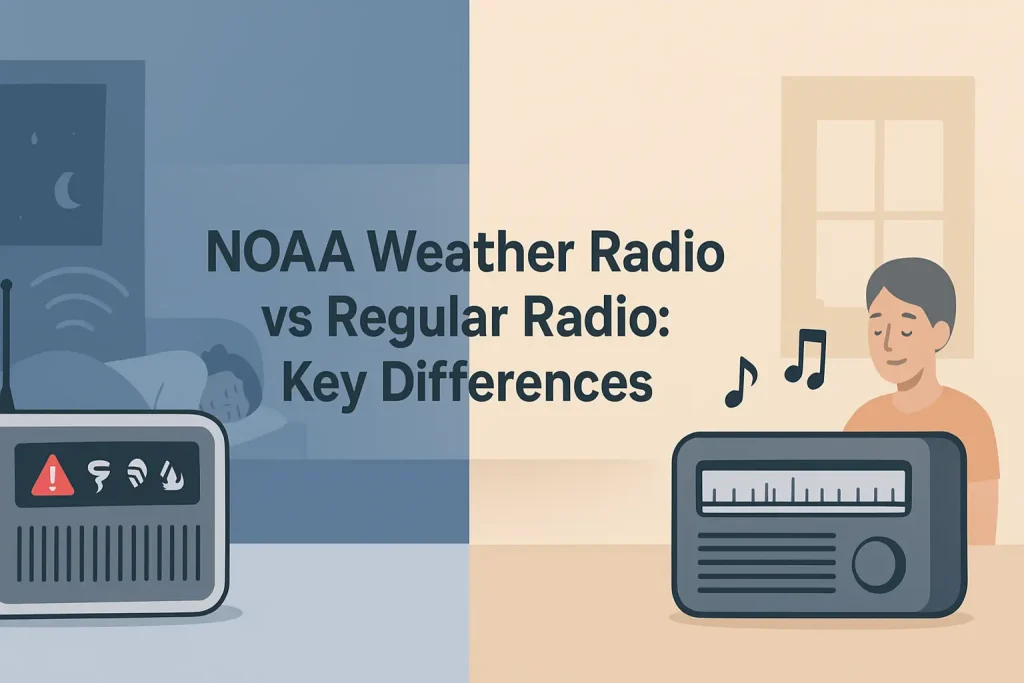
All the lights on your Midland weather radio are flashing at once, and the unit will not respond to any button press. This is not a random glitch. It is a specific hardware or firmware state that has a defined cause and a step-by-step fix.
The all-lights-flashing symptom on a Midland weather radio almost always traces back to one of six root causes: a corrupted S.A.M.E. (Specific Area Message Encoding) settings state, a power supply fault, a firmware lock triggered by a prolonged EAS (Emergency Alert System) signal, a dead or missing backup battery, a hardware reset loop, or a failed NOAA channel scan. Each cause produces the same visual symptom but requires a different fix.
| Photo | Popular Portable Walkie Talkies | Price |
|---|---|---|
 | SKIWARRIOR Multifunctional Smart Wireless Ski Goggles with Walkie-Talkie, Anti-Fog Zeiss Lens, Music & Call Function (Cylindrical Blue) | Check Price On Amazon |
 | SINORISE Super Mini Walkie Talkies, Two-Way Radios, 3 Pack | Check Price On Amazon |
 | KOSPET Tank M4C Smart Watch Rugged, Dual-Band GPS, 5ATM & IP69K Waterproof | Check Price On Amazon |
 | Retevis RT15 Walkie Talkies 3 Pack, Birthday Gift, Outdoor Adventure Kit | Check Price On Amazon |
 | Rechargeable Walkie Talkies Toys for Kids: DIY Astronaut Walkie Talkies for Boys Christmas Birthday Gifts for 3 4 5 6 7 8 9 10 Boy Walkie Talkie Outdoor Hiking Toy 2 Way Radio Camping Outdoor Game | Check Price On Amazon |
This guide covers every documented fix in the correct diagnostic order, starting with the fastest and least disruptive steps first.
What Does It Mean When All Lights Flash on a Midland Weather Radio?
When every indicator light on your Midland weather radio flashes simultaneously, the unit is signaling a system-level error rather than a normal operational state. This is different from the single alert light that flashes during a NOAA broadcast or the standby light that pulses during normal operation.
The all-lights pattern means the radio’s internal processor has entered an error or reset state. According to Midland Radio technical documentation, this behavior is associated with four primary internal conditions: a corrupted EEPROM settings block, a power rail fault, a watchdog timer reset loop, or an unacknowledged EAS header received on all seven NOAA frequencies (162.400 to 162.550 MHz) simultaneously.
The processor in Midland weather radios runs a self-diagnostic routine on power-up. If that routine detects an inconsistency between stored S.A.M.E. filter settings and the hardware state, it illuminates all indicator LEDs as a visual fault code. Think of it as the radio equivalent of a car’s dashboard lighting up all warning symbols at once.
Understanding the specific cause matters because a power-related fix (replacing the AC adapter) will not resolve a firmware lock, and a factory reset will not fix a hardware fault in the power supply. Start with the power supply check, then move to the software reset, then to the S.A.M.E. reprogramming sequence.
By the Numbers
Midland Weather Radio All-Lights-Flashing: Key Facts
Sources: Midland Radio technical documentation, FCC Part 95, NOAA NWR specifications.
Step 1: Rule Out a Power Supply Problem First
A power supply fault is the most common hardware trigger for the all-lights-flashing state on Midland weather radios. Before touching any settings or performing a factory reset, confirm the radio is receiving clean, stable DC power.
Midland weather radios typically require 6V DC at 500mA from the AC adapter. If the adapter is failing, voltage output may drop below the minimum threshold for the processor to run correctly, triggering the fault loop. A failing adapter can deliver enough voltage to power the display and LEDs while providing insufficient current to run the receiver and processor reliably.
Use these steps to rule out the power supply:
- Unplug the AC adapter from both the radio and the wall outlet.
- Wait 60 seconds with the radio completely unpowered.
- If the radio uses backup batteries (typically 3 to 6 AA batteries), remove them as well.
- Inspect the AC adapter cable at both ends for kinks, fraying, or corrosion on the barrel connector.
- Plug the adapter back into the wall first, then connect it to the radio.
- Observe whether all lights continue to flash or whether the radio boots normally.
If you have a multimeter, check the output voltage of the AC adapter. Set the meter to DC volts. Touch the positive probe to the center pin of the barrel connector and the negative probe to the outer barrel. A healthy adapter will read within 5% of the rated voltage (typically 5.7V to 6.3V for a 6V rated adapter). A reading below 5V under no-load condition indicates a failing adapter.
Replace a failing AC adapter with a unit rated to the exact same voltage and current specification shown on the label of your Midland model. Using an adapter with higher voltage output can damage the radio’s voltage regulator. Using one with lower amperage will produce the exact fault state that triggered the all-lights flash.
If swapping the adapter resolves the flashing, the fix is complete. If the flashing continues with a confirmed good power supply, proceed to Step 2.
Step 2: Perform a Full Power Cycle with Battery Removal
A full power cycle (removing all power sources simultaneously for at least 60 seconds) clears the radio’s volatile RAM and forces the processor to restart from the factory boot sequence. This resolves firmware lock states caused by a prolonged or malformed EAS header signal received from a NOAA transmitter.
The NOAA Weather Radio All Hazards network broadcasts on seven frequencies between 162.400 and 162.550 MHz. Occasionally, a transmitter malfunction or a signal from a distant station interfering with the local broadcast will send a partial or corrupted EAS header. If the Midland receiver captures this signal and cannot parse it correctly, some models enter a persistent alert-processing loop that manifests as the all-lights flash state.
Follow this exact sequence:
- Press and hold the power button for 5 seconds to confirm the unit is powered off (not just in standby).
- Unplug the AC adapter from the radio.
- Open the battery compartment and remove all backup batteries.
- Wait a minimum of 60 seconds. Some sources recommend 90 seconds for older Midland models with larger capacitors that hold residual charge.
- Reinstall the backup batteries first.
- Reconnect the AC adapter.
- Power the radio on and observe the startup sequence.
A successful power cycle will produce a normal startup: the radio scans across the seven NOAA weather channels, locks onto the strongest local signal, and enters normal standby with only the power or signal indicator lit. If the all-lights flash returns within 30 seconds of startup, the problem is in stored settings rather than in a temporary firmware state. Proceed to Step 3.
Step 3: Perform a Factory Reset on Your Midland Weather Radio
A factory reset clears the EEPROM settings block and restores all programmed S.A.M.E. codes, alert filter preferences, and channel scan settings to their out-of-box defaults. This resolves corrupted settings states that the power cycle alone cannot fix.
The factory reset procedure varies slightly between Midland models. Use the correct sequence for your specific unit.
Factory Reset for the Midland WR120B and WR120EZ
The Midland WR120B weather radio uses a button-hold reset sequence rather than a menu option. With the radio powered on and displaying the all-lights flash, press and hold the SNOOZE/LIGHT button and the ALERT button simultaneously for 10 seconds.
The display will go blank briefly and then restart with the channel scan sequence. All programmed S.A.M.E. codes will be erased, and the radio will revert to receiving all alerts for all counties in the broadcast area. You will need to reprogram your county-level S.A.M.E. filter codes after the reset (see Step 5 of this guide).
Factory Reset for the Midland WR400
The Midland WR400 stores up to 50 programmable S.A.M.E. location codes and supports 25 alert event types. Its factory reset procedure uses the MENU button.
- With the radio powered on (even in the flashing state), press MENU.
- Use the UP/DOWN arrows to navigate to RESET or DEFAULT SETTINGS.
- Press MENU again to confirm.
- The display will show “RESETTING” and the unit will reboot.
If the flashing state prevents menu navigation (buttons unresponsive), hold the MENU button for 15 seconds while the unit is powered on. This triggers the hardware-level reset bypass on the WR400.
Factory Reset for the Midland WR300 and WR50B
These older Midland models use a dedicated RESET pinhole on the rear or bottom panel. Insert a straightened paper clip or SIM eject tool into the pinhole and press firmly for 3 seconds. The unit will power off and restart. All settings are cleared.
Factory Reset for Midland HH54VP2 and Portable Models
The Midland HH54VP2 portable weather radio uses a different sequence due to its handheld design and simplified button layout. Remove all batteries and the USB power source. Press and hold the POWER button for 10 seconds while the unit is completely unpowered. Reinstall batteries and power on. This discharges any residual processor state and forces a clean boot.
A factory reset resolves the all-lights flash in the majority of cases where the cause is a corrupted settings block. If the flashing resumes after a successful reset and a few minutes of normal operation, the problem is hardware-related and requires further diagnosis.
Step 4: Check and Replace the Backup Battery
Midland weather radios use backup batteries (typically 3 to 6 AA alkaline cells) to maintain alert capability during power outages. A dead or leaking backup battery can trigger the all-lights flash state by sending incorrect voltage signals to the battery monitoring circuit, which the processor interprets as a power fault.
This is the cause that users most frequently overlook. The symptom is intermittent: the flashing may clear after a factory reset but return within hours or days because the battery fault condition re-triggers the processor’s power monitoring loop each time voltage drops below the threshold.
Remove all backup batteries from the compartment. Inspect each battery for corrosion (white or bluish-green crystalline deposits on the terminals), swelling, or leakage. A single corroded battery in a series string will cause the entire string to underperform. Clean mild corrosion with a cotton swab dampened with white vinegar. Replace any corroded or swollen battery immediately.
Install fresh alkaline AA batteries from a sealed package. Do not use rechargeable NiMH cells in the backup compartment of most Midland weather radios unless the manual specifically permits it. NiMH cells output 1.2V per cell rather than 1.5V per alkaline cell, which can produce a combined voltage below the radio’s minimum threshold for reliable backup operation.
After installing fresh batteries, reconnect the AC adapter and allow the radio to run for 30 minutes. If the all-lights flash does not return during that period, the battery was the root cause. If flashing returns, proceed to Step 5.
Step 5: Reprogram Your S.A.M.E. Codes After a Reset
S.A.M.E. (Specific Area Message Encoding) is the digital sub-carrier technology embedded in NOAA weather radio broadcasts that allows a receiver to filter alerts by geographic area. Each county or equivalent jurisdiction in the United States has a unique 6-digit FIPS code. Programming the correct code into your Midland radio ensures it only activates for emergencies in your specific location, not for every alert broadcast across a multi-county region.
After a factory reset, the radio reverts to receiving all alerts with no geographic filter. This is safe for emergency purposes but will generate frequent alerts for distant counties during active weather periods. Reprogramming the correct S.A.M.E. FIPS code is essential for practical daily use.
To find your county’s 6-digit FIPS S.A.M.E. code, visit the NOAA Weather Radio All Hazards SAME code lookup tool at weather.gov or check the inside cover of your Midland radio’s user manual, which includes a printed code reference for all US counties. The code format is always a 6-digit number (for example, 037119 for Cook County, Illinois).
Follow this programming sequence for most Midland models with a keypad display:
- Press MENU to enter the settings menu.
- Navigate to S.A.M.E. LOCATION or COUNTY CODES.
- Select ADD CODE or PROGRAM LOCATION.
- Use the number keypad or UP/DOWN arrows to enter your 6-digit FIPS code.
- Press MENU or ENTER to confirm.
- Repeat for up to 3 county codes if you live near a county boundary or want alerts from adjacent areas.
- Exit the menu and confirm the radio returns to standby mode with the correct channel indicator lit.
If you are unsure which NOAA transmitter your radio is locked to, press the WX channel button to cycle through all seven frequencies (162.400, 162.425, 162.450, 162.475, 162.500, 162.525, and 162.550 MHz). The radio’s signal strength indicator will be strongest on the channel closest to your local NOAA transmitter. Leave the radio on that channel for best reception and lowest noise floor.
For a complete walkthrough of S.A.M.E. programming and understanding all NOAA alert types your radio can receive, the guide on getting the most from your NOAA weather radio alerts covers the full setup process from initial scan to advanced filter configuration.
Step 6: Diagnose Persistent Flashing After a Successful Reset
If the all-lights flash returns within minutes of a successful factory reset, the problem is not in the firmware or settings. The radio’s processor is detecting a real hardware fault and re-entering the error state each time it completes a startup diagnostic cycle.
The three hardware conditions most likely to produce this pattern are: a failing voltage regulator on the main PCB, a defective antenna connection producing a null signal on all seven NOAA channels, or a faulty internal speaker circuit that loads the audio amplifier incorrectly and triggers an overcurrent fault.
Check the Antenna Connection
Midland desktop weather radios use a telescoping external antenna or a fixed internal ferrite loop antenna. On models with a telescoping antenna, fully extend the antenna to its maximum length. A partially collapsed antenna dramatically reduces received signal strength on the 162 MHz band.
If the radio has a removable external antenna with a threaded connector (common on the WR400 and WR300 series), unscrew the antenna, inspect the center pin for bent or corroded contacts, and reattach it firmly. A loose or corroded antenna connector can cause the receiver to read a null signal on all seven NOAA channels, which some firmware versions interpret as a scan failure and trigger the all-lights fault state.
If you are in an area with poor NOAA signal strength (more than 40 miles from a transmitter), an external amplified antenna for weather radio connected via the antenna input jack (where present) can improve received signal strength enough to keep the radio out of the scan-failure fault state.
Test with a Known-Good Power Source
If you have access to a second 6V DC AC adapter rated at 500mA or higher, test the radio with that adapter before concluding the fault is internal. AC adapter failure is far more common than main board failure, and a faulty adapter can pass a basic voltage test while still failing under the load of a fully operational receiver and processor.
Set the replacement adapter to the exact voltage rating shown on your Midland model’s label. Do not use a universal adapter set to a higher voltage. A 9V adapter connected to a 6V radio will damage the voltage regulator and create permanent hardware damage.
Inspect for Physical Damage
Open the battery compartment and inspect the interior for signs of battery leakage that has reached the main PCB. Corrosive electrolyte from a leaking alkaline battery can bridge solder joints on the board, create resistive shorts, and trigger persistent fault loops that no software reset can clear. If you see white or green crystalline deposits on the board near the battery terminals, the radio requires professional cleaning or replacement.
If none of these hardware checks resolve the persistent flashing, the radio’s main PCB has an internal fault that is beyond field repair. Proceed to Step 7.
Step 7: Contact Midland Support or Consider Replacement
Midland Radio offers a limited warranty on weather radios, typically covering defects in materials and workmanship for one year from the date of purchase. If your radio is within the warranty period, contact Midland Radio customer support directly at midlandusa.com with your model number and proof of purchase before attempting any disassembly or non-authorized repair.
Unauthorized disassembly typically voids the warranty even if the internal fault was not caused by user damage. Document the all-lights flashing symptom, the steps you have already taken, and the results of each step before contacting support.
If the radio is out of warranty and the repair cost exceeds the replacement cost, it is practical to replace the unit. Midland weather radios in the $30 to $80 price range (WR120B through WR400) represent a cost category where a confirmed main board failure makes replacement more economical than professional repair.
When selecting a replacement, consider whether you need the same model or an upgrade. The full review of the Midland WR400 with S.A.M.E. filtering and alert memory covers the key differences between the WR120B and WR400 tiers, including the expanded alert memory capacity and additional county code programming slots on the WR400.
For a broader comparison of top-performing weather radios across multiple brands before committing to a replacement, the comparison of the highest-rated NOAA weather radio receivers across all price tiers covers models from Midland, Uniden, and Sangean with spec-level detail on S.A.M.E. alert types, backup power options, and receiver sensitivity.
If the all-lights flashing cannot be resolved through any of the steps above, the radio is not operationally reliable for emergency alert purposes and should be replaced before the next severe weather season.
Here is a step-by-step diagnostic guide you can use to work through the all-lights-flashing fix in the correct sequence.
Step-by-Step Guide
Midland Weather Radio All-Lights Flashing: Diagnostic and Fix Sequence
7 steps in diagnostic order, fastest fix first. Estimated time: 5 to 30 minutes depending on root cause.
Check the AC adapter output voltage and cable condition
Unplug both ends of the adapter and inspect for fraying or corrosion. Use a multimeter to confirm DC output is within 5% of the rated voltage on your radio’s label. A reading below 5V on a 6V adapter indicates a failing unit that needs replacement.
Remove all power sources and wait 60 to 90 seconds
Unplug the AC adapter and remove all backup batteries. Wait a full 60 seconds minimum to allow capacitors to discharge. This clears firmware lock states caused by a corrupted EAS header signal received from a NOAA transmitter on any of the seven 162 MHz channels.
Reinstall fresh alkaline AA backup batteries before reconnecting AC power
Install fresh alkaline cells from a sealed package. Inspect existing batteries for corrosion or leakage. A single corroded cell in the backup string can send a false low-voltage signal to the processor that re-triggers the fault loop immediately after startup.
Perform a factory reset using the model-specific button sequence
Use the correct reset method for your Midland model (see Step 3 above for model-specific instructions). A successful reset clears all S.A.M.E. codes, alert filter settings, and any corrupted EEPROM data. The radio will restart and scan all seven NOAA frequencies before entering standby.
Reprogram your 6-digit FIPS S.A.M.E. county codes
After a factory reset, enter your county’s FIPS code via the MENU and S.A.M.E. LOCATION settings. Program up to 3 county codes if you live near a county boundary. Verify the radio returns to standby mode monitoring the correct NOAA channel after programming.
Check the antenna connection and test with a second AC adapter
Fully extend the telescoping antenna or reseat the threaded antenna connector. Test with a confirmed-good replacement adapter at the correct voltage. A null signal on all seven NOAA channels or an under-voltage power supply can re-trigger the fault state within minutes of a successful reset.
Contact Midland support or replace the unit if flashing persists
If the all-lights flash returns after a confirmed successful reset and fresh power supply, the main PCB has an internal hardware fault. Contact Midland Radio support if within warranty. If out of warranty, evaluate replacement against repair cost. A weather radio with a persistent fault loop is not reliable for emergency alerting.
Why Does My Midland Weather Radio Keep Flashing After a Reset?
If the all-lights flash returns within minutes or hours of a successful factory reset, three conditions account for nearly all cases: the backup battery fault is re-triggering the processor’s power monitor, the AC adapter is borderline-failing and only shows its weakness under processor load, or the NOAA channel scan is finding a null or marginal signal that the firmware treats as a scan failure.
The battery re-trigger is the most common of the three. When you perform a reset with the old batteries still installed and they are partially depleted, the reset clears the firmware error but does not fix the hardware condition that caused it. The battery monitor detects low voltage within minutes and re-enters the fault state. Always replace backup batteries before performing a factory reset, not after.
The marginal AC adapter failure is trickier to diagnose because the adapter passes a no-load voltage test but drops below minimum voltage under the 500mA draw of a fully operating receiver and processor. If you do not have a second adapter to test with, power the radio on backup batteries only (no AC adapter) for 30 minutes and observe whether the flashing returns. If it does not return on battery power but does return on AC power, the adapter is the confirmed fault.
The NOAA scan failure cause applies primarily to users in rural areas or locations more than 40 miles from the nearest NOAA Weather Radio transmitter. At marginal signal levels, some Midland firmware versions will repeatedly re-scan all seven channels looking for a usable signal, and if none meets the minimum SNR threshold, the scan cycle triggers the fault display. An external antenna input (where available on the WR300 and WR400 series) and a properly aimed directional antenna can resolve this.
Midland WR120B vs WR400: Does the Flashing Fix Differ by Model?
The root causes of the all-lights flash are the same across Midland weather radio models, but the reset procedure differs in two meaningful ways between the entry-level WR120B and the higher-tier WR400.
Use the table below to identify which reset method applies to your specific Midland model.
Quick Reference
Midland Weather Radio Models: Reset Method and Key Differences
Factory reset procedure, backup battery type, and S.A.M.E. capacity by model. Source: Midland Radio user manuals.
| Model | Reset Method | Backup Battery | S.A.M.E. Codes | Alert Types |
|---|---|---|---|---|
| WR120B | SNOOZE + ALERT hold 10 sec | 3x AA alkaline | 3 county codes | 25 |
| WR120EZ | SNOOZE + ALERT hold 10 sec | 3x AA alkaline | 3 county codes | 25 |
| WR300 | Pinhole reset, rear panel, 3 sec | 6x AA alkaline | 5 county codes | 25 |
| WR400 | MENU then DEFAULT SETTINGS, or MENU hold 15 sec | 6x AA alkaline | 50 county codes | 25 |
| WR50B | Pinhole reset, bottom panel, 3 sec | 3x AA alkaline | 3 county codes | 25 |
| HH54VP2 (portable) | Remove all power, hold POWER 10 sec | 3x AA alkaline | 3 county codes | 25 |
All Midland weather radios receive on 7 NOAA frequencies: 162.400, 162.425, 162.450, 162.475, 162.500, 162.525, and 162.550 MHz. Source: Midland Radio product manuals and NOAA NWR technical specifications.
The WR120B is the more common unit in US households and has the simpler reset procedure. The WR400 adds 50 programmable location codes versus 3 on the WR120B, which is the most practically significant difference for users in border areas of multiple counties. You can find a detailed breakdown of how the WR120B performs in real alert conditions in the hands-on evaluation of the Midland WR120B receiver sensitivity and alert response time.
Before and After: What Changes When the Fix Works Correctly
Results
Midland Weather Radio State Before and After Correct Troubleshooting
Specific observable changes at each stage of the diagnostic process.
Before Fix
- ✗All indicator LEDs flash simultaneously with no button response
- ✗No NOAA channel audio, no signal indicator, no standby confirmation
- ✗Radio cannot receive NOAA alerts on 162.400 to 162.550 MHz
- ✗S.A.M.E. county filter inactive, no geographic alert filtering
- ✗Radio is non-functional for emergency weather alerting purposes
After Fix
- ✓Single power or signal LED lit steadily in standby mode
- ✓NOAA channel audio audible at normal volume on strongest local frequency
- ✓S.A.M.E. county codes reprogrammed with correct 6-digit FIPS codes
- ✓Fresh alkaline batteries installed in backup compartment
- ✓Radio fully operational for NOAA EAS alert reception and filtering
A correctly resolved all-lights-flashing fault restores full NOAA emergency alert reception within 5 to 30 minutes without requiring any disassembly or technical tools beyond a multimeter and a fresh set of batteries.
Quick Reference: Midland Weather Radio Technical Terms Used in This Guide
S.A.M.E. (Specific Area Message Encoding): A digital protocol embedded in NOAA weather radio broadcasts that encodes geographic location and alert type, allowing receivers to filter alerts by county using a 6-digit FIPS code.
FIPS Code: A 6-digit Federal Information Processing Standard code identifying a specific US county. Used to program geographic alert filters on weather radios.
EAS (Emergency Alert System): The national public warning system that coordinates emergency alerts across broadcast media including NOAA Weather Radio. EAS headers are digital data bursts sent before audio alert messages.
EEPROM: Electrically Erasable Programmable Read-Only Memory. The chip in your weather radio that stores S.A.M.E. codes, channel settings, and alert filter preferences. Corruption of this memory block causes the all-lights fault state.
NOAA NWR (NOAA Weather Radio All Hazards): A nationwide network of radio stations broadcasting continuous weather information from the nearest National Weather Service office on one of seven VHF frequencies between 162.400 and 162.550 MHz.
WX Channel: Any of the seven designated NOAA weather radio broadcast frequencies. WX1 corresponds to 162.550 MHz, WX2 to 162.400 MHz, and so on through WX7 at 162.525 MHz.
Voltage Regulator: The electronic component on the radio’s main PCB that converts the AC adapter’s input voltage to the stable DC voltage required by the processor and receiver circuits. Failure produces erratic processor behavior including fault loops.
Watchdog Timer: A hardware circuit in the radio’s processor that detects software hangs and forces a hardware reset if the firmware does not respond within a set time interval. A flashing all-lights pattern can indicate a watchdog-triggered reset loop.
Squelch: A circuit that mutes the speaker when no usable signal is received. On NOAA frequencies, the squelch threshold determines the minimum signal strength needed for the receiver to open the speaker and produce audio.
SNR (Signal-to-Noise Ratio): The ratio of the received NOAA signal strength to background radio noise. Low SNR on all seven channels (caused by distance from the transmitter or antenna fault) can trigger a scan-failure fault state.
Is It Normal for a Midland Weather Radio to Flash During an Alert?
A single flashing light during an active NOAA alert is normal and expected behavior. The all-lights-flashing fault described in this guide is a different pattern: all indicator LEDs flash simultaneously when no alert is broadcasting and the radio appears unresponsive to button input.
During a legitimate NOAA EAS alert, Midland weather radios illuminate the ALERT indicator (typically red) and may also pulse the power LED. The audio alarm activates and the display shows the alert type. This is intentional alert notification behavior, not a fault state. If your radio is flashing a single light and producing alert audio, it is working correctly. If all lights flash simultaneously with no audio and no button response, that is the fault state covered by this guide.
Can a Power Outage Cause the All-Lights Flash on a Midland Weather Radio?
Yes, a power outage can trigger the all-lights fault state on Midland weather radios in two ways. First, if the outage occurs while the radio is processing an incoming EAS header (the digital data burst that precedes an alert announcement), the sudden power interruption can corrupt the in-progress data in the processor’s volatile RAM. When power is restored, the processor detects the corrupted state and enters the fault loop.
Second, if the backup batteries are partially depleted, the transition from AC power to battery backup during an outage may produce a momentary voltage sag below the minimum processor operating threshold. This voltage sag triggers the same fault response as a failing AC adapter. Keeping fresh backup batteries installed at all times is the most effective preventive measure against outage-triggered fault states.
Why Do the Lights Flash Immediately After I Plug In the AC Adapter?
Lights flashing immediately upon AC adapter connection (before the power button is pressed) indicates the radio is detecting a power supply fault at startup. The processor initiates its power-on self-test when the adapter is connected, and if the supply voltage is outside the acceptable range, the fault display activates before the unit even reaches the main boot sequence.
This symptom almost always indicates either a failing AC adapter delivering low voltage or a partially shorted main PCB drawing more current than the adapter can supply. Test with a confirmed-good replacement adapter first. If the immediate flashing continues with a new adapter, the main board has an internal fault.
How Do I Know Which NOAA Channel My Midland Radio Should Be On?
Your Midland weather radio should be locked to the NOAA channel with the strongest signal from the transmitter nearest to your location. NOAA broadcasts on seven fixed VHF frequencies: 162.550 MHz (WX1), 162.400 MHz (WX2), 162.475 MHz (WX3), 162.425 MHz (WX4), 162.450 MHz (WX5), 162.500 MHz (WX6), and 162.525 MHz (WX7).
Press the WX button on your Midland radio to cycle through all seven channels and listen for the channel with the clearest, most consistent audio. The NOAA Weather Radio All Hazards transmitter finder tool at weather.gov/nwr allows you to enter your zip code and identify the frequency and transmitter ID for your area. Most Midland models also perform an automatic channel scan on startup and lock to the strongest signal, but this scan can be disrupted if the radio enters a fault state during startup.
What Is the Difference Between the ALERT Light and the POWER Light Flashing?
The POWER light (typically green) flashing alone indicates the radio is in low-power standby mode and is operating normally. Some Midland models pulse the power LED slowly in standby to indicate active monitoring without consuming full operating power. This is not a fault condition.
The ALERT light (typically red or orange) flashing alone indicates an active or recently received NOAA alert. This is also normal behavior. The radio is notifying you that an alert was received matching your programmed S.A.M.E. county filters. Press SNOOZE or the alert acknowledgment button to stop the audible alarm while the alert remains in memory.
All lights flashing simultaneously (both POWER and ALERT plus any additional status indicators at the same time) is the specific fault state this guide addresses. This pattern does not occur during normal alert reception or normal standby operation.
Does Cold Weather or High Humidity Cause the All-Lights Flash?
Extreme temperatures and high humidity can contribute to the all-lights fault state through two mechanisms. In cold environments below 32 degrees Fahrenheit, alkaline backup batteries lose up to 50% of their rated capacity. A partially depleted alkaline cell in cold conditions may drop below the minimum voltage threshold even if it tests healthy at room temperature, triggering the battery monitor fault.
High humidity (above 85% relative humidity) creates condensation risk on the main PCB if the radio is moved between temperature zones, for example from a cold garage to a warm indoor space. Condensation on the board can create resistive shorts between solder joints. These temporary shorts clear when the board dries but may have already triggered the fault state. If you suspect moisture exposure, allow the radio to dry in a warm indoor environment for 24 hours before attempting a reset.
Can I Prevent the All-Lights Flash from Happening Again After I Fix It?
Yes. Four maintenance practices prevent the most common re-triggers of the all-lights fault state. First, replace backup alkaline batteries every 12 months or when any battery in the string tests below 1.3V. Second, confirm the AC adapter output voltage annually with a multimeter. Adapters degrade over 3 to 5 years of continuous use.
Third, perform a manual test of the S.A.M.E. alert function monthly. Most Midland models have a TEST button that initiates a self-test of the alarm and S.A.M.E. decoder without requiring an actual NOAA alert. A successful monthly test confirms the firmware is running correctly and the receiver is locked to an active NOAA channel. Fourth, keep the radio in a location with stable ambient temperature and humidity away from windows, exterior walls, or areas with condensation risk.
For users who want to understand the full range of S.A.M.E. alert types and how to configure alert-specific notification settings on Midland and other brand weather radios, the guide to selecting a weather radio with the right alert filtering and S.A.M.E. capabilities covers alert type configuration across multiple hardware tiers.
Do Other Weather Radio Brands Have the Same All-Lights Flash Problem?
The all-lights fault state is not exclusive to Midland radios. Uniden, Sangean, and Eton weather radios all use similar processor-based S.A.M.E. decoder architectures that can enter error display states under the same conditions: corrupted EEPROM, power supply faults, or malformed EAS header reception. The visual symptom and the root causes are the same. The specific reset procedures differ by brand and model.
On Uniden weather radios (including the BC365CRS), a full power cycle (removing AC and backup batteries for 60 seconds) resolves the same class of fault in most cases, followed by a factory reset via the MENU system. The Uniden BC365CRS weather alert radio uses a pinhole reset on the rear panel for hardware-level resets when the menu system is unresponsive.
On Eton weather radios (including the FRX3+), the fault display typically appears as a continuous alert tone with all LEDs active, resolved by a full power cycle and reseating the hand-crank charging mechanism (which contains a small internal generator that can cause voltage spikes). For a comparison of how the Eton handles S.A.M.E. decoding versus Midland units in the same price tier, the detailed assessment of the Eton FRX3+ emergency radio in severe weather scenarios covers reception sensitivity and alert response differences between the two brands.
When Should I Consider Replacing Instead of Repairing My Midland Weather Radio?
Replace the radio rather than continuing to troubleshoot when any of the following conditions apply: the all-lights fault returns within 24 hours of a successful factory reset and fresh battery installation, the radio is more than 5 years old and has been in continuous AC-powered use (component aging in the voltage regulator circuit is the likely cause), battery corrosion has reached the main PCB and visible deposits cannot be fully cleaned from solder joints, or the radio does not pass its own monthly self-test after a successful reset.
A weather radio that enters the fault state intermittently is operationally unreliable for its primary purpose: alerting you to life-safety emergencies while you sleep or are away from other notification sources. A unit that might miss an alert is more dangerous than no unit at all because it creates false confidence. The replacement cost of a new entry-level Midland WR120B is typically $25 to $40, which is a low barrier relative to the safety value of a reliable alert receiver.
If you are evaluating replacements and want to compare the Midland WR400 against competing models from Uniden, Sangean, and Eton across alert type coverage, backup power options, and S.A.M.E. code capacity, the ranked comparison of the most reliable NOAA weather radios across all budget levels covers six models with side-by-side specifications. For users specifically interested in models that combine AM and FM reception with weather radio capability, the guide to weather radios with integrated AM and FM band reception identifies models where the combined receiver architecture changes the alert sensitivity profile compared to dedicated weather-only units.
For guidance on where to purchase a replacement unit (including which retailers stock the full Midland lineup versus which carry only entry-level models), the resource covering retail and online sources for NOAA weather radio receivers lists verified stocking locations with typical price ranges for each Midland tier.
An all-lights-flashing Midland weather radio is a solvable problem in the majority of cases. Work through the diagnostic sequence in order: confirm clean power first, then perform a full power cycle with battery removal, then do the model-specific factory reset, then install fresh alkaline backup batteries, and then reprogram your S.A.M.E. county codes. If the fault returns after completing all five steps with a confirmed-good power supply, the hardware has an internal fault that warrants replacement. A functioning weather radio locked to your local NOAA transmitter with your county’s FIPS code programmed correctly is one of the most reliable early warning tools available for severe weather events.
| Photo | TOP RATED WALKIE TALKIES | Price |
|---|---|---|
 | Retevis RT628 Kids Walkie Talkies, Toys Gifts for 4-12 Year Old Girl Boy | Check Price On Amazon |
 | Cobra ACXT545 Weather-Resistant Walkie Talkies, Rechargeable, 22 Channels | Check Price On Amazon |
 | Retevis RT388 Kids Walkie Talkies, Outdoor Toys for Kids Camping Essentials | Check Price On Amazon |
 | Cobra RX680 Walkie Talkies (2-Pack), IP54 Water Resistant Design | Check Price On Amazon |
 | Retevis RT22 Walkie Talkies Long Range Rechargeable with Earpiece (2 Pack) | Check Price On Amazon |
 | Midland GXT1000VP4 GMRS JIS4 Two-Way Radio, Black,2 Pack | Check Price On Amazon |
 | Retevis RT628 Walkie Talkies for Kids,Toys Gifts for 6-12 Years Old Boys Girls,Long Range 2 Way Radio 22CH VOX,Birthday Gift,Family Walkie Talkie for Camping Hiking Indoor Outdoor | Check Price On Amazon |