NOAA broadcasts weather alerts 24 hours a day on seven dedicated frequencies in the 162.400 to 162.550 MHz range. A weather radio without Specific Area Message Encoding (S.A.M.E.) technology will wake you up for every county in your state, not just yours.
Knowing which of the seven NOAA channels your local transmitter uses determines whether you hear static or life-saving alerts during a tornado warning at 3 a.m.
| Photo | Popular Portable Walkie Talkies | Price |
|---|---|---|
 | SKIWARRIOR Multifunctional Smart Wireless Ski Goggles with Walkie-Talkie, Anti-Fog Zeiss Lens, Music & Call Function (Cylindrical Blue) | Check Price On Amazon |
 | SINORISE Super Mini Walkie Talkies, Two-Way Radios, 3 Pack | Check Price On Amazon |
 | KOSPET Tank M4C Rugged Smart Watch with GPS, Built-in LED Flashlight, 5ATM Waterproof, 1.96" AMOLED, 170+ Sport Modes, Long Battery Life, Walkie-Talkie & Bluetooth Calls, Heart Rate/Sleep Monitor | Check Price On Amazon |
 | Retevis RT15 Walkie Talkies 3 Pack, Birthday Gift, Outdoor Adventure Kit | Check Price On Amazon |
 | Rechargeable Walkie Talkies Toys for Kids: DIY Astronaut Walkie Talkies for Boys Christmas Birthday Gifts for 3 4 5 6 7 8 9 10 Boy Walkie Talkie Outdoor Hiking Toy 2 Way Radio Camping Outdoor Game | Check Price On Amazon |
By the Numbers
NOAA Weather Radio Frequencies – Key Facts and Coverage
Sources: NOAA National Weather Service, FCC Part 95, NWR transmitter data.
What Are the 7 NOAA Weather Radio Frequencies?
The seven NOAA Weather Radio frequencies are 162.400 MHz, 162.425 MHz, 162.450 MHz, 162.475 MHz, 162.500 MHz, 162.525 MHz, and 162.550 MHz. Each is spaced exactly 25 kHz apart in the VHF public service band.
The National Weather Service assigns these frequencies to over 1,000 transmitters so that overlapping coverage areas use different channels to avoid interference. Your local transmitter uses only one of these seven frequencies.
Frequencies 162.500 MHz and 162.550 MHz have the fewest active transmitters nationwide. In many regions, scanning all seven channels produces silence on two or even three of them, which is normal.
Complete NOAA Weather Radio Channel and Frequency List
Use the table below to match each channel designation to its exact frequency. Most weather radios display the channel number (WX1 through WX7), not the frequency, so this mapping is essential for manual programming.
Frequency Reference
NOAA Weather Radio Channel-to-Frequency Mapping
All 7 channels with their exact broadcast frequencies. Source: NOAA NWR.
| Channel | Frequency (MHz) | Common Radio Display | Notes |
|---|---|---|---|
| WX1 | 162.550 | CH1 or 162.550 | Fewest active transmitters of all 7 channels |
| WX2 | 162.400 | CH2 or 162.400 | Most widely used frequency nationwide |
| WX3 | 162.475 | CH3 or 162.475 | Second most common frequency assignment |
| WX4 | 162.425 | CH4 or 162.425 | Often used to fill coverage gaps between WX2 and WX3 areas |
| WX5 | 162.450 | CH5 or 162.450 | Commonly used in the western United States |
| WX6 | 162.500 | CH6 or 162.500 | Sparse coverage; second least-used frequency |
| WX7 | 162.525 | CH7 or 162.525 | Regional use; check NOAA coverage map for your area |
Channel numbering varies by manufacturer. Always confirm the frequency, not the channel number, when programming manually.
Why Do Some NOAA Channels Have Static or No Broadcast?
A silent NOAA weather radio channel is almost always normal. Each NWR transmitter broadcasts on exactly one of the seven frequencies, and the other six channels in your area will produce static or silence.
This happens because NOAA assigns frequencies geographically to prevent adjacent transmitters from interfering with each other. If you live between two transmitter coverage zones, you may receive a clear signal on two different channels.
The same principle applies to the test tone. Every NWR transmitter sends a Required Weekly Test (RWT) on Wednesdays between 10 a.m. and noon local time, but only on its single assigned frequency.
How to Find Your Local NOAA Weather Radio Frequency
Finding the correct channel for your county takes under two minutes. The NOAA Weather Radio website maintains a complete county-by-county coverage listing.
Start by visiting the NOAA Weather Radio website and selecting your state. Then locate your county in the list and note the frequency and the transmitter call sign (such as KEC83 or WXJ76) listed next to it.
The call sign matters because a single county may be served by multiple transmitters. Choosing the transmitter closest to your location gives the most reliable reception indoors.
For a visual reference, the NOAA Weather Radio coverage map showing all transmitter locations lets you see exactly which tower serves your area.
Programming NOAA Frequencies on a Weather Radio
Most weather radios scan all seven NOAA channels automatically. A Midland WR400 desktop weather radio locks onto the strongest signal during its initial scan and sets that as the default channel.
If your radio does not auto-scan, press the WX or weather band button once to enter weather mode, then use the up and down arrows to step through channels WX1 through WX7 until you hear clear audio.
For radios that require manual frequency entry, use the frequency from the NOAA county listing rather than the channel number. Enter 162.400 MHz, for example, instead of selecting WX2.
A weak signal that breaks up indoors may be fixed by moving the radio near a window or extending the antenna fully. Weather radio signals travel by line of sight, so a radio in a basement may need an external antenna to receive a clean signal.
What Is the Difference Between S.A.M.E. and Basic NOAA Weather Radio?
A basic NOAA weather radio receives all alerts for all counties within range of the transmitter. A S.A.M.E. weather radio filters alerts by using a 6-digit FIPS code so you receive only the warnings for your specific county.
The practical difference is the 3 a.m. wake-up test. A basic radio sounds an alarm for every alert across a multi-county transmitter coverage area, while a S.A.M.E.-programmed radio stays silent during alerts for adjacent counties.
If you live in an area where your transmitter covers 15 counties, a basic weather radio will wake you for a Flash Flood Warning four counties away. For a deeper dive into how this technology works, explore the guide on what S.A.M.E. weather radio is and how it filters alerts by county.
Weather Band on AM/FM Radios vs Dedicated NOAA Receivers
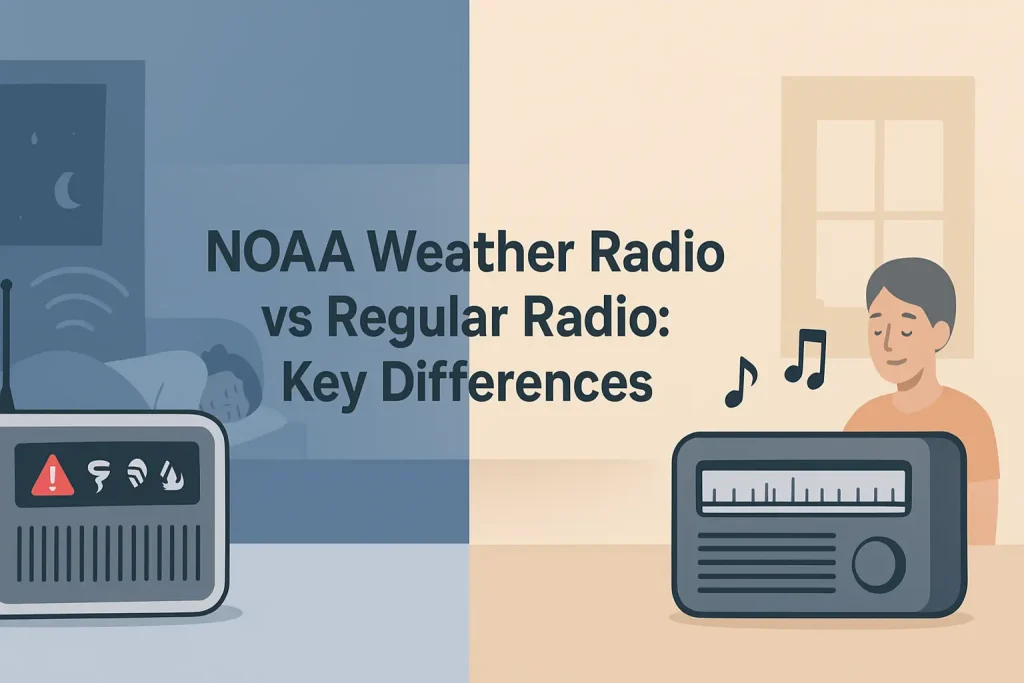
Some portable AM/FM radios include a weather band (WB) setting that covers the seven NOAA frequencies. These receive audio broadcasts but lack S.A.M.E. technology, so they cannot filter alerts by county or wake automatically when an alert is issued.
A dedicated NOAA weather radio with S.A.M.E. alerting provides county-specific warnings and automatically unmutes or powers on when your county is threatened. The difference between a radio that hears weather reports and a radio that wakes you for a tornado warning is explained in the comparison of weather band on AM/FM radios versus dedicated weather alert receivers.
How NOAA Weather Radio Frequencies Connect to the Emergency Alert System
NOAA Weather Radio is the primary distribution path for the Emergency Alert System (EAS). When the National Weather Service issues a warning, the alert travels from the local NWS forecast office to the NWR transmitter and simultaneously into the EAS relay network.
This means the same tornado warning that activates your weather radio also triggers EAS alerts on television and radio stations. The integration between NOAA Weather Radio and the IPAWS emergency alert infrastructure ensures warnings reach cellular networks, broadcasters, and dedicated weather receivers through a single activation.
NOAA Weather Radio Coverage by Region
NWR coverage is not uniform across the United States. Transmitter density is highest in the Midwest and Southeast, where tornado and hurricane threats demand overlapping coverage and redundant transmitters.
In mountainous regions, coverage gaps are common because VHF signals cannot penetrate terrain. A radio that works perfectly in Kansas may struggle in West Virginia even with a strong local transmitter.
For a detailed breakdown of stations in the region with the highest tornado frequency, see the full listing of Midwest NOAA weather radio stations and their frequencies by state. Coastal residents can reference the guide to Southeast weather radio stations covering hurricane-prone areas from Texas to the Carolinas.
Quick Reference: NOAA Weather Radio Terms
S.A.M.E. (Specific Area Message Encoding): A digital code system that lets you program your weather radio to alert only for your county using a 6-digit FIPS code.
FIPS (Federal Information Processing Standard) code: A unique six-digit number identifying a specific county or geographic area for S.A.M.E. alert filtering.
NWR (NOAA Weather Radio All Hazards): The nationwide network of VHF radio transmitters that broadcast continuous weather information and emergency alerts on seven dedicated frequencies.
WX1-WX7: Standard weather radio channel designations corresponding to the seven NOAA frequencies from 162.400 MHz to 162.550 MHz.
1050 Hz tone: The attention signal transmitted before an alert message that activates weather radios set to alert mode.
RWT (Required Weekly Test): A weekly test transmission sent by every NWR transmitter on Wednesdays between 10 a.m. and noon local time.
EAS (Emergency Alert System): The national public warning system that uses NOAA Weather Radio as one of its primary distribution paths for weather alerts.
Is NOAA Weather Radio Still Being Updated?
NOAA Weather Radio is actively maintained and upgraded. The history of NOAA Weather Radio from its origins to the present network shows how the system evolved from a few coastal marine weather stations to a nationwide all-hazards alerting platform.
The network now transmits AMBER alerts, hazardous materials warnings, and civil emergency messages in addition to weather watches and warnings. Transmitter upgrades continue in areas with coverage gaps, and digital S.A.M.E. encoding is standard on all current NWR broadcasts.
Can You Listen to NOAA Weather Radio Online or on a Smartphone?
You can stream most NWR transmitter audio through the official NOAA Weather Radio website or third-party streaming services. However, a streamed broadcast introduces a delay of several seconds and depends on your internet connection staying active during a storm.
Neither streaming nor NOAA weather apps can activate S.A.M.E. alerts on your phone the way a dedicated weather radio wakes you for a tornado warning at night. Your smartphone receives Wireless Emergency Alerts (WEA) through the cellular network for tornado and flash flood warnings.
The two systems complement each other but are not interchangeable. A dedicated weather radio with battery backup works when cellular towers lose power and when you are outside cellular coverage.
Why Does My Weather Radio Pick Up Two NOAA Stations at Once?
Your weather radio receives two NOAA stations when you live in the overlap zone between two transmitters broadcasting on different frequencies. This is a sign of good coverage, not a malfunction.
The NWR network intentionally overlaps coverage areas so that the failure of one transmitter does not leave a county without weather alert reception. If one station goes off the air or its signal fades, your radio should still receive the other station.
Program both frequencies into separate memory slots if your radio supports it. During severe weather, monitor the stronger signal but keep the secondary programmed as a backup.
What Happens If I Program the Wrong NOAA Frequency in My Area?
Programming the wrong NOAA frequency results in static or complete silence from your weather radio. You will not receive weather alerts for any county because no transmitter is broadcasting on that frequency in your area.
The fix takes 30 seconds. Go to the NOAA Weather Radio website, find your county, note the correct frequency, and reprogram your radio to that channel.
Test reception by waiting for the next Required Weekly Test on Wednesday or by pressing the weather radio’s alert test button if available. A clear audio broadcast confirms you have the correct frequency.
Do All Weather Radios Cover the Same NOAA Frequencies?
All weather radios sold in the United States cover the same seven NOAA frequencies between 162.400 MHz and 162.550 MHz. This is a federal standard, and any radio labeled as a weather radio or weather alert radio must receive all seven channels.
The difference between models is not frequency coverage but features. S.A.M.E. technology, battery backup type, external antenna jack, and alert volume are the features that separate a $25 basic weather radio from a $70 desktop alert radio.
Select the radio based on whether it supports S.A.M.E. for your county and whether it has a battery backup that fits your emergency plan, not on whether it claims to cover all NOAA channels.
Select the Correct NOAA Weather Radio Frequency for Your County
The seven NOAA weather radio frequencies between 162.400 MHz and 162.550 MHz carry the same alerts and warnings nationwide. Only one channel matters for your safety.
Find your county on the NOAA Weather Radio coverage site. Note the frequency and the transmitter call sign. Program that single frequency into your weather radio and test it on a Wednesday during the weekly test.
| Photo | TOP RATED WALKIE TALKIES | Price |
|---|---|---|
 | Retevis RT628 Kids Walkie Talkies, Toys Gifts for 4-12 Year Old Girl Boy | Check Price On Amazon |
 | Cobra ACXT545 Weather-Resistant Walkie Talkies, Rechargeable, 22 Channels | Check Price On Amazon |
 | Retevis RT388 Kids Walkie Talkies, Outdoor Toys for Kids Camping Essentials | Check Price On Amazon |
 | Cobra RX680 Walkie Talkies (2-Pack), IP54 Water Resistant Design | Check Price On Amazon |
 | Retevis RT22 Walkie Talkies Long Range Rechargeable with Earpiece (2 Pack) | Check Price On Amazon |
 | Midland GXT1000VP4 GMRS Two-Way Radio | Check Price On Amazon |
 | Retevis RT628 Walkie Talkies for Kids,Toys Gifts for 6-12 Years Old Boys Girls,Long Range 2 Way Radio 22CH VOX,Birthday Gift,Family Walkie Talkie for Camping Hiking Indoor Outdoor | Check Price On Amazon |