The “coverage map” for NOAA Weather Radio is not a single picture you can glance at. It is a network of over 1,000 transmitter towers scattered across all 50 states, Puerto Rico, the US Virgin Islands, and the Pacific territories, each broadcasting on one of seven dedicated VHF frequencies. Your actual reception depends on which towers are within roughly 40 miles of your location and what terrain sits between you and them.
This guide explains exactly how NOAA Weather Radio coverage works, how to find the correct frequency for any county in any state, what S.A.M.E. codes you need, and how to troubleshoot reception problems when the signal will not reach your radio.
| Photo | Popular Portable Walkie Talkies | Price |
|---|---|---|
 | SKIWARRIOR Multifunctional Smart Wireless Ski Goggles with Walkie-Talkie, Anti-Fog Zeiss Lens, Music & Call Function (Cylindrical Blue) | Check Price On Amazon |
 | SINORISE Super Mini Walkie Talkies, Two-Way Radios, 3 Pack | Check Price On Amazon |
 | KOSPET Tank M4C Smart Watch Rugged, Dual-Band GPS, 5ATM & IP69K Waterproof | Check Price On Amazon |
 | Retevis RT15 Walkie Talkies 3 Pack, Birthday Gift, Outdoor Adventure Kit | Check Price On Amazon |
 | Rechargeable Walkie Talkies Toys for Kids: DIY Astronaut Walkie Talkies for Boys Christmas Birthday Gifts for 3 4 5 6 7 8 9 10 Boy Walkie Talkie Outdoor Hiking Toy 2 Way Radio Camping Outdoor Game | Check Price On Amazon |
What Is NOAA Weather Radio Coverage and How Does It Work?
NOAA Weather Radio (NWR) is a nationwide network of VHF radio transmitters operated by the National Weather Service that broadcasts continuous weather information, watches, warnings, and emergency alerts 24 hours a day. Coverage means whether a given location can receive a clear, decodable signal from at least one NWR transmitter on one of the seven allocated frequencies between 162.400 and 162.550 MHz.
Each transmitter operates at 300 to 1,000 watts of effective radiated power and is positioned on elevated tower sites to maximize line-of-sight propagation across its designated service area. The network covers approximately 95 percent of the US population, but topographic obstructions (mountains, deep valleys, dense urban building clusters) create gaps where reception is weak or absent entirely.
This happens because VHF radio signals at 162 MHz travel primarily by line of sight. They do not bend over ridgelines or penetrate through substantial earth, steel, or concrete obstacles. A transmitter on a 1,000-foot tower can reach 40 to 50 miles across flat open terrain, but the same transmitter may be completely blocked by a 2,000-foot ridge 10 miles from your home.
Coverage is not uniform by state. States with flat terrain and dense transmitter networks (like Iowa, Illinois, and Florida) have near-complete coverage, while mountainous states (like West Virginia, Montana, and parts of Alaska) have significant gaps where terrain blocks every available transmitter. If your location cannot receive a ground-based NWR signal, satellite-based alerting or internet streaming of NWR broadcasts becomes the fallback.
By the Numbers
NOAA Weather Radio Coverage – Key Specifications and Standards
Sources: NOAA National Weather Service NWR transmitter database, FCC Part 15, NWS dissemination standards.
NOAA Weather Radio Frequencies: The Seven Channels That Cover the United States
All NOAA Weather Radio broadcasts share seven VHF frequencies spaced 25 kHz apart in the 162 MHz band. These seven channels (labeled WX1 through WX7 on most weather radios) are reused across thousands of transmitter sites nationwide, with frequency assignments engineered so that transmitters on the same frequency are separated by enough distance to prevent interference.
The seven NOAA weather radio frequencies are 162.400 MHz (WX1), 162.425 MHz (WX2), 162.450 MHz (WX3), 162.475 MHz (WX4), 162.500 MHz (WX5), 162.525 MHz (WX6), and 162.550 MHz (WX7). Not all seven frequencies are active in every area: most locations receive one to three usable NWR signals, and your weather radio automatically scans and locks onto the strongest one.
Frequency assignment for each transmitter follows a careful allocation plan managed by the NWS. Adjacent transmitters never use the same frequency. The NWS also coordinates with Canada along the northern border states (Washington, Montana, North Dakota, Minnesota, Michigan, New York, Vermont, New Hampshire, and Maine) to avoid interference with Environment Canada’s similar weather radio service on the same frequencies.
A frequency that works perfectly at your home may be completely silent 30 miles down the road. This is not a defect in your radio. It means you have driven out of the service contour of that specific transmitter and need to scan for the next one. If you want to understand how these frequencies are allocated in detail, our complete guide to NOAA weather radio frequencies and channel assignments covers the allocation engineering in depth.
NOAA Weather Radio Coverage Map by State: How to Find Your Local Transmitter
The National Weather Service maintains an interactive coverage map and transmitter lookup tool on its website that displays every NWR transmitter site, its call sign, frequency, and estimated coverage contour. You enter your county and state, and the tool returns the exact frequency and S.A.M.E. code you should program into your weather radio.
Each state has between 5 and 50 NWR transmitter sites depending on its size, terrain, and population distribution. Texas has over 50 transmitters to cover its 268,000 square miles. Rhode Island is covered by two primary transmitters. A single high-elevation transmitter in the Great Plains can cover 10 to 15 counties. A single transmitter in the Appalachian Mountains might reliably cover only two or three valleys.
The estimated coverage contour shown on NWS maps represents the area where a receiver with a basic indoor antenna should receive a usable signal at least 95 percent of the time. This contour assumes a receiver sensitivity of 0.5 microvolts or better (all consumer weather radios meet this). If you are inside the contour but hearing static, the problem is almost always a local obstruction, not a coverage map error.
Range Reference
NOAA Weather Radio Reception Range by Frequency and Terrain
Pre-calculated real-world reception estimates for a 1,000W NWR transmitter at 500 ft tower height. Find your terrain row for an honest expectation.
| NWR Channel / Terrain | Open rural / flat | Suburban / light woods | Urban / dense buildings | Mountainous / deep valley |
|---|---|---|---|---|
| WX1 (162.400 MHz) | 40-50 mi | 25-35 mi | 10-20 mi | 5-15 mi |
| WX2 (162.425 MHz) | 40-50 mi | 25-35 mi | 10-20 mi (most common) | 5-15 mi |
| WX3 (162.450 MHz) | 40-50 mi | 25-35 mi | 10-20 mi | 5-15 mi |
| WX4 (162.475 MHz) | 40-50 mi | 25-35 mi | 10-20 mi | 5-15 mi |
| WX5 (162.500 MHz) | 40-50 mi | 25-35 mi | 10-20 mi | 5-15 mi |
| WX6 (162.525 MHz) | 40-50 mi | 25-35 mi | 10-20 mi | 5-15 mi |
| WX7 (162.550 MHz) | 40-50 mi | 25-35 mi | 10-20 mi | 5-15 mi |
All seven NWR frequencies share identical propagation characteristics at 162 MHz. Range estimates assume receiver sensitivity of 0.5 microvolts and transmitter ERP of 1,000W. Actual range decreases with lower antenna height, dense foliage, metal building construction, and atmospheric conditions. Source: NWS transmitter engineering data, VHF propagation models at 162 MHz.
The NWS transmitter lookup tool covers every state and territory. For metro-area specific guidance, our Chicago NOAA weather radio frequency and S.A.M.E. code guide and Kansas City weather radio station listings show exactly how urban transmitter networks are configured in practice.
S.A.M.E. Codes and State-by-State Alert Programming
S.A.M.E. (Specific Area Message Encoding) is the digital protocol that lets a NOAA weather radio filter alerts by county, parish, or marine zone. Each county in the United States has a unique 6-digit FIPS code. The first digit identifies the county subdivision, the next two digits identify the state (01-50), and the final three digits identify the specific county within that state.
When you program your county’s S.A.M.E. code into a weather radio like the Midland WR400 desktop weather alert radio, the radio’s internal decoder listens for that specific code in the digital data stream. When the NWS issues an alert containing your programmed code, the radio activates its alarm and audio. Without S.A.M.E. programming, the radio will alert for every warning issued by that transmitter, often covering dozens of counties you do not care about.
The NWS publishes a complete state-by-state S.A.M.E. code directory. Texas alone has 254 county codes. California has 58. Every coastal state also has separate marine zone S.A.M.E. codes for offshore weather warnings. For a thorough explanation of how this system works and how to configure it correctly, read our detailed guide to S.A.M.E. technology and county-specific alert filtering.
Coverage Gaps and How to Improve Reception in Your Area
Coverage gaps exist in every state. They are most common in mountainous terrain, deep river valleys, dense urban cores with steel-frame high-rises, and rural areas more than 50 miles from the nearest NWR transmitter. If the NWS coverage map shows your location outside the service contour, or you are inside the contour but receiving static, there are specific steps you can take.
A VHF external antenna mounted outdoors and elevated is the single most effective improvement for marginal reception. Moving the antenna from inside a basement to the roof or attic can increase signal strength by 10 to 20 decibels, which translates to the difference between static and a clear decoded signal. A simple outdoor VHF antenna with 3 to 5 dBi of gain is sufficient.
This works because VHF signal strength increases with antenna height above ground. A receiver antenna at 30 feet above ground captures roughly four times the signal power of the same antenna at 6 feet above ground in the same location. The connection between antenna height and reception quality is a principle of radio propagation physics, not a quirk of weather radios.
If an outdoor antenna is not practical, position the radio near a window facing the direction of the nearest NWR transmitter. Avoid placing the radio near large metal appliances, LED light bulbs, computer equipment, or inside metal cabinets. All of these generate radio frequency interference or physically block VHF signals. A portable weather radio with battery backup lets you move the radio around your home to find the strongest signal location.
Seasonal Weather Radio Preparedness: When Coverage Matters Most
Weather radio coverage becomes critically important during specific seasons that vary by state and region. Tornado season peaks from March through June across the Southeast, Midwest, and southern Plains. Hurricane season runs from June 1 through November 30 along the Atlantic and Gulf coasts. Winter storm season brings ice storms and blizzards from November through March across the northern tier states.
The time to discover a coverage gap is not during a tornado warning when your radio is silent. Test your weather radio reception at least once per season by triggering the weekly test (typically every Wednesday between 10:00 AM and noon local time). If the weekly test does not activate your radio, your coverage has changed or your antenna setup has degraded.
The Midland ER310 emergency weather radio includes a hand crank and solar panel for power-outage operation, which is when weather radio coverage is most essential. Cellular networks frequently fail during widespread severe weather events, but NWR transmitters have backup generators and battery banks designed to maintain broadcast continuity through extended commercial power outages.
Weather Radio vs Smartphone Alerts: Which Provides Better Coverage?
Smartphone weather alerts (Wireless Emergency Alerts or WEA) and NOAA Weather Radio serve complementary but fundamentally different coverage roles. WEA alerts depend on cellular tower infrastructure, which often fails during the tornado, hurricane, or wildfire event that generated the alert in the first place. NWR transmitters run on hardened infrastructure with backup power at every site.
Smartphone alerts also lack geographic precision in many cases. A WEA tornado warning is broadcast to every phone connected to every cell tower in the warned area, which can span multiple entire counties. A S.A.M.E.-programmed weather radio alerts only for the specific county or counties you programmed. This difference matters at 3:00 AM when a tornado warning covers five counties but only one of them is actually in the tornado’s path.
Our detailed comparison of weather radio reliability versus smartphone emergency alerts examines the infrastructure and failure modes of both systems. The short version is that a dedicated weather radio should be your primary alerting device, and your smartphone should be the backup. Not the other way around.
How to Choose a Weather Radio for Your State’s Coverage Profile
Your state’s terrain, your distance from the nearest NWR transmitter, and whether you live in a single-family home or an apartment should all influence which weather radio you buy. If you live in a state with excellent coverage and you are within 20 miles of a transmitter, an inexpensive desktop weather radio with a built-in antenna (like the Midland WR120) will work reliably.
If you live in a mountainous state, a rural area more than 30 miles from a transmitter, or a dense urban apartment building, you need a weather radio with an external antenna connector. The Uniden BC365CRS scanner with weather alert includes an external antenna jack and covers all seven NWR frequencies plus AM/FM and scanner bands. Pair it with a basic outdoor VHF antenna for reception that a built-in whip antenna cannot match.
If you live in a hurricane-prone coastal state where multi-day power outages are common, prioritize a weather radio with multiple power sources. The Eton Sidekick emergency weather radio charges via USB, solar panel, or hand crank, and includes a USB output to charge your phone. In a prolonged power outage after a hurricane, the ability to receive NWR broadcasts and charge a phone from the same device becomes a genuine survival advantage.
What you need most from a weather radio is clear NWR reception inside your home, on battery power, with S.A.M.E. filtering programmed for your county. Every additional feature is secondary. Choose based on your state’s coverage conditions, not on the feature list printed on the box.
Common Mistakes When Setting Up a Weather Radio
The most common mistake is programming the wrong S.A.M.E. code or failing to program one at all. An unprogrammed weather radio set to “any” or “all alerts” mode will activate for every NWS alert issued by the transmitter it receives, which can cover 15 to 30 counties. This produces so many false alarms that most users disable the radio or ignore it, defeating the entire purpose.
The second most common mistake is placing the radio where the VHF signal cannot reach it. Basement placement, placement inside a metal rack or cabinet, or placement adjacent to a large refrigerator or HVAC unit are the three most frequent causes of “my weather radio stopped working” complaints. The radio works fine. The antenna is in a dead spot.
Another frequent error is confusing the channel number printed on the radio (1 through 7) with the frequency it represents. Channel 1 on a Midland radio and Channel 1 on an Eton radio both correspond to 162.400 MHz, but the labeling is not universal. Always confirm the frequency, not just the channel position. The NWR activation and alert dissemination process depends on the radio receiving the correct data on the correct frequency, and a mismatched channel assignment breaks that chain.
How Far Can a NOAA Weather Radio Transmitter Reach?
A standard NWR transmitter operating at 1,000 watts from a 500-foot tower reaches approximately 40 to 50 miles across flat open terrain with an outdoor receiver antenna. The same transmitter may reach only 5 to 15 miles into a deep mountain valley or 10 to 20 miles into a dense urban core. These are physical limits of VHF radio propagation at 162 MHz, not performance failures of individual transmitter sites.
The NWS designs its transmitter network so that most populated areas are within 40 miles of at least one site. In the Great Plains states (Kansas, Nebraska, the Dakotas), a single transmitter can reliably cover 40 to 50 miles in all directions because there are no terrain obstructions. In West Virginia, coverage is inherently patchy because ridges block line of sight in every direction, and the NWS has placed additional transmitters in valleys to fill the gaps as best as the terrain allows.
Can I Receive NOAA Weather Radio in All 50 States?
Yes, NOAA Weather Radio transmitters operate in all 50 states, Puerto Rico, the US Virgin Islands, American Samoa, Guam, and the Northern Mariana Islands. However, coverage within each state is not universal. Alaska has NWR transmitters concentrated in coastal communities and along major highways, with vast interior regions receiving no ground-based coverage. Hawaii has transmitters on all major islands covering populated coastal areas.
The mountainous western states (Montana, Idaho, Wyoming, Colorado, West Virginia) have the largest coverage gaps where terrain blocks every available NWR signal. In these areas, satellite-based alerting systems or internet streaming of NWR audio serve as the fallback. The NWS maintains a streaming page for every NWR transmitter, accessible through weather.gov, which provides an alternative for anyone with internet access but no reliable over-the-air signal.
Why Does My Weather Radio Lose Signal at Night?
NOAA Weather Radio signals at 162 MHz can sometimes propagate farther at night due to a phenomenon called tropospheric ducting. This is the same effect that causes distant FM radio stations to appear suddenly on summer nights. While this sounds like a benefit, it can actually cause interference when a distant NWR transmitter on the same frequency as your local transmitter becomes temporarily audible.
The nighttime signal loss you experience is more commonly caused by increased radio frequency interference from electronics active in the evening (LED lighting, televisions, computers) or by the radio being moved to a different location after dark. The NWR transmitter itself operates at the same power 24 hours a day and does not reduce output at night. Check for new interference sources in your home before assuming the transmitter signal has weakened.
Do I Need an Outdoor Antenna for NOAA Weather Radio?
You do not need an outdoor antenna if you are within 20 miles of an NWR transmitter in flat or gently rolling terrain and your radio is placed near a window facing the transmitter. The built-in whip antenna on a desktop weather radio is adequate under these conditions for reliable reception.
You should install an outdoor antenna if you are more than 30 miles from the nearest transmitter, live in mountainous terrain, live in a building with metal siding or foil-backed insulation, or have tried indoor placement and still receive static or intermittent decoding. A simple outdoor VHF antenna (3 to 5 dBi gain) mounted as high as practical, with coaxial cable run to your weather radio’s external antenna jack, is the definitive solution for marginal reception. This configuration also benefits any scanner radio you might own that monitors NWR frequencies.
Can I Use the Same Weather Radio When I Travel to Another State?
Yes, a weather radio works in any state that has an NWR transmitter within range. Most weather radios have an auto-scan function that finds the strongest NWR frequency at your current location. However, your programmed S.A.M.E. codes are location-specific and will not alert correctly in a different state or county.
When traveling, you have two options: reprogram the S.A.M.E. codes for your destination county before you leave (look up the 6-digit FIPS code on the NWS website), or run the radio in “any alerts” mode without S.A.M.E. filtering. The second option will activate for all alerts on the transmitter, which is acceptable for short-term travel but annoying for extended stays. Some portable travel weather radios store multiple S.A.M.E. code presets, allowing you to pre-load codes for several counties or states.
What Happens to NOAA Weather Radio Coverage During a Power Outage?
NWR transmitter sites are equipped with backup generators and battery banks designed to maintain continuous broadcast operation through extended commercial power outages. This is a core design requirement of the NWR network. The transmitters will continue broadcasting weather information and emergency alerts even when the surrounding community has lost power.
Your weather radio also needs backup power to receive those broadcasts. A desktop weather radio plugged into a wall outlet becomes useless the moment power fails unless it has battery backup installed. Choose a weather radio with an integrated battery compartment (typically 4 to 6 AA batteries) or a built-in rechargeable battery that charges while on AC power and automatically takes over during an outage. Check and replace those backup batteries every six months.
How Do I Program S.A.M.E. Codes for Multiple Counties in My State?
Most weather radios with S.A.M.E. capability allow you to program between 15 and 50 county codes. Enter the 6-digit FIPS code for each county you want to monitor using the radio’s menu system. The NWS website provides a complete county-by-county FIPS code directory organized by state. Program the county you live in, the county immediately upwind or upstream (where weather typically comes from), and any county where family members live or work.
Do not program 15 surrounding counties just because the radio has slots available. Each additional county increases the probability of being awakened for an alert that does not affect you. A well-programmed weather radio should alert you roughly 2 to 5 times per year for genuine threats. An over-programmed radio will false-alarm weekly and quickly be ignored.
Is NOAA Weather Radio Coverage Available in Alaska and Hawaii?
Yes. Alaska has NWR transmitters in Anchorage, Fairbanks, Juneau, and most coastal communities along the Gulf of Alaska, the Bering Sea coast, and the Arctic coast. However, interior Alaska, the Brooks Range, and the Alaska Range have large areas with no ground-based NWR coverage due to extreme terrain and the absence of roads and power infrastructure at potential tower sites.
Hawaii has NWR transmitters on all major islands (Oahu, Maui, Hawaii Island, Kauai, Molokai, and Lanai) covering populated coastal areas. Coverage extends inland and upslope on each island but may be blocked by volcanic terrain on the leeward sides of the islands. Tsunami warnings are the most critical alert type for Hawaii, and NWR transmitters carry these with the highest priority.
What Is the Difference Between NOAA Weather Radio and the Emergency Alert System?
NOAA Weather Radio (NWR) is a direct broadcast network from the National Weather Service that operates 24 hours a day on dedicated VHF frequencies and carries all NWS weather watches, warnings, and advisories. The Emergency Alert System (EAS) is a coordinated warning system that uses NWR as one of its primary input sources but distributes alerts across broadcast television, AM/FM radio, satellite radio, and cable systems.
NWR is the originating source for most weather-related EAS activations. When the NWS issues a tornado warning, it is transmitted on NWR and simultaneously triggers the EAS daisy chain that interrupts television and radio broadcasts. Your weather radio receives the NWR transmission directly from the transmitter. Your television receives the same warning indirectly through the EAS relay system, often with a delay of 30 seconds to 2 minutes. In rapidly evolving severe weather, that delay is significant.
Can Buildings and Terrain Block NOAA Weather Radio Signals?
Yes. Steel-frame buildings, metal siding, foil-backed insulation, concrete with rebar reinforcement, and underground or partially underground rooms (basements) all attenuate or block VHF radio signals. A weather radio placed in a basement with no external antenna will have severely degraded reception regardless of distance to the transmitter.
Terrain blockage is permanent. If a ridge, mountain, or substantial hill sits between your location and the nearest NWR transmitter, no amount of receiver sensitivity will bring in a clear signal from that particular transmitter. Your options are to install a high outdoor antenna to achieve line of sight over the obstruction, use a different NWR transmitter on a different frequency that may have a clearer path to your location, or fall back to internet streaming of NWR audio for that transmitter.
How Often Should I Test My Weather Radio to Ensure Coverage?
Test your weather radio at least once per season by verifying reception of the weekly NWS test broadcast. Most NWR transmitters send a Required Weekly Test (RWT) every Wednesday between 10:00 AM and noon local time. If your S.A.M.E.-programmed radio activates for the weekly test, your coverage, programming, and alert audio are all functioning correctly.
If two consecutive weekly tests do not activate your radio, something has changed. Check the batteries, verify the S.A.M.E. code programming, try repositioning the radio, and check the NWS transmitter outage page (weather.gov/nwr/outages) to confirm the transmitter itself is operational. Transmitter maintenance outages are rare but do occur, typically lasting a few hours to a few days.
Why Am I Getting Alerts for Counties I Did Not Program?
This occurs when your weather radio is set to receive alerts for all counties on the transmitter rather than only the S.A.M.E. codes you programmed. Most weather radios have a setting that toggles between “S.A.M.E. only” and “any” or “all” mode. If the radio is in “any” mode, it will activate for every alert the transmitter broadcasts, regardless of your programmed codes.
A less common cause is programming a S.A.M.E. code with a typo that happens to match a different valid county code. Verify every programmed FIPS code against the official NWS S.A.M.E. code directory for your state. A single mistyped digit is all it takes to receive alerts for a county 500 miles away that shares a coincidentally similar code.
Do I Need a License to Listen to NOAA Weather Radio?
No. NOAA Weather Radio is a free public service provided by the National Weather Service. No FCC license is required to own or operate a weather radio receiver. This is fundamentally different from two-way radio services like GMRS (which requires a $35 FCC license) or amateur radio (which requires passing a license examination).
For any two-way radio communication beyond passive NWR reception, understanding the licensing landscape matters. Our complete introduction to NOAA Weather Radio explains the network infrastructure and how it fits into the broader public safety communication ecosystem, including its relationship with the Emergency Alert System and the FCC’s public warning regulations.
Can I Listen to NOAA Weather Radio on a Regular AM/FM Radio?
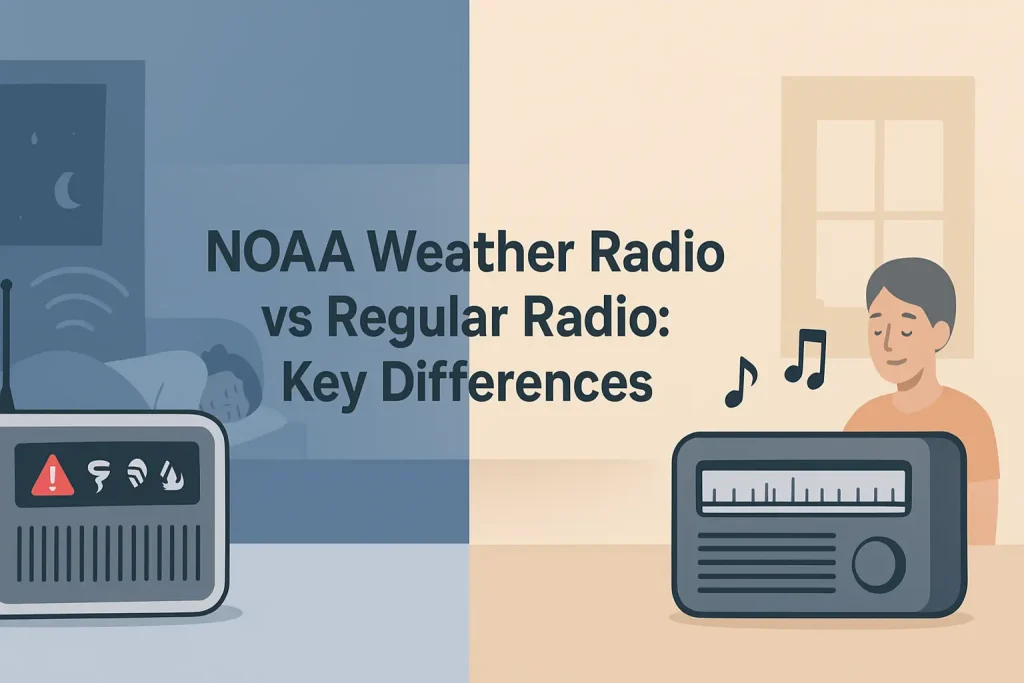
No. NOAA Weather Radio broadcasts on VHF frequencies between 162.400 and 162.550 MHz. Standard AM/FM radios tune from 530 to 1710 kHz (AM) and 88 to 108 MHz (FM). These frequency ranges do not overlap. A dedicated weather radio, a scanner radio that covers the 162 MHz band, or a two-way radio with weather band receive capability is required.
Many FRS and GMRS walkie-talkies include a weather band receiver as a secondary feature. These radios can receive NWR broadcasts on the weather channels but typically lack S.A.M.E. decoding. They serve as adequate weather monitoring tools for outdoor activities where you want to hear current conditions and any watches or warnings, but they will not automatically alert you while you sleep. For unattended alerting, a dedicated S.A.M.E.-capable weather radio is the correct tool.
NOAA Weather Radio coverage across the United States is not a flat blanket. It is a carefully engineered network of over 1,000 transmitters broadcasting on seven frequencies, covering roughly 95 percent of the population but leaving gaps in mountainous terrain and deep rural valleys. Your ability to receive a clear signal depends on your distance from the nearest transmitter, what sits between you and it, and whether you have the right antenna in the right place. Program the correct S.A.M.E. code for your county. Test your radio when the weekly test broadcasts every Wednesday. Replace backup batteries every six months. If your indoor reception is marginal, install an outdoor VHF antenna. A weather radio that sits silent in a dead spot during a tornado warning provides exactly zero protection regardless of its feature list or price tag.
| Photo | TOP RATED WALKIE TALKIES | Price |
|---|---|---|
 | Retevis RT628 Kids Walkie Talkies, Toys Gifts for 4-12 Year Old Girl Boy | Check Price On Amazon |
 | Cobra ACXT545 Weather-Resistant Walkie Talkies, Rechargeable, 22 Channels | Check Price On Amazon |
 | Retevis RT388 Kids Walkie Talkies, Outdoor Toys for Kids Camping Essentials | Check Price On Amazon |
 | Cobra RX680 Walkie Talkies (2-Pack), IP54 Water Resistant Design | Check Price On Amazon |
 | Retevis RT22 Walkie Talkies Long Range Rechargeable with Earpiece (2 Pack) | Check Price On Amazon |
 | Midland GXT1000VP4 GMRS JIS4 Two-Way Radio, Black,2 Pack | Check Price On Amazon |
 | Retevis RT628 Walkie Talkies for Kids,Toys Gifts for 6-12 Years Old Boys Girls,Long Range 2 Way Radio 22CH VOX,Birthday Gift,Family Walkie Talkie for Camping Hiking Indoor Outdoor | Check Price On Amazon |