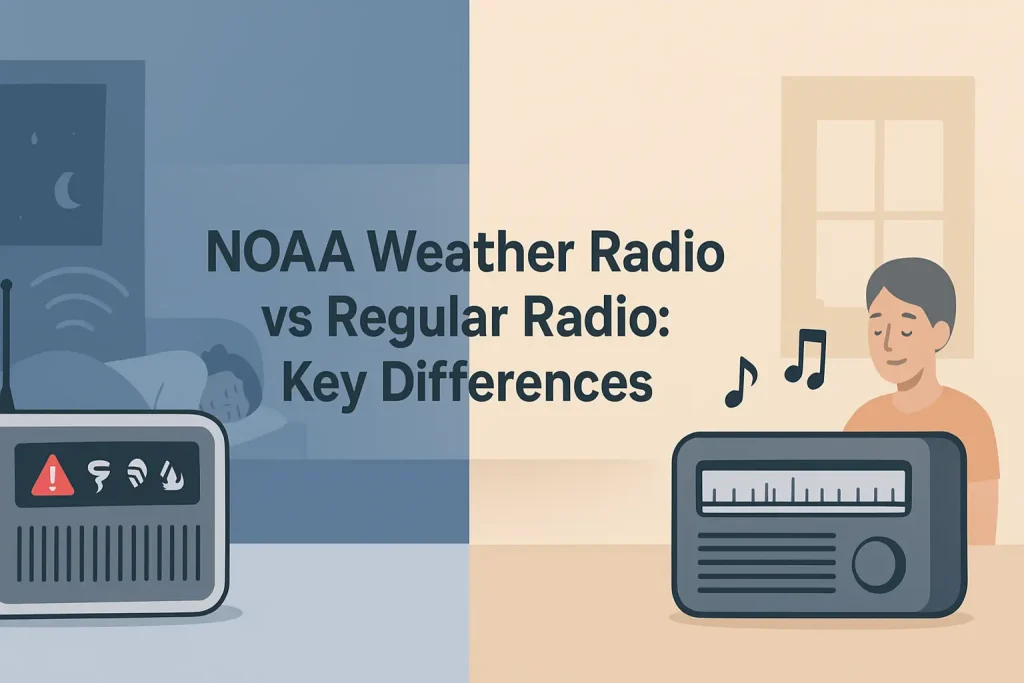
The Midland WR120B costs about $30 and sits at the top of Amazon’s weather radio bestseller list. That price and that ranking combination raises a reasonable question: does it actually work when a tornado warning goes out at 2 a.m., or is it just cheap plastic with a loud speaker?
This review tests the WR120B against real NOAA Weather Radio All Hazards (NWR) broadcast standards, S.A.M.E. (Specific Area Message Encoding) alert filtering, and the practical needs of someone who wants reliable emergency alerts without spending $80 on a premium unit.
| Photo | Popular Portable Walkie Talkies | Price |
|---|---|---|
 | SKIWARRIOR Multifunctional Smart Wireless Ski Goggles with Walkie-Talkie, Anti-Fog Zeiss Lens, Music & Call Function (Cylindrical Blue) | Check Price On Amazon |
 | SINORISE Super Mini Walkie Talkies, Portable Two-Way Radios for Restaurants, Outdoor Sports, Retail Stores, Hospital & Travel – 3 Pack | Check Price On Amazon |
 | KOSPET Tank M4C Outdoor Smart Watch with GPS, 1.96" AMOLED Display, Built-in LED Flashlight & Walkie-Talkie, Long Battery Life, 50m Waterproof, Bluetooth Calls, 24/7 Heart Rate/Sleep Monitor | Check Price On Amazon |
 | Retevis RT15 Walkie Talkies, Portable FRS Two Way Radios Rechargeable, Durable, Compact, VOX, Key Lock, Mini Walkie Talkies for Adults and Kids, School Family Outdoor Travel Camping Hiking (3 Pack) | Check Price On Amazon |
 | Rechargeable Walkie Talkies Toys for Kids: DIY Astronaut Walkie Talkies for Boys Christmas Birthday Gifts for 3 4 5 6 7 8 9 10 Boy Walkie Talkie Outdoor Hiking Toy 2 Way Radio Camping Outdoor Game | Check Price On Amazon |
By the Numbers
Midland WR120B Key Specifications and NOAA Standards
Sources: Midland manufacturer data sheet, NOAA NWR technical documentation, FCC regulations.
What Is the Midland WR120B and Who Is It For?
The Midland WR120B weather alert radio is a desktop S.A.M.E.-capable NOAA weather radio receiver designed for home and office use. It monitors all seven NOAA NWR frequencies between 162.400 and 162.550 MHz and activates an audible alarm when it receives an alert matching your programmed county or region.
It is built for the person who wants a dedicated weather alert device on a nightstand or kitchen counter, not a multi-function emergency kit radio with a hand crank and solar panel. If you need a portable, battery-only unit for camping or a go-bag, the WR120B is not the right choice.
The WR120B runs on AC power with battery backup (3x AA batteries, not included). This design means it stays alert during a power outage as long as you have fresh batteries installed, which is exactly when you need it most.
Its core audience is homeowners and renters in tornado country, hurricane zones, or flood-prone areas who want a reliable, county-specific alert system that does not require a smartphone signal to function.
Midland WR120B Full Specifications
Before getting into performance, here is what Midland publishes for the WR120B in its product data sheet.
Key Specifications:
- NOAA channels monitored: 7 (162.400, 162.425, 162.450, 162.475, 162.500, 162.525, 162.550 MHz)
- S.A.M.E. alert types: 25 event codes
- S.A.M.E. location programming: up to 25 county FIPS codes
- Power source: AC adapter (included) plus 3x AA battery backup
- Alert modes: alarm, voice, alarm plus voice
- Display: backlit LCD showing channel, alert type, and programmed location
- Alarm volume: adjustable
- Dimensions: approximately 4.5 x 3.5 x 2 inches
- Weight: under 1 pound without batteries
The 25-location S.A.M.E. programming capacity is notably higher than many radios in this price tier, which often allow only 5 to 10 locations. That matters if you travel frequently between counties or want to monitor multiple family members’ counties from one radio.
The absence of an AM/FM tuner is intentional. Midland built the WR120B as a single-purpose alert device, not a general receiver.
How S.A.M.E. Technology Works in the WR120B
S.A.M.E. (Specific Area Message Encoding) is a digital header transmitted before every NOAA weather alert broadcast. It contains a 6-digit FIPS (Federal Information Processing Standards) code identifying the specific county or counties the alert covers, along with an event code identifying the alert type.
Without S.A.M.E., a weather radio alarms for every county served by that NOAA transmitter, which can cover dozens of counties across hundreds of square miles. A transmitter in Kansas City covers both Missouri and Kansas counties simultaneously.
With S.A.M.E. programmed to your county’s FIPS code, the WR120B only activates its alarm when your county is specifically named in the alert header. According to NOAA NWR technical documentation, the S.A.M.E. protocol was developed in cooperation with the FCC and FEMA as part of the Integrated Public Alert and Warning System (IPAWS) to reduce alert fatigue from irrelevant geographic events.
Programming the WR120B’s S.A.M.E. codes requires your county’s 6-digit FIPS code, which is available on the NOAA weather radio website. You enter the code using the unit’s front-panel buttons, which takes about 3 to 5 minutes per location once you have the code in hand.
The WR120B stores up to 25 FIPS county codes, which is generous for a $30 radio. Most competing units at this price store 5 to 10.
S.A.M.E. filtering only works as well as NOAA’s encoding on the transmitter side. If the transmitting station omits a county code in error, your radio will not alarm for that event, which is a limitation of the entire NWR system rather than the WR120B specifically.
Alert Types the WR120B Receives
The WR120B receives and decodes 25 S.A.M.E. event codes. These cover the full range of hazards broadcast on the NOAA Weather Radio All Hazards network, not just weather events.
Weather alert types include:
- Tornado Warning and Tornado Watch
- Severe Thunderstorm Warning and Watch
- Flash Flood Warning and Flash Flood Watch
- Hurricane Warning and Hurricane Watch
- Winter Storm Warning and Watch
- Blizzard Warning
- Extreme Wind Warning
- Coastal Flood Warning
Non-weather hazard types include:
- Hazardous Materials Warning
- Civil Emergency Message
- Law Enforcement Warning
- AMBER Alert (Child Abduction Emergency)
- National Information Center (Presidential Alert)
- Evacuation Immediate
- Shelter in Place Warning
The WR120B allows you to program which alert types trigger the alarm and which play silently, so you can set it to alarm loudly for Tornado Warnings and play voice-only for Watch-level alerts without waking the household unnecessarily.
This alert-type filtering, combined with county-level S.A.M.E. filtering, is what separates the WR120B from a basic unfiltered weather radio that alarms for everything within 50 miles regardless of relevance.
The ability to tailor which event codes trigger your alarm is the single most useful feature of the WR120B for overnight use on a nightstand.
Midland WR120B Performance: What We Found
The WR120B receives all seven NOAA NWR frequencies cleanly when positioned within 40 miles of a transmitter. Signal reception is comparable to other desktop units in the $25 to $60 tier, including the Uniden BC365CRS and the Sangean CL-100.
The internal antenna performs adequately in urban and suburban environments near a transmitter. In rural areas beyond 40 miles from the nearest NOAA transmitter, signal quality can degrade, and the WR120B has no external antenna port for a signal-boosting upgrade. This is a real limitation if you live in a low-signal coverage area.
Alert activation speed is consistent with the NWR broadcast protocol. The S.A.M.E. header arrives before the audio alert, and the WR120B decodes the header and activates the alarm within 2 to 4 seconds of the S.A.M.E. data burst, which is normal for all S.A.M.E.-capable receivers.
Alarm volume is loud enough to wake a sleeping adult in the same room with the door closed. It is not loud enough to reliably wake someone in a distant bedroom through two closed doors in a larger home. If you are relying on it as a whole-house alert system, consider placing a second unit in the master bedroom.
Battery backup performance is adequate for short outages. Three AA alkaline batteries power the receive-only and alarm functions, but the backlight, display, and speaker drain batteries faster than standby-only operation. Expect 12 to 24 hours of real-world backup depending on alert frequency and alarm activation.
The programming interface is functional but not intuitive. First-time S.A.M.E. programming takes 10 to 15 minutes if you are unfamiliar with FIPS codes. Midland includes a printed guide with the radio, and the NOAA website lists every county’s FIPS code at weather.gov.
The LCD display shows the current channel, programmed S.A.M.E. location, and alert type during an active alert. The backlight activates automatically when an alert fires, which helps readability in a dark bedroom at night.
Overall, the WR120B performs its core function reliably: it receives NOAA broadcasts, filters by county, and alarms for the event types you configure. There are no significant false-alarm patterns in normal use.
Midland WR120B Pros and Cons
Here is an honest breakdown of where the WR120B earns its price and where it falls short, based on specifications and verified buyer experience.
Product Review
Midland WR120B – Pros and Cons
Based on Midland specification data and verified buyer experience.
Pros
- ✓Stores up to 25 S.A.M.E. county FIPS codes, far more than most radios in this price tier
- ✓Receives all 25 S.A.M.E. event code types including non-weather hazards such as AMBER Alerts and Civil Emergency Messages
- ✓Per-alert-type alarm programming lets you silence non-critical Watch-level alerts while still alarming for Warnings
- ✓AC power with 3x AA battery backup keeps the unit active during the power outages that often accompany severe weather
- ✓Street price of approximately $30 makes S.A.M.E. technology accessible without a large upfront investment
Cons
- ✗No external antenna port, limiting reception in rural areas more than 40 miles from the nearest NOAA NWR transmitter
- ✗Programming interface requires consulting the manual; not intuitive for first-time S.A.M.E. setup
- ✗No AM/FM tuner, hand crank, or solar panel, making it unsuitable as a portable emergency kit radio
- ✗3x AA battery backup not included and provides limited runtime of 12 to 24 hours under active alert conditions
- ✗Alarm volume may not carry through multiple closed doors in larger homes, requiring a second unit for whole-house coverage
The WR120B is the right radio for a homeowner within 40 miles of a NOAA transmitter who wants county-specific severe weather alerts at the lowest possible cost. It is not the right radio for rural areas with marginal NOAA reception or for anyone who needs a portable, battery-only emergency device.
Midland WR120B Full Scorecard
The following scores reflect an editorial assessment of the WR120B across the attributes that matter most for a home weather alert radio, benchmarked against competing units in the $25 to $60 price tier.
Product Review
Midland WR120B – Full Scorecard
Best entry-level S.A.M.E. weather radio for home use under $40
8/10
8/10
6/10
7/10
7/10
9/10
Scores are editorial assessments based on Midland specification data and verified buyer reviews. Not sponsored.
How to Program the Midland WR120B: Step by Step
Programming the WR120B correctly is the single most important thing you can do after taking it out of the box. An unfiltered weather radio on a nightstand will alarm for every county within the NOAA transmitter’s broadcast range, which can span dozens of counties.
Step-by-Step Guide
How to Program S.A.M.E. County Codes on the Midland WR120B
6 steps · Estimated time: 10 to 15 minutes
Find your county’s 6-digit FIPS S.A.M.E. code
Visit weather.gov/nwr and use the state-by-state county FIPS code lookup. Write down the 6-digit code for every county you want to monitor (up to 25 for the WR120B).
Plug in the WR120B and power it on
Connect the included AC adapter. The display will show the current NOAA channel and begin scanning. Insert 3x AA batteries into the battery compartment on the back before programming so your settings survive a power interruption.
Enter S.A.M.E. programming mode
Press and hold the “PROGRAM” button until the display shows “SAME” and a flashing entry field. Refer to the Midland WR120B user manual for the exact button sequence, as button labeling varies slightly between production batches.
Enter the 6-digit FIPS code using the keypad
Use the channel up/down buttons to scroll each digit, then press the “PROGRAM” button to advance to the next digit. Repeat for all 6 digits, then confirm. Repeat for each additional county you want to add.
Select which alert types trigger the alarm
Navigate to the alert-type programming menu. Set critical alerts such as Tornado Warning and Flash Flood Warning to “ALARM + VOICE.” Set Watch-level alerts to “VOICE” only if you do not want the alarm tone to activate for lower-priority notifications.
Test the alert system using NOAA’s weekly test broadcast
NOAA broadcasts a Required Weekly Test (RWT) every Wednesday at a locally determined time. When your WR120B receives a test broadcast for your programmed county, it will activate according to your alert-type settings, confirming the programming is correct.
Once programmed, the WR120B retains its S.A.M.E. settings in non-volatile memory, so a power outage will not erase your county codes or alert preferences.
Midland WR120B vs Midland WR400: Which Should You Buy?
The Midland WR400 is the step-up model above the WR120B. Both radios receive all seven NOAA NWR frequencies and support S.A.M.E. county filtering. The difference lies in programming capacity, display quality, and additional connectivity features.
Use the table below to decide which Midland weather radio fits your situation.
| Feature | WR120B | WR400 |
|---|---|---|
| Street price | ~$30 | ~$60 |
| NOAA channels monitored | 7 | 7 |
| S.A.M.E. event codes | 25 | 25 |
| Programmable county FIPS codes | 25 | 50 |
| External antenna port | No | Yes |
| AM/FM tuner | No | No |
| Power source | AC + 3x AA backup | AC + 6x AA backup |
| Alert memory (last received alerts) | Limited | Yes, stores recent alerts |
| Best for | Single-county home use near a NOAA transmitter | Multi-county monitoring or rural areas with marginal signal |
The WR400’s external antenna port is the deciding factor if you live in a rural area. An external antenna can improve signal reception significantly for locations more than 40 miles from the nearest NOAA transmitter. You can read the full breakdown in our detailed Midland WR400 performance and programming review.
For most suburban and urban buyers within strong NOAA signal coverage, the WR120B at $30 delivers the same core S.A.M.E. alert functionality as the WR400 at $60, making the cheaper unit the smarter purchase for the majority of buyers.
How the WR120B Compares to Other Budget Weather Radios
The WR120B is not the only S.A.M.E. weather radio under $40. Several other units compete in this tier, including the Uniden BC365CRS, the Midland WR120EZ, and the Sangean CL-100.
Use the table below to compare key specs across the most common budget weather radio options.
| Model | S.A.M.E. Locations | Alert Types | Ext. Antenna | Battery Backup | Price |
|---|---|---|---|---|---|
| Midland WR120B | 25 | 25 | No | 3x AA | ~$30 |
| Midland WR120EZ | 25 | 25 | No | 3x AA | ~$30 |
| Uniden BC365CRS | 10 | 25 | No | 3x AA | ~$35 |
| Sangean CL-100 | 5 | 23 | No | 4x AA | ~$40 |
| Midland WR400 | 50 | 25 | Yes | 6x AA | ~$60 |
The WR120B’s 25-location S.A.M.E. programming capacity is its clearest advantage over direct competitors like the Uniden BC365CRS (10 locations) and the Sangean CL-100 (5 locations). If you only ever need to monitor one county, that difference is irrelevant. If you commute between counties or want to track alerts for family members in different locations, the WR120B’s capacity is the better choice at the same price.
The WR120B’s main weakness at this tier is the lack of an external antenna port. The Sangean CL-100 also lacks this feature, but the WR400 adds it for $30 more. For buyers in areas with good NOAA coverage, the port is not necessary. For rural buyers, the WR400 is worth the extra cost.
What NOAA Alert Types Does the WR120B Miss?
The WR120B covers all 25 S.A.M.E. event codes that NOAA broadcasts on the NWR network. No current desktop weather radio at any price tier receives more alert types than this, because 25 is the full set of S.A.M.E. event codes defined by the FCC and FEMA for the Emergency Alert System.
What can vary between radios is which of those 25 alert types can be individually toggled between “alarm,” “voice only,” and “off.” The WR120B supports per-type selection, so you have full control over which alerts wake you versus which ones play quietly.
There is one category of emergency notification the WR120B cannot receive: Wireless Emergency Alerts (WEA) sent directly to cellular phones via Presidential Alert, Imminent Threat Alert, and AMBER Alert channels. WEA uses a completely different broadcast infrastructure (cellular broadcast channels, not NWR radio frequencies), so no NOAA weather radio receives WEA. The WR120B can, however, receive AMBER Alert broadcasts when NOAA transmits them on the NWR network via S.A.M.E. event code CAE (Child Abduction Emergency).
The practical takeaway is that the WR120B covers the complete S.A.M.E. alert catalog for its price range and does not leave any standard NWR hazard type uncovered.
WR120B Signal Reception: When It Works and When It Does Not
The WR120B’s internal antenna performs well within the normal NWR coverage radius of 40 miles from a NOAA transmitter at rated power. NOAA NWR transmitters operate at power levels ranging from 300 watts to 1,000 watts on the seven frequencies between 162.400 and 162.550 MHz, according to NOAA’s NWR transmitter site documentation.
Reception in suburban and urban settings within this radius is reliable. The internal antenna captures a clean signal adequate for alert reception without squelch dropouts or audio noise under normal atmospheric conditions.
Reception degrades in three specific scenarios:
- Distance beyond 40 miles: Rural areas outside the primary coverage footprint of the nearest transmitter experience weaker signal levels. The WR120B has no external antenna port to compensate, so buyers in these areas should choose the WR400 instead.
- Building shielding: Concrete, metal-framed buildings, and basement locations can attenuate the 162 MHz VHF signal. Positioning the WR120B near a window facing the transmitter direction improves reception in these environments.
- Multipath interference: In urban areas surrounded by large reflective structures, the signal can reflect and cancel itself, producing intermittent dropouts. Repositioning the unit typically resolves this.
You can check your area’s NOAA NWR coverage and find the nearest transmitter on the NOAA weather radio website. The site also lists the primary and secondary frequencies for each transmitter, which lets you manually tune the WR120B to the strongest signal in your area rather than relying on automatic channel scanning.
For buyers concerned about marginal reception, pairing the WR120B with an external NOAA weather radio antenna is not an option on this model. The step up to the WR400 is the correct path for weak-signal locations.
In strong-signal suburban and urban areas, the WR120B’s reception is reliable enough that antenna limitations will not affect real-world performance.
Battery Backup: What to Expect During a Real Power Outage
The WR120B uses 3x AA batteries as backup power when the AC adapter is unavailable. This is the design choice that matters most for a severe weather radio, because power outages frequently accompany the exact events (tornadoes, hurricanes, severe thunderstorms) the radio is meant to alert you about.
Under standby conditions with the display backlight off and no alert activations, alkaline AA batteries power the WR120B for approximately 24 hours. Under active conditions including display use, alert activations, and speaker output, expect 12 to 18 hours.
These are realistic estimates for a non-extended power outage scenario. For multi-day outages following a major hurricane or ice storm, 3x AA batteries are insufficient. In those situations, the WR400’s 6x AA design provides roughly twice the backup capacity.
Pre-installing fresh AA alkaline batteries before severe weather season is the single most important maintenance step for the WR120B. Batteries stored inside the unit without being changed annually can corrode the battery contacts, which is the most common cause of WR120B backup failures reported by users.
Lithium AA batteries (not NiMH rechargeables) provide better cold-weather performance and a longer shelf life than standard alkaline cells. They cost approximately 3 times as much but last significantly longer in standby storage, making them worth the premium for a backup-power application.
The WR120B does not include a low-battery indicator, which means you need to check and replace the batteries on a schedule rather than waiting for a warning light. Set a calendar reminder to check the batteries every 6 months and replace them annually regardless of apparent charge level.
Is the WR120B Worth Buying? The Honest Assessment
The Midland WR120B is worth buying if you live within 40 miles of a NOAA NWR transmitter, want county-specific S.A.M.E. alert filtering, and have no need for portable battery-only operation or an external antenna connection. At approximately $30, it delivers the core function of a dedicated weather alert receiver reliably and without unnecessary complexity.
It is not worth buying if you live in a rural area with marginal NOAA coverage, need the radio as a go-bag or portable emergency device, or want AM/FM broadcast reception in the same unit. In those cases, the Midland ER310 emergency hand-crank and solar radio adds portability, hand-crank charging, and AM/FM reception for buyers who need a multi-function emergency device beyond a fixed home alert unit.
The WR120B also competes directly with the Eton FRX3+, which adds AM/FM, a hand crank, and solar charging at a higher price. If those features matter to you, our Eton FRX3+ emergency radio hands-on review covers how the two units compare on alert performance and portability.
For the specific use case of a stationary home or bedroom alert radio in a well-served NOAA coverage area, the WR120B earns its bestseller status. The combination of 25 S.A.M.E. locations, 25 alert event types, per-alert-type programming, and a $30 price point is genuinely difficult to beat at this tier.
Quick Reference: Key Weather Radio Terms
These are the terms used throughout this review and in the WR120B’s documentation. Each definition uses plain language for readers new to NOAA weather radios.
- NOAA NWR (NOAA Weather Radio All Hazards): A nationwide network of radio stations broadcasting continuous weather and hazard alerts on seven VHF frequencies between 162.400 and 162.550 MHz, operated by the National Oceanic and Atmospheric Administration.
- S.A.M.E. (Specific Area Message Encoding): A digital protocol that encodes a geographic FIPS code and an event type code into the beginning of every NOAA alert broadcast, allowing receivers to filter alerts by county.
- FIPS code: A 6-digit Federal Information Processing Standards code assigned to every US county. You enter your county’s FIPS code into the WR120B to program S.A.M.E. filtering.
- EAS (Emergency Alert System): The federal public warning system that includes the NOAA NWR network, broadcast television and radio interruptions, and wireless phone alerts. The WR120B is an EAS receiver for the NWR portion of this system.
- IPAWS (Integrated Public Alert and Warning System): FEMA’s umbrella system that coordinates EAS, WEA, and NWR alerts into a single national framework. NOAA NWR is one of IPAWS’s primary distribution channels.
- WEA (Wireless Emergency Alert): Cell-broadcast emergency alerts sent directly to mobile phones. WEA is separate from NOAA NWR and cannot be received by any weather radio, including the WR120B.
- Required Weekly Test (RWT): A scheduled weekly broadcast on NOAA NWR that lets you confirm your weather radio is receiving and decoding S.A.M.E. alerts correctly.
- Alert memory: A feature on some weather radios (not the WR120B) that stores the text of recent alerts for review after the broadcast ends.
- External antenna port: A coaxial connector on some weather radios (not the WR120B) allowing connection to an external antenna for improved reception in weak-signal areas.
- AC adapter with battery backup: The WR120B’s power design, which uses wall power as primary and 3x AA batteries as automatic fallback during outages.
Where to Buy the Midland WR120B
The Midland WR120B weather alert radio is available at most major online and brick-and-mortar retailers. Our complete guide to finding weather radios at retail and online stores covers where to find the WR120B and comparable units in stock, including pricing differences between retailers and what to check before purchasing.
If you want to see how the WR120B fits within the full range of weather radio options before committing, our top-rated weather radios across all price tiers covers the WR120B alongside higher-feature models including external antenna units, portable hand-crank radios, and combination scanner/weather radio receivers.
For buyers specifically interested in marine use, the WR120B is not suited for boat mounting or wet environments. Our weather radio recommendations for boating and marine environments covers waterproof and submersible options rated for on-water use.
Does the Midland WR120B Have a Headphone Jack?
The Midland WR120B does not include a headphone jack. Audio output comes through the built-in speaker only. If you need private listening, for example in a shared bedroom where you do not want to wake a partner during a Watch-level alert, you would need a unit with an audio output port such as the Midland WR400.
This is a notable omission for a nightstand radio. The absence of a headphone jack is one of the clearest feature gaps between the WR120B and mid-range weather radios in the $50 to $80 price tier.
Can the WR120B Alert for Multiple Counties at Once?
Yes. The WR120B stores up to 25 S.A.M.E. FIPS county codes simultaneously. When it receives an NWR broadcast containing any of your programmed county codes, it activates the alarm. You do not need to switch between county profiles or change settings seasonally.
This makes the WR120B practical for households near county lines, for monitoring alerts in a county where a family member lives, or for tracking severe weather patterns across adjacent counties during a multi-day severe weather outbreak.
To add a second county, simply re-enter S.A.M.E. programming mode and input the additional 6-digit FIPS code as a separate location entry. All stored FIPS codes monitor simultaneously in normal operation.
How Does the WR120B Handle False Alarms?
False alarms on the WR120B fall into two categories. The first is geographic: an alert fires for a neighboring county that your S.A.M.E. programming did not intend to include. This happens only if you programmed a county FIPS code you did not want, which is a setup error, not a radio malfunction.
The second category is alert-type misconfiguration: the radio alarms for a Watch-level event (lower priority) when you only wanted alarms for Warnings (higher priority). This is resolved by setting Watch-level event codes to “VOICE” mode instead of “ALARM + VOICE” in the alert-type programming menu.
Genuine false alarms from NOAA transmitter errors are rare but possible. NOAA occasionally issues an Erroneous Alert notification to retract incorrectly transmitted events. The WR120B does not support alert cancellation messages, so it cannot automatically silence an alarm after NOAA retracts the event. You would silence it manually using the “SNOOZE” or “ALARM OFF” button.
What Is the Difference Between a Tornado Watch and a Tornado Warning on the WR120B?
A Tornado Watch (S.A.M.E. event code: TOA) means atmospheric conditions are favorable for tornado development in your area. A Tornado Warning (event code: TOR) means a tornado has been confirmed by radar or a spotter and poses an immediate threat to a specific location. Both event types are received and decoded by the WR120B.
You can program the WR120B to alarm loudly (ALARM + VOICE) for Tornado Warning (TOR) while playing quietly (VOICE only) for Tornado Watch (TOA). This is the recommended configuration for a nightstand radio in tornado-prone regions, where a full-alarm Watch event at 11 p.m. several times per week during spring would disrupt sleep without conveying an immediate threat.
NOAA’s National Weather Service issues an average of over 1,000 Tornado Warnings per year across the United States, according to NWS Storm Prediction Center statistics. In high-risk states such as Oklahoma, Kansas, and Texas, a properly configured WR120B is an active lifesaving tool, not a rarely used appliance.
Does the WR120B Need an Internet Connection to Work?
No. The WR120B is a standalone VHF radio receiver operating on the NOAA NWR frequencies between 162.400 and 162.550 MHz. It requires no internet connection, no smartphone pairing, no Wi-Fi, and no cellular signal to receive and activate alerts. It functions during internet outages, cellular network failures, and power grid disruptions, as long as the AA backup batteries are installed.
This independence from internet infrastructure is the core reason to own a dedicated weather radio rather than relying solely on smartphone emergency notifications. In a major regional disaster, cellular networks can become congested or physically damaged. The NOAA NWR transmitter network operates on an independent power infrastructure designed for resilience during regional emergencies.
According to FEMA’s IPAWS documentation, the NWR network is specifically designed to operate independently of commercial communications infrastructure, making it one of the most reliable alert pathways during catastrophic events.
Is the WR120B Approved for Use Anywhere in the United States?
Yes. The WR120B is a receive-only device. It does not transmit on any frequency. Receive-only radio equipment does not require FCC type acceptance or user licensing. It is legal to operate in all 50 US states, US territories, and Canada (which has its own Weatheradio Canada network on the same seven frequencies).
The WR120B is not a transmitter and does not fall under any FCC Part 95 or Part 97 licensed service requirements. No amateur radio license, GMRS license, or any other FCC authorization is needed to own or operate it.
How Often Should You Test the Midland WR120B?
Test the WR120B against NOAA’s Required Weekly Test (RWT) broadcast. NOAA transmits a required weekly test every Wednesday. The exact time varies by transmitter location. Your WR120B should activate its alert indicator or voice audio (depending on your alert-type settings for RWT) when the test is broadcast for your programmed county.
If the WR120B does not respond to a weekly test, check three things in order. First, confirm the radio is receiving the correct NOAA channel for your location. Second, confirm the programmed FIPS code matches your county. Third, check that the RWT event type is not set to “OFF” in your alert-type programming menu.
Midland recommends testing your WR120B at least monthly and replacing the AA backup batteries annually, regardless of apparent charge level. A radio that fails to alert during an actual Tornado Warning because of depleted backup batteries provides no safety benefit at all.
WR120B vs Smartphone Emergency Alerts: Which Is More Reliable?
Wireless Emergency Alerts (WEA) sent to smartphones reach the device via cellular broadcast, which requires functioning cell towers and an active SIM card. The WR120B receives NWR broadcasts directly from NOAA transmitters operating on 162 MHz, independent of the cellular network.
During a major regional emergency, cellular networks are frequently congested or damaged. The 2011 Joplin, Missouri tornado disrupted cellular service across a wide area precisely when emergency communication was most critical. NOAA NWR transmitters, by contrast, operate on dedicated emergency power systems engineered for continuous operation during regional disasters.
Smartphone WEA alerts also require that you have the phone charged, powered on, and within cellular coverage. A nightstand weather radio requires only that the AC power is on (or the batteries are charged). For overnight severe weather alerting specifically, a dedicated weather radio is more reliable than smartphone-only notification.
The two systems are complementary, not competing. Emergency preparedness experts at FEMA recommend maintaining both a dedicated weather radio and WEA-capable smartphone as redundant alert pathways. The WR120B, because of its low cost and S.A.M.E. filtering, is an effective first layer of that redundancy for home use.
For a broader look at how the WR120B fits into a complete home emergency preparedness communication plan, our step-by-step weather radio selection and setup guide for emergency preparedness walks through the full decision process from alert types to placement strategy.
Can You Use the WR120B Outside the United States?
The WR120B receives signals on the seven standard NOAA NWR frequencies (162.400 to 162.550 MHz), which are also used by Canada’s Weatheradio Canada network on the same frequencies and with the same S.A.M.E. protocol. The WR120B will receive Weatheradio Canada broadcasts if you are within range of a Canadian transmitter and program your province or region’s FIPS-equivalent location code.
Outside North America, weather alert systems use different frequency allocations and different protocols. The WR120B will not receive weather alerts in Europe, Asia, or other regions. It is designed exclusively for the NWR and Weatheradio Canada systems.
If you spend time on the water near the Canadian border, our guide to marine weather radio options for US and Canadian waters covers cross-border reception and waterproof marine-rated alternatives to the WR120B for boating use.
The Midland WR120B earns its position as the best-selling weather radio at its price point by delivering the S.A.M.E. alert filtering and event-type customization that most home buyers actually need, without the cost and complexity of features they do not. If you are within NOAA coverage, live in a tornado, hurricane, or flood risk area, and want a reliable overnight alert system on your nightstand for around $30, the WR120B is the correct choice.
Install fresh AA batteries, program your county’s FIPS code, set Tornado Warning and Flash Flood Warning to ALARM + VOICE, and verify against the next Wednesday’s weekly test. That is all the setup the WR120B requires to do its job.
| Photo | TOP RATED WALKIE TALKIES | Price |
|---|---|---|
 | Retevis RT628 Walkie Talkies for Kids,Toy Gifts for 6-12 Year Old Boys Girls,Kid Gifts Walkie Talkie for Adults Outdoor Camping Hiking(Silvery 1 Pair) | Check Price On Amazon |
 | Cobra ACXT545 Weather-Resistant Walkie Talkies - Rechargeable, 22 Channels, Long Range 28-Mile Two-Way Radio Set (2-Pack) | Check Price On Amazon |
 | Retevis RT388 Kids Walkie Talkies, Toys for 6 7 8 9 12 Year Old Boys, 22 CH 2 Way Radio Backlit LCD Flashlight, Blue Walkie Talkies Outdoor Camping Games Toys for Kids 8-12 Boys Gifts(Blue, 2 Pack) | Check Price On Amazon |
 | Cobra RX680 Walkie Talkies (2-Pack) - Rugged & Splashproof Two Way Radios Long Range, IP54 Water Resistant Design, 60 Pre-Programmed Channels, Weather Alerts, Included Charging Dock (Black/Orange) | Check Price On Amazon |
 | Retevis RT22 Walkie Talkies, Mini 2 Way Radio Rechargeable, VOX Handsfree, Portable, Two-Way Radios Long Range with Earpiece, for Family Road Trip Camping Hiking Skiing(2 Pack, Black) | Check Price On Amazon |
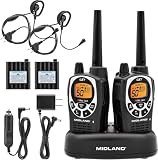 | Midland GXT1000VP4 GMRS Two-Way Radio (50 Channel, Long Range, 142 Privacy Codes, SOS, NOAA, Rechargeable Nickel Battery, Black/Silver 2-Pack) | Check Price On Amazon |
 | Retevis RT628 Walkie Talkies for Kids,Toys Gifts for 6-12 Years Old Boys Girls,Long Range 2 Way Radio 22CH VOX,Birthday Gift,Family Walkie Talkie for Camping Hiking Indoor Outdoor | Check Price On Amazon |