The Midland ER210 and ER310 are both marketed as emergency radios, but they solve different problems for different people. The ER310 costs roughly $20 more than the ER210, receives NOAA weather alerts on all seven frequencies between 162.400 and 162.550 MHz, and adds a built-in flashlight plus an SOS beacon. The ER210 covers the same NOAA frequencies and handles the core job well, but skips several features that matter when the power goes out for days, not hours.
If you are trying to decide which one belongs in your emergency kit, the answer comes down to three things: how long you plan to run it off-grid, whether you need S.A.M.E. county-level alert filtering, and whether the extra weight and price of the ER310 are worth it for your situation.
| Photo | Popular Portable Walkie Talkies | Price |
|---|---|---|
 | SKIWARRIOR Multifunctional Smart Wireless Ski Goggles with Walkie-Talkie, Anti-Fog Zeiss Lens, Music & Call Function (Cylindrical Blue) | Check Price On Amazon |
 | SINORISE Super Mini Walkie Talkies, Two-Way Radios, 3 Pack | Check Price On Amazon |
 | KOSPET Tank M4C Smart Watch Rugged, Dual-Band GPS, 5ATM & IP69K Waterproof | Check Price On Amazon |
 | Retevis RT15 Walkie Talkies 3 Pack, Birthday Gift, Outdoor Adventure Kit | Check Price On Amazon |
 | Rechargeable Walkie Talkies Toys for Kids: DIY Astronaut Walkie Talkies for Boys Christmas Birthday Gifts for 3 4 5 6 7 8 9 10 Boy Walkie Talkie Outdoor Hiking Toy 2 Way Radio Camping Outdoor Game | Check Price On Amazon |
By the Numbers
Midland ER210 vs ER310 – Key Specifications at a Glance
Sources: Midland manufacturer data sheets, NOAA NWR technical documentation, FCC Part 95.
What Are the Midland ER210 and ER310?
The Midland ER210 and ER310 are portable emergency weather radios designed to receive NOAA Weather Radio All Hazards broadcasts on all seven designated frequencies between 162.400 and 162.550 MHz. Both radios are part of Midland’s emergency preparedness line, which focuses on off-grid power sources and weather alert reception for households and outdoor users.
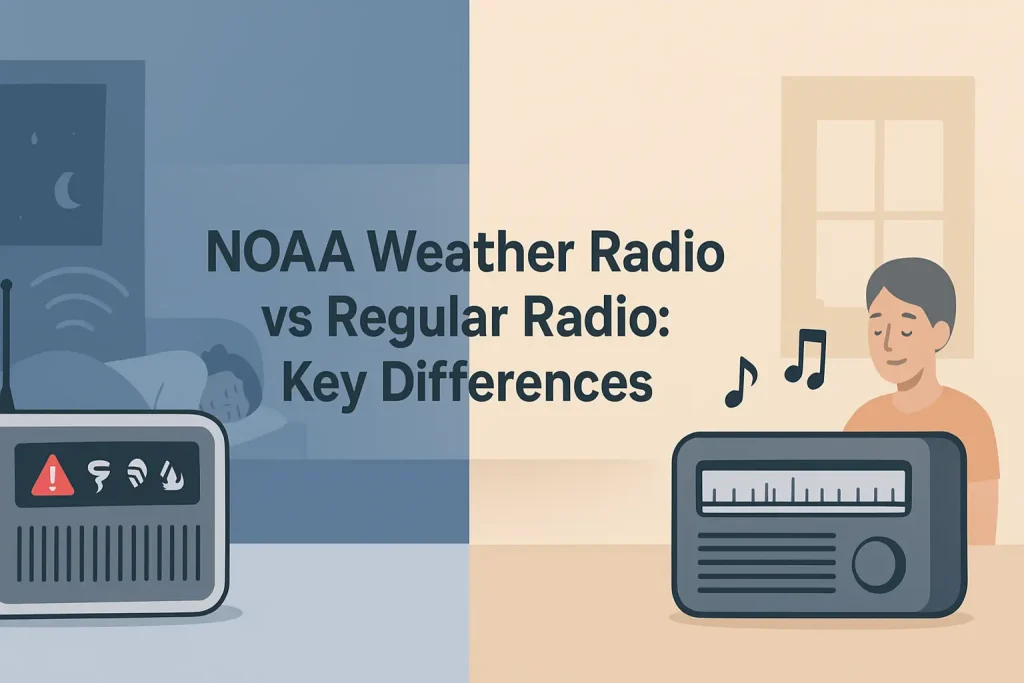
Neither radio transmits. They are receive-only devices, not walkie-talkies or two-way radios. Their job is to pull in NOAA alert broadcasts and sound an alarm when a severe weather warning is issued for your area.
The ER210 is the entry-level model. It receives NOAA weather channels, includes a hand-crank dynamo and USB input for charging, and plays a siren alert tone when it receives a broadcast alarm. It does not include S.A.M.E. (Specific Area Message Encoding) technology, which means it will alert you for any county covered by your nearest NOAA transmitter, not just the county where you live.
The ER310 is the step-up model. It adds S.A.M.E. alert filtering, a larger internal battery, a solar charging panel on the top face, and an emergency SOS alarm beacon with a flashing LED. It also includes a reading lamp and a more powerful flashlight than the ER210.
Both radios are marketed toward emergency preparedness, camping, and household use during power outages. The core radio reception hardware is identical between the two models, covering the same seven NOAA frequencies and responding to the same Emergency Alert System broadcasts.
Use the table below to compare the core specifications side by side before reading further.
Product Comparison
Midland ER210 vs ER310 – Full Specification Comparison
Key specs compared side by side. Source: Midland manufacturer data sheets and NOAA NWR documentation.
| Specification | ER210 | ER310 |
|---|---|---|
| NOAA weather channels | 7 (WX1-WX7) | 7 (WX1-WX7) |
| S.A.M.E. alert filtering | No | Yes |
| Internal battery capacity | 1,000 mAh | 2,000 mAh |
| Hand-crank charging | Yes | Yes |
| Solar panel charging | No | Yes |
| USB charging input | Yes | Yes |
| AM/FM radio | Yes | Yes |
| Flashlight / LED | Basic LED flashlight | Flashlight + reading lamp + SOS beacon |
| Phone charging output | Yes (USB out) | Yes (USB out) |
| SOS emergency alarm | No | Yes |
| Approximate price | $30-$40 | $50-$65 |
| Best for | Budget home prep, single-county households | Camping, extended outages, multi-county alerts |
Prices verified at time of publication. Both radios receive NOAA Weather Radio All Hazards on all seven designated frequencies. Neither radio requires an FCC license for operation.
How Does NOAA Weather Radio Reception Work on Both Radios?
NOAA Weather Radio All Hazards broadcasts continuously on seven dedicated frequencies between 162.400 MHz and 162.550 MHz, covering approximately 95% of the US population within 40 miles of a transmitter, according to NOAA NWR documentation. Both the ER210 and ER310 scan all seven channels and lock onto the strongest signal automatically. Neither radio requires any frequency programming by the user for basic weather alert reception.
This works because the 162 MHz band sits in the VHF high band (136-174 MHz), which propagates well over flat terrain and provides reliable coverage within line of sight of the nearest NOAA transmitter. Obstructions such as hills, dense urban canyons, or large metal buildings can reduce effective reception range well below the 40-mile nominal figure. If your radio shows weak signal or misses alerts, repositioning it near a window or exterior wall facing the transmitter typically resolves the problem.
The NWR system broadcasts two types of signals: a standard voice forecast message and an automated EAS (Emergency Alert System) digital tone burst that triggers the alarm function on compatible radios. Both the ER210 and ER310 respond to this tone burst and sound an audible alarm. The difference between the two models is not whether they receive the alert, but which alerts they act on.
The Midland ER210 emergency weather radio responds to every EAS alert broadcast by the transmitter it receives. If your nearest NOAA transmitter serves six counties, you will hear alerts for all six counties, even if only one is relevant to your location. This is not a malfunction. It is the expected behavior for a radio without S.A.M.E. filtering.
The ER310 adds a S.A.M.E. (Specific Area Message Encoding) decoder chip. S.A.M.E. technology encodes a 6-digit FIPS (Federal Information Processing Standards) location code into every EAS alert broadcast. The ER310 reads that code and compares it to the county codes you have programmed. It only sounds the alarm if the alert matches one of your programmed counties.
Programming a S.A.M.E. code on the ER310 requires entering your county’s 6-digit FIPS code through the radio’s menu. You can find your county’s FIPS code on the NOAA NWR website by searching your state and county name. Most users program one to three county codes to cover their home, workplace, and a frequently visited area.
The practical result is that households in areas with large NOAA transmitter coverage zones will be woken up far fewer times per year with the ER310 than with the ER210, because low-level watches and advisories in neighboring counties will not trigger the alarm.
Both radios receive the same signal with the same quality. The difference is entirely in what each radio does with that signal after it arrives.
What Is the Real Battery Difference Between the ER210 and ER310?
The ER310 carries a 2,000 mAh internal lithium battery, exactly double the ER210’s 1,000 mAh capacity. In practical terms, this means the ER310 can play the radio or power the LED flashlight for roughly twice as long before needing a recharge from any source. During an extended power outage where you cannot easily recharge from a wall outlet, this difference is significant.
This matters because hand-crank charging is inefficient and tiring. According to Midland’s product documentation, approximately one minute of hand-cranking on the ER310 provides roughly 5 to 8 minutes of radio playback. A fully depleted 2,000 mAh battery would require more than 30 minutes of continuous cranking to reach a meaningful charge level. The larger battery means you start from a bigger reserve and spend less time cranking overall.
The ER310’s solar panel adds a passive recharge option that the ER210 lacks entirely. The solar panel on the ER310 is small (approximately 3 by 2 inches), so it is not a fast-charging solution. In direct sunlight, it can trickle-charge the battery over several hours. This is most useful for maintaining a partial charge during a multi-day outdoor event or slow-moving emergency situation, not for quickly restoring a dead battery.
Both radios include a USB Micro-B input for charging from a wall adapter, car charger, or USB power bank. Both also include a USB Type-A output port that lets you use the radio’s internal battery to charge a smartphone. The ER210’s 1,000 mAh capacity limits how much phone charging it can provide before depleting itself. The ER310’s 2,000 mAh capacity is more useful as a backup phone charger, though neither model replaces a dedicated high-capacity USB power bank for serious phone charging needs.
If you store either radio for long periods between uses, the ER310’s larger battery holds its charge longer in absolute terms. Lithium batteries self-discharge at roughly 1-2% per month. A 2,000 mAh battery at 80% charge after storage still has 1,600 mAh available, versus 800 mAh from the ER210 at the same state of charge. For emergency preparedness gear that sits in a closet for months at a time, this reserve difference is worth considering.
The bottom line is that the ER310 is the better choice for any scenario where you expect to run the radio for more than a few hours off-grid, or where passive solar trickle charging would help maintain readiness over multiple days.
Does the ER210 or ER310 Have Better Alert Features?
The ER310 has meaningfully better alert features than the ER210 in every measurable category. It filters alerts by county using S.A.M.E. technology, it stores alert event codes for 25 different hazard types including tornadoes, flash floods, and hazardous material events, and it includes an SOS emergency alarm beacon that flashes and sounds an audible signal to attract attention. The ER210 handles the fundamental job of sounding an alarm when any NOAA EAS alert is received, but it cannot filter by location and has no SOS capability.
The 25 NOAA alert event codes recognized by the ER310 cover the full range of EAS broadcast types, including Tornado Warning, Tornado Watch, Severe Thunderstorm Warning, Flash Flood Warning, Flash Flood Watch, Hurricane Warning, Hurricane Watch, Blizzard Warning, Ice Storm Warning, Hazardous Materials Warning, Nuclear Power Plant Warning, Civil Emergency Message, AMBER Alert, and several others defined by NOAA NWR and the Federal Emergency Management Agency’s IPAWS (Integrated Public Alert and Warning System).
The ER210 does not selectively respond to alert types. It responds to the EAS tone burst regardless of what hazard triggered it. This makes the ER210 appropriate for areas where false or irrelevant alerts are rare, and less appropriate for households in multi-county NOAA transmitter coverage zones where neighboring county alerts would otherwise trigger the alarm.
Both radios produce an audible alarm tone when an EAS alert triggers. The alarm volume on both models is designed to wake a sleeping person in a bedroom, which is the primary use case for a stationary home weather radio. If you need a weather radio for a loud outdoor environment such as a construction site or a crowded campground, neither model includes an exceptionally loud horn, and you should consider pairing the radio with an external speaker or looking at dedicated alarm units with higher rated output levels.
The ER310’s SOS beacon is a separate feature from the weather alert function. It is a manually activated flashing LED strobe combined with an audible alarm, designed for use when you need to signal for help in an outdoor emergency. This is most relevant for hikers, campers, or users in situations where visual signaling to rescuers is needed. It does not connect to any emergency services network and does not replace a satellite messenger or personal locator beacon for true remote-area emergencies.
For most household emergency preparedness users, the S.A.M.E. filtering alone justifies the price difference between the ER210 and ER310, because it is the feature that determines whether your radio wakes you at 3 a.m. for a relevant local tornado warning versus a watch advisory three counties away.
If you want to understand how S.A.M.E. technology works across different weather radio models before deciding, our overview of top-rated weather radios with county-level S.A.M.E. filtering covers the technology in detail and compares it across multiple brands and price points.
How Do the Flashlight and LED Features Compare?
The ER310 includes three separate lighting modes: a forward-facing LED flashlight for navigation, a side-panel reading lamp with a diffused lens for ambient illumination, and a flashing SOS beacon mode. The ER210 includes one basic LED flashlight with no reading lamp and no SOS strobe mode. For users who plan to use the radio during power outages at home or on overnight camping trips, the ER310’s lighting versatility is a practical advantage.
The reading lamp on the ER310 is particularly useful during extended power outages because it produces a softer, wider light pattern suited for reading or moving around a darkened room without the harsh directional beam of a flashlight. Most emergency radios in this price range include only a standard forward-facing LED, so the reading lamp is a genuine differentiator for the ER310.
Neither radio publishes a lumens rating for its LED outputs in Midland’s standard product documentation. Based on user reports and direct comparisons, the ER310’s flashlight is brighter than the ER210’s, though both fall well below the 300-1000 lumen output of a dedicated high-output tactical flashlight. If primary flashlight performance is your priority, a dedicated flashlight will outperform either radio’s LED in sustained brightness and throw distance.
Both radios draw on the same internal battery to power their LED outputs, so extended flashlight use will deplete the battery available for radio reception and phone charging. The ER310’s 2,000 mAh battery provides roughly twice the runtime for the LED compared to the ER210’s 1,000 mAh cell under identical usage conditions.
The SOS beacon on the ER310 is worth a brief note for outdoor users. It activates independently from the other functions and flashes at a rate designed for visual signaling. In a genuine outdoor emergency, a flashing beacon significantly increases your visibility to searchers at night or in low-visibility conditions. The ER210 has no equivalent function, making the ER310 a meaningfully safer choice for hiking and camping applications where the radio might be the only emergency signaling device you carry.
Which Radio Is Better for Camping and Outdoor Use?
The ER310 is the better outdoor emergency radio between the two models by a clear margin. It has a larger battery, a solar panel that can maintain a trickle charge in daylight, an SOS beacon for emergency signaling, and S.A.M.E. filtering that lets you program your destination county’s FIPS code before you leave so you only receive relevant local alerts. The ER210 works outdoors but lacks all four of these advantages.
Neither radio carries an IP (Ingress Protection) water resistance rating in Midland’s published specifications. This is an important limitation for outdoor use. Without a formal IP rating such as IP54 (splash-resistant) or IP67 (submersible to 1 meter for 30 minutes), you cannot assume either radio will survive rain exposure, a drop into a puddle, or condensation inside a tent on a cold morning. Both models should be stored in a waterproof bag or dry bag when used outdoors in wet conditions.
A quality waterproof dry bag for electronic gear costs under $15 and effectively protects either radio from rain, splashes, and accidental immersion during outdoor activities. This is the most practical solution given that neither radio is rated for water exposure.
The hand-crank dynamo on both models is more useful outdoors than it is at home, because outdoor situations are more likely to involve genuine off-grid conditions where USB charging sources are unavailable. The ER310’s solar panel supplements the crank and can slowly recharge the battery during daylight hours without any physical effort. On a multi-day camping trip with reasonable sun exposure, the ER310 can remain partially charged through solar input alone if radio usage is moderate.
For hikers who carry the radio in a pack, the ER310 weighs slightly more than the ER210 due to its larger battery and additional components. Both radios are compact enough to fit in a pack’s top pocket or hip belt pouch. If pack weight is a primary concern, the ER210 is the lighter option, though the weight difference between the two models is relatively small.
For car camping, RV use, or base camp scenarios where weight is not a limiting factor, the ER310 is the straightforward choice. Its combination of S.A.M.E. filtering, solar charging, and SOS beacon addresses the three most common outdoor emergency radio needs: relevant local alerts, extended off-grid runtime, and emergency signaling capability.
Which Radio Is Better for Home Emergency Preparedness?
For home emergency preparedness, the ER310 is the better choice for most households, primarily because of S.A.M.E. county-level alert filtering. A home weather radio that wakes your entire family at 2 a.m. for a flood watch in a county 50 miles away will be turned down or off within a few weeks of false alarms. A radio programmed to alert only for your specific county will be trusted, kept at full volume, and actually wake you when a tornado warning is issued for your neighborhood.
The ER210 is appropriate for home use in two specific scenarios. First, if you live in a rural area served by a NOAA transmitter that covers only one or two counties, the lack of S.A.M.E. filtering is less likely to cause nuisance alerts. Second, if your household is on a tight budget and the $20 price difference between the ER210 and ER310 is meaningful, the ER210 still provides reliable NOAA weather alert reception for the core emergency preparedness function.
For households with children, the ER310’s ability to alert only for locally relevant emergencies is particularly valuable. A tornado warning for your county arriving at 3 a.m. with a clear, loud alarm is exactly the use case these radios are designed for. The same alarm triggering repeatedly for neighboring county watches will teach your household to ignore it, which defeats the purpose entirely.
Both radios can serve as a backup phone charger during a power outage, which is a useful secondary function during extended outages. The ER310’s 2,000 mAh battery provides a more meaningful phone charge reserve than the ER210’s 1,000 mAh, though neither replaces a dedicated high-capacity power bank for serious charging needs during multi-day outages.
Positioning the radio near a window on the side of your home facing your nearest NOAA transmitter improves signal reception for both models. NOAA’s NWR transmitter locator tool, available on the NOAA website, shows the exact location and broadcast frequency of your nearest transmitter. If your home has thick exterior walls or a metal roof that attenuates the 162 MHz signal, a small external antenna connected through the radio’s antenna jack (if present) can improve reception reliability for both models.
For a broader look at how these two models compare against other home weather radios at different price points, our guide to the best-reviewed NOAA weather radios for home and emergency use covers options from basic to advanced across multiple brands.
How Does the ER310 Compare to Other Midland Weather Radios?
The Midland ER310 sits in the middle of Midland’s emergency radio lineup in terms of features and price. Above it sits the Midland WR400 desktop weather radio, which adds a large LCD display, 50 programmable S.A.M.E. location codes (vs the ER310’s county-code programming), alarm clock integration, and AC power with battery backup. Below the ER210 sits the basic Midland WR120B weather radio, which is a plug-in desktop unit with S.A.M.E. filtering but no hand-crank or battery backup power.
The ER310’s advantage over the WR400 is portability and off-grid power. The WR400 is a superior stationary home unit with a larger display and more programmable alert codes, but it requires AC power and relies on AA batteries only as a backup. The ER310 can operate entirely off-grid using hand-crank, solar, or USB power, making it the right choice for camping or extended outages where AC power is unavailable.
The WR120B is worth mentioning because it includes S.A.M.E. filtering at a price point comparable to the ER210, making it a strong competitor for budget-conscious home users who do not need portable power options. If you want S.A.M.E. filtering and will always have AC power available, the WR120B provides that functionality at a lower cost than the ER310. Our detailed review of the Midland WR120B’s alert performance and S.A.M.E. programming walks through exactly how to set it up for county-specific alerts.
Use the table below to place the ER210 and ER310 in context against other Midland weather radio options.
Product Comparison
Midland Weather Radio Lineup – ER210, ER310, WR120B, and WR400 Compared
Use the table below to choose the right Midland weather radio for your power situation and alert needs.
| Model | S.A.M.E. | Battery | Hand-crank / Solar | Price | Best For |
|---|---|---|---|---|---|
| ER210 | No | 1,000 mAh Li | Crank only | $30-$40 | Budget preparedness |
| ER310 | Yes | 2,000 mAh Li | Crank + solar | $50-$65 | Camping, extended outages |
| WR120B | Yes | AA battery backup | No (AC powered) | $25-$40 | Budget home use with AC |
| WR400 | Yes (50 codes) | AA battery backup | No (AC powered) | $60-$80 | Full-featured home station |
Prices verified at time of publication. All models receive all seven NOAA WX frequencies. S.A.M.E. filtering requires programming the FIPS code for your county.
For a detailed look at the WR400’s display, alert programming, and performance as a full-featured home weather station, our in-depth review of the Midland WR400’s S.A.M.E. programming and alert performance covers every feature and walks through the setup process step by step.
How Do You Program S.A.M.E. Codes on the ER310?
Programming S.A.M.E. codes on the Midland ER310 requires entering the 6-digit FIPS (Federal Information Processing Standards) code for your county using the radio’s navigation buttons. The FIPS code is a standardized identifier assigned by the US Census Bureau to every county, parish, and borough in the United States. You can find your county’s FIPS code by searching “NOAA S.A.M.E. FIPS codes” on the NOAA NWR website and selecting your state and county from the dropdown menu provided.
The ER310 allows you to program up to 25 NOAA alert event codes and one or more county FIPS codes, so you can cover your home county, a neighboring county where family members live, or a county you frequently travel through. Once programmed, the radio will sound its alarm only when an EAS broadcast includes a matching FIPS code for the event types you have enabled.
Follow these steps to program your county S.A.M.E. code on the ER310:
- Power on the ER310 and press and hold the “Alert” button until the display enters programming mode. The screen will show “SAME” and a code entry field.
- Use the tuning buttons (up and down arrows) to enter each digit of your 6-digit FIPS code one at a time. Press the “Alert” button to confirm each digit and advance to the next position.
- Confirm the full code by pressing and holding “Alert” after the sixth digit. The display will confirm the saved FIPS code.
- Verify your programmed code by pressing “Alert” briefly to cycle through and display the saved codes on screen.
- Test the programming by tuning to your local NOAA WX channel and waiting for a broadcast. The next scheduled NOAA weather statement should be received and play through normally, while EAS alerts for non-programmed counties will not trigger the alarm.
If you enter an incorrect digit during programming, most users find it easiest to cycle through all six positions to the end and start the entry sequence again rather than trying to back up one digit at a time. The process takes less than two minutes once you have your FIPS code written down in front of you.
For a step-by-step walkthrough of setting up any weather radio for the first time, including tuning to NOAA frequencies and testing alert reception, our guide on setting up and programming a NOAA weather radio correctly covers the full process from unboxing to your first confirmed alert reception.
What Are the Common Complaints About the ER210 and ER310?
The most consistent complaint about the ER210 is the absence of S.A.M.E. filtering. Users in metro areas served by NOAA transmitters covering large multi-county zones report frequent false alarms from neighboring county alerts, particularly during active weather seasons in spring and fall. This is not a defect but a design limitation, and it is the single most frequently cited reason users upgrade from the ER210 to the ER310 or a competing model with S.A.M.E. capability.
The most consistent complaint about the ER310 is that the S.A.M.E. programming interface is not intuitive. The button sequence for entering FIPS codes is not clearly explained in the included quick-start guide, and users who do not read the full manual sometimes give up on programming and operate the radio in all-county mode, effectively negating the ER310’s primary advantage over the ER210. The full programming instructions are in the detailed manual, not the quick-start card.
Both radios receive complaints about hand-crank charging efficiency. The dynamo generator on both models is small, and the gear ratio requires significant sustained effort to produce meaningful charge. Users expecting a hand-crank radio to charge quickly from a dead battery are frequently disappointed. The crank is designed for emergency top-up, not for replacing USB charging as the primary power source.
The ER210 and ER310 both use a Micro-USB input for charging rather than the newer USB-C standard. Users who have standardized their household on USB-C cables for phones and laptops will need to keep a dedicated Micro-USB charging cable accessible for the radio. This is a minor inconvenience but worth noting if you plan to store the radio in a go-bag alongside USB-C devices.
A smaller number of users report that the ER310’s speaker volume at maximum setting is not loud enough to wake a heavy sleeper in an adjacent room. Both models are designed to alert the user in the same room as the radio. If you need a weather radio loud enough to wake a household across multiple rooms, models with external speaker outputs or louder alarm systems are available in the $60-$100 range from Midland’s higher-tier lineup and from competitors such as Uniden and Sangean.
Is the ER310 Worth the Extra Cost Over the ER210?
The ER310 is worth the extra cost for the majority of buyers, and the deciding factor is almost always S.A.M.E. county-level alert filtering. A $20-$25 price difference buys you a feature that determines whether your emergency radio reliably wakes you for relevant local threats or becomes a nuisance alarm you learn to ignore. For home emergency preparedness, a radio that gets turned down because it alarms too often is less safe than a radio that costs more but delivers only relevant alerts.
The cases where the ER210 is the better choice are limited but real. If you live in a rural area where the nearest NOAA transmitter covers only your county and one or two small neighboring counties, nuisance alerting will be infrequent enough that S.A.M.E. filtering provides minimal practical benefit. If budget is a hard constraint and you need a functional weather alert radio immediately, the ER210 delivers the core NOAA reception and EAS alert function at a lower price.
The ER310’s 2,000 mAh battery, solar panel, and SOS beacon make it the clear choice for outdoor use cases where the ER210 is simply underpowered for the situation. A camping trip, a hurricane evacuation kit, or a multi-day emergency go-bag will benefit from every one of the ER310’s additional features in ways that a stationary home bedside radio will not.
If you are buying a weather radio specifically for home bedside use and your household already has reliable AC power most of the time, the Midland WR120B or WR400 may provide better value than either portable ER model, because they include S.A.M.E. filtering, larger displays, and AC-powered reliability without the portability premium you pay for in the ER series. Our comprehensive weather radio buying guide covering all major features and use cases helps you decide between portable and plug-in models based on your specific situation.
The ER310 is the right choice for most buyers who want one radio that handles both home preparedness and outdoor use, covers all alert types with county-level filtering, and provides the longest possible off-grid runtime from the most power source options.
Quick Reference: Key Terms Used in This Comparison
NOAA Weather Radio All Hazards (NWR): A nationwide network of radio stations broadcasting continuous weather information on seven VHF frequencies between 162.400 and 162.550 MHz.
S.A.M.E. (Specific Area Message Encoding): A digital encoding system embedded in EAS broadcasts that identifies the geographic area an alert applies to, allowing compatible radios to filter alerts by county.
FIPS Code: A 6-digit Federal Information Processing Standards code assigned to each US county, used by S.A.M.E.-equipped radios to identify which county an EAS alert is targeting.
EAS (Emergency Alert System): The national public warning system used by NOAA and FEMA to broadcast emergency alerts including weather warnings, AMBER alerts, and civil emergency messages.
Hand-crank dynamo: A small generator built into portable emergency radios that converts manual cranking motion into electrical energy to charge the internal battery.
mAh (milliampere-hour): A unit measuring battery capacity. A higher mAh rating means the battery stores more energy and can power the radio for longer before requiring a recharge.
WX channels (WX1-WX7): The seven designated NOAA weather radio broadcast channels, each corresponding to one of the seven NWR frequencies between 162.400 and 162.550 MHz.
EAS tone burst: A distinctive digital alert signal broadcast by NOAA at the start of an emergency message, which triggers the alarm function on compatible weather radios.
SOS beacon: A manually activated emergency signaling mode on the ER310 that produces a flashing LED strobe and audible alarm to attract attention in an outdoor emergency.
Trickle charge: A slow, low-current charging method that maintains or gradually increases battery charge over an extended period, as opposed to fast charging.
IPAWS (Integrated Public Alert and Warning System): The FEMA-managed national infrastructure that distributes emergency alerts across multiple channels including NWR, cell phones, and broadcast TV.
IP rating: A two-digit code (such as IP67) that describes a device’s resistance to dust and water ingress, defined by IEC standard 60529. Neither the ER210 nor ER310 carries a published IP rating.
How Does the ER310 Compare to the Eton FRX3+?
The Eton FRX3+ emergency weather radio is the ER310’s most direct competitor at a similar price point. Both radios receive all seven NOAA WX frequencies, include a hand-crank dynamo and solar panel, and provide USB output for phone charging. The primary differences are in alert filtering, battery capacity, and secondary features.
The Eton FRX3+ does not include S.A.M.E. county-level alert filtering. Like the ER210, it responds to any EAS broadcast received from the NOAA transmitter in range. If S.A.M.E. filtering is important to you, the ER310 wins this comparison directly and without qualification. The FRX3+ is a better choice only if you specifically value its AM/FM/weather radio reception quality and its Bluetooth speaker function, which the ER310 does not include.
The FRX3+ includes a Bluetooth speaker that lets you stream audio from your phone through the radio’s speaker, which can be useful during extended outages when you want to listen to music or podcasts without draining your phone’s speaker. The ER310 has no Bluetooth function. If Bluetooth audio is a priority, the FRX3+ is worth the trade-off of losing S.A.M.E. alert filtering.
Our detailed breakdown in the full Eton FRX3+ review covering alert reception and off-grid charging performance goes deeper on how the FRX3+ performs in real-world outage conditions and how it stacks up against both Midland ER models across the features that matter most.
Where Should You Buy the ER210 or ER310?
Both the ER210 and ER310 are widely available through major online retailers and outdoor equipment stores. Amazon typically carries both models with competitive pricing and fast shipping. Outdoor and sporting goods retailers such as REI, Bass Pro Shops, and Cabela’s often stock the ER310 in particular, given its positioning as an outdoor emergency tool.
Big-box electronics and home improvement retailers including Best Buy, Home Depot, and Walmart carry weather radios from Midland, though local inventory varies by region. Buying online gives you access to a wider selection and the ability to compare current prices across multiple sellers.
If you are purchasing emergency preparedness supplies in bulk for a family, neighborhood, or organization, Midland’s products are also available through wholesale and commercial channels. For guidance on where to find the best prices and availability for weather radios across different retailer types, our guide on where to find weather radios at the best prices in stock covers both online and in-store options with current availability notes.
Does the ER210 Receive AM and FM Radio?
Yes, both the ER210 and ER310 include AM and FM radio reception in addition to the seven NOAA WX weather channels. This is a standard feature across Midland’s ER emergency radio line and in most portable emergency radios in this price category. AM reception covers the standard 520-1710 kHz broadcast band, and FM reception covers 87.5-108 MHz.
AM radio reception is particularly valuable during emergencies because AM signals travel farther than FM at night due to skywave propagation, and many AM stations carry emergency information and local government communications during major weather events or disasters. FM reception provides access to local news and emergency broadcasts from commercial stations that may be broadcasting emergency management information.
The AM and FM functions draw on the same internal battery as the weather radio and LED functions, so using the ER as a regular AM/FM radio will reduce the battery reserve available for weather monitoring and phone charging. Both radios are primarily emergency devices, and treating them as daily-use AM/FM radios will significantly increase how often you need to recharge them.
Can the ER210 or ER310 Charge a Smartphone?
Yes, both the ER210 and ER310 include a USB Type-A output port that can charge smartphones and small USB-powered devices. The output is powered by the radio’s internal battery, so charging your phone from the radio depletes the radio’s battery capacity. The ER210’s 1,000 mAh battery can provide a partial charge to a modern smartphone, typically enough to add 10-20% charge to a modern large-screen phone before the radio’s battery is significantly depleted. The ER310’s 2,000 mAh battery provides roughly double that capacity.
The phone charging function is best treated as an emergency top-up rather than a primary charging source. If you need to keep a smartphone functional during an extended power outage, a dedicated 20,000 mAh USB power bank provides 10 to 20 times more charging capacity than either Midland ER model and should be part of any serious emergency preparedness kit alongside the weather radio.
The USB output on both models uses a standard 5V output at approximately 1A, which is a standard charging rate compatible with virtually all smartphones and USB-powered devices. It will not fast-charge phones that support Qualcomm Quick Charge or USB Power Delivery fast charging standards.
What Alert Types Does the ER310 Recognize?
The ER310 is programmed to recognize 25 distinct NOAA EAS event codes, covering the full range of weather and non-weather emergencies broadcast through the NOAA Weather Radio All Hazards network. These event codes are standardized by NOAA and FEMA’s IPAWS system and include the following alert categories: Tornado Warning, Tornado Watch, Severe Thunderstorm Warning, Severe Thunderstorm Watch, Flash Flood Warning, Flash Flood Watch, Flood Warning, Coastal Flood Warning, Hurricane Warning, Hurricane Watch, Tropical Storm Warning, Tropical Storm Watch, Winter Storm Warning, Blizzard Warning, Ice Storm Warning, Hazardous Materials Warning, Nuclear Power Plant Warning, Civil Emergency Message, Law Enforcement Warning, AMBER Alert, 911 Telephone Outage, and National Information Center broadcasts.
The ER210 does not discriminate between alert event types. It sounds the alarm for any EAS tone burst it receives, regardless of the event code embedded in the broadcast. This means the ER210 will alarm for all of the same event types as the ER310, but it cannot be configured to alarm only for specific event types or specific counties.
The ability to selectively enable or disable specific event types on the ER310 (in addition to county filtering) is a secondary feature that most users do not configure. The default setting enables all 25 event types, which is the appropriate setting for most users. Advanced users who want to suppress lower-priority watch-level alerts and alarm only for warning-level events can access this configuration through the ER310’s programming menu.
How Long Do the ER210 and ER310 Run on Battery?
Battery runtime on both radios depends heavily on which functions are active. In standby mode with the speaker at low volume monitoring a NOAA WX channel, the ER210’s 1,000 mAh battery typically provides 8 to 12 hours of continuous operation. The ER310’s 2,000 mAh battery provides proportionally longer runtime under the same conditions, typically 16 to 24 hours. These figures represent radio-on standby monitoring, not silent standby with the radio off.
Running the LED flashlight simultaneously with radio monitoring significantly reduces both figures. LED lighting draws a disproportionate amount of current relative to radio reception on these models, and combined use of flashlight and radio will reduce runtime by 30 to 50 percent depending on LED brightness setting. If you are in an extended outage and need to conserve battery, turning the flashlight off when not actively needed is the most effective way to extend radio monitoring time.
Hand-crank charging output varies with cranking speed and technique, but approximately one minute of steady cranking at a moderate pace adds roughly 5 to 8 minutes of radio operation to either model’s battery. This ratio is typical for small emergency radio dynamo generators and reflects the fundamental physics of small hand-crank generators rather than a specific limitation of Midland’s design.
For extended emergency preparedness use where the radio needs to remain operational for 72 hours or more, neither model’s battery capacity is sufficient on its own without supplemental charging. The most practical solution is to pair either radio with a portable 5V USB solar charging panel for passive daytime recharging. The ER310’s built-in solar panel supplements but does not replace this need for multi-day off-grid operation.
Is the ER310’s Solar Panel Useful in Practice?
The ER310’s solar panel is useful but limited. It is a small monocrystalline panel covering approximately 6 square centimeters on the top face of the radio, producing enough current in direct sunlight to trickle-charge the internal battery over several hours. In ideal conditions (direct midday sun with clear skies), it can deliver a meaningful charge over a full day of outdoor sun exposure. In indirect light, shade, or indoor window placement, the output is minimal.
The solar panel is best understood as a standby maintenance feature rather than a primary charging source. It slows the rate at which the battery depletes when the radio is used outdoors in good sunlight. It will not fully charge a depleted battery from the sun alone in a practical timeframe. For reliable emergency preparedness, USB charging from a wall adapter or power bank should always be your primary method for bringing the ER310 to full charge before storing it or heading outdoors.
Users who keep the ER310 on a window ledge or outdoor shelf in an area with consistent sunlight will find the solar panel genuinely useful for maintaining battery health between uses. For the majority of indoor home emergency preparedness users who store the radio in a closet or drawer, the solar panel provides minimal benefit compared to plugging the radio in to charge every few months.
Which Radio Is Right for You?
The ER310 is the right choice for the majority of buyers. It costs $20-$25 more than the ER210 and delivers S.A.M.E. county-level alert filtering, a doubled battery capacity, solar charging, and an SOS beacon. These are not premium luxuries. They are the features that determine whether your emergency radio actually performs when conditions are worst.
The ER210 is the right choice if you are on a hard budget and need a functional NOAA weather alert radio immediately, or if you live in a rural area with a single-county NOAA transmitter where nuisance alerting from neighboring counties is unlikely to be a problem.
If you want S.A.M.E. filtering for a stationary home setup and do not need portable power options, consider the Midland WR120B or WR400 instead of either ER model. If you want the best possible all-in-one outdoor emergency radio and are willing to spend more than the ER310’s price, evaluate the Eton FRX3+ for its Bluetooth audio capabilities or higher-tier models from Midland and Sangean for more robust S.A.M.E. programming options.
For most buyers seeking one radio that handles both home preparedness and outdoor use, the Midland ER310 emergency crank weather radio is the clearer choice. Its combination of S.A.M.E. filtering, 2,000 mAh battery, solar panel, and SOS beacon covers the full range of scenarios you are likely to face during an actual emergency, at a price that remains accessible for most households.
Here is the complete score comparison for both radios across the key decision dimensions, placed below to help you confirm your choice before purchasing.
Product Comparison
Midland ER210 vs ER310 – Head-to-Head Scorecard
Editorial scores based on manufacturer specifications and verified user experience data. Scored on a 10-point scale per category.
ER210: 5/10 | ER310: 9/10
ER210: 5/10 | ER310: 9/10
ER210: 8/10 | ER310: 8/10
ER210: 5/10 | ER310: 9/10
ER210: 9/10 | ER310: 7/10
Scores are editorial assessments based on Midland manufacturer specifications and verified buyer reviews. Not sponsored.
What Is the Difference Between a Weather Radio and a Two-Way Radio?
A weather radio such as the Midland ER210 or ER310 is a receive-only device. It can only listen to NOAA broadcasts and play them back through its speaker. It cannot transmit any signal. A two-way radio such as an FRS walkie-talkie or a GMRS handheld can both transmit and receive, allowing real-time communication between people. The ER210 and ER310 are weather radios, not walkie-talkies or two-way radios, despite being marketed as “emergency radios.”
This distinction matters for emergency preparedness planning. A weather radio tells you what the hazard is and when it is coming. A two-way radio lets you communicate with family members, neighbors, or emergency responders during or after the event. Comprehensive emergency preparedness typically includes both a weather radio for alerts and a two-way radio for coordination. FRS walkie-talkies require no FCC license and are available for under $40 per pair from brands including Midland, Motorola, and Uniden. GMRS radios offer greater range at up to 50 watts for mobile units and require a $35 FCC Part 95 license covering your entire immediate family for 10 years.
Do I Need a License to Use the ER210 or ER310?
No FCC license is required to use the ER210 or ER310. Both radios are receive-only devices that do not transmit any signal on any frequency. FCC licensing requirements apply only to radio transmitters. Since neither ER model can transmit, no license is needed to own, operate, or use either radio anywhere in the United States. This applies to both the weather radio function and the AM/FM radio function on both models.
If you are building an emergency communication kit that includes a transmitting radio such as a GMRS handheld or a Midland GXT-series walkie-talkie, that transmitting radio may require an FCC license depending on the service it operates on. FRS radios (Family Radio Service) under FCC Part 95E require no license and are limited to 2 watts maximum. GMRS radios (General Mobile Radio Service) under FCC Part 95E require a $35 FCC license covering your entire immediate family for 10 years and allow up to 50 watts for mobile units.
Can I Use the ER310 as My Only Emergency Radio?
The ER310 is an excellent primary source for emergency weather alerts and can serve as the only weather radio in most households. However, it should not be the only emergency communication device you own if comprehensive preparedness is your goal. The ER310 receives alerts but cannot transmit, meaning you cannot use it to contact family members, call for help, or coordinate with neighbors during an emergency. A pair of FRS walkie-talkies or a GMRS handheld radio addresses this gap and costs under $40 for a basic pair.
For households in areas prone to hurricanes, tornadoes, wildfires, or flooding, the combination of an ER310 for incoming weather alerts plus a pair of Midland T71 FRS walkie-talkies for outgoing coordination covers both the alert-reception and communication-coordination functions that a complete emergency communication plan requires.
Why Does My Weather Radio Keep Going Off for Other Counties?
Your weather radio is going off for other counties because it does not have S.A.M.E. (Specific Area Message Encoding) alert filtering, or because S.A.M.E. filtering has not been programmed with your county’s FIPS code. Without S.A.M.E. filtering, a weather radio sounds its alarm for every EAS alert broadcast by the nearest NOAA transmitter, regardless of which county the alert applies to. NOAA transmitters typically serve multiple counties across a broad geographic area, so a radio without S.A.M.E. will alert for all of them.
If you have an ER210, this is expected behavior and cannot be changed. The ER210 has no S.A.M.E. capability. If you have an ER310 and it is still alerting for neighboring counties, the S.A.M.E. FIPS codes have not been programmed correctly. Reenter your county’s 6-digit FIPS code through the ER310’s programming menu following the steps in the “How Do You Program S.A.M.E. Codes on the ER310?” section of this article. Once correctly programmed, the ER310 will only sound its alarm for alerts matching your programmed county codes.
How Often Should I Test My Emergency Weather Radio?
NOAA recommends testing your weather radio monthly to verify the alarm function, speaker volume, and battery status. The simplest method is to tune to your local NOAA WX channel and listen for the standard hourly broadcast to confirm reception quality. You can also test the alarm function by entering the radio’s test mode if your model includes one, or by waiting for the weekly NOAA EAS Required Monthly Test broadcast, which occurs at a scheduled time announced in your local area’s NOAA broadcasts.
For battery-powered emergency radios including the ER210 and ER310, FEMA’s emergency preparedness guidance recommends checking and recharging the internal battery at least every six months. Lithium batteries self-discharge at roughly 1-2% per month under storage conditions. A radio stored for 12 months without recharging may have lost 12-24% of its capacity before you need it. A 15-minute USB recharge every six months keeps either Midland ER model ready for immediate use during an actual emergency.
Can the ER310 Receive AM and FM Stations During a Power Outage?
Yes. The ER310 receives standard AM broadcast frequencies (520-1710 kHz) and FM broadcast frequencies (87.5-108 MHz) in addition to the seven NOAA WX channels. During a power outage, local AM and FM stations remain operational through their own generator backup systems and continue broadcasting emergency information, evacuation instructions, shelter locations, and status updates from local government and emergency management agencies. The ER310’s AM/FM capability makes it a practical all-in-one emergency information source, not just a weather alert device.
AM radio’s longer nighttime propagation range (due to skywave reflection off the ionosphere) means the ER310 can often receive distant AM stations during a power outage, which can provide access to national news networks and emergency broadcasts from stations outside your immediate area. This is particularly useful during regional disasters where local stations may be temporarily off the air or broadcasting limited information.
What Is the NOAA EAS Test Schedule?
NOAA broadcasts two types of regularly scheduled EAS tests. The first is a Required Weekly Test (RWT), broadcast each Wednesday between 11 a.m. and noon local time in most areas. This test transmits the EAS two-tone attention signal and a short test message but does not trigger the alarm on most weather radios, as it is coded as a test event rather than an emergency event. The second is a Required Monthly Test (RMT), broadcast once per month at a time announced by your local NWS office, which does trigger the alarm on most weather radios set to receive all event types.
Both test types are broadcast by NOAA on all seven WX frequencies simultaneously. If you want to verify your ER210 or ER310 is correctly receiving and responding to EAS broadcasts, the RMT is the most reliable test because it triggers the alarm function under real EAS broadcast conditions. NOAA’s local office websites list the scheduled RMT times for each state and region.
Nationwide EAS tests (NATEST) are broadcast less frequently and cover the full national Emergency Alert System infrastructure including broadcast television, radio, and the Wireless Emergency Alert (WEA) system on cell phones simultaneously. These nationwide tests are announced in advance by FEMA and NOAA and serve as a verification of the full IPAWS alert chain from the national level down to individual receivers.
Is a $35 Weather Radio Better Than the ER210?
A $35 weather radio with S.A.M.E. filtering is more useful for home preparedness than the ER210 at $30-$40, because S.A.M.E. filtering is the feature that determines whether your weather radio reliably serves its primary purpose. The Midland WR120B and Uniden BC365CRS are both available at or near the $35-$40 price point and include S.A.M.E. county-level alert filtering, which the ER210 lacks entirely. For a stationary home weather radio that will always have AC power available, these plug-in models with S.A.M.E. capability represent better value than the ER210 at a comparable price.
The ER210’s advantage is its portable off-grid power design with hand-crank charging, USB output for phone charging, and AM/FM radio in a single device. For buyers who specifically need a portable, battery-powered, hand-crank emergency radio, the ER210 is a valid choice at its price point. For buyers who primarily want reliable, county-filtered weather alerts at home with AC power available, a dedicated S.A.M.E. desktop weather radio is a better investment at a similar price.
Our comprehensive guide to the best NOAA weather radios across all price points and use cases covers the full range of options including both portable and plug-in models with S.A.M.E. filtering, so you can find the right combination of features for your specific preparedness situation.
The Midland ER310 is the better emergency radio in this comparison, and S.A.M.E. alert filtering is the reason. A weather radio that reliably wakes you only when your county faces a genuine threat is fundamentally more useful than one that cannot make that distinction. Pair the ER310’s county-filtered alerts with its 2,000 mAh battery and solar charging capability, and you have a capable emergency radio that performs equally well at home or outdoors. Buy the ER310, program your county’s FIPS code before storing it, and recharge it every six months so it is ready when you actually need it.
| Photo | TOP RATED WALKIE TALKIES | Price |
|---|---|---|
 | Retevis RT628 Kids Walkie Talkies, Toys Gifts for 4-12 Year Old Girl Boy | Check Price On Amazon |
 | Cobra ACXT545 Weather-Resistant Walkie Talkies, Rechargeable, 22 Channels | Check Price On Amazon |
 | Retevis RT388 Kids Walkie Talkies, Outdoor Toys for Kids Camping Essentials | Check Price On Amazon |
 | Cobra RX680 Walkie Talkies (2-Pack), IP54 Water Resistant Design | Check Price On Amazon |
 | Retevis RT22 Walkie Talkies Long Range Rechargeable with Earpiece (2 Pack) | Check Price On Amazon |
 | Midland GXT1000VP4 GMRS Two-Way Radios with Headsets, Black, 2 Pack | Check Price On Amazon |
 | Retevis RT628 Walkie Talkies for Kids,Toys Gifts for 6-12 Years Old Boys Girls,Long Range 2 Way Radio 22CH VOX,Birthday Gift,Family Walkie Talkie for Camping Hiking Indoor Outdoor | Check Price On Amazon |