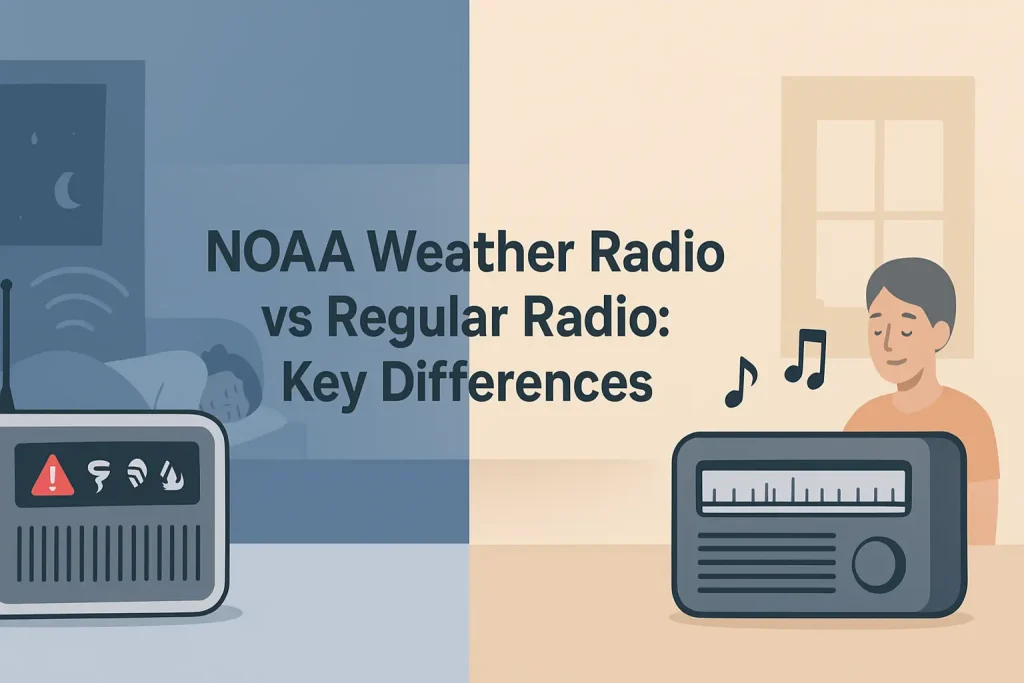
A weather radio without S.A.M.E. technology will sound an alert for every county in your state, not just yours. That means 3 a.m. wake-ups for storms 200 miles away while a tornado warning for your exact county scrolls silently past.
This guide covers everything you need to build a complete weather radio emergency kit: which radios to buy, how to program S.A.M.E. location codes, what accessories extend your preparedness, and how to integrate your radio into a broader emergency communication plan.
| Photo | Popular Portable Walkie Talkies | Price |
|---|---|---|
 | SKIWARRIOR Multifunctional Smart Wireless Ski Goggles with Walkie-Talkie, Anti-Fog Zeiss Lens, Music & Call Function (Cylindrical Blue) | Check Price On Amazon |
 | SINORISE Super Mini Walkie Talkies, Two-Way Radios, 3 Pack | Check Price On Amazon |
 | KOSPET Tank M4C Smart Watch Rugged, Dual-Band GPS, 5ATM & IP69K Waterproof | Check Price On Amazon |
 | Retevis RT15 Walkie Talkies 3 Pack, Birthday Gift, Outdoor Adventure Kit | Check Price On Amazon |
 | Rechargeable Walkie Talkies Toys for Kids: DIY Astronaut Walkie Talkies for Boys Christmas Birthday Gifts for 3 4 5 6 7 8 9 10 Boy Walkie Talkie Outdoor Hiking Toy 2 Way Radio Camping Outdoor Game | Check Price On Amazon |
Emergency Guide
Weather Radio for Emergency Preparedness – Key Numbers and Standards
Sources: NOAA National Weather Radio All Hazards documentation, FCC Part 95, FEMA emergency preparedness publications.
What Is a NOAA Weather Radio and Why Does It Matter for Emergency Preparedness?
A NOAA Weather Radio All Hazards (NWR) receiver is a dedicated radio that monitors one of seven broadcast frequencies between 162.400 and 162.550 MHz, 24 hours a day, and sounds an alarm the moment the National Weather Service issues a warning for your area. It does not depend on cellular towers, internet connectivity, or commercial broadcast stations, all of which can fail during the exact emergencies the radio is designed to warn you about.
According to NOAA NWR documentation, the network operates more than 1,000 transmitters across the United States, covering approximately 95% of the US population within reception range of at least one transmitter. Each transmitter broadcasts on one of seven dedicated VHF frequencies: 162.400, 162.425, 162.450, 162.475, 162.500, 162.525, and 162.550 MHz.
A NOAA weather radio is a type of emergency communication receiver within the broader Emergency Alert System (EAS) infrastructure. The NWR network consists of the NOAA transmitter network, the S.A.M.E. (Specific Area Message Encoding) broadcast system, and the EAS decoder chip built into your receiver hardware.
The critical distinction between a basic weather radio and a S.A.M.E.-capable receiver is county-level filtering. Without S.A.M.E. technology, your radio will alarm for every alert issued within range of your nearest NOAA transmitter, which can cover dozens of counties across multiple states. With S.A.M.E. programmed to your 6-digit FIPS county code, the alarm only sounds for warnings affecting your specific location.
For emergency preparedness purposes, this filtering is not a convenience feature. It is the difference between a device your household will trust and one it will eventually ignore because it alarms too frequently. A reliable weather radio is one that sounds when the threat is real and stays silent when it is not.
The NOAA NWR system broadcasts all hazard types, not just weather. Alert categories include tornado warnings, severe thunderstorm warnings, flash flood warnings, hurricane warnings, hazardous materials incidents, civil emergencies, AMBER alerts, and National Information Center broadcasts from federal agencies including FEMA.
What Equipment Do You Need for a Complete Weather Radio Emergency Kit?
A complete weather radio emergency kit requires more than a single radio. It needs a S.A.M.E.-capable receiver as the core unit, a reliable power backup system, and a set of supporting accessories that keep the radio functional when your home loses power, floods, or sustains structural damage. The Midland WR400 weather radio is a strong starting point as a desktop S.A.M.E. receiver that programs up to 50 location codes.
Key Specifications for the Midland WR400:
- Frequencies: 162.400 to 162.550 MHz (all 7 NOAA channels)
- S.A.M.E. alert types programmable: 25 event categories
- Location code memory: up to 50 S.A.M.E. FIPS codes
- Power: AC adapter with 6x AA battery backup
- Alert output: flashing strobe, audible alarm, and display readout
The kit framework has three tiers: the primary receiver for your home, a portable backup for power outages and evacuation, and a set of accessories that address specific failure modes. Each tier solves a different problem.
Tier 1: The Primary Desktop Receiver
The primary receiver stays plugged into AC power in a central location and serves as your main alert device during normal operation. It should have S.A.M.E. filtering, a battery backup slot for power outages, an external alarm output or strobe for hearing-impaired household members, and a display that shows the alert type and affected counties without requiring you to interpret an audio tone.
The Uniden BC365CRS weather radio and the Midland WR120 weather alert radio are both widely available desktop S.A.M.E. receivers in the $30 to $60 price range. Both support county-level filtering and AA battery backup.
Position the primary receiver in the room where household members sleep or spend the most time, not in a garage or basement where walls may dampen the alarm. Most desktop receivers produce 85 to 90 dB of alarm volume, which is audible through interior walls but not through two closed doors across a large home.
Tier 2: The Portable Backup Radio
The portable backup radio is the unit you grab when you need to leave the house or when the power goes out. It needs to operate on batteries or alternative power sources including hand-crank generation or solar charging. The Midland ER310 emergency crank weather radio combines NOAA weather reception, AM/FM broadcast, hand-crank charging, solar charging, a 2000 mAh USB power bank output, and a built-in flashlight in a single unit.
Key Specifications for the Midland ER310:
- Power sources: 3x AA batteries, hand crank (1 minute of cranking = approximately 10-15 minutes of radio use), solar panel, or USB-C input
- Internal battery: 2000 mAh rechargeable lithium-ion
- NOAA channels: all 7 (162.400 to 162.550 MHz)
- Additional receive bands: AM (520 to 1710 kHz) and FM (87.5 to 108 MHz)
- USB output: 5V/1A for device charging
- Alert type: S.A.M.E. capable
A portable backup radio that also receives AM and FM broadcasts gives you an additional channel for emergency information from local stations during extended outages. This matters because NOAA transmitters, while reliable, can go off the air during severe infrastructure damage affecting a broad region.
Tier 3: Kit Accessories That Prevent Failure
The accessories in your kit address specific failure modes: dead batteries, no AC power, damaged antenna reception, and the inability to hear the alarm while sleeping. Each accessory targets one failure mode.
Rechargeable AA batteries in your desktop receiver’s backup slot prevent the unit from going silent during extended outages. Eneloop rechargeable AA batteries maintain charge for up to 5 years in storage, which makes them reliable for infrequently tested backup slots. Standard alkaline AAs self-discharge and can leak inside the battery compartment, which damages the radio’s contacts.
A bed shaker or vibrating alert accessory connects to the external alert port on desktop S.A.M.E. receivers and physically vibrates a pillow or mattress when the alarm triggers. The bed shaker alert accessory for weather radios is essential for deaf or hard-of-hearing household members and for anyone who wears hearing aids while sleeping.
A VHF external antenna for weather radios improves reception in fringe areas or in homes with metal roofing, concrete walls, or other RF-blocking construction. NOAA broadcasts at low power from transmitters designed for wide-area coverage, and the 162 MHz VHF band can be blocked by dense building materials. An external wire antenna improves the signal-to-noise ratio significantly in marginal reception locations.
A complete weather radio emergency kit addresses every failure mode before an emergency occurs, not during one.
How to Choose the Right Weather Radio for Your Emergency Preparedness Kit
The single most important specification in a weather radio for emergency preparedness is S.A.M.E. capability with programmable FIPS county codes. Every other feature is secondary. A radio without S.A.M.E. will either alarm for the entire NOAA transmitter coverage zone (causing alarm fatigue and eventual non-compliance) or require manual monitoring (which defeats the purpose of an automated alert device).
According to NOAA NWR technical documentation, S.A.M.E. encoding is transmitted as a digital header preceding every NOAA broadcast alert. Receivers with a S.A.M.E. decoder chip compare the incoming FIPS codes in that header against the codes you have programmed into the radio. If your county code appears in the header, the alarm activates. If not, the radio stays silent.
Use the table below to compare the key decision factors across weather radio categories.
| Feature | Basic (no S.A.M.E.) | S.A.M.E. Desktop | Portable/Crank | Premium Multi-Hazard |
|---|---|---|---|---|
| County filtering | No | Yes | Yes (most models) | Yes |
| Battery backup | AA slot only | AA or 9V slot | Rechargeable + AA | Rechargeable + AA |
| Hand-crank power | No | No | Yes | Some models |
| Alert types | All (no filter) | Up to 25 selectable | Up to 25 selectable | All 25+ with priority |
| External alert port | Rarely | Most models | Some models | Yes |
| Price range | $15 to $25 | $30 to $60 | $40 to $80 | $60 to $130 |
| Best for | Awareness only | Home primary unit | Go-bag / evacuation | Full household prep |
For most households, the correct choice is a S.A.M.E. desktop receiver as the primary unit and a portable hand-crank radio as the backup, giving you alert coverage both at home and during evacuation or shelter-in-place situations without power.
Key Buying Criteria Beyond S.A.M.E. Capability
After confirming S.A.M.E. support, evaluate these five specifications in priority order: alarm volume (minimum 85 dB), number of programmable FIPS codes (50 codes covers most multi-county households), battery backup type (rechargeable internal preferred over alkaline-only), external alert output (3.5mm jack for bed shaker or strobe light), and display readability in low light.
Alarm volume matters because most severe weather events arrive at night. A radio producing less than 80 dB of alarm output will not reliably wake all household members through closed doors.
The number of programmable FIPS codes matters if your household travels frequently or you want alerts for counties where family members live. The Midland WR400 weather alert radio stores up to 50 codes, which covers virtually any multi-location use case. Budget models typically store only 1 to 5 codes.
Choosing the right weather radio type for your specific situation determines whether the device actually performs during the emergency it was built for.
How to Program S.A.M.E. Codes on Your Weather Radio: Step by Step
Programming a S.A.M.E. code requires your 6-digit FIPS (Federal Information Processing Standards) county location code, which you can find on the NOAA Weather Radio county coverage page or through the official NOAA S.A.M.E. code lookup tool. The first two digits are your state code, the next three are your county code, and the last digit is always 0 for general county-wide coverage.
The programming process differs slightly between manufacturers, but the FIPS code lookup and the logic of what you are programming are identical regardless of model. Find your county’s 6-digit code before touching any buttons on the radio.
- Locate your 6-digit FIPS S.A.M.E. code. Visit the NOAA Weather Radio county coverage page at weather.gov/nwr/counties. Search by state, then county. Write down the 6-digit code before starting the programming sequence on your radio.
- Enter programming mode on your receiver. On most Midland models, press and hold the “Program” button for 3 seconds until the display flashes. On Uniden models, press “Menu,” then navigate to “SAME Programming” using the arrow keys. Consult your model’s manual for the exact entry sequence.
- Select a memory location. Most S.A.M.E. receivers offer between 5 and 50 programmable location slots. Select slot 1 for your primary county. Use additional slots for neighboring counties, your workplace county, or locations where family members live.
- Enter your 6-digit FIPS code. Use the numeric keypad to enter the code one digit at a time. The display will show each digit as you enter it. Double-check the code on the display before confirming.
- Confirm the entry and save. Press “Enter” or “Set” to save the code to memory. The radio will typically display the county name or a location confirmation if the code is recognized by the receiver’s internal database.
- Select which alert types to enable. Navigate to the alert type menu. For emergency preparedness, enable tornado warnings, severe thunderstorm warnings, flash flood warnings, hurricane warnings, and civil emergency messages at minimum. You can disable low-priority alerts like hazardous surf advisories if you are inland.
- Test the programming. NOAA broadcasts weekly tests every Wednesday between 11 a.m. and noon local time. The radio should sound and display the test alert. If it does not alarm during a scheduled test, verify the FIPS code and that your chosen alert types include the test broadcast category.
If your receiver does not alarm during the Wednesday test broadcast, the most common cause is either a mistyped FIPS code or alert type filtering that excludes the required message category. Check both before assuming a hardware fault.
Correct S.A.M.E. programming is the single step that separates a weather radio that works during an actual emergency from one that has been sitting unprogrammed in a drawer.
What Are the Best Weather Radios for Emergency Preparedness?
The best weather radios for emergency preparedness are S.A.M.E.-capable units with battery backup, alarm volumes above 85 dB, and external alert port support for bed shakers or strobes. The Midland WR400, Sangean CL-100, and Midland ER310 represent the three most important product categories: premium desktop, mid-range desktop, and portable crank-powered backup.
According to manufacturer specifications and verified buyer reviews across multiple retail platforms, these are the consistently highest-rated units in each category for emergency preparedness use.
The following widget shows how top weather radios for emergency preparedness compare across the specifications that matter most in a real emergency scenario.
Emergency Guide
Weather Radios for Emergency Preparedness – Specs by Category
Key specifications across top-rated S.A.M.E.-capable weather radios. Source: manufacturer data sheets and NOAA NWR compatibility documentation.
Prices verified at time of publication. S.A.M.E. code count refers to the number of FIPS location codes the radio can store simultaneously. All models receive all 7 NOAA Weather Radio frequencies (162.400 to 162.550 MHz).
Midland WR400: Best Overall Desktop S.A.M.E. Receiver
The Midland WR400 NOAA weather alert radio is the strongest all-around desktop unit for emergency preparedness because it combines 50-code S.A.M.E. memory, a 3.5mm external alert port for bed shakers or strobe lights, a bilingual alarm announcement (English and Spanish), and a “Tornado Probability” display that shows the specific alert type on screen at alarm time.
The 6x AA battery backup slot keeps the unit functional during power outages that can last hours or days after a severe weather event. The radio also supports “Alert Only” mode, which silences audio during non-emergency broadcast content while still alarming for warnings and watches.
Midland ER310: Best Portable Emergency Radio
The Midland ER310 emergency weather radio is the most complete portable option because it addresses every power failure scenario in a single unit. The hand crank, solar panel, USB-C input, and built-in 2000 mAh lithium-ion battery create four independent power paths. If one fails, three others remain functional.
The 2000 mAh internal battery can also charge external devices via the 5V/1A USB output, which matters during an extended outage when a smartphone may be your only communication link to emergency services.
Sangean CL-100: Best Premium Tabletop Receiver
The Sangean CL-100 weather alert radio delivers superior audio quality for users who also want to monitor NOAA’s continuous broadcast content (not just alarm alerts) and for households in fringe reception areas where audio clarity helps distinguish intelligible speech from static. The CL-100 uses a more sensitive front-end receiver circuit than most budget S.A.M.E. radios, which matters at the edges of NOAA transmitter coverage zones.
For an in-depth comparison of the top-rated models across all categories, the complete rankings of the highest-rated weather radios cover additional options including combination scanner-weather receivers and marine-rated units.
What S.A.M.E. Alert Types Should You Enable on Your Weather Radio?
For emergency preparedness in most US locations, you should enable at minimum six S.A.M.E. alert event codes: tornado warning (TOR), severe thunderstorm warning (SVR), flash flood warning (FFW), flash flood emergency (FFE), hurricane warning (HUR), and civil emergency message (CEM). These six event codes cover the most life-threatening hazards that the NOAA NWR system is specifically designed to warn about at night when the alarm must wake you.
According to NOAA’s Emergency Alert System documentation, S.A.M.E. event codes are standardized three-letter abbreviations transmitted in the digital header of every NOAA broadcast alert. Your receiver compares the incoming event code against your enabled alert type list and triggers the alarm only if both the county code and the event code match your programmed settings.
The NOAA NWR system broadcasts more than 25 distinct S.A.M.E. event codes. Not all of them are equally critical for every location. Use the table below to decide which alert types to activate based on your geographic hazard profile.
| S.A.M.E. Code | Event Type | Priority | Who Should Enable |
|---|---|---|---|
| TOR | Tornado Warning | CRITICAL | All locations nationwide |
| SVR | Severe Thunderstorm Warning | CRITICAL | All locations nationwide |
| FFW | Flash Flood Warning | CRITICAL | All locations, especially near waterways |
| FFE | Flash Flood Emergency | CRITICAL | All locations nationwide |
| CEM | Civil Emergency Message | CRITICAL | All locations nationwide |
| HUR | Hurricane Warning | HIGH | Coastal and Gulf states |
| EAN | Emergency Action Notification | HIGH | All locations (national emergency activation) |
| EWW | Extreme Wind Warning | HIGH | Coastal areas, plains states |
| CAE | Child Abduction Emergency (AMBER) | HIGH | All locations (optional preference) |
| WSW | Winter Storm Warning | MODERATE | Northern states, high-altitude locations |
| HMW | Hazardous Materials Warning | MODERATE | Near industrial areas or major highways |
If you are unsure which S.A.M.E. event codes apply to your region, enable all critical codes universally and then review the alert types your area actually receives over a 30-day monitoring period. Understanding the difference between a tornado warning and a tornado watch, and which S.A.M.E. code covers each, is covered in detail in the guide on how weather radios distinguish tornado watches from active tornado warnings.
Enabling every alert type without filtering produces alarm fatigue. Filtering to only your critical hazard profile produces reliable, trusted alerts that your household will actually respond to.
How Does Weather Radio Fit Into a Broader Emergency Communication Plan?
A weather radio is your primary alerting device, not your primary communication device. It receives NOAA broadcasts but cannot transmit. A complete emergency communication plan requires a receiving device (the weather radio), an outgoing communication device (a two-way radio or cell phone), and a backup power strategy for both. The weather radio’s role is to wake you up and tell you what to do. Your two-way radios handle coordination once the emergency is underway.
According to FEMA’s Emergency Preparedness publications, a complete household communication kit should include at minimum a NOAA weather radio, a battery-powered or hand-crank radio for news and emergency broadcast monitoring, and a set of two-way radios for local coordination if cellular networks become congested or go down. FRS (Family Radio Service) radios on channels 1 through 22 in the 462 to 467 MHz range require no license and provide 0.5 to 2 miles of local communication range, which is adequate for neighborhood-level coordination during most emergencies.
The three-device approach (NOAA receiver, two-way radio, backup power) addresses three separate failure scenarios that often occur simultaneously during a major weather event: the alerting failure (no warning received), the coordination failure (no way to communicate locally), and the power failure (all devices go dark).
Two-Way Radios That Complement Your Weather Radio Kit
FRS radios are the simplest complement to a weather radio kit because they require no FCC license and operate on standardized channels that are interoperable across all FRS-certified brands. The Midland T71 FRS walkie-talkie is a frequently recommended pairing because it is water-resistant, operates on the full 22 FRS channel set, and includes a NOAA weather radio receiver built into the unit itself.
For households that need more range than FRS provides (beyond 1 to 2 miles in suburban terrain), a GMRS (General Mobile Radio Service) radio operating at up to 5 watts on handhelds and up to 50 watts on mobile units extends effective communication range to 3 to 5 miles on handhelds and 15 to 25 miles on mobile units in open terrain. GMRS requires a $35 FCC license valid for 10 years and covering all immediate family members, with no exam required.
The Midland GXT1000VP4 GMRS radio also includes a NOAA weather channel receiver, giving each family member carrying a radio the ability to receive NOAA alerts in the field, not just at the base station.
Power Backup Strategy for Your Full Communication Kit
A portable power station for emergency radio charging in the 100 to 300 Wh capacity range charges every radio in your kit from a single source for 24 to 72 hours, depending on draw rate. This eliminates the need to manage dozens of individual AA batteries across multiple devices during an extended outage.
Alternatively, a stockpile of Energizer Ultimate Lithium AA batteries offers a 20-year shelf life versus 5 to 7 years for alkaline, which makes them the correct choice for the backup slots in your desktop weather radio. Lithium primary cells also perform reliably at temperatures below freezing, which matters during winter storm scenarios where batteries may sit in a cold garage or vehicle.
Your weather radio and two-way radio kit together form the communication layer of your emergency preparedness plan. The weather radio tells you the threat is arriving. The two-way radios coordinate your household’s response.
How to Test Your Weather Radio Kit Before an Emergency Occurs
Testing your weather radio kit has four components: the weekly S.A.M.E. broadcast test, a manual alarm test using the test function on the radio itself, a battery backup test under simulated power failure, and a full communication drill with your two-way radios. NOAA broadcasts a weekly test of the EAS system every Wednesday between 11 a.m. and noon local time in most areas. Your radio should alarm during this test if S.A.M.E. programming is correct and all enabled alert types include the weekly test broadcast code (RWT: Required Weekly Test).
The manual alarm test button on most S.A.M.E. receivers activates the alarm and speaker but does not test whether the radio will receive an actual NOAA S.A.M.E. broadcast. It only confirms the alarm hardware is functional. The Wednesday test broadcast is the only way to verify that the S.A.M.E. decoder, FIPS code programming, and alert type settings are all working correctly together.
To test battery backup, unplug the AC adapter and confirm the radio remains powered and functional on batteries alone. Many households discover their backup batteries are dead or missing only when they need them. Run this test every 90 days and replace batteries once per year regardless of their apparent charge level.
The communication drill test is the one most households skip and the one that matters most during an actual emergency. Assign each family member a two-way radio, designate a primary meeting channel (FRS Channel 1 or a GMRS channel if licensed), and practice the sequence that begins when the weather radio alarm sounds: who wakes the household, who retrieves the go-bag with the portable radio, who monitors NOAA for additional information, and who initiates contact with neighbors or extended family.
A weather radio that has been tested and whose household knows how to respond is an emergency communication tool. One sitting in a drawer with dead batteries and no programmed FIPS code is not.
What Are the Most Common Weather Radio Setup Mistakes and How Do You Fix Them?
The most common and most dangerous weather radio setup mistake is a failure to program any S.A.M.E. FIPS code at all, leaving the radio in its factory default state, which broadcasts every alert for the entire NOAA transmitter coverage zone without filtering. This produces frequent false alarms for distant counties, leading households to disable the alarm or ignore it, which defeats the entire purpose of the device.
According to NOAA’s S.A.M.E. implementation documentation, a radio operating without a programmed FIPS code will alarm for all 25+ alert types across every county covered by the nearest transmitter. A single NOAA transmitter can cover 20 to 40 counties. This means during a multi-county storm system, the radio may alarm 10 to 20 times per hour for counties that are not yours.
Use the table below to identify and fix the five most common setup errors.
| Mistake | What Goes Wrong | Fix |
|---|---|---|
| No FIPS code programmed | Radio alarms for all counties in transmitter range, causing alarm fatigue | Look up 6-digit FIPS code at weather.gov/nwr/counties and program it before placing radio in service |
| Wrong FIPS code entered | Radio never alarms because no incoming NOAA broadcasts match the programmed code | Verify code against NOAA S.A.M.E. county lookup, reenter, and confirm with Wednesday weekly test |
| RWT alert type disabled | Radio never alarms during Wednesday weekly test, so setup errors go undetected | Enable RWT (Required Weekly Test) in alert type settings to verify full system function weekly |
| Dead backup batteries | Radio goes silent during power outage, which is exactly when weather alerts are most critical | Install lithium primary AA batteries (20-year shelf life) and replace annually regardless of apparent charge |
| Radio positioned in RF-blocking room | Concrete walls, metal roofing, or basement placement blocks 162 MHz VHF signal, reducing reception reliability | Position radio near an exterior wall or window on the ground floor, or add a VHF external antenna via the radio’s antenna jack |
Fixing these five mistakes before severe weather season begins transforms a weather radio from a piece of equipment that feels like it works into one that provably works.
Understanding how weather radios respond to different alert categories, including what distinguishes a severe thunderstorm warning from a watch, is covered in depth in the guide to how weather radios handle severe thunderstorm warning broadcasts and in the dedicated resource on using a weather radio specifically for tornado threat preparedness.
How Does Weather Radio Reception Work and What Affects Signal Quality?
NOAA weather radio transmitters broadcast on seven VHF frequencies between 162.400 and 162.550 MHz at power levels ranging from 10 watts to 1,000 watts depending on transmitter classification. VHF propagation at 162 MHz is line-of-sight with a ground-wave component, meaning reception quality degrades with distance from the transmitter and is strongly affected by terrain, building construction, and antenna placement. Most receivers within 40 miles of a 1,000-watt transmitter will achieve reliable reception with the built-in telescoping antenna at full extension.
This happens because VHF signals at 162 MHz travel primarily in straight lines from the transmitter antenna. They do not bend around the curvature of the earth the way AM broadcast signals do, and they do not skip off the ionosphere the way HF radio signals do. A NOAA transmitter at 162 MHz covers a roughly circular ground area with a radius determined by the transmitter power, antenna height, and terrain between the transmitter and receiver.
This only occurs reliably when the receiver antenna has a clear or near-clear path to the transmitter. Dense building materials (concrete, metal cladding, brick) can attenuate the 162 MHz signal enough to prevent reliable reception even at distances of only 5 to 10 miles from a transmitter. If your radio shows weak signal or intermittent reception, the cause is almost always antenna placement, not transmitter distance.
If signal quality is poor, fix it by moving the receiver to a window-facing location, extending the telescoping antenna to its full length, or connecting a VHF wire dipole antenna via the radio’s external antenna jack. A simple half-wave dipole cut to approximately 36 inches for 162 MHz provides approximately 2.15 dBi of gain over the stock antenna and can dramatically improve reception in fringe areas.
To check whether your location is within range of a NOAA transmitter and which of the seven frequencies your nearest transmitter uses, the NOAA Weather Radio station listing at weather.gov/nwr/station_listing shows every transmitter by state, frequency, and power level. Tune your radio to the listed frequency for your nearest transmitter rather than relying on the radio’s auto-scan function, which may lock to a weaker distant transmitter instead of the strongest local one.
Strong signal reception means your weather radio will alarm within seconds of NOAA issuing a warning. Weak signal reception can cause the S.A.M.E. digital header to be decoded incorrectly, resulting in missed alerts or false triggers.
What Is the Difference Between a Weather Radio and a Weather App for Emergency Alerting?
A weather radio receives NOAA NWR broadcasts independently of cellular infrastructure, internet connectivity, and commercial power. A weather app on your smartphone depends on all three. During a significant tornado event, cellular networks are frequently congested within minutes of a warning being issued as hundreds of thousands of people simultaneously open apps, make calls, and send messages. The weather radio is not competing for cellular bandwidth. It is receiving a dedicated VHF broadcast that is transmitting whether or not anyone is listening.
NOAA’s NWR transmitter network broadcasts continuously on 162 MHz frequencies regardless of internet outages, cellular congestion, or commercial power disruptions. A smartphone weather app cannot receive NOAA broadcasts directly. Wireless Emergency Alerts (WEA) sent to smartphones are a different system, issued through the FEMA IPAWS infrastructure over the cellular network, and they depend on your phone having cellular service, battery charge, and signal in the warning zone.
Use the table below to compare the two alerting methods across the factors that matter most in an actual emergency.
| Factor | NOAA Weather Radio | Smartphone Weather App |
|---|---|---|
| Cellular dependency | None | Full dependency |
| Internet dependency | None | Full dependency |
| Commercial power dependency | None (with battery backup) | Requires charging |
| Alert latency after NWS issues warning | Under 60 seconds | Variable (seconds to minutes under load) |
| Functions while you sleep (no user action) | Yes (dedicated alarm) | Requires phone not silenced |
| County-level filtering | Yes (S.A.M.E. FIPS codes) | Yes (GPS-based) |
| Cost | $30 to $90 one-time | Free (data plan required) |
| Reliability during major disaster | High (independent infrastructure) | Variable (network congestion risk) |
A weather app and a NOAA weather radio are not competing products. They address different failure scenarios. Use the weather radio for middle-of-the-night alerting without cellular dependency, and use the smartphone app for daytime situational awareness and interactive radar. Both belong in a complete emergency preparedness kit.
For a foundational understanding of how the NOAA Weather Radio All Hazards network operates, what frequencies it uses, and how transmitters are organized by region, the detailed overview of what the NOAA Weather Radio system actually broadcasts and covers explains the full infrastructure behind the alerts your receiver decodes.
How to Build a Go-Bag Weather Radio Kit for Evacuation and Shelter-in-Place
A go-bag weather radio kit is a portable, self-contained communication package that functions for a minimum of 72 hours without access to commercial power or cellular networks. The 72-hour standard is derived from FEMA’s emergency preparedness guidance, which establishes 72 hours as the minimum self-sufficiency window for household emergency planning before expecting organized emergency services to be available in a widespread disaster.
The go-bag kit differs from your home kit in one critical way: every component must be portable, sealed against moisture, and operable by any family member without reading a manual. The home desktop receiver can be complex. The go-bag unit must be simple.
The core go-bag weather radio kit contains five components:
- Portable S.A.M.E. weather radio with hand-crank and solar charging. The Midland ER310 hand-crank solar emergency radio is the standard recommendation because it operates on four independent power sources and includes a USB output to charge other devices.
- Set of FRS or GMRS two-way radios with a full battery charge and spare batteries. Store a pair of Motorola T600 waterproof FRS walkie-talkies (IP67 rated, submersible to 1 meter for 30 minutes) in the go-bag for local coordination that does not depend on cellular networks.
- Pre-charged USB power bank of minimum 10,000 mAh capacity. A 10,000 mAh USB power bank charges the ER310’s internal battery twice over and charges a smartphone four to five times, extending your communication window well beyond 72 hours in most scenarios.
- Spare lithium AA and AAA batteries sealed in a waterproof bag. Energizer Ultimate Lithium AA batteries work reliably at temperatures from negative 40 to 140 degrees Fahrenheit, which covers all severe weather evacuation scenarios including winter storm events.
- Laminated quick-reference card with your programmed FIPS codes, local NOAA transmitter frequency, designated family communication channel, and emergency contact numbers. This card ensures any family member can set up and operate the radio kit even under stress without needing to remember specific numbers or settings.
Store the go-bag kit in a waterproof container or bag near your home’s primary exit, not in a basement that may flood or a garage that may be inaccessible after structural damage. Check the kit every six months: verify battery charge levels, test both radios, and confirm the laminated card’s FIPS codes and channel designations are still current.
A go-bag kit that has been assembled, tested, and stored correctly can be grabbed and operational within 60 seconds of deciding to evacuate.
For households that include marine vessels, RVs, or farms in their emergency preparedness planning, weather radio requirements and NOAA reception considerations differ significantly from residential use. The dedicated guide on weather radio requirements for marine and boating applications covers NOAA WX reception on vessels, and the resource on how farmers use weather radios for agricultural emergency planning addresses rural fringe reception and multi-location alert strategies.
Seasonal Guide
Weather Radio Emergency Preparedness – Month by Month Action Guide
What to check, test, or prepare each month for reliable weather radio and emergency communication readiness. Source: NOAA NWR maintenance recommendations and FEMA preparedness calendar.
Maintenance and transition month
Quick Reference: Weather Radio Emergency Preparedness Terms
The terms below appear throughout this guide and throughout weather radio product documentation. Each definition is written for a reader with no prior radio or emergency preparedness background.
NOAA Weather Radio All Hazards (NWR): The US federal government’s dedicated radio broadcast network operated by the National Oceanic and Atmospheric Administration, transmitting continuous weather and emergency information 24 hours per day on seven VHF frequencies between 162.400 and 162.550 MHz.
S.A.M.E. (Specific Area Message Encoding): A digital encoding system embedded in NOAA broadcast alerts that allows a receiver to filter incoming alerts by county using a 6-digit FIPS location code and by event type using 3-letter alert codes. Without S.A.M.E., a receiver alarms for all alerts in the transmitter’s coverage zone regardless of location.
FIPS Code: A 6-digit Federal Information Processing Standards number that identifies a specific US county. The first two digits identify the state; the next three identify the county. The final digit is 0 for countywide coverage. This is the code you program into your weather radio’s S.A.M.E. location memory.
EAS (Emergency Alert System): The federal public warning system coordinated by FEMA, FCC, and NOAA that distributes emergency alerts across television, radio, and cable networks. NOAA Weather Radio is one of the primary EAS distribution channels. Wireless Emergency Alerts (WEA) on smartphones are a separate but parallel system.
S.A.M.E. Event Code: A 3-letter abbreviation in the NOAA broadcast header identifying the type of emergency being issued. Examples include TOR (Tornado Warning), SVR (Severe Thunderstorm Warning), FFW (Flash Flood Warning), CEM (Civil Emergency Message), and RWT (Required Weekly Test).
VHF (Very High Frequency): The radio frequency range from 30 to 300 MHz. NOAA Weather Radio broadcasts at 162 to 162.55 MHz, which is within the VHF high band. VHF propagation is primarily line-of-sight, meaning reception quality depends heavily on the path between transmitter and receiver.
Battery Backup: A set of batteries installed in the weather radio that automatically powers the unit when AC power is interrupted. Most desktop S.A.M.E. receivers accept AA or 9V alkaline or lithium batteries. Lithium primary batteries have a longer shelf life and perform better in cold temperatures than alkaline.
External Alert Port: A 3.5mm output jack on premium weather radios that sends a signal to an accessory device (bed shaker, strobe light, or paging system) when the alarm activates. Essential for deaf or hard-of-hearing users and for placement in rooms where the built-in alarm may not be audible.
FRS (Family Radio Service): A license-free two-way radio service operating on 22 channels between 462 and 467 MHz, with a maximum power output of 2 watts on channels 1 through 14 and 0.5 watts on channels 15 through 22. FRS radios complement weather radios by providing local two-way communication during emergencies.
GMRS (General Mobile Radio Service): A licensed two-way radio service operating in the 462 to 467 MHz range, allowing up to 5 watts on handheld radios and up to 50 watts on mobile units. A $35 FCC license covers all immediate family members for 10 years. GMRS radios are commonly used as the two-way communication complement to a weather radio emergency kit.
Go-Bag: A portable kit containing all essential emergency supplies that can be grabbed quickly during evacuation. A communication go-bag typically includes a portable weather radio, two-way radios, spare batteries, and a quick-reference card with FIPS codes and communication channels.
Fringe Area: A location at the edge of a NOAA transmitter’s reliable coverage zone, where signal strength is sufficient for reception under normal conditions but may degrade during certain atmospheric conditions or due to building construction. An external VHF antenna can significantly improve reception in fringe areas.
Is a Weather Radio Still Necessary If You Have a Smartphone?
Yes, a weather radio is necessary even if you have a smartphone, because the two devices address different failure modes that frequently occur simultaneously during the same severe weather event. A weather radio operates independently of cellular networks and commercial power, while a smartphone depends on both. When a tornado or hurricane disables local cell towers, congests the network with millions of simultaneous users, or causes a power outage that drains your phone battery, your weather radio continues receiving NOAA alerts without interruption.
Wireless Emergency Alerts (WEA) sent to smartphones via the FEMA IPAWS system are an important secondary alerting layer, but they require your phone to have cellular signal, battery charge, and volume enabled. A S.A.M.E. weather radio with fresh backup batteries and a powered external alarm does not require any of these conditions to sound an alarm at 3 a.m.
The correct answer for emergency preparedness is to use both: the weather radio as the primary autonomous alarm device and the smartphone as the secondary situational awareness and communication tool. Relying solely on your smartphone for weather alerts leaves you with a single point of failure during the exact scenario your alerting system needs to be most reliable.
How Many S.A.M.E. Location Codes Should You Program?
Program at minimum two S.A.M.E. FIPS codes: your home county and at least one adjacent county that shares the same severe weather risk corridor. Tornado outbreaks and major storm systems typically affect multiple counties along a path, and a warning issued for an adjacent county 15 minutes before your county is affected gives you critical additional warning time if you have programmed that county’s FIPS code into your receiver.
For households with members who commute to a different county, work or school in a different county, or frequently travel to a recurring destination, programming those additional counties into a receiver with a 25- to 50-code memory adds meaningful protection at no additional cost. The Midland WR400 S.A.M.E. weather radio supports up to 50 stored FIPS codes, which is more than sufficient for any multi-location household.
Do not program more counties than you have a genuine reason to monitor. Programming all counties in your state defeats the purpose of S.A.M.E. filtering and re-introduces the alarm fatigue problem that S.A.M.E. technology was specifically designed to prevent.
Can You Use a Weather Radio During a Power Outage?
Yes, any weather radio with a battery backup slot, built-in rechargeable battery, or hand-crank generator will continue operating during a power outage. The key requirement is that the backup power source must be charged or fully stocked before the outage occurs, not after. A weather radio with a dead battery backup is functionally identical to a weather radio with no backup at all the moment your power goes out.
Desktop S.A.M.E. receivers with AA battery backup slots automatically switch to battery power when AC power is interrupted, with no user action required. The radio continues receiving NOAA broadcasts and will alarm during a power outage exactly as it would during normal operation, as long as the backup batteries have charge.
Test your backup power by unplugging the AC adapter and confirming the radio stays powered. Do this every 90 days and replace the backup batteries once per year regardless of their apparent charge level. Alkaline batteries self-discharge over 1 to 3 years even without use. Lithium primary batteries retain charge for up to 20 years and are the better choice for the backup slot in a device that is rarely used on battery power but must work reliably when it is.
What Is the Difference Between a Tornado Watch and a Tornado Warning on a Weather Radio?
A tornado watch means atmospheric conditions in your area are favorable for tornado development, and you should monitor your weather radio closely. A tornado warning means a tornado has been confirmed by radar or a trained spotter and is occurring or imminent in your specific area. Your weather radio will alarm for both, but they carry different S.A.M.E. event codes: TOA (Tornado Watch) and TOR (Tornado Warning). You can program your receiver to alarm at different volume levels or to distinguish between the two alert types based on urgency.
The practical difference for your emergency response is significant. A tornado watch means prepare and monitor. A tornado warning means take shelter immediately. If your receiver is programmed to alarm only for TOR (Tornado Warning) and not TOA (Tornado Watch), you will receive no advance warning before the most urgent alarm activates. For maximum preparedness, enable both codes and use the watch alarm as your preparation cue and the warning alarm as your shelter-in-place signal.
The full technical distinction between watches and warnings, including how the National Weather Service issues each type and what your weather radio broadcasts in response, is explained in detail in the guide on the difference between tornado watch and warning broadcasts on a weather radio.
How Far Away Can a NOAA Weather Radio Transmitter Reach?
A 1,000-watt NOAA weather radio transmitter covers a radius of approximately 40 miles under typical conditions, meaning approximately 95% of the US population lives within reception range of at least one NOAA transmitter. Lower-power transmitters (300 watts or 10 watts) cover proportionally smaller areas: approximately 25 miles and 15 miles respectively. Actual reception at any given location depends on terrain, building construction, antenna placement, and local RF interference, not transmitter power alone.
In mountainous terrain, VHF signals at 162 MHz cannot propagate around ridges and peaks, creating coverage shadows where a household may be 20 miles from a transmitter but receive no signal because a mountain range blocks the path. NOAA addresses this with additional lower-power fill-in transmitters placed on elevated terrain to reach shadowed valleys, but gaps in coverage still exist in remote mountainous areas.
If you live in a potential coverage gap, check weather.gov/nwr/station_listing to find the nearest transmitter and its broadcast frequency, then verify reception by manually tuning to that specific frequency and monitoring for the continuous NOAA broadcast audio. A clear, static-free audio signal confirms reliable reception. If you hear only static or intermittent audio, an external VHF antenna will improve signal strength in most cases.
Do You Need a License to Operate a NOAA Weather Radio?
No. NOAA Weather Radio receivers are receive-only devices. They do not transmit, and receive-only radio equipment requires no FCC license of any kind under US law. You can legally purchase, own, and operate any NOAA weather radio receiver without registration, licensing, or FCC interaction of any kind. The only licensing requirement associated with weather radio preparedness applies if you choose to add two-way GMRS radios to your kit, which require a $35 FCC GMRS license under Part 95 of the FCC rules.
FRS two-way radios (Family Radio Service) also require no license and are a common complement to weather radio kits for local household emergency communication. The licensing rules differ between FRS and GMRS: FRS is completely license-exempt for all 22 channels at power levels up to 2 watts, while GMRS requires a license for any operation on GMRS-designated frequencies regardless of the power level used.
Can a Weather Radio Receive Alerts When the Sound Is Turned Off?
Yes, most S.A.M.E.-capable weather radios include an “Alert Only” or “Silent Monitoring” mode that mutes the speaker during normal NOAA broadcast programming but still activates the full audible alarm when a warning matching your programmed FIPS codes and alert types is received. This mode allows the radio to function as a dedicated emergency alarm device without broadcasting the continuous NOAA weather forecast audio throughout your home 24 hours per day.
In “Alert Only” mode, the radio’s S.A.M.E. decoder remains fully active even though the speaker is silent. When an incoming S.A.M.E. header matches your county code and a critical alert type, the radio overrides the silent mode and sounds the alarm at full volume. This is the recommended operating mode for a desktop weather radio placed in a bedroom for overnight emergency alerting.
What Should You Do When Your Weather Radio Alarms at Night?
When your weather radio alarms at night, the first action is to listen to the broadcast audio to identify the specific alert type and the counties affected before moving. Most NOAA alerts include a spoken or synthesized voice announcement that states the event type (tornado warning, flash flood warning), the affected counties, and the expected duration. This 30- to 60-second announcement determines whether you are sheltering in place, evacuating, or monitoring.
For a tornado warning (TOR) affecting your county, move immediately to an interior room on the lowest floor of the structure, away from windows and exterior walls. Do not wait for visual confirmation. For a severe thunderstorm warning (SVR) without a tornado component, monitor the broadcast for updates and avoid outdoor areas. For a flash flood warning (FFW), stay away from waterways, drainage channels, and low-lying roads.
A pre-established household response plan reduces the decision time from alarm to shelter from several minutes to under 30 seconds. Assign one person to monitor the broadcast audio, one person to wake any sleeping household members, and one person to retrieve the go-bag communication kit. Practice this sequence before you need it. For a complete walkthrough of how to use your weather radio during an active alert, the step-by-step guide on operating a weather radio effectively during an active emergency broadcast covers the full response sequence.
How Long Do Weather Radio Batteries Last During an Extended Outage?
A desktop S.A.M.E. weather radio operating in “Alert Only” mode (speaker muted, S.A.M.E. decoder active) on 6x AA lithium primary batteries will typically run for 50 to 100 hours, or 2 to 4 days of continuous operation. In active alarm mode with the speaker running continuously, battery life drops to approximately 8 to 15 hours depending on speaker volume and the specific battery chemistry used. Alkaline AA batteries provide approximately 40 to 60% of the runtime of lithium primary batteries in the same application.
Portable hand-crank and solar combination radios like the Midland ER310 with a fully charged 2000 mAh lithium-ion internal battery will run in receive mode for approximately 10 to 16 hours before needing supplemental charging. One minute of hand cranking provides approximately 10 to 15 minutes of radio operation. A 1-hour hand-crank session provides approximately 10 to 15 hours of receive-only operation, which covers most emergency outage scenarios.
For outages extending beyond 72 hours, a portable solar panel connected to the radio’s USB-C or USB input can maintain indefinite operation during daylight hours. A 5-watt portable solar panel with USB output in direct sunlight produces enough power to simultaneously charge the internal battery and run the radio, eliminating the need for any stored battery capacity during daylight operating hours.
A complete weather radio emergency kit, built around a S.A.M.E.-capable receiver, a portable backup unit with multiple power sources, and the right accessories for your household’s specific needs, gives you reliable NOAA alert reception through virtually any emergency scenario your region is likely to face.
Program your FIPS county code today, run the Wednesday weekly test broadcast to confirm your setup is working, and store fresh lithium backup batteries in every radio in your kit. Those three steps, done before the next severe weather season, are the difference between a household that gets the warning and one that does not.
| Photo | TOP RATED WALKIE TALKIES | Price |
|---|---|---|
 | Retevis RT628 Kids Walkie Talkies, Toys Gifts for 4-12 Year Old Girl Boy | Check Price On Amazon |
 | Cobra ACXT545 Weather-Resistant Walkie Talkies, Rechargeable, 22 Channels | Check Price On Amazon |
 | Retevis RT388 Kids Walkie Talkies, Outdoor Toys for Kids Camping Essentials | Check Price On Amazon |
 | Cobra RX680 Walkie Talkies (2-Pack), IP54 Water Resistant Design | Check Price On Amazon |
 | Retevis RT22 Walkie Talkies Long Range Rechargeable with Earpiece (2 Pack) | Check Price On Amazon |
 | Midland GXT1000VP4 GMRS JIS4 Two-Way Radio, Black,2 Pack | Check Price On Amazon |
 | Retevis RT628 Walkie Talkies for Kids,Toys Gifts for 6-12 Years Old Boys Girls,Long Range 2 Way Radio 22CH VOX,Birthday Gift,Family Walkie Talkie for Camping Hiking Indoor Outdoor | Check Price On Amazon |